Synthesis, Structure and Properties of Polyester Polyureas via a Non-Isocyanate Route with Good Combined Properties

 ,
, 
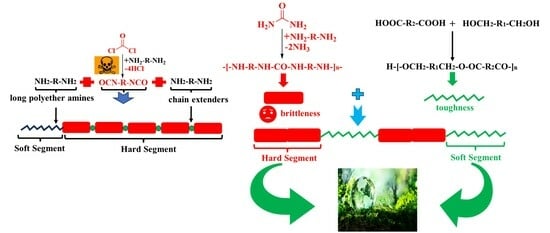
Abstract
Share and Cite
Zheng, L.; Xie, Q.; Hu, G.; Wang, B.; Song, D.; Zhang, Y.; Liu, Y. Synthesis, Structure and Properties of Polyester Polyureas via a Non-Isocyanate Route with Good Combined Properties. Polymers 2024, 16, 993. https://doi.org/10.3390/polym16070993
Zheng L, Xie Q, Hu G, Wang B, Song D, Zhang Y, Liu Y. Synthesis, Structure and Properties of Polyester Polyureas via a Non-Isocyanate Route with Good Combined Properties. Polymers. 2024; 16(7):993. https://doi.org/10.3390/polym16070993
Chicago/Turabian StyleZheng, Liuchun, Qiqi Xie, Guangjun Hu, Bing Wang, Danqing Song, Yunchuan Zhang, and Yi Liu. 2024. "Synthesis, Structure and Properties of Polyester Polyureas via a Non-Isocyanate Route with Good Combined Properties" Polymers 16, no. 7: 993. https://doi.org/10.3390/polym16070993
APA StyleZheng, L., Xie, Q., Hu, G., Wang, B., Song, D., Zhang, Y., & Liu, Y. (2024). Synthesis, Structure and Properties of Polyester Polyureas via a Non-Isocyanate Route with Good Combined Properties. Polymers, 16(7), 993. https://doi.org/10.3390/polym16070993