Review

Grafting Starch with Acrylic Acid and Fenton’s Initiator: The Selectivity Challenge

by
Inge-Willem Noordergraaf
1,*,
Judy R. Witono
2 and
Hero J. Heeres
1
1
Faculty of Science and Engineering, Green Chemical Engineering, Groningen University, Nijenborgh 4, 9747 AG Groningen, The Netherlands
2
Chemical Engineering Department, Parahyangan Catholic University Bandung, Jl. Ciumbuleuit no. 94, Bandung 40164, Indonesia
*
Author to whom correspondence should be addressed.
Polymers 2024, 16(2), 255; https://doi.org/10.3390/polym16020255
Submission received: 30 September 2023 / Revised: 14 December 2023 / Accepted: 22 December 2023 / Published: 16 January 2024
(This article belongs to the Special Issue Modification and Application of Starch-Based Polymers)

Abstract

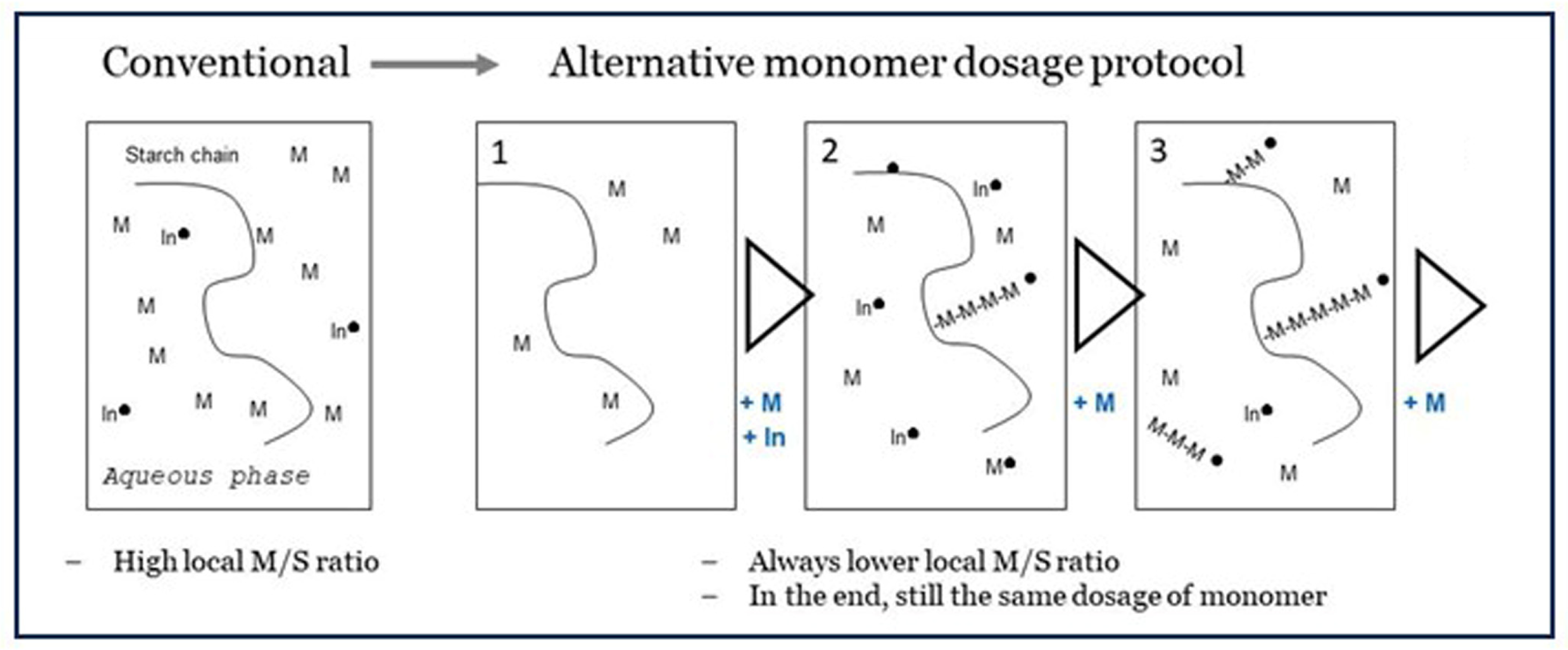
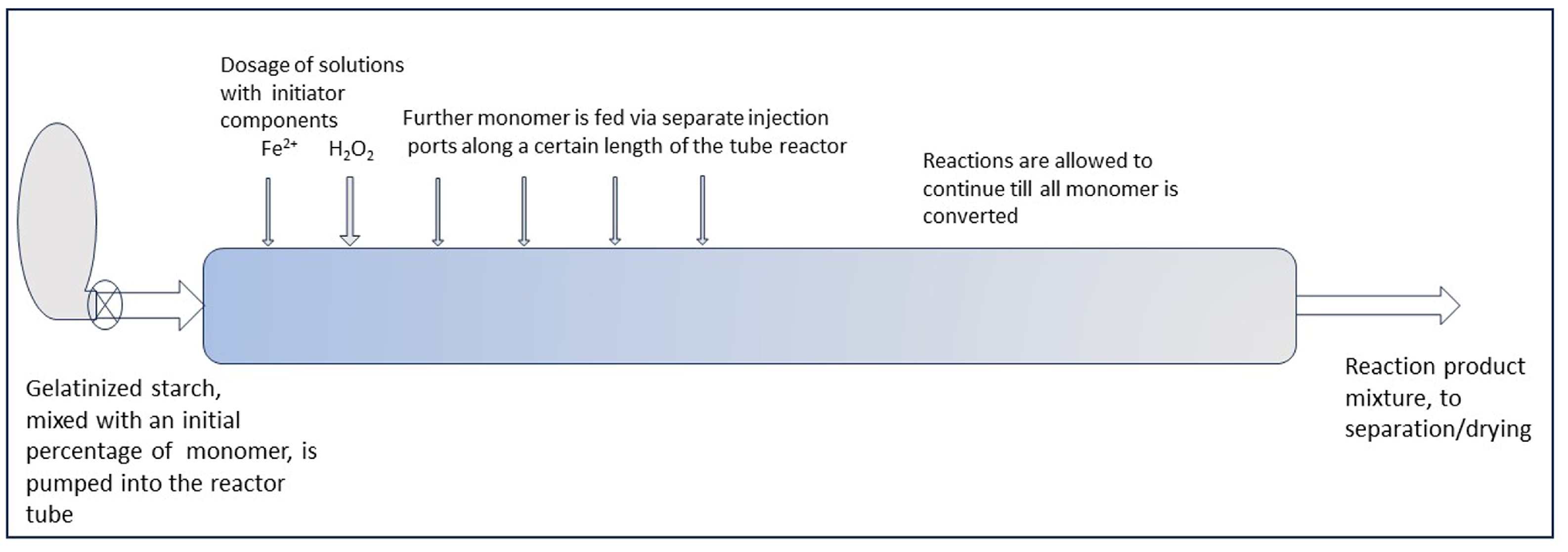
Through the graft polymerization of acrylic monomers onto starch, materials with interesting new properties can be synthesized. Fenton’s chemistry, Fe2+/H2O2, is considered to be attractive for the initiation of graft polymerization with the monomer acrylic acid since it is cheap and reacts quickly at ambient conditions and should therefore be easy to scale up. However, the selectivity of the grafting versus the homopolymerization reaction poses a challenge with this monomer and this type of initiator. In the present review paper, we investigate why data from the literature on grafting systems with other monomers and initiation systems tend to show higher graft selectivity. A scheme is presented, based on reaction engineering principles, that supports an explanation for these observed differences. It is found that more selective activation of starch is a factor, but perhaps even more important is a low monomer-to-starch ratio at the starting sites of graft reactions. Since water is the most common solvent, monomers that are less water-soluble have an advantage in this respect. Based on the proposed scheme, methods to improve the graft selectivity with Fenton’s initiator and acrylic acid are evaluated. Most promising appears to be a method of gradual monomer dosage. With gelatinized cassava starch in a batch reactor, both the grafting percentage (17 => 29%) and graft selectivity (18 => 31%) could be improved. This can be considered a principal breakthrough. Still, more research and development would be needed to refine the method and to implement the idea in a continuous reactor at a larger scale.
Keywords: starch graft copolymerization; acrylic acid monomer; graft selectivity; Fenton’s initiator; graphical representation of different grafting systems; water solubility of the monomer as a key factor; methods to improve selectivity; dedicated monomer dosage starch graft copolymerization; acrylic acid monomer; graft selectivity; Fenton’s initiator; graphical representation of different grafting systems; water solubility of the monomer as a key factor; methods to improve selectivity; dedicated monomer dosage