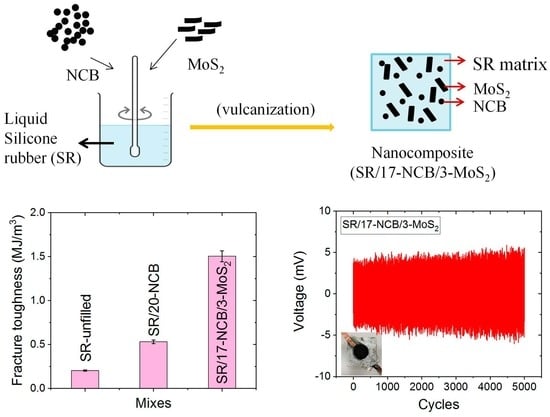
Nanocarbon Black and Molybdenum Disulfide Hybrid Filler System for the Enhancement of Fracture Toughness and Electromechanical Sensing Properties in the Silicone Rubber-Based Energy Harvester



Abstract
Share and Cite
Alam, M.N.; Kumar, V.; Jeong, T.; Park, S.-S. Nanocarbon Black and Molybdenum Disulfide Hybrid Filler System for the Enhancement of Fracture Toughness and Electromechanical Sensing Properties in the Silicone Rubber-Based Energy Harvester. Polymers 2023, 15, 2189. https://doi.org/10.3390/polym15092189
Alam MN, Kumar V, Jeong T, Park S-S. Nanocarbon Black and Molybdenum Disulfide Hybrid Filler System for the Enhancement of Fracture Toughness and Electromechanical Sensing Properties in the Silicone Rubber-Based Energy Harvester. Polymers. 2023; 15(9):2189. https://doi.org/10.3390/polym15092189
Chicago/Turabian StyleAlam, Md Najib, Vineet Kumar, Taemin Jeong, and Sang-Shin Park. 2023. "Nanocarbon Black and Molybdenum Disulfide Hybrid Filler System for the Enhancement of Fracture Toughness and Electromechanical Sensing Properties in the Silicone Rubber-Based Energy Harvester" Polymers 15, no. 9: 2189. https://doi.org/10.3390/polym15092189
APA StyleAlam, M. N., Kumar, V., Jeong, T., & Park, S.-S. (2023). Nanocarbon Black and Molybdenum Disulfide Hybrid Filler System for the Enhancement of Fracture Toughness and Electromechanical Sensing Properties in the Silicone Rubber-Based Energy Harvester. Polymers, 15(9), 2189. https://doi.org/10.3390/polym15092189