


Article

In Vitro Comparison of Surface Roughness, Flexural, and Microtensile Strength of Various Glass-Ionomer-Based Materials and a New Alkasite Restorative Material

1
Department of Restorative Dentistry, University of Cumhuriyet, Sivas 58140, Türkiye
2
Department of Pediatric Dentistry, University of Cumhuriyet, Sivas 58140, Türkiye
3
Department of Pediatric Dentistry, University of Osmangazi, Eskişehir 26040, Türkiye
*
Author to whom correspondence should be addressed.
Polymers 2023, 15(3), 650; https://doi.org/10.3390/polym15030650
Submission received: 8 December 2022 / Revised: 19 January 2023 / Accepted: 23 January 2023 / Published: 27 January 2023
(This article belongs to the Special Issue New Horizons in Nanofillers Based Polymer Composites II)

Abstract

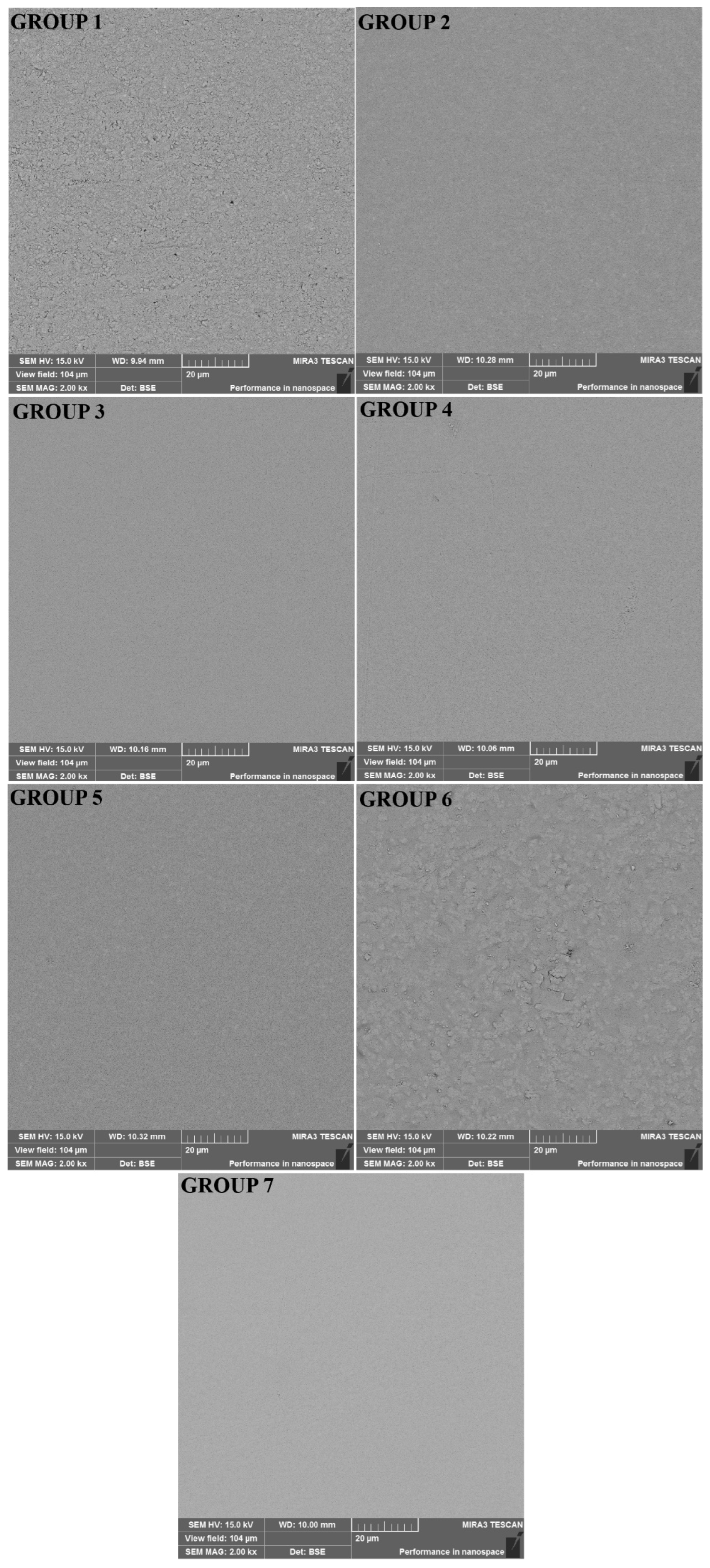
This study aims to evaluate the physical properties of Cention N and various glass-ionomer-based materials in vitro. The groups were obtained as follows: Group 1 (LC-Cent): light-cured Cention N; Group 2 (SC-Cent): self-cured Cention N; Group 3 (COMP): composite (3M Universal Restorative 200); Group 4 (DYRA): compomer (Dyract XP); Group 5 (LINER): Glass Liner; Group 6 (FUJI): FujiII LC Capsule; and Group 7 (NOVA): Nova Glass LC. For the microtensile bond strength (μTBS) test, 21 extracted human molar teeth were used. The enamel of the teeth was removed, and flat dentin surfaces were obtained. Materials were applied up to 3 mm, and sticks were obtained from the teeth. Additionally, specimens were prepared, and their flexural strength and surface roughness (Ra) were evaluated. Herein, data were recorded using SPSS 22.0, and the flexural strength, μTBS, and Ra were statistically analyzed. According to the surface roughness tests, the highest Ra values were observed in Group 6 (FUJI) (0.33 ± 0.1), whereas the lowest Ra values were observed in Group 2 (SC-Cent) (0.17 ± 0.04) (p < 0.05). The flexural strengths of the materials were compared, and the highest value was obtained in Group 2 (SC-Cent) (86.32 ± 15.37), whereas the lowest value was obtained in Group 5 (LINER) (41.75 ± 10.05) (p < 0.05). When the μTBS of materials to teeth was evaluated, the highest μTBS was observed in Group 3 (COMP) (16.50 ± 7.73) and Group 4 (DYRA) (16.36 ± 4.64), whereas the lowest μTBS was found in Group 7 (NOVA) (9.88 ± 1.87) (p < 0.05). According to the μTBS results of materials-to-materials bonding, both Group 2 (SC-Cent) and Group 1 (LC-Cent) made the best bonding with Group 3 (COMP) (p < 0.05). It can be concluded that self-cured Cention N had the highest flexural strength and lowest surface roughness of the seven materials tested. Although the bond strength was statistically lower than conventional composites and compomers, it was similar to resin-modified glass ionomer cements. Additionally, the best material-to-material bonding was found between self-cured Cention N and conventional composites.
Keywords: Cention N; alkasite restorative; self-cured restorative; resin-modified glass ionomer cement; microtensile bond strength Cention N; alkasite restorative; self-cured restorative; resin-modified glass ionomer cement; microtensile bond strength

