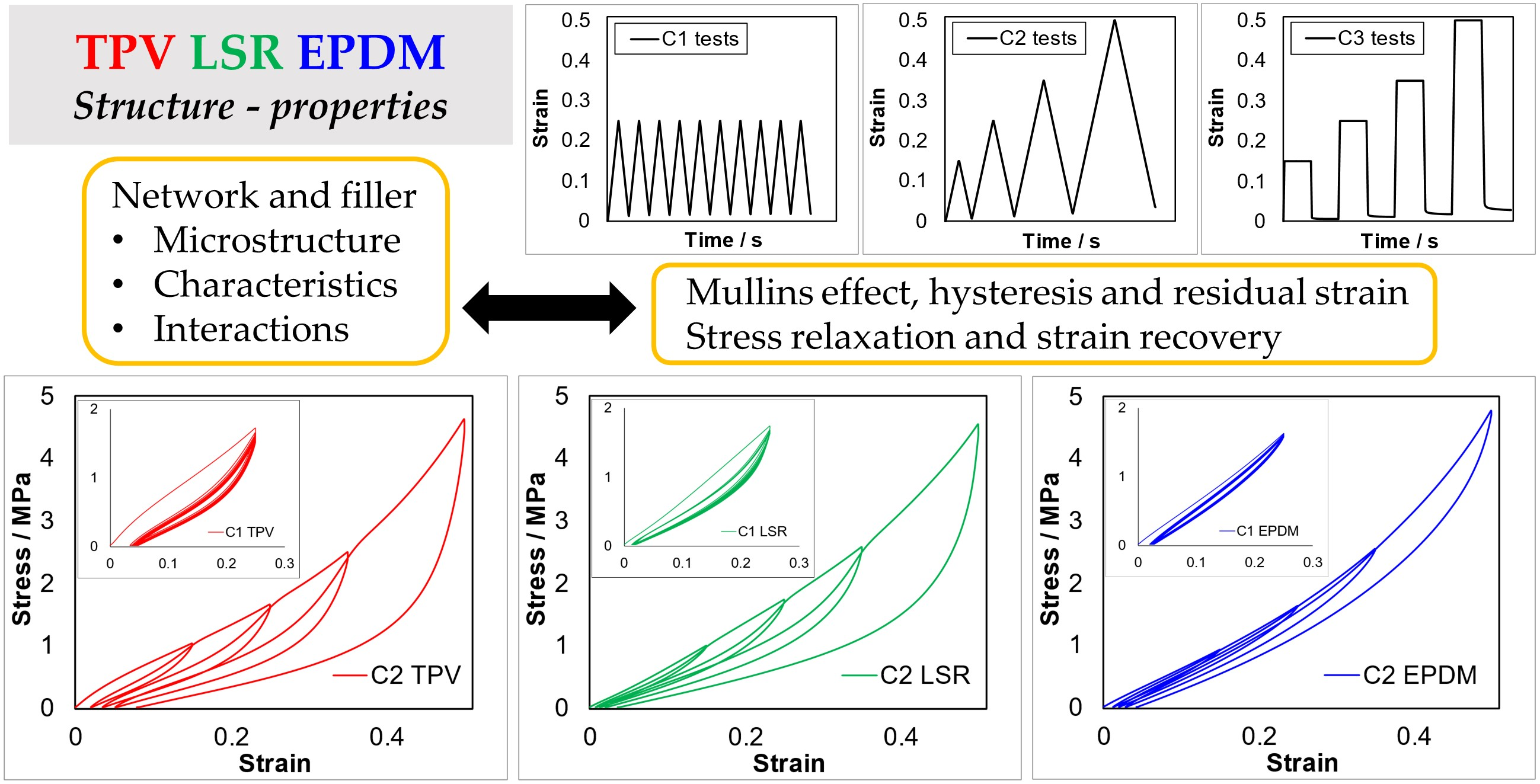
Cyclic Compression Testing of Three Elastomer Types—A Thermoplastic Vulcanizate Elastomer, a Liquid Silicone Rubber and Two Ethylene-Propylene-Diene Rubbers

Abstract
Share and Cite
Persson, A.-M.M.R.; Andreassen, E. Cyclic Compression Testing of Three Elastomer Types—A Thermoplastic Vulcanizate Elastomer, a Liquid Silicone Rubber and Two Ethylene-Propylene-Diene Rubbers. Polymers 2022, 14, 1316. https://doi.org/10.3390/polym14071316
Persson A-MMR, Andreassen E. Cyclic Compression Testing of Three Elastomer Types—A Thermoplastic Vulcanizate Elastomer, a Liquid Silicone Rubber and Two Ethylene-Propylene-Diene Rubbers. Polymers. 2022; 14(7):1316. https://doi.org/10.3390/polym14071316
Chicago/Turabian StylePersson, Anna-Maria Märta Ruth, and Erik Andreassen. 2022. "Cyclic Compression Testing of Three Elastomer Types—A Thermoplastic Vulcanizate Elastomer, a Liquid Silicone Rubber and Two Ethylene-Propylene-Diene Rubbers" Polymers 14, no. 7: 1316. https://doi.org/10.3390/polym14071316
APA StylePersson, A.-M. M. R., & Andreassen, E. (2022). Cyclic Compression Testing of Three Elastomer Types—A Thermoplastic Vulcanizate Elastomer, a Liquid Silicone Rubber and Two Ethylene-Propylene-Diene Rubbers. Polymers, 14(7), 1316. https://doi.org/10.3390/polym14071316