Review

The Frontiers of Functionalized Nanocellulose-Based Composites and Their Application as Chemical Sensors


by
Mohd Nor Faiz Norrrahim
1,*,
Victor Feizal Knight
1,*,
Norizan Mohd Nurazzi
2,3,*,
Mohd Azwan Jenol
4,
Muhammad Syukri Mohamad Misenan
5,
Nurjahirah Janudin
1,
Noor Azilah Mohd Kasim
1,6,
Muhammad Faizan A. Shukor
1,
Rushdan Ahmad Ilyas
7,8,
Muhammad Rizal Muhammad Asyraf
8,9 and
Jesuarockiam Naveen
10
1
Research Centre for Chemical Defence, Universiti Pertahanan Nasional Malaysia, Kem Perdana Sungai Besi, Kuala Lumpur 57000, Malaysia
2
Bioresource Technology Division, School of Industrial Technology, Universiti Sains Malaysia, Penang 11800, Malaysia
3
Green Biopolymer, Coatings & Packaging Cluster, School of Industrial Technology, Universiti Sains Malaysia, Penang 11800, Malaysia
4
Department of Bioprocess Technology, Faculty of Biotechnology and Biomolecular Sciences, Universiti Putra Malaysia, Serdang 43400, Malaysia
5
Department of Chemistry, College of Arts and Science, Yildiz Technical University, Esenler, Istanbul 34220, Turkey
6
Department of Chemistry and Biology, Centre for Defence Foundation Studies, Universiti Pertahanan Nasional Malaysia, Kem Perdana Sungai Besi, Kuala Lumpur 57000, Malaysia
7
School of Chemical and Energy Engineering, Faculty of Engineering, Universiti Teknologi Malaysia, Johor Bahru 81310, Malaysia
8
Centre for Advanced Composite Materials (CACM), Universiti Teknologi Malaysia, Johor Bahru 81310, Malaysia
9
Engineering Design Research Group (EDRG), School of Mechanical Engineering, Faculty of Engineering, Universiti Teknologi Malaysia, Johor Bahru 81310, Malaysia
10
School of Mechanical Engineering, Vellore Institute of Technology, Vellore 632014, India
*
Authors to whom correspondence should be addressed.
Polymers 2022, 14(20), 4461; https://doi.org/10.3390/polym14204461
Submission received: 26 August 2022 / Revised: 30 September 2022 / Accepted: 2 October 2022 / Published: 21 October 2022

Abstract

Chemical sensors are a rapidly developing technology that has received much attention in diverse industries such as military, medicine, environmental surveillance, automotive power and mobility, food manufacturing, infrastructure construction, product packaging and many more. The mass production of low-cost devices and components for use as chemical sensors is a major driving force for improvements in each of these industries. Recently, studies have found that using renewable and eco-friendly materials would be advantageous for both manufacturers and consumers. Thus, nanotechnology has led to the investigation of nanocellulose, an emerging and desirable bio-material for use as a chemical sensor. The inherent properties of nanocellulose, its high tensile strength, large specific surface area and good porous structure have many advantages in its use as a composite material for chemical sensors, intended to decrease response time by minimizing barriers to mass transport between an analyte and the immobilized indicator in the sensor. Besides which, the piezoelectric effect from aligned fibers in nanocellulose composites is beneficial for application in chemical sensors. Therefore, this review presents a discussion on recent progress and achievements made in the area of nanocellulose composites for chemical sensing applications. Important aspects regarding the preparation of nanocellulose composites using different functionalization with other compounds are also critically discussed in this review.
Keywords: nanocellulose; composites; chemical sensors; functionalization nanocellulose; composites; chemical sensors; functionalization
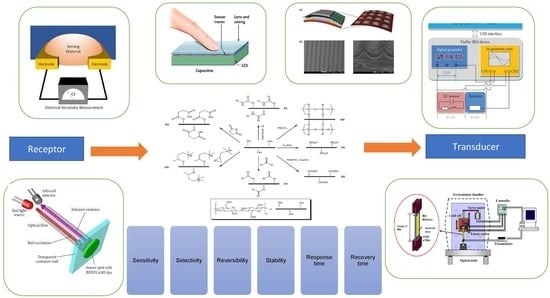
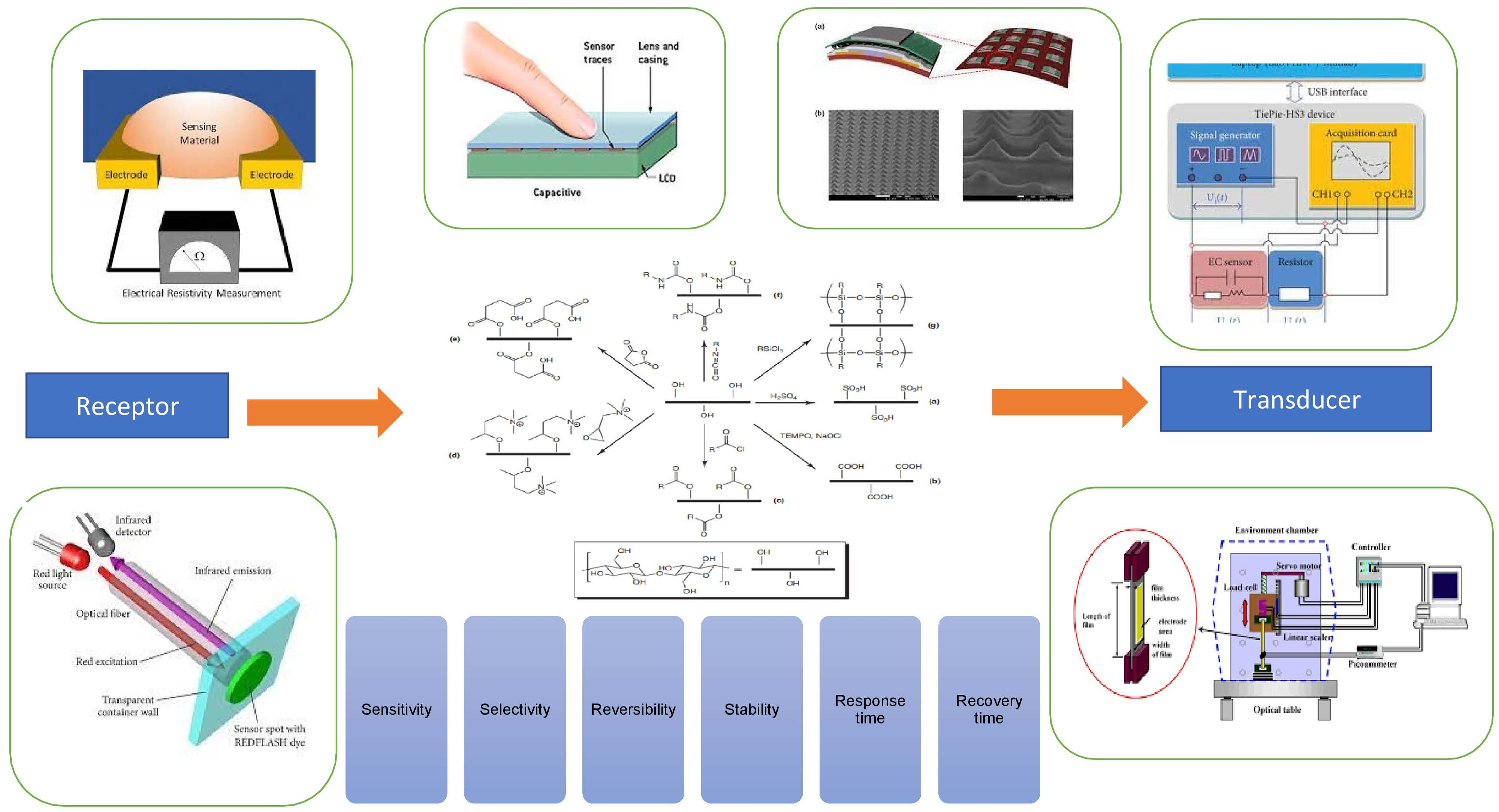
Graphical Abstract