Article

Experimental and Numerical Analyses on the Buckling Characteristics of Woven Flax/Epoxy Laminated Composite Plate under Axial Compression
by
Venkatachalam Gopalan
1,
Vimalanand Suthenthiraveerappa
2,
Jefferson Stanley David
3,
Jeyanthi Subramanian
4,
A. Raja Annamalai
5 and
Chun-Ping Jen
6,*
1
Centre for Innovation and Product Development, Vellore Institute Technology, Chennai 600127, Tamilnadu, India
2
Department of Mechanical Engineering, Karpagam College of Engineering, Coimbatore 614032, Tamilnadu, India
3
School of Mechanical Engineering, Vellore Institute Technology, Vellore 632014, Tamilnadu, India
4
School of Mechanical Engineering, Vellore Institute Technology, Chennai 600127, Tamilnadu, India
5
Centre for Innovative Manufacturing Research, Vellore Institute Technology, Vellore 632014, Tamilnadu, India
6
Department of Mechanical Engineering and Advanced Institute of Manufacturing for High-Tech Innovations, National Chung Cheng University, Chia-Yi 62102, Taiwan
*
Author to whom correspondence should be addressed.
Polymers 2021, 13(7), 995; https://doi.org/10.3390/polym13070995
Submission received: 6 March 2021 / Revised: 18 March 2021 / Accepted: 22 March 2021 / Published: 24 March 2021
(This article belongs to the Special Issue Polymer Composite Analysis and Characterization)

Abstract

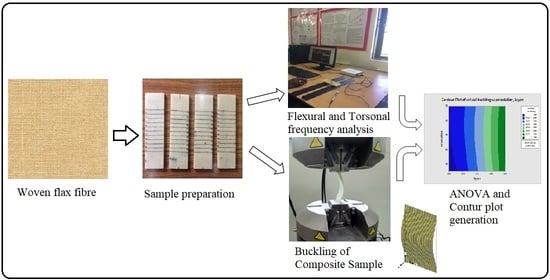
The evolution of a sustainable green composite in various loadbearing structural applications tends to reduce pollution, which in turn enhances environmental sustainability. This work is an attempt to promote a sustainable green composite in buckling loadbearing structural applications. In order to use the green composite in various structural applications, the knowledge on its structural stability is a must. As the structural instability leads to the buckling of the composite structure when it is under an axial compressive load, the work on its buckling characteristics is important. In this work, the buckling characteristics of a woven flax/bio epoxy (WFBE) laminated composite plate are investigated experimentally and numerically when subjected to an axial compressive load. In order to accomplish the optimization study on the buckling characteristics of the composite plate among various structural criterions such as number of layers, the width of the plate and the ply orientation, the optimization tool “response surface methodology” (RSM) is used in this work. The validation of the developed finite element model in Analysis System (ANSYS) version 16 is carried out by comparing the critical buckling loads obtained from the experimental test and numerical simulation for three out of twenty samples. A comparison is then made between the numerical results obtained through ANSYS16 and the results generated using the regression equation. It is concluded that the buckling strength of the composite escalates with the number of layers, the change in width and the ply orientation. It is also noted that the weaving model of the fabric powers the buckling behavior of the composite. This work explores the feasibility of the use of the developed green composite in various buckling loadbearing structural applications. Due to the compromised buckling characteristics of the green composite with the synthetic composite, it has the capability of replacing many synthetic composites, which in turn enhances the sustainability of the environment.
Keywords: green composite; environmental sustainability; buckling; response surface methodology; elastic constants; finite element method green composite; environmental sustainability; buckling; response surface methodology; elastic constants; finite element method
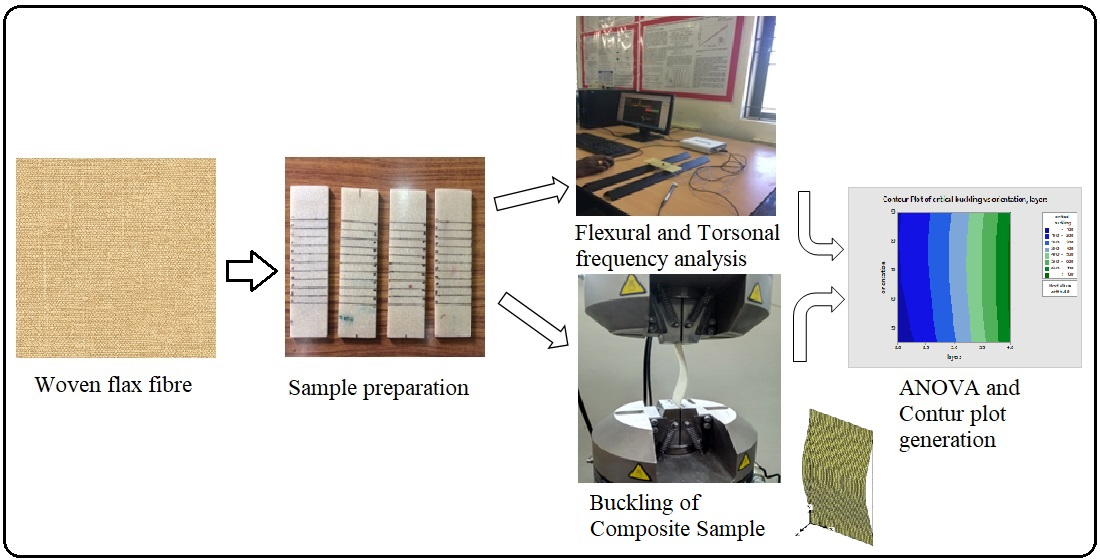
Graphical Abstract