Article

Steroid Eluting Esophageal-Targeted Drug Delivery Devices for Treatment of Eosinophilic Esophagitis

by
Alka Prasher
1,2,
Roopali Shrivastava
1,2,
Denali Dahl
1,2,
Preetika Sharma-Huynh
3,
Panita Maturavongsadit
1,2,
Tiffany Pridgen
4,
Allison Schorzman
5,6,7,8,
William Zamboni
5,6,7,8,
Jisun Ban
5,6,7,8,
Anthony Blikslager
4,
Evan S. Dellon
9 and
Soumya Rahima Benhabbour
1,3,*
1
Department of Biomedical Engineering, UNC Chapel Hill & North Carolina State University, Chapel Hill, NC 27599-3290, USA
2
Department of Chemistry, University of North Carolina at Chapel Hill, Chapel Hill, NC 27599-3290, USA
3
Division of Pharmacoengineering and Molecular Pharmaceutics, UNC Eshelman School of Pharmacy, University of North Carolina at Chapel Hill, Chapel Hill, NC 27599-3290, USA
4
Department of Clinical Sciences, College of Veterinary Medicine, North Carolina State University, Raleigh, NC 27606, USA
5
Division of Pharmacotherapy and Experimental Therapeutics, UNC Eshelman School of Pharmacy, University of North Carolina, Chapel Hill, NC 27599-3290, USA
6
UNC Lineberger Comprehensive Cancer Center, Chapel Hill, NC 27599-3290, USA
7
Carolina Institute for Nanomedicine, Chapel Hill, NC 27599-3290, USA
8
UNC Advanced Translational Pharmacology and Analytical Chemistry Lab, Chapel Hill, NC 27599-3290, USA
9
Division of Gastroenterology and Hepatology, UNC School of Medicine, University of North Carolina, Chapel Hill, NC 27599-3290, USA
*
Author to whom correspondence should be addressed.
Polymers 2021, 13(4), 557; https://doi.org/10.3390/polym13040557
Submission received: 25 January 2021 / Revised: 6 February 2021 / Accepted: 8 February 2021 / Published: 13 February 2021
(This article belongs to the Special Issue Advances in Biocompatible and Biodegradable Polymers)

Abstract

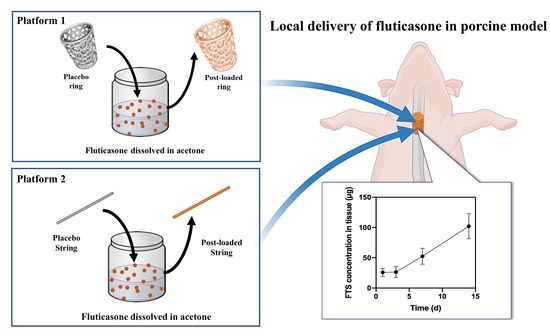
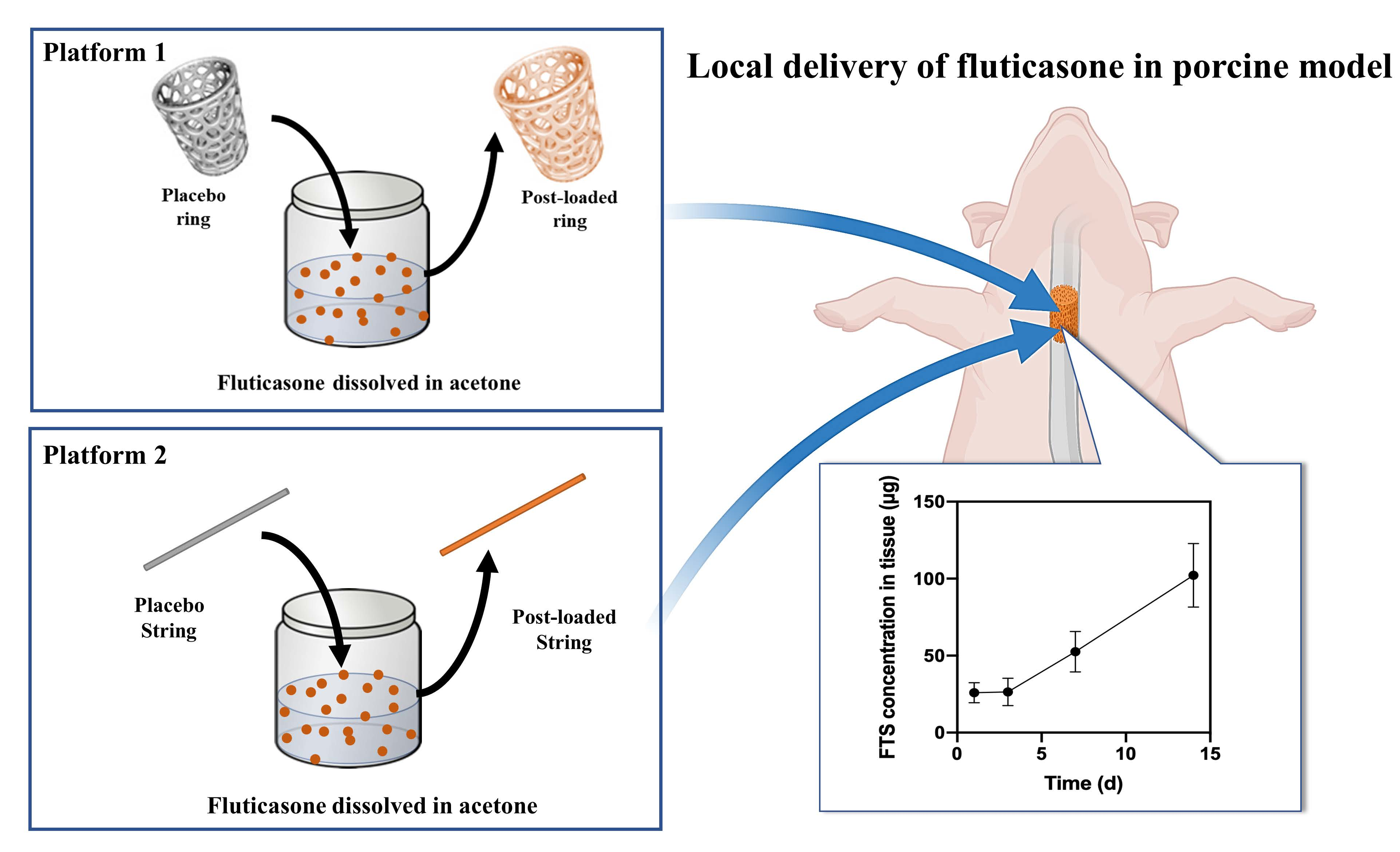
Eosinophilic esophagitis (EoE) is a chronic atopic disease that has become increasingly prevalent over the past 20 years. A first-line pharmacologic option is topical/swallowed corticosteroids, but these are adapted from asthma preparations such as fluticasone from an inhaler and yield suboptimal response rates. There are no FDA-approved medications for the treatment of EoE, and esophageal-specific drug formulations are lacking. We report the development of two novel esophageal-specific drug delivery platforms. The first is a fluticasone-eluting string that could be swallowed similar to the string test “entero-test” and used for overnight treatment, allowing for a rapid release along the entire length of esophagus. In vitro drug release studies showed a target release of 1 mg/day of fluticasone. In vivo pharmacokinetic studies were carried out after deploying the string in a porcine model, and our results showed a high local level of fluticasone in esophageal tissue persisting over 1 and 3 days, and a minimal systemic absorption in plasma. The second device is a fluticasone-eluting 3D printed ring for local and sustained release of fluticasone in the esophagus. We designed and fabricated biocompatible fluticasone-loaded rings using a top-down, Digital Light Processing (DLP) Gizmo 3D printer. We explored various strategies of drug loading into 3D printed rings, involving incorporation of drug during the print process (pre-loading) or after printing (post-loading). In vitro drug release studies of fluticasone-loaded rings (pre and post-loaded) showed that fluticasone elutes at a constant rate over a period of one month. Ex vivo pharmacokinetic studies in the porcine model also showed high tissue levels of fluticasone and both rings and strings were successfully deployed into the porcine esophagus in vivo. Given these preliminary proof-of-concept data, these devices now merit study in animal models of disease and ultimately subsequent translation to testing in humans.
Keywords: eosinophilic esophagitis (EoE), esophageal drug delivery systems; drug-eluting string; 3D printing; photopolymerizable resins; Drug loading strategies; steroids; fluticasone eosinophilic esophagitis (EoE), esophageal drug delivery systems; drug-eluting string; 3D printing; photopolymerizable resins; Drug loading strategies; steroids; fluticasone
Graphical Abstract