Phase Transition and Melt-Recrystallization Behavior of Poly(Butylene Adipate) Investigated by Simultaneous Measurements of Wide-Angle X-Ray Diffraction (WAXD) and Differential Scanning Calorimetry (DSC)

Abstract
:
1. Introduction
2. Experimental Section
2.1. Materials and Sample Preparation
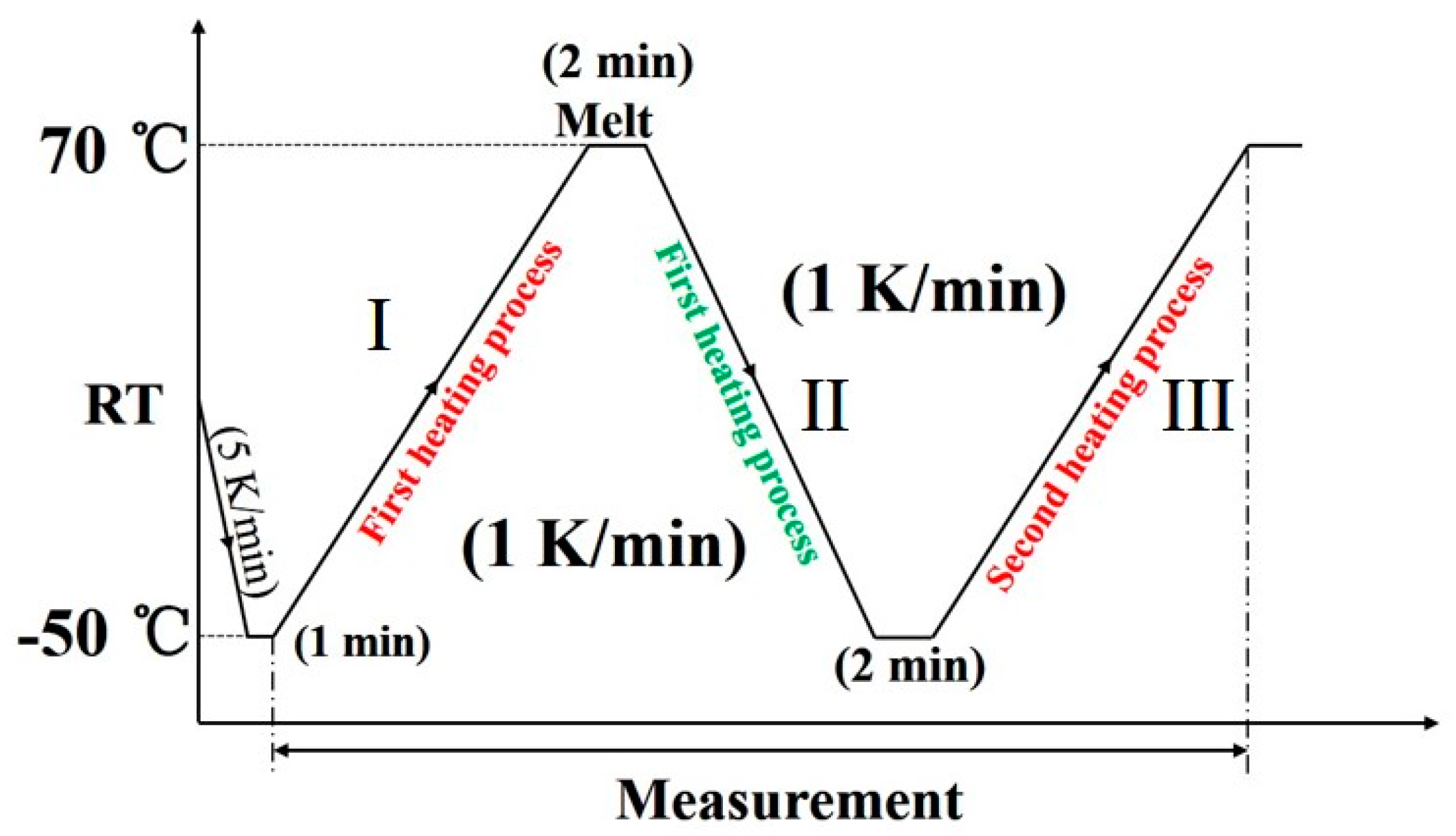
2.2. WAXD-DSC Simultaneous Measurements
3. Results and Discussion
3.1. Melting and the β-to-αH Phase Transition of PBA during the First Heating
3.2. Different Crystallization Pathways of αH and α Phase
4. Conclusions
Supplementary Materials
Author Contributions
Acknowledgments
Conflicts of Interest
References
- Vroman, I.; Tighzert, L. Biodegradable polymers. Materials 2009, 2, 307–344. [Google Scholar] [CrossRef]
- Takiyama, E.; Fujimaki, T. “bionolle” biodegradable plastic through chemical synthesis. Stud. Polym. Sci. 1994, 12, 150–174. [Google Scholar]
- Nikolic, M.S.; Djonlagic, J. Synthesis and characterization of biodegradable poly (butylene succinate-co-butylene adipate)s. Polym. Degrad. Stab. 2001, 74, 263–270. [Google Scholar] [CrossRef]
- Lindström, A.; Hakkarainen, M. Environmentally friendly plasticizers for poly (vinyl chloride)—Improved mechanical properties and compatibility by using branched poly (butylene adipate) as a polymeric plasticizer. J. Appl. Polym. Sci. 2006, 100, 2180–2188. [Google Scholar] [CrossRef]
- Tserki, V.; Matzinos, P.; Pavlidou, E.; Panayiotou, C. Biodegradable aliphatic polyesters. Part II. Synthesis and characterization of chain extended poly (butylene succinate-co-butylene adipate). Polym. Degrad. Stab. 2006, 91, 377–384. [Google Scholar] [CrossRef]
- Ren, J.; Fu, H.; Ren, T.; Yuan, W. Preparation, characterization and properties of binary and ternary blends with thermoplastic starch, poly (lactic acid) and poly (butylene adipate-co-terephthalate). Carbohydr. Polym. 2009, 77, 576–582. [Google Scholar] [CrossRef]
- Anthierens, T.; Billiet, L.; Devlieghere, F.; Du Prez, F. Poly (butylene adipate) functionalized with quaternary phosphonium groups as potential antimicrobial packaging material. Innov. Food Sci. Emerg. 2012, 15, 81–85. [Google Scholar] [CrossRef]
- Tang, Y.; Xu, J.; Guo, B. Polymorphic behavior and enzymatic degradation of poly (butylene adipate) in the presence of hexagonal boron nitride nanosheets. Ind. Eng. Chem. Res. 2015, 54, 1832–1841. [Google Scholar] [CrossRef]
- Göpferich, A. Mechanisms of polymer degradation and erosion. Biomaterials 1996, 17, 103–114. [Google Scholar] [CrossRef]
- Iwata, T. Crystal structure and biodegradation of aliphatic polyester crystals. Macromol. Chem. Phys. 1999, 200, 2429–2442. [Google Scholar] [CrossRef]
- Zhao, L.; Wang, X.; Li, L.; Gan, Z. Structural analysis of poly (butylene adipate) banded spherulites from their biodegradation behavior. Polymer 2007, 48, 6152–6161. [Google Scholar] [CrossRef]
- Fuller, C.S.; Frosch, C.J. X-ray investigation of the decamethylene series of polyesters. J. Am. Chem. Soc. 1939, 61, 2575–2580. [Google Scholar] [CrossRef]
- Fuller, C.S. The Investigation of Synthetic Linear Polymers by X-rays. Chem. Rev. 1940, 26, 143–167. [Google Scholar] [CrossRef]
- Minke, R.; Blackwell, J. Polymorphic structures of poly (tetramethylene adipate). J. Macromol. Sci. Part B Phys. 1979, 16, 407–417. [Google Scholar] [CrossRef]
- Minke, R.; Blackwell, J. Single crystals of poly (tetramethylene adipate). J. Macromol. Sci. Part B Phys. 1980, 18, 233–255. [Google Scholar] [CrossRef]
- Gan, Z.; Kuwabara, K.; Abe, H.; Iwata, T.; Doi, Y. The role of polymorphic crystal structure and morphology in enzymatic degradation of melt-crystallized poly (butylene adipate) films. Polym. Degrad. Stab. 2005, 87, 191–199. [Google Scholar] [CrossRef]
- Gan, Z.; Abe, H. Temperature-Induced Polymorphic Crystals of Poly (butylene adipate). Macromol. Chem. Phys. 2002, 203, 2369–2374. [Google Scholar] [CrossRef]
- Wang, M.; Vantasin, S.; Wang, J.; Sato, H.; Zhang, J.; Ozaki, Y. Distribution of Polymorphic Crystals in the Ring-Banded Spherulites of Poly(butylene adipate) Studied Using High-Resolution Raman Imaging. Macromolecules 2017, 50, 3377–3387. [Google Scholar] [CrossRef]
- Kai, W.; Zhu, B.; He, Y.; Inoue, Y. Crystallization of poly (butylene adipate) in the presence of nucleating agents. J. Polym. Sci. Part B Polym. Phys. 2005, 43, 2340–2351. [Google Scholar] [CrossRef]
- Gan, Z.; Kuwabara, K.; Abe, H.; Iwata, T.; Doi, Y. Metastability and transformation of polymorphic crystals in biodegradable poly (butylene adipate). Biomacromolecules 2004, 5, 371–378. [Google Scholar] [CrossRef]
- Wang, M.; Tashiro, K.; Ozaki, Y. Reinvestigation of the β-to-α Crystal Phase Transition of Poly(butylene adipate) by the Time-Resolved X-ray Scattering and FTIR Spectral Measurements in the Temperature-Jump Process. Macromolecules 2017, 50, 3883–3889. [Google Scholar] [CrossRef]
- Woo, E.M.; Yen, K.C.; Wu, M.C. Analysis of multiple melting behavior of spherulites comprising ring-band shell/ringless core in polymorphic poly (butylene adipate). J. Polym. Sci. Part B Polym. Phys. 2008, 46, 892–899. [Google Scholar] [CrossRef]
- Yang, J.; Li, Z.; Pan, P.; Zhu, B.; Dong, T.; Inoue, Y. Temperature-dependent polymorphic crystalline structure and melting behavior of poly (butylene adipate) investigated by time-resolved FTIR spectroscopy. J. Polym. Sci. Part B Polym. Phys. 2009, 47, 1997–2007. [Google Scholar] [CrossRef]
- Sun, X.; Liu, J.; Takahashi, I.; Yan, S. Melting and β to α transition behavior of β-PBA and the β-PBA/PVPh blend investigated by synchrotron SAXS and WAXD. RSC Adv. 2014, 4, 39101–39109. [Google Scholar] [CrossRef]
- Li, Q.; Zhou, J.; Chai, L.; Memon, J.; Ren, Z.; Li, H.X.; Yan, S. The effect of the poly (vinyl phenol) sublayer on the melting behavior of poly (butylene adipate) crystals. Polym. Chem. 2014, 5, 4293–4303. [Google Scholar] [CrossRef]
- Woo, E.M.; Wu, M.C. Thermal and X-ray analysis of polymorphic crystals, melting, and crystalline transformation in poly (butylene adipate). J. Polym. Sci. Part B Polym. Phys. 2005, 43, 1662–1672. [Google Scholar] [CrossRef]
- Sun, X.; Pi, F.; Zhang, J.; Takahashi, I.; Wang, F.; Yan, S.; Ozaki, Y. Study on the Phase Transition Behavior of Poly (butylene adipate) in its Blends with Poly (vinyl phenol). J. Phys. Chem. B 2011, 115, 1950–1957. [Google Scholar] [CrossRef]
- Sun, Y.; Li, H.; Huang, Y.; Chen, E.; Zhao, L.; Gan, Z.; Yan, S. Epitaxial Crystallization of Poly(butylene adipate) on Highly Oriented Polyethylene Thin Film. Macromolecules 2005, 38, 2739–2743. [Google Scholar] [CrossRef]
- Sato, H.; Nakamura, M.; Padermshoke, A.; Yamaguchi, H.; Terauchi, H.; Ekgasit, S.; Noda, I.; Ozaki, Y. Thermal behavior and molecular interaction of poly (3-hydroxybutyrate-co-3-hydroxyhexanoate) studied by wide-angle X-ray diffraction. Macromolecules 2004, 37, 3763–3769. [Google Scholar] [CrossRef]
- Sato, H.; Mori, K.; Murakami, R.; Ando, Y.; Takahashi, I.; Zhang, J.; Terauchi, H.; Hirose, F.; Senda, K.; Tashiro, K.; et al. Crystal and Lamella Structure and C−H···O=C Hydrogen Bonding of Poly(3-hydroxyalkanoate) Studied by X-ray Diffraction and Infrared Spectroscopy. Macromolecules 2006, 39, 1525–1531. [Google Scholar] [CrossRef]
- Sato, H.; Murakami, R.; Padermshoke, A.; Hirose, F.; Senda, K.; Noda, I.; Ozaki, Y. Infrared Spectroscopy Studies of CH···O Hydrogen Bondings and Thermal Behavior of Biodegradable Poly (hydroxyalkanoate). Macromolecules 2004, 37, 7203–7213. [Google Scholar] [CrossRef]
- Sato, H.; Padermshoke, A.; Nakamura, M.; Murakami, R.; Hirose, F.; Senda, K.; Terauchi, H.; Ekgasit, S.; Noda, I.; Ozaki, Y. Infrared Spectroscopy and X-ray Diffraction Studies on the Structure and Thermal Behavior of Biodegradable Polyhydroxyalkanoates. Macromol. Symp. 2005, 220, 123–138. [Google Scholar] [CrossRef]
- Sato, H.; Ando, Y.; Dybal, J.; Iwata, T.; Noda, I.; Ozaki, Y. Crystal Structures, Thermal Behaviors, and C−H···O═C Hydrogen Bondings of Poly(3-hydroxyvalerate) and Poly(3-hydroxybutyrate) Studied by Infrared Spectroscopy and X-ray Diffraction. Macromolecules 2008, 41, 4305–4312. [Google Scholar] [CrossRef]
- Guo, L.; Spegazzini, N.; Sato, H.; Hashimoto, T.; Masunaga, H.; Sasaki, S.; Takata, M.; Ozaki, Y. Multistep Crystallization Process Involving Sequential Formations of Density Fluctuations, “Intermediate Structures”, and Lamellar Crystallites: Poly(3-hydroxybutyrate) As Investigated by Time-Resolved Synchrotron SAXS and WAXD. Macromolecules 2012, 45, 313–328. [Google Scholar] [CrossRef]
- Scherrer, P. Bestimmung der Grosse und der inneren Struktur von Kolloidteilchen mittels Rontgenstrahlen (1918) in: X-ray Diffraction Methods in Polymer Science; Alexander, L.E., Ed.; Wiley-Interscience: New York, NY, USA, 1969. [Google Scholar]
- Crist, B. SAXS studies of polymer melting: Models for surface melting, sequential melting, and stack melting. Macromolecules 2003, 36, 4880–4890. [Google Scholar] [CrossRef]
- Liu, J.; Ye, H.; Xu, J.; Guo, B. Formation of ring-banded spherulites of α and β modifications in Poly (butylene adipate). Polymer 2011, 52, 4619–4630. [Google Scholar] [CrossRef]


© 2020 by the authors. Licensee MDPI, Basel, Switzerland. This article is an open access article distributed under the terms and conditions of the Creative Commons Attribution (CC BY) license (http://creativecommons.org/licenses/by/4.0/).
Share and Cite
Wang, M.; Cao, W. Phase Transition and Melt-Recrystallization Behavior of Poly(Butylene Adipate) Investigated by Simultaneous Measurements of Wide-Angle X-Ray Diffraction (WAXD) and Differential Scanning Calorimetry (DSC). Polymers 2020, 12, 75. https://doi.org/10.3390/polym12010075
Wang M, Cao W. Phase Transition and Melt-Recrystallization Behavior of Poly(Butylene Adipate) Investigated by Simultaneous Measurements of Wide-Angle X-Ray Diffraction (WAXD) and Differential Scanning Calorimetry (DSC). Polymers. 2020; 12(1):75. https://doi.org/10.3390/polym12010075
Chicago/Turabian StyleWang, Mengfan, and Weiyu Cao. 2020. "Phase Transition and Melt-Recrystallization Behavior of Poly(Butylene Adipate) Investigated by Simultaneous Measurements of Wide-Angle X-Ray Diffraction (WAXD) and Differential Scanning Calorimetry (DSC)" Polymers 12, no. 1: 75. https://doi.org/10.3390/polym12010075
APA StyleWang, M., & Cao, W. (2020). Phase Transition and Melt-Recrystallization Behavior of Poly(Butylene Adipate) Investigated by Simultaneous Measurements of Wide-Angle X-Ray Diffraction (WAXD) and Differential Scanning Calorimetry (DSC). Polymers, 12(1), 75. https://doi.org/10.3390/polym12010075