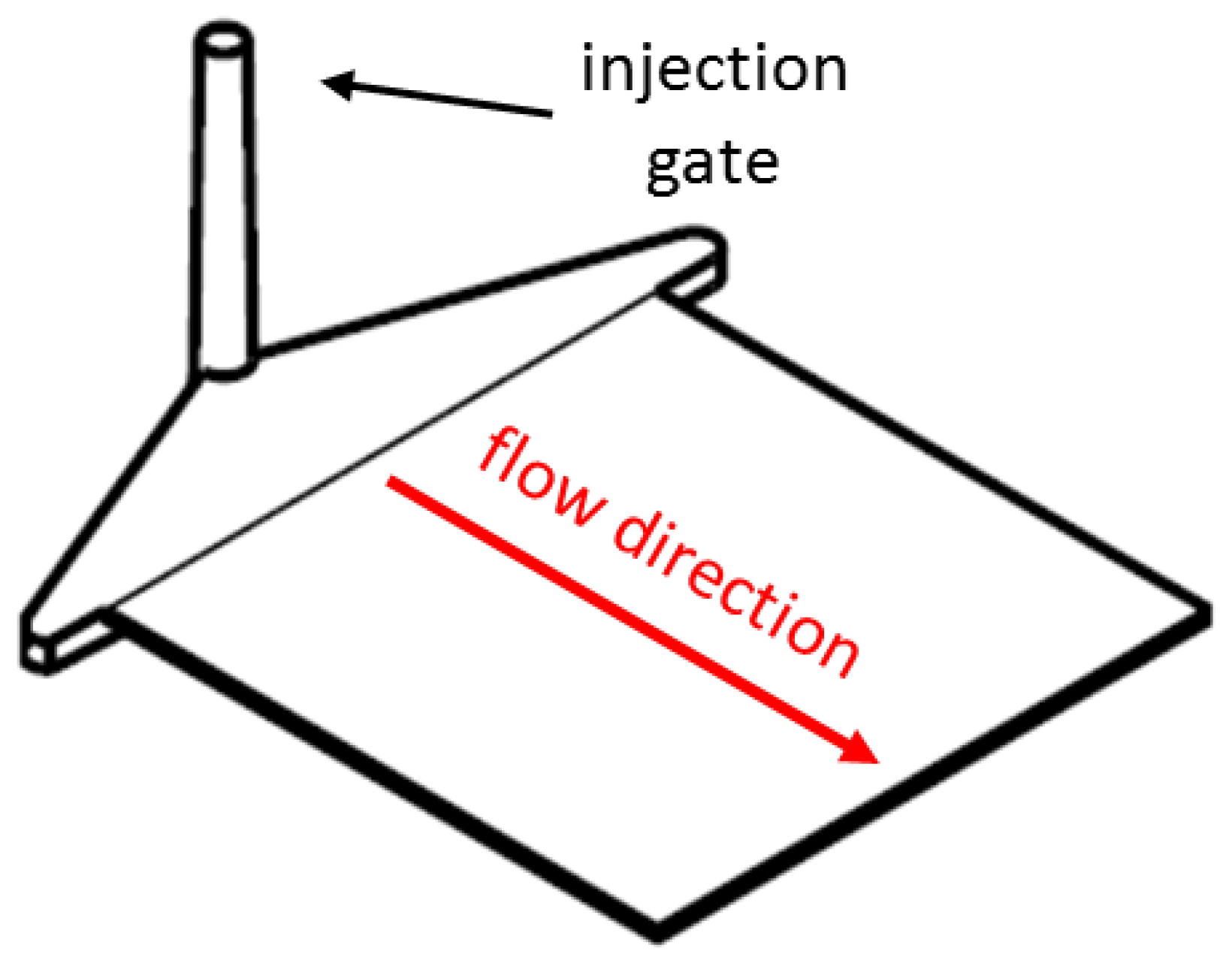
Figure 1.
Schematic representation of a sample obtained by injection molding (70 × 70 × 1 mm).
Figure 1.
Schematic representation of a sample obtained by injection molding (70 × 70 × 1 mm).
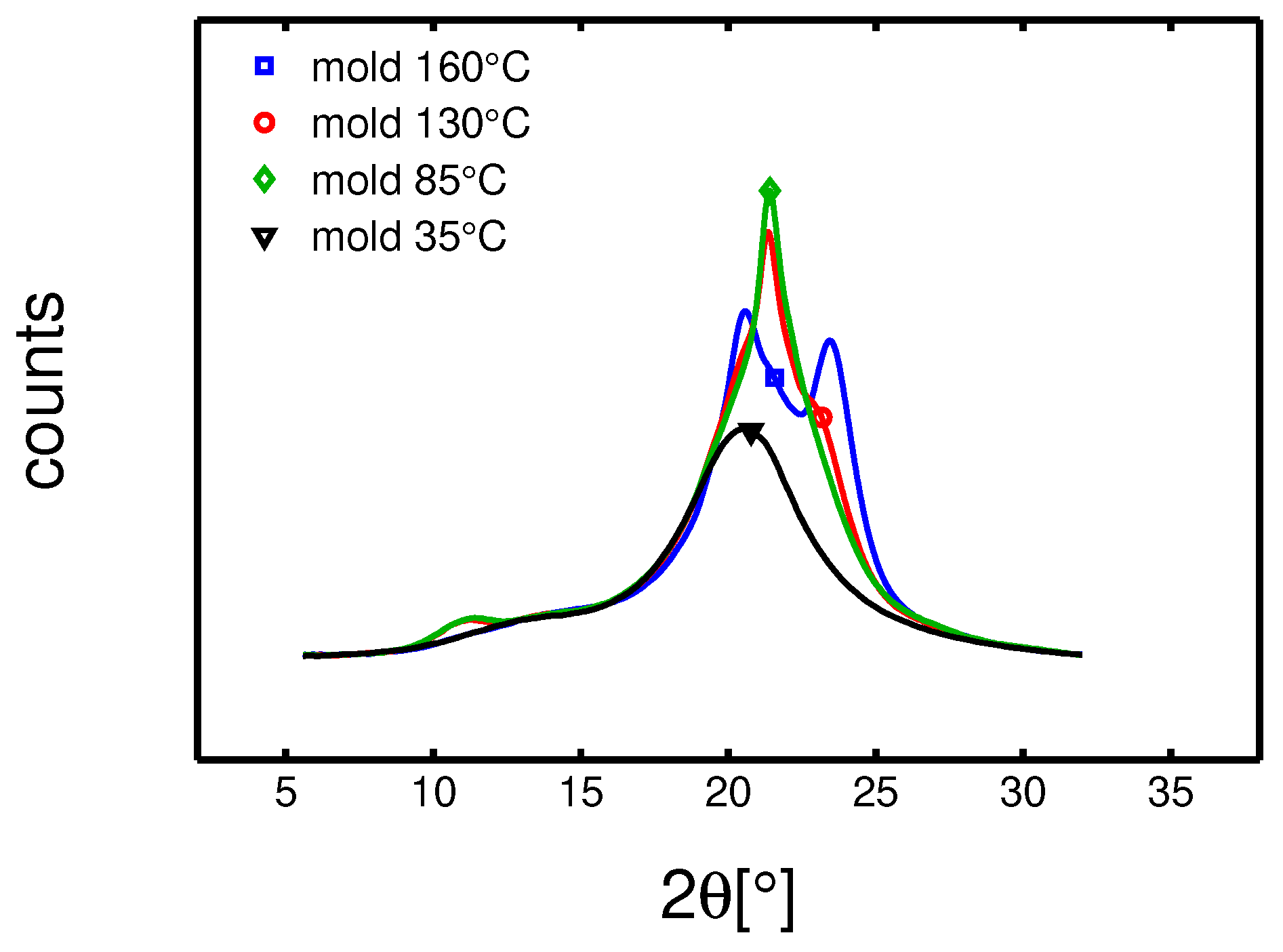
Figure 2.
WAXD integrated patterns of samples molded at different temperatures; experiments performed at room temperature (23 C) and dry condition.
Figure 2.
WAXD integrated patterns of samples molded at different temperatures; experiments performed at room temperature (23 C) and dry condition.
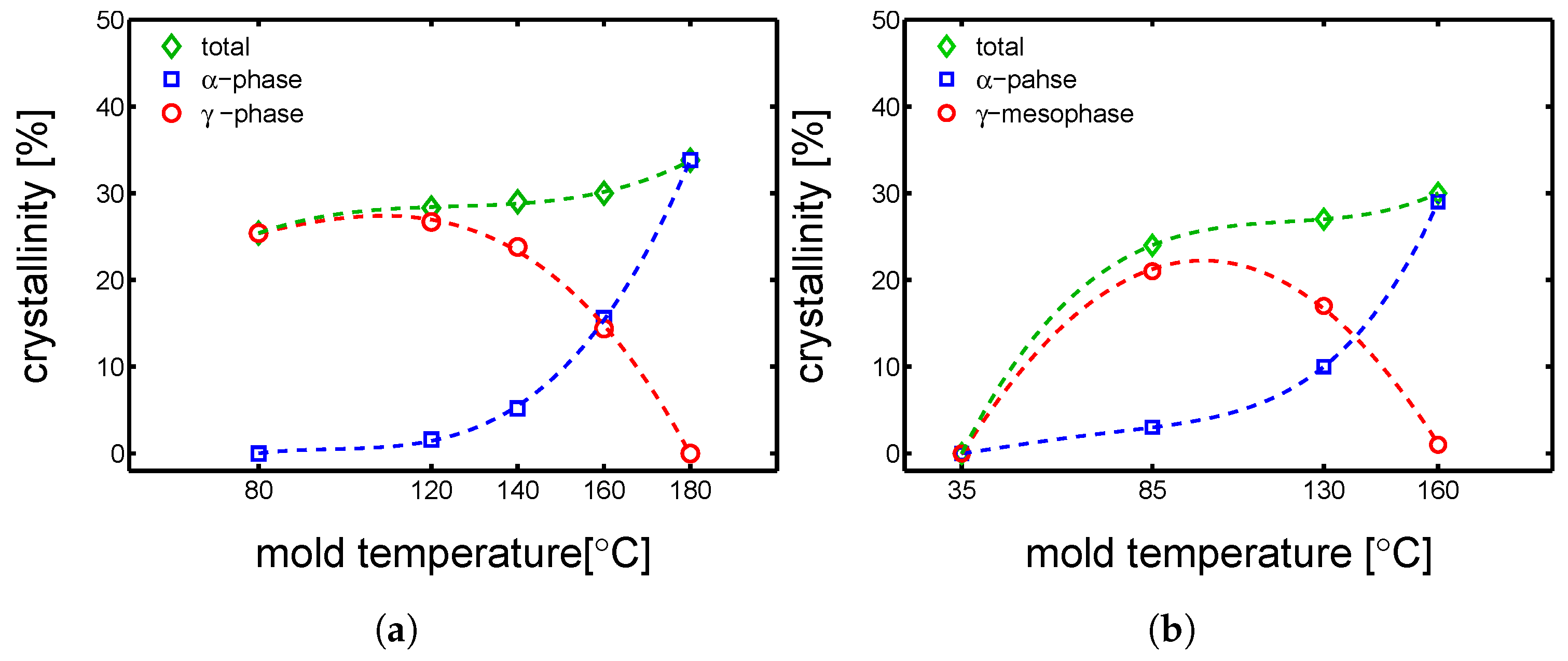
Figure 3.
Deconvolution analysis of WAXD patterns. Crystallinity, and fractions as functions of mold temperature. (a) Case: compression molding, (b) case: injection molding.
Figure 3.
Deconvolution analysis of WAXD patterns. Crystallinity, and fractions as functions of mold temperature. (a) Case: compression molding, (b) case: injection molding.
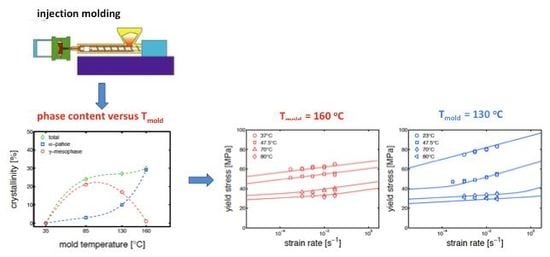
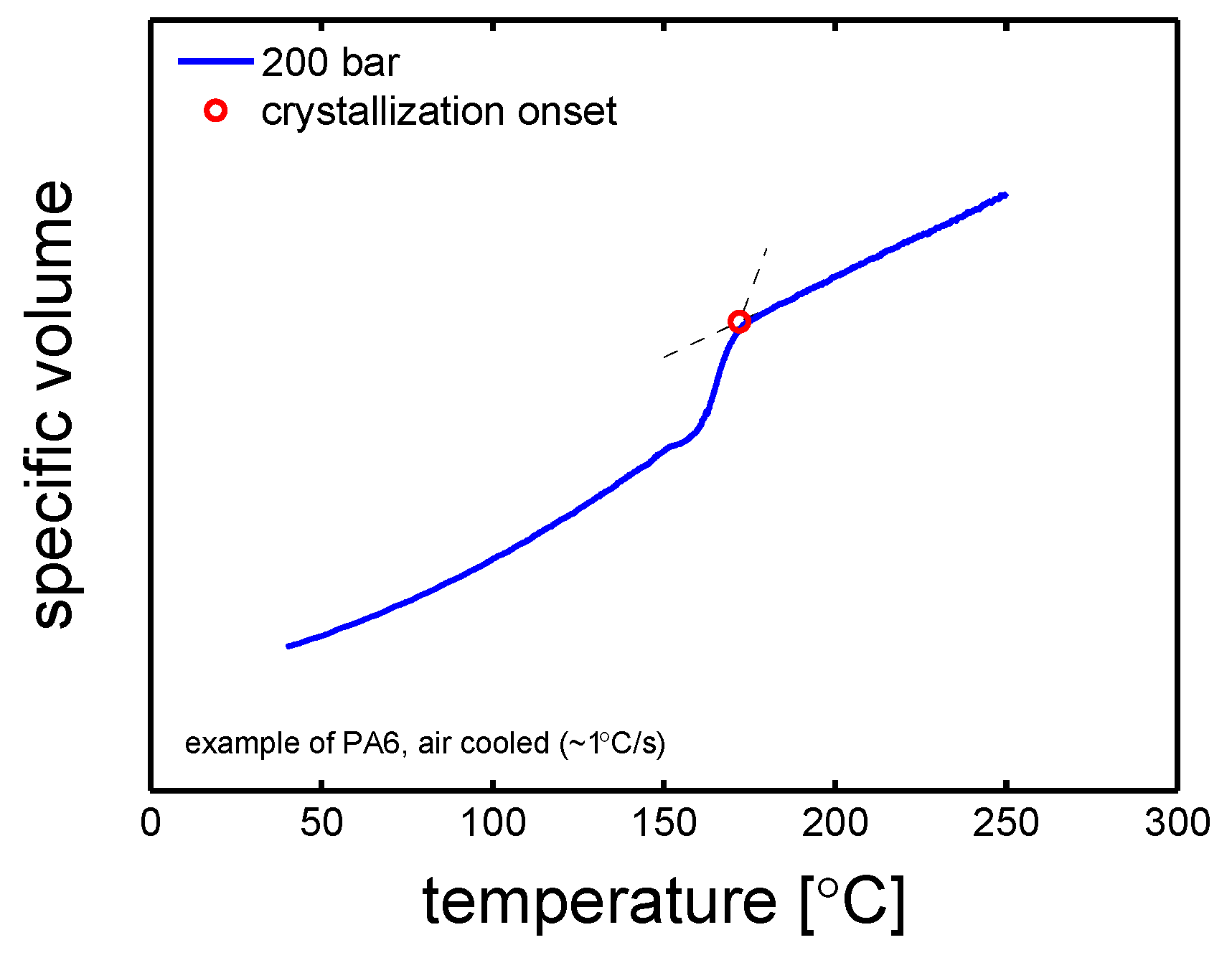
Figure 4.
Dilatometry-PVT experiment, cooling at ≈1 C/s and 200 bar with no shear flow. The circle indicates the crystallization onset temperature.
Figure 4.
Dilatometry-PVT experiment, cooling at ≈1 C/s and 200 bar with no shear flow. The circle indicates the crystallization onset temperature.
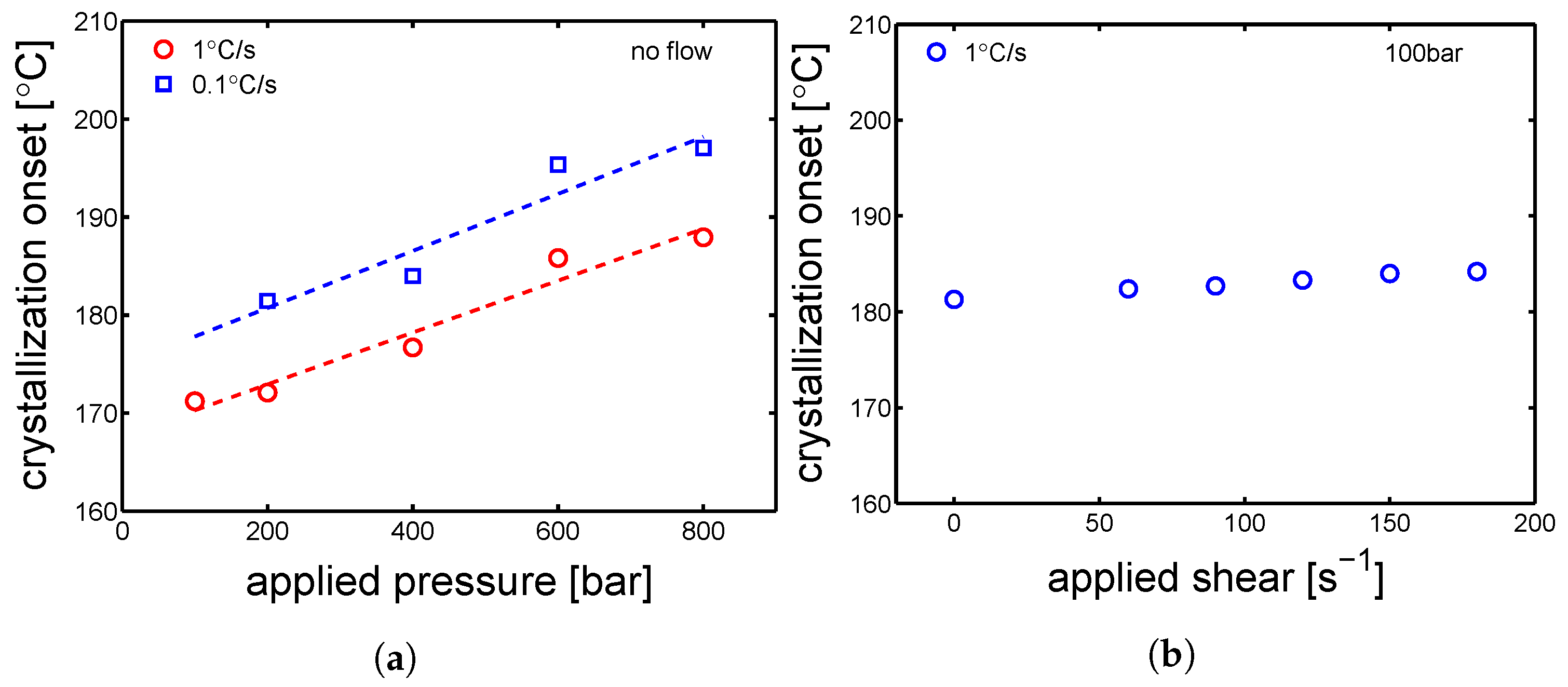
Figure 5.
(a). Crystallization onset temperature obtained by cooling upon different pressures and cooling rates. Lines are just guides to the eye. (b) Crystallization onset temperature obtained by cooling upon different shear flow rates and 100 bar.
Figure 5.
(a). Crystallization onset temperature obtained by cooling upon different pressures and cooling rates. Lines are just guides to the eye. (b) Crystallization onset temperature obtained by cooling upon different shear flow rates and 100 bar.
Figure 6.
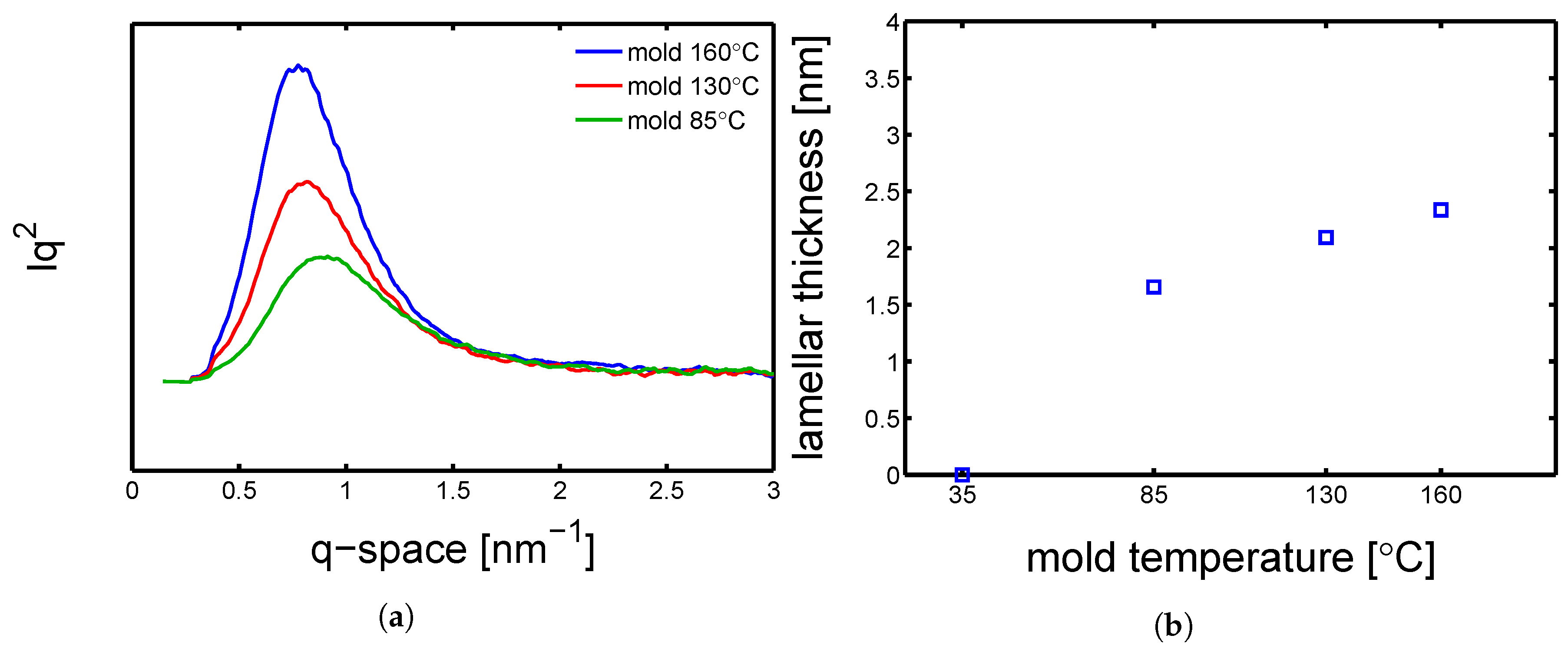
(a) SAXS integrated patterns of samples molded at different temperatures; experiments performed at room temperature (23 C) and dry condition. (b) Lamellar thickness as a function of mold temperature; experiments performed at room temperature (23 C) and dry condition.
Figure 6.
(a) SAXS integrated patterns of samples molded at different temperatures; experiments performed at room temperature (23 C) and dry condition. (b) Lamellar thickness as a function of mold temperature; experiments performed at room temperature (23 C) and dry condition.
Figure 7.
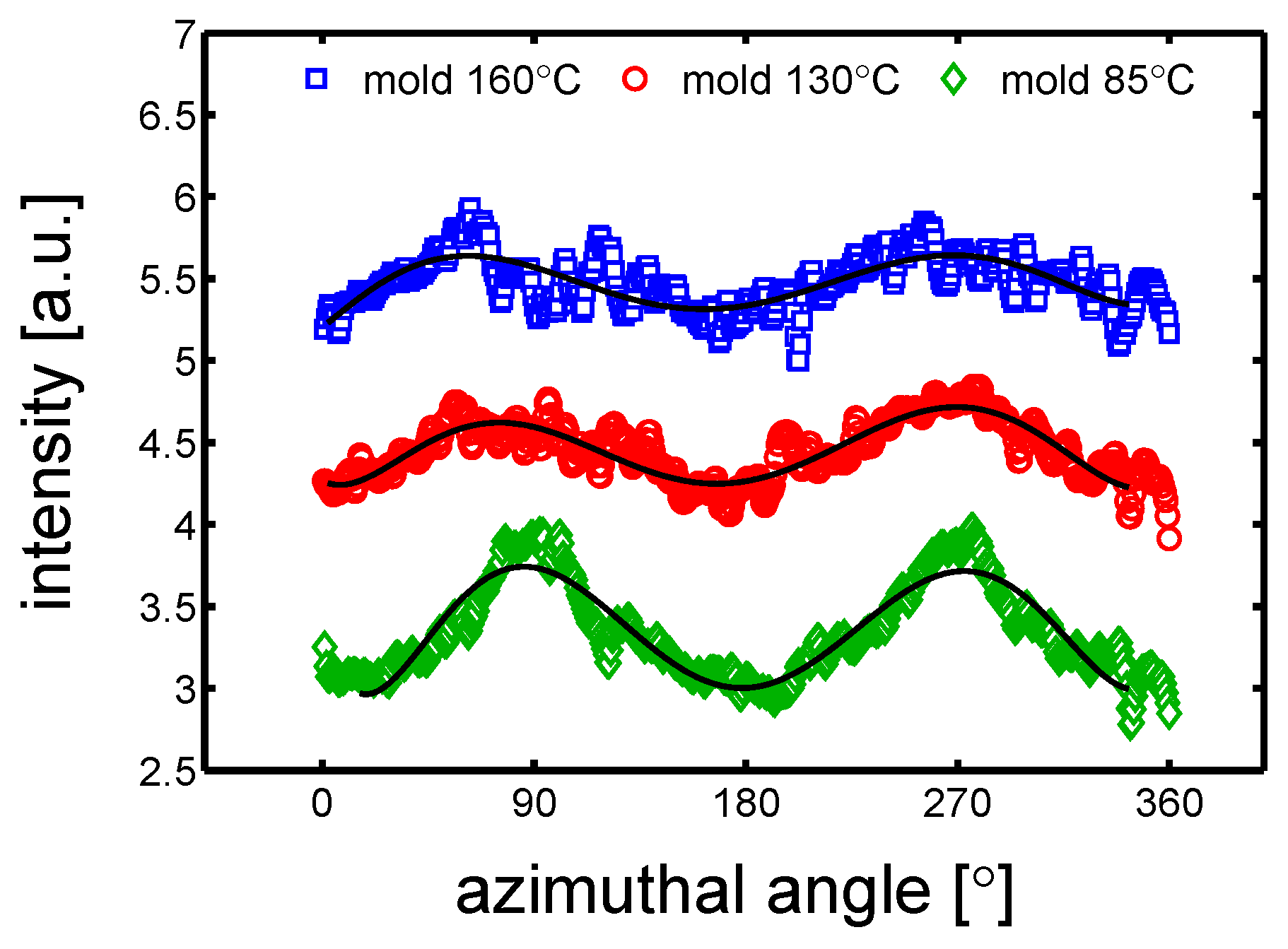
Azimuthal integration over a range from 0° to 180° of samples at dry conditions and room temperature. The solid lines are guide to the eye.
Figure 7.
Azimuthal integration over a range from 0° to 180° of samples at dry conditions and room temperature. The solid lines are guide to the eye.
Figure 8.
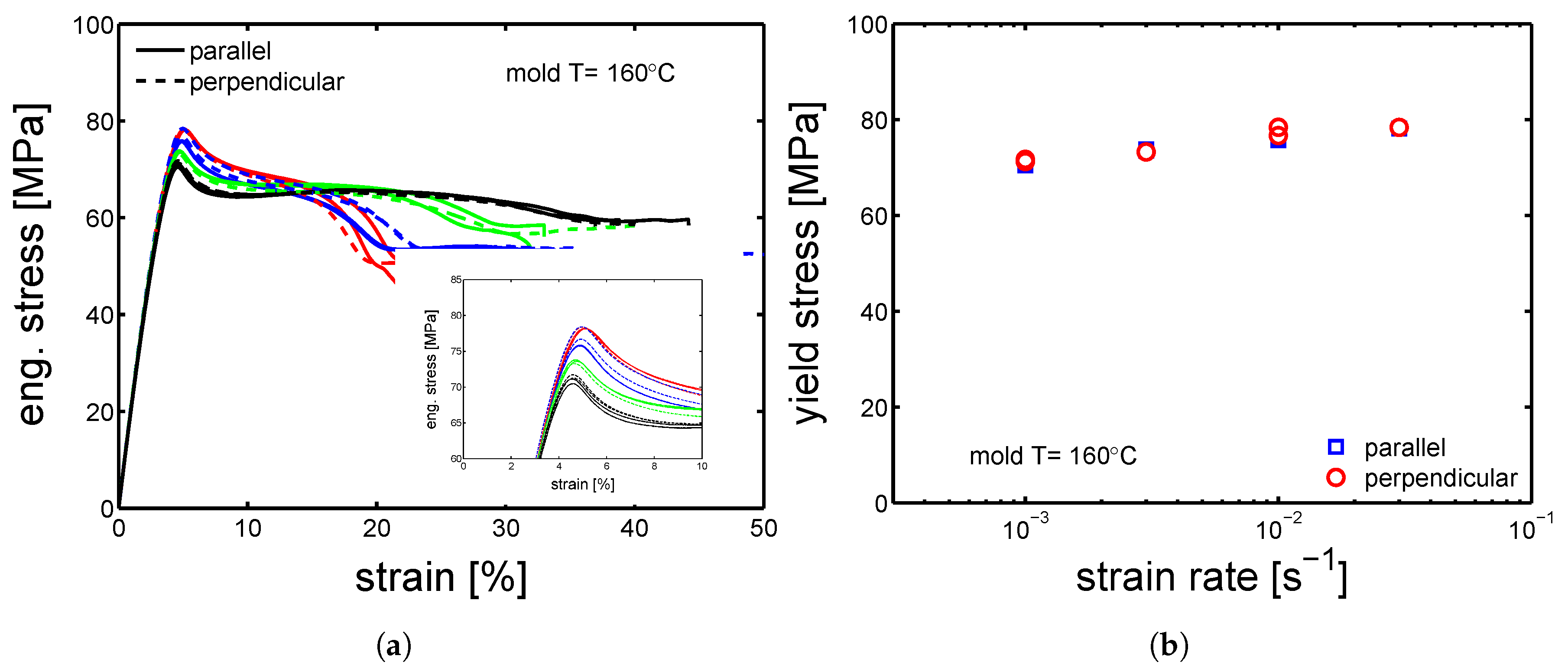
(a) Tensile tests at strain rate from s to s at 23 C; comparison between samples cut in parallel (solid lines) and perpendicular (dashed lines) direction compare to the flow. (b) Yield stress as a function of strain rate. Samples molded at 160 C.
Figure 8.
(a) Tensile tests at strain rate from s to s at 23 C; comparison between samples cut in parallel (solid lines) and perpendicular (dashed lines) direction compare to the flow. (b) Yield stress as a function of strain rate. Samples molded at 160 C.
Figure 9.
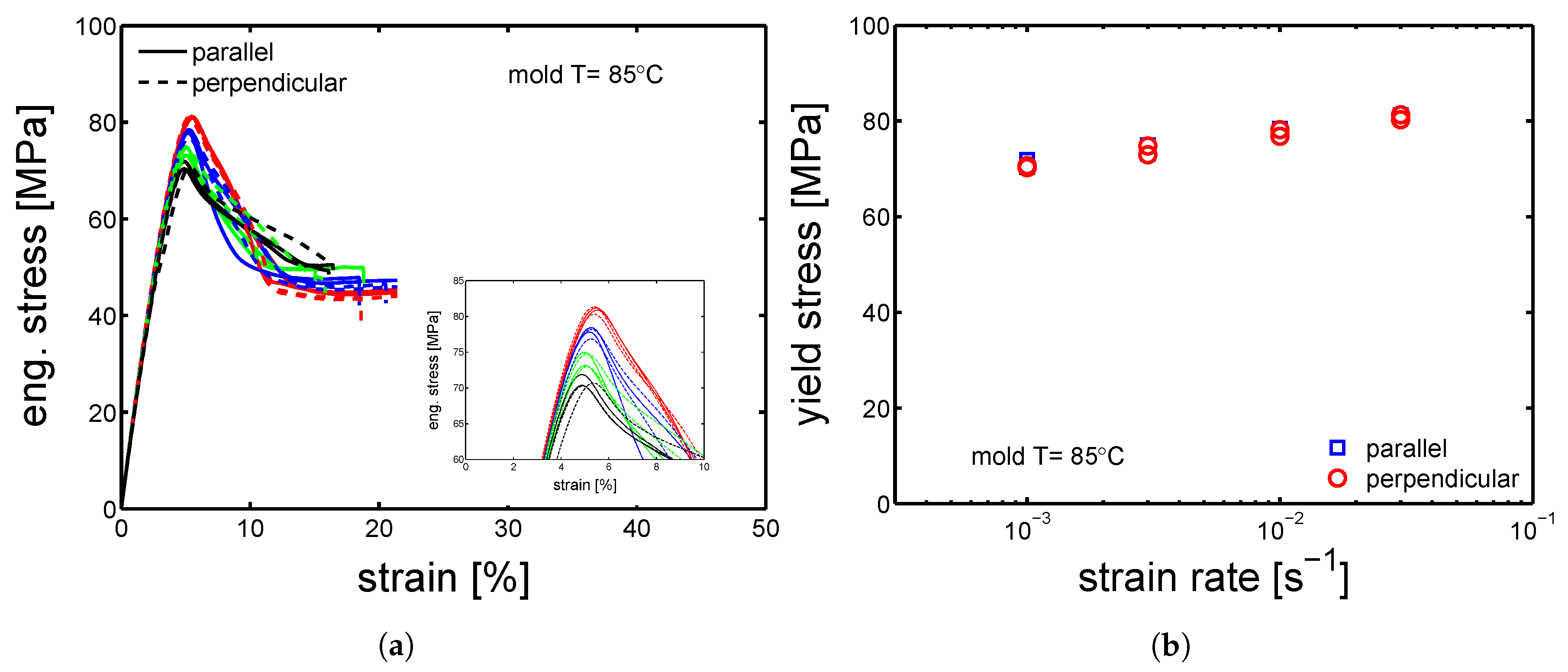
(a) Tensile tests at strain rate from s to s and 23 C; comparison between samples cut in parallel (solid lines) and perpendicular (dashed lines) direction compare to the flow. (b) Yield stress as a function of strain rate. Samples molded at 85 C.
Figure 9.
(a) Tensile tests at strain rate from s to s and 23 C; comparison between samples cut in parallel (solid lines) and perpendicular (dashed lines) direction compare to the flow. (b) Yield stress as a function of strain rate. Samples molded at 85 C.
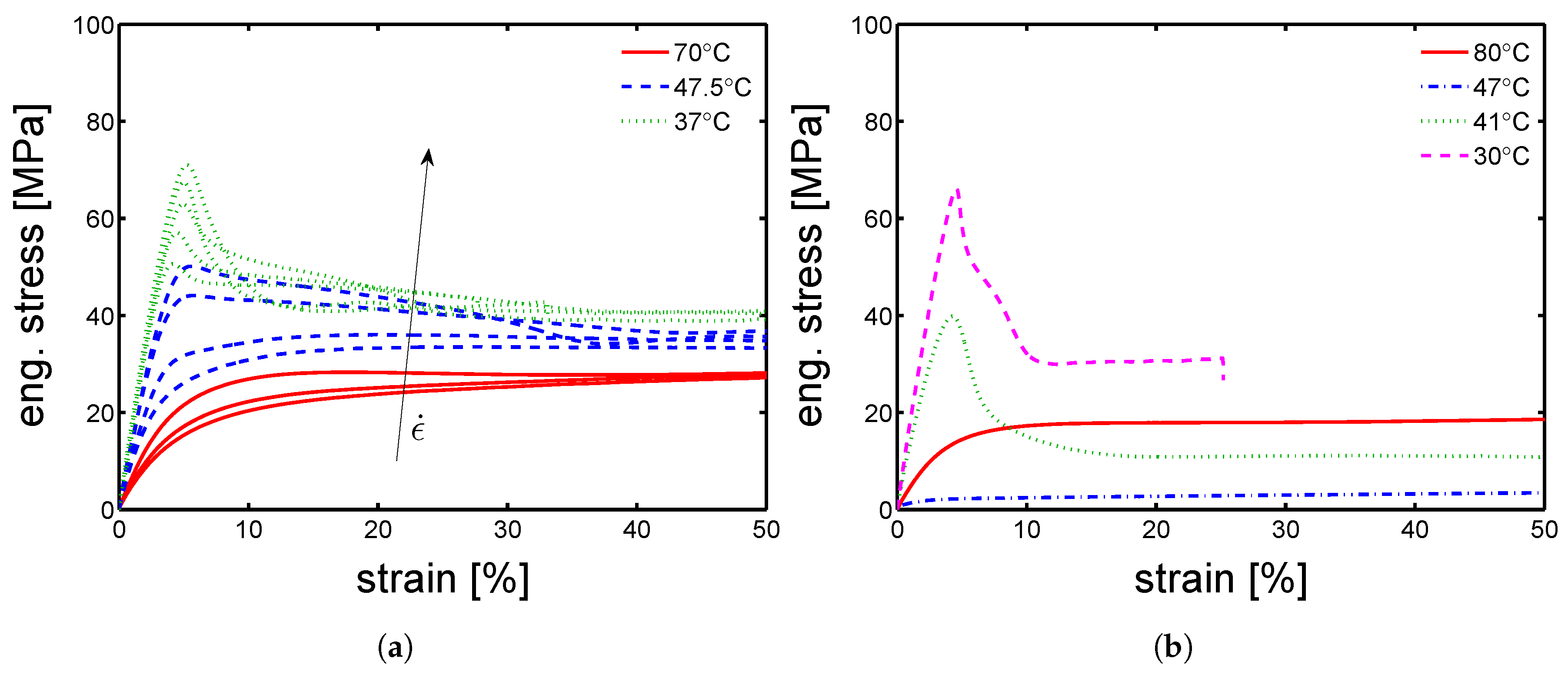
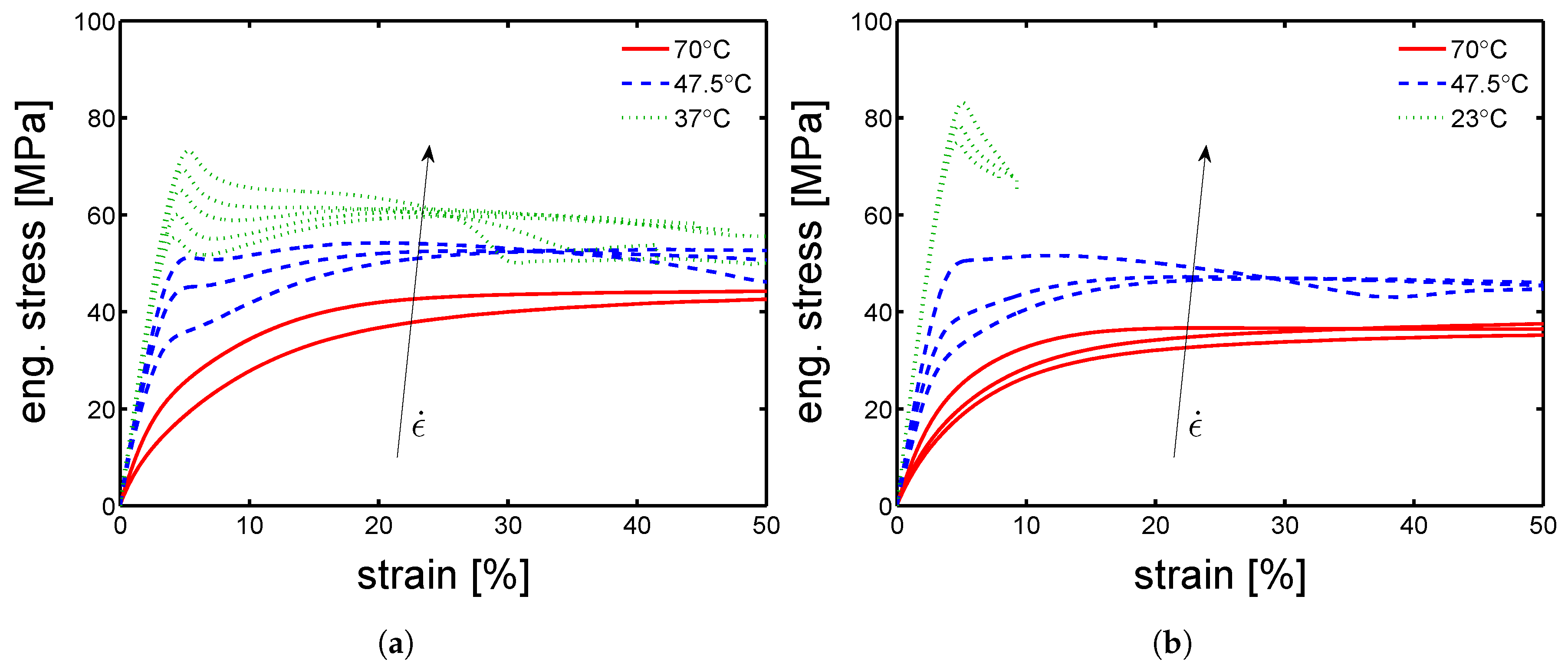
Figure 10.
Stress-strain response at different temperatures and strain rates of samples molded at (a) 160 C and (b) 130 C.
Figure 10.
Stress-strain response at different temperatures and strain rates of samples molded at (a) 160 C and (b) 130 C.
Figure 11.
Stress-strain response at different temperatures and strain rates of samples molded at (a) 85 C and (b) 35 C.
Figure 11.
Stress-strain response at different temperatures and strain rates of samples molded at (a) 85 C and (b) 35 C.
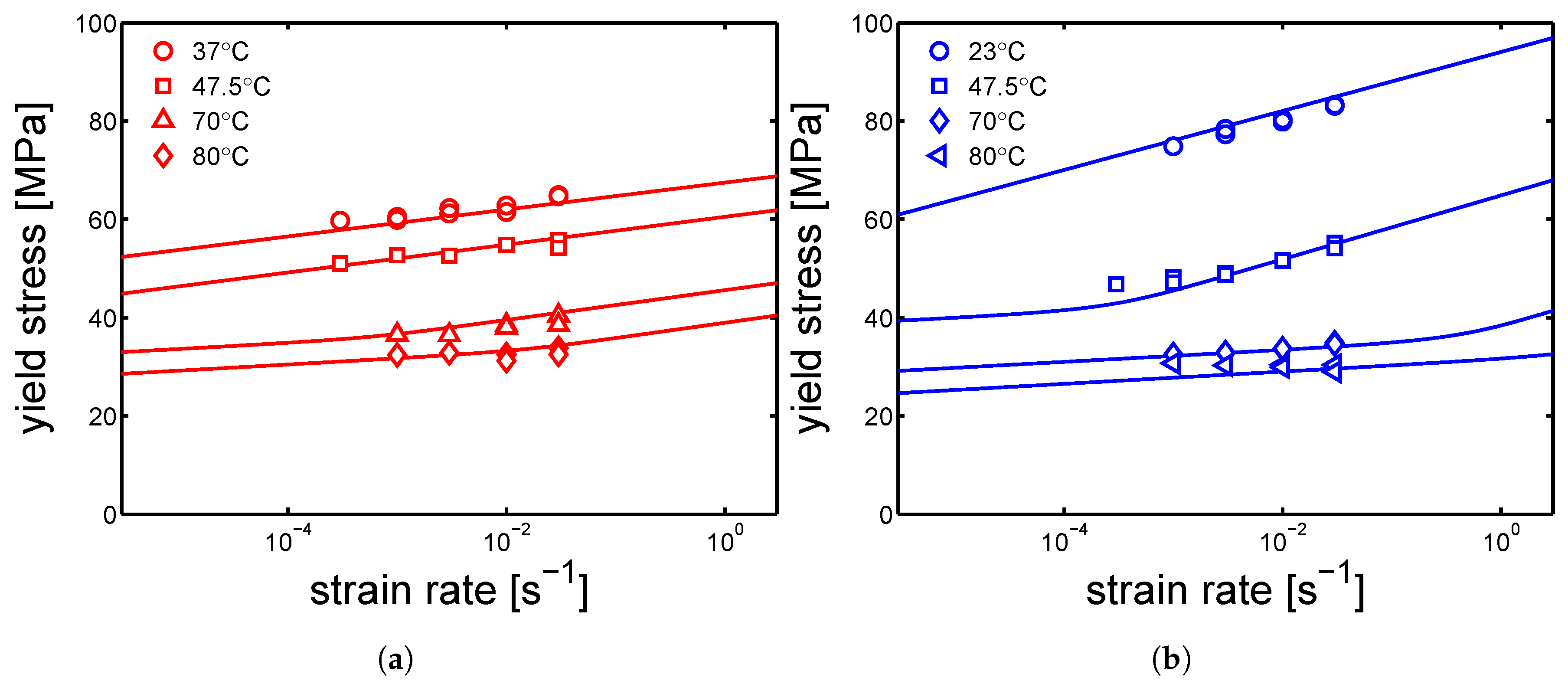
Figure 12.
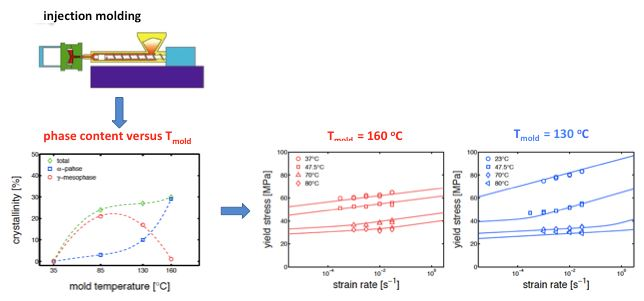
Yield kinetics (yield stress as a function of strain rate) of samples in dry condition, molded at (a) 160 C (b) 130 C. Lines are the the results of the Ree-Eyring equation.
Figure 12.
Yield kinetics (yield stress as a function of strain rate) of samples in dry condition, molded at (a) 160 C (b) 130 C. Lines are the the results of the Ree-Eyring equation.
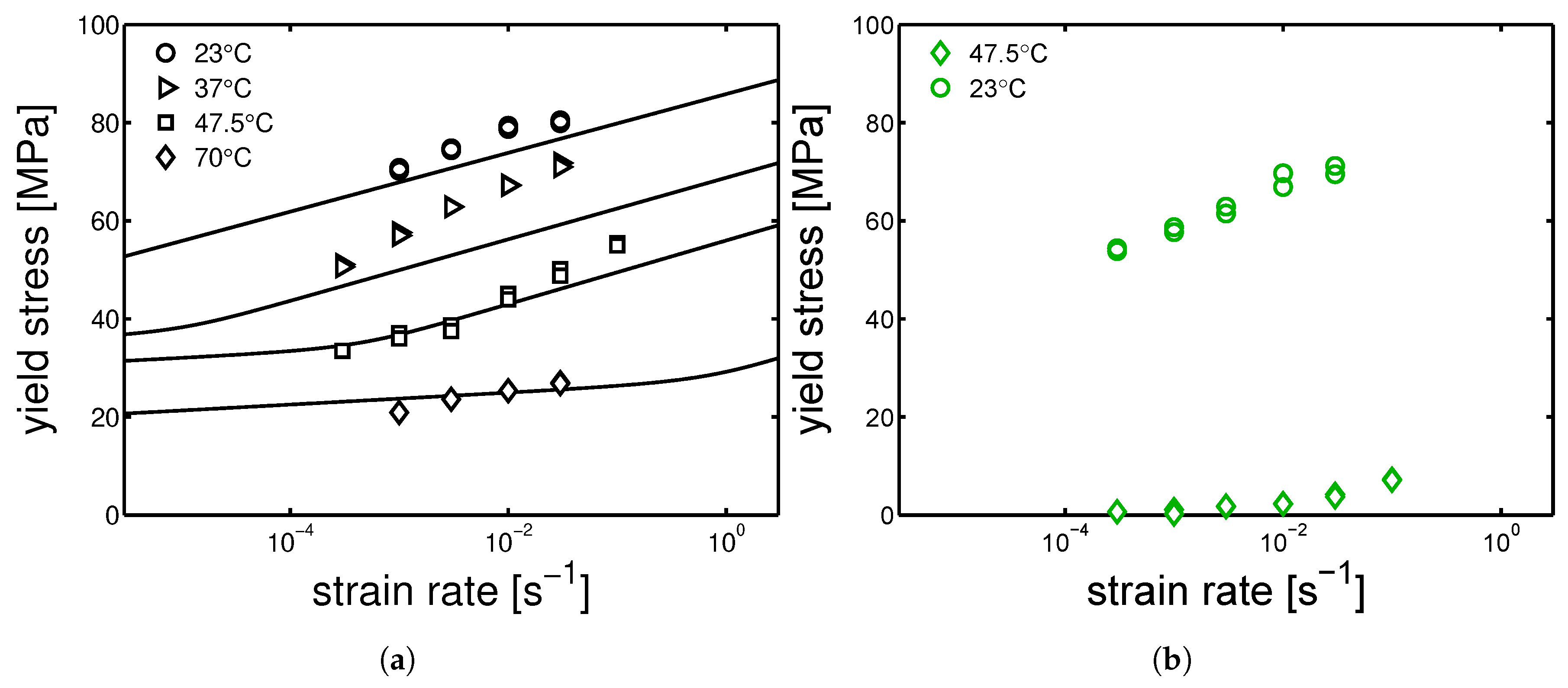
Figure 13.
Yield kinetics (yield stress as a function of strain rate) of samples in dry condition, molded at (a) 85 C (b) 35 C. Lines are the the results of the Ree-Eyring equation.
Figure 13.
Yield kinetics (yield stress as a function of strain rate) of samples in dry condition, molded at (a) 85 C (b) 35 C. Lines are the the results of the Ree-Eyring equation.
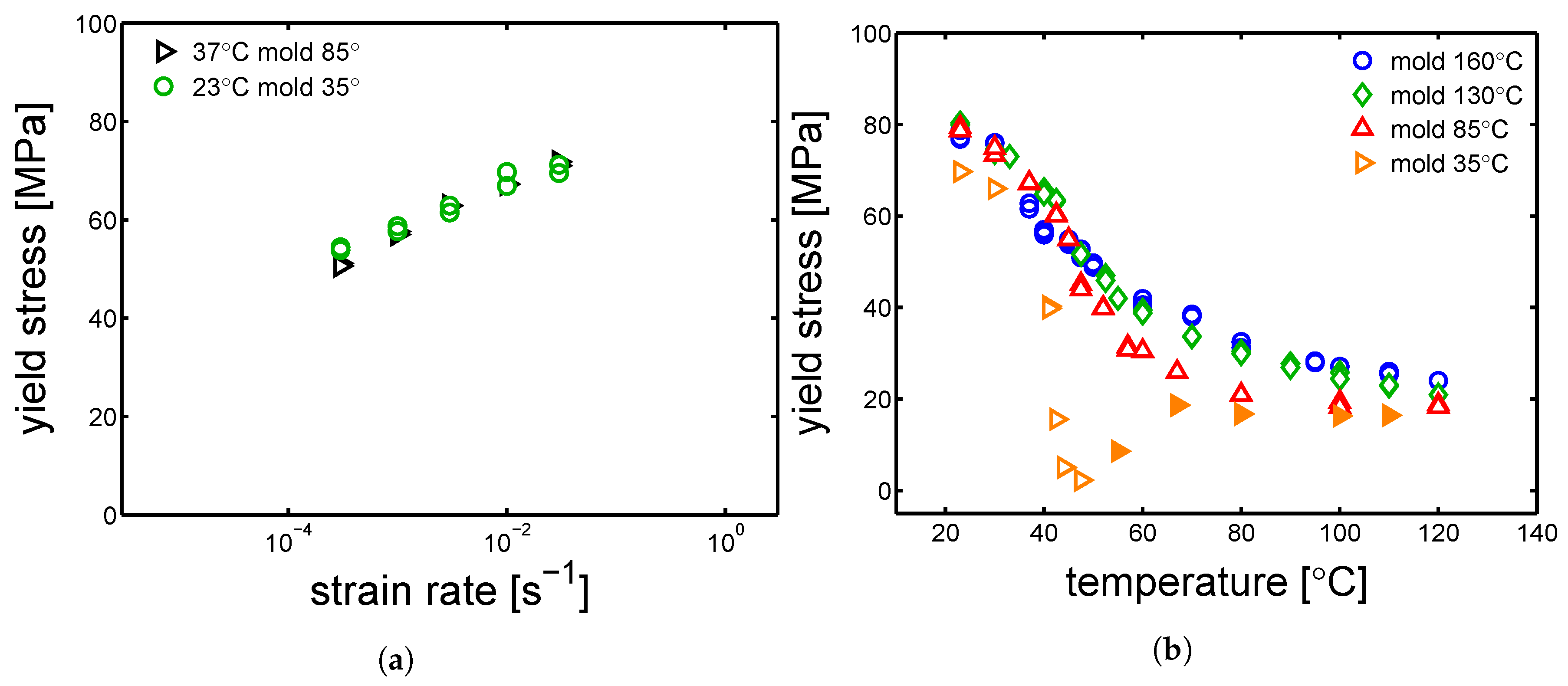
Figure 14.
(a) Comparison between the yield kinetics of samples molded at 85 C and 35 C. (b) Yield stress as a function of temperature. In the case of the samples molded at 35 C, the transition from unfilled to filled markers, is due to the fact that after ≈45 C the samples start to cold-crystallize. Thus, the filled markers are not really representative of the samples molded at 35 C but an evolution of those. Strain rate s.
Figure 14.
(a) Comparison between the yield kinetics of samples molded at 85 C and 35 C. (b) Yield stress as a function of temperature. In the case of the samples molded at 35 C, the transition from unfilled to filled markers, is due to the fact that after ≈45 C the samples start to cold-crystallize. Thus, the filled markers are not really representative of the samples molded at 35 C but an evolution of those. Strain rate s.
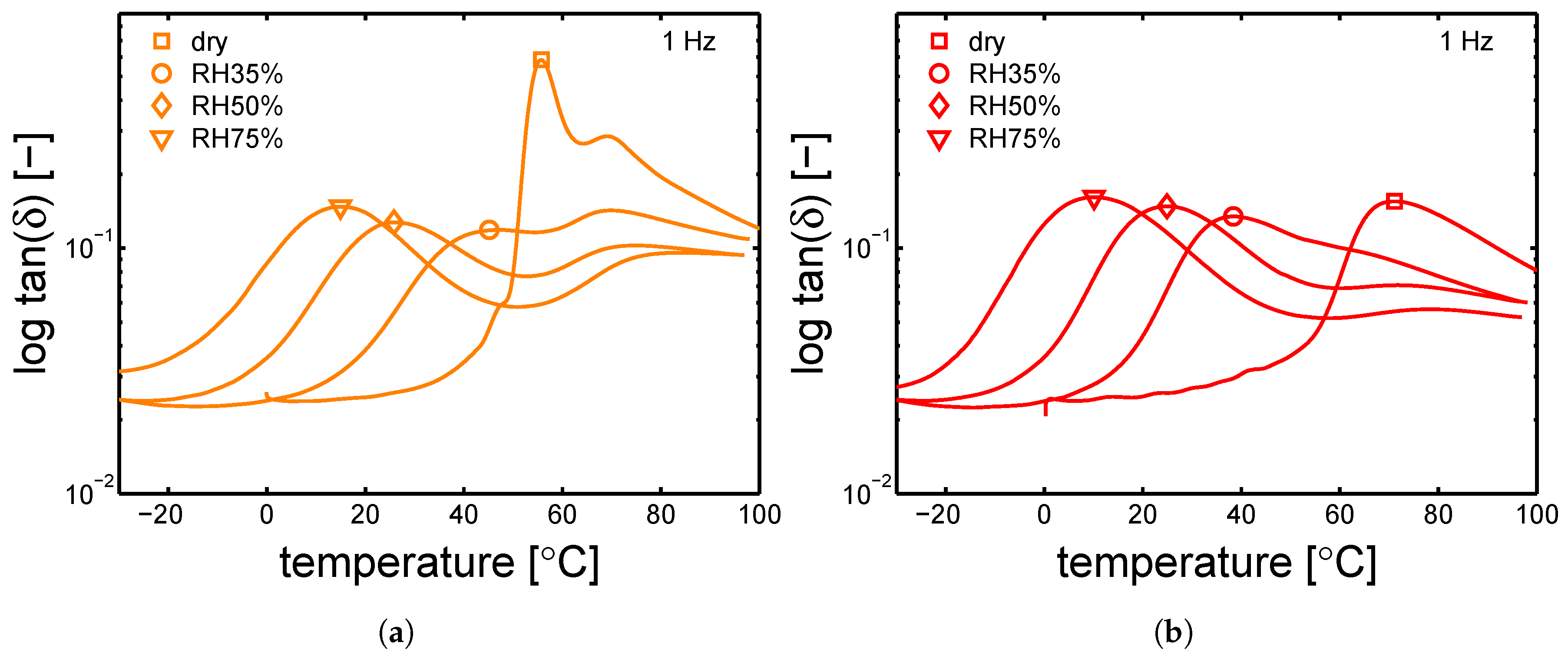
Figure 15.
DMTA experiments for samples conditioned at different relative humidities, tan() as a function temperature for samples molded at (a) 35 C and (b) 85 C. Markers indicate the measured ’s.
Figure 15.
DMTA experiments for samples conditioned at different relative humidities, tan() as a function temperature for samples molded at (a) 35 C and (b) 85 C. Markers indicate the measured ’s.
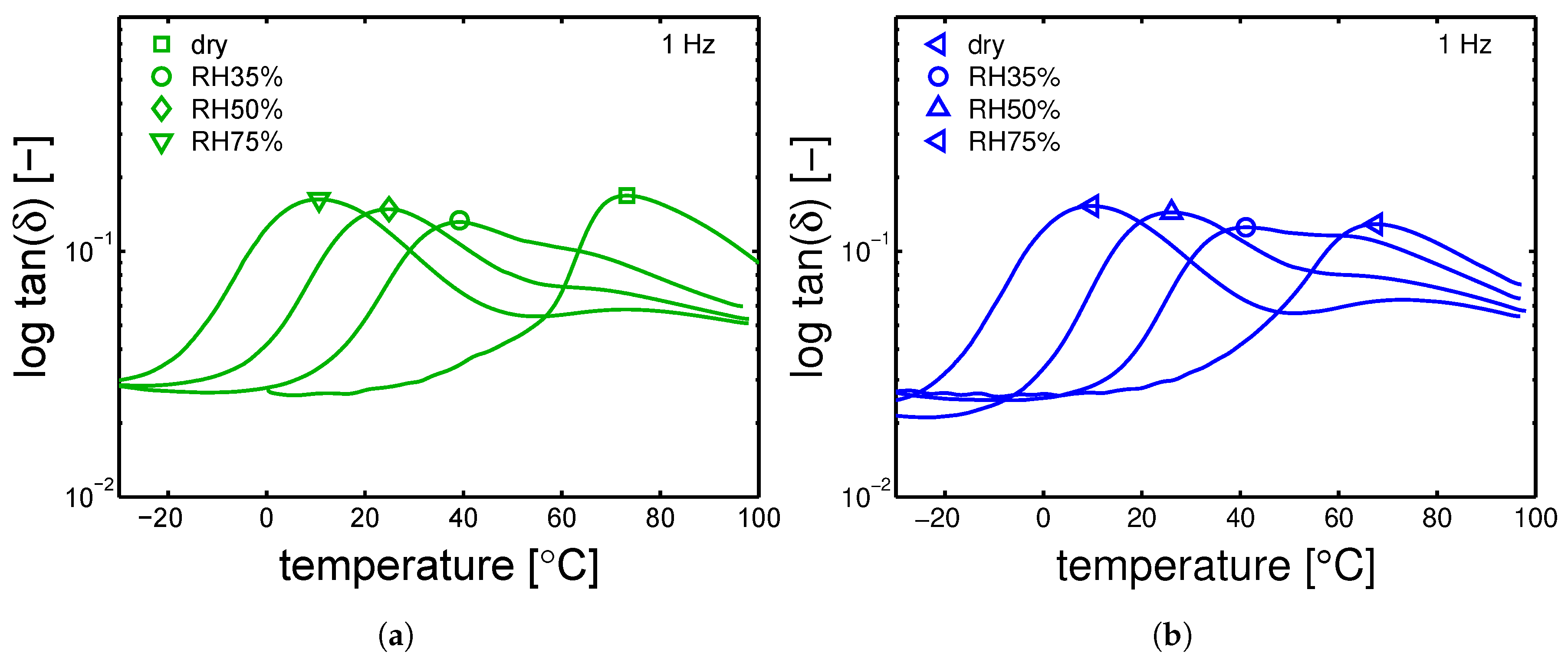
Figure 16.
DMTA experiments for samples conditioned at different relative humidities, tan() as a function temperature for samples molded at (a) 130 C and (b) 160 C. Markers are the selected .
Figure 16.
DMTA experiments for samples conditioned at different relative humidities, tan() as a function temperature for samples molded at (a) 130 C and (b) 160 C. Markers are the selected .
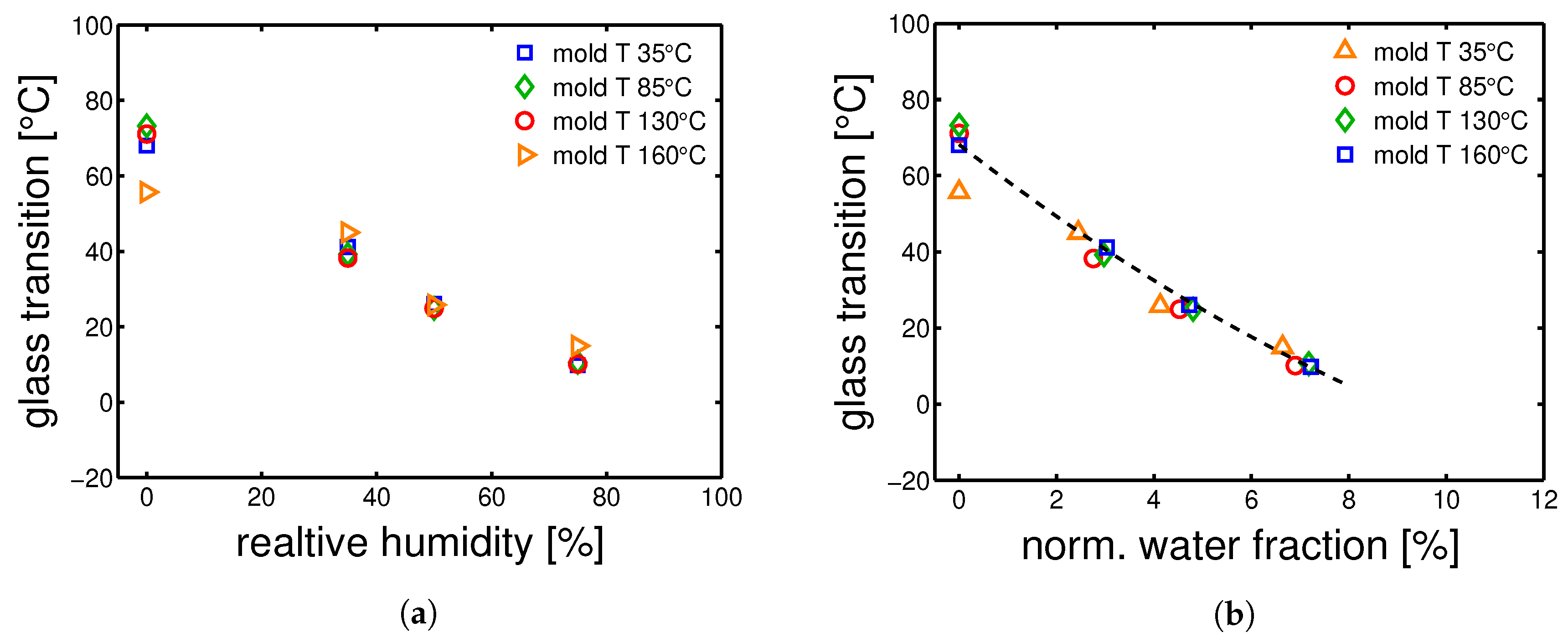
Figure 17.
Glass transition temperatures as functions of (a) relative humidities and (b) normalized absorbed water fraction. The line is a guide to the eye.
Figure 17.
Glass transition temperatures as functions of (a) relative humidities and (b) normalized absorbed water fraction. The line is a guide to the eye.
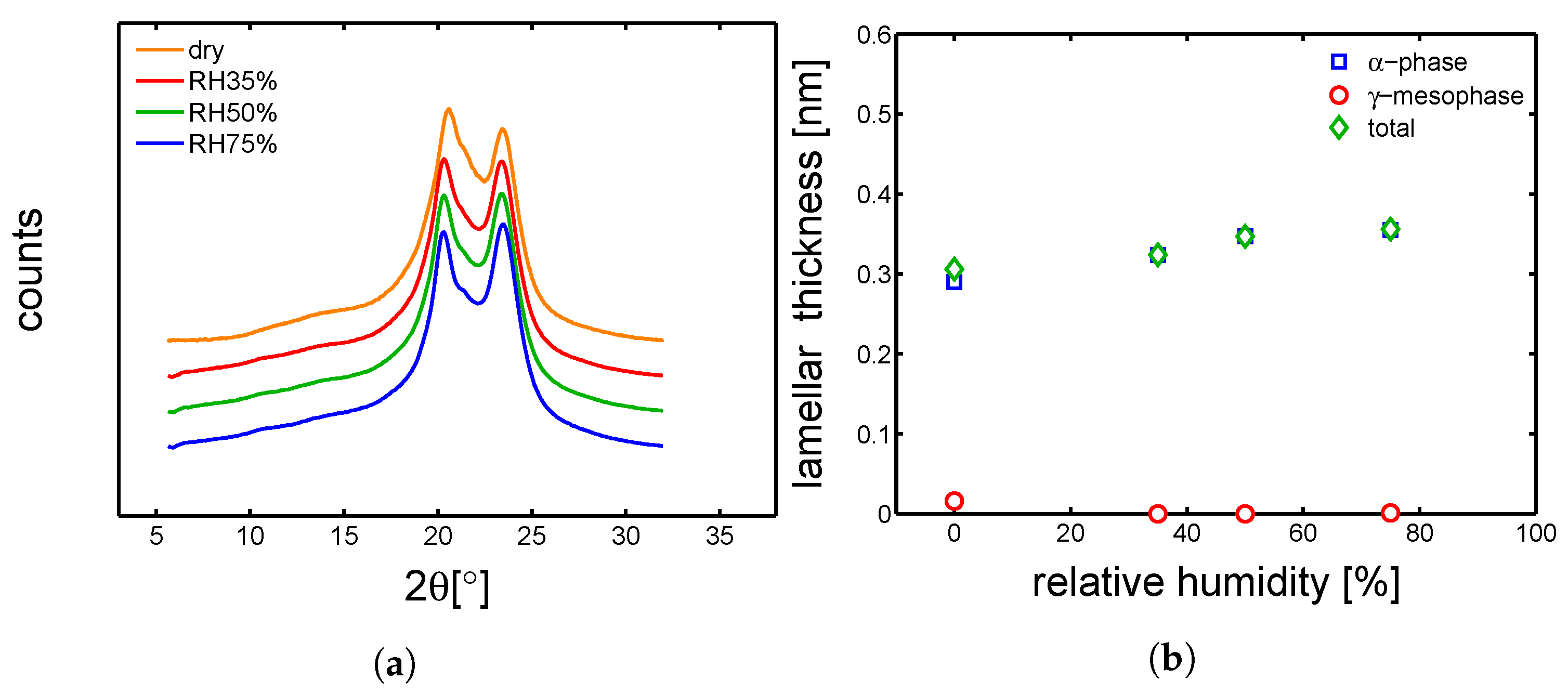
Figure 18.
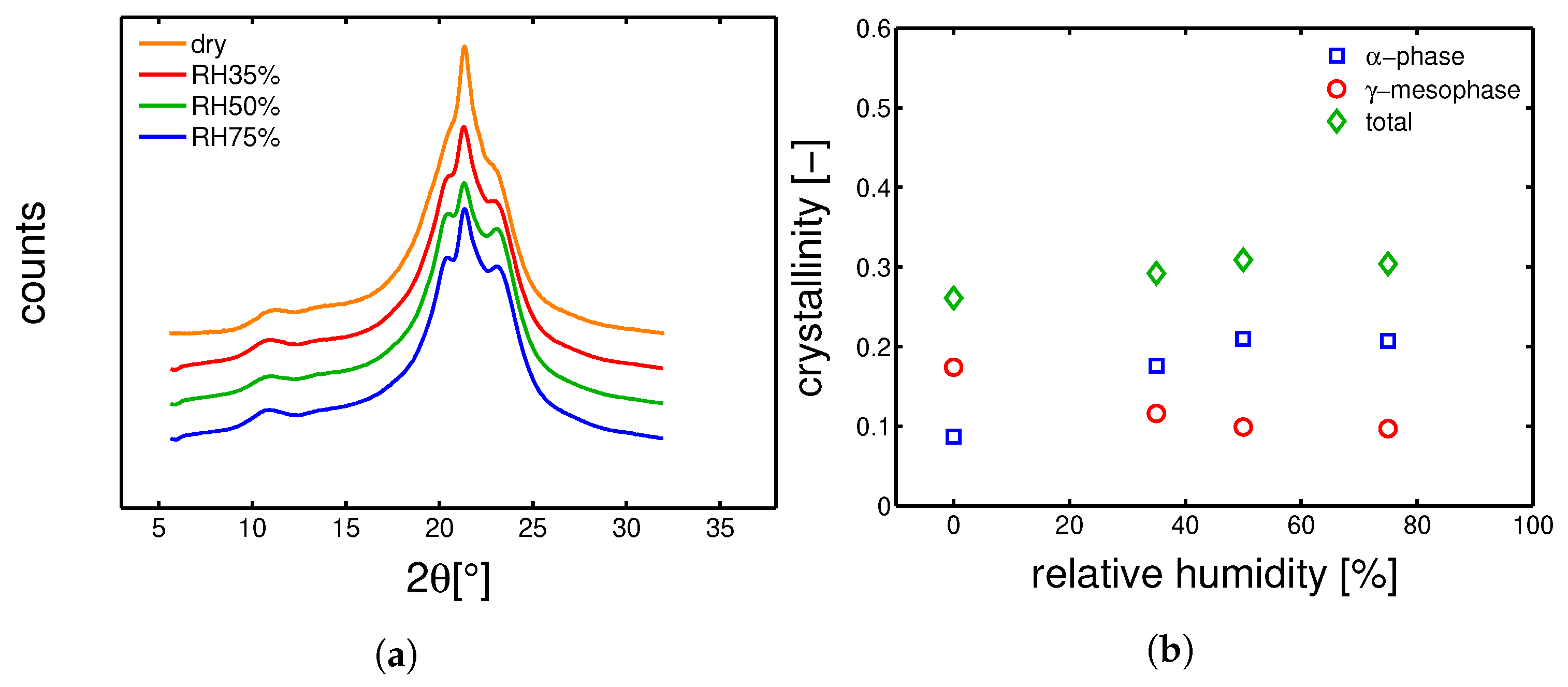
(a) Wide angle X-ray diffraction integrated patterns, samples molded at 160 C and conditioned at different humidities. (b) Deconvolution analysis of the integrated WAXD patterns, crystalline, and fraction as a function of relative humidity.
Figure 18.
(a) Wide angle X-ray diffraction integrated patterns, samples molded at 160 C and conditioned at different humidities. (b) Deconvolution analysis of the integrated WAXD patterns, crystalline, and fraction as a function of relative humidity.
Figure 19.
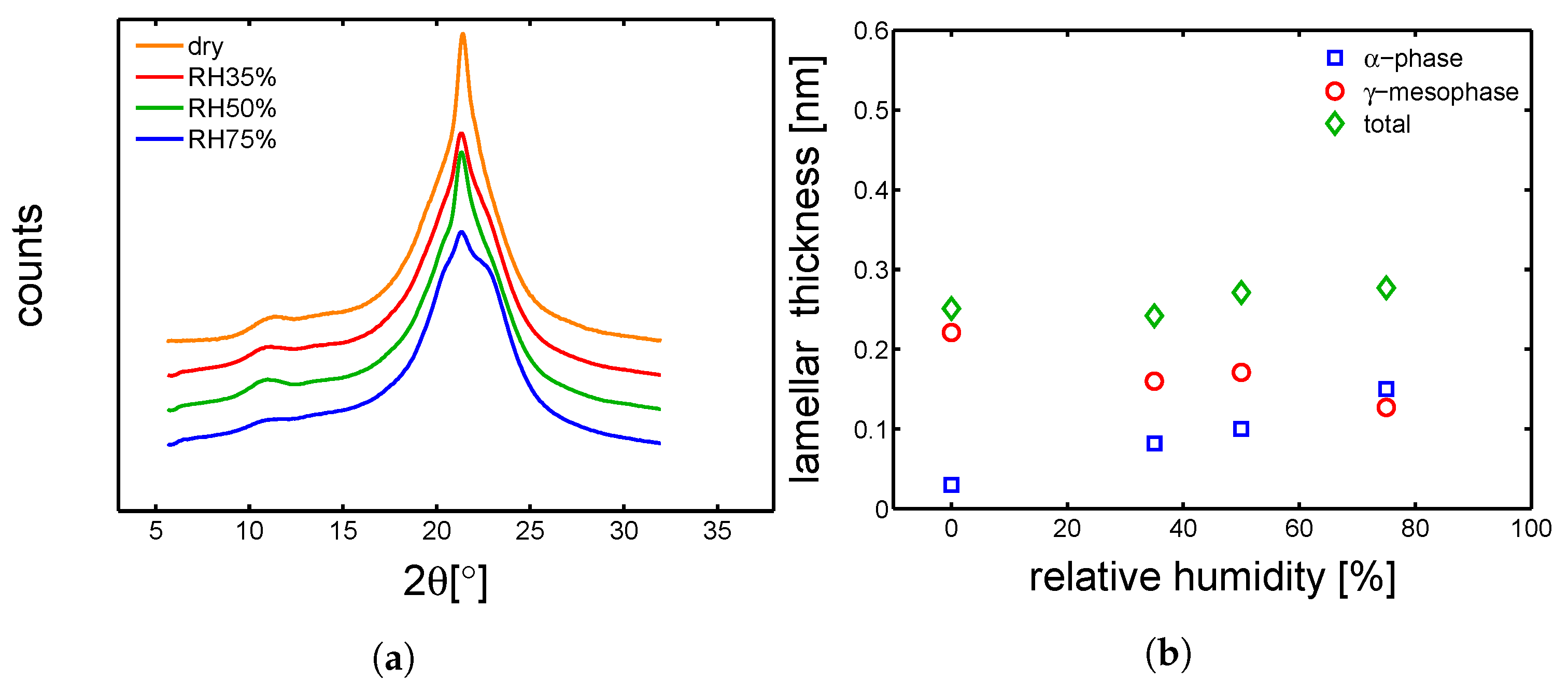
(a) Wide angle X-ray diffraction integrated patterns, samples molded at 130 C and conditioned at different humidities. (b) Deconvolution analysis of the integrated WAXD patterns, crystalline, and fraction as a function of relative humidity.
Figure 19.
(a) Wide angle X-ray diffraction integrated patterns, samples molded at 130 C and conditioned at different humidities. (b) Deconvolution analysis of the integrated WAXD patterns, crystalline, and fraction as a function of relative humidity.
Figure 20.
(a) Wide angle X-ray diffraction integrated patterns, samples molded at 85 C and conditioned at different humidities. (b) Deconvolution analysis of the integrated WAXD patterns, crystalline, and fraction as a function of relative humidity.
Figure 20.
(a) Wide angle X-ray diffraction integrated patterns, samples molded at 85 C and conditioned at different humidities. (b) Deconvolution analysis of the integrated WAXD patterns, crystalline, and fraction as a function of relative humidity.
Figure 21.
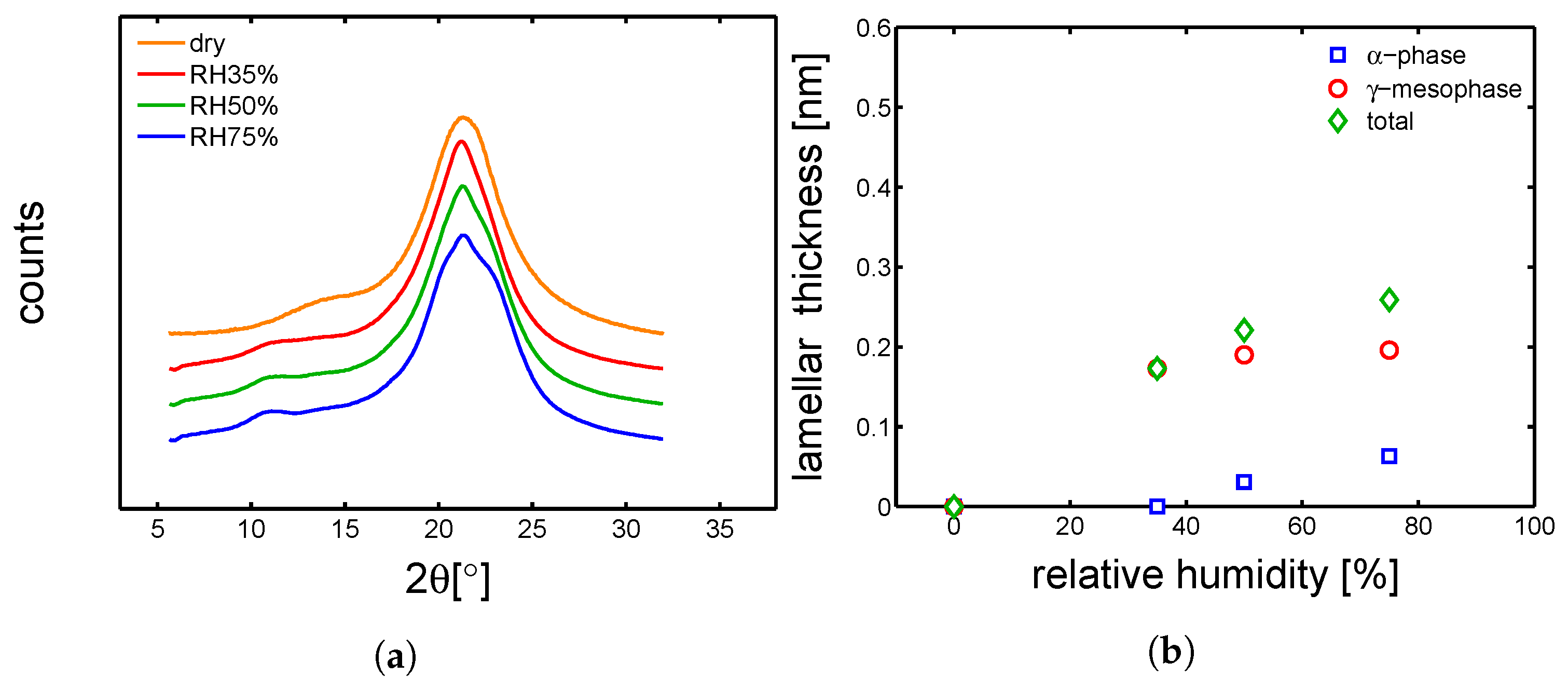
(a) Wide angle X-ray diffraction integrated patterns, samples molded at 35 C and conditioned at different humidities. (b) Deconvolution analysis of the integrated WAXD patterns, crystalline, and fraction as a function relative humidity.
Figure 21.
(a) Wide angle X-ray diffraction integrated patterns, samples molded at 35 C and conditioned at different humidities. (b) Deconvolution analysis of the integrated WAXD patterns, crystalline, and fraction as a function relative humidity.
Figure 22.
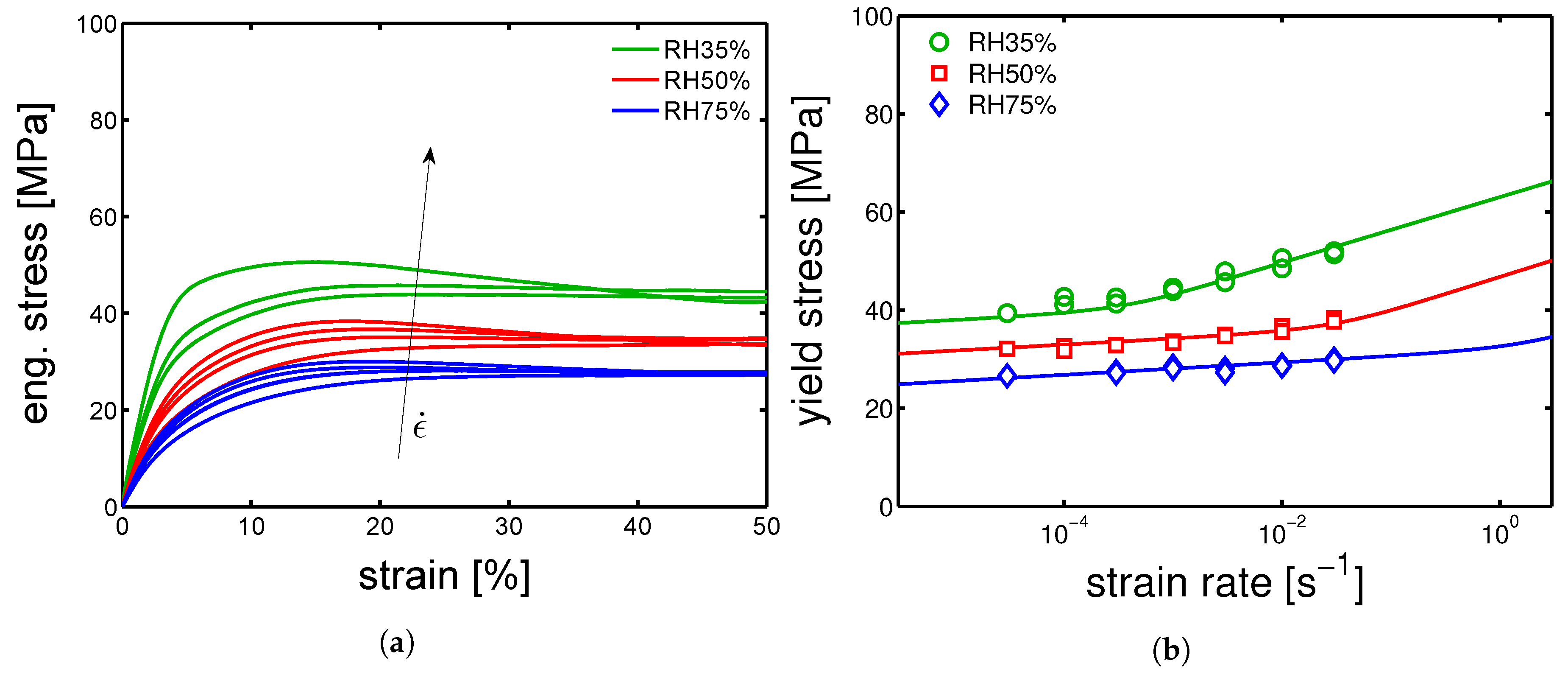
(a) Stress-strain response of samples conditioned at different relative humidities and tested at strain rate in a range from s to s. (b) Yield stress kinetics of samples molded at 130 C.
Figure 22.
(a) Stress-strain response of samples conditioned at different relative humidities and tested at strain rate in a range from s to s. (b) Yield stress kinetics of samples molded at 130 C.
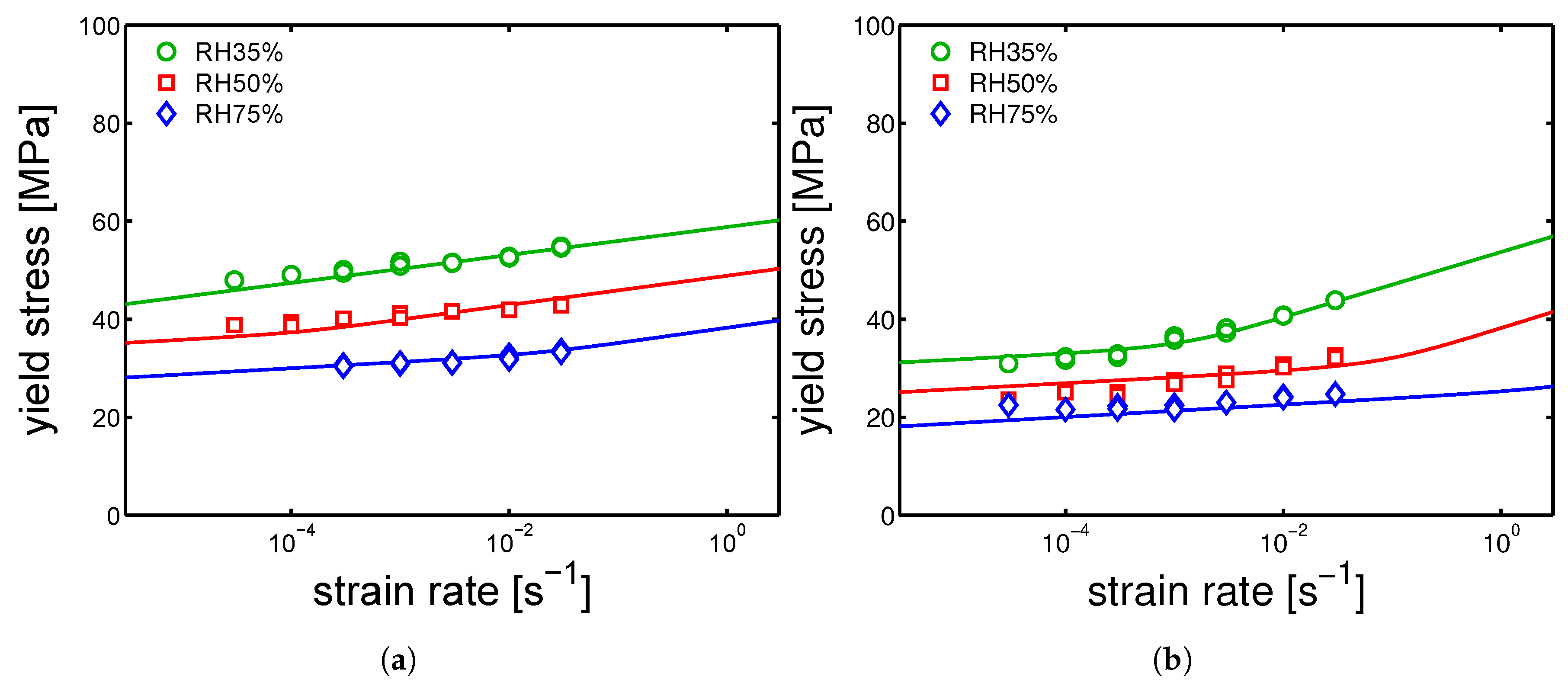
Figure 23.
Yield stress kinetics of samples conditioned at 23 C different relative humidities and molded at (a) 160 C and (b) 85 C.
Figure 23.
Yield stress kinetics of samples conditioned at 23 C different relative humidities and molded at (a) 160 C and (b) 85 C.
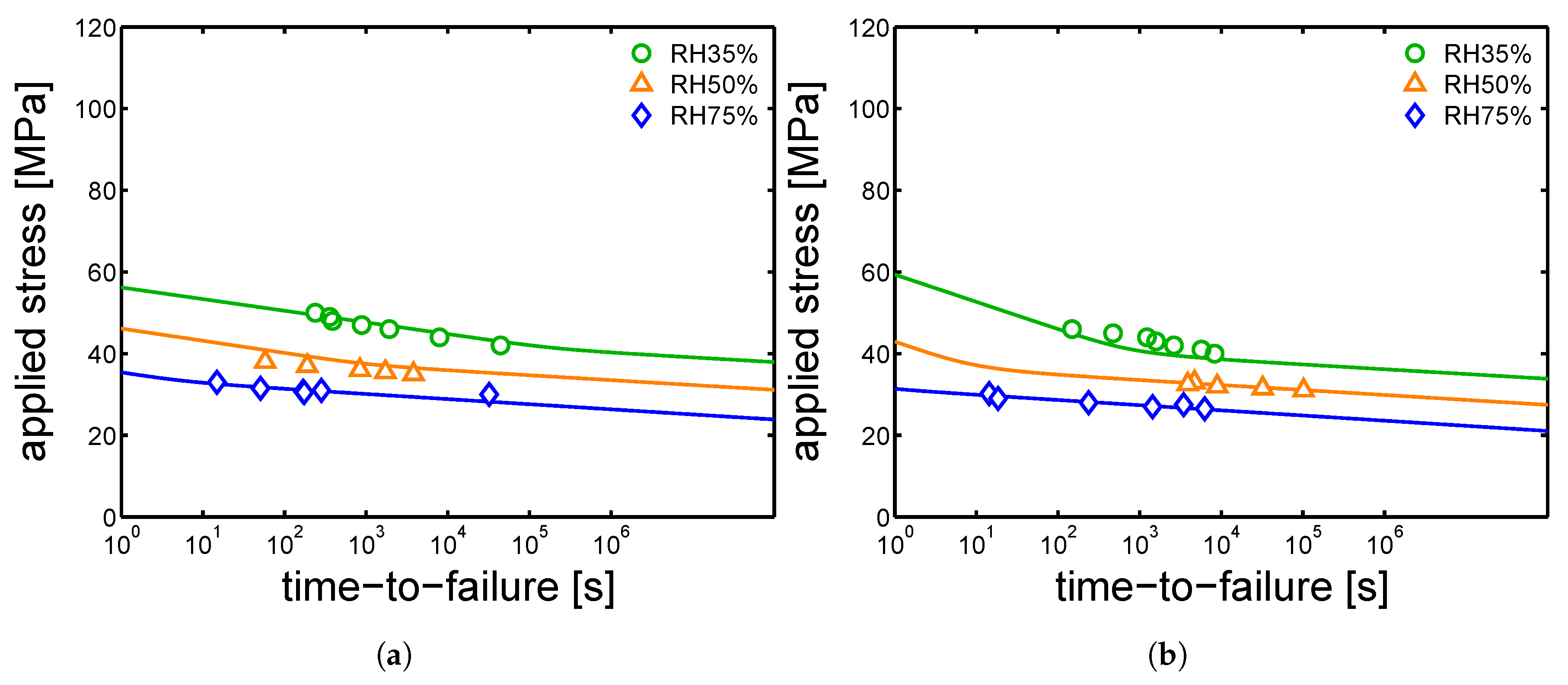
Figure 24.
Creep tests, applied load as a function of time-to-failure for samples conditioned at different relative humidities and room temperature. The lines are the results of Equation (
3). (
a) Mold temperature 160
C and (
b) 130
C.
Figure 24.
Creep tests, applied load as a function of time-to-failure for samples conditioned at different relative humidities and room temperature. The lines are the results of Equation (
3). (
a) Mold temperature 160
C and (
b) 130
C.
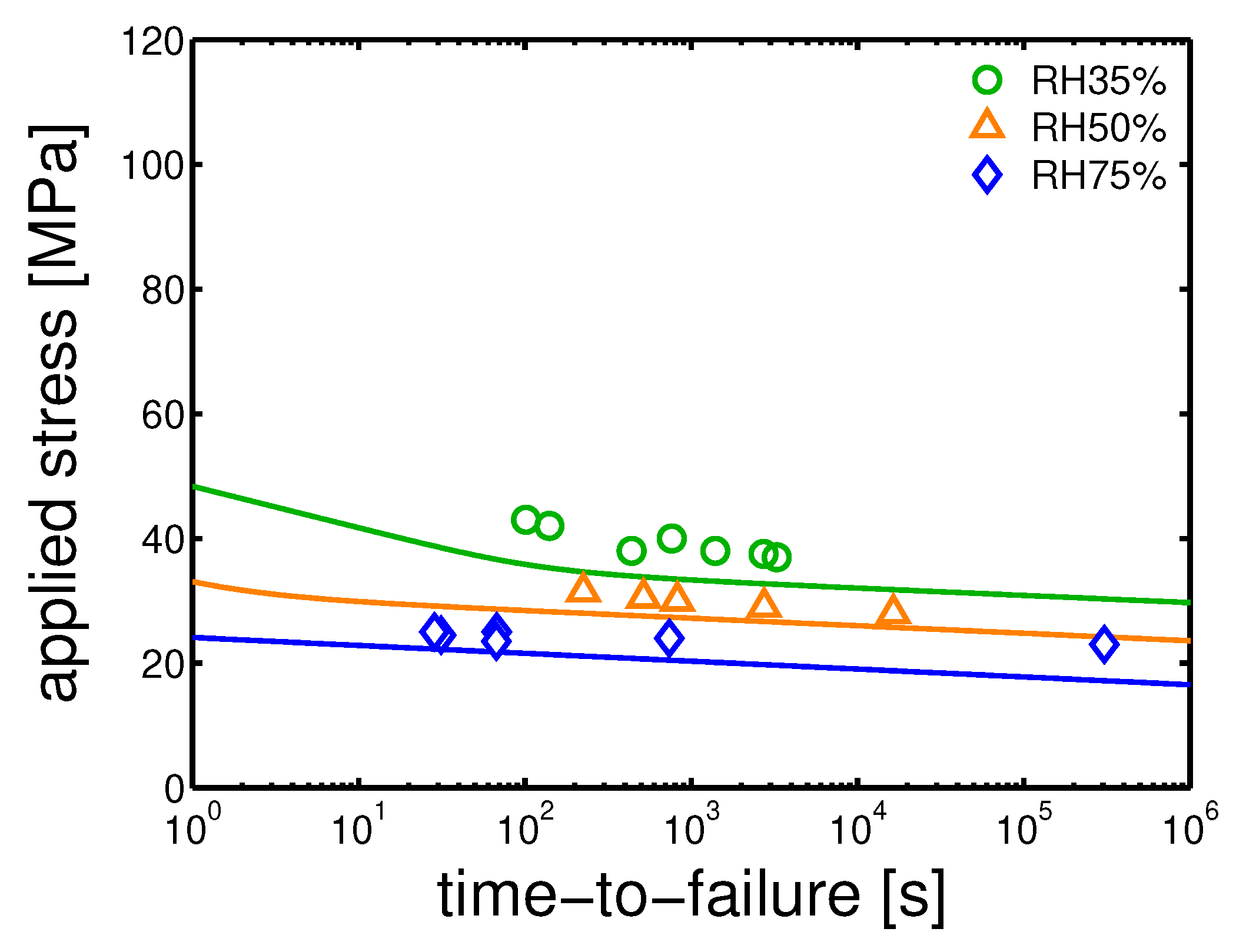
Figure 25.
Creep tests, applied load as a function of time-to-failure for samples conditioned at different relative humidities and room temperature. The lines are the results of Equation (
3). Mold temperature 85
C.
Figure 25.
Creep tests, applied load as a function of time-to-failure for samples conditioned at different relative humidities and room temperature. The lines are the results of Equation (
3). Mold temperature 85
C.
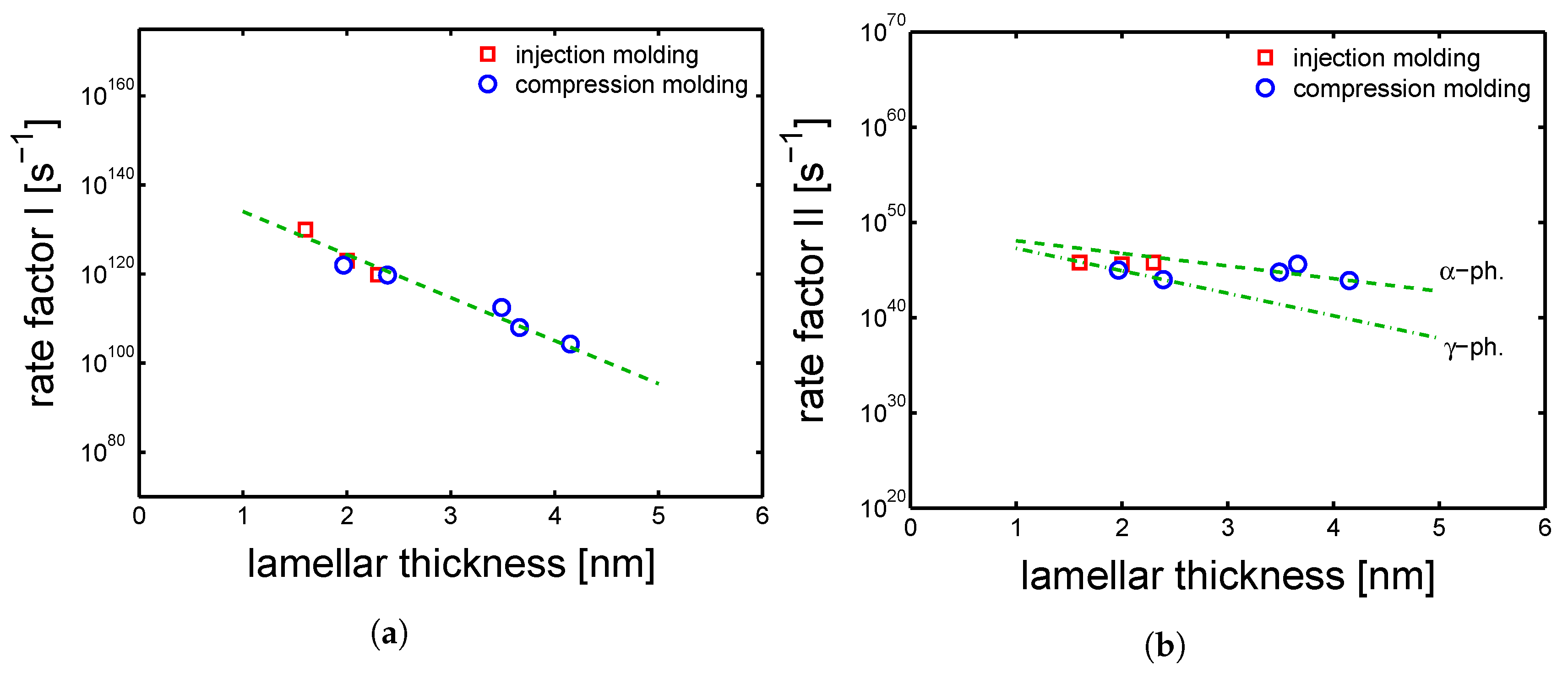
Figure 26.
(a) Rate factor I and (b) rate factor II as functions of lamellar thickness. Lines are guides to the eye.
Figure 26.
(a) Rate factor I and (b) rate factor II as functions of lamellar thickness. Lines are guides to the eye.
Table 1.
Ree-Eyring parameters defined for -phase.
Table 1.
Ree-Eyring parameters defined for -phase.
| | | |
|---|
| I | 9 | 1 |
| II | 6 | 3.2 |
Table 2.
Ree-Eyring parameters defined for -mesophase.
Table 2.
Ree-Eyring parameters defined for -mesophase.
| | | |
|---|
| I | 9 | 1 |
| II | 1.9 | 3 |
Table 3.
Ree-Eyring parameters: rate factors for samples molded at 160 C.
Table 3.
Ree-Eyring parameters: rate factors for samples molded at 160 C.
| | |
|---|
| I | 7 |
| II | 6 |
Table 4.
Ree-Eyring parameters: rate factors for samples molded at 130 C.
Table 4.
Ree-Eyring parameters: rate factors for samples molded at 130 C.
| | |
|---|
| I | 1 |
| II | 4 |
Table 5.
Ree-Eyring parameters: rate factors for samples molded at 85 C.
Table 5.
Ree-Eyring parameters: rate factors for samples molded at 85 C.
| | |
|---|
| I | 1 |
| II | 6 |
Table 6.
Glass transition temperature [C].
Table 6.
Glass transition temperature [C].
| Sample | Dry | 35 RH% | 50 RH% | 75 RH% |
|---|
| mold 160 C | 68 | 41 | 26 | 10 |
| mold 130 C | 73 | 39 | 25 | 11 |
| mold 85 C | 71 | 38 | 25 | 10 |
| mold 35 C | 56 | 45 | 26 | 15 |