
Article

Structural and Quantitative Investigation of Perovskite Pore Filling in Mesoporous Metal Oxides
1
Institute of Chemistry, Casali Center for Applied Chemistry, The Hebrew University of Jerusalem, Jerusalem 90400, Israel
2
The Center of Nanoscience and Nanotechnology, The Hebrew University of Jerusalem, Jerusalem 90400, Israel
*
Author to whom correspondence should be addressed.
Crystals 2016, 6(11), 149; https://doi.org/10.3390/cryst6110149
Submission received: 29 September 2016 / Revised: 5 November 2016 / Accepted: 9 November 2016 / Published: 16 November 2016
(This article belongs to the Special Issue Colloidal Nanocrystals: Synthesis, Characterization and Application)

Abstract

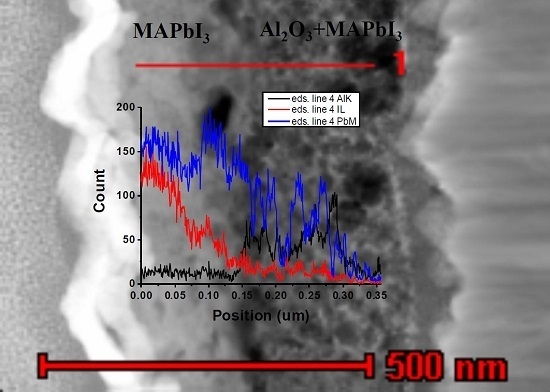
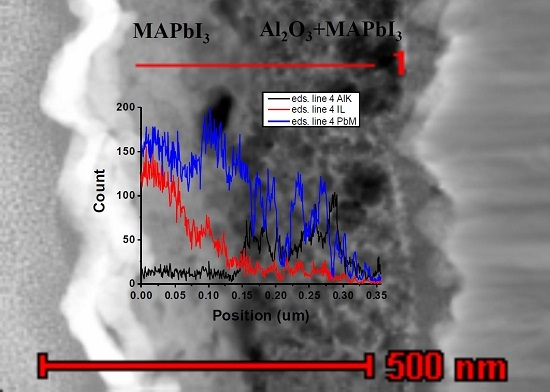
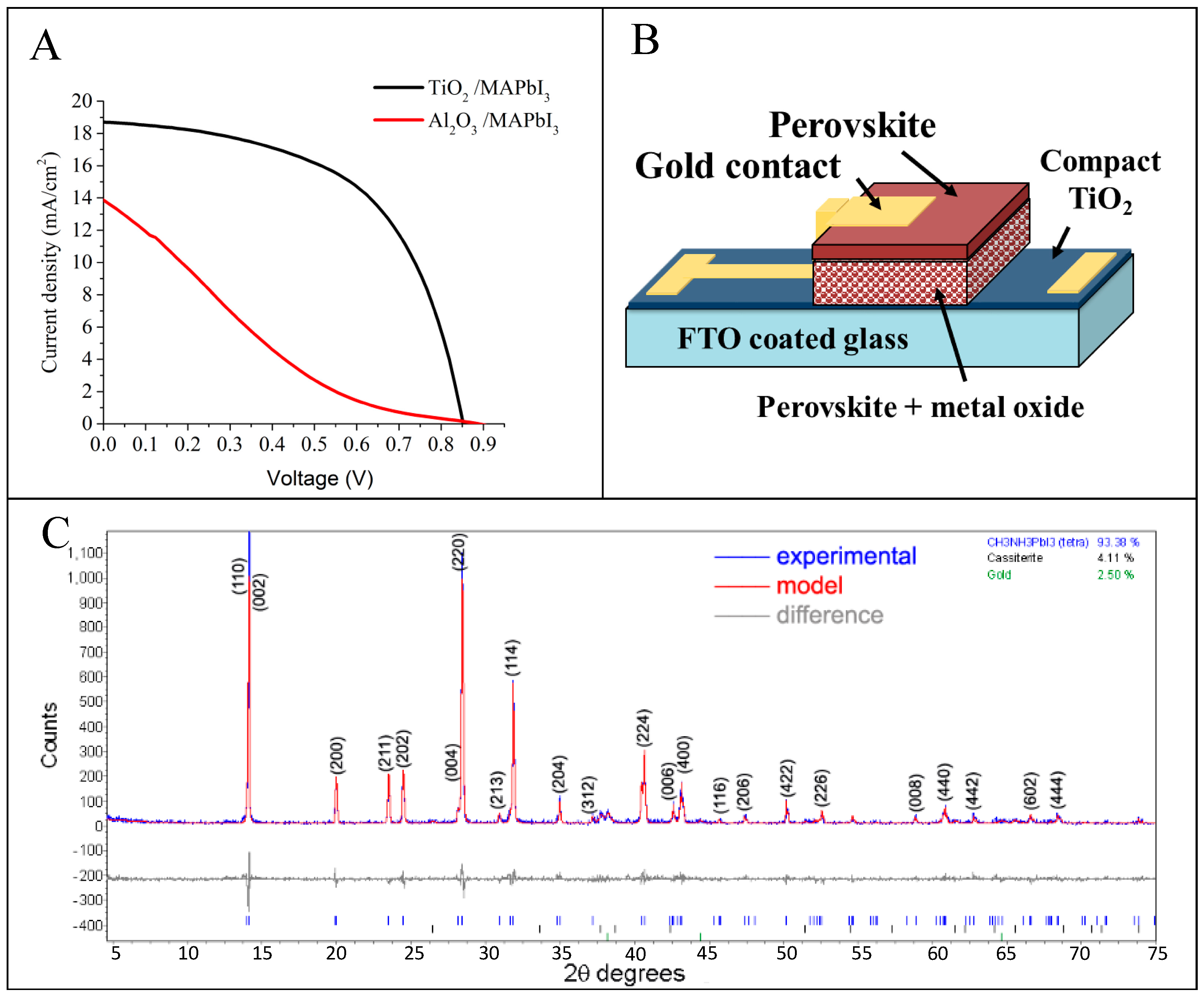
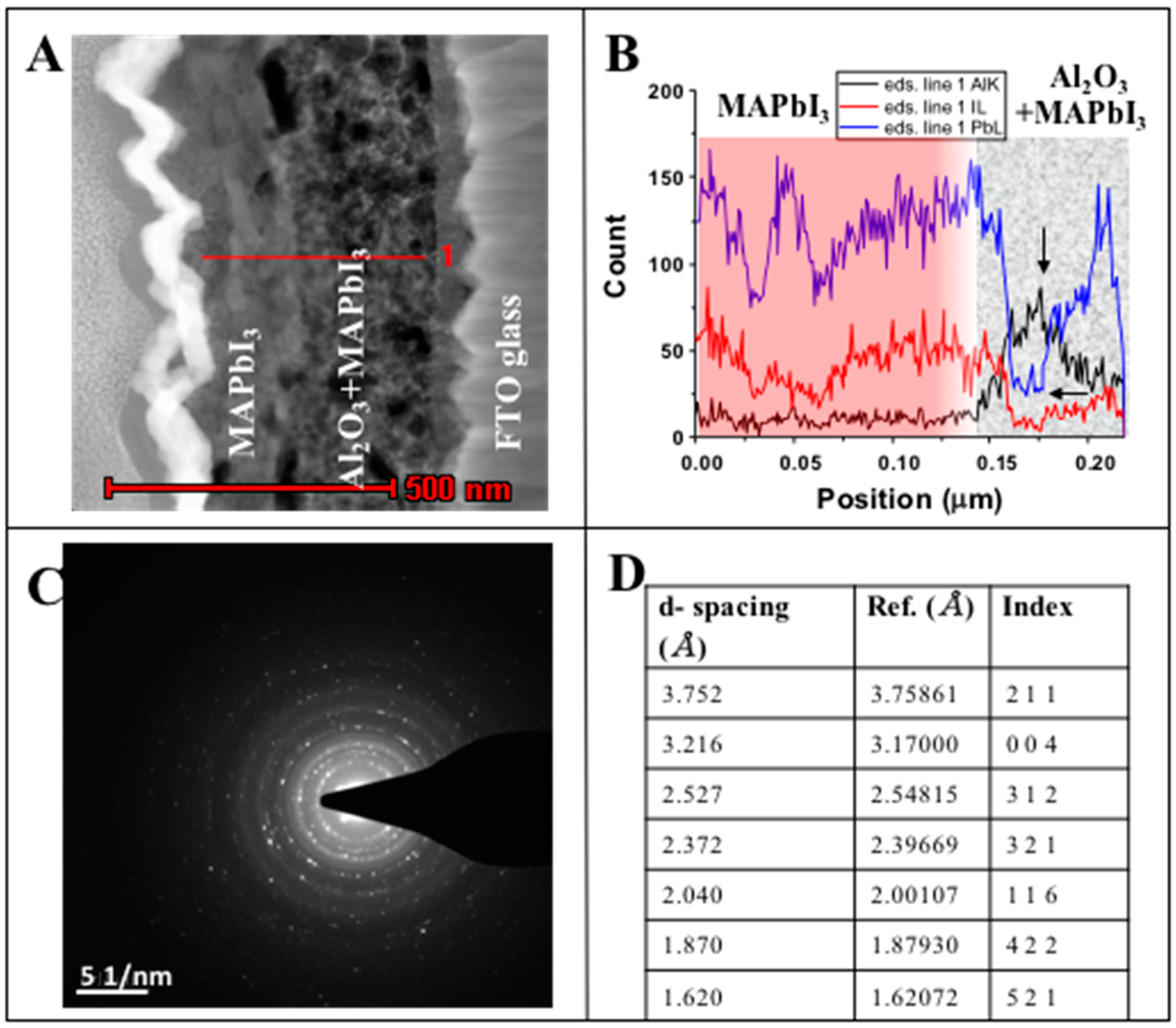
In recent years, hybrid organic–inorganic perovskite light absorbers have attracted much attention in the field of solar cells due to their optoelectronic characteristics that enable high power conversion efficiencies. Perovskite-based solar cells’ efficiency has increased dramatically from 3.8% to more than 20% in just a few years, making them a promising low-cost alternative for photovoltaic applications. The deposition of perovskite into a mesoporous metal oxide is an influential factor affecting solar cell performance. Full coverage and pore filling into the porous metal oxide are important issues in the fabrication of highly-efficient mesoporous perovskite solar cells. In this work, we carry out a structural and quantitative investigation of CH3NH3PbI3 pore filling deposited via sequential two-step deposition into two different mesoporous metal oxides—TiO2 and Al2O3. We avoid using a hole conductor in the perovskite solar cells studied in this work to eliminate undesirable end results. Filling oxide pores with perovskite was characterized by Energy Dispersive X-ray Spectroscopy (EDS) in Transmission Electron Microscopy (TEM) on cross-sectional focused ion beam (FIB) lamellae. Complete pore filling of CH3NH3PbI3 perovskite into the metal oxide pores was observed down to X-depth, showing the presence of Pb and I inside the pores. The observations reported in this work are particularly important for mesoporous Al2O3 perovskite solar cells, as pore filling is essential for the operation of this solar cell structure. This work presents structural and quantitative proof of complete pore filling into mesoporous perovskite-based solar cells, substantiating their high power conversion efficiency.
Keywords: pore filling; mesoporous; perovskite; STEM-TEM; XRD pore filling; mesoporous; perovskite; STEM-TEM; XRD
Graphical Abstract