Article

Molecular Dynamics Simulation of Simultaneous High-Speed Impact of Double Tungsten Fragments on a Titanium Target Plate

1
The Third College, Naval Aviation University, Yantai 264003, China
2
National Key Laboratory of Air-Based Information Perception and Fusion, China Airborne Missile Academy, Luoyang 471000, China
3
Aviation Key Laboratory of Science and Technology on Advanced Titanium Alloys, AECC Beijing Institute of Aeronautical Materials, Beijing 100095, China
*
Author to whom correspondence should be addressed.
Crystals 2026, 16(9), 569; https://doi.org/10.3390/cryst16090569
Submission received: 22 July 2026 / Revised: 28 August 2026 / Accepted: 29 August 2026 / Published: 31 August 2026
(This article belongs to the Section Crystalline Metals and Alloys)

Abstract

This study employs molecular dynamics (MD) simulations to explore the high-speed impact behavior of double conical tungsten (W) fragments on titanium (Ti) target plates, focusing on fragment cloud formation, Ti damage evolution, and the effects of temperature and impact velocity. High-speed impact converts W fragments’ kinetic energy into internal energy, causing W fragmentation and the formation of a mixed-phase fragment cloud, which induces severe damage to the Ti target. Under double-particle impacts, W fragments penetrate the Ti target to form a multi-source fragment cloud, with Ti target damage (characterized by amorphous phase distribution) undergoing initiation and extension stages. Higher temperatures broaden the high-temperature damage zone and increase crater size but do not change the impact penetration evolution mode or penetration depth. Impact velocity determines damage modes: low velocity causes non-through internal damage with a rear bulge, while high velocity leads to full perforation with mixed W-Ti fragment ejection, and lateral crater size is almost unaffected by velocity. This study innovatively reveals the atomic-scale damage evolution mechanism of Ti targets under dual conical W fragment impact, which fills the research gap in conventional single-fragment impact studies. These findings clarify the high-speed impact mechanism of Ti alloys, providing theoretical support for the design of Ti-based protective structures in engineering.

1. Introduction

The study of the dynamic response and penetration mechanism of W alloy fragments impacting Ti alloy target plates is an important topic in the current fields of protective engineering and material dynamic mechanics. Due to its extremely high density and hardness, W, as a kinetic penetrator or fragment, has a significant momentum advantage. Ti alloys are widely used in aerospace, jet engine blades [1], and armor protection structures due to high specific strength, excellent corrosion resistance, and medium density [2,3]. The interaction between the two under high-speed collisions involves complex stress wave propagation, adiabatic shear localization, phase transformation, and interface friction and material mixing effects at high temperatures. Current research mainly uses ballistic experiments, numerical simulations, and microscopic microstructure characterization to deeply reveal the influence laws of different velocity ranges, fragment shapes, and incident angles on the damage evolution of the titanium target [4].
The process of W fragments impacting a Ti target is essentially a high-speed dynamic coupling problem between high-density hard materials and medium-density high-strength materials. Within the range of low to medium penetration velocities, the penetration behavior is mainly dominated by plastic deformation. The W fragments, with their high kinetic energy, cause the target material to undergo intense plastic deformation, resulting in typical conical or funnel-shaped penetration holes [4]. During this process, obvious bulges often appear on the back of the titanium alloy target plate. This is the result of stress waves reflecting off the free surface and forming tensile waves, which cause cracking or plastic buckling of the layer [5]. As the impact speed increases, the penetration depth and the hole diameter show a non-linear growth. However, the integrity of the fragments also faces challenges. Research indicates that spherical tungsten alloy fragments remain intact at low speeds when impacting thick steel plates or high-strength alloys, but they are prone to fragmentation at high speeds. This fragmentation mechanism directly affects the energy transfer efficiency [6].
As an atomistic computational method, MD simulation plays an irreplaceable role in the research of fragment impact and high-speed impact. By solving Newton’s equations of motion, MD can accurately capture the micro-structural evolution, phase transformation mechanisms, damage nucleation, and debris cloud formation of materials under extreme loading conditions. It thereby compensates for the limitations of continuum mechanics at the nano-scale or under extremely high strain rates [7]. In the study of fragment impact, MD not only reveals the microscopic mechanism of the conversion from kinetic energy to thermal energy but also clarifies the statistical distribution of fragment sizes and its intrinsic correlation with impact energy. The accuracy of MD simulations strongly depends on the selection of interatomic potentials. For impact research on metallic materials, the Embedded Atom Method (EAM) potential and Morse potential are widely employed. For instance, in fragment impact studies, the Face-Centered Cubic (FCC) Al atomic system modeled with the Morse potential successfully reproduces variations in debris cloud structures under different impact velocities. Notably, the debris cloud formed at an impact velocity of 7 km/s differs substantially from that generated at low velocities [8].
In previous studies, a single-particle model was usually adopted for MD simulations of nanoparticles to explore the intrinsic structural characteristics and dynamic behaviors of nanoparticles [9]. This strategy effectively eliminates interfering factors originating from multi-particle systems, such as particle agglomeration, interparticle van der Waals forces, and collision coupling effects. Initially, a single-crystal bulk structure was established and further trimmed into regular spherical nanoparticles. The configurations of surface low-coordination atoms were optimized to reduce inherent structural defects. The simulation box was expanded with an adequate vacuum layer surrounding the nanoparticle to avoid the mutual interaction between periodic mirror images and suppress boundary-related adverse effects [10]. Based on the single-particle model, Kona et al. investigated projectile target impacts across scales via atomistic MD and continuum SPH simulations [11]. Norris et al. used a parameter-free single-ion model as multiscale analysis input to predict the transition between nano-scale patterning and smooth surfaces, matching experimental results well [12]. Burlison et al. explored nanoparticle collision on iono-covalent ZnO ceramic substrates under micro-cold spray conditions [13].
Although single-particle molecular dynamics only simulates one particle impacting the substrate and eliminates inter-particle interference to accurately analyze the intrinsic rules of deformation and deposition affected by impact velocity and particle size, the double-particle model introduces collisions between particles. It reproduces real impact processes including simultaneous impact, internal material extrusion, and atomic diffusion, making up for the deficiency of the single-particle model, which cannot characterize particle interactions and superposition of impact damage. The definition of simultaneous impact states that fragments have identical initial positions, the same accelerations, and equal impact–contact time instants. Meanwhile, from the target’s perspective, the target is subjected to fragment loading simultaneously.
Therefore, this study is mainly focused on the impact of titanium caused by two W nanoparticles. Distinct from single-fragment high-speed impact studies, this MD simulation investigates Ti target responses subjected to double-conical W fragments. It identifies multi-source fragment cloud formation and two-stage Ti damage evolution quantified by amorphous phase distribution. The obtained results will overcome the limitations of the previous single-particle model, such as multi-particle effects, and provide solid data support for systematically understanding fragment impact damage and the failure mechanisms of Ti alloys.

2. Methods

2.1. Molecular Dynamics

MD simulation is a computational method grounded in the principles of classical mechanics [14]. It numerically solves the equations of motion for multi-particle systems to reveal the dynamic behaviors and thermodynamic properties of substances at atomic and molecular scales [15]. At its core, this method converts the interactions between microscopic particles into macroscopically observable physical quantities, thereby bridging static structures and dynamic functionalities. In this study, MD simulations were performed using LAMMPS [16] software (version: 64-bit 2Apr2025).
Relying on accurate integration of Newton’s equations of motion, MD simulation also incorporates the theoretical framework of statistical mechanical ensembles, the construction of force field parameters, and the implementation of efficient numerical algorithms. The force field [17] applied in this study was developed for LAMMPS pair style adp for refractory alloys containing W and Ti. It was reported that this model enables simulation of diverse Ti-W related structural transformations and crystal defect behaviors for multiple experimentally observed phases within the simulated system [17].

2.2. Nano-Scale Models

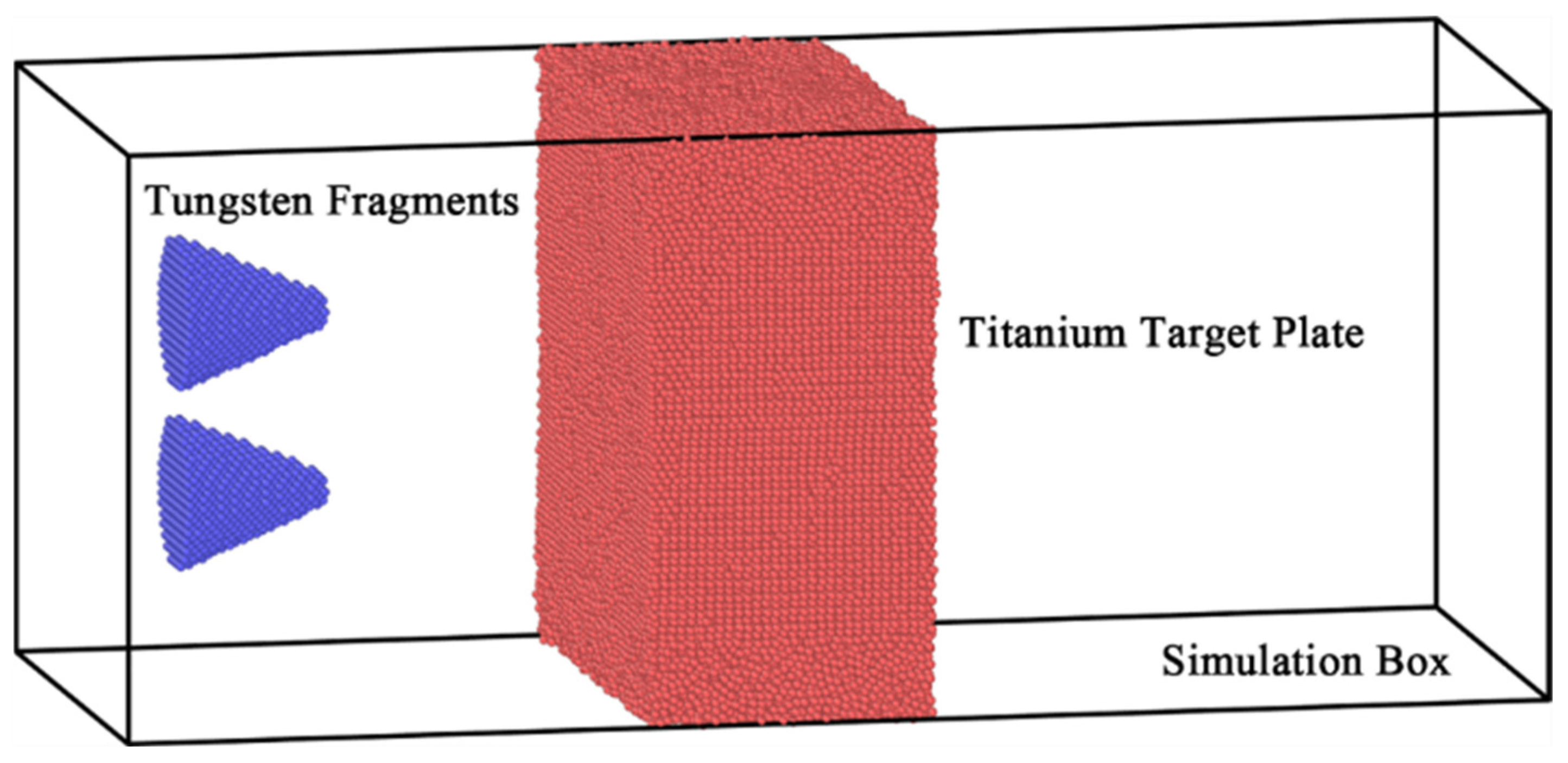
The initial model of the impact of double W fragments on the Ti target plate is shown in Figure 1 below. The geometry of the W fragment is a cone, including top and bottom radii of about 0.5 and 2.5 nm. The W fragment adopts a Body-Centered Cubic (BCC) crystal structure with a lattice constant of 3.165 Å. Each W fragment consists of 2505 W atoms, so the two fragments contain a total of 5010 W atoms. The central axes of the two fragments are perpendicular to the contact surface of the Ti target. At the moment of impact, the top surfaces of the fragments first make contact with the Ti target plate. Then, the size of the Ti target plate is 20 × 20 × 10 nm3, and the initial horizontal distance between the fragment and the target is about 10 nm. The composition of the Ti target plate is only Ti; in other words, this is a pure Ti target without alloying elements. Ti adopts a Hexagonal Close-Packed (HCP) crystal structure with a lattice constant of 3.2 Å. The entire Ti target plate contains a total of 176,514 Ti atoms. The gap between two fragments is about 1 nm. All individual models are assembled in a simulation box with 3D periodic boundaries. The visualization of the following models and are accomplished by OVITO software (version 3.15.4) [18].

2.3. Computing Conditions

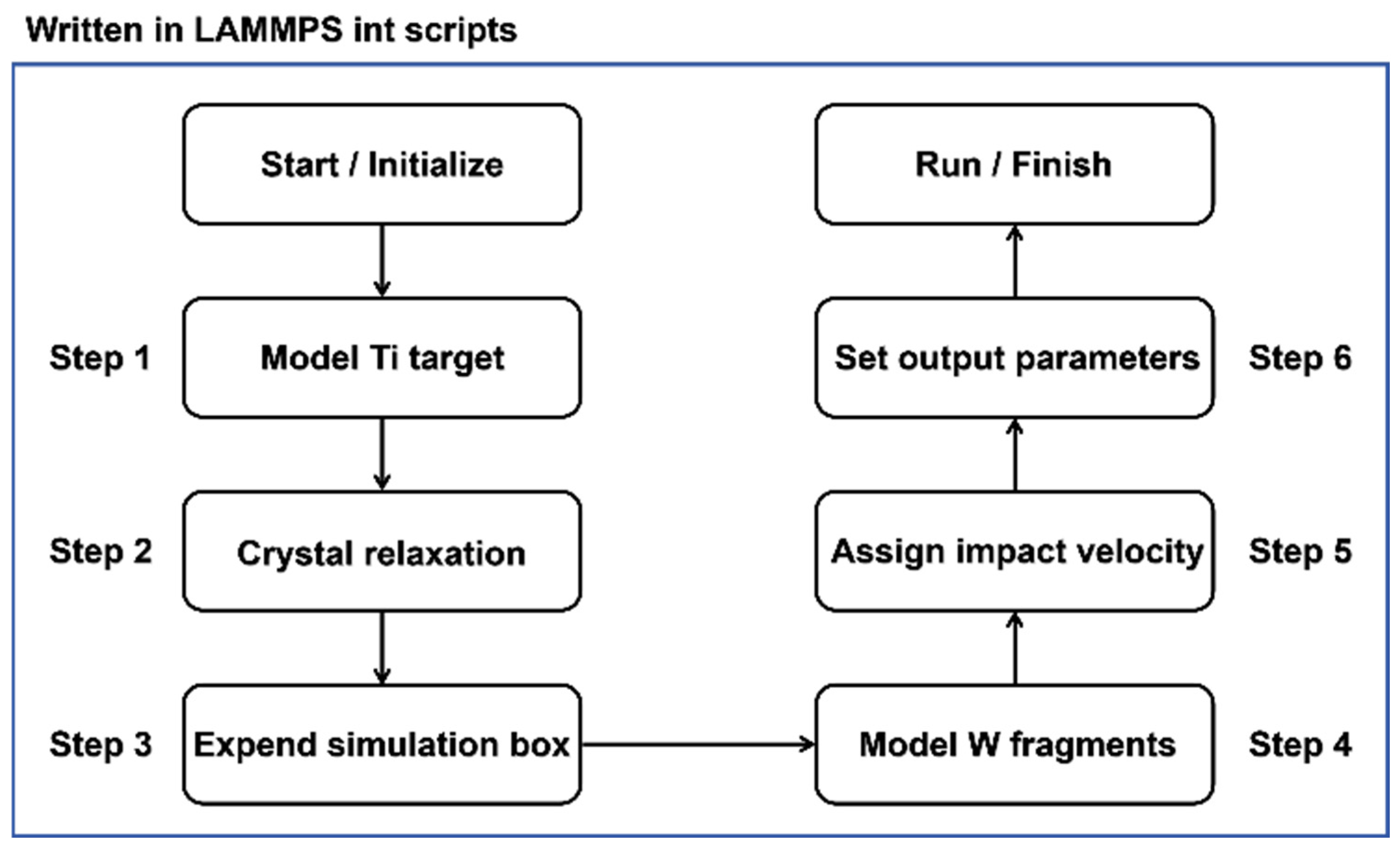
The MD simulations’ flow diagram performed in this study is presented in Figure 2 below. The parameters of steps 1 and 4 have been introduced in Section 2.2 above. The unit type of the LAMMPS script is “metal” to fix the atomic style of the data file. The relaxation of the Ti plate was prepared at 900 K with an initial 10 ps equilibrium MD process. The time step is defined as 1 fs, and it is applied throughout the study. Then the box was expended alongside the X axis to allow for the modeling of W fragments. Next, both W fragments were assigned a initial velocity of 5 Ǻ/ps.
The impact of both fragments was integrated for 30,000 steps. During the overall simulation, Isothermal–Isobaric Ensemble (NPT) and microcanonical ensemble (NVE) were applied for modelling and impact, respectively. Additionally, comparisons of impact temperature and flying velocities were set with different conditions. The temperature was between 300 and 900 K, and then the velocity was raised up to 10 Ǻ/ps. All thermodynamic and trajectory data were exported every 1000 steps.

3. Results and Discussion

3.1. Mechanism of Double-Fragment Impacts at 900 K

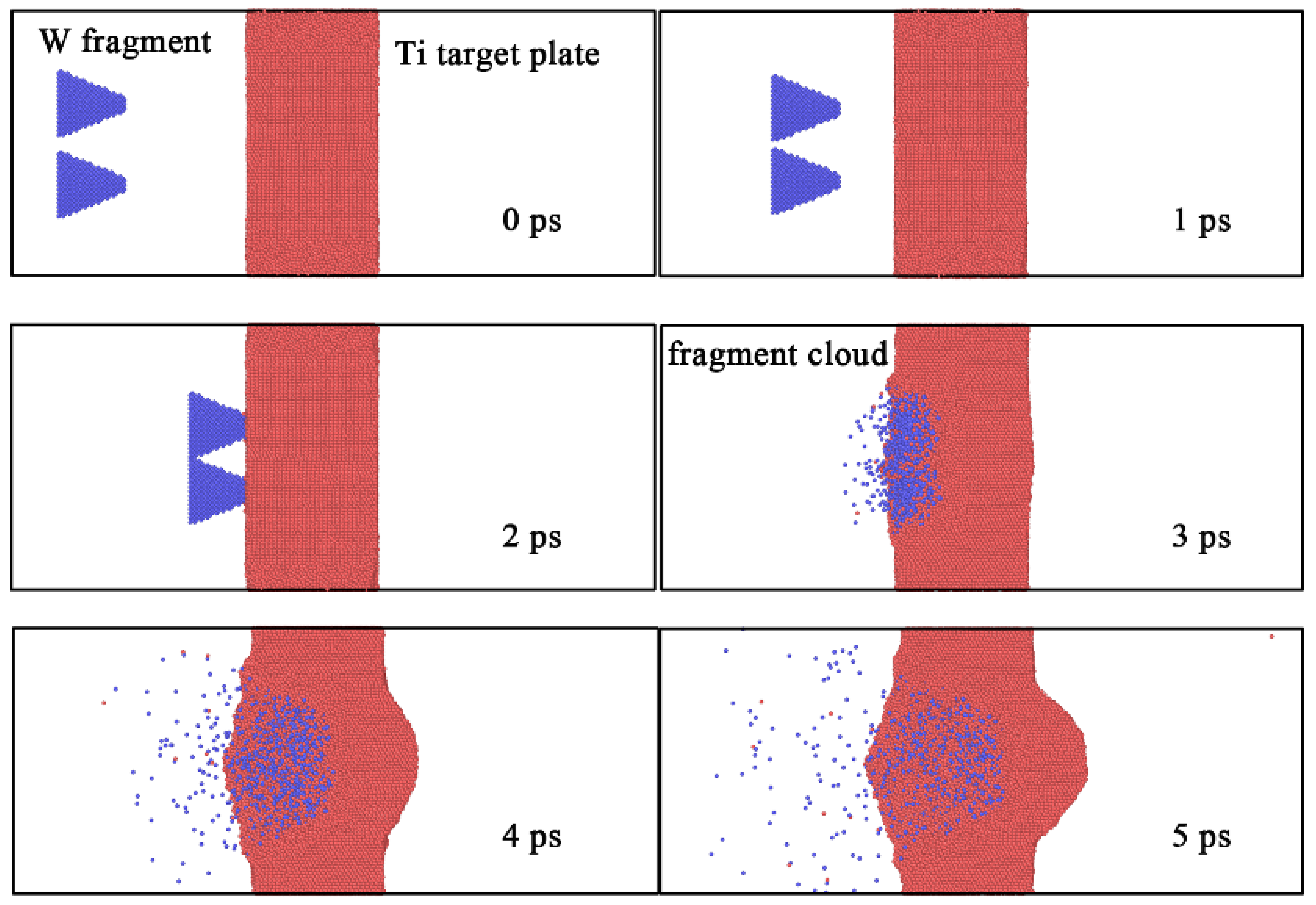
It is said that when a projectile collides with a target plate at high speed, its enormous kinetic energy is instantaneously converted into internal energy, causing the material to undergo intense compression, heating, melting, and even vaporization, ultimately forming a mixed-phase debris cloud composed of solid fragments, liquid droplets, and gaseous vapor [19]. When under ideal conditions without environmental resistance, these two conical tungsten fragments maintain their initial velocity throughout the trajectory, retaining a 5 Å/ps impact speed upon reaching the Ti target surface. The production of a fragment cloud for the double-fragment model is demonstrated in Figure 3 below, in which the synchronous fragmentation behavior of double W fragments and the micro-structural evolution characteristics of the Ti target plate under dual impacts are presented.
Under the simultaneous high-speed impact of two fragments, both of them penetrate into the interior of the Ti target and continue to be pulverized and refined, eventually mixing to form a multi-source W fragment cloud. The fragment system caused by the double-fragment model is mainly divided into two types. The first part remains in the composite crater formed by the superimposed impact, uniformly diffusing in the crater area, while the second part is ejected in the opposite direction of the impact, spreading outward in a radial pattern. Furthermore, particle–particle interactions occur after surface contact as fragment clouds overlap after 3 ps in Figure 3. So, for the double-particle model, it will produce a merged impact crater, which could be considered another type of particle–particle interaction. The penetration performance of the fragments is determined by their own shape characterization. The double-cone configuration used in this simulation cannot penetrate the titanium target plate; however, the strong stress wave generated by the double impact propagates to the rear side of the target plate, eventually forming a distinct plastic bulge on the corresponding back surface of the crater.
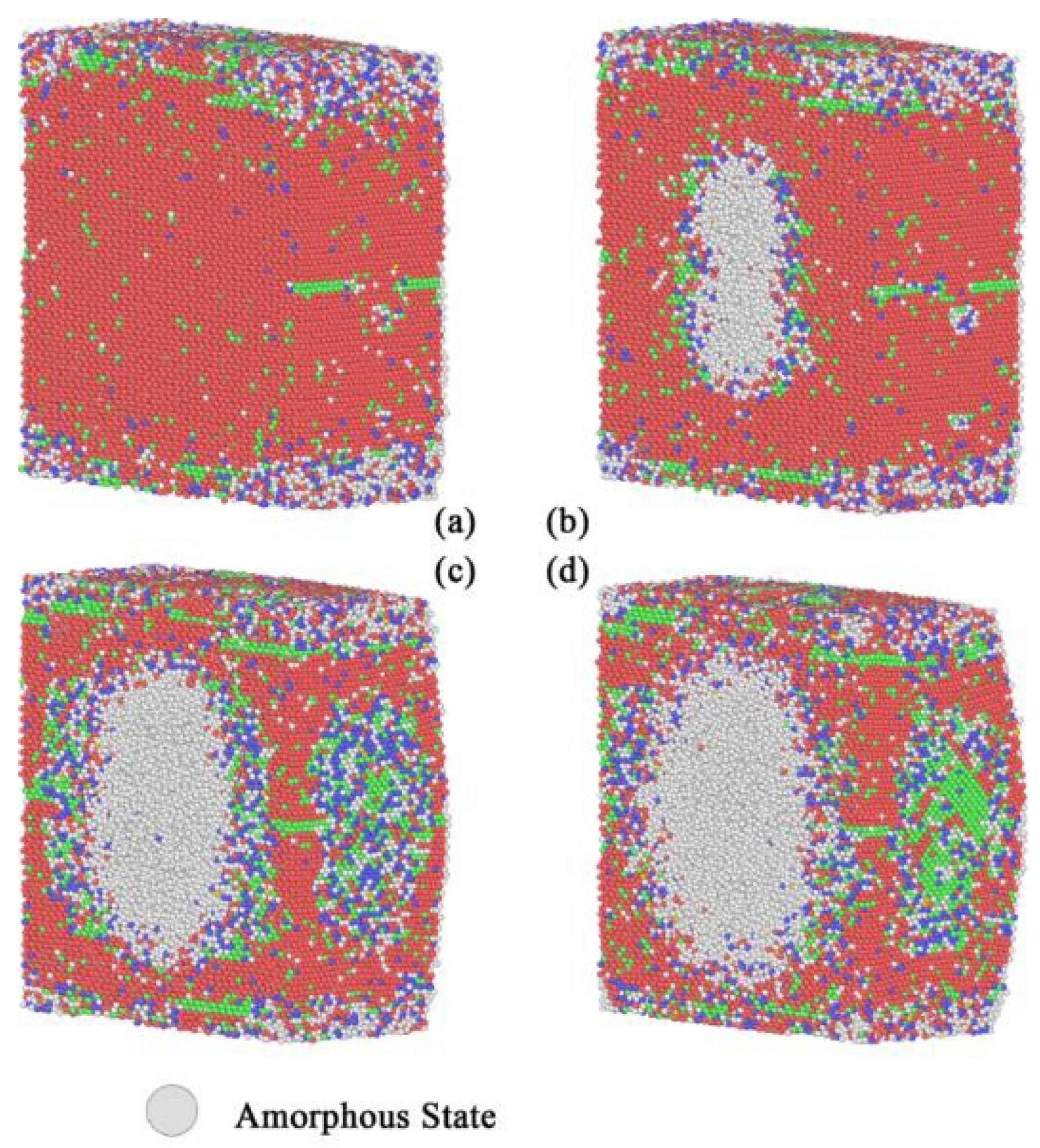
It seems that the ejection of the fragment cloud is produced not only from W but also from the Ti target plate. If parts of phases are peeled off from the Ti crystal, a large area of injury ought to be produced. To some extent, the identification of this injury could be illustrated by the distribution of crystal types, as the majority of amorphous phases in the Ti crystal are produced from the impact of the W fragment. Figure 4 presents the development of Ti target injury in 9 ps. After visualizing the deletion of the W fragment and its cloud, the identification of the Ti target plate crystal type is accomplished by Ackland–Jones [20] analysis. It is observed at the point of 3 ps that the geometry of craters is similar to the cross-section of the double-fragment model, and the interface of the double fragment was not expanded. Then, at the point of 6 ps and 9 ps, these two fragment-like craters are merged into a larger area.
It is said that damage propagation in Ti alloys is not a uniform and continuous process, but it is strongly modulated by crystallographic factors, residual stress fields, and environmental media [21]. According to the distribution of the amorphous phase in the Ti target plate, its damage propagation mainly has two key stages. One is the production stage caused by the impact at high speed, and the other is the extension stage with energy transfer.
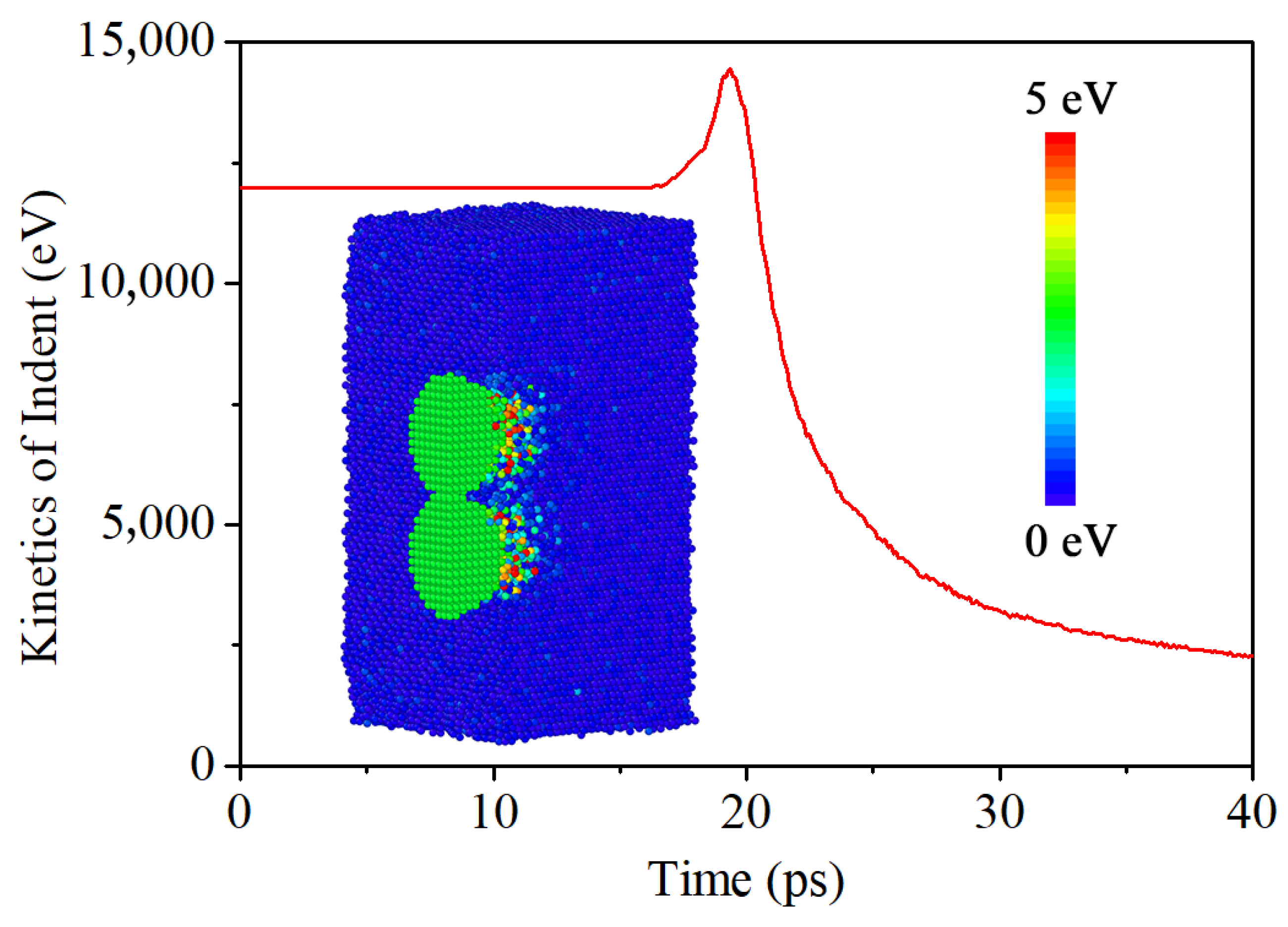
Molecular dynamics simulations indicate that an increase in temperature significantly enhances the average kinetic energy and amplitude of atoms, thereby strengthening the interaction strength between atoms. For instance, the temperature effect influences the fracture behavior of materials by altering the thermal vibration amplitude of atoms, which directly reflects the modulation effect of energy transfer between atoms on the macroscopic mechanical properties [22]. In this study, the kinetics of Ti is not only from their initial thermal vibration but also from the energy transfer from two impacting fragments. Figure 5 shows the indentation kinetics line from the beginning to the end. The kinetics of double W fragments remain stable in the first 16.7 ps, and this is because both Ti target plates and W fragments are under relaxation at 900 K. In this process, there is no energy transfer, so the inner energy system is relatively stable. Then, the indenting kinetics is raised in 4 ps. This is because the double W fragment is accelerated towards the Ti target plate with an initial velocity.
When the fragment and target are impacted with each other, the high kinetic energy is transferred from W to Ti; this could be considered as the damage source presented in Figure 4 above. Additionally, the increase in atomic kinetic energy also appears in parts of W atoms. As shown in Figure 5, the atomic value for impacting sides is much higher than the majority of W atoms. In other words, the energy transfer is also valid for W-W atomic pairs. This allows high kinetics for the W clouds shown in Figure 3.

3.2. Comparisons Between 300 K and 900 K

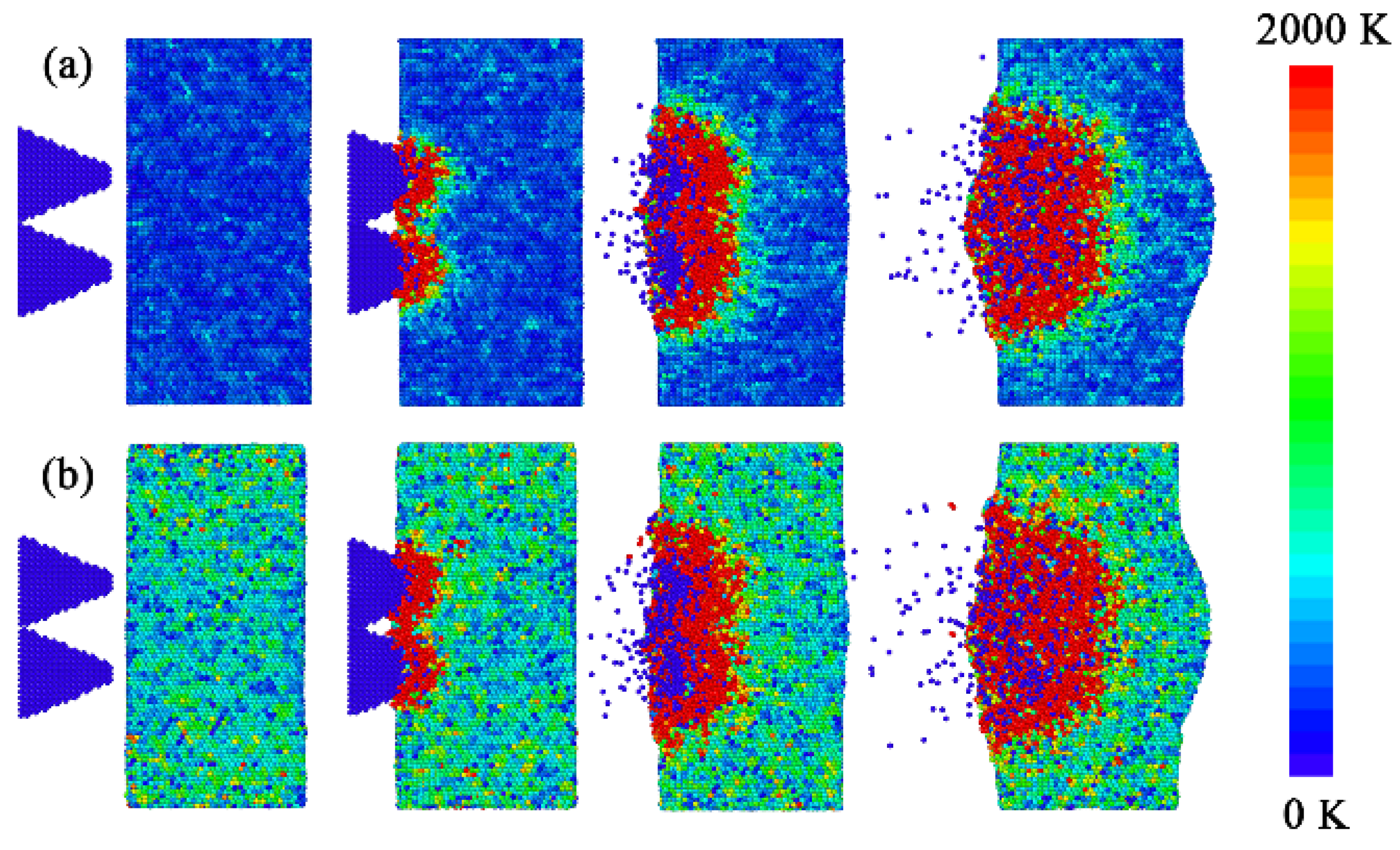
Many metallic materials exhibit significant brittle characteristics under low-temperature conditions. For steel, its impact toughness decreases with decreasing temperature in the range from 293 K to 203 K, and the fracture mode undergoes a transition [23]. The impact behavior of titanium alloys at low temperatures also exhibits unique characteristics. The impact properties and deformation mechanisms of Grade 2 pure titanium and the Ti-2.5Al-3Zr-1Mo alloy undergo significant changes as the temperature decreases from 20 °C to −196 °C [24]. In protective applications, the Ti surface is not always under high temperatures, so comparisons at room and high temperatures could be necessary for this study. As presented in Figure 6, the entire impacting process is uncovered by cross-sections along the middle line of the model.
Analysis based on the double-fragment model indicates that the transient thermal peak effect induced by the synergistic impact of dual tungsten particles remarkably expands the high-temperature damage zone. As shown in Figure 6, when two W fragments strike the target simultaneously, their kinetic energy is converted into internal energy, superimposing to form an extreme local temperature-pressure field. The temperature field results in Figure 6 reveal intensive heat accumulation in overlapping crater regions, where the peak temperature exceeds 2000 K. This has surpassed the melting point of the Ti target plate and generated a continuous molten liquid layer. By comparing two models under 300 K and 900 K, it is found that successive impacts of dual particles drastically elevate the overall temperature of the target substrate. Then, reducing the temperature gap between craters and other regions could weaken heat dissipation efficiency. This is because trapped heat intensifies thermal accumulation and further broadens the high-temperature-affected area. This aggravates melting and vaporization damage of the Ti target compared with single-particle impact.
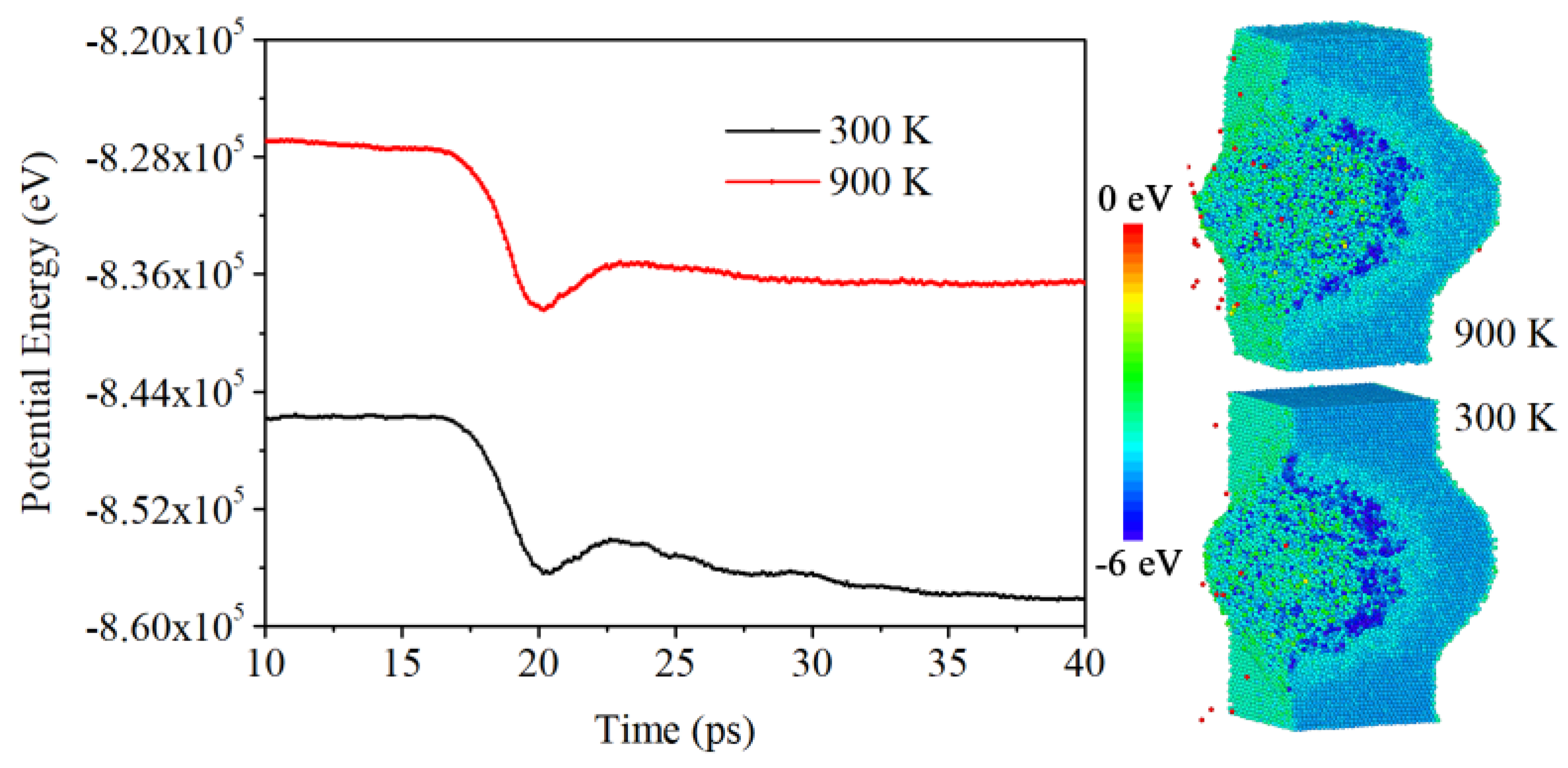
If the visualization structure represents the impact damage result, then the plotting of potential energy could further represent the impact mode. Figure 7 shows the developing trend of potential energy curves from 10 ps to 40 ps, and the snapshots of the crater colored by atomic potential energy. Atomic potential energy is the position-dependent energy stored in the interaction between atoms, determining the stable spacing and binding strength of atoms [9].
When the system temperature decreases from 900 K to 300 K, the in situ thermal vibration of atoms is greatly suppressed, and interatomic interactions are remarkably strengthened. As a result, the absolute value of potential energy at 300 K is significantly higher than that at 900 K. Upon impact, abundant tungsten atoms penetrate and embed into the titanium matrix at high velocity, leading to an instantaneous sharp rise in the absolute potential energy. The subsequent drop of the potential energy curve originates from the ejection of fragment clouds out of the Ti matrix, after which the potential energy gradually plateaus.
By comparing the potential energy curves at 300 K and 900 K, it is found that both the single nano-fragment and double-particle impact models exhibit identical penetration evolution modes at the two temperatures, with highly similar variation trends of potential energy. Temperature only regulates the strength of interatomic interactions within the Ti matrix, reflected by the magnitude of system potential energy, without altering the overall impact penetration evolution behavior.
In order to quantitatively compare crater geometries induced by fragment impact at 300 K and 900 K, characteristic crater dimensions are summarized in Table 1. In terms of crater depth, values at 300 K and 900 K are generally comparable, while a slightly deeper crater is observed at 900 K. Elevated temperature weakens interatomic bonding of the matrix, which facilitates larger plastic deformation under identical impact loading. Similarly, both the long and short crater diameters increase with rising temperature. Nevertheless, penetration depth exhibits negligible temperature dependence. The initial kinetic energy of tungsten fragments is identical across all simulations. After the intact tungsten fragment disintegrates into fragment clouds, the temperature of the Ti target plate exerts no evident influence on the overall penetration performance. Furthermore, as illustrated in Figure 6 and Figure 7, the rear bulge heights of targets from two temperature models are roughly equivalent.

3.3. Effects of Impact Velocity

Impact velocity acts as a critical physical parameter governing the damage mode, energy absorption mechanism, and ultimate failure behavior of titanium alloys, especially the Ti-6Al-4V alloy, under dynamic loading. With the increase in impact velocity, the material response gradually shifts from quasi-static plastic deformation to adiabatic shear and even hydrodynamic penetration under high strain rates. Recent advanced studies have verified that impact velocity not only directly determines the magnitude of input kinetic energy but also profoundly modulates the macroscopic mechanical properties and micro-structural integrity of titanium alloys by altering strain rate sensitivity, phase transformation kinetics, and the evolution path of micro-defects [25,26]. Titanium alloys exhibit distinctly different damage evolution characteristics under different impact velocity ranges. Under low-velocity impact, the primary failure modes are local indentation and initiation/propagation of matrix microcracks. Medium-high velocity impact induces the generation and continuous propagation of adiabatic shear bands. Under ultra-high velocity impact, spallation and full penetration perforation tend to occur, accompanied by severe thermal softening and solid-state phase transformation [27].
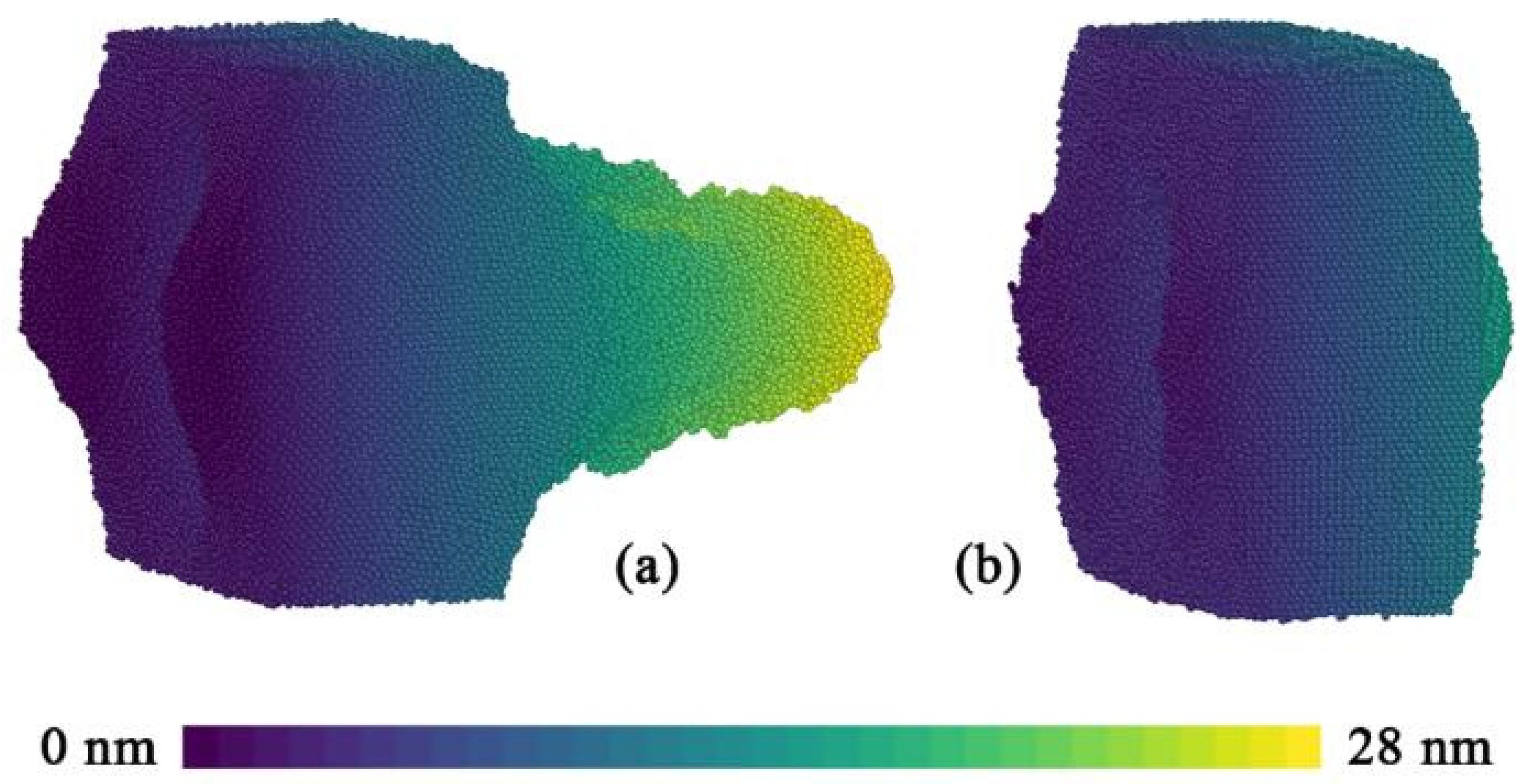
In the penetration simulations adopting the double-particle model, two distinct damage modes emerge depending on the kinetic energy of tungsten (W) fragments. At low impact energy, the W fragment lacks sufficient momentum to perforate the Ti target plate. As illustrated in Figure 8b, only a convex bulge generates on the rear surface of the target, corresponding to non-through internal damage. Once the kinetic energy of the W fragment exceeds the critical penetration threshold, full perforation occurs as displayed in Figure 8a, accompanied by penetrating damage.
The two penetration scenarios share an identical initial impact behavior; upon instantaneous contact between particles, the primary W projectile shatters into fine fragment clouds, which dominate the subsequent damage evolution within the Ti substrate. Nevertheless, prominent discrepancies exist between the two modes. For the non-perforation case in Figure 8b, the rear bulge solely consists of Ti atoms, and fractured W debris becomes trapped inside the target to terminate penetration. In contrast, the ejected fragment clusters after full perforation in Figure 8a are a mixture of W and Ti atomic species. This observation indicates that sufficiently high kinetic energy input enables adequate energy transfer during penetration. Such energy cannot confine fragmented W particles inside the target and simultaneously provides Ti atomic clusters with enough kinetic energy to detach from the Ti target plate, resulting in complete target penetration.
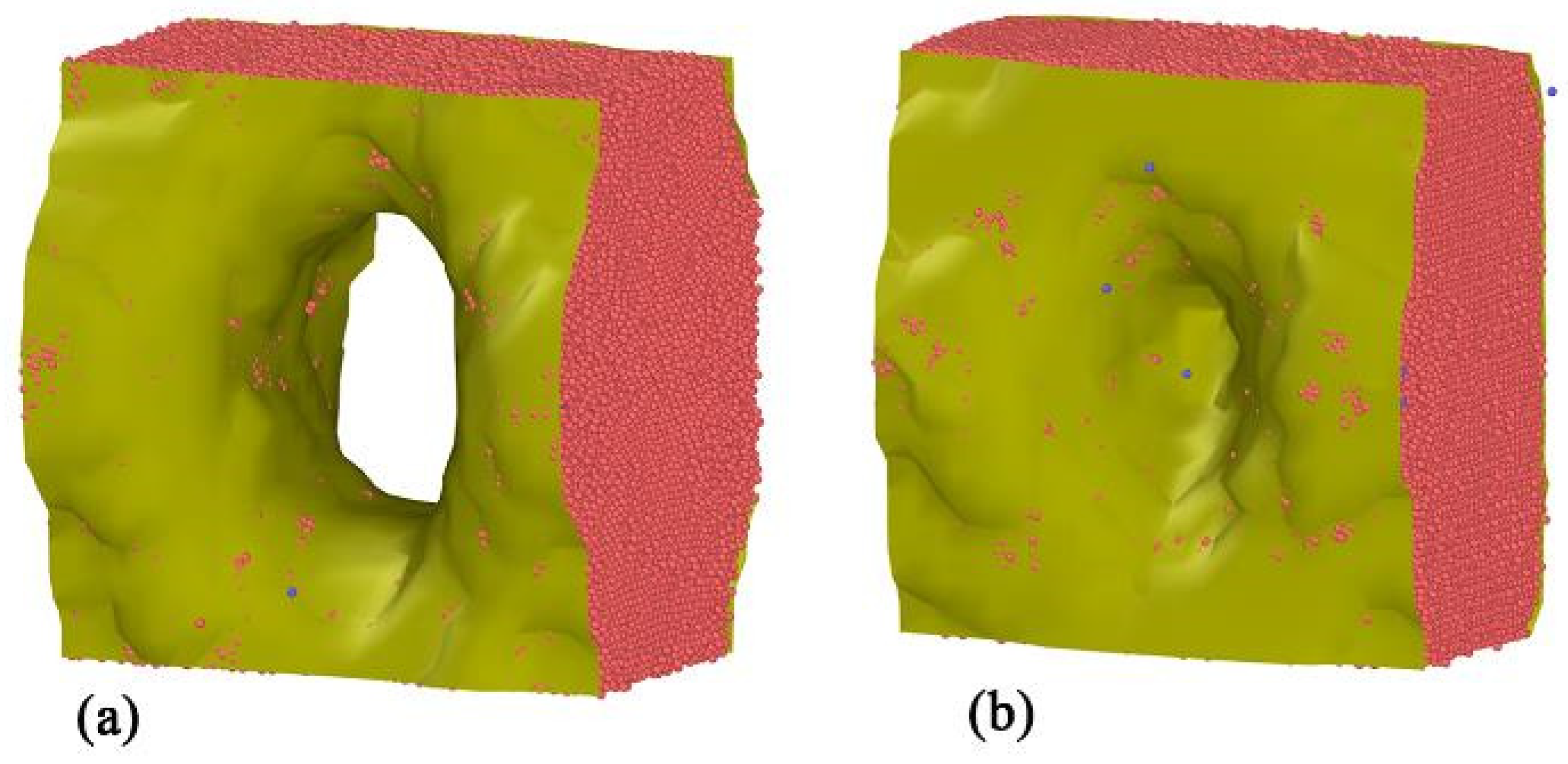
To further analyze crater dimensions after impact penetration, surface and crater visualizations in Figure 9 are rendered using Gaussian Density calculation in OVITO. The craters shown in Figure 9a,b feature nearly identical transverse widths ranging from 6 to 7 nm, whereas their penetration depths differ significantly. This finding reveals that nano-tungsten projectiles of the same geometric size produce distinct penetration depths under perforating and non-perforating impact states. However, impact velocity barely alters the lateral crater size distributed on the planar Ti target surface.

4. Conclusions

This study investigates the high-speed impact behavior of double conical W fragments on Ti target plates via MD simulations. The discussion focuses on fragment cloud formation, target damage evolution, and the effects of temperature and impact velocity.
The MD simulation results demonstrate that high-speed impact transforms the kinetic energy of W fragments into internal energy in the form of atomic thermal excitation and lattice distortion. Upon impact, W fragments penetrate the Ti target and produce a multi-source fragment cloud, which is either confined within the crater cavity or ejected outward along the radial direction. Characterized by amorphous phase distribution, target damage evolves in two distinct stages: impact-triggered damage initiation and subsequent damage extension through continuous energy transfer. Impact velocity governs primary damage modes: low velocity yields non-penetrating internal damage with obvious rear bulging, whereas high velocity leads to full target perforation and ejection of mixed W-Ti fragment clusters. The lateral crater dimension is weakly dependent on impact velocity, while penetration depth differs markedly between perforating and non-perforating loading conditions.
These findings provide fundamental insights into the high-speed impact mechanism of Ti alloys, especially the double-particle mode, offering theoretical support for the design of Ti-based protective structures in engineering applications, such as inhibiting the spreading of fragment clouds and reducing the brittleness of Ti alloys.

Author Contributions

M.X., writing—original draft, writing—review and editing, and investigation; X.S., supervision and validation; R.S., software, conception, data curation, and resources. All authors have read and agreed to the published version of the manuscript.

Funding

This study was funded by the Natural Science Foundation of Henan Province (Grant No. 242300420509).

Data Availability Statement

Data are available upon request from the corresponding author.

Conflicts of Interest

The authors declare that they have no conflicts of interest.

References

  1. Tetsui, T.; Mizuta, K. Effects of Al and O concentrations on the practical properties of TiAl4822 for jet engine blades and the feasibility of machining chip reuse. Crystals 2026, 16, 156. [Google Scholar] [CrossRef] [Scilit]
  2. Zhang, B.; Tang, Y.; Liu, B.; Liu, T.; Nong, Z.; Zhang, H. Research advances in the corrosion behavior and underlying mechanisms of additively manufactured titanium alloys. Crystals 2026, 16, 418. [Google Scholar] [CrossRef] [Scilit]
  3. Chen, Z.; Wang, X.; Tang, H.; Pan, K.; Zhu, L. Effect of Mo content on microstructure and properties of laser additive manufactured TC4 alloy. Rare Met. Mater. Eng. 2026, 55, 124–135. [Google Scholar]
  4. Hu, P.; Wang, S.; Feng, X.; Li, J.; Lu, Z.; Li, Z.; Zhang, X.; Zhang, X. Experimental investigation on failure behaviors of G50 ultra-high strength steel targets struck by tungsten alloy spherical fragments at high velocity. Front. Mater. 2021, 7, 618771. [Google Scholar] [CrossRef] [Scilit]
  5. Hong, D.; Li, W.; Zheng, Y.; Jiang, N.; Zhang, K.; Liu, Z.; Jiang, Y. Study on bulge state of PCrNi3MoV target plates penetrated by square fragments. Appl. Sci. 2022, 12, 6987. [Google Scholar] [CrossRef] [Scilit]
  6. Wan, M.; Bai, R.; Shang, Z.; Wang, Y.; Liang, J.; Li, X. Crushing mechanism of spherical tungsten alloy fragments penetrate thick steel plate target. J. Wuhan Univ. Technol. 2023, 38, 445–450. [Google Scholar] [CrossRef] [Scilit]
  7. Deng, X.; Li, B.; Tang, G.; Zhu, W. Application of molecular dynamics simulation to dynamic response of metals. Chin. J. High Press. Phys. 2019, 33, 030103. [Google Scholar]
  8. Nakatani, K.; Kayanoki, R.; Sugiyama, Y. Molecular dynamics study of impact velocity dependence of structure of debris cloud under hyper velocity impact. J. Soc. Mater. Sci. Jpn. 2007, 56, 199–204. [Google Scholar] [CrossRef] [Scilit]
  9. Liu, P.; Liu, J.; Wang, M. Ignition and combustion of nano-sized aluminum particles: A reactive molecular dynamics study. Combust. Flame 2019, 201, 276–289. [Google Scholar] [CrossRef] [Scilit]
  10. Sun, R.; Liu, P.; Qi, H.; Wang, W.; Lv, F.; Liu, J. Aluminium nanoparticle modelling coupled with molecular dynamic simulation method to compare the effect of annealing rates on diethyl ether coating and oxidation behaviours. J. Mol. Graph. Model. 2020, 100, 107667. [Google Scholar] [CrossRef] [Scilit] [PubMed]
  11. Ganesh, K.V.; Patra, P.K.; Travis, K.P. Multiscale modeling of impact through molecular dynamics and smooth particle hydrodynamics. Physica A 2022, 593, 126903. [Google Scholar] [CrossRef] [Scilit]
  12. Norris, S.A.; Samela, J.; Bukonte, L.; Backman, M.; Djurabekova, F.; Nordlund, K.; Madi, C.S.; Brenner, M.P.; Aziz, M.J. Molecular dynamics of single-particle impacts predicts phase diagrams for large scale pattern formation. Nat. Commun. 2011, 2, 276. [Google Scholar] [CrossRef] [Scilit] [PubMed]
  13. Burlison, S.; Becker, M.F.; Kovar, D. A molecular dynamics study of the effects of velocity and diameter on the impact behavior of zinc oxide nanoparticles. Model. Simul. Mater. Sci. Eng. 2023, 31, 075008. [Google Scholar] [CrossRef] [Scilit]
  14. Vollmayr-Lee, K. Introduction to molecular dynamics simulations. Am. J. Phys. 2020, 88, 401–422. [Google Scholar] [CrossRef] [Scilit]
  15. Liu, H.; Ma, W.; Chen, Z.; Wang, L. Molecular dynamic simulations of carbon coated aluminum nanoparticle with core–shell structure for oxidation resistance behaviors and mechanism. AIP Adv. 2025, 15, 095116. [Google Scholar] [CrossRef] [Scilit]
  16. Thompson, A.P.; Aktulga, H.M.; Berger, R.; Bolintineanu, D.S.; Brown, W.M.; Crozier, P.S.; in’t Veld, P.J.; Kohlmeyer, A.; Moore, S.G.; Nguyen, T.D.; et al. LAMMPS—A flexible simulation tool for particle-based materials modeling at the atomic, meso, and continuum scales. Comput. Phys. Commun. 2022, 271, 108171. [Google Scholar] [CrossRef] [Scilit]
  17. Starikov, S.; Grigorev, P.; Lee, S.-H.; Xie, Z.; Olsson, P.A.T. Angular-dependent interatomic potential for large-scale simulation of bcc and hcp multi-component refractory alloys. Comput. Mater. Sci. 2026, 262, 114369. [Google Scholar] [CrossRef] [Scilit]
  18. Stukowski, A. Visualization and analysis of atomistic simulation data with OVITO–the open visualization tool. Model. Simul. Mater. Sci. Eng. 2010, 18, 015012. [Google Scholar] [CrossRef] [Scilit]
  19. Chen, L.; He, Q.; Chen, X. Numerical study on the phase-transition characteristics of debris cloud under hypervelocity impacts. Int. J. Impact Eng. 2024, 187, 104922. [Google Scholar] [CrossRef] [Scilit]
  20. Ackland, G.J.; Jones, A.P. Applications of local crystal structure measures in experiment and simulation. Phys. Rev. B 2006, 73, 054104. [Google Scholar] [CrossRef] [Scilit]
  21. Wang, K.; Li, H.; Zhou, Y.; Wang, J.; Xin, R.; Liu, Q. Dislocation slip and crack nucleation mechanism in dual-phase microstructure of titanium alloys: A review. Acta Metall. Sin. 2023, 36, 353–365. [Google Scholar] [CrossRef] [Scilit]
  22. Ma, B.; Rao, Q.; He, Y. Molecular dynamics simulation of temperature effect on tensile mechanical properties of single crystal tungsten nanowire. Comput. Mater. Sci. 2016, 117, 40–44. [Google Scholar] [CrossRef] [Scilit]
  23. Ivanov, A.M.; Alexandrova, E.S. Impact toughness of low alloy steels subjected to heat treatment and equal-channel angular pressing at low temperature. Mater. Sci. Forum 2020, 992, 480–486. [Google Scholar] [CrossRef] [Scilit]
  24. Zhao, W.; Su, W.; Li, L.; Fang, D.; Chen, N. Evolution of Mechanical Properties of Ti-6Al-4V Alloy in the Temperature Range of 20 to −196 °C. Met. Mater. Int. 2021, 27, 3214–3224. [Google Scholar] [CrossRef] [Scilit]
  25. Cai, X.; Yang, Y.; Hou, Y.; Liu, B.; Zhang, W.; Mu, Z.; Xie, W.; Jiao, Y.; He, Y.; Wang, P.; et al. Spallation strength and microstructural damage evolution in TC4 titanium alloy subjected to high-velocity impact. J. Alloys Compd. 2025, 1037, 182451. [Google Scholar] [CrossRef] [Scilit]
  26. Zhou, Y.; Zhao, X.; Wang, L.; Zhuang, W.; Sun, X.; Wang, M.; Chu, Z. Deformation and failure mechanism of flat-nosed TC4 titanium alloy projectile penetrating steel target at different velocities. Mater. Des. 2025, 254, 114030. [Google Scholar] [CrossRef] [Scilit]
  27. Guan, X.R.; Chen, Q.; Qu, S.J.; Cao, G.J.; Wang, H.; Ran, X.D.; Feng, A.H.; Chen, D.L. High-strain-rate deformation: Stress-induced phase transformation and nanostructures in a titanium alloy. Int. J. Plast. 2023, 169, 103707. [Google Scholar] [CrossRef] [Scilit]
Figure 1. The initial model including double W fragments and the Ti target plate.
Crystals 16 00569 g001
Figure 2. Flow diagram of performing impact simulation through MD.
Crystals 16 00569 g002
Figure 3. The process of impacts between the W fragment and the Ti target plate.
Crystals 16 00569 g003
Figure 4. Production of the amorphous phase at (a) initial point; (b) 3 ps; (c) 6 ps; (d) 9 ps.
Crystals 16 00569 g004
Figure 5. Development of indenting kinetics in 40 ps.
Crystals 16 00569 g005
Figure 6. Cross-sections of the entire impacting process under (a) 300 K and (b) 900 K.
Crystals 16 00569 g006
Figure 7. Development of potential energy curves for two temperature systems.
Crystals 16 00569 g007
Figure 8. Atomic displacements rendered Ti target plate structure with velocities of (a) 10 and (b) 5 Ǻ/ps.
Crystals 16 00569 g008
Figure 9. Surface meshes rendered snapshots (obtained by OVITO) for the Ti target plate structure after impacts with fragment velocities of (a) 10 and (b) 5 Ǻ/ps.
Crystals 16 00569 g009
Table 1. Crater parameters of Ti target plates after the impact process.
Target Temperature (K)300900
Crater depth (nm)1–22–3
Long diameter (nm)11–1313–15
Short diameter (nm)5–66–7
Complete penetrationNoNo
Rear bulge height (nm)4–54–5
Disclaimer/Publisher’s Note: The statements, opinions and data contained in all publications are solely those of the individual author(s) and contributor(s) and not of MDPI and/or the editor(s). MDPI and/or the editor(s) disclaim responsibility for any injury to people or property resulting from any ideas, methods, instructions or products referred to in the content.