Article

Structure and Photophysical Properties of a Cyclometalated Iridium(III) Complex with 5,6,7,8-Tetraphenyl-1,12-Diazatripheneylene Ligand

Department of Chemistry, Graduate School of Natural Science and Technology, Shimane University, 1060, Nishikawatsu, Matsue 690-8504, Shimane, Japan
*
Authors to whom correspondence should be addressed.
Crystals 2026, 16(9), 565; https://doi.org/10.3390/cryst16090565
Submission received: 1 August 2026 / Revised: 22 August 2026 / Accepted: 27 August 2026 / Published: 29 August 2026

Abstract

A cyclometalated iridium(III) complex [Ir(ppy)2(tpdp)]PF6 ([1]PF6; ppy = 2-phenylpyridinate, tpdp = 5,6,7,8-tetraphenyl-1,12-diazatripheneylene) was synthesized and structurally characterized by single-crystal X-ray diffraction analysis. In [1]+, two nitrogen atoms of tpdp coordinate to the iridium(III) ion with Ir-N distances of 2.131(4) and 2.114(4) Å. The peripheral phenyl substituents of tpdp are oriented nearly perpendicular to the enlarged π-conjugated plane of tpdp. [1]PF6 exhibits shoulder bands at 472, 407, 368, and 337 nm, while the absorption increases continuously from ca. 520 nm toward shorter wavelengths. This spectral feature is similar to that of [Ir(ppy)2(phen)]PF6 ([2]PF6), but the absorption intensity is much higher for [1]PF6 in the UV region. The contribution from the π–π* transition of the tpdp ligand was considered to be the reason that [1]PF6 exhibits such strong absorption in the UV region. Furthermore, [1]PF6 exhibits an emission from 3MLLCT at 558 nm, whereas [2]PF6 exhibits it at 560 nm. The luminescence lifetime (τ) of [1]PF6 was 411 ns, shorter than that of [2]PF6 (900 ns), and the absolute quantum yield (Φ) of [1]PF6 was 4.8%, lower than that of [2]PF6 (20.5%). Cyclic voltammetry (CV) analysis in degassed CH3CN revealed redox waves both at the negative and positive sides (E1/2 = 1.28 and −1.38 V vs. SCE) for [1]PF6. In addition, DFT calculations were performed to discuss the electronic structures and photophysical properties of [1]+.

1. Introduction

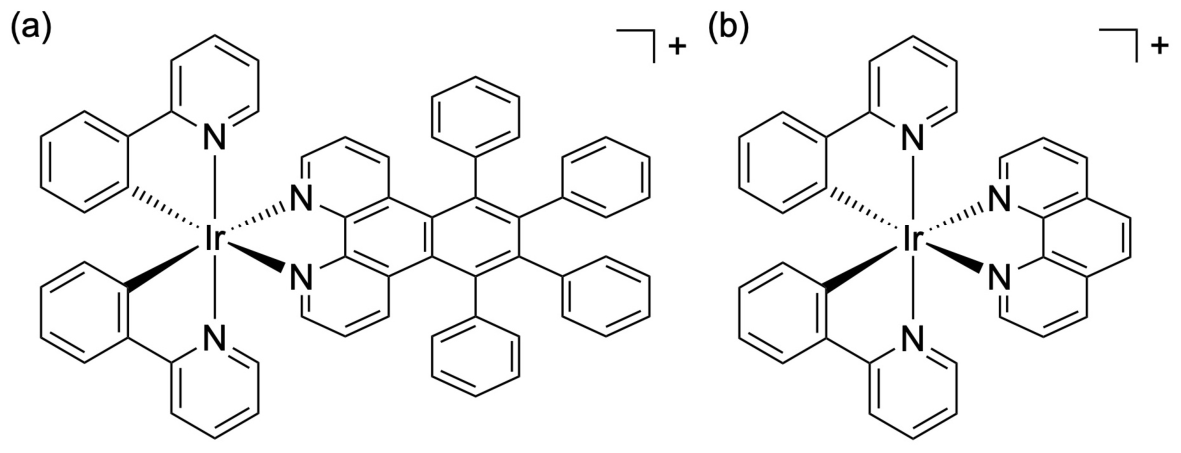
Cyclometalated iridium(III) complexes [Ir(C^N)2(N^N)]X (typically, X = Cl or PF6), in which C^N and N^N are aromatic chelating ligands such as 2-phenylpyridinate (ppy) and 2,2′-bipyridine (bpy) or 1,10-phenanthoroline (phen), respectively, and their homologous compounds have been attracting much attention due to their long-lived luminescence as well as their high photostability [1,2,3]. These properties are suitably applicable for emissive dopants for organic light-emitting diodes (OLEDs) [4,5,6,7], light-emitting electrochemical cells (LECs) [8,9,10,11,12,13], photosensitizers for artificial photosynthesis [14,15,16,17], photo-redox reactions [18,19,20], cell imaging [21,22], etc. It is well known that the spin–orbit coupling (SOC) of the iridium(III) center and strong-ligand field nature based on the IrIII-C bonds give rise to high phosphorescence quantum yield and the high phosphorescent emissions originate from intra-ligand (π–π*) and metal–ligand-to-ligand charge transfer (MLLCT) excited state [5,8,23,24]. Because the HOMO and LUMO are mainly constituted of the components of Ir(C^N)2 and N^N moieties, respectively, the fine tuning of photophysical properties can be made by systemically changing N^N and Ir(C^N)2 moieties [25,26,27]. From this perspective, numerous studies have been conducted on iridium(III) complexes incorporating N^N and Ir(C^N)2 moieties functionalized with various substituent groups [1,2,3]. For example, [Ir(Fppy)2(dmb)]+ (dmb = 4,4′-dimethyl-2,2′-bipyridine) exhibited an intense blue-green 3MLCT emission with an exceptionally high photoluminescence quantum yield (Φ ≈ 1) [28]. Furthermore, [Ir(Phppy)2(N^N)]+ and [Ir(Ph2ppy)2(N^N)]+ were reported as efficient emitters in light-emitting electrochemical cells (LECs) with exceptionally long operational lifetimes [10]. In the case of [Ir(pquin)2(N^N)]+ (pquin = 2-phenyl-quinolinate), expansion of the π-conjugated N^N ligand through benzannulation (bpy → phen → benzo[f][1,10]phenanthroline → naphtho[2,3-f][1,10]phenanthroline) had little influence on the energies of the charge-transfer (CT) absorption and emission bands [29]. In the present study, a new cyclometalated iridium(III) complex, [Ir(ppy)2(tpdp)]PF6 ([1]PF6; tpdp = 5,6,7,8-tetraphenyl-1,12-diazatriphenylene) was synthesized and characterized. The cation [1]+ has an enlarged π-conjugated plane (like the case of benzo[f][1,10]phenanthroline), with four peripheral phenyl substituents (Scheme 1a). The complex was characterized by elemental analysis, ESI-TOF mass spectrometry, and 1H NMR spectroscopy, and its molecular structure was determined by single-crystal X-ray diffraction analysis. Single crystals of the tpdp ligand itself were also obtained and structurally characterized by X-ray crystallography, allowing a detailed comparison between the molecular structure of the free tpdp ligand and that of the coordinated tpdp moiety in [1]PF6. Furthermore, the photophysical properties of [1]PF6 were compared with those of [Ir(ppy)2(phen)]PF6 ([2]PF6; phen = 1,10-phenanthroline), whose cationic structure is shown in Scheme 1b.

2. Results

2.1. Synthesis and Characterization

The tpdp ligand was prepared according to the method reported by Matsumoto et al. [30]. The obtained ligand was employed for the reaction with [Ir(ppy)2Cl]2 (molar ratio of tpdp: [Ir(ppy)2Cl]2 ≈ 2:1) by refluxing for 24 h in 1,2-dichloroethane/methanol (1:1, v/v) solution. The reaction solution was evaporated to a small portion and followed by the addition of diethyl ether to give the precipitation, which was dissolved in water/methanol (4:5, v/v) solution, added by excess NH4PF6 in aqueous solution, and dried under vacuum at 100 °C to give the objective complex [1]PF6 as a yellow powder. The yield was 65.2% based on [Ir(ppy)2Cl]2. The positive electron ionization time-of-flight mass spectroscopy (ESI-TOF-MS) of [1]PF6 showed a peak at 1035.3048 m/z, which corresponds to the [M]+ value of [1]+ (1035.3038 m/z). The 1H NMR spectrum of [1]PF6 was measured in DMSO-d6 and is shown in Figure S1. The signals were assigned to the 42 protons of ppy and tpdp of [1]+. Attenuated total reflection–Fourier-transform infrared (ATR-FT-IR) spectroscopy of [1]PF6 showed the strong P–F vibrations of the PF6 anion at 837 cm−1. In the elemental analysis, observed C, H, and N values are consistent with those calculated for [1]PF6, respectively. Based on the results described above, the objective compound [1]PF6 was successfully obtained without any important impurities.

2.2. Crystal Structures

Single crystals suitable for the X-ray diffraction analyses of [1]PF6 and the tpdp ligand were grown by recrystallizations from a mixed solvent of DMF/dichloromethane and ethyl acetate, respectively. The diffraction analyses were performed at 100 K. The ligand tpdp crystallized in the triclinic system with a space group of P 1 ¯ , while [1]PF6 crystallized in the tetragonal system with a space group of I 4 ¯ 2 d . Bond distances and angles of tpdp and [1]PF6 are listed in Tables S1 and S2, respectively.
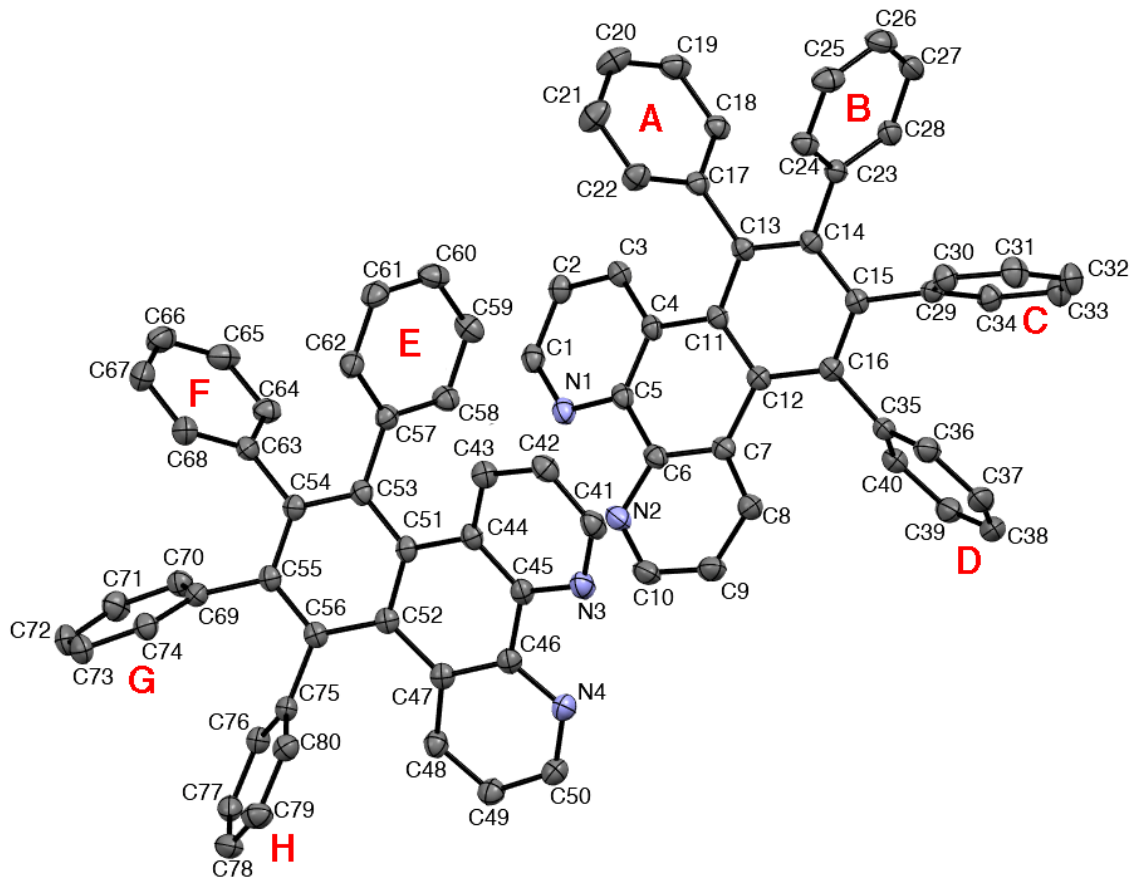
Figure 1 shows the ORTEP view of tpdp. There are two crystallographically independent tpdp molecules in the crystal. No significant structural differences are observed between these two tpdp molecules. The extended π-conjugated planes are both highly planar; the deviations of the constituent atoms from the mean plane containing N1 and N2 atoms and that containing N3 and N4 atoms are less than 0.6 Å and 0.5 Å, respectively. The four attached phenyl groups are oriented nearly perpendicular to each conjugated plane. Specifically, the dihedral angles between the planes of phenyl groups designated A, B, C, and D and the conjugated plane containing N1 and N2 atoms are 64.11°, 89.69°, 86.44° and 68.91°, respectively, while the dihedral angles between the planes of the phenyl groups designated E, F, G, and H and the conjugated plane containing N3 and N4 atoms are 62.60°, 67.21°, 66.08° and 63.31°, respectively. The perpendicularly oriented phenyl groups prevent the tpdp molecules from approaching each other, and no significant intermolecular short contacts are observed. The packing diagram is given in Figure S2.
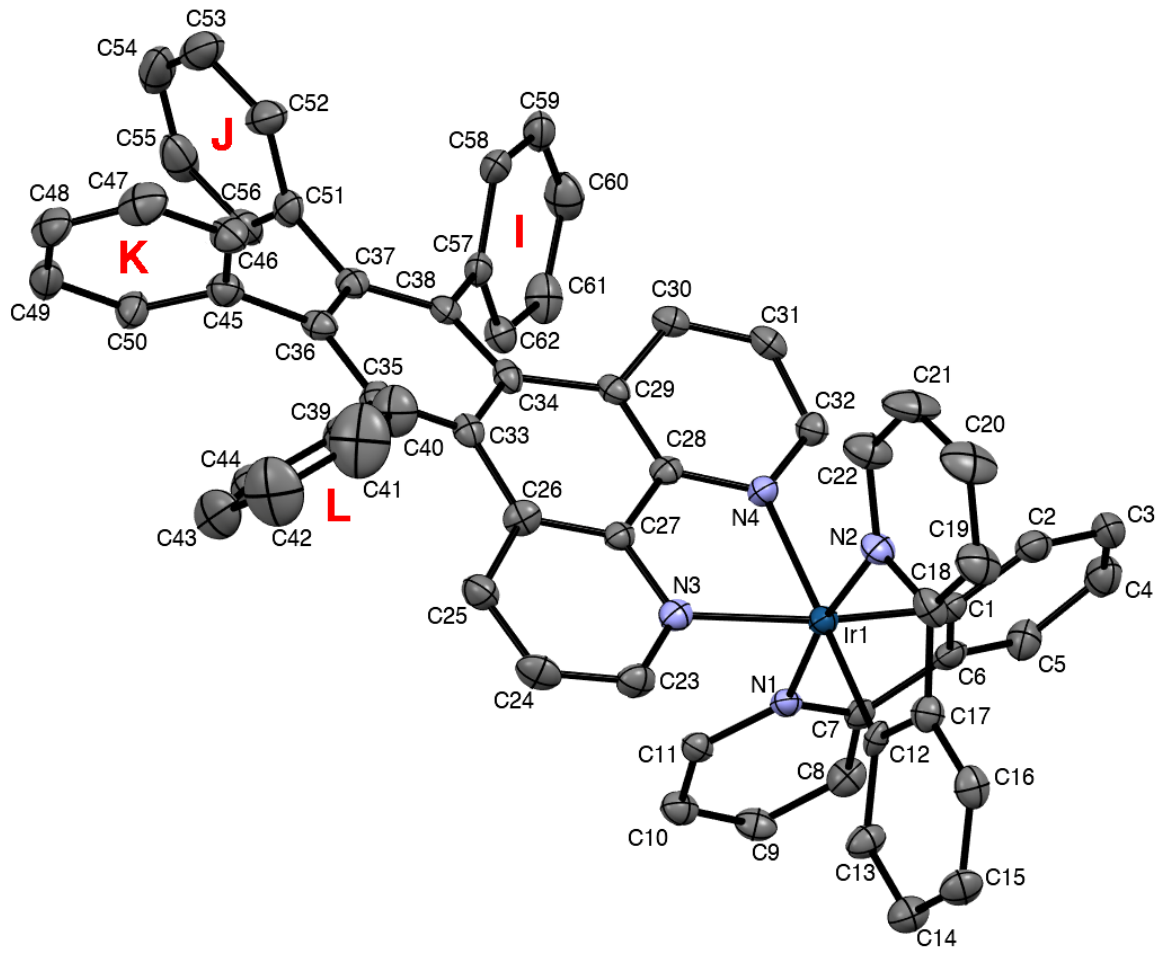
Figure 2 shows the ORTEP view of [1]PF6, although the counter anion PF6 is omitted for clarity. The asymmetric unit of [1]PF6 consists of one [1]+ cation and two half PF6 anions. The cation has two ppy and one tpdp ligands in a pseudo-octahedral coordination geometry around the iridium(III) center. The cyclometalated carbon and nitrogen atoms in the two ppy ligand molecules are coordinated to the iridium(III) center to form the two five-membered chelate rings. The carbon and nitrogen atoms belonging to the different chelate rings are mutually located at their cis and trans positions, respectively, in the octahedron. In the Ir(ppy)2 fragments, the average Ir-C and Ir-N bond lengths are 2.012 and 2.054 Å, respectively, which are almost the same as those of [2]PF6 (Ir-Cav = 2.010 Å; Ir-Nav = 2.046 Å) and [Ir(ppy)2(bpy)]PF6 (Ir-Cav = 2.014 Å; Ir-Nav = 2.045 Å) [8]. In the Ir(tpdp) fraction, the iridium(III) ion is chelated by tpdp with the bond distances of Ir-N3 = 2.131(4) Å and Ir-N4 = 2.114(4) Å, respectively. The Ir-N bond distances are similar to Ir-N(phen) distances of [2]PF6 (2.1367(9) and 2.1496(11) Å) and Ir-N(bpy) distances of [Ir(ppy)2(bpy)]PF6 (2.129(3) and 2.137(3) Å) [8]. The four phenyl groups of the tpdp ligand are oriented nearly perpendicular to the π-conjugated plane like the case of the tpdp ligand itself. The dihedral angles between the planes of the phenyl groups designated I, J, K, and L and the π-conjugated plane are 59.09, 81.63, 84.13, and 65.99°, respectively. The perpendicular orientation of these phenyl groups prevents effectively the close intermolecular contacts between adjacent [1]+ cations in the crystal lattice. The deviations of the constituent atoms from the mean plane of the coordinated tpdp molecule are less than 0.5 Å, indicating that high planarity of the π-conjugated plane is retained upon coordination to the iridium(III) center. The PF6 counter anions exist between the [1]+ cations as shown in the packing diagram (Figure S3).

2.3. Optimized Geometries and Electronic Structures

To understand the molecular geometries and electronic structures of [1]+ in the ground (S0) state and the most stable triplet excited (T1) state, density functional theory (DFT) calculations were performed using a dispersion-corrected hybrid DFT functional, PBE1PBE-D3BJ. As summarized in Table S3, the optimized geometry of [1]+ in the S0 state successfully reproduces the crystal structure; the bond lengths and bond angles in the first coordination sphere show excellent agreement within 0.03 Å and 0.4°, respectively. On the other hand, compared to the optimized structure of the S0 state, that of the T1 state of [1]+ shows a slight shortening (approximately 0.02 Å) of the cyclometalated Ir–C bonds and a slight widening (~0.8°) of the bidentate angles, whereas the Ir–N bond lengths show almost no changes. These structural features and changes of [1]+ are similar to those of common [Ir(ppy)2(N^N)]+ complexes [24].
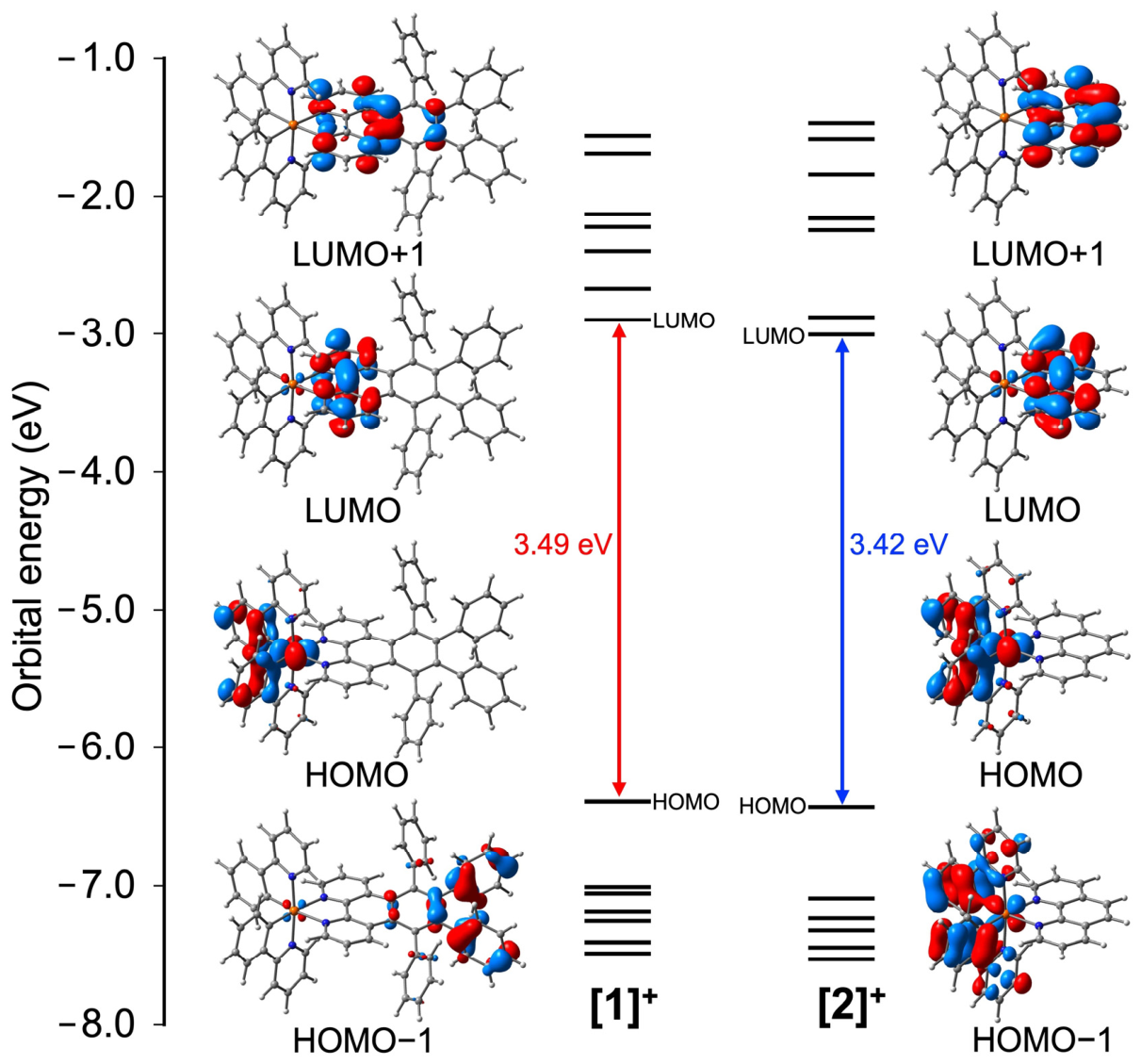
Figure 3 shows the electronic structures along with selected molecular orbitals (MOs) of [1]+ and [2]+. Hereafter, the highest occupied MO and the lowest unoccupied MO are abbreviated as HOMO and LUMO, respectively. The MOs from HOMO–8 to LUMO+5 of [1]+ are depicted in Figure S4. In general, the unstable occupied and stable unoccupied MOs of [Ir(ppy)2(N^N)]+ complexes tend to be localized on the Ir(ppy)2 and N^N moieties, respectively [22], and the MOs of [1]+ were essentially consistent with these tendencies, as in [2]+. Specifically, in the occupied MOs of [1]+, HOMO and HOMO–2 were localized on d(Ir)/π(Ph[ppy]) orbitals, whose energies were nearly the same as the corresponding orbitals (HOMO/HOMO–1) in [2]+. MO characteristics of the tpdp ligand in [1]+ were found in HOMO–1 and HOMO–3, to which the π orbitals of two phenyl moieties (J & K rings for HOMO–1; I & L rings for HOMO–3) together with the benzo moiety made major contributions. HOMO–4 was predominantly occupied by the d(Ir) orbital. On the other hand, LUMO was localized on the π* orbital characters of the phen moiety in the tpdp ligands, while LUMO+1/+2 were both localized on the phen and benzo moieties in the tpdp ligand. These results are consistent with the tendency observed in the stable unoccupied MOs of [Ir(ppy)2(N^N)]+, such as LUMO/LUMO+1 in [2]+, in which the orbitals are localized on the N^N ligand moiety. The orbital energies of LUMO and LUMO+1 of [1]+ were slightly more destabilized than those of [2]+, and the HOMO-LUMO gap of [1]+ was only 0.07 eV wider than that of [2]+. LUMO+3/+4 and LUMO+5/+6 were localized on the π*(ppy) and π*(py[ppy]) moieties, respectively.

2.4. Photophysical Properties

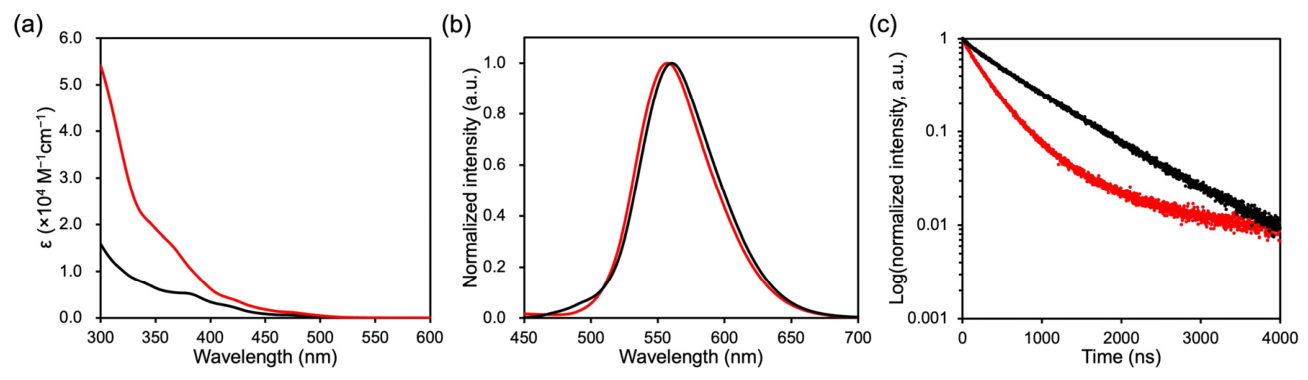
The photophysical properties of [1]PF6 were investigated by measuring its absorption and emission spectra, emission decay, and absolute quantum yield (AQY) in CHCl3, and the results together with the corresponding data for [2]PF6 are summarized in Table 1. As shown in Figure 4a, the absorption spectrum of [1]PF6 exhibits a continuous increase in absorbance from ca. 520 nm toward shorter wavelengths, and displays four shoulder bands, including two in the visible region (472 nm [ε = 1226 M−1cm−1] and 407 nm [ε = 5124 M−1cm−1]) and two in the UV region (368 nm [ε = 14787 M−1cm−1] and 337 nm [ε = 22424 M−1cm−1]). These spectral features closely resemble those of [2]PF6 and its derivatives, and it was confirmed that the molar absorption coefficients of [1]PF6 are, overall, larger than those of [2]PF6. Time-dependent DFT (TDDFT) calculations for [1]+ (see Table S4) revealed that (i) the two visible shoulder bands at 472 and 407 nm are both metal–ligand-to-ligand charge transfer (MLLCT) transitions [31], corresponding to d(Ir)/π(Ph[ppy]) [HOMO] to π*(phen[tpdp]) [LUMO] and to π*(ppy) [LUMO+3], respectively, and (ii) the main excitation character of the two strong-absorbance UV-region shoulder bands is a mixture of MLLCT transitions from d(Ir)/π(ppy) to π*(phen[tpdp]) [LUMO/LUMO+1] and π–π* transitions within the tpdp ligand. This contribution from the π–π* transition of the tpdp ligand accounts for why [1]+ exhibits higher absorbance than [2]+ in the UV region.
In the emission spectra in degassed CHCl3 at 298 K, [1]PF6 exhibits one broad emission band, with an emission maximum at 558 nm (see Figure 4b). This spectral shape closely resembles that of [2]PF6 under the same conditions, and the emission maximum is also very close to that of [2]PF6 (560 nm). Based on the electronic structure in the S0 state and spin-density distributions in the T1 state of [1]+ calculated by DFT, the dominant character of this band for [1]PF6 was assigned to emission from a 3MLLCT state, that is, a π*(tpdp)→d(Ir)/π(ppy) phosphorescence transition, whose characteristics are commonly observed in heteroleptic iridium(III) complexes [Ir(C^N)2(N^N)]+. On the other hand, as shown in Figure 4c, the emission decay of [1]PF6 and [2]PF6 exhibited a clear difference. The emission lifetime (τ) of [1]PF6 was 411 nsec, which was shorter than that of the relatively long-lived [2]PF6 (900 nsec), although this value falls within the typical range for common [Ir(ppy)2(N^N)]PF6 complexes (e.g., N^N = bpy: 269 nsec, 4,4‘-di-tert-butyl-2,2‘-bipyridine: 621 nsec) [32]. Furthermore, the AQY (Φ) of [1]PF6 was 4.8%, which was significantly lower than that of [2]PF6 (20.5%). To discuss the emission properties in more detail, the radiative rate constant (kr) and non-radiative rate constant (knr) of [1]PF6 were calculated using Equation (1) and compared with those of [2]PF6.
Φ = k r k r + k n r = τ k r
The kr value of [1]PF6 was estimated as 1.17 × 10⁵ s−1, which is significantly lower than the knr value (2.31 × 10⁶ s−1), indicating that the transition process from the T1 state to the S0 state for [1]PF6 was dominated by thermal deactivation rather than phosphorescence. In addition, the kr (2.28 × 10⁵ s−1) and knr (0.883 × 10⁶ s−1) values of [2]PF6 were obviously higher and lower than those of [1]PF6. These results suggested that the tpdp ligand in [1]PF6 likely possess greater conformational flexibility in the excited state (e.g., vibration and rotation of the phenyl groups) compared to the phen ligand in [2]PF6.

2.5. Electrochemical Properties

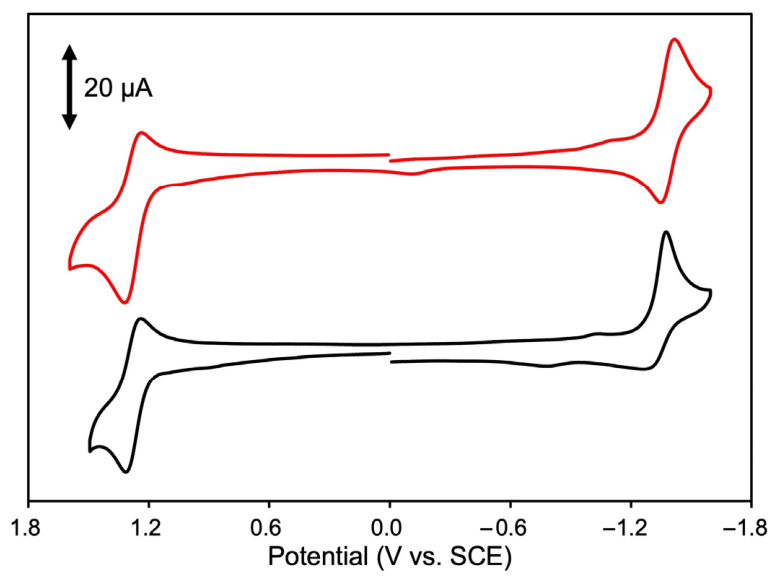
Cyclic voltammetry (CV) analysis in degassed CH3CN was performed to investigate the electrochemical properties of [1]PF6 and their results were compared with those of [2]PF6. As shown in Figure 5, [1]PF6 exhibited one pair of reversible waves on each of the positive and negative sides. The redox potential (E1/2) of the wave on the positive side for [1]PF6 was 1.28 V vs. SCE, and this value is consistent with that of [2]PF6 [E1/2 = 1.28 V vs. SCE]. This result is consistent with the finding that the HOMOs of both [1]+ and [2]+ are localized on d(Ir)/π(ppy). On the other hand, the redox potential of the wave on the negative side for [1]PF6 was −1.38 V vs. SCE, which was slightly more negative than that of [2]PF6 (−1.32 V vs. SCE).
These redox processes are considered, based on DFT calculations, to occur at the N^N moieties. The fact that the wave for [1]+ appeared slightly more negative than that of [2]+ is consistent with the DFT calculations, in which the LUMO energy of [1]+ is slightly less stable (higher in energy) than that of [2]+.

3. Experimental Section

3.1. Materials and Instruments

The chloride-bridged diiridium complex [Ir(ppy)2Cl]2 was prepared according to the method described in the literature [33]. The ligand tpdp was also prepared as previously described [30]. 2-Phenylpyridine (Hppy) was purchased from Tokyo Chemical Industry Co., Ltd. (Tokyo, Japan), and the other regents were obtained from Fujifilm-Wako Pure Chemical Industry (Osaka, Japan).
The CHN elemental analyses were performed by a Yanako (Tokyo, Japan) CHN Coder MT-6 instrument at Shimane University. The 1H NMR spectrum was measured in DMSO-d6 using a JEOL (Tokyo, Japan) JNM-ECX500 spectrometer with the chemical shift (δ) relative to the residual DMSO peak (δ = 2.49 ppm). Electrospray time-of-flight ionization mass spectrometry (ESI-TOF-MS) was measured using a Bruker (Billerica, MA, USA) micrOTOF II instrument in the positive-ion mode using sodium formate as a mass calibrant. Attenuated total reflection–Fourier-transform infrared (ATR-FT-IR) spectroscopy was measured using a JASCO (Tokyo, Japan) FT/IR-6300 spectrophotometer equipped with an ATR PRO ONE module. Absorption and emission spectra were on JASCO (Tokyo, Japan) V-670 and FP-8300 spectrophotometers, respectively. The emission lifetimes were measured with a HORIBA (Kyoto, Japan) FluoroCube instrument, operated at an excitation wavelength of 370 nm, and the absolute quantum yields were assessed with a HAMAMATSU Photonics (Shizuoka, Japan) Quantaurus-QY system under the same excitation wavelength. Cyclic voltammetry (CV) was conducted at a scan rate of 100 mV/s using a HOKUTO DENKO HZ-7000 system (Tokyo, Japan) in a degassed CH3CN solution containing 0.10 M tetrabutylammonium hexafluorophosphate (TBAPF6), with a glassy carbon disk (3.0 mm diameter), a platinum wire, and a saturated calomel electrode (SCE) employed as the working, counter, and reference electrodes, respectively.

3.2. Synthesis of [1]PF6

[Ir(ppy)2Cl]2 (26.8 mg, 0.025 mmol) and tpdp (29.4 mg, 0.055 mmol) were dissolved in 15 mL of 1,2-dichloroethane/methanol (1:1, v/v) solution and refluxed for 24 h. The resultant solution was evaporated and followed by addition of diethyl ether. The residue formed was separated through filtration using a membrane filter to exclude the unreacted materials and washed with diethyl ether. The obtained yellow powder was solved in 45 mL of water/methanol (4:5, v/v) solution, followed by the addition of an excess amount of NH4PF6 (244.5 mg, 1.50 mmol). The solution was stirred at room temperature for 2 h. A resultant yellow precipitate was collected, washed with a mixed solvent of water/methanol (4:5, v/v), and dried under vacuum at 373 K. Yield: 38.5 mg (65.2% based on [Ir(ppy)2Cl]2). Anal. Calc. for C62H42F6Ir1N4P1: C, 63.10; H, 3.59; N, 4.75%. Found: C, 63.12; H, 3.75; N, 4.50%. 1H NMR (500 MHz, DMSO-d6, δ): 8.26 (d, 2H), 7.92 (m, 8H), 7.56 (dd, 2H), 7.41 (q, 2H), 7.19 (m, 8H), 7.10 (m, 2H), 7.01 (m, 4H), 6.90 (m, 8H), 6.80 (m, 2H), 6.66 (m, 2H), 6.21 (dd, 2H) ppm. ESI-TOF-MS: calc. for [M]+: 1035.3038 m/z; found 1035.3048 m/z.

3.3. Crystallography

X-ray diffraction data of tpdp and [1]PF6 crystals were collected at 100 K using a RIGAKU (Tokyo, Japan) XtaLAB Synergy system equipped with a Hypix-6000 detector and a molybdenum rotating anode X-ray source. The collected diffraction data were processed and reduced using a CrysAlisPro program (version 1.171.42.94a) [34]. The initial modes of the structures were obtained using the SHELXT-2014 program [35] with the intrinsic phasing method and were then refined with full-matrix least squares on F2 using the SHELXL-2019 program [36] in the Olex2 software (version 1.5) [37]. Non-hydrogen atoms were refined anisotropically, and hydrogen atoms were fixed at the calculated positions and refined as riding models. The electron densities of the disordered solvents in [1]PF6 crystal were removed using the solvent mask routine of Olex2 software. The crystallographic data for the final refined structures of tpdp and [1]PF6 crystals are summarized in Table 2, and their structural parameters are given in Tables S1 and S2. These crystallographic data can be obtained free of charge from the Cambridge Crystallographic Data Center (CCDC); the deposition numbers of tpdp and [1]PF6 are CCDC 2577985 and 2577986, respectively.

3.4. Quantum Chemical Calculations

All quantum chemical calculations performed in this study were carried out using the dispersion-corrected hybrid DFT functional PBE1PBE-D3BJ [38,39], with the Def2-TZVP basis set for the Ir atom and the Def2-SVP basis set for the other atoms [40], as implemented in Gaussian 16 (Rev. C.01) software [41]. A polarizable continuum model (PCM) was used to account for the solvent effect of CHCl3 [42]. Molecular geometries were fully optimized without any structural constraints and finally verified by vibrational frequency analyses. Time-dependent DFT (TDDFT) calculations [43] were performed to gain the excitation wavelengths, oscillator strengths, and assignments of excitation characters. MOs were visualized using GaussView 5.0 software [44].

4. Conclusions

In this study, we successfully synthesized and characterized a new cyclometalated iridium(III) complex, [Ir(ppy)2(tpdp)]PF6 ([1]PF6; ppy = 2-phenylpyridinate, tpdp = 5,6,7,8-tetraphenyl-1,12-diazatriphenylene). Single-crystal X-ray diffraction analyses of both [1]PF6 and the free tpdp ligand revealed that the high planarity of the π-conjugated framework of tpdp is retained upon coordination to the iridium(III) center. [1]PF6 exhibits shoulder absorption bands at 472, 407, 368, and 337 nm, while the absorption increases continuously from ca. 520 nm toward shorter wavelengths. Although its absorption profile is similar to that of [Ir(ppy)2(phen)]PF6 ([2]PF6), the absorption intensity of [1]PF6 is significantly higher than that of [2]PF6 in the UV region. [1]PF6 displays a 3MLLCT emission band at 558 nm, whereas [2]PF6 emits at 560 nm. The luminescence lifetime (τ) of [1]PF6 was determined to be 411 ns, which is shorter than that of [2]PF6 (900 ns), and the absolute photoluminescence quantum yield (Φ) of [1]PF6 was 4.8%, lower than that of [2]PF6 (20.5%). These results are attributed to the greater structural flexibility of the tpdp ligand in [1]PF6, likely arising from the vibrational and rotational motions of the peripheral phenyl groups. Nevertheless, the expanded π-conjugated system of the N^N ligand was found to be effective in enhancing UV absorption. For the development of this class of luminescent materials, reducing the structural flexibility of substituents attached to the enlarged π-conjugated framework may be an effective strategy for improving photophysical performance. Ongoing studies in our laboratory are focused on identifying suitable substituent groups to achieve this goal.

Supplementary Materials

The following supporting information can be downloaded at https://www.mdpi.com/article/10.3390/cryst16090565/s1, Figure S1: 1H NMR spectrum [1]PF6 in DMSO-d6; Figure S2: Packing view of crystal structure of tpdp; Figure S3: Packing view of crystal structure of [1]PF6; Figure S4: MO pictures from HOMO-8 to LUMO+5 of [1]+; Table S1: Bond distances and angles of crystal structure of tpdp; Table S2: Bond distances and angles of crystal structure of [1]PF6; Table S3: Comparison of bonding parameters of the first coordination sphere of [1]+ derived from SCXRD and from structures optimized in the S0 and T1 states; Table S4: Result of TDDFT calculation of [1]+ (H and L indicate the HOMO and LUMO, respectively).

Author Contributions

Conceptualization, Y.K.; validation, N.Y., M.H. and Y.K.; formal analysis, N.Y., K.I., M.H. and Y.K.; investigation, N.Y., K.I., M.H. and Y.K.; resources, Y.K.; data curation, N.Y., M.H. and Y.K.; writing—original draft preparation, M.H. and Y.K.; writing—review and editing, N.Y., K.I., M.H. and Y.K.; visualization, N.Y. and Y.K.; supervision, Y.K.; project administration, Y.K.; funding acquisition, N.Y., M.H. and Y.K. All authors have read and agreed to the published version of the manuscript.

Funding

This research was supported by JSPS KAKENHI, grant numbers JP24K08494, JP24K08363, and JP25K18113. This research was financially supported by SDGs research project of Shimane University.

Data Availability Statement

The original contributions presented in this study are included in the article/Supplementary Material. Further inquiries can be directed to the corresponding authors.

Acknowledgments

The authors are grateful to Michiko Egawa (Shimane University) for her measurements of the elemental analyses. During the preparation of this manuscript, the authors used M365 Copilot, based on the GPT-5 chat model, for English proof-reading. The authors have reviewed and edited the output and take full responsibility for the content of this publication.

Conflicts of Interest

The authors declare no conflicts of interest.

References

  1. Ladouceur, S.; Zysman-Colman, E. A Comprehensive Survey of Cationic Iridium(III) Complexes Bearing Nontraditional Ligand Chelation Motifs. Eur. J. Inorg. Chem. 2013, 17, 2985–3007. [Google Scholar] [CrossRef] [Scilit]
  2. Mills, I.N.; Porras, J.A.; Bernhard, S. Judicious Design of Cationic, Cyclometalated Ir(III) Complexes for Photochemical Energy Conversion and Optoelectronics. Acc. Chem. Res. 2018, 51, 352–364. [Google Scholar] [CrossRef] [Scilit] [PubMed]
  3. Monti, F.; Baschieri, A.; Sambri, L.; Armaroli, N. Excited-State Engineering in Heteroleptic Ionic Iridium(III) Complexes. Acc. Chem. Res. 2021, 54, 1492–1505. [Google Scholar] [CrossRef] [Scilit] [PubMed]
  4. Slinker, J.D.; Gorodetsky, A.A.; Lowry, M.S.; Wang, J.J.; Parker, S.; Rohl, R.; Bernhard, S.; Malliaras, G.G. Efficient Yellow Electroluminescence from a Single Layer of a Cyclometalated Iridium Complex. J. Am. Chem. Soc. 2004, 126, 2763–2767. [Google Scholar] [CrossRef] [Scilit] [PubMed]
  5. Tamayo, A.B.; Garon, S.; Sajoto, T.; Djurovich, P.I.; Tsyba, I.M.; Bau, R.; Thompson, M.E. Cationic Bis-cyclometalated Iridium(III) Diimine Complexes and Their Use in Efficient Blue, Green, and Red Electroluminescent Devices. Inorg. Chem. 2005, 44, 8723–8732. [Google Scholar] [CrossRef] [Scilit] [PubMed]
  6. Henwood, A.F.; Bansal, A.K.; Cordes, D.B.; Slawin, A.M.Z.; Samuel, I.D.W.; Zysman-Colman, E. Solubilised Bright Blue-Emitting Iridium Complexes for Solution Processed OLEDs. J. Mater. Chem. C 2016, 4, 3726–3737. [Google Scholar] [CrossRef] [Scilit] [PubMed]
  7. Orwat, B.; Witkowska, E.; Kownacki, I.; Oh, M.-J.; Hoffmann, M.; Kubicki, M.; Grzelak, I.; Marciniec, B.; Glowacki, I.; Luszczynska, B.; et al. Microwave-Assisted One-Pot Synthesis of New Ionic Iridium Complexes of [Ir(bzq)2(N^N)]+A Type and Their Selected Electroluminescent Properties. Dalton Trans. 2017, 46, 9210–9218. [Google Scholar] [CrossRef] [Scilit] [PubMed]
  8. Costa, R.D.; Ortí, E.; Bolink, H.J.; Graber, S.; Schaffner, S.; Neuburger, M.; Housecroft, C.E.; Constable, E.C. Archetype Cationic Iridium Complexes and Their Use in Solid-State Light-Emitting Electrochemical Cells. Adv. Funct. Mater. 2009, 19, 3456–3463. [Google Scholar] [CrossRef] [Scilit]
  9. Li, P.; Shan, G.-G.; Cao, H.-T.; Zhu, D.-X.; Su, Z.-M.; Jitchati, R.; Bryce, M.R. Intramolecular π-Stacking in Cationic Iridium(III) Complexes with Phenyl-Functionalized Cyclometalated Ligands: Synthesis, Structure, Photophysical Properties, and Theoretical Studies. Eur. J. Inorg. Chem. 2014, 2014, 2376–2382. [Google Scholar] [CrossRef] [Scilit]
  10. Bünzli, A.M.; Constable, E.C.; Housecroft, C.E.; Prescimone, A.; Zampese, J.A.; Longo, G.; Gil-Escrig, L.; Pertegás, A.; Ortí, E.; Bolink, H.J. Exceptionally Long-Lived Light-Emitting Electrochemical Cells: Multiple Intra-Cation π-Stacking Interactions in [Ir(C^N)2(N^N)][PF6] Emitters. Chem. Sci. 2015, 6, 2843–2852. [Google Scholar] [CrossRef] [Scilit] [PubMed]
  11. Wang, X.X.; Wang, S.R.; Pan, F.F.; He, L.; Duan, L. Cationic Iridium Complexes with 5-Phenyl-1H-1,2,4-triazole Type Cyclometalating Ligands: Toward Blue-Shifted Emission. Inorg. Chem. 2019, 58, 12132–12145. [Google Scholar] [CrossRef] [Scilit] [PubMed]
  12. Demir, N.; Karaman, M.; Yakali, G.; Gultekin, B.; Tugsuz, T.; Denizalti, S.; Demic, S.; Aygun, M.; Dindar, B.; Can, M. Supramolecular Orange-Red- and Yellow-Emitting Ir(III) Complexes with TFSI and PF6 Counteranions and Production of LEC Devices. ACS Appl. Electron. Mater. 2020, 2, 3549–3561. [Google Scholar] [CrossRef] [Scilit]
  13. Golbodaghi, Z.; Bideh, B.N. Supramolecularly Caged Cyclometalated Iridium Complex with a New Imidazole Type Ancillary Ligand for Stable and Bright Green Light-Emitting Electrochemical Cell. Luminescence 2025, 40, e70234. [Google Scholar] [CrossRef] [Scilit] [PubMed]
  14. Goldsmith, J.I.; Hudson, W.R.; Lowry, M.S.; Anderson, T.H.; Bernhard, S. Discovery and High-Throughput Screening of Heteroleptic Iridium Complexes for Photoinduced Hydrogen Production. J. Am. Chem. Soc. 2005, 127, 7502–7510. [Google Scholar] [CrossRef] [Scilit] [PubMed]
  15. Takizawa, S.; Shimada, K.; Sato, Y.; Murata, S. Controlling the Excited State and Photosensitizing Property of a 2-(2-Pyridyl)benzo[b]thiophene-Based Cationic Iridium Complex through Simple Chemical Modification. Inorg. Chem. 2014, 53, 2983–2995. [Google Scholar] [CrossRef] [Scilit] [PubMed]
  16. Kataoka, Y.; Yano, N.; Handa, M.; Kawamoto, T. Intrinsic Hydrogen Evolution Capability and a Theoretically Supported Reaction Mechanism of a Paddlewheel-Type Dirhodium Complex. Dalton Trans. 2019, 48, 7302–7312. [Google Scholar] [CrossRef] [Scilit] [PubMed]
  17. Kataoka, Y.; Sato, K.; Yano, N. Hydroxypyridinate-bridged Paddlewheel-type Dirhodium Complex as a Catalyst for Photochemical and Electrochemical Hydrogen Evolution. J. Chem. Phys. 2023, 159, 204304. [Google Scholar] [CrossRef] [Scilit] [PubMed]
  18. Bawden, J.C.; Francis, P.S.; DiLuzio, S.; Hayne, D.J.; Doeven, E.H.; Truong, J.; Alexander, R.; Henderson, L.C.; Gómez, D.E.; Massi, M.; et al. Reinterpreting the Fate of Iridium(III) Photocatalysts—Screening a Combinatorial Library to Explore Light-Driven Side-Reactions. J. Am. Chem. Soc. 2022, 144, 11189–11202. [Google Scholar] [CrossRef] [Scilit] [PubMed]
  19. Connell, T.U.; Fraser, C.L.; Czyz, M.L.; Smith, Z.M.; Hayne, D.J.; Doeven, E.H.; Agugiaro, J.; Wilson, D.J.D.; Adcock, J.L.; Scully, A.D.; et al. The Tandem Photoredox Catalysis Mechanism of [Ir(ppy)2(dtb-bpy)]+ Enabling Access to Energy Demanding Organic Substrates. J. Am. Chem. Soc. 2019, 141, 17646–17658. [Google Scholar] [CrossRef] [Scilit] [PubMed]
  20. Li, L.-P.; Ye, B.-H. Efficient Generation of Singlet Oxygen and Photooxidation of Sulfide into Sulfoxide via Tuning the Ancillary of Bicyclometalated Iridium(III) Complexes. Inorg. Chem. 2019, 58, 7775–7784. [Google Scholar] [CrossRef] [Scilit] [PubMed]
  21. Caporale, C.; Massi, M. Cyclometalated Iridium(III) Complexes for Life Science. Coord. Chem. Rev. 2018, 363, 71–91. [Google Scholar] [CrossRef] [Scilit]
  22. Zhang, K.Y.; Liu, H.-W.; Tang, M.-C.; Choi, A.W.-T.; Zhu, N.; Wei, X.-G.; Lau, K.-C.; Lo, K.K.-W. Dual-Emissive Cyclometalated Iridium(III) Polypyridine Complexes as Ratiometric Biological Probes and Organelle-Selective Bioimaging Reagents. Inorg. Chem. 2015, 54, 6582–6593. [Google Scholar] [CrossRef] [Scilit] [PubMed]
  23. Garces, F.O.; King, K.A.; Watts, R.J. Synthesis, Structure, Electrochemistry, and Photophysics of Methyl-Substituted Phenylpyridine Ortho-Metalated Iridium(III) Complexes. Inorg. Chem. 1988, 27, 3464–3471. [Google Scholar] [CrossRef] [Scilit]
  24. Yano, N.; Handa, M.; Kataoka, Y. Photophysical Properties and Photosensitizing Abilities for Hydrogen Evolution Reactions of Robust Cyclometalated Iridium(III) Complexes with 5,5′-Bis(trifluoromethyl)-2,2′-bipyridine. J. Photochem. Photobiol. A Chem. 2020, 400, 112716. [Google Scholar] [CrossRef] [Scilit]
  25. Hasan, K.; Bansal, A.K.; Samuel, I.D.W.; Roldán-Carmona, C.; Bolink, H.J.; Zysman-Colman, E. Tuning the Emission of Cationic Iridium (III) Complexes Towards the Red Through Methoxy Substitution of the Cyclometalating Ligand. Sci. Rep. 2015, 5, 12325. [Google Scholar] [CrossRef] [Scilit] [PubMed]
  26. Skórka, Ł.; Filapek, M.; Zur, L.; Małecki, J.G.; Pisarski, W.; Olejnik, M.; Danikiewicz, W.; Krompiec, S. Highly Phosphorescent Cyclometalated Iridium(III) Complexes for Optoelectronic Applications: Fine Tuning of the Emission Wavelength through Ancillary Ligands. J. Phys. Chem. C 2016, 120, 7284–7294. [Google Scholar] [CrossRef] [Scilit]
  27. Langdon-Jones, E.E.; Hallett, A.J.; Routledge, J.D.; Crole, D.A.; Ward, B.D.; Platts, J.A.; Pope, S.J.A. Using Substituted Cyclometalated Quinoxaline Ligands To Finely Tune the Luminescence Properties of Iridium(III) Complexes. Inorg. Chem. 2013, 52, 448–456. [Google Scholar] [CrossRef] [Scilit] [PubMed]
  28. Zanoni, K.P.S.; Kariyazaki, B.K.; Ito, A.; Brennaman, M.K.; Meyer, T.J.; Murakami Iha, N.Y. Blue-Green Iridium(III) Emitter and Comprehensive Photophysical Elucidation of Heteroleptic Cyclometalated Iridium(III) Complexes. Inorg. Chem. 2014, 53, 4089–4099. [Google Scholar] [CrossRef] [Scilit] [PubMed]
  29. Liu, B.; Lystrom, L.; Brown, S.L.; Hobbie, E.K.; Kilina, S.; Sun, W. Impact of Benzannulation Site at the Diimine (N^N) Ligand on the Excited-State Properties and Reverse Saturable Absorption of Biscyclometalated Iridium(III) Complexes. Inorg. Chem. 2019, 58, 5483–5493. [Google Scholar] [CrossRef] [Scilit] [PubMed]
  30. Matsumoto, K.; Kato, M.; Yagi, I.; Xie, S.; Asakura, K.; Noro, S.-I.; Tohnai, N.; Campidelli, S.; Hayashi, T.; Onoda, A. One-Step Preparation of Fe/N/C Single-Atom Catalysts Containing Fe−N4 Sites from an Iron Complex Precursor with 5,6,7,8-Tetraphenyl-1,12-Diazatriphenylene Ligands. Chem. Eur. J. 2022, 28, e202103545. [Google Scholar] [CrossRef] [Scilit] [PubMed]
  31. Ikeda, K.; Yano, N.; Handa, M.; Kataoka, Y. Luminescent Iridium–Terpyridine Complexes with Various Bis-Cyclometalated Ligands. Molecules 2025, 30, 193. [Google Scholar] [CrossRef] [Scilit] [PubMed]
  32. Lowry, M.S.; Hudson, W.R.; Pascal, R.A., Jr.; Bernhard, S. Accelerated Luminophore Discovery through Combinatorial Synthesis. J. Am. Chem. Soc. 2004, 126, 14129–14135. [Google Scholar] [CrossRef] [Scilit] [PubMed]
  33. Sprouse, S.; King, K.A.; Spellane, P.J.; Watts, R.J. Photophysical Effects of Metal–Carbon σ Bonds in ortho-Metalated Complexes of Ir(III) and Rh(III). J. Am. Chem. Soc. 1984, 106, 6647–6653. [Google Scholar]
  34. Rigaku Oxford Diffraction. CrysAlisPro Software System; Rigaku Oxford Diffraction: Akishima, Japan, 2018. [Google Scholar]
  35. Sheldrick, G.M. SHELXT—Integrated space-group and crystal-structure determination. Acta Crystallogr. A Found. Adv. 2015, A71, 3–8. [Google Scholar] [CrossRef] [Scilit] [PubMed]
  36. Sheldrick, G.M. Crystal structure refinement with SHELXL. Acta Cryst. 2015, C71, 3–8. [Google Scholar] [CrossRef] [Scilit] [PubMed]
  37. Dolomanov, O.V.; Bourhis, L.J.; Gildea, R.J.; Howard, J.A.K.; Puschmann, H. OLEX2: A complete structure solution, refinement and analysis program. J. Appl. Cryst. 2009, 42, 339–341. [Google Scholar] [CrossRef] [Scilit]
  38. Perdew, J.P.; Burke, K.; Ernzerhof, M. Generalized Gradient Approximation Made Simple. Phys. Rev. Lett. 1997, 78, 1396–1399. [Google Scholar] [CrossRef] [Scilit]
  39. Grimme, S.; Ehrlich, S.; Goerigk, L. Effect of the Damping Function in Dispersion Corrected Density Functional Theory. J. Comput. Chem. 2011, 32, 1456–1465. [Google Scholar] [CrossRef] [Scilit] [PubMed]
  40. Weigend, F.; Ahlrichs, R. Balanced Basis Sets of Split Valence, Triple Zeta Valence and Quadruple Zeta Valence Quality for H to Rn: Design and Assessment of Accuracy. Phys. Chem. Chem. Phys. 2005, 7, 3297–3305. [Google Scholar] [CrossRef] [Scilit] [PubMed]
  41. Frisch, M.J.; Trucks, G.W.; Schlegel, H.B.; Scuseria, G.E.; Robb, M.A.; Cheeseman, J.R.; Scalmani, G.; Barone, V.; Petersson, G.A.; Nakatsuji, H.; et al. Gaussian 16, Revision C.01; Gaussian, Inc.: Wallingford, CT, USA, 2016.
  42. Cancès, E.; Mennucci, B.; Tomasi, J. A New Integral Equation Formalism for the Polarizable Continuum Model: Theoretical Background and Applications to Isotropic and Anisotropic Dielectrics. J. Chem. Phys. 1997, 107, 3032–3041. [Google Scholar] [CrossRef] [Scilit]
  43. Runge, E.; Gross, E.K.U. Density-Functional Theory for Time-Dependent Systems. Phys. Rev. Lett. 1984, 52, 997–1000. [Google Scholar] [CrossRef] [Scilit]
  44. Dennington, R.; Keith, T.; Millam, J. GaussView, Version 5.0; Semichem Inc.: Shawnee Mission, KS, USA, 2009.
Scheme 1. Chemical structures of (a) [1]+ and (b) [2]+.
Crystals 16 00565 sch001
Figure 1. Crystal structure of the ligand molecule of tpdp with the atomic numbering scheme [C: glay and N: violet]. Both of the crystallographically independent tpdp molecules are shown, where the phenyl rings of tpdp are designated with A–H, respectively. Hydrogen atoms are omitted for clarity.
Crystals 16 00565 g001
Figure 2. Crystal structure of [1]PF6 with the atomic numbering scheme [Ir: blue, C: glay, and N: violet], where the phenyl rings of the tpdp ligand are designated with J–I, respectively. The PF6 counter anions and hydrogen atoms are omitted for clarity.
Crystals 16 00565 g002
Figure 3. MO diagrams with selected MO pictures of [1]+ and [2]+.
Crystals 16 00565 g003
Figure 4. (a) Absorption and (b) emission spectra and (c) emission decay profiles of [1]PF6 (red) and [2]PF6 (black) in degassed CHCl3. Excitation wavelength is 370 nm in the emission measurements.
Crystals 16 00565 g004
Figure 5. CV diagrams of [1]PF6 (red line) and [2]PF6 (black line) in a degassed CH3CN solution containing 0.10 M TBAPF6.
Crystals 16 00565 g005
Table 1. Photophysical data of [1]PF6 and [2]PF6 in CHCl3.
ComplexAbsorption
(nm) [ε (M−1cm−1)]
Emission
(nm)
τ
(nsec)
Φ
(%)
kr
(105 s−1)
knr
(106 s−1)
[1]PF6337 [22424], 368 [14787], 407 [5124], 472 [1226]5584114.81.172.31
[2]PF6337 [7809], 378 [5290], 407 [2996], 470 [625]56090020.52.280.883
Table 2. Crystallographic data and structure refinement of tpdp and [1]PF6.
Compoundstpdp[1]PF6
Chemical formulaC40H26N2C62H42F6IrN4P
FW534.631180.16
Temperature, T (K)100100
Crystal systemTriclinicTetragonal
Space group P 1 ¯ I 4 ¯ 2d
a (Å)12.39080(10)38.0808(4)
b (Å)13.43200(10)38.0808(4)
c (Å)19.1442(2)15.2100(3)
α (°)71.8020(10)90
β (°)73.6460(10)90
γ (°)74.4290(10)90
V3)2846.89(5)22056.7(6)
Z416
Dcalcd (g cm−3)1.2471.422
Crystal size (mm)0.184 × 0.18 × 0.1080.45 × 0.42 × 0.13
μ (mm−1)0.5562.513
θ range for data collection (°)2.488–70.0762.139–27.482
Reflections collected3641244227
[R1 (I < 2σ(I)); wR2 (all data)] (a)R1 = 0.0341
ωR2 = 0.0903
R1 = 0.0272
ωR2 = 0.0672
GOF1.0621.050
(a)  R 1 = F O F c F O ;   ω R 2 = ω F O 2 F C 2 2 F O 2 2 1 2 .
Disclaimer/Publisher’s Note: The statements, opinions and data contained in all publications are solely those of the individual author(s) and contributor(s) and not of MDPI and/or the editor(s). MDPI and/or the editor(s) disclaim responsibility for any injury to people or property resulting from any ideas, methods, instructions or products referred to in the content.