1. Introduction
Semiconductor silicon single crystals are the cornerstone of the modern integrated circuit industry. Currently, the Czochralski (CZ) method is widely used in industry for producing large-diameter, electronic-grade, high-quality silicon single crystals. CZ silicon single crystal growth is fundamentally a nonlinear process involving strong multi-physics coupling among heat transfer, fluid convection, phase-change kinetics, and magnetic field interactions [
1,
2]. In this extremely complex environment, the morphological evolution of the solid–liquid interface is a key physical quantity that reflects the combined state of heat transport and dynamic equilibrium within the furnace. Research has shown that the interface deformation magnitude not only determines the thermal stress distribution inside the crystal, but also directly governs the evolution of intrinsic point defects such as vacancies and interstitial atoms, as well as impurity segregation behavior [
3]. Therefore, accurate assessment and management of solid–liquid interface deformation during crystal growth are important for improving the yield and quality of large-diameter silicon single crystals.
However, reliable assessment and process-parameter guidance for the solid–liquid interface present significant challenges. Because the interior of the CZ furnace is a high-temperature, sealed, and strongly disturbed extreme environment, the solid–liquid interface cannot be directly observed online with physical sensors, resulting in a severe “sensing blind spot” for process-state evaluation [
4]. Traditional parameter adjustment for interface management relies heavily on expert operator experience or simplified mechanistic models, but mechanistic models are computationally time-consuming and difficult to use for large-scale candidate recipe screening. In recent years, with the rapid development of industrial big data, data-driven surrogate-assisted optimization [
5,
6] has provided a new paradigm for solving such high-dimensional “black-box” problems [
7,
8]. This approach constructs soft-sensor models using deep learning to replace time-consuming physical experiments or numerical simulations in evaluating the objective function, and then employs intelligent optimization algorithms to search for feasible candidate solutions within the vast process parameter space. It has become a useful research direction for complex industrial process-parameter optimization.
From the perspective of current industrial practice, this problem has become more urgent with the development of large-diameter CZ silicon crystal production and stricter defect-control requirements. As crystal size increases, the thermal field, melt convection, magnetic field, and phase-change process become more strongly coupled, and small deviations in interface morphology may affect thermal stress distribution, point-defect evolution, impurity segregation, and crystal quality stability. In actual production, process adjustment still largely depends on expert recipes, offline simulations, and conservative operating windows. These strategies are practical but have limited capability for rapidly evaluating a large number of candidate parameter combinations under multi-variable coupling and time-varying furnace conditions. Therefore, a fast surrogate model combined with a constrained intelligent optimizer is needed to provide process guidance while respecting physical and equipment constraints.
Although surrogate-model-based optimization methods offer considerable promise, two major technical bottlenecks remain when applying them to process parameter optimization for CZ silicon single crystal growth. First, the objective space for process parameter optimization is highly complex [
9]. Numerous process parameters influence interface deformation, and under the coupling effects of heat and flow fields, their impact on interface morphology exhibits strong non-convexity and multiple local extrema. Second, existing optimization algorithms have insufficient global search capability and convergence stability [
10]. Traditional heuristic algorithms are prone to premature convergence when handling such high-dimensional optimization problems with strict physical boundary and energy conservation constraints, becoming trapped in local optima. The Langevin Evolutionary Algorithm (LEE) [
11] simulates thermal fluctuations and damping mechanisms from Brownian motion and has shown some potential for escaping local optima. However, in complex engineering constraint spaces, the original algorithm still suffers from excessively rapid loss of population diversity and convergence efficiency that falls short of stringent process requirements.
To address these challenges, this paper proposes an Improved Langevin Evolutionary Algorithm (ILEE)-based surrogate-assisted process-parameter optimization framework for offline candidate recipe generation in CZ silicon single crystal growth. First, a pre-trained temporal deep learning model (LSA-Transformer) serves as the surrogate, establishing the nonlinear mapping between process parameters and solid–liquid interface deformation values. Second, the candidate recipe screening problem is transformed into a multi-variable constrained optimization problem that balances “surrogate-predicted interface deformation minimization” and “process parameter smoothness.” Finally, building on the classical LEE algorithm, an adaptive inertia weight mechanism is designed, and a diversity promoter (DP) operator and a local escaping operator (LEO) are introduced to achieve dynamic balance between global exploration and local exploitation.
The main contributions of this paper are summarized as follows:
Construction of a surrogate optimization model for practical industrial constraints: The interface-deformation-oriented parameter screening problem is formulated with an objective function incorporating six key decision variables for thermal and flow field adjustment. The Stefan phase-change energy conservation condition and process smoothness are included as constraint terms to improve the physical feasibility of candidate recipes.
Proposal of the ILEE global optimization algorithm: To address the tendency to become trapped in local optima in high-dimensional non-convex solution spaces, adaptive parameter mechanisms and DP/LEO dual mutation operators are designed to enhance the escape capability of the Langevin optimization mechanism. Benchmark tests and statistical comparisons show that ILEE has competitive overall performance, although its advantage is problem dependent and not uniform for all test functions.
Candidate recipe generation across selected growth stages of large-diameter silicon single crystals: Targeting the thermal field evolution characteristics of crystals at different growth lengths from 200 mm to 1000 mm, the proposed strategy identifies feasible process parameter combinations associated with low surrogate-predicted interface deformation, providing data-driven parameter guidance for subsequent CFD or experimental validation.
2. Surrogate-Assisted Optimization Modeling for Interface-Deformation-Oriented Parameter Screening
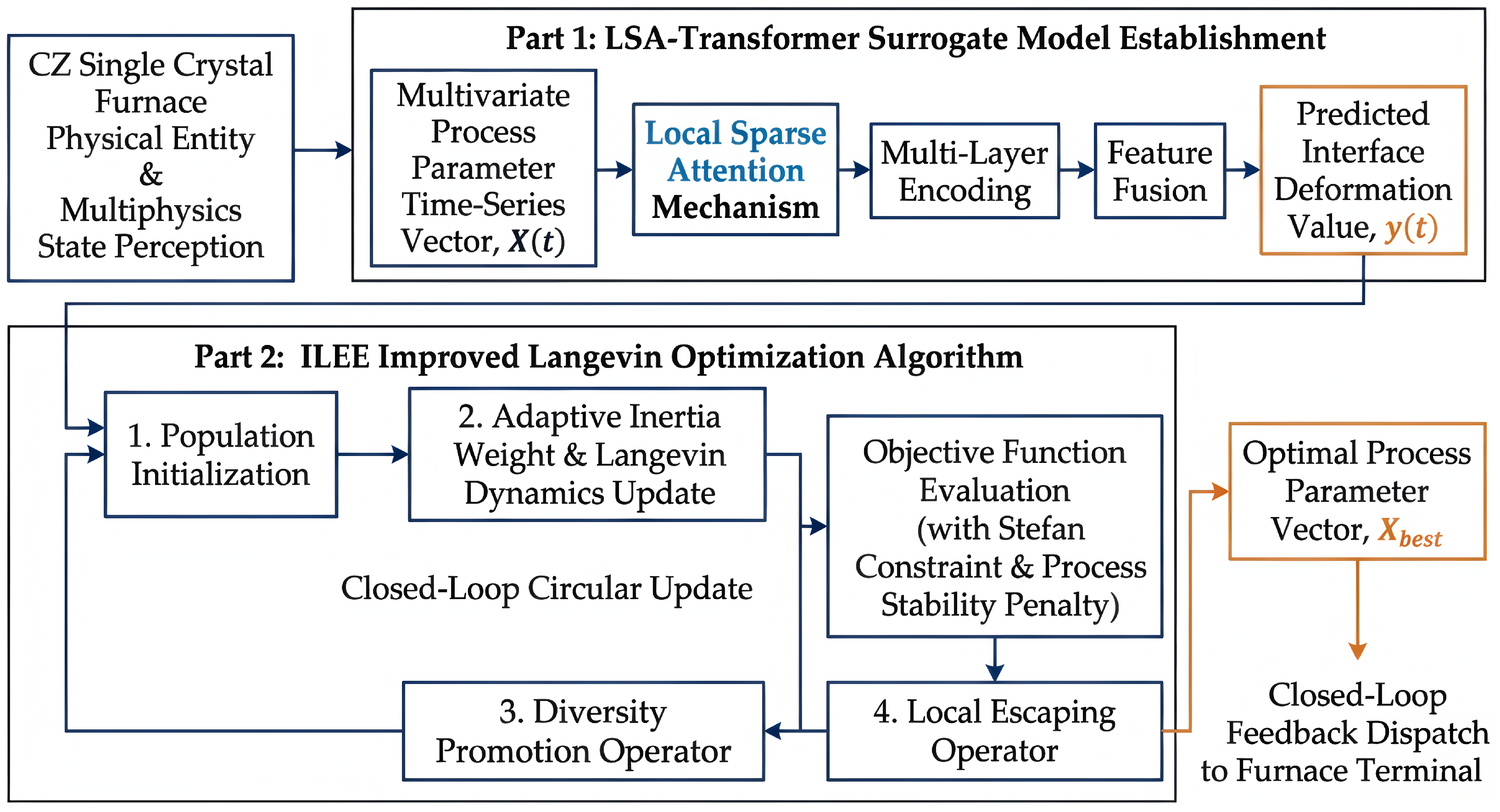
In CZ silicon single crystal growth, solid–liquid interface sensing is inherently difficult and process parameter optimization is highly susceptible to high-dimensional physical constraints and local extrema. To address these challenges, this study proposes a surrogate-assisted offline optimization framework that combines the LSA-Transformer surrogate model with the ILEE optimization algorithm. The method comprises three core components: surrogate model construction, heuristic optimization updating, and physical-constraint-based candidate recipe screening, as illustrated in
Figure 1.
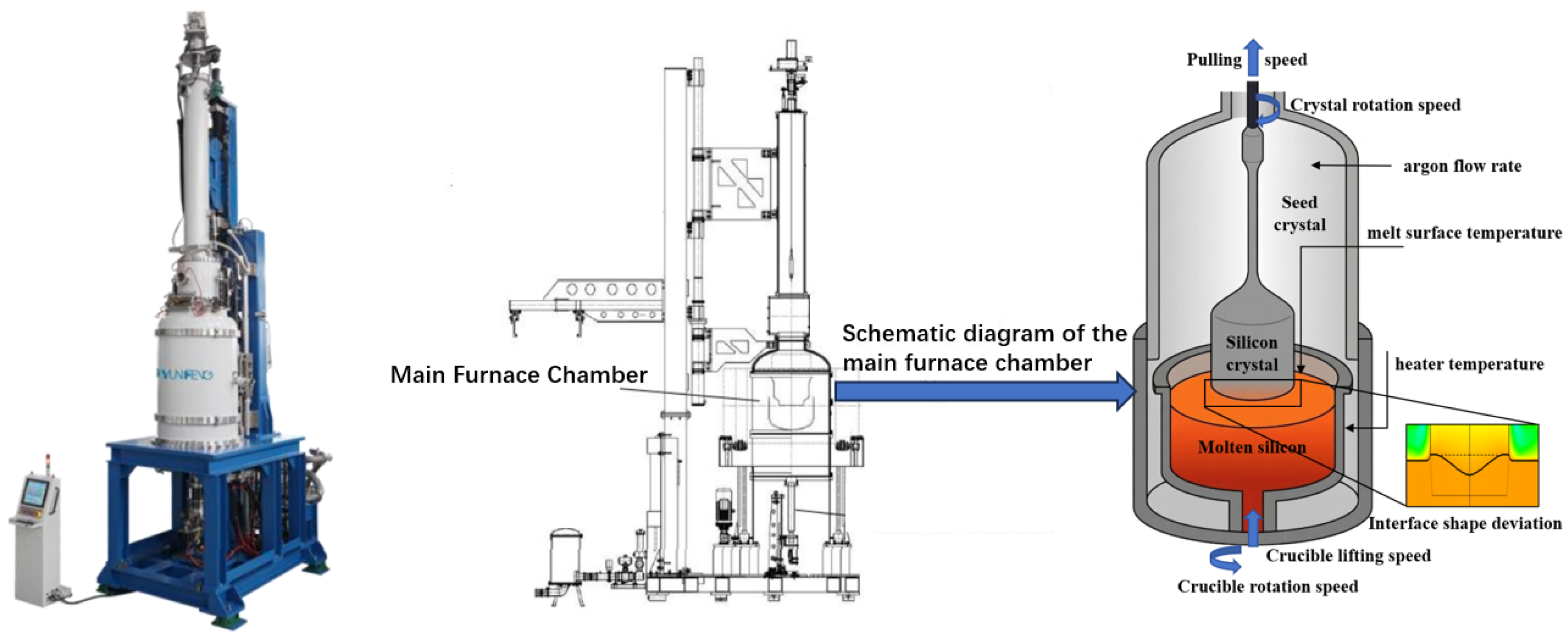
Figure 2 further illustrates the physical correspondence between the proposed optimization variables and the CZ silicon single crystal growth equipment. The figure includes the CZ growth furnace, the schematic structure of the main chamber, the positions of key process variables, and the calculated solid–liquid interface shape-deviation region. This additional illustration clarifies where heater power, pulling rate, argon flow rate, crystal rotation, crucible rotation, and magnetic field strength act in the actual furnace environment, thereby linking the surrogate optimization model with the practical crystal growth setup.
Surrogate model (upper half): The LSA-Transformer takes the multi-variable temporal process parameter vector as input, employs a local sparse attention mechanism to capture long-range dependencies and local perturbations, and outputs the predicted interface deformation as the surrogate evaluation basis for optimization.
ILEE optimization (lower half): Following population initialization, the algorithm performs adaptive inertia-weighted Langevin updates, reinforced by a diversity promoter (DP) and a local escaping operator (LEO). All candidate solutions are evaluated under the objective function incorporating Stefan constraints and process smoothness penalties.
Candidate recipe output: The optimized parameter vector is retained as an offline candidate process recipe, which can be further examined by high-fidelity CFD simulation or crystal growth experiments before practical implementation.
2.1. Surrogate Model Construction for Interface Deformation
In traditional process optimization, evaluating the impact of a given set of process parameters on solid–liquid interface morphology typically relies on computational fluid dynamics (CFD) numerical simulation [
1]. However, owing to the strong nonlinear coupling in the silicon single crystal growth environment, a single full-field numerical simulation is extremely time-consuming and is difficult to use directly in intelligent optimization algorithms requiring tens of thousands of iterative evaluations.
To overcome this computational bottleneck, this paper adopts a surrogate-assisted optimization strategy. A local sparse attention Transformer model (LSA-Transformer) [
12,
13,
14] is employed as the surrogate for the objective function. The model takes the current process parameter vector and historical temporal state features as input and outputs the current solid–liquid interface deformation value. It is used to provide fast approximate evaluations of candidate process recipes in the optimization loop. In the optimization framework, the surrogate model mapping can be expressed as:
where
is the predicted solid–liquid interface deformation at the current time;
is the trained LSA-Transformer surrogate model; and
X is the six-dimensional process parameter vector optimized by ILEE. In the training and prediction stage of the surrogate model, crystal length is additionally used as a process-state feature. Therefore, the LSA-Transformer input feature vector is
where
L is the crystal length. In contrast,
X in Equation (
2) contains only the six decision variables searched during optimization. The correspondence between engineering symbols, measurement units, and decision vector components is shown in
Table 1.
The surrogate-model dataset contains 28,917 samples collected from historical CZ silicon single crystal growth production data. The interface deformation label was generated from historical production records combined with an offline physical model. The dataset was divided into training and testing subsets at a ratio of 8:2, with approximately 23,134 samples used for model training and 5783 samples used for testing. All input features and output labels were normalized to the range
using Min–Max normalization before training. The main data and training settings are summarized in
Table 2.
2.2. Decision Variables and Physical Constraints
2.2.1. Selection of Decision Variables
The morphology of the solid–liquid interface is jointly modulated by the thermal field distribution, melt convection intensity, and magnetic field strength within the furnace [
15]. Based on multi-physics coupling mechanisms and correlation analysis, six key process parameters with the most significant influence on interface deformation [
16] are selected as decision variables for the optimization process. The selected decision variables are listed in
Table 1.
2.2.2. Variable Boundary Constraints
To ensure that the optimized process parameters are safe and feasible for industrial production, all decision variables are subject to the hardware capability limits and basic process specifications of the CZ furnace, and must satisfy strict upper and lower bound constraints:
where
and
are determined by the safe operating limits of the actual CZ furnace equipment and the expert experience window.
In the present optimization implementation, the practical search interval is constructed from the historical production window and equipment operating specifications. For each decision variable, the maximum and minimum values observed in the selected feasible production window are first identified, and the engineering search bounds are then expanded as and . Candidate solutions outside this interval are clipped or penalized during optimization. This setting prevents the optimizer from generating parameter combinations that are numerically attractive for the surrogate model but infeasible for industrial operation.
2.2.3. Phase-Change Energy Conservation Constraint
In addition to equipment boundary limits, stable propagation of the solid–liquid interface must strictly obey the thermodynamic energy conservation law. According to the Stefan phase-change boundary condition, the heat flux difference across the interface must be in dynamic balance with the latent heat released during silicon melt crystallization:
where
and
are the thermal conductivities of the solid and liquid phases, respectively;
and
are the normal temperature gradients at the interface on the solid and liquid sides, respectively;
is the silicon crystal density; and
is the latent heat of crystallization. If the parameter combination searched by the algorithm severely violates this energy balance, catastrophic consequences such as crystal growth disruption or remelting may occur [
17], even if the surrogate model outputs a small interface deformation value. Therefore, this physical constraint is a mandatory condition that must be strictly satisfied during process optimization.
2.3. Objective Function Formulation
For offline process-parameter screening, candidate recipes should not only correspond to low surrogate-predicted interface deformation but also maintain smooth parameter variation. If parameters such as heater power and pulling rate undergo abrupt changes between adjacent growth stages, thermal shock may be induced within the furnace, increasing the risk of severe dislocation formation or even crystal fracture.
Taking into account the surrogate-predicted interface-deformation objective, process smoothness, and the aforementioned physical constraints, a comprehensive optimization objective function with a penalty mechanism is constructed:
where the first term
is the surrogate-predicted interface-deformation objective term, aiming to minimize the absolute value of the interface deformation predicted by the surrogate model and move the candidate recipe toward a flatter predicted interface state, with
being the weighting factor. The second term is the process smoothness penalty term, penalizing large fluctuations in decision variables between adjacent stages, where
is the variation penalty coefficient for different variables (e.g., higher weights are assigned to heater power and pulling rate, which are extremely sensitive to thermal field variations), and
is the overall smoothness weighting factor. The third term
is the penalty function: when a searched parameter combination violates boundary constraints or severely breaches the Stefan energy conservation condition,
is assigned a very large positive value, forcing the optimization search trajectory to rapidly escape the infeasible domain:
For reproducibility, the roles and sources of the main objective-function and constraint parameters are summarized in
Table 3. The weighting coefficients
,
, and
are used to balance the surrogate-predicted interface-deformation objective and process smoothness. The Stefan-related quantities are obtained from silicon material properties, offline physical-model calculations, or actual process conditions. In this work, they are not independent optimization variables but physical feasibility parameters used to evaluate whether a candidate process recipe satisfies the phase-change energy balance.
Through the above mathematical modeling, the interface-deformation-oriented recipe screening problem in CZ silicon single crystal growth is transformed into a well-defined, computable multi-variable nonlinear optimization problem with explicit physical constraints. This provides the mathematical basis for applying the improved Langevin evolutionary algorithm (ILEE) to offline candidate recipe generation.
3. Design of the Improved Langevin Evolutionary Algorithm
In the surrogate optimization problem for CZ silicon single crystal growth, the objective function space formed by strong coupling of thermal and flow fields is highly non-convex, contains multiple local extrema, and has narrow feasible regions. Traditional swarm intelligence algorithms (such as PSO and GWO) are highly susceptible to becoming trapped in local optima due to loss of population diversity when handling such complex spaces with strict physical boundaries. To address this, this paper proposes an improved Langevin evolutionary algorithm based on the classical Langevin dynamics framework. By integrating an adaptive weight mechanism and dual escape operators, the algorithm is designed to improve the search of feasible candidate recipes under complex industrial constraints.
3.1. Classical Langevin Dynamics
The classical Langevin equation originates from the description of Brownian motion in statistical mechanics, characterizing the stochastic evolution of microscopic particles under thermal fluctuations and damping in a fluid. Its core physical mechanisms include inertial acceleration, frictional damping, and random thermal fluctuations. In the optimization domain, this equation is mapped to a particle search mechanism within the “potential energy field” of the objective function.
where
and
are the acceleration and velocity of the
i-th candidate solution at the
t-th iteration, respectively;
is the damping coefficient (used to suppress excessive divergence); and
is the random perturbation force representing thermal fluctuations, whose magnitude is proportional to the system “computational temperature” and the degree to which the current solution deviates from the population mean.
Subsequently, the velocity and position of the candidate solution are updated as:
This physically driven search mechanism enables candidate solutions to explore the global space with very large random perturbation forces in the early search phase, and gradually transition to local fine exploitation as the “temperature” decays in later stages. However, when facing the non-convex penalty boundaries of silicon single crystal optimization, purely classical Langevin dynamics still suffers from insufficient exploration capacity, necessitating the introduction of more proactive escape mechanisms.
3.2. Diversity Promoter and Local Escaping Operators
To overcome local traps in complex process constraint spaces, this paper innovatively introduces a diversity promoter (DP) operator and a local escaping operator (LEO) into the basic LEE algorithm, constructing a dual escape mechanism.
3.2.1. Diversity Promoter Operator
When the algorithm approaches a local optimum for a certain process parameter combination (e.g., a set of parameters that reduces deformation but causes large process fluctuations), the population tends to converge rapidly. The DP operator is designed to superimpose a controlled natural perturbation onto the basic Langevin position update to maintain population diversity. Its mathematical expression is:
where
is the new solution generated by the original Langevin dynamics;
is the current solution;
is a dynamic probability factor based on individual fitness; and
is an adaptive search step size (related to the upper and lower bound spans of the search space). The DP operator is not a blind mutation, but a further extension of Langevin dynamics, allowing candidate solutions to perform “micro-probing” within a certain radius around the current promising trajectory and helping compensate for insufficient detection accuracy within complex potential wells.
3.2.2. Local Escaping Operator
If the DP operator primarily maintains diversity at the microscopic level, the local escaping operator (LEO) executes “controlled transitions” at the macroscopic level. When the population enters a severe stagnation period (e.g., no significant improvement in the objective function value over several consecutive generations), the LEO operator is triggered with probability
. Upon triggering, the algorithm forcibly combines the current global best solution
, random individuals
and
, and the current individual to generate a transition vector:
where
and
are dynamically adjusted coefficients that balance exploitation and exploration. By superimposing the guiding force of the global best solution (exploitation) and the random individual difference vector (exploration), the LEO operator encourages candidate solutions to cross the “energy barriers” formed by Stefan constraints or process smoothness penalty terms, enabling rapid transfer to more promising process parameter subspaces. This mechanism simulates the “quantum tunneling effect” or high-energy-level transitions in physics and supports more active global search when facing complex constraints.
3.3. Adaptive Parameter Strategy for Silicon Single Crystal Growth
To enable the algorithm to adaptively adjust the optimization pace at different crystal growth stages, key hyperparameters of the algorithm are designed adaptively:
Adaptive inertia weight mechanism: Define a population fitness diversity indicator: . Based on this indicator, construct the adaptive inertia weight: .
When is small, it indicates that the population tends to aggregate (potentially reaching premature convergence); the algorithm automatically increases the inertia weight w to strengthen particle momentum and break through local extrema. Conversely, when is large, w is reduced to promote stable convergence in promising regions.
Adaptive Gaussian mutation: A time-varying mutation probability
and mutation step size
are introduced [
18]. In the early search phase, larger mutation probability and magnitude are assigned to fully explore the broad combination boundaries of sensitive parameters such as heater power and argon flow rate; in later iterations, these decay exponentially to ensure smooth convergence to the optimal process parameter recipe.
3.4. Overall Execution Flow of the ILEE Algorithm
Algorithm 1 presents the pseudocode of the ILEE algorithm.
| Algorithm 1 Pseudocode of the ILEE algorithm. |
Input: Population size N, maximum iterations ; process parameter search bounds ; pre-trained soft-sensor surrogate ; , ; base damping ; , , . Output: Optimal process parameters and .
- 1:
/ Phase 1: Initialization / - 2:
for
to
N
do - 3:
Randomly initialize and within - 4:
- 5:
Compute incorporating the Stefan energy conservation penalty term - 6:
end for - 7:
Select and initialize and , set
- 8:
/ Phase 2: Main Optimization Loop / - 9:
while
do - 10:
Compute ; update and Langevin temperature
- 11:
for to N do - 12:
/ Step 1: Adaptive Langevin / Compute ; - 13:
;
- 14:
/ Step 2: DP /; - 15:
if then - 16:
- 17:
end if
- 18:
/ Step 3: LEO /; - 19:
if then - 20:
Select - 21:
- 22:
end if
- 23:
/ Step 4: Boundary / Clip to ; - 24:
end for
- 25:
/ Step 5: Surrogate & best / - 26:
for to N do - 27:
Feed into to obtain and - 28:
if then - 29:
; - 30:
end if - 31:
end for - 32:
- 33:
end while
- 34:
Return ,
|
4. Algorithm Benchmark Testing and Comparative Analysis
To verify the optimization performance and stability of the proposed ILEE algorithm, this section conducts simulation experiments using classical benchmark functions and performs quantitative analysis of algorithm performance through multiple evaluation metrics. Meanwhile, the improved algorithm is compared with various classical and state-of-the-art optimization algorithms to assess its global search capability and convergence performance in a balanced manner.
4.1. Experimental Environment and Initial Parameter Settings
The simulation experiments in this study were conducted in MATLAB R2023b, on a hardware platform equipped with an AMD Ryzen 9 8945HX processor and an NVIDIA GeForce RTX 5060 GPU. To ensure the stability of model training and optimization calculations, the raw production data were uniformly preprocessed before the experiments, including outlier removal, missing data imputation, and normalization. In addition, to ensure fairness of comparison across different algorithms, the key parameters of each comparison algorithm were uniformly configured. The main parameter settings of the proposed ILEE algorithm are shown in
Table 4.
4.2. Surrogate Model Validation
Before using the LSA-Transformer as the fitness-evaluation model in the subsequent optimization process, its prediction accuracy was evaluated using RMSE, MAE, and
, as shown in
Table 5. The testing-set results indicate that the surrogate model retains good generalization capability on samples not used for training. In the optimization stage, this surrogate model is used as a fast fitness-evaluation model rather than as an independent physical validation tool.
4.3. Benchmark Functions and Evaluation Metrics
Considering that the silicon single crystal growth process parameter optimization problem exhibits non-convex characteristics and must satisfy strict physical boundary constraints, 23 representative benchmark functions were selected from standard test suites, with their indices and search ranges listed in
Table 6. These functions cover various types of complex topological terrain, specifically including unimodal functions, multimodal functions, and fixed-dimension hybrid functions. The detailed mathematical expressions of all 23 benchmark functions are provided in the
Supplementary Materials. In the experiments, the original Langevin evolutionary algorithm (LEE), particle swarm optimization (PSO) [
19], grey wolf optimization (GWO) [
20], sparrow search algorithm (SSA) [
21], whale optimization algorithm (WOA) [
22], arithmetic optimization algorithm (AOA) [
23], and differential evolution (DE) [
24] were selected as baseline comparison algorithms.
To eliminate the influence of randomness and enable quantitative comparison, the following three core evaluation metrics are adopted:
Mean value: reflects the average optimization accuracy of the algorithm over multiple independent runs. The closer the mean value to the theoretical optimum (typically 0), the higher the optimization accuracy of the algorithm. Its formula is:
where
N is the number of independent repeated experiments, and
is the best fitness value obtained in the
i-th experiment.
Standard deviation: reflects the dispersion of algorithm results across multiple runs. A smaller standard deviation indicates stronger stability and robustness of the algorithm, with less influence from random factors. Its formula is:
Convergence curve: records the variation of the objective function value with iterations. By observing the slope of the curve and the presence of “secondary transitions,” the convergence efficiency and the ability to escape local traps can be intuitively assessed.
In addition to Mean, Std, and convergence curves, statistical significance tests were further conducted on the raw results of 30 independent runs for each algorithm and each benchmark function. Wilcoxon rank-sum tests were used to compare ILEE with each baseline algorithm function by function at a significance level of 0.05. Friedman testing and average-rank analysis were used to evaluate the overall performance difference among all algorithms across the 23 benchmark functions.
4.4. Optimization Accuracy and Robustness Analysis
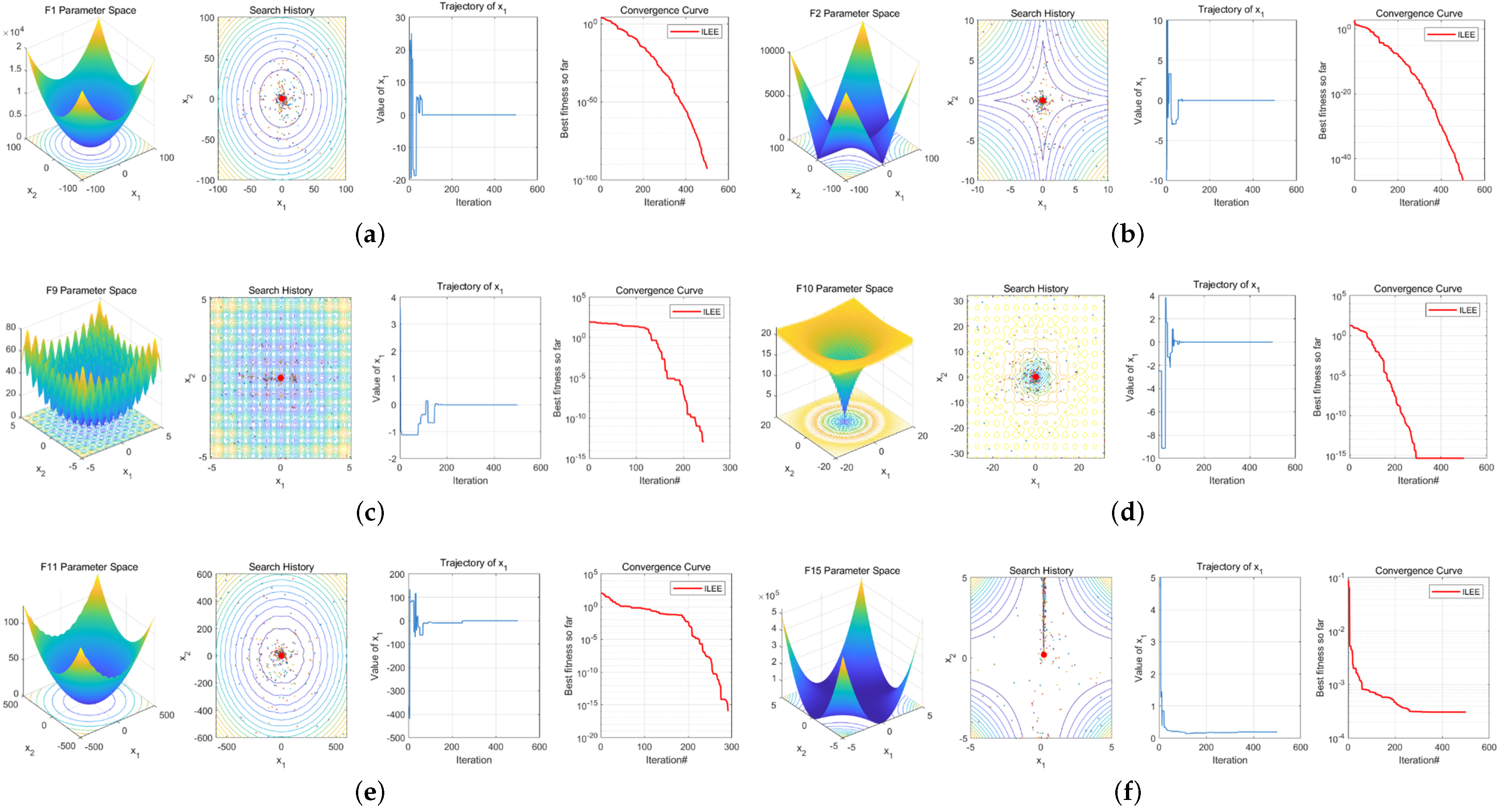
Table 7 summarizes the mean best value (Mean) and standard deviation (Std) of each algorithm on six benchmark functions. To intuitively analyze the search behavior and convergence characteristics of the improved LEE algorithm (ILEE),
Figure 3 presents the parameter space distribution, search history, key variable trajectories, and convergence curves for typical benchmark functions F1, F2, F9, F10, F11, and F15, respectively.
From the quantitative data in
Table 7, it can be seen that ILEE achieves near-zero values approaching the theoretical optimum on functions F1, F9, and F11, and a high accuracy of
on F2. On several functions, such as F9 and F10, ILEE obtains results comparable to the best-performing algorithms, whereas PSO, AOA, and DE show larger errors. However, the results also show that ILEE is not uniformly superior on every function; for example, LEE or SSA obtains better average results on some benchmark functions such as F15. Therefore, the benchmark results should be interpreted as evidence of competitive overall performance rather than universal dominance.
From
Figure 3, the search history shows that in the early iteration phase, population individuals are widely dispersed, indicating good global exploration capability; in the later phase, search points gradually converge to high-quality regions, achieving efficient local exploitation. The variable trajectories show large fluctuations in the early phase and steady convergence in the later phase; oscillations before convergence on complex functions help maintain population diversity. These observations indicate that the improved algorithm can maintain a useful balance between exploration and exploitation on representative test cases, although quantitative comparisons and statistical tests are still needed for a more objective assessment.
4.5. Statistical Significance Analysis
To avoid relying only on average values, Wilcoxon rank-sum tests were conducted using the 30 independent-run results on each of the 23 benchmark functions. The significance level was set to 0.05. The symbols “+”, “=”, and “-” indicate that ILEE is significantly better than, statistically indistinguishable from, or significantly worse than the corresponding comparison algorithm, respectively.
Table 8 summarizes the win/tie/loss counts.
The Wilcoxon results show that ILEE is not significantly better than all comparison algorithms on all functions. In particular, the 1/11/11 result against LEE indicates that the original LEE still has comparable or better behavior on several benchmark functions. In contrast, ILEE shows more favorable win/tie/loss records against PSO, GWO, SSA, WOA, AOA, and DE. This supports a more balanced conclusion: ILEE has competitive performance relative to most baseline algorithms, but its advantage is problem dependent.
Friedman testing was further used to evaluate the overall performance difference among all algorithms. The Friedman statistic was 41.3556 with a
p value of
, indicating a statistically significant overall difference among algorithms. The average ranks are listed in
Table 9; smaller ranks indicate better overall performance.
These statistical results indicate that the proposed improvements do not make ILEE universally superior to the original LEE on all benchmark functions. Accordingly, the performance discussion in this paper is restricted to competitive overall behavior and the ability to obtain better or comparable results on many functions, rather than claiming comprehensive superiority.
4.6. Ablation Study
To further analyze the contribution of the main improvement modules in ILEE, an ablation study was conducted on four representative benchmark functions, namely F1, F9, F12, and F21. These functions cover unimodal, multimodal, hybrid, and composition-type search landscapes. The compared versions include the original LEE, ILEE without the adaptive inertia weight mechanism (ILEE without AIW), ILEE without the diversity promoter mechanism (ILEE without DP), ILEE without the local escaping operator (ILEE without LEO), and the complete ILEE. Each algorithm was independently run 30 times under the same population size, maximum iteration number, and search boundary settings. The mean and standard deviation of the best fitness values are reported in
Table 10.
The ablation results show that the influence of each improvement module is function dependent. In particular, removing the local escaping operator leads to a clear performance degradation on F9 and F21; for example, the mean fitness on F9 increases from 0 to 14.745, and the mean fitness on F21 changes from to . This indicates that LEO contributes to escaping local optima and handling complex search landscapes. However, the adaptive inertia weight and diversity-promoter mechanisms do not produce monotonic improvements on every function, and the complete ILEE is not the best variant in all ablation cases. Therefore, the ablation study supports a cautious interpretation of the algorithmic improvements: the proposed modules are useful for enhancing search behavior in several complex cases, but their effects are problem dependent.
4.7. Analysis of Convergence Behavior and Local Optima Escape Capability
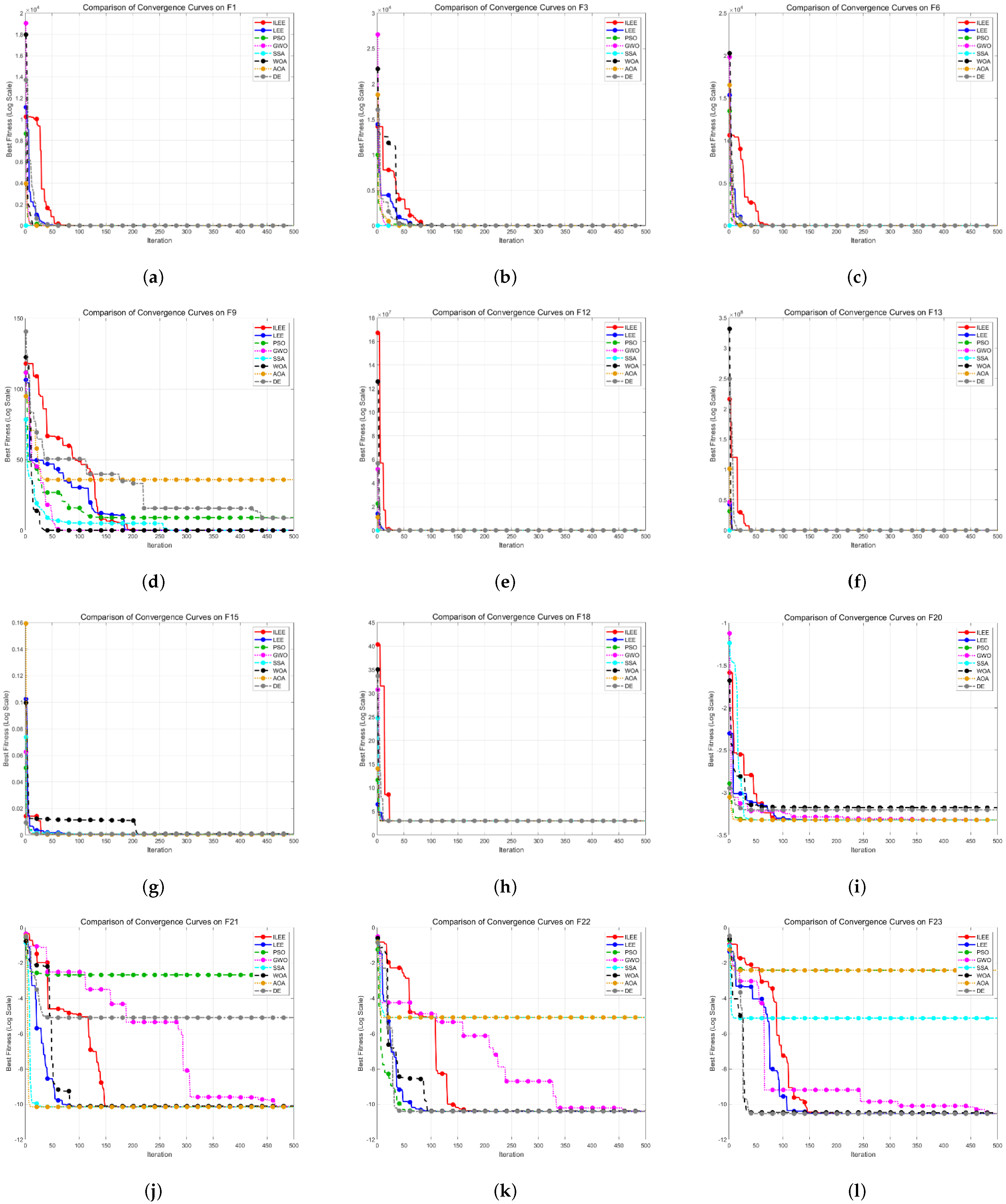
For the ILEE algorithm, 12 representative benchmark functions (F1, F3, F6, F9, F12, F13, F15, F18, F20, F21, F22, F23) were selected for simulation experiments.
Figure 4 presents the convergence curve comparison of ILEE with the original LEE, PSO, GWO, SSA, WOA, AOA, and DE algorithms over the same number of iterations. To intuitively reveal the dynamic characteristics of each algorithm during the search process, the ordinate adopts the logarithmic form of the fitness value. From the morphological evolution of the convergence curves, several observations can be identified.
From the test results on unimodal functions (F1, F3, F6), ILEE shows good convergence accuracy and search efficiency in several cases. Observing the curves, ILEE (red curve) exhibits clear search direction from the early iterations and often reaches low fitness magnitude levels within a relatively small number of iterations. This indicates that when handling search spaces with relatively simple topological structures, ILEE has useful local exploitation capability.
In processing multimodal functions (e.g., F9, F12, F13, F15, F18, F20), the test focus lies in the algorithm’s ability to balance exploration and exploitation. The convergence curves show that ILEE can maintain a stable downward trend in several complex cases, whereas some comparison algorithms enter plateau phases. However, as indicated by the statistical tests, this advantage is not uniform across all benchmark functions.
For composite multimodal functions (F21, F22, F23), ILEE exhibits stepwise descent characteristics in several runs, suggesting transitions from one local region to another. This behavior is related to the synergistic mechanism of the DP and LEO operators: the DP operator helps maintain population diversity, while the LEO operator provides additional transitions toward potentially promising regions. The ablation study further indicates that the effect of these modules is function dependent.
In summary, the benchmark test results, statistical tests, and ablation analysis indicate that the improved ILEE algorithm has competitive search performance and useful local optima escape capability on several representative functions. At the same time, the results also show that ILEE is not universally superior to LEE or other baselines on every function, and its advantages should be interpreted in a problem-dependent manner.
5. Surrogate-Based Candidate Recipe Generation for CZ Silicon Single Crystal Growth
To examine the process-parameter guidance capability of the proposed “LSA-Transformer surrogate model + ILEE optimization algorithm” for large-diameter CZ silicon single crystal production, this section applies the surrogate optimization method to offline candidate recipe generation during the equal-diameter growth stage. By comparing the baseline process parameters set by expert experience with the candidate recipe identified by the algorithm, the process trends and surrogate-predicted interface-deformation values are analyzed.
5.1. Experimental Setup
This paper uses crystal growth length as the partitioning criterion and selects five characteristic nodes from the equal-diameter stage: 200 mm, 400 mm, 600 mm, 800 mm, and 1000 mm. At each characteristic node, the current furnace state is used as the initial condition input to the optimization method. The ILEE algorithm searches for six-dimensional candidate process parameters associated with low surrogate-predicted interface deformation, subject to CZ furnace hardware boundaries and Stefan phase-change energy conservation constraints. The six parameters include heater power, pulling rate, crystal/crucible rotation speeds, argon flow rate, and magnetic field strength. The experimental parameter settings are shown in
Table 11. The search range of each variable strictly follows the operating experience and equipment specifications of actual CZ furnaces: the upper bound of decision variables is set to 1.1 times the maximum value, and the lower bound to 0.9 times the minimum value. By setting reasonable search boundaries, the feasibility of the candidate recipes in engineering practice is improved.
5.2. Multi-Stage Candidate Recipe Results and Surrogate-Predicted Trends
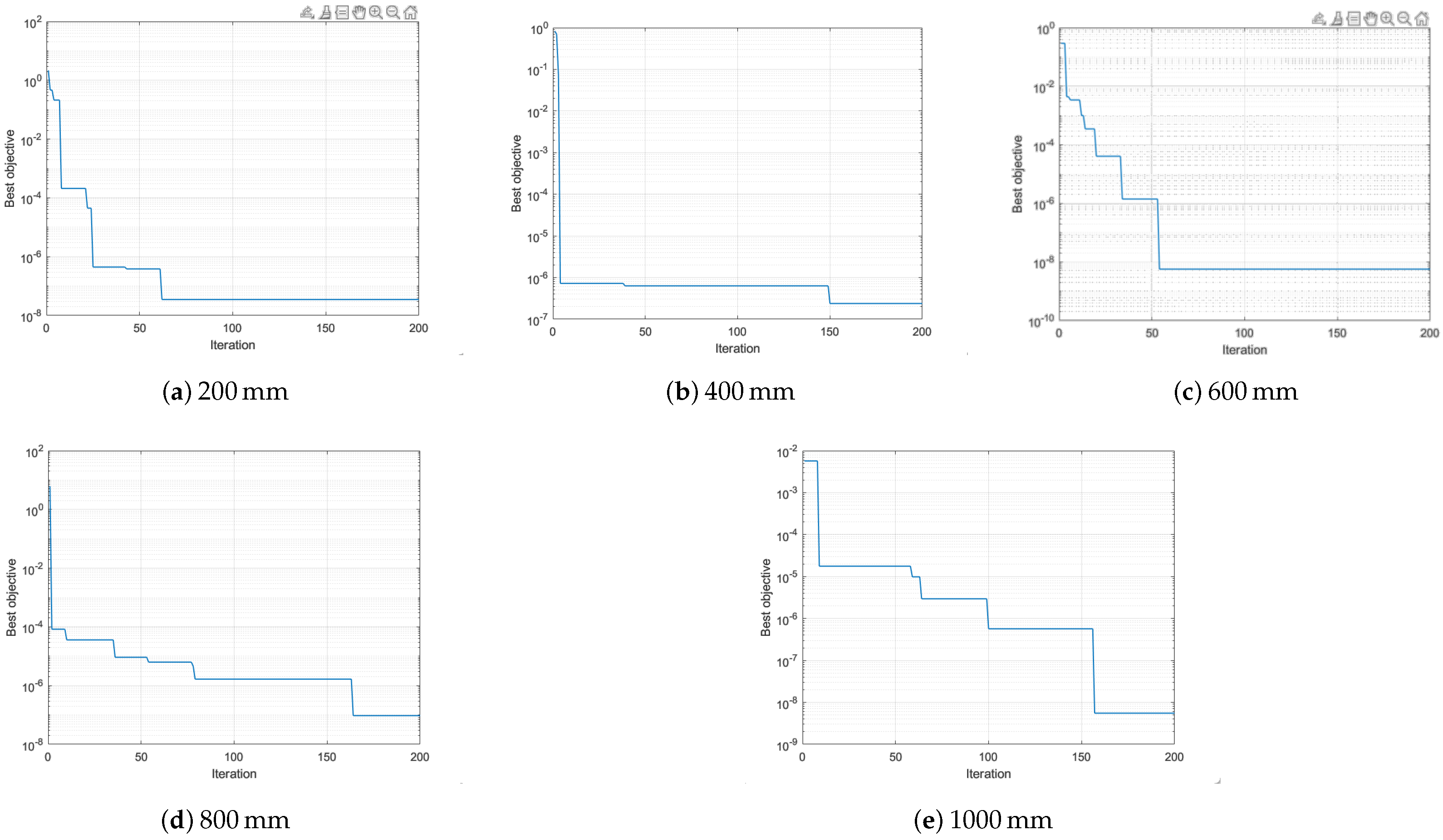
Figure 5a–e illustrates the objective function convergence process of the ILEE algorithm at the five characteristic growth stages. The convergence curves at each stage show a rapid decline in the early iterations, indicating that the algorithm can quickly identify candidate regions with lower surrogate-predicted objective values. As the iterations proceed, the curves display “stepwise” descent characteristics; notably at the 600 mm (
Figure 5c) and 1000 mm (
Figure 5e) stages, the search process moves away from several local regions and finally converges to a stable candidate solution.
Table 12 summarizes the candidate process parameter combinations and corresponding predicted interface deformation values obtained by the ILEE algorithm at each growth stage. These values are outputs of the LSA-Transformer surrogate model under the candidate process parameters, rather than independent CFD results or direct experimental interface-shape measurements. The results indicate that, within the surrogate-assisted optimization framework and the imposed physical constraints, the proposed method can search feasible process parameter combinations with low predicted interface deformation (e.g.,
mm at the 600 mm stage). Therefore, the results should be interpreted as surrogate-model-based parameter guidance for subsequent physical verification.
5.3. Comparison of Surrogate-Predicted Interface Deformation
To intuitively compare the surrogate-predicted effect of the candidate recipes, the process parameters before and after optimization were respectively input into the LSA-Transformer surrogate model, yielding the predicted evolution sequence of interface deformation throughout the growth process.
The comparison results indicate that, under the baseline case using traditional expert experience parameters, the surrogate-predicted solid–liquid interface deformation exhibits slight fluctuations at 200 mm and increases at growth stages beyond 800 mm. Such a trend suggests that this region may require further attention in subsequent physical verification. In contrast, with the candidate process recipe generated by the ILEE algorithm, the surrogate-predicted interface deformation at each stage is lower. Meanwhile, owing to the “process smoothness penalty term” introduced in the objective function, the optimized key parameters (such as pulling rate and power) do not exhibit step-change mutations, which is consistent with the requirement of smooth process adjustment in industrial production.
In summary, the ILEE-based surrogate optimization method can identify feasible parameter combinations with low surrogate-predicted interface deformation within the constrained process parameter space. These results provide a useful parameter adjustment reference for subsequent CFD or experimental assessment, while further high-fidelity CFD verification or crystal growth experiments are still needed to evaluate the physical response of the optimized recipes.
6. Conclusions
To address the challenges that interface deformation in CZ silicon single crystal growth is difficult to sense online and that process-parameter screening is highly susceptible to local optima, this paper proposes a physics-informed surrogate-assisted optimization method that integrates a surrogate model (LSA-Transformer) with an improved Langevin dynamics algorithm (ILEE). The method introduces dual escape operators–a diversity promoter and a local escaping operator–and explicitly couples physical penalty constraints such as the Stefan phase-change energy conservation condition. Benchmark tests, statistical significance analysis, and ablation experiments show that ILEE has competitive overall performance and useful local optima escape capability on several representative functions, although it is not uniformly superior to all comparison algorithms on every benchmark. Multi-stage surrogate-assisted candidate recipe generation for 12-inch silicon single crystal growth indicates that the proposed framework can provide feasible process-parameter guidance with low surrogate-predicted interface deformation under the given surrogate model and physical constraints.
Future work will further input the optimized process recipes into high-fidelity CFD or multi-physics numerical models, and, where possible, combine them with crystal growth experiments to independently evaluate the physical response of the predicted interface morphology. In addition, future work will extend toward multi-objective surrogate optimization and advance lightweight deployment and edge-side incremental learning, enabling the method to dynamically adapt to time-varying disturbances such as thermal field aging in CZ furnaces.