Research Advances in the Corrosion Behavior and Underlying Mechanisms of Additively Manufactured Titanium Alloys

Abstract
1. Introduction
2. Classification and Operational Principles of AM Technologies
2.1. LPBF/SLM
2.2. EBM
2.3. DED
2.4. WAAM
3. Corrosion Behavior of AMed Titanium Alloys
3.1. LPBF/SLM
3.1.1. Influence of Matrix Composition on Corrosion Properties
3.1.2. Effects of Post-Treatment Methods on Corrosion Behavior
3.1.3. Influence of Corrosion Environment on Corrosion Failure Modes
3.2. EBM
3.2.1. Influence of Matrix Composition on the Corrosion Performance of EBMed Titanium Alloys
3.2.2. Modulating Effects of Various Post-Treatment Processes on the Corrosion Performance of EBMed Titanium Alloys
3.3. DED
Horizontal Comparison of Corrosion Performance Across Fabrication Routes
3.4. WAAM
Regulatory Effect of Post-Processing Methods on the Corrosion Performance of WAAMed Titanium Alloys
4. Corrosion Mechanisms of AMed Titanium Alloys
4.1. Universal Corrosion Mechanisms of AMed Titanium Alloys
4.1.1. Passive Film Formation and Failure Mechanism
4.1.2. Micro-Galvanic Corrosion and Phase-Selective Dissolution
4.1.3. Multi-Scale Microstructural Modulation of Local Passivation and Localized Corrosion
4.2. Process-Specific Corrosion Vulnerabilities
4.2.1. LPBF/SLM: Vulnerabilities from Metastable α′ Martensite and High Residual Stress
4.2.2. EBM: Vulnerabilities from High Surface Roughness and Dual-Phase Lamellar Microstructure
4.2.3. DED: Vulnerabilities from Fusion Zone Heterogeneity and Large-Size Irregular Defects
4.2.4. WAAM: Vulnerabilities from Interlayer HAZ Variations and Strong Columnar Grain Texture
5. Conclusions and Outlook
5.1. Conclusions
5.2. Outlook
Author Contributions
Funding
Data Availability Statement
Conflicts of Interest
Abbreviations
| Abbreviation | Full Term | Abbreviation | Full Term |
| Aa | Alkali activation | NiTi SMAs | NiTi shape memory alloys |
| AB | As-built | NSS | Network structure surface |
| AC | Air cooling | OA | Oxalic acid |
| AE | Acid etching | OI | Oxidizing ions |
| AM | Additive manufacturing | PBS | Phosphate-buffered saline (1 L of deionized water: 8.18 g NaCl, 0.22 g KCl, 1.13 g Na2HPO4·2H2O, 0.56 g NaH2PO4·2H2O, adjusted to pH 7.4 with dilute sodium hydroxide solution at 37 °C.) |
| AS | Artificial saliva (1 L of deionized water: 0.400 g NaCl, 0.400 g KCl, 0.795 g CaCl2·2H2O, 0.690 g NaH2PO4·2H2O, 0.005 g Na2S·9H2O, 1.000 g urea, adjusted to pH 5.3 with lactic acid at 37 °C) | PDP | Potentiodynamic polarization |
| BD | Building direction | PN | Plasma nitriding |
| BR | Bonding region | PO | Plasma oxidation |
| Cp-Ti | Commercially pure titanium | P-P HT | Pressure-free annealing |
| C-WAAM | Conventional wire arc additive manufacturing | P-WAAM | Pulsed wire arc additive manufacturing |
| DED | Directed energy deposition | RDF | Runway deicing fluid |
| DLD | Direct laser deposition | Rp | Polarization resistance |
| DSS | Dispersed structure surface | RS | Ringer’s solution (1 L of bidistilled water: 8.500 g NaCl, 0.300 g KCl, 0.330 g anhydrous CaCl2, 0.200 g NaHCO3, and a pH of 7.4 at 37 °C) |
| DT | Dynamic Hank’s solution (1 L of distilled water: 8.000 g NaCl, 0.350 g NaHCO3, 0.400 g KCl, 0.060 g KH2PO4, 0.048 g Na2HPO4, 0.140 g CaCl2, 0.098 g MgSO4, 1.000 g D-glucose, 0.011 g phenol red sodium salt, and a pH of 7.35 adjusted by diluted HCl and NaOH at 37 ± 0.5 °C) | SB | Sand blasting |
| EBM | Electron beam melting | SBF | Simulated body fluid (1 L of bidistilled water: 7.996 g NaCI, 0.350 g NaHCO3, 0.224 g KCl, 0.228g K2HPO4·3H2O, 0.305 g MgCl2·6H2O, 40 mL 1 mol/L HCI, 0.278 g CaCl2, 0.071 g Na2SO4, 6.057 0 NH2C(CH2OH)3, and a pH of 7.4 at 37 °C) |
| Ecorr | Corrosion potential | ||
| EP | Electropolishing | SFPB | Supersonic fine particle bombardment |
| F | Forging | SLM | Selective laser melting |
| FC | Furnace cooling | SPC | Simulated physiological conditions |
| GA-Ti | Gas atomized titanium | SPS | Spark plasma sintering |
| H | Horizontal | SSW | Synthetic seawater (1 L of deionized water: 26.72 g NaCl, 0.72 g KCl, 1.15 g CaCl2, 2.26 g MgCl2, 3.25 g MgSO4, 0.20 g NaHCO3) |
| HAM | PBF-DED hybrid | ||
| HAZ | Heat-affected zone | ST | Static Hank’s solution (1 L of distilled water: 8.000 g NaCl, 0.350 g NaHCO3, 0.400 g KCl, 0.060 g KH2PO4, 0.048 g Na2HPO4, 0.140 g CaCl2, 0.098 g MgSO4, 1.000 g D-glucose, 0.011 g phenol red sodium salt, and a pH of 7.35 adjusted by diluted HCl and NaOH at 37 ± 0.5 °C) |
| HBSS | Hank’s balanced salt solution (1 L of deionized water: 8.000 g NaCl, 0.408 g KCl, 0.142 g CaCl2, 0.105 g MgSO4·7H2O, 0.111 g MgCl2·6H2O, 0.065 g Na2HPO4·2H2O, 0.063 g KH2PO4, 1.000 g D-Glucose, 0.353 g NaHCO3, tested at 25 °C) | STA | Solution treatment and aging heat treatment |
| HC | Hydrogen charging | TC4 | Ti-6Al-4V |
| HDH-Ti | Hydrogenation-dehydrogenation titanium | TC11 | Ti-6.5Al-3.5Mo-1.5Zr-0.3Si |
| HIP | Hot isostatic pressing | TD | Transverse direction |
| HS | Hank’s solution | Ti4822 | Ti-48Al-2Cr-2Nb |
| HT | Heat treatment | Ti536 | Ti5Al3V6Cu |
| Icorr | Corrosion current density | Ti-55531 | Ti-5Al-5Mo-5V-3Cr-1Zr |
| IPCs | Interpenetrating phase composites | Ti6321 | Ti-6Al-3Nb-2Zr-1Mo |
| IQ | Ice cooling | TMN | Ti-0.3Mo-0.8Ni |
| LA | Lactic acid | TMZF | Ti-12Mo-6Zr-2Fe |
| LC-CPF | Laser cladding with coaxial powder feeding | TNZ | Ti-13Nb-13Zr |
| LCD | Laser cladding deposition | TNZT | Ti-35Nb-7Zr-5Ta |
| LENS | Laser-engineered net shaping | TNZTS | Ti-34.5Nb-6.9Zr-4.9Ta-1.4Si |
| LMD | Laser metal deposition | TSG | Trailing shielding gas |
| LPBF | Laser powder bed fusion | V | Vertical |
| LSF | Laser solid forming | VA | Vacuum annealing |
| LSM | Laser surface melting | WAAM | Wire arc additive manufacturing |
| LWAM-V | Laser wire additive manufacturing—vacuum | WPC-AM | Wire-powder collaborative arc additive manufacturing |
| MAO | Micro-arc oxidation | WQ | Water quenching |
| MKR | Modified Kroll’s reagent | WR | Wrought |
| MPAM | Micro-plasma arc additive manufacturing | μ-PAPAM | Micro-plasma arc powder additive manufacturing |
| MWAAM | Multi-wire arc additive manufacturing |
References
- Wu, B.; Pan, Z.; Li, S.; Cuiuri, D.; Ding, D.; Li, H. The anisotropic corrosion behaviour of wire arc additive manufactured Ti-6Al-4V alloy in 3.5% NaCl solution. Corros. Sci. 2018, 137, 176–183. [Google Scholar] [CrossRef]
- Balasubramani, T.; Kumar, N.M.; Aseer, J.R.; Sivaram, N.M. Additive Manufacturing of Ti-6 Al-4 V Alloys: Fabrication Techniques and Material Properties—Review. Trans. Indian Inst. Met. 2025, 78, 200. [Google Scholar] [CrossRef]
- Yang, Y.; Yan, S.; Qu, S.; Yi, M.; Chen, Z.; Zhou, T.; Xu, C. Microstructure of titanium alloy in additive/subtractive hybrid manufacturing: A review. J. Alloys Compd. 2025, 1014, 178769. [Google Scholar] [CrossRef]
- Srivastava, M.; Jayakumar, V.; Udayan, Y.; Sathishkumar, M.; Muthu, S.M.; Gautam, P.; Nag, A. Additive manufacturing of Titanium alloy for aerospace applications: Insights into the process, microstructure, and mechanical properties. Appl. Mater. Today 2024, 41, 102481. [Google Scholar] [CrossRef]
- Nguyen, H.D.; Pramanik, A.; Basak, A.K.; Dong, Y.; Prakash, C.; Debnath, S.; Shankar, S.; Jawahir, I.S.; Dixit, S.; Buddhi, D. A critical review on additive manufacturing of Ti-6Al-4V alloy: Microstructure and mechanical properties. J. Mater. Res. Technol. 2022, 18, 4641–4661. [Google Scholar] [CrossRef]
- Vignesh, M.; Ranjith Kumar, G.; Sathishkumar, M.; Manikandan, M.; Rajyalakshmi, G.; Ramanujam, R.; Arivazhagan, N. Development of Biomedical Implants through Additive Manufacturing: A Review. J. Mater. Eng. Perform. 2021, 30, 4735–4744. [Google Scholar] [CrossRef]
- Balasubramanian Gayathri, Y.K.; Kumar, R.L.; Ramalingam, V.V.; Priyadharshini, G.S.; Kumar, K.S.; Prabhu, T.R. Additive Manufacturing of Ti-6Al-4V alloy for Biomedical Applications. J. Bio-Tribo-Corros. 2022, 8, 98. [Google Scholar] [CrossRef]
- Xu, G.; Wang, Q.; Chen, R.; Li, A.; Chen, D.; Fu, H. Columnar to equiaxed transition in additively manufactured titanium alloys: A comprehensive review of mechanisms and grain control strategies. J. Alloys Compd. 2025, 1032, 181196. [Google Scholar] [CrossRef]
- Seabra, M.; Azevedo, J.; Araújo, A.; Reis, L.; Pinto, E.; Brandão, P.; Infante, V.; Deus, A.M.; Alves, N.; Santos, R.; et al. Selective laser melting (SLM) and topology optimization for lighter aerospace components. Procedia Struct. Integr. 2016, 1, 289–296. [Google Scholar] [CrossRef]
- Li, L.; Xu, Q.; Yang, H.; Ying, Y.; Cao, Z.; Guo, D.; Ji, V. Design and Rate Control of Large Titanium Alloy Springs for Aerospace Applications. Aerospace 2024, 11, 514. [Google Scholar] [CrossRef]
- Ju, J.; Li, J.-j.; Jiang, M.; Li, M.-y.; Yang, L.-x.; Wang, K.-m.; Yang, C.; Kang, M.-d.; Wang, J. Microstructure and electrochemical corrosion behavior of selective laser melted Ti−6Al−4V alloy in simulated artificial saliva. Trans. Nonferrous Met. Soc. China 2021, 31, 167–177. [Google Scholar] [CrossRef]
- Jo, Y.-J.; Cho, Y.-J.; Kim, J.-S.; Kim, J.; You, J.-S.; Oh, J.-S.; Moon, S.-Y. Fixation of Iliac Avulsion Fracture Using Additive Manufacturing Titanium Mesh after DCIA Flap Harvesting: Case Report. Appl. Sci. 2023, 13, 2855. [Google Scholar] [CrossRef]
- Goldsmith, I.; Evans, P.L.; Goodrum, H.; Warbrick-Smith, J.; Bragg, T. Chest wall reconstruction with an anatomically designed 3-D printed titanium ribs and hemi-sternum implant. 3D Print. Med. 2020, 6, 26. [Google Scholar] [CrossRef] [PubMed]
- Wu, Y.; Zhang, C.; Wang, F.; Yang, C. Theoretical and Numerical Study of Eddy Current Pulsed Thermography to Detect Damage of Deep-Sea Manned Pressure Hull. J. Mar. Sci. Eng. 2023, 11, 1410. [Google Scholar] [CrossRef]
- Jiang, J.; Li, N.; Wang, B.; Liu, F.; Liu, C.; Cheng, X. A Study on the Influence of Different Defect Types on the Corrosion Behavior of Q235/TA2 Composite Plates in a Marine Environment. Metals 2024, 14, 652. [Google Scholar] [CrossRef]
- Mohamed, O.A.; Masood, S.H.; Xu, W. Nickel-titanium shape memory alloys made by selective laser melting: A review on process optimisation. Adv. Manuf. 2022, 10, 24–58. [Google Scholar] [CrossRef]
- Dammulla, I.N.; Weston, R.; Mahmud, Z.U.; Saha, S.; McFall-Boegeman, S.; Rice, L.; Dwyer, J.H.; Kmetz, T.; Boehlert, C.J.; Swain, G.M. Material Characterization and Electrochemical Properties of Titanium Alloy 5553 Prepared by Selective Laser Melting as Processed and after Abrading and Polishing. ACS Omega 2024, 9, 34021–34035. [Google Scholar] [CrossRef] [PubMed]
- Aboulkhair, N.T.; Simonelli, M.; Parry, L.; Ashcroft, I.; Tuck, C.; Hague, R. 3D printing of Aluminium alloys: Additive Manufacturing of Aluminium alloys using selective laser melting. Prog. Mater. Sci. 2019, 106, 100578. [Google Scholar] [CrossRef]
- Liu, S.; Shin, Y.C. Additive manufacturing of Ti6Al4V alloy: A review. Mater. Des. 2019, 164, 107552. [Google Scholar] [CrossRef]
- Lu, F.; Ma, Q.; Liu, E.; Wei, R.; Bai, J.; Gao, Q.; Qi, J. Advancements in understanding the microstructure and properties of additive manufacturing Ti-6Al-4V alloy: A comprehensive review. J. Alloys Compd. 2025, 1027, 180543. [Google Scholar] [CrossRef]
- Zhang, J.; Liu, Y.; Sha, G.; Jin, S.; Hou, Z.; Bayat, M.; Yang, N.; Tan, Q.; Yin, Y.; Liu, S.; et al. Designing against phase and property heterogeneities in additively manufactured titanium alloys. Nat. Commun. 2022, 13, 4660. [Google Scholar] [CrossRef] [PubMed]
- Wang, J.; Zhu, R.; Liu, Y.; Zhang, L. Understanding melt pool characteristics in laser powder bed fusion: An overview of single- and multi-track melt pools for process optimization. Adv. Powder Mater. 2023, 2, 100137. [Google Scholar] [CrossRef]
- Yao, L.; Ramesh, A.; Xiao, Z.; Chen, Y.; Zhuang, Q. Multimetal Research in Powder Bed Fusion: A Review. Materials 2023, 16, 4287. [Google Scholar] [CrossRef] [PubMed]
- Yue, W.; Zhang, Y.; Zheng, Z.; Lai, Y. Hybrid Laser Additive Manufacturing of Metals: A Review. Coatings 2024, 14, 315. [Google Scholar] [CrossRef]
- Springer, S.; Leitner, M.; Gruber, T.; Oberwinkler, B.; Lasnik, M.; Grün, F. Low-Cycle Fatigue Behavior of Wire and Arc Additively Manufactured Ti-6Al-4V Material. Materials 2023, 16, 6083. [Google Scholar] [CrossRef] [PubMed]
- Atik, B.; Bozkurt, Y.B.; Kavasoğlu, Y.S.; Kovacı, H.; Çelik, A. Pitting corrosion performance of plasma oxidized Cp-Ti and effects of fabrication methods. Surf. Coat. Technol. 2024, 478, 130384. [Google Scholar] [CrossRef]
- Sangali, M.; Cremasco, A.; Soyama, J.; Caram, R.; Contieri, R.J. Selective Laser Melting of Ti-6Al-4V Alloy: Correlation Between Processing Parameters, Microstructure and Corrosion Properties. Mater. Res. 2023, 26, e20230055. [Google Scholar] [CrossRef]
- Qiu, W.B.; Wei, Y.Q.; Chen, A.J.; Deng, H.; Zhou, L.; Zuo, H.Y.; Chen, L.Q.; Xia, Z.X.; Wang, H.; Tang, J. Corrosion behavior of additive manufactured Ti-6Al-4V in sulfamic acid cleaning solution. New J. Chem. 2021, 45, 2967–2973. [Google Scholar] [CrossRef]
- Hao, S.; Wen, X.-M.; Cheng, J.; Yao, X.-Y.; Huang, W.-Y.; Li, R.-F.; Chen, L.-Y. Tailoring corrosion resistance of laser powder bed fusion produced Ti-6Al-4V via heat treatment at 700 °C in potential biomedical applications: Microstructural evolution and electrochemical behavior. Met. Adv. 2026, 39, 83–94. [Google Scholar] [CrossRef]
- Huang, J.; Zhang, W.; Xu, H.; Fang, W. Effect of Heat Treatment on Corrosion Properties of Ti-6Al-4V Titanium Alloy Produced by Electron Powder Bed Fusion. JOM 2024, 76, 3039–3049. [Google Scholar] [CrossRef]
- Gai, X.; Bai, Y.; Li, S.; Hou, W.; Hao, Y.; Zhang, X.; Yang, R.; Misra, R.D.K. In-situ monitoring of the electrochemical behavior of cellular structured biomedical Ti-6Al-4V alloy fabricated by electron beam melting in simulated physiological fluid. Acta Biomater. 2020, 106, 387–395. [Google Scholar] [CrossRef] [PubMed]
- Yan, Q.-b.; Xue, T.; Liu, S.-f.; Wang, W.-l.; Wang, Y.; Song, X.; Yang, X.; Shang, W.-w. A comparative study of surface characterization and corrosion behavior of micro-arc oxidation treated Ti–6Al–4V alloy prepared by SEBM and SLM. J. Iron Steel Res. Int. 2022, 30, 165–175. [Google Scholar] [CrossRef]
- Yu, Q.; Wang, C.; Wang, D.; Min, X. Microstructure and properties of Ti–Zr congruent alloy fabricated by laser additive manufacturing. J. Alloys Compd. 2020, 834, 155087. [Google Scholar] [CrossRef]
- Fatoba, O.S.; Jen, T.-C.; Akinlabi, E.T. Experimental study on microstructural evolution, mechanical property, and corrosion behaviour of laser additive manufactured (LAM) titanium alloy grade 5. Int. J. Adv. Manuf. Technol. 2021, 114, 655–669. [Google Scholar] [CrossRef]
- Li, J.; Lin, X.; Yang, Y.; Wang, J.; Liu, J.; Guo, P.; Huang, W. Distinction in electrochemical behaviour of Ti6Al4V alloy produced by direct energy deposition and forging. J. Alloys Compd. 2021, 860, 157912. [Google Scholar] [CrossRef]
- Sarıkaya, M.; Başcıl Önler, D.; Dağlı, S.; Hartomacıoğlu, S.; Günay, M.; Królczyk, G.M. A review on aluminum alloys produced by wire arc additive manufacturing (WAAM): Applications, benefits, challenges and future trends. J. Mater. Res. Technol. 2024, 33, 5643–5670. [Google Scholar] [CrossRef]
- Jiang, P.F.; Li, X.R.; Zong, X.M.; Wang, X.B.; Chen, Z.K.; Yang, H.X.; Liu, C.Z.; Gao, N.K.; Zhang, Z.H. Multi-wire arc additive manufacturing of Ti basic heterogeneous alloy: Effect of deposition current on the microstructure, mechanical property and corrosion-resistance. J. Alloys Compd. 2022, 920, 166056. [Google Scholar] [CrossRef]
- Lekatou, A.G.; Efremenko, B.V.; Haoui, V.; Efremenko, V.G.; Emmanouilidou, S.; Zurnadzhy, V.I.; Petryshynets, I.; Chabak, Y.G.; Sili, I.I. Microstructure, electrochemical, wear and corrosive wear performance of laser-based powder bed fusion and wrought biomedical Ti−6Al−4V alloys. Trans. Nonferrous Met. Soc. China 2025, 35, 2612–2631. [Google Scholar] [CrossRef]
- Lekatou, A.G.; Sarika, V.; Efremenko, B.; Chabak, Y.; Efremenko, V.; Petrišinec, I.; Emmanouilidou, S.; Tsirka, K. Effect of Laser Surface Melting on the Microstructure and Corrosion Resistance of Laser Powder Bed Fusion and Wrought Ti-6Al-4V Alloys. Coatings 2025, 15, 1285. [Google Scholar] [CrossRef]
- Gürkan, D.; Sagbas, B.; Uzunsoy, D.; Dalbayrak, B.; Arisan, E.D. A comparative study about corrosion resistance and biocompatibility of Ti6Al4V samples produced by wrought and additive manufacturing methods. Mater. Chem. Phys. 2026, 347, 131503. [Google Scholar] [CrossRef]
- Usha Rani, S.; Anusha Thampi, V.V.; Kesavan, D.; Ramanathan, S.; Kamaraj, M. An integrated investigation of the effect of sub-transus treatment on the microstructure and corrosion behaviour of the LPBF Ti–6Al–4V alloy. Mater. Chem. Phys. 2024, 322, 129555. [Google Scholar] [CrossRef]
- Kocijan, A.; Malej, S. Comparison of Powder-Bed Fusion, Directed-Energy Deposition and Hybrid Additive Manufacturing of TI6AL4V Components: Microstructure, Corrosion and Mechanical Properties. Mater. Tehnol. 2025, 59, 153–161. [Google Scholar] [CrossRef]
- Delpazir, M.H.; Asherloo, M.; Nasiri Khalil Abad, S.; Thompson, A.; Guma, V.; Bagi, S.D.; Sreenivas, K.K.; Paliwal, M.; Terry, J.; Rollett, A.D.; et al. Microstructure and corrosion behavior of differently heat-treated Ti-6Al-4V alloy processed by laser powder bed fusion of hydride-dehydride powder. Corros. Sci. 2023, 224, 111495. [Google Scholar] [CrossRef]
- Hemmasian Ettefagh, A.; Zeng, C.; Guo, S.; Raush, J. Corrosion behavior of additively manufactured Ti-6Al-4V parts and the effect of post annealing. Addit. Manuf. 2019, 28, 252–258. [Google Scholar] [CrossRef]
- Mazumder, S.; Pantawane, M.V.; Ho, Y.-H.; Dahotre, N.B. Spatial response of laser powder bed additively manufactured Ti6Al4V to temperature variation of aqueous electrolyte. Appl. Phys. A 2020, 126, 902. [Google Scholar] [CrossRef]
- Zhan, Z.; Zhang, Q.; Wang, S.; Liu, X.; Zhang, H.; Sun, Z.; Ge, Y.; Du, N. Comparison on the Electrochemical Corrosion Behavior of Ti6Al4V Alloys Fabricated by Laser Powder Bed Fusion and Casting. Materials 2024, 17, 3322. [Google Scholar] [CrossRef] [PubMed]
- Chen, L.-Y.; Zhang, H.-Y.; Zheng, C.; Yang, H.-Y.; Qin, P.; Zhao, C.; Lu, S.; Liang, S.-X.; Chai, L.; Zhang, L.-C. Corrosion behavior and characteristics of passive films of laser powder bed fusion produced Ti–6Al–4V in dynamic Hank’s solution. Mater. Des. 2021, 208, 109907. [Google Scholar] [CrossRef]
- Zadeh, M.K.; Yeganeh, M.; Shoushtari, M.T.; Ramezanalizadeh, H.; Seidi, F. Microstructure, corrosion behavior, and biocompatibility of Ti-6Al-4 V alloy fabricated by LPBF and EBM techniques. Mater. Today Commun. 2022, 31, 103502. [Google Scholar] [CrossRef]
- D’Ambrosi, L.; Brunelli, K.; Cammelli, F.; Revilla, R.I.; Yazdanpanah, A. Residual Stress and Corrosion Performance in L-PBF Ti6Al4V: Unveiling the Optimum Stress Relieving Temperature via Microcapillary Electrochemical Characterisation. Metals 2025, 15, 855. [Google Scholar] [CrossRef]
- Ning, C.; Chu, Q.; Dong, Z.; Zhu, J.; Liu, M.; Dou, Y.; Yan, X.; Zhang, Z. Heat treatment effect on corrosion and tribological behavior of LPBF β-type Ti–12Mo–6Zr–2Fe (TMZF) alloy in SBF. J. Mater. Sci. 2026, 61, 3403–3424. [Google Scholar] [CrossRef]
- Yan, A.; Chen, T.; Li, H.Z.; Lu, H.Z.; Cai, W.S.; Li, P.X.; Kang, L.M.; Yang, C. Effect of micro-strain and (100) texture intensity on corrosion behaviors of NiTi alloy via laser powder bed fusion. Appl. Surf. Sci. 2025, 698, 163081. [Google Scholar] [CrossRef]
- Huang, K.; Ren, Y.-j.; Wang, Q.-g.; Liu, Y.; Fu, Q.; Li, N.; Baker, I.; Song, M.; Wu, H. Microstructural evolution, mechanical properties and corrosion resistance of Ti-12Ni alloy fabricated by laser powder bed fusion. Trans. Nonferrous Met. Soc. China 2025, 35, 3734–3750. [Google Scholar] [CrossRef]
- Zhang, X.; Liu, H.; Li, S.; Al-Ammari, A.; Liu, H.; Hong, Y.; Ren, L.; Yao, H.; Yang, K. Corrosion behavior of laser powder bed fusion manufactured Cu-bearing titanium alloy in artificial saliva. Mater. Lett. 2023, 349, 134817. [Google Scholar] [CrossRef]
- Hariharan, A.; Goldberg, P.; Gustmann, T.; Maawad, E.; Pilz, S.; Schell, F.; Kunze, T.; Zwahr, C.; Gebert, A. Designing the microstructural constituents of an additively manufactured near β Ti alloy for an enhanced mechanical and corrosion response. Mater. Des. 2022, 217, 110618. [Google Scholar] [CrossRef]
- Luo, X.; Li, Y.; Yang, C.; Zhao, C.; Ma, H.; Song, T.; Sun, M.; Liu, X.; Li, D.; Li, N. Insights into laser powder bed fused β-type titanium alloy: Investigating corrosion behavior and wear properties after post-heat treatment. J. Mater. Res. Technol. 2025, 37, 1596–1605. [Google Scholar] [CrossRef]
- Brumbauer, F.; Arneitz, S.; Helthuis, N.G.J.; Brunner, P.; Okamoto, N.L.; Ichitsubo, T.; Sommitsch, C.; Sprengel, W.; Luckabauer, M. Biomedical β-titanium alloys from pure metal powders—Key role of Sn during additive manufacturing. J. Mater. Res. Technol. 2025, 39, 5582–5596. [Google Scholar] [CrossRef]
- Dong, Y.P.; Tang, J.C.; Wang, D.W.; Wang, N.; He, Z.D.; Li, J.; Zhao, D.P.; Yan, M. Additive manufacturing of pure Ti with superior mechanical performance, low cost, and biocompatibility for potential replacement of Ti-6Al-4V. Mater. Des. 2020, 196, 109142. [Google Scholar] [CrossRef]
- Zhang, L.; Hu, H.; Wang, Q.; Zhou, J.; Liu, Y.; Li, Z.; Zhang, Y.; Kui, Z.; He, Z.; Jiang, Y. Additively manufactured porous Ti6Al4V Alloy with excellent mechanical properties, corrosion resistance, in vitro and in vivo biocompatibility. J. Alloys Compd. 2024, 1009, 176982. [Google Scholar] [CrossRef]
- Zhao, B.; Wang, H.; Qiao, N.; Wang, C.; Hu, M. Corrosion resistance characteristics of a Ti-6Al-4V alloy scaffold that is fabricated by electron beam melting and selective laser melting for implantation in vivo. Mater. Sci. Eng. C 2017, 70, 832–841. [Google Scholar] [CrossRef] [PubMed]
- Lu, P.; Wu, M.; Liu, X.; Duan, W.; Han, J. Study on Corrosion Resistance and Bio-Tribological Behavior of Porous Structure Based on the SLM Manufactured Medical Ti6Al4V. Met. Mater. Int. 2019, 26, 1182–1191. [Google Scholar] [CrossRef]
- Zhou, L.; Deng, H.; Chen, L.; Qiu, W.; Wei, Y.; Peng, H.; Hu, Z.; Lu, D.; Cui, X.; Tang, J. Morphological effects on the electrochemical dissolution behavior of forged and additive manufactured Ti-6Al-4V alloys in runway deicing fluid. Surf. Coat. Technol. 2021, 414, 127096. [Google Scholar] [CrossRef]
- Tkachuk, O.V.; Pohrelyuk, I.M.; Proskurnyak, R.V.; Lavrys, S.M. Effect of heat treatment on corrosion behaviour of selective laser melted Ti-6Al-4V alloy in Ringer’s solution. Results Mater. 2025, 28, 100790. [Google Scholar] [CrossRef]
- Che, S.; Zhang, Y.; Yuan, Q.; Huang, C.; Kong, L.; Li, J. The effect of heat treatment on the electrochemical properties of additive manufactured TC4 titanium alloy. Int. J. Electrochem. Sci. 2025, 20, 101007. [Google Scholar] [CrossRef]
- Chen, C.-H.; Lee, C.-Y.; Ger, M.-D.; Jian, S.-Y.; Hung, J.-C.; Yang, P.-J.; Kao, C.-H.; Ferng, Y.-C.; Huang, Y.-S.; Jen, K.-K. The Effect of Oxalic Acid as the Pre-Activator for the Electropolishing of Additive Manufactured Titanium-Based Materials and Its Characterization. Polymers 2022, 14, 4198. [Google Scholar] [CrossRef] [PubMed]
- Leon, A.; Katarivas Levy, G.; Ron, T.; Shirizly, A.; Aghion, E. The effect of strain rate on stress corrosion performance of Ti6Al4V alloy produced by additive manufacturing process. J. Mater. Res. Technol. 2020, 9, 4097–4105. [Google Scholar] [CrossRef]
- Zhang, L.; Wang, Z.W.; Wu, S.C.; Zhang, Z.H.; Li, J.H.; Yi, X.N.; Lang, H.D.; Jiang, M.Q.; He, Y.Y.; Li, Y. Corrosion and wear-corrosion behavior of the nitrided layer on selective laser melting fabricated TC4 alloy by hollow cathodic plasma source nitriding. J. Mater. Res. Technol. 2025, 39, 5891–5906. [Google Scholar] [CrossRef]
- Venkatesan, K.; Tchekep, A.G.K.; Anadebe, V.C.; Mathew, A.M.; Sreya, P.V.; Rajendran, A.; Barik, R.C.; Pattanayak, D.K. Development of bioactive and antimicrobial nano-topography over selective laser melted Ti6Al4V implant and its in-vitro corrosion behavior. J. Mech. Behav. Biomed. Mater. 2024, 149, 106210. [Google Scholar] [CrossRef] [PubMed]
- Li, J.; Zhang, T.; Li, L.; Li, Z.; Peng, J.; Chen, Y.; You, W.; Fu, C.; Okonkwo, B.O.; Xiang, C.; et al. Effect of hydrogen on the corrosion and stress corrosion cracking behavior of additively manufactured Ti–6Al–4V compared with traditional process. J. Mater. Res. Technol. 2025, 37, 4417–4432. [Google Scholar] [CrossRef]
- Yan, X.; Shi, C.; Liu, T.; Ye, Y.; Chang, C.; Ma, W.; Deng, C.; Yin, S.; Liao, H.; Liu, M. Effect of heat treatment on the corrosion resistance behavior of selective laser melted Ti6Al4V ELI. Surf. Coat. Technol. 2020, 396, 125955. [Google Scholar] [CrossRef]
- Lavrys, S.; Danyliak, M.-O.; Pohrelyuk, I.; Tkachuk, O. Improving corrosion resistance of additively manufactured Ti6Al4V titanium alloy by post heat treatment. Procedia Struct. Integr. 2023, 53, 246–253. [Google Scholar] [CrossRef]
- Mofazali, P.; Atapour, M.; Gokcekaya, O.; Park, S.-H.; Ercan, B.; Nakano, T. Comparison and evolution of Ti6Al4V bioalloy fabricated by laser and electron beam additive manufacturing: Mechanical features and anisotropic electrochemical properties. Mater. Today Commun. 2025, 47, 113124. [Google Scholar] [CrossRef]
- Liu, Z.; Zhang, L.-m.; Ren, D.-c.; Ma, A.-l.; Ji, H.-b.; Zheng, Y.-g. Corrosion behavior of Ti−6Al−4V alloy fabricated by selective laser melting in simulated spent fuel reprocessing environment. Trans. Nonferrous Met. Soc. China 2024, 34, 2167–2180. [Google Scholar] [CrossRef]
- Li, L.; Chen, Y.; Lu, Y.; Qin, S.; Huang, G.; Huang, T.; Lin, J. Effect of heat treatment on the corrosion resistance of selective laser melted Ti6Al4V3Cu alloy. J. Mater. Res. Technol. 2021, 12, 904–915. [Google Scholar] [CrossRef]
- Huang, G.; Fan, Z.; Li, L.; Lu, Y.; Lin, J. Corrosion Resistance of Selective Laser Melted Ti6Al4V3Cu Alloy Produced Using Pre-Alloyed and Mixed Powder. Materials 2022, 15, 2487. [Google Scholar] [CrossRef] [PubMed]
- Meng, Y.; Zhou, Y.; Wu, C.; Sheng, Z.; Huang, Z. Fabrication of Ti2AlN/TC4 interpenetrating phase composites and their corrosion resistance in marine environment. Appl. Surf. Sci. 2025, 712, 164226. [Google Scholar] [CrossRef]
- Meng, Y.; Zhou, Y.; Sheng, Z.; Wu, C.; Huang, Z. Ceramic content drives the evolution of surface passive film in Ti2AlN/TC4 interpenetrating phase composites and influences their corrosion resistance in marine environment. Surf. Coat. Technol. 2026, 520, 133057. [Google Scholar] [CrossRef]
- Zuo, H.; Deng, H.; Zhou, L.; Qiu, W.; Xu, P.; Chen, H.; Liu, W.; Tang, J. The anisotropy of corrosion and passive behavior in selective laser melted Ti-5Al-5Mo-5 V-3Cr-1Zr alloy. Mater. Charact. 2023, 201, 112954. [Google Scholar] [CrossRef]
- Zuo, H.; Deng, H.; Zhou, L.; Qiu, W.; Xu, P.; Wei, Y.; Peng, H.; Xia, Z.; Tang, J. The effect of heat treatment on corrosion behavior of selective laser melted Ti-5Al-5Mo-5V-3Cr-1Zr alloy. Surf. Coat. Technol. 2022, 445, 128743. [Google Scholar] [CrossRef]
- Huang, X.; Chu, S.; Qin, S.; Lin, Y.; Huang, W.; Liu, H. Microstructural, mechanical and biocompatibility of Zr/Ti6Al4V alloy fabricated by selective laser melting. J. Mater. Res. Technol. 2026, 40, 176–187. [Google Scholar] [CrossRef]
- Ummethala, R.; Jayaraj, J.; Karamched, P.S.; Rathinavelu, S.; Singh, N.; Surreddi, K.B.; Prashanth, K.G. In Vitro Corrosion Behavior of Selective Laser Melted Ti-35Nb-7Zr-5Ta. J. Mater. Eng. Perform. 2021, 30, 7967–7978. [Google Scholar] [CrossRef]
- Li, Y.; Zhou, Z.; Yi, X.; Yan, J.; Xiu, J.; Fang, D.; Shao, M.; Ren, P.; He, Y.; Qiu, J. Improved seawater corrosion resistance of electron beam melting Ti6Al4V titanium alloy by plasma nitriding. Vacuum 2023, 216, 112463. [Google Scholar] [CrossRef]
- Bertolini, R.; Lizzul, L.; Pezzato, L.; Ghiotti, A.; Bruschi, S. Improving surface integrity and corrosion resistance of additive manufactured Ti6Al4V alloy by cryogenic machining. Int. J. Adv. Manuf. Technol. 2019, 104, 2839–2850. [Google Scholar] [CrossRef]
- Shahsavari, M.; Imani, A.; Schaller, R.F.; Asselin, E. Corrosion evaluation of Ti–6Al–4V manufactured by electron beam melting in Ringer’s physiological solution: An in vitro study of the passive film. J. Appl. Electrochem. 2022, 52, 1003–1019. [Google Scholar] [CrossRef]
- Acquesta, A.; Monetta, T. As-Built EBM and DMLS Ti-6Al-4V Parts: Topography–Corrosion Resistance Relationship in a Simulated Body Fluid. Metals 2020, 10, 1015. [Google Scholar] [CrossRef]
- Almanza, E.; Pérez, M.J.; Rodríguez, N.A.; Murr, L.E. Corrosion resistance of Ti-6Al-4V and ASTM F75 alloys processed by electron beam melting. J. Mater. Res. Technol. 2017, 6, 251–257. [Google Scholar] [CrossRef]
- Szymczyk-Ziółkowska, P.; Hoppe, V.; Gąsiorek, J.; Rusińska, M.; Kęszycki, D.; Szczepański, Ł.; Dudek-Wicher, R.; Detyna, J. Corrosion resistance characteristics of a Ti-6Al-4V ELI alloy fabricated by electron beam melting after the applied post-process treatment methods. Biocybern. Biomed. Eng. 2021, 41, 1575–1588. [Google Scholar] [CrossRef]
- Behjat, A.; Sanaei, S.; Mosallanejad, M.H.; Atapour, M.; Sheikholeslam, M.; Saboori, A.; Iuliano, L. A novel titanium alloy for load-bearing biomedical implants: Evaluating the antibacterial and biocompatibility of Ti536 produced via electron beam powder bed fusion additive manufacturing process. Biomater. Adv. 2024, 163, 213928. [Google Scholar] [CrossRef] [PubMed]
- Behjat, A.; Sanaei, S.; Mosallanejad, M.H.; Atapour, M.; Saboori, A. Electrochemical Behavior of Electron Beam Powder Bed Fused Ti536 Alloy under Simulated Inflammatory Conditions. Acta Metall. Sin. (Engl. Lett.) 2025, 38, 969–980. [Google Scholar] [CrossRef]
- Behjat, A.; Saboori, A.; Galati, M.; Iuliano, L. The electrochemical behaviour of Ti-48Al-2Cr-2Nb produced by electron beam powder bed fusion process. Intermetallics 2024, 175, 108472. [Google Scholar] [CrossRef]
- Kozadaeva, M.; Surmeneva, M.; Khrapov, D.; Rybakov, V.; Surmenev, R.; Koptyug, A.; Vladescu, A.; Cotrut, C.M.; Tyurin, A.; Grubova, I. Assessment of Microstructural, Mechanical and Electrochemical Properties of Ti–42Nb Alloy Manufactured by Electron Beam Melting. Materials 2023, 16, 4821. [Google Scholar] [CrossRef] [PubMed]
- Ding, X.; Zhang, Q. Comparison of corrosion resistance for laser wire-feed vacuum additive manufactured and wrought Ti6Al4V alloy. Rapid Prototyp. J. 2025, 32, 270–280. [Google Scholar] [CrossRef]
- Milošev, I.; Rodič, P.; Kapun, B.; Sačer, D.; Nair, A.; Kramar, D.; Jeromen, A.; Govekar, E. Composition, microstructure and corrosion resistance of DED-LB additively manufactured Ti–6Al–4V alloy: Comparison with wrought alloy. J. Alloys Compd. 2025, 1033, 181280. [Google Scholar] [CrossRef]
- Li, J.; Lin, X.; Tan, H.; Zhu, G.; Liu, Y.; Chan, K.C.; Shi, S. Electrochemical dissolution behavior of Ti6Al4V alloy: Effect of microstructure and processing method. J. Mater. Process. Technol. 2022, 307, 117646. [Google Scholar] [CrossRef]
- Li, J.; Han, Q.; Zou, Y.; Yu, Z.; Zhu, G.; Xu, W.; Shi, S. Electrochemical behavior of additive manufactured TC4 alloy in different concentrated NaCl solutions. J. Appl. Electrochem. 2022, 52, 1419–1431. [Google Scholar] [CrossRef]
- Qin, X.; Yang, H.; Zhao, Y.; Wan, S.; Zhao, X.; Yu, T.; Wang, X.; Zhang, Z. Investigation of the microstructural characteristics of laser-cladded Ti6Al4V titanium alloy and its corrosion behavior in simulated body fluid. Mater. Today Commun. 2024, 41, 110780. [Google Scholar] [CrossRef]
- Zhou, X.; Xu, D.; Geng, S.; Fan, Y.; Liu, M.; Wang, Q.; Wang, F. Mechanical properties, corrosion behavior and cytotoxicity of Ti-6Al-4V alloy fabricated by laser metal deposition. Mater. Charact. 2021, 179, 111302. [Google Scholar] [CrossRef]
- Dong, M.; Wang, C.; Cui, X.; Wang, Y.; Jin, G. Supersonic particle bombardment of additive manufactured Ti6Al4V-induced gradient microstructure with prominent tribology and corrosion resistance. J. Mater. Sci. 2023, 58, 7794–7806. [Google Scholar] [CrossRef]
- Antolak-Dudka, A.; Czujko, T.; Durejko, T.; Stępniowski, W.J.; Ziętala, M.; Łukasiewicz, J. Comparison of the Microstructural, Mechanical and Corrosion Resistance Properties of Ti6Al4V Samples Manufactured by LENS and Subjected to Various Heat Treatments. Materials 2024, 17, 1166. [Google Scholar] [CrossRef] [PubMed]
- Song, H.; Wang, H.; Wang, Y.; Zhao, C.; Dong, G.; Liu, D.; Jia, X.; Li, Y.; Bi, J.; Tan, C. Preparation of ultrafine acicular α′ phase titanium alloys via laser melting deposition: Achieving synergistic enhancement of strength and corrosion resistance. J. Alloys Compd. 2025, 1042, 184126. [Google Scholar] [CrossRef]
- Guo, C.; Niu, J.; Dai, G.; Guo, Y.; Dan, Z.; Chang, H. Electrochemical and passive behaviors of Ti-Fe-B alloy manufactured via casting, forging and additive manufacturing. Mater. Charact. 2023, 196, 112530. [Google Scholar] [CrossRef]
- Soni, R.; Pande, S.; Salunkhe, S.; Natu, H.; Abouel Nasr, E.; Shanmugam, R.; Hussein, H.M.A.M. In Vitro and Electrochemical Characterization of Laser-Cladded Ti-Nb-Ta Alloy for Biomedical Applications. Crystals 2022, 12, 954. [Google Scholar] [CrossRef]
- Bhardwaj, T.; Shukla, M.; Prasad, N.K.; Paul, C.P.; Bindra, K.S. Direct Laser Deposition-Additive Manufacturing of Ti–15Mo Alloy: Effect of Build Orientation Induced Surface Topography on Corrosion and Bioactivity. Met. Mater. Int. 2019, 26, 1015–1029. [Google Scholar] [CrossRef]
- Mahamood, R.M.; Akinlabi, E.T. Corrosion behavior of laser additive manufactured titanium alloy. Int. J. Adv. Manuf. Technol. 2018, 99, 1545–1552. [Google Scholar] [CrossRef]
- Thomas, T.; Palacios, B.; Rodriguez, K.; Mohammed, S.M.A.K.; Langan, S.; Agarwal, A. Exploring Corrosion Pathways in Wire-Arc Direct Energy Deposited Grade 2 Titanium in Chloride-Enriched Systems. J. Mater. Eng. Perform. 2025, 34, 30035–30048. [Google Scholar] [CrossRef]
- Xu, C.; Zheng, X.; An, F.; Zhou, X.; Cai, Y.; Zhang, B. Effect of V Content on the Corrosion Resistance of Wire Arc Additive Manufactured Ti–6Al–xV Alloys. Mater. Trans. 2023, 64, 2606–2614. [Google Scholar] [CrossRef]
- Chen, Z.; Liang, Y.; Xu, C.; Zhang, X.; Fan, J.; Liu, J.; Kong, J.; Wang, K.; Peng, Y. Improving the product of strength and ductility and corrosion resistance by adding He shielding gas in the CMT additive manufacturing process of Ti6Al4V. J. Alloys Compd. 2024, 1005, 176078. [Google Scholar] [CrossRef]
- Zhang, J.; Yang, P.; Yang, H.; Yang, W.; Yang, K.; Xu, W. Effect of heat treatment on microstructure and properties of hybrid manufacturing TC4 alloy bonding zone. J. Mater. Res. Technol. 2025, 34, 1108–1119. [Google Scholar] [CrossRef]
- Song, L.; Chao, Y.; Liao, B.; Wang, Y.; Luan, B. Passive Behavior of Ti-6Al-4V Alloy Fabricated Using Pulsed Arc Additive Manufacturing. J. Mater. Eng. Perform. 2025, 35, 15443–15455. [Google Scholar] [CrossRef]
- Yang, J.; Yang, H.; Yu, H.; Wang, Z.; Zeng, X. Corrosion Behavior of Additive Manufactured Ti-6Al-4V Alloy in NaCl Solution. Metall. Mater. Trans. A 2017, 48, 3583–3593. [Google Scholar] [CrossRef]
- Cheng, H.; Luo, H.; Cheng, J.; Hao, W.; Song, J.; Xu, G. Optimizing the corrosion resistance of additive manufacturing TC4 titanium alloy in proton exchange membrane water electrolysis anodic environment. Int. J. Hydrog. Energy 2024, 93, 753–769. [Google Scholar] [CrossRef]
- Wu, W.; Chen, X.; Fang, T.; Wang, Y.; Su, C.; Qin, S.; Chen, L. Research on the laser quenching performance of Ti6Al4V-7.3%Cu alloys fabricated by wire-powder collaborative arc additive manufacturing. J. Alloys Compd. 2024, 1002, 175450. [Google Scholar] [CrossRef]
- Cao, G.; Zhang, B.; Wang, K.; Li, G.; Huang, W.; Wang, J. Corrosion behaviour of Ti-0.3Mo-0.8Ni alloy in fluorine-containing solution. Mater. Today Commun. 2025, 46, 112733. [Google Scholar] [CrossRef]
- He, X.; Yi, H.; Zhang, W.; Yin, Y.; Liu, Y.; Cao, H. Comparison of microstructure, mechanical properties and corrosion resistance of Ti6321 alloy by wire-arc directed energy deposition versus rolling. J. Alloys Compd. 2024, 1005, 176196. [Google Scholar] [CrossRef]
- Bankar, P.S.; Rao, P.K.V.; Sawant, M.S.; Kumar, P.; Arya, P.K.; Jain, N.K. Microstructural Analysis, Tribological, and Corrosion Behavior of Nix-Tiy Alloys Deposited Using µ-Plasma Additive Manufacturing Process. J. Mater. Eng. Perform. 2024, 34, 14649–14660. [Google Scholar] [CrossRef]
- Bankar, P.S.; Rao, P.K.V.; Arya, P.K.; Sawant, M.S.; Kumar, P.; Jain, N.K. Comparative Analysis of Corrosion and Biocompatibility of Ni45Ti55 and SS316L Steel Deposited by Micro-Plasma Additive Manufacturing Process. JOM 2025, 77. [Google Scholar] [CrossRef]
- Arya, P.K.; Kumar, P.; Negi, B.S.; Jain, N.K.; Sathiaraj, D. Corrosion behaviour of Ti6Al4VxCryNi alloys fabricated by μ-plasma arc powder additive manufacturing process. J. Alloys Compd. 2024, 984, 173980. [Google Scholar] [CrossRef]
- Seo, D.-I.; Lee, J.-B. Effects of competitive anion adsorption (Br− or Cl−) and semiconducting properties of the passive films on the corrosion behavior of the additively manufactured Ti–6Al–4V alloys. Corros. Sci. 2020, 173, 108789. [Google Scholar] [CrossRef]





| Process | Heat Source | Cooling Rate | Residual Stress | Typical Defects | As-Built (AB) Microstructure | Key Corrosion Features |
|---|---|---|---|---|---|---|
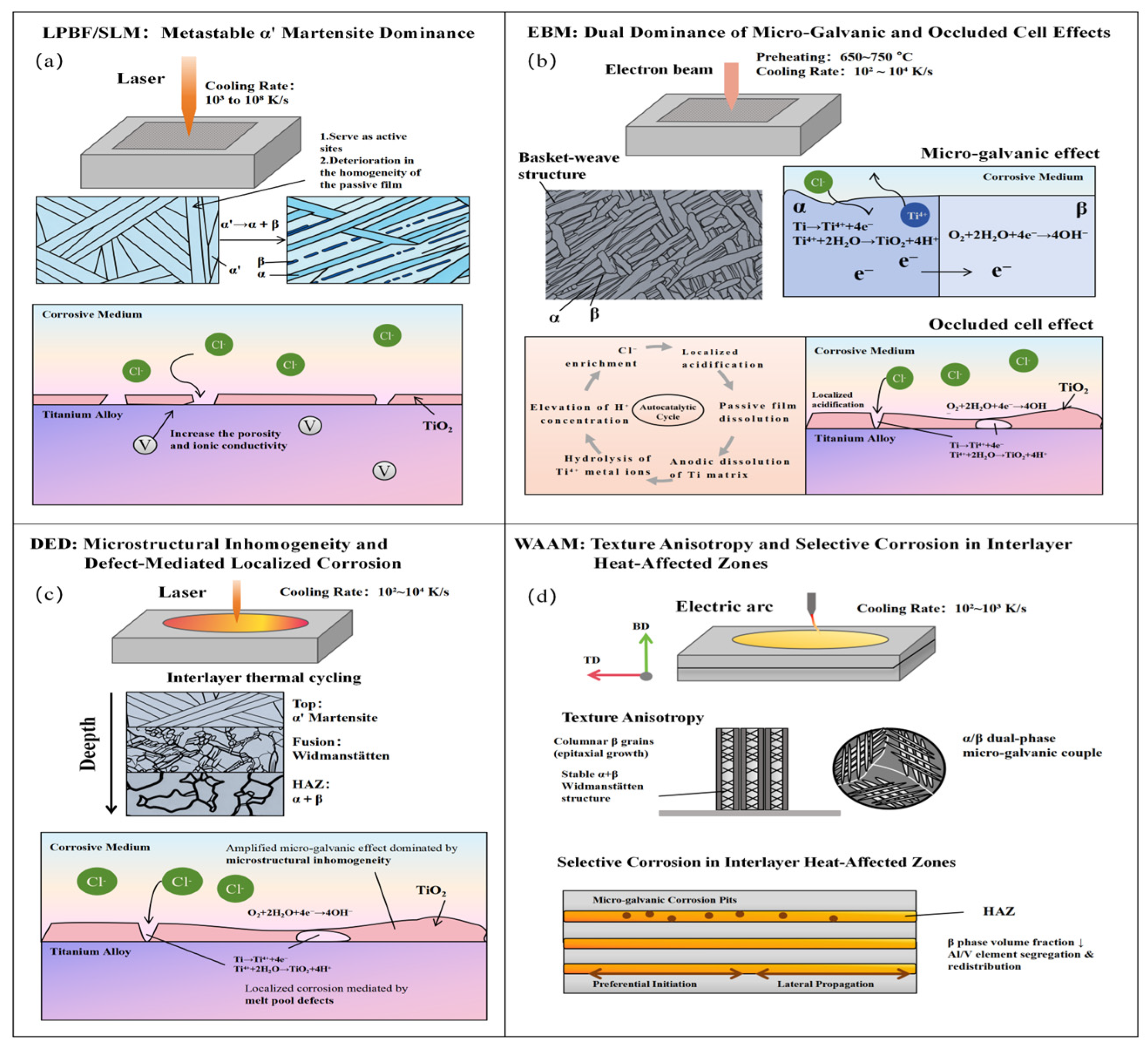
| LPBF/ SLM | High-energy laser | 103–108 K/s | High | Microporosity, lack of fusion | Acicular α′ martensite; textured fine columnar grains | High-defect passive film; strong corrosion anisotropy; corrosion evolution governed by α′ decomposition |
| EBM | Electron beam (vacuum) | 102–103 K/s | Low (preheated powder bed) | High surface roughness; low internal porosity | Lamellar α + β Widmanstätten structure; coarse epitaxial β grains | Combined action of α/β micro-galvanic corrosion and surface-occluded cell effect |
| DED | High-power laser (coaxial feeding) | 102–104 K/s | Medium | Large irregular pores; pronounced HAZ inhomogeneity | Mixed α′ + Widmanstätten α + β; distinct fusion boundary | Amplified micro-galvanic effect; severe occluded cell corrosion from large defects |
| WAAM | Electric arc (wire feedstock) | 10–102 K/s | High, non-uniform | Interlayer HAZs; interlayer bonding defects | Coarse textured columnar α + β Widmanstätten structure | Strong texture-induced anisotropy; selective corrosion at interlayer HAZs |
| Matrix | Post-Treatment Methods | Sample States | Corrosion Mediums | Reference Electrode | Ecorr (V) | Icorr (A/m2) | Rp (Ω·m2) | Ref. |
|---|---|---|---|---|---|---|---|---|
| TC4 | LSM | LPBF | SBF | Ag/AgCl | −0.468 ± 0.041 | (5.3 ± 2.2) × 10−4 | - | [38] |
| WR | −0.489 ± 0.023 | (2.0 ± 0.8) × 10−4 | - | |||||
| TC4 | LSM | LSM-LPBF | SBF | Ag/AgCl | −0.110 ± 0.008 | (3.2 ± 0.49) × 10−3 | - | [39] |
| LSM-WR | −0.157 ± 0.002 | (1.1 ± 0.13) × 10−3 | - | |||||
| TC4 | SB: F100 WFA/5 bar/2 min AE: Modified Kroll’s reagent | WR | SBF | Ag/AgCl | −0.13 ± 0.06 | (1.83 ± 0.5) × 10−2 | 1.8518 ± 0.00403 | [40] |
| AB | −0.50 ± 0.08 | 0.3397 ± 0.084 | 0.1563 ± 0.00575 | |||||
| AB-SB | −0.10 ± 0.07 | (1.52 ± 4.3) × 10−2 | 3.8292 ± 0.0481 | |||||
| AB-AE | −0.37 ± 0.165 | 0.3539 ± 0.143 | 0.2065 ± 0.00826 | |||||
| TC4 | 850 °C/2 h/FC/Ar | AB | 0.9 wt% NaCl | Ag/AgCl | −0.389 ± 0.007 | 8.46 × 10⁻⁴ | 271 ± 132 | [41] |
| HT | −0.158 ± 0.11 | 3.5 × 10⁻⁴ | 782 ± 204 | |||||
| TC4 | 800 °C/2 h/FC | PBF | 3.5 wt% NaCl | Ag/AgCl | −0.3713 | 9.9 × 10⁻³ | - | [42] |
| HAM | −0.3067 | 1.12 × 10⁻² | - | |||||
| TC4 | HT: 850 ± 2 °C/2 h/FC HIP: 899 ± 14 °C/1034 ± 34 bar/2 h/WQ | HT-H | 3.5 wt% NaCl | Ag/AgCl | −0.085 | 1.53 × 10⁻³ | - | [43] |
| HIP-H | −0.069 | 2.15 × 10⁻³ | - | |||||
| HT-V | −0.058 | 1.98 × 10⁻³ | - | |||||
| HIP-V | −0.085 | 2.62 × 10⁻³ | - | |||||
| TC4 | 800 °C/2 h/FC/Ar | WR | 3.5 wt% NaCl | SCE | −0.318 ± 0.010 | 1.15 × 10⁻³ ± 4.0 × 10⁻⁵ | - | [44] |
| AB | −0.494 ± 0.016 | 1.82 × 10⁻² ± 5.9 × 10⁻⁴ | - | |||||
| HT | −0.337 ± 0.011 | 1.51 × 10⁻³ ± 6 × 10⁻⁵ | - | |||||
| TC4 | - | Top-S1 | 20 °C/3.5 wt% NaCl | SCE | −0.45 ± 0.029 | 85 ± 130 | 199 ± 16 | [45] |
| Middle-S2 | −0.43 ± 0.069 | 110 ± 170 | 158 ± 29 | |||||
| Bottom-S3 | −0.39 ± 0.016 | 190 ± 290 | 94 ± 111 | |||||
| TC4 | - | Cast | 1 mol/L HCl | SCE | −0.341 ± 0.018 | 9.2 × 10⁻³ ± 6.0 × 10⁻⁴ | - | [46] |
| AB | −0.389 ± 0.046 | 1.11 × 10⁻² ± 2.4 × 10⁻³ | - | |||||
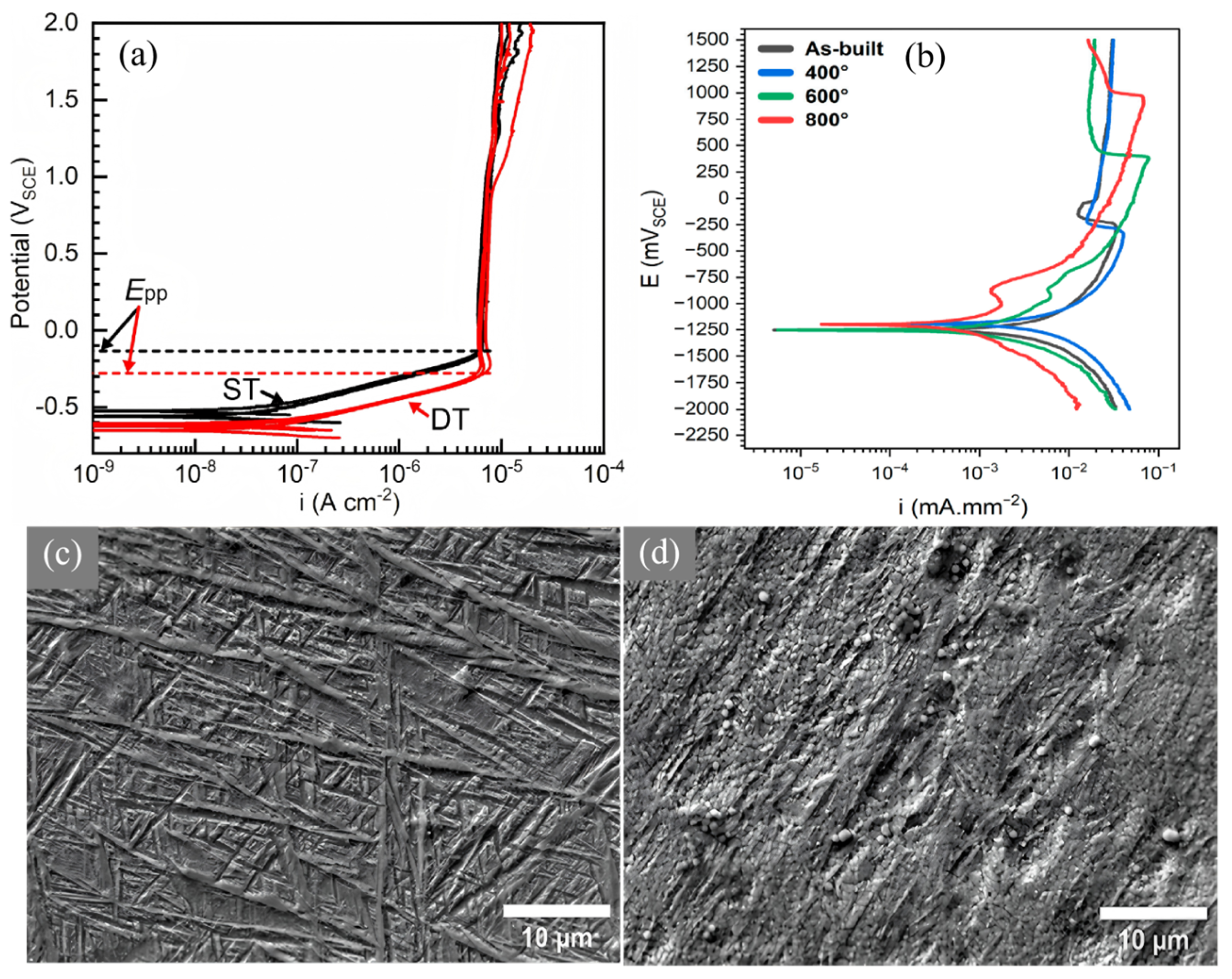
| TC4 | - | ST | ST | SCE | −0.548 ± 0.016 | 8.0 × 10⁻⁵ ± 4.0 × 10⁻⁵ | - | [47] |
| DT | DT | −0.627 ± 0.019 | 3.0 × 10⁻⁴ ± 3.0 × 10⁻⁵ | - | ||||
| TC4 | - | 1 h | RS | Ag/AgCl | −0.172 | 4.0 × 10⁻⁴ | - | [48] |
| 100 h | −0.329 | 3.6 × 10⁻³ | - | |||||
| TC4 | 400/600/800 °C/1 h/FC/Ar | AB | AS + 5% NaF | SCE | −1.2623 | 2.84 | - | [49] |
| 400 –800 °C | −1.2012–−1.2534 | 0.586–3.66 | - | |||||
| TC4 | 700 °C/2 h/FC 700 °C/2 h/AC | AB | HBSS | Ag/AgCl | −0.376 ± 0.015 | 1.28 × 10⁻³ ± 1.1 × 10⁻⁴ | - | [29] |
| FC | −0.228 ± 0.017 | 2.12 × 10⁻³ ± 1.8 × 10⁻⁴ | - | |||||
| AC | −0.517 ± 0.034 | 1.12 × 10⁻³ ± 8.0 × 10⁻⁵ | - | |||||
| TMZF | 900 °C/1 h/WQ | AB | SBF | SCE | −0.44 | 3.5 × 10⁻³ ± 2 × 10⁻⁴ | 26 | [50] |
| ST | −0.41 ± 0.03 | 1.16 × 10⁻² ± 1 × 10⁻⁴ | 7 | |||||
| NiTi SMAs | - | 200 W | 3.5 wt% NaCl | SCE | −0.320 ± 0.012 | (5.34 ± 0.42) × 10−4 | - | [51] |
| 80 W | −0.430 ± 0.014 | (1.321 ± 0.035) × 10−3 | - | |||||
| 300 W | −0.340 ± 0.013 | (1.845 ± 0.037) × 10−3 | - | |||||
| Ti-12Ni | - | 67 J/mm3 | 3.5 wt% NaCl | SCE | −0.25 ± 0.05 | (4.55 ± 1.3) × 10−5 | - | [52] |
| 133 J/mm3 | −0.29 ± 0.06 | (4.839 ± 0.97) × 10−4 | - | |||||
| 267 J/mm3 | −0.30 ± 0.02 | (1.754 ± 0.24) × 10−4 | - | |||||
| Ti-xCu | - | 0–8 | AS | SCE | - | (1.16–5.38) × 10−4 | - | [53] |
| TNZ | 900 °C/1 h/IQ 660 °C/1 h/WQ | WR | PBS | SCE | −0.355 ± 0.022 | 8.6 × 10⁻⁴ ± 3.2 × 10⁻⁴ | - | [54] |
| AB | −0.348 ± 0.016 | 5.1 × 10⁻⁴ ± 2.2 × 10⁻⁴ | - | |||||
| IQ | −0.425 ± 0.048 | 3.0 × 10⁻⁴ ± 2.9 × 10⁻⁴ | - | |||||
| WQ | −0.462 ± 0.077 | 4.6 × 10⁻⁴ ± 1.9 × 10⁻⁴ | - | |||||
| TC4 TNZT TNZTS | - | TC4 | PBS | SCE | −0.47 ± 0.01 | 4.6 × 10⁻³ ± 7.0 × 10⁻⁴ | - | [55] |
| - | TNZT | −0.47 ± 0.02 | 3.5 × 10⁻³ ± 8.0 × 10⁻⁴ | - | ||||
| 1200 °C/30 min/IQ | TNZTS | −0.52 ± 0.06 | 2.8 × 10⁻³ ± 1.0 × 10⁻³ | - | ||||
| Ti-12Cr Ti-12Cr-3Sn | - | Ti-12Cr + Ti-12Cr-3Sn | PBS | Ag/AgCl | −0.381 | 4 × 10⁻⁴ | - | [56] |
| Matrix | Post-Treatment Method | Sample States | Corrosion Mediums | Reference Electrode | Ecorr (V) | Icorr (A/m2) | Rp (Ω·m2) | Ref. |
|---|---|---|---|---|---|---|---|---|
| HDH-Ti GA-Ti | - | HDH-Ti | 3.5 wt% NaCl | SCE | −0.28751 | 1.96 × 10⁻² | - | [57] |
| GA-Ti | −0.25241 | 3.07 × 10⁻² | - | |||||
| Cp-Ti | PO:750 °C/4 h | F | SBF | Ag/AgCl | −0.114 ± 0.00548 | 1.15 ± 3.45 × 10⁻² | - | [26] |
| F-PO | −0.0789 ± 0.00552 | 0.399 ± 2.39 × 10⁻² | - | |||||
| AB | −0.232 ± 0.01856 | 1.18 ± 8.26 × 10⁻² | - | |||||
| AB-PO | −0.0996 ± 0.00727 | 0.297 ± 2.08 × 10⁻² | - | |||||
| TC4 | - | 400–700 μm | SBF | - | −0.972–−0.508 | (4.78–18.07) × 10−3 | - | [58] |
| TC4 | - | AB | SBF | SCE | −0.10 | - | - | [59] |
| WR | −0.10 | - | - | |||||
| TC4 | - | 160–240 W | SBF | Ag/AgCl | −0.462–−0.352 | (1.176–3.395) × 10−3 | 11.3–31.13 | [60] |
| TC4 | - | WR | RDF | SCE | −1.22 | 1.76 × 10⁻⁴ | - | [61] |
| AB-H | −1.23 | 8.325 × 10⁻⁴ | - | |||||
| AB-V | −1.29 | 3.428 × 10⁻³ | - | |||||
| TC4 | 800 °C/2 h + 500 °C/0.5 h/FC (VA) | WR | RS | Ag/AgCl | −0.333 ± 0.04 | 1.2 × 10⁻³ ± 3 × 10⁻⁵ | - | [62] |
| AB-HT | −0.388 ± 0.015 | 6.0 × 10⁻⁴ ± 5 × 10⁻⁵ | - | |||||
| TC4 | - | WR | AS/37 ± 1 °C | Ag/AgCl | −0.55 ± 0.02 | 2.08 × 10⁻² | 2.08 ± 0.05 | [11] |
| XOZ | −0.55 ± 0.03 | 1.98 × 10⁻² | 2.58 ± 0.06 | |||||
| XOY | −0.54 ± 0.02 | 1.75 × 10⁻² | 2.78 ± 0.05 | |||||
| TC4 | 800/940 °C/4 h/WQ | 800 °C | SSW | SCE | −0.204 | 0.3438 | - | [63] |
| 940 °C | −0.161 | 0.5379 | - | |||||
| TC4 | - | 600–1200 mm/s | 0.9 wt% NaCl | Ag/AgCl | −0.664–−0.57 | (1.4–4.67) × 10−3 | - | [27] |
| TC4 | APEP:10 wt.% OA/30 min + EP/20 min | AB | 3.5 wt% NaCl | SCE | −0.078 | 2.42 × 10⁻² | - | [64] |
| APEP20 | −0.009 | 1.25 × 10⁻³ | - | |||||
| TC4 | HT: 650 °C/3 h (VA) HIP: 925 ± 14 °C/100 MPa/3 h/Ar | WR | 3.5 wt% NaCl | SCE | −0.4883 | 1.9 × 10⁻⁴ | - | [65] |
| HT | −0.4178 | 1.97 × 10⁻³ | - | |||||
| HIP | −0.3243 | 8.5 × 10⁻⁴ | - | |||||
| TC4 | PN: 485–545 °C/300 Pa/1 h | AB | 3.5 wt% NaCl | SCE | −0.401 | 2.168 × 10⁻² | 2094 | [66] |
| PN-(485–545) | −0.455–−0.314 | (1.021–303.9) × 10−4 | 1663–12190 | |||||
| TC4 | Aa + HT 600 °C/1 h Aa + Ca/Ag/24 h + HT 600 °C/1 h | AB | 3.5 wt% NaCl | Ag/AgCl | −0.257 | 1 × 10⁻⁴ ± 1 × 10⁻⁵ | - | [67] |
| AB-Na | −0.170 | 6 × 10⁻⁵ ± 2 × 10⁻² | - | |||||
| AB-Na-9.9 Ca/0.1 Ag | −0.207 | 2 × 10⁻⁵ ± 3 × 10⁻² | - | |||||
| TC4 | 800 °C/2 h/FC hydrogen charging | F-HC | 3.5 wt% NaCl | SCE | 0.095 | 1.40 × 10⁻⁴ | - | [68] |
| HT-XY | −0.258 | 2.28 × 10⁻⁵ | - | |||||
| HT-XY-HC | 0.195 | 7.19 × 10⁻⁵ | - | |||||
| TC4 | MAO | 0–15 min | 3.5 wt% NaCl | SCE | −0.334–−0.13 | 0.1532–0.6212 | - | [32] |
| TC4 | HT: 900 °C/2 h/FC + 200 °C/AC (VA) HIP: 900 °C/120 MPa/2 h | AB | 1 M NaCl | SCE | −0.92 ± 0.03 | 8.3 × 10⁻² | - | [69] |
| HT | −0.68 ± 0.04 | 4.5 × 10⁻² | - | |||||
| HIP | −0.57 ± 0.03 | 1.5 × 10⁻³ | - | |||||
| TC4 | 800 °C/2 h + 500 °C/0.5 h/FC (VA) | F | 20 wt.% HCl | Ag/AgCl | −0.63 | 0.813 | 0.04278 | [70] |
| AB-HT | −0.61 | 0.847 | 0.03908 | |||||
| TC4 | - | XY-YZ | 1 M HCl | SCE | 0.3152 | 7.66 × 10⁻³ | 6.39 | [71] |
| XY-XZ | −0.1788 | 1.90 × 10⁻² | 3.84 | |||||
| TC4 | - | AB | 6 M 95 °C HNO3-OI | SCE | 1.06 | 8.30 × 10⁻² | 0.352 | [72] |
| Cast | 1.019 | 0.4203 | 0.125 | |||||
| TC4-3Cu | 760/820/875 °C/2 h/WQ/Ar | AB | 0.9 wt% NaCl | SCE | −0.37 | 6.965 × 10⁻⁴ | 26.25 | [73] |
| 760–875 °C | −0.423–−0.344 | (3.92–49.2) × 10−4 | 8.632–34.57 | |||||
| TC4-3Cu | Cast | 0.9 wt% NaCl | SCE | −0.322 ± 0.021 | 2.15 × 10⁻³ | 23.152 ± 2.594 | [74] | |
| 750 °C/2 h/AC | Pre-alloyed | −0.389 ± 0.010 | 6.66 × 10⁻⁴ | 37.167 ± 10.360 | ||||
| Mixed | −0.354 ± 0.042 | 8.42 × 10⁻⁴ | 35.417 ± 14.178 | |||||
| Ti2AlN/TC4 (IPCs) | - | TC4 | 3.5 wt% NaCl | SCE | −0.551 | 9.3 × 10⁻³ | - | [75] |
| Ceramic | −0.527 | 2.0 × 10⁻⁴ | - | |||||
| NSS | −0.532 | 3.4 × 10⁻³ | - | |||||
| DSS | −0.554 | 9.8 × 10⁻³ | - | |||||
| 35% Ti2AlN | −0.458 | 4.6 × 10⁻³ | - | [76] | ||||
| Ti-55531 | - | SLM-H | 3.5 wt% NaCl | SCE | −0.194 ± 0.009 | 4.16 × 10⁻³ ± 1.6 × 10⁻⁴ | - | [77] |
| SLM-V | −0.275 ± 0.032 | 5.19 × 10⁻³ ± 2.8 × 10⁻⁴ | - | |||||
| Ti-55531 | ST: 790 °C/1.5 h/AC + 600 °C/6 h/AC HT: 870 °C/1.5 h/AC + 750 °C/1 h/AC + 600 °C/6 h/AC | STA-H | 3.5 wt% NaCl | SCE | −0.3956 ± 0.019 | 3.52 × 10⁻³ ± 2.8 × 10⁻⁴ | - | [78] |
| STA-V | −0.4386 ± 0.027 | 3.75 × 10⁻³ ± 3.3 × 10⁻⁴ | - | |||||
| HT-H | −0.6145 ± 0.017 | 4.76 × 10⁻³ ± 2.1 × 10⁻⁴ | - | |||||
| HT-V | −0.6462 ± 0.030 | 5.35 × 10⁻³ ± 3.8 × 10⁻⁴ | - | |||||
| Zr/TC4 | - | 0–4%Zr | HBSS | SCE | −0.641–−0.504 | (3.106–4.915) × 10−3 | - | [79] |
| TNZT | - | SLM-45° | PBS | Ag/AgCl | −0.04 | 2.3 × 10⁻³ | 2.48 | [80] |
| SPS | −0.02 | 3.15 × 10⁻² | 1.99 |
| Matrix | Post-Treatment Method | Sample States | Corrosion Mediums | Reference Electrode | Ecorr (V) | Icorr (A/m2) | Rp (Ω·m2) | Ref. |
|---|---|---|---|---|---|---|---|---|
| TC4 | - | XX-YZ | 1 M HCl | SCE | −0.6938 | 0.22 | 0.237 | [71] |
| XX-XZ | 0.1962 | 0.01885 | 5.25 | |||||
| XX-XY | −0.7492 | 0.163 | 0.33 | |||||
| TC4 | PN | AB | 3.5 wt% NaCl | SCE | - | 2.75 × 10⁻³ | - | [81] |
| AB-PN | - | 3.39 × 10⁻⁴ | - | |||||
| TC4 | MAO | AB | 3.5 wt% NaCl | SCE | −0.249 | 0.504 | - | [32] |
| MAO-5 min | −0.141 | 0.176 | - | |||||
| MAO-10 min | −0.130 | 0.4528 | - | |||||
| MAO-15 min | −0.118 | 1.138 | - | |||||
| TC4 | HT1:600 °C/1 h/FC HT2:800 °C/1 h/FC HT3:920 °C/1 h/WQ | AB | 3.5 wt% NaCl | SCE | −0.461 ± 0.025 | 1.09 × 10⁻³ | 5.4152 | [30] |
| HT1 | −0.335 ± 0.018 | 2.45 × 10⁻³ | 1.2278 | |||||
| HT2 | −0.507 ± 0.027 | 2.20 × 10⁻⁴ | 36.779 | |||||
| HT3 | −0.331 ± 0.034 | 2.02 × 10⁻³ | 3.2647 | |||||
| TC4 | - | EBM | SBF | SCE | −0.18 | - | - | [59] |
| WR | −0.10 | - | - | |||||
| TC4 | Feed rate: 0.1 mm/r Cryogenic: LN2/0.9 kg/min | WR-C-0.1 | SPC | SCE | −0.43 | 2.00 × 10⁻⁴ | - | [82] |
| AM-C-0.1 | −0.35 | 1.00 × 10⁻⁴ | - | |||||
| TC4 | - | EBM-H | RDF | SCE | −1.18 | 1.127 × 10⁻⁴ | - | [61] |
| EBM-V | −1.24 | 3.112 × 10⁻⁴ | - | |||||
| F | −1.22 | 1.76 × 10⁻⁴ | - | |||||
| TC4 | - | 1 h | RS | Ag/AgCl | −0.279 | 8.0 × 10⁻⁴ | - | [48] |
| 100 h | −0.165 | 8.7 × 10⁻³ | - | |||||
| TC4 | - | WR | RS | Ag/AgCl | −0.25 ± 0.01 | (7 ± 0.5) × 10−3 | - | [83] |
| EBM | −0.16 ± 0.02 | (2.7 ± 0.6) × 10−3 | - | |||||
| TC4 | - | WR | HBSS | SCE | −0.48 | - | - | [84] |
| - | EBM | 0.04 | - | - | ||||
| SiC polishing: P400/P800/P1200 | EBM-MP | −0.49 | - | - | ||||
| TC4 | - | 0.166 mV/s | HBSS | SCE | −0.353743 | 1.507 × 10⁻² | - | [85] |
| 0.05 mV/s | −0.379018 | 4.335 × 10⁻³ | - | |||||
| TC4 | SB: Al2O3/30 bar/30 s Machined: Ra ≈ 1.66 μm HIP: 910 °C/2 h/1500 bar/Ar | AB | HBSS | SCE | - | (6.144 ± 3.773) × 10−2 | 1.99 ± 1.55 | [86] |
| AB-SB | - | (2.516 ± 2.308) × 10−2 | 4.38 ± 2.56 | |||||
| AB-M | - | (3.1 ± 1.5) × 10−4 | 111.69 ± 8.11 | |||||
| HIP-M | - | (3.2 ± 2.1) × 10−4 | 106.47 ± 19.21 | |||||
| Ti536 | - | TC4 | SBF | Ag/AgCl | −0.03 ± 0.01 | (1.90 ± 0.10) × 10−4 | 132 | [87] |
| Ti536 | −0.09 ± 0.03 | (5.60 ± 0.20) × 10−4 | 24.2 | |||||
| Ti536 | - | TC4-2 h | 0.9 wt% NaCl | Ag/AgCl | −0.025 ± 0.138 | (4.2 ± 0.4) × 10−4 | 4.453 ± 0.02 | [88] |
| Ti536-2 h | −0.035 ± 0.015 | (2.6 ± 0.2) × 10−4 | 1.994 ± 0.02 | |||||
| TC4-2 h | 0.9% NaCl + H2O2 | 0.165 ± 0.013 | (3.1 ± 0.3) × 10−4 | 0.588 ± 0.01 | ||||
| Ti536-2 h | 0.203 ± 0.174 | (4.4 ± 0.4) × 10−4 | 0.203 ± 0.03 | |||||
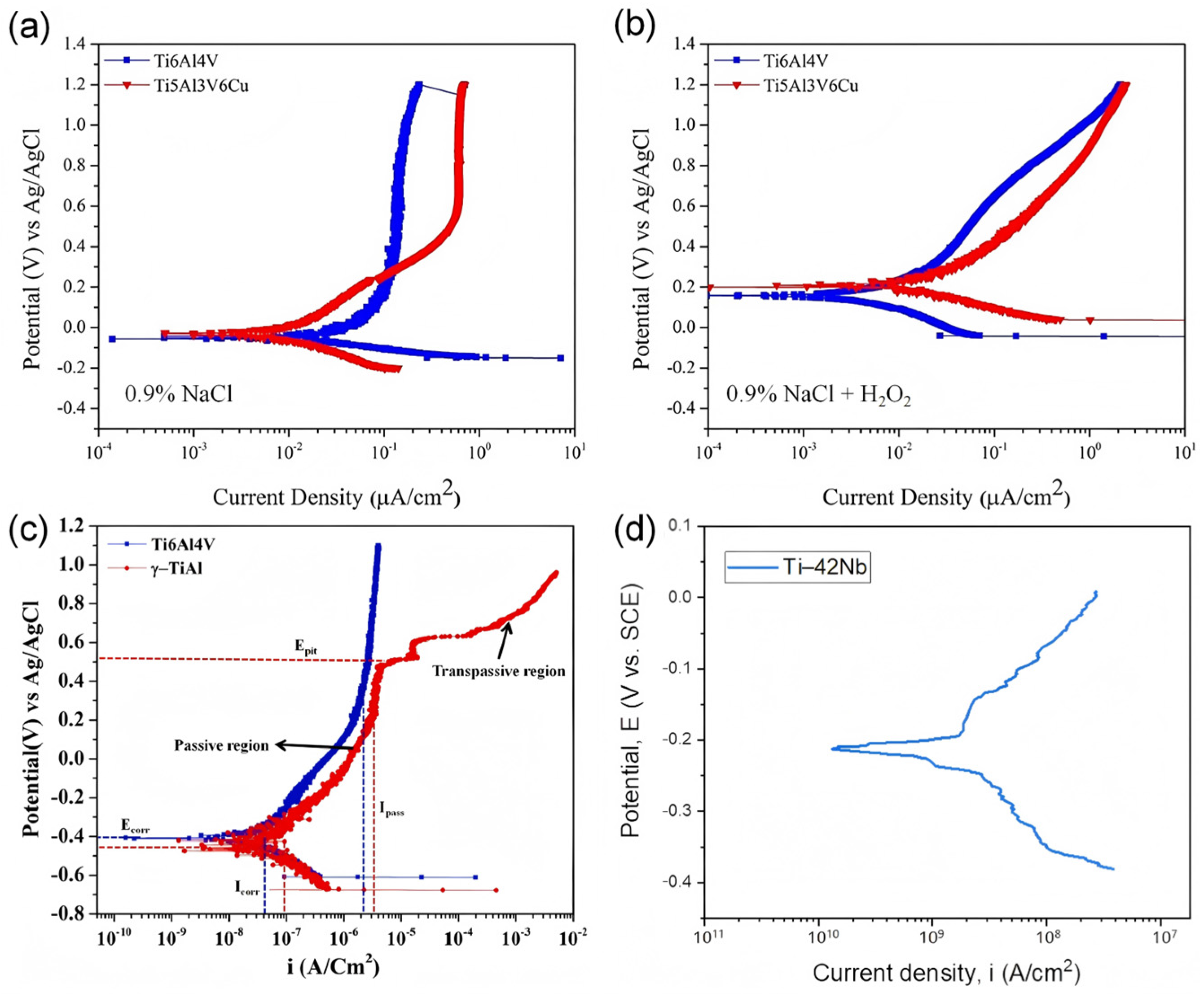
| Ti4822 | - | TC4 | 0.9 wt% NaCl | Ag/AgCl | −0.41 ± 0.23 | (3.4 ± 1.2) × 10−4 | 276 ± 37 | [89] |
| Ti4822 | −0.46 ± 0.11 | (9.2 ± 3.8) × 10−4 | 149 ± 72 | |||||
| Ti-42Nb | - | Ti-42Nb | SBF | SCE | –0.225 ± 0.002 | (3.84 ± 0.02) × 10−5 | 2091 ± 94 | [90] |
| Matrix | AM Method | Post-Treatment Method | Sample States | Corrosion Medium | Reference Electrode | Ecorr (V) | Icorr (A/m2) | Rp (Ω·m2) | Ref. |
|---|---|---|---|---|---|---|---|---|---|
| TC4 | LWAM-V | - | F | 3.5 wt% NaCl | Ag/AgCl | −0.1967 | 7.852 × 10⁻³ | 4.335 | [91] |
| LWAM-V | −0.1638 | 1.607 × 10⁻² | 2.408 | ||||||
| TC4 | DED | 800 °C/2 h/FC | DED | 3.5 wt% NaCl | Ag/AgCl | −0.4384 | 7.1 × 10⁻³ | - | [42] |
| HAM | HAM | −0.3067 | 1.12 × 10⁻² | - | |||||
| TC4 | DED | - | WR | HBSS | Ag/AgCl | −0.319 ± 0.086 | (1.2 ± 0.2) × 10−4 | 570 | [92] |
| DED | −0.094 ± 0.076 | (1.5 ± 0.7) × 10−4 | 323 | ||||||
| WR | 0.9 wt% NaCl | −0.334 ± 0.025 | (1.4 ± 0.3) × 10−4 | 809 | |||||
| DED | −0.074 ± 0.032 | (5.3 ± 1.2) × 10−4 | 154 | ||||||
| WR | AS | −0.337 ± 0.030 | (1.5 ± 0.5) × 10−4 | 880 | |||||
| DED | −0.039 ± 0.066 | (5.9 ± 3.4) × 10−4 | 64 | ||||||
| TC4 | LSF | HT: 650 °C/1 h/FC | LSF-HT | 15 wt% NaCl | SCE | −0.224 ± 0.0012 | (1.559 ± 0.268) × 10−2 | - | [35] |
| F | −0.230 ± 0.0010 | (6.064 ± 1.754) × 10−2 | - | ||||||
| TC4 | LSF | - | LSF | 15 wt% NaCl | SCE | −0.255 ± 0.0015 | (7.862 ± 3.508) × 10−2 | - | [93] |
| F | −0.230 ± 0.0010 | (6.064 ± 1.754) × 10−2 | - | ||||||
| TC4 | LCD | - | 3.5 wt% | 3.5/10/15 wt% NaCl | SCE | −0.204 ± 0.001 | (3.36 ± 0.04) × 10−3 | - | [94] |
| 10 wt% | −0.280 ± 0.003 | (1.11 ± 0.08) × 10−3 | - | ||||||
| 15 wt% | −0.356 ± 0.009 | (1.02 ± 0.26) × 10−3 | - | ||||||
| TC4 | LC-CPF | - | LC-CPF | SBF | SCE | −0.22 ± 0.00585 | (2.53 ± 0.0692) × 10−2 | 0.473 | [95] |
| F | −0.11 ± 0.00529 | (2.93 ± 0.17) × 10−3 | 0.583 | ||||||
| TC4 | LMD | - | WR | AS | SCE | −0.249 ± 0.005 | (5.11 ± 0.48) × 10−5 | - | [96] |
| One-way | −0.281 ± 0.003 | (9.33 ± 0.20) × 10−5 | - | ||||||
| Cross | −0.334 ± 0.003 | (14.03 ± 0.16) × 10−5 | - | ||||||
| TC4 | LMD | SFPB: Al2O3/1.5 MPa/60 s | LMD | 3.5 wt% NaCl | SCE | −0.362 | 7.05 × 10⁻³ | - | [97] |
| LMD-SFPB | −0.347 | 1.1802 × 10⁻³ | - | ||||||
| TC4 | LENS | P-PHT: 950 °C/30 min/10−2 mbar/FC HIP: 950 °C/30 min/300 MPa/FC/Ar | LENS | 0.9 wt% NaCl | Ag/AgCl | −0.021 | 3.1 × 10⁻³ | - | [98] |
| P-PHT | −0.034 | 3.6 × 10⁻³ | - | ||||||
| HIP | −0.074 | 7.7 × 10⁻⁴ | - | ||||||
| TC11 TC11-10Mo | LMD | - | TC11 | 3.5 wt% NaCl | - | −0.702 | 8.89 × 10⁻³ | - | [99] |
| TC11-10Mo | −0.411 | 4.18 × 10⁻⁴ | - | ||||||
| Ti-2Fe-0.1B | LMD | - | Cast | HBSS | Ag/AgCl | −0.168 ± 0.01 | (7.144 ± 1.40) × 10−4 | - | [100] |
| F | −0.176 ± 0.02 | (5.727 ± 1.10) × 10−4 | - | ||||||
| LMD | −0.128 ± 0.03 | (4.689 ± 0.99) × 10−4 | - | ||||||
| Ti-Al-xSi-xCu | LMD | - | TC4 | 3.5 wt% NaCl | - | −0.245 | 5.58 × 10⁻³ | 4.607 | [34] |
| Ti-Al-12Si-2Cu | −0.465 | 0.0196 | 0.1313 | ||||||
| Ti-Al-7Si-4Cu | −0.388 | 3.86 × 10⁻³ | 6.658 | ||||||
| Ti-Zr | LCD | - | Ti-40Zr | 1 mol/L HCl | SCE | 0.062819 | 1.035 × 10⁻³ | - | [33] |
| Ti-17Nb-6Ta | LCD | - | Ti-17Nb-6Ta | RS | SCE | −0.3 | 2.26 × 10⁻³ | - | [101] |
| Ti-15Mo | DED | - | DLD-H | SBF | SCE | −0.472 | 2.99 × 10⁻² | 0.419 | [102] |
| DLD-V | −0.667 | 7.70 × 10⁻² | 0.238 |
| Matrix | AM Method | Post-Treatment Method | Sample States | Corrosion Mediums | Reference Electrode | Ecorr (V) | Icorr (A/m2) | Rp (Ω·m2) | Ref. |
|---|---|---|---|---|---|---|---|---|---|
| Cp-Ti | WDED | - | 1N HCl | 1N/6N HCl | SCE | 0.5292 | 0.3985 | - | [104] |
| 6N HCl | 0.7018 | 11.59 | - | ||||||
| Ti-6Al-xV | WAAM | - | Ti-6Al | 3.5 wt% NaCl | SCE | −0.108 ± 0.015 | (4.2 ± 1.2) × 10−3 | - | [105] |
| Ti-6Al-2V | −0.097 ± 0.023 | (6.7 ± 2.5) × 10−3 | - | ||||||
| TC4 | −0.109 ± 0.026 | (3.9 ± 1.0) × 10−3 | - | ||||||
| Ti-6Al | 1 M LA + AS | −0.057 ± 0.022 | (1.6 ± 0.3) × 10−3 | - | |||||
| Ti-6Al-2V | −0.156 ± 0.015 | (7.0 ± 1.0) × 10−4 | - | ||||||
| TC4 | −0.180 ± 0.045 | (1.2 ± 0.4) × 10−3 | - | ||||||
| TC4 | CMTAM | - | Cast | 3.5 wt% NaCl | SCE | −0.48 | 9.53 × 10⁻⁴ | 184.9 | [106] |
| 100%Ar | −0.59 | 2.06 × 10⁻³ | 24.7 | ||||||
| 100%He | −0.44 | 9.17 × 10⁻⁴ | 105.4 | ||||||
| 50%Ar + 50%He | −0.34 | 5.47 × 10⁻⁴ | 212.3 | ||||||
| TC4 | WAAM | HT: 950 °C/1 h/AC + 600 °C/4 h/AC | BR | 3.5 wt% NaCl | SCE | −0.47 | 9.87 × 10⁻³ | - | [107] |
| HT-BR | −0.47 | 4.37 × 10⁻³ | - | ||||||
| TC4 | WAAM | - | C-WAAM + TSG | 3.5 wt% NaCl | SCE | −0.52 | 8.46 × 10⁻³ | - | [108] |
| P-WAAM | −0.47 | 8.52 × 10⁻³ | - | ||||||
| P-WAAM + TSG | −0.5 | 8.50 × 10⁻³ | - | ||||||
| TC4 | WAAM | - | WAAM | 3.5 wt% NaCl | SCE | - | - | 5.14 | [109] |
| Rolling | - | - | 7.84 | ||||||
| TC4 | WAAM | 850/1050 °C/2 h/FC/Ar | WR | 0.5 M H2SO4 + 5 ppm F−/70 °C/O2 | Ag/AgCl | −0.831 ± 0.009 | 0.892 ± 0.033 | 0.01802 | [110] |
| AM | −0.794 ± 0.011 | 0.779 ± 0.012 | 0.02104 | ||||||
| AM-850 | −0.803 ± 0.009 | 0.619 ± 0.0008 | 0.02617 | ||||||
| AM-1050 | −0.833 ± 0.008 | 0.54 ± 0.0125 | 0.02844 | ||||||
| TC4-7.3% Cu | WPC-AM | S1: 630 W/<850 °C S2: 690 W/850–1000 °C S3: 810 W/1000–1200 °C | AB | 3.5 wt% NaCl | SCE | −0.243 | 420 | - | [111] |
| S1 | −0.176 | 320 | - | ||||||
| S2 | −0.048 | 50 | - | ||||||
| S3 | −0.162 | 190 | - | ||||||
| TMN | WAAM | STA: 850/FC + 650 °C/2 h HT: 650 °C/FC | AB | 3.5% NaCl (pH = 2) | SCE | −0.337 | (2.73 ± 0.3) × 10−3 | - | [112] |
| STA | −0.401 | (4.03 ± 0.4) × 10−3 | - | ||||||
| HT | −0.388 | (5.65 ± 0.3) × 10−3 | - | ||||||
| AB | 3.5 wt% NaCl + 0.005 M F− | −0.473 | 0.178 ± 0.004 | - | |||||
| STA | −0.518 | 0.177 ± 0.006 | - | ||||||
| HT | −0.485 | 0.207 ± 0.004 | - | ||||||
| TC11 | MWAAM | - | 360A | 3.5 wt% NaCl | SCE | −0.311 | 1.23 × 10⁻⁴ | - | [37] |
| 380A | −0.315 | 2.34 × 10⁻⁴ | - | ||||||
| 400A | −0.329 | 3.36 × 10⁻⁴ | - | ||||||
| Ti6321 | WAAM | - | Rolling | 3.5 wt% NaCl | SCE | −0.403846 | 8.7 × 10⁻⁵ | - | [113] |
| DED-BD | −0.456391 | 4.8 × 10⁻⁵ | - | ||||||
| DED-TD | −0.315705 | 2.9 × 10⁻⁵ | - | ||||||
| Ni-Ti | MPAM | - | Ni45Ti55 | 3.5 wt% NaCl | SCE | −0.26 | 2.81 × 10⁻² | - | [114] |
| Ni50Ti50 | −0.29 | 4.15 × 10⁻² | - | ||||||
| Ni55Ti45 | −0.37 | 5.47 × 10⁻² | - | ||||||
| Ni-Ti | MPAM | - | Ni45Ti55 | HBSS | SCE | −0.28 ± 0.01 | (4.8 ± 0.3) × 10−3 | 0.12 | [115] |
| TC4-5Cr TC4-2.5Cr2.5Ni TC4-5Ni | μ-PAPAM | - | TC4-5Cr | 3.5 wt% NaCl | Ag/AgCl | −0.302 | 1.95 × 10⁻³ | 51.66 | [116] |
| TC4-2.5Cr2.5Ni | −0.348 | 2.37 × 10⁻³ | 46.17 | ||||||
| TC4-5Ni | −0.412 | 2.94 × 10⁻³ | 37.47 | ||||||
| TC4 | −0.473 | 3.49 × 10⁻³ | 19.78 |
| Process | Dominant Mechanism | Characteristic Microstructure | Effective Improvement Strategies |
|---|---|---|---|
| LPBF/SLM | α′ martensite-mediated passive film breakdown; α/β micro-galvanic corrosion; defect-induced localized corrosion | Fine acicular α′ martensite; textured columnar grains; high dislocation density | Sub-transus annealing; HIP; surface modification (SB/PO) |
| EBM | α/β micro-galvanic corrosion; surface-occluded cell effect; intergranular corrosion propagation | Lamellar α + β Widmanstätten structure; epitaxial β grains; high surface roughness | Machining/polishing; HIP; protective surface coating (MAO/PN) |
| DED | Micro-galvanic effect amplified by microstructural inhomogeneity; localized corrosion from large defects; alloying-modified passive film | Distinct fusion zone and HAZ; mixed-size microstructure; large irregular defects | Process parameter optimization; stress relief annealing; Mo/Nb/Zr alloying |
| WAAM | Texture-induced corrosion anisotropy; selective corrosion at interlayer HAZs; interlayer micro-galvanic effect | Coarse textured columnar grains; multi-thermal-cycle interlayer HAZs | Solution + aging treatment; interlayer rolling; laser surface quenching |
Disclaimer/Publisher’s Note: The statements, opinions and data contained in all publications are solely those of the individual author(s) and contributor(s) and not of MDPI and/or the editor(s). MDPI and/or the editor(s) disclaim responsibility for any injury to people or property resulting from any ideas, methods, instructions or products referred to in the content. |
© 2026 by the authors. Licensee MDPI, Basel, Switzerland. This article is an open access article distributed under the terms and conditions of the Creative Commons Attribution (CC BY) license.
Share and Cite
Zhang, B.; Tang, Y.; Liu, B.; Liu, T.; Nong, Z.; Zhang, H. Research Advances in the Corrosion Behavior and Underlying Mechanisms of Additively Manufactured Titanium Alloys. Crystals 2026, 16, 418. https://doi.org/10.3390/cryst16070418
Zhang B, Tang Y, Liu B, Liu T, Nong Z, Zhang H. Research Advances in the Corrosion Behavior and Underlying Mechanisms of Additively Manufactured Titanium Alloys. Crystals. 2026; 16(7):418. https://doi.org/10.3390/cryst16070418
Chicago/Turabian StyleZhang, Boyan, Yuman Tang, Baicheng Liu, Teng Liu, Zhisheng Nong, and Hongliang Zhang. 2026. "Research Advances in the Corrosion Behavior and Underlying Mechanisms of Additively Manufactured Titanium Alloys" Crystals 16, no. 7: 418. https://doi.org/10.3390/cryst16070418
APA StyleZhang, B., Tang, Y., Liu, B., Liu, T., Nong, Z., & Zhang, H. (2026). Research Advances in the Corrosion Behavior and Underlying Mechanisms of Additively Manufactured Titanium Alloys. Crystals, 16(7), 418. https://doi.org/10.3390/cryst16070418