
Lithium Processing in the Past and for the Future


Abstract
1. Introduction
- (1)
- From lithium-bearing brines (salars, geothermal brines, oil field brines);
- (2)
- From lithium ores that need thermal activation (rocks, clays).
2. Lithium Demand, Resources, and Availability
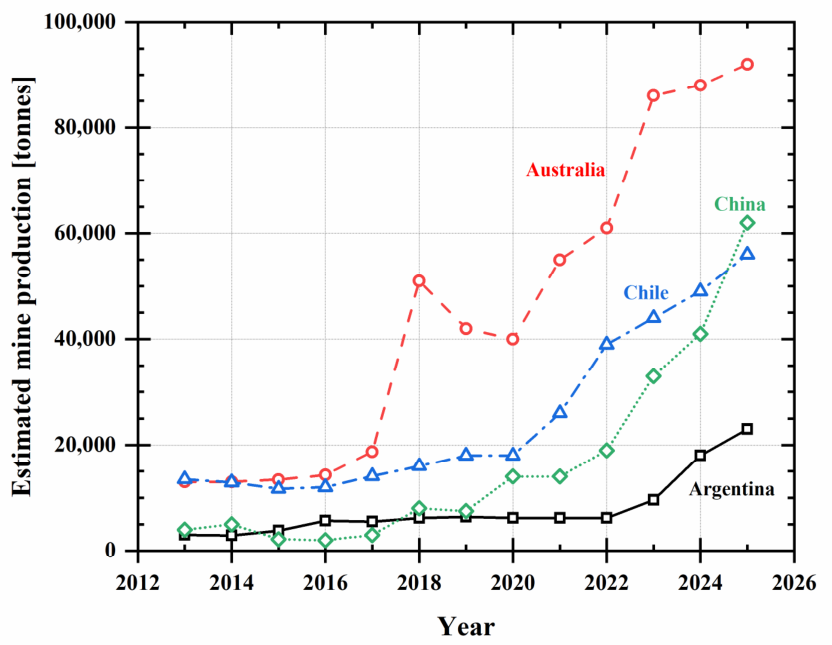
- Estimations are made using distinct non-standardized methodologies;
- Information comes from distinct sources; some of these are privately funded studies [3] that do not necessarily reflect the reality of the lithium deposits.
3. Physicochemical Properties of Lithium
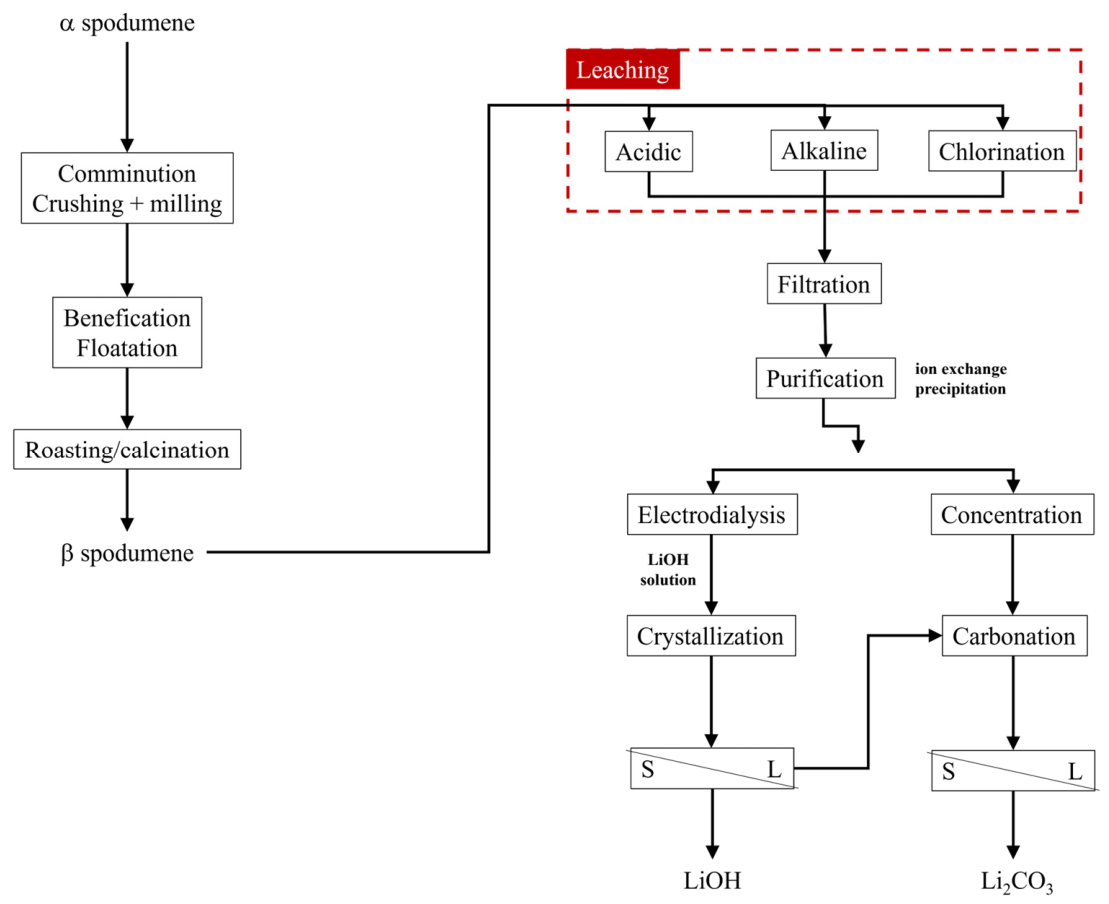
4. Lithium Extraction from Mineral Resources
4.1. Beneficiation of Lithium-Bearing Ores
- (a)
- There is a significant difference in the density of gangue minerals and ores like spodumene [85].
- (b)
- If spodumene is found in mica or clay minerals, its density does not change. Additionally, upon milling, spodumene particles are shaped into acicular particles that float away along with gangue minerals [86].
4.2. Processing of Spodumene Ores
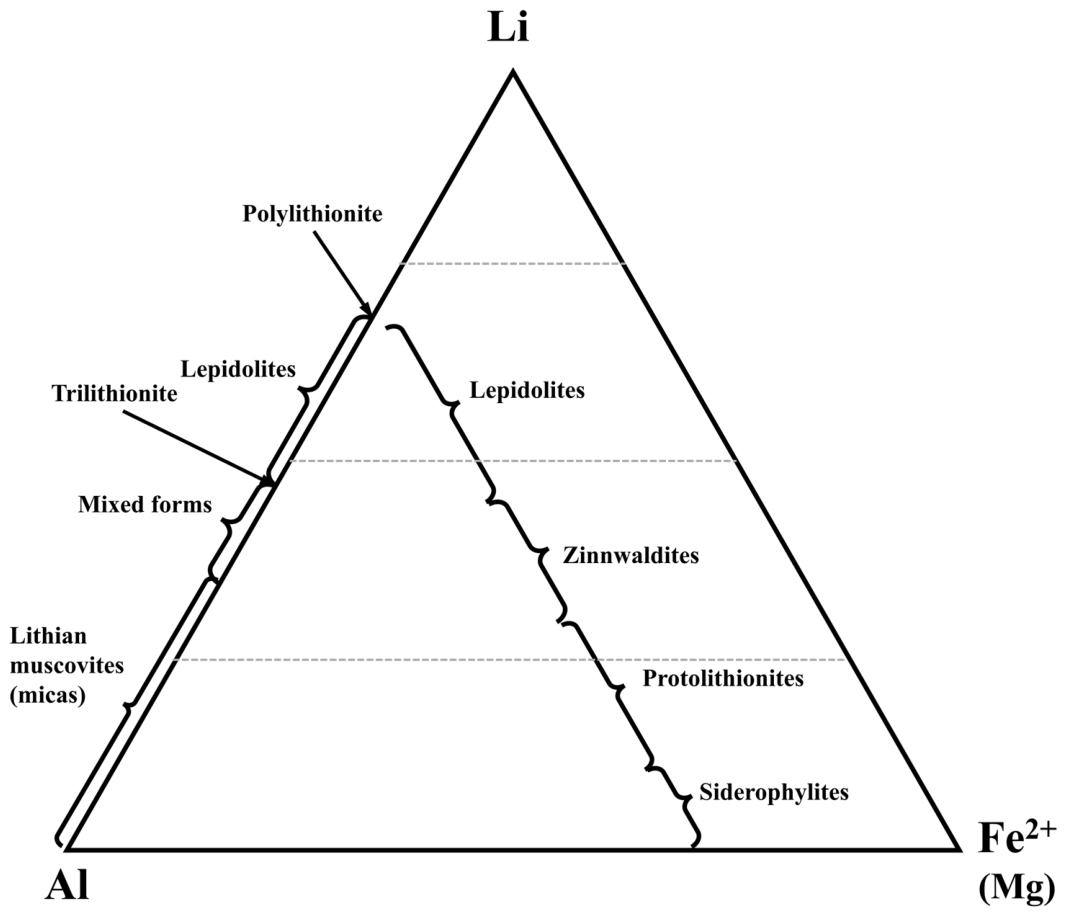
4.3. Processing of Lepidolite, Petalite, Amblygonite and Zinnwaldite Ores
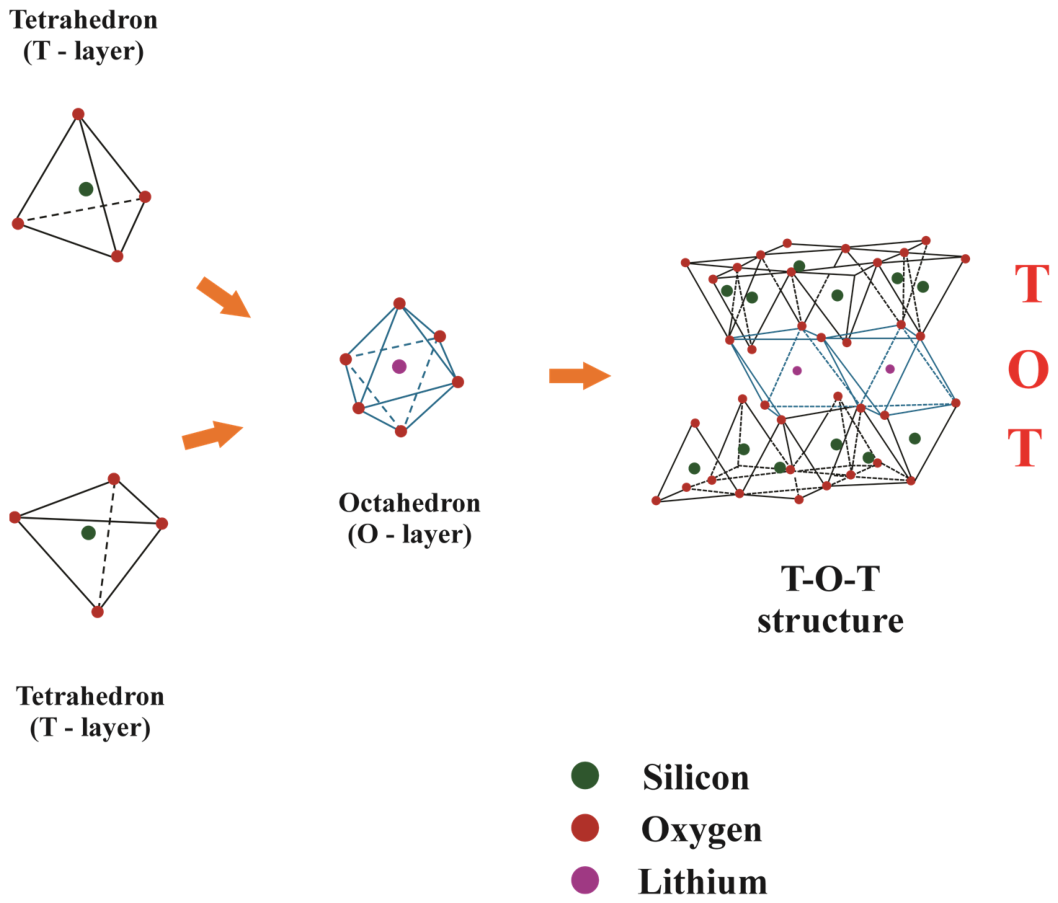
4.4. Processing of Lithium-Bearing Clays
- (1)
- Unheated clays have fewer exchangeable cations;
- (2)
- Clay structure has local atomic sites of the trioctahedral kind.
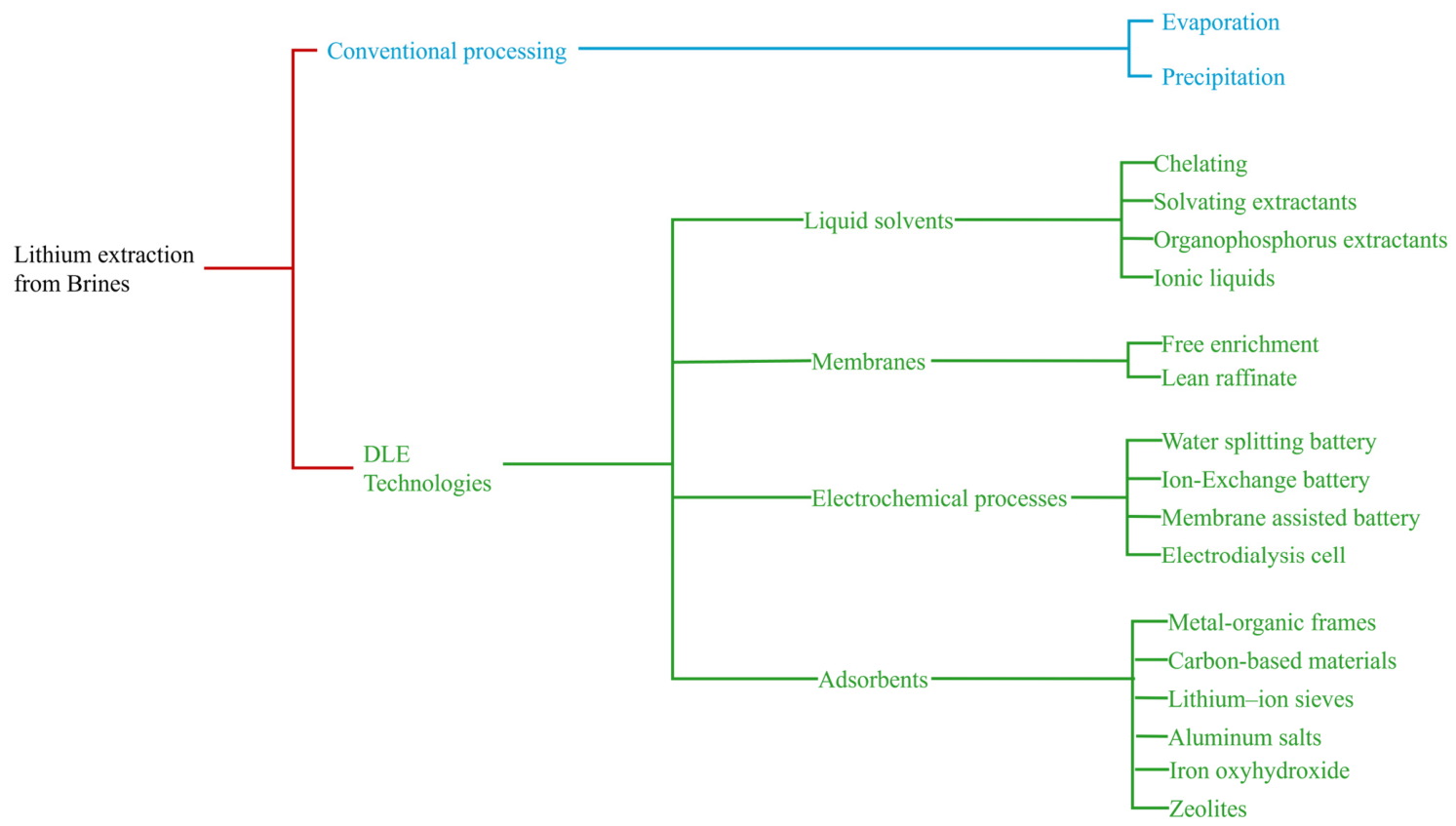
4.5. Processing of Brines
- ○
- Sedimentation: Brines originate from seawater;
- ○
- Magmatic: Brines emerge from the Earth’s mantle;
- ○
- Leakage: Brines stem from fluid inclusions in bedrock due to the presence of pressure gradients.
- (1)
- Arid Climate: Contributes to the formation of salars. It also factors into the concentration of lithium in brines. Determines the rate of evaporation during the recovery of lithium.
- (2)
- Contains a salar: Closed-basin brines are associated with a salar or a salty lake. This feature is controlled by tectonics and climate. In salars, brines are found in shallow aquifers that contain mixtures of salts like halite (NaCl), gypsum (CaSO4), and some carbonates, in addition to volcanic ashes and alluvial deposits (resulting from hydrothermal activity). Because of the presence of these species, lithium enrichment is found, although the enrichment is in the low lithium concentration range.
- (3)
- Associated hydrothermal or geothermal activity: This provides enough thermal energy to increase the lithium concentration through leaching and evaporation processes, besides inducing flows to transport the lithium from its source to the bulk of the brine. It may contribute to the alteration of clays.
- (4)
- Tectonic activity: Closed-basin brines occur in sites where tectonic drivers like extension, transtension, or orogenic loading occur.
- (5)
- Sources of lithium: Lithium may originate from high-silica rocks like ignimbrites and ashes, lithium-bearing clays, and other salar salt deposits.
- (6)
- Time: Refers to the period required to leach, transport, and concentrate the lithium. The mechanisms involved in these three stages are not well understood yet. However, evidence in North and South American brine sites indicates that brines are geologically young.
- (7)
- Hydrogeology: This accounts for the combination of flow phenomena involved in the recharging and transport mechanisms that are present between the brines and fresh waters. These phenomena control the mass flux of lithium from unsaturated to saturated regions and impact the determination of the size of the brine deposit and possible economic viability.
4.6. Other Technologies
5. Environmental Impacts
6. Final Remarks
Author Contributions
Funding
Data Availability Statement
Acknowledgments
Conflicts of Interest
References
- Bonilla, O.; Merino, D.N. Economics of a Hydrogen Bus Transportation System: Case Study Using an After Tax Analysis Model. Eng. Manag. J. 2010, 22, 34–44. [Google Scholar] [CrossRef]
- Egbue, O.; Long, S. Critical Issues in the Supply Chain of Lithium for Electric Vehicle Batteries. Eng. Manag. J. 2012, 24, 52–62. [Google Scholar] [CrossRef]
- Fasel, D.; Tran, M.Q. Availability of Lithium in the Context of Future D–T Fusion Reactors. Fusion Eng. Des. 2005, 75–79, 1163–1168. [Google Scholar] [CrossRef]
- Vikström, H.; Davidsson, S.; Höök, M. Lithium Availability and Future Production Outlooks. Appl. Energy 2013, 110, 252–266. [Google Scholar] [CrossRef]
- Helbig, C.; Thorenz, A.; Tuma, A. Quantitative Assessment of Dissipative Losses of 18 Metals. Resour. Conserv. Recycl. 2020, 153, 104537. [Google Scholar] [CrossRef]
- Prior, T.; Giurco, D.; Mudd, G.; Mason, L.; Behrisch, J. Resource Depletion, Peak Minerals and the Implications for Sustainable Resource Management. Glob. Environ. Change 2012, 22, 577–587. [Google Scholar] [CrossRef]
- Simon, B.; Ziemann, S.; Weil, M. Potential Metal Requirement of Active Materials in Lithium-Ion Battery Cells of Electric Vehicles and Its Impact on Reserves: Focus on Europe. Resour. Conserv. Recycl. 2015, 104, 300–310. [Google Scholar] [CrossRef]
- Zeng, X.; Li, J. Implications for the Carrying Capacity of Lithium Reserve in China. Resour. Conserv. Recycl. 2013, 80, 58–63. [Google Scholar] [CrossRef]
- Bradley, D.; Stillings, L.L.; Jaskula, B.W.; Munk, L.A.; McCauley, A.D. Lithium. In Critical Mineral Resources of the United States—Economic and Environmental Geology and Prospects for Future Supply; U.S. Geological Survey: Reston, VA, USA, 2017; pp. K1–K21. [Google Scholar]
- Ebensperger, A.; Maxwell, P.; Moscoso, C. The Lithium Industry: Its Recent Evolution and Future Prospects. Resour. Policy 2005, 30, 218–231. [Google Scholar] [CrossRef]
- Kipouros, G.J.; Sadoway, D.R. Toward New Technologies for the Production of Lithium. JOM 1998, 50, 24–26. [Google Scholar] [CrossRef]
- Kunasz, I.A. Quo Vadis, Lition? Energy 1978, 3, 387–390. [Google Scholar] [CrossRef]
- Gasafi, E.; Pardemann, R. Processing of Spodumene Concentrates in Fluidized-Bed Systems. Miner. Eng. 2020, 148, 106205. [Google Scholar] [CrossRef]
- Elshkaki, A. Long-Term Analysis of Critical Materials in Future Vehicles Electrification in China and Their National and Global Implications. Energy 2020, 202, 117697. [Google Scholar] [CrossRef]
- Oliveira, L.; Messagie, M.; Rangaraju, S.; Sanfelix, J.; Hernandez Rivas, M.; Van Mierlo, J. Key Issues of Lithium-Ion Batteries—From Resource Depletion to Environmental Performance Indicators. J. Clean. Prod. 2015, 108, 354–362. [Google Scholar] [CrossRef]
- Zhao, H.; Wang, Y.; Cheng, H. Recent Advances in Lithium Extraction from Lithium-Bearing Clay Minerals. Hydrometallurgy 2023, 217, 106025. [Google Scholar] [CrossRef]
- Haddad, A.Z.; Hackl, L.; Akuzum, B.; Pohlman, G.; Magnan, J.-F.; Kostecki, R. How to Make Lithium Extraction Cleaner, Faster and Cheaper—In Six Steps. Nature 2023, 616, 245–248. [Google Scholar] [CrossRef] [PubMed]
- Evans, R.K. Lithium Reserves and Resources. Energy 1978, 3, 379–385. [Google Scholar] [CrossRef]
- Yaksic, A.; Tilton, J.E. Using the Cumulative Availability Curve to Assess the Threat of Mineral Depletion: The Case of Lithium. Resour. Policy 2009, 34, 185–194. [Google Scholar] [CrossRef]
- Kesler, S.E.; Gruber, P.W.; Medina, P.A.; Keoleian, G.A.; Everson, M.P.; Wallington, T.J. Global Lithium Resources: Relative Importance of Pegmatite, Brine and Other Deposits. Ore Geol. Rev. 2012, 48, 55–69. [Google Scholar] [CrossRef]
- Azevedo, M.; Baczyńska, M.; Hoffman, K.; Krauze, A. Lithium Mining: How New Production Technologies Could Fuel the Global EV Revolution; McKinsey & Company: Singapore, 2022; p. 10. [Google Scholar]
- McNulty, B.A.; Jowitt, S.M. Barriers to and Uncertainties in Understanding and Quantifying Global Critical Mineral and Element Supply. iScience 2021, 24, 102809. [Google Scholar] [CrossRef] [PubMed]
- Greim, P.; Solomon, A.A.; Breyer, C. Assessment of Lithium Criticality in the Global Energy Transition and Addressing Policy Gaps in Transportation. Nat. Commun. 2020, 11, 4570. [Google Scholar] [CrossRef] [PubMed]
- U.S. Geological Survey. Mineral Commodity Summaries 2014; U.S. Geological Survey: Reston, VA, USA, 2014.
- U.S. Geological Survey. Mineral Commodity Summaries 2015; U.S. Geological Survey: Reston, VA, USA, 2015.
- U.S. Geological Survey. Mineral Commodity Summaries 2016; U.S. Geological Survey: Reston, VA, USA, 2016.
- U.S. Geological Survey. Mineral Commodity Summaries 2017; U.S. Geological Survey: Reston, VA, USA, 2017.
- U.S. Geological survey. Mineral Commodity Summaries 2018; U.S. Geological Survey: Reston, VA, USA, 2018.
- U.S. Geological Survey. Mineral Commodity Summaries 2019; U.S. Geological Survey: Reston, VA, USA, 2019.
- U.S. Geological Survey. Mineral Commodity Summaries 2020; U.S. Geological Survey: Reston, VA, USA, 2020.
- U.S. Geological Survey. Mineral Commodity Summaries 2021; U.S. Geological Survey: Reston, VA, USA, 2021.
- U.S. Geological Survey. Mineral Commodity Summaries 2022; U.S. Geological Survey: Reston, VA, USA, 2022.
- U.S. Geological Survey. Mineral Commodity Summaries 2023; U.S. Geological Survey: Reston, VA, USA, 2023.
- U.S. Geological Survey. Mineral Commodity Summaries 2024; U.S. Geological Survey: Reston, VA, USA, 2024.
- U. S. Geological Survey. Mineral Commodity Summaries 2025; U.S. Geological Survey: Reston, VA, USA, 2025.
- U.S. Geological Survey. Mineral Commodity Summaries 2026; U.S. Geological Survey: Reston, VA, USA, 2026.
- Statista Lithium Carbonate Price. Available online: www.statista.com/statistics/606350/battery-grade-lithium-carbonate-price/ (accessed on 27 February 2026).
- Habib, K.; Hansdóttir, S.T.; Habib, H. Critical Metals for Electromobility: Global Demand Scenarios for Passenger Vehicles, 2015–2050. Resour. Conserv. Recycl. 2020, 154, 104603. [Google Scholar] [CrossRef]
- Miedema, J.H.; Moll, H.C. Lithium Availability in the EU27 for Battery-Driven Vehicles: The Impact of Recycling and Substitution on the Confrontation between Supply and Demand Until2050. Resour. Policy 2013, 38, 204–211. [Google Scholar] [CrossRef]
- Swain, B. Recovery and Recycling of Lithium: A Review. Sep. Purif. Technol. 2017, 172, 388–403. [Google Scholar] [CrossRef]
- Tabelin, C.B.; Dallas, J.; Casanova, S.; Pelech, T.; Bournival, G.; Saydam, S.; Canbulat, I. Towards a Low-Carbon Society: A Review of Lithium Resource Availability, Challenges and Innovations in Mining, Extraction and Recycling, and Future Perspectives. Miner. Eng. 2021, 163, 106743. [Google Scholar] [CrossRef]
- Bulin, D. The Critical Mineral Rush: Lithium and Cobalt—A Canadian Perspective. In Proceedings of the Constraints and Opportunities in Shaping the Future: New Approaches to Economics and Policy Making; Springer: Cham, Switzerland, 2024; pp. 315–328. [Google Scholar]
- Sun, X.; Hao, H.; Zhao, F.; Liu, Z. Global Lithium Flow 1994–2015: Implications for Improving Resource Efficiency and Security. Environ. Sci. Technol. 2018, 52, 2827–2834. [Google Scholar] [CrossRef] [PubMed]
- Martin, G.; Rentsch, L.; Höck, M.; Bertau, M. Lithium Market Research—Global Supply, Future Demand and Price Development. Energy Storage Mater. 2017, 6, 171–179. [Google Scholar] [CrossRef]
- Chagnes, A.; Światowska, J. Lithium Process Chemistry: Resources, Extraction, Batteries, and Recycling; Elsevier: Amsterdam, The Netherlands, 2015; ISBN 978-0-12-801417-2. [Google Scholar]
- International Energy Agency (IEA). The Role of Critical Minerals in Clean Energy Transitions; International Energy Agency: Paris, France, 2022; pp. 1–283. [Google Scholar]
- Averill, W.A.; Olson, D.L. A Review of Extractive Processes for Lithium from Ores and Brines. Energy 1978, 3, 305–313. [Google Scholar] [CrossRef]
- Choubey, P.K.; Chung, K.-S.; Kim, M.; Lee, J.; Srivastava, R.R. Advance Review on the Exploitation of the Prominent Energy-Storage Element Lithium. Part II: From Sea Water and Spent Lithium Ion Batteries (LIBs). Miner. Eng. 2017, 110, 104–121. [Google Scholar] [CrossRef]
- Choubey, P.K.; Kim, M.; Srivastava, R.R.; Lee, J.; Lee, J.-Y. Advance Review on the Exploitation of the Prominent Energy-Storage Element: Lithium. Part I: From Mineral and Brine Resources. Miner. Eng. 2016, 89, 119–137. [Google Scholar] [CrossRef]
- Hader, R.N.; Nielsen, R.L.; Herre, M.G. Lithium and Its Compounds. Ind. Eng. Chem. 1951, 43, 2636–2646. [Google Scholar] [CrossRef]
- Kavanagh, L.; Keohane, J.; Garcia Cabellos, G.; Lloyd, A.; Cleary, J. Global Lithium Sources—Industrial Use and Future in the Electric Vehicle Industry: A Review. Resources 2018, 7, 57. [Google Scholar] [CrossRef]
- Mahi, P.; Smeets, A.A.J.; Fray, D.J.; Charles, J.A. Lithium—Metal of the Future. JOM 1986, 38, 20–26. [Google Scholar] [CrossRef]
- Meshram, P.; Pandey, B.D.; Mankhand, T.R. Extraction of Lithium from Primary and Secondary Sources by Pre-Treatment, Leaching and Separation: A Comprehensive Review. Hydrometallurgy 2014, 150, 192–208. [Google Scholar] [CrossRef]
- Talens Peiró, L.; Villalba Méndez, G.; Ayres, R.U. Lithium: Sources, Production, Uses, and Recovery Outlook. JOM 2013, 65, 986–996. [Google Scholar] [CrossRef]
- Zhang, Y.; Hu, Y.; Wang, L.; Sun, W. Systematic Review of Lithium Extraction from Salt-Lake Brines via Precipitation Approaches. Miner. Eng. 2019, 139, 105868. [Google Scholar] [CrossRef]
- Han, Y.; Kim, H.; Park, J. Millimeter-Sized Spherical Ion-Sieve Foams with Hierarchical Pore Structure for Recovery of Lithium from Seawater. Chem. Eng. J. 2012, 210, 482–489. [Google Scholar] [CrossRef]
- Hoshino, T. Development of Technology for Recovering Lithium from Seawater by Electrodialysis Using Ionic Liquid Membrane. Fusion Eng. Des. 2013, 88, 2956–2959. [Google Scholar] [CrossRef]
- Hoshino, T. Preliminary Studies of Lithium Recovery Technology from Seawater by Electrodialysis Using Ionic Liquid Membrane. Desalination 2013, 317, 11–16. [Google Scholar] [CrossRef]
- Kelly, J.C.; Wang, M.; Dai, Q.; Winjobi, O. Energy, Greenhouse Gas, and Water Life Cycle Analysis of Lithium Carbonate and Lithium Hydroxide Monohydrate from Brine and Ore Resources and Their Use in Lithium Ion Battery Cathodes and Lithium Ion Batteries. Resour. Conserv. Recycl. 2021, 174, 105762. [Google Scholar] [CrossRef]
- Khakmardan, S.; Rolinck, M.; Cerdas, F.; Herrmann, C.; Giurco, D.; Crawford, R.; Li, W. Comparative Life Cycle Assessment of Lithium Mining, Extraction, and Refining Technologies: A Global Perspective. Procedia CIRP 2023, 116, 606–611. [Google Scholar] [CrossRef]
- Roy, V.; Paranthaman, M.P.; Zhao, F. Lithium from Clay: Assessing the Environmental Impacts of Extraction. Sustain. Prod. Consum. 2024, 52, 324–332. [Google Scholar] [CrossRef]
- Iida, T.; Kita, Y.; Okano, H.; Katayama, I.; Tanaka, T. An Equation for the Vapor Pressure of Liquid Metals and Calculation of Their Enthalpies of Evaporation. High Temp. Mater. Process. 1992, 10, 199–208. [Google Scholar] [CrossRef][Green Version]
- Kubaschewski, O.; Alcock, C.B. Metallurgical Thermochemistry. In International Series on Materials Science and Technology, 5th ed.; Pergamon Press: Oxford, UK; New York, NY, USA, 1979; ISBN 978-0-08-020897-8. [Google Scholar]
- Lide, D.R. CRC Handbook of Chemistry and Physics, 85th ed.; CRC Press: Boca Raton, FL, USA, 2004; ISBN 978-0-8493-0485-9. [Google Scholar]
- Garrett, D.E. Handbook of Lithium and Natural Calcium Chloride Their Deposits, Processing, Uses and Properties; Elsevier: Amsterdam, The Netherlands, 2004. [Google Scholar]
- Roine, A. HSC Chemistry 10; Metso: Espoo, Finland, 2020. [Google Scholar]
- Zheng, M.; Liu, W. A New Li Mineral-Zabuyelite. Acta Mineral. Sin. 1987, 7, 221–226. [Google Scholar]
- Ingebritsen, S.E.; Weis, P.; Bodnar, R.J.; Boutt, D.F.; Munk, L.A. Review: The Hydrogeology of Critical Mineral Resources Relevant to the Energy Transition. Hydrogeol. J. 2025, 33, 855–873. [Google Scholar] [CrossRef]
- Anderson, A.J.; Clark, A.H.; Gray, S. The Occurrence and Origin of Zabuyelite (Li2CO3) in Spodumene-Hosted Fluid Inclusions: Implications for the Internal Evolution of Rare-Element Granitic Pegmatites. Can. Mineral. 2001, 39, 1513–1527. [Google Scholar] [CrossRef]
- Daneshvar, N.; Azizi, H.; Minami, M.; Asahara, Y.; Tsuboi, M. Assessment of Lithium Potential for Future Exploration in the Ghahavand Plain of Western Iran. Sci. Rep. 2025, 15, 34798. [Google Scholar] [CrossRef] [PubMed]
- Brečević, L.; Nielsen, A.E.; Oskarsson, Å.; Hewitt, G.M.; Kutney, J.P.; Li, K.; MIlanova, R.K.; Nakata, H.; Nasiri, A.; Okada, Y. Solubility of Calcium Carbonate Hexahydrate. Acta Chem. Scand. 1993, 47, 668–673. [Google Scholar] [CrossRef][Green Version]
- De Visscher, A.; Vanderdeelen, J.; Königsberger, E.; Churagulov, B.R.; Ichikuni, M.; Tsurumi, M. IUPAC-NIST Solubility Data Series. 95. Alkaline Earth Carbonates in Aqueous Systems. Part 1. Introduction, Be and Mg. J. Phys. Chem. Ref. Data 2012, 41, 013105. [Google Scholar] [CrossRef]
- De Visscher, A.; Vanderdeelen, J. IUPAC-NIST Solubility Data Series. 95. Alkaline Earth Carbonates in Aqueous Systems. Part 2. J. Phys. Chem. Ref. Data 2012, 41, 023105. [Google Scholar] [CrossRef]
- Lambert, I.; Clever, H.L. Alkaline Earth Hydroxides in Water and Aqueous Solutions; Solubility Data Series; Pergamon Press: Oxford, UK, 1992; ISBN 978-0-08-023920-0. [Google Scholar]
- Morey, G.W. The Action of Water on Calcite, Magnesite and Dolomite. Am. Mineral. 1962, 47, 1456–1460. [Google Scholar]
- Sohn, H.-S. Extractive Metallurgy of Lithium. Resour. Recycl. 2022, 31, 3–15. [Google Scholar] [CrossRef]
- Meng, F.; McNeice, J.; Zadeh, S.S.; Ghahreman, A. Review of Lithium Production and Recovery from Minerals, Brines, and Lithium-Ion Batteries. Miner. Process. Extr. Metall. Rev. 2021, 42, 123–141. [Google Scholar] [CrossRef]
- Tadesse, B.; Makuei, F.; Albijanic, B.; Dyer, L. The Beneficiation of Lithium Minerals from Hard Rock Ores: A Review. Miner. Eng. 2019, 131, 170–184. [Google Scholar] [CrossRef]
- Dessemond, C.; Soucy, G.; Harvey, J.-P.; Ouzilleau, P. Phase Transitions in the α–γ–β Spodumene Thermodynamic System and Impact of γ-Spodumene on the Efficiency of Lithium Extraction by Acid Leaching. Minerals 2020, 10, 519. [Google Scholar] [CrossRef]
- Qiu, Y.; Wu, D.; Yan, L.; Zhou, Y. Recycling of Spodumene Slag: Preparation of Green Polymer Composites. RSC Adv. 2016, 6, 36942–36953. [Google Scholar] [CrossRef]
- Wang, D.; Dai, H.; Liu, S.; Wang, C.; Yu, Y.; Dai, J.; Liu, L.; Yang, Y.; Ma, S. Research and Exploration Progress on Lithium Deposits in China. China Geol. 2020, 3, 137–152. [Google Scholar] [CrossRef]
- London, D. Ore-Forming Processes within Granitic Pegmatites. Ore Geol. Rev. 2018, 101, 349–383. [Google Scholar] [CrossRef]
- London, D. A Petrologic Assessment of Internal Zonation in Granitic Pegmatites. Lithos 2014, 184–187, 74–104. [Google Scholar] [CrossRef]
- Gardiner, N.J.; Jowitt, S.M.; Sykes, J.P. Lithium: Critical, or Not so Critical? Geoenergy 2024, 2, geoenergy2023-045. [Google Scholar] [CrossRef]
- Bulatovic, S.M. Beneficiation of Lithium Ores. In Handbook of Flotation Reagents: Chemistry, Theory and Practice; Elsevier: Amsterdam, The Netherlands, 2015; pp. 41–56. ISBN 978-0-444-53083-7. [Google Scholar]
- Munson, G.A.; Clarke, F.F. Mining and Concentrating Spodumene in the Black Hills, South Dakota. AIME Trans. 1955, 202, 1041. [Google Scholar]
- Sahoo, S.K.; Tripathy, S.K.; Nayak, A.; Hembrom, K.C.; Dey, S.; Rath, R.K.; Mohanta, M.K. Beneficiation of Lithium Bearing Pegmatite Rock: A Review. Miner. Process. Extr. Metall. Rev. 2024, 45, 1–27. [Google Scholar] [CrossRef]
- Iuga, A.; Cuglesan, I.; Samuila, A.; Blajan, M.; Vadan, D.; Dascalescu, L. Electrostatic Separation of Muscovite Mica from Feldspathic Pegmatites. In Proceedings of the Conference Record of the 2001 IEEE Industry Applications Conference. 36th IAS Annual Meeting (Cat. No.01CH37248), Chicago, IL, USA, 30 September–4 October 2001; IEEE: New York, NY, USA, 2001; Volume 4, pp. 2249–2255. [Google Scholar]
- Botula, J.; Rucký, P.; Řepka, V. Extraction of Zinnwaldite from Mining and Processing Wastes. Min. Geol. Ser. 2005, 2, 9–16. [Google Scholar]
- Amarante, M.M.; De Sousa, A.B.; Leite, M.M. Processing a Spodumene Ore to Obtain Lithium Concentrates for Addition to Glass and Ceramic Bodies. Miner. Eng. 1999, 12, 433–436. [Google Scholar] [CrossRef]
- Sagzhanov, D.; Ito, J.; Altansukh, B.; Godirilwe, L.L.; Haga, K.; Takasaki, Y.; Shibayama, A. Lithium Ore Beneficiation: Sustainable Approaches for Efficient Recovery of Lithium from a Low-Grade Spodumene Ore. J. Sustain. Metall. 2025, 11, 754–772. [Google Scholar] [CrossRef]
- Menéndez, M.; Vidal, J.; Toraño, J.; Gent, M. Optimisation of Spodumene Flotation. Eur. J. Miner. Process. Environ. Prot. 2004, 4, 130–135. [Google Scholar]
- Opoku, P.A.; Tadesse, B.; Albijanic, B.; Nikoloski, A.N. An Overview of Coarse Particle Beneficiation of Lithium Ores. Sci. Rep. 2025, 15, 29091. [Google Scholar] [CrossRef] [PubMed]
- Korbel, C.; Filippova, I.V.; Filippov, L.O. Froth Flotation of Lithium Micas—A Review. Miner. Eng. 2023, 192, 107986. [Google Scholar] [CrossRef]
- Chen, X.; Peng, Y. Managing Clay Minerals in Froth Flotation—A Critical Review. Miner. Process. Extr. Metall. Rev. 2018, 39, 289–307. [Google Scholar] [CrossRef]
- Botto, I.L. Structural and Spectroscopic Properties of Leached Spodumene in the Acid Roast Processing. Mater. Chem. Phys. 1985, 13, 423–436. [Google Scholar] [CrossRef]
- Peltosaari, O.; Tanskanen, P.; Heikkinen, E.-P.; Fabritius, T. A → γ → β-Phase Transformation of Spodumene with Hybrid Microwave and Conventional Furnaces. Miner. Eng. 2015, 82, 54–60. [Google Scholar] [CrossRef]
- Konar, B.; Kim, D.-G.; Jung, I.-H. Critical Thermodynamic Optimization of the Li2O-Al2O3-SiO2 System and Its Application for the Thermodynamic Analysis of the Glass-Ceramics. J. Eur. Ceram. Soc. 2018, 38, 3881–3904. [Google Scholar] [CrossRef]
- Robie, R.A.; Hemmingway, B.; Fisher, J.R. Thermodynamic Properties of Minerals and Related Substances at 298.15 K and 1 Bar Pressure and at Higher Temperature; Department of the Interior, US Geological Survey: Reston, VA, USA, 1978; No. 1452.
- Abdullah, A.A.; Oskierski, H.C.; Altarawneh, M.; Senanayake, G.; Lumpkin, G.; Dlugogorski, B.Z. Phase Transformation Mechanism of Spodumene during Its Calcination. Miner. Eng. 2019, 140, 105883. [Google Scholar] [CrossRef]
- Kotsupalo, N.P.; Menzheres, L.T.; Ryabtsev, A.D.; Boldyrev, V.V. Mechanical Activation of α-Spodumene for Further Processing into Lithium Compounds. Theor. Found. Chem. Eng. 2010, 44, 503–507. [Google Scholar] [CrossRef]
- Han, S.; Sagzhanov, D.; Pan, J.; Vaziri Hassas, B.; Rezaee, M.; Akbari, H.; Mensah-Biney, R. Direct Extraction of Lithium from α-Spodumene by Salt Roasting–Leaching Process. ACS Sustain. Chem. Eng. 2022, 10, 13495–13504. [Google Scholar] [CrossRef]
- Rosales, G.D.; Ruiz, M.D.C.; Rodriguez, M.H. Novel Process for the Extraction of Lithium from β-Spodumene by Leaching with HF. Hydrometallurgy 2014, 147–148, 1–6. [Google Scholar] [CrossRef]
- Rosales, G.D.; Del Carmen Ruiz, M.; Rodriguez, M.H. Alkaline Metal Fluoride Synthesis as a Subproduct of β-Spodumene Leaching. Hydrometallurgy 2013, 139, 73–78. [Google Scholar] [CrossRef]
- Barbosa, L.I.; Valente, G.; Orosco, R.P.; González, J.A. Lithium Extraction from β-Spodumene through Chlorination with Chlorine Gas. Miner. Eng. 2014, 56, 29–34. [Google Scholar] [CrossRef]
- Barbosa, L.I.; Valente, N.G.; González, J.A. Kinetic Study on the Chlorination of β-Spodumene for Lithium Extraction with Cl2 Gas. Thermochim. Acta 2013, 557, 61–67. [Google Scholar] [CrossRef]
- Hien-Dinh, T.T.; Luong, V.T.; Gieré, R.; Tran, T. Extraction of Lithium from Lepidolite via Iron Sulphide Roasting and Water Leaching. Hydrometallurgy 2015, 153, 154–159. [Google Scholar] [CrossRef]
- Yan, Q.; Li, X.; Wang, Z.; Wu, X.; Wang, J.; Guo, H.; Hu, Q.; Peng, W. Extraction of Lithium from Lepidolite by Sulfation Roasting and Water Leaching. Int. J. Miner. Process. 2012, 110–111, 1–5. [Google Scholar] [CrossRef]
- Luong, V.T.; Kang, D.J.; An, J.W.; Kim, M.J.; Tran, T. Factors Affecting the Extraction of Lithium from Lepidolite. Hydrometallurgy 2013, 134–135, 54–61. [Google Scholar] [CrossRef]
- Pashkevich, D.; Li, R.; Waters, K. Temperature and Climate-Induced Fluctuations in Froth Flotation: An Overview of Different Ore Types. Can. Metall. Q. 2023, 62, 511–548. [Google Scholar] [CrossRef]
- Liu, J.; Yin, Z.; Li, X.; Hu, Q.; Liu, W. Recovery of Valuable Metals from Lepidolite by Atmosphere Leaching and Kinetics on Dissolution of Lithium. Trans. Nonferrous Met. Soc. China 2019, 29, 641–649. [Google Scholar] [CrossRef]
- Kuang, G.; Li, H.; Hu, S.; Jin, R.; Liu, S.; Guo, H. Recovery of Aluminium and Lithium from Gypsum Residue Obtained in the Process of Lithium Extraction from Lepidolite. Hydrometallurgy 2015, 157, 214–218. [Google Scholar] [CrossRef]
- Tian-ming, G.; Na, F.; Wu, C.; Tao, D. Lithium Extraction from Hard Rock Lithium Ores (Spodumene, Lepidolite, Zinnwaldite, Petalite): Technology, Resources, Environment and Cost. China Geol. 2023, 6, 137–153. [Google Scholar] [CrossRef]
- Clay Minerals: Classification, Structure, and Properties. In Developments in Clay Science; Elsevier: Amsterdam, The Netherlands, 2022; pp. 3–35. ISBN 978-0-323-91858-9.
- Fuentes, L.; Reyes, M. Mineralogía Analítica; Universidad Autónoma de Chihuahua: Chihuahua, Mexico, 2002; ISBN 978-968-6331-82-0. [Google Scholar]
- Spaziani, E.C.F. Contribuição ao Estudo das Interações Entre Corante Cationico e Partículas de Argila em Suspensão Aquosa. Ph.D. Thesis, Universidade de São Paulo, São Carlos, Brazil, 2014. [Google Scholar]
- Vine, J.D. Lithium in Sediments and Brines--How, Why and Where to Search. J. Res. U.S. Geol. Surv. 1975, 3, 479–485. [Google Scholar]
- Foster, M.D. Interpretation of the Composition of Lithium Micas; Shorter Contributions to General Geology; U.S. Geological Survey: Washington, DC, USA, 1960; pp. 115–147.
- Foster, M.D. Interpretation of the Composition of Trioctahedral Micas; Shorter Contributions to General Geology; U.S. Geological Survey: Washington, DC, USA, 1960; pp. 11–49.
- Foster, M.D. Correlation of Dioctahedral Potassium Micas on the Basis of Their Charge Relations; A Contribution to Geochemistry; U.S. Geological Survey: Washington, DC, USA, 1956; pp. 57–67.
- Starkey, H.C. The Role of Clays in Fixing Lithium; Contributions to Geochemical Prospecting for Minerals; U.S. Geological Survey: Reston, VA, USA, 1982; pp. F1–F11.
- Zhang, C.; He, H.; Qin, X.; Decarreau, A.; Baron, F.; Tao, Q.; Zhu, J.; Xi, Y.; Petit, S. The Growth Process of Saponite: A Study Based on Particle Size Distributions and Morphological Evolution. Appl. Clay Sci. 2022, 221, 106463. [Google Scholar] [CrossRef]
- Williams, L.B.; Hervig, R.L. Lithium and Boron Isotopes in Illite-Smectite: The Importance of Crystal Size. Geochim. Cosmochim. Acta 2005, 69, 5705–5716. [Google Scholar] [CrossRef]
- Tindle, A.G.; Webb, P.C. Estimation of Lithium Contents in Trioctahedral Micas Using Microprobe Data: Application to Micas from Granitic Rocks. Eur. J. Mineral. 1990, 2, 595–610. [Google Scholar] [CrossRef]
- Tischendorf, G.; Rieder, M.; Förster, H.-J.; Gottesmann, B.; Guidotti, C.V. A New Graphical Presentation and Subdivision of Potassium Micas. Mineral. Mag. 2004, 68, 649–667. [Google Scholar] [CrossRef]
- Tischendorf, G.; Gottesmann, B.; Förster, H.-J.; Trumbull, R.B. On Li-Bearing Micas: Estimating Li from Electron Microprobe Analyses and an Improved Diagram for Graphical Representation. Mineral. Mag. 1997, 61, 809–834. [Google Scholar] [CrossRef]
- Breiter, K.; Vašinová Galiová, M.; Korbelová, Z.; Hložková, M. Can Lithium Contents in Mica Be Correctly Calculated? Tischendorf́s Proposal (Mineralogical Magazine 61/1997) 25 Years After. Miner. Mag. 2023, 87, 878–886. [Google Scholar] [CrossRef]
- Aylmore, M.G.; Merigot, K.; Quadir, Z.; Rickard, W.D.A.; Evans, N.J.; McDonald, B.J.; Catovic, E.; Spitalny, P. Applications of Advanced Analytical and Mass Spectrometry Techniques to the Characterisation of Micaceous Lithium-Bearing Ores. Miner. Eng. 2018, 116, 182–195. [Google Scholar] [CrossRef]
- Brigatti, M.F.; Mottana, A.; Malferrari, D.; Cibin, G. Crystal Structure and Chemical Composition of Li-, Fe-, and Mn-Rich Micas. Am. Mineral. 2007, 92, 1395–1400. [Google Scholar] [CrossRef]
- Brigatti, M.F.; Guggenheim, S. Mica Crystal Chemistry and the Influence of Pressure, Temperature, and Solid Solution on Atomistic Models. Rev. Mineral. Geochem. 2002, 46, 1–97. [Google Scholar] [CrossRef]
- Calvet, R.; Prost, R. Cation Migration Into Empty Octahedral Sites and Surface Properties of Clays. Clays Clay Miner. 1971, 19, 175–186. [Google Scholar] [CrossRef]
- Feng, M.; Kou, Z.; Tang, C.; Shi, Z.; Tong, Y.; Zhang, K. Recent Progress in Synthesis of Zeolite from Natural Clay. Appl. Clay Sci. 2023, 243, 107087. [Google Scholar] [CrossRef]
- Krupskaya, V.; Novikova, L.; Tyupina, E.; Belousov, P.; Dorzhieva, O.; Zakusin, S.; Kim, K.; Roessner, F.; Badetti, E.; Brunelli, A.; et al. The Influence of Acid Modification on the Structure of Montmorillonites and Surface Properties of Bentonites. Appl. Clay Sci. 2019, 172, 1–10. [Google Scholar] [CrossRef]
- Cerny, P. Compositional Variations in Cookeite. Can. Mineral. 1970, 10, 636–647. [Google Scholar]
- Bobos, I.; Vieillard, P.; Charoy, B.; Noronha, F. Alteration of Spodumene to Cookeite and Its Pressure and Temperature Stability Conditions in Li-Bearing Aplite-Pegmatites from Northern Portugal. Clays Clay Miner. 2007, 55, 295–310. [Google Scholar] [CrossRef]
- Schleicher, A.M.; Van Der Pluijm, B.A.; Warr, L.N. Chlorite-Smectite Clay Minerals and Fault Behavior: New Evidence from the San Andreas Fault Observatory at Depth (SAFOD) Core. Lithosphere 2012, 4, 209–220. [Google Scholar] [CrossRef]
- Balaram, V.; Armstrong-Altrin, J.S.; Khan, R.M.K.; Rao, B.S. Land and Marine Sedimentary Deposits as Potential Sources of Lithium. Int. Geol. Rev. 2025, 67, 1217–1250. [Google Scholar] [CrossRef]
- Dry, M.; Gerbino, A. Aqueous Chemistry of Lithium Production. In Proceedings of the ALTA Uranium-REE-Lithium Conference, Perth, Australia, 24–25 May 2018. [Google Scholar]
- Dry, M.; LeBlanc, R. Lithium from Clay Versus Lithium from Spodumene; Arithmetek Inc.: Peterborough, ON, Canada, 2019; pp. 1–15. [Google Scholar]
- Amer, A.M. The Hydrometallurgical Extraction of Lithium from Egyptian Montmorillonite-Type Clay. JOM 2008, 60, 55–57. [Google Scholar] [CrossRef]
- Davidson, C.F. Recovery of Lithium from Clay by Selective Chlorination; U.S. Bureau of Mines: Washington, DC, USA, 1981; pp. 1–19.
- Lien, R.H. Recovery of Lithium from a Montmorillonite-Type Clay; U.S. Bureau of Mines: Washington, DC, USA, 1985; pp. 1–32.
- Crocker, L.; Lien, R.H. Lithium and Its Recovery from Low-Grade Nevada Clays; U.S. Bureau of Mines: Washington, DC, USA, 1988; pp. 1–44.
- Roth, D.; Tahija, L.; Lasillo, E.; Martina, K.; Chow, B.; Mutler, W.; Bahe, K.; Kaplan, P.; Cluff, T.; Shannon, B. Feasibility Study National Instrument 43-101 Technical Report for the Thacker Pass Project Humboldt County, Nevada, USA; Lithium Americas Corp.: Reno, NV, USA, 2022; pp. 1–350. [Google Scholar]
- Ausenco Services Pty Ltd. Ausenco Services Technical Report on the Feasibility Study for the Sonora Lithium Project, Mexico; Ausenco Services Pty Ltd.: Sonora, Mexico, 2018; p. 261. [Google Scholar]
- Ausenco Services Pty Ltd. Ausenco Services Technical Report on the Prefeasibility Study for the Sonora Lithium Project, Mexico; Ausenco Services Pty Ltd.: Sonora, Mexico, 2016; p. 194. [Google Scholar]
- SRK Consulting. Mineral Resource Estimate Update for the Sonora Lithum Project, Mexico; Bacanora Lithium: London, UK, 2015. [Google Scholar]
- Verley, C.G.; Vidal, M.F.; MacNeill, E. Report on the Sonora Lithium Project; Bacanora Minerals Ltd.: London, UK, 2012; pp. 1–39. [Google Scholar]
- Verley, C.G.; Vidal, M.F. Preliminary Economic Assessment for the La Ventana Lithium Deposit Sonora, Mexico; Bacanora Minerals Ltd.: London, UK, 2013; pp. 1–54. [Google Scholar]
- Harp, F.d.M. Depósitos de Litio en México. 2020. Available online: https://www.geomin.com.mx/pdf/panel/litio/PRESENTA_LITIO_MEXICO_AIMMGMNov2020_Corregida.pdf (accessed on 7 July 2025).
- Plascencia, G.; Ramírez, L.J.; Almaraz, A.; Bautista, A.H.; Torres, R. Ruta Extractiva de Litio Para Producir Carbonato de Litio Grado Bateria a Partir de Minerales de Arcilla 2024, 1–37. Available online: https://vidoc.impi.gob.mx/visor?usr=SIGA&texp=SI&tdoc=E&id=MX/a/2024/012253 (accessed on 7 July 2025).
- Flexer, V.; Baspineiro, C.F.; Galli, C.I. Lithium Recovery from Brines: A Vital Raw Material for Green Energies with a Potential Environmental Impact in Its Mining and Processing. Sci. Total Environ. 2018, 639, 1188–1204. [Google Scholar] [CrossRef] [PubMed]
- Alexeev, S.V.; Alexeeva, L.P.; Vakhromeev, A.G. Brines of the Siberian Platform (Russia): Geochemistry and Processing Prospects. Appl. Geochem. 2020, 117, 104588. [Google Scholar] [CrossRef]
- Ann Munk, L.; Boutt, D.; Butler, K.; Russo, A.; Jenckes, J.; Moran, B.; Kirshen, A. Lithium Brines: Origin, Characteristics, and Global Distribution. Econ. Geol. 2025, 120, 575–597. [Google Scholar] [CrossRef]
- Collins, A.G. Lithium Abundances in Oilfield Waters. In Lithium Resources and Requirements by the Year 2000; U.S. Geological Survey: Reston, VA, USA, 1976; pp. 116–123. [Google Scholar]
- Dugamin, E.J.M.; Cathelineau, M.; Boiron, M.-C.; Richard, A.; Despinois, F. Lithium Enrichment Processes in Sedimentary Formation Waters. Chem. Geol. 2023, 635, 121626. [Google Scholar] [CrossRef]
- Fontes, J.C.; Matray, J.M. Geochemistry and Origin of Formation Brines from the Paris Basin, France 2. Saline Solutions Associated with Oil Fields. Chem. Geol. 1993, 109, 177–200. [Google Scholar] [CrossRef]
- Fontes, J.C.; Matray, J.M. Geochemistry and Origin of Formation Brines from the Paris Basin, France 1. Brines Associated with Triassic Salts. Chem. Geol. 1993, 109, 149–175. [Google Scholar] [CrossRef]
- Khalil, A.; Mohammed, S.; Hashaikeh, R.; Hilal, N. Lithium Recovery from Brine: Recent Developments and Challenges. Desalination 2022, 528, 115611. [Google Scholar] [CrossRef]
- Disu, B.; Rafati, R.; Sharifi Haddad, A.; Mendoza Roca, J.A.; Iborra Clar, M.I.; Soleymani Eil Bakhtiari, S. Review of Recent Advances in Lithium Extraction from Subsurface Brines. Geoenergy Sci. Eng. 2024, 241, 213189. [Google Scholar] [CrossRef]
- Yu, X.; Wang, C.; Huang, H.; Yan, K. Origin of Lithium in Oilfield Brines in Continental Petroliferous Basin: Insights from Li and Sr Isotopes in the Jianghan Basin, Central China. Mar. Pet. Geol. 2024, 160, 106576. [Google Scholar] [CrossRef]
- An, J.W.; Kang, D.J.; Tran, K.T.; Kim, M.J.; Lim, T.; Tran, T. Recovery of Lithium from Uyuni Salar Brine. Hydrometallurgy 2012, 117–118, 64–70. [Google Scholar] [CrossRef]
- Liu, Y.; Guo, Y.; Yu, X.; Wang, S.; Deng, T. Solid–Liquid Metastable Phase Equilibria in the Five-Component System (Li + Na + K + Cl + SO4 + H2O) at 308.15 K. J. Chem. Eng. Data 2014, 59, 1685–1691. [Google Scholar] [CrossRef]
- Lai, X.; Xiong, P.; Zhong, H. Extraction of Lithium from Brines with High Mg/Li Ratio by the Crystallization-Precipitation Method. Hydrometallurgy 2020, 192, 105252. [Google Scholar] [CrossRef]
- Li, Z.; Mercken, J.; Li, X.; Riaño, S.; Binnemans, K. Efficient and Sustainable Removal of Magnesium from Brines for Lithium/Magnesium Separation Using Binary Extractants. ACS Sustain. Chem. Eng. 2019, 7, 19225–19234. [Google Scholar] [CrossRef]
- Liu, X.; Zhong, M.; Chen, X.; Li, J.; He, L.; Zhao, Z. Enriching Lithium and Separating Lithium to Magnesium from Sulfate Type Salt Lake Brine. Hydrometallurgy 2020, 192, 105247. [Google Scholar] [CrossRef]
- Wang, H.; Zhong, Y.; Du, B.; Zhao, Y.; Wang, M. Recovery of Both Magnesium and Lithium from High Mg/Li Ratio Brines Using a Novel Process. Hydrometallurgy 2018, 175, 102–108. [Google Scholar] [CrossRef]
- Kanagasundaram, T.; Murphy, O.; Haji, M.N.; Wilson, J.J. The Recovery and Separation of Lithium by Using Solvent Extraction Methods. Coord. Chem. Rev. 2024, 509, 215727. [Google Scholar] [CrossRef]
- Martell, A.E.; Hancock, R.D. Metal Complexes in Aqueous Solutions; Springer: Boston, MA, USA, 1996; ISBN 978-1-4899-1488-0. [Google Scholar]
- Nightingale, E.R. Phenomenological Theory of Ion Solvation. Effective Radii of Hydrated Ions. J. Phys. Chem. 1959, 63, 1381–1387. [Google Scholar] [CrossRef]
- Yang, S.; Wang, Y.; Pan, H.; He, P.; Zhou, H. Lithium Extraction from Low-Quality Brines. Nature 2024, 636, 309–321. [Google Scholar] [CrossRef] [PubMed]
- Farahbakhsh, J.; Arshadi, F.; Mofidi, Z.; Mohseni-Dargah, M.; Kök, C.; Assefi, M.; Soozanipour, A.; Zargar, M.; Asadnia, M.; Boroumand, Y.; et al. Direct Lithium Extraction: A New Paradigm for Lithium Production and Resource Utilization. Desalination 2024, 575, 117249. [Google Scholar] [CrossRef]
- Vera, M.L.; Torres, W.R.; Galli, C.I.; Chagnes, A.; Flexer, V. Environmental Impact of Direct Lithium Extraction from Brines. Nat. Rev. Earth Environ. 2023, 4, 149–165. [Google Scholar] [CrossRef]
- Ding, T.; Nie, Z.; Wu, Q.; Yu, J.; Bu, L.; Wang, Y.; Xing, E.; Zheng, M.; Li, Y. Optimization of Lithium Extraction Solar Pond in Zabuye Salt Lake: Theoretical Calculation Combined with Field Experiments. China Geol. 2025, 8, 26–38. [Google Scholar] [CrossRef]
- Liu, X.; Zhong, M.; Chen, X.; Zhao, Z. Separating Lithium and Magnesium in Brine by Aluminum-Based Materials. Hydrometallurgy 2018, 176, 73–77. [Google Scholar] [CrossRef]
- Paranthaman, M.P.; Li, L.; Luo, J.; Hoke, T.; Ucar, H.; Moyer, B.A.; Harrison, S. Recovery of Lithium from Geothermal Brine with Lithium–Aluminum Layered Double Hydroxide Chloride Sorbents. Environ. Sci. Technol. 2017, 51, 13481–13486. [Google Scholar] [CrossRef] [PubMed]
- Li, Y.; Zhao, Z.; Liu, X.; Chen, X.; Zhong, M. Extraction of Lithium from Salt Lake Brine by Aluminum-Based Alloys. Trans. Nonferr. Met. Soc. China 2015, 25, 3484–3489. [Google Scholar] [CrossRef]
- Kaplan, D. Process for the Extraction of Lithium from Dead Sea Solutions. Isr. J. Chem. 1963, 1, 115–120. [Google Scholar] [CrossRef]
- Schaller, J.; Headley, T.; Prigent, S.; Breuer, R. Potential Mining of Lithium, Beryllium and Strontium from Oilfield Wastewater after Enrichment in Constructed Wetlands and Ponds. Sci. Total Environ. 2014, 493, 910–913. [Google Scholar] [CrossRef] [PubMed]
- Chitrakar, R.; Kanoh, H.; Miyai, Y.; Ooi, K. Recovery of Lithium from Seawater Using Manganese Oxide Adsorbent (H1.6Mn1.6O4) Derived from Li1.6Mn1.6O4. Ind. Eng. Chem. Res. 2001, 40, 2054–2058. [Google Scholar] [CrossRef]
- Qian, F.; Zhao, B.; Guo, M.; Qian, Z.; Xu, N.; Wu, Z.; Liu, Z. Enhancing the Li+ Adsorption and Anti-Dissolution Properties of Li1.6Mn1.6O4 with Fe, Co Doped. Hydrometallurgy 2020, 193, 105291. [Google Scholar] [CrossRef]
- Recepoğlu, Y.K.; Kabay, N.; Yoshizuka, K.; Nishihama, S.; Yılmaz-Ipek, İ.; Arda, M.; Yüksel, M. Effect of Operational Conditions on Separation of Lithium from Geothermal Water by λ-MnO2 Using Ion Exchange–Membrane Filtration Hybrid Process. Solvent Extr. Ion Exch. 2018, 36, 499–512. [Google Scholar] [CrossRef]
- Chitrakar, R.; Makita, Y.; Ooi, K.; Sonoda, A. Lithium Recovery from Salt Lake Brine by H2TiO3. Dalton Trans. 2014, 43, 8933–8939. [Google Scholar] [CrossRef] [PubMed]
- Lucena, R.; Aranzana, M.S.C. (Eds.) Ionic Liquids. In Analytical Sample Preparation with Nano- and Other High-Performance Materials; Elsevier: Amsterdam, The Netherlands, 2021; pp. 427–451. ISBN 978-0-12-822139-6. [Google Scholar]
- Shamshina, J.; Zavgorodnya, O.; Rogers, R. Ionic Liquids. In Reference Module in Chemistry, Molecular Sciences and Chemical Engineering; Elsevier: Amsterdam, The Netherlands, 2018; ISBN 978-0-12-409547-2. [Google Scholar]
- Lei, Z.; Chen, B.; Koo, Y.-M.; MacFarlane, D.R. Introduction: Ionic Liquids. Chem. Rev. 2017, 117, 6633–6635. [Google Scholar] [CrossRef] [PubMed]
- Liu, G.; Zhao, Z.; Ghahreman, A. Novel Approaches for Lithium Extraction from Salt-Lake Brines: A Review. Hydrometallurgy 2019, 187, 81–100. [Google Scholar] [CrossRef]
- Evans, J.W. Metal Production: Electrometallurgy. In Encyclopedia of Materials: Science and Technology; Elsevier: Amsterdam, The Netherlands, 2003; pp. 1–12. ISBN 978-0-08-043152-9. [Google Scholar]
- Habashi, F. Extractive Metallurgy. In Encyclopedia of Materials: Science and Technology; Elsevier: Amsterdam, The Netherlands, 2001; pp. 2828–2831. ISBN 978-0-08-043152-9. [Google Scholar]
- Evans, J.W. The Evolution of Technology for Light Metals over the Last 50 Years: Al, Mg, and Li. JOM 2007, 59, 30–38. [Google Scholar] [CrossRef]
- Fray, D.J. Emerging Molten Salt Technologies for Metals Production. JOM 2001, 53, 27–31. [Google Scholar] [CrossRef]
- Sadoway, D.R. New Opportunities for Metals Extraction and Waste Treatment by Electrochemical Processing in Molten Salts. J. Mater. Res. 1995, 10, 487–492. [Google Scholar] [CrossRef]
- Utigard, T.A. The Properties and Uses of Fluxes in Molten Aluminum Processing. JOM 1998, 50, 38–43. [Google Scholar] [CrossRef]
- Utigard, T.A.; Roy, R.R.; Friesen, K. Properties of Fluxes Used in Molten Aluminium Processing. High Temp. Mater. Process. 2001, 20, 303–308. [Google Scholar] [CrossRef]
- Hoh, Y.C.; Chiu, T.M.; Chung, Z.J. Preparation of Lithium Metal by Molten Salt Electrolysis. In Production and Electrolysis of Light Metals; Elsevier: Amsterdam, The Netherlands, 1989; pp. 223–234. ISBN 978-0-08-037295-2. [Google Scholar]
- Sato, Y. Electrowinning of Metallic Lithium from Molten Salts. Proc. Vol. 2002, 2002–2019, 771–778. [Google Scholar] [CrossRef]
- Takeda, O.; Li, M.; Toma, T.; Sugiyama, K.; Hoshi, M.; Sato, Y. Electrowinning of Lithium from LiOH in Molten Chloride. J. Electrochem. Soc. 2014, 161, D820–D823. [Google Scholar] [CrossRef]
- Ghosh, S.; Ganesan, R.; Sridharan, R.; Gnanasekaran, T. Study of Phase Equilibria in LiCl-KCl-PrCl 3 Pseudo-Ternary System. Thermochim. Acta 2017, 653, 16–26. [Google Scholar] [CrossRef]
- Malyshev, V.V. Electrochemical Processes and Implementation of Molybdenum Electrodeposition in Melts. Russ. Metall. 2006, 2006, 126–132. [Google Scholar] [CrossRef]
- Kruesi, W.H.; Fray, D.J. Fundamental Study of the Anodic and Cathodic Reactions during the Electrolysis of a Lithium Carbonate-Lithium Chloride Melt Using a Carbon Anode. J. Appl. Electrochem. 1994, 24, 1102–1108. [Google Scholar] [CrossRef]
- Cooksey, M.A.; Taylor, M.P.; Chen, J.J.J. Resistance Due to Gas Bubbles in Aluminum Reduction Cells. JOM 2008, 60, 51–57. [Google Scholar] [CrossRef]
- Utigard, T.; Toguri, J.M.; Ip, S.W. Direct Observation of the Anode Effect by Radiography. In Essential Readings in Light Metals; Springer International Publishing: Cham, Switzerland, 2016; pp. 127–130. ISBN 978-3-319-48155-5. [Google Scholar]
- Vogt, H. Contribution to the Interpretation of the Anode Effect. Electrochim. Acta 1997, 42, 2695–2705. [Google Scholar] [CrossRef]
- Van Vuuren, D.S.; Swanepoel, E. Fundamental Differences between Magnesium and Alkali Metal Electrowinning. Adv. Mater. Res. 2014, 1019, 160–168. [Google Scholar] [CrossRef]
- Western, L.M.; Vollmer, M.K.; Krummel, P.B.; Adcock, K.E.; Crotwell, M.; Fraser, P.J.; Harth, C.M.; Langenfelds, R.L.; Montzka, S.A.; Mühle, J.; et al. Global Increase of Ozone-Depleting Chlorofluorocarbons from 2010 to 2020. Nat. Geosci. 2023, 16, 309–313. [Google Scholar] [CrossRef]
- Oliaii, E.; Désilets, M.; Lantagne, G. Numerical Analysis of the Effect of Structural and Operational Parameters on Electric and Concentration Fields of a Lithium Electrolysis Cell. J. Appl. Electrochem. 2017, 47, 711–726. [Google Scholar] [CrossRef]
- De Figueiredo Luiz, D.; Boon, J.; Otero Rodriguez, G.; Van Sint Annaland, M. Review of the Molten Salt Technology and Assessment of Its Potential to Achieve an Energy Efficient Heat Management in a Decarbonized Chemical Industry. Chem. Eng. J. 2024, 498, 155819. [Google Scholar] [CrossRef]
- Batteas, J.; Blank, K.G.; Colacino, E.; Emmerling, F.; Friščić, T.; Mack, J.; Moore, J.; Rivas, M.E.; Tysoe, W. Moving Mechanochemistry Forward. RSC Mechanochem. 2025, 2, 10–19. [Google Scholar] [CrossRef]
- Cuccu, F.; De Luca, L.; Delogu, F.; Colacino, E.; Solin, N.; Mocci, R.; Porcheddu, A. Mechanochemistry: New Tools to Navigate the Uncharted Territory of “Impossible” Reactions. ChemSusChem 2022, 15, e202200362. [Google Scholar] [CrossRef] [PubMed]
- Do, J.-L.; Friščić, T. Mechanochemistry: A Force of Synthesis. ACS Cent. Sci. 2017, 3, 13–19. [Google Scholar] [CrossRef] [PubMed]
- Dong, L.; Li, L.; Chen, H.; Cao, Y.; Lei, H. Mechanochemistry: Fundamental Principles and Applications. Adv. Sci. 2025, 12, 2403949. [Google Scholar] [CrossRef]
- Setoudeh, N.; Nosrati, A.; Welham, N.J. Lithium Extraction from Mechanically Activated of Petalite-Na2SO4 Mixtures after Isothermal Heating. Miner. Eng. 2020, 151, 106294. [Google Scholar] [CrossRef]
- Vieceli, N.; Nogueira, C.A.; Pereira, M.F.C.; Dias, A.P.S.; Durão, F.O.; Guimarães, C.; Margarido, F. Effects of Mechanical Activation on Lithium Extraction from a Lepidolite Ore Concentrate. Miner. Eng. 2017, 102, 1–14. [Google Scholar] [CrossRef]
- Colacino, E.; Isoni, V.; Crawford, D.; García, F. Upscaling Mechanochemistry: Challenges and Opportunities for Sustainable Industry. Trends Chem. 2021, 3, 335–339. [Google Scholar] [CrossRef]
- Stolar, T.; Alić, J.; Casali, L.; Gugin, N.; Baláž, M.; Michalchuk, A.A.L.; Emmerling, F. Mechanochemistry: Looking Back and Ahead. Chem. 2026, 12, 102880. [Google Scholar] [CrossRef]
- Zhou, Y.; Tang, X.; Qing, D.; Li, J.; Wang, H. Research Progress of Technology of Lithium Extraction. Sep. Purif. Technol. 2025, 359, 130561. [Google Scholar] [CrossRef]
- Duan, H.; Zhao, X.; Xu, C.; Zhang, D.; Gu, W.; Wang, R.; Lu, X. The Synergistic Interaction of Fungi with Different Structural Characteristics Improves the Leaching of Lithium from Lepidolite. Biochem. Eng. J. 2025, 213, 109564. [Google Scholar] [CrossRef]
- Rezza, I.; Salinas, E.; Calvente, V.; Benuzzi, D.; Tosetti, M.I.S.D. Extraction of Lithium from Spodumene by Bioleaching. Lett. Appl. Microbiol. 1997, 25, 172–176. [Google Scholar] [CrossRef] [PubMed]
- Sedlakova-Kadukova, J.; Marcincakova, R.; Luptakova, A.; Vojtko, M.; Fujda, M.; Pristas, P. Comparison of Three Different Bioleaching Systems for Li Recovery from Lepidolite. Sci. Rep. 2020, 10, 14594. [Google Scholar] [CrossRef] [PubMed]
- Marcincakova, R.; Kadukova, J.; Mrazikova, A.; Velgosova, O.; Vojtko, M. Lithium Bioleaching from Lepidolite Using the Yeast Rhodotorula Rubra. Inż. Miner. 2015, 16, 49–56. [Google Scholar]
- Ambrose, H.; Kendall, A. Understanding the Future of Lithium: Part 2, Temporally and Spatially Resolved Life-cycle Assessment Modeling. J. Ind. Ecol. 2020, 24, 90–100. [Google Scholar] [CrossRef]
- Ambrose, H.; Kendall, A. Understanding the Future of Lithium: Part 1, Resource Model. J. Ind. Ecol. 2020, 24, 80–89. [Google Scholar] [CrossRef]
- Hellweg, S.; Milà I Canals, L. Emerging Approaches, Challenges and Opportunities in Life Cycle Assessment. Science 2014, 344, 1109–1113. [Google Scholar] [CrossRef] [PubMed]
- Toniolo, S.; Borsoi, L.; Camana, D. Life Cycle Assessment: Methods, Limitations, and Illustrations. In Methods in Sustainability Science; Elsevier: Amsterdam, The Netherlands, 2021; pp. 105–118. ISBN 978-0-12-823987-2. [Google Scholar]
- Jiang, S.; Zhang, L.; Li, F.; Hua, H.; Liu, X.; Yuan, Z.; Wu, H. Environmental Impacts of Lithium Production Showing the Importance of Primary Data of Upstream Process in Life-Cycle Assessment. J. Environ. Manag. 2020, 262, 110253. [Google Scholar] [CrossRef] [PubMed]
- Mousavinezhad, S.; Fahimi, A.; Sharifian, S.; Vahidi, E. Sustainable Lithium Production from Sedimentary Rock Deposits: Carbon Reduction and EV Synergies. Resour. Conserv. Recycl. 2025, 218, 108271. [Google Scholar] [CrossRef]
- Mousavinezhad, S.; Nili, S.; Fahimi, A.; Vahidi, E. Environmental Impact Assessment of Direct Lithium Extraction from Brine Resources: Global Warming Potential, Land Use, Water Consumption, and Charting Sustainable Scenarios. Resour. Conserv. Recycl. 2024, 205, 107583. [Google Scholar] [CrossRef]
- Stamp, A.; Lang, D.J.; Wäger, P.A. Environmental Impacts of a Transition toward E-Mobility: The Present and Future Role of Lithium Carbonate Production. J. Clean. Prod. 2012, 23, 104–112. [Google Scholar] [CrossRef]





| Property | Li | Na | K |
|---|---|---|---|
| Atomic mass [g/mole] | 6.94 | 22.99 | 39.09 |
| Heat of formation of molecules from atoms [kJ/mole] | −113.8 | −76.9 | −52.7 |
| Electronic affinity [kJ] | 8.65 × 10⁻²³ | 1.19 × 10⁻²² | 1.12 × 10⁻²² |
| Electronegativity | 1.0 | 0.9 | 0.8 |
| Normal electrode potential [V] | 3.038 | 2.710 | 2.920 |
| Ionic radius [Å] | 0.68 | 0.97 | 1.33 |
| Covalent radius [Å] | 1.58 | 1.92 | 2.38 |
| Internuclear distance in molecule [Å] | 2.67 | 3.08 | 3.91 |
| Mineral Species | Chemical Formula | Element Content [mass %] | Typical Li Content [mass %] | ||||||||||||
|---|---|---|---|---|---|---|---|---|---|---|---|---|---|---|---|
| Li | Al | P | O | H | Na | F | K | Si | Fe | C | Mg | B | |||
| Amblygonite | (LiNa)AlPO4(FOH) | 3.35 | 17.8 | 20.5 | 44.9 | 0.17 | 3.8 | 9.4 | - | ||||||
| Zinnwaldite | KLiFeAl(AlSi3)O10(OHF)2 | 1.59 | 12.4 | 38.4 | 0.12 | 6.5 | 8.9 | 19.3 | 12.8 | 1.2–1.3 | |||||
| Zabuyelite | Li2CO3 | 18.8 | 65.0 | 16.26 | - | ||||||||||
| Triphylite | LiFe2PO4 | 4.40 | 19.6 | 40.6 | 35.4 | 2.5–3.8 | |||||||||
| Spodumene | LiAl(SiO3)2 | 3.73 | 14.5 | 51.6 | 30.2 | 1.9–3.3 | |||||||||
| Petalite | LiAlSi4O10 | 2.27 | 8.8 | 52.2 | 36.7 | 1.6–2.2 | |||||||||
| Montebrasite | LiAl(PO4) OH | 4.76 | 18.5 | 21.2 | 54.8 | 0.69 | 0.9–1.8 | ||||||||
| Nalipoite | NaLi2PO4 | 10.5 | 23.5 | 48.5 | 17.4 | - | |||||||||
| Lepidolite | K(Li Al)3(AlSi)4O10(FOH)2 | 3.51 | 31.9 | 32.4 | 0.34 | 6.4 | 6.6 | 18.9 | 1.4–1.9 | ||||||
| Hectorite | Na0.3(Mg Li)3Si4O10(OH)2 | 4.68 | 43.2 | 0.45 | 1.6 | 8.6 | 25.2 | 16.4 | 0.36 | ||||||
| Eucryptite | LiAlSiO4 | 5.51 | 21.4 | 50.8 | 22.2 | 2.3–3.3 | |||||||||
| Bikitaite | LiAlSi2O6 H2O | 3.40 | 13.2 | 54.9 | 0.98 | 27.5 | 1.3–1.7 | ||||||||
| Jadarite | LiNaSiB3O7(OH) | 3.16 | 58.4 | 0.46 | 10.5 | 12.8 | 14.8 | 0.09–0.1 | |||||||
| Cation | Hydrated Ionic Radii at 25 °C [Å] | Hydration Number | Distance M-O [Å] | Ionic Radii/Coordination Number [Å] |
|---|---|---|---|---|
| Li+ | 3.82 | 4 5 6 | 2.08 | 0.59/4 0.60/4 0.76/6 0.79/6 |
| Na+ | 3.58 | 4 5 6 | 2.35 | 0.99/4 1.02/5 1.02/6 1.07/6 |
| K+ | 3.31 | 3 6 6–8 | 2.79 | 1.37/4 1.38/6 1.46/7 |
| Ca2+ | 4.12 | 6 6–10 | 2.42 | 1.00/6 1.12/8 |
| Mg2+ | 4.28 | 6 | 2.09 | 0.57/4 0.72/6 |
Disclaimer/Publisher’s Note: The statements, opinions and data contained in all publications are solely those of the individual author(s) and contributor(s) and not of MDPI and/or the editor(s). MDPI and/or the editor(s) disclaim responsibility for any injury to people or property resulting from any ideas, methods, instructions or products referred to in the content. |
© 2026 by the authors. Licensee MDPI, Basel, Switzerland. This article is an open access article distributed under the terms and conditions of the Creative Commons Attribution (CC BY) license.
Share and Cite
Ramírez, L.J.; Plascencia, G. Lithium Processing in the Past and for the Future. Crystals 2026, 16, 396. https://doi.org/10.3390/cryst16060396
Ramírez LJ, Plascencia G. Lithium Processing in the Past and for the Future. Crystals. 2026; 16(6):396. https://doi.org/10.3390/cryst16060396
Chicago/Turabian StyleRamírez, Luis J., and Gabriel Plascencia. 2026. "Lithium Processing in the Past and for the Future" Crystals 16, no. 6: 396. https://doi.org/10.3390/cryst16060396
APA StyleRamírez, L. J., & Plascencia, G. (2026). Lithium Processing in the Past and for the Future. Crystals, 16(6), 396. https://doi.org/10.3390/cryst16060396