Article

Al-Bearing Scorodite (Scorodite—Mansfieldite Series) from Hemerdon Ball Mine, Plympton, Tavistock District, Devon, United Kingdom: Single-Crystal X-Ray Diffraction, Chemistry and Vibrational Spectroscopy


1
ICTerra-Porto, Faculty of Sciences, University of Porto, Rua do Campo Alegre 687, 4169-007 Porto, Portugal
2
Department of Chemistry, College of Arts and Sciences, University of the Philippines Visayas, Miagao, Iloilo 5023, Philippines
3
CICECO-Aveiro Institute of Materials & Department of Chemistry, University of Aveiro, 3810-193 Aveiro, Portugal
4
Institute of Physics for Advanced Materials, Nanotechnology and Photonics, Faculty of Sciences, University of Porto, Rua do Campo Alegre 687, 4169-007 Porto, Portugal
*
Author to whom correspondence should be addressed.
Crystals 2026, 16(6), 381; https://doi.org/10.3390/cryst16060381
Submission received: 13 April 2026 / Revised: 20 May 2026 / Accepted: 25 May 2026 / Published: 6 June 2026

Abstract

The Al-bearing scorodite from the Hemerdon Ball Mine (HBM) was studied using electron microscopy and microprobe analysis, single-crystal X-ray diffraction, infrared, and Raman spectroscopy. The crystal chemistry formula of Al-bearing scorodite is expressed as Fe3+0.87Al3+0.16(As0.97O4)·H2O. The calculated d-spacings and unit-cell parameters of Al-bearing scorodite are slightly affected by the substitution of Al for Fe in the octahedral sites. The Al-bearing scorodite HBM crystalizes in the Pbca space group with the following unit-cell lattice parameters: a = 8.92882(14) Å; b = 10.02217(14) Å; c = 10.30525(15) Å; V(Å) = 922.18(2) and Z = 8. The lattice structure becomes slightly distorted by the formation of the Fe,Al-OH octahedron, which leads to a compression of the newly formed octahedron along the a* ^ b* direction and an expansion of the Fe-OH octahedron along the c* direction. The incorporation of Al3+ has a strong effect on the tilting angle of the Fe,Al-OH octahedron in the b* ^ c* crystallographic direction. The refined structure suggests that Al3+ occupies the octahedral sites alongside Fe3+, leading to a distortion of the Fe,Al-OH octahedron. Infrared and Raman spectroscopy exhibit a doublet at 820 and 800 cm−1, and at 810 and 800 cm−1 ascribed to the Fe,Al-O-OAsO3 group. The 799–800 cm−1 Raman region is assigned to the Fe–O–As group (at 798 and 803 cm−1), whereas the 810–814 cm−1 region is ascribed to a band resulting from the AsO43−1 (A1) symmetric stretching vibrational modes], indicative of the Fe,Al–OH–As group in both Al-bearing scorodite and mansfieldite.

1. Introduction

Scorodite (FeAsO4·2H2O), a member of the variscite mineral group, may form a continuous series with either mansfieldite (AlAsO4·2H2O) or yanomamite (InAsO4·2H2O), but it is dimorphous with parascorodite. Mansfieldite is isostructural with scorodite, variscite (AlPO4·2H2O), and strengite (Fe3+PO4·2H2O). Nevertheless, mansfieldite formation is rare due to the typically low activity of Al3+ ions in solution [1].
Mansfieldite, the aluminum analog of scorodite, was first discovered at Hobart Butte, Lane County, Oregon (USA), where it forms as porous, cellular masses or crusts composed of spherulitic fiber aggregates, exhibiting a sinter-like or earthy habit [2]. The natural occurrence of the scorodite—mansfieldite solid solution series has been documented in several locations, including Neubulach, Schwarzwald (Germany) [3]; La Serena Valley (Spain) [4]; Krásno (Czech Republic) [5]; and Ľubietová-Svätodušná (Slovakia)—with the substitution of Al3+ for Fe3+ was found to be limited [6]. Moreover, Co- and Cu-bearing mansfieldite species were identified at the Mount Cobalt Mine, Selwyn district, Queensland, Australia [7] and ceruleite [CuAl4(AsO4)2(OH)8(H2O)4] at the Le Pradet, Cap Garonne Mine, Provence-Alpes-Côte d`Azur, France [8]. In these findings, mansfieldite was found associated with minerals, such as erythrite [Co3(AsO4)2·8H2O], olivenite [Cu2(AsO4)2OH], pharmacoalumite [KAl4(AsO4)3·6.5H2O], and cyanotrichite [Cu4Al2(SO4)(OH)12·2H2O], among others.
The crystal structure of scorodite was first determined by Kitahama et al. [9], where subsequent corrections for the O–H bond lengths and H-atom positions were made by Hawthorne [10]. Later, the location of the Fe(III) arsenate dihydrate and the H atoms with satisfactory bond lengths and angles was obtained by single-crystal X-ray diffraction (SCXRD) [11]. A structural refinement of the Co-bearing mansfieldite was carried out using synchrotron powder diffraction data [12]. Yanomamite (InAsO4·2H2O), which is isotypic with scorodite, was also characterized by SCXRD and electron probe microanalysis (EPMA) [13].
The minerals within the variscite group have been extensively examined by X-ray photoelectron spectroscopy and Raman microscopy, in which various symmetry changes and vibrational modes were explored [14]. Additionally, new molecular vibrational modes for roselite monoclinic arsenates, [Ca2Co(AsO4)2·2H2O], using Raman and infrared spectroscopy, were identified [15], expanding the Farmer’s list of arsenate minerals [16].
This work aims to detail the structural, morphological, textural, and chemical properties of Al-bearing scorodite from the Hemerdon Ball Mine, Plympton, UK. The study employed single-crystal X-ray diffraction (SCXRD) to analyze the substitution of Al3+ for Fe3+ within the octahedral site or individual octahedral sites, examining bond lengths, interatomic angles, polyhedral volumes, octahedral tilting, and the degree of site distortion to propose a crystal structure for Al-bearing scorodite. In addition, accurate vibrational spectroscopy data were acquired to study the molecular structure. These findings contribute to a better understanding of how Al3+ solutions affect the chemical stability of scorodite.

2. Materials and Methods

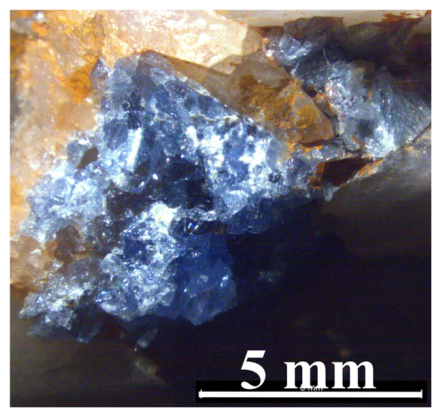
The macroscopic blue aggregates (<0.5 cm) of the Al-bearing scorodite HBM samples were collected by the first author from dumps and in situ surface locations close to fractures and quartz veins from the HBM open-pit mine, Devon, United Kingdom. The color of Al-bearing scorodite is bluish but may vary from pale leek-green to liver-brown, violet, or yellow. Aggregates (<10 mm) of Al-bearing scorodite were macroscopically observed along the fissures in quartz veins. Under a binocular microscope, the Al-bearing scorodite appears light blue and forms individual euhedral crystals (Figure 1). The luster varies from vitreous to sub-adamantine or sub-resinous.
Furthermore, scorodite KW (catalog number 030107073; J. Theo Kloprogge) and mansfieldite KW (catalog number 8472; J. Theo Kloprogge) collected from the HBM and the Mount Cobalt Mine, Selwyn District, Mount Isa–Cloncurry area, Queensland (Australia), respectively, were studied for comparison with our samples.
A Leica M205 C binocular microscope with a single optical path through which a 3D image was obtained with a Leica DFC 295 digital camera, Wetzlar, Germany (Leica LAS V 4.7 software) was used to evaluate the crystal morphology of the Al-bearing scorodite HBM (Figure 1).
The morphology of the Al-bearing scorodite HBM was studied using a high-resolution (Schottky) environmental scanning electron microscope (SEM) FEI Quanta 400 FEG (Hillsboro, OR, USA) equipped with a µ-XRF analyzer, which provides small and micro-spot X-ray analysis and mapping using an energy dispersive spectrometer (EDS) and an electron backscatter diffraction system (EBSD) equipped with an EDAX Genesis X4M (Mahwah, NJ, USA). High-resolution back-scattered electron (BSE) images were collected at up to 4.5 nA from the polished sections.
Quantitative oxide (mass %) compositions were obtained with a JEOL Hyperprobe JXA-8500F EPMA (Tokyo, Japan) operated at an accelerating voltage of 15 kV and a beam current of 20 nA for arsenates, with a counting time of 10 s on element peaks and 5 s on the background position. Samples of the Al-bearing scorodite HBM embedded in resin were prepared as polished sections, and the measurement conditions and standards used are shown in the Electronic Supplementary Material (ESD).
Randomly oriented powder samples (Al-bearing scorodite HBM) were investigated on a RINTUltima+ diffractometer (Rigaku, Akishima, Japan) with a Cu X-ray tube, Ni-filter, and silicon strip X-ray detector (Rigaku D/teX Ultra). The Rigaku CrystalClear software package was used to process the structure data, including applying an empirical multi-scan absorption correction using ABSCOR [17]. X-ray diffraction (XRD) analytical and measurement conditions are shown in the ESD. SCXRD data of the Al-bearing scorodite HBM (small blue crystal 0.20 × 0.08 × 0.02 mm of the mineral specimen shown in Figure 1) were collected at 150 (2) K using a Rigaku XtaLAB Synergy equipped with a Mo Kα (λ = 0.71073 Å) PhotonJet-i microsource, a HyPix3000 detector controlled by the CrysAlisPro software (Y. Oxford Diffraction Ltd., Abingdon, UK, 2022, CrysAlis PRO, Rigaku V1.171.142.173a), reference Agilent (2013), and equipped with an Oxford Cryosystems Series 800 cryostream (Witney, UK). Diffraction images were processed using the CrysAlisPro software, and data were corrected for absorption by the multi-scan absorption correction using spherical harmonics implemented in the SCALE3 ABSPACK scaling algorithm. The structure was solved by direct methods using SHELXT 2014/5 and refined by weighted full-matrix least-squares on F2 using SHELXL2018/3 [18]. All non-hydrogen atoms were refined with anisotropic displacement parameters. The Fe1 and Al1 atoms were refined at the same position with occupancies of 0.95 and 0.05, respectively. The H atoms bonded to the oxygen atoms O5 and O6 were located on the difference Fourier map. The crystal structure was drawn using Diamond 3.0.
Fourier transform infrared (IR) spectroscopy was carried out with a Bruker Tensor 27 spectrometer (Berlin, Germany). The integrated intensity of absorption bands was measured using the OPUS software 7.8 supplied with the Bruker instrument. Several Al-bearing scorodite HBM crystals (labeled ALS1 and ALS2 hereafter) at a micrometer scale were selected under the microscope from the bulk sample (see the ESD) for Raman spectroscopy. An Olympus BHSM microscope (Tokyo, Japan) equipped with 10× and 50× objectives, a monochromator, a filter system, and a charge-coupled device (CCD) was used. The ALS1- and ALS2-selected crystals were analyzed using a high-efficiency confocal Raman Renishaw inVia Qontor spectrometer (Gloucestershire, UK) equipped with a Spectra-Physics model-127 H–Ne excitation laser at 532, 633, and 785 nm. Spectroscopic manipulation (i.e., baseline adjustment, smoothing and normalization) was performed using the Fityk 0.9.8 software package [19], which enabled the type of fitting function to be selected and allowed specific parameters to be fixed or varied according to Martens et al. [20]. The Raman spectra of both crystals were compared with those of scorodite KW and mansfieldite KW to enable a rigorous Raman spectral analysis. Information on sample preparation for IR and Raman spectroscopy, analytical conditions, and the manipulation of results is provided in the ESD.

3. Results

3.1. Electron Microscopy

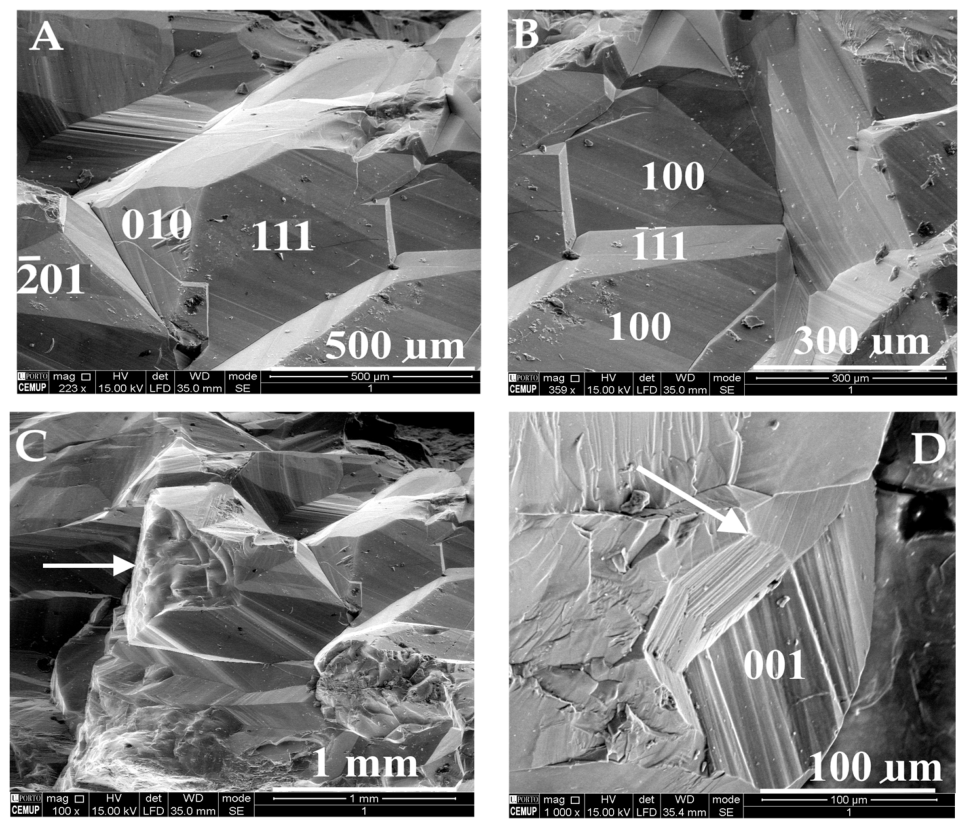
The crystals exhibit a pyramidal or pseudo-octahedral [111], prismatic [010], or tabular [001] well-developed habit under SEM (Figure 2A,B). The crystals are below 500 µm.
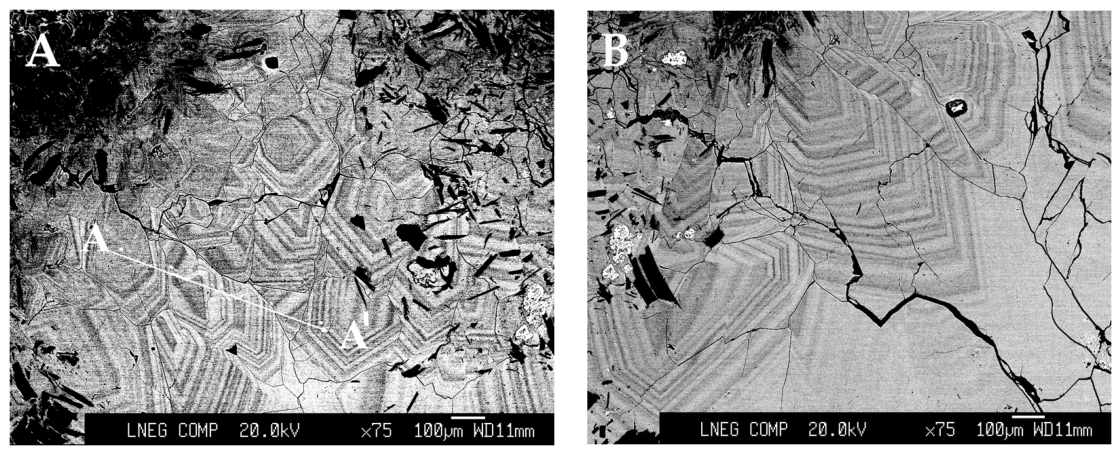
The [100] and [111] faces are dominant, showing a pseudo-octahedral shape within the orthorhombic structure that is well-oriented along the a* or c* direction (Figure 2A,B). The apparent striations observed along the faces reflect growth oscillatory zones (Figure 2A,B). Fractured edges are also observed in a few crystals (marked by an arrow, Figure 2C). Also, tabular crystals with [001] oriented to the c* direction may suggest a contact twin (e.g., mirror plane) between two crystals (marked by an arrow; Figure 2D). BSE images of the Al-bearing scorodite HBM show a clear crystal zonation that accompanies the main crystallographic planes [111] or [201] oriented along the b* ^ c* direction or [100] along the a* direction (Figure 3A,B). These quasi-cyclic alternation zones, ranging from tens of nanometers to a few micrometers, exhibit distinct chemistry corresponding to either Al- or Fe-scorodite compositions. The white points observed along the profile A-A′ (Figure 3A) represent the electron-beam spots where the crystal was chemically analyzed.
A detailed image, observed along the oriented [111] planes (b* ^ c*), shows multiple sharp growth zones in various shades from dark to light, caused by variations in Al2O3 content (Figure 3B). The light shades correspond to Fe-rich zones.

3.2. EPMA

The data obtained for the Al-bearing scorodite HBM (Table 1) were compared with the chemical compositions of Al-bearing scorodite and mansfieldite from Hobart Butte [2]. The As2O5 content shows a slight compositional variation from 48.31 to 49.93%, Al2O3 ranges from 0.76 to 4.28%, and Fe2O3 from 31.67 to 35.79%. A maximum amount of Al2O3 of 5.76% was measured for the Hobart Butte Al-bearing scorodite, compared with 23.30% for mansfieldite. The Al-bearing scorodite HBM contains traces of P2O5 (<0.01%), SO3 (<0.01%), SnO2 (0.09%), WO3 (0.09%), Au2O (0.04%), Ag2O (0.03%), and In2O3 (0.02%).
Aluminum ranges from 0.03 to 0.17 atoms per formula unit (apfu) for the Al-bearing scorodite HBM, whereas the maximum Al measured for the Hobart Butte Al-bearing scorodite is 0.24 apfu and 0.88 apfu for mansfieldite [2]. The Fe/(Fe + Al) ratio calculated for the Al-bearing scorodite HBM ranges from 0.83 to 0.97 (Table 1).

3.3. Structural and Crystallographic Analysis

The d-spacings observed with their corresponding Miller indices for the Al-bearing scorodite HBM (Figure S1, ESD) were compared with those of synthetic mansfieldite [21]. The first reflections of the Al-bearing scorodite HBM and synthetic mansfieldite are assigned to the (111) crystallographic planes at 5.65 Å and 5.50 Å, respectively. The second sharp reflection at 4.49 Å (020;102) is observed only for the Al-bearing scorodite HBM, whereas for synthetic mansfieldite it occurs at 3.12 Å (221). The 2-theta, d-spacing, and Miller indices for the Al-bearing scorodite HBM and synthetic mansfieldite are shown in the ESD (Tables S1 and S2).
The crystal structure of the Al-bearing scorodite HBM determined by SCXRD was formulated as [Fe0.95Al0.05(AsO4)(H2O)2] (Table 2). The X-ray pattern of single crystal is shown in Figure S2 (ESD). The mineral crystallizes in the orthorhombic system (space group Pbca) with unit-cell parameters a = 8.92882(14) Å, b = 10.02217(14) Å, and c = 10.30525(15) Å, yielding a unit-cell volume intermediate (922.18(2) Å3) between those reported for scorodite (931.5 Å3) [9] and mansfieldite (868.7 Å3) [21]. This intermediate volume is consistent with the partial substitution of Fe3+ by Al3+ at the octahedral site. The crystal structure consists of corner-sharing AsO4 tetrahedra and (Fe,Al)O6 octahedra forming a three-dimensional framework.
The Fe/Al–O bond distances in the studied structure (Fe/Al–O5 = 2.1107(10) Å; Fe/Al–O6 = 2.0446(10) Å) fall within the range typically reported for octahedrally coordinated Fe3+/Al3+ in arsenates. For example, in mansfieldite [21], Al–O distances range from 1.88 to 2.05 Å, while in scorodite [9], Fe–O distances typically span between 2.061 and 2.125 Å.
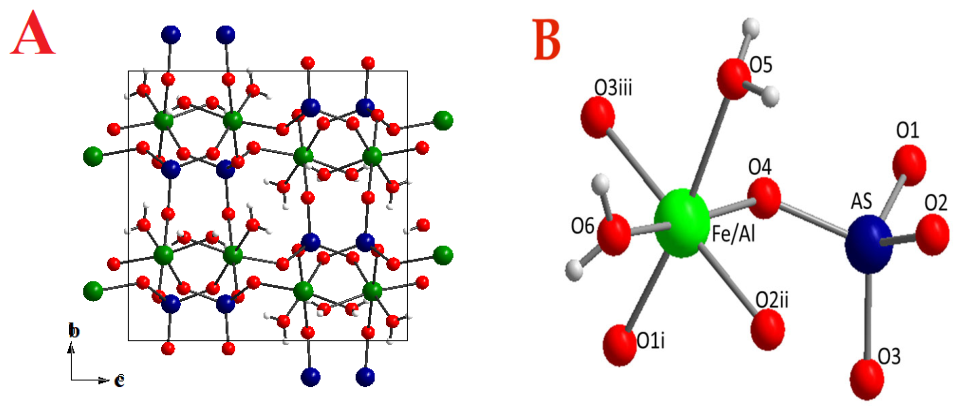
The AsO4 tetrahedra are relatively rigid, as indicated by the narrow range of As–O bond distances (1.6818–1.6885 Å), whereas the octahedral site accommodates chemical variability. The Fe coordination polyhedron mean bond value, quadratic elongation, and bond angle variance values are reported in Table 3, and the crystal structure is depicted in Figure 4A,B and in the Cambridge Crystallographic Data Center (Deposition Number: 2422016; ESD).
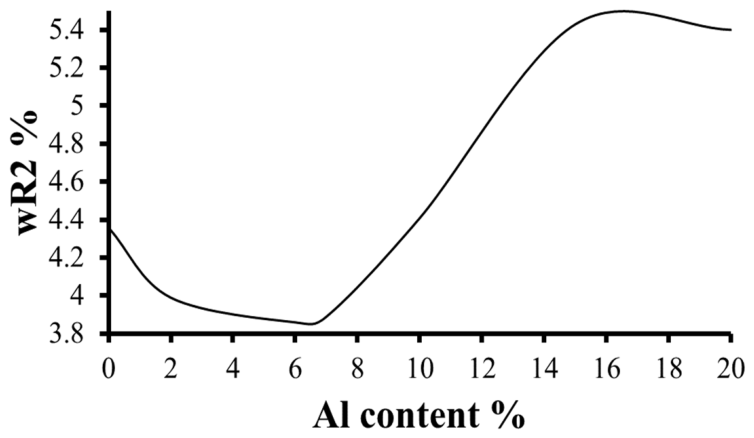
The Fe and Al atoms occupy the same position: several refinements were performed using different Al contents (Figure 5), and the best result was achieved with 5% of Al and 95% of Fe, in agreement with the chemical analysis of the Al-bearing scorodite HBM (5% of Al). The refined occupancy (Fe0.95Al0.05) indicates limited but significant substitution of Fe3+ by the smaller Al3+ cation.
This substitution has a direct structural effect: the smaller ionic radius of Al3+ leads to shorter M–O bond distances and a contraction of the octahedral framework. Consequently, the unit-cell volume decreases with increasing Al content, as observed in the literature data for the scorodite–mansfieldite series. The unit-cell volume of the present sample falls between those of Fe-bearing scorodite and Al-bearing mansfieldite, consistent with its intermediate composition. A comparison with the literature values and those reported in Table S3 (ESD) demonstrates a systematic relationship between composition and unit-cell parameters. This trend confirms that the substitution at the octahedral site controls both local geometry (M–O bond distances) and global structural parameters (unit-cell dimensions). At the same time, the AsO4 tetrahedra remain largely unaffected.

3.4. Infrared Spectroscopy

The term “As–O unit” mentioned in this section refers to the tetrahedral anion bearing a pentavalent cation (AsO43−), for which the band assignment to stretching and bending vibrations was established using a curve-fitting method. The IR stretching and bending modes of the As–O units of the Al-bearing scorodite HBM and scorodite KW (Figure S3) are given in the ESD (Table S3).
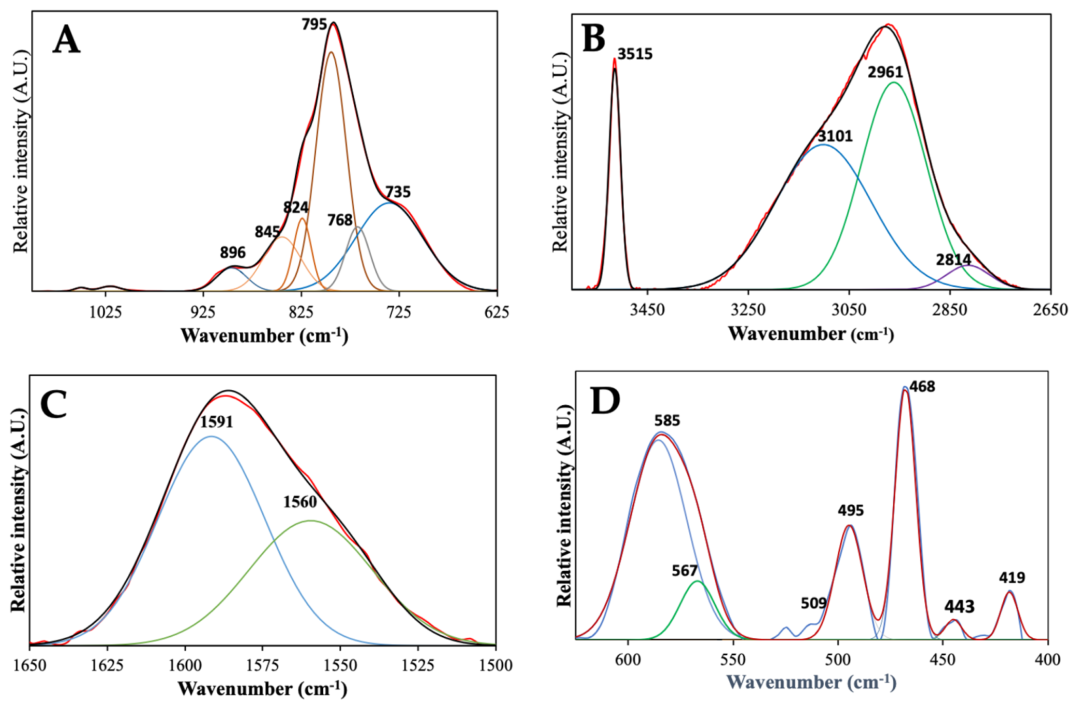
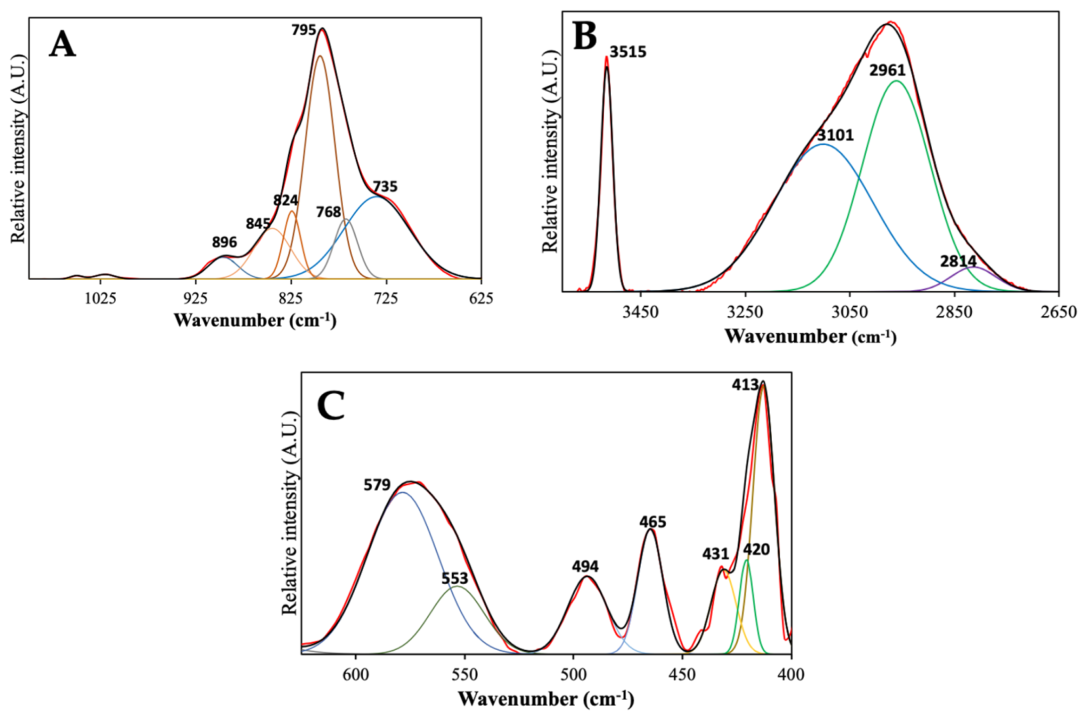
A sharp fundamental band of the As–O unit assigned to the ν1 (A1) symmetric stretching mode of AsO43− is observed at 820 cm−1 (Figure 6A) for the Al-bearing scorodite HBM, in addition to a splitting at 800 cm−1 of the fundamental ν1 vibration. The sharper ν1 (A1) AsO43− symmetric stretching mode for the scorodite KW occurs at 795 cm−1 (Figure 7A).
The bands at 945, 894, and 853 cm−1, obtained after curve-fitting deconvolution of the vibrational mode at 820 cm−1, are assigned to the ν3 antisymmetric stretching vibrations [14,22]. Nevertheless, the weak band at 945 cm−1 (Figure 6A), not observed for the scorodite KW (Figure 7A), is assigned to the AsO3(OH) bending. The shoulder at 719 cm−1 is ascribed to the As–O–Fe stretching mode [22] and the broad band at 785 cm−1 to the OH- deformation (Figure 6A) [14].
The ν3 antisymmetric stretching vibrations at 896, 845, and 824 cm−1 are observed for the scorodite KW (Figure 7A). The band at 768 cm−1 and the broadest band at 735 cm−1, assigned to the As–O–Fe symmetric stretching observed for scorodite [22], do not appear in the IR spectrum of the Al-bearing scorodite HBM (Figure 6A). A strong and sharp OH-stretching band for the Al-bearing scorodite HBM occurs at 3516 cm−1 and is associated with the three broad bands at 3200, 3042, and 2947 cm−1 (Figure 6B). The three bands are also bonded by Al, in addition to Fe, supporting the presence of the Fe,Al–OH stretching mode due to Fe substitution by Al and two different types of H2O and H3O [14]. In the case of the scorodite KW, only two bands appear at 3101 and 2961 cm−1 (Figure 7B). The H2O and –OH bending vibrations occur at 1591 and 1560 cm−1 (Figure 6C), observed also for the scorodite KW.
A broad band at 585 cm−1 and two intense bands at 495 and 468 cm−1 are seen in the 600–400 cm−1 region of the Al-bearing scorodite HBM (Figure 6D). The broader bands at 585 and 567 cm−1 are attributed to H2O vibration modes [14]. The bands at 509, 495, 468, 443, and 419 cm−1 are assigned to the ν4 antisymmetric bending modes of AsO43− (Figure 6D). The same vibrational modes between 600 and 400 cm−1 are also observed for the scorodite KW (Figure 7C).

3.5. Raman Spectroscopy

Two different orientations of the ALS1 (light color) and ALS2 (dark color) crystals (Al-bearing scorodite HBM) were chosen for Raman mapping (Figure S4a, ESD) and Raman micro-spectrometry. The Raman images, generated via univariate analysis, clearly distinguish both crystal types (ALS1 and ALS2), and the comprehensively analyzed datasets are shown as output maps (Figure S4b, ESD).
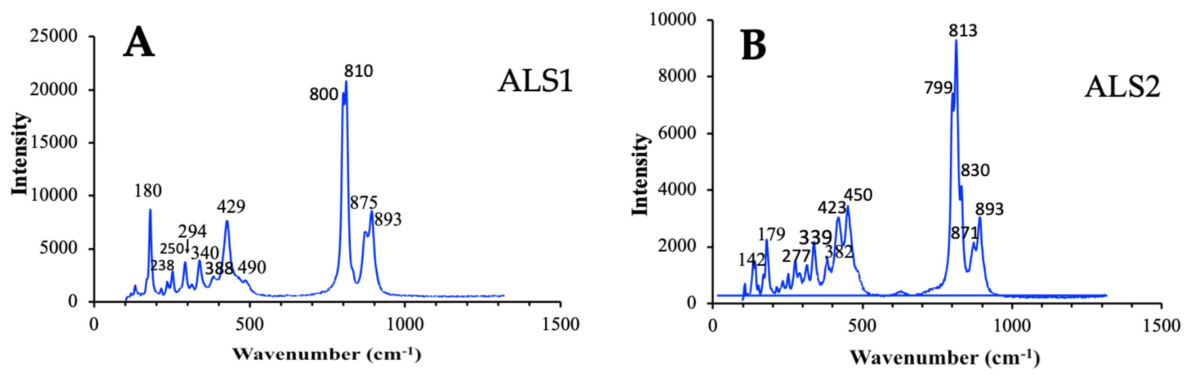
The Raman spectra of ALS1 and ALS2 crystals (Figure 8A,B) show a sharp band at 810 and 813 cm−1 assigned to the υ1 (A1) symmetric stretching mode of the AsO43− unit. This vibration mode at 810 or 813 cm−1 of the υ1 (A1) occurs at 820 cm−1 in the corresponding IR spectrum of the Al-bearing scorodite (see Figure 6A). The band at 810 (Figure 8A) or 813 cm−1 (Figure 8B) splits into one or two components coinciding with the antisymmetric υ3 (F2) mode at 800 (Figure 8A) or 799 cm−1 (Figure 8B). This division is related to oxygen bridging As and Fe/Al [As–O–Fe/Al] [14,23]. The band at 830 cm−1 (Figure 8B) is assigned to the antisymmetric stretching mode of AsO43− [14]. Two bands at 893 and 875 (871) cm−1 (Figure 8A,B) are ascribed to internal modes [22]. These bands occur at 894 and 853 cm−1 in the IR spectrum of the Al-bearing scorodite HBM (Figure 6A).
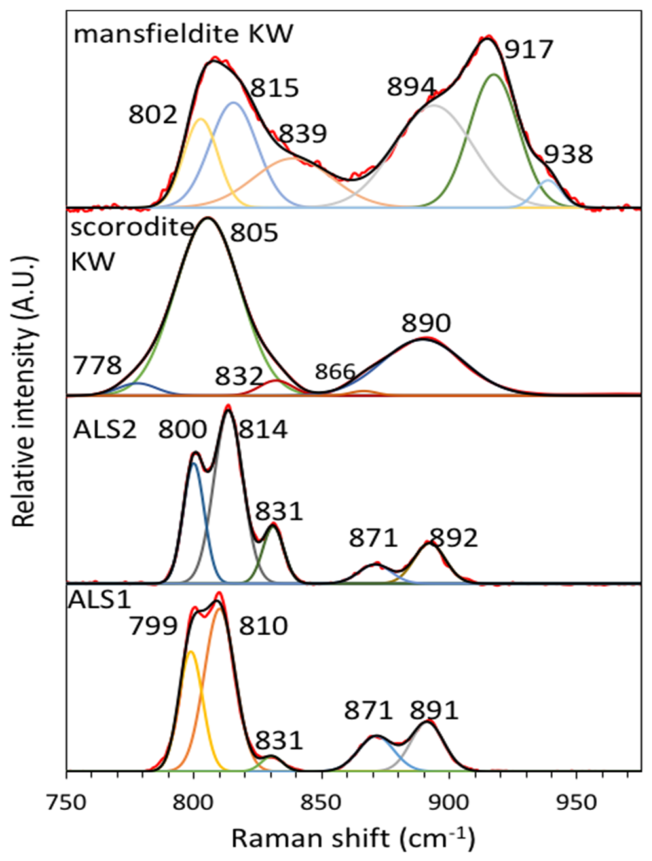
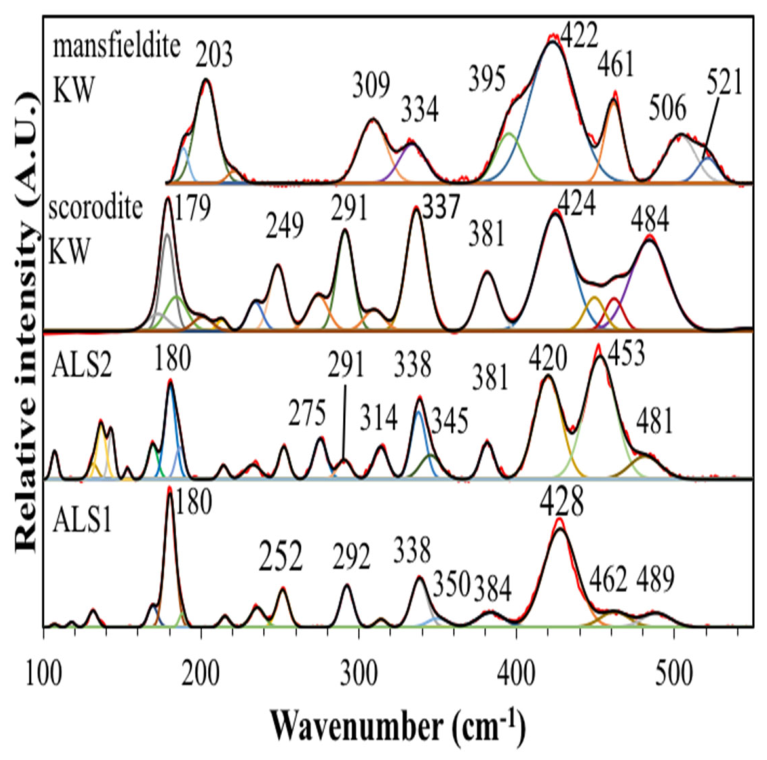
The υ2 (E) symmetric bending modes of the AsO43− unit occur at 388 (382) and 340 (339) cm−1, while the υ4 antisymmetric bending modes are seen at 490 and 429 (423) cm−1 (Figure 8A,B). Additionally, the antisymmetric bending mode at 450 cm−1 is observed only in ALS2 (Figure 8B). The remaining bands are associated with lattice modes of Fe–O, which can also be affected by the Al for Fe substitution in the crystal structure of the Al-bearing scorodite HBM. The Raman spectra of the ALS1 and ALS2 crystals (Figure 8A,B) were compared with those of scorodite KW and mansfieldite KW (Kloprogge and Wood [14], refitted data) in the 1000–100 cm−1 region. Two sub-regions corresponding to symmetric and antisymmetric stretching modes (1000–700 cm−1) (Figure 9) and bending modes (500–100 cm−1) (Figure 10) of the AsO43− unit were selected for a detailed analysis. The Raman stretching and bending vibrational modes of samples ALS1, ALS2, scorodite KW, and mansfieldite KW are shown in the ESD (Table S4), where the data are compared with those published in the literature [14,22,23,24].
The AsO43− υ1 (A1) symmetric stretching vibrational modes at 810 and 814 cm−1 were deconvoluted into two distinct stretching vibrations at 814 and 810 cm−1 [symmetric υ1 (A1)] and at 799 (800) cm−1 [antisymmetric υ3 (F2)] for ALS1 and ALS2, respectively (Figure 9). Mansfieldite KW also exhibits two stretching vibrations at 815 and 802 cm−1, whereas the scorodite KW corresponds to one vibrational mode at 805 cm−1 (Table S4, ESD). The three bands at 892, 871, and 831 cm−1 (crystals ALS1 and ALS2) are ascribed to the internal modes [22]. The smaller band at 891 and 892 cm−1 for ALS1 and ALS2, assigned to a non-bridging oxygen, may also be due to crystal edges or defects [25]. Mansfieldite KW exhibits three vibrations at 917, 894, and 839 cm−1, whereas scorodite KW shows only two vibrations at 890 and 866 cm−1.
The AsO43− antisymmetric bending modes (υ4 F2) for the ALS1 and ALS2 crystals occur at 489 (481), 462 (453), and 428 (420) cm−1. The symmetric bending modes (υ2 F2) are at 384 (381) and 338 (338) cm−1 for ALS1 and ALS2, respectively (Figure 10).
Three similar antisymmetric bending modes at 506, 461, and 422 cm−1 are observed for mansfieldite KW, and only two bending modes at 484 and 424 cm−1 for scorodite KW. These alterations are probably due to differences in crystal orientation under the Raman microscope. The remaining bands are ascribed to Fe–O lattice modes in scorodite KW.

4. Discussion

4.1. Chemistry

Scorodite is the most common natural ferric arsenate weathering product found in arsenic-bearing ore deposits [26]. Only a few studies have been published on the crystal chemistry of the natural scorodite—mansfieldite solid solution series and the end-member mansfieldite [2,4,5,6]. Also, there is no documented evidence in the literature of a continuous scorodite—mansfieldite solid solution, and natural varieties of Al-scorodite may contain up to 7.1% Al2O3 [27].
The chemical stability of Fe3+-Al3+ arsenate solid solution (Fe1−xAlxAsO4·2H2O) under hydrothermal conditions confirmed a significant role of Al concentration on the chemical stability of scorodite, where Fe preferentially reacts with AsO43− to yield Fe-rich solid solution compounds, even in Al-rich solution [28]. Two distinct clusters based on the Fe/(Fe + Al) ratio were identified by Le Berre et al. [28] during the synthesis of Al-scorodite: one compositionally like scorodite (incorporating Al-bearing species) and another with an intermediate composition where Al > Fe (i.e., closer to a mansfieldite composition). The molar Fe/(Fe + Al) ratios of the synthesized precipitated products (scorodite—mansfieldite series) range from 0.93 to 0.64 (±0.02), with a notably lower ratio of 0.14 (±0.02) recorded for the end-member mansfieldite [28]. The observed gap between these two mineral solutions was interpreted by Le Berre et al. [28], indicating the thermodynamically non-ideal nature of the scorodite–mansfieldite solid solution. In addition, a gap was also confirmed by Mazjlan et al. [6] who noted a significant variation in the Fe/(Fe + Al) ratio among natural members of the scorodite—mansfieldite solid solution.
In our samples, the Al content ranges from 0.03 to 0.17 apfu, and Fe from 0.82 to 0.93 apfu. The Fe/(Fe + Al) ratio shows a minor variation from 0.83 to 0.97 for the Al-bearing scorodite HBM. This ratio decreases to 0.75 for the Hobart Butte Al-bearing scorodite and to 0.02 for the Hobart Butte mansfieldite (Table 1).
Otherwise, the highest In3+ content (6 wt.% In2O3) was observed in scorodite, corresponding to a ratio of Fe 0.90 and In 0.10 [29]. This ratio is also consistent with our Al-bearing scorodite HBM samples, indicating a miscibility gap between Fe3+ and Al3+. Indium may also substitute for Fe3+ to form yanomamite, where minor amounts of Fe and Al were detected in yanomamite [13].
The detection of trace metals confirmed the direct crystallization of the Al-bearing scorodite HBM from mineralized hydrothermal fluids, which also carried trace amounts of Sn, W, In, Au, and Ag. Traces of Sn (mass% 0.02), W (mass% 0.04), and In (mass% 0.003) were either adsorbed on the surface or incorporated into the structure during rapid crystal growth under equilibrium conditions. The crystal growth rate can further affect the distribution of trace elements between the crystal and the fluid. For example, minor substitutions of P and S for As in the arsenate group were observed in the Al-bearing scorodite HBM, indicating the dynamic nature of element incorporation during crystal formation.

4.2. Structural Data

Powder X-ray diffraction shows the dhkl reflections for the Al-bearing scorodite HBM, typical of scorodite, with the first 111 reflection at 5.65 Å (Figure S1, ESD), and for synthetic mansfieldite at 5.50 Å. The difference of 0.15 Å can be explained by the presence of Al3+ (0.535 Å) with a smaller ionic radius than Fe3+ (0.645 Å).
The lattice parameters calculated for the Al-bearing scorodite HBM were compared with the values reported for scorodite and synthetic mansfieldite (Table S3, ESD). The a and b unit-cell lattice parameters (8.93 Å and 10.02 Å) of the Al-bearing scorodite HBM lie between scorodite [9] and synthetic mansfieldite [21], whereas the c unit-cell lattice parameter (10.30 Å) is larger than the values obtained for scorodite (10.04 Å) and synthetic mansfieldite (10.11 Å).
Both the a and b unit-cell lattice parameters for synthetic mansfieldite are smaller. The b unit-cell lattice parameter (10.02 Å) is contracted in the Al-bearing scorodite. Conversely, the c unit-cell lattice parameter expanded (10.30 Å) in the Al-bearing scorodite, being attributed only to the formation of the Fe-OH octahedron.
This is also confirmed by the Fe,Al-O lengths of 1.9475(10)–1.9916(10) Å for the Al-bearing scorodite HBM from our SCXRD data, which are shorter than the Fe-O lengths of 1.952(3)–2.116(3) Å estimated by Xu et al. [11] for scorodite. The Al-O lengths for mansfieldite range from 1.848 to 1.908 Å [12]. The arsenate ions show As-O bond lengths between 1.679(3) and 1.690(3) Å for scorodite [11], whereas for the Al-bearing scorodite HBM ranges from 1.6818(10) to 1.6885(10) Å. According to Zoppi and Pratese [11], the As-O lengths measured for mansfieldite range from 1.654 to 1.704 Å. This suggests that a mere 5% substitution of Al3+ for Fe3+ in the Al-bearing scorodite HBM is confined to the octahedral sites, leading to a slight compression of the Al–O octahedron, particularly along the a* ^ b* crystallographic directions. The interatomic distances between the octahedral sites and O have a more pronounced effect on Fe, with a typical octahedral coordination. In contrast, the incorporation of Al3+ has a strong effect on the tilting angle of the Fe,Al octahedron in the b* ^ c* crystallographic direction. A reasonable model closely related to the structure of scorodite comprises short chains of As-OH tetrahedra and FeO6 octahedra alternately connected at vertices [30]. This forms a structure that serves as a plausible model for hydrous ferric arsenate, closely resembling the structure of scorodite [31]. The structure of the Al-bearing scorodite HBM is supposed to represent a solid solution between scorodite and mansfieldite, characterized by the linking of FeO6 and AlO6 octahedra at the vertices of arsenate tetrahedra. The refined structure of the Al-bearing compound (Figure 4) suggests a preference of Al3+ to occupy the octahedral sites alongside Fe3+, leading to a noticeable distortion of the Fe,Al-OH octahedron. This distortion is attributed to an expansion of the c unit-cell lattice occupied only by the Fe-OH octahedron. A gradual decrease in the bond lengths of the a and b unit-cells supports the substitution of Al3+ for Fe3+, resulting in the formation of an Fe,Al–OH octahedron. The arsenate tetrahedra form bridging bonds with the oxyhydroxide clusters, linking the oxygens of Fe,Al–OH octahedra, and As–OH tetrahedra.

4.3. Vibrational Spectroscopy

The As–O unit is composed of tetrahedral anions centered around the As5+ ion within the AsO43− configuration. In this structure, the symmetric stretching vibration of the arsenate anion (ν1) is observed at 810 cm−1, aligning with the position of the antisymmetric stretching mode (ν3). The most intense infrared band appears at 795 cm−1 (Figure 7A) for scorodite KW, whereas the roselite is assigned to the AsO42− antisymmetric stretching vibration at 785 cm−1 [14].
The symmetry of the AsO43− tetrahedra may be changed due to its high propensity for protonation [23]. Increasing the arsenate protonation [AsO43− → AsO(OH)4], the vibrational band position in the IR spectra shifts by 25 cm−1 from 795 to 810 cm−1. This shift occurs during the transformation from scorodite KW to the Al-bearing scorodite HBM. Thus, the chemical interaction with the fluid reduces the tetrahedral symmetry of AsO43−, shifting the symmetric stretching vibration mode to different wavenumbers.
The doublet at 800 and 820 cm−1 observed after deconvolution in the IR spectrum of the Al-bearing scorodite HBM (Figure 6A) agrees with the Raman data and corresponds to the AsO43− symmetric and antisymmetric stretching vibrations within the Al-bearing scorodite structure. Several new vibration modes may arise from the splitting of the degenerate E and F modes [23]. The complexity observed in the vibrational spectrum of hydrated arsenates arises from the presence of mixed cationic species [14]. The variety of molecular vibration planes illustrates how arsenate bonds to different cations, thereby reducing the symmetry of the arsenate anion. Specifically, two distinct vibrations at 854 and around 790 cm−1 correspond to the AsO43− symmetric and antisymmetric stretching vibrations for roselite [14]. These vibrations also appear at 832 and 795 cm−1 for erythrite [16].
The ν4 (F2) antisymmetric stretching modes of AsO43− at 495, 468, and 419 cm−1 observed for the Al-bearing scorodite HBM are likely those found for scorodite KW, para-scorodite (Kañk, Czech Republic), scorodite from Djebel, Algeria [32], and in several published works [22,23,24].
The Raman spectra show the υ1 (A1) symmetric stretching vibrational mode of AsO43− at 805 cm−1, which is deconvoluted into two distinct bands at 815 and 802 cm−1 for mansfieldite KW. Similarly, this vibrational mode splits into two components at 810 and 814 cm−1, as well as at 799 and 800 cm−1 for the crystals ALS1 and ALS2, respectively (Figure 8).
The most intense band at 805 cm−1 for the scorodite KW, assigned to the υ1 (A1) symmetric stretching vibration of AsO43−, has a corresponding band at 795 cm−1 in the IR spectrum. In addition, Coleyshaw et al. [24] and Gomez et al. [33] identified only one υ1 (A1) symmetric stretching vibration at 800 and 799 cm−1, whereas Filippi et al. [23] observed two bands at 810 and 799 cm−1, both assigned to the υ1 (A1) symmetric stretching mode.
The Raman spectrum of kañkite (FeAsO4·3.5H2O) displays intense stretching modes for ν1 at 812 cm−1 and ν3 at 882 and 903 cm−1 [23]. The band assigned to the As–OFe symmetric stretching mode appears at 836 cm−1, and the hydroxyl deformation modes at 771 and 794 cm−1. The band at 800 cm−1 for scorodite was assigned to the ν3 (F2) antisymmetric stretching mode of AsO43− associated with oxygen bridging between As and Fe (As–O–Fe) [25].
The Raman spectra of the Al-bearing scorodite HBM and mansfieldite KW show two vibrational bands attributed to the AsO43− ν1 symmetric stretching modes, similar to the AsO43− group observed in the IR spectra. The 799–800 cm−1 Raman shift region has been assigned to the Fe–O–As group, with specific shifts at 798 and 803 cm−1. Additionally, the 810–814 cm−1 Raman shift region corresponds to a band arising due to the protonation of AsO43−1 (A1) symmetric stretching vibrational modes], indicative of the Al–OH–As group in both Al-bearing scorodite and mansfieldite KW. Therefore, the Fe(Al) coordination is achieved by four bridging arsenate ions, with each As atom forming four As–O–Fe/Al linkages through bridging O atoms. This arrangement is further completed by two water molecules acting as terminal ligands for Fe(Al).

4.4. Crystallization of Al-Bearing Scorodite

The crystallization of the Al-bearing scorodite HBM requires aluminum supplied from kaolinite dissolution (observed in the kaolinized granite). The hydrolysis of kaolinite leads to the formation of various dissolved species (such as =AlOH or ≡SiOH) in aqueous systems influenced by the pH solution [34]. Al3+ becomes the dominant species in acid solutions (pH < 5), whereas the AlOH2+ and Al(OH)2+ species become more relevant in solutions with pH 4.5 to 5.5. The destabilization of scorodite increases with increasing Al concentration in solution, and this effect is influenced by the presence of Al species [28]. The small ionic radius and high charge of the Al3+ ion result in a significant polarization of water molecules [35]. This effect, combined with the fluid’s pH, influences the degree of ionization of Al–OH surfaces exposed to water, leading to the formation of surface hydroxyl groups (S–OH).
Acid/base reaction occurs, resulting in surface charge development at the interface of the particle/solution [36], according to Equation (1):
S O H 2 + H + S O H O H S O
Further neutralization may lead to the formation of gibbsite or amorphous Al(OH)3, which controls aAl3+ above pH 4.6 [35]. Gibbsite was not identified in this study, suggesting that the pH was <4.6 during the Al–OH reaction with scorodite. The hydrolysis of aqueous Al3+ enables the bridging of oxygens between different hydrated aluminum ions, facilitating the isolation of these interactions [37].
Following this process, the initial scorodite structure becomes destabilized as the Al concentration in solution increases. New Al-bearing scorodite crystals nucleated from an amorphous scorodite solution containing Fe3+, Al3+, and arsenate, exhibiting high solubility under high supersaturation conditions [38]. One possible explanation for the observed chemical variations in the Al and Fe distributions is local self-organization at the mineral surface [25]. However, the distribution of Fe3+ and Al3+ within the Al-bearing scorodite HBM does not reflect a physical mixing of the two end-members via co-precipitation. Minerals with lower Al content tend to exhibit characteristics like scorodite, whereas those with higher Al content resemble mansfieldite.
Nevertheless, the composition of a mineral is intrinsically linked to the physical and chemical conditions of the fluid involved. Crystal growth increases at high fluid supersaturation, leading to sector zoning within individual crystals when the growth rates of different octahedral and tetrahedral chains differ in chemical composition. In such environments, the fluid chemistry continuously fluctuates, reflecting rhythmic changes in solution composition throughout crystallization, moving from the core to the rim of the growing mineral [39]. This phenomenon suggests that the mineral’s failure to maintain chemical equilibrium with the surrounding fluid can lead to concentric zoning during crystal growth in an open-transport reaction system. As the supersaturation level nears equilibrium, less stable crystals may start to dissolve, providing material for other crystals of the same phase to grow during an eventual ripening process.
The crystal zoning observed in the Al-bearing scorodite HBM is indicative of the classic zoned textures found in solid-solution minerals, where zonation results from the sequential addition of layers with distinct chemical composition, ranging from scorodite to mansfieldite. As a result, concentric zoning vanishes, and the crystal composition may exhibit minor variations around the solution’s average composition at high supersaturation levels. This zoning reflects the dynamic changes in environmental conditions, serving as a historical record of those changes.
The crystal morphology of the Al-bearing scorodite HBM exhibits a typical polyhedron habit, characterized by an orthorhombic structure, where the octahedral-shaped single crystal is defined by (111) and either (100) or (001) crystal planes. Moreover, the transition from a pseudo-octahedral to a tabular {001} configuration (Figure 2D) suggests different conditions of crystallization. The tabular habit indicates an undersaturated environment, conducive to crystal growth primarily in one direction [40] within the dipyramidal class during the final stage of growth. In contrast, mansfieldite from Ľubietová–Svätodušná exhibits a typical ring-like structure [6], likely crystallized from a gelatinous fluid or through the continuous dissolution of a precursor phase, where the gelatinous fluid was quiescent and highly concentrated with respect to amorphous aluminous-arsenate.

5. Conclusions

The Al-bearing scorodite HBM serves as an exemplary mineral for thorough environmental management, highlighting the importance of understanding the octahedral site occupancies of Fe3+ and Al3+ along with atomic coordinates for a deeper insight into scorodite’s stability.
The lattice structure of the Al-bearing scorodite HBM becomes slightly distorted by the formation of the Fe,Al-OH octahedron, which leads to a compression of the newly formed octahedron along the a* ^ b* direction and an expansion of the Fe-OH octahedron along the c* direction. This structural distortion likely impedes further substitution of Al3+ for Fe3+, creating a miscibility gap as noted by several authors. Consequently, a solid solution series between scorodite and the Al-end-member scorodite (i.e., mansfieldite) is questionable.
These findings are further corroborated by IR and Raman spectroscopy. The doublet observed at 821 and 800 cm−1 in the Raman spectra of the Al-bearing scorodite HBM, similarly found in mansfieldite KW, aligns with the υ1 (A1) symmetric stretching vibrational modes of AsO43− at 805 cm−1. The Raman shift region between 799 and 800 cm−1 has been assigned to the Fe–O–As group (798 and 803 cm−1), whereas the 810–814 cm−1 Raman shift region has been attributed to a band resulting from the protonation of AsO43−1 (A1) symmetric stretching vibrational modes] associated with the Al–OH–As group in both the Al-bearing scorodite HBM and the mansfieldite KW. Essentially, the doublet observed by Raman spectroscopy is indicative of the AsO43− group bound to Fe,Al-OH octahedron. The distribution of Fe and Al in the Al-bearing scorodite HBM suggests that its formation does not merely result from a straightforward physical mixing of the two end-members via co-precipitation. Instead, crystals with lower Al content exhibit properties akin to scorodite KW, whereas those with higher Al content exhibit structural characteristics like those of mansfieldite KW. The Fe,AlO6 octahedra are interconnected at the vertices of arsenate tetrahedra, forming chains of Fe,Al(AsO4)(OH)2 that mirror the structure of the Al-bearing scorodite HBM. This nuanced interplay between Al and Fe within the mineral structure underscores the complexity of its formation process and the significant role of chemical composition in determining the mineral’s structural characteristics.

Supplementary Materials

The following supporting information can be downloaded at https://www.mdpi.com/article/10.3390/cryst16060381/s1, Figure S1. X-ray diffraction patterns of Al-bearing scorodite HBM (blue line) and mansfieldite (red line); Figure S2. Single X-ray crystal pattern of Al-bearing scorodite from HBM; Figure S3. The IR spectra of Al-bearing scorodite HBM and scorodite KW; Figure S4. Raman mapping of distinct oriented Al-bearing scorodite HBM crystals; Table S1. The 2-theta, d-spacing and Miller indices measured for Al-bearing scorodite HBM; Table S2. The 2-theta, d-spacing and Miller indices for mansfieldite [18]; Table S3. The unit-cell lattice parameters calculated for Al-bearing scorodite HBM compared with scorodite, mansfieldite, Co-mansfieldite and yanomamite data; Table S4. The stretching and bending modes (Infrared and Raman spectra) of Al-bearing scorodite HBM are compared with published literature data.

Author Contributions

I.B.: conceptualization, EPMA, XRD, IR and Raman measurements, formal analysis, writing—original draft, review and editing, and visualization. J.T.K.: IR and Raman spectroscopy methodology and modeling, formal analysis, writing—original draft, review, and editing. P.B. and J.R.: SCXRD methodology and measurements, formal analysis, writing—original draft, review, and editing. R.V. and J.A.M.: Raman spectroscopy data acquisition and review. All authors have read and agreed to the published version of the manuscript.

Funding

IB: under the project UID/04683/2025 (https://doi.org/10.54499/UID/04683/2025) for analytic support and financial support for publication. PB and JR for single crystal X-ray diffraction (project CICECO-Aveiro Institute of Materials, UIDB/50011/2025, UIDP/50011/2025 and LA/P/0006/2025, financed by FCT/MCTES, PIDDAC). R.V. and J.A.M.: under the project UID/04968/2025 (https://doi.org/10.54499/UID/04968/2025) for analytic support and financial support for publication.

Data Availability Statement

The original contributions presented in this study are included in the article and Supplementary Material. Further inquiries can be directed to the corresponding author.

Acknowledgments

Many thanks to F. Guimarães (LNEG—Porto) for EPMA and B. Postolnyi (Institute of Physics for Advanced Materials, Nanotechnology and Photonics—Porto) for XRD. The authors thank the three reviewers for their comments on the earlier version of the manuscript.

Conflicts of Interest

The authors declared no potential conflicts of interest with respect to the research, authorship, and/or publication of this article.

References

  1. Dove, M.P.; Rimstidt, J.D. The solubility of scorodite, FeAsO4·2H2O. Am. Mineral. 1985, 70, 838–844. [Google Scholar]
  2. Allen, V.T.; Fahey, J.J.; Axelrod, J.M. Mansfieldite, a new arsenate, the aluminum analogue of scorodite, and the mansfieldite-scorodite series. Am. Mineral. 1948, 33, 122–132. [Google Scholar]
  3. Walenta, K. Mansfieldit von Neubulach im Württembergischen Schwarzwald. Neues Jahrb. Mineral. Abh. 1963, 79–87. [Google Scholar]
  4. Rincón, J.M.; Romero, M.; Hidalgo, A.; Liso, M.J. Thermal behaviour and characterization of an iron aluminum arsenate mineral. Mansfieldite-scorodite series. J. Therm. Anal. Calorim. 2004, 76, 903–911. [Google Scholar] [CrossRef]
  5. Sejkora, J.; Ondruš, P.; Fikar, M.; Veselovský, F.; Mach, Z.; Gabašová, A.; Škoda, R.; Beran, P. Supergene minerals at the Huber stock and Schnöd deposits, Krásno ore district, the Slavkovskýles area, Czech Republic. J. Czech Geol. Soc. 2006, 51, 57–101. [Google Scholar]
  6. Majzlan, J.; Nielsen, U.G.; Dachs, E.; Benisek, A.; Drahota, P.; Kolitsch, U.; Herrmann, J.; Bolanz, R.; Števko, M. Thermodynamic properties of mansfieldite (AlAsO4·2H2O), angelellite (Fe4(AsO4)2O3) and kamarizaite (Fe3(AsO4)2(OH)3·3H2O). Mineral. Mag. 2018, 82, 1333–1354. [Google Scholar] [CrossRef]
  7. Day, B.; Beyer, B. Some mines of the Mt. Isa district, Queensland; the Mt Cobalt mine. Aus. J. Mineral. 1995, 1, 17–23. [Google Scholar]
  8. Mills, S.J.; Christy, A.G.; Favreau, G. The crystal structure of ceruleite, CuAl4[AsO4]2(OH)8(H2O)4, from Cap Garonne, France. Mineral. Mag. 2018, 82, 181–187. [Google Scholar] [CrossRef]
  9. Kitahama, K.; Kiriyama, R.; Yoshihisa, B. Refinement of the Crystal Structure of Scorodite. Acta Crystallogr. 1975, B31, 322–324. [Google Scholar] [CrossRef]
  10. Hawthorne, F.C. The hydrogen positions in scorodite. Acta Crystallogr. 1976, B32, 2891–2892. [Google Scholar] [CrossRef]
  11. Xu, Y.; Zhou, G.P.; Zheng, X.-F. Redetermination of iron (III) arsenate dihydrate. Acta Crystallogr. 2007, E63, i67–i69. [Google Scholar] [CrossRef]
  12. Zoppi, M.; Pratesi, G. Rietveld refinement of a natural cobaltian mansfieldite from synchrotron data. Acta Crystallogr. 2008, E65, i6–i7. [Google Scholar] [CrossRef]
  13. Botelho, N.F.; Roger, G.; D’Yvoire, F.; Moëlo, Y.; Volfinger, M. Yanomamite, InAsO4·2H2O, a new indium mineral from topaz-bearing greisen in the Goiás Tin Province, Brazil. Eur. J. Mineral. 1994, 6, 245–254. [Google Scholar] [CrossRef]
  14. Kloprogge, T.J.; Wood, B.J. X-ray Photoelectron Spectroscopic and Raman microscopic investigation of the variscite group minerals: Variscite, strengite, scorodite and mansfieldite. Spectrochim. Acta Part A Mol. Biomol. Spectrosc. 2017, 185, 163–172. [Google Scholar] [CrossRef] [PubMed]
  15. Frost, R.L. Raman and infrared spectroscopy of arsenates of the roselite and fairfieldite mineral subgroups. Spectrochim. Acta Part A Mol. Biomol. Spectrosc. 2009, 71, 1788–1794. [Google Scholar] [CrossRef] [PubMed][Green Version]
  16. Farmer, C.V. The Infrared Spectra of Minerals; Mineralogical Society Monograph No 4; Mineralogical Society: London, UK, 1974; 539p. [Google Scholar]
  17. Higashi, T. ABSCOR; Rigaku Corporation: Tokyo, Japan, 2001. [Google Scholar]
  18. Sheldrick, G.M. A short history of SHELX. Acta Crystallogr. Sect. A Found. Crystallogr. 2008, 64, 112–122. [Google Scholar] [CrossRef]
  19. Wojdyr, M. Fityk: A general-purpose peak fitting program. J. Appl. Crystallogr. 2010, 43, 1126–1128. [Google Scholar] [CrossRef]
  20. Martens, W.N.; Kloprogge, J.T.; Frost, R.L.; Rintoul, L. Single-crystal Raman study of erythrite, Co3(AsO4)2.8H2O. J. Raman Spectrosc. 2004, 35, 208–216. [Google Scholar] [CrossRef][Green Version]
  21. Harrison, W.T.A. Synthetic mansfieldite, AlAsO4·2H2O. Acta Crystallogr. 2000, C56, e421. [Google Scholar] [CrossRef]
  22. Gomez, M.A.; Assaaoudi, H.; Becze, L.; Cutler, J.N.; Demopoulos, G.P. Vibrational spectroscopy study of hydrothermally produced scorodite (FeAsO4·2H2O), ferric arsenate sub-hydrate (FAsH; FeAsO4·0.75H2O) and basic ferric arsenate sulfate (BFAS; Fe[(AsO4)1−x(SO4)x(OH)x]·wH2O). J. Raman Spectr. 2010, 41, 212–221. [Google Scholar] [CrossRef]
  23. Filippi, M.; Machovic, V.; Drahota, P.; Bohmova, V. Raman microspectroscopy as a valuable additional method to X-ray diffraction and electron microscope/microprobe analysis in the study of iron arsenates in environmental samples. App. Spectrosc. 2009, 63, 621–662. [Google Scholar] [CrossRef]
  24. Coleyshaw, E.E.; Griffith, W.P.; Bowell, R.J. Fourier-transform Raman spectroscopy of minerals. Spectrochim. Acta Part A Mol. Biomol. Spectrosc. 1994, 50A, 1909–1918. [Google Scholar] [CrossRef]
  25. Savage, K.S.; Bird, D.K.; O’Day, P.A. Arsenic speciation in synthetic jarosite. Chem. Geol. 2005, 215, 473–498. [Google Scholar] [CrossRef]
  26. Boyle, R.W.; Jonasson, I.R. The geochemistry of arsenic and its use as an indicator element in geochemical prospecting. J. Geoch. Expl. 1973, 2, 251–296. [Google Scholar] [CrossRef]
  27. Betejtin, A.G. Curso de Mineralogia; Editorial Mir: Moscow, Russia, 1951; 731p. (In Spanish) [Google Scholar]
  28. Le Berre, J.F.; Cheng, T.C.; Gauvin, R.; Demopoulus, G.P. Hydrothermal synthesis and stability evaluation of Iron (III)-Aluminum (III) Arsenate solid solutions. Metall. Mat. Trans. 2007, 38B, 159–165. [Google Scholar] [CrossRef]
  29. Botelho, N.F.; Roger, G. Découverte de minéraux d’indium dans la paragénèse sulfuree du gîte stannifère proterozoïque de Mangabeira, Goiás, Brésil. Comptes Rendus L’Acad. Sci. 1990, 310, 247–253. [Google Scholar]
  30. Das, B. Theoretical Study of Formation of Secondary Arsenic Minerals Scorodite and Pharmacosiderite. ACS Earth Space Chem. 2019, 3, 192–201. [Google Scholar] [CrossRef]
  31. Mikutta, C.; Mandaliev, P.N.; Kretzschmar, R. New Clues to the Local Atomic Structure of Short-Range Ordered Ferric Arsenate from Extended X-ray Absorption Fine Structure Spectroscopy. Environ. Sci. Technol. 2013, 47, 3122–3131. [Google Scholar] [CrossRef] [PubMed]
  32. Ondrus, P.; Skala, R.; Viti, C.; Veselowski, F.; Novak, F.; Jansa, J. Parascorodite FeAsO4·2H2O—A new mineral from Kaňk near Kutná Hora, Czech Republic. Am. Mineral. 1999, 84, 1439–1444. [Google Scholar] [CrossRef]
  33. Gomez, M.A.; Becze, L.; Celikin, M.; Demopoulos, G.P. The effect of copper on the precipitation of scorodite (FeAsO4·2H2O) under hydrothermal conditions: Evidence for a hydrated copper containing ferric arsenate sulfate-short lived intermediate. J. Colloid Interface Sci. 2011, 360, 508–518. [Google Scholar] [CrossRef]
  34. Stumm, W. Chemistry of the Solid-Water Interface; Wiley & Sons: New York, NY, USA, 1992; 346p. [Google Scholar]
  35. Nordstrom, D.K.; Ball, J.W. The geochemical behavior of aluminum in acidified surface waters. Science 1986, 232, 54–56. [Google Scholar] [CrossRef]
  36. Tari, G.; Bobos, I.; Gomes, C.; Ferreira, J.M. Modification of charge density during the kaolinite to hallosyite-7Å transformation. J. Colloid Interface Sci. 1999, 209, 360–366. [Google Scholar] [CrossRef]
  37. Hem, J.D.; Roberson, C.E. Form and Stability of Aluminum Hydroxide Complexes in Dilute Solution; U.S. Geological Survey Water Supply Paper 1827; U.S. Government Publishing Office: Washington, DC, USA, 1967. [Google Scholar]
  38. Demopoulos, G.P.; Droppert, D.J.; Van Weert, G. Precipitation of crystalline scorodite (FeAsO4·2H2O) from chloride solutions. Hydrometallurgy 1995, 38, 245–261. [Google Scholar] [CrossRef]
  39. Saunders, K.; Buse, B.; Kilburn, R.M.; Kearns, S.; Blundy, J. Nanoscale characterization of crystal zoning. Chem. Geol. 2014, 364, 20–32. [Google Scholar] [CrossRef][Green Version]
  40. Kostov, I.; Kostov, R.I. Crystal Habits of Minerals; Bulgarian Academic Monographs No. 1; Pensoft Publishers: Sofia, Bulgaria, 1999; 415p. [Google Scholar]
Figure 1. Light blue Al-bearing scorodite crystals from the HBM.
Crystals 16 00381 g001
Figure 2. Morphology of the Al-bearing scorodite HBM crystals observed by scanning electron microscopy. (A,B) Crystals with a pseudo-octahedral [111], prismatic [010], or tabular [001] well-developed habit. (C) Fractured edge indicated by an arrow. (D) A contact twin between two crystals marked by an arrow.
Crystals 16 00381 g002
Figure 3. (A,B) Back-scattered electron microscopy images of the Al-bearing scorodite HBM crystals showing a clear zonation. The light shades correspond to zones with an Fe-rich composition.
Crystals 16 00381 g003
Figure 4. (A) Crystal packing of the Al-bearing scorodite from the HBM along [100] direction showing the AsO4 tetrahedra (dark blue color) linked with Fe/AlO6 octahedra (green color). (B) Environment around Fe/Al and As atoms, where i, ii, and iii are the symmetry operations i = x, 3/2 − y, 1/2 + z, ii = 1 − x, 1 − y, 1 − z; iii = 1/2 + x, 3/2 − y, 1 − z.
Crystals 16 00381 g004
Figure 5. The diagram of Al content (%) vs. wR2 (%).
Crystals 16 00381 g005
Figure 6. (A) Deconvolution of the ν3 (A1) antisymmetric stretching modes of AsO43− (B) the OH- stretching band), (C) the OH-bend vibration, and (D) the ν4 (A1) antisymmetric bending modes of AsO43− for the Al-bearing scorodite HBM.
Crystals 16 00381 g006
Figure 7. (A) Deconvolution of the ν3 (A1) antisymmetric stretching modes of AsO43−, (B) the OH- stretching band, and (C) the ν4 (A1) antisymmetric bending modes of AsO43− for scorodite KW.
Crystals 16 00381 g007
Figure 8. (A,B) Raman spectra of the Al-bearing scorodite HBM (ALS1 and ALS2 crystals) with two different crystallographic orientations.
Crystals 16 00381 g008
Figure 9. Deconvolution of the symmetric and antisymmetric stretching modes (1000–700 cm−1) of the AsO43− unit for the ALS 1 and ALS 2 samples. The data are compared with scorodite KW and mansfieldite KW.
Crystals 16 00381 g009
Figure 10. Deconvolution of the antisymmetric bending modes (υ4 F2) of the AsO43− unit (500–100 cm−1) for the ALS 1 and ALS 2 samples. The data are compared with scorodite KW and mansfieldite KW.
Crystals 16 00381 g010
Table 1. Average EPMA analyses (a mean number of five analyses per point) of Al-bearing scorodite from the HBM and the structural formula calculated for six oxygens (O, OH) were compared with the literature data for Al-bearing scorodite and mansfieldite from Hobart Butte.
Oxides (%)12345678910MinMaxMeanAl 1M 2
Al2O32.71.841.011.273.242.42.163.144.280.750.764.282.285.7623.30
Fe2O335.1234.1635.0334.8632.7133.132.9833.4131.6735.7931.6735.7933.8825.720.88
As2O548.8349.3648.5749.2249.1749.5349.1749.9348.3149.4148.3149.9349.1548.8856.43
SO3-0.02-0.05-0.07-----0.070.010.000.00
P2O50.020.020.01-0.01----0.03-0.030.010.000.00
CoO-0.030.040.010.040.020.020.02-0.00-0.040.020.000.00
PbO--0.11-0.010.090.02-0.04--0.110.030.000.00
In2O30.010.010.01---0.02-0.010.00-0.010.000.000.00
CuO0.01-0.00---0.02--0.00-0.020.000.000.00
Ag2O-0.02----0.030.02---0.020.010.000.00
Au2O-0.01--0.02--0.010.030.03-0.030.010.000.00
ZnO-0.01-0.04-------0.0420.010.000.00
SnO20.09-0.03----0.070.020.04-0.090.030.000.00
WO3-0.05-0.060.080.090.070.06-0.02-0.090.040.000.00
Bi2O30.14-0.070.050.070.130.080.0350.030.04-0.140.060.000.00
Total86.9285.5284.8985.5785.3485.4484.5686.6984.4086.1384.086.9285.580.36 80.61
Al0.110.080.040.050.130.10.090.130.170.030.030.160.090.240.88
Fe0.890.880.930.910.850.860.870.850.820.930.880.870.870.70.02
As11.031.031.041.031.041.041.021.011.031.080.971.031.061.11
S0.000.000.000.000.000.000.000.000.000.000.000.000.000.000.00
P0.000.000.000.000.000.000.000.000.000.000.000.000.000.000.00
Fe/(Fe + Al)0.890.920.960.960.870.990.910.870.830.970.970.840.910.750.02
1—Al: Al-bearing scorodite from Hobart Butte [2]. 2—M: Mansfieldite from Hobart Butte [2].
Table 2. Crystal data and refinement parameters of the Al-bearing scorodite HBM.
Empirical FormulaO6H4AsFe0.95Al0.05
Mw229.35
Crystal systemOrthorhombic
Space groupPbca (61)
a/[Å]8.92882(14)
b/[Å]10.02217(14)
c/[Å]10.30525(15)
V [Å3]922.18(2)
Z8
Dc [Mg m−3]3.304
μ/[mm−1]10.188
F(000)883
Crystal size [mm3]0.20 × 0.08 × 0.02
θ range for data collection (°)3.640–33.528
Index ranges−13 ≤ h ≤ 13, −15 ≤ k ≤ 15, −15 ≤ l ≤ 15
Reflections collected19,314
Unique reflections, [Rint]1772 [0.0207]
Final R indices
R1, wR2 [I > 2σI]0.0155, 0.0381 [1659]
R1, wR2 (all data)0.0175, 0.0386
Data/restraints/parameters2948/0/90
Goodness-of-fit on F21.087
Table 3. The Fe coordination polyhedron mean bond value, quadratic elongation, and bond angle variance values reported.
Bond LengthsBond Angles
As-O(1)1.6818(10)O(1)-As-O(2)112.02(5)O(2ii)-Fe/Al-O(3ii)179.31(4)
As-O(2)1.6827(10)O(1)-As-O(3)110.20(5)O(2ii)-Fe/Al-O(4)91.41(4)
As-O(3)1.6839(10)O(1)-As-O(4)107.53(5)O(2ii)-Fe/Al-O(5)96.15(4)
As-O(4)1.6885(10)O(2)-As-O(3)107.06(5)O(2ii)-Fe/Al-O(6)84.53(4)
Fe/Al-O(1i)1.9668(10)O(2)-As-O(4)109.33(5)O(3iii)-Fe/Al-O(4)87.92(4)
Fe/Al-O(2ii)1.9916(10)O(3)-As-O(4)110.72(5)O(3iii)-Fe/Al-O(5)84.00(4)
Fe/Al-O(3iii)1.9811(10)O(1i)-Fe/Al-O(2ii)91.10(4)O(3iii)-Fe/Al-O(6)96.16(4)
Fe/Al-O(4)1.9475(10)O(1i)-Fe/Al-O(3iii)88.78(4)O(4)-Fe/Al-O(5)88.99(4)
Fe/Al-O(5)2.1107(10)O(1i)-Fe/Al-O(4)92.78(4)O(4)-Fe/Al-O(6)169.40(4)
Fe/Al-O(6)2.0446(10)O(1i)-Fe/Al-O(5)172.50(4)O(5)-Fe/Al-O(6)81.74(4)
O(1i)-Fe/Al-O(6)97.08(4)
i = x, 3/2 − y, 1/2 + z; ii = 1 − x, 1 − y, 1 − z; iii = 1/2 + x, 3/2 − y, 1 − z.
Disclaimer/Publisher’s Note: The statements, opinions and data contained in all publications are solely those of the individual author(s) and contributor(s) and not of MDPI and/or the editor(s). MDPI and/or the editor(s) disclaim responsibility for any injury to people or property resulting from any ideas, methods, instructions or products referred to in the content.