Review

Research Progress and Prospects of Inorganic Rare Earth Luminescence Thermometry Technology
1
School of Environmental and Chemical Engineering, Zhaoqing University, Zhaoqing 526061, China
2
Department of Materials Science and Engineering, University of Pennsylvania, Philadelphia, PA 19104, USA
*
Authors to whom correspondence should be addressed.
Crystals 2026, 16(6), 380; https://doi.org/10.3390/cryst16060380
Submission received: 30 April 2026 / Revised: 25 May 2026 / Accepted: 29 May 2026 / Published: 5 June 2026
(This article belongs to the Topic High Performance Ceramic Functional Materials)

Abstract

Temperature is a physical quantity that represents the degree of heat or cold of an object and has significant application value across various fields. Traditional contact temperature measurement technologies, such as thermocouples and infrared thermometers, suffer from limitations like poor environmental adaptability and low spatial resolution, which makes it difficult to meet the temperature measurement requirements for micro-/nano-devices and extreme environments. In recent years, non-contact optical temperature measurement technology based on the luminescence characteristics of rare earth ions has garnered widespread attention due to its high sensitivity, strong interference resistance, and good environmental adaptability. In addition to inorganic luminescent materials, lanthanide-based molecular and coordination-complex thermometers have also become an important branch of this field; however, this paper focuses on inorganic rare earth luminescence thermometry. This paper provides a systematic review of the mechanisms of temperature measurement using rare earth ion luminescence, including single-energy-level luminescence intensity measurement and luminescence intensity ratio measurement based on thermally coupled levels (TCLs) and non-thermally coupled levels (NTCLs). It analyzes the principles of various technologies, performance parameters (such as absolute sensitivity Sa, relative sensitivity Sr, and temperature resolution δT), and their application progress in fields such as biomedical imaging, high-temperature aerospace environments, and the integration of micro-/nano-devices. Special attention is paid to emerging research directions, including Stark sublevel engineering for enhanced sensitivity, negative thermal expansion (NTE) host design for anti-thermal quenching, multi-modal collaborative thermometry, and artificial intelligence (AI)-assisted material design and data processing. The article also discusses the challenges currently faced by the technology, such as high-temperature fluorescence quenching and signal interference, and looks forward to future development directions, including artificial intelligence-assisted material design and multi-modal cooperative temperature measurement, aiming to provide a reference for the research and application of rare earth luminescence temperature sensing technology.

1. Introduction

Temperature is a physical quantity in nature that indicates the degree of heat or cold of an object, reflecting the intensity of molecular thermal motion. It plays an irreplaceable role in material preparation, biomedicine, industrial production, aerospace, and microelectronics [1,2,3]. With the development of science and technology, accurate, fast, and high spatial resolution temperature measurement methods have become increasingly important in various fields [4]. Traditional contact temperature measurement methods, such as thermocouples and thermistors, have the advantages of high accuracy and stability and are widely used in large-scale temperature measurements. However, they have significant limitations in extreme environment adaptability, dynamic response speed, spatial resolution, and localized detection, making it difficult to meet the temperature detection needs of modern high-integration systems, small-scale devices, and complex environments [5,6,7,8,9,10].
To address the challenges and issues faced by traditional contact temperature measurement technologies, it is crucial to develop non-contact temperature measurement technologies with high temperature sensitivity, strong interference resistance, sensitive response, and strong environmental adaptability. This field includes two major branches, inorganic rare earth luminescent materials and lanthanide-based molecular/coordination-complex thermometers, and the present review focuses on inorganic systems. In recent years, researchers have developed non-contact optical temperature measurement technologies based on the unique energy level structure and luminescence characteristics of rare earth ions. Interestingly, once developed, this luminescence temperature measurement technology quickly became a hot topic of research in the field of temperature sensing due to its high sensitivity, strong interference resistance, and wide applicability in harsh environments [11,12]. These temperature measurement materials have unique electronic structures and luminescence characteristics, enabling rapid response to environmental temperature over a wide spectral range (ultra-high frequency-visible near-infrared) [13]. It is worth noting that the 4f orbitals of rare earth ions are shielded by the abundant outer 5s2, 5p6 electrons, resulting in sharp emission lines, long lifetimes, and minimal influence from crystal fields, providing good photo-thermal stability and reliability [14].
However, current rare earth luminescence thermometry still faces several key bottlenecks: excitation power dependence and laser-induced heating seriously degrade measurement accuracy, high-temperature thermal quenching limits the upper operating temperature, single-modal readout lacks self-calibration ability and anti-interference performance, and the rational design of high-performance materials relies heavily on trial-and-error with insufficient artificial intelligence (AI) assistance. To overcome these limitations, emerging strategies including Stark sublevel engineering, negative thermal expansion (NTE) host design for anti-quenching, multi-modal collaborative thermometry, and AI-assisted material design and data processing have attracted extensive attention, providing new avenues to further improve sensitivity, stability, and practical applicability.
In current research, rare earth optical temperature measurement strategies are mainly divided into three categories: single-energy-level luminescence intensity temperature measurement, temperature measurement based on the thermally coupled levels (TCL) model, and temperature measurement based on the non-thermally coupled levels (NTCL) model with dual-emission centers [15,16,17,18]. This paper will discuss rare earth luminescence temperature measurement technology based on luminescence intensity, systematically organize recent research results and reports, analyze the current limitations and challenges faced by rare earth luminescence temperature measurement technology, and provide an outlook and prediction for future development trends, offering a reference for the continuous development and application of the field of rare earth luminescence temperature sensing.

2. Fundamentals of Rare Earth Ion Luminescence Thermometry Mechanisms

2.1. Rare Earth Energy Level Structure and Characteristics of 4f Transitions

Rare earth refers to scandium and yttrium, the two elements of the III B group in the periodic table, and the fifteen lanthanide elements numbered 57–71, which are also known as rare earths due to their scarce distribution in nature [19]. Rare earths generally exist most commonly as trivalent ions (Re3+), and their unique electronic structure and optical properties make them irreplaceable in fields such as luminescent materials, energy, information technology, and biomedicine, earning them the reputation of being the “vitamins” of modern industry [20].
The electronic configuration of trivalent rare earth ions is [Xe] 4fn (where n = 0~14), with the inner 4f orbitals partially filled and surrounded by the outer 5s2 and 5p6 electron clouds, forming a natural “shielding layer” that makes the 4f electrons less affected by the external crystal field environment, keeping their energy levels stable across different matrices [21]. This shielding effect from the outer electron cloud endows rare earth ions with spectral stability, which is a potential advantage for their use as luminescent activators.
It is worth noting that the 4f orbitals of trivalent rare earth ions Y3+, Sc3+, and La3+ are empty and the 4f shell of Lu3+ is completely filled, and these two special cases greatly limit the electronic transitions between energy levels, making these rare earth ions exhibit insurmountable inertia in luminescence. In contrast, other rare earth ions with partially filled 4f orbitals have a rich array of transition energy levels [14,22,23].
Due to spin–orbit coupling and crystal field splitting, the 4f orbital energy levels split into multiple sublevels, forming a rich and complex energy level system. When rare earth-doped materials are excited by light (such as ultraviolet or visible light), these 4f electrons absorb photons and transition between different energy levels within the 4f orbital (direct transition) or transition to higher energy 5d orbitals (indirect transition) [24]. Among them, the 4f-4f transitions (parity forbidden) have long energy level lifetimes (up to milliseconds), and the resulting emission spectra are characterized by narrow, sharp lines with very high color purity, covering the ultraviolet and near-infrared bands, such as the red light of Eu3+ and the green light of Tb3+ [13]. The 4f-5d transitions have a large absorption cross-section, and their energy levels are easily adjustable, thus exhibiting broad spectral characteristics and high temperature sensitivity (such as the blue light emission of Ce3+) [25,26].
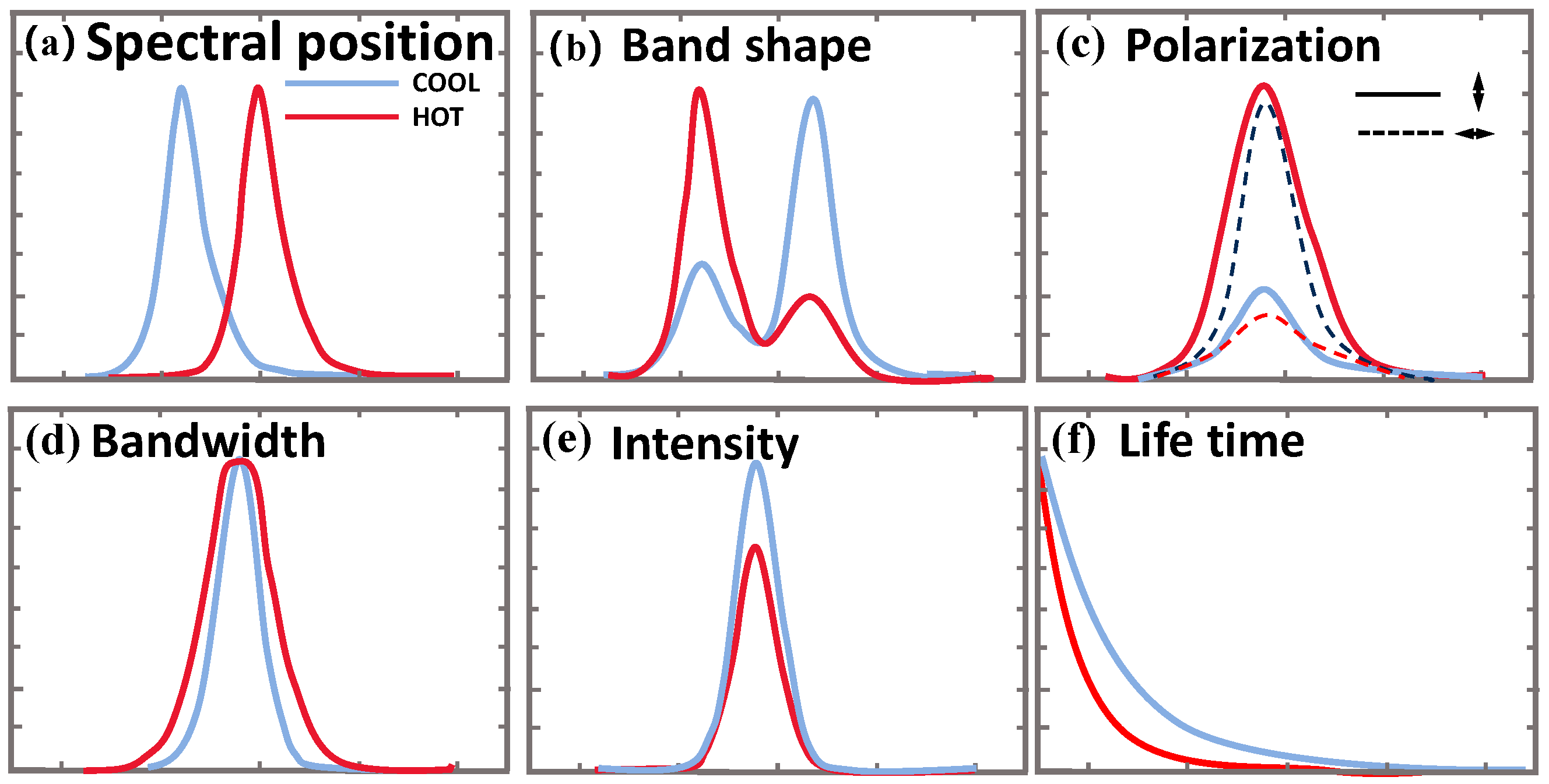
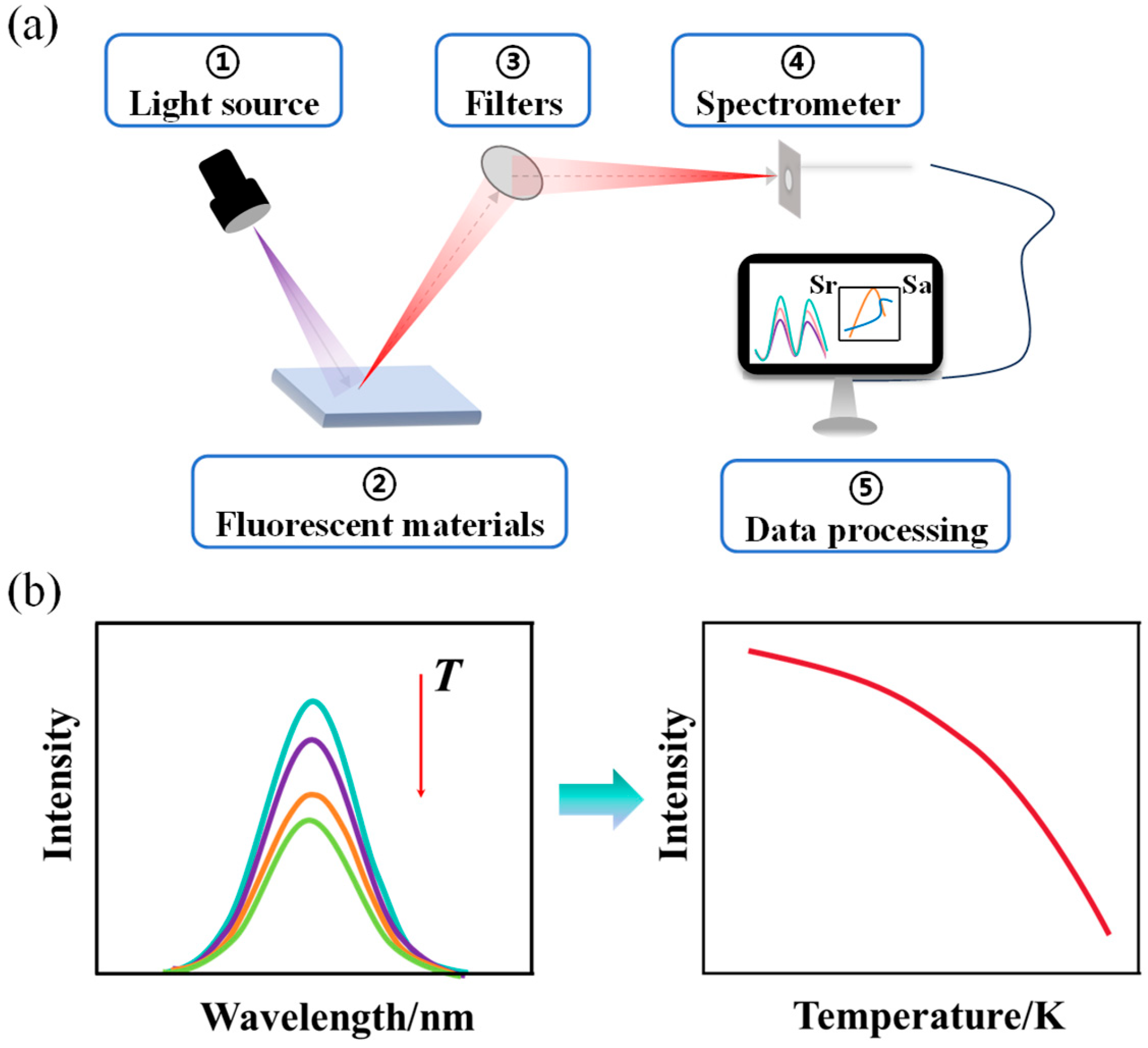
As shown in Figure 1 [22,27], the strong correlation between the optical performance of luminescent materials and temperature is mainly reflected in emission wavelength, peak shape (fluorescence intensity ratio), polarization anisotropy, bandwidth, single peak intensity, fluorescence lifetime, etc., depending on the trend of the luminescent performance of rare earth ion-doped materials over time to measure the environmental temperature. Figure 2a is a schematic diagram of temperature measurement based on the luminescence characteristics of rare earth, showing the principle of temperature measurement based on rare earth luminescence. Under the illumination of an excitation light source at a specific wavelength, rare earth ions are excited and emit characteristic fluorescence due to electron transitions. These fluorescence signals are captured by a fluorescence collection system, along with a filter component to eliminate the interference of background light sources, ensuring that the collected signal is solely the emission light of the rare earth ions. The emission light signal is transmitted to a spectrometer via a fluorescence detection system to obtain detailed information about the fluorescence, including key parameters such as luminescence intensity and fluorescence lifetime. Subsequently, these parameters are processed and analyzed by a data system to establish a quantitative relationship between fluorescence characteristics and temperature, and corresponding images are plotted. On this basis, further curve fitting and temperature calibration are carried out to accurately measure the temperature. In addition to rare earth ions, transition metal ions (e.g., Mn4+, Cr3+, Ti3+) and main group ions (e.g., Bi3+, Eu2+) have also gained rapid momentum in optical thermometry in recent years, owing to their high crystal field sensitivity, low cost, and simple preparation processes. Table 1 provides a detailed comparison of the key differences between rare earth ion- and transition metal ion-based thermometric materials, offering a clear reference for material selection.

2.2. Single-Energy-Level Luminescence Intensity Thermometry Technology

Single-level luminescence intensity thermometry is a straightforward and direct temperature measurement method, which is based on monitoring the variation of the intensity of a specific emission peak with temperature to reflect the temperature level. This approach can clearly reveal the quantitative relationship between the fluorescence intensity of the emission peak and temperature, as described by Equation (1) [28]:
I ( T ) = I 0 e x p ( E a K B T )
where I(T) is the luminescence intensity at temperature T; I0 is the luminescence intensity at a reference temperature; Ea is the activation energy, related to the energy level structure of rare earth ions; KB is the Boltzmann constant; and T is the absolute temperature. Generally, when the luminescence intensity and concentration are determined, the luminescence intensity is often most influenced by the energy transfer efficiency. The energy transfer efficiency, in turn, depends on the energy transfer efficiency between the host material and the rare earth luminescent centers, as well as the probability of non-radiative transitions of electrons. Notably, these parameters are constrained by temperature. The effect of temperature changes on the luminescence intensity of fluorescent materials exhibits non-monotonic characteristics, primarily due to two competing microscopic mechanisms. First, changes in temperature directly affect the coupling state between the luminescent centers and the host lattice field, thereby modulating phonon-involved physical processes and enhancing the energy transfer efficiency from the host to the luminescent centers. Second, as the temperature increases, lattice vibrations intensify, increasing the probability of non-radiative relaxation of excited rare earth ions, leading to a decline in luminescence intensity. Although both mechanisms influence luminescence intensity, their dependence on temperature differs, and their dominance varies across different temperature ranges. In the lower temperature range, the enhancement of energy transfer efficiency predominates, while in the higher temperature range, the increase in non-radiative transition probability becomes the dominant factor. Consequently, a distinct turning point emerges in the relationship between fluorescence intensity I and temperature T. When the temperature is below this point, the promoting effect of temperature on the energy transfer process outweighs the inhibitory effect of non-radiative transitions, causing the fluorescence intensity to increase with rising temperature. Beyond this point, the increased number of phonons and enhanced electron–phonon interactions lead to a significant rise in non-radiative transition probability, causing the fluorescence intensity to gradually decline until thermal quenching occurs. Based on this non-monotonic dependence, temperature monitoring can be achieved by observing changes in fluorescence intensity. Additionally, the selection of host materials and luminescent centers plays a crucial role in energy transfer efficiency and non-radiative transition probability. By combining and matching different host materials and luminescent centers, the competitive balance between the two mechanisms can be significantly altered, enabling the regulation of the temperature-sensitive properties of the material.
Zhang et al. [29] prepared SrB4O7:Tm2+ phosphor via the conventional high-temperature solid-state method and achieved temperature measurement based on the temperature dependence of the 4f125d → 4f13 (2F7/2) transition of Tm2+ ions. The material exhibited a temperature sensitivity Sr of 3.55% K−1, reaching its maximum at 363 K.
Figure 2b illustrates the principle diagram of single-energy-level luminescence intensity thermometry. When the temperature exceeds the turning point, the probability of non-radiative transitions within the rare earth ion luminescence centers becomes significant, surpassing the energy transfer between the host material and the luminescent centers. As the temperature continues to rise, typical thermal quenching occurs, leading to a decline in fluorescence intensity. Based on this variation, the temperature-dependent spectra corresponding to a single energy level can be obtained. By analyzing and fitting the acquired data, the relationship between luminescence intensity and temperature is derived, thereby enabling temperature determination based on the detected luminescence intensity.
Although single-energy-level luminescence intensity thermometry offers the advantage of a simple principle, it still exhibits several limitations in practical applications. Notably, it strongly depends on the excitation light intensity; even minor fluctuations in excitation light can directly affect the measurement results. Simultaneously, the generated fluorescence signal is susceptible to attenuation due to absorption and scattering, which, to some extent, reduces measurement accuracy. Furthermore, this method shows significant thermal quenching of fluorescence at high temperatures, resulting in markedly weakened signals and imposing high sensitivity requirements on detection equipment. Due to these factors, this technique faces application limitations in complex environments or scenarios requiring high precision, making it difficult to meet the diverse demands of contemporary optical device development.

2.3. Luminescence Intensity Ratio Thermometry Based on Thermally Coupled Energy Levels (TCLs)

2.3.1. Traditional Luminescence Intensity Ratio Thermometry Based on Thermally Coupled Levels

The traditional single-energy-level luminescence intensity thermometry faces significant challenges in practical applications due to various influencing factors such as environmental interference and material stability. In recent years, luminescence intensity ratio thermometry based on thermally coupled energy levels (TCLs) has been proposed and extensively studied [30,31]. This technique enables temperature measurement by monitoring the variation with temperature in the ratio of fluorescence intensities corresponding to transitions from two thermally coupled energy levels within the same luminescent center [32]. As early as 1976, Kusama et al. [33] first proposed the fluorescence intensity ratio (FIR) technique based on the Boltzmann distribution of thermally coupled energy levels (TCLs) for temperature detection. Figure 3 provides a schematic diagram illustrating the mechanism of TCL-based thermometry. In 1990, Berthou and colleagues [34] first observed thermally coupled energy level phenomena in Er3+ ions within an Er3+/Yb3+ co-doped fluoride system and conducted temperature sensing research based on this observation. With the growing interest in TCL-based FIR thermometry, researchers have identified several rare earth ions possessing thermally coupled energy levels suitable for FIR-based temperature measurement, including Eu3+, Er3+, Sm3+, Dy3+, Pr3+, Yb3+, Tm3+, and Ho3+. Notably, Yb3+ is frequently employed as a sensitizer due to its large absorption cross-section at 980 nm, enhancing the luminescence intensity of other rare earth ions such as Er3+, Nd3+, Tm3+, and Ho3+ [35]. Table 2 provides a detailed list of the common thermally coupled levels and their corresponding energy level spacings for the aforementioned rare earth ions.
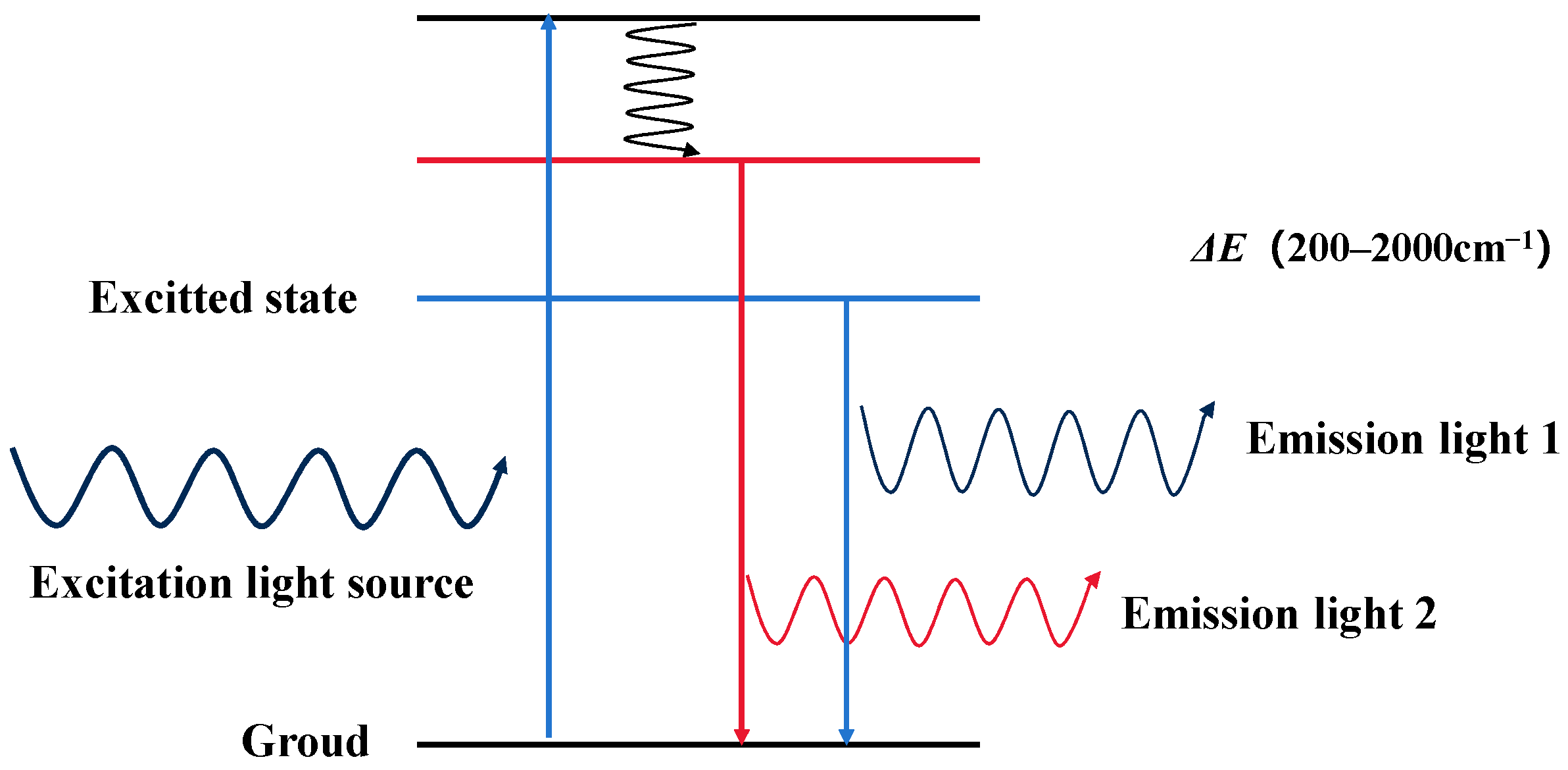
Generally, the energy level difference of thermally coupled energy level pairs is relatively small, typically in the range of 200–2000 cm−1 [33]. If the energy level spacing between TCLs is too small (<200 cm−1), it becomes difficult to separate the emission peaks from different energy levels. Conversely, if the spacing is too large (>2000 cm−1), low-temperature decoupling may occur [43,44,45]. As the temperature increases, electrons in the lower energy level are thermally excited to the higher energy level. The distribution of electrons between these two energy levels follows Boltzmann statistics. In this scenario, the electron population of the two levels can be inferred using the FIR of the TCLs, thereby enabling temperature calculation. Since the luminescence intensity of thermally coupled levels is proportional to the population, the FIR formula for TCLs can be expressed as follows [6,46,47]:
FIR   =   I 2 I 1 = N 2 N 1 = g 2 σ 20 ω 2 g 1 σ 10 ω 1 exp ( E k B T ) = A e x p ( E K B T )
I1, N1, g1, σ10, and ω1 represent the luminescence intensity, population, degeneracy, emission cross-section, and fluorescence transition angular frequency of the upper energy level (J = 2) and lower energy level (J = 1), respectively; A = g2σ20ω2/g1σ10ω1; ΔE is the energy difference between the thermally coupled levels; KB is the Boltzmann constant; and T is the absolute temperature. The formula indicates that the FIR increases monotonically with temperature, and for a given ΔE, the FIR depends solely on temperature. Therefore, temperature measurement can be achieved based on the FIR of thermally coupled levels. The thermally coupled level pair 2H11/24S3/2 of Er3+ (energy gap ΔE ≈ 800 cm−1), known for its high transition intensity and moderate energy spacing, has become a classic system for FIR-based optical thermometry.
Tong et al. [48] prepared Na2YMg2(VO4)3:Er3+/Yb3+ phosphors via a high-temperature solid-state method. Utilizing the fluorescence intensity ratio (FIR) behavior of the dual green emissions from the 2H11/2, 4S3/2, and 4F9/24I15/2 transitions, a relative sensitivity of 1.104% K−1 was achieved at 303 K. Meanwhile, the total green emission intensity surged by 254 times with increasing temperature, demonstrating excellent signal distinguishability.
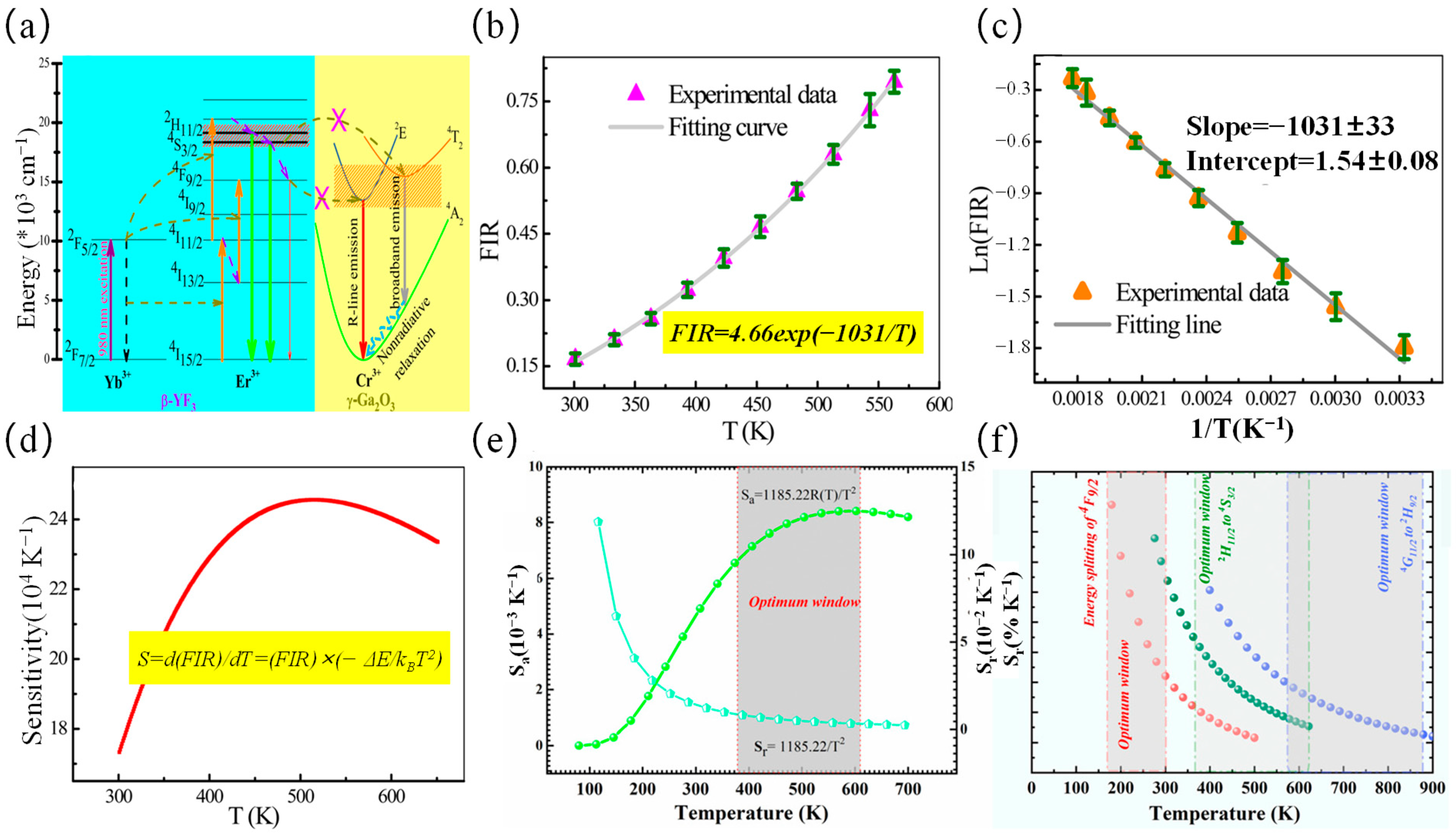
The team led by Chen [49] synthesized Yb3+/Er3+/Cr3+ co-doped aluminosilicate glass (SiO2–Al2O3–YF3–Ga2O3–NaF–LiF) using melt-quenching and crystallization techniques. Figure 4a illustrates the energy level distribution of Yb3+/Er3+ in the YF3 phase and Cr3+ in the Ga2O3 phase. The thermally coupled energy levels realize temperature measurement via fluorescence intensity ratio (FIR) and lifetime technology, respectively. Meanwhile, spatial isolation suppresses the detrimental energy transfer between ions. As shown in Figure 4b–d, by leveraging the thermally coupled characteristics of Er3+ and the H11/2/4S3/2 energy level thermometry, this glass achieves a maximum relative sensitivity of 0.25% K−1 at 514 K. It exhibits excellent high-temperature sensing performance and provides new insights for related research.
Furthermore, Rao et al. [50] introduced multiple sets of TCLs in the double perovskite CsNaInCl6:Er3+, including 2H11/2/4S3/2E ≈ 865 cm−1) and 4G11/2/2H9/2E ≈ 1160 cm−1). As shown in Figure 4e,f, this system achieved an extremely broad temperature measurement window from 100 to 880 K, with Sr values consistently above 0.3% K−1 throughout the entire range. This work not only verified the role of energy level engineering in expanding the temperature measurement range but also provided new ideas for multi-mode optical thermometry in extreme environments.
The team led by Gao [51] successfully achieved co-doping of Er3+/Yb3+ in CaLaAl3O7. Utilizing the FIR effect of the 2H11/2/4S3/2 energy levels, a maximum sensitivity of 0.00345 K−1 was attained at 453 K.
In addition to Er3+-based oxide thermometric materials, Eu3+/Tb3+ dual-emission systems also demonstrate outstanding ratiometric thermometric performance in molecular-based materials. Yin et al. [52] fabricated thermally stable metal–organic complexes using Brønsted acidic ionic liquids as functional ligands. Utilizing the thermally coupled energy level response of Eu3+/Tb3+, the system achieved a maximum relative sensitivity of 3.29% K−1 in the physiological to moderate high-temperature range (303–403 K), accompanied by color changes visible to the naked eye. This provides a new molecular-based material platform for high-sensitivity visual thermometry in mild temperature regions.
Current research on temperature measurement technology based on the luminescence intensity ratio of thermally coupled energy levels has been extensively conducted, covering not only various rare earth ions but also extending to different types of host materials. A brief summary of selected ions is provided in this paper, as shown in Table 3. In summary, through a synergistic strategy of host selection, energy level design, and process optimization, the Er3+ 2H11/2/4S3/2 system continues to set new records in key indicators such as sensitivity, linearity, and temperature measurement range. This lays a solid material foundation for non-contact temperature monitoring in biological in vivo applications, micro-/nano-electronic devices, and high-temperature extreme scenarios.

2.3.2. Advanced Level Engineering

Beyond conventional thermally coupled levels (TCLs) and non-thermally coupled levels (NTCLs), advanced level engineering has emerged as a core strategy to break the traditional sensitivity limit (Sr ≤ ΔEeff/(kBT2)) and significantly improve thermometric performance. This approach precisely manipulates the energy level structure of rare earth ions via crystal field modulation, host engineering, and ion doping, enabling novel thermometric pathways with enhanced sensitivity, extended temperature ranges, and improved signal discriminability. Stark sublevel engineering leverages crystal field-induced splitting of 4f levels, enabling high sensitivity from subtle temperature-dependent population redistribution [63,64]. Three-level cascaded transitions construct sequential energy transfer pathways, improving sensitivity while suppressing excitation power dependence [65]. Rational regulation of energy gaps via host design and co-doping further optimizes thermometric performance.
For instance, Ding et al. [66] demonstrated that the fine splitting of Er3+ energy levels into multiple Stark sublevels enables ultrasensitive thermometry in β-NaYF4:Yb3+/Er3+@NaGdF4 core–shell nanoparticles. By constructing luminescence intensity ratios from thermally coupled Stark sublevels (2H11/2(1)(2) and 4S3/2(1)(2)(3)), the maximum relative sensitivity was enhanced from 10.9 × 10⁻³ K−1 (conventional LIR) to 17.8 × 10⁻³ K−1 (Stark-LIR), highlighting the great potential of Stark-level engineering for high-sensitivity optical thermometry.
Furthermore, Xiang et al. [65] proposed a novel three-level thermometry strategy based on the Er3+:4F7/2/2H11/2/4S3/2 system in YNbO4:Yb3+/Er3+ phosphors. Benefiting from the large energy gap (~2000 cm−1) between 4F7/2 and 4S3/2, and the intermediate 2H11/2 level that effectively suppresses thermal decoupling, an ultra-high relative sensitivity of 2.67% K−1 was achieved, which is significantly superior to most conventional TCL-based thermometers.
In addition, customized energy gap regulation via host lattice design and co-doping further optimizes thermometric performance. By tuning the crystal field strength, phonon energy, and local coordination environment, the energy difference between coupled levels can be precisely controlled within the optimal range (typically 500–2000 cm−1), balancing high sensitivity and good signal separation. Combined with defect engineering and energy transfer modulation, advanced-level engineering not only addresses the limitations of traditional thermometric mechanisms but also provides a solid theoretical basis for the development of next-generation high-performance rare earth luminescence thermometers.

2.4. Luminescence Intensity Ratio Thermometry Technology Based on Non-Thermally Coupled Levels

Generally, a smaller ΔE may cause significant overlap between the two emission peaks, while a larger ΔE can lead to an insufficient population of electrons in the higher-energy state within a given temperature range, resulting in decoupling [43,44,45]. Theoretically, the relative sensitivity Sr is proportional to ΔE, meaning that a larger energy level spacing generally leads to better temperature sensing performance. However, in practice, due to the constraints of ΔE between TCLs, improving relative sensitivity becomes a contradictory issue. Compared to the FIR technique based on TCLs, the FIR technique based on non-thermally coupled levels (NTCLs) is no longer limited by the energy gap, enabling high signal discriminability, as emission peaks can be chosen from distinct spectral regions. NTCLs feature dual-emission centers, and the luminescence from these two centers exhibits different temperature-dependent behaviors, allowing the construction of a non-coupled energy level thermometric model [67]. Although the physical mechanism behind it has not yet been fully clarified, this model scheme has been experimentally verified and widely adopted for temperature detection. The following formula can be approximately used for fitting [46]:
FIR   =   A exp B T + C
Since 2021, to overcome the limitations of traditional thermally coupled level (TCL) thermometry in terms of sensitivity or temperature range, researchers have turned their attention to “non-TCL” strategies involving dual-emission centers or multi-center synergy. Nozha Ben Amar et al. [68] synthesized Y2Mo3O12:2% Pr3+/15% Yb3+ nanostructures using the sol–gel method. By employing the emissions of Pr3+ (3P03F2, 705 nm) and Yb3+ (2F5/22F7/2, 980 nm) as non-coupled channels for temperature sensing, this system achieved a maximum relative sensitivity of 2.00% K−1 over the temperature range of 298–648 K, significantly surpassing most TCL-based materials in the same temperature interval.
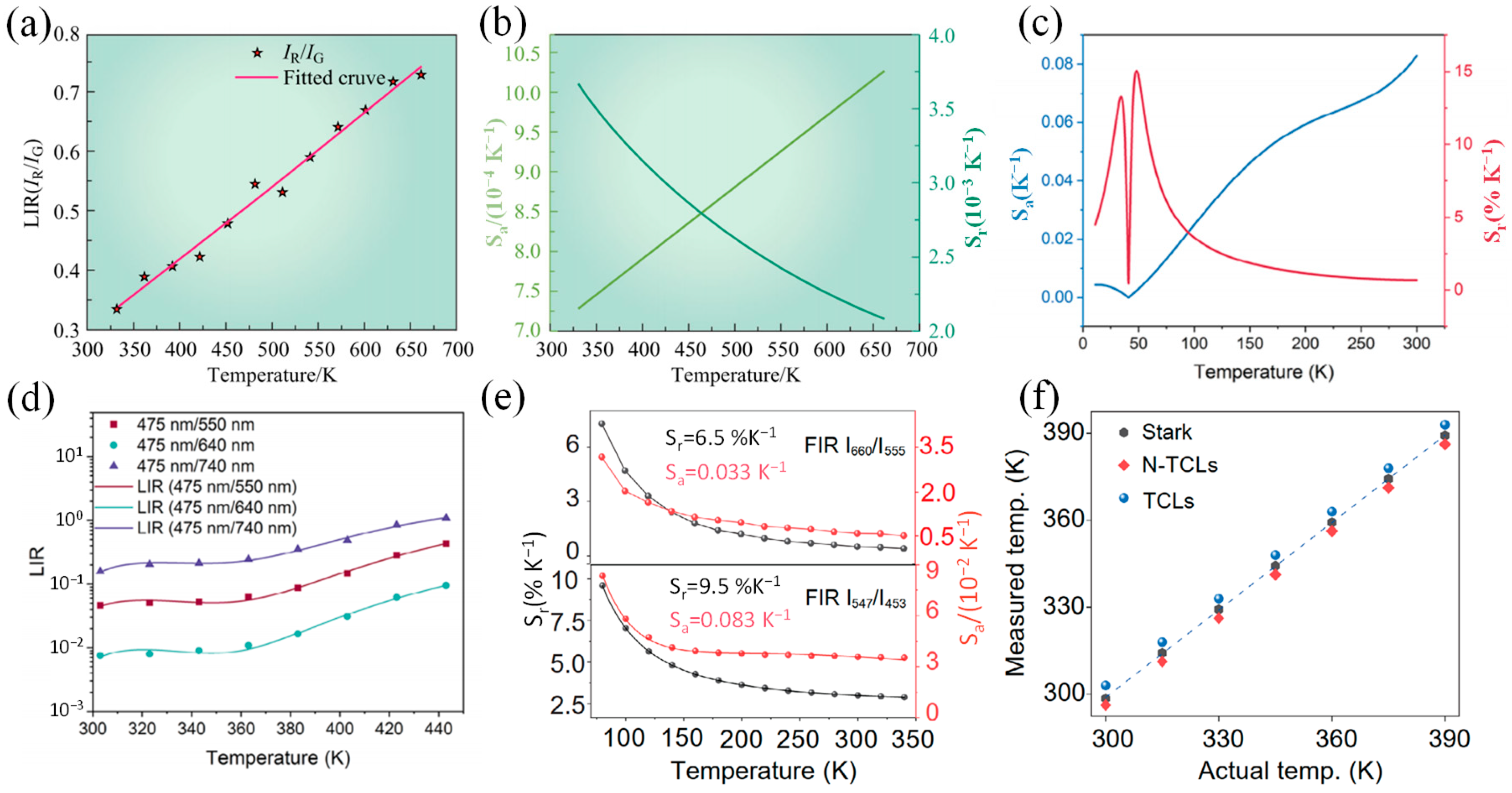
The team led by Ding [69] prepared Yb3+/Ho3+ co-doped GYTO single crystals via the Czochralski method and realized temperature sensing based on the fluorescence intensity ratio of non-thermally coupled levels of Ho3+. As shown in Figure 5a,b, the crystal exhibits two-photon upconversion luminescence under 980 nm excitation, reaching a maximum relative sensitivity of 0.0037 K−1 within the range of 330–660 K, which outperforms most phosphor-based matrices and demonstrates promising prospects for optical thermometry.
Zhou et al. [70] constructed LiYF4:Ho@LiYF4:Yb@LiYF4 nanoparticles with a multilayer core–shell structure. By spatially separating the sensitizer Yb3+ and the activator Ho3+, they suppressed back-energy transfer and enhanced upconversion luminescence through interfacial energy transfer. As illustrated in Figure 5c,d, this system achieved red-to-green ratio thermometry based on non-thermally coupled levels of Ho3+, attaining a relative sensitivity of 15.1% K−1 at 50 K. Furthermore, the introduction of a Tm3+ shell extended the temperature measurement range to 443 K.
Zhang et al. [71] constructed Nd3+-based double perovskite Cs2NaNdCl6 co-doped with Tm3+, Er3+, and Yb3+. Benefiting from its large unit cell and low phonon energy, concentration quenching under high doping levels was effectively suppressed. As shown in Figure 5e,f, the material realized multi-mode fluorescence intensity ratio thermometry on non-thermally coupled levels (e.g., I560/I555 and I547/I455), achieving a maximum relative sensitivity of 9.5% K−1 in the range of 80–340 K, demonstrating significant advantages for wide-range, high-sensitivity optical temperature sensing.
For non-thermally coupled level thermometry, Zhang et al. [72] effectively enhanced the upconversion luminescence efficiency of YOF:Er/Tm/Yb nanocrystals by doping with metal ions, such as K+, and markedly improved their non-thermally coupled level fluorescence intensity ratio thermometric performance. When the K+ doping concentration reached 40 mol%, the material exhibited an absolute sensitivity of 116.41 × 10⁻³ K−1 under the NTCL strategy—more than ten times higher than that achieved with the thermal-coupling strategy—highlighting its superior sensitivity and application potential in the field of non-contact optical thermometry.
In line with the development of non-thermally coupled level thermometry in coordination systems, Zhernakov et al. [73] systematically explored Dy3+/Eu3+ and Tb3+/Sm3+ dual-center coordination compounds as novel thermometric platforms. Benefiting from the favorable energy level structure of these new ion pairs, the materials achieved a maximum relative sensitivity of 4.11% K−1 within the 253–353 K range. This work provides new, high-performance alternatives to conventional Tb3+/Eu3+ systems, advancing the development of molecular-based luminescence thermometers.
In addition to inorganic hosts, molecular and coordination compounds represent another major and indispensable category for lanthanide luminescent thermometers, especially owing to their structural tunability, easy functionalization, and favorable biocompatibility. A representative summary of the optical thermometric parameters for typical molecular-/coordination-based lanthanide thermometers operating via the non-thermally coupled intensity ratio (NFIR) mechanism is presented in Table 4.

2.5. Luminescence Temperature Sensitivity Parameters: Sa, Sr, and δT

The performance of temperature sensing devices is typically characterized by absolute sensitivity (Sa), relative sensitivity (Sr), and temperature resolution (δT). The formula for absolute sensitivity is given below [80]:
S a = dLIR d T
Sa is defined as the absolute change in the measured LIR per 1 K change in temperature, with units of K−1. It can be used to compare the performance of temperature sensors based on the same measurement principle. For temperature sensing devices employing different measurement principles, relative sensitivity is generally used for comparison. It is defined as the relative change in the measured LIR per 1 K change in temperature, with units of % K−1. Its formula is shown below [32]:
S r = 1 LIR dLIR d T
Furthermore, temperature resolution (δT) indicates the minimum detectable temperature change by the temperature sensor, with units of K.
δ T = 1 S r dLIR LIR
In this formula, δLIR/LIR represents the relative uncertainty of the LIR, which is primarily influenced by the detection setup and the luminescent material. The signal-to-noise ratio of the detector and the luminescence efficiency of the material are key factors affecting the δT value. In addition, the stability of the sample and the data acquisition conditions can also introduce errors into δLIR/LIR. Therefore, achieving an excellent δT value relies mainly on relative sensitivity (Sr value), optimal measurement conditions, and high-efficiency luminescent performance of the material.
However, it is crucial to clarify that the relative uncertainty δLIR/LIR (and consequently δT) is not merely determined by the detector’s SNR, excitation stability, or material photostability. Recent explicit error propagation models demonstrate that δLIR/LIR is often heavily dominated by systematic spectral and environmental artifacts, which are frequently overlooked in idealized descriptions of thermometric performance. These effects introduce temperature-independent biases that severely degrade the accuracy and reproducibility of luminescence thermometry, even when high-sensitivity materials and optimized instruments are used.
For instance, Rafael Vieira Perrella et al. [81] demonstrated that background superposition between the host matrix’s broad emission and rare earth signals severely distorts the measured LIR in YVO4:Eu3+ systems. Uncorrected overlap with the VO43- host emission inflated temperature uncertainties by nearly an order of magnitude and underestimated relative sensitivity by more than 60%, revealing that matrix luminescence is a critical yet often ignored source of error.
High-power excitation artifacts present another major challenge, as shown by Allison R. Pessoa et al. [82] in single-particle upconversion studies of Y2O3:Yb3+/Er3+. Under high irradiance, higher-order non-thermally coupled upconversion bands spectrally overlap with thermally coupled levels, introducing significant power-dependent readout uncertainties that cannot be eliminated by simple improvements in detector SNR.
Furthermore, photonic environmental artifacts were systematically investigated by Freddy T. Rabouw et al. [83] in NaYF4:Er3+ and Ho3+ systems. They found that modulation of the local density of optical states (LDOS) by scattering or reflecting interfaces can distort emission spectra independent of the thermometer’s intrinsic properties, leading to massive ratiometric readout errors of up to hundreds of degrees.
These examples collectively illustrate that achieving reliable, high-precision luminescence thermometry requires not only high-performance materials and instrumentation but also rigorous consideration of systematic artifacts. Moving forward, the development of robust correction strategies—including advanced spectral deconvolution, power-dependent calibration protocols, and environmentally insensitive ratiometric designs—will be essential to translate laboratory demonstrations into practical, real-world applications. Addressing these challenges will be key to unlocking the full potential of luminescence thermometry in complex biological, industrial, and photonic environments.

2.6. Multi-Modal Collaborative and Self-Calibrating Thermometry Strategies

To overcome the limitations of single-modal FIR thermometry, multi-modal and self-calibrating strategies have been widely explored. Integrating FIR with luminescence lifetime measurements eliminates excitation power dependence and concentration interference. Time-gated detection effectively rejects autofluorescence in biological media, enabling deep tissue thermometry. Additionally, combining photoluminescence with Raman scattering or colorimetric analysis broadens the temperature range and improves sensitivity, while NIR-II window emission further enhances biocompatibility and detection depth. Table 5 presents a comparison of key temperature measurement methods.

2.6.1. Fluorescence Lifetime Thermometry

Luminescence lifetime (τ) of RE3+ ions is intrinsically immune to concentration fluctuations, scattering, and excitation power variations, making it a robust self-calibrating readout [84]. The temperature dependence of (τ) arises from enhanced non-radiative decay at higher temperatures.
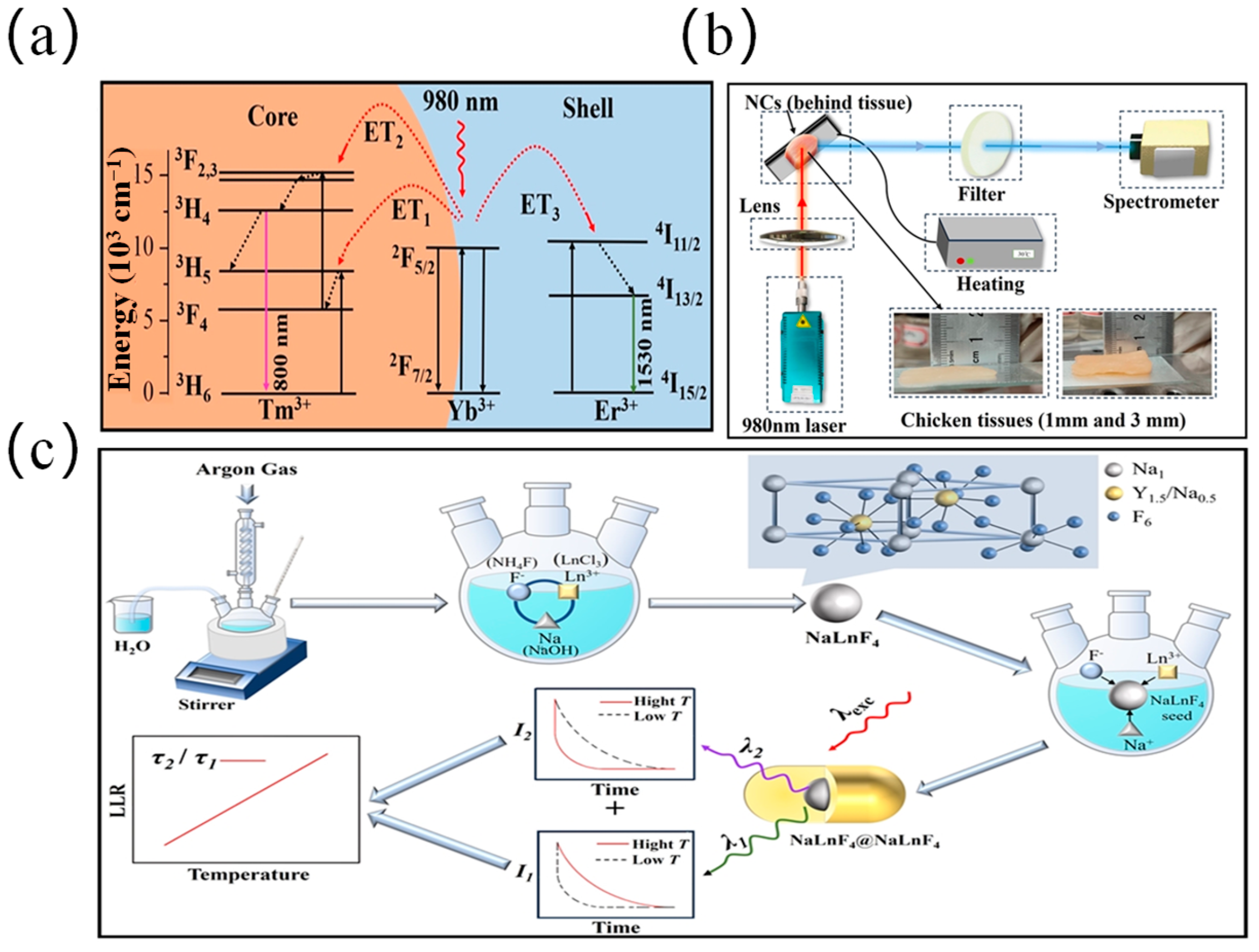
A representative example is the Er3+/Tm3+ co-doped NaYF4 core–shell nanoparticle system reported by Raza et al. [85], where a luminescence lifetime ratio (LLR) strategy was proposed to further boost performance in biological media. As shown in Figure 6a, unlike conventional single-lifetime thermometry, this approach leverages the opposite temperature responses of Tm3+ (800 nm emission, decreasing lifetime with temperature) and Er3+ (1530 nm emission, increasing lifetime with temperature) within the biological window, yielding a high relative sensitivity of 0.36% K−1. Notably, using the thermometric method and experimental results presented in Figure 6b,c, the LLR method maintained stable calibration curves in ex vivo experiments with 1–3 mm thick chicken tissue, whereas the traditional luminescence intensity ratio (LIR) method suffered severe signal distortion and measurement drift, demonstrating the superior anti-interference capability of lifetime-based readouts in complex biological environments.

2.6.2. Multi-Modal Synergistic Thermometry

Multi-modal synergistic thermometry integrates multiple optical parameters, such as luminescence intensity, lifetime, and Raman scattering, to overcome the limitations of single-mode thermometry. This strategy effectively mitigates environmental interference, extends the temperature sensing range, and significantly enhances detection sensitivity by combining the complementary advantages of different readout mechanisms [86].
A typical example is the Raman–photoluminescence intensity ratio (RPIR) method proposed by De et al. [87], which synergistically uses the temperature-dependent responses of photoluminescence and Raman signals in Eu3+-doped BaTiO3 phosphors. The PL intensity decreases with temperature, while the Raman intensity increases, forming a highly sensitive RPIR parameter. This system achieves an ultra-high relative sensitivity of 2.4% K−1 at room temperature and maintains excellent performance over a wide temperature range from 10 K to 573 K, demonstrating the great potential of multi-modal strategies for high-precision optical thermometry.

2.6.3. Time-Gated Detection for Biological Applications

Time-gated detection suppresses autofluorescence from biological tissues by collecting RE3+ luminescence (long lifetime, µs–ms) after a delay, rejecting short-lived autofluorescence (ns). This technique enables precise deep tissue thermometry (>5 mm) in vivo, as it effectively isolates the probe signal from background noise that plagues conventional steady-state measurements.
A representative demonstration of this advantage was reported by Kurahashi et al. [88], who integrated time-gated imaging with lifetime-based thermometry using Nd3+/Yb3+ co-doped β-NaYF4 nanoparticles. By applying time-gated detection, they successfully eliminated tissue autofluorescence and achieved clear, high-contrast temperature mapping in deep biological tissues, validating the critical role of this technique in enabling robust, high-precision in vivo optical thermometry.
In summary, multi-modal collaborative and self-calibrating strategies significantly enhance the reliability and practicality of rare earth luminescence thermometry, addressing key issues such as susceptibility to environmental interference and lack of self-calibration capability in single-modal thermometry. In the future, by further integrating emerging mechanisms, such as NIR-II/NIR-III band luminescence, defect energy levels, and charge transfer bands, and combining artificial intelligence algorithms to optimize multi-parameter data processing, it is expected to construct a rare earth luminescence thermometry system with higher precision, better stability, and closer alignment with practical application scenarios, providing new technical support for biomedical applications, high-temperature aerospace environments, and micro-/nano-device thermal management.

2.7. Emerging Mechanisms: Defects and Charge Transfer

2.7.1. Defect Energy Levels

Beyond the conventional thermally coupled level (TCL) strategy, defect-related luminescence has emerged as a novel and promising mechanism for optical thermometry. Defects such as oxygen vacancies, interstitial ions, or surface traps often exhibit distinct thermal quenching behavior compared to lanthanide f–f transitions [89]. By combining defect emission with lanthanide luminescence, self-calibrated ratiometric thermometers can be constructed, offering high sensitivity and anti-interference capability against excitation power fluctuations and environmental noise.
For instance, Drabik et al. [90] demonstrated this concept in Tb3+-doped Y2O3 and Lu2O3 nanocrystals, where defect-related luminescence and Tb3+ f–f transitions exhibited opposite thermal quenching behaviors. By combining these two signals, they constructed a self-calibrated ratiometric thermometer with a high relative sensitivity of up to 4.92% K−1, effectively eliminating interference from excitation power fluctuations.

2.7.2. Charge Transfer Bands (CTBs)

Charge transfer bands (CTBs), including ligand-to-metal charge transfer (LMCT) and metal-to-metal charge transfer (MMCT), represent another emerging pathway for luminescence thermometry. Unlike lanthanide f–f transitions, which are typically weakly dependent on temperature, CTBs often show strong and even anomalous thermal quenching responses. By leveraging the opposite or complementary temperature dependencies between CTB and f–f emission, highly sensitive ratiometric thermometers can be realized, breaking the sensitivity bottleneck of traditional TCL-based methods [91].
For example, Zhou et al. [92] developed an optical thermometer by exploiting the abnormal thermal quenching of LMCT bands in rare earth-doped phosphors. The LMCT band showed a remarkable thermal enhancement with increasing temperature, while the Eu3+/Nd3+ f–f emissions underwent conventional thermal quenching. By establishing the intensity ratio of CTB to f–f transition, an ultra-high relative sensitivity was achieved, breaking the limitation of traditional thermally coupled level-based sensors.
Overall, defect- and CTB-based luminescence thermometry offer complementary advantages: defect levels provide robust anti-interference performance, while CTBs enable ultra-high sensitivity. Both mechanisms advance the development of next-generation optical temperature sensors beyond conventional TCL strategies.

3. Applications of Multi-Rare Earth Luminescence Intensity Thermometry Technology

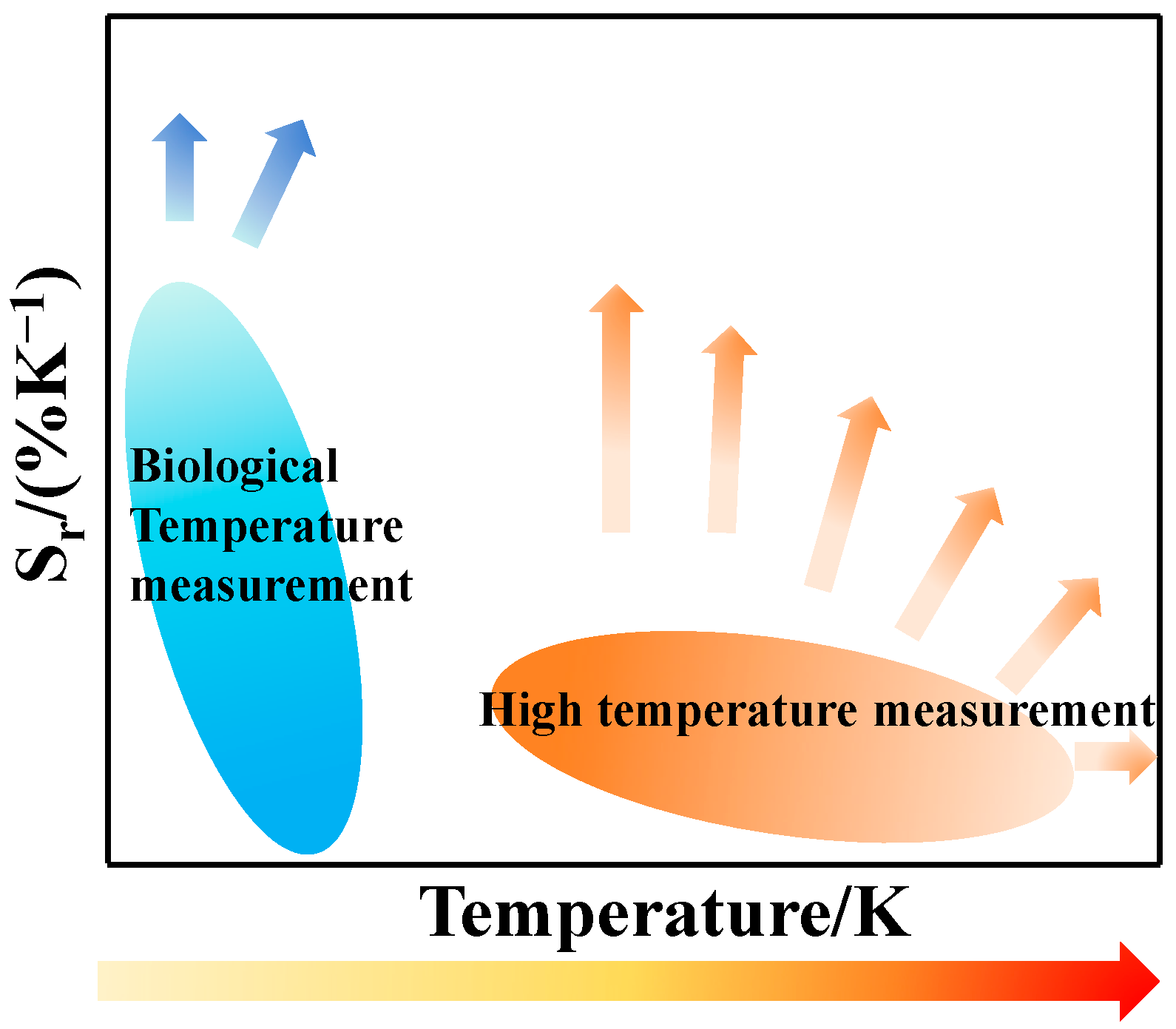
The primary applications of rare earth luminescence intensity thermometry are concentrated in two key temperature domains: the physiological temperature range (approximately 298–350 K) and ultra-high-temperature environments (usually above 900 K). These two fields impose distinctly different requirements on the temperature sensing performance of materials.
In contrast, for ultra-high-temperature thermometry, the foremost and most stringent requirement is that the material itself can withstand extremely high-temperature environments while maintaining stable luminescence performance. For example, fluorescent temperature-sensitive coatings applied to aerospace engines often need to operate above 1000 K. This demands that the material not only possesses excellent thermal stability but also maintains a sufficiently strong luminescence intensity at elevated temperatures, posing a dual challenge for material design.
In summary, the practical application of this technology clearly leads to differentiated material performance requirements. Future research urgently needs to take these specific application needs as the fundamental starting point for targeted material design and development, thereby promoting the translation of scientific value into practical significance. Figure 7 summarizes the core requirements for temperature measurement performance in the two temperature intervals mentioned above.

3.1. Temperature Imaging and Localization in Microenvironments of Biological Tissues

Temperature plays a fundamental regulatory role in biomedical processes. It not only profoundly modulates the metabolic rate and gene expression patterns of organisms, but even minor fluctuations can trigger significant changes in physiological functions. Clinically, an increase in body temperature is often regarded as a key biomarker of infection, inflammation, and various diseases [93]. Therefore, developing precise and sensitive temperature monitoring technology holds important practical significance for early disease warning and health management.
In recent years, with advancements in nanomaterials and micro-/nano-fabrication technologies, researchers have been dedicated to developing functional temperature sensing units at the micrometer or nanometer scale. Such thermometers typically leverage the dependence of optical responses—such as variations in fluorescence intensity, luminescence lifetime, or spectral shift—on temperature to accomplish non-contact temperature measurement in microenvironments [94]. Related technologies are continuously expanding toward high spatial resolution, real-time monitoring, and biocompatibility, providing innovative tools for cutting-edge applications such as in vivo cell thermometry and tumor hyperthermia monitoring.
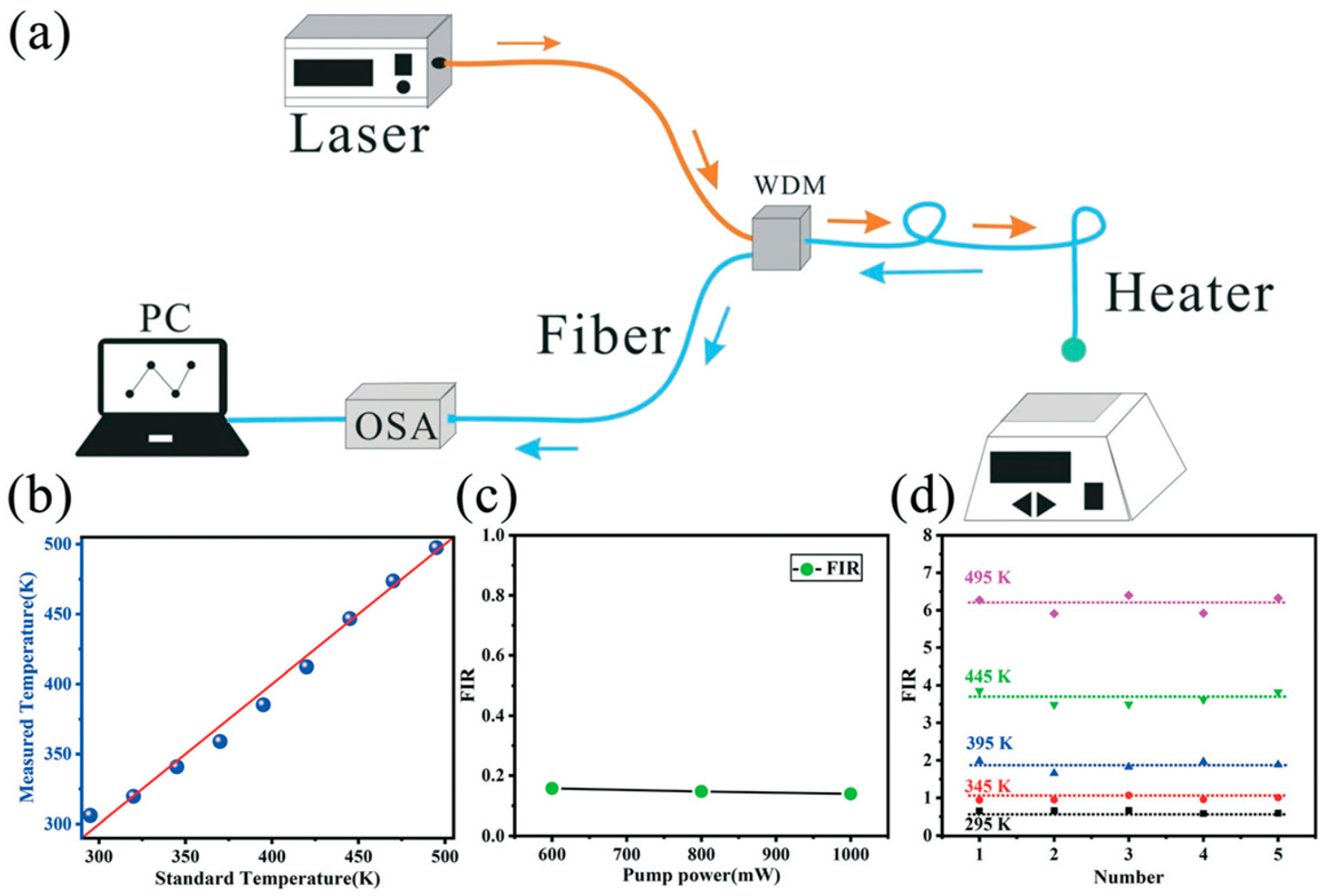
In 2022, Meng et al. [95] successfully prepared core–shell structured nanoprobes NaYF4:Yb3+/Tm3+@NaYF4:Yb3+/Er3+. Under 980 nm excitation within the biological window, the upconversion luminescence of these probes exhibited a penetration depth exceeding 3 cm. Based on the Tm3+ 700/646 nm energy level pair, a relative sensitivity Sr of 2.155% K−1 was achieved, with a resolution δT lower than 0.0139 K. Figure 8 demonstrates the potential of this sample for in vivo temperature measurement via fiber-optic sensors.
Pratikshya Parajuli et al. [96] fabricated multilayer PDMS-La2O2S:Eu3+ phosphor composite films using spin-coating technology, enabling temperature sensing from −40 to 75 °C. The films exhibit excellent thermal responsiveness, mechanical flexibility, tunable thermal conductivity, and biocompatibility.
Tian et al. [97] employed the Sc2(MoO4)3 matrix, which exhibits low phonon energy and excellent chemical stability. Through tri-doping with Nd3+/Yb3+/Er3+ and excitation by an 808 nm laser, localized heating with low tissue damage was achieved. In this system, the 4I13/24I15/2 transition of Er3+ produces an emission at 1538 nm, located within the NIR-II window. As the temperature increased from 303 K to 403 K, the emission intensity was enhanced by approximately 127.5 times, while the lifetime extended from tens of microseconds to 204 μs. The temperature sensing sensitivity Sr based on the lifetime temperature dependence reached as high as 6.03% K−1 at 323 K, significantly surpassing most rare earth-doped systems. Furthermore, by utilizing a hygroscopicity control strategy of Nd3+, the doping concentration could be precisely regulated to further balance excitation efficiency and thermal response, offering a new material platform for real-time, non-invasive temperature mapping of living tissues.
Building on these advances in NIR-II luminescence thermometry, recent research has further expanded into the NIR-III biological window (1500–1850 nm), where drastically reduced light scattering and tissue absorption enable deep tissue temperature measurements beyond 5 mm. This spectral range is particularly attractive for in vivo applications, as it minimizes photodamage and improves the signal-to-noise ratio, opening new avenues for high-performance, non-invasive temperature sensing in living systems [98].
Specifically, Mengmeng Dai et al. [99] reported that, benefiting from the prominent negative thermal expansion of ScF3 nanocrystals in the Yb3+–Ho3+–Tm3+ co-doped system, excitation energy is efficiently guided to the target emitting states, enabling intense NIR-III emission at ~1625 nm (Tm3+: 3F43H6). This work first unlocked the high-performance NIR-III luminescence thermometry based on the ScF3 host, which significantly expands the detection range into the deep near-infrared region, provides a low-background and deep tissue sensing channel for biological applications, and lays a solid foundation for developing multi-modal ratiometric nanothermometers with ultra-high sensitivity.
Collectively, biological luminescence thermometry has advanced significantly toward deeper tissue penetration, shifting focus from conventional optical windows to NIR-II and NIR-III bands. However, several key challenges remain to be addressed. Improving luminescence quantum yields in longer-wavelength regions, validating the long-term biocompatibility of nano-scale probes for in vivo use and developing high-sensitivity, real-time imaging systems compatible with deep tissue measurement. Looking ahead, future work should prioritize optimizing host matrices and energy transfer pathways to enhance signal brightness, conducting systematic safety evaluations, and integrating advanced optical detection techniques to translate these technologies into reliable tools for biological and clinical applications.

3.2. Thermal Management and Non-Contact Monitoring in High-Temperature Aerospace Environments

In extreme environments, such as high temperatures and strong radiation, the performance requirements for temperature sensing materials become exceptionally stringent. These materials must not only withstand extremely high temperatures but also possess excellent radiation resistance to maintain stable and accurate temperature measurement functions under complex working conditions. Identifying materials with outstanding chemical stability, thermal stability, and radiation resistance has become an ideal solution to meet these demanding needs.
Mikołaj Łukaszewicz et al. [100] synthesized Y2O3:Er3+ and Yb3+ with an extremely wide temperature range via the nitrate decomposition method. By utilizing the 2H11/2/4S3/2 TCL-FIR mode of Er3+, temperature sensing was achieved over 175–1100 K. Combined with the intrinsic thermal radiation signal of the matrix, the monitoring range was further extended to 1300–2100 K, enabling continuous temperature detection from 400 to 2100 K. The FIR sensitivity reached 1.4% K−1 at 300 K, making this material an ideal candidate for real-time temperature mapping of aerospace thermal protection layers.
Wang [101] discovered that KGaGeO4:Yb/Nd exhibits an anomalous negative thermal quenching phenomenon (intensity increased by 102–103 times) within the temperature range of 298–653 K, with a thermoluminescence sensitivity (Sr) as high as 4.7% K−1, making it suitable for extreme temperature environments.
Li et al. [102] reported SrGdLiTeO6:Mn4+/Tb3+ phosphors as thermal quenching warning materials. By leveraging the intrinsic difference between the easily quenched red emission of Mn4+ and the stable green emission of Tb3+, the material exhibits a visually distinguishable red-to-green color change warning above 500 K. Simultaneously, dual-mode thermometry combining FIR and lifetime achieved an Sr value of 1.88% K−1 at 573 K, realizing an integrated system of “visual warning + quantitative temperature measurement.” This provides a simple and reliable optical label for safety monitoring in high-temperature work environments.
Overall, these examples demonstrate three key advances in high-temperature aerospace luminescence thermometry: ultra-wide-range temperature monitoring, negative thermal quenching (NTQ) materials, and dual-mode integrated sensing. However, critical challenges remain, including maintaining long-term stability under combined high-temperature and radiation conditions, balancing ultra-high sensitivity with anti-interference performance, and scaling these lab-level materials into practical, deployable aerospace monitoring systems.

3.3. Exploration of Applications in Optoelectronic Systems and Micro-/Nano-Device Integration

As devices such as chips and micro-LEDs progressively advance toward sub-millimeter or even micrometer scales, traditional thermocouples or infrared thermal imagers can no longer simultaneously meet the demands for spatial resolution, response speed, and system compatibility. Luminescent thermometric materials, owing to their capabilities of being fabricated into thin films, patterned, and read out in multiple modes, are gradually becoming core candidate solutions for micro-/nano-scale thermal management and the integration of functional optoelectronic systems.
Chen et al. [103] synthesized Sr9In(PO4)7:Yb3+/Er3+ phosphors, which exhibit high-color-purity green emission (>90%). Upon temperature increase, the green emission continuously shifts toward blue-green, a change discernible to the naked eye. The research team directly inkjet-printed these phosphors into dynamic QR codes, achieving both FIR-based temperature measurement over 298–473 K (Sr = 1.13% K−1) and imparting an anti-counterfeiting feature of temperature-dependent color change to the product. This provides an integrated label with “one-print, dual-function” capability for cold chain logistics and high-end electronic products.
Mikhail A. Kurochkin [104] synthesized nano-sized Gd2O3:Tb3+/Eu3+ dual-center phosphors via the Pechini foam method, successfully realizing remote temperature measurement of micro-electronic components in the range of 303.15–363.15 K and verifying their application on resistors and microcontrollers.
Xia et al. [105] synthesized SrLaLiTeO6:Eu3+ phosphors by a high-temperature solid-state method. Based on a dual-excitation single-emission-band ratio (SBR) strategy, they achieved both temperature measurement and latent fingerprint development, capable of resolving Level I–III details.
Chen et al. [106] synthesized Cs2NaErCl6:Yb3+ via a solvothermal method and fabricated flexible films using PDMS, developing a self-calibrating triple-mode optical thermometer (TCLs/NTCLs/luminescence lifetime) with a thermal resolution of 0.07 K, suitable for precise monitoring of hotspots in electronic components.
Wang et al. [107] synthesized KBT:Er/In transparent ceramics using the conventional high-temperature solid-state method. These ceramics maintain an ultra-high sensitivity of Sr = 8.73% K−1 even in the low-temperature region (<200 K). Simultaneously, Er/In co-doping induced photochromic centers, enabling reversible modulation of luminescence intensity by 76.59% under 405 nm laser irradiation, which can be used for rewritable optical storage. The ceramics themselves can be co-sintered with silicon-based optoelectronic arrays, providing an on-chip integrated solution of “temperature sensing—storage” for scenarios such as deep space exploration and low-temperature packaging of quantum devices.
T. H. Q. Vu et al. [108] prepared Ba2MgWO6:Er3+ phosphors via a co-precipitation method. Owing to their high sensitivity at low temperatures (Sr = 2.78% K−1 @ 198 K) and low-temperature uncertainty (δT < 0.1 K), these phosphors have been verified as suitable for non-contact temperature measurement applications in low-temperature micro-/nano-devices.
In summary, luminescent thermometric materials have evolved from “laboratory spectroscopic tools” into “integratable, programmable, and multifunctional” micro-/nano-photonic components. Through thin-film fabrication processes, patterned printing, and heterogeneous integration technologies, it is envisioned that thermal imaging, anti-counterfeiting traceability, optical storage, and real-time temperature control closed loops could be realized on a single chip in the future, thereby truly bridging the entire chain from “materials to devices to systems.”

4. Technical Challenges and Future Development Directions

4.1. High-Temperature Quenching and Luminescent Stability Issues

Under high-temperature operating conditions, lattice vibrations within the material intensify significantly, leading to a drastic enhancement of multi-phonon non-radiative transition processes. This, in turn, severely weakens the efficiency of radiative recombination. As a result, when the temperature reaches the 400–500 K range, the luminescence intensity of the vast majority of fluorescent thermometric materials exhibits a sharp, “plummeting” decline. This effect fundamentally limits the luminescence performance of materials in high-temperature environments, directly caps the upper limit of their effective temperature measurement capability, and severely constrains the practical application scope of fluorescent thermometry under high-temperature conditions.
In the Ca2Sb2O7 host matrix, Shi et al. [109] introduced Eu3+ as a single dopant into the lattice via the conventional high-temperature solid-state method, pioneering a self-referenced thermometry strategy based on a “dual-emission-center” approach. The study indicates that efficient energy transfer from the host to Eu3+ not only endows the material with remarkable resistance to thermal quenching—exhibiting a 240% enhancement in emission intensity with increasing temperature—but also achieves an excellent relative sensitivity of 3.369% K−1.
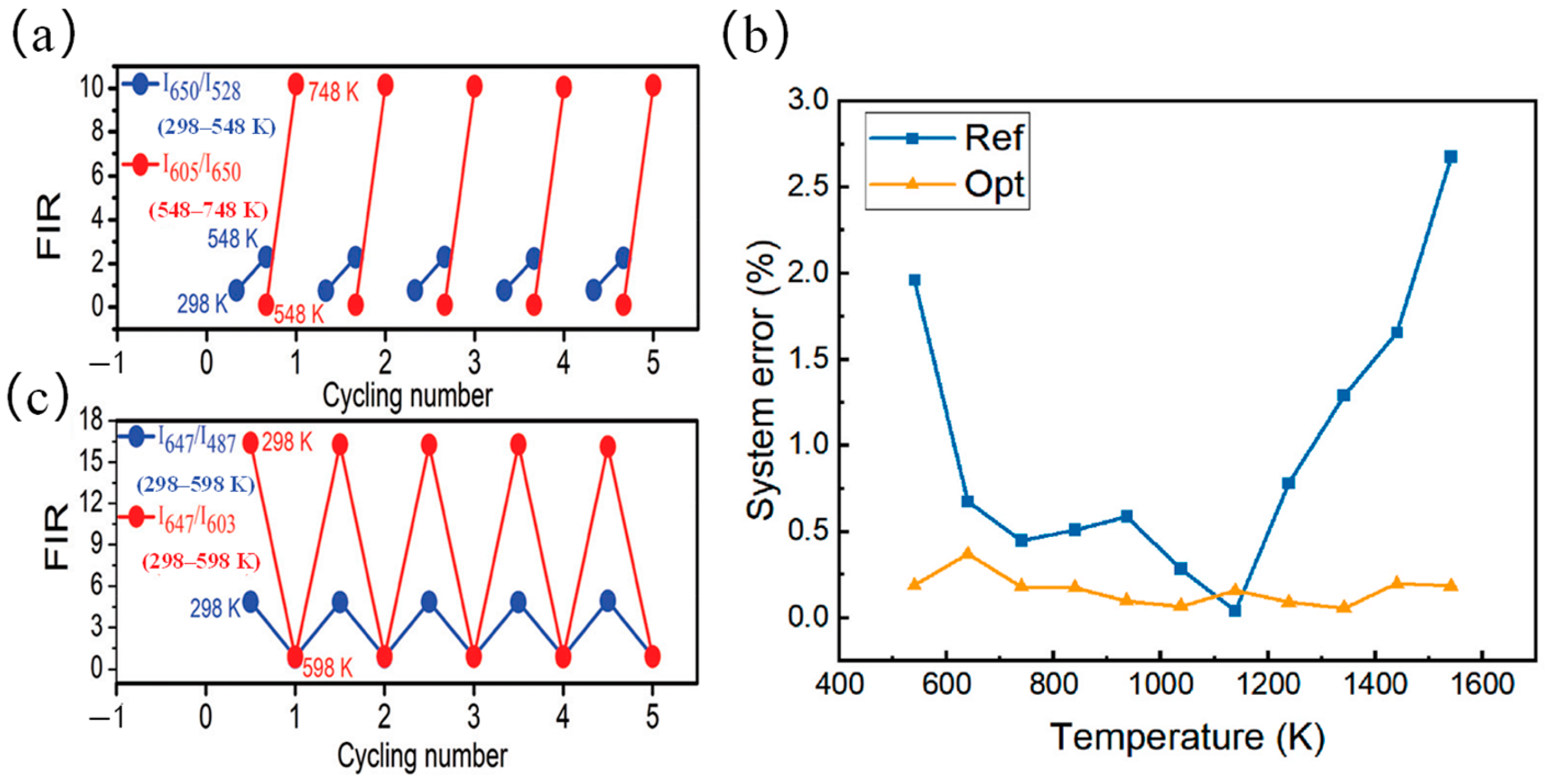
Wang et al. [110] effectively suppressed IVCT-induced non-radiative transitions at high temperatures by introducing Yb3+ to regulate the electron population of Pr3+. This enabled La2Mo3O12:Yb3+ and Pr3+ to maintain measurement repeatability above 99% even under conditions exceeding 700 K. The temperature cycling tests shown in Figure 9a,b visually demonstrate the stable performance of the material at elevated temperatures.
Building on these anti-quenching strategies, recent advances have introduced a transformative approach using negative thermal expansion (NTE) hosts, which turn thermal quenching into thermal enhancement. Unlike conventional hosts that suffer from luminescence degradation at high temperatures, NTE materials undergo lattice contraction upon heating, shortening interionic distances and boosting energy transfer efficiency, thereby enabling significant upconversion luminescence (UCL) enhancement and promising optical thermometry applications.
Wang et al. [111] developed (KMg)3+-doped Sc2W3O12:Er3+/Yb3+ phosphors with exceptional anti-quenching UCL enhancement. Benefiting from the synergistic effect of NTE characteristics and impurity doping, the upconversion intensity at 573 K was enhanced 6000-fold compared with room temperature, and the constructed all-fiber temperature sensor enabled accurate real-time monitoring of CPU chips.
Dai et al. [112] synthesized NTE ScF3:Yb3+/Tm3+ nanorods with thermally boosted UCL. The NTE-induced lattice contraction strengthened phonon-assisted energy transfer, leading to a remarkable enhancement of the 698 nm emission. The luminescence intensity ratio (LIR) thermometry achieved a high relative sensitivity of 1.60% K−1, demonstrating great potential for high-sensitivity optical temperature sensing.
While current anti-quenching strategies, including low-phonon-energy hosts and ion co-doping, have raised the temperature ceiling of luminescent thermometry to ~700 K, key challenges persist. Long-term thermal stability, high-temperature measurement repeatability, and scalable material synthesis remain major obstacles to real-world deployment. Furthermore, the precise manipulation of non-radiative transitions and energy transfer pathways under extreme thermal conditions requires deeper mechanistic insights. Future research will likely focus on transformative approaches, such as negative thermal expansion (NTE) hosts, which leverage lattice contraction to reverse thermal quenching, as well as multi-modal sensing designs combining optical signals with structural stability engineering. These innovations are poised to extend the practical temperature range to over 700 K, enabling robust optical thermometry in harsh scenarios such as aerospace thermal management and deep earth resource exploration.

4.2. Signal Accuracy and Suppression of Complex Background Interference

Background noise in complex environments—such as scattering in biological tissues, obscuration by industrial dust, and excitation power drift—has become a critical bottleneck limiting the accuracy of optical thermometry. Taking biological tissue as an example, its strong scattering of visible–near-infrared light significantly attenuates the green emission signal of Er3+, while fluctuations in the excitation source power directly amplify errors in single-intensity readings. To break through this dual “environment-instrument” interference, on the one hand, a multi-parameter collaborative strategy is used to collect multi-dimensional information such as FIR, lifetime, and color coordinates simultaneously for cross-validation. For instance, the Ba3In(PO4)3:Er3+/Yb3+ system studied by Lei et al. [113] employs a quadruple readout combining the FIR, chromaticity coordinate shift, and lifetime variation of Er3+, effectively suppressing systematic errors caused by excitation power drift. On the other hand, self-calibrating systems achieve internal reference correction by constructing “sensitive-robust” dual-emission centers within the same particle. A typical example is the Ce3+/Tb3+ co-doped β-NaYF4:Ce3+ system [114], in which the Ce3+ signal is highly sensitive to environmental perturbations while the Tb3+ signal remains almost unaffected. The ratio of the two signals can serve as a real-time calibration factor, maintaining a temperature measurement error of <3% in biological scattering or dusty environments without requiring an external reference. Additionally, by utilizing Ln3+-stabilized fluorescence as a reference signal, leveraging differential decay mechanisms in organic semiconductor composite systems, and regulating MLCT/IVCT charge transfer, external environmental and cross-sensitivity interferences are effectively suppressed. This ultimately enables temperature measurements with both high sensitivity (up to 22% K−1) and strong anti-interference capability. In addition to these approaches, novel error optimization methods have also been proposed. For example, Quan et al. [60] introduced a wavelength and bandwidth optimization method based on error theory to improve the temperature measurement accuracy of YAG:Dy and YSZ:Dy under high-temperature conditions (540–1542 K). Figure 9c displays the variation of systematic error with temperature for the YAG:Dy material before and after optimization. The blue curve (reference group, i.e., the traditional thermally coupled levels method) shows a systematic error as high as approximately 2.68% (close to 2.5%) at high temperature (1542 K), whereas the red curve (optimized group) maintains a systematic error below 0.5% across the entire temperature range, with a significantly reduced maximum error of merely 0.37% (close to 0.36%) at high temperatures.
In addition, excitation power dependence and laser-induced heating are critical practical limitations of conventional FIR thermometry. High-power continuous wave excitation (>10–50 mW) often causes significant temperature readout drift (10–50 K), severely compromising accuracy. To address this, power-independent calibration protocols, square-wave/pulsed excitation to suppress thermal loading, and laser heating correction algorithms have been developed, effectively reducing measurement errors and improving reliability in practical applications [115,116,117].
For instance, Li et al. [118] systematically investigated the laser power dependence of ratiometric thermometry in CaWO4:Yb3+/Ho3+ phosphors, revealing that different non-thermally coupled levels exhibit distinct power-dependent behaviors, which can lead to large temperature errors when excitation conditions change. To address this, power-independent calibration protocols, square-wave/pulsed excitation to suppress thermal loading, and laser heating correction algorithms have been developed, effectively reducing measurement errors and improving reliability in practical applications.
In summary, excitation power drift, laser-induced heating, and complex environmental interferences, such as scattering and dust, have become major bottlenecks limiting the practical accuracy of conventional luminescence thermometry. To address these challenges, multi-parameter collaborative strategies, self-calibrating dual-emission centers, and error optimization methods have been developed. These approaches effectively suppress systematic errors, significantly improve anti-interference capability, and maintain high sensitivity across diverse conditions. Together, these advances highlight the importance of both mechanism optimization and calibration design in achieving reliable, high-precision optical thermometry for real-world applications.

4.3. AI-Assisted Prediction

With the advancement of artificial intelligence (AI) technology, AI-assisted prediction is increasingly becoming a core driver for the rational design of materials and breakthroughs in performance. Traditionally, rare earth luminescent materials, leveraging their unique electronic transition properties, have demonstrated advantages of high sensitivity and multi-modal response in multi-parameter sensing of temperature, stress, chemical environment, etc. However, their performance optimization relied solely on extensive trial-and-error experimentation, resulting in low efficiency. Today, drawing on the successful paradigm of machine learning in the discovery of LED phosphors, research has shifted towards constructing a new pathway of “data-driven → feature engineering → intelligent prediction → experimental closed-loop [119].”
By integrating material databases and high-throughput calculations, research can extract key descriptors and symbols from composition, structure, and local coordination environments. Algorithms such as XGBoost and Support Vector Machines (SVMs) can then be utilized to accurately predict the excitation/emission wavelengths, quantum efficiency, and thermal stability of rare earth ions (e.g., Eu2+, Ce3+). This enables the targeted screening of materials for specific sensing needs, thereby reducing trial-and-error costs. Active learning and Bayesian optimization methods further allow for efficient exploration within complex multi-component spaces, enabling the rapid identification of high-performance candidate materials with minimal experimental iterations. This approach will significantly accelerate the development of novel rare earth luminescent sensing materials.
Beyond material innovation, advanced data analytics have emerged as a critical direction to address the limitations of conventional ratiometric thermometry, such as subjective parameter selection and low precision [120,121]. Ximendes et al. [122] pioneered the use of dimensionality reduction (DR) techniques (PCA and t-SNE) to process high-dimensional luminescence spectra of rare earth nanoparticles. By extracting core thermometric features from complex spectral data, they achieved a thermal resolution as low as 0.09 °C, outperforming traditional intensity ratio methods. Building on this, Santos et al. [123] further introduced automated machine learning (AutoML) into Nd3+:YAG luminescence thermometry. The AutoML model automatically optimized regression pipelines without manual feature screening, reducing temperature uncertainty from 9.8 °C to 1.2 °C and enabling real-time, robust measurements.
In summary, these works highlight the transformative impact of AI-driven techniques. While dimensionality reduction and AutoML address the subjectivity and low-precision issues of traditional methods, convolutional neural networks (CNNs) further advance the field by directly extracting complex thermal features from raw spectra. Despite the remarkable progress, key challenges remain. Current models often lack generalization to real-world environments, and the interpretability of complex algorithms needs to be improved. Future efforts should focus on enhancing model robustness and developing interpretable AI frameworks for practical applications.

5. Conclusions

Rare earth luminescence thermometry, featuring non-contact operation, high sensitivity, superior spatial resolution, and strong anti-interference capability, effectively overcomes the limitations of traditional contact-based techniques, such as thermocouples and infrared thermometers, in micro-/nano-scale, extreme environments, and in vivo biological applications, making it a cutting-edge research hotspot in temperature sensing. This paper systematically reviews the fundamental mechanisms of rare earth luminescence thermometry, including single-level intensity thermometry, thermally coupled level (TCL) ratiometric thermometry, and non-thermally coupled level (NTCL) ratiometric thermometry. The physical meanings and optimization principles of key parameters such as absolute sensitivity (Sa), relative sensitivity (Sr), and temperature resolution (δT) are clarified. The progress of this technology in biomedical imaging, high-temperature aerospace, and micro-/nano-device integration is also summarized, highlighting its irreplaceable value in precision sensing and extreme environment monitoring.
Despite remarkable progress, several challenges remain for broader and more demanding applications: (1) severe thermal quenching in the moderate-to-high temperature range (400–700 K), which limits long-term stability; (2) environmental interference and calibration issues caused by excitation power drift, tissue scattering, and background fluorescence; (3) insufficient adaptability for biological applications, including limited penetration depth of visible/NIR-I signals and poor long-term biocompatibility; and (4) low efficiency in material design, relying heavily on trial and error rather than theoretical guidance.
Looking ahead, several emerging directions are driving further development.
NIR-II thermometry represents a key breakthrough in biomedical research. With weak scattering, deep penetration, and low autofluorescence, it enables non-invasive deep tissue temperature measurement for tumor hyperthermia and in vivo imaging. Intracellular thermometry facilitates micro-scale life science research. Rare earth nanoprobes, with small size, low toxicity, and stable luminescence, allow precise temperature sensing at the single-cell and subcellular levels, supporting studies on metabolism and thermal stress. Self-calibrating probes effectively suppress interference from excitation power, concentration, and matrix background, significantly improving measurement reliability in complex conditions. Multi-modal sensing integrates multiple optical signals to achieve high precision, a wide temperature range, and strong anti-interference performance. Single-particle thermometry meets micro-/nano-scale requirements, offering nanometer spatial resolution for chip hotspot monitoring and quantum material research.
In the long term, rare earth luminescence thermometry will develop toward high performance, practicality, and intelligence. Thermal quenching will be addressed via negative thermal expansion matrices and energy level engineering. Artificial intelligence and machine learning will accelerate rational material design. The integration of NIR-II probes, self-calibrating systems, and multi-modal sensing will promote real-world applications. With interdisciplinary integration, rare earth luminescence thermometry will become an indispensable core technology in precision temperature sensing.

Author Contributions

J.L.: writing—original draft, literature research, writing—review and editing; Z.C.: writing—review and editing; T.C.: writing—review and editing; P.C.: resource investigation and summary; C.W.: data sorting and visualization; Q.J.: data sorting and visualization; J.F.: writing—original draft, writing—review and editing, project administration; L.C.: conceptualization, writing—review and editing; X.L.: funding acquisition, writing—review and editing. All authors have read and agreed to the published version of the manuscript.

Funding

This research was funded by the National Natural Science Foundation of China (22002139), the Special Projects in Key Areas of Ordinary Universities in Guangdong Province (2024ZDZX3006), the Science and Technology Innovation Guidance Project of Zhaoqing (250726160096936, 241213224168841), the Innovation Research Team Project of Zhaoqing University (TD202411), the Research Fund of Zhaoqing University (gcc202604, qn202626), and the College Students’ Innovation and Entrepreneurship Training Program (S202410580060).

Data Availability Statement

Data will be made available upon request.

Acknowledgments

The authors gratefully acknowledge the National Natural Science Foundation of China (22002139), the Special Projects in Key Areas of Ordinary Universities in Guangdong Province (2024ZDZX3006), the Science and Technology Innovation Guidance Project of Zhaoqing (250726160096936, 241213224168841), the Innovation Research Team Project of Zhaoqing University (TD202411), the Research Fund of Zhaoqing University (gcc202604, qn202626), and the College Students’ Innovation and Entrepreneurship Training Program (S202410580060).

Conflicts of Interest

The authors declare that they have no known competing financial interests or personal relationships that could have appeared to influence the work reported in this paper.

References

  1. Brites, C.D.; Marin, R.; Suta, M.; Carneiro Neto, A.N.; Ximendes, E.; Jaque, D.; Carlos, L.D. Spotlight on luminescence thermometry: Basics, challenges, and cutting-edge applications. Adv. Mater. 2023, 35, 2302749. [Google Scholar] [CrossRef]
  2. Dramićanin, M.D.; Marciniak, Ł.; Kuzman, S.; Piotrowski, W.; Ristić, Z.; Periša, J.; Evans, I.; Mitrić, J.; Đorđević, V.; Romčević, N. Mn5+-activated Ca6Ba(PO4)4O near-infrared phosphor and its application in luminescence thermometry. Light Sci. Appl. 2022, 11, 279. [Google Scholar] [CrossRef]
  3. Zheng, B.; Fan, J.; Chen, B.; Qin, X.; Wang, J.; Wang, F.; Deng, R.; Liu, X. Rare-earth doping in nanostructured inorganic materials. Chem. Rev. 2022, 122, 5519–5603. [Google Scholar] [CrossRef]
  4. Feng, G.; Zhang, H.; Zhu, X.; Zhang, J.; Fang, J. Fluorescence thermometers: Intermediation of fundamental temperature and light. Biomater. Sci. 2022, 10, 1855–1882. [Google Scholar] [CrossRef]
  5. Dramićanin, M.D. Sensing temperature via downshifting emissions of lanthanide-doped metal oxides and salts. A review. Methods Appl. Fluoresc. 2016, 4, 042001. [Google Scholar] [CrossRef]
  6. Suo, H.; Zhao, X.; Zhang, Z.; Wang, Y.; Sun, J.; Jin, M.; Guo, C. Rational design of ratiometric luminescence thermometry based on thermally coupled levels for bioapplications. Laser Photonics Rev. 2021, 15, 2000319. [Google Scholar] [CrossRef]
  7. Okabe, K.; Inada, N.; Gota, C.; Harada, Y.; Funatsu, T.; Uchiyama, S. Intracellular temperature mapping with a fluorescent polymeric thermometer and fluorescence lifetime imaging microscopy. Nat. Commun. 2012, 3, 705. [Google Scholar] [CrossRef]
  8. Amarasinghe, D.K.; Rabuffetti, F.A. Bandshift luminescence thermometry using Mn4+:Na4Mg(WO4)3 phosphors. Chem. Mater. 2019, 31, 10197–10204. [Google Scholar] [CrossRef]
  9. Senapati, S.; Nanda, K.K. Red emitting Eu:ZnO nanorods for highly sensitive fluorescence intensity ratio based optical thermometry. J. Mater. Chem. C 2017, 5, 1074–1082. [Google Scholar] [CrossRef]
  10. Nexha, A.; Carvajal, J.J.; Pujol, M.C.; Díaz, F.; Aguiló, M. Lanthanide doped luminescence nanothermometers in the biological windows: Strategies and applications. Nanoscale 2021, 13, 7913–7987. [Google Scholar] [CrossRef]
  11. Chen, K.; Shao, Z.; Zhang, C.; Jia, S.; Deng, T.; Zhou, R.; Zhou, Y.; Song, E. Illuminating the path to high-precision dual-mode optical thermometry: A Mn4+-activated oxyfluoride single crystal for a portable optical fiber thermometric platform. Chem. Eng. J. 2023, 477, 147165. [Google Scholar] [CrossRef]
  12. Li, G.; Chen, X.; Wang, M.; Cheng, S.; Yang, D.; Wu, D.; Han, Y.; Jia, M.; Li, X.; Zhang, Y. Regulating exciton de-trapping of Te4+-doped zero-dimensional scandium-halide perovskite for fluorescence thermometry with record high time-resolved thermal sensitivity. Adv. Mater. 2023, 35, 2305495. [Google Scholar] [CrossRef]
  13. Gupta, I.; Singh, S.; Bhagwan, S.; Singh, D. Rare earth (RE) doped phosphors and their emerging applications: A review. Ceram. Int. 2021, 47, 19282–19303. [Google Scholar] [CrossRef]
  14. McLaurin, E.J.; Bradshaw, L.R.; Gamelin, D.R. Dual-emitting nanoscale temperature sensors. Chem. Mater. 2013, 25, 1283–1292. [Google Scholar] [CrossRef]
  15. Pudovkin, M.; Ginkel, A.; Morozov, O.; Kiiamov, A.; Kuznetsov, M. Highly-sensitive lifetime optical thermometers based on Nd3+, Yb3+: YF3 phosphors. J. Lumin. 2022, 249, 119037. [Google Scholar] [CrossRef]
  16. Tong, X.; Zhou, X.; Tang, X.; Min, Y.; Li, X.; Wang, W.; Qian, Y. Upconversion luminescence and optical temperature-sensing properties of LiNbO3: Yb3+/Er3+ nanoparticles. CrystEngComm 2022, 24, 1407–1412. [Google Scholar] [CrossRef]
  17. Kumar, K.N.; Kang, G.; Lim, J.; Choi, J. Biocompatible Yb3+/Er3+ Co-activated La2(WO4)3 upconversion nanophosphors for optical thermometry, biofluorescent, and anticancer agents. Inorg. Chem. 2022, 61, 3851–3865. [Google Scholar] [CrossRef]
  18. Xu, H.; Yu, J.; Hu, Q.; Han, Q.; Wu, W. Highly sensitive dual-mode optical thermometry of Er3+/Yb3+ codoped lead-free double perovskite microcrystal. J. Phys. Chem. Lett. 2022, 13, 962–968. [Google Scholar] [CrossRef]
  19. Hu, J.; Xue, D. Research progress on the characteristics of rare earth ions and rare earth functional materials. Chin. J. Appl. Chem. 2020, 37, 245–255. [Google Scholar]
  20. Zhou, J.; Liu, Z.; Li, F. Upconversion nanophosphors for small-animal imaging. Chem. Soc. Rev. 2012, 41, 1323–1349. [Google Scholar] [CrossRef]
  21. Lurdhumary, J.; Jayanthi, A.; Bakkiyaraj, M.; Krishnamoorthy, N.; Dhanasakkaravarthi, B.; Hariram, S.; Dhanraj, J.A. Nanofabrication techniques for scalable and efficient nanodevices. AIP Conf. Proc. 2025, 3300, 020021. [Google Scholar]
  22. Chen, P.; Ilton, E.S.; Wang, Z.; Rosso, K.M.; Zhang, X. Global rare earth element resources: A concise review. Appl. Geochem. 2024, 175, 106158. [Google Scholar] [CrossRef]
  23. Chen, H.; Hardwick, J.; Gao, L.; Plasencia, D.M.; Subramanian, S.; Hirayama, R. Acoustics in additive manufacturing: A path toward contactless, scalable, and high-precision manufacturing. Appl. Phys. Rev. 2025, 12, 031305. [Google Scholar] [CrossRef]
  24. Chen, Z.; Zhu, H.; Qian, J.; Li, Z.; Hu, X.; Guo, Y.; Fu, Y.; Zhu, H.; Nai, W.; Yang, Z. Rare earth ion doped luminescent materials: A review of up/down conversion luminescent mechanism, synthesis, and anti-counterfeiting application. Photonics 2023, 10, 1014. [Google Scholar] [CrossRef]
  25. Chen, X.; Huang, X. Preparation, structure and properties of ultra-broadband yellow-emitting CaGd2Sc2Al2SiO12:Ce3+ garnet phosphors for blue-chip-pumped white LEDs. Ceram. Int. 2025, 51, 4185–4194. [Google Scholar] [CrossRef]
  26. Chen, X.; Huang, X. CaLu2Sc2Al2SiO12:Ce3+ Green Phosphors for High-Quality White LEDs. Inorg. Chem. 2025, 64, 2518–2528. [Google Scholar] [CrossRef]
  27. Chambers, M.; Clarke, D. Doped oxides for high-temperature luminescence and lifetime thermometry. Annu. Rev. Mater. Res. 2009, 39, 325–359. [Google Scholar] [CrossRef]
  28. Sakakibara, J.; Adrian, R.J. Whole field measurement of temperature in water using two-color laser induced fluorescence. Exp. Fluids 1999, 26, 7–15. [Google Scholar] [CrossRef]
  29. Zhang, Q.; Liao, Z.; Qiu, L.; Wei, X.; Chen, Y.; Yin, M. Investigation of SrB4O7:Tm2+ luminescence for temperature imaging with high sensitivity based on time-resolved luminescence. Dalton Trans. 2024, 53, 14289–14299. [Google Scholar] [CrossRef]
  30. Feng, J.; Li, J.; Lin, R.; Liu, J.; Chen, Y.; Xie, J.; Ni, H.; Chen, L.; Li, X. Independent Excitation of Dy3+ and Sm3+ in Garnet Phosphors for Fluorescence Thermometry. Ceram. Int. 2026, 52, 11971–11978. [Google Scholar] [CrossRef]
  31. Feng, J.; Wang, J.; Chen, H.; Lin, R.; Liang, J.; Xie, J.; Chen, L.; Li, J. Structural confinement helps achieve more accurate energy transfer: Studies on garnet structural NYGlG:Tb3+, Eu3+ phosphors. Mater. Chem. Front. 2024, 8, 3962–3972. [Google Scholar] [CrossRef]
  32. Wang, C.; Jin, Y.; Zhang, R.; Yao, Q.; Hu, Y. A review and outlook of ratiometric optical thermometer based on thermally coupled levels and non-thermally coupled levels. J. Alloys Compd. 2022, 894, 162494. [Google Scholar] [CrossRef]
  33. Zhang, X.; Zhu, Z.; Guo, Z.; Sun, Z.; Chen, Y. A ratiometric optical thermometer with high sensitivity and superior signal discriminability based on Na3Sc2P3O12:Eu2+, Mn2+ thermochromic phosphor. Chem. Eng. J. 2019, 356, 413–422. [Google Scholar] [CrossRef]
  34. Berthou, H.; Jörgensen, C. Optical-fiber temperature sensor based on upconversion-excited fluorescence. Opt. Lett. 1990, 15, 1100–1102. [Google Scholar] [CrossRef]
  35. Suo, H.; Zhao, X.; Zhang, Z.; Li, T.; Goldys, E.M.; Guo, C. Constructing multiform morphologies of YF:Er3+/Yb3+ up-conversion nano/micro-crystals towards sub-tissue thermometry. Chem. Eng. J. 2017, 313, 65–73. [Google Scholar] [CrossRef]
  36. Periša, J.; Ristić, Z.; Piotrowski, W.; Antić, Ž.; Marciniak, L.; Dramićanin, M.D. All near-infrared multiparametric luminescence thermometry using Er3+, Yb3+-doped YAG nanoparticles. RSC Adv. 2021, 11, 15933–15942. [Google Scholar] [CrossRef]
  37. Liu, Q.; Cao, B.; Gao, M.; Qiu, L.; Weng, Y.; He, Y.; Han, X.; Dong, B. Deconstructing excitation transitions in Dy3+-doped CaWO4 to develop a new ratiometric luminescent thermometry for achieving ultra-high sensing sensitivity. J. Mater. Chem. C 2024, 12, 12854–12861. [Google Scholar] [CrossRef]
  38. Taleb, Z.E.A.A.; Saidi, K.; Dammak, M. High-precision optical thermometry using Pr3+-doped NaCaY(MoO4)3 luminophores: A multi-spectral and chromaticity-based approach to non-contact temperature sensing. RSC Adv. 2025, 15, 5327–5337. [Google Scholar] [CrossRef]
  39. Gopal, R.; Kumari, C.; Manam, J. Development of SrWO4:Ho3+/Yb3+ green phosphor for optical thermometry application. Phys. Chem. Chem. Phys. 2023, 25, 32184–32195. [Google Scholar] [CrossRef]
  40. Xie, C.; Zhao, L.; Jiang, B.; Mao, J.; Lin, Y.; Wang, P.; Wei, X.; Yin, M.; Chen, Y. Dual-activator luminescence of LuAG:Mn4+/Tb3+ phosphor for optical thermometry. J. Am. Ceram. Soc. 2019, 102, 7500–7508. [Google Scholar] [CrossRef]
  41. Wang, J.; Feng, Q.; Lei, R.; Chen, X.; Deng, D.; Xu, S. Dual-mode optical thermometry design in K3YSi2O7:Eu multi-site phosphor. Opt. Lett. 2022, 47, 3415–3418. [Google Scholar] [CrossRef]
  42. Chen, D.; Wan, Z.; Zhou, Y.; Huang, P.; Zhong, J.; Ding, M.; Xiang, W.; Liang, X.; Ji, Z. Bulk glass ceramics containing Yb3+/Er3+:β-NaGdF4 nanocrystals: Phase-separation-controlled crystallization, optical spectroscopy and upconverted temperature sensing behavior. J. Alloys Compd. 2015, 638, 21–28. [Google Scholar] [CrossRef]
  43. Suo, H.; Guo, C.; Yang, Z.; Zhou, S.; Duan, C.; Yin, M. Thermometric and optical heating bi-functional properties of upconversion phosphor Ba5Gd8Zn4O21:Yb3+/Tm3+. J. Mater. Chem. C 2015, 3, 7379–7385. [Google Scholar] [CrossRef]
  44. León-Luis, S.F.; Rodríguez-Mendoza, U.R.; Lalla, E.; Lavín, V. Temperature sensor based on the Er3+ green upconverted emission in a fluorotellurite glass. Sens. Actuators B Chem. 2011, 158, 208–213. [Google Scholar] [CrossRef]
  45. Runowski, M.; Stopikowska, N.; Szeremeta, D.; Goderski, S.; Skwierczyńska, M.; Lis, S. Upconverting lanthanide fluoride core@ shell nanorods for luminescent thermometry in the first and second biological windows: β-NaYF4:Yb3+–Er3+@SiO2 temperature sensor. ACS Appl. Mater. Interfaces 2019, 11, 13389–13396. [Google Scholar] [CrossRef] [PubMed]
  46. Jiang, Y.; Tong, Y.; Chen, S.; Zhang, W.; Hu, F.; Wei, R.; Guo, H. A three-mode self-referenced optical thermometry based on up-conversion luminescence of Ca2MgWO6:Er3+, Yb3+ phosphors. Chem. Eng. J. 2021, 413, 127470. [Google Scholar] [CrossRef]
  47. Zhang, Y.; Chai, X.; Li, J.; Wang, X.; Li, Y.; Yao, X. Enhanced up-conversion luminescence and excellent temperature sensing properties in Yb3+ sensitized Er3+-doped Bi3Ti1.5W0.5O9 multifunctional ferroelectric ceramics. J. Alloys Compd. 2018, 735, 473–479. [Google Scholar] [CrossRef]
  48. Tong, Y.; Zhang, W.; Wei, R.; Chen, L.; Guo, H. Na2YMg2(VO4)3:Er3+, Yb3+ phosphors: Up-conversion and optical thermometry. Ceram. Int. 2021, 47, 2600–2606. [Google Scholar] [CrossRef]
  49. Chen, D.; Wan, Z.; Zhou, Y.; Zhou, X.; Yu, Y.; Zhong, J.; Ding, M.; Ji, Z. Dual-phase glass ceramic: Structure, dual-modal luminescence, and temperature sensing behaviors. ACS Appl. Mater. Interfaces 2015, 7, 19484–19493. [Google Scholar] [CrossRef]
  50. Rao, Z.; Li, Z.; Zhao, X.; Gong, X. Targeted high-precision up-converting thermometer platform over multiple temperature zones with Er3+. Mater. Horiz. 2023, 10, 1816–1824. [Google Scholar] [CrossRef]
  51. Gao, P.; Li, X.; Gong, Y.; Shen, G.; Zhang, S.; Guan, L. Highly sensitive up-conversion phosphor for optical thermometry: CaLaAl3O7:Er3+/Yb3+. J. Rare Earths 2019, 37, 937–942. [Google Scholar] [CrossRef]
  52. Yin, Q.; Sun, X.; Dong, K.; Lu, X.; Yang, F.; He, X.; Zhong, S.; Diao, Y.; Wang, Y. Dual-Emitting Ratiometric Luminescent Thermometers Based on Lanthanide Metal–Organic Complexes with Brønsted Acidic Ionic Liquids. Inorg. Chem. 2022, 61, 18998–19009. [Google Scholar] [CrossRef]
  53. Long, S.; Tian, M.; Zhang, D.; Luo, X.; Xu, W.; Tian, Y.; Xin, S. Achieving high sensing sensitivity in a Dy3+ doped garnet phosphor toward optical thermometry. J. Mater. Chem. C 2024, 12, 19536–19544. [Google Scholar] [CrossRef]
  54. Zhang, Z.; Cui, R.; Zhang, J.; Deng, C. Dual-mode thermometry of zero-thermal quenching phosphor Mg2YVO6:Sm3+. Ceram. Int. 2025, 51, 6906–6915. [Google Scholar] [CrossRef]
  55. Kiran, R.; Princy, A.; Masilla Moses Kennedy, S.; Mishra, M.M.; Sayyed, M.I.; Ahmed, M.R.; Kamath, S.D. Evaluation of luminescent and thermal properties of Dy3+ doped tungstate phosphors for optoelectronic and thermometry applications. Phys. B Condens. Matter 2025, 697, 416712. [Google Scholar]
  56. Zhang, P.; Hong, J.; Wen, H.; Wei, H.; Liu, J.; Yue, F.; Dan, Y. Fluorescence optimization and ratiometric thermometry of near-infrared emission in erbium/oxygen-doped crystalline silicon. J. Lumin. 2022, 250, 119035. [Google Scholar] [CrossRef]
  57. Wang, X.; Wang, Y.; Yu, J.; Bu, Y.; Yan, X. Modifying phase, shape and optical thermometry of NaGdF4:2%Er3+ phosphors through Ca2+ doping. Opt. Express 2018, 26, 21950–21959. [Google Scholar] [CrossRef]
  58. Liu, Q.; Wu, M.; Chen, B.; Huang, X.; Liu, M.; Liu, Y.; Su, K.; Min, X.; Mi, R.; Huang, Z. Optical thermometry based on fluorescence intensity ratio of Dy3+-Doped oxysilicate apatite warm white phosphor. Ceram. Int. 2023, 49, 4971–4978. [Google Scholar] [CrossRef]
  59. Abbas, M.T.; Khan, S.A.; Mao, J.; Khan, N.Z.; Qiu, L.; Ahmed, J.; Wei, X. Optical thermometry based on the luminescence intensity ratio of Dy3+-doped GdPO4 phosphors. J. Therm. Anal. Calorim. 2022, 147, 11769–11776. [Google Scholar] [CrossRef]
  60. Quan, Y.; Yin, Q.; Cheng, Z.; Liu, J.; Chai, J.; Liu, J.; Zhang, L. Optimization method of working wavelengths and bandwidths for high precision phosphor thermometry at high temperature. Int. J. Therm. Sci. 2025, 210, 109649. [Google Scholar] [CrossRef]
  61. Kolesnikov, I.E.; Mamonova, D.V.; Kurochkin, M.A.; Medvedev, V.A.; Bai, G.; Kolesnikov, E.Y. Ratiometric thermometry using single Er3+-doped CaWO4 phosphors. Nanotechnology 2022, 34, 055501. [Google Scholar] [CrossRef]
  62. Gao, M.; Cao, B.; Liao, Z.; Qiu, L.; He, Y.; Zhang, G.; Dong, B. Ultra-sensitive luminescent ratiometric thermometry based on matrix energy transfer in Dy3+ doped CaWO4 phosphors. J. Lumin. 2023, 263, 120102. [Google Scholar] [CrossRef]
  63. Kitos, A.A.; Galico, D.A.; Castaneda, R.; Ovens, J.S.; Murugesu, M.; Brusso, J.L. Stark sublevel-based thermometry with Tb (III) and Dy (III) complexes cosensitized via the 2-amidinopyridine ligand. Inorg. Chem. 2020, 59, 11061–11070. [Google Scholar] [CrossRef]
  64. Tian, C.; Ruan, J.; Zhao, X.; Han, J.; Liu, C. Structure, spectroscopic properties and optical temperature-sensing behavior of glass-ceramics containing polymorphic CaTa2O6:Er3+/Yb3+ nanocrystals. J. Mater. Chem. C 2024, 12, 16594–16607. [Google Scholar] [CrossRef]
  65. Xiang, G.; Xiong, M.; Yang, Z.; Wang, Y.; Yao, L.; Jiang, S.; Zhou, X.; Li, L.; Wang, X.; Zhang, J. Supernormal temperature sensing performance realized through the blue emitting level of Er3+ along with detection ability in deep tissues. Inorg. Chem. 2024, 63, 20014–20021. [Google Scholar] [CrossRef]
  66. Ding, J.; Liao, H.; Pang, L.; Wang, D.; Ye, S. Improved up-conversion behaviors and temperature sensitivity based on Stark sublevels of Er3+ in β-NaYF4:Yb3+, Er3+ and β-NaYF4:Yb3+, Er3+@NaGdF4. Opt. Mater. 2022, 128, 112304. [Google Scholar] [CrossRef]
  67. Li, P.; Jia, M.; Liu, G.; Zhang, A.; Sun, Z.; Fu, Z. Investigation on the fluorescence intensity ratio sensing thermometry based on nonthermally coupled levels. ACS Appl. Bio Mater. 2019, 2, 1732–1739. [Google Scholar] [CrossRef]
  68. Amar, N.B.; Saidi, K.; Hernández-Álvarez, C.; Dammak, M.; Martin, I.R. Ultra-high-sensitive temperature sensing based on emission Pr3+ and Yb3+ codoped Y2Mo3O12 nanostructures. Mater. Adv. 2025, 6, 827–838. [Google Scholar] [CrossRef]
  69. Zhang, C.; Ding, S.; Wang, M.; Ren, H.; Tang, X.; Zou, Y.; Dou, R.; Liu, W. Upconversion luminescence and optical thermometry behaviors of Yb3+ and Ho3+ co-doped GYTO crystal. Front. Optoelectron. 2023, 16, 31. [Google Scholar] [CrossRef] [PubMed]
  70. Wei, H.; Cai, Z.; Huang, H.; Wei, G.; Zhou, B. Ultra-Sensitive Low-Temperature Upconversion via Interfacial Energy Transfer Toward Visual Cryogenic Nanothermometry. Adv. Funct. Mater. 2025, 35, e10764. [Google Scholar] [CrossRef]
  71. Xin, Y.; Xiao, X.; Wang, J.; Abbas, N.; Zhang, S.; Han, Y.; Tang, J.; Skripka, A.; Zhang, Z. Multi-Ion Doping in Low-Phonon-Energy Nd3+ Based Double Perovskite Unlocks Multimodal Anti-Counterfeiting and High-Performance Optical Thermometry. Adv. Funct. Mater. 2025, 36, e25789. [Google Scholar] [CrossRef]
  72. Zhang, B.; Zhang, H.; Cheng, X.; Li, S.; Han, Q. Enhancement of UC luminescence and temperature sensing properties of YOF nanocrystals by doped metal ions. Ceram. Int. 2025, 51, 18416–18427. [Google Scholar] [CrossRef]
  73. Zhernakov, M.A.; Sedykh, A.E.; Denisenko, Y.G.; Molokeev, M.S.; Mirzayanov, I.I.; Becker, J.; Shtyrlin, V.G.; Müller-Buschbaum, K. Luminescent Thermometer Systems Dy3+/Eu3+ and Tb3+/Sm3+ Based on Coordination Compounds: New Pairs to the Approved Tb3+/Eu3+? Chem. Mater. 2024, 36, 9704–9717. [Google Scholar] [CrossRef]
  74. Deng, X.; Li, R.; Zhou, L.-P.; Duan, X.-F.; Cheng, X.-Y.; Hu, S.-J.; Sun, Q.-F. Tunable luminescence and ratiometric temperature sensing by hierarchical self-assembly of lanthanide-organic cage. Nano Res. 2025, 18, 94907327. [Google Scholar] [CrossRef]
  75. Feng, X.; Shang, Y.; Zhang, H.; Liu, X.; Wang, X.; Chen, N.; Wang, L.; Li, Z. Multi-functional lanthanide-CPs based on tricarboxylphenyl terpyridyl ligand as ratiometric luminescent thermometer and highly sensitive ion sensor with turn on/off effect. Dalton Trans. 2020, 49, 4741–4750. [Google Scholar] [CrossRef]
  76. Li, Z.; Zhang, J.; Wu, Z.; Lei, H.; Zhao, Y.; Qi, W.; Gao, X.; Jiang, F.; Liu, Y.; Chen, L. A Sensitive Ratiometric Thermometer Constructed by AIEgen-Based Mixed Lanthanide MOF for Intracellular Temperature Mapping. Adv. Sci. 2025, 12, e10147. [Google Scholar] [CrossRef]
  77. Liu, S.; Liu, W.; Chen, C.; Sun, Y.; Bai, S.; Liu, W. Construction of highly luminescent lanthanide coordination polymers and their visualization for luminescence sensing. Inorg. Chem. 2024, 63, 1725–1735. [Google Scholar] [CrossRef]
  78. Zhou, X.; Li, S.; Zhou, X.; Chen, L.; Wu, J.; Yu, T.; Li, L.; Jiang, S.; Tang, X.; Xiang, G. Luminescent properties and ratiometric optical thermometry of Ln-BDC-F4 compounds. Spectrochim. Acta Part A Mol. Biomol. Spectrosc. 2020, 224, 117418. [Google Scholar] [CrossRef]
  79. Psalti, A.E.; Eliseeva, S.V.; Hatzidimitriou, A.; Oikonomidis, S.; Petoud, S.; Lazarides, T. Luminescent Lanthanide Metal–Organic Frameworks for Temperature Sensing in Two Distinct Temperature Regions. J. Am. Chem. Soc. 2026, 148, 4020–4031. [Google Scholar] [CrossRef]
  80. Jia, M.; Sun, Z.; Zhang, M.; Xu, H.; Fu, Z. What determines the performance of lanthanide-based ratiometric nanothermometers? Nanoscale 2020, 12, 20776–20785. [Google Scholar] [CrossRef]
  81. Vieira Perrella, R.; Derroso, G.; de Sousa Filho, P.C. Improper background treatment underestimates thermometric performance of rare earth vanadate and phosphovanadate nanocrystals. ACS Omega 2024, 9, 34974–34980. [Google Scholar] [CrossRef]
  82. Pessoa, A.R.; Galindo, J.A.; Dos Santos, L.F.; Goncalves, R.R.; Maier, S.A.; Menezes, L.d.S.; Amaral, A.M. Correction due to nonthermally coupled emission bands and its implications on the performance of Y2O3:Yb3+/Er3+ single-particle thermometers. J. Phys. Chem. C 2023, 127, 9673–9680. [Google Scholar] [CrossRef]
  83. Vonk, S.J.; van Swieten, T.P.; Cocina, A.; Rabouw, F.T. Photonic artifacts in ratiometric luminescence nanothermometry. Nano Lett. 2023, 23, 6560–6566. [Google Scholar] [CrossRef]
  84. dos Santos, L.F.; Galindo, J.A.; Lima, K.d.O.; Pessoa, A.R.; Amaral, A.M.; Menezes, L.d.S.; Gonçalves, R.R. Lifetime-based luminescence thermometry from Yb3+/Er3+ codoped nanoparticles suspended in water. J. Lumin. 2023, 262, 119946. [Google Scholar] [CrossRef]
  85. Ehtesham Raza, S.M.; Wang, X.; Jin, Y.; Tian, Y.; Wang, C.; Ren, J.; Liu, L.; Zhang, J. Improved thermometry via luminescence lifetime ratio of Er3+ and Tm3+ operated in the biological window. Opt. Express 2024, 32, 35822–35831. [Google Scholar] [CrossRef] [PubMed]
  86. Suo, H.; Guo, D.; Zhao, P.; Zhang, X.; Wang, Y.; Zheng, W.; Li, P.; Yin, T.; Guan, L.; Wang, Z. Ultrasensitive colorimetric luminescence thermometry by progressive phase transition. Adv. Sci. 2024, 11, 2305241. [Google Scholar] [CrossRef]
  87. De, A.; Dwij, V.; Sathe, V.; Hernández-Rodríguez, M.; Carlos, L.D.; Ranjan, R. Synergistic use of Raman and photoluminescence signals for optical thermometry with large temperature sensitivity. Phys. B Condens. Matter 2022, 626, 413455. [Google Scholar] [CrossRef]
  88. Kurahashi, H.; Umezawa, M.; Okubo, K.; Soga, K. Pixel screening in Lifetime-Based temperature mapping using β-NaYF4:Nd3+, Yb3+ by Time-Gated Near-Infrared fluorescence imaging on deep tissue in live mice. ACS Appl. Bio Mater. 2024, 7, 3821–3827. [Google Scholar] [CrossRef]
  89. Chang, Q.; Zhou, X.; Zhou, X.; Chen, L.; Xiang, G.; Jiang, S.; Li, L.; Li, Y.; Tang, X. Strategy for optical thermometry based on temperature-dependent charge transfer to the Eu3+ 4f-4f excitation intensity ratio in Sr3Lu(VO4)3:Eu3+ and CaWO4:Nd3+. Opt. Lett. 2020, 45, 3637–3640. [Google Scholar] [CrossRef]
  90. Drabik, J.; Ledwa, K.; Marciniak, Ł. Implementing defects for ratiometric luminescence thermometry. Nanomaterials 2020, 10, 1333. [Google Scholar] [CrossRef]
  91. Wang, J.; Zhou, X.; Xiang, G.; Jiang, S.; Li, L.; Wang, Y.; Li, Y.; Jing, C.; Yao, L.; Yang, H. The explanation of abnormal thermal quenching of the charge transfer band based on thermally coupled levels and applications as temperature sensing probes. Dalton Trans. 2022, 51, 17224–17234. [Google Scholar] [CrossRef]
  92. Wu, J.; Hu, Y.; Yang, Q.; Zhang, J.; Lei, T.; Hu, C.; Wang, S.; Ye, Z.; Cheng, X. Self-doping in ScOOH oxyhydrates and relevant temperature sensing exploration combined with lanthanide fluorescence probes. J. Lumin. 2021, 231, 117836. [Google Scholar] [CrossRef]
  93. Zhong, L.; Jiang, S.; Wang, X.; Wang, Y.; Xie, J.; Li, Y.; Huang, B.; Wang, Y.; Xiang, G.; Li, L. Ultra-sensitive luminescence thermometry based on MgNb2O6:Dy3+/Pr3+ thermochromic phosphors. Inorg. Chem. Front. 2022, 9, 5757–5765. [Google Scholar] [CrossRef]
  94. Herzog, J.M.; Witkowski, D.; Rothamer, D.A. Characterization of the Ce, Pr:LuAG phosphor for Co-doped aerosol phosphor thermometry. J. Lumin. 2021, 229, 117665. [Google Scholar] [CrossRef]
  95. Meng, M.; Zhang, R.; Fa, X.; Yang, J.; Cheng, Z.; Ansari, A.A.; Ou, J.; Wurth, C.; Resch-Genger, U. Preparation of core–shell structured NaYF4:Yb3+/Tm3+@NaYF4:Yb3+/Er3+ nanoparticles with high sensitivity, low resolution and good reliability and application of their fluorescence temperature properties. CrystEngComm 2022, 24, 1752–1763. [Google Scholar] [CrossRef]
  96. Parajuli, P.; Allison, S.W.; Sabri, F. Spincoat-fabricated multilayer PDMS-phosphor composites for thermometry. Meas. Sci. Technol. 2017, 28, 065101. [Google Scholar] [CrossRef]
  97. Tian, X.; Wen, Y.; Dou, H.; Wu, L.; Wang, C.; Zhang, Y. NIR-II fluorescence and thermometry properties in negative thermal expansion phosphor Sc2(MoO4)3. Ceram. Int. 2025, 51, 8516–8523. [Google Scholar] [CrossRef]
  98. Wang, Z.; Jia, M.; Zhang, M.; Jin, X.; Xu, H.; Fu, Z. Trimodal ratiometric luminescent thermometer covering three near-infrared transparency windows. Inorg. Chem. 2021, 60, 14944–14951. [Google Scholar] [CrossRef]
  99. Dai, M.; Li, K.; Xu, H.; Fu, Z. Engineering Visible to Near-Infrared Luminescence through a Selective Doping Strategy for High-Performance Temperature Sensing. Inorg. Chem. 2024, 63, 13413–13424. [Google Scholar] [CrossRef]
  100. Łukaszewicz, M.; Tomala, R.; Lisiecki, R. From upconversion to thermal radiation: Spectroscopic properties of a submicron Y2O3:Er3+, Yb3+ ceramic under IR excitation in an extremely broad temperature range. J. Mater. Chem. C 2020, 8, 1072–1082. [Google Scholar] [CrossRef]
  101. Wang, C.; Zhang, H.; Cai, Y.; Wang, Q.; Zhou, B.; Xu, X.; Yu, X. Phonon-Assisted Negative Thermal Quenching in a One-Photon Up-Conversion Phosphor for Thermometry. Laser Photonics Rev. 2023, 17, 2300499. [Google Scholar] [CrossRef]
  102. Li, L.; Li, X.; Wu, Z.; Hua, Y.; Zhou, X.; Wang, Y.; Cao, Z.; Jiang, S.; Xiang, G.; Yu, J.S. Designing dual-emission phosphors for temperature warning indication and dual-mode luminescence thermometry. Dalton Trans. 2023, 52, 15798–15806. [Google Scholar] [CrossRef] [PubMed]
  103. Chen, W.; Gao, H.; Chen, Q.; Geng, X.; Ma, B. Upconversion fluorescent Sr9In(PO4)7:Yb3+, Er3+ phosphors with applications in temperature measurement and anti-counterfeiting. Ceram. Int. 2024, 50, 23256–23263. [Google Scholar]
  104. Kurochkin, M.A.; Mamonova, D.V.; Medvedev, V.A.; Kolesnikov, E.Y.; Kolesnikov, I.E. Remote temperature sensing in microelectronics: Optical thermometry using dual-center phosphors. Nanotechnology 2024, 35, 295501. [Google Scholar] [CrossRef] [PubMed]
  105. Xia, Z.-R.; Li, R.-Q.; Zheng, Q.-H.; Liu, F.-F.; Zhou, W.-W.; Yuan, K.-X.; Tong, Y.; Zhao, W. Optical thermometry and fingerprint detection in SrLa1−xEuxLiTeO6 phosphors with abnormal thermal quenching effect. AIP Adv. 2025, 15, 035021. [Google Scholar] [CrossRef]
  106. Chen, W.; Jin, M.; Tang, J.; Li, Y.; Chen, C.; Xiang, J.; Li, Z.; Guo, C. Self-calibrated multi-mode optical thermometry in up-converting phosphor Cs2NaErCl6:Yb3+. J. Lumin. 2023, 263, 120132. [Google Scholar] [CrossRef]
  107. Wang, Y.; Wang, Y.; Ma, C.; Li, Y.; Zhao, C.; Ye, W.; Wen, Z.; Yuan, X.; Cao, Y. Splendid cryogenic optical thermometry and rewritable photomemory based on the up-conversion luminescence of K0.5Bi0.5TiO3:Er/In ceramic. J. Mater. Chem. C 2021, 9, 16626–16633. [Google Scholar] [CrossRef]
  108. Vu, T.; Bondzior, B.; Stefańska, D.; Dereń, P. An Er3+ doped Ba2MgWO6 double perovskite: A phosphor for low-temperature thermometry. Dalton Trans. 2022, 51, 8056–8065. [Google Scholar] [CrossRef]
  109. Shi, X.; Xue, Y.; Mao, Q.; Pei, L.; Li, X.; Liu, M.; Zhang, Q.; Zhong, J. Eu3+ single-doped phosphor with antithermal quenching behavior and multicolor-tunable properties for luminescence thermometry. Inorg. Chem. 2023, 62, 893–903. [Google Scholar] [CrossRef]
  110. Wang, Q.; Liao, M.; Lin, Q.; Xiong, M.; Zhang, X.; Dong, H.; Lin, Z.; Wen, M.; Zhu, D.; Mu, Z. The design of dual-switch fluorescence intensity ratio thermometry with high sensitivity and thermochromism based on a combination strategy of intervalence charge transfer and up-conversion fluorescence thermal enhancement. Dalton Trans. 2021, 50, 9298–9309. [Google Scholar] [CrossRef]
  111. Wang, X.; Zhang, P.; Xiao, X.; Lei, R.; Huang, L.; Xu, S.; Zhao, S.; Wang, X. Giant enhancement of anti-quenching upconversion luminescence in Sc2W3O12:Er3+/Yb3+ phosphors for temperature sensing. J. Mater. Chem. C 2024, 12, 8977–8986. [Google Scholar] [CrossRef]
  112. Dai, M.; Li, Y.; Wang, Z.; Li, A.; Sheng, T.; Xu, H.; Li, K.; Fu, Z. Thermally boosted upconversion luminescence and high-performance thermometry in ScF3:Yb3+/Tm3+ nanorods with negative thermal expansion. J. Lumin. 2024, 265, 120219. [Google Scholar] [CrossRef]
  113. Lei, Z.; Liu, R.; Sun, L.; Wang, X.; Hu, C.; Zou, Y.; Yang, X.; Su, S.; Teng, B.; Xu, H. An up-conversion Ba3In(PO4)3:Er3+/Yb3+ phosphor that enables multi-mode temperature measurements and wide-gamut ‘temperature mapping’. Dalton Trans. 2023, 52, 10155–10164. [Google Scholar] [CrossRef]
  114. Ding, M.; Lu, C.; Chen, L.; Ji, Z. Ce3+/Tb3+ co-doped β-NaYF4 dual-emitting phosphors for self-referencing optical thermometry. J. Alloys Compd. 2018, 763, 85–93. [Google Scholar] [CrossRef]
  115. Zhou, Y.; Ledoux, G.; Philippon, D.; Descartes, S.; Martini, M.; He, S.; Desroches, C.; Fournier, D.; Journet, C.; Bois, L. Laser-induced heating in GdVO4:Yb3+/Er3+ nanocrystals for thermometry. ACS Appl. Nano Mater. 2022, 5, 16388–16401. [Google Scholar] [CrossRef]
  116. Jia, M.; Li, M.; Li, D.; Zhang, X.; Chen, G. Excitation-power dependence of lanthanide-based ratiometric luminescent nanothermometry. Nano Lett. 2024, 24, 15450–15456. [Google Scholar] [CrossRef]
  117. Zhang, Y.; Wang, P.; Wang, H.; Zheng, X.; Guo, Y.; Zhang, N.; Liu, H. Visible and near-infrared luminescence properties of Nd3+/Yb3+ co-doped Gd2O3 phosphors for highly sensitive optical thermometry. Dalton Trans. 2022, 51, 10612–10622. [Google Scholar] [CrossRef]
  118. Li, L.; Qin, F.; Zhou, Y.; Zhang, Z. Comprehensive study on the combined effect of laser-induced heating and laser power dependence on luminescence ratiometric thermometry. ACS Omega 2019, 4, 3646–3652. [Google Scholar] [CrossRef]
  119. Lee, N.; Brgoch, J. From Model to Material: Machine Learning Enabled Discovery of LED-Compatible Phosphors. Adv. Opt. Mater. 2025, 14, e02034. [Google Scholar] [CrossRef]
  120. Polikovskiy, T.A.; Gontcharenko, V.E.; Korshunov, V.M.; Metlin, M.T.; Metlina, D.A.; Samsonov, S.V.; Belousov, Y.A.; Brites, C.D.; Carlos, L.D.; Taydakov, I.V. Combining materials design and deep learning: AI-enhanced luminescence thermometry with a novel Eu3+/Tb3+ polymeric coordination compound. Mater. Chem. Front. 2025, 9, 3443–3459. [Google Scholar] [CrossRef]
  121. Xu, W.; Cui, J.; Bai, F.; Zheng, L.; Hu, C.; Zhang, Z.; Sun, Z.; Zhang, Y. Convolutional neural networks driving thermally enhanced upconversion luminescence for temperature sensing: Achieving high accuracy and robustness across a wide temperature range. J. Mater. Chem. C 2023, 11, 15233–15245. [Google Scholar] [CrossRef]
  122. Ximendes, E.; Marin, R.; Carlos, L.D.; Jaque, D. Less is more: Dimensionality reduction as a general strategy for more precise luminescence thermometry. Light Sci. Appl. 2022, 11, 237. [Google Scholar] [CrossRef]
  123. Santos, E.P.; Pugina, R.S.; Hilário, E.G.; Carvalho, A.J.; Jacinto, C.; Rego-Filho, F.A.; Canabarro, A.; Gomes, A.S.; Caiut, J.M.A.; Moura, A.L. Towards accurate real-time luminescence thermometry: An automated machine learning approach. Sens. Actuators A Phys. 2023, 362, 114666. [Google Scholar] [CrossRef]
Figure 1. Temperature sensing method based on the luminescence characteristics of rare earth ions. (a) Temperature-induced shift of the luminescence spectral position. (b) Temperature-dependent evolution of the luminescence band profile. (c) Polarization behavior of the luminescence under varying temperatures. (d) Temperature dependence of the full width at half-maximum (FWHM) of the luminescence band. (e) Temperature-dependent variation of the luminescence intensity. (f) Temperature-dependent luminescence lifetime decay dynamics.
Crystals 16 00380 g001
Figure 2. (a) Schematic diagram of temperature sensing based on the luminescence characteristics of rare earth ions. (b) Schematic diagram of single-energy-level luminescence intensity-based thermometry.
Crystals 16 00380 g002
Figure 3. Schematic diagram of the principle of luminescence intensity ratio-based thermometry.
Crystals 16 00380 g003
Figure 4. (a) Schematic energy level diagrams of Yb3+ and Er3+ and configuration coordination of Cr3+ showing the suppression of energy transfers between Er3+ and Cr3+ ions when Yb3+/Er3+ partitioned into YF3 while Cr3+ ions entered into Ga2O3. (b) Temperature dependence of FIR. (c) Monolog plot of FIR versus inverse absolute temperature. (d) Temperature dependence of sensor sensitivity. (e) Absolute sensitivity (Sa) and relative sensitivity (Sr) values as functions of absolute temperature. (f) Variation curve of the relative sensitivity Sr with continuously increasing temperature.
Crystals 16 00380 g004
Figure 5. (a) The temperature-dependent function range of the LIR values of GYTO:Yb/Ho. (b) The temperature-dependent absolute and relative sensitivities. (c) The dependence of the relative sensitivity (Sr) and absolute sensitivity (Sa) obtained from the LIR of the LiYF4:Ho@LiYF4:Yb@LiYF4 core–shell–shell nanoparticles on temperature from 11 to 300 K. (d) Linear and nonlinear regression fitting results. (e) The sensitivities of the non-TCLs (non-thermally coupled levels) of Cs2NaNdCl6:Yb3+/Er3+ are displayed separately. (f) The comparison between experimentally measured and actual temperatures based on Stark levels, non-TCLs, and TCLs verifies the accuracy of different optical thermometric strategies.
Crystals 16 00380 g005
Figure 6. (a) The brief mechanisms of Tm3+ and Er3+ NIR emissions. (b) Schematic diagram of the experimental arrangements. (c) Flowchart of synthesis of NCs and conceptual diagram of proposed LLR thermometry.
Crystals 16 00380 g006
Figure 7. The core requirements for temperature measurement performance in two temperature ranges.
Crystals 16 00380 g007
Figure 8. Several aspects of the fiber-optic temperature sensing system. (a) Experimental arrangement of an optical fiber temperature sensing system. (b) The measured temperature and the standard temperature displayed on the heater (the red line is the baseline where the measured temperature is equal to the standard temperature). (c) FIR values were recorded at different excitation powers at room temperature. (d) FIR values were recorded over 5 cycles between 295 and 435 K.
Crystals 16 00380 g008
Figure 9. (a) Segmented FIR values recorded for temperature cycling measurements at a wavelength of 980 nm. (b) Two model FIR values recorded for temperature-cycling measurements at a wavelength of 450 nm. (c) Systematic error comparison of operating wavelength and bandwidth for YAG:Dy.
Crystals 16 00380 g009
Table 1. Comparison of rare earth and transition metal thermometric materials.
TypeAdvantagesDisadvantagesApplicable Scenarios
Rare EarthNarrow emission linewidth, long lifetime, good thermal stability, biocompatibleRelatively high cost, low sensitivity in some systemsBioimaging, high-temperature sensing, long-term monitoring
Transition MetalLow cost, crystal field-sensitive, high sensitivityBroad emission band, poor thermal stability, susceptible to environmental interferenceIndustrial temperature measurement, low-cost rapid detection
Table 2. Common thermal coupling energy levels and energy level spacings of rare earth ions.
Rare Earth IonTransitionsΔE/cm−1Ref.
Er3+4S3/2, 2H11/2800[36]
Dy3+4I15/2, 4F9/21100[37]
Pr3+3P0, 3P1/1I6650[38]
Ho3+5G6/5F1, 5F2,3/3K81500[39]
Tm3+3F2,3, 3H41600[40]
Nd3+4F7/2, 4F3/21700[41]
Eu3+5D1, 5D01700[42]
Table 3. Research on temperature sensing based on the fluorescence intensity ratio of thermally coupled energy levels of different rare earths.
Host Lattice: Luminescent Ln3+TransitionsΔT/KSr, Max/(%·K−1)Ref.
Ca2.5Hf2.5Ga3O12:Dy3+4I15/2, 4F9/2298–5232.120 (523 K)[53]
Mg2YVO6:Sm3+I563/I654298–4480.5700 (298 K)[54]
Ca2MgWO6:Dy3+4F9/2/6H15/2, 4F9/2/6H13/2303–483/[55]
Er/O-doped crystalline silicon4I13/2, 4I15/24–2001.170 (50 K)[56]
NaGdF4:Er3+2H11/2, 4S3/2298–5732.130 (416 K)[57]
CaLa3(SiO4)3O:Dy3+4I15/2, 4F9/2298–5480.1673 (298 K)[58]
GdPO4:Dy3+4I15/2, 4F9/2290–5301.550 (290 K)[59]
YAG:Dy3+4I15/2, 4F9/2540–15420.633 (540 K)[60]
CaWO4:Er3+2H11/2, 4S3/298–7731.080 (298 K)[61]
CaWO4:Dy3+4I15/2, 4F9/2300–4751.700 (300 K)[62]
Table 4. Partial optical thermometric parameters of molecular- and coordination-based lanthanide thermometers.
Material SystemSr, Max/(%·K−1)ΔT/KλexλemRef.
Eu4L42.04250–320380497, 615[74]
Ln-CPs (Sm, Eu, Gd, Tb, Dy)8.41305–340334545, 612[75]
Tb1−xEux-TPDB7.32291–321338542, 615[76]
Tb0.96Eu0.04-HS16.8273–333296546, 616[77]
Tb0.99Eu0.01-BDC-F40.7650–300303544, 619[78]
La1−xLnx(BDC)1−γ(ABDC)γCl(DMF) (Ln = Eu, Tb, Dy, Sm)11.1 (10 K); 2.2 (150 K)10–330300390–600 (ligand); 545 (Tb3+); 613 (Eu3+)[79]
Table 5. Comparison of key thermometric modalities.
ModalityPrincipleAdvantagesLimitationSeδT Range
FIR (TCLs)Boltzmann distribution of TCLsSelf-referenced, simpleSensitivity ceiling, limited ΔE0.1–1 K
FIR (NTCLs)Dual-center independent temperature responseUltra-high sensitivity, large spectral separationComplex mechanism, limited material design0.01–0.5 K
Luminescence LifetimeTemperature-dependent decay rateImmune to concentration/scattering, self-calibratingRequires lifetime detection equipment0.05–0.5 K
Multi-Modal (FIR + Lifetime)Combined FIR and lifetime readoutsHigh accuracy, strong anti-interferenceComplex data processing0.01–0.2 K
Disclaimer/Publisher’s Note: The statements, opinions and data contained in all publications are solely those of the individual author(s) and contributor(s) and not of MDPI and/or the editor(s). MDPI and/or the editor(s) disclaim responsibility for any injury to people or property resulting from any ideas, methods, instructions or products referred to in the content.