1. Introduction
Scintillator materials emit light when exposed to ionizing radiation. This property makes them indispensable in diverse applications that include medical diagnostics, radiation detection, security, industrial inspection, and a wide range of scientific research methods [
1,
2,
3,
4,
5,
6,
7,
8,
9].
Scintillation crystals are essential components of electromagnetic calorimeters in high-energy physics; for example, PbWO
4 crystals are used in the Compact Muon Solenoid (CMS) electromagnetic calorimeter at the Large Hadron Collider (LHC) [
10,
11]. More broadly, scintillator research includes tungstates, halides, garnets, oxyorthosilicates, and related wide-band-gap materials [
12,
13,
14,
15,
16,
17,
18,
19,
20].
Y
2SiO
5 (YSO) is a scintillator host material used in photonic and radiation-detection applications [
21,
22]. Its rare-earth sublattice can be progressively modified by replacing Y
3+ with Lu
3+, giving the solid-solution family (Lu
xY
1−x)
2SiO
5, hereafter denoted as LYSO. Complete replacement of Y by Lu gives the Lu-rich end member Lu
2SiO
5 (LSO) [
23,
24].
LYSO, a solid solution of LSO and YSO, retains the advantageous growth characteristics of YSO and the desirable scintillating properties of LSO. This provides several advantages, including a lower melting point, reduced raw material costs, and easier incorporation of cerium activators into the crystal structure. Furthermore, the incorporation of Lu into the YSO lattice substantially increases the density and effective atomic number relative to pure YSO, thereby improving the stopping power, while still retaining more favorable growth characteristics and lower cost than pure LSO [
25,
26].
Importantly, although the present study addresses the intrinsic Ce-free host lattice, its properties are directly relevant for experimentally realized LYSO-based scintillators, where mechanical stability governs crystal growth, machining, and long-term device reliability. Therefore, a brief overview of scintillation applications is retained here to connect the fundamental description of the host matrix with its practical use and to ensure that the manuscript remains accessible to both theoretical and experimental audiences. LYSO scintillators, doped with cerium (Ce), have become essential in applications such as medical imaging and high-energy physics due to their high stopping power, fast decay time, and high light output [
2,
3]. The development of LYSO was initially driven by the demand for improved performance in positron emission tomography (PET) systems, where its high density and effective atomic number make it an ideal material for efficient radiation detection [
2,
4]. LYSO is non-hygroscopic and exhibits relatively high light output, though its intrinsic radioactivity, originating from
176Lu beta decay, must be considered in certain applications [
4,
27]. Despite this, its fast decay and strong luminescence have made it particularly suitable for time-of-flight PET (TOF-PET) systems [
5]. Intrinsic luminescence in Ce-doped (Lu,Y)2SiO5 (LYSO:Ce) single crystals has been investigated using vacuum-ultraviolet (VUV) excitation spectroscopy under synchrotron radiation [
28,
29]. A previously unreported emission band at ∼250 nm was observed, with its thermal behavior characterized between 10 and 120 K, suggesting origins from either the singlet component of self-trapped excitons or self-trapped excitons in the lutetium sublattice. Additionally, Ce
3+ emission centers with different coordination environments (six- and seven-coordinated) were found to be excited across the VUV range (4.5–8 eV), indicating that the same energy transfer mechanisms from the host lattice to Ce
3+ are operative regardless of coordination. These results further demonstrate that excitonic processes, involving both intrinsic and bound excitons, dominate the energy transfer to Ce
3+ luminescence in LYSO.
Advances in crystal growth and processing have further enhanced LYSO performance. Techniques such as the Czochralski method enable the production of high-quality, transparent, and inclusion-free crystals, improving uniformity and scintillation properties [
6]. These improvements have solidified LYSO’s role as a mainstream scintillator in PET imaging, often paired with photomultiplier tubes (PMTs) or silicon photomultipliers (SiPMs) to optimize timing resolution and system performance [
5]. Ongoing research continues to explore LYSO’s applications, including its potential in photon-counting detector (PCD) computed tomography (CT) for high-resolution imaging [
6].
Recent studies have highlighted strategies to further enhance LYSO:Ce performance through defect engineering and co-doping. Xu et al. [
30] demonstrated that annealing at 1200 °C for 10 h effectively reconstructs oxygen vacancy clusters, increases lattice order, raises the photoluminescence quantum yield (PLQY) to 66.01%, improves light output by up to ∼52%, and significantly enhances energy resolution. Qiu et al. [
31] showed that trace Co
2+ co-doping (330 ppm) in
-PD-grown crystals suppresses carrier traps and achieves a high light yield (∼37,800 ph/MeV), providing an efficient low-level doping strategy. Van der Sar et al. [
9] reported that LYSO:Ce is well suited for lower count-rate photon-counting CT applications, while Campbell et al. [
32] demonstrated that Ca co-doping modifies Ce valence states (Ce
3+→Ce
4+) and enables multiple-photon emission, offering a pathway to amplify scintillation signals. Collectively, these studies show that precise control over lattice defects and dopant chemistry can substantially improve the performance of LYSO:Ce in medical imaging and radiation detection.
The development of LYSO scintillators has therefore been marked by significant advancements in crystal growth techniques and a strong focus on optimizing their scintillation properties for medical imaging applications. Their high performance in terms of light output, decay time, and stopping power has established LYSO as a critical component in modern radiation detection technologies.
LYSO scintillators not only exhibit excellent optical and scintillation properties but also possess important mechanical characteristics that affect their performance in detectors [
7]. LYSO crystals are valued for their high density, small Molière radius, fast response, and high radiation hardness, making them suitable for applications in high-energy physics and space [
8,
33].
Mechanical robustness ensures stable optical coupling with PMTs or SiPMs, minimizes crack formation during thermal cycling, and maintains long-term detector reliability. Additionally, rare-earth orthosilicates exhibit moderate but anisotropic thermal expansion. For LSO, Speakman et al. [
34] reported strongly anisotropic expansion with average linear coefficients of ∼7–
K
−1, with the expansion along the
b- and
c-axes being 5–10 times larger than that along the
a-axis. The thermal expansion of LSO and YSO was found to be similar, with
values at 700 °C differing by only about 1–5%. For YSO, Sun et al. [
35] and Nowok et al. [
36] reported a polycrystalline thermal expansion coefficient in the range ∼6.9–
K
−1. Such moderate thermal expansion is beneficial for limiting thermally induced dimensional changes under operating conditions.
The application of LYSO in high-energy and nuclear physics has been limited by the availability of high-quality crystals in sufficiently large sizes and by the high cost associated with their high melting point. Nevertheless, large LYSO samples with dimensions of
have been successfully grown and characterized in terms of transmittance, light output, decay kinetics, light-response uniformity, and radiation-induced degradation [
3,
37]. Compared with BGO (Bi
4Ge
3O
12) samples of the same size, LSO/LYSO crystals exhibit a much faster decay time and a substantially higher light yield, although their longitudinal light-response uniformity can be affected by variations in Ce concentration and/or Y content. These results confirm the potential of large LSO/LYSO crystals for future large-scale calorimetry applications, while indicating that further optimization and readout studies are still required.
Overall, the combination of high optical performance and adequate mechanical strength makes LYSO a preferred scintillator for high-resolution medical imaging and high-energy physics applications. Despite extensive studies of optical and scintillation properties, the mechanical response of YSO–LYSO–LSO solid solutions remains comparatively less explored.
Recent theoretical and experimental studies have established that the elastic and thermo-mechanical properties of rare-earth orthosilicates are sensitive to modifications of the rare-earth sublattice. First-principles investigations of doped Y
2SiO
5 have shown that partial substitution of Y
3+ by other rare-earth ions induces systematic, nearly linear changes in elastic moduli, elastic anisotropy, Debye temperature, and related thermodynamic quantities, reflecting the strong coupling between local bonding, mass distribution, and lattice dynamics [
38]. Complementary theoretical and experimental studies on stoichiometric X2-RE
2SiO
5 compounds (RE = Y, Tb–Lu) further demonstrated that elastic stiffness, sound velocities, and thermo-mechanical stability vary markedly across the rare-earth series, primarily due to the progressive strengthening of RE–O bonds associated with decreasing ionic radius and increasing atomic mass [
39,
40]. The mechanical response of YSO, LYSO, and LSO has been characterized by multiple complementary techniques including impulse excitation [
39,
40], four-point bending on single crystals [
41], and nanoindentation [
42], yielding a Young’s modulus in the moderate range of ∼150–180 GPa across all three compounds. The materials are brittle, with low fracture toughness, which requires careful handling during cutting and polishing of large-format crystals [
42]. A detailed quantitative review of the available mechanical data, including hardness, fracture toughness, and elastic anisotropy, is provided in
Section 3. These properties are critical for producing large, inclusion-free crystals and for fabricating pixelated arrays used in PET and photon-counting CT systems [
6]. Existing studies have largely been restricted to either dilute doped systems or stoichiometric end-member compounds, thereby neglecting the mechanically most relevant regime of continuous solid solutions. In solid solutions such as YSO–LYSO–LSO, the substantial yet chemically compatible contrast between Y
3+ and Lu
3+ introduces intrinsic configurational disorder, local strain fields, and mass fluctuations that cannot be captured within simple doping or end-member models, therefore a composition-resolved investigation of elastic properties across the full solid-solution range is essential for establishing reliable structure–property relationships and for enabling predictive mechanical design of YSO–LYSO-based functional materials.
In this work, we conduct a systematic study of YSO–LYSO–LSO solid solutions with varying Lu/Y compositions and cation arrangements using the LCAO DFT hybrid method. We evaluate how both the Lu/Y ratio and the cation distribution affect the structural and elastic properties of LYSO solid solutions.
2. YSO, LYSO, and LSO Structural Properties
YSO exhibits two distinct monoclinic polymorphs. The low-temperature so-called X1-YSO polymorph with the space group P2
1/c (Nr. 14) is characterized by isolated silicon-oxygen tetrahedra and two distinct nine-coordinated and seven-coordinated yttrium sites. This P2
1/c phase undergoes a transformation to the high-temperature phase with the space group Nr. 15 (C2/c) around 1190 °C [
43,
44]. This YSO polymorph, commonly referred to as X2-YSO, is frequently employed in theoretical and experimental studies [
38,
45], as it provides a more favorable host environment for luminescent ions. Although metastable at low temperatures, the X2 phase can persist upon cooling after the high-temperature phase transition. Our current research focus is specifically on the YSO and LSO phases with space group No. 15, as the investigation aimed to analyze the behavior of the solid solution with varying ratios of yttrium and lutetium ions. In turn, only the monoclinic X2-type structure with space group No. 15 has been experimentally established for LSO under normal conditions. Described dichotomy in the existence of the X1/X2 phases reflects a systematic dependence on the RE
3+ ionic radius. Rare earths from La to Gd, with larger ionic radii, crystallize predominantly in the P2
1/c (X1) structure, whereas those from Dy to Lu adopt the C2/c (X2) structure. Y and Tb, situated near the crossover region, may accommodate both polymorphs [
40,
46]. This structural evolution is consistent with the lanthanide contraction, which increases the cation field strength (
) and generally strengthens RE–O bonding for smaller RE
3+ cations [
40].
It should be noted that in the description of monoclinic-centered lattices, particularly in space group Nr. 15, to which both LSO and LYSO belong, the issue of standardization persists. This is due to the possibility of using either body-centered (I2/a) or face-centered (C2/c) descriptions of the structure [
47]. Furthermore, the order of lattice constant vectors and unit cell angles can also vary, and the cell could be chosen as, e.g., B2/b. Speakman et al. provided a detailed illustration of the structural transformation between the C2/c and I2/a crystal settings for this material system (see Figure 1. in Ref [
34]). The transformation between the two crystallographic settings is carried out using a pair of mutually inverse matrices. The transition from the B2/b setting to the I2/a setting is defined by the following transformation matrix:
Conversely, the reverse transformation from the I2/a setting back to the B2/b setting is performed using the inverse matrix:
Throughout this work, all calculated and experimental structural parameters for YSO–LYSO–LSO compounds are reported consistently in the B2/b setting with the unique (high-symmetry)
b-axis. The experimental structural parameters are listed in
Table 1. Values taken from references that used the I2/a setting (marked with an asterisk in
Table 1) were converted to B2/b setting using
(Equation (
2)) prior to comparison.
Crystal structures belonging to space group No. 15 can be described not only using the conventional crystallographic unit cell, but also equivalently in terms of a primitive unit cell. In the case of the YSO–LSO system, the conventional unit cell contains a total of 64 atoms, corresponding to 8 structural units of Y
2SiO
5 or Lu
2SiO
5 [
61], while the primitive cell contains 32 atoms and represents the minimal repeating unit of the lattice with the smallest possible volume, with 4 structural units. In the present calculations, the primitive cell was adopted in CRYSTAL calculations in order to reduce the computational costs. A detailed definition of the used primitive cell and its transformation to the conventional crystallographic cell (B2/b setting) using the transformations described in Ref. [
62] is provided in the
Supplementary Information S2.
The used primitive cell of Y
2SiO
5 and Lu
2SiO
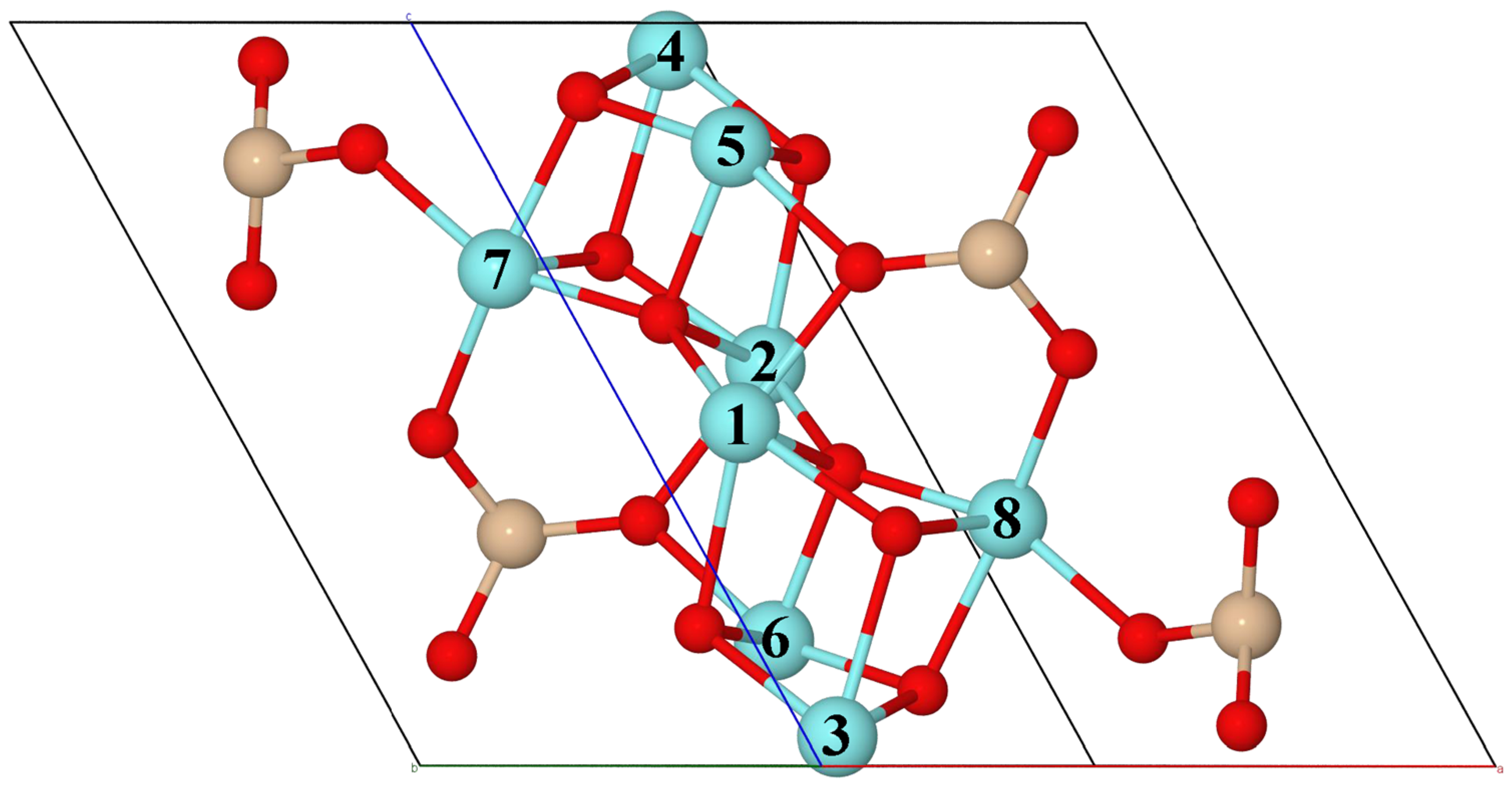
5 with 32 atoms is shown in
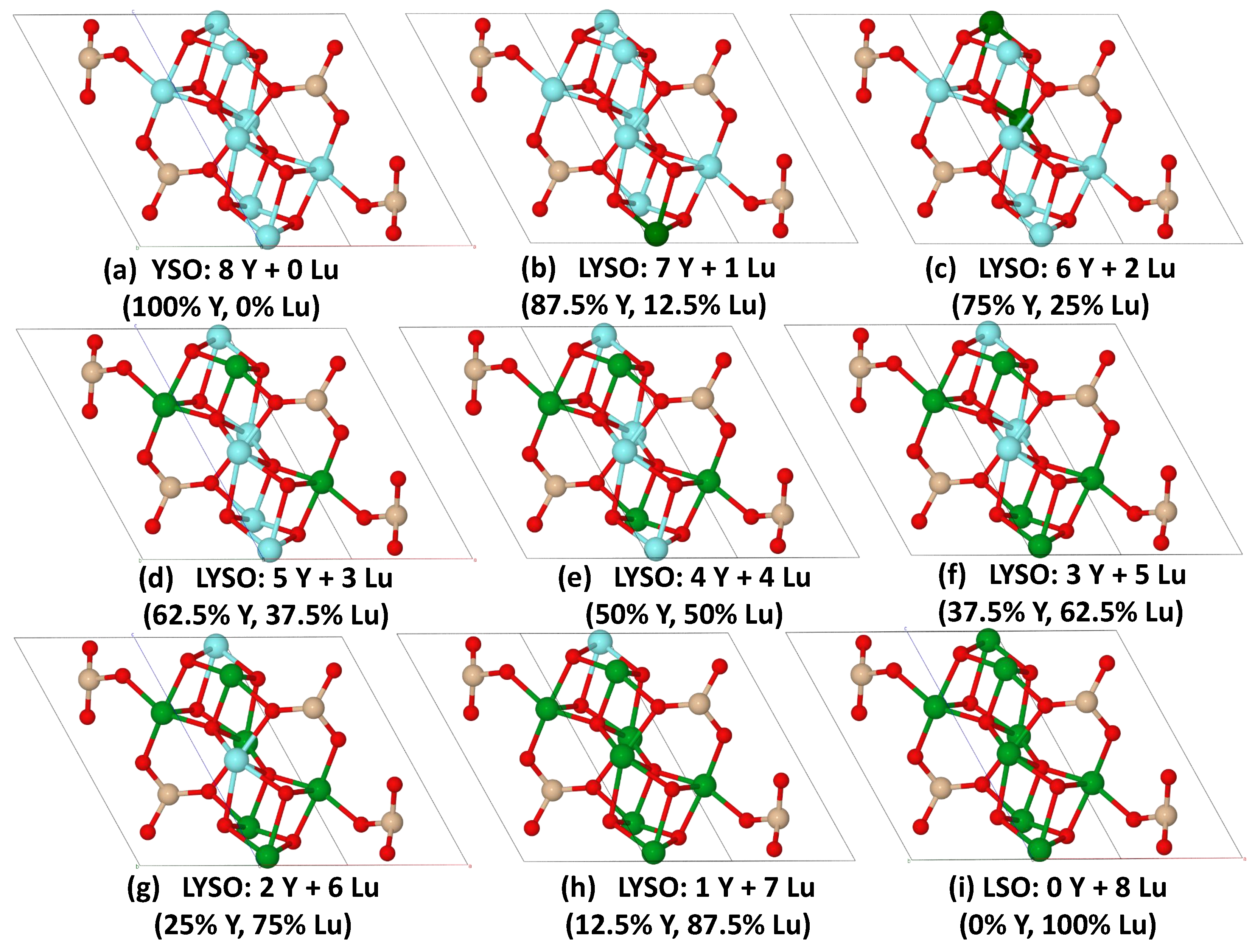
Figure 1. Eight yttrium atoms are substituted with lutetium in different ways, creating Y/Lu substitution patterns and producing 76 symmetry-independent structures in total. For clarity, representative lowest-energy configurations for each Y/Lu composition are shown in
Figure 2. It should also be noted that the eight rare-earth sites in the primitive cell are not equivalent: they form two crystallographically distinct sets, sites 5–8 and 1–4 in
Figure 1. Sites 5–8 correspond to sixfold-coordinated Y/Lu environments, commonly denoted in the literature as RE2, whereas sites 1–4 correspond to sevenfold-coordinated environments, commonly denoted as RE1 [
54,
55,
57].
3. YSO, LYSO, and LSO Elastic Properties
Since the present study is focused on a systematic ab initio description of the elastic properties of LYSO solid solutions, it is instructive to first summarize the existing experimental and theoretical data available for the YSO–LSO compounds and their lightly substituted variants. Previous studies have employed a variety of experimental techniques, including nanoindentation, impulse excitation, bending tests, and heat-treatment analyses, as well as first-principles calculations, to characterize elastic moduli, hardness, fracture behavior, and elastic anisotropy of rare-earth oxyorthosilicates.
This section provides a concise overview of earlier work on the elastic properties of YSO, LYSO, and LSO crystals. Particular attention is paid to the reported values of Young’s modulus, shear and bulk moduli, Poisson’s ratio, and elastic anisotropy, as well as to the microscopic bonding mechanisms responsible for the observed mechanical behavior.
Nano-indentation experiments applying a controlled load to the crystal surface revealed that LYSO exhibits an average hardness of 11.18 ± 0.50 GPa and a Young’s modulus of 155.78 ± 4 GPa. Notably, the modulus remains consistent even as the indentation load increases, underscoring the material’s suitability for applications demanding precision [
42].
According to the findings reported by Sun et al. using the impulse-excited resonance method, YSO exhibits a Young’s modulus of approximately
GPa and a shear modulus of 47 GPa [
35]. The bulk modulus is 108 GPa, and the Poisson’s ratio is 0.31. These values suggest that YSO has relatively low stiffness and shear resistance compared with other ceramic materials. Vickers microhardness testing applying loads up to 50 N demonstrated a hardness of 5.3 ± 0.1 GPa, and the Chevron-notched beam method was used to measure the fracture toughness, which was 1.85 ± 0.17
. The DFT calculations were also employed to investigate the equilibrium crystal structure and bonding characteristics of YSO using the CASTEP code. The equilibrium crystal structure of YSO was determined by applying Vanderbilt-type ultrasoft pseudopotentials and the generalized gradient approximation for geometry optimization. The analysis revealed that the Si–O bonds within the -SiO
4− tetrahedra exhibit strong covalent character. In contrast, the Y–O bonds are relatively weaker. The primary factor contributing to YSO’s low resistance to shear deformation is attributed to the bonding characteristics, particularly the weak Y–O bonds within the -YO
6− and -YO
7− polyhedra. Conversely, the rigid -SiO
4− tetrahedra remain relatively unaffected by mechanical strain, allowing for energy dissipation through mechanisms such as micro-cleavage and crack deflection. A more recent experimental study by Wagner et al. [
63] characterized the temperature-dependent elastic response of Eu
3+:Y
2SiO
5 single crystals using mechanical spectroscopy, reporting a room-temperature Young’s modulus of ∼150 GPa and a zero-temperature extrapolated value of
GPa, together with a Debye temperature of
K derived from the temperature dependence of elastic resonances.
The Young’s modulus of polycrystalline LSO and YSO has been measured experimentally with the impulse excitation technique to be ∼172–176 GPa and 155 GPa, respectively [
40,
64], indicating that LSO is slightly stiffer. Bending and tensile tests on Czochralski-grown Lu
1.8Y
0.2SiO
5:Ce single crystals yielded Young’s moduli in the range of 129–186 GPa, with an average of ∼180 GPa [
41,
56]. The monoclinic symmetry of both compounds, combined with the structural contrast between the rigid SiO
4 tetrahedra and the softer rare-earth–oxygen polyhedra (LuO
6/YO
6 and LuO
7/YO
7), gives rise to a pronounced directional dependence of the elastic stiffness constants. Theoretical second-order elastic constants calculated using the CASTEP code were derived from stress–strain relationships obtained using DFT calculations with ultrasoft pseudopotentials and the local density approximation (LDA) [
39]. The authors reported single-crystal elastic constants for both Lu
2SiO
5 and Y
2SiO
5; the corresponding effective polycrystalline Young’s moduli, obtained from Voigt–Reuss–Hill averaging, are 167 and 150 GPa, respectively. For LSO, the directional Young’s modulus exhibits significant anisotropy, ranging from 115 GPa in the least stiff direction to 242 GPa in the stiffest direction; a specific directional analysis of Young’s modulus for YSO is not provided in that work. The Poisson’s ratio, a parameter that quantifies the ratio between longitudinal and lateral strain in a material under uniaxial stress, is 0.25 for both YSO and LSO compounds [
39].
The mechanical interpretation of four-point bending measurements on LYSO single-crystal square cross-section prisms was provided by Davì and Rinaldi [
7], who formulated an anisotropic Saint-Venant-type model for monoclinic LYSO specimens and related the measured extensional Young-type modulus to the elastic moduli of the monoclinic crystal. This theoretical treatment was motivated by, and builds on, the earlier experimental work of Scalise et al. [
41], where the ultimate tensile strength and Young’s modulus of LYSO:Ce single-crystal samples were measured by a four-point bending method along the [010] tensile direction. For LYSO containing 10% yttrium, the Young’s modulus was measured using a four-point bending test, yielding an average value of 180 GPa. The crystals displayed brittle elastic behavior and significant anisotropy due to their monoclinic structure, where the elastic response is heavily dependent on the crystallographic orientation. Measurements of ultimate tensile strength (the maximum stress that a material can withstand while being stretched or pulled before breaking) exhibited substantial variability, ranging from 68 MPa to 115 MPa, which was attributed to material defects and differences in annealing. Interestingly, the annealing process appeared to reduce the homogeneity of both the ultimate tensile strength and Young’s modulus, suggesting a detrimental impact of annealing on the overall mechanical performance of the crystals [
41].
Density functional theory calculations using the Vienna
Ab initio Simulation Package (VASP) were performed in Ref. [
40] employing the GGA and projector-augmented wave basis set. The elastic properties of rare-earth oxyorthosilicate compounds (RE
2SiO
5) with space group No. 15 crystal structures were investigated, where RE includes Y, Lu, Tb, Dy, Ho, Er, Tm, and Yb. From the 13 independent elastic constants, the Voigt–Reuss–Hill averaging method was used to calculate the bulk modulus, shear modulus, and Young’s moduli. Due to the crystal’s anisotropy, the minimum and maximum Young’s moduli were considered for each compound. The ratio of the maximum to minimum Young’s modulus in different crystallographic directions is approximately 2 for all RE
2SiO
5 compounds, indicating significant directional variations in stiffness. Among the maximum Young’s modulus values, lutetium oxyorthosilicate exhibits the highest value of 229 GPa, while yttrium oxyorthosilicate shows the lowest value of 183 GPa. Among the minimum values, LSO has the second-highest modulus, slightly lower than Tm
2SiO
5 (127 GPa), while YSO belongs to the compounds with the lowest Young’s moduli (113 GPa), slightly exceeding Yb
2SiO
5 (111 GPa) and Tb
2SiO
5 (108 GPa). The differences in elastic stiffness are attributed to the contraction of the RE
3+ ionic radius, which strengthens the RE–O bonds and enhances material rigidity. Poisson’s ratio varies slightly among the materials, with typical values around 0.20–0.25. Additionally, the longitudinal and transverse sound velocities were derived from the elastic moduli, and these were used to calculate properties such as the Debye temperature. Their study demonstrated a clear increase in elastic stiffness with decreasing ionic radius of the RE
3+ cation and highlighted the key role of relatively soft RE–O polyhedra in controlling the mechanical response, while rigid SiO
4 tetrahedra remain largely unaffected. However, that work focused exclusively on stoichiometric end-member compounds and did not address configurational effects or compositional disorder in YSO–LSO solid solutions, which are central to the present study.
A complementary experimental study by the same group [
64] focused specifically on dense polycrystalline Lu
2SiO
5 fabricated by in situ hot pressing/reaction sintering at 1500 °C. The room-temperature Young’s modulus, bulk modulus, shear modulus, and Poisson’s ratio of Lu
2SiO
5 were reported as
GPa,
GPa,
GPa, and
, respectively, providing an independent and self-consistent set of elastic parameters for the LSO end-member. Vickers microhardness was found to plateau at ∼
GPa for indentation loads above 30 N, while the fracture toughness measured by the single-edge notched-beam method was
and the four-point bending strength was
MPa. Both fracture toughness and bending strength of LSO are higher than the corresponding values reported for Y
2SiO
5 [
35], in line with the expected stiffening upon Y to Lu substitution. The Young’s modulus of Lu
2SiO
5 retained
of its room-temperature value at 1377 °C, demonstrating excellent high-temperature elastic stability.
Mirzai et al. employed DFT with the GGA functional, as implemented in the VASP code, to investigate the effects of europium (Eu
3+) doping on the mechanical and thermodynamic properties of YSO [
38]. The elastic constants were determined using both stress–strain and strain–energy methods. The undoped YSO crystal exhibited a bulk modulus of 105.56 GPa, a shear modulus of 59.66 GPa, and a Young’s modulus of 150.61 GPa, with a Poisson’s ratio of 0.262, indicating moderate stiffness and mechanical stability. Additionally, the researchers calculated the Debye temperature (
K for undoped YSO) and a spatial representation of Young’s modulus for the material.
Jang et al. investigated the thermal behavior and mechanical characteristics of YSO following isothermal heat treatment at varied temperatures and durations [
65]. The as-sprayed samples displayed a Martens hardness of 4.8 GPa and a Young’s modulus of 127 GPa. Both properties exhibited a steady increase, reaching up to 5.8 GPa and 155 GPa, respectively, with prolonged heat treatment times and higher treatment temperatures. This enhancement was attributed to improved crystallization and the formation of monoclinic
-Y
2O
3 phases.
LYSO:Ce single crystals were grown from the melt using the Czochralski technique, with a nominal composition of Lu
1.8Y
0.2SiO
5:Ce [
56]. The cerium concentration in the melt was maintained below 1 atomic percent. The results demonstrate that thermal annealing at 300 °C for 10 h influences the mechanical properties of the crystals. The ultimate tensile strength and Young’s modulus were found to range from 68–114 MPa and 129–186 GPa, respectively. The crystallographic structure of the samples was investigated through X-ray diffraction and neutron diffraction analyses.
5. Results and Discussion
5.1. Structural Properties of YSO–LSO Solid Solutions
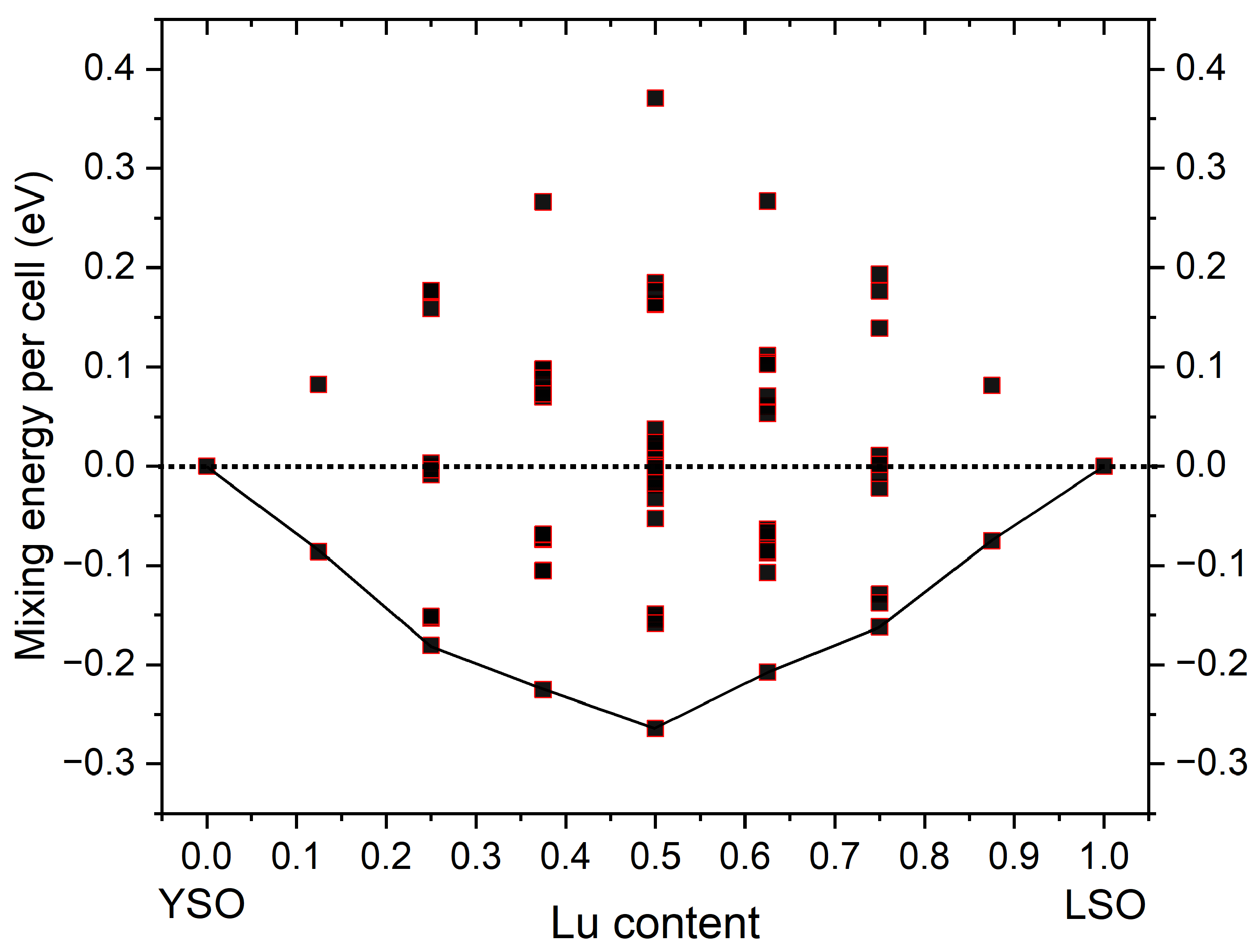
Figure 3 shows the mixing energies of YSO and LSO, calculated with respect to pure compound energies as follows:
where
is the total energy of the solid solution,
and
are the total energies of pristine yttrium and lutetium orthosilicates, respectively, and
is the Lu fraction on the rare-earth sublattice, ranging from 0 for YSO to 1 for LSO.
Out of the 76 symmetry-independent optimized configurations, 41 exhibit mixing energies that are zero or negative, indicating an energetic stabilization upon Y/Lu substitution and implying thermodynamic favorability of these configurations.
To estimate the thermodynamic behavior of the system, additional data on the vibrational contribution to the free energy for selected configurations (including pure YSO, LSO, and representative lowest-energy solid solutions) are provided in the
Supplementary Information (Excel file S3). The results show that the inclusion of vibrational (−TS) contributions at 300 K modifies the relative energies by approximately 10 meV on average, while preserving the energetic ordering of configurations. Therefore, the conclusions based on the total-energy calculations remain valid for larger temperatures.
Table 2 summarizes the structural parameters of the lowest-energy configurations as a function of Lu concentration and substitution pattern. Multiplicity
M denotes the number of crystallographically equivalent Y/Lu substitution configurations. In other words, it counts how many distinct atomic arrangements are generated by symmetry operations of the parent crystal that have identical total energy and structural parameters. It reflects the configurational degeneracy of a given substitution pattern. Probability
P represents the Boltzmann probability of finding a specific substitution configuration at
T = 293 K. It is calculated from the relative total energies of all symmetry-independent configurations at the same composition, taking into account their multiplicities.
The mass density of each configuration was calculated using the equilibrium unit-cell volume from
Table 2 and the corresponding chemical composition of the conventional monoclinic unit cell in the B2/b setting. The conventional unit cell contains eight formula units (
) of
(
), i.e., 16 rare-earth cations, 8 Si atoms, and 40 O atoms.
In
Table 2, the parameter
(ranging from 0 to 8) denotes the number of substituted Lu atoms among eight symmetry-distinct rare-earth sites in the configurational model. Therefore, the total number of Lu and Y atoms in the conventional unit cell is given by
The mass of the unit cell was computed as
where
are the atomic molar masses and
is Avogadro’s number.
Finally, the mass density was obtained from
where the equilibrium unit-cell volume
V is taken from
Table 2 and converted from Å
3 to cm
3. This approach yields an individual density value for each symmetry-independent configuration.
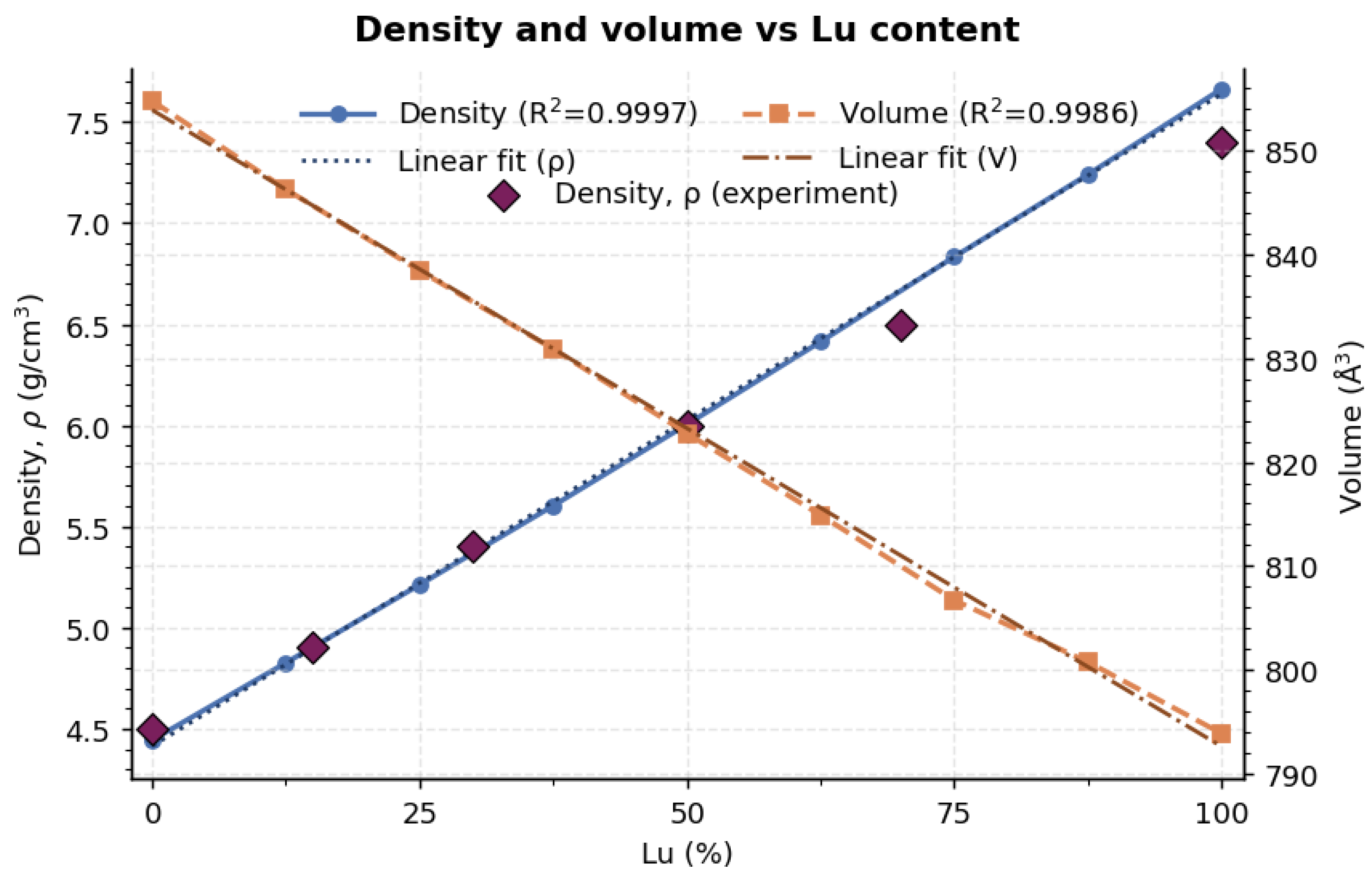
The obtained density values agree well with the reported values equal to 4.5 g/cm
3 for YSO [
26,
81,
82], 7.4 g/cm
3 for LSO [
26,
81,
83,
84] and 4.9–6.5 g/cm
3 for different LYSO variations [
26]. The unit-cell volume exhibits a pronounced decrease with increasing Lu content, from 854.7 Å
3 for the Lu-free structure to 793.9 Å
3 for the fully substituted composition.
Both dependencies (density
and conventional unit-cell volume
V as functions of Lu content) are shown in
Figure 4. The available experimental density data is also included and shows good agreement with the calculated trend.
The linear trends observable in the figure were obtained using a least-squares linear regression of the form
where
x is the Lu content (in at.%) and
y corresponds to either the density
or the unit cell volume
V.
The fitting parameters k (slope) and d (intercept) were determined by minimizing the sum of squared residuals between the calculated data points and the linear model. In practice, this was implemented using a first-order polynomial fit (NumPy polyfit).
The quality of the fit was evaluated using the coefficient of determination
, defined as
where
are the calculated values,
are the fitted values, and
is the mean of the dataset.
The obtained high values ( for the density and for the unit cell volume) indicate an almost perfectly linear dependence of both density and unit cell volume on the Lu content.
This trend is consistent with Vegard’s law, which predicts a linear dependence of a structural parameter on composition,
where
, and
and
denote the unit-cell volumes of the Y-rich and Lu-rich end members, respectively.
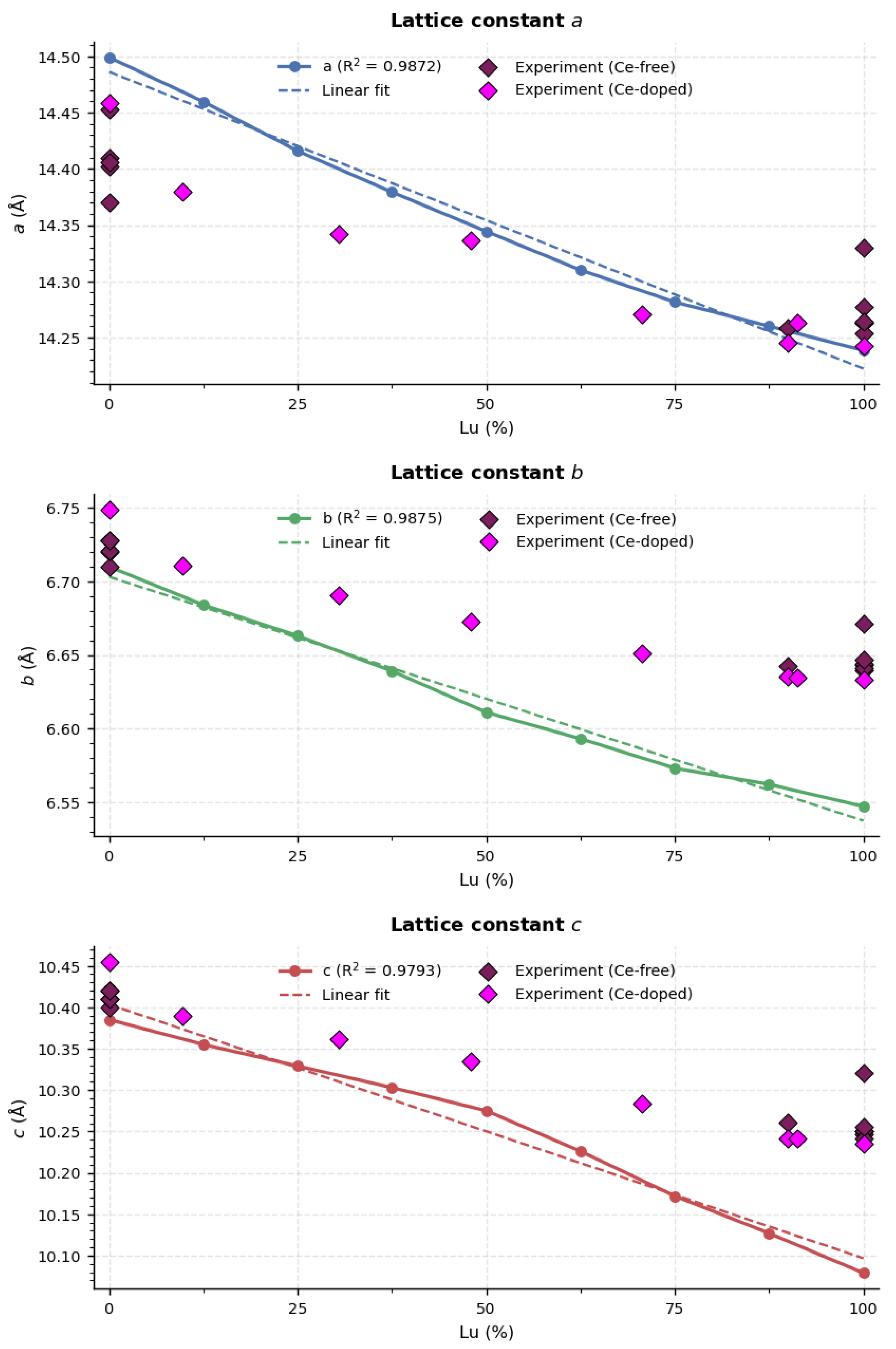
A similar Vegard-like behavior is observed for the lattice parameters
a,
b, and
c, which decrease smoothly and monotonically with increasing Lu content, as illustrated in
Figure 5. The calculated values agree well with the available experimental data from
Table 1: the monotonic decrease of
a,
b, and
c is correctly reproduced, while the monoclinic angle
remains nearly composition-independent and falls within the experimental scatter. The absence of discontinuities or anomalous changes across the entire compositional range indicates that Lu substitution does not induce structural instabilities or symmetry breaking, but instead results in a uniform lattice contraction driven by the smaller ionic radius of Lu
3+ compared with Y
3+, with the high
values (
= 0.9872 for
a,
= 0.9875 for
b, and
= 0.9793 for
c) which confirm an excellent linear description of all considered structural parameters. Despite accurately reproducing the overall trend for LSO, the calculated theoretical values are slightly lower (within about 5%) than those obtained from experimental measurements.
The lattice angles , , and remain nearly constant, with deviations below approximately 0.5°. This points to the fact that for YSO–LSO compounds, changes in bond lengths are more important than bond angles that preserve the monoclinic crystal framework.
From a thermodynamic perspective, most compositions are dominated by a single configuration with probability at 293 K, indicating a well-defined ground state. However, for intermediate compositions ( and 0.75), several configurations lie within a narrow energy window, leading to a redistribution of probabilities among multiple substitution patterns.
The preferred substitution patterns evolve systematically with Lu content. At low concentrations, Lu
3+ ions occupy both seven- and six-coordinated sites, resulting in mixed substitution patterns that minimize local strain. At intermediate compositions, multiple competing configurations with different distributions of Lu over the two crystallographically distinct sublattices become energetically comparable, giving rise to a configurationally sensitive regime. At higher Lu contents (
), the lowest-energy configurations increasingly favor occupation of the more compact six-coordinated sites, leading to a more uniform and clustered arrangement of Lu ions within the rare-earth framework (see
Figure 2). Despite this clustering tendency, the macroscopic lattice parameters remain well described by Vegard’s law, indicating efficient strain accommodation within the crystal lattice.
Table 3 shows the statistical characteristics of Y–O and Lu–O interatomic distances within the considered coordination shells in YSO–LSO solid solutions. The average Y/Lu–O distances decrease nearly monotonically with increasing Lu content, from ∼2.36 Å in YSO to ∼2.27 Å in LSO, reflecting the smaller ionic radius of Lu
3+ and the resulting lattice contraction.
At intermediate compositions, Y–O bonds remain systematically longer than Lu–O bonds, indicating the persistence of distinct local coordination environments rather than a fully averaged rare-earth sublattice. The spread between minimum and maximum bond lengths decreases toward Lu-rich compositions, pointing to a more compact and less deformable Lu–O polyhedral network.
A comparison of our results for Y–O bond lengths in YSO with the data of Ching et al. [
85] shows good agreement. Using the orthogonalized linear combination of atomic orbitals (OLCAO) method, Ching et al. quantified the strength of individual Y–O contacts through the Mulliken bond order
, calculated from the eigenvector coefficients and the inter-orbital overlap matrix in a minimal-basis representation (Equation (
2) and Table III of Ref. [
85]). In their structural model, the seven-coordinated Y1 site exhibits Y–O distances ranging from 2.199 to 2.604 Å, whereas the six-coordinated Y2 site has a narrower range of 2.203–2.287 Å. The longest Y1–O2 contact, 2.604 Å, has the smallest Mulliken bond order,
, substantially lower than most other Y–O bond orders (
–0.19). This long and weak contact corresponds to the outermost oxygen in the sevenfold-coordinated Y1 polyhedron and may therefore be regarded as a weak peripheral contact rather than as one of the dominant Y–O bonds. Excluding this bond, the remaining Y–O distances reported by Ching et al. lie within approximately 2.20–2.37 Å, in close agreement with the Y–O bond-length range obtained in the present work (
Table 3).
Minor non-monotonic variations of the extreme values at intermediate Lu contents originate from different Y/Lu substitution patterns and local strain accommodation. The systematic offset between the average and median Y/Lu–O distances (the mean lying above the median) reflects a right-skewed bond-length distribution: the seven-coordinated RE1 site contributes one long, weak peripheral RE–O contact (up to ∼2.9 Å) that shifts the mean upward relative to the median. This asymmetry is most pronounced for the Y–O distances, consistent with the longer and softer Y–O bonds, and decreases toward the Lu-rich compositions, where the more compact six-coordinated environment narrows the distribution. Overall, the progressive shortening of Y/Lu–O bonds provides a microscopic basis for the increase in elastic stiffness observed with increasing Lu concentration.
5.2. Mechanical Properties of YSO–LSO Solid Solutions
Table 4 summarizes the elastic properties (bulk modulus
K, shear modulus
G, Young’s modulus
Y, and Poisson’s ratio
) obtained from CRYSTAL23 [
66] calculations using the Hill averaging scheme. The relative total energies of different Y/Lu substitution patterns are also listed. With increasing Lu content, the bulk modulus (
,
, and
) generally increases, indicating enhanced lattice stiffness. However, the increase in bulk modulus is non-linear. The bulk modulus displays an increase from approximately 92 GPa for pure YSO to about 115 GPa for pure LSO. The shear modulus (
G) and Young’s modulus (
Y) also generally increase with the increase in Lu% content, suggesting that the material becomes increasingly resistant to shape changes under applied force. In turn, Poisson’s ratio (
) exhibits slight fluctuations as the composition changes.
Table 5 summarizes the elastic properties of the YSO–LSO solid solutions (bulk modulus
K, Young’s modulus
Y, shear modulus
G, and Poisson’s ratio
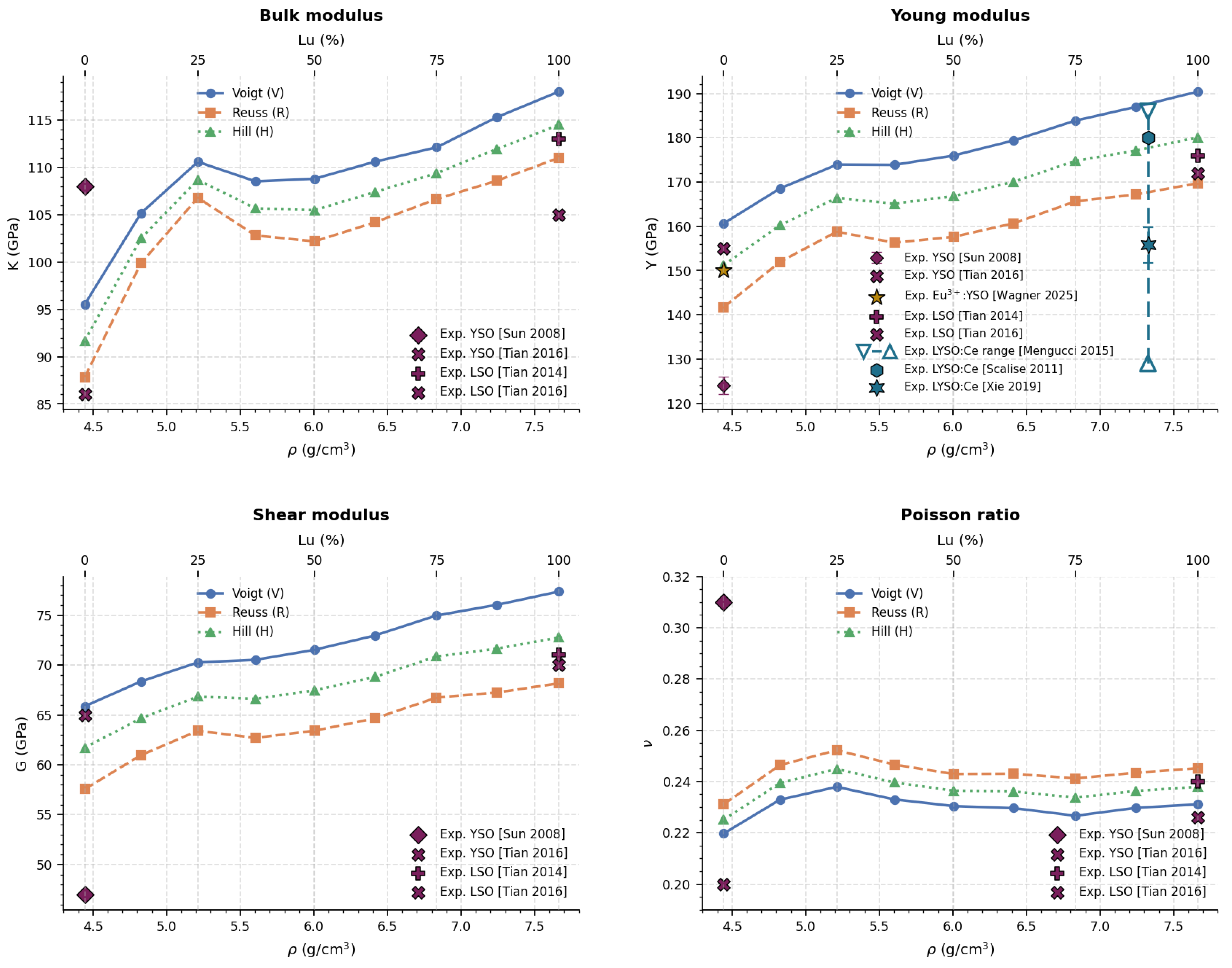
) calculated using Voigt, Reuss, and Hill approximations, averaging schemes derived from the initial elastic constant tensor obtained in CRYSTAL calculations, as implemented in the ELATE online tool [
74]. These trends are also illustrated in
Figure 6. Because Young’s modulus is the most consistently reported property, the detailed quantitative comparison focuses mainly on
Y.
The elastic properties of YSO–LSO solid solutions exhibit clear systematic trends with increasing Lu content . The bulk modulus K, Young’s modulus Y, and shear modulus G all show an overall increase as Lu progressively substitutes Y, indicating a gradual stiffening of the lattice from YSO toward LSO for each Voigt, Reuss, and Hill approximation.
Minor non-monotonic variations are observed at intermediate LYSO compositions (notably around
. Non-monotonicity observed for the elastic moduli and Poisson’s ratio at intermediate Lu concentrations, with the local maximum at 25% Lu content, reflects the configurational nature of the Y/Lu solid solution. The substitution of Y by the smaller Lu cation generally shortens the Y/Lu–O bonds and increases the stiffness of the rare-earth–oxygen polyhedral framework. However, at intermediate compositions, the elastic response depends not only on the total Lu content but also on the occupation of the two crystallographically distinct rare-earth sublattices. In the present structural model, two crystallographically inequivalent Y/Lu positions are present: sites 1–4 correspond to the seven-coordinated Y/Lu positions, whereas sites 5–8 correspond to the six-coordinated Y/Lu positions. At low Lu concentrations, substitution occurs at both seven-coordinated and six-coordinated sites, as evidenced by the mixed substitution patterns in
Table 2. With increasing Lu content, the lowest-energy configurations increasingly favor six-coordinated sites 5, 6, 7, and 8. This crossover from mixed to preferential six-coordinated site occupation introduces a transitional compositional regime in which the elastic response reflects competing contributions from Lu at both sublattices, locally suppressing the monotonic stiffening trend.
5.3. Directional Elastic Properties of YSO–LSO Solid Solutions
Table 6 presents the directional elastic properties of YSO–LSO solid solutions as a function of Lu concentration
, including the minimum and maximum values of Young’s modulus
Y, linear compressibility
, shear modulus
G, and Poisson’s ratio
, together with the corresponding anisotropy factors obtained in the ELATE online tool [
74]. Additional visualization of spatial elastic properties is provided in the
Supplementary Information (S1).
The results reveal pronounced elastic anisotropy across the entire compositional range. For all compositions, the ratio between the maximum and minimum values of Young’s modulus reaches ∼2, indicating a strong directional dependence of the stiffness. While the minimum values of Y increase moderately with Lu content, the maximum values exhibit a clearer monotonic increase from YSO to LSO, reflecting the overall stiffening of the lattice upon substitution of Y by Lu.
A similar anisotropic behavior is observed for the shear modulus G, with anisotropy factors remaining in the range of approximately 2.2–2.5. Both the minimum and maximum shear moduli increase with increasing , consistent with the trends obtained from the Hill-averaged elastic constants. In contrast, the linear compressibility shows the opposite trend: its minimum and maximum values generally decrease toward the LSO compound, indicating reduced compressibility and enhanced resistance to volume deformation with increasing Lu content.
Poisson’s ratio exhibits a relatively narrow variation in its maximum values, remaining close to –0.56 for all compositions. Notably, the minimum values of Poisson’s ratio are negative for all compositions , which indicates the presence of direction-dependent auxetic behavior in the YSO–LSO solid-solution series. This effect does not imply that the materials are globally auxetic; rather, it reflects a highly anisotropic elastic response in which specific crystallographic directions or deformation modes exhibit lateral expansion under uniaxial loading. Such local auxeticity is typically associated with the underlying crystal topology and the anisotropic connectivity of polyhedral units in low-symmetry lattices. In the YSO–LSO system, the coexistence of rigid SiO4 tetrahedra and more deformable rare-earth–oxygen polyhedra may be associated with nontrivial deformation mechanisms, including polyhedral rotations and hinge-like motions, which enable negative transverse strain in selected directions. The persistence of negative across the entire compositional range suggests that these mechanisms are intrinsic to the crystal framework and are not suppressed by Lu/Y substitution.
A comparison between our calculated elastic properties presented in this section and the literature data summarized in
Section 3 demonstrates overall good qualitative and quantitative agreement, particularly when the differences between single-crystal, polycrystalline, and coating samples, as well as between direct (resonance, bending, tensile) and indirect (nanoindentation) techniques, are taken into account.
For YSO, the Hill-averaged Young’s modulus obtained in this work (
GPa) lies within the experimental scatter reported in the literature. Sun et al. [
35] measured
GPa on dense polycrystalline YSO using the impulse-excited resonance method, while Tian et al. [
40] reported
GPa on YSO polycrystals obtained by the same technique. Plasma-sprayed YSO coatings studied by Jang et al. [
65] exhibited a lower as-sprayed Young’s modulus of
GPa, increasing up to
GPa after isothermal heat treatment due to improved crystallinity and the formation of the monoclinic
-Y
2O
3 phase.
Recent mechanical-spectroscopy measurements on Eu
3+:YSO single crystals [
63] yielded a room-temperature Young’s modulus of ∼150 GPa and a zero-temperature extrapolated value of
GPa, together with a pronounced mode-dependent elastic response. The latter is consistent with the picture established by Sun et al. [
35] and Tian et al. [
40], in which the relatively weak RE–O bonds govern shear deformation and acoustic dissipation, while the rigid SiO
4 tetrahedra remain largely unaffected. Our value of
GPa is also consistent with previous DFT results for stoichiometric YSO (
–152 GPa) [
38,
39,
40].
The calculated shear modulus for YSO (
GPa) is noticeably higher than the resonance-based experimental estimate of ∼47 GPa [
35]. This discrepancy is consistent with the strong directional dependence of the shear stiffness, with directional shear moduli ranging from ∼37 to ∼90 GPa in the present calculations (
Table 6), and reflects the difference between an orientation-averaged Hill estimate for an idealized polycrystal and a measurement performed on a real sample with finite texture and porosity. The agreement with the theoretical values obtained by Tian et al. (
GPa,
GPa,
GPa) [
40] is, by contrast, excellent.
For LSO, our Hill-averaged shear modulus (
GPa) agrees closely with the experimentally derived values of 71 GPa from Tian et al. [
64] and ∼70 GPa from the X2-RE
2SiO
5 series [
40], providing further validation across the LSO end-member.
The calculated bulk modulus for YSO (
GPa) lies between the experimental value of ∼86 GPa reported by Tian et al. from impulse excitation [
40] and the value of ∼108 GPa derived from the elastic constants measured by Sun et al. [
35], and is consistent with previously reported DFT values of 100–106 GPa [
38,
40]. This spread is in line with the typical variation among different DFT methodologies and the well-known tendency of GGA-type functionals to overestimate the bulk modulus relative to experiment slightly.
For LSO, our Hill-averaged value (
GPa) agrees closely with the experimentally derived value of
GPa reported by Tian et al. [
64] and with the VASP/GGA value of
GPa from [
40], while the impulse-excitation estimate of
GPa from the X2-RE2SiO5 series [
40] is somewhat lower.
The calculated Young’s modulus for LSO and Lu-rich LYSO compositions (
–180 GPa) is in good agreement with the available experimental data for polycrystalline and single-crystal Lu-containing oxyorthosilicates. In particular, Tian et al. [
64] reported
GPa,
GPa,
GPa, and
for dense polycrystalline Lu
2SiO
5 fabricated by
in situ hot pressing/reaction sintering at 1500 °C, while a subsequent study by the same group on the X2-RE
2SiO
5 series (RE = Tb, Dy, Ho, Er, Tm, Yb, Lu, Y) yielded
GPa for Lu
2SiO
5 prepared by two-step reactive sintering followed by hot pressing at 1600 °C [
40]. Both independent impulse-excitation measurements lie within a few GPa of our calculated Hill-averaged value of ∼180 GPa. Our prediction also matches the average value of ∼180 GPa reported by Scalise et al. [
41] from four-point bending tests on Czochralski-grown Lu
1.8Y
0.2SiO
5:Ce single crystals (10% yttrium), as well as the range of 129–186 GPa reported on the same set of samples by Mengucci et al. [
56], where the lowest values were correlated with the presence of nanoscale coherent precipitates induced by annealing at 300 °C.
The mean nanoindentation value of
GPa reported by Xie et al. [
42] for LYSO is somewhat lower than our prediction; this is consistent with the known tendency of nanoindentation on anisotropic monoclinic substrates to probe a depth- and orientation-averaged response that systematically underestimates the maximum directional Young’s modulus. Earlier first-principles work [
40] reported even higher maximum directional values, exceeding ∼229 GPa for LSO, in line with the strong anisotropy (
) found in the present study (
Table 6).
Finally, the Poisson’s ratio obtained in our calculations (
–
) falls within the range reported in the literature for YSO, LYSO, and LSO. Experimental values span a broader interval, from
–
reported by Tian et al. [
40] for the X2-RE2SiO5 polycrystalline series and
obtained by the same group for LSO produced by
in situ hot pressing/reaction sintering [
64], to
reported by Sun et al. [
35] from resonance measurements on YSO, while previous DFT studies report
[
39,
40]. The remaining discrepancies between calculated and measured values can be attributed to a combination of elastic anisotropy, differences in averaging schemes, sample-dependent porosity and texture, and the influence of defects, dopants, and thermal history in the experimental samples.
5.4. Sound Velocities and Debye Temperature
Table 7 summarizes the transverse (
), longitudinal (
), and mean (
) sound velocities together with the corresponding Debye temperatures
for the lowest-energy YSO–LSO configurations. To calculate values, we used Equations (
11) and (
12), with the Hill-averaged bulk and shear moduli
and
G (
Table 4), and the density
computed from the equilibrium unit-cell volume (
Table 2). The Debye temperature exhibits a clear and systematic decrease with increasing Lu content, dropping from approximately 518 K for YSO to about 439 K for LSO.
This trend reflects the combined influence of two competing factors: the gradual increase in elastic stiffness (bulk and shear moduli) and the pronounced increase in mass density resulting from the substitution of Y by the heavier Lu cation. Although both and G increase with Lu concentration, the accompanying rise in density dominates the acoustic response, leading to a reduction in all sound velocities and, consequently, in .
For fixed compositions with multiple symmetry-independent configurations, the variations in are relatively small (typically within 5–10 K), indicating that the Debye temperature is only weakly sensitive to the specific Lu/Y substitution pattern. Instead, it is primarily governed by the average composition and associated macroscopic quantities, such as density and elastic moduli. This observation is consistent with the configurational averaging inherent in the Debye model.
The longitudinal sound velocity decreases monotonically from about 6250 m s−1 in YSO to approximately 5250 m s−1 in LSO, while the transverse velocity shows a similar reduction from roughly 3730 m s−1 to about 3080 m s−1. As a result, the mean sound velocity , which directly enters the Debye temperature expression, decreases by nearly 17% across the solid-solution series, in close correspondence with the observed reduction of .
Tian et al. reported calculated elastic moduli, sound velocities, and Debye temperatures for the end-member compositions [
39]. For YSO, Tian et al. reported a Debye temperature of
K, which is in good agreement with our value of
518 K. Similarly, for LSO, Tian et al. obtained
K, which closely matches our calculated value of
439 K for LSO.
A comparison of sound velocities reveals a consistent trend. According to Table 3 in Tian et al. [
39], the mean sound velocity for LSO is lower than that for YSO, reflecting the effect of the higher atomic mass of Lu and the increased heterogeneity of chemical bonding. In our manuscript, the absolute values of the longitudinal
, transverse
, and mean
sound velocities are close to those reported by Tian et al., namely
m/s,
m/s, and
m/s for LSO, and
m/s,
m/s, and
m/s for YSO. The differences do not exceed the typical level expected from the use of different DFT methodologies, namely plane-wave CASTEP calculations versus the LCAO-DFT approach adopted in the present work.
Mirzai et al. also evaluated [
38] Debye temperature
for YSO using the elastic-constant-based approach within the Debye–Anderson model, where the elastic moduli were obtained from plane-wave density functional theory calculations. In that work, longitudinal and transverse sound velocities were derived from the Voigt–Reuss–Hill averaged bulk and shear moduli and the crystal density, and subsequently used to determine
. The Debye temperature of YSO was found to be
K, in good agreement with our theoretical estimates. In addition, a recent experimental study reported a Debye temperature of approximately
K for Eu
3+:YSO single crystals, derived from the temperature dependence of elastic resonances [
63].
Overall, the monotonic evolution of the Debye temperature confirms a progressive softening of lattice vibrational frequencies with increasing Lu content, despite the simultaneous increase in elastic moduli. This behavior is characteristic of solid solutions in which mass effects outweigh stiffness enhancement.
6. Conclusions
We performed systematic ab initio calculations of Y2SiO5-Lu2SiO5 solid solutions across the full compositional range. By explicitly constructing 76 symmetry-independent Y/Lu substitution patterns within a 32-atom primitive cell, both configurational and compositional effects were systematically addressed.
Out of the 76 symmetry-independent configurations, 41 exhibit zero or negative mixing energies, demonstrating the thermodynamic compatibility of Y3+ and Lu3+ on the rare-earth sublattice across the entire YSO–LSO range. The preferred substitution patterns evolve systematically with composition: at low Lu content, Lu3+ ions populate both seven-coordinated (RE1) and six-coordinated (RE2) sites in mixed patterns that minimize local strain, whereas at higher Lu concentrations () the lowest-energy configurations increasingly favor occupation of the more compact six-coordinated RE2 sites, leading to a more uniform and slightly clustered Lu arrangement within the rare-earth framework.
The calculated lattice parameters and unit-cell volumes exhibit a smooth and nearly linear compositional dependence consistent with Vegard’s law, indicating uniform lattice contraction driven by the smaller ionic radius of Lu3+ compared with Y3+. This practically important result shows that lattice parameters of LYSO solid solutions can be reliably estimated by linear interpolation, without pronounced structural anomalies. The Y/Lu–O bond-length analysis reveals that Y–O bonds remain systematically longer than Lu–O bonds even at intermediate compositions, indicating that the two crystallographically distinct rare-earth environments preserve their local identity rather than forming a fully averaged sublattice. The progressive shortening of Y/Lu–O bonds with increasing Lu content provides a microscopic basis for the macroscopic stiffening observed in the elastic response.
Hill-averaged bulk, shear, and Young’s moduli increase overall with increasing Lu content, reflecting progressive lattice stiffening, while Poisson’s ratio remains nearly composition-independent. A non-monotonic local maximum of the elastic moduli is observed near , originating from the crossover between mixed and preferential six-coordinated site occupation in the lowest-energy configurations; this configurational sensitivity cannot be captured by end-member or dilute-doping models and constitutes one of the principal findings of the present work. Despite this smooth macroscopic behavior, pronounced elastic anisotropy is preserved across the entire solid-solution series, with directional Young’s and shear moduli differing by more than a factor of two. Notably, negative minimum values of Poisson’s ratio are found for all compositions, revealing intrinsic direction-dependent auxetic behavior associated with the low-symmetry monoclinic framework and with the coexistence of rigid SiO4 tetrahedra and more deformable RE–O polyhedra.
The mean sound velocity decreases by nearly 17% from YSO to LSO, and the Debye temperature systematically decreases from K at the YSO end to K at the LSO end. This evolution reflects the dominant effect of increasing mass density, which outweighs the concurrent stiffening of the lattice. The Debye temperature is found to be only weakly sensitive (∼5–10 K) to the specific Lu/Y substitution pattern at fixed composition, indicating that vibrational thermodynamics in this system are governed primarily by composition-averaged macroscopic quantities.
Overall, the results provide a comprehensive microscopic picture of how isovalent rare-earth substitution governs structural contraction, elastic stiffness, anisotropy, and lattice dynamics in LYSO solid solutions.