
Article

Collaborative Surface Modification of Alloy Wire and Wheel for Enhanced Photothermal Performance in a Solar-Driven NiTi Rotary Engine

1
School of Future Technology, Shanghai University, Shanghai 200444, China
2
School of Mechanical Engineering, Shanghai Jiao Tong University, Shanghai 200240, China
3
College of Smart Energy, Shanghai Jiao Tong University, Shanghai 200240, China
*
Authors to whom correspondence should be addressed.
These authors contributed equally to this work.
Crystals 2026, 16(6), 373; https://doi.org/10.3390/cryst16060373
Submission received: 22 April 2026 / Revised: 26 May 2026 / Accepted: 26 May 2026 / Published: 2 June 2026
(This article belongs to the Section Inorganic Crystalline Materials)

Abstract

Solar-driven NiTi alloy wire rotary engines are promising for lightweight actuation, but their performance is often restricted by insufficient light absorption of the alloy wire and unstable wheel–wire transmission. In this work, a collaborative surface-modification strategy was developed by combining a CNT/PDA-based photothermal coating on the NiTi alloy wire with a CNT/PDMS-based coating on the wheel surface. To establish a controllable wire-coating process, electrophoretic deposition parameters were first screened on titanium plates using an orthogonal design involving voltage, duty ratio, water content, treatment time, and electrode distance. Among the tested conditions, an electrode distance of 10 mm provided the most favorable balance between coating thickness and microstructural uniformity, while water content and electrode distance were identified as the main factors affecting coating variation. After transfer to the alloy wire, the coating greatly reduced reflectance in the 300–1400 nm range and significantly enhanced photothermal heating, increasing the maximum irradiation temperature by about 30 °C. On the wheel side, PDMS-based surface modification further improved rotational output, and the 1.5 wt% + 10 wt% formulation showed the best performance. In coupled rotation tests, the system with simultaneous wire and wheel modification exhibited the fastest startup and the highest angular velocity, reaching about five times that of the slowest rotating modified group. These results demonstrate that coordinated surface modification of the alloy wire and wheel is an effective route to improving the photothermal response and rotational performance of NiTi alloy wire rotary engines.

1. Introduction

Light-driven and low-grade-heat-driven rotary actuators based on shape memory alloy (SMA) wires have attracted sustained interest because of their simple structure, compact size, and direct conversion of thermal input into mechanical motion [1,2,3,4,5,6,7,8]. Among SMA materials, NiTi alloys are particularly attractive because of their large recoverable strain, high work density, and reliable thermomechanical response [9,10]. These attributes have supported their use in compact rotary actuators [1,4,5,6,7] and in solar- or radiation-driven thermomechanical devices [2,11,12,13,14].
Despite these advantages, the rotational performance of alloy wire engines remains limited by at least two key bottlenecks. First, the alloy wire itself often exhibits insufficient light absorption and limited local heat accumulation, which reduces the thermal contrast required for cyclic contraction and recovery. This issue is especially critical in wire-based rotary systems, where the effective photothermal response directly determines the available actuation output. Second, the contact interface between the wheel and the wire may exhibit unstable traction, local slipping, and inefficient force transmission, thereby impairing startup and continuous rotation. Similar limitations have been reported in SMA engines and wire-driven rotary actuators, in which thermal activation, structural configuration, and transmission conditions jointly affect the attainable motion output [1,3,4,5,6,7].
Existing optimization strategies have mostly addressed these two issues separately. On the one hand, electrophoretic deposition (EPD) has been widely used to assemble CNT-containing coatings on conductive substrates and fibrous supports, providing a practical route to tuning coating thickness, continuity, and microstructure [15,16,17,18,19]. Carbon-based solar-thermal coatings and polydopamine-enabled photothermal layers have also been explored to improve broadband absorption and localized heating efficiency [20,21,22,23,24]. On the other hand, soft interfacial materials such as polydimethylsiloxane (PDMS) have been employed to regulate adhesion, friction, and contact stability in mechanically coupled systems [25]. However, in a continuously rotating wheel–wire system, the photothermal absorption interface and the mechanical transmission interface are intrinsically coupled. Faster wire heating cannot be fully converted into rotational output if wheel–wire transmission remains unstable, whereas improvement of the wheel surface alone cannot compensate for insufficient thermal actuation of the wire. Therefore, a cooperative interfacial strategy is required to improve the overall energy-conversion pathway from irradiation to stable rotary motion.
In this work, a dual-interface collaborative thermal-management strategy is proposed for a solar-driven NiTi alloy wire rotary engine. A carbon-nanotube-based photothermal coating was deposited onto a 0.3 mm-diameter NiTi shape memory alloy wire by EPD to enhance light absorption and accelerate local heating, while a PDMS-modified wheel surface was introduced to improve wheel–wire contact and transmission stability. Different from previous studies that mainly optimized SMA actuator configuration, photothermal conversion, or contact/friction regulation separately, the present work treats the rotary engine as a coupled thermal–mechanical interfacial system. The novelty therefore lies in the simultaneous engineering of two functionally coupled interfaces: the irradiation–absorption interface of the NiTi wire and the mechanical transmission interface between the wheel and the wire. The electrophoretic process was first optimized on titanium plates to establish a controllable coating window, and the selected conditions were then transferred to alloy wires for optical, photothermal, and rotary evaluation. Through wheel-side formulation screening and coupled-rotation experiments, we show that the CNT-based wire coating reduces the reflectance of the alloy wire from approximately 25–30% to below 5% and increases the maximum local temperature from about 27.3 °C to 59.6 °C, while the PDMS-modified wheel surface improves traction stability and torque transfer. As a result, the dual-modified system reaches an angular velocity of approximately 22–24 rad s−1, much higher than the 4–6 rad s−1 obtained from the single-interface modified groups under identical irradiation conditions. These results demonstrate that coordinated optimization of the thermal absorption interface and the mechanical transmission interface provides not only a practical coating route for NiTi wires, but also a system-level design principle for improving startup behavior, rotational output, and operational stability in light-driven alloy wire rotary systems.

2. Experimental Section

2.1. Overall Device Design and Working Principle

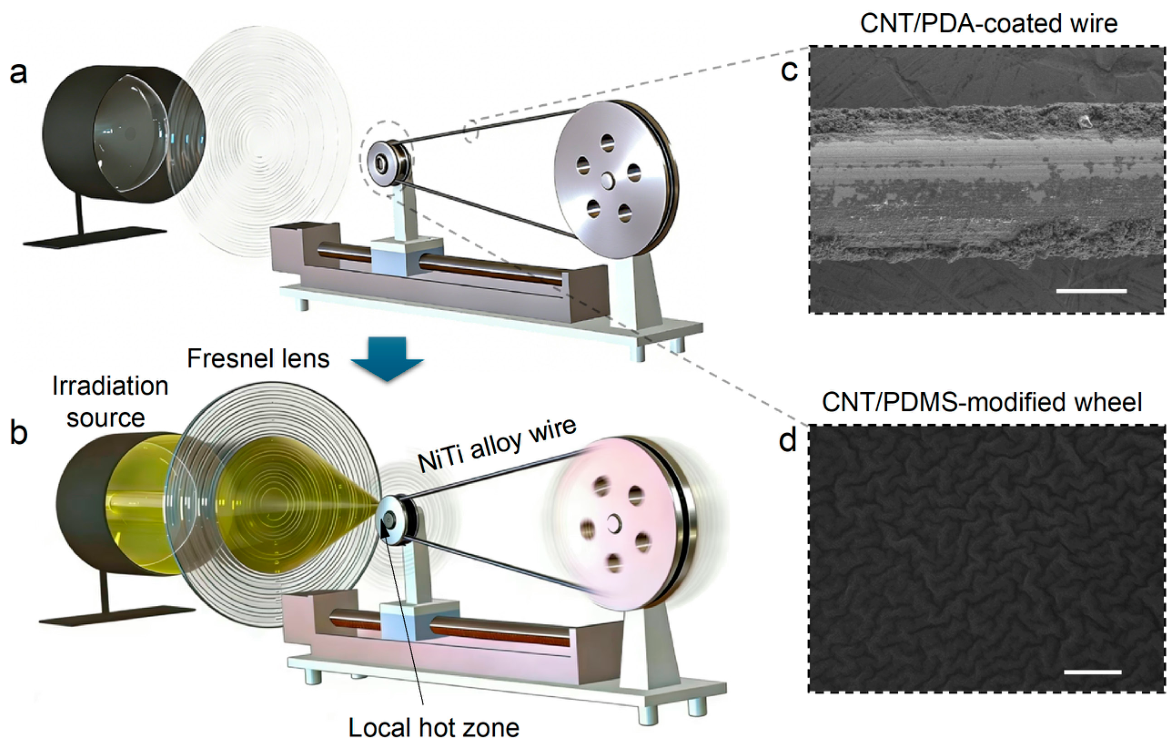
The rotary engine consisted of a 30 mm small wheel and a 75 mm large wheel connected by a looped NiTi shape memory alloy wire with a diameter of 0.3 mm. During operation, incident light was focused by a Fresnel lens onto the wire segment adjacent to the small wheel, establishing a localized hot zone while the remaining loop stayed relatively cool. The resulting temperature gradient induced cyclic contraction and recovery of the NiTi wire, thereby generating asymmetric tension in the loop and driving continuous wheel rotation (Figure 1a,b).
To improve the overall irradiation-to-motion conversion pathway, a dual-interface collaborative thermal-management design was introduced. The alloy wire was coated with a CNT-based photothermal layer to suppress reflectance and accelerate local heating, whereas the wheel surface was modified with a CNT/PDMS-based compliant layer to improve traction and reduce local slip. Representative morphologies of the two functional interfaces are shown in Figure 1c,d. Additional device dimensions, fixture details, and irradiation conditions are provided in the Supplementary Information (Section S1.2 and Figure S2).

2.2. Orthogonal Optimization of the Electrophoretic Coating Process

To establish a controllable coating process before deposition on alloy wires, titanium plates were used as model substrates for parameter screening because their flat geometry facilitates thickness measurement and microstructural evaluation. The use of planar metallic substrates for process-window identification is consistent with common practice in EPD studies of CNT-containing coatings [15,16,17,18]. Four process factors were included in the orthogonal design: voltage, duty ratio, water content, and total treatment time. Each factor was assigned three levels based on preliminary experiments and practical operating limits, as summarized in Table 1 and Table 2.
In addition to the four orthogonal factors, the electrode-to-substrate distance was examined separately as a structural parameter at 10, 15, and 20 mm (Table 3). Deposition quality was evaluated using coating thickness, surface coverage, agglomerate number, agglomerate area, and their corresponding variability metrics. Here, the agglomerate descriptors refer to the number and projected area of aggregated particles identified from optical images.
All electrophoretic experiments were carried out in a pulse-assisted deposition system (Figure S1), in which a carbon rod served as the anode and the titanium plate or the NiTi wire served as the cathode. The nominal effective energized time was defined as the duty ratio multiplied by the total treatment time to enable comparison among pulsed conditions. Based on the combined thickness and image-analysis results, the 10 mm spacing was selected as the preferred deposition window, and the parameter combination corresponding to Run 7 (60 V, duty ratio 0.3, water content 0.15, and treatment time 6 min) was used for the subsequent alloy wire coating. Detailed bath preparation and circuit information are given in the Supplementary Information (Sections S1.4 and S1.5). The overall process design follows the general EPD principles and CNT-coating strategies reported in previous studies [15,16,17,18,19].

2.3. Preparation and Characterization of Coated Alloy Wires

After the process window had been identified on titanium plates, the selected electrophoretic conditions were transferred to commercial NiTi alloy wires. The coated wires were then characterized in terms of surface morphology, optical response, and photothermal behavior, and detailed pretreatment, instrument information, and characterization setups are provided in the Supplementary Information (Sections S1.5 and S1.6; Figures S2–S4).
Reflectance spectra were collected in the 300–1400 nm range with a 5 nm step size using an integrating sphere and a standard white reference. Optical micrographs were acquired at 500× under identical illumination conditions, and SEM observations were performed at 2–6 kV without sputter coating. Independent photothermal tests were conducted under fixed 808 nm irradiation with the light source positioned approximately 30 cm from the sample, and the maximum apparent temperature in the irradiated region was used for comparison in infrared thermography.

2.4. PDMS Coating of the Wheel Surface

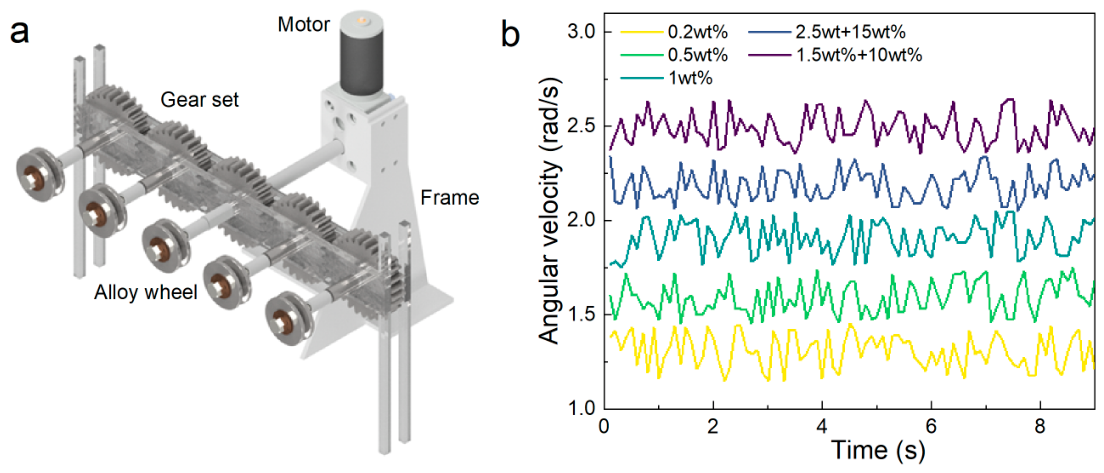
To optimize the mechanical transmission interface, PDMS-based coatings with different CNT/diluent formulations were applied to the wheel surface and compared using a multi-wheel screening setup. The primary purpose of this screening was to identify a wheel-side coating that improved contact conformity and traction stability under otherwise identical driving conditions.
The wheel angular velocity extracted from video recordings was used as the main metric for formulation comparison (see also below in Section 3.4). For clarity, the notation x wt% + y wt% denotes x wt% CNT content and y wt% diluent content relative to the total mass of the coating mixture; the detailed definition is provided in the Supplementary Information (Section S1.7).

2.5. Coupling Experiments and Motion Analysis

The final system-level verification was carried out using four groups: unmodified, wheel-only coating, wire-only coating, and simultaneous wheel + wire coating. For each group, the startup process and continuous rotation behavior were recorded by video, and representative sequences are discussed in Section 3.5 and provided in Supplementary Videos S1 and S2. Each group was tested three times, and the angle–time and angular velocity curves represent averaged results.
The rotation angle and angular velocity were extracted from the recorded videos using frame-by-frame tracking of the wheel motion. Both short-term startup behavior and longer-term rotational stability were evaluated. Detailed recording parameters and the tracking workflow are provided in the Supplementary Information (Section S1.8 and Figure S5).

2.6. Data Analysis

Coating thickness, surface coverage, agglomerate count, and agglomerate area were used as quantitative descriptors for process evaluation. For the titanium-plate orthogonal screening, coating thickness was measured at 3 positions for each sample, and 2 representative optical micrographs were analyzed for each condition under identical magnification and illumination. Surface coverage, agglomerate count, and agglomerate area were extracted from grayscale-processed optical images using a threshold-based image-analysis procedure.
For the orthogonal screening results, standardized metrics and contribution-to-variance analyses were used to evaluate the relative influence of voltage, duty ratio, water content, treatment time, and electrode-to-substrate distance on the deposition outcomes. The relative contribution of each process factor was calculated as
P j = S S j S S j × 100 %
where P j is the relative contribution of factor j , and S S j is the corresponding sum of squares obtained from the level-mean response. In this analysis, the process parameters were treated as input variables, while coating thickness and image-derived descriptors were treated as response variables. The contribution-to-variance results were used as a sensitivity-style analysis to identify the dominant process factors and their relative importance.
No machine-learning algorithm was used in this study. The term “tracking feature” refers only to the visual marker or local image region used for video-based motion tracking, rather than to a machine-learning input feature. Therefore, no training dataset, target variable, model training, or prediction procedure was involved.
For the rotational experiments, each group was tested three times under identical irradiation and recording conditions. The angle–time and angular-velocity–time curves were extracted from frame-by-frame video tracking, smoothed before differentiation, and averaged for comparison. For the coupled-rotation groups, a simplified rotational-energy analysis based on the effective wheel inertia and the measured angular velocity was additionally used to compare relative mechanical-output levels under identical testing conditions.

3. Results

3.1. Dual-Interface Collaborative Design of the Rotary Engine

Figure 1 summarizes the conceptual framework of the present work. Figure 1a,b illustrate the device configuration before and during irradiation, respectively, showing how focused heating near the small wheel generates a localized thermal asymmetry that drives rotation. Figure 1c,d further present representative surface morphologies of the coated alloy wire and the CNT-modified PDMS wheel layer, highlighting that both the thermal-input interface and the mechanical-transmission interface were deliberately engineered.
The key design logic is therefore collaborative rather than additive. The wire-side coating enhances light harvesting and local heat localization, whereas the wheel-side coating stabilizes contact, increases conformal traction, and suppresses intermittent slip. By coupling these two functions in one rotary system, more of the absorbed irradiation can be converted into sustained rotational output.

3.2. Optimization of the Electrophoretic Process on Titanium Plates

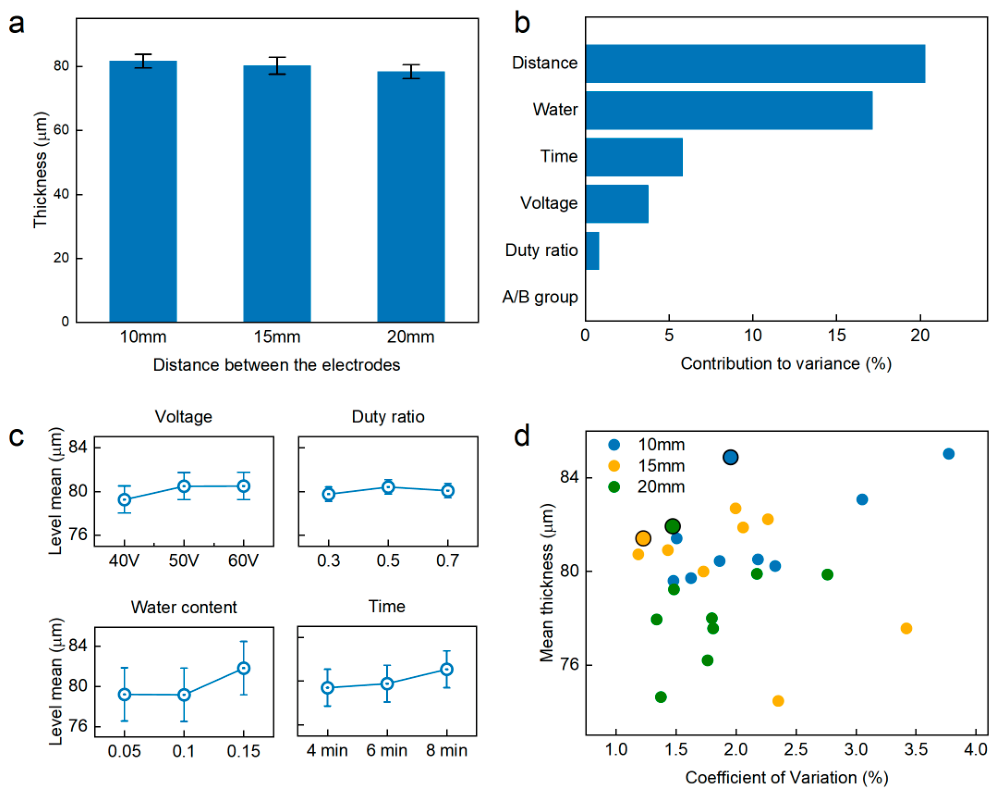
The orthogonal screening results for coating thickness are summarized in Figure 2. Figure 2a shows that the mean thickness remained within a relatively narrow range across the three electrode distances, although the 10 mm condition provided the highest average value, approximately 81 μm. Figure 2b indicates that electrode distance and water content were the dominant contributors to thickness variance, with approximate contributions of 20% and 17%, respectively, whereas treatment time, voltage, and duty ratio played smaller roles.
The level-mean trends in Figure 2c show that increasing the voltage from 40 to 50–60 V moderately increased the response value, while duty ratio caused only limited changes. Higher water content and longer treatment time generally improved the coating response. The mean-thickness versus coefficient-of-variation plot in Figure 2d places the 10 mm group in a region of relatively high thickness and acceptable variability, supporting its selection as the preferred geometric condition.
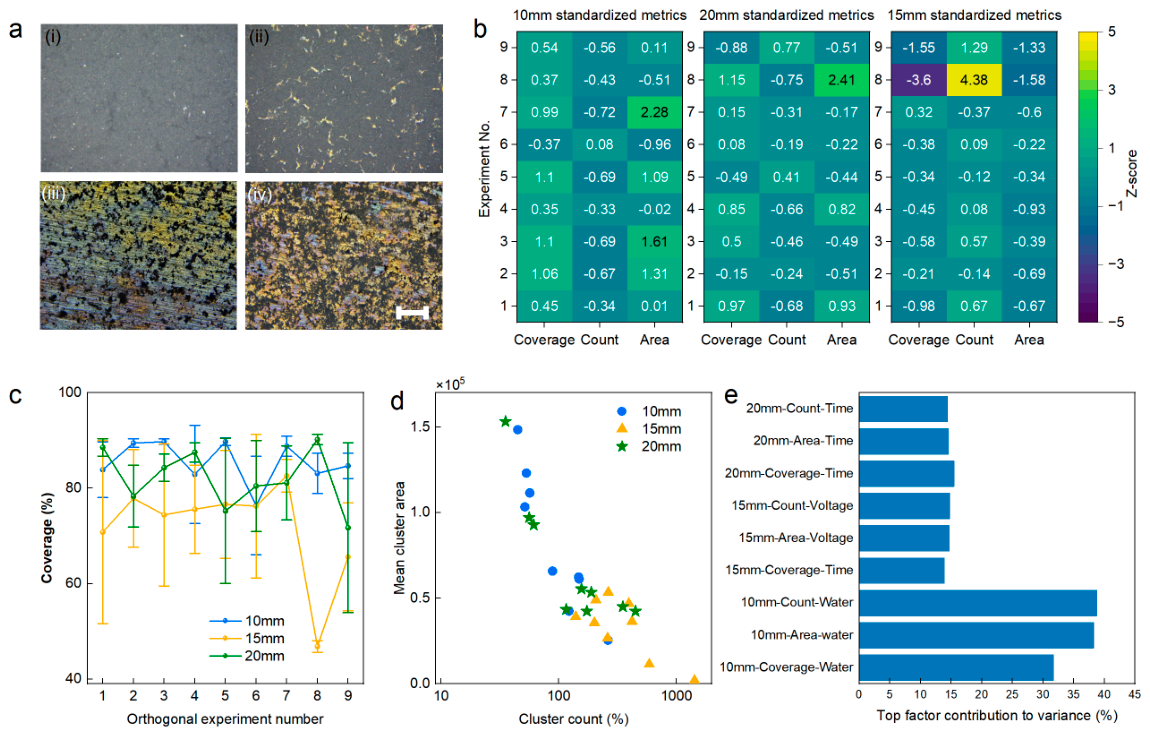
The image-analysis results in Figure 3 provide additional insight into coating quality beyond thickness alone. Representative optical micrographs in Figure 3a show that the coating morphology varied markedly across the orthogonal runs, ranging from sparse particle attachment to more continuous clustered coverage. The standardized-metric heatmaps in Figure 3b indicate that the 10 mm group contained multiple runs with simultaneously positive coverage and area responses, whereas the 15 mm and 20 mm groups exhibited larger fluctuations in count- and cluster-related descriptors.
The coverage comparison in Figure 3c confirms that the 10 mm and 20 mm groups generally maintained coverage between about 75% and 90%, whereas one run in the 15 mm group dropped sharply, indicating a less robust deposition window. The cluster-count versus area relationship in Figure 3d also suggests that the 10 mm condition achieved a more balanced microstructure with fewer extreme outliers. Finally, Figure 3e shows that water content dominated the 10 mm dataset, while time became more important for the 20 mm group and voltage/time contributed more visibly in the 15 mm group. Taken together, these results identify 10 mm as the most suitable electrode distance for obtaining a uniform and stable coating.
Therefore, the contribution-to-variance results in Figure 2b and Figure 3e can be regarded as a sensitivity-style comparison of the process factors. Within the tested parameter window, electrode distance and water content showed the strongest influence on thickness and image-derived coating metrics, whereas voltage, duty ratio, and treatment time produced comparatively weaker or condition-dependent effects. Because the orthogonal design was used for process screening rather than predictive modeling, these results indicate relative factor importance but do not provide a full interaction model.

3.3. Optical and Photothermal Characteristics of the Coated Alloy Wires

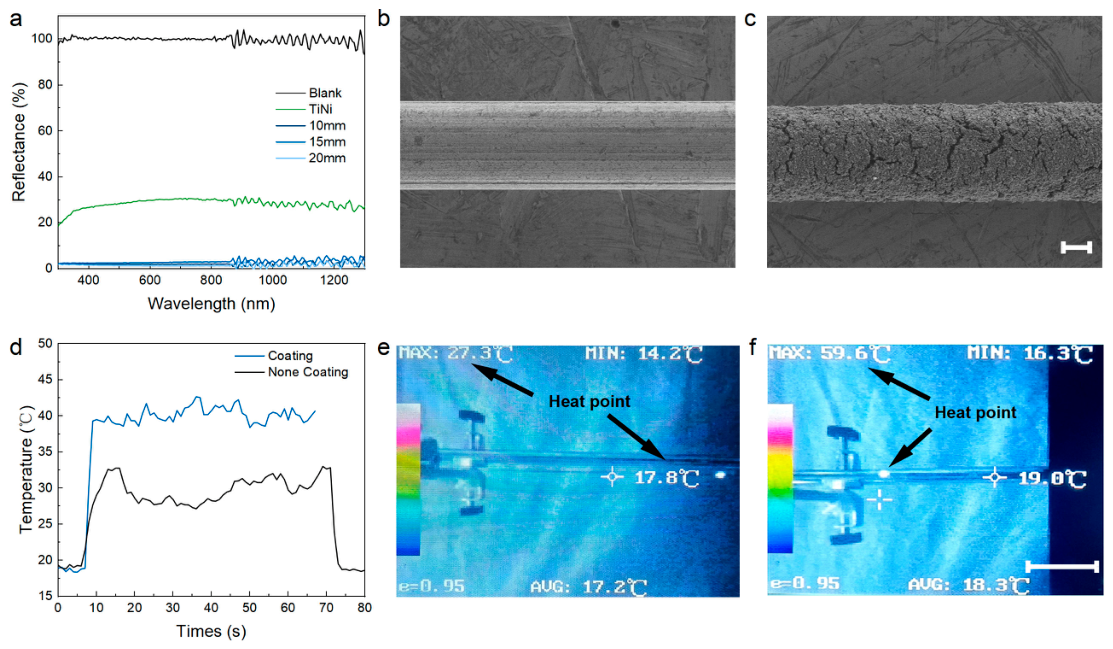
The optimized process was then transferred to the alloy wire, and the resulting optical and thermal properties are summarized in Figure 4. The reflectance spectra in Figure 4a show a pronounced reduction in light reflection after coating. Whereas the blank reference remained near 100% reflectance and the bare TiNi wire stayed around 25–30%, the coated wires prepared at 10, 15, and 20 mm all exhibited very low reflectance, generally below 5% over most of the measured wavelength range.
The microscopy comparison in Figure 4b,c reveals the structural transition from a relatively smooth bare wire to a rough, continuous coated surface. The temperature–time data in Figure 4d show that the coated wire rapidly reached about 39–42 °C under irradiation, whereas the uncoated wire stabilized at only about 28–32 °C under the same conditions. This combination of roughened surface texture and reduced reflectance is favorable for enhanced photothermal absorption.
The infrared images in Figure 4e,f provide direct evidence of local heat accumulation. The maximum temperature near the irradiation point increased from about 27.3 °C in the uncoated state to about 59.6 °C in the coated state, demonstrating that the functional layer significantly intensified local thermal concentration. Because the rotary engine relies on localized thermal asymmetry to trigger cyclic contraction and recovery of the alloy wire, this enhanced photothermal behavior is expected to directly improve startup speed and rotational output.

3.4. Effect of PDMS Coating on the Wheel Surface

The wheel-side interface was screened independently using the multi-wheel test platform shown in Figure 5a. Distinct differences in angular velocity were observed among the tested PDMS formulations in Figure 5b. The 1.5 wt% + 10 wt% sample delivered the highest and most stable response, with angular velocity values centered around 2.4–2.6 rad/s. The 2.5 wt% + 15 wt% formulation ranked second, whereas the 1 wt%, 0.5 wt%, and 0.2 wt% samples showed progressively lower outputs.
These results indicate that wheel-side performance is highly sensitive to surface formulation. An insufficiently modified surface does not provide adequate traction, whereas an optimized PDMS layer improves contact conformity and stabilizes torque transfer from the thermally driven wire to the wheel. On this basis, the highest-performing formulation was selected for the coupled experiments.

3.5. Coupled Rotation Performance of the Small Wheel Alloy Wire System

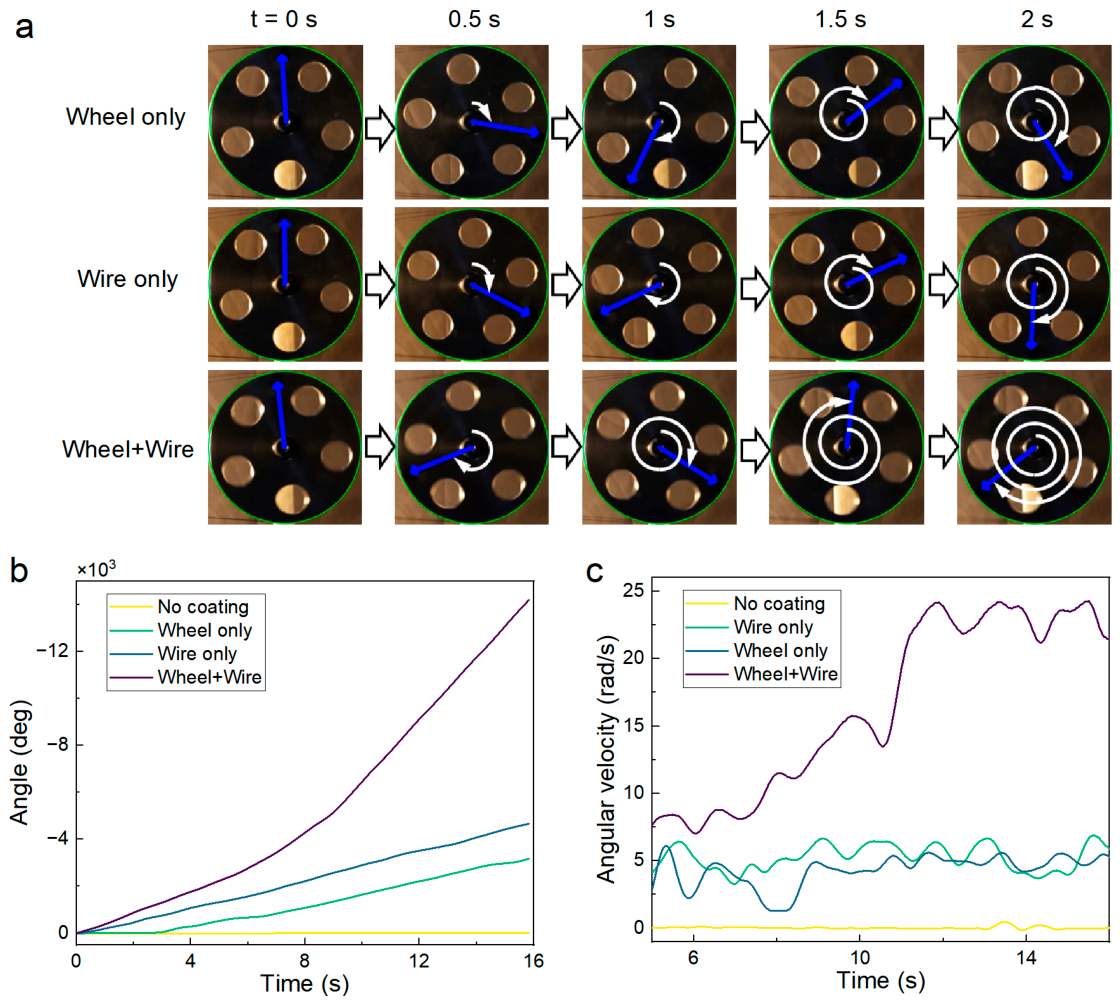
Figure 6 compares the rotational behavior of the four experimental groups. The time-lapse images in Figure 6a show that the unmodified system remained nearly static, whereas the wheel-only and wire-only modifications both produced visible rotation. The dual-modified wheel + wire group exhibited the fastest startup and the largest angular displacement over the same observation period.
The angle–time curves in Figure 6b provide a quantitative comparison. After 16 s, the wheel + wire group accumulated on the order of 1.4   ×   10 4 degrees of rotation, far exceeding the wheel-only and wire-only groups, which reached only several thousand degrees, while the no-coating group stayed near zero. The angular velocity curves in Figure 6c show the same trend: the wheel + wire group rapidly increased to approximately 22–24 rad/s and maintained a distinctly higher level than the single-interface groups, which fluctuated mainly around 4–6 rad/s.
These results confirm a strong synergistic effect between the two engineered interfaces. Improving only the wire side enhances photothermal actuation but leaves transmission losses partially unresolved, whereas improving only the wheel side strengthens traction but cannot compensate for limited wire heating. When both interfaces are modified simultaneously, the system achieves fast startup, large cumulative rotation, and substantially higher steady angular velocity. To interpret these results beyond a purely phenomenological comparison, the coupled-rotation behavior can be described by a simplified rotational-dynamics framework in which the wheel assembly is characterized by an effective moment of inertia J e f f , the angular momentum is L   =   J e f f ω , the net torque is τ n e t   =   J e f f   d ω / d t , and the rotational kinetic energy is E r o t   =   1 / 2   J e f f   ω 2 [26,27]. During startup, the thermally generated torque of the alloy wire must satisfy τ S M A   =   τ l o s s   +   J e f f   d ω / d t , where τ l o s s represents bearing friction, air drag, and interfacial dissipation associated with local slip. Accordingly, the steeper initial rise in the angular velocity in the wheel + wire group indicates a larger net driving torque, while its higher quasi-steady angular velocity indicates that the torque generated by the heated wire remains higher than the total dissipation over a longer period [28].
From an energy-conversion perspective, the rotary output can be expressed in simplified form as
P r o t = η t r   η S M A   η p t   1 R P i n
where P i n is the incident optical power on the irradiated wire segment, R is the optical reflectance, η p t is the photothermal conversion term, η S M A describes the conversion from thermal asymmetry to recoverable wire force, and η t r is the transmission efficiency from wire tension difference to wheel rotation [24,27,28]. In the present system, the CNT/PDA coating primarily improves the absorption/heating term by reducing the reflectance of the alloy wire from about 25–30% to below 5% and increasing the maximum local temperature from about 27.3 °C to 59.6 °C. By contrast, the PDMS-based wheel coating primarily improves η t r by enhancing conformal contact and suppressing interfacial slip [25]. Therefore, the dual-modified system benefits from simultaneous enhancement of both the driving term and the transmission term, which explains the much higher angular velocity of the wheel + wire group compared with the single-interface groups.
Because all groups were tested under the same wheel geometry and irradiation condition, the relative enhancement in mechanical output can be further estimated from the rotational kinetic energy, E r o t     ω 2 . By approximating the small and large wheels as rigid disks using the dimensions and masses listed in the Supplementary Information, the combined rotational inertia of the wheel pair is about 4.0   ×   10 5 kg·m2. On this basis, the dual-modified group operating at about 22–24 rad s−1 corresponds to a rotational kinetic energy level of approximately 9.7   ×   10 3 to 1.16   ×   10 2 J, whereas the single-interface groups operating at about 4–6 rad s−1 correspond to only about 3.2   ×   10 4 to 7.2   ×   10 4 J. This represents an increase of roughly 13–36 times in the rotational kinetic-energy level. Moreover, the cumulative rotation angle of about 14,000° after 16 s indicates that the performance gain is not limited to transient kinetic energy storage, but also reflects substantially greater cumulative mechanical work against frictional and interfacial losses during continuous rotation.

4. Discussion

The results collectively show that the rotational performance of the present alloy wire engine depends on coordinated thermal and mechanical optimization. On the deposition side, the orthogonal screening demonstrates that electrode distance cannot be treated as a secondary geometric detail. It strongly affects the deposition field and, therefore, the local particle transport, coating continuity, and process robustness. The preference for the 10 mm condition suggests that a shorter transport path promotes more stable deposition while maintaining acceptable coating thickness and microstructural uniformity. Such sensitivity of deposition behavior to the electric field configuration and particle-transport path is well aligned with the established fundamentals of EPD and with CNT-EPD studies on metallic and fibrous substrates [15,16,17,18,19].
Water content also played an important role in the coating statistics. This behavior is reasonable because water content influences suspension conductivity, wetting behavior, and evaporation characteristics during deposition, thereby affecting both deposition kinetics and the final packing state of the coating. Similar sensitivities of coating quality to suspension chemistry and processing window are widely reported in the EPD literature [15,16,17].
On the functional side, the wire coating provided two simultaneous advantages: lower reflectance and stronger local heat accumulation. The reduced optical loss allows more incident energy to be absorbed by the coated segment, while the roughened surface and dark coating composition improve photothermal conversion efficiency. The elevated local temperature then promotes faster phase transformation of the alloy wire and increases the available driving force. This interpretation is consistent with previous reports on CNT-based solar-thermal coatings and PDA-assisted photothermal heating [22,23]. Related progress on photothermally driven NiTi-based actuators further supports the importance of efficient light-to-heat conversion at the alloy surface [24].
The PDMS layer acts through a different but complementary mechanism. Rather than changing the wire temperature directly, it modifies the wheel–wire contact state. A compliant wheel surface can improve conformity, increase effective contact area, and reduce intermittent slipping, thereby converting more of the wire contraction into useful rotational motion. This behavior is in line with the known adhesion and friction characteristics of PDMS-based interfaces [25].
It should be noted that the present dataset does not yet allow a rigorous calculation of absolute thermodynamic efficiency, because the incident optical flux, effective illuminated area, output torque, and dissipative loss terms were not measured directly. Therefore, the analysis above should be understood as a comparison of relative mechanical-output enhancement under identical testing conditions rather than as a complete efficiency determination [27,28].
From an application perspective, the dual-interface strategy provides a practical route for improving compact solar-driven actuators and low-grade thermal energy conversion devices. Because the method combines scalable surface treatment with simple structural modification, it may be extended to other wire-driven rotary systems and passive solar thermomechanical devices in which interfacial heat management and traction stability are simultaneously important [11,12,13,14].

5. Conclusions

A dual-interface collaborative thermal management strategy was developed for a solar-driven NiTi alloy wire rotary engine by combining an electrophoretic photothermal coating on the alloy wire with a PDMS-based coating on the wheel surface.
Orthogonal screening on titanium plates showed that the electrophoretic process was strongly affected by electrode distance and water content, and the 10 mm condition provided the best balance between coating thickness, coverage, and stability.
After transfer to alloy wires, the coating greatly reduced reflectance across the visible-near-infrared range and significantly enhanced the irradiation temperature response, confirming its effectiveness as a photothermal interface.
PDMS wheel screening demonstrated that the tested formulations produced markedly different angular velocities, and the 1.5 wt% + 10 wt% formulation exhibited the best wheel-side performance.
In the coupled experiment, simultaneous wheel + wire modification gave the fastest startup, the largest angular displacement, and the highest angular velocity, clearly outperforming the wheel-only, wire-only, and unmodified groups. These findings show that coordinated optimization of the thermal absorption interface and the mechanical transmission interface is an effective design route for improving alloy wire-driven rotary systems.

Supplementary Materials

The following supporting information can be downloaded at: https://www.mdpi.com/article/10.3390/cryst16060373/s1. The Supporting Information includes detailed materials and methods for the rotary device configuration and irradiation conditions, the mechanistic description of CNT/PDA formation and deposition on Ni–Ti alloy, the pulse-assisted electrophoretic deposition setup, preparation of the CNT/PDA suspension and electrophoretic bath, characterization details, the definition of PDMS wheel-side coating formulations, and video-based motion tracking; Figure S1: Supplementary circuit configuration and photograph of the pulse-assisted electrophoretic deposition setup; Figure S2: Device and deposition-support configuration; Figure S3: Representative optical micrographs from the orthogonal experiments at 10 mm spacing and the corresponding grayscale-processing route; Figure S4: Near-infrared irradiation-heating setup used for photothermal characterization; Figure S5: Detailed steps for fitting and exporting wheel-rotation characteristic parameters; Table S1: Chemicals and reagents used in this study; Table S2: Structural materials and device components; Table S3: Preparation, deposition, and characterization instruments; Table S4: Software and data-processing tools; Video S1: Representative indoor rotation measurement under controlled artificial irradiation; Video S2: Outdoor demonstration of device operation under natural sunlight.

Author Contributions

Conceptualization, Y.C. and H.Z.; methodology, X.K. and Y.C.; software, X.K.; validation, X.K. and X.W.; formal analysis, X.K., X.W. and S.Q.; investigation, X.K.; resources, H.Z.; data curation, X.K.; writing—original draft preparation, X.K.; writing—review and editing, Y.C., X.W., S.Q. and H.Z.; visualization, X.K.; supervision, Y.C. and H.Z.; project administration, Y.C. and H.Z.; funding acquisition, H.Z. All authors have read and agreed to the published version of the manuscript.

Funding

This study was financially supported by the National Natural Science Foundation of China (U24B2025), the Ling Chuang Research Project of China National Nuclear Corporation and the open research fund of Songshan Lake Materials Laboratory (2023SLABFN09), Science and Technology Innovation Action Plan (25TS1402500).

Data Availability Statement

The data presented in this study are available from the corresponding author upon reasonable request.

Acknowledgments

The authors would like to thank the Instrumental Analysis Center of Shanghai Jiao Tong University for technical support in microscopy and spectroscopy characterization.

Conflicts of Interest

The authors declare no conflicts of interest.

Abbreviations

The following abbreviations are used in this manuscript:
SMAShape memory alloy
NiTiNickel-titanium alloy
PDMSPolydimethylsiloxane
EPDElectrophoretic deposition
IRInfrared

References

  1. Chen, T.G.; Zhang, Y.H.; Qiu, S.B.; Jiang, J.; Zhang, Q.; Zhang, X.Y. Experiments and Modeling of Machined Spring Rotary Actuators with Shape Memory Alloys. Materials 2022, 15, 6674. [Google Scholar] [CrossRef]
  2. Hull, P.V.; Canfield, S.L.; Carrington, C. A radient energy-powered shape memory alloy actuator. Mechatronics 2004, 14, 757–775. [Google Scholar] [CrossRef]
  3. Kumar, P.; Kishore, R.A.; Maurya, D.; Stewart, C.J.; Mirzaeifar, R.; Quandt, E.; Priya, S. Shape memory alloy engine for high efficiency low-temperature gradient thermal to electrical conversion. Appl. Energy 2019, 251, 113277. [Google Scholar] [CrossRef]
  4. Song, G. Design and control of a Nitinol wire actuated rotary servo. Smart Mater. Struct. 2007, 16, 1796–1801. [Google Scholar] [CrossRef]
  5. Zhang, X.Y.; Yan, X.J. Continuous Rotary Motor Actuated by Multiple Segments of Shape Memory Alloy Wires. J. Mater. Eng. Perform. 2012, 21, 2643–2649. [Google Scholar] [CrossRef]
  6. Yuan, H.; Fauroux, J.C.; Chapelle, F.; Balandraud, X. A review of rotary actuators based on shape memory alloys. J. Intell. Mater. Syst. Struct. 2017, 28, 1863–1885. [Google Scholar] [CrossRef]
  7. Stroud, H.; Hartl, D. Shape memory alloy torsional actuators: A review of applications, experimental investigations, modeling, and design. Smart Mater. Struct. 2020, 29, 113001. [Google Scholar] [CrossRef]
  8. Kishore, R.A.; Priya, S. A Review on Low-Grade Thermal Energy Harvesting: Materials, Methods and Devices. Materials 2018, 11, 1433. [Google Scholar] [CrossRef]
  9. Otsuka, K.; Ren, X. Physical metallurgy of Ti-Ni-based shape memory alloys. Prog. Mater. Sci. 2005, 50, 511–678. [Google Scholar] [CrossRef]
  10. Jani, J.M.; Leary, M.; Subic, A.; Gibson, M.A. A review of shape memory alloy research, applications and opportunities. Mater. Des. 2014, 56, 1078–1113. [Google Scholar] [CrossRef]
  11. Almadani, I.K.; Osman, I.S.; Hariri, N.G. In-Depth Assessment and Optimized Actuation Method of a Novel Solar-Driven Thermomechanical Actuator via Shape Memory Alloy. Energies 2022, 15, 3807. [Google Scholar] [CrossRef]
  12. Hariri, N.G.; Almadani, I.K.; Osman, I.S. A State-of-the-Art Self-Cleaning System Using Thermomechanical Effect in Shape Memory Alloy for Smart Photovoltaic Applications. Materials 2022, 15, 5704. [Google Scholar] [CrossRef]
  13. Osman, I.S.; Hariri, N.G. Thermal Investigation and Optimized Design of a Novel Solar Self-Driven Thermomechanical Actuator. Sustainability 2022, 14, 5078. [Google Scholar] [CrossRef]
  14. Stelzmann, M.; Zakner, F.; de Sosa, I.N.; Nemati, A.; Kahnt, A.; Maass, B.; Drossel, W.G. Development of a Self-Regulating Solar Shading Actuator Based on the Thermal Shape Memory Effect. Actuators 2024, 13, 85. [Google Scholar] [CrossRef]
  15. Besra, L.; Liu, M. A review on fundamentals and applications of electrophoretic deposition (EPD). Prog. Mater. Sci. 2007, 52, 1–61. [Google Scholar] [CrossRef]
  16. Boccaccini, A.R.; Cho, J.; Roether, J.A.; Thomas, B.J.C.; Minay, E.J.; Shaffer, M.S.P. Electrophoretic deposition of carbon nanotubes. Carbon 2006, 44, 3149–3160. [Google Scholar] [CrossRef]
  17. Rehman, M.A.U.; Chen, Q.; Braem, A.; Shaffer, M.S.P.; Boccaccini, A.R. Electrophoretic deposition of carbon nanotubes: Recent progress and remaining challenges. Int. Mater. Rev. 2021, 66, 533–562. [Google Scholar] [CrossRef]
  18. Bai, Y.; Neupane, M.P.; Park, I.S.; Lee, M.H.; Bae, T.S.; Watari, F.; Uo, M. Electrophoretic deposition of carbon nanotubes-hydroxyapatite nanocomposites on titanium substrate. Mater. Sci. Eng. C 2010, 30, 1043–1049. [Google Scholar] [CrossRef]
  19. Guo, J.H.; Lu, C.X. Continuous preparation of multiscale reinforcement by electrophoretic deposition of carbon nanotubes onto carbon fiber tows. Carbon 2012, 50, 3101–3103. [Google Scholar] [CrossRef]
  20. Lee, H.; Dellatore, S.M.; Miller, W.M.; Messersmith, P.B. Mussel-inspired surface chemistry for multifunctional coatings. Science 2007, 318, 426–430. [Google Scholar] [CrossRef]
  21. Ryu, J.H.; Messersmith, P.B.; Lee, H. Polydopamine Surface Chemistry: A Decade of Discovery. ACS Appl. Mater. Interfaces 2018, 10, 7523–7540. [Google Scholar] [CrossRef] [PubMed]
  22. Wu, X.H.; Jiang, Q.S.; Ghim, D.; Singamaneni, S.; Jun, Y.S. Localized heating with a photothermal polydopamine coating facilitates a novel membrane distillation process. J. Mater. Chem. A 2018, 6, 18799–18807. [Google Scholar] [CrossRef]
  23. Vinetsky, Y.; Jambu, J.; Mandler, D.; Magdassi, S. CNT-Based Solar Thermal Coatings: Absorptance vs. Emittance. Coatings 2020, 10, 1101. [Google Scholar] [CrossRef]
  24. Wei, L.; Ma, D.; Xie, D.; Jing, P.; Leng, Y. The performance and stability of NiTi photoactuator utilizing photothermal effect of TiN films with tilted columnar structure. Sens. Actuators A Phys. 2024, 368, 115106. [Google Scholar] [CrossRef]
  25. Vaenkatesan, V.; Li, Z.L.; Vellinga, W.P.; de Jeu, W.H. Adhesion and friction behaviours of polydimethylsiloxane—A fresh perspective on JKR measurements. Polymer 2006, 47, 8317–8325. [Google Scholar] [CrossRef]
  26. Chen, Y.N.; Ricardo, B. Micro-mechanical analysis of shape memory based engines. Appl. Phys. A 2021, 127, 704. [Google Scholar] [CrossRef]
  27. Chikhareva, M.; Vaidyanathan, R. A Thermal, Mechanical, and Materials Framework for a Shape Memory Alloy Heat Engine for Thermal Management. Nanomaterials 2023, 13, 2159. [Google Scholar] [CrossRef] [PubMed]
  28. Niccoli, F.; Maletta, C.; Sgambitterra, E.; Furgiuele, F. A thermo-mechanical model for shape memory alloy-based crank heat engines. J. Intell. Mater. Syst. Struct. 2015, 26, 652–662. [Google Scholar] [CrossRef]
Figure 1. Schematic diagram of the dual-interface collaborative thermal-management design for the NiTi alloy wire rotary engine. (a) Structural configuration of the device before irradiation, consisting of a Fresnel lens, a small wheel, a large wheel, and a looped NiTi alloy wire. (b) Working state under focused irradiation, where localized heating near the small wheel generates thermally induced contraction–recovery behavior of the alloy wire and drives continuous rotation. (c) SEM image of the coated alloy wire surface. (d) SEM image of the CNT-modified PDMS coating on the wheel-side interface. The scale bars in panels (c) and (d) are 100 μm and 1 μm, respectively.
Crystals 16 00373 g001
Figure 2. Analysis of the optimization results for electrophoretic titanium-plate preparation. (a) Mean coating thickness obtained at different electrode-to-substrate distances; (b) contribution of the investigated factors to the variance in thickness; (c) level-mean plots for voltage, duty ratio, water content, and treatment time; (d) relationship between mean thickness and coefficient of variation for samples prepared at 10, 15, and 20 mm. Coating thickness was measured at three positions for each sample.
Crystals 16 00373 g002
Figure 3. Image-based evaluation of electrophoretic titanium-plate coatings. (a) Representative optical micrographs of four typical coating states; (b) heatmaps of standardized coverage, count, and area metrics for the 10, 15, and 20 mm groups; (c) coating coverage for the nine orthogonal runs; (d) mean cluster area as a function of cluster count; (e) dominant factor contributions to variance in the image-analysis metrics. The scale bar in panel (a) is 50 μm.
Crystals 16 00373 g003
Figure 4. Characterization of the coated alloy wires. (a) Reflectance spectra of the blank reference, bare TiNi wire, and coated wires prepared at 10, 15, and 20 mm; (b) representative morphology of the bare alloy wire; (c) representative morphology of the coated alloy wire; (d) temperature–time comparison between coated and uncoated wires under irradiation; (e,f) infrared images showing the heat distribution of the uncoated and coated wires, the color map represents the apparent temperature distribution, with warmer colors indicating higher temperatures. The scale bars in panels (b), (c), and (f) are 100 μm, 100 μm, and 5 cm, respectively.
Crystals 16 00373 g004
Figure 5. Screening of PDMS-coated wheel formulations. (a) Schematic of the multi-wheel screening setup; (b) angular velocity responses of wheel samples prepared with different PDMS formulations. Each formulation was tested three times, and the average angular velocity response is shown.
Crystals 16 00373 g005
Figure 6. Coupled rotation performance of the small-wheel alloy wire system. (a) Time-lapse comparison of the wheel-only, wire-only, and wheel + wire groups. The blue arrow indicates the starting point, while the white arrow shows the direction of rotation and the number of turns; (b) angle–time curves of the four groups; (c) angular-velocity–time curves of the four groups.
Crystals 16 00373 g006
Table 1. Design of the process-factor levels for electrophoretic coating optimization.
Process FactorLevel 1Level 2Level 3
Voltage (V)405060
Duty ratio0.30.50.7
Water content0.050.100.15
Treatment time (min)468
Table 2. Orthogonal parameter optimization design used for titanium-plate screening.
Run No.Voltage (V)Duty RatioWater ContentTreatment Time (min)
1400.30.054
2400.50.106
3400.70.158
4500.30.108
5500.50.154
6500.70.056
7600.30.156
8600.50.058
9600.70.104
Table 3. Structural variable used in the optimization experiments.
VariableValue
Electrode-to-substrate distance (mm)10, 15, 20
Disclaimer/Publisher’s Note: The statements, opinions and data contained in all publications are solely those of the individual author(s) and contributor(s) and not of MDPI and/or the editor(s). MDPI and/or the editor(s) disclaim responsibility for any injury to people or property resulting from any ideas, methods, instructions or products referred to in the content.