


Abstract
This study presents a novel biosensor for non-invasive glucose detection in saliva using sol colloids of erbium phthalocyanine (ErPc) and polyvinyl acetate (PVAc). The sensors were manufactured by depositing thin films on glass substrates and characterized via optical transmission spectroscopy in the UV-Vis range. The detection signal was based on variations in the transmission spectra amplitude after glucose intake. Results showed that the transmission response effectively distinguished between three health conditions: a regular individual, an athlete, and a prediabetic patient. Specifically, the relative transmission increased significantly in the prediabetic subject compared to the healthy individuals, demonstrating the biosensor’s capability to track glucose fluctuations non-invasively.
1. Introduction
Since the first diabetes detection in an individual was carried out by Thomas Cawley in 1788 [1] until today, glucose measurement has mainly relied on blood analysis [2,3,4]. A momentous milestone in the clinical diagnostic landscape was marked with the manufacture of the first glucometer by Anton H. Clemens in 1970 [5] due to its significant role in managing diabetes. Diabetes, a chronic condition of high prevalence, arises when the pancreas fails to secrete enough insulin to regulate blood glucose levels [6]. The disease can lead to long-term damage in the body involving organs such as the eyes, kidneys, nervous system, and heart.
On the other hand, in a global context, the burden of this disease affects a considerable number of individuals [7], amounting by the year 2017 to 415 million people, with 90% corresponding to the type II diabetes variant [8]. Current projections predict that almost a third of the world population could suffer from diabetes by the year 2050 [9]. Moreover, according to the IDF Diabetes Atlas (2025), approximately 589 million adults are living with diabetes worldwide, and this number is projected to rise to 783 million by 2045 [10]. This represents a significant increase from the 368 million reported in earlier studies [11], representing an increase of 88%. Currently, diabetes continues to prevail as a challenge of global magnitude in the field of public health.
On the other hand, the predominant tool in approaching this problem is the point-of-care glucometer, which provides accurate blood glucose measurements [12]. In general, the operation principle of glucometers is based on blood readings obtained from a small blood sample, taken from fingers. Another technique to quantify glucose involves performing a blood test in a laboratory setting [8]. More recently, non-invasive techniques have emerged to detect glucose levels from biological fluids other than blood, particularly, saliva, which contains a panoply of essential components [12], glucose being one of them. Recent developments in salivary glucose monitoring have explored various materials, including electrochemical sensors based on CuO nanorods or carbon nanotubes, which offer high sensitivity but often require complex fabrication [13]. Phthalocyanines have been previously utilized in enzymatic biosensors due to their electron transfer properties [14]; however, their use as non-enzymatic optical indicators in a PVAc matrix represents a simplified and stable alternative for point-of-care applications. Glucose levels present in saliva can fluctuate depending on nutrition and individual dietary patterns [15]. Furthermore, the glycemic content of saliva may also be susceptible to variations depending on the age and gender of the individual [16]. According to various studies, glycemic figures in saliva fluctuate in a range between 0.1 and 8.5 mmol/L [17]. The highest rates are detected in those on carbohydrate-rich diets. Given its potential, salivary glucose levels have been outlined as indicators for non-invasive diabetes monitoring, demonstrating their ability to predict blood glucose levels [13,18,19].
To develop investigations into glucose monitoring in saliva, using a diverse range of compounds and materials is essential. In this regard, organic semiconductors as electronic components designed to detect or measure a physical or chemical property of an organic compound [20] play a leading role in this process. These semiconductors find applications in a wide range of fields, ranging from air [21,22] and water quality monitoring to detecting contaminants in soil [21,22], among others. These technological innovations have empowered researchers to conceive various sensor devices, ranging from electrochemical-based gaseous sensors to capacitance-based liquid sensors [23].
Erbium phthalocyanine (ErPc) belongs to the family of organic semiconductors with a green, fluorescent pigmentation commonly used in dyes [24]. The physical properties that characterize ErPc include its high affinity for oxygen, spin orientation, high thermal stability, and oxidation resistance [25]. As a result of these chemical, optical, and photochemical virtues, ErPc has been used in sensors [26], optical devices [27], and catalysts [28].
Polyvinyl acetate (PVAc) is a synthetic thermoplastic polymer primarily derived from the polymerization of vinyl acetate monomer. It has emerged as a central material in biosensor development due to its high chemical stability, flexibility, and excellent film-forming capacity. Its high solubility in various solvents and optical transparency make it an ideal matrix for organic semiconductors like phthalocyanines [26]. These qualities facilitate the creation of stable composite mixtures that are easily processed for manufacturing coatings and thin films. PVAc has been presented as an ideal option in various industrial applications. Its heat resistance, high solubility in different materials, and light stability make it a material of choice for the manufacturing of adhesives, coatings, films, tapes, and other substrates.
It is characterized by its high chemical stability, flexibility, resistance to wear and abrasion, as well as its ability to form thin and transparent films [26]. Gurol et al., in their research [29], report the use of PVAc with phthalocyanine because of their antibacterial properties and mention that the choice of polyvinyl acetate to create composites with phthalocyanines is based on its ability to form stable mixtures during its simple processing [30].
This research focuses on producing a biosensor using sol colloids composed of erbium phthalocyanine (ErPc) particles dispersed in polyvinyl acetate (PVAc) capable of detecting the presence of glucose in saliva. We investigated two types of biosensors to optimize their resolution and detection capacity. To accomplish this task, various strategies were undertaken to materialize a device capable of detecting glucose levels in patients with the minimum possible invasion. The results obtained from the optical and morphological characterizations of the biosensors indicate the significant influence that PVAc and ErPc have on glucose measurements in saliva. These findings highlight the importance of the composition and structure of the biosensors in their ability to accurately detect and measure glucose levels in biological samples, which could have significant implications in the development of non-invasive and precise monitoring technologies for diabetes control.
2. Materials and Methods
For the synthesis of ErPc powder, a novel approach employing a solar reactor prototype was undertaken [17]. The precursor materials mentioned subsequently were mixed thoroughly in an agate mortar, ensuring a uniform mixture. The precursor compounds, along with their respective quantities, were 2 g of 1,2-dicyanobenzene (C6H4(CN)2, Sigma-Aldrich, 3050 Spruce Street, Saint Louis, MO, USA), 1.8 g of erbium acetate (Er(OOCCH3), Alfa Aesar, Shore Road, Port of Heysham Industrial Park, Heysham, UK), 0.5 g of urea (CO(NH2)2, Sigma-Aldrich, 3050 Spruce Street, Saint Louis, MO, USA) as the nitrogen source, and 100 µL of 1,8-diazabicyclo(5.4.0) undeca-7-ene ≥98.0% (C5H10NCNC4H6, Sigma-Aldrich, 3050 Spruce Street, Saint Louis, MO, USA), commonly known as DBU, a catalyst for the macrocycle formation. The homogenized solid mixture was introduced into a 100 mL round-bottom flask and supplemented with 100 µL of DBU. Subsequently, the flask was positioned within a Fresnel lens solar reactor under an inert atmosphere and the temperature was increased to 180 °C for 5 and a half minutes. Post-reaction cooling was followed by a Soxhlet extraction purification process with various solvents, which completed the removal of all soluble impurities. The resultant ErPc powder was analyzed using the established analytical methodologies such as FT-IR, UV-Vis spectroscopy, and Fast Atom Bombardment (FAB) mass spectrometry.
The first heterostructure, c-Si/ErPc, was prepared using ultrasonic spray pyrolysis (USP). In this case, crystalline silicon (c-Si) was employed as a substrate solely for the initial morphological and structural characterization of the ErPc film via SEM and FT-IR, ensuring the purity of the synthesized powder before its application on glass substrates for the saliva tests, with a liquid dispersion of ErPc-MeOH obtained with 2 mg of ErPc powder combined with 20 mL of methanol (CH3OH). The deposition process was completed after 6.0 min and the substrate, placed on a hot plate, reached a temperature of 68.0 °C. For the preparation of the sol colloids with erbium phthalocyanine (PVAc-ErPc), it was necessary to first make a dispersion of MeOH-ErPc by mixing 10 mg of ErPc and 100 mL of CH3OH in an ultrasonic bath for 10 min until a homogeneous mixture was obtained. Then, 5 mL of this MeOH-ErPc dispersion was mixed with 1 mL of PVAc and 5 mL of deionized water until a homogeneous mixture free of lumps was obtained.
Two types of mixtures with PVAc-ErPc were used to obtain the biosensors: the first solution consisted of PVAc-ErPc without modification (labeled as BS-1), and the second was PVAc-ErPc mixed with an additional 1 mL of MeOH-ErPc dispersion (labeled as BS-2). The two mixtures were deposited on glass substrates with the following dimensions: 0.5 cm long × 0.5 cm wide × 1.2 mm thick. The drip technique was employed with 150 µL of solution per deposit. To expedite the evaporation of the solution, a hot plate at 45 °C was utilized for 20 min.
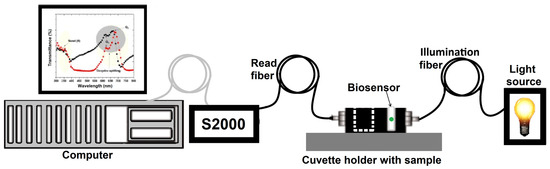
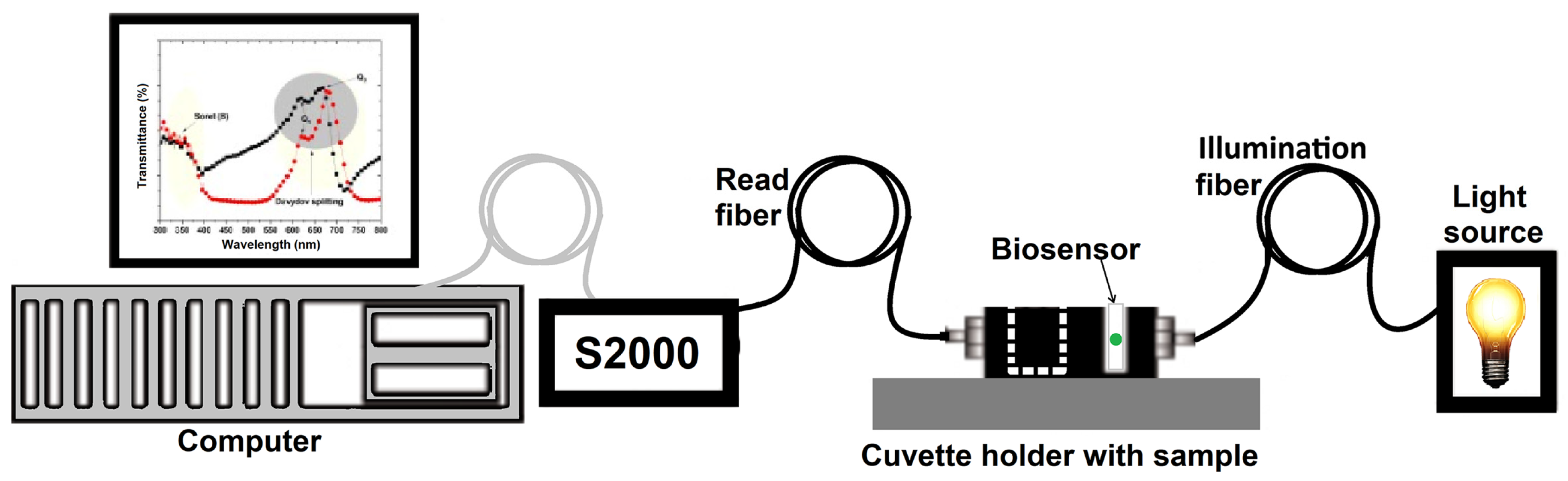
Mass spectrometry analysis of the ErPc powder was performed using a JEOL-JMS-700 M station (JEOL USA, Inc., Boston, MA, USA) with a fast Atom Bombardment source (FAB+ ion mode) and a dual-focus magnetic sensor. The c-Si/ErPc and biosensor samples were characterized by Field Emission Scanning Electron Microscopy (FE-SEM) using an FEI-SCIOS Dual Beam equipment (JEOL USA, Inc., Boston, MA, USA) operated at 10 kV to observe the morphology of the ErPc. Absorption spectra of the c-Si/ErPc and biosensor samples at room temperature were measured using a Cary 5000 UV-vis-NIR system (Agilent Technologies Inc., Santa Clara, CA, USA). The spectra were recorded from 200 to 800 nm with a resolution of 1 nm. Finally, a fiber-coupled optical setup in transmission configuration was used to characterize the biosensor samples with glucose in saliva. Light from a wideband source from 400 to 800 nm was used to characterize the light spectrum profile from the samples by using a transmission spectrometer (Ocean Optics s2000, Ocean Optics, Inc., Dunedin, FL, USA) with a V-groove optical system that allowed for placing the sample between the input and the output fibers. The obtained transmission spectra profile data were recorded by a computer (See Figure 1).
Figure 1.
Scheme for the absorbance/transmission spectra measurement.
Before commencing the saliva glucose test, the subjects were briefed on the procedure and requested to sign the informed consent. There were three test subjects (2 males and 1 female).
The experimental procedure for saliva glucose detection followed a rigorous 45 min protocol. Initially, the baseline blood glucose level was recorded using a commercial glucometer, followed by an optical reference measurement of the biosensor without saliva. After the initial saliva characterization, subjects ingested 335 mL of a standardized glucose solution (soda with 35.5 g of sugar). To prevent direct contamination of the sample, subjects rinsed their mouths with 100 mL of purified water after 20 min. Final blood and salivary measurements were then conducted to correlate the optical transmission response with the systemic glucose increase. Before commencing the saliva glucose test, the subjects were briefed on the procedure and requested to sign the informed consent. There were three test subjects (2 males and 1 female). The three patients for the biosensor test were chosen considering their lifestyles and medical conditions. Patient 1 is a regular person who drinks soda daily, has a high-carbohydrate diet, does little exercise per week, and does not have diabetes. Patient 2 has prediabetes, is undergoing medical treatment, has a high-carbohydrate diet, and exercises three times a week. Patient 3 is an athlete (cyclist) with a diet rich in protein and low in carbohydrates; he exercises daily and is in excellent health.
3. Results and Discussion
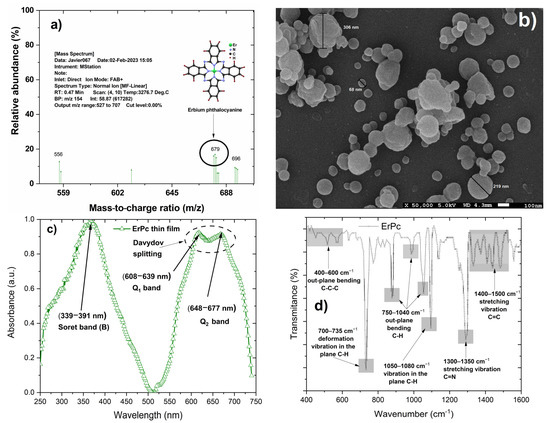
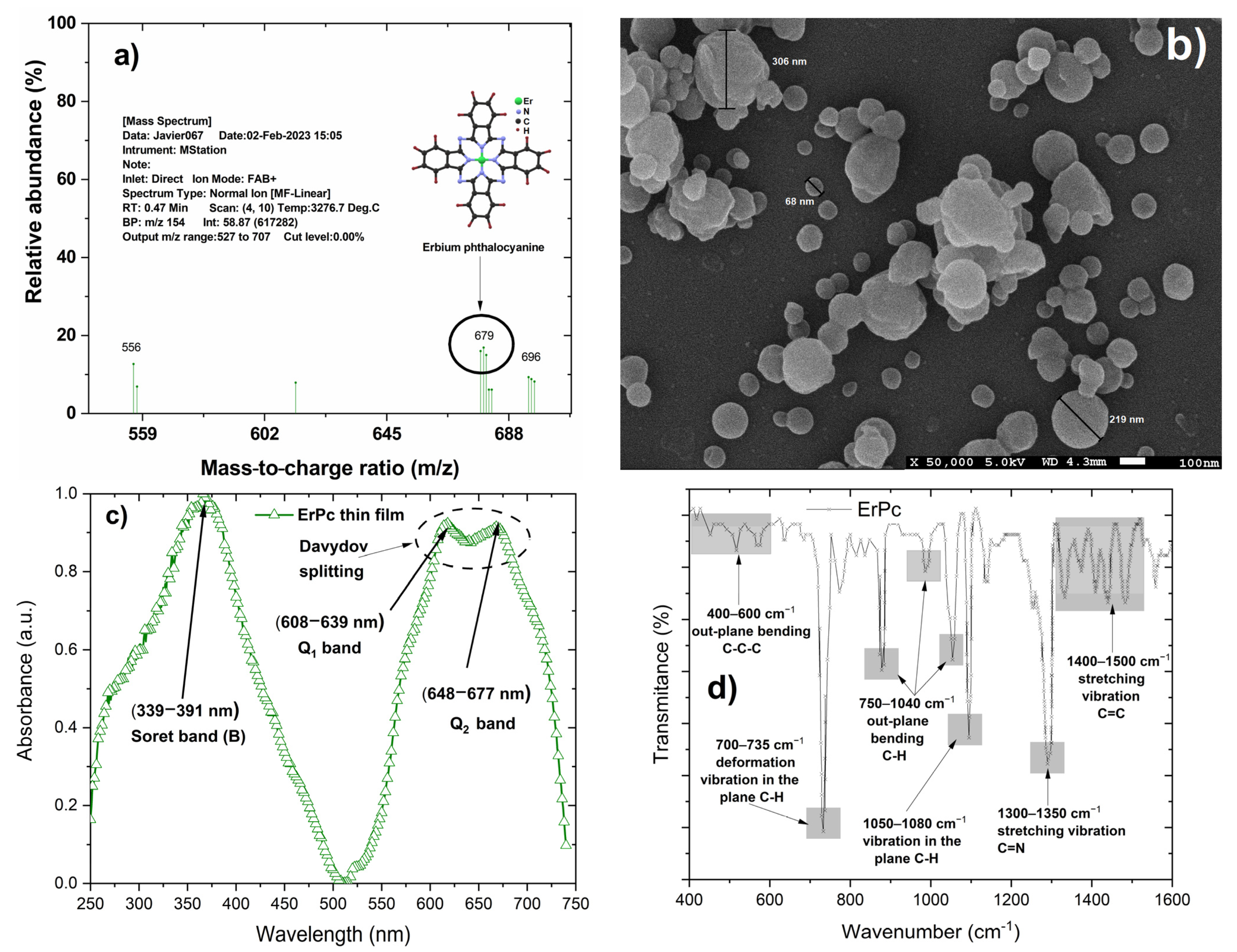
The new synthesis protocol to obtain erbium phthalocyanine using a solar reactor was developed successfully as confirmed by the results using the standard analytical techniques for phthalocyanine compounds. In Figure 2, the mass spectroscopy plot, an SEM micrograph, and the UV-Vis and FTIR spectra that confirm the molecular structure of the ErPc product are shown. In Figure 2a, the mass spectrometry analysis reveals the presence of the molecular ion (679 m/z) corresponding to ErPc [24,25]. In parallel, Figure 2b shows the scanning electron microscopy (SEM) micrograph where the morphology of the thin film derived from the ErPc powder can be observed. Within this micrographic representation, the formation of tiny nanospheres characterized by dimensions ranging between 69 and 306 nm is evident. Agglomerations can be observed in this micrograph, and they are attributed to the deposition mechanism by ultrasonic spray pyrolysis (USP). Figure 2c presents the absorption spectrum of the ErPc deposited as a thin film on a glass substrate. The spectrum shows the Soret band (B) in a wavelength range of 339 to 391 nm and the Q band between 550 and 750 nm, which are the characteristic absorptions in the UV-Vis range for a phthalocyanine molecule. The resulting Q band corresponds to π-π* transitions [27,30,31,32,33,34,35,36,37,38,39,40,41,42,43]. This band occasionally undergoes a subdivision identified as Davydov splitting, producing in this case two maxima located at 608–639 nm (Q1) and 654–677 nm (Q2) [44,45]. Figure 2d displays the Fourier Transform Infrared (FT-IR) spectrum of ErPc. FT-IR spectrum absorption bands associated with phthalocyanine macrocycles are evident and span the spectral range from 400 to 1800 cm−1. These characteristic peaks, presented in Figure 2d, effectively constitute the infrared fingerprint of phthalocyanines, offering different markers for its identification [46]. The peaks near 400–600 cm−1 are attributed to out-of-plane C-C-C bending vibrations and the peaks in the range of 700–735 cm−1 correspond to the out-of-plane C-H vibration modes. Other spectral zones, spanning 750–1040 cm−1, correspond to the bending modes of the outer C-H plane, while the band at 1050–1080 cm−1 is attributed to the bending C-H plane vibration. The C=C–N group vibration, associated with pyrrole fragments and interatomic nitrogen, appears as a low-intensity band at 1396–1407 cm−1 [47]. Furthermore, discernible bands emerge at 1300–1350 cm−1 and 1400–1500 cm−1, which are attributed to stretching vibrations of the isoindole segment, including pyrrole and benzene residues [48].
Figure 2.
(a) Mass spectrum of ErPc powder, (b) SEM micrograph of c-Si/ErPc, (c) absorption spectra of c-Si/ErPc, and (d) FT-IR spectra of c-Si/ErPc.
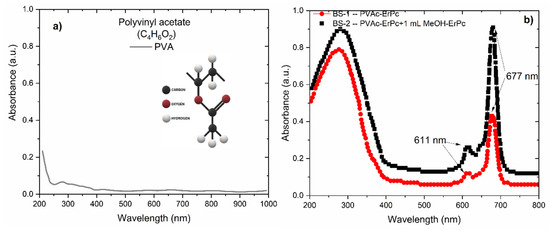
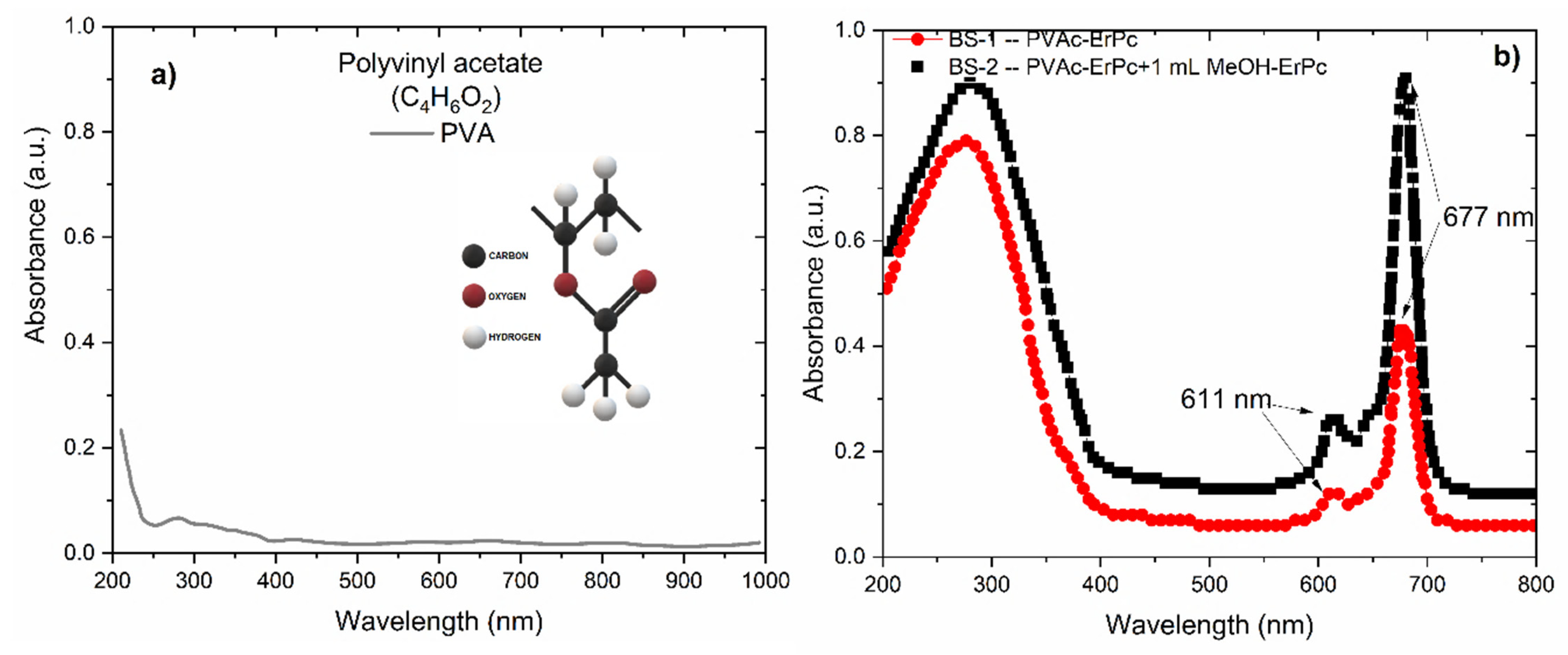
Once the characterization of the phthalocyanine material was confirmed, we proceeded to obtain the absorption spectra of the materials required to prepare the active layer of the sensor. Figure 3a shows the absorption spectrum of PVA deposited on a glass substrate. The spectrum obtained corresponds to that of PVA [49]. The origins of PVA, synthesized through the polymerization of vinyl acetate, give it its capacity as a vinyl adhesive. Furthermore, its transparency, depending on the thickness of the material, is manifested in the spectrum by an effectively imperceptible degree of absorption. Figure 3b shows the spectra of the two different biosensors on glass substrates (glass/PVAc-ErPc and glass/PVAc-ErPc + 1 mL of MeOH-ErPc). These spectra exhibit the characteristic Q bands in the 600 to 700 nm range and the B bands in the 277 nm range. The bands in the biosensor are similar to those shown in Figure 2c, corresponding to the ErPc film. Surprisingly, the Q1 band experiences an attenuation due to the influence of PVA. BS-1 shows a decreased absorption level compared to its counterpart, BS-2, due to the higher concentration of erbium phthalocyanine from the methanol solution in the BS-2 sample (+1.0 mL MeOH-ErPc).
Figure 3.
Absorption spectra of (a) polyvinyl acetate (PVAc), (b) PVAc-ErPc (BS-1), and PVAc-ErPc + 1 mL MeOH-ErPc (BS-2 T).
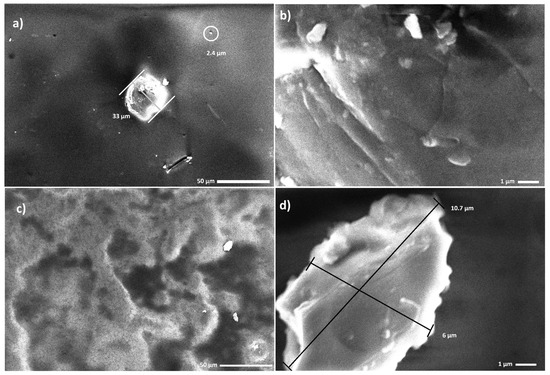
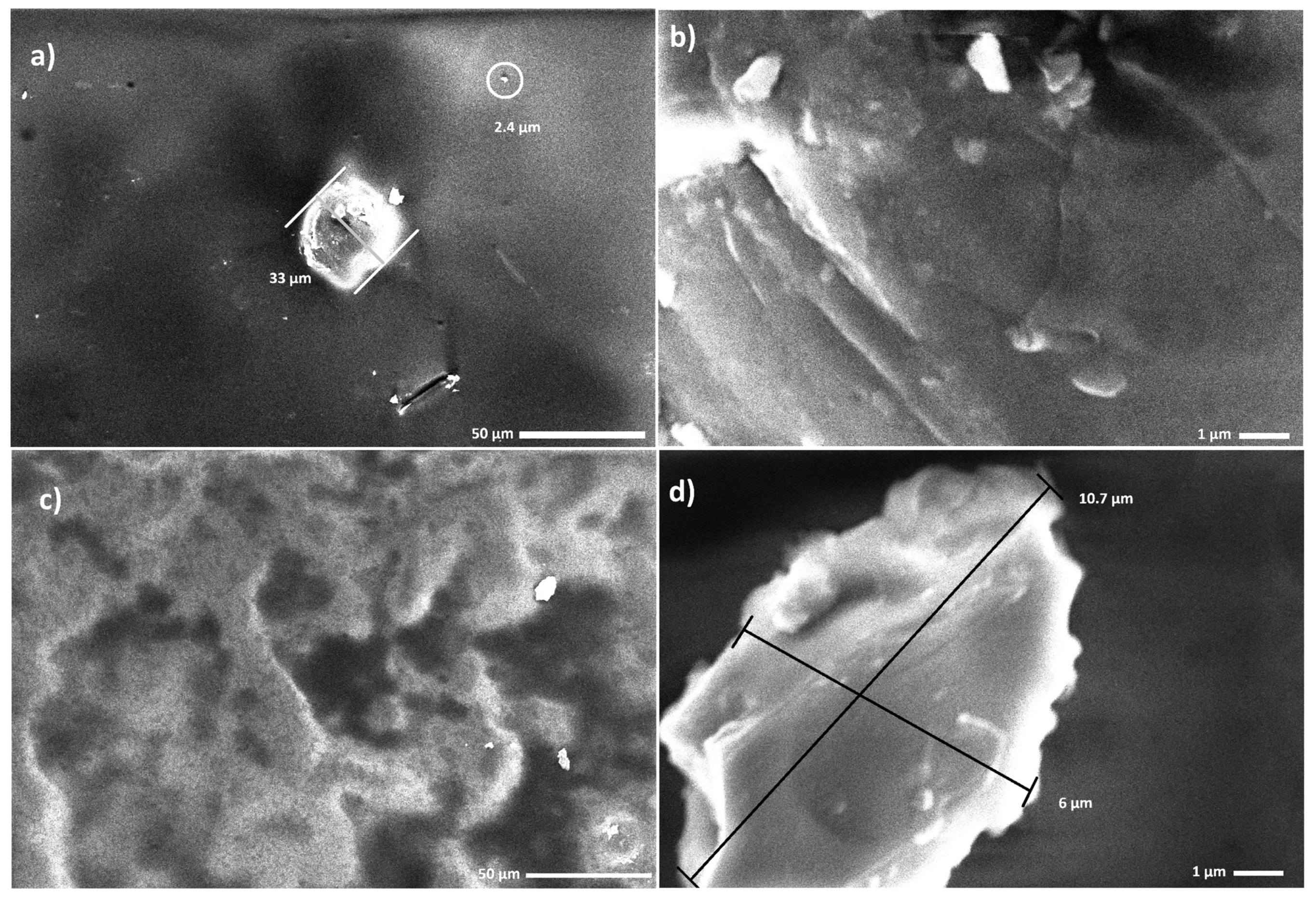
Regarding the characterization of the two biosensors obtained, their SEM micrographs are presented in Figure 4. Figure 4a,b correspond to the BS-1 (PVAc-ErPc) structure. In Figure 4a, the appearance of different bright regions due to the presence of ErPc can be observed, while the dark areas are attributed to PVAc. Additionally, circular ErPc clusters in thin films become evident. Figure 4b provides a magnification of the central region of the structure, revealing the most pronounced agglomeration and underlining the formation of flake-like structures resulting from the ErPc agglomeration. Furthermore, due to the use of PVAc to make the composite film, a better compaction is observed. This feature solves a recurring challenge in phthalocyanine thin films: their adhesion to substrates after their deposition in powder form on substrates.
Figure 4.
SEM micrographs of thin films of (a) BS-1 (PVAc-ErPc), (b) BS-1 (PVAc-ErPc)—zoom 1 µm, (c) BS-2 (PVAc-ErPc + 1 mL MeOH-ErPc) and (d) BS-2 (PVAc-ErPc + 1 mL MeOH-ErPc)—zoom 1 µm.
Figure 4c,d show the SEM micrographs associated with the BS-2 biosensor (PVAc-ErPc + 1.0 mL MeOH-ErPc). In Figure 4c, an increase in the ErPc concentration is evident and this is a direct result of the higher proportion of ErPc from the methanol solution (1.0 mL MeOH-ErPc) added to the film. In addition, Figure 4d reveals a magnified perspective of one of the conglomerates identified in the micrograph of Figure 4c, showing a morphology and compression similar to that observed in the case of BS-1. Within this film, a reduction in the number of clusters and a broader distribution of ErPc within the PVAc matrix is observed.
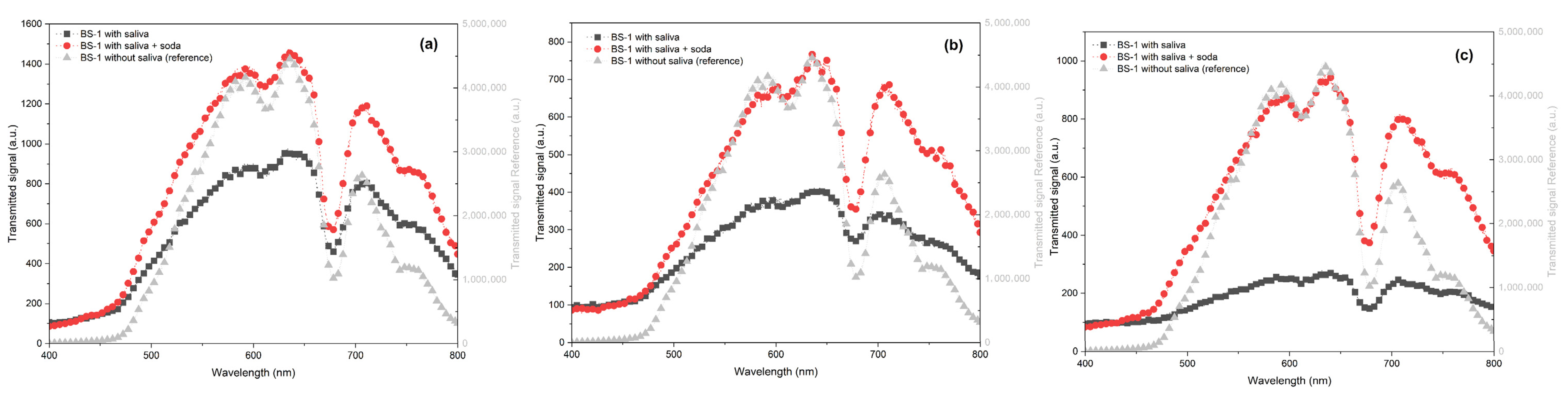
The methodology employed for saliva glucose characterizations is outlined in the Materials and Methods section, and the ensuing results are presented below. The transmission characterization for biosensor BS-1, obtained by UV-Vis spectroscopy from 400 to 850 nm, is shown in Figure 5. The steps to carry out this characterization in a regular person are as follows: Step 1: A glucose measurement was taken using a glucometer, resulting in a reading of 101.0 mg/dL. Step 2: A characterization was performed on the UV-Vis equipment of BS-1, which will serve as a reference. Figure 5 and Figure 6 show the transmission spectra of the biosensors without saliva, which serves as a stable baseline, confirming the reproducibility and stability of the films before interaction with biological samples. Step 3: Saliva glucose was characterized using BS-1. Step 4: The subject was given 335 mL of soda with a sugar concentration of 35.5 g. Step 5: After waiting 20 min, the subject was given 100 mL of purified water to remove soda residues from their mouth. Step 6: Blood glucose was characterized using a glucometer, resulting in a reading of 108.0 mg/dL. Step 7: Finally, a new BS-1 characterization of glucose in saliva was performed. Figure 5a shows the transmission spectra of the regular person using BS-1 before and after soda intake. Figure 5b,c show the results obtained for the athlete and the prediabetic person using the BS-1 biosensor. The same procedure was completed for the prediabetic person, with blood glucose measurements of 128 mg/dL and 148 mg/dL before and after 20 min of soda intake, respectively, and finally, for the athlete, with measurements of 81 mg/dL and 114 mg/dL. As observed in the case of BS-1, the optical spectra show an increase in the transmitted signal from the baseline saliva state to the saliva measurement when soda was ingested. Additionally, different amplitude levels are observed for each case study (regular persona, athlete, and prediabetic person).
Figure 5.
Transmitted signal spectra of BS-1 in saliva and saliva with soda for: (a) regular person, (b) athlete, (c) prediabetic person.
Figure 6.
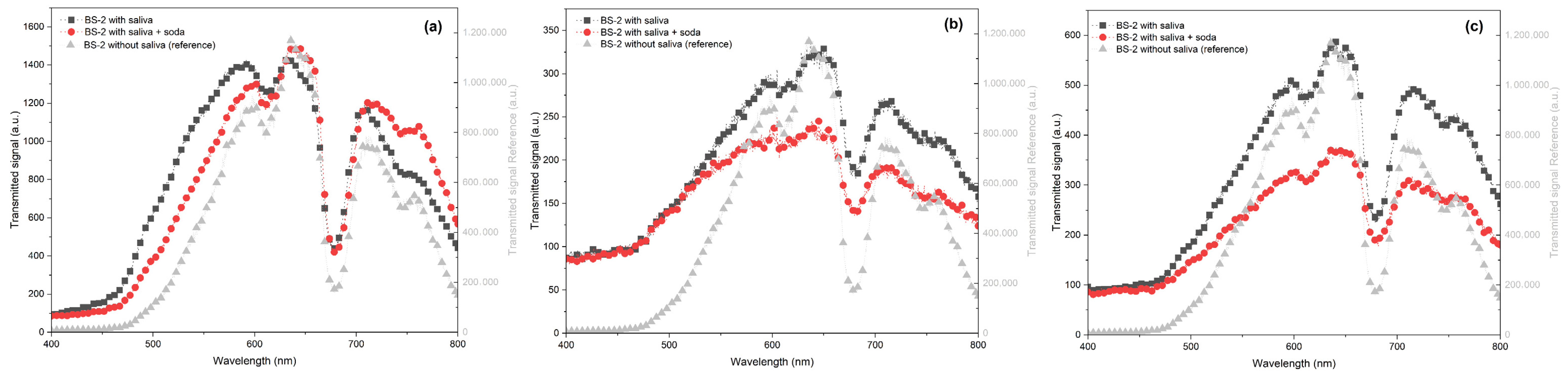
Transmitted signal spectra of BS-2 in saliva and saliva with soda for (a) regular person, (b) athlete, (c) prediabetic person.
In the same manner, the characterization of biosensor BS-2 was carried out. Figure 6a–c show the transmitted signal for regular, athlete, and prediabetic individuals, respectively, measured before and after soda ingestion. Contrary to what was observed with BS-1, in the case of the biosensor BS-2, the amplitude of the spectra decreases for the measurements after the soda ingestion. The spectrum amplitude for measurements before and after soda ingestion is similar for regular people. The decrease is relatively low for the athlete compared to that of the prediabetic person.
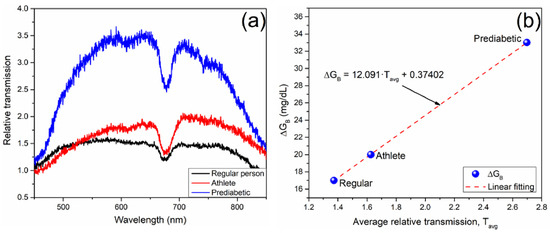
In order to characterize the transmission spectra amplitude variation with the blood glucose measurement (related to the body glucose synthesis process), the relative transmission was calculated as the ratio between the initial spectrum measurement for saliva and the saliva measurement twenty minutes before soda ingestion for each study case, as shown in Figure 7a. The results were obtained in a wavelength range of 450 to 850 nm, with significant amplitude variations. It can be noticed that the relative transmission for the regular person exhibits a low increase, lower than that observed for the athlete. Finally, the ratio drastically increases for a prediabetic person compared to the other two cases.
Figure 7.
Biosensor BS-1 characterization: (a) relative transmission for each study case, (b) average relative transmission as a function of blood glucose.
From the results obtained, it can be inferred that a healthy person with a diet that regularly includes sugars and carbohydrates can synthesize glucose quickly, and therefore the relative transmittance is low. In the case of an athlete, regulating the diet with a reduction in carbohydrates and sugars makes glucose synthesis slower compared to the average healthy person. However, the favorable reaction corresponds to a low relative transmittance change. Finally, in the case of a prediabetic person, the synthesis capacity of glucose is highly inhibited, and so the relative transmittance observed through the BS-1 biosensor is shown to be significantly high. Figure 7b shows the relationship between the relative transmission observed in saliva with the biosensor BS-1 and the blood glucose measurement with the commercial glucometer before and after soda ingestion. The average relative transmission for each case was obtained in the appropriate wavelength range. The blood glucose difference () was calculated for each case as the difference between the glucose measurement after and before the soda ingestion. Linear dependence of as a function of the average relative transmission () measured was used for BS-1 with transmission response of 12.091 [mg/dL]/, and .
Based on the linear response obtained for BS-1 (sensitivity S = 12.091 [mg/dL]/, R2 = 0.999), a preliminary estimation of the limit of detection (LOD) and limit of quantification (LOQ) was performed using the standard signal-to-noise approach (LOD = 3σ/S; LOQ = 10σ/S), where σ represents the standard deviation of the baseline noise estimated from the reference spectra (σ ≈ 0.003 ). This yields estimated values of LOD ≈ 0.9 mg/dL (≈0.05 mmol/L) and LOQ ≈ 3.0 mg/dL (≈0.17 mmol/L) for BS-1, which fall within the physiological salivary glucose range (0.1–8.5 mmol/L) [17]. The Table 1 summarizes the key benchmarks.
Table 1.
Comparative analysis of evaluated benchmarks.
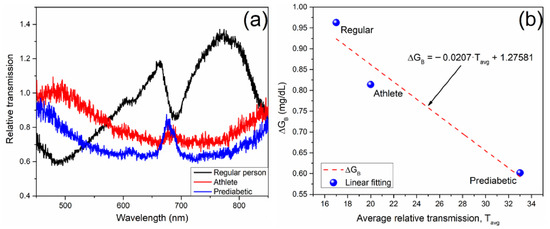
The relative transmission allows to determine the transmission level comparison for each study case, as is shown in Figure 8a. The results for BS-2 exhibit a decrease in relative transmission when the person is less able to synthesize glucose. Although for the regular person the relative transmission seems to be non-conclusive, the average transmission is in a range near unity, indicating rapid glucose synthesis in the regular person, as is reflected by being a function of in Figure 8b. The dependence of was linearly fitted with a low-transmission-response slope of −0.0207 [mg/dL]/, and .
Figure 8.
Biosensor BS-2 characterization: (a) relative transmission for each study case, (b) average relative transmission as a function of blood glucose.
From the obtained results it can be observed that the BS-1 biosensor exhibited a more pronounced transmission response to salivary glucose variations than BS-2. Moreover, the behavior of the transmission response slope is contrary in BS-2 compared with BS-1. As can be observed from Figure 3b, for a PVAc-ErPC film, the absorbance is highly increased when a dopant of 1 mL of MeOH is included, also modifying the optical transmission characteristics of the biosensor. In this regard, we attribute the low transmission response and slope change in BS-2 to the dopant concertation in the film deposition. As a result, more attractive results in saliva glucose estimation were obtained with the biosensor BS-1, where the minimum absorbance peak was observed.
Regarding the sensing mechanism, the optical response of the ErPc/PVAc biosensor to glucose is proposed to arise from a non-covalent interaction between glucose molecules and the active sites of erbium phthalocyanine. The Er3+ central metal ion, which possesses partially occupied 4f orbitals and high affinity for oxygen-containing molecules, is expected to interact with the hydroxyl groups (–OH) of glucose via axial coordination or physisorption. This interaction perturbs the π-conjugated macrocycle system of ErPc, inducing changes in the π–π* electronic transitions that manifest as the Q-band (550–750 nm) shifts observed in the transmission spectra. The PVAc matrix plays a complementary role as a hygroscopic medium that facilitates the diffusion and contact of salivary glucose molecules with ErPc active sites. This dual mechanism is consistent with metallophthalocyanine-based non-enzymatic optical sensors reported in the literature [14,32]. Confirmation by spectroscopic binding studies (e.g., Raman spectroscopy or fluorescence quenching) is planned for future experimental stages.
Compared with state-of-the-art salivary glucose biosensors, the ErPc/PVAc sensor presents distinctive advantages: it is enzyme-free (avoiding enzymatic instability), uses optical transmission transduction without electrodes, and relies on a solar-energy-based synthesis route. Electrochemical sensors such as CuO/SnOx nanorods (LOD ~ 0.5 μM, Wang et al., 2022 [13]) and CNT/PEI/GOx (LOD ~ 0.01 mM, Lin et al., 2022 [18]) achieve lower LOD values than the preliminary estimate for BS-1 (LOD ~ 0.05 mmol/L); however, they require complex multi-step fabrication and enzymatic components. The wearable mouthguard sensor by Arakawa et al. (2020) [19] achieves continuous monitoring, a feature that the present sensor does not yet offer. The current limitations of n = 3 and the absence of a direct calibration curve prevent definitive performance benchmarking.
4. Conclusions
A high-purity erbium phthalocyanine (ErPc) powder suitable for an optical biosensor was obtained using the novel synthetic protocol as evidenced by the standard characterization analysis of phthalocyanine materials. They show corresponding absorption bands in the UV-Vis and FT-IR spectra and the characteristic mass spectrometry peaks of ErPc.
The combination of PVAc and the MeOH solution with ErPc has a strong influence on the characteristic bands of ErPc. The SEM micrographs reveal the structural morphology of ErPc in the biosensors, making more apparent the effects of the ErPc concentration in the thin film depending on the deposition processes. The morphological insights shown in these micrographs give an insight into the effect of the amount of ErPc on the compression and density of the films and this can help to optimize the performance of the biosensor.
Finally, transmission spectra captured at different stages of glucose measurements in saliva compared to a conventional blood glucose measurement devices demonstrate the biosensors’ transmission response to individuals’ varying glucose levels. This research contributes to a broader understanding of organic materials such as phthalocyanines for use as biosensors and promises advances in non-invasive glucose monitoring technologies.
Author Contributions
D.H.C.G. carried out the experimental setup and characterization and wrote the manuscript. J.M.L.Q., C.Z.I., A.G.R. and J.L.S.S. read and approved the final manuscript. All authors have read and agreed to the published version of the manuscript.
Funding
This research was funded by CONAHCYT through the researchers for Mexico program with number 700475.
Institutional Review Board Statement
The procedures performed in this study involving human participants were in accordance with the ethical standards of the institutional research committee and with the 1964 Helsinki Declaration and its later amendments or comparable ethical standards. Informed consent was obtained from all individual participants included in the study. The study was conducted in accordance with the Declaration of Helsinki, and the protocol was approved by the Ethics committee of Instituto Tecnológico Superior Progreso.
Informed Consent Statement
Informed consent was obtained from all subjects involved in the study. Written informed consent has been obtained from the patient(s) to publish this paper.
Data Availability Statement
The raw data supporting the conclusions of this article will be made available by the authors on request.
Conflicts of Interest
The authors declare no conflicts of interest.
Abbreviations
| ErPc | Erbium phthalocyanine |
| PVAc | Polyvinyl acetate |
| DBU | 1,8-Diazabicyclo(5.4.0) undeca-7-ene ≥ 98.0% (C5H10NCNC4H6) |
| FAB | Fast Atom Bombardment |
| USP | Ultrasonic spray pyrolysis |
| MeOH | Methanol |
| FE-SEM | Field Emission Scanning Electron Microscopy |
| Average relative transmission | |
| Blood glucose difference |
References
- Porta, M. Diabetes in Ancient Times: The Long and Winding Road to Insulin; Karger: Basel, Switzerland, 2020; pp. 1–13. [Google Scholar] [CrossRef] [Scilit]
- Fiedorova, K.; Augustynek, M.; Kubicek, J.; Kudrna, P.; Bibbo, D. Review of present method of glucose from human blood and body fluids assessment. Biosens. Bioelectron. 2022, 211, 114348. [Google Scholar] [CrossRef] [Scilit] [PubMed]
- Chang, T.; Li, H.; Zhang, N.; Jiang, X.; Yu, X.; Yang, Q.; Jin, Z.; Meng, H.; Chang, L. Highly integrated watch for noninvasive continual glucose monitoring. Microsyst. Nanoeng. 2022, 8, 25. [Google Scholar] [CrossRef] [Scilit] [PubMed]
- Zafar, H.; Channa, A.; Jeoti, V.; Stojanović, G.M. Comprehensive Review on Wearable Sweat-Glucose Sensors for Continuous Glucose Monitoring. Sensors 2022, 22, 638. [Google Scholar] [CrossRef] [Scilit] [PubMed]
- Prerna, P.; Tripathy, S.S. Glucometer: A Survey; Springer: Berlin/Heidelberg, Germany, 2020; pp. 463–471. [Google Scholar] [CrossRef] [Scilit]
- Peschke, E. Melatonin, endocrine pancreas and diabetes. J. Pineal Res. 2007, 44, 26–40. [Google Scholar] [CrossRef] [Scilit]
- Chatterjee, S.; Khunti, K.; Davies, M.J. Type 2 diabetes. Lancet 2017, 389, 2239–2251. [Google Scholar] [CrossRef] [Scilit]
- Zhang, X.; Huang, X.; Wang, Z.; Zhang, Y.; Huang, X.; Li, Z.; Daglia, M.; Xiao, J.; Shi, J.; Zou, X. Bioinspired nanozyme enabling glucometer readout for portable monitoring of pesticide under resource-scarce environments. Chem. Eng. J. 2022, 429, 132243. [Google Scholar] [CrossRef] [Scilit]
- Albala, C. EL ENVEJECIMIENTO DE LA POBLACIÓN CHILENA Y LOS DESAFÍOS PARA LA SALUD Y EL BIENESTAR DE LAS PERSONAS MAYORES. Rev. Médica Clínica Las Condes 2020, 31, 7–12. [Google Scholar] [CrossRef] [Scilit]
- International Diabetes Federation. IDF Diabetes Atlas, 11th ed.; International Diabetes Federation: Bangkok, Thailand, 2025; Volume 1. [Google Scholar]
- Murray, C.J.L.; Aravkin, A.Y.; Zheng, P.; Abbafati, C.; Abbas, K.M.; Abbasi-Kangevari, M.; Abd-Allah, F.; Abdelalim, A.; Abdollahi, M.; Abdollahpour, I.; et al. Global burden of 87 risk factors in 204 countries and territories, 1990–2019: A systematic analysis for the Global Burden of Disease Study 2019. Lancet 2020, 396, 1223–1249. [Google Scholar] [CrossRef] [Scilit]
- Pham, M.; Underwood, J.; Oliva Chávez, A.S. Changing the Recipe: Pathogen Directed Changes in Tick Saliva Components. Int. J. Environ. Res. Public Health 2021, 18, 1806. [Google Scholar] [CrossRef] [Scilit]
- Wang, D.; Zheng, C.; Li, Y.; Han, C.; Fang, H.; Fang, X.; Zhao, H. Sensitive non-invasive electrochemical sensing of glucose in saliva using amorphous SnOx decorated one-dimensional CuO nanorods rich in oxygen vacancy defects. Appl. Surf. Sci. 2022, 592, 153349. [Google Scholar] [CrossRef] [Scilit]
- Stefanov, C.; van Staden, J.K.F.; Stefan-van Staden, R.-I. Review—Enzymatic and Non-Enzymatic (bio)sensors Based on Phthalocyanines. A Minireview. ECS J. Solid. State Sci. Technol. 2020, 9, 051012. [Google Scholar] [CrossRef] [Scilit]
- Goh, A.T.; Yao, J.; Chua, X.H.; Whitton, C.; Dam, R.M.V.; Forde, C.G. Associations between oral processing, saliva, and bolus properties on daily glucose excursions amongst people at risk of type-2 diabetes. Food Funct. 2023, 14, 2260–2269. [Google Scholar] [CrossRef] [Scilit] [PubMed]
- Teruya, T.; Goga, H.; Yanagida, M. Human age-declined saliva metabolic markers determined by LC–MS. Sci. Rep. 2021, 11, 18135. [Google Scholar] [CrossRef] [Scilit]
- Deshpande, A.D.; Harris-Hayes, M.; Schootman, M. Epidemiology of Diabetes and Diabetes-Related Complications. Phys. Ther. 2008, 88, 1254–1264. [Google Scholar] [CrossRef] [Scilit] [PubMed]
- Lin, M.-H.; Gupta, S.; Chang, C.; Lee, C.-Y.; Tai, N.-H. Carbon nanotubes/polyethylenimine/glucose oxidase as a non-invasive electrochemical biosensor performs high sensitivity for detecting glucose in saliva. Microchem. J. 2022, 180, 107547. [Google Scholar] [CrossRef] [Scilit]
- Arakawa, T.; Tomoto, K.; Nitta, H.; Toma, K.; Takeuchi, S.; Sekita, T.; Minakuchi, S.; Mitsubayashi, K. A Wearable Cellulose Acetate-Coated Mouthguard Biosensor for In Vivo Salivary Glucose Measurement. Anal. Chem. 2020, 92, 12201–12207. [Google Scholar] [CrossRef] [Scilit]
- Scaccabarozzi, A.D.; Basu, A.; Aniés, F.; Liu, J.; Zapata-Arteaga, O.; Warren, R.; Firdauss, Y.; Nugraha, M.I.; Lin, Y.; Campoy-Quiles, M.; et al. Doping Approaches for Organic Semiconductors. Chem. Rev. 2022, 122, 4420–4492. [Google Scholar] [CrossRef] [Scilit]
- Yang, B.; Lu, Y.; Jiang, D.; Li, Z.; Zeng, Y.; Zhang, S.; Ye, Y.; Liu, Z.; Ou, Q.; Wang, Y.; et al. Bioinspired Multifunctional Organic Transistors Based on Natural Chlorophyll/Organic Semiconductors. Adv. Mater. 2020, 32, 2001227. [Google Scholar] [CrossRef] [Scilit]
- Mariani, F.; Gualandi, I.; Tonelli, D.; Decataldo, F.; Possanzini, L.; Fraboni, B.; Scavetta, E. Design of an electrochemically gated organic semiconductor for pH sensing. Electrochem. Commun. 2020, 116, 106763. [Google Scholar] [CrossRef] [Scilit]
- Chang, W.-L.; Sun, I.-M.; Tsai, J.-A.; Meng, H.-F.; Zan, H.-W.; Chen, L.-Y.; Lu, C.-J. Rapid quality test for drinking water by vertical-channel organic semiconductor gas sensor. Anal. Chim. Acta 2022, 1206, 339729. [Google Scholar] [CrossRef] [Scilit]
- Garzon-Roman, A.; Cuate-Gomez, D.H.; Zuñiga-Islas, C.; Sosa-Sánchez, J.L.; López-Huerta, F. Erbium phthalocyanine on porous silicon: Morphological, optical, and electrical characterization, for its possible application as a photodetector. Sens. Actuators A Phys. 2020, 315, 112309. [Google Scholar] [CrossRef] [Scilit]
- Cuate-Gomez, D.H.; Garzon-Roman, A.; Sosa-Sánchez, J.L.; Zuniga-Islas, C.; Dominguez, M.A. Polycrystalline Erbium Phthalocyanine Thin Films Deposited on Silicon and Porous Silicon by Ultrasonic Spray Pyrolysis: Optical, Morphological, and Electrical Characterizations. J. Electron. Mater. 2021, 50, 6951–6963. [Google Scholar] [CrossRef] [Scilit]
- Kolter, K.; Dashevsky, A.; Irfan, M.; Bodmeier, R. Polyvinyl acetate-based film coatings. Int. J. Pharm. 2013, 457, 470–479. [Google Scholar] [CrossRef] [Scilit] [PubMed]
- Hauffe, K.; Ionescu, N.I.; Meyer-Laack, A.; Petrikat, K. Electrophotographic Properties of Copper Phthalocyanine-Zinc Oxide Systems. In Current Problems in Electrophotography; Berg, W.F., Hauffe, K., Eds.; De Gruyter: Berlin, Germany; Boston, MA, USA, 1972; pp. 271–286. [Google Scholar] [CrossRef] [Scilit]
- Zhao, J.; Lyu, H.; Wang, Z.; Ma, C.; Jia, S.; Kong, W.; Shen, B. Phthalocyanine and porphyrin catalysts for electrocatalytic reduction of carbon dioxide: Progress in regulation strategies and applications. Sep. Purif. Technol. 2023, 312, 123404. [Google Scholar] [CrossRef] [Scilit]
- Gurol, I.; Altinkok, C.; Agel, E.; Tasaltin, C.; Durmus, M.; Acik, G. Phthalocyanine functionalized poly(vinyl alcohol)s via CuAAC click chemistry and their antibacterial properties. J. Coat. Technol. Res. 2020, 17, 1587–1596. [Google Scholar] [CrossRef] [Scilit]
- Prabakaran, R.; Fortunato, E.; Martins, R.; Ferreira, I. Fabrication and characterization of hybrid solar cells based on copper phthalocyanine/porous silicon. J. Non Cryst. Solids 2008, 354, 2892–2896. [Google Scholar] [CrossRef] [Scilit]
- Liu, Z.; Wang, X.; Ge, H.; Li, A.; Wang, X. Recent Research Progress and Perspectives on Porphyrin and Phthalocyanine Analogues for Perovskite Solar Cell Applications. Energy Fuels 2024, 38, 13685–13703. [Google Scholar] [CrossRef] [Scilit]
- Puttaningaiah, K.P.C.H.; Hur, J. Recent Advances in Phthalocyanine-Based Hybrid Composites for Electrochemical Biosensors. Micromachines 2024, 15, 1061. [Google Scholar] [CrossRef] [Scilit]
- Bushnaq, H.; Munro, C.; Pu, S.; Razmjou, A.; Zargar, M.; Palmisano, G.; Mettu, S.; Dumée, L.F. Phthalocyanine-enabled technologies for water treatment and disinfection strategies. J. Water Process Eng. 2024, 65, 105861. [Google Scholar] [CrossRef] [Scilit]
- Hamad, O.A.; Kareem, R.O.; Omer, P.K. Recent Developments in Synthesize, Properties, Characterization, and Application of Phthalocyanine and Metal Phthalocyanine. J. Chem. Rev. 2024, 6, 39–75. [Google Scholar]
- Tereshchenko, S.A.; Savelyev, M.S.; Podgaetsky, V.M.; Gerasimenko, A.Y.; Selishchev, S.V. Nonlinear threshold effect in the Z-scan method of characterizing limiters for high-intensity laser light. J. Appl. Phys. 2016, 120, 093109. [Google Scholar] [CrossRef] [Scilit]
- Gómez, S.L.; Cuppo, F.L.S.; Figueiredo Neto, A.M. Nonlinear optical properties of liquid crystals probed by Z-scan technique. Braz. J. Phys. 2003, 33, 813–820. [Google Scholar] [CrossRef] [Scilit]
- He, T.; Cheng, Y.; Du, Y.; Mo, Y. Z-scan determination of third-order nonlinear optical nonlinearity of three azobenzenes doped polymer films. Opt. Commun. 2007, 275, 240–244. [Google Scholar] [CrossRef] [Scilit]
- Bielykh, S.P.; Galstian, T.; Reshetnyak, V.Y. Theoretical modeling of photo-induced lens formation in a polymerizable matrix containing quantum dots. J. Opt. Soc. Am. B 2018, 35, 2029. [Google Scholar] [CrossRef] [Scilit]
- Yu, B.-H.; Zhang, D.-L.; Li, Y.-B.; Tang, Q.-B. Nonlinear optical behaviors in a silver nanoparticle array at different wavelengths. Chin. Phys. B 2013, 22, 014212. [Google Scholar] [CrossRef] [Scilit]
- Ağar, E.; Şaşmaz, S.; Bati, B.; Özdemir, M. Synthesis and Characteriza Tion of Copper(II) Phthalocyanina Tes Substituted With Four Aza Macrocycle Groups. Synth. React. Inorg. Met.-Org. Chem. 1995, 25, 1165–1175. [Google Scholar] [CrossRef] [Scilit]
- Kocak, M.; Can Osmanogullari, S.; Soyler, D.; Ozturmen, B.A.; Bekircan, O.; Biyiklioglu, Z.; Soylemez, S. Synthesis and comparison of the performance of two different water-soluble phthalocyanine based electrochemical biosensor. Bioelectrochemistry 2024, 160, 108788. [Google Scholar] [CrossRef] [Scilit]
- Neamtu, M.; Nadejde, C.; Brinza, L.; Dragos, O.; Gherghel, D.; Paul, A. Iron phthalocyanine-sensitized magnetic catalysts for BPA photodegradation. Sci. Rep. 2020, 10, 5376. [Google Scholar] [CrossRef] [Scilit]
- Mei, L.; Cui, X.; Wei, J.; Duan, Q.; Li, Y. Metal phthalocyanine-based conjugated microporous polymer/carbon nanotube composites as flexible electrodes for supercapacitors. Dye. Pigment. 2021, 190, 109299. [Google Scholar] [CrossRef] [Scilit]
- Müller, H.; Eckhardt, C.J. Observation of Davydov splitting in PTS polydiacetylene crystal spectra. J. Chem. Phys. 1977, 67, 5386–5387. [Google Scholar] [CrossRef] [Scilit]
- Kim, K.; Lee, J.-U.; Nam, D.; Cheong, H. Davydov Splitting and Excitonic Resonance Effects in Raman Spectra of Few-Layer MoSe 2. ACS Nano 2016, 10, 8113–8120. [Google Scholar] [CrossRef] [Scilit]
- Ramírez-Hernández, A.; Aguilar-Flores, C.; Aparicio-Saguilán, A. Fingerprint analysis of FTIR spectra of polymers containing vinyl acetate. Dyna 2019, 86, 198–205. [Google Scholar] [CrossRef] [Scilit]
- Liu, Z.; Zhang, X.; Zhang, Y.; Jiang, J. Theoretical investigation of the molecular, electronic structures and vibrational spectra of a series of first transition metal phthalocyanines. Spectrochim. Acta A Mol. Biomol. Spectrosc. 2007, 67, 1232–1246. [Google Scholar] [CrossRef] [Scilit]
- Fujisawa, J. Definitive assignment and mechanistic study of interfacial charge-transfer transitions between ZnO and benzenethiol. Chem. Phys. Lett. 2021, 778, 138774. [Google Scholar] [CrossRef] [Scilit]
- Sheqnab, M.L.; Alnayli, R.S. Effect of Cdte Nanoparticles on Linear and Nonlinear Optical Property of Polyvinyl Alcohols PVA Film. J. Coll. Educ. PURE Sci. 2019, 9, 259–268. [Google Scholar] [CrossRef] [Scilit]

Disclaimer/Publisher’s Note: The statements, opinions and data contained in all publications are solely those of the individual author(s) and contributor(s) and not of MDPI and/or the editor(s). MDPI and/or the editor(s) disclaim responsibility for any injury to people or property resulting from any ideas, methods, instructions or products referred to in the content. |
© 2026 by the authors. Licensee MDPI, Basel, Switzerland. This article is an open access article distributed under the terms and conditions of the Creative Commons Attribution (CC BY) license.