


Abstract
Circular dichroism is at the core of chiral spectroscopy and polarization light manipulation. However, achieving metal-based devices with high efficiency, compactness, and easy integration in the near-infrared band remains a significant challenge. Traditional metal chiral microstructures, such as broken open rings, helical lines, or waveplates–polarizers I confirm., are limited to circular dichroism values below 50% due to their inherent ohmic losses, severely restricting practical applications. To overcome this bottleneck, this paper proposes a twisted double-layer plasmonic metasurface composed of two anisotropic metal metasurfaces. This design breaks the mirror symmetry of the structure by precisely controlling the in-plane twist angle between the layers, inducing strong coupling and interference effects in the chiral optical response. Simulation results show that this device achieves excellent multi-wavelength circular dichroism control. At a wavelength of 1660 nm, the circular dichroism value reaches 0.48, and it further increases to 0.84 at 2200 nm, significantly surpassing the performance limits of traditional metal structures. This work not only provides a simple and scalable design paradigm for high-performance chiral optical devices but also opens up new avenues for advanced applications such as chiral molecular sensing, polarization coding, and quantum optics in the near-infrared band.
1. Introduction
Circularly polarized light, with its unique chiral characteristics, has shown broad application prospects in fields such as quantum optics [1], spin photonics [2], chiral molecule sensing [3], and three-dimensional display [4]. Unlike linearly polarized light, the electric field vector of circularly polarized light rotates helically during propagation, a property that enables it to serve as a probe to reveal the chiral characteristics of substances or as an information carrier for polarization multiplexing encoding [5]. In these applications, circularly polarized filters play a core functional role, selectively transmitting specific chiral circularly polarized light. The development of traditional circularly polarized filters can be traced back to the field of photography, with a typical structure consisting of a linear polarizer and a quarter-wave plate in series [6]. When non-polarized light passes successively through a linear polarizer and a quarter-wave plate with its optical axis at a 45° angle to the linear polarization direction, circularly polarized light of a specific chirality can be generated. Conversely, this combination can also be used to identify and filter incident circularly polarized light. However, this cascaded structure has inherent drawbacks [7]. Firstly, the device is relatively large, making it difficult to meet the compactness requirements of photonic integrated circuits. Secondly, the dispersion characteristics of the quarter-wave plate limit its phase retardation condition to a narrow band, restricting its operational bandwidth.
To fundamentally avoid the shortcomings of traditional circular polarization filtering devices in terms of performance and integration, chiral metasurfaces [8,9,10,11,12,13], as a cutting-edge artificial electromagnetic interface, have come into the research spotlight. This structure arranges subwavelength-scale “artificial atoms” on a two-dimensional plane to construct electromagnetic responses that natural materials do not possess, thereby precisely customizing the amplitude, phase, and polarization state of light waves at the deep subwavelength scale [14,15,16,17,18,19,20]. Its core advantage lies in the fact that through the chiral geometric design of artificial atoms, strong chiral optical effects can be excited within an extremely thin material layer. Examining the development trajectory of plasmonic chiral metasurfaces, a clear evolution from structurally complex to functionally integrated can be observed. Initially, researchers emulated chiral molecules in nature by constructing macroscopic three-dimensional helical arrays [21,22,23,24,25]. Although this structure could generate circular dichroism (CD) through intuitive geometric chirality, its fabrication process relied on complex micro-nano processing techniques, which were not only costly but also difficult to achieve uniform and repeatable preparation on a wafer scale. To break this deadlock, research focus gradually shifted to two-dimensional and quasi-three-dimensional structures, such as vertically stacked bilayer nanorods [26,27,28,29] or helical structure [30,31,32,33] with in-plane asymmetry. These structures utilized interlayer near-field coupling or in-plane symmetry breaking to effectively achieve chiral responses, greatly simplifying the fabrication process and enhancing the degree of freedom in controlling the polarization state. However, such metal-based metasurfaces have always been unable to bypass the physical limitations imposed by the materials themselves. Due to the inherent Joule losses of metals in the near-infrared band, the circular dichroism value of the devices in the transmission mode is often limited to below 50% [34]. This efficiency ceiling determined by material properties directly weakens the competitiveness of the devices in application scenarios that require high photon utilization, such as low-threshold chiral laser emission or high-performance polarization state converters, becoming a key obstacle hindering their practical application.
This paper proposes a chiral structure design based on twisted bilayer plasmonic (TBP) metasurfaces. This scheme differs from the traditional “waveplate–polarizer” cascading approach and is also distinct from three-dimensional helical configurations that rely on the intrinsic chirality of the structure. The designed device consists of two stacked anisotropic plasmonic metasurfaces, each of which does not possess intrinsic chirality. However, by precisely controlling the in-plane twist angle between the two layers, the mirror symmetry of the overall structure can be effectively broken, thereby inducing strong CD in the transmission spectrum. Simulation results show that the device achieves multi-wavelength CD enhancement in the near-infrared band. At a wavelength of 1660 nm, the CD value reaches 0.48, and it further increases to 0.84 at 2200 nm, significantly surpassing the 50% performance limit of traditional metal structures. This work provides a new design paradigm for efficient and compact chiral optoelectronic devices and is expected to promote the practical application of chiral photonics on integrated optical platforms.
2. Materials and Methods
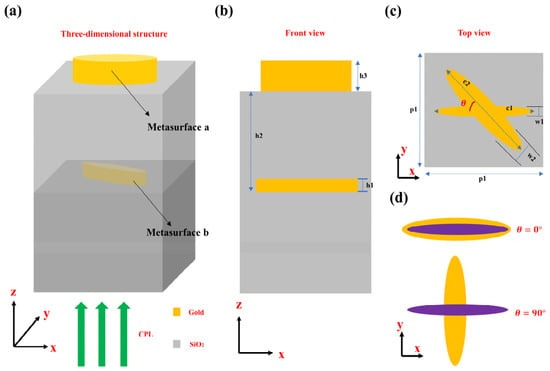
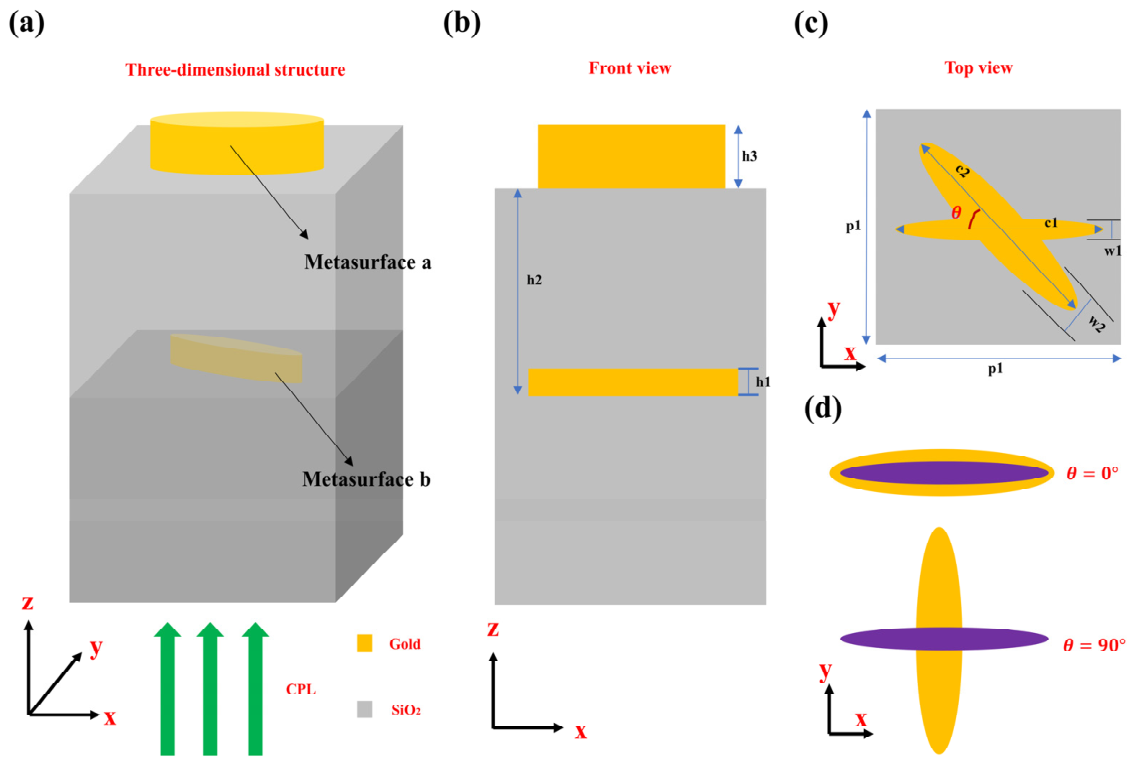
Figure 1a schematically shows the unit cell structure of the proposed TBP metasurface. This metasurface is composed of a bottom SiO2 substrate, a bottom plasmonic metasurface (metasurface b), an intermediate SiO2 spacer layer, and a top plasmonic metasurface (metasurface a), which are stacked and infinitely extended in the x and y directions with sub-wavelength periods. The structure adopts a gold–SiO2 material system and has the potential to be compatible with commercial CMOS processes. Figure 1b presents a front view of the unit cell of the TBP metasurface, with the thickness information of each functional layer labeled. Figure 1c shows the corresponding top view, where the key geometric degree of freedom—the twist angle θ, which is the in-plane angle between the long axes of metasurface a and metasurface b—is defined. Figure 1d illustrates the combined configurations when the twist angle θ is 0° and 90°, respectively. The structures in these two states have mirror symmetry in the YZ plane. When θ takes any angle between 0° and 90° (excluding the endpoints), the overall structure no longer coincides with its mirror image, thus presenting chiral geometric features. The function of this TBP metasurface is similar to that of a circular polarization filter: it has a high transmission rate for left circularly polarized (LCP) light and a low transmission rate for right circularly polarized (RCP) light. The difference in transmission rates between the two is defined as the CD of the device. The transmission rate data were obtained through COMSOL software (Version 5.6) based on the finite element method, and the value is equal to the area integral of the Poynting vector at the transmission port. In the simulation model, due to the periodic arrangement of the unit cell of metasurfaces, the boundaries in the x and y directions were set as periodic boundary conditions. Perfectly matched layers (PML) were added to the top and bottom of the model to absorb boundary reflections, with a PML thickness of 4000 nm. The dispersion parameters of gold were taken from reference [35], and the maximum size in the meshing was 30 nm. The refractive index of SiO2 in the target band was set to 1.46. The polarization state and intensity of the incident light were controlled through the incident port. The potential testing and fabrication methods of metasurfaces can be found in the Supplementary Materials.
Figure 1.
(a) Three-dimensional schematic diagram of the unit cell of the TBP metasurface. The lower and upper metasurfaces are respectively named metasurface b and metasurface a. The incident light represented by the green arrow is circularly polarized light (CPL), which is incident perpendicularly from below the substrate. (b) Side view of the metasurface, showing the thickness information of each layer. h1 = 45 nm, h2 = 1200 nm, h3 = 395 nm. (c) Top view of the metasurface, showing the dimensions and period of the two gold ellipses. p1 = 1040 nm, c1 = 1020 nm, w1 = 260 nm, c2 = 950 nm, w2 = 110 nm, θ = 40°. (d) The shape of the combination of two golden ellipses when the twist angle θ is 0° and 90°. To distinguish them, one of the ellipses is in purple.
3. Results
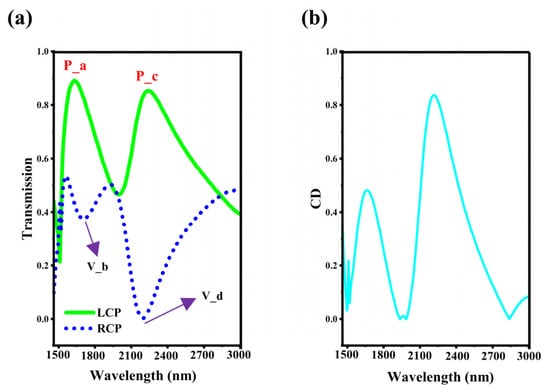
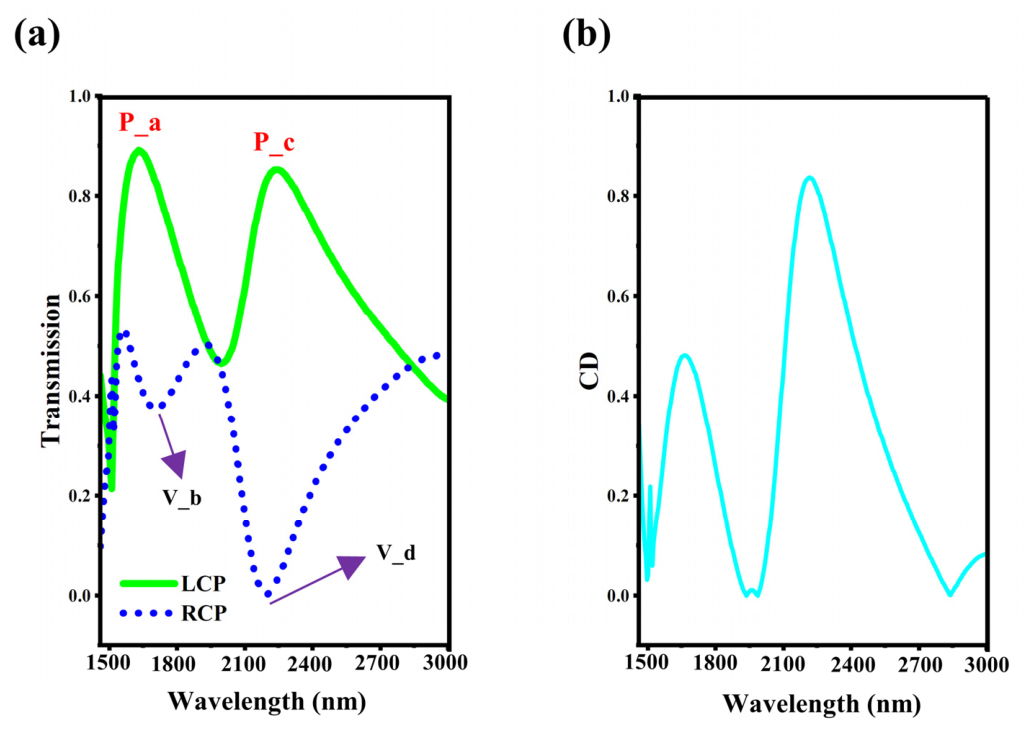
Figure 2a shows the transmission spectra of the proposed TBP metasurface for LCP and RCP in the wavelength range from 1500 nm to 3000 nm. For LCP, the transmission spectrum exhibits a double-peak feature within the studied wavelength range, with a spectral profile resembling the letter “M”. Two typical transmission peaks (labeled as peak a and peak c) are located near 1640 nm and 2240 nm, respectively, with corresponding peak transmission rates of approximately 0.89 and 0.84. For the case of RCP incidence, the transmission spectrum shows a more complex spectral profile, but overall, it is approximately mirror-symmetric to the LCP spectrum. The two transmission minima corresponding to RCP are labeled as valley b and valley d. Figure 2b calculates the CD spectrum of the device in the corresponding wavelength band, where CD is defined as the absolute value of the difference between the transmission rates of LCP and RCP, that is, CD = |TLCP–TRCP|. The results show that the metasurface has two significant CD peaks in the studied wavelength range, with peak values located at 1660 nm and 2200 nm, respectively, and corresponding CD values reaching 0.48 and 0.84. As shown in Table 1, most of the work has focused on chiral control at a single wavelength, and the intensity of CD is not high. Although the broken-ring structure has achieved high-efficiency chiral control, it requires the stacking of three layers of metasurfaces, which is highly challenging in terms of process. The TBP metasurface we designed has significant advantages in terms of the intensity of the CD peak and the number of controllable CD peaks.
Figure 2.
(a) Transmission spectrum of the TBP metasurface under CPL incidence. P_a, P_c, V_b, and V_d are the abbreviations for peak a, peak c, valley b, and valley d respectively. (b) CD spectrum of the TDP metasurface. The units of the transmission and CD are both 1.
Table 1.
A comparison of plasmonic metasurfaces that emerged in the same period of work.
3.1. The Influence of Interlayer Twist Angle θ
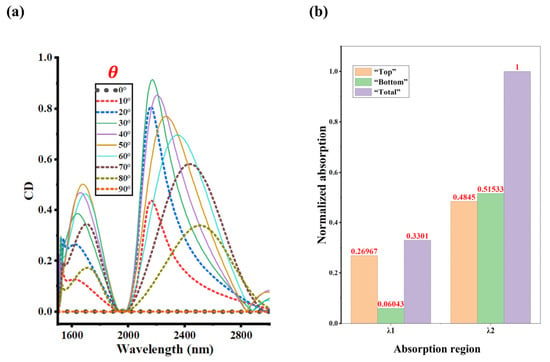
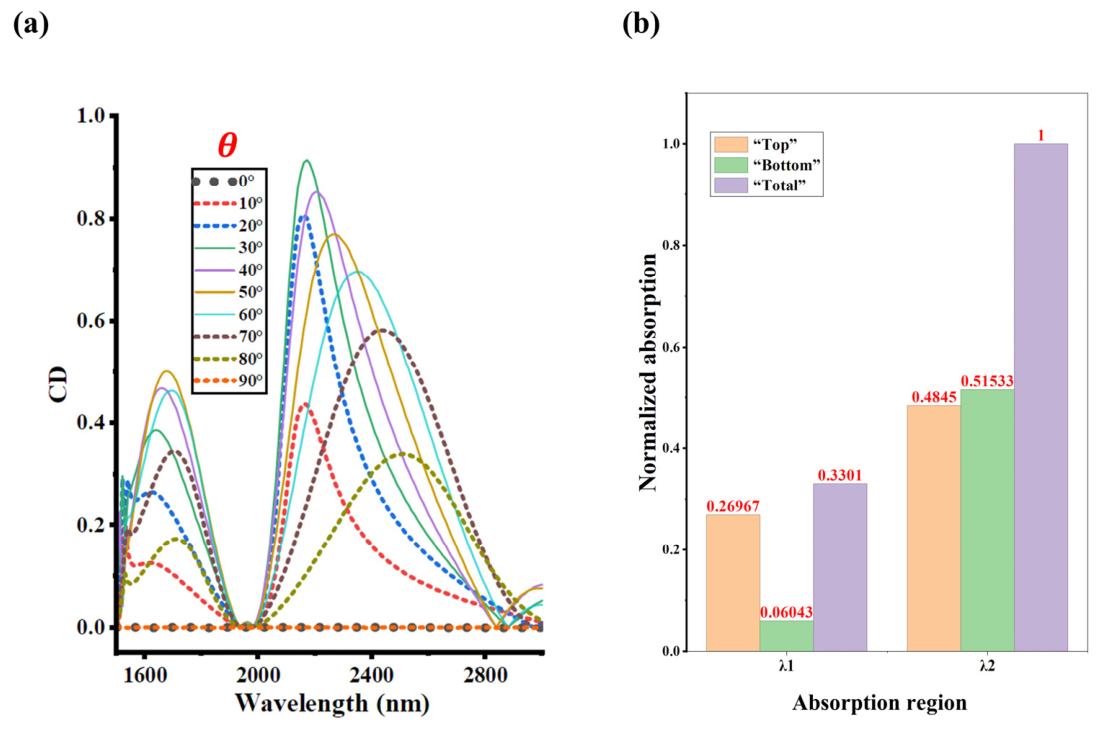
To explore the physical origin of the chiral optical response of the TBP metasurface, the evolution of the CD spectrum with the interlayer twist angle θ is systematically analyzed. As shown in Figure 3a, the metasurface is composed of two vertically stacked anisotropic elliptical cylindrical gold metasurfaces. When the two layers are in-plane aligned (θ = 0° or 90°), the overall structure is mirror-symmetric, and its CD spectrum is strictly zero throughout the entire studied wavelength range. As the twist angle θ increases from 0° to 90° in 10° steps, the structure gradually evolves into a chiral configuration, and the CD spectrum shows a non-zero response, presenting two characteristic peaks throughout the entire wavelength range. Notably, the intensities of the two CD peaks first increase and then decrease as the twist angle θ increases, with the maximum value of the peaks corresponding to θ = 50° and θ = 30°, respectively. This evolution clearly indicates that the mirror symmetry breaking introduced by the interlayer twist is the fundamental cause of the chiral optical resonance in this system, rather than the intrinsic properties of the individual metasurface layers. To further reveal the physical mechanism of the two CD peaks, we analyzed the light absorption distribution of the device at the two characteristic wavelengths. Figure 3b shows the light absorption intensities of the top metasurface (metasurface a) and the bottom metasurface (metasurface b) at wavelengths λ1 and λ2, with all data have been uniformly normalized based on the value of the sixth group of data from left to right (the data on the far right) in the bar chart. The results indicate that the total light absorption intensity at λ2 is approximately three times that at λ1. From the wavelength spatial distribution perspective, at λ1, the absorption loss is mainly concentrated in the top metasurface a. At λ2, both the top and bottom metasurfaces contribute significantly to the absorption. This difference reveals that the two CD peaks correspond to resonant modes with different electromagnetic field localization characteristics. λ1 may correspond to a localized mode dominated by the top layer, while λ2 involves a strong coupling mode between the top and bottom layers.
Figure 3.
(a) CD spectra corresponding to different twist angles θ. Visually, the curve corresponding to 0 degrees is completely obscured by the one corresponding to 90 degrees, as these two curves are basically superimposed. (b) Optical absorption information of the two plasmonic metasurfaces in the TBP metasurface at different incident wavelengths. “Top” refers to the top metasurface a, and “Bottom” refers to the bottom metasurface b. λ1 (1660 nm) and λ2 (2200 nm) correspond to the characteristic wavelengths of the two CD peaks in Figure 2b, respectively. The first three columns represent the absorption of the top metasurface, the bottom metasurface, and the entire metasurface, respectively, under the incidence of λ1 wavelength. The last three columns correspond to the incidence of λ2 wavelength.
3.2. The Equivalent Current Analysis at Characteristic Wavelengths
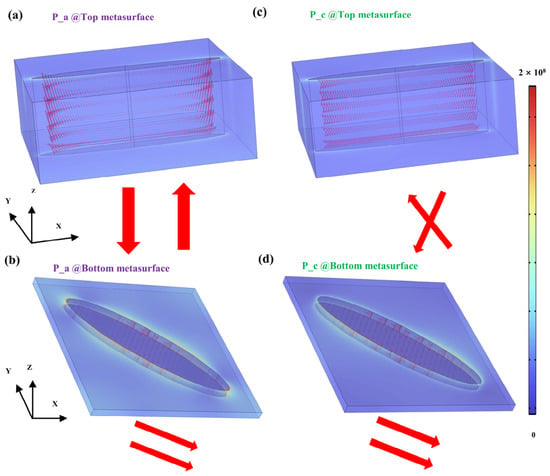
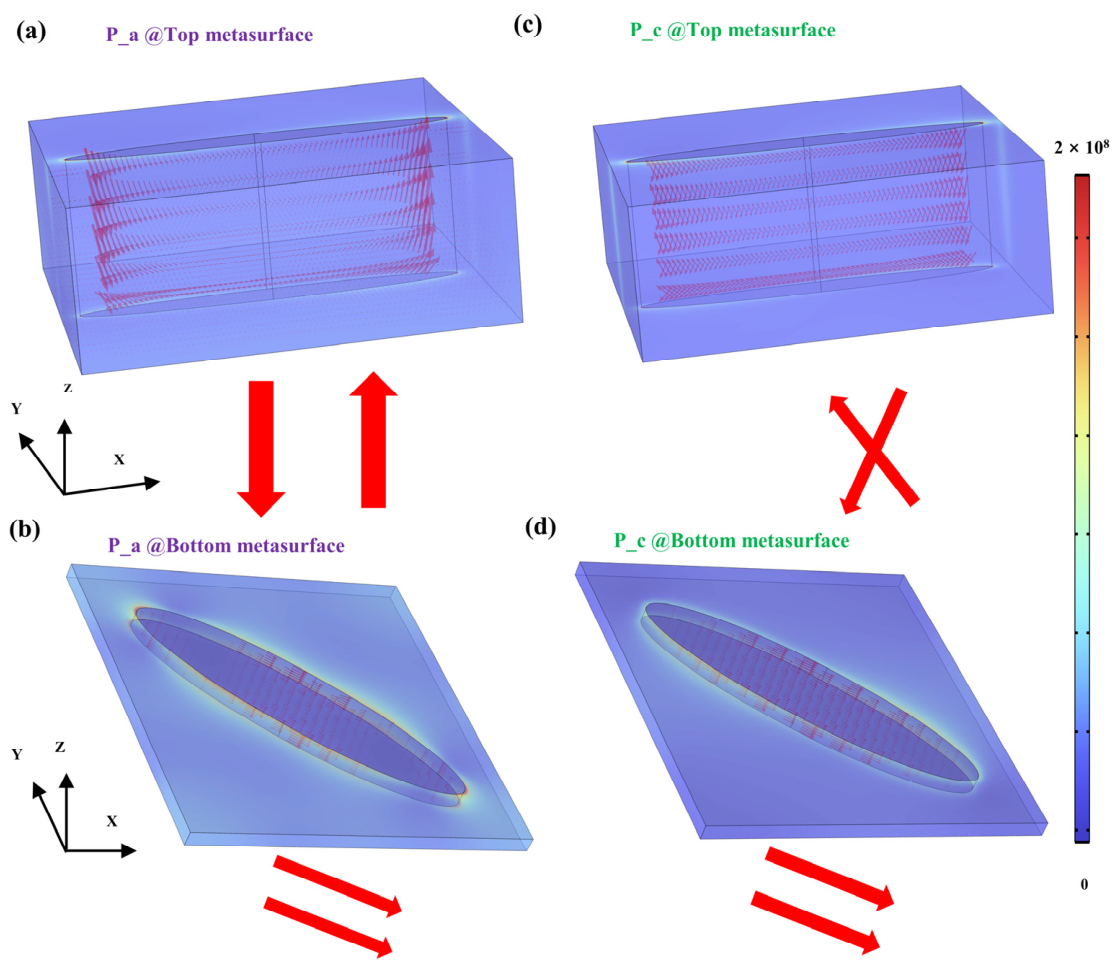
To reveal the physical mechanisms corresponding to the two CD peaks, Figure 4 shows the electric field intensity distribution and equivalent current distribution within the metasurface at the wavelengths of peak a and peak c in the LCP spectrum. The red arrows below each small figure in the figure are simplified diagrams of the equivalent current. At the incident wavelength corresponding to peak a, the electric field energy is mainly localized at the boundary between the bottom metasurface and the surrounding silica medium, and its intensity density is significantly higher than that at the top metasurface. From the equivalent current distribution, the top metasurface can be regarded as a pair of line currents oscillating in opposite directions along the Z-axis, which is a typical out-of-plane magnetic dipole resonance feature, as shown in Figure 4a. The bottom metasurface, on the other hand, exhibits two parallelly arranged electric dipoles, with their dipole moments existing in the XY plane and forming an angle of approximately −40° with the X-axis (Figure 4b). This current configuration indicates that peak a results from the coherent interference of the scattering field generated by the top magnetic dipole and the bottom tilted electric dipole with the incident light. At the incident wavelength corresponding to peak c, the distribution of the electric field intensity is similar to that corresponding to peak a. However, the response of the current distribution presents a completely different pattern. The equivalent current within the top metasurface is mainly distributed in the XZ plane and shows an oscillation feature of approximately 45° crossing (Figure 4c). In addition, Figure 4d shows that the bottom metasurface, on the other hand, exhibits a collection of two electric dipoles oscillating in the same direction and reinforcing each other. Therefore, peak c can be attributed to the cooperative coupling effect between the 45° crossing line current in the top and the parallel reinforcing electric dipoles in the bottom.
Figure 4.
Distribution maps of electric field intensity and equivalent current density. (a) Top metasurface a at peak a in the LCP spectrum. (b) Bottom metasurface b at peak a in the LCP spectrum. (c) Top metasurface a at peak c in the LCP spectrum. (d) Bottom metasurface b at peak c in the LCP spectrum. The legend on the far right corresponds to the distribution of electric field intensity. The red arrows correspond to the equivalent current.
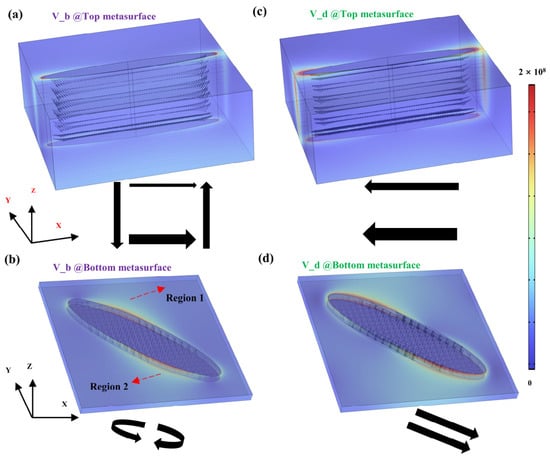
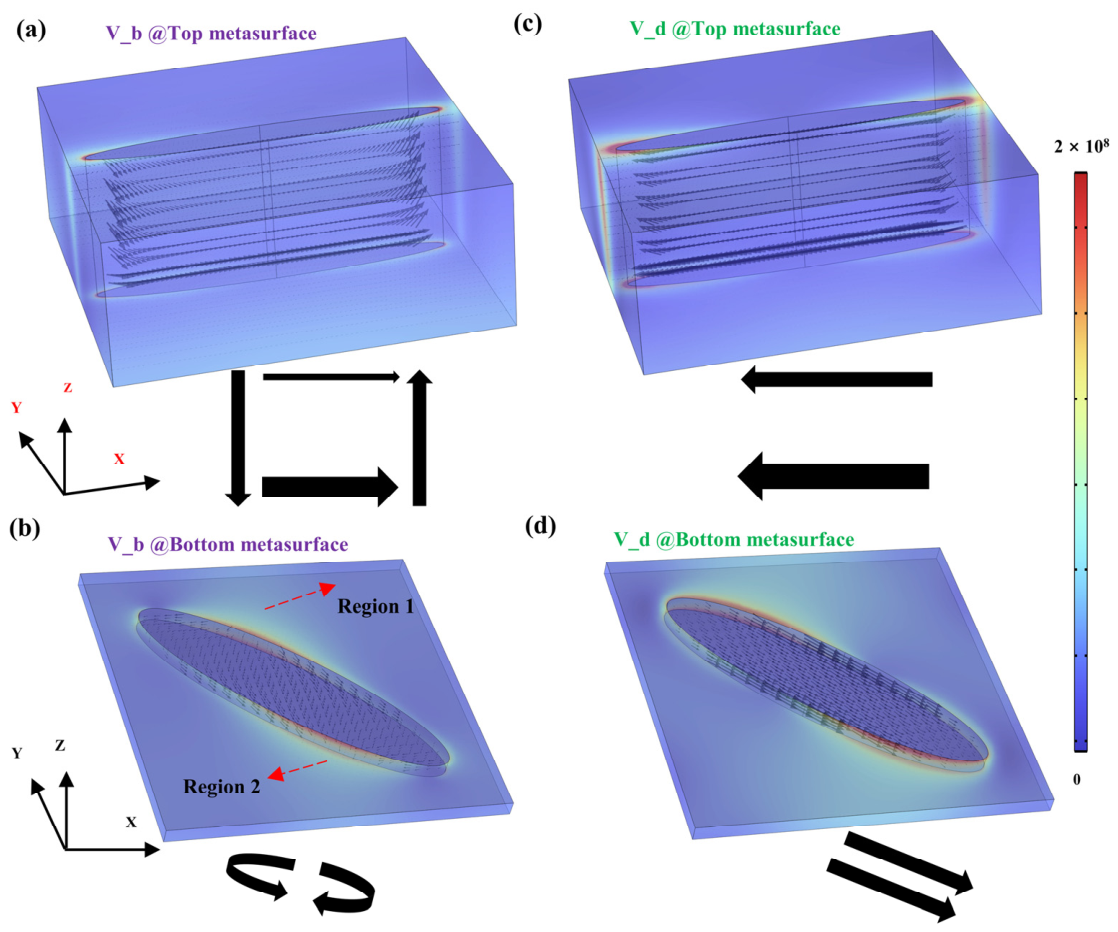
To further clarify the physical origin of the two transmission minima (valley b and valley d) in the RCP transmission spectrum, Figure 5 shows the electric field intensity distribution and equivalent current distribution of the metasurfaces at the corresponding wavelengths. Generally speaking, the electric energy density of the bottom metasurface is significantly higher than that of the top metasurface, which is mainly attributed to the difference in their mode volumes. In addition, unlike Figure 4, the electric field distribution in Figure 5 exhibits typical behavior of Localized Surface Plasmon Resonances (LSPRs). It can be observed that, regardless of whether it is valley b or valley d, the elliptical cylinders at the top metasurface have very sharp shapes at the two ends in the x-direction, which is an excellent location for amplifying the electric field intensity. A very significant coupling phenomenon of LSPRs occurs between adjacent unit cells, corresponding to the red vertical stripes on both sides in Figure 5a,c. For the bottom metasurface, it also has the LSPRs effect, but the locations of its electric field hotspots are different from the uniformly distributed situation in Figure 4b,d. It shows a significant anisotropic feature, mainly concentrated at the positions of “Region 1” and “Region 2”. The mutual coupling of LSPRs between the bottom and top metasurfaces may have a crucial impact on the extinction effect of RCP. Moreover, the current distribution map also contains a lot of physical information. At the wavelength of valley b, the equivalent current of the top metasurface is mainly distributed in the XZ plane. It presents as a pair of oppositely oscillating electric dipoles along the X-axis and two coherently oscillating electric dipoles along the Z-axis (Figure 5a). This current configuration indicates that the top metasurface supports a complex multipole hybrid mode at this wavelength. Meanwhile, the equivalent current of the bottom metasurface shows two semi-ring distributions with opposite rotations (Figure 5b), which is a typical feature of the vertical electric dipole. At the wavelength of valley d, the electromagnetic response mode changes significantly. The equivalent current of the top metasurface simplifies to a single-oriented electric dipole (Figure 5c), while the bottom metasurface presents as an electric dipole at an approximately 40° angle to the X-axis (Figure 5d). Therefore, the formation of valley b and valley d can be attributed to the destructive interference between specific multipole modes in the upper and lower metasurface, thereby significantly suppressing the transmission of LCP. Figure S1 in the Supplementary Materials also analyzes the optical resonance phenomenon from the perspective of the two-dimensional CD spectrum of the period and the wavelength.
Figure 5.
Distribution maps of electric field intensity and equivalent current density. (a) Top metasurface a at the valley b in the RCP spectrum. (b) Bottom metasurface b at the valley b in the RCP spectrum. (c) Top metasurface a at the valley d in the RCP spectrum. (d) Bottom metasurface b at the valley d in the RCP spectrum. The black arrows correspond to the equivalent current.
3.3. Error Analysis in Chiral Mirrors
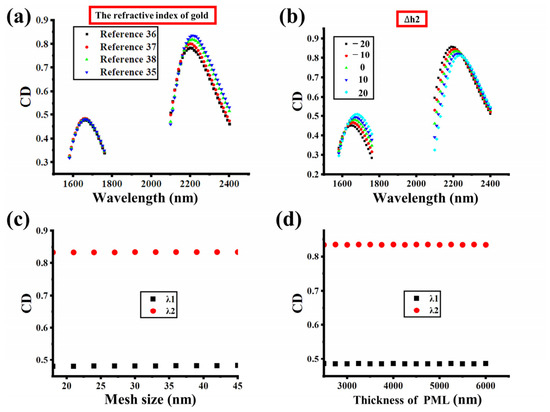
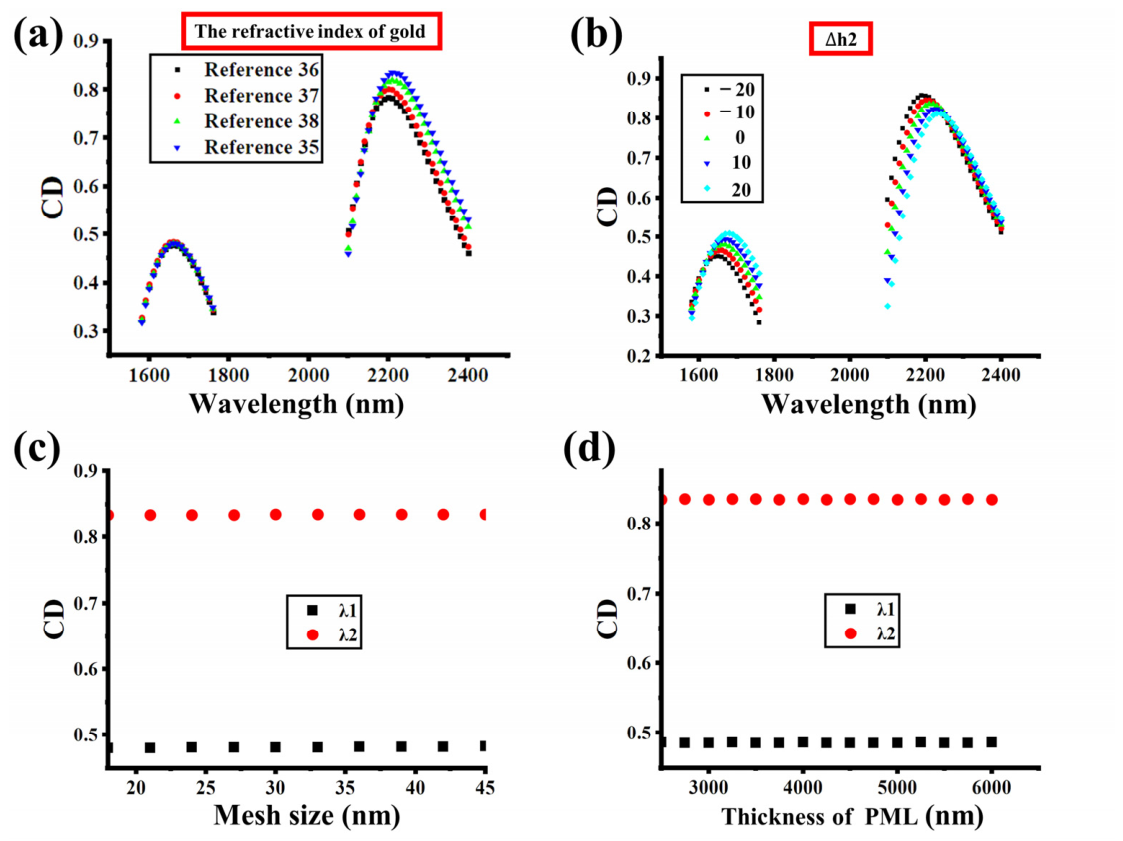
To ensure the reliable convergence of optical simulation, we systematically investigated the influence of material parameters and model configuration on the CD spectrum. Figure 6a assesses the impact of the optical refractive index parameters of gold, with four sets of dispersion data sourced from different literature [35,36,37,38]. The results indicate that minor perturbations in material parameters only cause weak changes in the CD peak and do not alter the fundamental characteristics of the chiral optical response, confirming the robustness of the designed structure to material parameter tolerances. Figure 6b examines the effect of the thickness variation Δh2 of the dielectric layer between the upper and lower metasurfaces, which can result from thermal expansion due to temperature fluctuations or polishing errors during fabrication. The analysis reveals that a shift in the dielectric layer thickness does not lead to the disappearance of the circular dichroism phenomenon but causes a slight wavelength drift of the characteristic peak positions. Figure 6c investigates the influence of the grid size of the gold material. In this model, the default grid size is set to 30 nm. When the grid size varies within the range of 20 nm to 45 nm, the circular dichroism spectra remain stable, indicating that the calculation results have converged to a grid-independent solution. Figure 6d verifies the impact of the thickness of the perfectly matched layer on the simulation accuracy. The results show that when the thickness of the perfectly matched layer exceeds 2500 nm, the circular dichroism values no longer change with it, demonstrating that the current model’s setting of 4000 nm for the perfectly matched layer is sufficient to eliminate numerical errors caused by boundary reflections. In addition, the analyses of the lateral dislocation and etching tilt angle can all be found in the Figure S2 of the Supplementary Materials.
Figure 6.
(a) The influence of the gold refractive index parameters on the CD spectrum. (b) The influence of the thickness h2 of the dielectric layer between the upper and lower metasurfaces on the CD spectrum. (c) The influence of the mesh size on the CD spectrum. (d) The influence of the thickness of the PML on the CD spectrum.
4. Discussion
The twisted bilayer plasmonic metasurface proposed in this paper introduces the interlayer twist angle as a new degree of freedom, providing a design concept different from traditional techniques for achieving efficient circular dichroism. Unlike the intrinsic chiral schemes that rely on three-dimensional helical structures, this work adopts a stacked structure of two non-chiral anisotropic metasurfaces, inducing chiral optical responses by breaking the mirror symmetry of the overall structure. This design not only avoids the complex three-dimensional micro-nano processing technology but also realizes the tunability of chiral responses through the precise control of the twist angle.
It is worth noting that, compared with the traditional “waveplate–polarizer” cascaded scheme, this design adds the new degree of freedom of twist angle control, achieving high circular dichroism values at two different wavelengths. At a wavelength of 1660 nm, the CD value is 0.48, which is close to the theoretical limit of traditional metal chiral structures. At a wavelength of 2200 nm, the CD value is as high as 0.84, significantly breaking through the 50% efficiency bottleneck. This phenomenon can be attributed to the wavelength dependence of chiral resonance modes in the multilayer structure. The strength of interlayer coupling changes in different bands, thus forming enhanced chiral optical responses at specific wavelengths. This multi-wavelength characteristic makes the device potentially valuable in wavelength division multiplexing systems. Compared with chiral structures based on dielectric metasurfaces, although metal metasurfaces have ohmic losses, by optimizing geometric parameters and twist angles, significant enhancement of chiral responses can be achieved in specific bands, thereby offsetting the negative impact of losses. The simulation results of this work verify the feasibility of this design concept, laying a foundation for subsequent experimental verification.
5. Conclusions
In summary, this study numerically demonstrates an efficient CD device based on a twisted double-layer metal metasurface. By precisely engineering the in-plane twist angle between the two anisotropic metasurface layers, the mirror symmetry of the structure is broken, giving rise to strong coupling and interference effects that significantly enhance the CD response at multiple wavelengths. Simulation results indicate that the device achieves CD values of 0.48 at 1660 nm and 0.84 at 2200 nm, surpassing the 50% efficiency bottleneck inherent to conventional metallic chiral structures. This approach eliminates the need for complex three-dimensional helical geometries as well as traditional “waveplate–polarizer” cascades, offering a simple, fabrication-compatible, and scalable design strategy for high-performance chiral photonic devices. These findings may open up new avenues for applications such as near-infrared high-resolution chiral molecular sensing, dual-wavelength dynamic polarization coding, and low-loss integrated quantum photonics.
Supplementary Materials
The following supporting information can be downloaded at: https://www.mdpi.com/article/10.3390/cryst16050317/s1, Figure S1: (a) The variation of CD as h2 decreases. (b) The XZ and YZ magnetic field cross-sectional diagrams of the bilayer metasurface when h2 takes the values corresponding to the three peaks of the red solid line in Figure S1a. (c) The two-dimensional CD spectrum related to the period and wavelength. (d) The XZ and YZ magnetic field cross-sectional diagrams of the bilayer metasurface when h2 takes the values corresponding to the three peaks of the black solid line in Figure S1a; Figure S2: (a) Top view of the unit cell of the metal metasurface. The black dots represent the centers of the elliptical cylinders. (b) The etching tilt angle θ. (c) The influence of the horizontal misalignment dx on CD. (d) The influence of the horizontal misalignment dy on CD. (e) The influence of the etching tilt angle θ on CD. (f) The influence of the refractive index of silicon dioxide on the CD spectrum; Figure S3: The influence of the parameters p1, w1, c1, h3, w2, c2, h1, and h2 of the metasurface on the CD value at two operating wavelengths. The range of the size variation has three levels, from large to small: 100 nm, 50 nm, and 20 nm, which also correspond to the initial values of the parameters from large to small. The purple numbers above each small graph represent the initial values of the parameters.
Author Contributions
Conceptualization, X.J. and L.L.; methodology, B.C. and Y.Z.; software, L.L. and X.W.; validation, G.S., X.J. and Y.Z.; formal analysis, X.J.; investigation, Y.Z. and G.S.; resources, L.L.; data curation, X.J. and X.Z.; writing—original draft preparation, X.J. and L.L.; writing—review and editing, K.Z. and H.S.; visualization, K.Z.; supervision, H.S.; project administration, H.S.; funding acquisition, K.Z. and H.S. All authors have read and agreed to the published version of the manuscript.
Funding
This research was funded by the National Key Research and Development Program of China, grant number NO. 2024YFB2807803; This research was funded by the Natural Science Foundation of Tianjin, grant number NO. 24JCQNJC01880; This research was funded by the Research on Optoelectronic Fusion Technology, ZB253015; This research was funded by the Young Elite Scientists Sponsorship Program of Cast, grant number NO. YESS20240775; This research was funded by the Strategic Priority Research Program of the Chinese Academy of Sciences (grant no. XDB0980000).
Data Availability Statement
The raw data supporting the conclusions of this article will be made available by the authors on request.
Acknowledgments
The authors are grateful to Ya jin of Nankai University. During the preparation of this manuscript, the author used The AI translation in Youdao Translate, Version 2.0 for the purposes of the grammar checking. The authors have reviewed and edited the output and take full responsibility for the content of this publication.
Conflicts of Interest
The authors declare that there are no conflicts of interest related to this article.
References
- Scully, M.O.; Zubairy, M.S.; Milonni, P.W. Quantum Optics. Phys. Today 1998, 51, 90–92. [Google Scholar] [CrossRef] [Scilit]
- Cardano, F.; Marrucci, L. Spin–orbit photonics. Nat. Photonics 2015, 9, 776–778. [Google Scholar] [CrossRef] [Scilit]
- Ghamari, S.; Wu, H.Y.; Pedireddy, S.; Vollmer, F. Plasmonic nanorod and dimer chiral molecule sensing from cysteine monolayer to bi-layers and multilayered shells. npj Biosensing 2025, 2, 17. [Google Scholar] [CrossRef] [Scilit]
- Lewis, J.D.; Verber, C.M.; Mcghee, R.B. A true three-dimensional display. IEEE Trans. Electron Devices 1971, 18, 724–732. [Google Scholar] [CrossRef] [Scilit]
- Soai, I.S.K. Circularly Polarized Light. In Catalysis from A to Z; Wiley: Hoboken, NJ, USA, 2020. [Google Scholar]
- Goldstein, D.H. Polarized Light, 2nd ed.; Marcel Dekker: New York, NY, USA, 2003. [Google Scholar]
- Iwanaga, M. Ultrathin Polarizers and Waveplates Made of Metamaterials. In Micro- and Nanophotonic Technologies; Wiley: Hoboken, NJ, USA, 2017. [Google Scholar]
- Won, R. Metasurfaces: Chiral spectrometer. Nat. Photonics 2017, 11, 208. [Google Scholar] [CrossRef] [Scilit]
- Chen, X.; Chen, K.; Zhou, Y.; Ma, X.; Fang, W.; Zhang, W.; Huang, S.; Fang, Z.; Gao, W. Temporal coupled-mode theory for PT-symmetric chiral metasurfaces. Opt. Lett. 2023, 48, 5503–5506. [Google Scholar] [CrossRef] [Scilit]
- Tang, H.; Stan, L.; Czaplewski, D.A.; Yang, X.; Gao, J. Infrared phase-change chiral metasurfaces with tunable circular dichroism. Opt. Express 2024, 32, 10. [Google Scholar] [CrossRef] [Scilit]
- Tang, H.; Stan, L.; Czaplewski, D.A.; Yang, X.; Gao, J. Wavelength-tunable infrared chiral metasurfaces with phase-change materials. Opt. Express 2023, 31, 10. [Google Scholar] [CrossRef] [Scilit]
- Wu, J.; Ouyang, C.; Ma, J.; Li, H.; Xu, Z.H.; Hao, X.; Xu, Q.; Gu, J.; Xu, S.; Li, Y. Reconfigurable BIC-Based Intrinsic Chiral All-Dielectric Terahertz Metasurfaces. Laser Photonics Rev. 2025, 19, e00674. [Google Scholar] [CrossRef] [Scilit]
- Wang, C.; Wu, J.; Tian, J. High-Q Chiral Janus Metasurfaces Based on Multipolar Resonances. Laser Photonics Rev. 2025, 19, e00205. [Google Scholar] [CrossRef] [Scilit]
- Doshi, S.; Ji, A.; Mahdi, A.I.; Keene, S.T.; Selvin, S.P.; Lalanne, P.; Appel, E.A.; Melosh, N.A.; Brongersma, M.L. Electrochemically mutable soft metasurfaces. Nat. Mater. 2025, 24, 205–211. [Google Scholar] [CrossRef] [Scilit]
- Ryu, J.E.; Kim, J. Electrically controlled nano-OLED metasurfaces. Nat. Photonics 2026, 20, 5–6. [Google Scholar] [CrossRef] [Scilit]
- Meinzer, N.; Barnes, W.L.; Hooper, I.R. Plasmonic meta-atoms and metasurfaces. Nat. Photonics 2014, 8, 889–898. [Google Scholar] [CrossRef] [Scilit]
- Kildishev, A.V.; Boltasseva, A.; Shalaev, V.M. Planar Photonics with Metasurfaces. Science 2013, 339, 1232009. [Google Scholar] [CrossRef] [Scilit]
- Yu, N.; Capasso, F. Flat optics with designer metasurfaces. Nat. Mater. 2014, 13, 139–150. [Google Scholar] [CrossRef] [Scilit]
- Yin, X.; Ye, Z.; Rho, J.; Wang, Y.; Zhang, X. Photonic Spin Hall Effect at Metasurfaces. Science 2013, 339, 1405–1407. [Google Scholar] [CrossRef] [Scilit]
- Shen, Z.; Lin, X.; Huang, D. Dual-mode dual-band circular polarization device based on three-layer plasmonic metasurface. APL Mater. 2023, 11, 091108. [Google Scholar] [CrossRef] [Scilit]
- Gansel, J.K.; Thiel, M.; Rill, M.S.; Decker, M.; Bade, K.; Saile, V.; Freymann, G.V.; Linden, S.; Wegener, M. Gold Helix Photonic Metamaterial as Broadband Circular Polarizer. Science 2009, 325, 1513–1515. [Google Scholar] [CrossRef] [Scilit]
- Zhao, Y.; Belkin, M.A.; Alù, A. Twisted optical metamaterials for planarized ultrathin broadband circular polarizers. Nat. Commun. 2012, 3, 870. [Google Scholar] [CrossRef] [Scilit]
- Zhenyu, Y.; Ming, Z.; Peixiang, L. How to improve the signal-to-noise ratio for circular polarizers consisting of helical metamaterials? Opt. Express 2011, 19, 4255. [Google Scholar]
- Ji, R.; Wang, S.W.; Liu, X.; Guo, H.; Lu, W. Hybrid Helix Metamaterials for Giant and Ultrawide Circular Dichroism. ACS Photonics 2016, 3, 2368–2374. [Google Scholar] [CrossRef] [Scilit]
- Dietrich, K.; Menzel, C.; Lehr, D.; Puffky, O.; Huebner, U.; Pertsch, T.; Tuennermann, A.; Kley, E.B. Elevating optical activity: Efficient on-edge lithography of three-dimensional starfish metamaterial. Appl. Phys. Lett. 2014, 104, 2517–2534. [Google Scholar] [CrossRef] [Scilit]
- Cen, M.; Wang, J.; Cheng, M.; Lei, Z.; Li, Y.; Wang, Z.; Zhao, X.; Wu, Z.; Zhang, H.; Liu, Y.J. Moiré metasurfaces with tunable near-infrared-I chiroptical responses for biomolecular chirality discrimination. Nanoscale 2025, 17, 1970–1979. [Google Scholar] [CrossRef] [Scilit] [PubMed]
- Bai, J.; Wang, C.; Chen, X.; Basiri, A.; Wang, C.; Yao, Y. Chip-integrated plasmonic flat optics for mid-infrared full-Stokes polarization detection. Photonics Res. 2019, 7, 116–125. [Google Scholar] [CrossRef] [Scilit]
- Bai, J.; Wang, C.; Chen, X.; Basiri, A.; Wang, C.; Yao, Y. Chip-Integrated Plasmonic Flat Optics for Mid-infrared Polarization Detection. In CLEO: QELS_Fundamental Science; Optica Publishing Group: Washington, DC, USA, 2018. [Google Scholar]
- Bai, J.; Zuo, J.; Yao, Y. Mid-Infrared Chip-Integrated Full-Stokes Polarimeter Array Based on Plasmonic Metasurfaces. In Proceedings of the Conference on Lasers and Electro-Optics, San Jose, CA, USA, 15–20 May 2022; p. STh2H.1. [Google Scholar]
- Li, L.; Wang, J.; Kang, L.; Liu, W.; Wang, X. Monolithic Full-Stokes Near-Infrared Polarimetry with Chiral Plasmonic Metasurface Integrated Graphene–Silicon Photodetector. ACS Nano 2020, 14, 16634–16642. [Google Scholar] [CrossRef] [Scilit]
- Wang, Z.; Wang, Y.; Adamo, G.; Teh, B.H.; Wu, Q.Y.S.; Teng, J.; Sun, H. A Novel Chiral Metasurface with Controllable Circular Dichroism Induced by Coupling Localized and Propagating Modes. Adv. Opt. Mater. 2016, 4, 883–888. [Google Scholar] [CrossRef] [Scilit]
- Deng, J.; Shi, M.; Liu, X.; Zhou, J.; Qin, X.; Wang, R.; Zhen, Y.; Dai, X.; Chen, Y.; Wei, J. An on-chip full-Stokes polarimeter based on optoelectronic polarization eigenvectors. Nat. Electron. 2024, 7, 1004–1014. [Google Scholar] [CrossRef] [Scilit]
- Cheng, B.; Zou, Y.; Song, G. Full-stokes polarization photodetector based on the chiral metasurface with the dislocated double gold rod configurations. Opt. Laser Technol. 2024, 174, 7. [Google Scholar] [CrossRef] [Scilit]
- Arbabi, A.; Faraon, A. Fundamental Limits of Ultrathin Metasurfaces. Sci. Rep. 2017, 7, 43722. [Google Scholar] [CrossRef] [Scilit]
- Babar, S.; Weaver, J.H. Optical constants of Cu, Ag, and Au revisited. Appl. Opt. 2015, 54, 477–481. [Google Scholar] [CrossRef] [Scilit]
- Hagemann, H.J.; Gudat, W.; Kunz, C. Optical constants from the far infrared to the x-ray region: Mg, Al, Cu, Ag, Au, Bi, C, and Al2O3. J. Opt. Soc. Am. 1975, 65, 742–744. [Google Scholar] [CrossRef] [Scilit]
- Ordal, M.A.; Bell, R.J.; Alexander, R.W.; Long, L.L.; Querry, M.R. Optical properties of Au, Ni, and Pb at submillimeter wavelengths. Appl. Opt. 1987, 26, 744. [Google Scholar] [CrossRef] [Scilit]
- Olmon, R.L.; Slovick, B.; Johnson, T.W.; Shelton, D.; Oh, S.H.; Boreman, G.D.; Raschke, M.B. Optical dielectric function of gold. Phys. Rev. B Condens. Matter Mater. Phys. 2012, 86, 235147. [Google Scholar] [CrossRef] [Scilit]

Disclaimer/Publisher’s Note: The statements, opinions and data contained in all publications are solely those of the individual author(s) and contributor(s) and not of MDPI and/or the editor(s). MDPI and/or the editor(s) disclaim responsibility for any injury to people or property resulting from any ideas, methods, instructions or products referred to in the content. |
© 2026 by the authors. Licensee MDPI, Basel, Switzerland. This article is an open access article distributed under the terms and conditions of the Creative Commons Attribution (CC BY) license.