


The Influence of Discontinuous Dynamic Recrystallization on the Microstructure and Distribution of Plastic Deformations in Pure Aluminum and Copper at High Strain Rates

Abstract
1. Introduction
2. Materials and Methods
2.1. Continuum and Plasticity Model
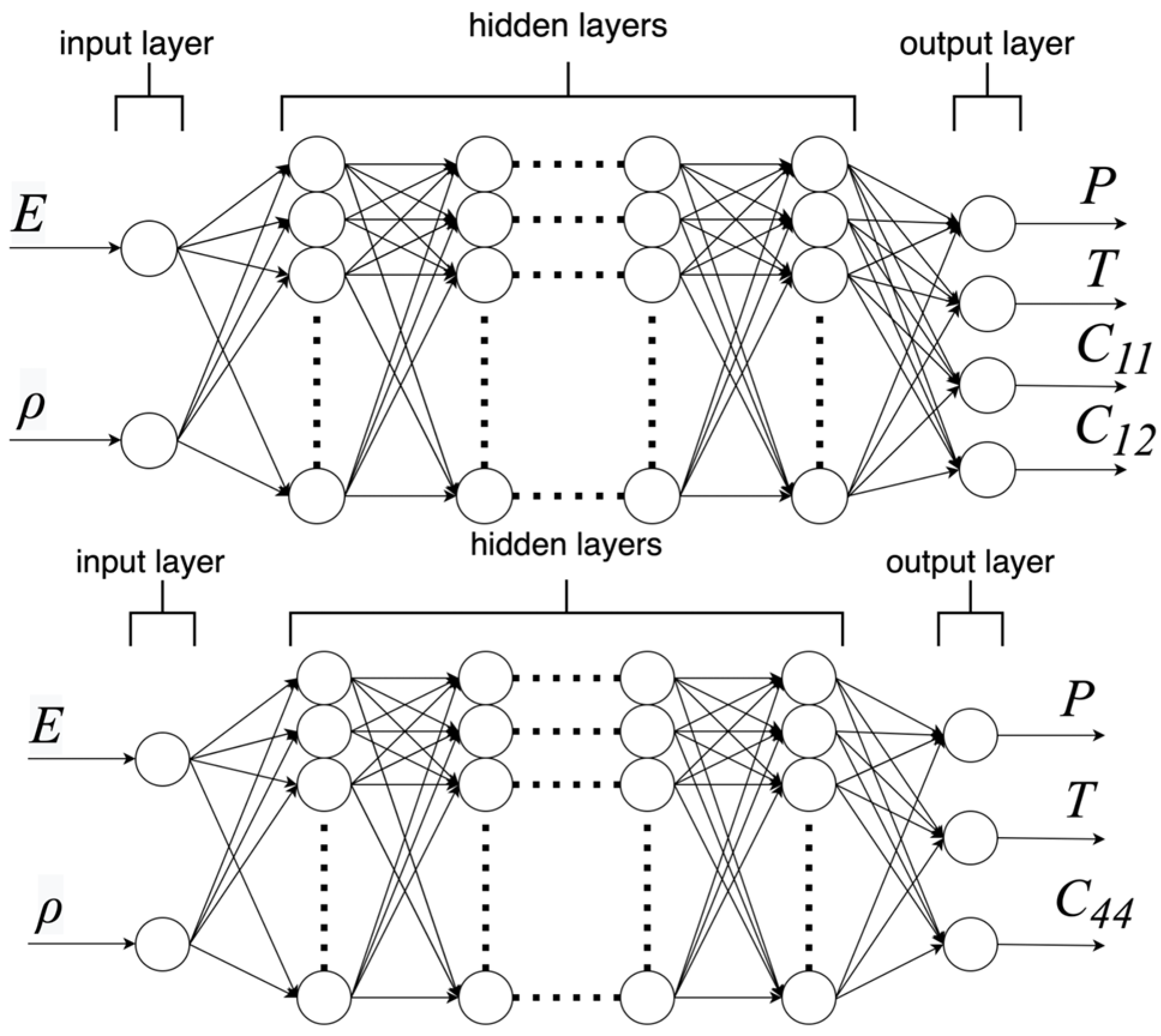
2.2. Equation of State and Constitutive Relation in the Form of a Feedforward Neural Network
2.3. Discontinuous Dynamic Recrystallization Model
- Before simulating material deformation, a polycrystal is created on the computational mesh using the Voronoi diagram method. The simulated box is divided into polygons, and each computational cell is assigned to its respective polygon using the ray casting method. Each grain is then assigned a uniformly distributed tilt angle. The slip plane projection tensor (6) is reoriented for each computational cell within the grain according to its tilt angle.
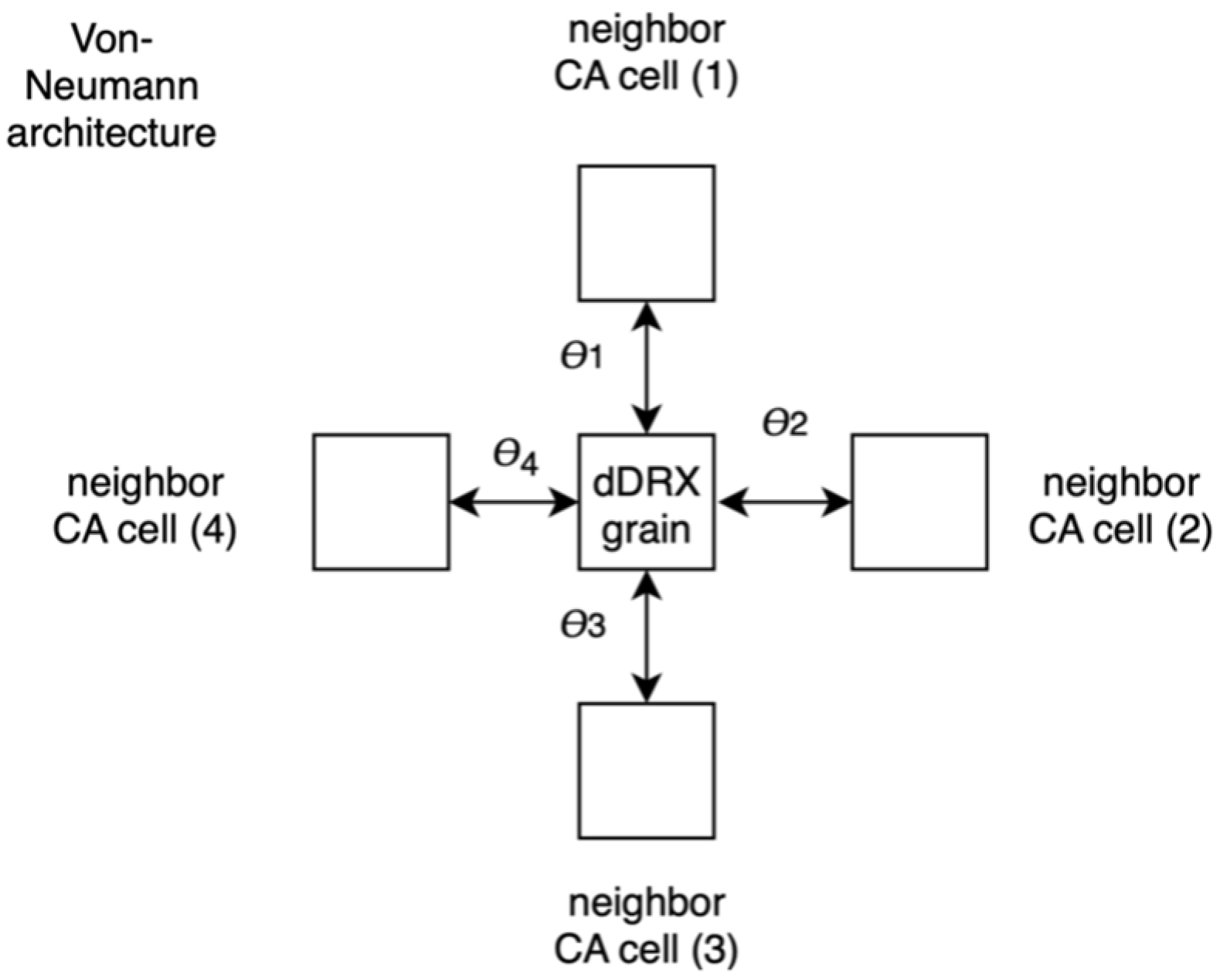
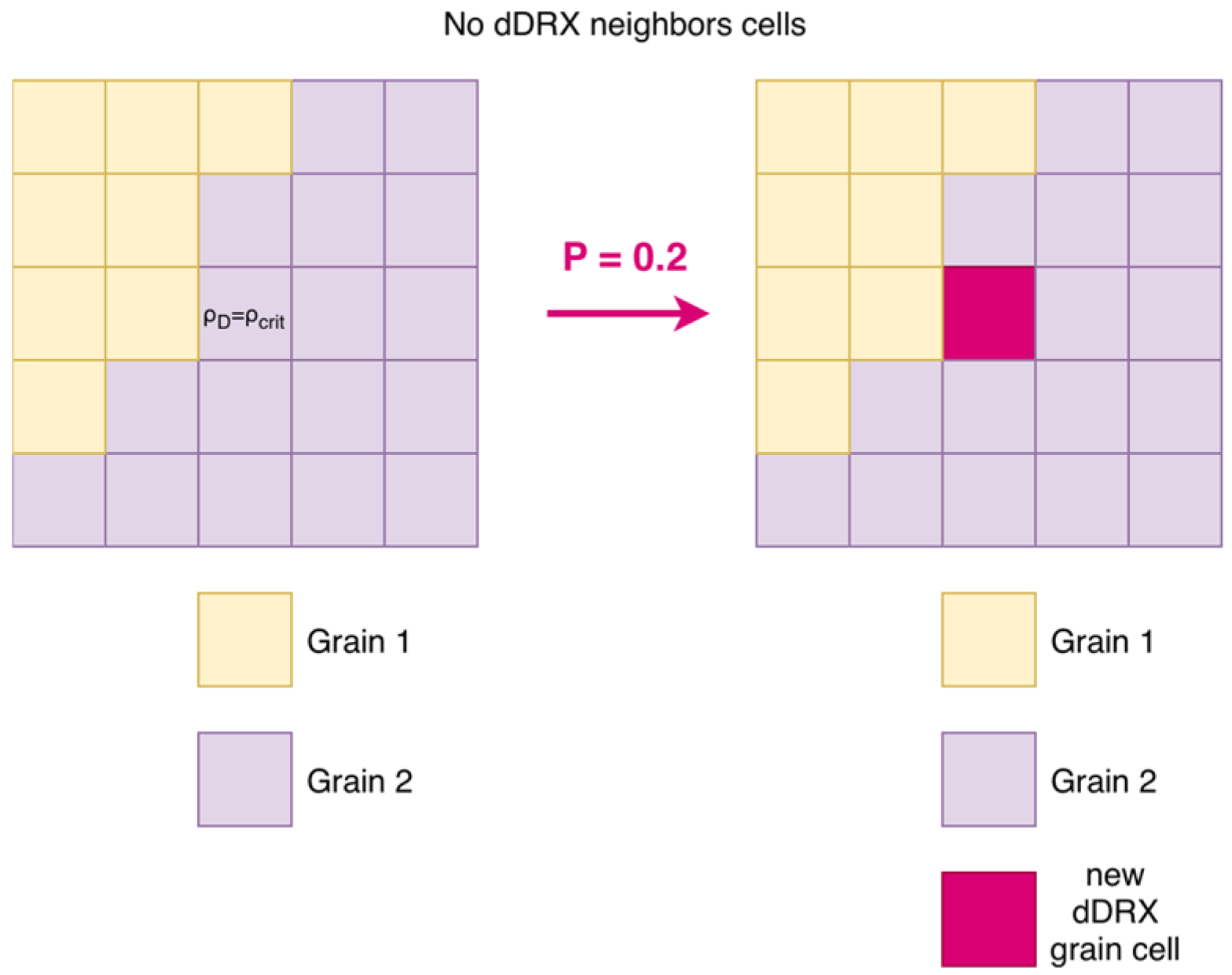
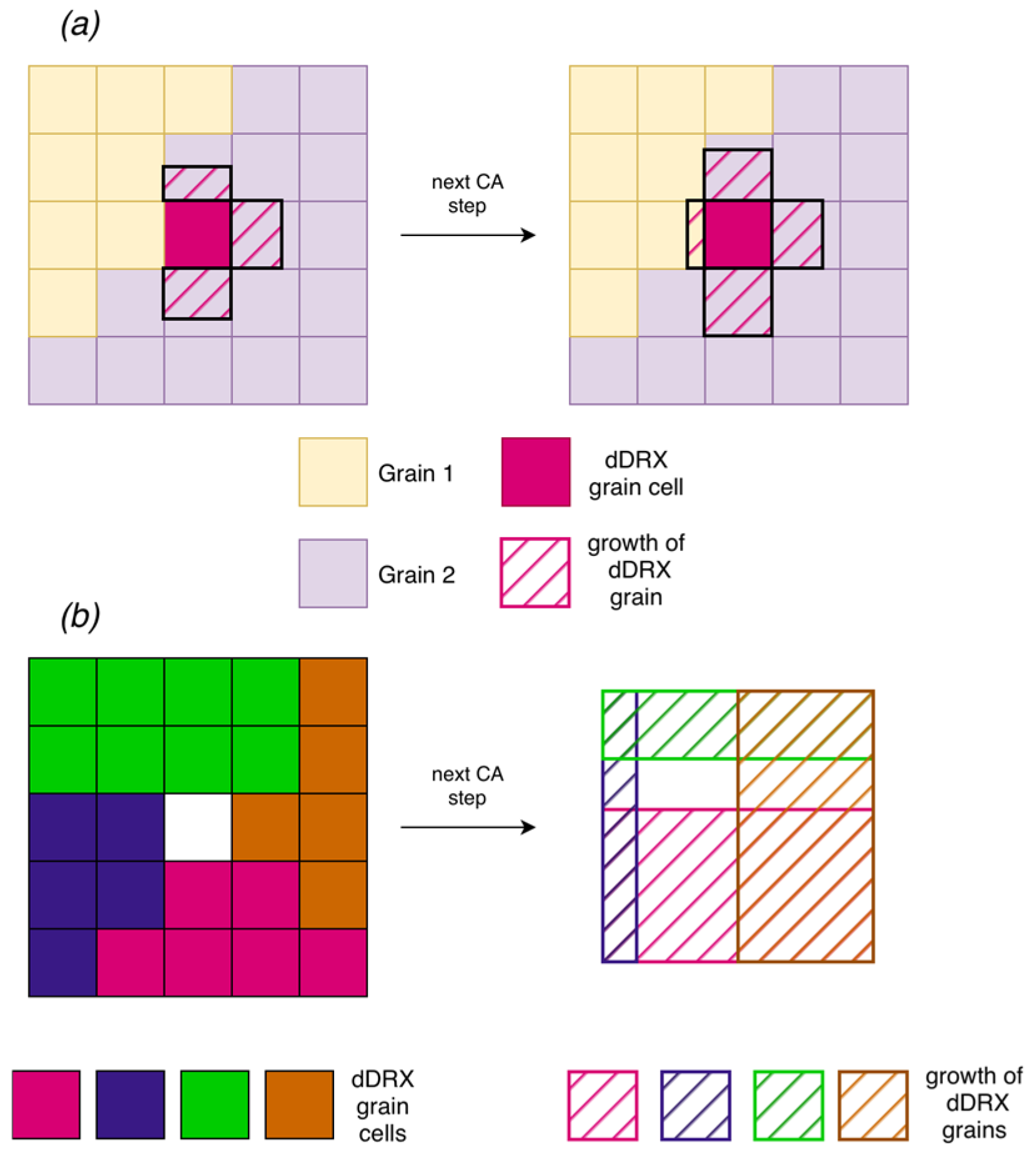
- After determining the load on the material through boundary conditions and setting the initial temperature, the deformation of the material begins. During plastic deformation, upon reaching the critical dislocation density (32), nucleation of dDRX grains occurs according to the scheme in Figure 3, since the material either has no or very few existing dDRX cells. Nucleation depends on the state of neighboring cells within the von Neumann neighborhood. Two states are considered: recrystallized grain or crystalline matrix. The transition probabilities to a new state are as follows: matrix cells contribute a transition probability of 0.05, while recrystallized grains contribute 0.2. To determine the new state of the current cell, the probabilities are summed over all cells in the neighborhood. Therefore, in the absence of recrystallized cells, a new grain nucleates. Due to the absorption of dislocations, this new grain rotates by 10 degrees (see Figure 3). The dislocation densities of the cell are set to their initial levels , the orientation of the slip planes (7) is recalculated, and the cells in the von Neumann neighborhood become grain boundary cells.
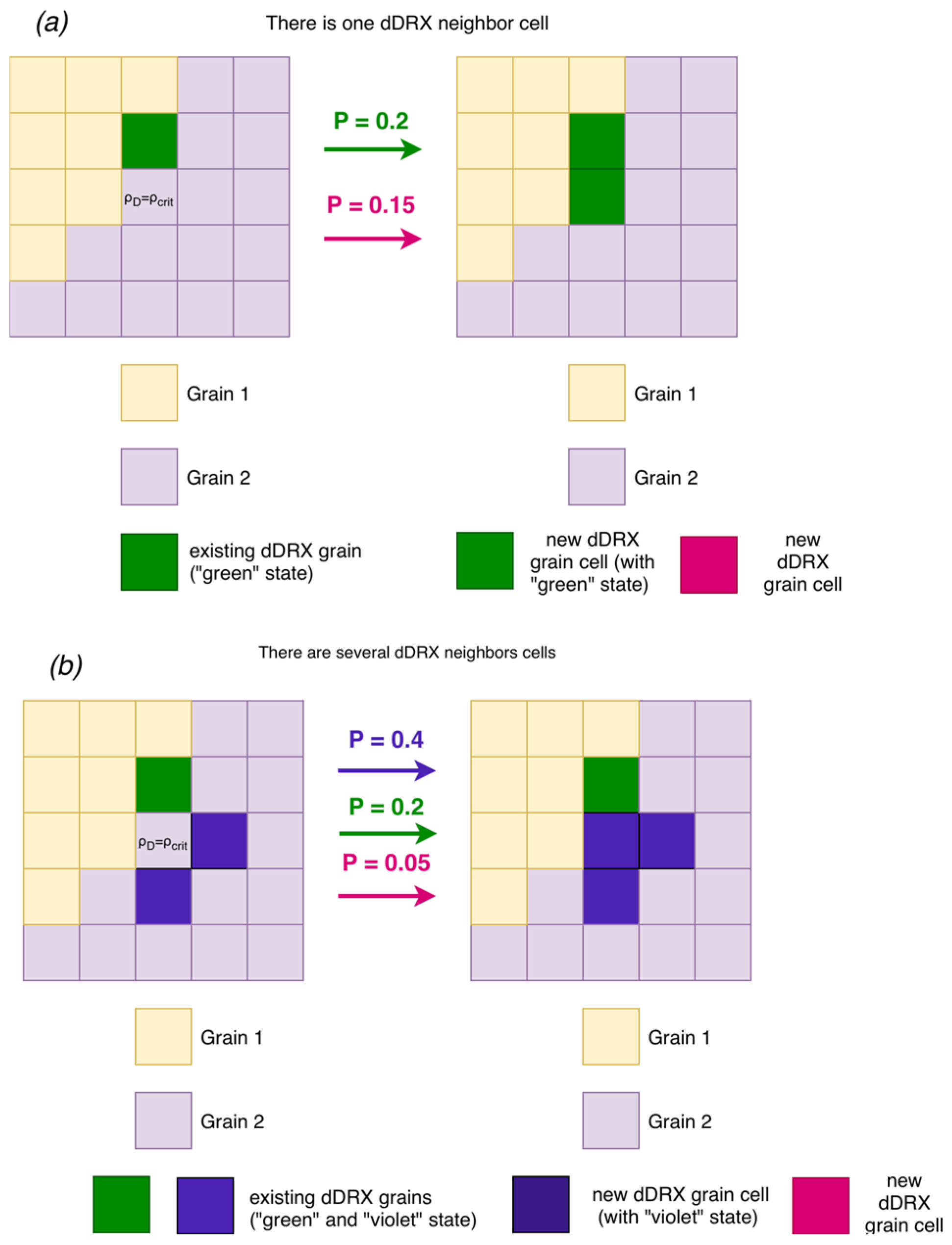
- During continued plastic deformation of the material, nucleation can also occur, provided that the critical dislocation density (32) is reached in a grain boundary cell. However, situations now arise where dDRX grains are already present in the vicinity of the current cell. Therefore, the probability of transitioning to the dDRX state will depend on the number of recrystallized neighboring cells, as shown in Figure 4: the current cell can “attach” to an existing recrystallized grain and adopt its slip plane orientation and grain identifier. The probabilities remain the same as in the previous stage and are summed over the entire neighborhood. After the current cell transitions to the recrystallized state, the dislocation densities decrease to their initial values, and grain boundary cells are defined between neighbors with different grain orientations.
- The second effect modeled by the CA method is the growth of recrystallized grains into the crystalline matrix of the material. Since dislocations are consumed during the nucleation of dDRX grains (described in the previous stages), a driving force arises between recrystallized cells and the material matrix, acting on the newly formed grain boundary, as defined in Equation (35). Knowing the driving force, we can calculate, for each boundary cell, the fraction filled by each adjacent recrystallized grain that grows into the crystalline matrix (if multiple such grains exist). When the fraction becomes equal to 1—that is, when it fills the entire cell—the current boundary cell becomes a recrystallized grain (if several neighboring recrystallized grains compete, the one that “grew” faster determines the outcome). Subsequently, the orientation of the slip systems is redefined, and neighboring cells with the crystalline matrix become grain boundary cells.
3. Results
3.1. Results of Hot Tension and Compression Simulations
3.2. Average Grain Size and Grain Distribution
4. Discussion
5. Conclusions
- The theoretical model has been developed that simultaneously accounts for dislocation plasticity and discontinuous dynamic recrystallization in FCC metals (pure aluminum and copper). This model allows us to describe plasticity processes by taking into account dislocation motion on all slip systems and the rotation of slip systems within each crystallite. Together with the plasticity model, the cellular automata method enables us to account for the effects of DRX and to describe plasticity processes in new grains, including their rotation.
- The equation of state and constitutive relations in the elastic region have been obtained, accounting for temperature and strain dependencies. This equation is presented in the form of a feedforward neural network trained using molecular dynamics simulation data. These relations are presented for aluminum and copper. Using them, we can describe the state of the material in the elastic region for FCC crystals over a wide range of temperatures (100–900 K for aluminum and 100–1300 K for copper) and densities (2.2–3 kg/m3 for aluminum and 7.5–10 kg/m3 for copper).
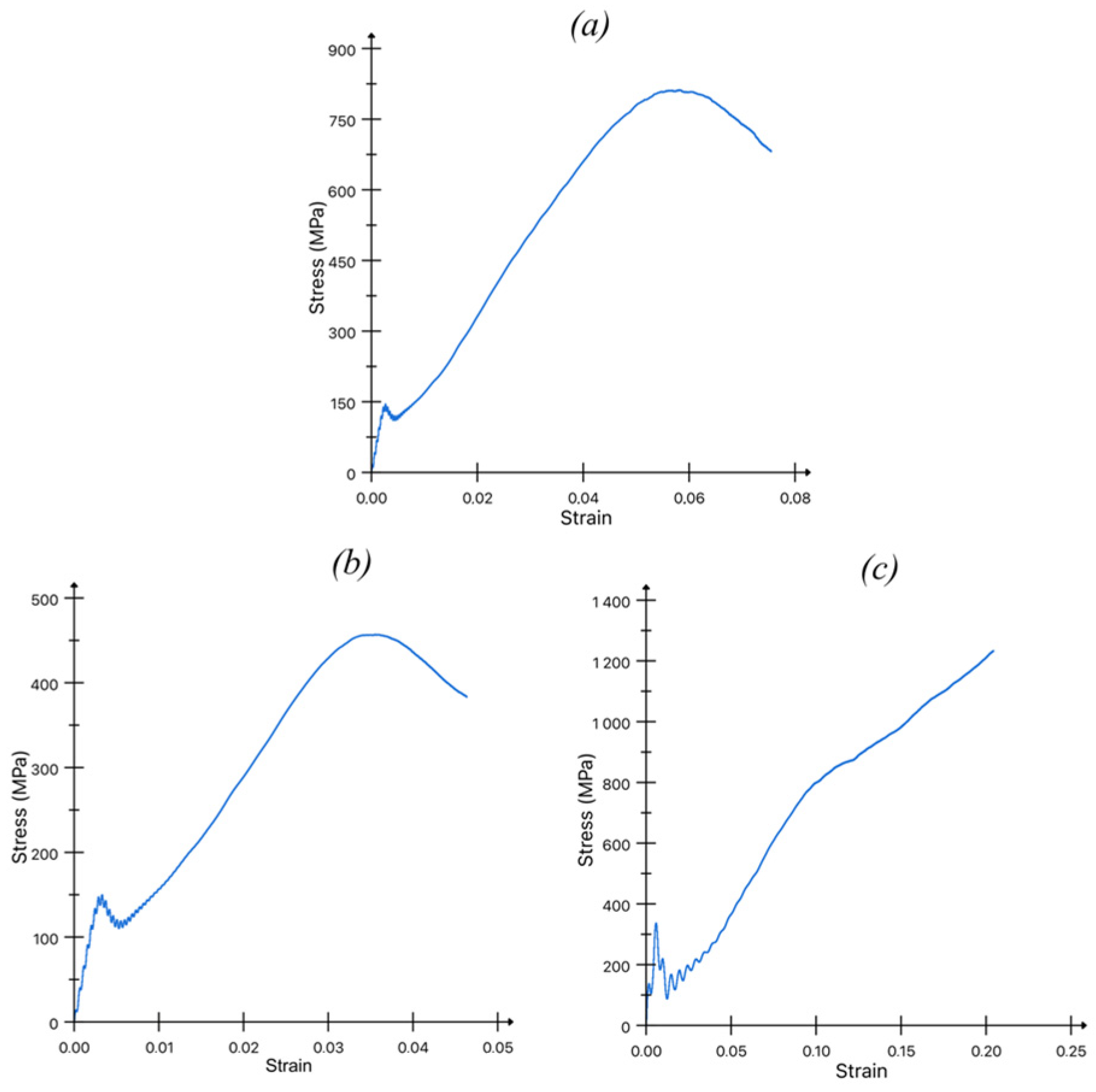
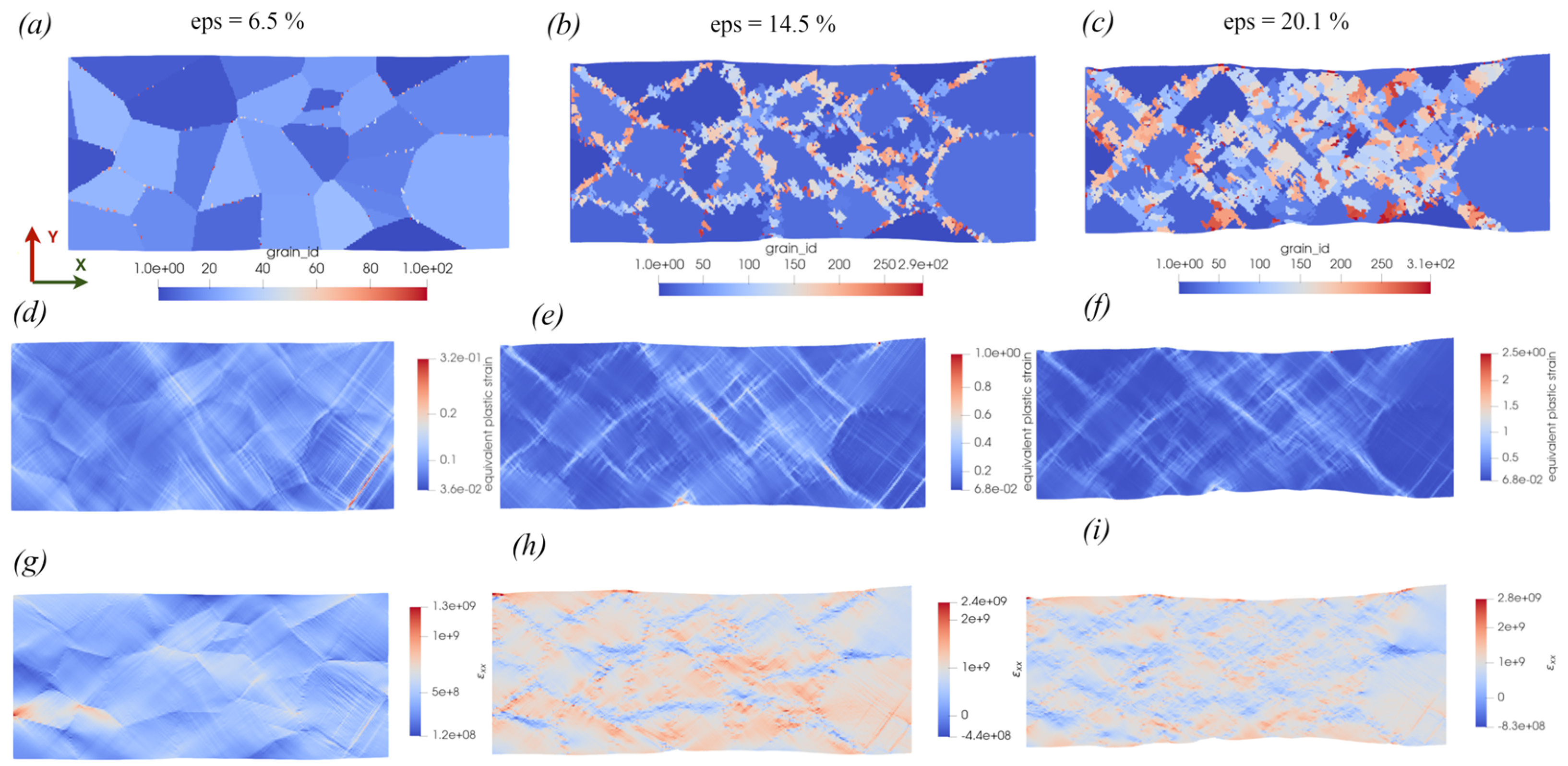
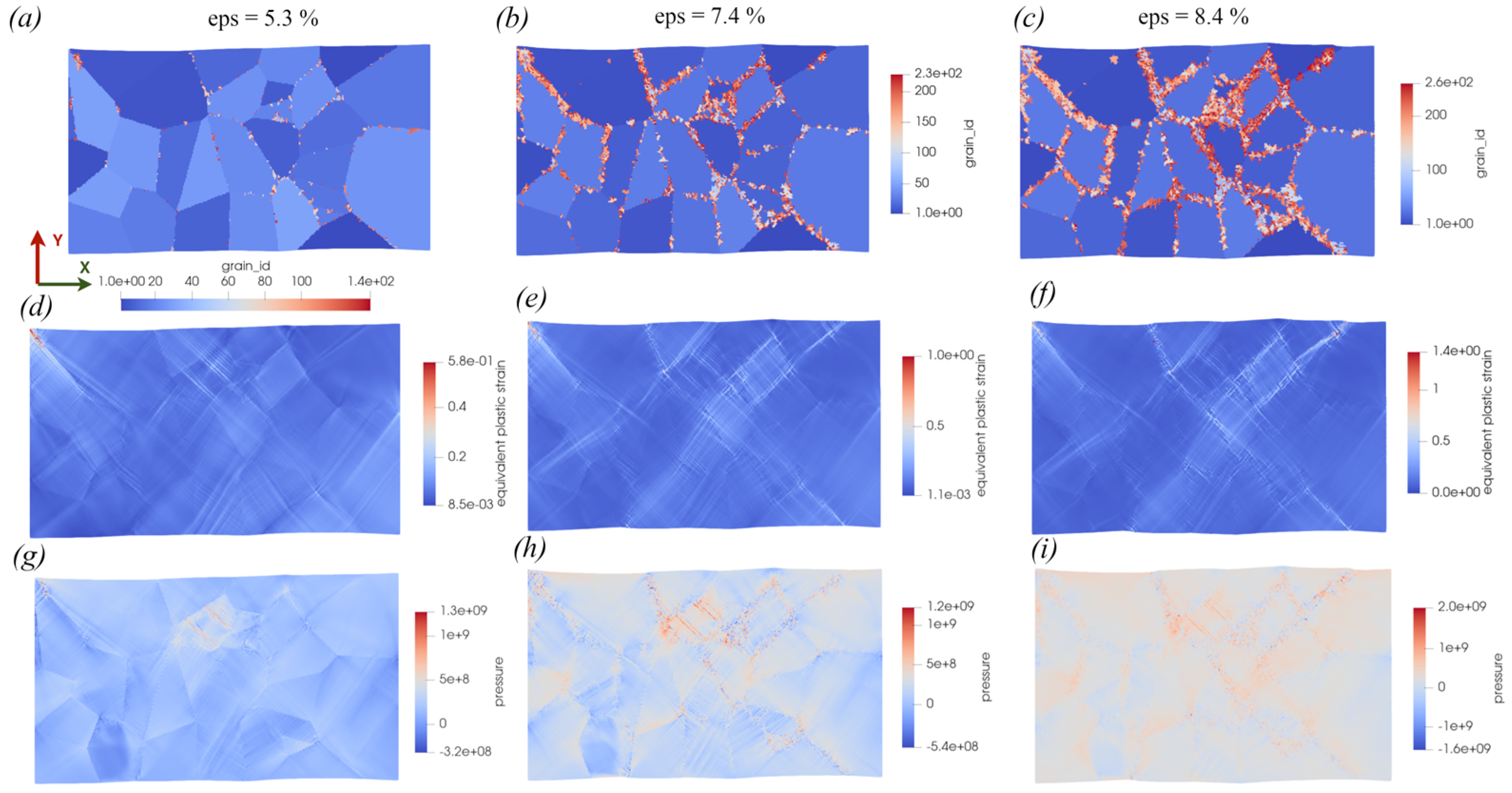
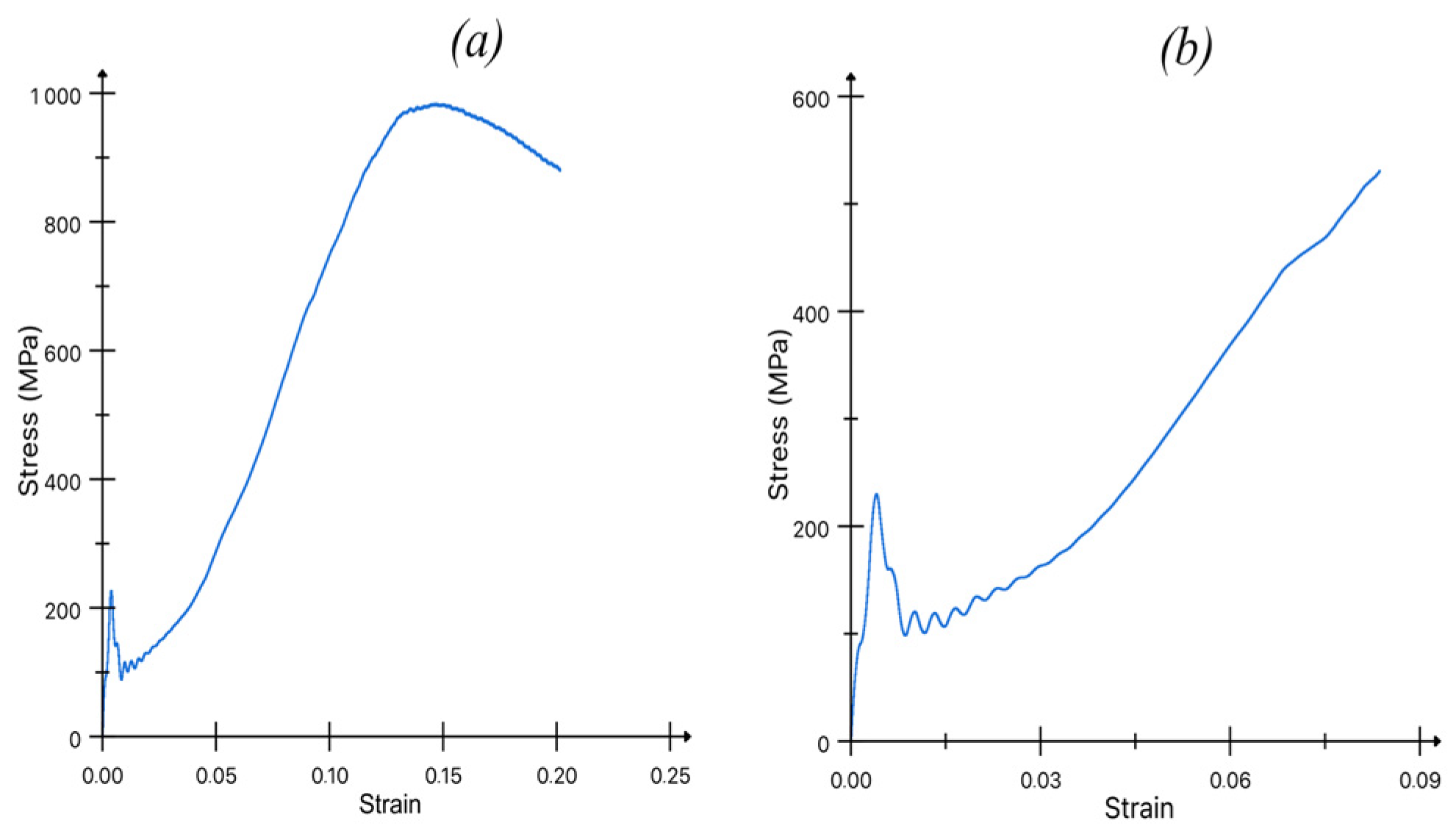
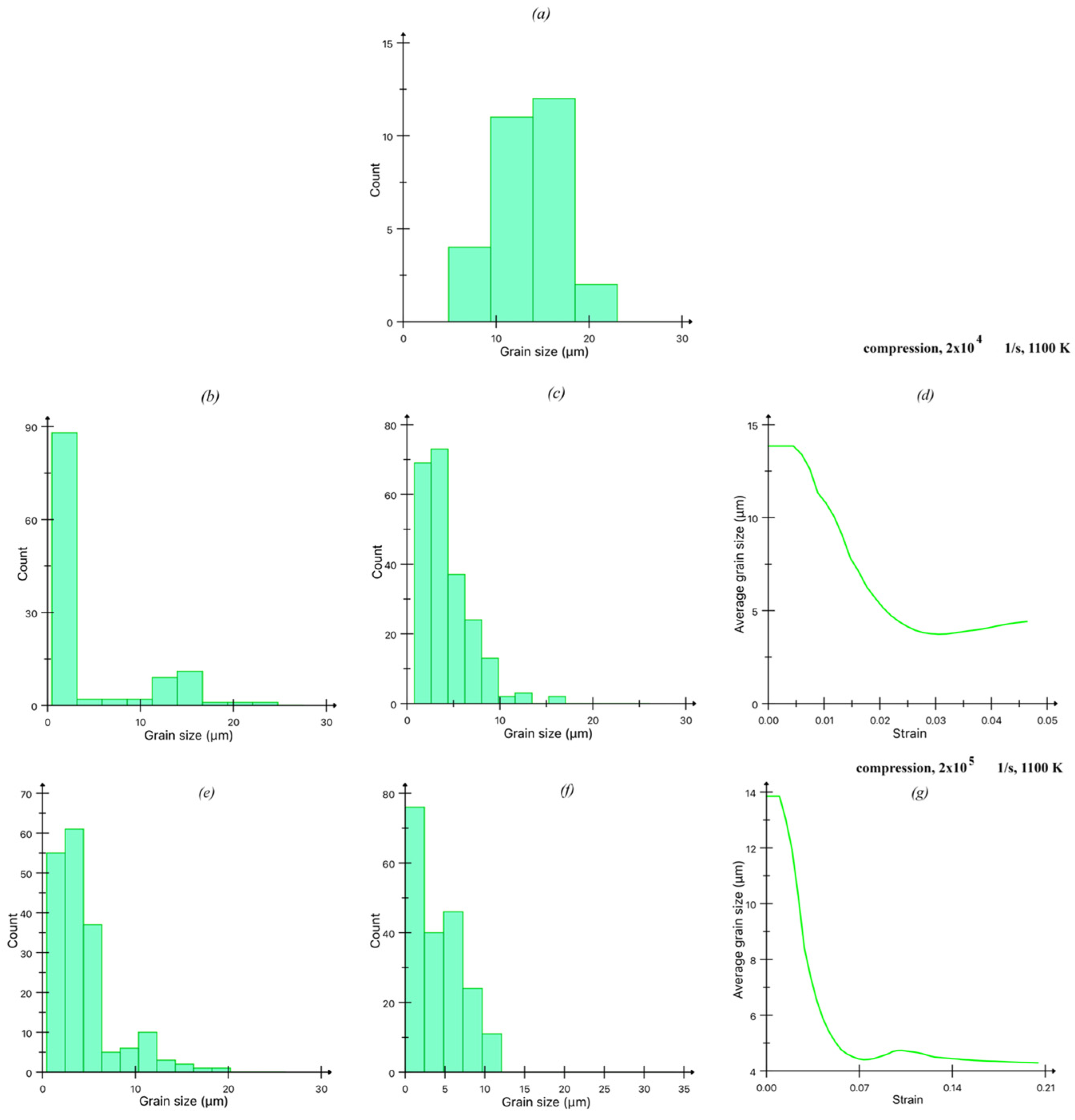
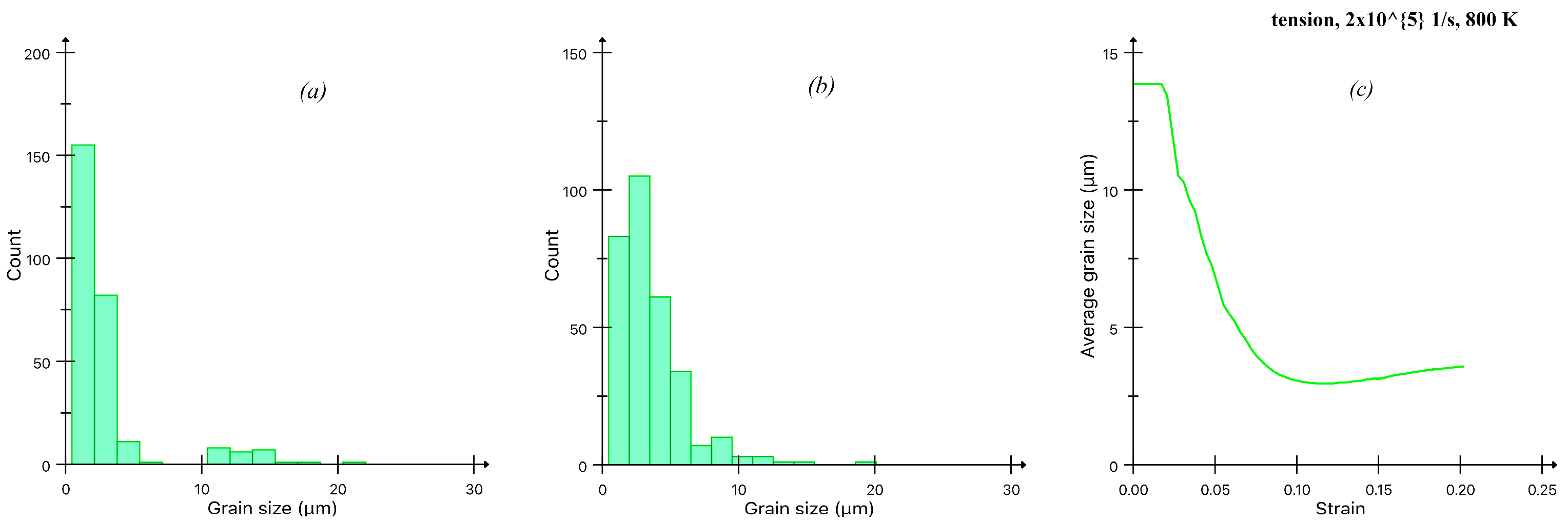
- Based on the results of uniaxial tension and compression of copper and aluminum polycrystals, a tendency toward grain refinement during high-speed deformation (104 to 105 s−1) at elevated temperatures (in the range of 600–800 K for pure aluminum and 800–1100 K for pure copper) is demonstrated. The average grain size decreases from an initial value of 14 μm to a value in the range of 4–5 μm. The grain size distribution shifts to a maximum of approximately 4–5 μm during deformation.
- Under these deformation conditions, strong localization of plastic deformation is observed. Initially, the polycrystal deforms at the grain level, forming shear bands. Plastic deformation then localizes in zones near grain boundaries, where maximum plastic strain values in the range of 1–3 are observed.
- The distribution of total strains in the crystal shows that the material deforms non-uniformly: zones of increased strain are visible in the grains of the undeformed crystal, and during deformation and the accompanying recrystallization, the number of localization sites increases in the center of the crystal.
Author Contributions
Funding
Data Availability Statement
Acknowledgments
Conflicts of Interest
Abbreviations
| DRX | Dynamic recrystallization |
| cDRX | Continuous dynamic recrystallization |
| dDRX | Discontinuous dynamic recrystallization |
| DRV | Dynamic recovery |
| FCC | Face-centered cubic |
| ML | Machine learning |
| ANN | Artificial neural network |
| MAPE | Mean absolute percentage error |
| GB | Grain boundary |
References
- Lv, J.; Zheng, J.-H.; Yardley, V.A.; Shi, Z.; Lin, J. A Review of Microstructural Evolution and Modelling of Aluminium Alloys under Hot Forming Conditions. Metals 2020, 10, 1516. [Google Scholar] [CrossRef]
- Kim, J.R.; Han, S.J.; Kim, H.G.; Kim, G.-H.; Kim, W.R.; Choi, S.-J.; Han, H.-S.; Kang, H.-S.; Lee, T.W. Hot isostatic pressing-induced dynamic recrystallization in pure copper: Mechanisms and implications for work hardening enhancement. J. Alloys Compd. 2025, 1045, 184654. [Google Scholar] [CrossRef]
- Heidarzadeh, A.; Laleh, H.M.; Gerami, H.; Hosseinpour, P.; Shabestari, M.J.; Bahari, R. The origin of different microstructural and strengthening mechanisms of T copper and brass in their dissimilar friction stir welded joint. Mater. Sci. Eng. A 2018, 735, 336–342. [Google Scholar] [CrossRef]
- Newishy, M.; Jaskari, M.; Järvenpää, A.; Fujii, H.; Abdel-Aleem, H.A. Friction Stir Welding of Dissimilar Al 6061-T6 to AISI 316 Stainless Steel: Microstructure and Mechanical Properties. Materials 2023, 16, 4085. [Google Scholar] [CrossRef]
- Xu, X.; Zhang, J.; Outeiro, J.; Xu, B.; Zhao, W. Multiscale simulation of grain refinement induced by dynamic T recrystallization of Ti6Al4V alloy during high speed machining. J. Mater. Process. Technol. 2020, 286, 116834. [Google Scholar] [CrossRef]
- Zhang, J.; Yi, Y.; He, H.; Huang, S.; Mao, X.; Guo, W.; You, W.; Guo, Y.; Dong, F.; Tang, J. Kinetic model for describing continuous and discontinuous dynamic recrystallization behaviors of 2195 aluminum alloy during hot deformation. Mater. Charact. 2021, 181, 111492. [Google Scholar] [CrossRef]
- Gao, W.; Belyakov, A.; Miura, H.; Sakai, T. Dynamic recrystallization of copper polycrystals with different purities. Mater. Sci. Eng. A 1999, 265, 233–239. [Google Scholar] [CrossRef]
- Zhang, Y.; Jiang, J.; Wang, Y.; Liu, Y.; Huang, M. Hot deformation behavior and microstructure evolution of hot-extruded 6A02 aluminum alloy. Mater. Charact. 2022, 188, 111908. [Google Scholar] [CrossRef]
- Manonukul, A.; Dunne, F.P.E. Initiation of dynamic recrystallization under inhomogeneous stress states in pure copper. Acta Mater. 1999, 47, 4339–4354. [Google Scholar] [CrossRef]
- Ponge, D.; Bredehöft, M.; Gottstein, G. Dynamic recrystallization in high purity aluminum. Scr. Mater. 1997, 37, 1769–1775. [Google Scholar] [CrossRef]
- Yang, J.Y.; Kim, W.J. Examination of high-temperature mechanisms and behavior under compression and processing maps of pure copper. J. Mater. Res. Technol. 2020, 9, 960–968. [Google Scholar] [CrossRef]
- Liu, H.; Hua, Y.; Li, W.; Hou, Z.; Dong, J.; Liu, Y. Effect of Trace Bismuth on Deformation Behavior of Ultrahigh-Purity Copper during Hot Compression. Coatings 2024, 14, 1261. [Google Scholar] [CrossRef]
- Yang, Q.; Wojcik, T.; Kozeschnik, E. Continuous Dynamic Recrystallization and Deformation Behavior of an AA1050 Aluminum Alloy during High-Temperature Compression. Metals 2024, 14, 889. [Google Scholar] [CrossRef]
- Liu, M.; Wang, P.; Lu, G.; Huang, C.-Y.; You, Z.; Wang, C.-H.; Yen, H.-W. Deformation-activated recrystallization twin: New twinning path in pure aluminum enabled by cryogenic and rapid compression. iScience 2022, 25, 104248. [Google Scholar] [CrossRef]
- Chen, S.F.; Li, D.Y.; Zhang, S.H.; Han, H.N.; Lee, H.W.; Lee, M.G. Modelling continuous dynamic recrystallization of aluminum alloys based on the polycrystal plasticity approach. Int. J. Plast. 2020, 131, 102710. [Google Scholar] [CrossRef]
- Sun, Z.C.; Wu, H.L.; Cao, J.; Yin, Z.K. Modeling of continuous dynamic recrystallization of Al-Zn-Cu-Mg alloy during hot deformation based on the internal-state-variable (ISV) method. Int. J. Plast. 2018, 106, 73–87. [Google Scholar] [CrossRef]
- Kang, J.-H.; Ko, Y.-G. Microstructure and mechanical properties of ultrafine grained 5052 Al alloy fabricated by multi-pass differential speed rolling. J. Mater. Res. Technol. 2022, 19, 2031–2049. [Google Scholar] [CrossRef]
- Chen, Y.Q.; Xu, J.B.; Pan, S.P.; Lu, D.D.; Song, Y.F.; Liu, Y.; Zhi, Q.; Liu, H.Q. Effects of initial orientation on microstructure evolution of aluminum single crystals during hot deformation. Mater. Sci. Eng. A 2018, 735, 336–342. [Google Scholar] [CrossRef]
- He, D.; Chen, S.-B.; Lin, Y.C.; Li, C.; Xu, Z.; Xiao, G. Microstructural evolution characteristics and a unified dislocation-density related constitutive model for a 7046 aluminum alloy during hot tensile. J. Mater. Res. Technol. 2023, 25, 2353–2367. [Google Scholar] [CrossRef]
- Zhao, J.; Deng, Y.; Tan, J.; Zhang, J. Effect of strain rate on the recrystallization mechanism during isothermal T compression in 7050 aluminum alloy. Mater. Sci. Eng. A 2018, 734, 120–128. [Google Scholar] [CrossRef]
- Kareem, S.A.; Anaele, J.U.; Aikulola, E.O.; Olanrewajua, O.F.; Omiyale, B.O.; Falana, S.O.; Oke, S.R.; Bodunrin, M.O. Hot deformation behavior of aluminum alloys: A comprehensive review on deformation mechanism, processing maps analysis and constitutive model description. Mater. Today Commun. 2025, 44, 112004. [Google Scholar] [CrossRef]
- Ferraz, F.M.B.; Buzolin, R.H.; Ebenbauer, S.; Leitner, T.; Krumphals, A.; Poletti, M.C. A predictive mesoscale model for continuous dynamic recrystallization. Int. J. Plast. 2024, 179, 104022. [Google Scholar] [CrossRef]
- Montheillet, M. Some Facts We Can Learn from Analytical Modeling of DDRX in Pure Metals and Solid Solutions. Metals 2018, 8, 789. [Google Scholar] [CrossRef]
- Chen, F.; Zhu, H.; Chen, W.; Ou, H.; Cui, Z. Multiscale modeling of discontinuous dynamic recrystallization during hot working by coupling multilevel cellular automaton and finite element method. Int. J. Plast. 2021, 145, 103064. [Google Scholar] [CrossRef]
- Shah, V.; Sedighiani, K.; Van Dokkum, J.S.; Bos, C.; Roters, F.; Diehl, M. Coupling crystal plasticity and cellular automaton models to study meta-dynamic recrystallization during hot rolling at high strain rates. Mater. Sci. Eng. A 2022, 849, 143471. [Google Scholar] [CrossRef]
- Hallberg, H.; Wallin, M.; Ristinma, M. Simulation of discontinuous dynamic recrystallization in pure Cu using a probabilistic cellular automaton. Comput. Mater. Sci. 2010, 49, 25–34. [Google Scholar] [CrossRef]
- Traka, K.; Sedighiania, K.; Bos, C.; Lopeza, J.G.; Angenendt, K.; Raabe, D.; Sietsma, J. Topological aspects responsible for recrystallization evolution in an IF-steel sheet—Investigation with cellular-automaton simulations. Comput. Mater. Sci. 2021, 198, 110643. [Google Scholar] [CrossRef]
- Zhou, G.; Hu, Y.; Hu, R.; Wu, P.; Li, D. A straightforward 3D polycrystal plasticity finite element method for dynamic/static recrystallization simulation. J. Mater. Sci. Technol. 2025, 220, 180–198. [Google Scholar] [CrossRef]
- He, Y.; Chuan, W.; HongWei, L.; XiaoGuand, F. Review on cellular automata simulations of microstructure evolution during metal forming process: Grain coarsening, recrystallization and phase transformation. Sci. China Tech. Sci. 2011, 54, 2107–2118. [Google Scholar]
- Liu, G.; Zhang, D.; Yao, C. Investigation of the grain refinement mechanism in machining Ti-6Al-4V: Experiments and simulations. J. Manuf. Process. 2023, 94, 479–496. [Google Scholar] [CrossRef]
- Ding, R.; Guo, Z.X. Coupled quantitative simulation of microstructural evolution and plastic flow during dynamic recrystallization. Acta Mater. 2001, 49, 3163–3175. [Google Scholar] [CrossRef]
- Khishchenko, K.V.; Mayer, A.E. High- and low-entropy layers in solids behind shock and ramp compression waves. Int. J. Mech. Sci. 2021, 189, 105971. [Google Scholar] [CrossRef]
- Krasnikov, V.S.; Mayer, A.E. Influence of local stresses on motion of edge dislocation in aluminum. Int. J. Plast. 2018, 101, 170–187. [Google Scholar] [CrossRef]
- Rodionov, E.S.; Lupanov, V.G.; Gracheva, N.A.; Mayer, P.N.; Mayer, A.E. Taylor Impact Tests with Copper Cylinders: Experiments, Microstructural Analysis and 3D SPH Modeling with Dislocation Plasticity and MD-Informed Artificial Neural Network as Equation of State. Metals 2022, 12, 264. [Google Scholar] [CrossRef]
- Mayer, A.E.; Khishchenko, K.V.; Levashov, P.R.; Mayer, P.N. Modeling of plasticity and fracture of metals at shock loading. J. Appl. Phys. 2013, 113, 93508. [Google Scholar] [CrossRef]
- Krasnikov, V.S.; Mayer, A.E.; Yalovets, A.P. Dislocation based high-rate plasticity model and its application to plate-impact and ultra-short electron irradiation simulations. Int. J. Plast. 2011, 27, 1294–1308. [Google Scholar] [CrossRef]
- Grachyova, N.; Fomin, E.; Mayer, A. Theoretical Model of Structural Phase Transitions in Al-Cu Solid Solutions under Dynamic Loading Using Machine Learning. Dynamics 2024, 4, 526–553. [Google Scholar] [CrossRef]
- Plimpton, S. Fast parallel algorithms for short-range molecular dynamics. J. Comput. Phys. 1995, 117, 1–19. [Google Scholar] [CrossRef]
- Apostol, F.; Mishin, Y. Interatomic potential for the Al-Cu system. Phys. Rev. B 2011, 83, 054116. [Google Scholar] [CrossRef]
- Roberts, W.; Ahlblom, B. A nucleation criterion for dynamic recrystallization during hot working. Acta Metall. 1978, 26, 801–813. [Google Scholar] [CrossRef]
- Humphreys, F.J. A unified theory of recovery, recrystallization and grain growth, based on the stability and growth of cellular microstructures—I. The basic model. Acta Mater. 1997, 45, 4231–4240. [Google Scholar] [CrossRef]
- Niño, J.D.; Johnson, O.K. Influence of grain boundary energy anisotropy on the evolution of grain boundary network structure during 3D anisotropic grain growth. Comput. Mater. Sci. 2023, 217, 111879. [Google Scholar] [CrossRef]
- Ding, R.; Guo, Z.X. Microstructural evolution of a Ti–6Al–4V alloy during -phase processing: Experimental and simulative investigations. Mater. Sci. Eng. A 2004, 365, 172–179. [Google Scholar] [CrossRef]
- Rubio, R.A.; Haouala, S.; LLorca, J. Grain boundary strengthening of FCC polycrystals. J. Mater. Res. 2019, 34, 2263–2274. [Google Scholar] [CrossRef]
- Rupert, T.J. Strain localization in a nanocrystalline metal: Atomic mechanisms and the effect of testing conditions. J. Appl. Phys. 2013, 114, 033527. [Google Scholar] [CrossRef]
- Mello, A.W.; Nicolas, A.; Lebensohn, R.A.; Sangid, M.D. Effect of microstructure on strain localization in a 7050 aluminum alloy: Comparison of experiments and modeling for various textures. Mater. Sci. Eng. A 2016, 661, 187–197. [Google Scholar] [CrossRef]
- Moretti, M.A.; Dalai, B.; Åkerström, P.; Arvieu, C.; Jacquin, D.; Lacoste, E.; Lindgren, L.-E. High Strain Rate Deformation Behavior and Recrystallization of Alloy 718. Metall. Mater. Trans. A 2021, 52, 5243–5257. [Google Scholar] [CrossRef]
- Tsuru, T. Origin of tension-compression asymmetry in ultrafine-grained fcc metals. Phys. Rev. Mater. 2017, 1, 033604. [Google Scholar] [CrossRef]
- Sadovnichy, V.; Tikhonravov, A.; Voevodin, V.; Opanasenko, V. “Lomonosov”: Supercomputing at Moscow state university. In Contemporary High Performance Computing: From Petascale Toward Exascale; Vetter, J.S., Ed.; CRC Press: Philadelphia, PA, USA, 2013; pp. 283–307. [Google Scholar]



| Parameter Designation | Parameter Value | ||
|---|---|---|---|
| Name | Symbol | Al | Cu |
| Static yield strength | [Pa] | 22 × 106 | 30 × 106 |
| Burgers vector magnitude | [nm] | 2.87 × 10⁻¹⁰ | 2.56 × 10⁻¹⁰ |
| Temperature dependence parameter of the phonon friction coefficient | [K] | 430 | 280 |
| Material hardening parameter | 6 | 3 | |
| Dislocation generation coefficient | [1/J] | 7.8 × 10¹⁶ | 7.8 × 10¹⁶ |
| Dislocation immobilization coefficient | [m/s] | 1.7 | 2 |
| Dislocation annihilation coefficient | 7 | 5 | |
| Density of free dislocations | [1/m2] | 1 × 10¹⁰ | 1 × 10¹¹ |
| Initial scalar dislocation density | [1/m2] | 1 × 10¹¹ | 1 × 10¹¹ |
| Initial density of immobile dislocations | [1/m2] | 1 × 10¹¹ | 1 × 10¹³ |
| Taylor-Kinney coefficient | 0.9 | 0.9 | |
| Dataset | Al | Cu | ||
|---|---|---|---|---|
| Average (MAPE) | Maximum (MAPE) | Average (MAPE) | Maximum (MAPE) | |
| Train | 0.03 | 0.36 | 0.092 | 1.04 |
| Validation | 0.2 | 1.5 | 0.11 | 0.9 |
| Parameter Designation | Range of Values (Min … Max) | |
|---|---|---|
| Al | Cu | |
| P (pressure) [GPa] | −9 … 3.5 | −1.5 … 3.5 |
| T (temperature) [K] | 100 … 900 | 100 … 1300 |
| (elastic modulus) [GPa] | 15 … 90 | 50 … 200 |
| (elastic modulus) [GPa] | 10 … 150 | 55 … 220 |
| (elastic modulus) [GPa] | 20…90 | 60 … 150 |
| (density) [kg/m3] | 2.2 … 3 | 7.5 … 10 |
| (specific internal energy) [eV] × 106 | −1.7 … −1.4 | −1.8 … −1.5 |
| Hyperparameter | Value | |
|---|---|---|
| ANN 1 (Al) | ANN 2 (Cu) | |
| Adam step | 0.001 | 0.001 |
| PReLU parameter | 0.1 | 0.2 |
| Cross-Validation step | 10 | 10 |
| Mini-batch size | 20 | 20 |
| Train dataset size | 37,396 | 19,163 |
| Validation dataset size | 6557 | 3687 |
| ANN length | 4 | 5 |
| Neurons per layer | 20 | 15 |
| Epoch | 1000 | 1000 |
| Parameter Designation | Value | ||
|---|---|---|---|
| Al | Cu | ||
| Pre-exponential mobility parameter of GBs | [m4/Js] | 5.52 | 2.4 |
| Activation energy for GBs motion | [kJ/mol] | 76.1 | 104 |
| Parameters of the GBs mobility function | 4 | 4 | |
| 5 | 5 | ||
| Boundary angle of low-angle GBs | [°] | 15 | 15 |
| Energy of high-angle GBs | [J/m2] | 0.5 | 0.625 |
Disclaimer/Publisher’s Note: The statements, opinions and data contained in all publications are solely those of the individual author(s) and contributor(s) and not of MDPI and/or the editor(s). MDPI and/or the editor(s) disclaim responsibility for any injury to people or property resulting from any ideas, methods, instructions or products referred to in the content. |
© 2026 by the authors. Licensee MDPI, Basel, Switzerland. This article is an open access article distributed under the terms and conditions of the Creative Commons Attribution (CC BY) license.
Share and Cite
Fomin, E.; Bryukhanov, I. The Influence of Discontinuous Dynamic Recrystallization on the Microstructure and Distribution of Plastic Deformations in Pure Aluminum and Copper at High Strain Rates. Crystals 2026, 16, 295. https://doi.org/10.3390/cryst16050295
Fomin E, Bryukhanov I. The Influence of Discontinuous Dynamic Recrystallization on the Microstructure and Distribution of Plastic Deformations in Pure Aluminum and Copper at High Strain Rates. Crystals. 2026; 16(5):295. https://doi.org/10.3390/cryst16050295
Chicago/Turabian StyleFomin, Evgenii, and Ilya Bryukhanov. 2026. "The Influence of Discontinuous Dynamic Recrystallization on the Microstructure and Distribution of Plastic Deformations in Pure Aluminum and Copper at High Strain Rates" Crystals 16, no. 5: 295. https://doi.org/10.3390/cryst16050295
APA StyleFomin, E., & Bryukhanov, I. (2026). The Influence of Discontinuous Dynamic Recrystallization on the Microstructure and Distribution of Plastic Deformations in Pure Aluminum and Copper at High Strain Rates. Crystals, 16(5), 295. https://doi.org/10.3390/cryst16050295