

Metal–Organic Frameworks as Materials for Applications in Sensors for Toxicants




Abstract
1. Introduction

2. Luminescent PCP/MOF Materials
3. Electrochemical Sensors Based on PCPs/MOFs
4. Other Methods of Sensing
5. Detection of Metal Ions
5.1. Lead Detection
5.2. Copper Detection
5.3. Cerium Detection
5.4. Mercury Detection
5.5. Iron Detection
5.6. Cadmium Detection
6. Small Molecules as Analytes
7. Sensing of Inorganic Anions
8. Sensing of Antibiotics and Pharmaceuticals
8.1. Antibiotics
8.2. Pharmaceuticals
9. Detection of Mycotoxins
10. Sensing of Phenols and Nitroaromatic Compounds
11. Detection of Pesticides and Herbicides
11.1. Pesticides
11.2. Herbicides
12. Detection of Chloroorganic Compounds
13. Sensing of Radioactive Impurities
14. Detection of Amines
15. Sensing of Explosives
16. Detection of Bacteria
17. Smartphone-Based Methods and Nanozimes
18. Prospects and Outlook

| Metal–organic framework | Sensor Type/Sensing Mechanism | Target Chemical | Detection Limit | Reference |
|---|---|---|---|---|
| Cations | ||||
| Tb(BTB)(DMF) 1.5DMF 2.5H2O | Luminescence | Fe3+ | 10−2 mmol/L | [230] |
| Eu3+@UiO-66(Zr)-COOH | Luminescence | Cd2+ | 6 × 10⁻² mmol/L | [231] |
| Adenine-La-MOF | Luminescence | Hg2+ | 0.2 nmol | [232] |
| Eu3+@MIL-121 | Luminescence | Ag+ | 0.1 mmol | [233] |
| DNA-functionalized Fe(porphyrin)-PCP | Luminescence | Pb2+ | 0.034 nmol | [234,235] |
| Eu3+/CDs@UiO-66 | Luminescence | Cu2+ | 51 nmol | [236] |
| Anions | ||||
| [Ln2ZnL3(H2O)4](NO3)2·12H2O)n (Ln = Eu, Tb; L = 4,4′-dicarboxylate-2,2′-dipyridine anion) | Luminescence | I− | 1 ppb | [237] |
| ({RuII(tBubpy)(CN)4[CuII(dien)]2}(ClO4)2 | Luminescence | CN− | 30 ppb | [238] |
| UiO-66-NH2 | Luminescence | ClO− | 40 nmol | [250] |
| UiO–66–NH2@Eu–MOF | Luminescence | PO43− | 0.67 μmol/L | [239] |
| Molecules | ||||
| Layers of Cu-BTC | Surface acoustic waves | H2O | <1 ppm | [249] |
| Cu3(HITP)2 | Chemiresistive | NH3 | 0.5 ppm | [242] |
| MFM-300 (In-MOF) | Capacitive | SO2 | 5 ppb | [251] |
| Au-SH-SiO2NPs on Cu-MOF | Electrochemical | N2H4 | 10 nmol | [78] |
| Organic molecules | ||||
| ZnO@ZIF-67 | Chemiresistive | CH2O | 50 ppm | [256] |
| Co(Im)2 | Chemiresistive | Me3N | 2 ppm | [245] |
| UiO-66-NH2 | Work function | Dimethylmethylphosphonate | 3 ppb | [246] |
| NH2-MIL-53(Al) in Matrimid | Work function | Alcohols | 2 ppm | [253] |
| IRMOF-3 | Luminescence | Trinitrophenol | 0.1 ppm | [257] |
Author Contributions
Funding
Data Availability Statement
Conflicts of Interest
Abbreviations
| bdc | benzene-1,4-dicarboxylate |
| bpdc | 4,4′-biphenyldicarboxylate |
| btc | benzene-1,3,5-benzenetricarboxylate |
| COF | Covalent Organic Frameworks |
| JUC | Jilin University of China |
| MeIm | methylimidazolate |
| MOF | metal–organic framework |
| PCP | porous coordination polymer |
| PTMTC | 4,4′,4-methanetriyltris(2,3,5,6-tetrachlorobenzoate) |
| pzdc | pyrazine-2,3-dicarboxylate |
| ZIF | zeolitic imidazolate framework |
References
- Hoskins, B.F.; Robson, R. Infinite Polymeric Frameworks Consisting of Three Dimensionally Linked Rod-like Segments. J. Am. Chem. Soc. 1989, 111, 5962–5964. [Google Scholar] [CrossRef]
- Yaghi, O.M.; Li, G.; Li, H. Selective Binding and Removal of Guests in a Microporous Metal–Organic Framework. Nature 1995, 378, 703–706. [Google Scholar] [CrossRef]
- Park, K.S.; Ni, Z.; Côté, A.P.; Choi, J.Y.; Huang, R.; Uribe-Romo, F.J.; Chae, H.K.; O’Keeffe, M.; Yaghi, O.M. Exceptional Chemical and Thermal Stability of Zeolitic Imidazolate Frameworks. Proc. Natl. Acad. Sci. USA 2006, 103, 10186–10191. [Google Scholar] [CrossRef] [PubMed]
- Stepanov, A.V.; Mel’nik, K.E.; Isaeva, V.I.; Kapustin, G.I.; Chernyshev, V.V.; Veselovsky, V.V. The Henry Reaction Catalyzed by Zeolitic Imidazolate Framework ZIF-8. Mendeleev Commun. 2018, 28, 88–90. [Google Scholar] [CrossRef]
- Dybtsev, D.N.; Sapianik, A.A.; Fedin, V.P. Pre-Synthesized Secondary Building Units in the Rational Synthesis of Porous Coordination Polymers. Mendeleev Commun. 2017, 27, 321–331. [Google Scholar] [CrossRef]
- Veselovsky, V.V.; Lozanova, A.V.; Isaeva, V.I.; Lobova, A.A.; Chernyshev, V.V. Optically Active Derivatives of Terephthalic Acid: Synthesis and Crystal Structures. Russ. Chem. Bull. 2017, 66, 1589–1596. [Google Scholar] [CrossRef]
- Lozanova, A.V.; Stepanov, A.V.; Mel′nik, K.E.; Zlokazov, M.V.; Veselovsky, V.V. Synthesis of Functionalized 1,2-Diphenylacetylene Derivatives. Russ. Chem. Bull. 2019, 68, 64–67. [Google Scholar] [CrossRef]
- Sonnauer, A.; Hoffmann, F.; Fröba, M.; Kienle, L.; Duppel, V.; Thommes, M.; Serre, C.; Férey, G.; Stock, N. Giant Pores in a Chromium 2,6-Naphthalenedicarboxylate Open-Framework Structure with MIL-101 Topology. Angew. Chem.-Int. Ed. 2009, 48, 3791–3794. [Google Scholar] [CrossRef]
- Wong-Foy, A.G.; Matzger, A.J.; Yaghi, O.M. Exceptional H2 Saturation Uptake in Microporous Metal-Organic Frameworks. J. Am. Chem. Soc. 2006, 128, 3494–3495. [Google Scholar] [CrossRef]
- Férey, G.; Serre, C.; Mellot-Draznieks, C.; Millange, F.; Surblé, S.; Dutour, J.; Margiolaki, I. A Hybrid Solid with Giant Pores Prepared by a Combination of Targeted Chemistry, Simulation, and Powder Diffraction. Angew. Chem.-Int. Ed. 2004, 43, 6296–6301. [Google Scholar] [CrossRef]
- Martin, R.L.; Haranczyk, M. Exploring Frontiers of High Surface Area Metal–Organic Frameworks. Chem. Sci. 2013, 4, 1781–1785. [Google Scholar] [CrossRef]
- Isaeva, V.I.; Kustov, L.M. Metal-Organic Frameworks and Related Materials: Miles to Go. In Zeolites and Zeolite-Like Materials; Elsevier: Amsterdam, The Netherlands, 2016; pp. 33–109. [Google Scholar] [CrossRef]
- Rowsell, J.L.C.; Yaghi, O.M. Strategies for Hydrogen Storage in Metal–Organic Frameworks. Angew. Chem. Int. Ed. 2005, 44, 4670–4679. [Google Scholar] [CrossRef]
- Xuan, W.; Zhu, C.; Liu, Y.; Cui, Y. Mesoporous Metal–Organic Framework Materials. Chem. Soc. Rev. 2012, 41, 1677–1695. [Google Scholar] [CrossRef] [PubMed]
- Phan, A.; Doonan, C.J.; Uribe-Romo, F.J.; Knobler, C.B.; Okeeffe, M.; Yaghi, O.M. Synthesis, Structure, and Carbon Dioxide Capture Properties of Zeolitic Imidazolate Frameworks. Acc. Chem. Res. 2010, 43, 58–67. [Google Scholar] [CrossRef] [PubMed]
- Qiu, S.; Zhu, G. Molecular Engineering for Synthesizing Novel Structures of Metal–Organic Frameworks with Multifunctional Properties. Coord. Chem. Rev. 2009, 253, 2891–2911. [Google Scholar] [CrossRef]
- Furukawa, S.; Reboul, J.; Diring, S.; Sumida, K.; Kitagawa, S. Structuring of Metal–Organic Frameworks at the Mesoscopic/Macroscopic Scale. Chem. Soc. Rev. 2014, 43, 5700–5734. [Google Scholar] [CrossRef]
- Li, P.; Cheng, F.F.; Xiong, W.W.; Zhang, Q. New Synthetic Strategies to Prepare Metal–Organic Frameworks. Inorg. Chem. Front. 2018, 5, 2693–2708. [Google Scholar] [CrossRef]
- Kalmutzki, M.J.; Hanikel, N.; Yaghi, O.M. Secondary Building Units as the Turning Point in the Development of the Reticular Chemistry of MOFs. Sci. Adv. 2018, 4, eaat9180. [Google Scholar] [CrossRef]
- Stock, N.; Biswas, S. Synthesis of Metal-Organic Frameworks (MOFs): Routes to Various MOF Topologies, Morphologies, and Composites. Chem. Rev. 2012, 112, 933–969. [Google Scholar] [CrossRef]
- Cohen, S.M. Postsynthetic Methods for the Functionalization of Metal-Organic Frameworks. Chem. Rev. 2012, 112, 970–1000. [Google Scholar] [CrossRef]
- Cohen, S.M. Modifying MOFs: New Chemistry, New Materials. Chem. Sci. 2010, 1, 32–36. [Google Scholar] [CrossRef]
- Cui, Y.; Li, B.; He, H.; Zhou, W.; Chen, B.; Qian, G. Metal-Organic Frameworks as Platforms for Functional Materials. Acc. Chem. Res. 2016, 49, 483–493. [Google Scholar] [CrossRef]
- Isaeva, V.I.; Belyaeva, E.V.; Fitch, A.N.; Chernyshev, V.V.; Klyamkin, S.N.; Kustov, L.M. Synthesis and Structural Characterization of a Series of Novel Zn(II)-Based MOFs with Pyridine-2,5-Dicarboxylate Linkers. Cryst. Growth Des. 2013, 13, 5305–5315. [Google Scholar] [CrossRef]
- Diercks, C.S.; Kalmutzki, M.J.; Diercks, N.J.; Yaghi, O.M. Conceptual Advances from Werner Complexes to Metal-Organic Frameworks. ACS Cent. Sci. 2018, 4, 1457–1464. [Google Scholar] [CrossRef]
- Schneemann, A.; Bon, V.; Schwedler, I.; Senkovska, I.; Kaskel, S.; Fischer, R.A. Flexible Metal–Organic Frameworks. Chem. Soc. Rev. 2014, 43, 6062–6096. [Google Scholar] [CrossRef]
- Yu, Q.; Dong, H.; Zhang, X.; Zhu, Y.X.; Wang, J.H.; Zhang, F.M.; Sun, X.J. Novel Stable Metal–Organic Framework Photocatalyst for Light-Driven Hydrogen Production. CrystEngComm 2018, 20, 3228–3233. [Google Scholar] [CrossRef]
- Fang, Q.R.; Makal, T.A.; Young, M.D.; Zhou, H.C. Recent Advances in the Study of Mesoporous Metal-Organic Frameworks. Comments Inorg. Chem. 2010, 31, 165–195. [Google Scholar] [CrossRef]
- Zheng, J.; Vemuri, R.S.; Estevez, L.; Koech, P.K.; Varga, T.; Camaioni, D.M.; Blake, T.A.; McGrail, B.P.; Motkuri, R.K. Pore-Engineered Metal-Organic Frameworks with Excellent Adsorption of Water and Fluorocarbon Refrigerant for Cooling Applications. J. Am. Chem. Soc. 2017, 139, 10601–10604. [Google Scholar] [CrossRef] [PubMed]
- Yang, J.; Zhang, Y.B.; Liu, Q.; Trickett, C.A.; Gutiérrez-Puebla, E.; Monge, M.Á.; Cong, H.; Aldossary, A.; Deng, H.; Yaghi, O.M. Principles of Designing Extra-Large Pore Openings and Cages in Zeolitic Imidazolate Frameworks. J. Am. Chem. Soc. 2017, 139, 6448–6455. [Google Scholar] [CrossRef]
- Fletcher, A.J.; Thomas, K.M.; Rosseinsky, M.J. Flexibility in Metal-Organic Framework Materials: Impact on Sorption Properties. J. Solid State Chem. 2005, 178, 2491–2510. [Google Scholar] [CrossRef]
- Pribylov, A.A.; Murdmaa, K.O.; Solovtsova, O.V.; Knyazeva, M.K. Methane Adsorption on Various Metal-Organic Frameworks and Determination of the Average Adsorption Heats at Supercritical Temperatures and Pressures. Russ. Chem. Bull. 2018, 67, 1807–1813. [Google Scholar] [CrossRef]
- Babaei, H.; McGaughey, A.J.H.; Wilmer, C.E. Effect of Pore Size and Shape on the Thermal Conductivity of Metal-Organic Frameworks. Chem. Sci. 2016, 8, 583–589. [Google Scholar] [CrossRef] [PubMed]
- Almeida Paz, F.A.; Klinowski, J. Two- and Three-Dimensional Cadmium-Organic Frameworks with Trimesic Acid and 4,4′-Trimethylenedipyridine. Inorg. Chem. 2004, 43, 3882–3893. [Google Scholar] [CrossRef]
- Stavila, V.; Talin, A.A.; Allendorf, M.D. MOF-Based Electronic and Opto-Electronic Devices. Chem. Soc. Rev. 2014, 43, 5994–6010. [Google Scholar] [CrossRef]
- Finsy, V.; De Bruyne, S.; Alaerts, L.; De Vos, D.; Jacobs, P.A.; Baron, G.V.; Denayer, J.F.M. Shape Selective Adsorption of Linear and Branched Alkanes in the Cu3(BTC)2 Metal-Organic Framework. Stud. Surf. Sci. Catal. 2007, 170, 2048–2053. [Google Scholar] [CrossRef]
- Lei, J.; Qian, R.; Ling, P.; Cui, L.; Ju, H. Design and Sensing Applications of Metal-Organic Framework Composites. TrAC-Trends Anal. Chem. 2014, 58, 71–78. [Google Scholar] [CrossRef]
- Chidambaram, A.; Stylianou, K.C. Electronic Metal–Organic Framework Sensors. Inorg. Chem. Front. 2018, 5, 979–998. [Google Scholar] [CrossRef]
- Lustig, W.P.; Mukherjee, S.; Rudd, N.D.; Desai, A.V.; Li, J.; Ghosh, S.K. Metal–Organic Frameworks: Functional Luminescent and Photonic Materials for Sensing Applications. Chem. Soc. Rev. 2017, 46, 3242–3285. [Google Scholar] [CrossRef]
- Kumar, V.; Kim, K.H.; Kumar, P.; Jeon, B.H.; Kim, J.C. Functional Hybrid Nanostructure Materials: Advanced Strategies for Sensing Applications toward Volatile Organic Compounds. Coord. Chem. Rev. 2017, 342, 80–105. [Google Scholar] [CrossRef]
- Zhang, Y.; Yuan, S.; Day, G.; Wang, X.; Yang, X.; Zhou, H.C. Luminescent Sensors Based on Metal-Organic Frameworks. Coord. Chem. Rev. 2018, 354, 28–45. [Google Scholar] [CrossRef]
- Yi, F.Y.; Chen, D.; Wu, M.K.; Han, L.; Jiang, H.L. Chemical Sensors Based on Metal–Organic Frameworks. Chempluschem 2016, 81, 675–690. [Google Scholar] [CrossRef]
- Stassen, I.; Burtch, N.; Talin, A.; Falcaro, P.; Allendorf, M.; Ameloot, R. An Updated Roadmap for the Integration of Metal–Organic Frameworks with Electronic Devices and Chemical Sensors. Chem. Soc. Rev. 2017, 46, 3185–3241. [Google Scholar] [CrossRef]
- Fang, X.; Zong, B.; Mao, S. Metal–Organic Framework-Based Sensors for Environmental Contaminant Sensing. Nanomicro Lett. 2018, 10, 64. [Google Scholar] [CrossRef] [PubMed]
- Qiu, L.G.; Li, Z.Q.; Wu, Y.; Wang, W.; Xu, T.; Jiang, X. Facile Synthesis of Nanocrystals of a Microporous Metal–Organic Framework by an Ultrasonic Method and Selective Sensing of Organoamines. Chem. Commun. 2008, 31, 3642–3644. [Google Scholar] [CrossRef]
- Wong, K.L.; Law, G.L.; Yang, Y.Y.; Wong, W.T. A Highly Porous Luminescent Terbium–Organic Framework for Reversible Anion Sensing. Adv. Mater. 2006, 18, 1051–1054. [Google Scholar] [CrossRef]
- Zou, R.Q.; Yamada, Y.; Xu, Q. Strong Fluorescent Emission of a New Fourfold-Interpenetrated Diamondoid Metal-Organic Framework of Zinc(II) Urocanate with One-Dimensional Open Channels. Microporous Mesoporous Mater. 2006, 91, 233–237. [Google Scholar] [CrossRef]
- Zhong, R.Q.; Zou, R.Q.; Xu, Q. Microporous Metal-Organic Framework Zinc(II) Imidazole-4,5-Dicarboxylate: Four-Fold Helical Structure and Strong Fluorescent Emission. Microporous Mesoporous Mater. 2007, 102, 122–127. [Google Scholar] [CrossRef]
- Xu, Y.H.; Lan, Y.Q.; Zhao, Y.H.; Du, D.Y.; Xu, G.J.; Shao, K.Z.; Su, Z.M.; Liao, Y. Two Novel Supramolecular Isomers Based on 2,2′-Biimidazole Derivative and Zinc Ions: Syntheses, Structures and Luminescent Properties. Inorg. Chem. Commun. 2009, 12, 169–172. [Google Scholar] [CrossRef]
- Chandra, D.; Kasture, M.W.; Bhaumik, A. A New Microporous MOF Material Based on Zn(II)-Polycarboxylate Coordination Polymer Synthesized with the Aid of 1,6-Diaminohexane as Template. Microporous Mesoporous Mater. 2008, 116, 204–209. [Google Scholar] [CrossRef]
- Myers, M.; Podolska, A.; Heath, C.; Baker, M.V.; Pejcic, B. Pore Size Dynamics in Interpenetrated Metal Organic Frameworks for Selective Sensing of Aromatic Compounds. Anal. Chim. Acta 2014, 819, 78–81. [Google Scholar] [CrossRef]
- Choi, J.H.; Jeon, H.J.; Choi, K.M.; Kang, J.K. Metal–Organic Frameworks for Visible Light Absorption via Anion Substitution. J. Mater. Chem. 2012, 22, 10144–10147. [Google Scholar] [CrossRef]
- Yin, M.-J.; Gu, B.; An, Q.F.; Yang, C.; Guan, Y.L.; Yong, K.T. Recent Development of Fiber-Optic Chemical Sensors and Biosensors: Mechanisms, Materials, Micro/Nano-Fabrications and Applications. Coord. Chem. Rev. 2018, 376, 348–392. [Google Scholar] [CrossRef]
- Zhu, S.; Zhang, H.; Zhao, Y.; Shao, M.; Wang, Z.; Li, M. Synthesis, Structures and Luminescence of Three Coordination Polymers Constructed from Rigid 1,3,5-Benzenetricarboxylic Acid and Flexible Bis(Imidazol-1-Ylmethyl)-Benzene. J. Mol. Struct. 2008, 892, 420–426. [Google Scholar] [CrossRef]
- Basak, S.; Sen, S.; Marschner, C.; Baumgartner, J.; Batten, S.R.; Turner, D.R.; Mitra, S. Synthesis, Crystal Structures and Fluorescence Properties of Two New Di- and Polynuclear Cd(II) Complexes with N2O Donor Set of a Tridentate Schiff Base Ligand. Polyhedron 2008, 27, 1193–1200. [Google Scholar] [CrossRef]
- Yang, E.C.; Liang, Q.Q.; Wang, P.; Zhao, X.J. A 3D Photoluminescent Cadmium(II)-Organic Framework with Unusual Pentanuclear Cluster as Secondary Building Unit. Inorg. Chem. Commun. 2009, 12, 211–213. [Google Scholar] [CrossRef]
- Zhao, J.; Zhu, G.S.; Zou, Y.C.; Fang, Q.R.; Xue, M.; Li, Z.Y.; Qiu, S.L. Synthesis, Structure and Luminescent Property of a New 3D Porous Metal–Organic Framework with Rutile Topology. J. Mol. Struct. 2007, 871, 80–84. [Google Scholar] [CrossRef]
- Chen, L.F.; Li, Z.J.; Qin, Y.Y.; Cheng, J.K.; Yao, Y.G. Syntheses, Crystal Structures and Photoluminescence of Two New Pyrazinecarboxylate-Based Cadmium(II) Coordination Polymers. J. Mol. Struct. 2008, 892, 278–282. [Google Scholar] [CrossRef]
- Huang, Y.G.; Yuan, D.Q.; Gong, Y.Q.; Jiang, F.L.; Hong, M.C. Synthesis, Structure and Luminescent Properties of Lanthanide–Organic Frameworks Based on Pyridine-2,6-Dicarboxylic Acid. J. Mol. Struct. 2008, 872, 99–104. [Google Scholar] [CrossRef]
- Li, X.; Zhang, Y.B.; Shi, M.; Li, P.Z. (4,4)- and (6,3)-2-D Luminescent Lanthanide(III) Metal-Organic Frameworks Constructed from Tetrafluorosuccinate and 1,10-Phenanthroline. Inorg. Chem. Commun. 2008, 11, 869–872. [Google Scholar] [CrossRef]
- Zhang, Z.H.; Song, Y.; Okamura, T.A.; Hasegawa, Y.; Sun, W.Y.; Ueyama, N. Syntheses, Structures, near-Infrared and Visible Luminescence, and Magnetic Properties of Lanthanide-Organic Frameworks with an Imidazole-Containing Flexible Ligand. Inorg. Chem. 2006, 45, 2896–2902. [Google Scholar] [CrossRef]
- Zhu, Y.J.; Ren, Z.G.; Zhang, W.H.; Chen, Y.; Li, H.X.; Zhang, Y.; Lang, J.P. Synthesis and Structural Characterization of a Unique 3D Coordination Polymer [Pb(4-Pya)2]n(4-Pya=trans-4-Pyridylacrylate). Inorg. Chem. Commun. 2007, 10, 485–488. [Google Scholar] [CrossRef]
- Zhao, Y.H.; Su, Z.M.; Fu, Y.M.; Shao, K.Z.; Li, P.; Wang, Y.; Hao, X.R.; Zhu, D.X.; Liu, S.D. Syntheses and Characterizations of Four Metal Coordination Polymers Constructed by the Pyridine-3,5-Dicarboxylate Ligand. Polyhedron 2008, 27, 583–592. [Google Scholar] [CrossRef]
- Luo, G.G.; Huang, R.B.; Zhang, N.; Lin, L.R.; Zheng, L.S. Structural Diversity in the (Ag–NO3−–2-Aminopyrimidyl Derivatives) System: New Zero-, One-, and Two-Dimensional Inorganic–Organic Hybrids. Polyhedron 2008, 27, 3231–3238. [Google Scholar] [CrossRef]
- Marti, A.M.; Nijem, N.; Chabal, Y.J.; Balkus, K.J. Selective Detection of Olefins Using a Luminescent Silver-Functionalized Metal Organic Framework, RPM3. Microporous Mesoporous Mater. 2013, 174, 100–107. [Google Scholar] [CrossRef]
- Furukawa, H.; Miller, M.A.; Yaghi, O.M. Independent Verification of the Saturation Hydrogen Uptake in MOF-177 and Establishment of a Benchmark for Hydrogen Adsorption in Metal–Organic Frameworks. J. Mater. Chem. 2007, 17, 3197–3204. [Google Scholar] [CrossRef]
- Marlow, F.; McGehee, M.D.; Zhao, D.; Chmelka, B.F.; Stucky, G.D. Doped Mesoporous Silica Fibers: A New Laser Material. Adv. Mater. 1999, 11, 632–636. [Google Scholar] [CrossRef]
- Cui, Y.; Yue, Y.; Qian, G.; Chen, B. Luminescent Functional Metal-Organic Frameworks. Chem. Rev. 2012, 112, 1126–1162. [Google Scholar] [CrossRef]
- Zhang, J.W.; Zhao, Y.; Yin, R.Q.; Tan, T.; Zhu, Z.H.; Wu, X.L.; Liu, Z.Q. Synthesis and Fluorescence Recognition Properties of Two Cd-MOFs Based on Different Mixed Ligands. Dye. Pigment. 2025, 235, 112600. [Google Scholar] [CrossRef]
- Hasi, Q.M.; Mu, X.T.; Su, X.H.; Wei, Y.M. Luminescence Cd(II) Coordination Compounds Based on a Semi-Rigid Tricarboxylic Acid Ligand for Identifying Metal Cations, Inorganic Anions and Organic Solvents. Polyhedron 2022, 219, 115799. [Google Scholar] [CrossRef]
- Obvintseva, L.A. Metal Oxide Semiconductor Sensors for Determination of Reactive Gas Impurities in Air. Russ. J. Gen. Chem. 2008, 78, 2545–2555. [Google Scholar] [CrossRef]
- Rumyantseva, M.N.; Makeeva, E.A.; Gas’Kov, A.M. Influence of the Microstructure of Semiconductor Sensor Materials on Oxygen Chemisorption on Their Surface. Russ. J. Gen. Chem. 2008, 78, 2556–2565. [Google Scholar] [CrossRef]
- Llabrés i Xamena, F.X.; Corma, A.; Garcia, H. Applications for Metal-Organic Frameworks (MOFs) as Quantum Dot Semiconductors. J. Phys. Chem. C 2007, 111, 80–85. [Google Scholar] [CrossRef]
- Sun, L.; Park, S.S.; Sheberla, D.; Dincǎ, M. Measuring and Reporting Electrical Conductivity in Metal-Organic Frameworks: Cd2(TTFTB) as a Case Study. J. Am. Chem. Soc. 2016, 138, 14772–14782. [Google Scholar] [CrossRef] [PubMed]
- Talin, A.A.; Centrone, A.; Ford, A.C.; Foster, M.E.; Stavila, V.; Haney, P.; Kinney, R.A.; Szalai, V.; El Gabaly, F.; Yoon, H.P.; et al. Tunable Electrical Conductivity in Metal-Organic Framework Thin-Film Devices. Science 2014, 343, 66–69. [Google Scholar] [CrossRef]
- Sheberla, D.; Sun, L.; Blood-Forsythe, M.A.; Er, S.; Wade, C.R.; Brozek, C.K.; Aspuru-Guzik, A.; Dincǎ, M. High Electrical Conductivity in Ni3(2,3,6,7,10,11-Hexaiminotriphenylene)2, a Semiconducting Metal-Organic Graphene Analogue. J. Am. Chem. Soc. 2014, 136, 8859–8862. [Google Scholar] [CrossRef]
- Sun, L.; Campbell, M.G.; Dincə, M. Electrically Conductive Porous Metal-Organic Frameworks. Angew. Chem.-Int. Ed. 2016, 55, 3566–3579. [Google Scholar] [CrossRef]
- Hosseini, H.; Ahmar, H.; Dehghani, A.; Bagheri, A.; Fakhari, A.R.; Amini, M.M. Au-SH-SiO2 Nanoparticles Supported on Metal-Organic Framework (Au-SH-SiO2@Cu-MOF) as a Sensor for Electrocatalytic Oxidation and Determination of Hydrazine. Electrochim. Acta 2013, 88, 301–309. [Google Scholar] [CrossRef]
- Hosseini, H.; Ahmar, H.; Dehghani, A.; Bagheri, A.; Tadjarodi, A.; Fakhari, A.R. A Novel Electrochemical Sensor Based on Metal-Organic Framework for Electro-Catalytic Oxidation of L-Cysteine. Biosens. Bioelectron. 2013, 42, 426–429. [Google Scholar] [CrossRef]
- Wan, X.; Song, H.; Zhao, D.; Zhang, L.; Lv, Y. A Y-Doped Metal-Organic Framework-Based Cataluminescence Gas Sensor for Isobutanol. Sens. Actuators B Chem. 2014, 201, 413–419. [Google Scholar] [CrossRef]
- Li, Y.; Huangfu, C.; Du, H.; Liu, W.; Li, Y.; Ye, J. Electrochemical Behavior of Metal–Organic Framework MIL-101 Modified Carbon Paste Electrode: An Excellent Candidate for Electroanalysis. J. Electroanal. Chem. 2013, 709, 65–69. [Google Scholar] [CrossRef]
- Llobet, E. Gas Sensors Using Carbon Nanomaterials: A Review. Sens. Actuators B Chem. 2013, 179, 32–45. [Google Scholar] [CrossRef]
- Zhou, Z.; Mukherjee, S.; Hou, S.; Li, W.; Elsner, M.; Fischer, R.A. Porphyrinic MOF Film for Multifaceted Electrochemical Sensing. Angew. Chem. Int. Ed. 2021, 60, 20551–20557. [Google Scholar] [CrossRef]
- Zhang, L.; Pu, Y.; Xu, W.; Peng, J.; Liu, Y.; Du, H. A Ratiometric Electrochemical Sensor for Simultaneous Detection of Multiple Heavy Metal Ions in Water and Herbal Medicines Based on Methylene Blue-Functionalized Metal–Organic Framework. Microchem. J. 2024, 201, 110542. [Google Scholar] [CrossRef]
- Maspoch, D.; Ruiz-Molina, D.; Wurst, K.; Domingo, N.; Cavallini, M.; Biscarini, F.; Tejada, J.; Rovira, C.; Veciana, J. A Nanoporous Molecular Magnet with Reversible Solvent-Induced Mechanical and Magnetic Properties. Nat. Mater. 2003, 2, 190–195. [Google Scholar] [CrossRef] [PubMed]
- Han, S.; Qiao, X.; Zhao, Q.; Guo, J.; Yu, D.; Xu, J.; Zhuang, S.; Wang, D.; Fang, X.; Zhang, D. Ultrafast and Parts-per-Billion-Level MEMS Gas Sensors by Hetero-Interface Engineering of 2D/2D Cu-TCPP@ZnIn2S4 with Enriched Surface Sulfur Vacancies. Nano Lett. 2024, 24, 7389–7396. [Google Scholar] [CrossRef] [PubMed]
- Allendorf, M.D.; Houk, R.J.T.; Andruszkiewicz, L.; Talin, A.A.; Pikarsky, J.; Choudhury, A.; Gall, K.A.; Hesketh, P.J. Stress-Induced Chemical Detection Using Flexible Metal-Organic Frameworks. J. Am. Chem. Soc. 2008, 130, 14404–14405. [Google Scholar] [CrossRef]
- Venkatasubramanian, A.; Lee, J.-H.; Houk, R.J.; Allendorf, M.D.; Nair, S.; Hesketh, P.J. Characterization of HKUST-1 Crystals and Their Application to MEMS Microcantilever Array Sensors. ECS Trans. 2010, 33, 229–238. [Google Scholar] [CrossRef]
- Tu, M.; Wannapaiboon, S.; Khaletskaya, K.; Fischer, R.A. Engineering Zeolitic-Imidazolate Framework (ZIF) Thin Film Devices for Selective Detection of Volatile Organic Compounds. Adv. Funct. Mater. 2015, 25, 4470–4479. [Google Scholar] [CrossRef]
- Khoshaman, A.H.; Bahreyni, B. Application of Metal Organic Framework Crystals for Sensing of Volatile Organic Gases. Sens. Actuators B Chem. 2012, 162, 114–119. [Google Scholar] [CrossRef]
- Kreno, L.E.; Hupp, J.T.; Van Duyne, R.P. Metal-Organic Framework Thin Film for Enhanced Localized Surface Plasmon Resonance Gas Sensing. Anal. Chem. 2010, 82, 8042–8046. [Google Scholar] [CrossRef]
- Lu, G.; Hupp, J.T. Metal-Organic Frameworks as Sensors: A ZIF-8 Based Fabry-Pérot Device as a Selective Sensor for Chemical Vapors and Gases. J. Am. Chem. Soc. 2010, 132, 7832–7833. [Google Scholar] [CrossRef]
- Sohrabi, H.; Ghasemzadeh, S.; Shakib, S.; Majidi, M.R.; Razmjou, A.; Yoon, Y.; Khataee, A. Metal-Organic Framework-Based Biosensing Platforms for the Sensitive Determination of Trace Elements and Heavy Metals: A Comprehensive Review. Ind. Eng. Chem. Res. 2023, 62, 4611–4627. [Google Scholar] [CrossRef]
- Jain, S.; Dilbaghi, N.; Singhal, N.K.; Kaushik, A.; Kim, K.H.; Kumar, S. Carbon Quantum Dots@metal–Organic Framework Based Catalytic Nucleic Acid Fluorescent System for Highly Sensitive and Selective Detection of Pb2+ in Aqueous Solutions. Chem. Eng. J. 2023, 457, 141375. [Google Scholar] [CrossRef]
- Wang, Y.; Wu, Y.; Xie, J.; Hu, X. Metal–Organic Framework Modified Carbon Paste Electrode for Lead Sensor. Sens. Actuators B Chem. 2013, 177, 1161–1166. [Google Scholar] [CrossRef]
- Olorunyomi, J.F.; White, J.F.; Gengenbach, T.R.; Caruso, R.A.; Doherty, C.M. Fabrication of a Reusable Carbon Dot/Gold Nanoparticle/Metal-Organic Framework Film for Fluorescence Detection of Lead Ions in Water. ACS Appl. Mater. Interfaces 2022, 14, 35755–35768. [Google Scholar] [CrossRef]
- Li, H.; Hou, Y. High Selective Detection of Trace Lead Ions via Substitution-Triggered Chemiluminescence Enhancement. ChemistrySelect 2023, 8, e202301231. [Google Scholar] [CrossRef]
- Li, Y.; Wan, Y.; Wang, Y.; Zhang, Y. 3D Printing MOFs-Based Fiber Electrodes: A Novel Platform as Electrochemical Sensors for Heavy Metal Ions. Z. Anorg. Allg. Chem. 2022, 648, e202200236. [Google Scholar] [CrossRef]
- Liu, W.; Guan, J.; Kong, B.; Lu, H.; Wu, Y.; Qin, X.L.; Jiang, H.; Liu, X. Amino Functionalized Bismuth-Based Metal-Organic Frameworks and Graphene Aerogels for Simultaneous Detection of Cadmium and Lead Ions. J. Solid State Electrochem. 2023, 27, 3393–3404. [Google Scholar] [CrossRef]
- Zheng, X.; Han, Y.; Liu, Z.; Liang, S.; Wang, C.; Guo, Y. Electrochemical Sensor Built on Graphene@Iron-Based Metal–Organic Frameworks for Simultaneous Detection of Cd2+ and Pb2+. Electroanalysis 2025, 37, e12002. [Google Scholar] [CrossRef]
- Hou, J.; Jia, P.; Yang, K.; Bu, T.; Zhao, S.; Li, L.; Wang, L. Fluorescence and Colorimetric Dual-Mode Ratiometric Sensor Based on Zr-Tetraphenylporphyrin Tetrasulfonic Acid Hydrate Metal-Organic Frameworks for Visual Detection of Copper Ions. ACS Appl. Mater. Interfaces 2022, 14, 13848–13857. [Google Scholar] [CrossRef]
- Lv, W.; Song, Y.; Guo, R.; Liu, N.; Mo, Z. Zirconium-Based Metal–Organic Framework Encapsulated Dye Molecules: An Excellent Sensing Platform for Sensitive Detection of Cu2+ in Aqueous Environments. Spectrochim. Acta Part A Mol. Biomol. Spectrosc. 2024, 310, 123883. [Google Scholar] [CrossRef]
- Liu, Y.; Guo, L.; Chen, Y.; Wang, Y.; Xu, G.; Gu, L.; Yu, Z.; Yuan, Y. A Porphyrin-Based Metal-Organic Framework Al-TCPP for Highly Selective Sensing of Copper Ions with Exceptional Low Limit of Detection. J. Environ. Chem. Eng. 2023, 11, 111021. [Google Scholar] [CrossRef]
- Meng, S.; He, X.; Li, B.; Yang, Y.; Mao, S.; Li, Z. A Luminescent Lanthanide Functionalized Hydrogen-Bonded Organic Framework Hydrogel: Fluorescence Sensing Platform for Copper and Iron Ions Detection. Talanta 2025, 285, 127420. [Google Scholar] [CrossRef]
- Wang, Y.; Zheng, Y.; Huo, F.; Zhang, Q.; Yang, X.; Karmaker, P.G. Ratiometric Fluorescence Sensor Based on Europium-Organic Frameworks for Selective and Quantitative Detection of Cerium Ions. Anal. Chim. Acta 2024, 1287, 342131. [Google Scholar] [CrossRef]
- Bodkhe, G.A.; Siva, S.; Gaikwad, D.K.; Tsai, M.L.; Hianik, T.; Kim, M.; Shirsat, M.D. Ag Nanoparticles Incorporated Metal Organic Framework (Ag@ZnBDC): Highly Sensitive and Selective Detection of Hg2+ Ions. J. Phys. Chem. Solids 2024, 193, 112142. [Google Scholar] [CrossRef]
- Zhang, L.; Xu, Y.; Xu, J.; Zhang, H.; Zhao, T.; Jia, L. Intelligent Multicolor Nano-Sensor Based on Nontoxic Dual Fluoroprobe and MOFs for Colorful Consecutive Detection of Hg2+ and Cysteine. J. Hazard. Mater. 2022, 430, 128478. [Google Scholar] [CrossRef]
- Liu, J.; Zhao, C.; Yang, J.; Zhou, Y.; Du, H.; Yang, Y.; Yang, Y. A Novel Hybrid Lanthanide Metal-Organic Frameworks Based on Porphyrin for Rapid Detection of Iron Ions. Anal. Chim. Acta 2024, 1319, 342961. [Google Scholar] [CrossRef] [PubMed]
- Mao, X.; Li, H.; Shi, Y.; Liu, J.; Kuai, L.; Yang, F.; Wu, C. A Multifunctional Fluorescence Sensor Based Zn(II) Metal-Organic Framework for Rapid and Sensitive Detection Fe3+ and Al3+. Polyhedron 2024, 264, 117246. [Google Scholar] [CrossRef]
- He, X.; Wang, J.; Niu, G.; Zhu, D. Eu3+ Functionalized Gd-BTC: Turn-off Fluorescent Switch for Selectively Detecting Acetone and Fe3+. J. Mol. Struct. 2022, 1267, 133663. [Google Scholar] [CrossRef]
- Ding, N.; Liu, R.; Zhang, B.; Yang, N.; Qin, M.; Zhang, Y.; Wang, Z. A Fluorescent Nanoprobe and Paper-Based Nanofiber Platform for Detection and Imaging of Fe3+ in Actual Samples and Living Cells. Talanta 2024, 271, 125713. [Google Scholar] [CrossRef]
- Kabir, H.M.; Ehab, F.A.; El-Hady, M.S. Functional Metal-Organic Frameworks-Based Sensing for the Sensitive Determination of Heavy Metals in Polluted Water. In Proceedings of the 74th Southeastern Regional Meeting of the American Chemical Society, SERMACS 2023; American Chemical Society: Durham, UK, 2023; p. 1053. [Google Scholar]
- Pournara, A.D.; Margariti, A.; Tarlas, G.D.; Kourtelaris, A.; Petkov, V.; Kokkinos, C.; Economou, A.; Papaefstathiou, G.S.; Manos, M.J. A Ca 2+ MOF Combining Highly Efficient Sorption and Capability for Voltammetric Determination of Heavy Metal Ions in Aqueous Media. J. Mater. Chem. A Mater. 2019, 7, 15432–15443. [Google Scholar] [CrossRef]
- Wang, X.; Qi, Y.; Shen, Y.; Yuan, Y.; Zhang, L.; Zhang, C.; Sun, Y. A Ratiometric Electrochemical Sensor for Simultaneous Detection of Multiple Heavy Metal Ions Based on Ferrocene-Functionalized Metal-Organic Framework. Sens. Actuators B Chem. 2020, 310, 127756. [Google Scholar] [CrossRef]
- Ahmadijokani, F.; Tajahmadi, S.; Bahi, A.; Molavi, H.; Rezakazemi, M.; Ko, F.; Aminabhavi, T.M.; Arjmand, M. Ethylenediamine-Functionalized Zr-Based MOF for Efficient Removal of Heavy Metal Ions from Water. Chemosphere 2021, 264, 128466. [Google Scholar] [CrossRef]
- Lu, M.; Deng, Y.; Luo, Y.; Lv, J.; Li, T.; Xu, J.; Chen, S.W.; Wang, J. Graphene Aerogel-Metal-Organic Framework-Based Electrochemical Method for Simultaneous Detection of Multiple Heavy-Metal Ions. Anal. Chem. 2019, 91, 888–895. [Google Scholar] [CrossRef]
- Wang, Y.; Wang, L.; Huang, W.; Zhang, T.; Hu, X.; Perman, J.A.; Ma, S. A Metal–Organic Framework and Conducting Polymer Based Electrochemical Sensor for High Performance Cadmium Ion Detection. J. Mater. Chem. A Mater. 2017, 5, 8385–8393. [Google Scholar] [CrossRef]
- Farahani, Y.D.; Safarifard, V. Highly Selective Detection of Fe3+, Cd2+ and CH2Cl2 Based on a Fluorescent Zn-MOF with Azine-Decorated Pores. J. Solid State Chem. 2019, 275, 131–140. [Google Scholar] [CrossRef]
- Li, M.; Qi, X.; Gao, G.; Cao, Y.; Zhang, W.; Ma, Y.; Tang, B. A Ratiometric Multimode Optical Sensor for Highly Selective and Sensitive Detection of Ammonia by Hydrogen Bonding Interaction Regulatio5. Anal. Chem. 2024, 97, 14722–14730. [Google Scholar] [CrossRef]
- Song, Z.; Luo, T.; Ke, J.; Hu, S.; Yang, W.; Ni, J.; Chen, X.; Chen, Z. A New-Style Pohotoelectrochemical Sensing Device Based on NH2-UiO-66@Bi2O3 for the Sensitive Detection of Hydrogen Sulfide. Microchem. J. 2024, 206, 111669. [Google Scholar] [CrossRef]
- Li, S.; Zhang, P.; Zhao, X.; Liu, Y. Green/Red Emission Modulation via Tb/Eu Co-Doping in MOF Host for the Ratiometric Sensing of Peroxyacetic Acid. J. Mol. Struct. 2023, 1276, 134778. [Google Scholar] [CrossRef]
- Men, Y.; Qin, Z.; Yang, Z.; Zhang, P.; Li, M.; Wang, Q.; Zeng, D.; Yin, X.; Ji, H. Antibacterial Defective-ZIF-8/PPY/BC-Based Flexible Electronics as Stress-Strain and NO2 Gas Sensors. Adv. Funct. Mater. 2024, 34, 2316633. [Google Scholar] [CrossRef]
- Lu, Y.; Xiong, R.; Lin, X.; Zhang, L.; Meng, X.; Luo, Z. CsPbBr3 NCs Confined and In Situ Grown in ZIF-8: A Stable, Sensitive, Reliable Fluorescent Sensor for Evaluating the Acid Value of Edible Oils. ACS Appl. Mater. Interfaces 2024, 16, 42772–42782. [Google Scholar] [CrossRef]
- Gao, G.; Li, M.; Qi, X.; Cao, Y.; Zhang, W.; Ma, Y.; Tang, B. A Highly Selective Ammonia Ratiometric Fluorescence Sensor Based on Multifunctional Metal-Organic Framework Platform with Rich Brønsted Acidic Metal Clusters. Anal. Chem. 2024, 96, 19706–19713. [Google Scholar] [CrossRef] [PubMed]
- Abascal, E.; Gómez-Coma, L.; Ortiz, I.; Ortiz, A. Global Diagnosis of Nitrate Pollution in Groundwater and Review of Removal Technologies. Sci. Total Environ. 2022, 810, 152233. [Google Scholar] [CrossRef]
- Karwowska, M.; Kononiuk, A. Nitrates/Nitrites in Food—Risk for Nitrosative Stress and Benefits. Antioxidants 2020, 9, 241. [Google Scholar] [CrossRef]
- Mishra, R.K. The Effect of Eutrophication on Drinking Water. Br. J. Multidiscip. Adv. Stud. 2023, 4, 7–20. [Google Scholar] [CrossRef]
- Ali, S.; Thakur, S.K.; Sarkar, A.; Shekhar, S. Worldwide Contamination of Water by Fluoride. Environ. Chem. Lett. 2016, 14, 291–315. [Google Scholar] [CrossRef]
- Arul, P.; Huang, S.T.; Mani, V.; Hu, Y.C. Ultrasonic Synthesis of Bismuth-Organic Framework Intercalated Carbon Nanofibers: A Dual Electrocatalyst for Trace-Level Monitoring of Nitro Hazards. Electrochim. Acta 2021, 381, 138280. [Google Scholar] [CrossRef]
- Yang, N.; Zhou, X.; Qi, X.; Li, J.; Fang, W.; Xue, H.; Yang, Z. A Nitrite Sensor Based on Bimetallic Zeolitic Imidazole Framework Derived Co/Porous Carbon Nanorods. Microchem. J. 2022, 182, 107910. [Google Scholar] [CrossRef]
- Patri, S.B.; Karekuladh, S.M.; Malingappa, P. ZIF-8/CNFs/PANI Composite as an Electrochemical Platform in Trace-Level Nitrite Sensing. Carbon Lett. 2024, 34, 421–435. [Google Scholar] [CrossRef]
- Liang, M.; Gao, Y.; Sun, X.; Kong, R.M.; Xia, L.; Qu, F. Metal-Organic Framework-Based Ratiometric Point-of-Care Testing for Quantitative Visual Detection of Nitrite. J. Hazard. Mater. 2024, 469, 134021. [Google Scholar] [CrossRef] [PubMed]
- He, M.Q.; Li, H.W.; Wu, Y. A Novel Ratiometric Fluorescent Nanosensor Based-on UiO-66-NH2 Capped Carbon Dots for Nitrite Determination. Spectrochim. Acta Part A Mol. Biomol. Spectrosc. 2025, 327, 125422. [Google Scholar] [CrossRef]
- Bej, S.; Banerjee, P. “Caught in the Act” @ Disruption of A-ET-E Process in the Recognition of F− by a Lamellar EuIII-MOF in Heterogeneous Manner with Logic Gate Construction: From Protagonist Idea to Implementation World. Spectrochim. Acta Part A Mol. Biomol. Spectrosc. 2022, 283, 121764. [Google Scholar] [CrossRef]
- Gupta, A.; Adusumalli, V.N.K.B.; Lee, S.Y.; Park, Y.I. Ultrasensitive Detection of CO32– and PO43– Ions through Forbidden Charge Transfer-Induced Luminescence Enhancement Using NH2-MIL-101 (Fe), and Its Onsite Real-Time Application in Anti-Counterfeiting. Sens. Actuators B Chem. 2025, 422, 136564. [Google Scholar] [CrossRef]
- Dang, J.; Cao, Y.; Li, Z.; Zhao, H. Highly Sensitive and Selective Fluorescence Detection of Hypochlorite by Amorphous Europium Metal-Organic Frameworks with Dual Ligands. Colloids Surf. A Physicochem. Eng. Asp. 2025, 709, 136092. [Google Scholar] [CrossRef]
- Fan, L.; Li, J.; Sun, C.; Zhang, J.; Zhao, Y.; Li, W.; Chang, Z. An Ultra-Sensitive Fluorescent Sensor Based on Zn-MOF for Selective Detection of Riboflavin in Food. J. Solid State Chem. 2022, 316, 123616. [Google Scholar] [CrossRef]
- Fu, K.; Sun, H.; Chen, X.; Liu, L.; Cao, Y.; Zhao, J.; Li, S.; Ma, W. Computer-Aided Design and Preparation of Surface Arsenite Molecularly Imprinted Polymers for Selective Adsorption and Highly Sensitive Detection of As(III). J. Hazard. Mater. 2024, 480, 136386. [Google Scholar] [CrossRef] [PubMed]
- Ru, J.; Wang, X.; Zhao, J.; Yang, J.; Zhou, Z.; Du, X.; Lu, X. Evaluation and Development of GO/UiO-67@PtNPs Nanohybrid-Based Electrochemical Sensor for Invisible Arsenic (III) in Water Samples. Microchem. J. 2022, 181, 107765. [Google Scholar] [CrossRef]
- Khezerlou, A.; Tavassoli, M.; Khalilzadeh, B.; Ehsani, A.; Kazemian, H. Metal-Organic Framework-Based Advanced Sensing Platforms for the Detection of Tetracycline in Food and Water Samples. Food Control 2023, 153, 109965. [Google Scholar] [CrossRef]
- Gan, Z.; Hu, X.; Xu, X.; Zhang, W.; Zou, X.; Shi, J.; Zheng, K.; Arslan, M. A portable test strip based on fluorescent europium-based metal–organic framework for rapid and visual detection of tetracycline in food samples. Food Chem. 2021, 354, 129501. [Google Scholar] [CrossRef]
- Liu, X.; Ma, Q.; Feng, X.; Li, R.; Zhang, X. A recycled Tb-MOF fluorescent sensing material for highly sensitive and selective detection of tetracycline in milk. Microchem. J. 2021, 170, 106714. [Google Scholar] [CrossRef]
- Liu, Q.; Ning, D.; Li, W.J.; Du, X.M.; Wang, Q.; Li, Y.; Ruan, W.J. Metal-organic framework-based fluorescent sensing of tetracycline-type antibiotics applicable to environmental and food analysis. Analyst 2019, 144, 1916–1922. [Google Scholar] [CrossRef] [PubMed]
- Li, R.; Wang, W.; El-Sayed, E.-S.M.; Su, K.; He, P.; Yuan, D. Ratiometric fluorescence detection of tetracycline antibiotic based on a polynuclear lanthanide metal–organic framework. Sens. Actuators B Chem. 2021, 330, 129314. [Google Scholar] [CrossRef]
- Li, C.; Yang, W.; Zhang, X.; Han, Y.; Tang, W.; Yue, T.; Li, Z. A 3D hierarchical dual-metal–organic framework heterostructure up-regulating the pre-concentration effect for ultrasensitive fluorescence detection of tetracycline antibiotics. J. Mater. Chem. C 2020, 8, 2054–2064. [Google Scholar] [CrossRef]
- Yang, Y.; Yang, L.; Ma, Y.; Wang, X.; Zhang, J.; Bai, B.; Yu, L.; Guo, C.; Zhang, F.; Qin, S. A novel metal–organic frameworks composite-based label-free point-of-care quartz crystal microbalance aptasensing platform for tetracycline detection. Food Chem. 2022, 392, 133302. [Google Scholar] [CrossRef]
- Shi, B.; Zhang, X.; Li, W.; Liang, N.; Hu, X.; Xiao, J.; Wang, D.; Zou, X.; Shi, J. An intrinsic dual-emitting fluorescence sensing toward tetracycline with self-calibration model based on luminescent lanthanide-functionalized metal-organic frameworks. Food Chem. 2023, 400, 133995. [Google Scholar] [CrossRef] [PubMed]
- Yao, R.; Li, Z.; Huo, P.; Gong, C.; Liu, G.; Zheng, C.; Pu, S. L-histidine functionalized ZiF-8 with aggregation-induced emission for detection of tetracycline. Spectrochim. Acta Part A Mol. Biomol. Spectrosc. 2022, 280, 121546. [Google Scholar] [CrossRef]
- Yazhini, C.; Rafi, J.; Chakraborty, P.; Kapse, S.; Thapa, R.; Neppolian, B. Inner filter effect on amino-functionalized metal-organic framework for the selective detection of tetracycline. J. Clean. Prod. 2022, 373, 133929. [Google Scholar] [CrossRef]
- Gan, Z.; Zhang, W.; Shi, J.; Xu, X.; Hu, X.; Zhang, X.; Wang, X.; Arslan, M.; Xiao, J.; Zou, X. Collaborative compounding of metal-organic frameworks and lanthanide coordination polymers for ratiometric visual detection of tetracycline. Dyes Pigm. 2021, 194, 109545. [Google Scholar] [CrossRef]
- Bai, F.; Bu, T.; Zhang, M.; Tian, Y.; Sun, X.; Jia, P.; Zhang, Y.; Li, R.; Zhao, S.; He, K.; et al. Rhombic-like Al nanosupporter-based fluorescent immunochromatographic assay for the sensitive detection of tetracycline. Sens. Actuators B Chem. 2020, 324, 128721. [Google Scholar] [CrossRef]
- Li, C.; Zhu, L.; Yang, W.; He, X.; Zhao, S.; Zhang, X.; Tang, W.; Wang, J.; Yue, T.; Li, Z. Amino-functionalized Al-MOF for fluorescent detection of tetracyclines in milk. J. Agric. Food Chem. 2019, 67, 1277–1283. [Google Scholar] [CrossRef]
- Jia, L.; Guo, S.; Xu, J.; Chen, X.; Zhu, T.; Zhao, T. A ratiometric fluorescent nano-probe for rapid and specific detection of tetracycline residues based on a dye-doped functionalized nanoscaled metal–organic framework. Nanomaterials 2019, 9, 976. [Google Scholar] [CrossRef] [PubMed]
- He, J.-X.; Yuan, H.-Q.; Zhong, Y.-F.; Peng, X.-X.; Xia, Y.-F.; Liu, S.-Y.; Fan, Q.; Yang, J.L.; Deng, K.; Wang, X.Y.; et al. A luminescent Eu3+-functionalized MOF for sensitive and rapid detection of tetracycline antibiotics in swine wastewater and pig kidney. Spectrochim. Acta Part A Mol. Biomol. Spectrosc. 2022, 277, 121252. [Google Scholar] [CrossRef]
- Chen, J.; Zhang, Q.; Xu, F.; Li, S. Bimetallic organic frame nanosheet fluorescent probe used for detecting tetracycline and folic acid. Microchem. J. 2021, 170, 106673. [Google Scholar] [CrossRef]
- Chen, J.; Xu, Y.; Li, S.; Xu, F.; Zhang, Q. Ratio fluorescence detection of tetracycline by a Eu3+/NH2-MIL-53(Al) composite. RSC Adv. 2021, 11, 2397–2404. [Google Scholar] [CrossRef]
- Song, J.; Huang, M.; Lin, X.; Li, S.F.Y.; Jiang, N.; Liu, Y.; Guo, H.; Li, Y. Novel Fe-based metal–organic framework (MOF) modified carbon nanofiber as a highly selective and sensitive electrochemical sensor for tetracycline detection. Chem. Eng. J. 2022, 427, 130913. [Google Scholar] [CrossRef]
- Zhang, Y.; Wei, J.; Xing, L.; Li, J.; Xu, M.; Pan, G.; Li, J. Superoxide radical mediated persulfate activation by nitrogen doped bimetallic MOF (FeCo/N-MOF) for efficient tetracycline degradation. Sep. Purif. Technol. 2022, 282, 120124. [Google Scholar] [CrossRef]
- Khataee, A.; Jalili, R.; Dastborhan, M.; Karimi, A.; Ebadi Fard Azar, A. Ratiometric visual detection of tetracycline residues in milk by framework-enhanced fluorescence of gold and copper nanoclusters. Spectrochim. Acta Part A Mol. Biomol. Spectrosc. 2020, 242, 118715. [Google Scholar] [CrossRef]
- Wang, X.; Zhang, L.; Ye, N.; Xiang, Y. Synthesis of a dual metal–organic framework heterostructure as a fluorescence sensing platform for rapid and sensitive detection of tetracycline in milk and beef samples. Food Anal. Methods 2020, 15, 2801–2809. [Google Scholar] [CrossRef]
- Feng, Y.; Yan, T.; Wu, T.; Zhang, N.; Yang, Q.; Sun, M.; Yan, L.; Du, B.; Wei, Q. A label-free photoelectrochemical aptasensing platform base on plasmon Au coupling with MOF-derived In2O3@ g-C3N4 nanoarchitectures for tetracycline detection. Sens. Actuators B Chem. 2019, 298, 126817. [Google Scholar] [CrossRef]
- Chen, F.-Z.; Gao, Y.; Li, Y.-J.; Li, W.; Wu, X.-Y.; Han, D.-M.; Zhao, W.W. Photoelectrochemical detection of tetracycline with exceptional speediness, ultralow detection limit, and high selectivity. Sens. Actuators B Chem. 2022, 361, 131651. [Google Scholar] [CrossRef]
- Li, X.S.; An, J.D.; Zhang, H.M.; Liu, J.J.; Li, Y.; Du, G.X.; Wu, X.X.; Fei, L.; Lacoste, J.D.; Cai, Z.; et al. Cluster-based CaII, MgII and CdII coordination polymers based on amino-functionalized tri-phenyl tetra-carboxylate: Bi-functional photo-luminescent sensing for Fe3+ and antibiotics. Dyes Pigm. 2019, 170, 107631. [Google Scholar] [CrossRef]
- Zhao, Y.; Wang, Q.; Wang, H.; Zhangsun, H.; Sun, X.; Bu, T.; Liu, Y.; Wang, W.; Xu, Z.; Wang, L. Europium-based metal-organic framework containing characteristic metal chains: A novel turn-on fluorescence sensor for simultaneous high-performance detection and removal of tetracycline. Sens. Actuators B Chem. 2021, 334, 129610. [Google Scholar] [CrossRef]
- Marimuthu, M.; Arumugam, S.S.; Sabarinathan, D.; Li, H.; Chen, Q. Metal organic framework based fluorescence sensor for detection of antibiotics. Trends Food Sci. Technol. 2021, 116, 1002–1028. [Google Scholar] [CrossRef]
- Wu, N.; Guo, H.; Wang, M.; Cao, Y.; Sun, L.; Yang, F.; Zhang, T.; Peng, L.; Liu, Y.; Yang, W. A novel core-shell coordination assembled hybrid via postsynthetic metal exchange for simultaneous detection and removal of tetracycline. Anal. Chim. Acta 2022, 1190, 339247. [Google Scholar] [CrossRef] [PubMed]
- Li, Y.; Wang, Y.; Du, P.; Zhang, L.; Liu, Y.; Lu, X. Fabrication of carbon dots@hierarchical mesoporous ZIF-8 for simultaneous ratiometric fluorescence detection and removal of tetracycline antibiotics. Sens. Actuators B Chem. 2022, 358, 131526. [Google Scholar] [CrossRef]
- Yang, Q.; Hong, H.; Luo, Y. Heterogeneous nucleation and synthesis of carbon dots hybrid Zr-based MOFs for simultaneous recognition and effective removal of tetracycline. Chem. Eng. J. 2020, 392, 123680. [Google Scholar] [CrossRef]
- Ma, H.Y.; Wu, Q.; Ma, K.X.; Yang, H.; Li, D.C.; Dou, J.M.; Li, Y.W.; Wang, S.N. An Amide Groups Functionalized Cd-MOF as Multi-Responsive Luminescent Sensor for Detecting Fe3+, Cr2O72− and OTC in Water Media. J. Mol. Struct. 2023, 1291, 136009. [Google Scholar] [CrossRef]
- Zhu, Y.; Tang, R.; Zhao, J.; Jiang, C.; Li, L.; Liu, B. Design and Application of Metal-Organic Framework Based Chemo-Fluorescent Sensor for Selective Sensing of the Full Spectrum of Tetracyclines in Complex Samples. Chem. Eng. J. 2025, 507, 160281. [Google Scholar] [CrossRef]
- Yuan, N.; Gao, T.; Ren, Y.; Liu, W.; Wang, J.; Liang, Y. EuIII-Based MOF Boosting Fluorescence Sensing for Cu2+, B4O72−, Prochloraz and Tetracycline and Enhanced Photocatalytic Degradation Efficiency. Microchem. J. 2025, 212, 113490. [Google Scholar] [CrossRef]
- Yong, W.; Huang, Q.C.; Mu, H.Y.; Shi, W.X.; Dai, B.L.; Kong, J.J.; Chen, X.R.; Huang, X.C. A Luminescent Zn(II) Metal−organic Framework Assembled with a Thiazolothiazole Chromophore for Sensing Mainly Cobalt(II) and Nitrofuran Antibiotics in Aqueous Solutions. J. Mol. Struct. 2024, 1301, 137424. [Google Scholar] [CrossRef]
- Zhang, L.; Zhang, S.; Zhao, Z.; Wu, S. Fluorescence Ratiometric Antibiotic Detection with a Single Lanthanide Metal-Organic Framework. Eur. J. Inorg. Chem. 2023, 26, e202200790. [Google Scholar] [CrossRef]
- Shukla, V.; Ahmad, M.; Siddiqui, K.A. Synthesis of Dual Functional Zn(II) MOF for Colorimetric Detection of Norfloxacin and Photocatalytic Degradation of Ornidzole Drugs in Aqueous Medium. Polyhedron 2024, 260, 117078. [Google Scholar] [CrossRef]
- Wang, Q.; He, B.; Liu, Y.; Wu, L.; Zhao, W.; Xie, D.; Ren, W.; Xu, Y. A Portable and Efficient Strategy for Ofloxacin Detection Using Ce-Based MOF-Loaded Glucose Oxidase and a Personal Glucose Meter. Anal. Chim. Acta 2025, 1351, 343880. [Google Scholar] [CrossRef] [PubMed]
- Zhang, D.; He, M.; Qin, C.; Wu, Z.; Cao, M.; Ni, D.; Yu, Z.; Liang, P. A highly effective SERS platform formed by the fabrication of Ag@ZIF-8@Au nanoparticles for rapid detection of acetamiprid in environment. Spectrochim. Acta A Molec. Biomolec. Spectrosc. 2024, 308, 123754. [Google Scholar] [CrossRef] [PubMed]
- Zhang, S.; Xiong, J.; Wang, S.; Li, Z.; Qin, L.; Sun, B.; Wang, Z.; Liu, X.; Zheng, Y.; Jiang, H. Four Birds with One Stone: Aggregation-Induced Emission-Type Zeolitic Imidazolate Framework-8 Based Bionic Nanoreactor for Portable Detection of Olaquindox in Environmental Water and Swine Urine by Smartphone. J. Hazard. Mater. 2024, 469, 134068. [Google Scholar] [CrossRef]
- Sha, H.; Yan, B. Eu3+ Functionalized Metal-Organic Framework for Selective Monitoring of Emerging Environmental Pollutants Non-Steroidal Anti-Inflammatory Drugs. Anal. Chim. Acta 2023, 1272, 341525. [Google Scholar] [CrossRef]
- Fu, Z.; Chen, Z.; Yang, L.; Wang, H.; Xie, J.; Ding, Z. A RhB@Tb-MOF Sensor for Selective Detection of Malachite Green and Leucomalachite Green. J. Food Compos. Anal. 2025, 140, 107311. [Google Scholar] [CrossRef]
- Jiang, L.; Li, C.; Hou, X. Smartphone-Based Dual Inverse Signal MOFs Fluorescence Sensing for Intelligent on-Site Visual Detection of Malachite Green. Talanta 2024, 274, 126039. [Google Scholar] [CrossRef]
- Zhou, J.; Liu, J.; Pan, P.; Li, T.; Yang, Z.; Wei, J.; Li, P.; Liu, G.; Shen, H.; Zhang, X. Electrochemical Determination of Levofloxacin with a Cu–Metal–Organic Framework Derivative Electrode. J. Mater. Sci. Mater. Electron. 2022, 33, 9941–9950. [Google Scholar] [CrossRef]
- Afzal, M.H.; Pervaiz, W.; Huang, Z.; Wang, Z.; Li, G.; Liu, H. In Situ Synthesis of a UIO-66-NH 2 @Ti 3 C 2 Composite for Advanced Electrochemical Detection of Acetaminophen. Nanoscale 2025, 17, 4444–4454. [Google Scholar] [CrossRef] [PubMed]
- Li, Z.; Xu, X.; Quan, H.; Zhang, J.; Zhang, Q.; Fu, Y.; Ying, Y.; Li, Y. Adsorptive and Responsive Hybrid Sponge of Melamine Foam and Metal Organic Frameworks for Rapid Collection/Removal and Detection of Mycotoxins. Chem. Eng. J. 2021, 410, 128268. [Google Scholar] [CrossRef]
- Tiwari, J.; Tarale, P.; Sivanesan, S.; Bafana, A. Environmental Persistence, Hazard, and Mitigation Challenges of Nitroaromatic Compounds. Environ. Sci. Pollut. Res. 2019, 26, 28650–28667. [Google Scholar] [CrossRef]
- Panigrahy, N.; Priyadarshini, A.; Sahoo, M.M.; Verma, A.K.; Daverey, A.; Sahoo, N.K. A Comprehensive Review on Eco-Toxicity and Biodegradation of Phenolics: Recent Progress and Future Outlook. Environ. Technol. Innov. 2022, 27, 102423. [Google Scholar] [CrossRef]
- Sebastian, N.; Yu, W.C.; Balram, D.; Noman, M.T.; Amor, N. Silver Doped Dodecahedral Metal-Organic Framework Anchored RGO Nanosheets for Nanomolar Quantification of Priority Toxic Pollutant in Aquatic Environment. J. Alloys Compd. 2022, 922, 166180. [Google Scholar] [CrossRef]
- Ji, L.; Li, F.; Jia, Q.; Yao, Y.; Zhu, X.; Li, Z.; Hu, P. Signal-Amplified Electrochemical Monitoring of 4-Chlorophenol in Water Environments Based on Ni-BDC Decorated Multi-Walled Carbon Nanotubes. J. Environ. Chem. Eng. 2024, 12, 113532. [Google Scholar] [CrossRef]
- Chen, J.; Zhang, Q.; Dong, J.; Xu, F.; Li, S. Amino-Functionalized Cu Metal–Organic Framework Nanosheets as Fluorescent Probes for Detecting TNP. Anal. Methods 2021, 13, 5328–5334. [Google Scholar] [CrossRef]
- Chen, L.; Cheng, Z.; Peng, X.; Qiu, G.; Wang, L. Eu-Doped MOF-Based High-Efficiency Fluorescent Sensor for Detecting 2,4-Dinitrophenol and 2,4,6-Trinitrophenol Simultaneously. Anal. Methods 2021, 14, 44–51. [Google Scholar] [CrossRef] [PubMed]
- Kamal, S.; Khalid, M.; Khan, M.S.; Shahid, M.; Ahmad, M. A Zinc(II) MOF for Recognition of Nitroaromatic Explosive and Cr(III) Ion. J. Solid State Chem. 2022, 315, 123482. [Google Scholar] [CrossRef]
- Arya, K.; Kumar, A.; Sharma, I.; Singh, S.; Mehta, S.K.; Kansal, S.K.; Kataria, R. A Highly Sensitive and Selective Zn-Based Luminescent MOF for Specific Detection of Trinitrotoluene in Aqueous Phase. J. Mol. Struct. 2024, 1307, 138008. [Google Scholar] [CrossRef]
- Singha, D.; Panda, J.; Rana, M.K. Uncovering the Latent Responsiveness of the Water-Stable, Luminescent Zn-BDC MOF with Distinct Morphology for Advanced Sensing of Nitro Explosives and Ions. J. Phys. Chem. C 2024, 128, 19013–19023. [Google Scholar] [CrossRef]
- Zhang, X.; Zhang, J.; Yan, D.; Chen, Z.; Song, S.; Yuan, F. Aptamer Encapsulated Inside the Array Channel of Ni-MOF for Bisphenol A Determination in Multi-Interference System. ChemistrySelect 2024, 9, e202400942. [Google Scholar] [CrossRef]
- Sohrabi, H.; Sani, P.S.; Orooji, Y.; Majidi, M.R.; Yoon, Y.; Khataee, A. MOF-Based Sensor Platforms for Rapid Detection of Pesticides to Maintain Food Quality and Safety. Food Chem. Toxicol. 2022, 165, 113176. [Google Scholar] [CrossRef]
- Jiao, Z.H.; Hou, S.L.; Kang, X.M.; Yang, X.P.; Zhao, B. Recyclable Luminescence Sensor for Dinotefuran in Water by Stable Cadmium-Organic Framework. Anal. Chem. 2021, 93, 6599–6603. [Google Scholar] [CrossRef]
- Peng, X.X.; Bao, G.M.; Zhong, Y.F.; Zhang, L.; Zeng, K.B.; He, J.X.; Xiao, W.; Xia, Y.F.; Fan, Q.; Yuan, H.Q. Highly Sensitive and Rapid Detection of Thiabendazole Residues in Oranges Based on a Luminescent Tb3+-Functionalized MOF. Food Chem. 2021, 343, 128504. [Google Scholar] [CrossRef]
- Wang, Y.; Wang, X.; Chu, M.; Xin, J.; Liu, Y.; Pang, H.; Yang, G.; Ma, H. Construction of Defect-Rich Bimetallic MOF Loaded on N, S-Codoped MXene QDs/RGO for Electrochemical Detection of Catechol. Anal. Chim. Acta 2025, 1346, 343770. [Google Scholar] [CrossRef]
- Ji, B.T.; Liu, L.P.; Chen, J.H.; Gao, L.L.; Sun, Y.; Wang, J.J.; Deng, Z.P.; Sun, Y.X. Ratiometric Fluorescence Sensor Based on Dye-Encapsulated Zn-MOF for Highly Sensitive Detection of Diquat in Tap Water and Apple Samples. Microchem. J. 2024, 207, 111663. [Google Scholar] [CrossRef]
- Gu, C.; Ji, S.; Chen, Z.; Yang, W.; Deng, Y.; Zhao, M.; Huang, W.; Yang, W.; Xu, W. Enrichment-Catalytic Synergistically Enhanced Electrochemiluminescence Sensors Based on IRMOF-3/CdTe for Ultrasensitive Detection of Organophosphorus Pesticides. Biosens. Bioelectron. 2025, 279, 117398. [Google Scholar] [CrossRef]
- Yang, F.; Li, S.; Ma, J.; Jia, Q. Confinement of CuNCs with AZIF-8 via One-Pot Encapsulation: Construction of an Enzyme-Free Sensor toward Fluorescence and Smartphone Detection of Chlorpyrifos Based on the Inner Filter Effect. J. Food Compos. Anal. 2024, 135, 106685. [Google Scholar] [CrossRef]
- Wan, C.Q.; Pang, Y.H.; Yang, Q.Y.; Yang, C.L.; Shen, X.F. Paper-Based Analytical Device Coupled with Bi-MOF: Electric Field Amplification and Fluorescence Sensing of Glyphosate. Anal. Chim. Acta 2023, 1248, 340930. [Google Scholar] [CrossRef] [PubMed]
- Niu, Z.; Liu, Y.; Li, X.; Yan, K.; Chen, H. Electrochemical Sensor for Ultrasensitive Detection of Paraquat Based on Metal-Organic Frameworks and Para-Sulfonatocalix[4]Arene-AuNPs Composite. Chemosphere 2022, 307, 135570. [Google Scholar] [CrossRef]
- Elfiky, M.; Abdo, M.; Darwesh, M.; Salahuddin, N. Ultra-Sensitive Detection of 4-Chloro-2-Methylphenoxyacetic Acid Herbicide Using a Porous Co-1,4-Benzenedicarboxylate/Montmorillonite Nanocomposite Sensor. Microchim. Acta 2025, 192, 30. [Google Scholar] [CrossRef]
- Zhao, Y.; Ye, Y.; Wu, Z.; Jiang, J.; Li, Z.; Lei, H.; Jiang, F.; Chen, L.; Hong, M. Manipulating Weak Interactions between Host/Guest and Analytes in Cu(I)-Cluster-Based MOF for Fluorescent Gas Sensing towards Chlorinated Volatile Organic Compounds. Chem. Eng. J. 2025, 506, 159923. [Google Scholar] [CrossRef]
- Zheng, X.; Li, C.; Yang, N.; Niu, L.; Gao, F.; Wang, Q. Electrochemical Sensing of Perfluorooctanoic Acid via a Rationally Designed Fluorine-Functionalized Cu-MOF and In-Depth Analysis of Sensing Mechanism. Anal. Chem. 2025, 97, 6347–6358. [Google Scholar] [CrossRef]
- Kang, K.; Dai, X.; Shen, N.; Xie, R.; Zhang, X.; Lei, L.; Wang, S.; Xiao, C. Unveiling the Uncommon Fluorescent Recognition Mechanism towards Pertechnetate Using a Cationic Metal–Organic Framework Bearing N-Heterocyclic AIE Molecules. Chem.–A Eur. J. 2021, 27, 5632–5637. [Google Scholar] [CrossRef]
- Cui, A.Q.; Wu, X.Y.; Ye, J.B.; Song, G.; Chen, D.Y.; Xu, J.; Liu, Y.; Lai, J.P.; Sun, H. “Two-in-One” Dual-Function Luminescent MOF Hydrogel for Onsite Ultra-Sensitive Detection and Efficient Enrichment of Radioactive Uranium in Water. J. Hazard. Mater. 2023, 448, 130864. [Google Scholar] [CrossRef]
- Xie, J.; Liang, J.; Lei, J.; Xiao, Y.; Luo, F.; Hu, B. Highly Sensitive and Selective Detection of Uranyl Ions Based on a Tb3+-Functionalized MOF via Competitive Host-Guest Coordination. Inorg. Chem. 2025, 64, 3616–3625. [Google Scholar] [CrossRef]
- Dong, X.; He, Q.; Li, M.; Wang, X.; Wang, Y.; Zhang, W. Fluorescence and Electrochemical Detection of Iodine Vapor in the Presence of High Humidity Using Ln-Based MOFs. Dalton Trans. 2021, 50, 15567–15575. [Google Scholar] [CrossRef]
- Fekete, A.; Malik, A.K.; Kumar, A.; Schmitt-Kopplin, P. Amines in the Environment. Crit. Rev. Anal. Chem. 2010, 40, 102–121. [Google Scholar] [CrossRef]
- Karri, R.R.; Sahu, J.N.; Chimmiri, V. Critical Review of Abatement of Ammonia from Wastewater. J. Mol. Liq. 2018, 261, 21–31. [Google Scholar] [CrossRef]
- Hashemian, H.; Ghaedi, M.; Dashtian, K.; Khan, S.; Mosleh, S.; Hajati, S.; Razmjoue, D. Highly Sensitive Fluorometric Ammonia Detection Utilizing Solenostemon scutellarioides (L.) Extracts in MOF-Tragacanth Gum Hydrogel for Meat Spoilage Monitoring. Sens. Actuators B Chem. 2024, 406, 135354. [Google Scholar] [CrossRef]
- Fang, H.; Cao, L.; Sui, J.; Lin, H.; Wang, L.; Wang, X.; Wang, K. Multifunctional Metal-Organic Framework-Enhanced Sodium Alginate-Based Intelligent Indicator: Mechanism and Application for Freshness Monitoring. Int. J. Biol. Macromol. 2024, 276, 133914. [Google Scholar] [CrossRef] [PubMed]
- Yang, X.C.; Fu, S.Q.; Li, Q.L.; Jiao, Z.; Zhao, J.T.; Guo, Y.; Zhang, Z.J.; Gao, S.; Cheng, L.L. Superior Triethylamine Sensing Platform Based on MOF Activated by Carbon Dots for Photoelectric Dual-Mode in Biphasic System. Chem. Eng. J. 2023, 465, 142869. [Google Scholar] [CrossRef]
- Khosropour, H.; Keramat, M.; Laiwattanapaisal, W. A Dual Action Electrochemical Molecularly Imprinted Aptasensor for Ultra-Trace Detection of Carbendazim. Biosens. Bioelectron. 2024, 243, 115754. [Google Scholar] [CrossRef]
- Wang, Y.P.; Wang, F.; Luo, D.F.; Zhou, L.; Wen, L.L. A Luminescent Nanocrystal Metal–Organic Framework for Sensing of Nitroaromatic Compounds. Inorg. Chem. Commun. 2012, 19, 43–46. [Google Scholar] [CrossRef]
- Kaur, R.; Paul, A.K.; Deep, A. Nanocomposite of Europium Organic Framework and Quantum Dots for Highly Sensitive Chemosensing of Trinitrotoluene. Forensic Sci. Int. 2014, 242, 88–93. [Google Scholar] [CrossRef]
- Li, X.; Yang, L.; Zhao, L.; Wang, X.L.; Shao, K.Z.; Su, Z.M. Luminescent Metal-Organic Frameworks with Anthracene Chromophores: Small-Molecule Sensing and Highly Selective Sensing for Nitro Explosives. Cryst. Growth Des. 2016, 16, 4374–4382. [Google Scholar] [CrossRef]
- Xiong, R.; Odbadrakh, K.; Michalkova, A.; Luna, J.P.; Petrova, T.; Keffer, D.J.; Nicholson, D.M.; Fuentes-Cabrera, M.A.; Lewis, J.P.; Leszczynski, J. Evaluation of Functionalized Isoreticular Metal Organic Frameworks (IRMOFs) as Smart Nanoporous Preconcentrators of RDX. Sens. Actuators B Chem. 2010, 148, 459–468. [Google Scholar] [CrossRef]
- Hu, Z.; Deibert, B.J.; Li, J. Luminescent Metal–Organic Frameworks for Chemical Sensing and Explosive Detection. Chem. Soc. Rev. 2014, 43, 5815–5840. [Google Scholar] [CrossRef] [PubMed]
- Yu, L.; Feng, L.; Xiong, L.; Li, S.; Wang, S.; Wei, Z.; Xiao, Y. Portable Visual Assay of Bacillus Anthracis Biomarker Based on Ligand-Functionalized Dual-Emission Lanthanide Metal-Organic Frameworks and Smartphone-Integrated Mini-Device. J. Hazard. Mater. 2022, 434, 128914. [Google Scholar] [CrossRef] [PubMed]
- Chui, S.S.Y.; Lo, S.M.F.; Charmant, J.P.H.; Orpen, A.G.; Williams, I.D. A Chemically Functionalizable Nanoporous Material [Cu3(TMA)2(H2O)3]n. Science 1999, 283, 1148–1150. [Google Scholar] [CrossRef] [PubMed]
- Chen, Y.; Chen, Y.; Yi, H.C.; Gu, H.W.; Yin, X.L.; Xiang, D.L.; Zou, P. An Electrochemical and Colorimetric Dual-Mode Aptasensor for Staphylococcus aureus Based on a Multifunctional MOF and Magnetic Separation Technique. Microchem. J. 2023, 190, 108681. [Google Scholar] [CrossRef]
- Wei, H.; Gao, L.; Fan, K.; Liu, J.; He, J.; Qu, X.; Dong, S.; Wang, E.; Yan, X. Nanozymes: A Clear Definition with Fuzzy Edges. Nano Today 2021, 40, 101269. [Google Scholar] [CrossRef]
- Yang, L.F.; Fu, Z.; Xie, J.; Ding, Z. Portable Sensing of Hydrogen Peroxide Using MOF-Based Nanozymes. Food Res. Int. 2024, 197, 115272. [Google Scholar] [CrossRef]
- Amalraj, A.; Ayyanu, R.; Pavadai, R.; Govindaraj, T.S.; Aham, E.C.; Li, X.; Deng, Y.; Zhang, Z. Smartphone Assisted Paper Strip-Based Colorimetric Sensing of Phosphate and Copper Ions Utilizing Bi-Ligand Intercalated Cobalt-MOF as a Dual Functional Nanozyme. J. Environ. Chem. Eng. 2024, 12, 113522. [Google Scholar] [CrossRef]
- Ren, K.; Li, Y.; Liu, Q. Rapid On-Site Colorimetric Detection of Arsenic(V) by NH2-MIL-88(Fe) Nanozymes-Based Ultraviolet-Visible Spectroscopic and Smartphone-Assisted Sensing Platforms. Anal. Chim. Acta 2025, 1336, 343523. [Google Scholar] [CrossRef] [PubMed]
- Cao, Q.; Tao, J.; Sun, Y.; Sun, W.; Zhao, L.; Yang, R.; Qu, L. A Smartphone-Assisted on-Site Colorimetric Sensing for Total Amount Determination of Leuco-Malachite Green and Malachite Green Based on Nanozyme Selected Oxidation Strategy. Sens. Actuators B Chem. 2024, 418, 136180. [Google Scholar] [CrossRef]
- Liu, J.; Hu, C.; Meng, X.; Sun, Y.; Zhao, B.; Lin, Z. Metal Covalent Organic Frameworks-Based Laccase-like Nanozyme for Oxidative Degradation and Identification of Phenolic Pollutants. J. Hazard. Mater. 2025, 487, 137142. [Google Scholar] [CrossRef]
- Xu, H.; Hu, H.C.; Cao, C.S.; Zhao, B. Lanthanide Organic Framework as a Regenerable Luminescent Probe for Fe3+. Inorg. Chem. 2015, 54, 4585–4587. [Google Scholar] [CrossRef] [PubMed]
- Hao, J.N.; Yan, B. A Water-Stable Lanthanide-Functionalized MOF as a Highly Selective and Sensitive Fluorescent Probe for Cd2+. Chem. Commun. 2015, 51, 7737–7740. [Google Scholar] [CrossRef]
- Tan, H.; Liu, B.; Chen, Y. Lanthanide Coordination Polymer Nanoparticles for Sensing of Mercury(II) by Photoinduced Electron Transfer. ACS Nano 2012, 6, 10505–10511. [Google Scholar] [CrossRef]
- Hao, J.N.; Yan, B. Highly Sensitive and Selective Fluorescent Probe for Ag+ Based on a Eu3+ Post-Functionalized Metal–Organic Framework in Aqueous Media. J. Mater. Chem. A Mater. 2014, 2, 18018–18025. [Google Scholar] [CrossRef]
- Cui, L.; Wu, J.; Li, J.; Ju, H. Electrochemical Sensor for Lead Cation Sensitized with a DNA Functionalized Porphyrinic Metal-Organic Framework. Anal. Chem. 2015, 87, 10635–10641. [Google Scholar] [CrossRef] [PubMed]
- Wang, Y.; Ge, H.; Wu, Y.; Ye, G.; Chen, H.; Hu, X. Construction of an Electrochemical Sensor Based on Amino-Functionalized Metal-Organic Frameworks for Differential Pulse Anodic Stripping Voltammetric Determination of Lead. Talanta 2014, 129, 100–105. [Google Scholar] [CrossRef]
- Peng, L.; Guo, H.; Wu, N.; Liu, Y.; Liu, B.; Wang, M.; Chen, Y.; Tian, J.; Yang, W. A novel dual emission ratiometric fluorescence sensor Eu3+/CDs@UiO-66 to achieve Cu2+detection in water environment. Colloids Surf. A Physicochem. Eng. Asp. 2023, 664, 131205. [Google Scholar] [CrossRef]
- Shi, P.F.; Hu, H.C.; Zhang, Z.Y.; Xiong, G.; Zhao, B. Heterometal–Organic Frameworks as Highly Sensitive and Highly Selective Luminescent Probes to Detect I− Ions in Aqueous Solutions. Chem. Commun. 2015, 51, 3985–3988. [Google Scholar] [CrossRef]
- Chow, C.F.; Lam, M.H.W.; Wong, W.Y. A Heterobimetallic Ruthenium(II)-Copper(II) Donor-Acceptor Complex as a Chemodosimetric Ensemble for Selective Cyanide Detection. Inorg. Chem. 2004, 43, 8387–8393. [Google Scholar] [CrossRef]
- Zheng, J.; Zhou, Y. PO4-3– Ions Detection Based on UiO–66–NH2@Eu–MOFs Ratio Fluorescent Probes. J. Chinese Ceram. Soc. 2023, 51, 796–802. [Google Scholar] [CrossRef]
- Rumyantseva, M.N.; Makeeva, E.A.; Badalyan, S.M.; Zhukova, A.A.; Gaskov, A.M. Nanocrystalline SnO2 and In2O3 as Materials for Gas Sensors: The Relationship between Microstructure and Oxygen Chemisorption. Thin Solid Film. 2009, 518, 1283–1288. [Google Scholar] [CrossRef]
- Robinson, A.L.; Stavila, V.; Zeitler, T.R.; White, M.I.; Thornberg, S.M.; Greathouse, J.A.; Allendorf, M.D. Ultrasensitive Humidity Detection Using Metal-Organic Framework-Coated Microsensors. Anal. Chem. 2012, 84, 7043–7051. [Google Scholar] [CrossRef]
- Campbell, M.G.; Sheberla, D.; Liu, S.F.; Swager, T.M.; Dincə, M. Cu3(Hexaiminotriphenylene)2: An Electrically Conductive 2D Metal–Organic Framework for Chemiresistive Sensing. Angew. Chem. Int. Ed. 2015, 54, 4349–4352. [Google Scholar] [CrossRef] [PubMed]
- Smith, M.K.; Mirica, K.A. Self-Organized Frameworks on Textiles (SOFT): Conductive Fabrics for Simultaneous Sensing, Capture, and Filtration of Gases. J. Am. Chem. Soc. 2017, 139, 16759–16767. [Google Scholar] [CrossRef]
- Chen, E.X.; Yang, H.; Zhang, J. Zeolitic Imidazolate Framework as Formaldehyde Gas Sensor. Inorg. Chem. 2014, 53, 5411–5413. [Google Scholar] [CrossRef] [PubMed]
- Chen, E.X.; Fu, H.R.; Lin, R.; Tan, Y.X.; Zhang, J. Highly Selective and Sensitive Trimethylamine Gas Sensor Based on Cobalt Imidazolate Framework Material. ACS Appl. Mater. Interfaces 2014, 6, 22871–22875. [Google Scholar] [CrossRef]
- Stassen, I.; Bueken, B.; Reinsch, H.; Oudenhoven, J.F.M.; Wouters, D.; Hajek, J.; Van Speybroeck, V.; Stock, N.; Vereecken, P.M.; Van Schaijk, R.; et al. Towards Metal–Organic Framework Based Field Effect Chemical Sensors: UiO-66-NH2 for Nerve Agent Detection. Chem. Sci. 2016, 7, 5827–5832. [Google Scholar] [CrossRef]
- Pohle, R.; Tawil, A.; Davydovskaya, P.; Fleischer, M. Metal Organic Frameworks as Promising High Surface Area Material for Work Function Gas Sensors. Procedia Eng. 2011, 25, 108–111. [Google Scholar] [CrossRef]
- Tansell, A.J.; Jones, C.L.; Easun, T.L. MOF the Beaten Track: Unusual Structures and Uncommon Applications of Metal–Organic Frameworks. Chem. Cent. J. 2017, 11, 100. [Google Scholar] [CrossRef]
- Paschke, B.; Wixforth, A.; Denysenko, D.; Volkmer, D. Fast Surface Acoustic Wave-Based Sensors to Investigate the Kinetics of Gas Uptake in Ultra-Microporous Frameworks. ACS Sens. 2017, 2, 740−747. [Google Scholar] [CrossRef] [PubMed]
- Yua, F.; Du, T.; Wanga, Y.; Lia, C.; Qina, Z.; Jianga, H.; Wang, X. Ratiometric fluorescence sensing of UiO-66-NH2 toward hypochlorite with novel dual emission in vitro and in vivo. Sens. Actuators B. Chem. 2022, 353, 13103. [Google Scholar] [CrossRef]
- Chernikova, V.; Yassine, O.; Shekhah, O.; Eddaoudi, M.; Salama, K.N. Highly sensitive and selective SO2 MOF sensor: The integration of MFM-300 MOF as a sensitive layer on a capacitive interdigitated electrode. J. Mater. Chem. A 2018, 6, 5550–5554. [Google Scholar] [CrossRef]
- Liu, J.; Wöll, C. Surface-Supported Metal–Organic Framework Thin Films: Fabrication Methods, Applications, and Challenges. Chem. Soc. Rev. 2017, 46, 5730–5770. [Google Scholar] [CrossRef]
- Sachdeva, S.; Koper, S.J.H.; Sabetghadam, A.; Soccol, D.; Gravesteijn, D.J.; Kapteijn, F.; Sudhölter, E.J.R.; Gascon, J.; De Smet, L.C.P.M. Gas Phase Sensing of Alcohols by Metal Organic Framework-Polymer Composite Materials. ACS Appl. Mater. Interfaces 2017, 9, 24926–24935. [Google Scholar] [CrossRef]
- Liu, L.; Zhou, Y.; Liu, S.; Xu, M. The Applications of Metal−Organic Frameworks in Electrochemical Sensors. ChemElectroChem 2018, 5, 6–19. [Google Scholar] [CrossRef]
- Guo, L.; Chen, F.; Xie, N.; Wang, C.; Kou, X.; Sun, Y.; Ma, J.; Liang, X.; Gao, Y.; Lu, G. Metal–Organic Frameworks Derived Tin-Doped Cobalt Oxide Yolk-Shell Nanostructures and Their Gas Sensing Properties. J. Colloid Interface Sci. 2018, 528, 53–62. [Google Scholar] [CrossRef]
- Zhou, T.; Sang, Y.; Wang, X.; Wu, C.; Zeng, D.; Xie, C. Pore Size Dependent Gas-Sensing Selectivity Based on ZnO@ZIF Nanorod Arrays. Sens. Actuators B Chem. 2018, 258, 1099–1106. [Google Scholar] [CrossRef]
- Zhu, M.; Wu, X.; Niu, B.; Guo, H.; Zhang, X. Fluorescence sensing of 2,4,6-trinitrophenol based on hierarchical IRMOF-3 nanosheets fabricated through a simple one-pot reaction. Appl. Organometal. Chem. 2018, 32, e4333. [Google Scholar] [CrossRef]
- Wang, X.F.; Song, X.Z.; Sun, K.M.; Cheng, L.; Ma, W. MOFs-Derived Porous Nanomaterials for Gas Sensing. Polyhedron 2018, 152, 155–163. [Google Scholar] [CrossRef]
- Aliev, S.B.; Gurskiy, S.I.; Zakharov, V.N.; Kustov, L. Synthesis of Novel Nanoporous Metal-Organic Gels with Tunable Porosity and Sensing of Aromatic Compounds. Microporous Mesoporous Mater. 2018, 264, 112–117. [Google Scholar] [CrossRef]



| Class of Target Chemicals | Representative Examples Available in the Literature |
|---|---|
| Cations | Fe3+, Al3+, Cu2+, Zn2+, Cd2+, Hg2+, Ag+, Pb2+, Ca2+, Co2+, Ni2+, Cr3+, Mg2+, Mn2+, Bi3+, Pb2+, Cd2+, Ln3+ (Eu3+, Tb3+), Pd2+, K+, etc. |
| Anions | F−, Cl−, Br−, I−, CN−, SCN−, N3−, NO2−, NO3−, N(CN)2−, CO32−, PO43−, ClO4−, ClO−, BF4−, B4O72−, MnO42−, CrO42−, Cr2O72−, etc. |
| Inorganic molecules | O2, H2, NH3, NO, NO2, HCl, H2O, H2S, I2, CO, CO2, N2H4, etc. |
| Organic molecules | Alkanes, alkenes, alcohols, amines, aminoalcohols, aminoacids, nitro aromatic compounds, aldehydes, formaldehyde, dimethyl ether, ketones, phenol, chloroform, DMF, explosives, phosphor-organic compounds, antibiotics, mycotoxins, peracids, oxidized edible oil etc. |
| MOF-Based Sensor | Pollutant | Method | Detection Limit, µM | Linear Range, µM | Ref. |
|---|---|---|---|---|---|
| Bi-MOF/CNFs | NO2− | Amp. | 0.000184 | 0.002–2000 | [129] |
| CoN-PCRs | NO2− | Amp. | 0.14 | 0.2–4000/4000–10,000 | [130] |
| CNF/PANI/ZIF-8 | NO2− | Vol. | 8.1 | 16–835 | [131] |
| Ru@NH2-UiO-66 | NO2− | Flu. | 0.5 | 0.6–1.5 | [132] |
| CDs/NH2-UiO-66 | NO2− | Flu. | 0.76 | 0.5–2 | [133] |
| Eu@CMERI | F− | Flu. | 1.5 | - | [134] |
| NH2-MIL-101(Fe) | CO32− | Flu. | 0.014 | - | [135] |
| NH2-MIL-101(Fe) | PO43− | Flu. | 0.131 | - | [135] |
| amEu-ENX/NH2BDC | ClO− | Flu. | 0.03 | 0.05–40 | [136] |
| [Zn(L)(H2O)]⋅DMF | Cr2O72− | Flu. | 0.23 | 50–600 | [137] |
| [Zn(L)(H2O)]⋅DMF | CrO42− | Flu. | 2.06 | 20–800 | [137] |
| Type of MOF-Based Sensors | MOF (Metal/Ligand) | Mechanism of Detection | Samples | Linear Range | LOD (nM) | Response Time (s) | Ref. |
|---|---|---|---|---|---|---|---|
| Monometallic | Eu(NO3)3·6H2O/H3BDC | IFE and PET | Milk and beef | 0–140 μM | 9.8 | 60 | [141] |
| Tb(NO3)3·6H2O/H2L | IFP | Raw milk and pasteurized milk | 0–100 μmol/L 100–244 μmol/L | 84 | 120 | [142] | |
| InCl3/H2sbdc | FRET | Milk, pork and fish | 0–30 μm | 280 | - | [143] | |
| Tb(NO3)3·6H2O/H3L1 | IFE | Tap water | 0.06–10 mg/mL | 18 | - | [144] | |
| Modified | AlCl3·6H2O/NH2-BDC | IFE and PET | Milk | 0.001–53.33 μM | 0.53 | 480 | [145] |
| Zn(NO3)2·H2O/2-MIM | Chelation of Zn2+ and TC, π-π stacking and H-bonding 2-MIM and TC | Drink water, milk, beef samples | 0.01–1 μM 5–30 μM | 2.4 | 180 | [146] | |
| ZrCl4/PMA | IFE and PET | Milk, pork, honey and tap water | 0.01–200 μM | 12.8 | 60 | [147] | |
| Zn(CH3COO)2·H2O/2-MIM | IFE | Drinking water and tap water | 0–40 μM 40–150 μM | 110 | - | [148] | |
| ZnCl2/2-MIM and l-histidine | Electrostatic interaction and H-bonding | Milk and honey | 0.1–20 μM | 28.6 | 60 | [149] | |
| Zn(CH3CO2)2·H2O/BDC | Antenna effect | Milk and pork | 0–20 μM | 18.5 | 120 | [150] | |
| AlCl3/NH2-BDC | Electrostatic/π-π stacking and Van der Waals | Beef, chicken, milk, honey | 0.02–0.375 ng/mL | 0.12 | - | [151] | |
| AlCl3·6H2O/NH2-BDC | IFE and PET | Milk | 0.00–72.33 μM | 26.16 | 30 | [152] | |
| ZrCl4/BDC | - | Honey and milk | 0.1 and 6 μM | 17.9 | 60 | [153] | |
| ZrCl4/p-CBA | Energy transfer from UiO-66-(COOH)2/p-CBA to TC | Pig kidney | 0–50 μM | 26 | 30 | [154] | |
| FeCl3·6H2O/H2BDC | - | Tap water | 0.0643–1.53 μmol/L | 26 | - | [155] | |
| AlCl3·6H2O/NH2-H2BDC | - | Tap water | 0.5–60 mM | 160 | 60 | [156] | |
| Composite | FeCl3·6H2O/NH2BDC | - | Tap water | 0.1–105 nM | 0.1 | 120 | [157] |
| ZrCl4/H4BTCC | IFE and Antenna effect | Milk and Honey | 0–4 μM | 3.16 | 14 | [158] | |
| Zn(NO3)2·H2O/2-MIM | - | Raw and pasteurized cow Milk | 20–650 nM | 4.8 | 300 | [159] | |
| ZIF-8@PCN-128Y | - | Milk and beef | 0.4–200 μM | 60 | 25 | [160] | |
| In(NO3)3·H2O/H2BDC | - | Milk | 0.01–500 nmol/L | 0.0033 | - | [161] | |
| ZIF-8 | Electron transfer | Milk | 1 pM–100 nM | 0.0001 | - | [162] |
| Type of MOF-Based Sensors | MOF (Metal/Ligand) | Mechanism | Samples | Absorption Capacity (mg/g) | Linear Range | LOD (nM) | Response Time (s) | Recovery (%) | Ref. |
|---|---|---|---|---|---|---|---|---|---|
| Bimetallic | ZrCl4 and Eu(NO3)3/BDC | FRET | Pork | 289 | 0.001–0.5 μg/mL | 2.07 | 360 | 93.16–104.16 | [163] |
| Modified | EuCl3·6H2O/H2BIPA and 2-MIM | Antenna effect | Tap water, milk | 387.14 | 0.05–60 μM | 3 | 300 | 94.89–112.06 | [164] |
| AlCl3·6H2O/NH2-BDC | IFE and PET | Milk | 533 | 0.004–38.5 μg/L | 2.7 | 480 | 87.07–116.44 | [165] | |
| Composite | Zn(NO3)2·6H2O/2-MIM | Antenna effect | Milk, honey and tap Water | 377.07 | 0–70 mM | 17 | 120 | 96.9–104.6 | [166] |
| Zn(NO3)2·6H2O/2-MIM | IFE and interaction between TC and Zn2+ | Milk | 1974.03 | 0.5–50 μM | 6.56 | 60 | 94.83–101.79 | [167] | |
| ZrCl4/BPDC | IFE and FRET | Water, fish and sheep muscle | 427.35 | 0.08–20 μg/L | 141.78 | 900 | 87.12–107.52 | [168] |
| MOF-Base Sensor | Pollutant | Method | Detection Limit, µM | Linear Range, µM | Ref. |
|---|---|---|---|---|---|
| ZIF-67/RGO/SPCE | 4NP | Vol. | 0.0003 | 0.09–13.6 | [186] |
| Ni-BDC/MWCNTs | 4CP | Vol. | 0.0165 | 0.1–50/50–500 | [187] |
| Cu-abdc | TNP | Flu. | 0.08 | 0.5–30 | [188] |
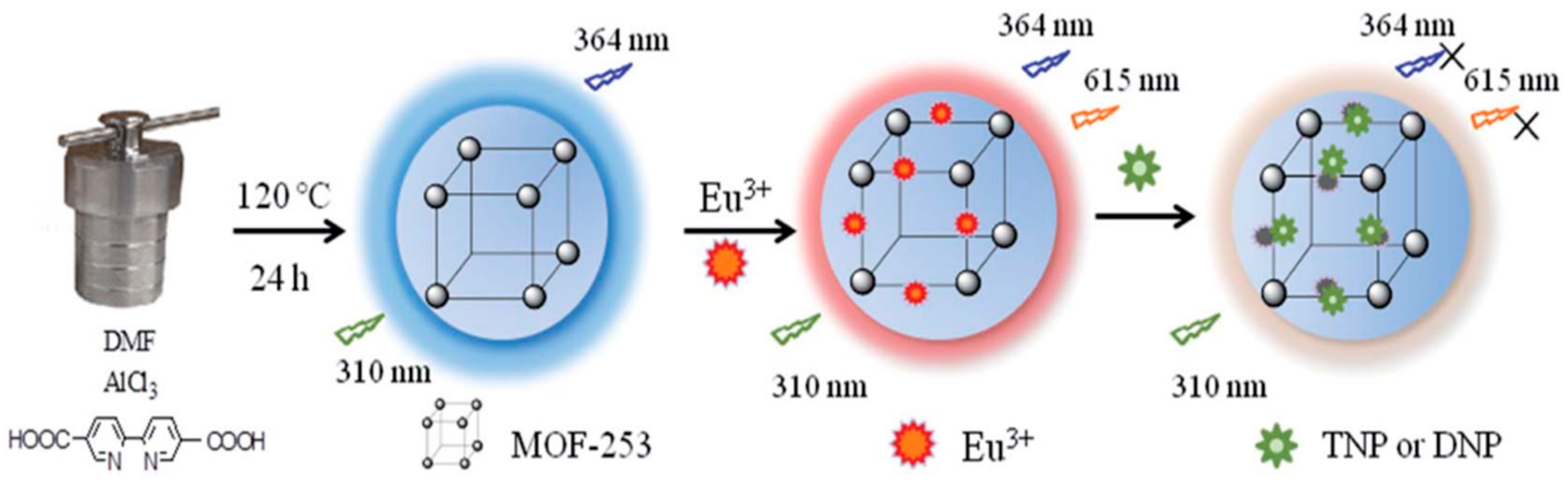
| Eu@MOF-253 | TNP | Flu. | 0.01 | 0.01–100 | [189] |
| Eu@MOF-253 | 2,4DNP | Flu. | 0.01 | 0.01–25 | [189] |
| SM-2 | TNP | Flu. | 0.0005 | 0.005–0.03 | [190] |
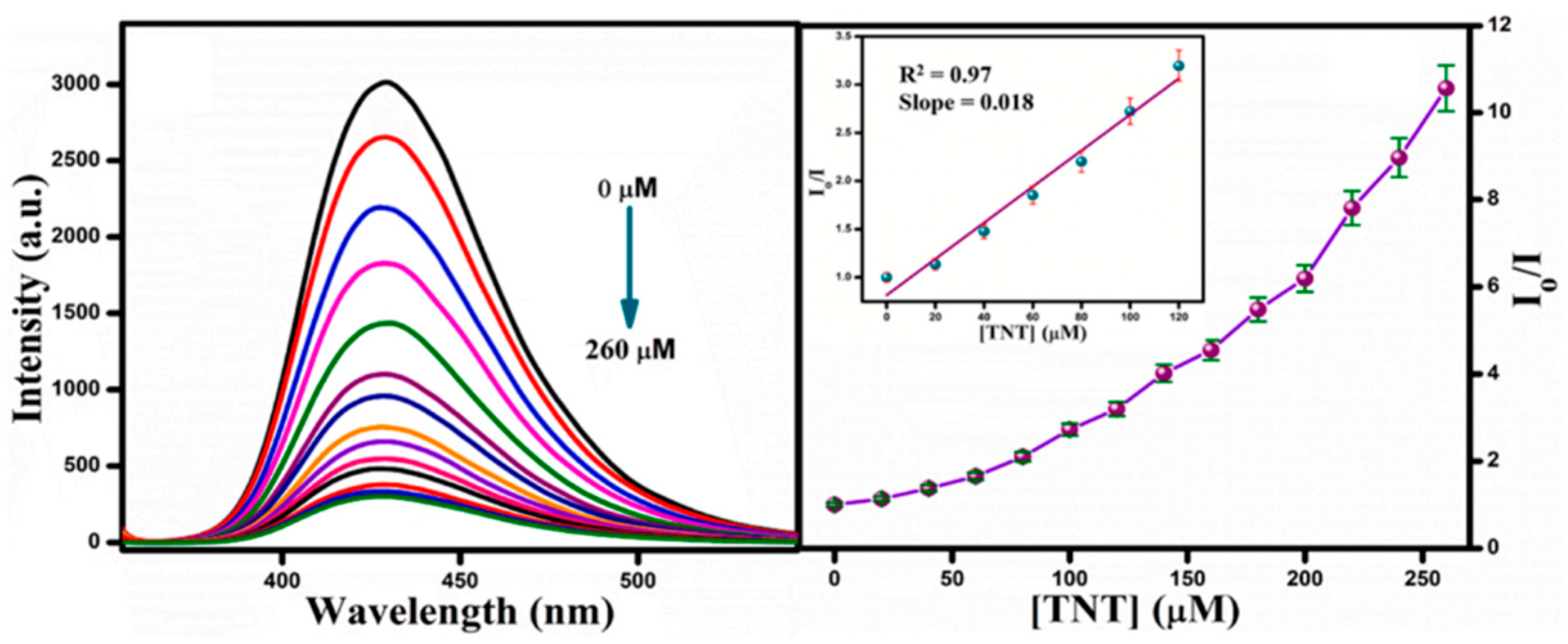
| PUC2 | TNT | Flu. | 0.145 | 20–100 | [191] |
| Zn-BDC | 4NP | Flu. | 0.68 | 2.5–45 | [192] |
| Zn-BDC | TNP | Flu. | 0.92 | 2.5–80 | [192] |
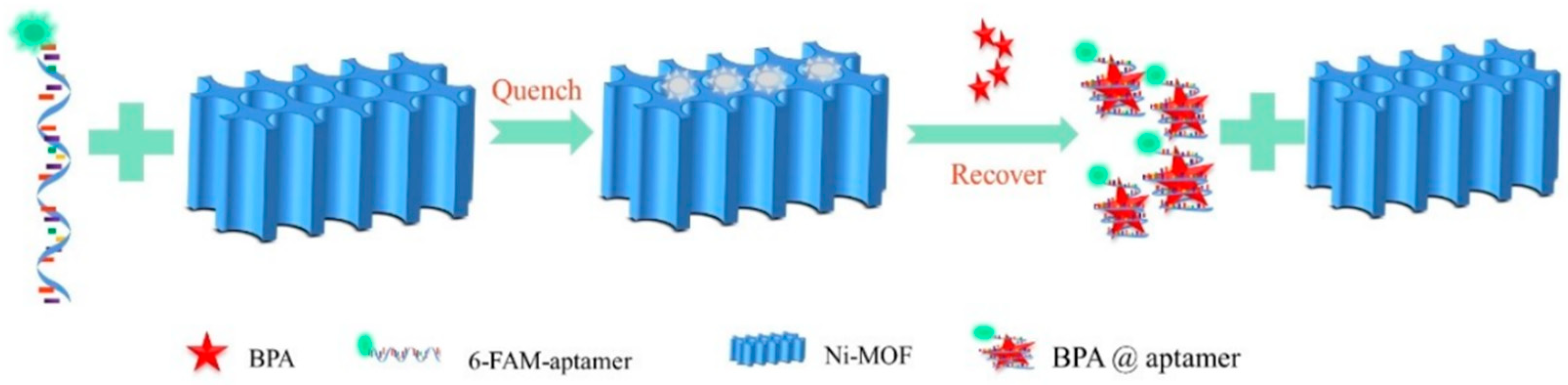
| ssDNA@Ni-MOF | BPA | Flu. | 0.34 | 15–40 | [193] |
| MOF-Base Sensor | Pollutant | Method | Detection Limit | Linear Range | Ref. |
|---|---|---|---|---|---|
| PE@MOF-5 | NH3(gas) | VC | 49.6 ppb | 5.4–80.47 ppm | [212] |
| AN@NH2-UiO-66 | NH3(liquid) | VC | 1.43 mM | - | [213] |
| CDs@ZIF-8(In) | TEA(liquid) | Flu. | 58.7 µM | 0.001–5.8 mM | [214] |
| CDs@DZIF-8(In) | TEA(gas) | RS | 1 ppm | 1–100 ppm | [214] |
| H-AlMOF@AuNP | CAB | Vol. | 80 aM | 0.3 fM–10 pM | [215] |
| H-AlMOF@AuNP | CAB | Amp. | 300 aM | 0.7 fM–10 pM | [215] |
Disclaimer/Publisher’s Note: The statements, opinions and data contained in all publications are solely those of the individual author(s) and contributor(s) and not of MDPI and/or the editor(s). MDPI and/or the editor(s) disclaim responsibility for any injury to people or property resulting from any ideas, methods, instructions or products referred to in the content. |
© 2026 by the authors. Licensee MDPI, Basel, Switzerland. This article is an open access article distributed under the terms and conditions of the Creative Commons Attribution (CC BY) license.
Share and Cite
Kustov, L.; Vergun, V.; Zakharov, V.; Aslanov, L. Metal–Organic Frameworks as Materials for Applications in Sensors for Toxicants. Crystals 2026, 16, 279. https://doi.org/10.3390/cryst16050279
Kustov L, Vergun V, Zakharov V, Aslanov L. Metal–Organic Frameworks as Materials for Applications in Sensors for Toxicants. Crystals. 2026; 16(5):279. https://doi.org/10.3390/cryst16050279
Chicago/Turabian StyleKustov, Leonid, Vadim Vergun, Valery Zakharov, and Leonid Aslanov. 2026. "Metal–Organic Frameworks as Materials for Applications in Sensors for Toxicants" Crystals 16, no. 5: 279. https://doi.org/10.3390/cryst16050279
APA StyleKustov, L., Vergun, V., Zakharov, V., & Aslanov, L. (2026). Metal–Organic Frameworks as Materials for Applications in Sensors for Toxicants. Crystals, 16(5), 279. https://doi.org/10.3390/cryst16050279