Article

In Situ Growth of ZnFe2O4 Nanoparticle Hybridized with rGO for High-Performance Lithium-Ion Battery Anodes


1
Guangxi Key Laboratory of Automobile Components and Vehicle Technology, Guangxi University of Science and Technology, Liuzhou 545006, China
2
Industry College of Intelligent Vehicle (Manufacturing) and New Energy Automobile, Guangxi University of Science and Technology, Liuzhou 545006, China
*
Author to whom correspondence should be addressed.
Crystals 2026, 16(4), 251; https://doi.org/10.3390/cryst16040251
Submission received: 19 March 2026 / Revised: 5 April 2026 / Accepted: 8 April 2026 / Published: 10 April 2026
(This article belongs to the Section Materials for Energy Applications)

Abstract

ZnFe2O4 is a promising anode material for lithium-ion batteries (LIBs) due to its high theoretical capacity, but its practical use is limited by poor conductivity and large volume changes during cycling. To address these issues, a ZnFe2O4-reduced graphene oxide (Z-F-rGO) composite was fabricated via solvothermal synthesis and calcination, with Z-F nanoparticles in situ anchored on rGO sheets. Characterizations (XRD, Raman, XPS, SEM, TEM) confirm the formation of highly crystalline spinel Z-F with good interfacial contact with rGO. The Z-F-rGO electrode shows excellent electrochemical performance, maintaining a reversible capacity of 985.4 mA h g−1 after 100 cycles at 0.5 A g−1, significantly higher than the 498.2 mA h g−1 of the Z-F. At 1.0 A g−1, the Z-F-rGO electrode retains 959.4 mA h g−1 after 300 cycles, while the Z-F electrode shows a capacity of 441.3 mA h g−1. CV analysis indicates good reversibility, while EIS and GITT reveal reduced charge-transfer resistance and enhanced Li+ diffusion. This work provides an efficient strategy for scalable Z-F-rGO composites, offering a promising approach for high-performance LIB anodes.

1. Introduction

Driven by mounting environmental pressure and the increasing societal demand for sustainable energy solutions, clean and renewable energy technologies are receiving growing research interest worldwide [1]. Among various electrochemical storage technologies, LIBs have become indispensable for electric mobility and portable electronic systems because they offer comparatively high energy-storage efficiency together with long-term serviceability [2]. Even so, the anode materials used in traditional LIBs remain unable to fully satisfy practical requirements, mainly owing to their limited specific capacity, unsatisfactory high-rate capability, and insufficient long-term cycling stability. For this reason, the design and investigation of high-performance anode materials have become essential [3].
Relative to graphite, transition-metal oxides (TMOs) are regarded as attractive anode materials owing to their higher theoretical capacities and flexible electrochemical characteristics associated with conversion-type mechanisms [4]. In particular, binary/mixed TMOs can benefit from synergistic effects between different cations, which helps improve charge transport and overall electrochemical activity [5], while nano structuring and compositing strategies are often employed to further address kinetic and stability issues in TMO anodes [6].
As a representative spinel-type binary oxide, ZnFe2O4 has been widely explored in recent years for use in LIBs anodes because it promising theoretical Li-storage capability associated with synergistic conversion and alloying mechanisms. Nevertheless, the material still faces several inherent drawbacks, including low electrical conductivity and pronounced volume fluctuation upon repeated lithiation/delithiation, both of which tend to cause electrode polarization, mechanical degradation of the structure, and deterioration in cycling stability and rate capability [7]. To mitigate these issues, rational structural design and carbon/composite engineering have been demonstrated to stabilize ZnFe2O4 electrodes, such as constructing ZnFe2O4/C hollow spheres [8], designing multi-shelled hollow ZnFe2O4 architectures [9], and building continuous porous/fibrous ZnFe2O4 frameworks to improve transport and mechanical integrity [10].
To accelerate the reaction kinetics of ZnFe2O4 and reinforce its structural robustness, integrating this oxide with two-dimensional conductive carbonaceous materials, including graphene and graphene oxide, has been widely regarded as an effective design strategy. Such hybridization can improve electrochemical behavior through the establishment of interconnected electron-transfer networks, mitigation of volume-change effects, and inhibition of particle aggregation. Chen et al. [11] showed that porous ZnFe2O4 nanospheres supported on graphene nanosheets delivered reversible achieved 970 mA h g−1 at 50 mA g−1 and retained 700 mA h g−1 even at 600 mA g−1, confirming the advantageous role of combining porous ZnFe2O4 with highly conductive graphene. Lin et al. [12] further demonstrated that core–shell ZnFe2O4@C nanoparticles immobilized on graphene nanosheets achieved a capacity of 705 mA h g−1 at 0.25 C after 180 cycles, and still maintained 403.5 mA h g−1 at 5 C, suggesting that the dual-protection configuration of a carbon shell together with graphene is beneficial for both cycling and rate performance. Li et al. [13] reported that self-assembled ZnFe2O4 hollow spheres coated uniformly with GO exhibited a reversible capacity of 829 mA h g−1 at 0.2 A g−1 after 500 cycles and retained 463 mA h g−1 at 1.0 A g−1, underscoring the positive effect of the hollow buffering framework combined with conductive GO coverage. Park et al. [14]. reported that well-dispersed ZnFe2O4nanoparticles on graphene could effectively address the insufficient reversible capacity and unsatisfactory conductivity of bare ZnFe2O4, further supporting the feasibility of graphene-based conductive frameworks for ZnFe2O4 anodes.
Although notable advances have been reported in the preparation of ZnFe2O4-based composites and their use in lithium-storage systems, achieving ZnFe2O4 anodes with a well-balanced combination of large reversible capacity, fast charge–discharge capability, and durable cycling stability continues to be the challenge for future LIBs.
Herein, a conductive composite anode was fabricated by solvothermally depositing Z-F nanoparticles onto rGO. Benefiting from the cooperative interaction between Z-F and rGO, the obtained Z-F-rGO maintained a reversible capacity of 959.4 mA h g−1 after 300 cycles at 1.0 A g−1. The enhanced electrochemical performance can be attributed to the ability of the rGO framework to accommodate volume fluctuation and facilitate both electron and ion transport. These results suggest an effective strategy for designing advanced composite anodes in deployment in advanced energy storage technologies.

2. Materials and Methods

2.1. Reagents and Chemicals

For Z-F and Z-F-rGO synthesis, zinc nitrate hexahydrate (Zn(NO3)2·6H2O, 99%) and PVP (polyvinylpyrrolidone, K30, 99%) were purchased from Macklin Biochemical (Macklin, Shanghai, China), ferric nitrate nonahydrate (Fe(NO3)3·9H2O, 99%) and sodium acetate (CH3COONa, AR) were from Sigma-Aldrich (Merck, Shanghai, China), while EG (ethylene glycol, C2H6O2, 99.7%) and commercial graphene oxide (GO) were purchased from Aladdin (Aladdin, Shanghai, China).
In the electrode-making step, Super P (conductive-carbon-black) was employed as the conductive component, PVDF (polyvinylidene fluoride, 99%) was chosen as the binder, and NMP (N-methyl-2-pyrrolidone, 99%) was utilized as the solvent. Their suppliers were Macklin Biochemical (Macklin, Shengzhen, China).

2.2. rGO Preparation

rGO was synthesized via hydrazine-hydrate reduction of GO under oil-bath heating [15,16,17]. Specifically, GO was first introduced into deionized water and treated by ultrasonication until a stable dispersion was formed. Then hydrazine hydrate was added as a reducing agent, and the mixture was refluxed in an oil bath at 96 °C for 24 h with stirring [15,16,17]. This treatment removed a large portion of the oxygen-containing functional groups from GO and partially reconstructed the conjugated carbon network. After the reaction, the black precipitate was filtered, the product was freeze-dried for 24 h, and the resulting material was collected as rGO.

2.3. Preparation Z-F-rGO

A combination of solvothermal treatment and post-annealing was employed to synthesize the Z-F-rGO composite. Specifically, 1 mmol Zn(NO3)2·6H2O and 2 mmol Fe(NO3)3·9H2O were dissolved in 70 mL ethylene glycol, the solution was subjected to constant agitation throughout the process. 1.0 g PVP and 12 mmol CH3COONa were then successively introduced, after which the system was stirred for another hour. Next, 50 mg of rGO was incorporated, and the suspension was subjected to ultrasonication for 2 h to promote uniform dispersion. The resulting precursor suspension was subsequently placed into a stainless-steel autoclave lined with Teflon, followed by treatment at 180 °C for 12 h. After the reaction, the product was allowed to cool to ambient temperature, collected by separation, repeatedly rinsed with water and ethanol to remove residual impurities, freeze-dried for 24 h, and subsequently annealed at 400 °C for 2 h in an Ar atmosphere, yielding the Z-F-rGO composite.

2.4. Characterization

X-ray diffractometer (XRD) analysis was carried out using a Bruker D8 Advance diffractometer (Bruker, Bremen, Germany) to investigate the crystallographic structure and phase distribution of the obtained samples. Diffraction measurements were carried out over the 2θ interval of 5–90° at 0.5° min−1.
The morphology of the synthesized samples was examined by field-emission scanning electron microscopy (FESEM, ZEISS Gemini SEM 300, Jena, Germany). Before SEM observation, the samples were sputter-coated with a thin Au layer using a sputter coater (Leica EM ACE600, Leica Microsystems, Shanghai, China) to improve surface conductivity and reduce charging effects. Elemental composition and spatial distribution were further analyzed by energy-dispersive X-ray spectroscopy (EDS, Oxford INCA, Oxfordshire, UK) attached to the FESEM.
Further microstructural characterization was carried out on a transmission electron microscope (JEM—F200 FEI Tecnai G2 F20 FEI Talos F200s, Thermo Fisher Scientific, Waltham, MA, USA). For TEM measurements, the sample dispersion was dropped onto a molybdenum grid and dried prior to observation. High-resolution TEM images were collected to reveal detailed structural features and lattice fringes of the obtained materials.
X-ray photoelectron spectroscopy (XPS) patterns were collected with a Thermo ESCA LAB spectrometer (Thermo Fisher Scientific, USA). Raman characterization was performed on a Lab RAMHR Evolution instrument (HORIBA, Tianjin, China) with 325 nm laser excitation, and the spectral data were recorded in the 1000–2000 cm−1 wavenumber window.
N2 adsorption–desorption testing was conducted with an ASAP 2460 system to assess the surface area and pore architecture of the prepared samples (Micromeritics, Shanghai, China), and the data were processed using Micro Active for ASAP 2460 Version 2.02. Before the BET measurements, the samples underwent a degassing process at 120 °C for 6 h.
Thermogravimetric analysis (TGA) tests were conducted on STA6000 (PerkinElmer, Shanghai, China) in an air environment, the samples were heated between 40 and 600 °C with a heating rate of 10 °C min−1.

2.5. Electrochemical Measurement

Electrochemical performance of the synthesized Z-F and Z-F-rGO samples was assessed using CR2025-type half-cells. To prepare the electrodes, the active material was combined with Super P and PVDF in an 8:1:1 weight ratio, and NMP was introduced to form a well-dispersed paste. This mixture was cast onto copper foil, vacuum-dried at 80 °C for 12 h, and then cut into circular electrode disks, followed by pressing treatment to improve contact within the electrode structure.
Assembly of the cells was performed in an argon-filled glovebox under strictly controlled conditions, with both H2O and O2 levels lower than 0.1 ppm. Lithium foil served as the counter electrode, and a Celgard 2400 polypropylene membrane was used as the separator. The electrolyte was prepared by dissolving 1.0 M LiPF6 in a mixed EC/DEC (ethylene carbonate/diethyl carbonate) solvent with a volume ratio of 1:1.
Charge–discharge behavior under constant current was examined between 0.01 and 3.0 V (vs. Li/Li+). In addition, cyclic voltammetry and electrochemical impedance spectroscopy were conducted on an electrochemical workstation. CV (cyclic voltammetry) data were collected within the identical potential window at multiple scan rates, while EIS (electrochemical impedance spectroscopy) spectra were measured over frequencies ranging from 0.01 Hz to 100 kHz under an AC excitation of 5 mV.

3. Results

3.1. Morphology and Structural Analysis

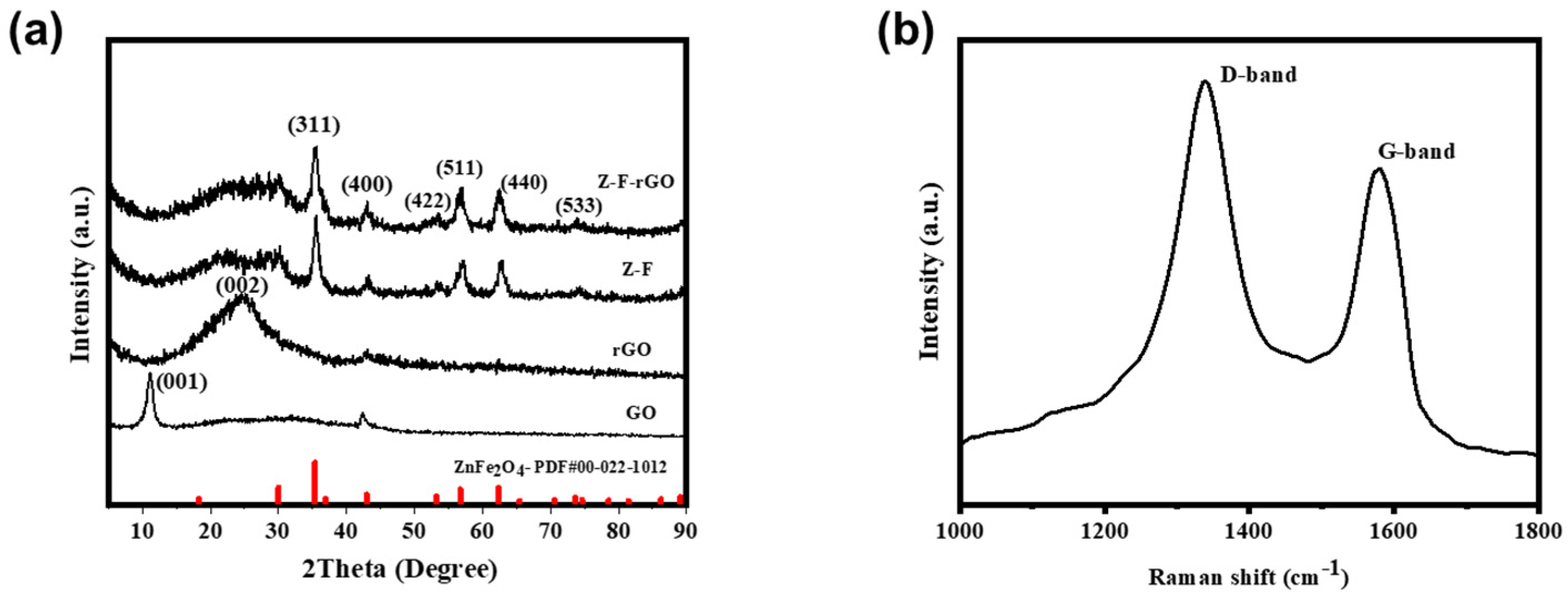
XRD analysis was conducted to reveal the structural characteristics and phase makeup of the prepared Z-F-rGO composite. Figure 1a shows that the diffraction pattern exhibits the characteristic peaks of spinel-type zinc ferrite, confirming the successful construction of the hybrid structure. The diffraction peaks located at 2θ ≈ 30.1°, 35.2°, 42.9°, 53.2°, and 56.0° can be indexed to the (220), (311), (400), (422), and (511) crystal planes of cubic spinel ZnFe2O4 (JCPDS No. 22-1012) [18]. The coexistence of these characteristic peaks and the absence of any obvious impurity peaks indicate that the composite possesses high phase purity [19]. Moreover, the diffraction peak positions of Z-F remain essentially unchanged after introducing rGO, indicating that the incorporation of rGO does left the crystal structure essentially unchanged of Z-F but mainly serves as a conductive framework/supporting matrix [20]. The pronounced broadening of the Z-F diffraction peaks further suggests that the Z-F phase is nanocrystalline [21].
It is noteworthy that the diffraction peaks of the Z-F sample are obviously broadened and weakened, indicating its low crystallinity and ultrafine nanocrystalline nature rather than a highly crystallized bulk structure [22]. Such a low-crystallinity/short-range disordered structure is generally associated with restricted grain growth under relatively low-temperature synthesis conditions [23,24]. Such a low-crystallinity/disordered structure is beneficial for shortening Li+ diffusion pathway and exposing more defect-related electrochemically active sites, thereby promoting surface-controlled lithium-storage kinetics; however, in the absence of a conductive support, these intrinsic structural features alone do not necessarily guarantee superior long-term cycling stability or rate capability, since the electrode may still suffer from limited electron transport, structural instability, and accumulated volume-change-induced deterioration during repeated cycling, which eventually results in active-site loss and capacity decay [25,26,27]. Therefore, in the present system, the introduction of rGO is important for improving electron transport, promoting the dispersion of active particles, and alleviating the electrode undergoes reversible volume change during lithiation and delithiation thereby enabling the lithium-storage advantages of low-crystallinity Z-F to be more effectively utilized.
In addition, clear differences can be observed among the XRD patterns of GO, rGO, and Z-F-rGO. GO shows a characteristic a diffraction peak appears near 10–12°, which corresponds to the (001) plane and is related to the enlarged interlayer spacing caused by oxygen-containing functional groups and interlayer water, after the reduction treatment, most oxygen-containing groups and interlayer water are removed, resulting in a decreased interlayer spacing, and the original (001) peak of GO consequently disappears [28,29]. As a result, rGO usually exhibits only a broad and weak (002)-type diffraction signal appearing in the 20–30° region, reflecting the reduced stacking order and increased structural disorder of the layered structure [30,31]. For the Z-F-rGO composite, no obvious characteristic peak of rGO is observed. This can be mainly from the low content of rGO, its poor crystallinity, weak diffraction intensity, and broadened peak profile, while its signal may also be masked by the diffraction peaks and background of Z-F [32,33]. Therefore, analysis of the X-ray diffraction data for the composite demonstrates that is dominated by the characteristic reflections of spinel Z-F, whereas rGO does not appear as an independent sharp diffraction peak.
The Raman profile of Z-F-rGO shown in Figure 1b reveals two typical carbon-related vibration bands in the 1000–2000 cm−1 region, appearing at approximately 1365 and 1600 cm−1. The lower-wavenumber peak corresponds to the D-band, which is associated with the A1g breathing vibration of sp2 carbon rings and reflects the existence of defects and disordered domains. The higher-wavenumber peak is assigned to the G-band, which can be assigned to the E2g in-plane vibrational motion of carbon atoms with sp2 bonding, and is indicative of the ordering extent within the graphitic structure [25,27,34].
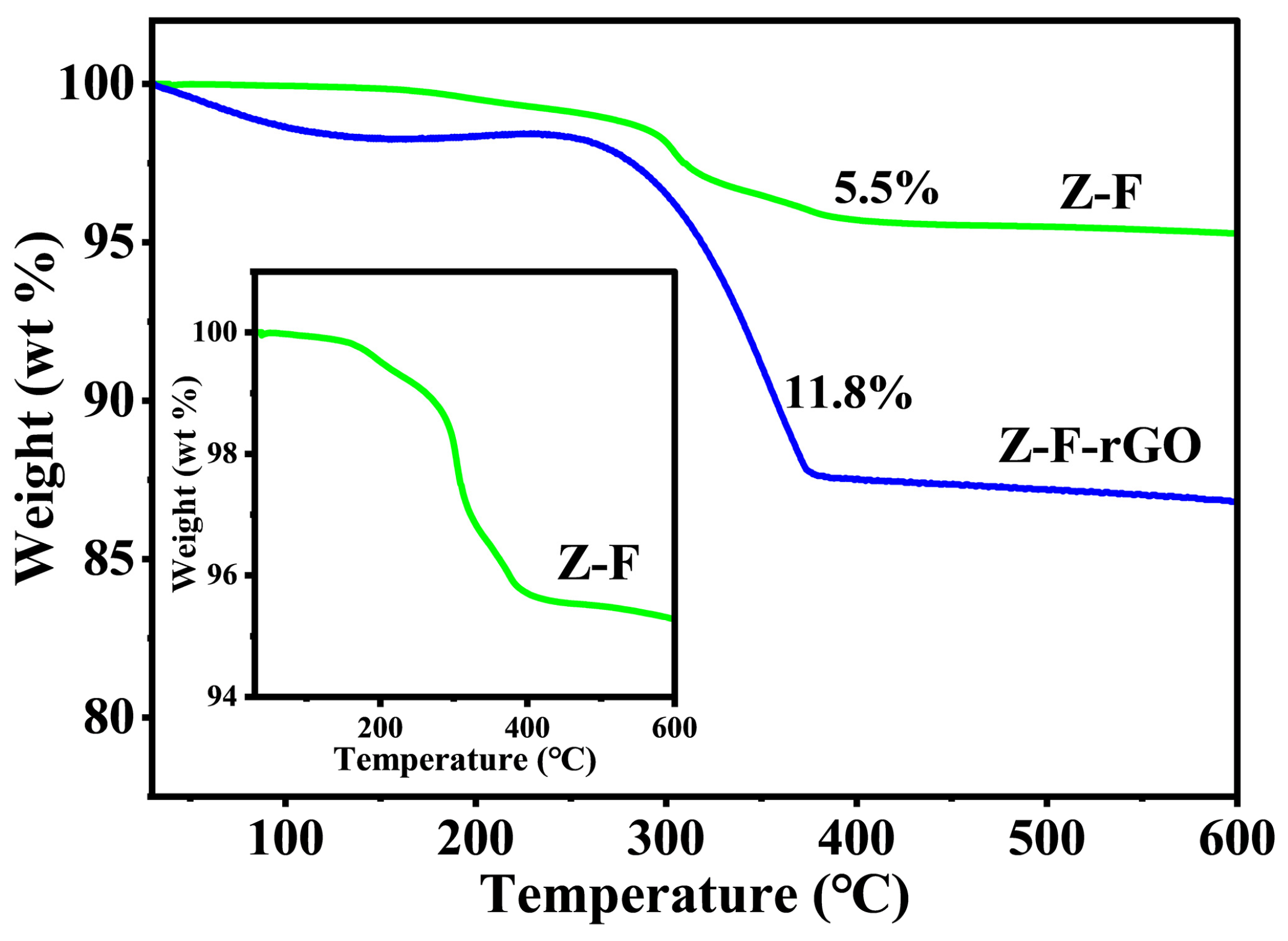
As show in Figure 2, both Z-F and Z-F-rGO under GO a relatively mild and continuous mass loss upon heating, reflecting their favorable thermal stability. The pristine Z-F sample exhibits an overall weight loss of about 5.5%, which is primarily attributed to evaporation of adsorbed water, removal of residual hydroxyl groups, and decomposition of minor organic species [35,36]. After incorporation of rGO, the total mass loss increases to approximately 11.5%, exceeding that of pure Z-F. This additional decrease is mainly derived from the thermal decomposition of oxygen-bearing surface groups and the thermal reaction of disordered carbon associated with rGO [37,38]. Accordingly, these results provide further evidence for the successful integration of rGO into the Z-F matrix while confirming that the composite still preserves good thermal stability.
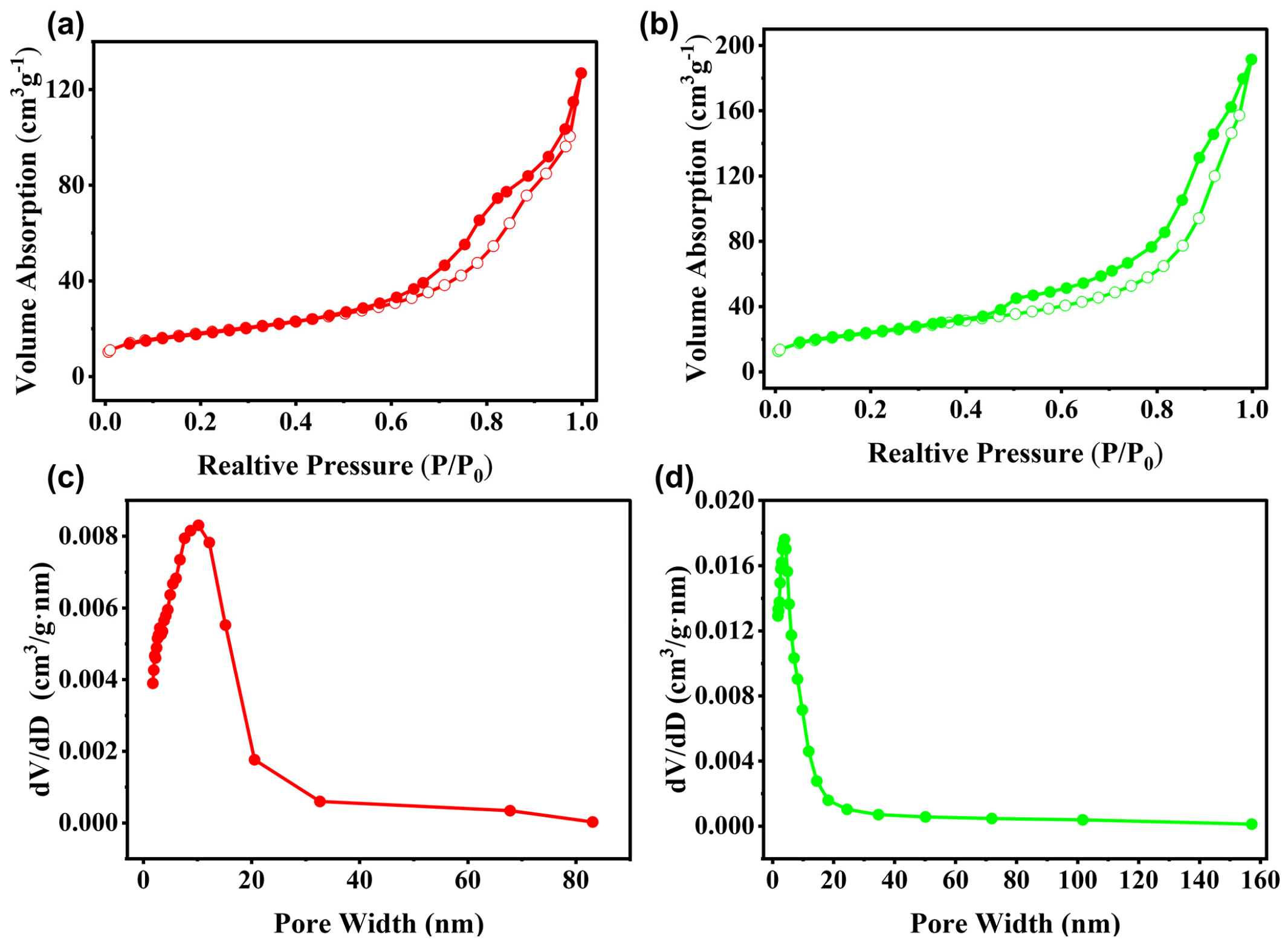
As show in Figure 3a,b, both Z-F and Z-F-rGO exhibit typical type IV adsorption–desorption isotherms, indicating that both samples are dominated by mesoporous structures [39]. Among them, Z-F shows a relatively weak hysteresis loop, with the pore size mainly concentrated in the range of about 6–15 nm and a main peak centered at approximately 9–11 nm, suggesting that it is primarily composed of relatively concentrated medium-sized mesopores, accompanied only by a small number of larger pores formed by particle aggregation [40,41]. In contrast, Z-F-rGO exhibits a more pronounced hysteresis loop and no clear plateau in the high relative pressure region, making it more similar to an H3-type hysteresis loop, which is generally associated with slit-shaped pores formed by the stacking of wrinkled rGO sheets as well as open channels between particles and sheets [14,42,43]. As show in Figure 3c,d, its pore size distribution is mainly concentrated in the range of about 2–8 nm, while also extending to a larger pore-size region, indicating that the composite possesses a more evident hierarchical porous structure. The specific surface area of Z-F is 63.27 m2 g−1, whereas that of Z-F-rGO increases to 84.93 m2 g−1. Therefore, the hierarchical porous structure of Z-F-rGO, consisting of small mesopores and larger pore channels, together with its higher specific surface area, is more favorable for electrolyte infiltration, rapid ion diffusion, and buffering of volume variation during the charge–discharge process, thereby contributing to improved rate capability and cycling stability.
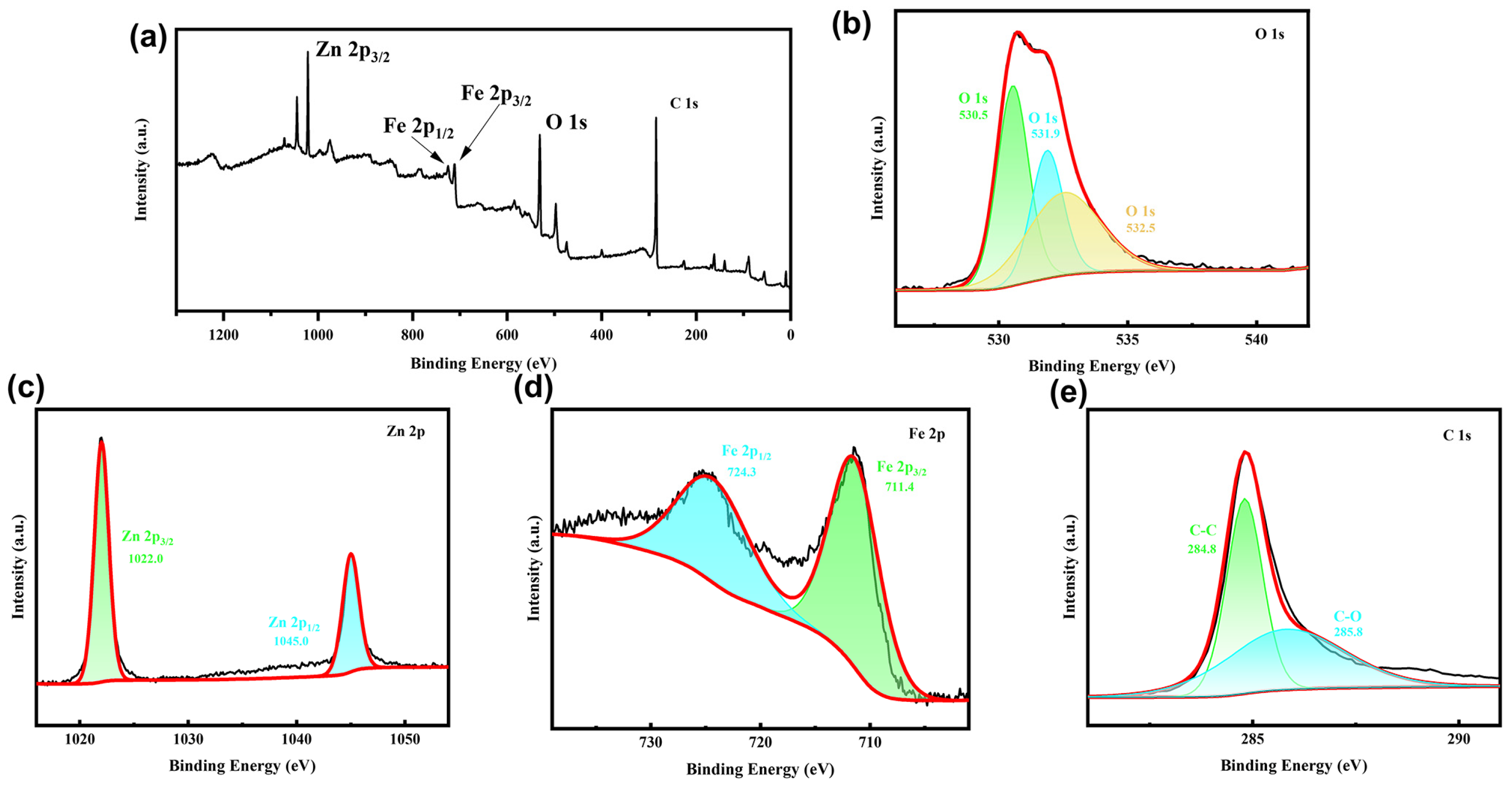
The phase identification of spinel Z-F was primarily confirmed by the XRD results, whereas XPS was employed to analyze the surface elemental composition and chemical states of the Z-F-rGO composite. As shown in Figure 4a, the XPS survey spectrum reveals the presence of Zn, Fe, O, and C, confirming the successful formation of the Z-F-rGO composite. In the high-resolution O 1s spectrum (Figure 4b), the peak can be deconvoluted into three components centered at 530.5, 531.8, and 532.5 eV, which are attributed to lattice oxygen, defect- or hydroxyl-related oxygen species, and adsorbed oxygen-containing species, respectively [44]. As shown in Figure 4c, the Zn 2p spectrum exhibits two characteristic peaks at 1022.0 and 1045.0 eV, corresponding to Zn 2p3/2 and Zn 2p1/2, respectively, indicating that Zn is mainly present in the Zn2+ state [45]. The Fe 2p spectrum in Figure 4d displays two main peaks at 711.4 and 724.3 eV, assigned to Fe 2p3/2 and Fe 2p1/2, respectively, which is consistent with the presence of Fe3+ in the spinel phase [46,47]. Moreover, the C 1s spectrum in Figure 4e can be deconvoluted into two components at 284.8 and 285.8 eV, corresponding to C–C/C=C and C–O bonds, respectively, confirming the retention of the carbon framework and indicating the presence of rGO in the composite [48].
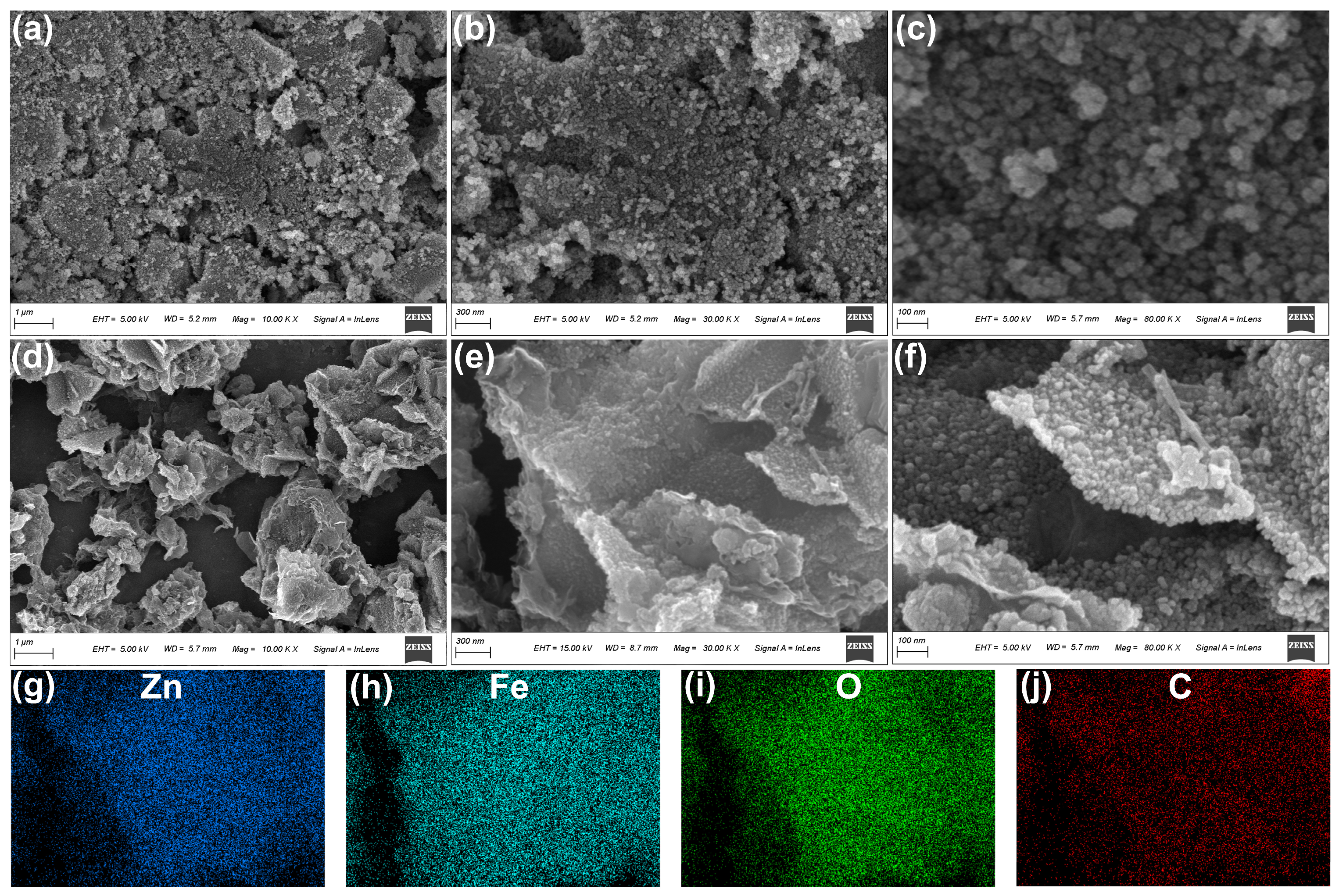
It can be observed from Figure 5a–c that the pristine Z-F sample exhibits severe particle agglomeration. The Z-F nanoparticles tend to aggregate into irregular clusters with relatively dense packing, resulting in limited exposed surface area and poor structural uniformity [49]. Such agglomeration is unfavorable for electrolyte penetration and Li+ diffusion during electrochemical cycling [50]. In contrast, Figure 5d–f shows the SEM images of the Z-F-rGO composite. It can be clearly observed that Z-F nanoparticles are uniformly anchored and showing a uniform distribution throughout the rGO sheet surface, forming a tightly integrated hybrid structure. The flexible and wrinkled rGO layers effectively suppress particle agglomeration and provide a continuous conductive network, which facilitates electron transport and buffers the volume variation of Z-F during repeated lithiation/delithiation processes [51]. Figure 5g–j EDS elemental mapping of the Z-F-rGO composite, showing the uniform distribution of Zn, Fe, O, and C elements, which indicates the successful incorporation of Z-F nanoparticles on rGO sheets.
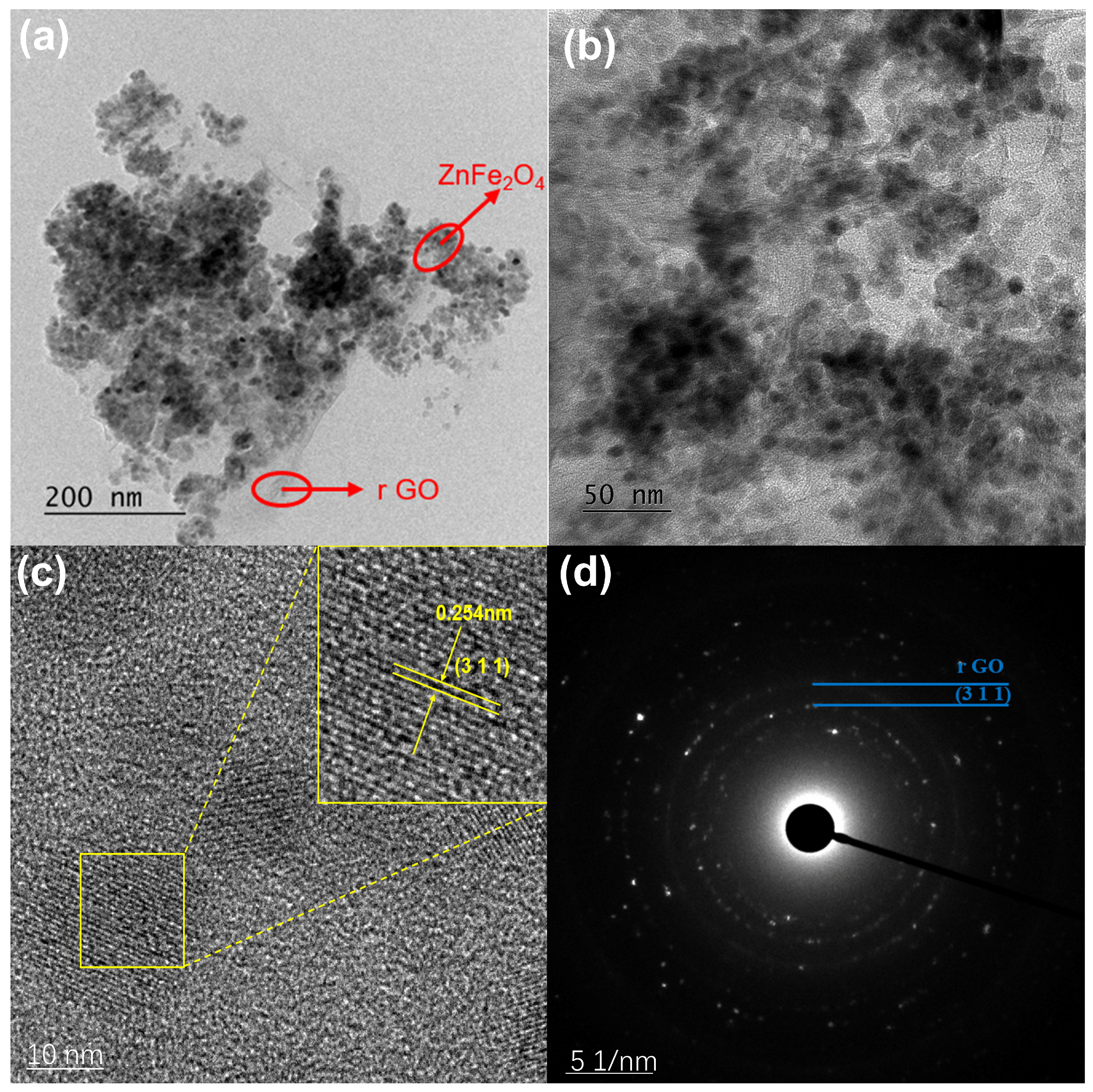
The TEM images Figure 6a–d reveal the nanoscale structural features of the Z-F-rGO composite. In Figure 6a, the dark regions correspond to Z-F nanoparticles, while the light gray, sheet-like areas are assigned to rGO, revealing a homogeneous dispersion of the nanoparticles anchored on the rGO surface, forming a well-integrated composite structure. Figure 6b presents a high-resolution TEM image, in which the nanoparticles are seen to form mild aggregates while remaining dispersed on the nanoscale, a morphology that is beneficial for increasing the specific surface area and providing abundant electrochemically active sites [52]. The HR-TEM image (Figure 6c) shows lattice fringes of the Z-F nanoparticles, with interplanar spacings of 0.254 nm, corresponding to the (3 1 1) planes of Z-F [53]. SAED pattern (Figure 6d) displays distinct ring patterns that can be identified as the (3 1 1) plane of spinel Z-F and the (0 0 2) plane of rGO, respectively [54].

3.2. Electrochemical Test

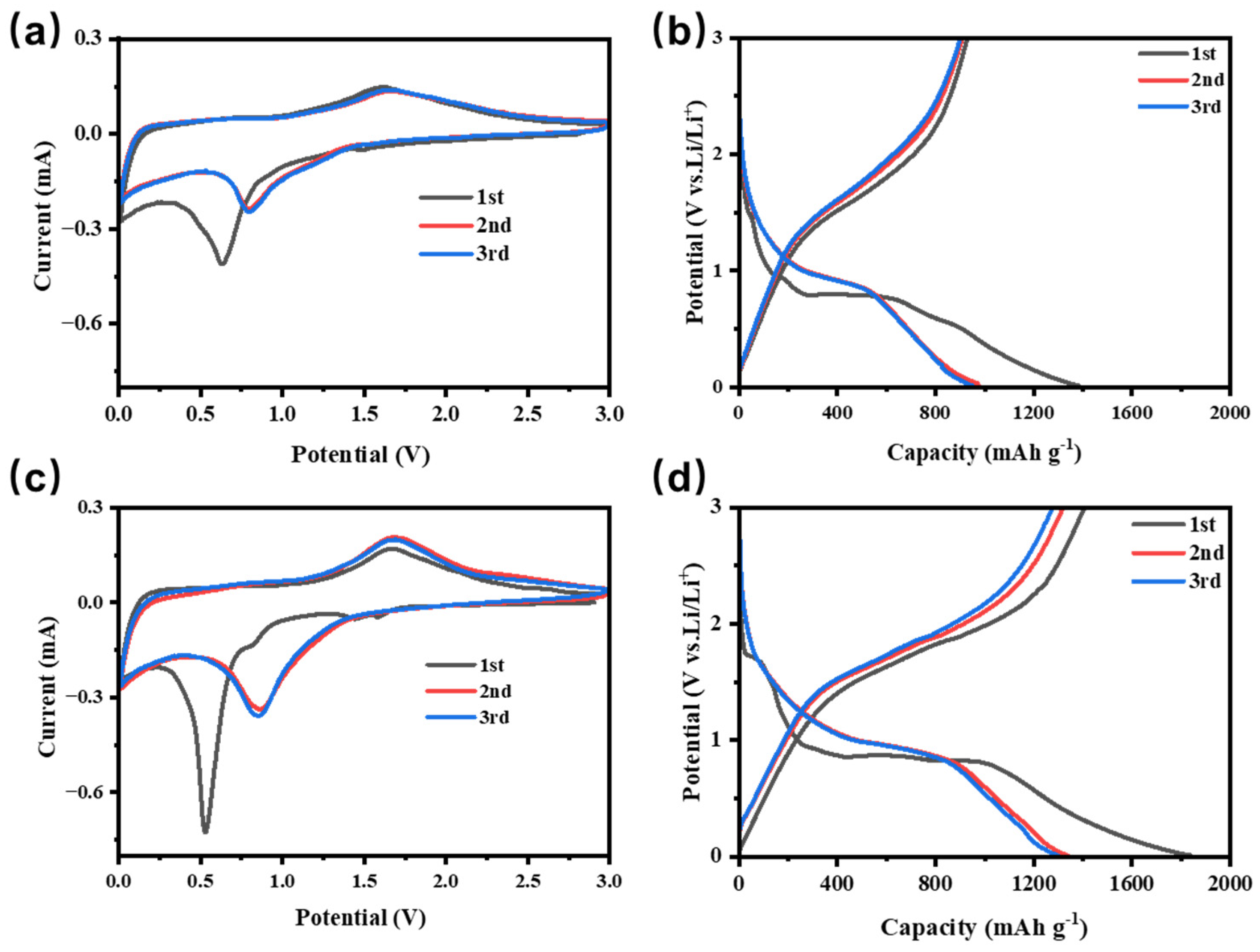
Figure 7a,c display the corresponding cyclic voltammetry results. Figure 7b,d present the first three galvanostatic charge–discharge curves of the Z-F and Z-F-rGO electrodes measured over 0.01–3.0 V (vs. Li/Li+). The CV curves of both Z-F and Z-F-rGO exhibit a sharp reduction peak at around 0.5 V in the first cycle. This peak corresponds to the lithiation process, during which Li+ can readily diffuse into the spinel lattice of zinc ferrite, while Fe3+ in the spinel structure is reduced to Fe2+, as expressed in Equations (1)–(4) [55,56]. The sharp peak disappears in the subsequent cycles, which may be attributed to the formation of the SEI film [57]. In the following cycles, the cathodic peak shifts to a higher potential and stabilizes at approximately 0.85 V. A relatively broad oxidation peak is observed at around 1.6 V, corresponding to the delithiation process, during which Zn is oxidized to Zn2+ and Fe is oxidized to Fe3+, as expressed in Equations (5) and (6) [55,58,59].
In 2004, Nuli et al. [59]. found that Li+ was reversibly embedded and eluted in ZnFe2O4. In 2010, Guo et al. [55]. summarized lithium-storage mechanism of ZnFe2O4 as follows:
ZnFe2O4 + 0.5Li+ + 0.5e ↔ Li0.5ZnFe2O4
Li0.5ZnFe2O4 + 1.5Li+ + 1.5e ↔ Li2ZnFe2O4
Li2ZnFe2O4 + 6Li+ + 6e ↔ 4Li2O + Zn + 2Fe
Zn + Li+ + e↔ LiZn
2Fe + 3Li2O ↔ Fe2O3 + 6Li+ + 6e
Zn + Li2O ↔ ZnO + 2Li+ + 2e
The second and third CV curve lines are expressed, the Z-F electric current is present in the circulation, the weak peak current is expressed, the irreversible capacity is large, and the electrochemical dynamics is weak. In contrast, the Z-F-rGO electrode exhibits smaller variations in peak current between successive cycles and maintains higher current responses, especially in the anodic region (~1.5–1.8 V), reflecting enhanced reversibility and faster reaction kinetics. However, the Z-F electrode shows a weak peak current in the subsequent cycles, indicating larger irreversible capacity loss and sluggish electrochemical kinetics. In contrast, the Z-F-rGO electrode exhibits smaller variations in peak current between successive cycles and maintains higher current responses, especially in the anodic region (~1.5–1.8 V), reflecting enhanced reversibility and faster reaction kinetics.
Notably, the Z-F-rGO electrode delivers a significantly higher initial discharge capacity of 1837 mA h g−1, when contrasted with the performance of the Z-F electrode (~1385 mA h g−1), indicating enhanced Li+ storage capability. During the subsequent cycling process, the reversible capacity of the Z-F-rGO electrode remains above ~979 mA h g−1, whereas the Z-F electrode exhibits a more pronounced capacity decay. Moreover, the charge–discharge curves in the second and third cycles almost overlap, particularly for the Z-F-rGO electrode, suggesting that the electrode under a stable conversion reaction after the initial activation and exhibits improved cycling reversibility.
The larger enclosed area in the CV curves together with the more pronounced anodic and cathodic responses further demonstrates the enhanced electrochemical reactivity of the Z-F-rGO electrode. This improvement mainly arises from the presence of rGO, which forms a continuous conductive framework for rapid electron transfer, reduces Li+ transport distance, and alleviates the structural stress caused by repeated volume changes during cycling. Meanwhile, the uniform dispersion of Z-F nanoparticles over the rGO sheets provides abundant interfacial active sites, thereby promoting active-material utilization and accelerating the overall reaction kinetics [60].
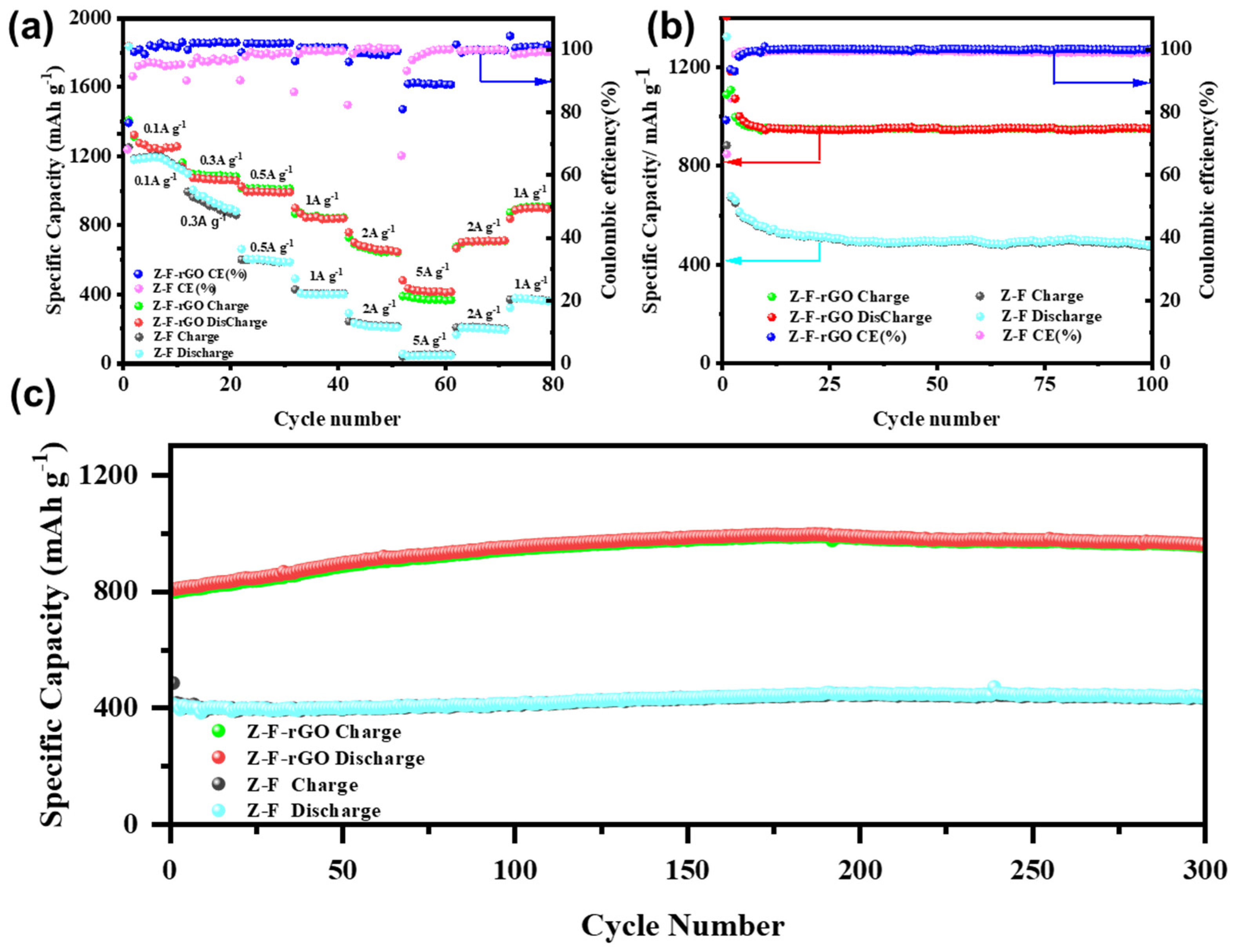
Figure 8a summarizes the rate capability of the two electrodes. From 0.1 to 5.0 A g−1, the Z-F-rGO electrode maintains discharge capacities of 1256.3, 1059.5, 993.1, 798.3, 654.8, and 414.0 mA h g−1, respectively. In contrast, the respective values for the Z-F electrode are much lower, only 945.0, 680.4, 499.6, 307.3, 163.5, and 41.0 mA h g−1. When back to 1.0 A g−1, the reversible capacities recover to 899.0 mA h g−1 for Z-F-rGO and 385.3 mA h g−1 for Z-F, further indicating the superior rate tolerance and structural integrity of the electrode containing rGO. The modest capacity increase observed in the initial stage can be ascribed to gradual electrochemical activation during repeated charge–discharge processes [61]. As further evidenced by the cycling test at 0.5 A g−1 in Figure 8b, Z-F-rGO exhibits much more stable long-term performance than the pristine Z-F electrode after the activation stage. Specifically, a reversible capacity of 985.4 mA h g−1 is still maintained after 100 cycles, whereas the capacity of Z-F declines markedly to 498.2 mA h g−1 while maintaining the same testing conditions. These results clearly verify that the introduction of rGO improving both rate behavior and cycling stability of Z-F-based anodes.
Figure 8c further demonstrates the clear electrochemical advantage of the Z-F-rGO electrode over the pristine Z-F electrode. At the beginning of cycling, Z-F-rGO with approximately 800 mA h g−1, and this value gradually increases to 959.4 mA h g−1 before remaining highly stable throughout 300 cycles, indicating a distinct activation behavior and outstanding cycling stability. By comparison, the Z-F sample only maintains a capacity in the range of about 390–450 mA h g−1, despite showing relatively stable cycling behavior. In addition, the close overlap as reflected by the difference between the charging and discharging behaviors of Z-F-rGO implies favorable reversibility and reduced polarization. This enhanced performance can be ascribed to the presence of rGO, which provides strengthened electrical conduction, accelerates interfacial charge transfer, and helps preserve electrode integrity during prolonged cycling. At the same time, the conductive network established through strong interfacial coupling between Z-F nanoparticles and rGO sheets shortens the Li+ transport path and promotes faster reaction kinetics within the electrode [62]. In addition, rGO sheets provide a continuous and flexible supporting framework, which suppresses nanoparticle aggregation and pulverization, helps inhibit undesired interfacial reactions taking place at the contact interface between the electrode and the electrolyte, and improves Coulombic efficiency [63]. This also leads to a more stable electrode structure and facilitates more efficient electron transport. Furthermore, binary transition-metal oxides such as Z-F involve multi-electron transfer reactions and possess relatively good structural stability [64]. After hybridization with conductive carbon materials, both electronic/ionic conductivity and mechanical stability are further improved, leading to excellent electrochemical cycling performance and rate behavior [65].
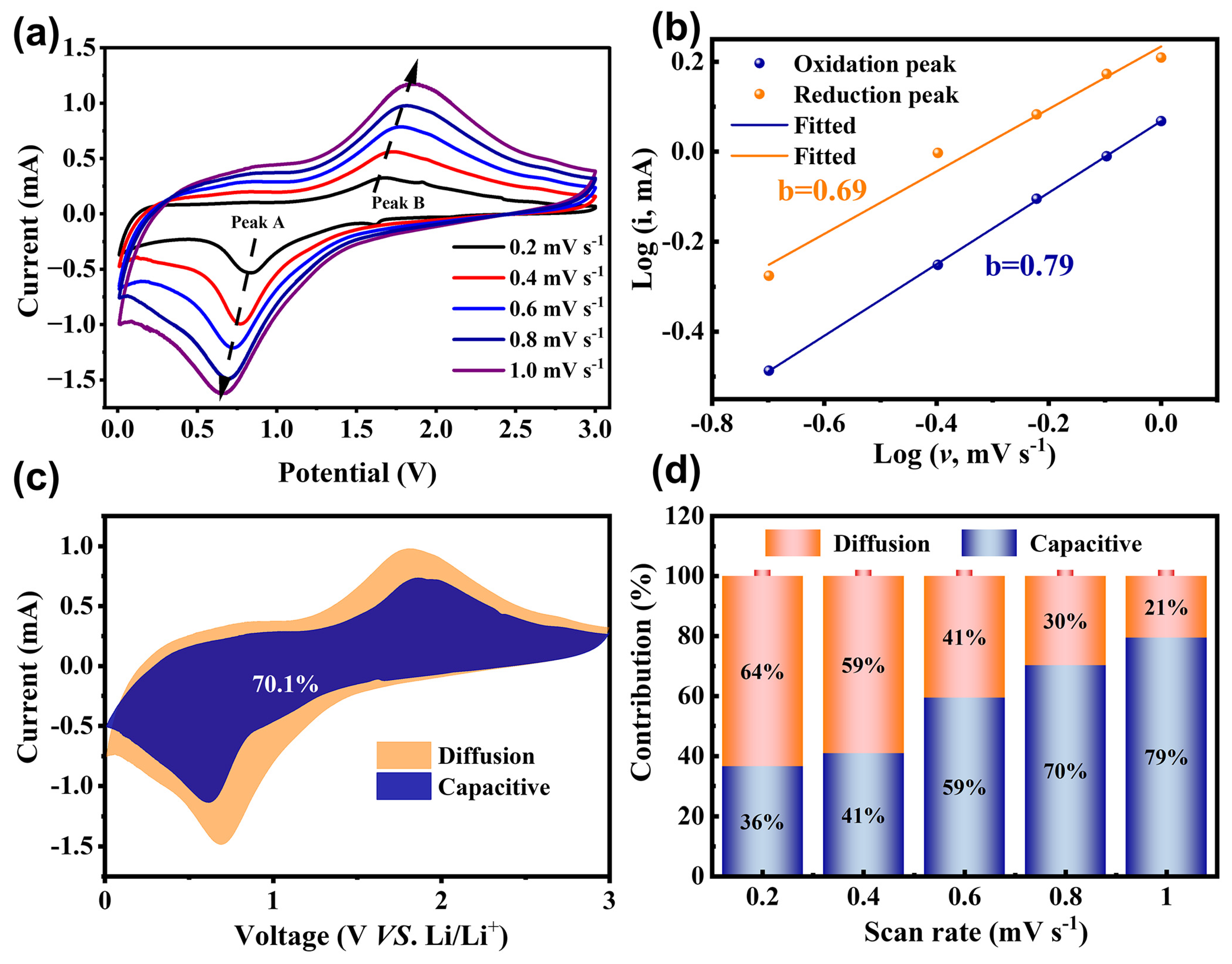
The b-values were calculated from the redox peak currents of the Z-F-rGO to distinguish between diffusion-controlled and capacitive-controlled contributions. The obtained b-values are 0.69 and 0.89 (Figure 9b), indicating that pseudocapacitive behavior contributes significantly to the reversible capacity of the Z-F-rGO. At 0.8 mV s−1, the pseudocapacitive contribution reaches 70.1% (Figure 9c), and the contribution further increases with increasing scan rate (Figure 9d).
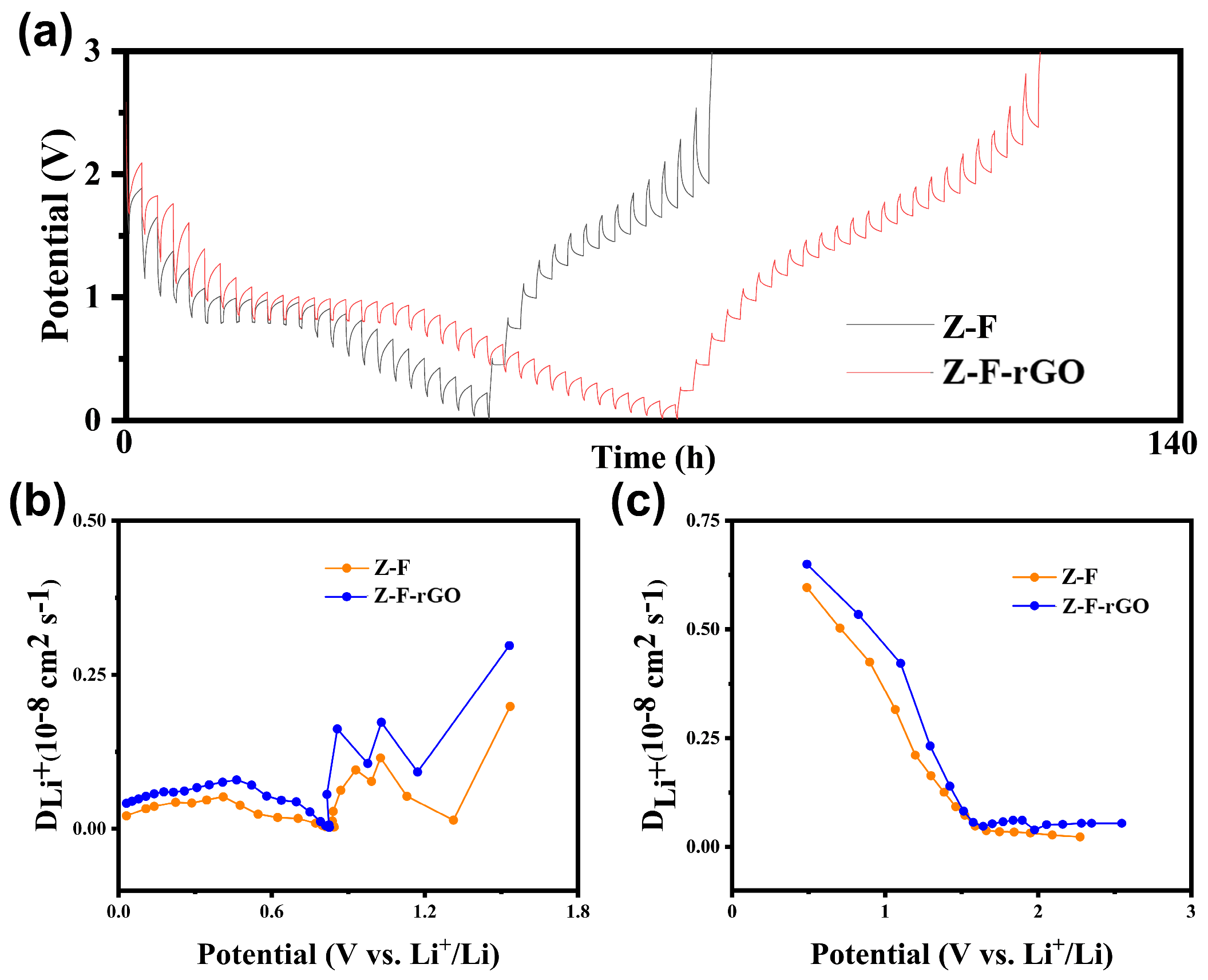
GITT were further employed to clarify the Li+ diffusion kinetics. Both Z-F and ZF-rGO anodes exhibit typical GITT profiles (Figure 10a). During a single GITT step, the electrodes show a potential response under a current pulse (30 min) followed by a relaxation process (120 min). Based on the GITT results, the Li+ diffusion coefficient (DLi+) was calculated (Figure 10b,c). For the Z-F electrode, the calculated DLi+ ranges from 2.07 × 10⁻¹⁰ to 1.9 × 10⁻⁹ cm2 s−1 during discharge, and from 0.22 × 10⁻¹⁰ to 5.9 × 10⁻⁹ cm2 s−1 during charge. For the Z-F-rGO, the Li+ diffusion coefficient ranges from 4.0 × 10⁻¹⁰ to 2.9 × 10⁻⁹ cm2 s−1 during discharge and from 0.54 × 10⁻¹⁰ to 6.4 × 10⁻⁹ cm2 s−1 during charge. The slightly larger DLi+ values of the Z-F-rGO can be attributed to the nanosheet-covered rGO surface, which provides more active adsorption sites for Li+, accelerates interfacial charge-transfer kinetics, and facilitates fast Li+ insertion/extraction reactions.
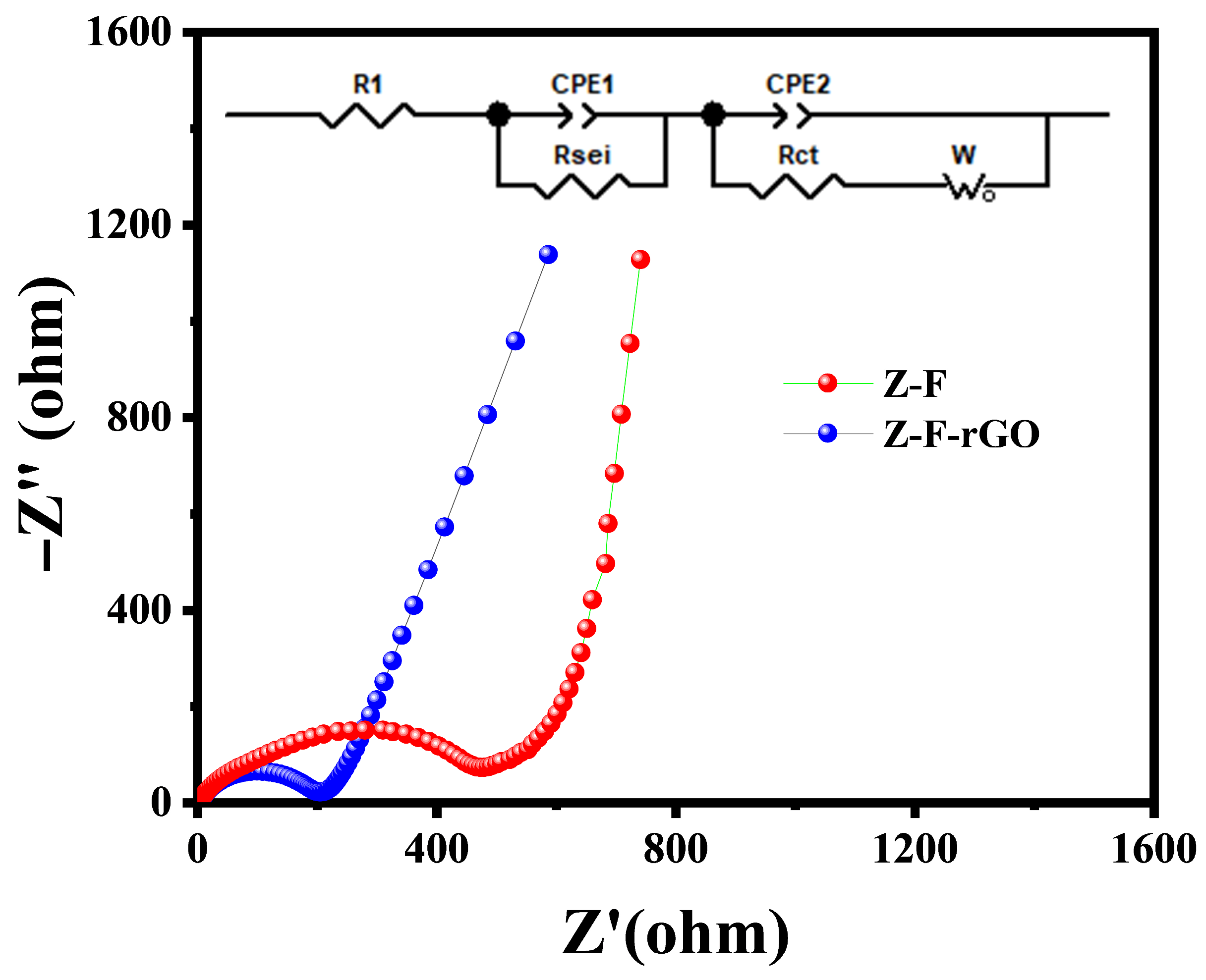
EIS analysis was employed to distinguish the kinetic responses of the two electrodes, with measurements collected across the 0.01 Hz–100 kHz frequency interval. As illustrated in Figure 11, The Nyquist profiles for all samples feature a depressed arc in the high-frequency region and a slanted line in the low-frequency region, corresponding respectively to the resistance for interfacial charge transfer and the diffusion kinetics of lithium ions. An equivalent-circuit model shown in Figure 11 was employed to fit the spectra. In this circuit, R1 represents the ohmic resistance of the cell, Rf is attributed to Li+ transport through the SEI layer, Rct corresponds to the resistance to charge transport at the boundary between the electrode and electrolyte, and W denotes the Warburg diffusion term associated with solid-phase lithium-ion diffusion. CPE1 and CPE2 were further introduced to account for the non-ideal capacitive behavior of the surface film and the interfacial electrochemical process. Notably, the fitted resistance drops from 482.6 Ω for Z-F to 214.8 Ω for Z-F-rGO, providing clear evidence that rGO incorporation decreases interface resistance and improves the overall reaction kinetics of the electrode [66].

4. Discussion

The Z-F-rGO composite demonstrates outstanding electrochemical properties, largely arising from the incorporation of rGO, which effectively reduces the tendency of particles to aggregate of Z-F particles and provides a continuous conductive network. SEM and TEM images (Figure 5 and Figure 6) show that Z-F nanoparticles show a uniform distribution on the rGO surface, forming a well-integrated composite structure, which enhances electron transport and alleviates volume expansion. XPS analysis (Figure 4) further confirms the good bonding between Z-F and rGO without changes in oxidation states. EIS results (Figure 11) show that the Z-F-rGO electrode exhibits significantly lower charge transfer resistance compared to pure Z-F, indicating improved electrochemical kinetics. The Z-F-rGO electrode maintains a reversible capacity of 959.4 mA h g−1 after 300 cycles at 1.0 A g−1, indicating robust cycling endurance and good rate behavior. Accordingly, the Z-F-rGO composite can be regarded as a viable negative-electrode material for the development of future lithium-ion batteries with enhanced performance.

5. Conclusions

In conclusion, a Z-F-rGO composite anode was successfully fabricated by integrating solvothermal synthesis with a post-calcination step. Owing to the homogeneous immobilization of Z-F nanoparticles on conductive rGO sheets, the as-prepared material exhibits enhanced lithium-storage properties and durable cycling stability. The electrode maintains a reversible capacity of 959.4 mA h g−1 at 1.0 A g−1. The improved electrochemical performance is mainly related to the synergistic interaction between the Z-F active phase and the rGO matrix, which not only facilitates Li+ transport and electron conduction, but also provides abundant active interfaces. Meanwhile, the rGO framework helps accommodate higher mass loading and areal capacity, while mitigating parasitic side reactions at the electrode surface. Therefore, this work demonstrates a feasible strategy for constructing anode materials with improved rate capability for LIB applications.

Author Contributions

Methodology, S.L.; software, Y.Z.; validation, A.T.; formal analysis, D.L.; investigation, Q.H.; writing—original draft preparation, S.L. and Y.Z.; writing—review and editing, S.L. and Y.Z.; visualization, Y.Z.; supervision, Q.H.; project administration, Q.H.; funding acquisition, S.L. All authors have read and agreed to the published version of the manuscript.

Funding

This research was supported by Guangxi Natural Science Foundation under Grant No. 2025GXNSFHA069223 and Grant No. 2025GXNSFHA069195, Doctoral foundation of Guangxi University of Science and Technology under Grant No. XKB 22Z11.

Data Availability Statement

The original contributions presented in this study are included in the article. Further inquiries can be directed to the corresponding author.

Acknowledgments

We gratefully recognize the following authors for their contributions to the completion of this study, particularly in securing experimental materials and undertaking the necessary laboratory investigations: Siying Li; Yifei Zhao; Ailin Tian; Dan Li; Qicheng Hu.

Conflicts of Interest

The authors declare no conflicts of interest.

References

  1. Gielen, D.; Boshell, F.; Saygin, D.; Bazilian, M.D.; Wagner, N.; Gorini, R. The role of renewable energy in the global energy transformation. Energy Strategy Rev. 2019, 24, 38–50. [Google Scholar] [CrossRef]
  2. Nitta, N.; Wu, F.; Lee, J.T.; Yushin, G. Li-ion battery materials: Present and future. Mater. Today 2015, 18, 252–264. [Google Scholar] [CrossRef]
  3. Li, Z.; Xiang, Y.; Lu, S.; Dong, B.; Ding, S.; Gao, G. Hierarchical hybrid ZnFe2O4 nanoparticles/reduced graphene oxide composite with long-term and high-rate performance for lithium ion batteries. J. Alloys Compd. 2018, 737, 58–66. [Google Scholar] [CrossRef]
  4. Cabana, J.; Monconduit, L.; Larcher, D.; Palacín, M.R. Beyond Intercalation-Based Li-Ion Batteries: The State of the Art and Challenges of Electrode Materials Reacting Through Conversion Reactions. Adv. Mater. 2010, 22, E170–E192. [Google Scholar] [CrossRef] [PubMed]
  5. Yuan, C.; Wu, H.B.; Xie, Y.; Lou, X.W. Mixed Transition-Metal Oxides: Design, Synthesis, and Energy-Related Applications. Angew. Chem. Int. Ed. 2014, 53, 1488–1504. [Google Scholar] [CrossRef] [PubMed]
  6. Lu, Y.; Yu, L.; Lou, X.W. Nanostructured Conversion-Type Anode Materials for Advanced Lithium-Ion Batteries. Chem 2018, 4, 972–996. [Google Scholar] [CrossRef]
  7. Sharma, Y.; Sharma, N.; Rao, G.V.S.; Chowdari, B.V.R. Li-storage and cyclability of urea combustion derived ZnFe2O4 as anode for Li-ion batteries. Electrochim. Acta 2008, 53, 2380–2385. [Google Scholar] [CrossRef]
  8. Deng, Y.; Zhang, Q.; Tang, S.; Zhang, L.; Deng, S.; Shi, Z.; Chen, G. One-pot synthesis of ZnFe2O4/C hollow spheres as superior anode materials for lithium ion batteries. Chem. Commun. 2011, 47, 6828–6830. [Google Scholar] [CrossRef]
  9. Hwang, H.; Shin, H.; Lee, W.-J. Effects of calcination temperature for rate capability of triple-shelled ZnFe2O4 hollow microspheres for lithium ion battery anodes. Sci. Rep. 2017, 7, 46378. [Google Scholar] [CrossRef]
  10. Lian, P.-J.; Zhao, B.-S.; Zhang, L.-Q.; Xu, N.; Wu, M.-T.; Gao, X.-P. Inorganic sulfide solid electrolytes for all-solid-state lithium secondary batteries. J. Mater. Chem. A 2019, 7, 20540–20557. [Google Scholar] [CrossRef]
  11. Qu, Y.; Zhang, D.; Wang, X.; Qiu, H.; Zhang, T.; Zhang, M.; Tian, G.; Yue, H.; Feng, S.; Chen, G. Porous ZnFe2O4 nanospheres as anode materials for Li-ion battery with high performance. J. Alloys Compd. 2017, 721, 697–704. [Google Scholar] [CrossRef]
  12. Lin, L.; Pan, Q. ZnFe2O4@C/graphene nanocomposites as excellent anode materials for lithium batteries. J. Mater. Chem. A 2015, 3, 1724–1729. [Google Scholar] [CrossRef]
  13. Li, Z.; Cao, J.; Xia, Z.; Zhang, J.; Fan, M.; Wei, D.; Yang, H. Self-assembled ZnFe2O4 hollow spheres/GO hybrid anode with excellent electrochemical performance for lithium-ion batteries. J. Mater. Sci. Mater. Electron. 2019, 31, 1126–1134. [Google Scholar] [CrossRef]
  14. Yao, L.; Su, Q.; Xiao, Y.; Huang, M.; Li, H.; Deng, H.; Du, G. Facial synthesis of carbon-coated ZnFe2O4/graphene and their enhanced lithium storage properties. J. Nanopart. Res. 2017, 19, 261. [Google Scholar] [CrossRef]
  15. Chua, C.K.; Pumera, M. The reduction of graphene oxide with hydrazine: Elucidating its reductive capability based on a reaction-model approach. Chem. Commun. 2016, 52, 72–75. [Google Scholar] [CrossRef]
  16. Stankovich, S.; Dikin, D.A.; Piner, R.D.; Kohlhaas, K.A.; Kleinhammes, A.; Jia, Y.; Wu, Y.; Nguyen, S.T.; Ruoff, R.S. Synthesis of graphene-based nanosheets via chemical reduction of exfoliated graphite oxide. Carbon 2007, 45, 1558–1565. [Google Scholar] [CrossRef]
  17. Tripathi, S.N.; Saini, P.; Gupta, D.; Choudhary, V. Electrical and mechanical properties of PMMA/reduced graphene oxide nanocomposites prepared via in situ polymerization. J. Mater. Sci. 2013, 48, 6223–6232. [Google Scholar] [CrossRef]
  18. Wu, K.; Luo, Y.; Li, Y.; Zhang, C. Synthesis and acetone sensing properties of ZnFe2O4/rGO gas sensors. Beilstein J. Nanotechnol. 2019, 10, 2516–2526. [Google Scholar] [CrossRef] [PubMed]
  19. Naseer, H.; Soomro, S.A.; Gul, I.H. Increased dielectric properties of ZnFe2O4/rGO nanohybrid via thermo-chemical route. J. Aust. Ceram. Soc. 2022, 58, 1265–1274. [Google Scholar] [CrossRef]
  20. Kaftelen-Odabaşi, H. Evaluation of morphological, structural, thermal, electrical, and chemical composition properties of graphene oxide, and reduced graphene oxide obtained by sequential reduction methods. Carbon Trends 2024, 17, 100429. [Google Scholar] [CrossRef]
  21. Holder, C.F.; Schaak, R.E. Tutorial on Powder X-Ray Diffraction for Characterizing Nanoscale Materials. ACS Nano 2019, 13, 7359–7365. [Google Scholar] [CrossRef]
  22. Matli, P.R.; Zhou, X.; Shiyu, D.; Huang, Q. Fabrication, characterization, and magnetic behavior of porous ZnFe2O4 hollow microspheres. Int. Nano Lett. 2014, 5, 53–59. [Google Scholar] [CrossRef]
  23. Shetter, M.V.; Kumar, M.U.; Swetha, R.; Sahana, B.V.; Kuri, R.S.; Anitha, J.; Kumari, L. Calcination temperature dependent structural, optical and dielectric properties of ZnFe2O4 nanomaterials synthesized by hydrothermal method. J. Mater. Sci. Mater. Electron. 2025, 36, 1940. [Google Scholar] [CrossRef]
  24. Jogi, J.K.; Singhal, S.K.; Jangir, R.; Dwivedi, A.; Tanna, A.R.; Singh, R.; Gupta, M.; Sagdeo, P.R. Investigation of the Structural and Optical Properties of Zinc Ferrite Nanoparticles Synthesized via a Green Route. J. Electron. Mater. 2022, 51, 5482–5491. [Google Scholar] [CrossRef]
  25. Li, Q.; Zhang, G.; Qu, Y.; Zheng, Z.; Wang, J.; Zhu, M.; Duan, L. Capacity Contribution Mechanism of rGO for SnO2/rGO Composite as Anode of Lithium-ion Batteries. Chin. J. Mech. Eng. 2022, 35, 63. [Google Scholar] [CrossRef]
  26. Choi, S.H.; Ko, Y.N.; Lee, J.K.; Kang, Y.C. Rapid continuous synthesis of spherical reduced graphene ball-nickel oxide composite for lithium ion batteries. Sci. Rep. 2014, 4, 5786. [Google Scholar] [CrossRef] [PubMed]
  27. Quan, H.; Zeng, W.; Pan, M.; Xu, Y.; Chen, D.; Liang, J. Controlled synthesis of α-Fe2O3@rGO core–shell nanocomposites as anode for lithium ion batteries. J. Mater. Sci. 2020, 56, 664–676. [Google Scholar] [CrossRef]
  28. Sharma, N.; Vyas, R.; Sharma, V.; Rahman, H.; Sharma, S.K.; Sachdev, K. A comparative study on gas-sensing behavior of reduced graphene oxide (rGO) synthesized by chemical and environment-friendly green method. Appl. Nanosci. 2019, 10, 517–528. [Google Scholar] [CrossRef]
  29. Poorali, M.S.; Bagheri-Mohagheghi, M.M. Comparison of chemical and physical reduction methods to prepare layered graphene by graphene oxide: Optimization of the structural properties and tuning of energy band gap. J. Mater. Sci. Mater. Electron. 2015, 27, 260–271. [Google Scholar] [CrossRef]
  30. Kumuda, S.; Gandhi, U.; Mangalanathan, U.; Rajanna, K. Synthesis and characterization of graphene oxide and reduced graphene oxide chemically reduced at different time duration. J. Mater. Sci. Mater. Electron. 2024, 35, 637. [Google Scholar] [CrossRef]
  31. Mhlongo, J.T.; Tlhaole, B.; Linganiso, L.Z.; Motaung, T.E.; Linganiso-Dziike, E.C. Microwave-Assisted Reduction of Graphene Oxide to Reduced Graphene Oxide. Processes 2025, 13, 216. [Google Scholar] [CrossRef]
  32. Sun, Q.; Wu, K.; Zhang, J.; Sheng, J. Construction of ZnFe2O4/rGO composites as selective magnetically recyclable photocatalysts under visible light irradiation. Nanotechnology 2019, 30, 315706. [Google Scholar] [CrossRef]
  33. Zhu, J.; Wang, D.; Chen, D.; Song, B.; Li, Y.; Liu, F.; Chen, J. Ionic liquid assisted multi-heteroatom doping in core-shell ZnFe2O4@rGO with highly reversible lithiation/delithiation kinetics. J. Alloys Compd. 2020, 848, 156593. [Google Scholar] [CrossRef]
  34. Xiao, L.; Schroeder, M.; Kluge, S.; Balducci, A.; Hagemann, U.; Schulz, C.; Wiggers, H. Direct self-assembly of Fe2O3/reduced graphene oxide nanocomposite for high-performance lithium-ion batteries. J. Mater. Chem. A 2015, 3, 11566–11574. [Google Scholar] [CrossRef]
  35. Ghorbani-Choghamarani, A.; Aghavandi, H.; Talebi, S.M. A new copper-supported zinc ferrite as a heterogeneous magnetic nanocatalyst for the synthesis of bis(pyrazolyl)methanes and oxidation of sulfides. Sci. Rep. 2022, 12, 20775. [Google Scholar] [CrossRef]
  36. Yao, J.; Li, Y.; Yan, J.; Jiang, J.; Xiao, S. ZnFe2O4 nanoparticles imbedding in carbon prepared from leaching liquor of jarosite residue as anode material for lithium-ion batteries. Ionics 2020, 26, 4373–4380. [Google Scholar] [CrossRef]
  37. Das, D.; Mitra, A.; Jena, S.; Majumder, S.B.; Basu, R.N. Electrophoretically Deposited ZnFe2O4-Carbon Black Porous Film as a Superior Negative Electrode for Lithium-Ion Battery. ACS Sustain. Chem. Eng. 2018, 6, 17000–17010. [Google Scholar] [CrossRef]
  38. Lu, X.; Xie, A.; Zhang, Y.; Zhong, H.; Xu, X.; Liu, H.; Xie, Q. Three dimensional graphene encapsulated ZnO-ZnFe2O4 composite hollow microspheres with enhanced lithium storage performance. Electrochim. Acta 2017, 249, 79–88. [Google Scholar] [CrossRef]
  39. Thommes, M.; Kaneko, K.; Neimark, A.V.; Olivier, J.P.; Rodriguez-Reinoso, F.; Rouquerol, J.; Sing, K.S.W. Physisorption of gases, with special reference to the evaluation of surface area and pore size distribution (IUPAC Technical Report). Pure Appl. Chem. 2015, 87, 1051–1069. [Google Scholar] [CrossRef]
  40. Li, J.; Ng, D.H.L.; Song, P.; Song, Y.; Kong, C. Bio-inspired synthesis and characterization of mesoporous ZnFe2O4 hollow fibers with enhancement of adsorption capacity for acid dye. J. Ind. Eng. Chem. 2015, 23, 290–298. [Google Scholar] [CrossRef]
  41. Sapna; Budhiraja, N.; Kumar, V.; Singh, S.K. Nanoparticles-assembled ZnFe2O4 mesoporous nanorods for physicochemical and magnetic properties. J. Mater. Sci. Mater. Electron. 2019, 30, 3078–3087. [Google Scholar] [CrossRef]
  42. Wan, B.; Guo, J.; Lai, W.-H.; Wang, Y.-X.; Liu, M.; Liu, H.-K.; Wang, J.-Z.; Chou, S.-L.; Dou, S.-X. Layered mesoporous CoO/reduced graphene oxide with strong interfacial coupling as a high-performance anode for lithium-ion batteries. J. Alloys Compd. 2020, 843, 156050. [Google Scholar] [CrossRef]
  43. Yuan, S.-X.; Yang, M.-H.; Lu, C.-X.; Wang, X.-M. Synthesis of a rGO/NiO composite with a hierarchical porous structure by self-assemblyand its electrochemical performance as a supercapacitor electrode. New Carbon Mater. 2020, 35, 731–738. [Google Scholar] [CrossRef]
  44. Zhang, L.; Wei, T.; Yue, J.; Sheng, L.; Jiang, Z.; Yang, D.; Yuan, L.; Fan, Z. Ultra-small and highly crystallized ZnFe2O4 nanoparticles within double graphene networks for super-long life lithium-ion batteries. J. Mater. Chem. A 2017, 5, 11188–11196. [Google Scholar] [CrossRef]
  45. Yue, H.; Chen, S.; Tie, W.; Wu, L.; Xie, W.; Li, T.; Li, W.; Li, H. Facile synthesis of hierarchical ZnFe2O4 hollow microspheres as high-performance anode for lithium-ion batteries. Ionics 2021, 27, 2835–2845. [Google Scholar] [CrossRef]
  46. Grosvenor, A.P.; Kobe, B.A.; Biesinger, M.C.; McIntyre, N.S. Investigation of multiplet splitting of Fe 2p XPS spectra and bonding in iron compounds. Surf. Interface Anal. 2004, 36, 1564–1574. [Google Scholar] [CrossRef]
  47. Biesinger, M.C.; Payne, B.P.; Grosvenor, A.P.; Lau, L.W.M.; Gerson, A.R.; Smart, R.S.C. Resolving surface chemical states in XPS analysis of first row transition metals, oxides and hydroxides: Cr, Mn, Fe, Co and Ni. Appl. Surf. Sci. 2011, 257, 2717–2730. [Google Scholar] [CrossRef]
  48. Wang, D.H.; Hu, Y.; Zhao, J.J.; Zeng, L.L.; Tao, X.M.; Chen, W. Holey reduced graphene oxide nanosheets for high performance room temperature gas sensing. J. Mater. Chem. A 2014, 2, 17415–17420. [Google Scholar] [CrossRef]
  49. Li, L.; Bi, H.; Gai, S.; He, F.; Gao, P.; Dai, Y.; Zhang, X.; Yang, D.; Zhang, M.; Yang, P. Uniformly Dispersed ZnFe2O4 Nanoparticles on Nitrogen-Modified Graphene for High-Performance Supercapacitor as Electrode. Sci. Rep. 2017, 7, 43116. [Google Scholar] [CrossRef] [PubMed]
  50. Zhu, J.; Ding, Y.; Ma, Z.; Tang, W.; Chen, X.; Lu, Y. Recent Progress on Nanostructured Transition Metal Oxides As Anode Materials for Lithium-Ion Batteries. J. Electron. Mater. 2022, 51, 3391–3417. [Google Scholar] [CrossRef]
  51. Cong, R.; Choi, J.-Y.; Song, J.-B.; Jo, M.; Lee, H.; Lee, C.-S. Characteristics and electrochemical performances of silicon/carbon nanofiber/graphene composite films as anode materials for binder-free lithium-ion batteries. Sci. Rep. 2021, 11, 1283. [Google Scholar] [CrossRef]
  52. Zhao, T.; Zheng, Y.; Meng, Y.; Huang, X.; Chen, S.; Chang, L.; Shen, J. ZnFe2O4 nanoparticles embedded dispersedly inside 3D porous carbon framework as advanced anode materials of Li-ion batteries. J. Alloys Compd. 2022, 913, 165279. [Google Scholar] [CrossRef]
  53. Fang, Z.; Zhang, L.; Qi, H.; Yue, H.; Zhang, T.; Zhao, X.; Chen, G.; Wei, Y.; Wang, C.; Zhang, D. Nanosheet assembled hollow ZnFe2O4 microsphere as anode for lithium-ion batteries. J. Alloys Compd. 2018, 762, 480–487. [Google Scholar] [CrossRef]
  54. Nayeem, F.; Angadi, B.; Mylarappa, M.; Chandruvasan, S. Fabrication of rGO/CeFe2O4 nanohybrid for photodegradation, energy storage, and dopamine detection. Ionics 2025, 32, 2245–2275. [Google Scholar] [CrossRef]
  55. Guo, X.; Lu, X.; Fang, X.; Mao, Y.; Wang, Z.; Chen, L.; Xu, X.; Yang, H.; Liu, Y. Lithium storage in hollow spherical ZnFe2O4 as anode materials for lithium ion batteries. Electrochem. Commun. 2010, 12, 847–850. [Google Scholar] [CrossRef]
  56. Shi, J.; Zhou, X.; Liu, Y.; Su, Q.; Zhang, J.; Du, G. One-pot solvothermal synthesis of ZnFe2O4 nanospheres/graphene composites with improved lithium-storage performance. Mater. Res. Bull. 2015, 65, 204–209. [Google Scholar] [CrossRef]
  57. Yao, L.; Hou, X.; Hu, S.; Tang, X.; Liu, X.; Ru, Q. An excellent performance anode of ZnFe2O4/flake graphite composite for lithium ion battery. J. Alloys Compd. 2014, 585, 398–403. [Google Scholar] [CrossRef]
  58. Jiang, L.; Dong, C.; Jin, B.; Wen, Z.; Jiang, Q. ZnFe2O4@PPy core-shell structure for high-rate lithium-ion storage. J. Electroanal. Chem. 2019, 851, 113442. [Google Scholar] [CrossRef]
  59. NuLi, Y.-N.; Chu, Y.-Q.; Qin, Q.-Z. Nanocrystalline ZnFe2O4 and Ag-Doped ZnFe2O4 Films Used as New Anode Materials for Li-Ion Batteries. J. Electrochem. Soc. 2004, 151, A1077. [Google Scholar] [CrossRef]
  60. Dong, Y.; Xia, Y.; Chui, Y.-S.; Cao, C.; Zapien, J.A. Self-assembled three-dimensional mesoporous ZnFe2O4-graphene composites for lithium ion batteries with significantly enhanced rate capability and cycling stability. J. Power Sources 2015, 275, 769–776. [Google Scholar] [CrossRef]
  61. Alam, M.W.; BaQais, A.; Rahman, M.M.; Aamir, M.; Abuzir, A.; Mushtaq, S.; Amin, M.N.; Khan, M.S. Investigation on In Situ Carbon-Coated ZnFe2O4 as Advanced Anode Material for Li-Ion Batteries. Gels 2022, 8, 305. [Google Scholar] [CrossRef] [PubMed]
  62. Jha, V.; Krishnamurthy, B. Modeling the SEI layer formation and its growth in lithium-ion batteries (LiB) during charge–discharge cycling. Ionics 2022, 28, 3661–3670. [Google Scholar] [CrossRef]
  63. Chang, L.; Liu, D.; Zhou, T.; Hu, M.; Wang, Y.; Ge, S.; He, J.; Li, C.; An, C. The phase-change evolution from surface to bulk of MnO anodes upon cycling. Nanoscale 2020, 12, 20425–20431. [Google Scholar] [CrossRef] [PubMed]
  64. Dorji, G.; Minakshi, M.; Ariga, K.; Shrestha, L.K. Binary transition metal oxides vs. binary metal oxides for electrochemical supercapacitors: Performance, challenges, and future prospects. J. Energy Storage 2026, 147, 120116. [Google Scholar] [CrossRef]
  65. Zhou, J.; Song, H.; Ma, L.; Chen, X. Magnetite/graphene nanosheet composites: Interfacial interaction and its impact on the durable high-rate performance in lithium-ion batteries. RSC Adv. 2011, 1, 782–791. [Google Scholar] [CrossRef]
  66. Lee, T.-Y.; Liu, W.-R. Reduced Graphene Oxide-Wrapped Novel CoIn2S4 Spinel Composite Anode Materials for Li-ion Batteries. Nanomaterials 2022, 12, 4367. [Google Scholar] [CrossRef]
Figure 1. (a) XRD patterns of Z-F-rGO, Z-F, rGO and GO; (b) Raman spectra of Z-F-rGO.
Crystals 16 00251 g001
Figure 2. TGA of Z-F and Z-F-rGO.
Crystals 16 00251 g002
Figure 3. (a) N2-sorption isotherms of Z-F; (b) N2-sorption isotherms of Z-F-rGO; (c) Pore-size distribution of the Z-F; (d) Pore-size distribution of the Z-F-rGO.
Crystals 16 00251 g003
Figure 4. XPS spectra of Z-F-rGO (a) survey spectra; (b) O 1s; (c) Zn 2p; (d) Fe 2p; (e) C 1s.
Crystals 16 00251 g004
Figure 5. SEM images of (ac) Z-F, (df) Z-F-rGO. Elemental mapping of images of (gj) Z-F-rGO.
Crystals 16 00251 g005
Figure 6. (a,b) TEM images of Z-F-rGO (c) HR-TEM (d) SAED pattern of Z-F-rGO.
Crystals 16 00251 g006
Figure 7. CV curves and GCD profiles of Z-F (a,b) and Z-F-rGO at 0.1 A g−1 (c,d).
Crystals 16 00251 g007
Figure 8. (a) Rate performance of Z-F and Z-F-rGO; (b) Comparative cycling performance of Z-F and Z-F-rGO at 0.5 A g−1; (c) tested at 1 A g−1 for 300 cycles.
Crystals 16 00251 g008
Figure 9. (a) CV curves of Z-F-rGO; (b) b value of Z-F-rGO; (c) the contribution of capacitance behavior at 0.8 mV s−1 of Z-F-rGO; (d) the ratio of capacitance behavior at 0.2–1.0 mV s−1 of Z-F-rGO.
Crystals 16 00251 g009
Figure 10. (a) GITT curves of the 1st cycle for Z-F and Z-F-rGO; (b,c) calculated diffusion coefficient of Li+ during the discharge/charge process.
Crystals 16 00251 g010
Figure 11. Nyquist plots and the equivalent circuit model of Z-F and Z-F-rGO.
Crystals 16 00251 g011
Disclaimer/Publisher’s Note: The statements, opinions and data contained in all publications are solely those of the individual author(s) and contributor(s) and not of MDPI and/or the editor(s). MDPI and/or the editor(s) disclaim responsibility for any injury to people or property resulting from any ideas, methods, instructions or products referred to in the content.