Article

Crystal Structure and Temperature-Induced Phase Transitions in the New Copper Vanadate Cs2Cu2[V4O12]Br2


by
Ilya V. Kornyakov
1,2,
Vladimir N. Bocharov
1 and
Sergey V. Krivovichev
1,2,*
1
Department of Crystallography, Institute of Earth Sciences, Saint-Petersburg State University, University Embankment 7/9, 199034 St. Petersburg, Russia
2
Nanomaterials Research Centre, Kola Science Centre, Russian Academy of Sciences, Fersmana 14, 184209 Apatity, Russia
*
Author to whom correspondence should be addressed.
Crystals 2026, 16(4), 252; https://doi.org/10.3390/cryst16040252
Submission received: 20 March 2026 / Revised: 7 April 2026 / Accepted: 9 April 2026 / Published: 10 April 2026
(This article belongs to the Special Issue Electronic Phenomena of Transition Metal Oxides Volume II)

Abstract

The new compound Cs2Cu2[V4O12]Br2 was synthesized by the chemical vapor transport reaction method. Structural data obtained by single-crystal X-ray diffraction in the temperature range 100–700 K revealed three successive (with decreasing temperature) structural phase transitions: from the high-temperature aristotype structure I4/mmm (>550 K) to the polymorph P4/mnc (550–340 K), then to P4/m (340–300 K), and finally to the low-temperature phase I4/m (<300 K). The crystal structure of the new compound is based upon the Cu2[V4O12]0 layers, consisting of four-membered rings of corner-sharing vanadate tetrahedra linked by CuO4 squares. Analysis of the structural evolution with increasing temperature shows that the entire sequence of phase transitions is governed by the rotation of the [V4O12]4− rings about the z axis.

1. Introduction

In recent decades, there has been a significant increase in interest in inorganic oxide materials driven by challenges associated with the development of renewable energy sources for energy-efficient technologies. Hydrogen is often considered one such renewable energy carrier; however, its production is currently a relatively inefficient and costly process [1,2]. At present, one of the most promising approaches to hydrogen production is the photoelectrochemical water splitting process [3], which can be realized using semiconducting materials [4].
In recent years, ternary oxides based on copper and vanadium have attracted sustained attention as materials with promising electronic and optical properties. This interest stems from the fact that the combination of a relatively narrow band gap, chemical stability, and compositional variability makes copper vanadates a convenient platform for the targeted search for new functional materials [5,6].
In particular, copper pyrovanadate Cu2V2O7 has been extensively investigated [7,8,9,10,11,12,13,14], more precisely its three polymorphic modifications: the α-modification (mineral analog blossite) [15], the β-modification (ziesite) [16,17], and the γ-modification [18]. The synthetic analogue of the mineral stoiberite, Cu5V2O10, has also been considered as a promising semiconductor [19]; depending on crystal morphology and synthesis conditions, it may exhibit either n-type or p-type conductivity [20,21]. Considerable attention has also been paid to the photochemical activity of Cu11V6O26 (fingerite) [22] and Cu3V2O8, as well as to the effect of molybdenum and tungsten doping on the resulting photocurrent density [23,24,25,26,27]. CuV2O6 has also been reported to exhibit good chemical stability, albeit with relatively low photocurrent densities [28,29,30,31].
Despite the intensive research on mixed vanadium oxides, most well-studied systems are limited to a rather narrow set of stoichiometries and structure types. In particular, studies of copper vanadates have traditionally focused on a few well-known phases only, whereas the composition–structure landscape of this family is far from being fully explored. For example, we recently synthesized a fourth polymorph, the δ-modification of Cu2V2O7; however, it has not yet been investigated with respect to its photoelectrochemical properties due to the difficulties associated with its synthesis [32]. It should be noted that this modification was obtained during an investigation of the CuO–V2O5–KCl system using the chemical vapor transport reaction method. In this regard, extending the potential search space for new copper vanadates by increasing the complexity of the initial system appears to be of particular interest.
In the present work, we report a crystal chemical study of a new Cs-Br-containing copper vanadate, Cs2Cu2[V4O12]Br2. Similarly to δ-Cu2V2O7 [32], the new compound was synthesized by the chemical vapor transport reaction method in the CuO–V2O5–CsBr system. The crystal structure is unprecedented among copper–vanadium compounds and can be described as consisting of Cu2[V4O12] layers, in which four-membered rings of corner-sharing (VO4) tetrahedra are linked via CuO4 squares. A distinctive feature of the new compound is a series of structural phase transitions which, upon heating, initially leads to a decrease in symmetry (I4/mP4/m) followed by a successive increase in symmetry (P4/mP4/mncI4/mmm).

2. Materials and Methods

2.1. Synthesis

Single crystals of the new compound Cs2Cu2[V4O12]Br2 were obtained by the chemical vapor transport reaction method under vacuum conditions. Copper oxide, CuO (99%, Vekton, Penfield, NY, USA); vanadium(V) oxide, V2O5 (99%, Sigma-Aldrich, Saint Louis, MO, USA); and cesium bromide, CsBr (99%, Sigma-Aldrich) were mixed in a 1:1:1 ratio and homogenized in an agate mortar. The resulting mixture was placed into a quartz ampoule (diameter 4 mm, wall thickness 2 mm, length 15 cm), which was then sealed while simultaneously evacuating the air to obtain a low vacuum (~10−3 mbar). The ampoule was placed horizontally in a cylindrical furnace programmed as follows: heating to 550 °C within 2 h, holding for 72 h, and cooling to 200 °C over 12 h, followed by switching off the furnace. A temperature gradient of approximately 50 °C was established in the cylindrical furnace to ensure gas transport. After the thermal treatment, the ampoule contained crystals both in the source zone and in the central part of the ampoule. The entire product was removed from the ampoule, washed in an ultrasonic bath, and thoroughly dried under vacuum. The obtained sample consisted of three main phases: large black hexagonal crystals of the synthetic averievite analog, [CsBr]Cu5O2(VO4)2 [33], reaching up to 0.5 mm across; orange plate-like crystals of CsV3O8 [34]; and crystals of a new phase, Cs2Cu2[V4O12]Br2. The crystals of the new compound do not exhibit a well-defined crystal habit and, depending on their thickness, range in color from reddish dark brown in thin plates to nearly pitch-black in larger crystals, beginning from a thickness of approximately 50 μm. Crystals of various sizes can be found in the sample, from plates about 10 μm thick to large crystals up to 0.5 mm across.

2.2. Single-Crystal X-Ray Diffraction Study

X-ray diffraction studies were carried out on a Rigaku XtaLAB Synergy-S diffractometer (Rigaku, Tokyo, Japan) equipped with a monochromatic microfocus MoKα radiation source PhotonJet-S (λ = 0.71073 Å), operating at 50 kV and 1.0 mA, and a hybrid photon-counting detector HyPix 6000HE. Data integration, as well as the correction for the polarization and Lorentz effects, were performed using the CrysAlisPro software package [35]. A numerical absorption correction based on a reconstructed crystal model was applied. The crystal structure was solved using the dual-space method implemented in SHELXT [36] and refined by full-matrix least-squares on F2 using SHELXL [37], both integrated in the OLEX2 software environment [38]. Crystallographic data, data-collection conditions, and refinement parameters for selected representative datasets of the Cs2Cu2[V4O12]Br2 structure are presented in Table 1. Fractional atomic coordinates as well as equivalent and anisotropic displacement parameters for the selected datasets can be found in Table A1.
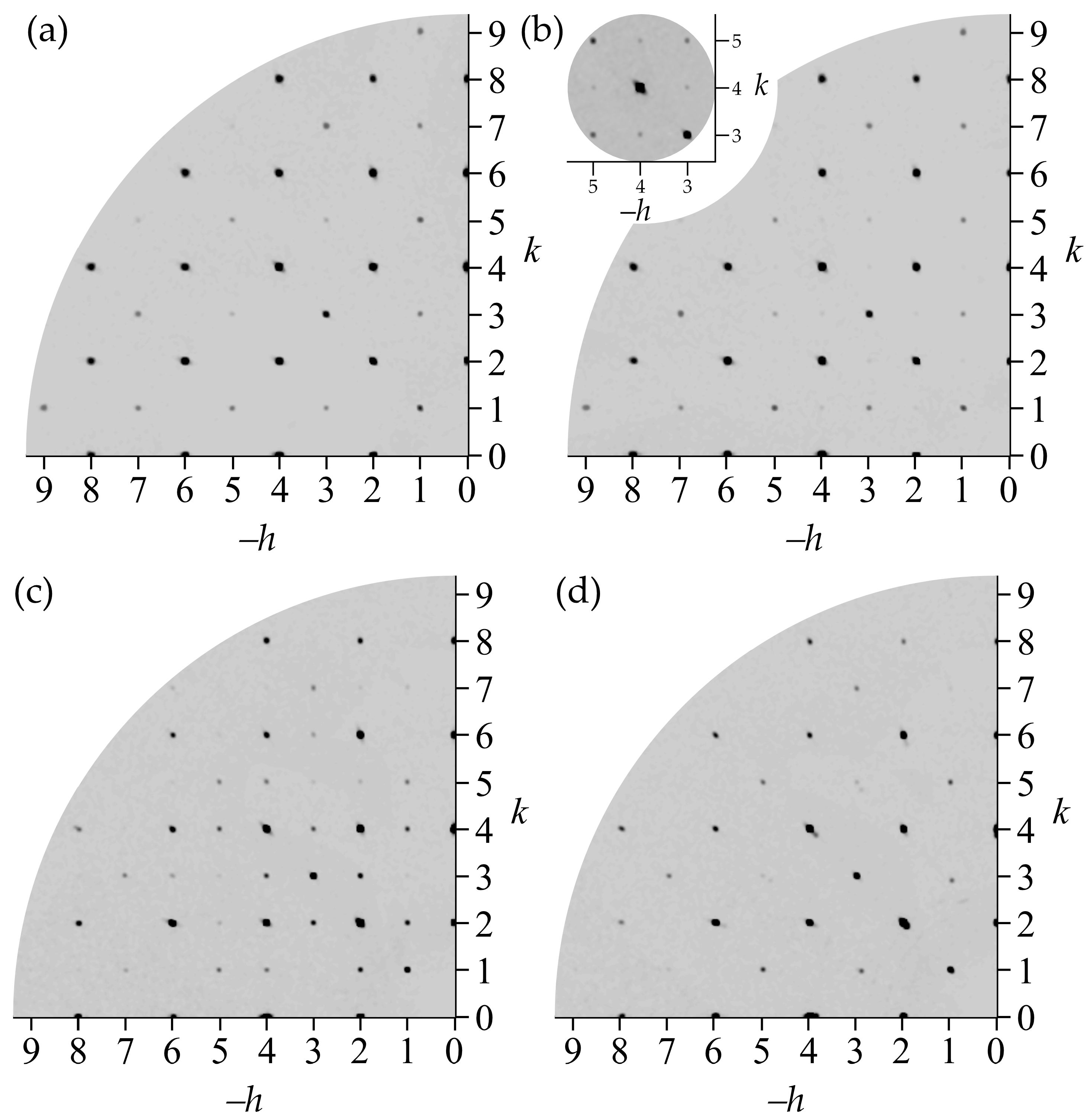
To investigate potential phase transitions, X-ray diffraction studies were carried out at different temperatures. Initial measurements at room temperature allowed the structure to be successfully solved in the space group P4/mnc (No. 128). Upon cooling, reflections with h + k + l = 2n + 1 exhibited a pronounced decrease in intensity and were no longer detectable already at 273 K (Figure 1a). To examine the lattice evolution in greater detail, X-ray diffraction measurements were performed using an Oxford Cobra low-temperature system in the temperature range 100–380 K with a step of 20 K. For this purpose, a preselected crystal was mounted on a thin quartz fiber using epoxy resin. The experimental strategy was designed to provide coverage of one half of the Ewald sphere with a redundancy of 5 and sinθ/λ ≈ 0.9. Data collection consisted of 14 ω-scans with an angular step of 0.5°, an exposure time of 5 s per frame, and a total of 2196 frames. The entire X-ray diffraction experiment was carried out sequentially, and the crystal maintained the same orientation throughout the experiment. Before each data collection, the crystal was equilibrated at the target temperature for 5 min.
Additional diffraction data were collected in a similar manner in the temperature range 350–700 K with a step of 50 K; however, high-temperature measurements have specific experimental considerations, which we described in detail in [39]. The crystal was mounted inside a quartz capillary and supported by a quartz fiber. The sample temperature was controlled using an FMB Oxford Small Hot Air Gas Blower heating system. The calculated experimental strategy consisted of 18 ω-scans with a step of 0.5°, an exposure time of 1 s per frame, and a total of 2128 frames. Prior to each data collection, the crystal was equilibrated at the target temperature for 5 min. At 650 K, the sample begins to lose crystallinity, as indicated by the absence of reflections at angles 2θ > 25°, as well as by a general decrease in the intensity of the observed reflections. At 700 K, reflections appear which, upon indexing, allow the unit cell of ziesite, β-Cu2V2O7, to be identified with a high degree of confidence. This most likely indicates incongruent melting of the compound occurring between 650 and 700 K.

2.3. Raman Spectroscopy

Raman spectroscopy studies on Cs2Cu2[V4O12]Br2 were carried out using a Horiba Jobin-Yvon LabRam HR800 Raman spectrometer (Horiba Ltd, Lyon, France) equipped with a solid-state laser (λ = 532 nm) and a 50× objective. A preselected crystal was oriented with the (001) plane normal to the incident laser beam and mounted in a Linkam THMS600 temperature-controlled stage. The spectra were recorded in the 200–1400 cm−1 range at 173 K and 292 K, with a spectral resolution of 2 cm−1. The obtained data were processed using the OriginPro 2018 software package [40]. Spectral deconvolution was performed using Lorentzian peak profiles, and the final fitted spectra reproduced the experimental data with a coefficient of determination of R2 > 0.99.
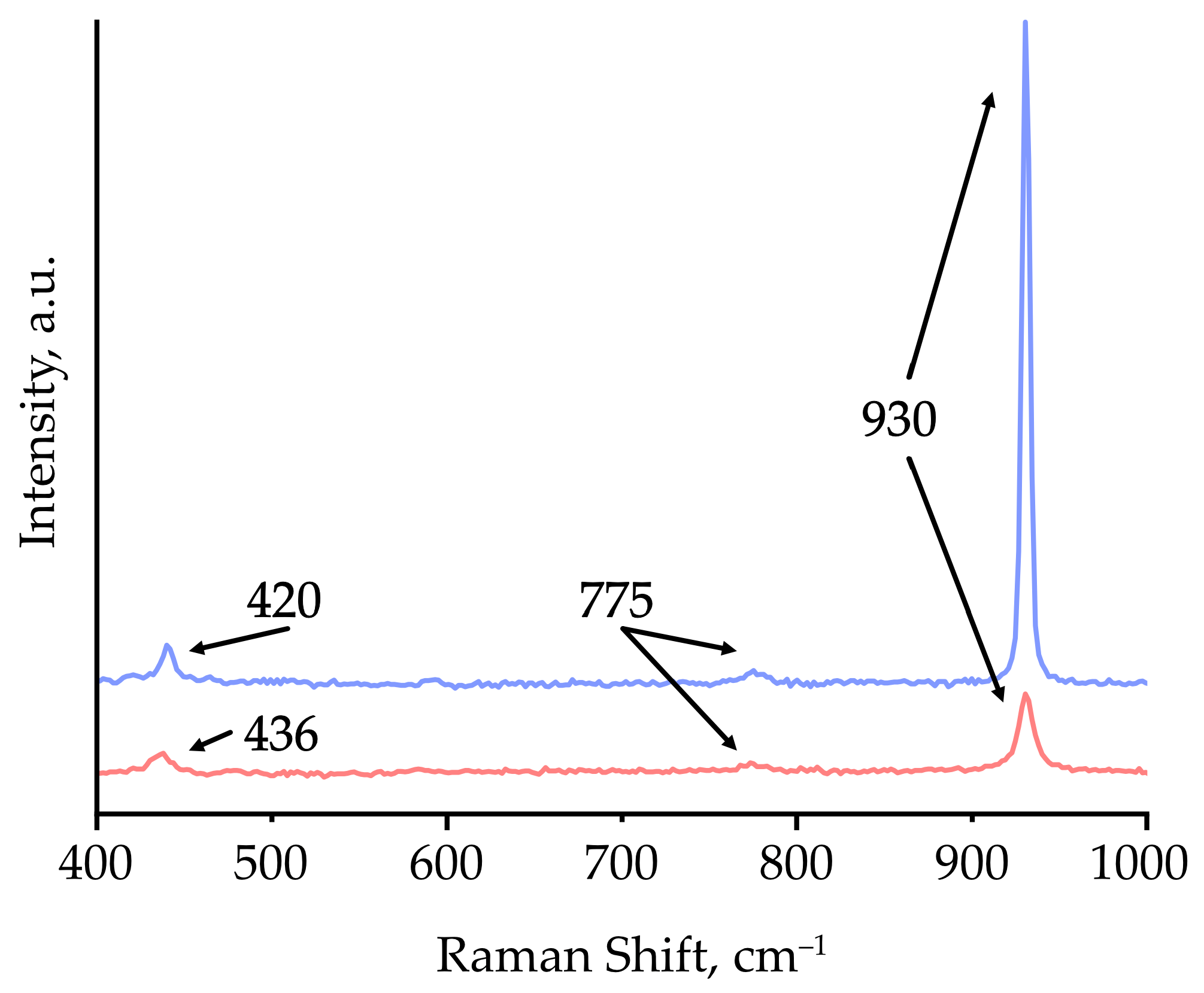
The obtained Raman spectra are presented in Figure 2. In total, three vibrational bands are observed: bands at 930 and 775 cm−1, as well as a third band located at 420 cm−1 at low temperature and at 436 cm−1 at room temperature. The observed bands, according to data in the literature, correspond to various vibrational modes of the (VO4)3− tetrahedron [41,42,43,44]. The most intense band, located at 930 cm−1, is assigned to the symmetric stretching vibration of the V=O bond, whereas the band at 775 cm−1 corresponds to the asymmetric stretching vibration. No unambiguous assignment of the band near 428 cm−1 has been reported in the literature. The closest identified bands occur in the 460–500 cm−1 range and are attributed either to the symmetric stretching of bridging V–O–V bonds or to bending modes of the tetrahedron.

3. Results

3.1. Structural Phase Transitions

Diffraction data collected in the temperature range 100–280 K clearly indicate a body-centered unit cell (Figure 1a), a relatively high internal agreement factor (Rint > 6.5%), and no clear preference between centrosymmetric and non-centrosymmetric space groups (⟨|E2 − 1|⟩ ≈ 0.85). The crystal structure can be successfully solved in the space group I4/mmm (No. 139); however, the resulting refinement is unsatisfactory, yielding relatively high agreement factors (R1 > 9%) and significant residual electron-density peaks (ρmax > 4 e·Å−3). All these features may indicate either an incorrect choice of the unit cell (for example, due to a reduction in symmetry to orthorhombic with ab) or an incorrect choice of the space group. After testing several alternative solutions for the crystal structure, the best refinement results were obtained in the space group I4/m (No. 87) with the introduction of a twin law corresponding to a twofold axis along [110] ([010/100/00 1 ¯ ]), indicating a merohedral twinning. The final agreement factors confirm the correctness of the selected space group (Table 1).
A similar problem accompanies the structure solution in the temperature range 300–320 K. At 300 K, the first reflections violating the systematic absences for the body-centered cell appear (Figure 1b), indicating a structural transition to a primitive cell. Attempts to solve the structure in the original space group P4/mnc led to relatively high agreement factors (R1 = 8.5 and 5.1% at 300 and 320 K, respectively). Considering the non-classical nature of the transition from higher to lower symmetry upon heating, and the point group 4/m observed at low temperatures, a logical solution is the refinement in the space group P4/m (No. 83). With this choice, the R1 values decrease to 2.2 and 2.5% at 300 and 320 K, respectively, with the simultaneous introduction of a twin law analogous to that described above. This choice of space group is further supported by the refined twin fractions of 0.41/0.59 and 0.43/0.57 at 300 and 320 K, respectively. Upon further heating, the intensity of reflections with h + k + l = 2n + 1 gradually increases (Figure 1c), and the crystal structure can be successfully solved in the space group P4/mnc without the need to lower the symmetry (R1 = 2.3% at 340 K).
Up to a temperature of 600 K, the structure does not exhibit any signs of phase transitions. However, at 600 K, reflections with h + k + l = 2n + 1 disappear (Figure 1d), which indicates the reappearance of a body-centered lattice. In this case, however, the crystal structure can be successfully solved in the space group I4/mmm (R1 = 2.8%) without the need for symmetry lowering.
It should also be noted that after completing the heating experiment in the temperature range 100–380 K, a subsequent cooling experiment was carried out over the same temperature interval. During the structure solution of the collected datasets, the P4/m phase was not observed, and the structure could be successfully solved down to 300 K in the space group P4/mnc. However, in contrast to the heating experiments, weak reflections indicating a primitive unit cell still exist down to 280 K. At this temperature, the structure cannot be satisfactorily refined in P4/mnc (R1 = 9.5%) but refines well in P4/m (R1 = 2.7%; twin fraction = 0.43:0.57), reflecting the presence of a hysteresis loop.
Thus, within the scope of the present study, four polymorphs of the compound Cs2Cu2[V4O12]Br2 have been identified, each stable within a different temperature range. According to the nomenclature of structural phase transitions adopted by the International Union of Crystallography [45], the following designations are used in this work for the identified polymorphs:
I | >~550 K | I4/mmm (139) | Decomposes above ~650 K.
II | ~550–340 K | P4/mnc (128) | Non-ferroic.
III | ~340–300 K | P4/m (83) | Ferroic | The transition is accompanied by the formation of ferroic domains and a gradual evolution of the domain fractions.
IV | ~<300 K | I4/m (87) | Non-ferroic.

3.2. Thermal-Expansion Description

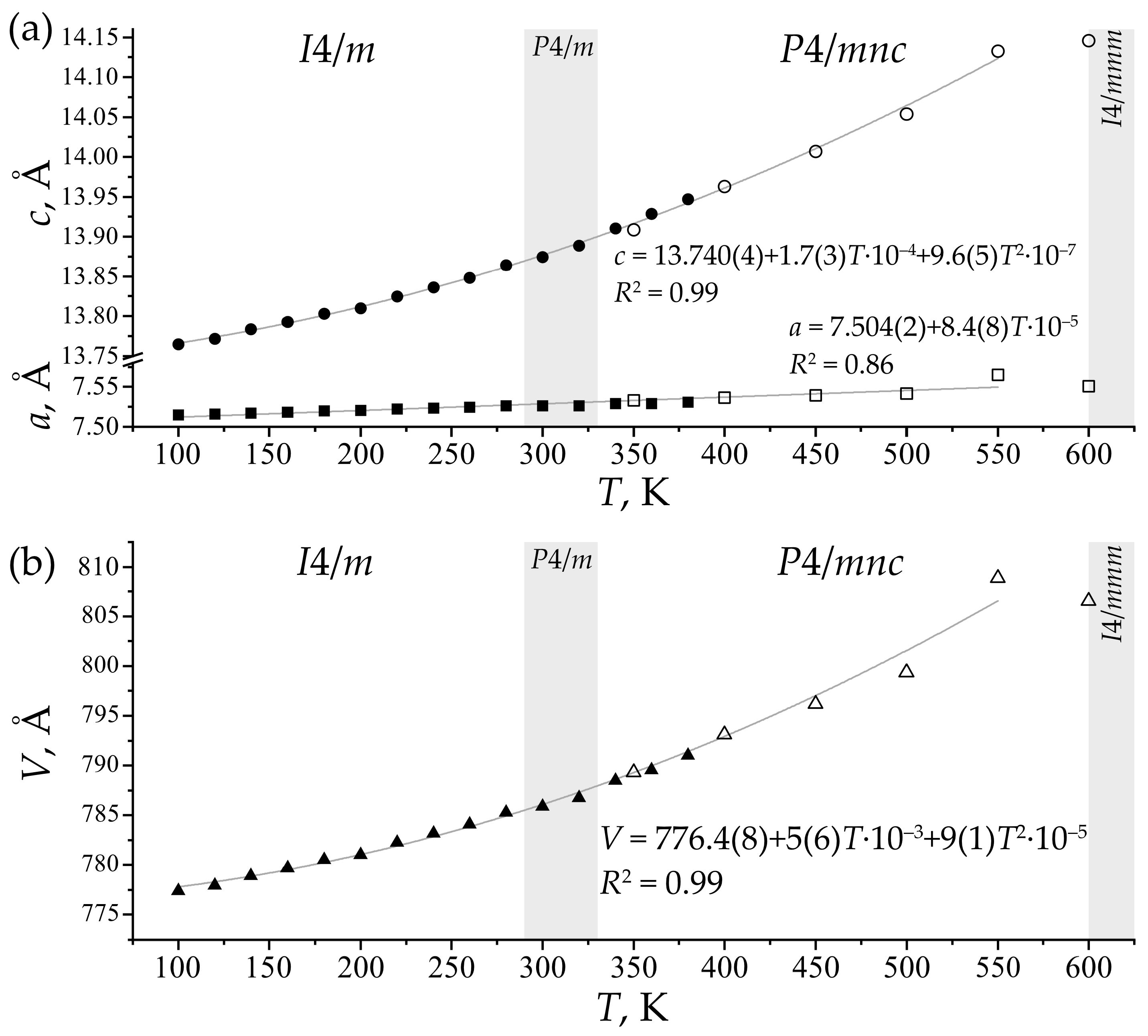
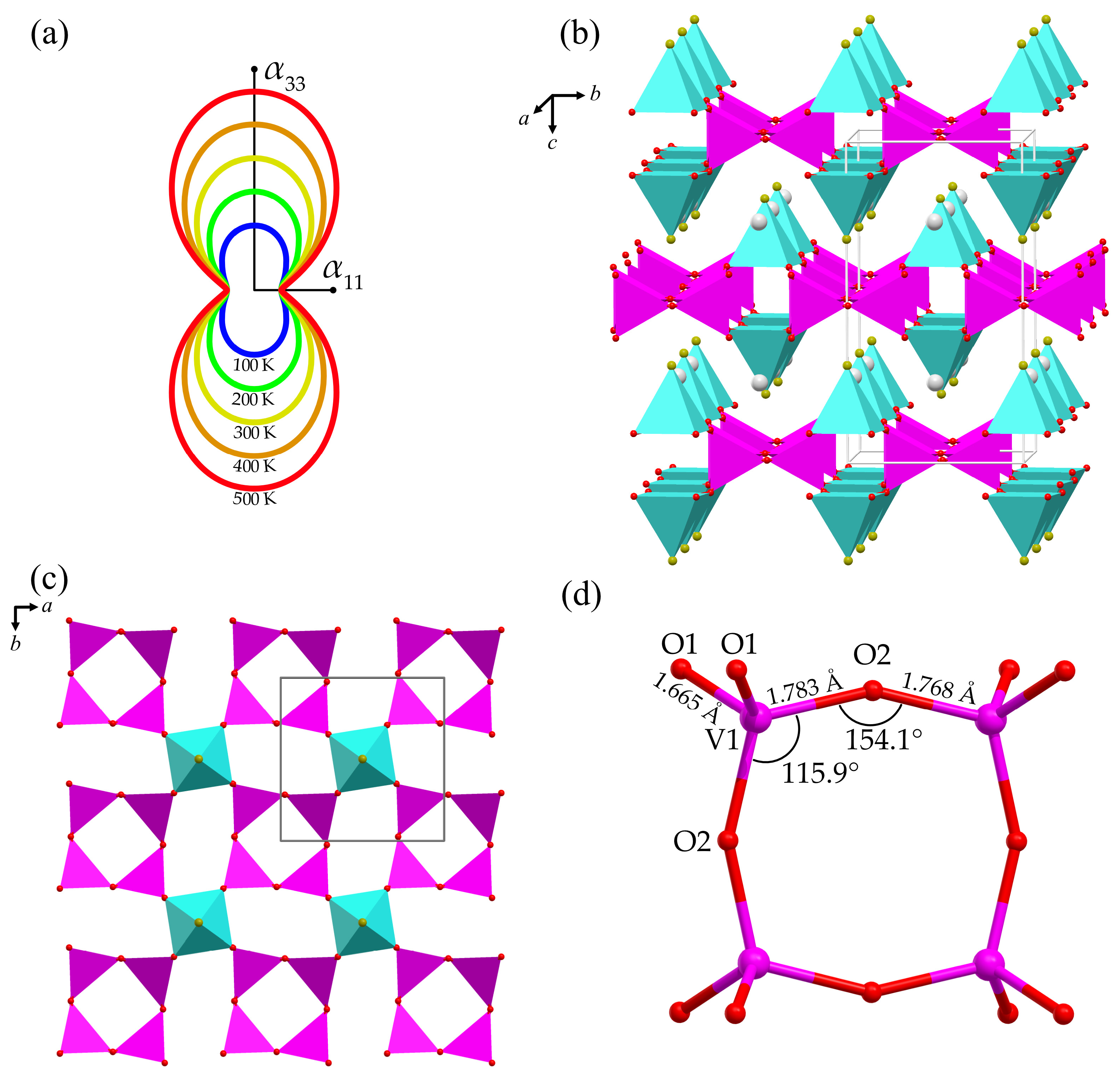
The unit-cell parameters gradually increase upon heating (Figure 3). Unfortunately, due to the different thermal treatment conditions applied to the two investigated crystals, the unit-cell parameters obtained from the two diffraction datasets in the two temperature ranges show a systematic offset. In particular, while the c parameter and the unit-cell volume V follow essentially the same trend (R2 = 0.99 in the range 100–550 K), the a parameter deviates considerably and shows systematically larger values in the high-temperature dataset compared with the low-temperature one (R2 = 0.86). Nevertheless, it is more convenient to describe the thermal expansion over the entire temperature range, since the number of high-temperature data points alone is insufficient to obtain reliable thermal-expansion parameters. Thus, the thermal expansion within the (001) plane is α11 = 11.1(1) × 10−6 K−1, whereas the expansion α33 along [001] increases smoothly from 26(1) × 10−6 K−1 at 100 K to 87(2) × 10−6 K−1 at 550 K (Figure 4a). The volume thermal-expansion coefficient also increases, lying in the range 45(5)–109(6) × 10−6 K−1.

3.3. Crystal Structure Description

The principal structural unit of Cs2Cu2[V4O12]Br2 (Figure 4b) is an electroneutral layer {Cu2[V4O12]}0 (Figure 4c), composed of four-membered rings of corner-sharing (VO4)3− tetrahedra (Figure 4d) linked via CuO4 squares. Each tetrahedron is formed by two symmetry-equivalent short V1–O1 bonds (1.66 Å at 100 K) and two longer nonequivalent V1–O2 bonds (1.77 and 1.78 Å). The tetrahedra are connected into four-membered rings through the V1–O2 bonds, with the O2–V1–O2 and V1–O2–V1 angles at 100 K equal to 115.9° and 154.1°, respectively. The remaining bond angles within the tetrahedron fall in the range 107.7–108.5°. Each of the tetrahedra shares two edges with Cu atoms, thereby forming square-planar CuO4 units (Cu–O = 1.95 Å). The CuO4 squares are complemented by additional Br atoms to form CuO4Br tetragonal pyramids with the apical Cu–Br bonds (2.53 Å) oriented along the fourfold axis. In the interlayer space, within a pseudo-tetrahedral void formed by four CuO4Br pyramids, resides the Cs1 atom. This atom forms four Cs1–Br1 bonds (3.83 Å), four shorter Cs1–O1 bonds (3.24 Å), and four longer Cs1–O2 bonds (3.82 Å).
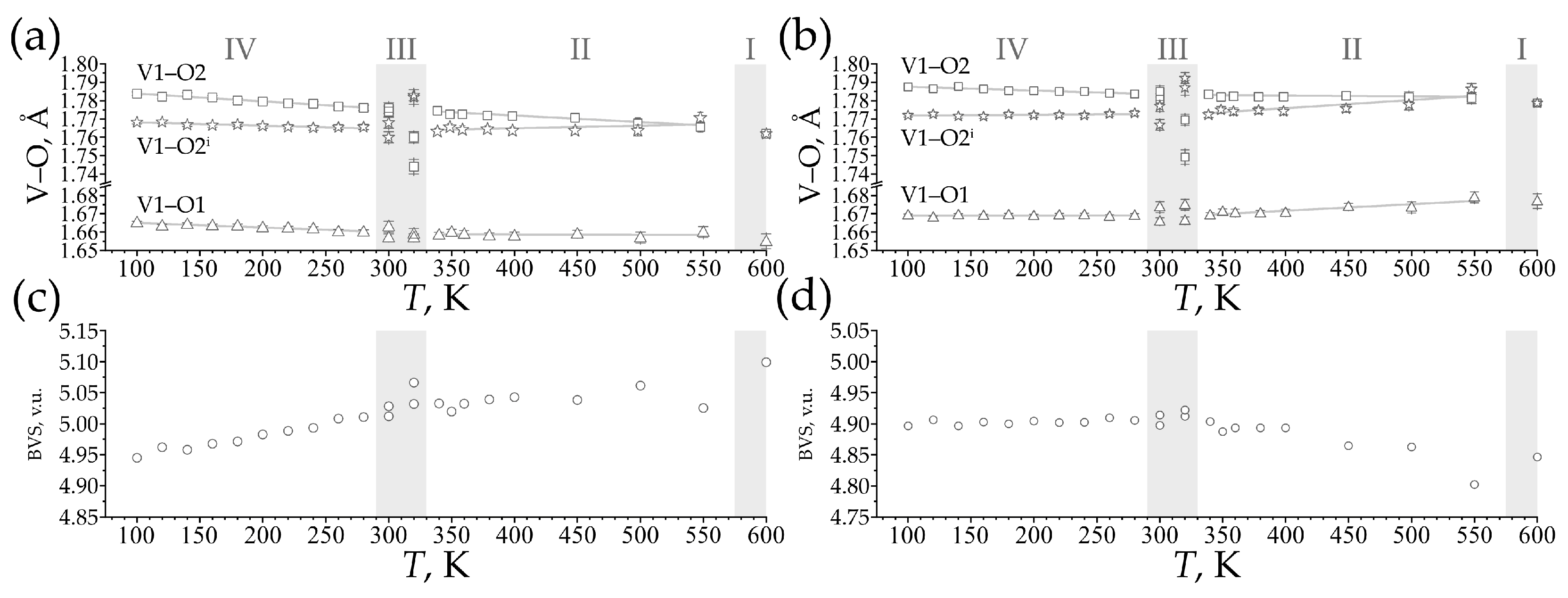
Figure 5a illustrates the evolution of the observed V–O bond lengths in the vanadate tetrahedra with increasing temperature. As can be seen, in the temperature range 100–280 K the overall trend shows a decrease in bond lengths, as reflected by the linear fits presented in Table 2. After the first structural transition from polymorph IV to III, the number of nonequivalent positions doubles, which is accompanied by an increase in the number of distinct bonds. At the same time, significant deviations of the bond lengths from the trends observed in polymorphs IV and II are also observed. The trend toward decreasing bond lengths continues in the 340–550 K range, although it becomes less pronounced. In particular, the V1–O1 and V1–O2 bonds can be regarded as essentially unchanged, whereas the V1–O2i (symmetry-related) bond length continues to decrease. At T = 600 K, the V1–O2 and V1–O2i bonds (1.762 Å) become symmetry-related (due to the transition to polymorph I), reflecting their overall tendency to converge in the temperature range 340–550 K. It should be noted that the V1–O2 bond length in the high-temperature aristotype differs from the value that could be estimated as the average of the V1–O2 and V1–O2i bond lengths in polymorph II (1.768 Å). Another important observation is that as the bond lengths decrease, the bond-valence sum (BVS) at the V1 atom gradually increases (Figure 5c). Thus, with the exception of two outliers at 320 K and 550 K, the BVS increases continuously from 4.95 to 5.10 valence units (v.u.).
The V–O bond lengths discussed above appear inconsistent with the expected thermal behavior of bond lengths. This apparently anomalous effect can be successfully explained, described, and corrected using the rigid-body motion theory, which accounts for thermal vibrations of rigid polyhedral units and enables the calculation of corrected bond lengths using the TLS (translation–libration–screw) formalism. The application of this method is associated with certain complications (see [39] and references therein for details). A simpler approach is to calculate corrected bond lengths using a ‘simple rigid-body motion correction’, first proposed in [46], which can be expressed by the following formula:
R corr = R obs 2 + 3 U anion U cation ,
where Rcorr is the corrected bond length, Robs is the observed bond length, and Uanion and Ucation are the equivalent mean-square displacement parameters of the anion and cation forming the bond, respectively. Bond lengths corrected in this way exhibit significantly more realistic temperature trends (Figure 5b). In the temperature range 100–280 K, only one bond shows a clear shortening (V1–O2), whereas the remaining two bonds remain essentially unchanged. With a further temperature increase in the range 340–550 K, the V1–O1 and V1–O2 bonds display a clear tendency toward expansion, while the V1–O2i bond remains nearly constant. The corrected V1–O2 bond length in the aristotype is 1.779 Å, which is very close to the average value calculated from all corrected V1–O2 bond lengths in the 340–550 K temperature range (1.780 Å). An additional indication that the correction is physically meaningful is provided by the trend in the bond-valence sums at the vanadium atom: the valence remains essentially unchanged in the range 100–400 K, averaging 4.9 v.u. without significant deviations (Figure 5d). Significant deviations begin to appear above 450 K, which can be attributed to the increasing contribution of rigid-body motion components not accounted for by the simplified correction formula. Nevertheless, with the exception of the 550 K dataset, the deviation does not exceed 0.05 v.u.
The crystal structure of Cs2Cu2[V4O12]Br2 is based on {Cu2[V4O12]}0 layers arranged parallel to the (001) plane. Two such layers are present within the unit cell, and each successive layer is shifted by half a translation along the [110] direction. As a result, each bromine atom is located above the center of a [V4O12]4− ring, with the closest V1···Br1 distance of 3.65 Å at 100 K.
Regardless of temperature, the [CsCuBr]2 sublattice remains stable and consistent with the aristotype structure I4/mmm. In all polymorphs, the cesium atom occupies the Wyckoff position 4d, except for polymorph III, where it is located at the 4i site. Nevertheless, the coordinates of Cs1 in this polymorph still correspond essentially to the higher symmetry. The only slight deviation is observed at 320 K, where zCs = 0.74994(4), i.e., the deviation from the symmetry-constrained value is ΔzCs = 0.00006(4), which is negligible and lies within 3σ. A similar description applies to the Cu and Br atoms, which occupy the 4e position in all polymorphs except III, where they split into two sets of positions, 2h and 2g, respectively. Unlike the cesium atom, whose position is rigidly fixed by symmetry and thus has zero degrees of freedom, the Cu and Br positions possess one degree of freedom along the z coordinate in all polymorphs. This allows a direct assessment of the symmetry relation between the 2h and 2g positions. Relative to the aristotype structure, the coordinates of these positions in polymorph III should deviate from the symmetry-constrained values z and 3/2 − z. Calculating the differences in the z coordinates gives the following values: at 300 K, ΔzCu = 0.00001(7) and ΔzBr = 0.00009(6); at 320 K, ΔzCu = 0.00003(6) and ΔzBr = 0.00013(6). Therefore, it can be concluded that the deviations of the [CsCuBr]2 sublattice from the symmetry of the aristotype are negligible. The only noticeable deviations are observed for the Br atom, although even these displacements remain within 3σ and are therefore statistically insignificant.
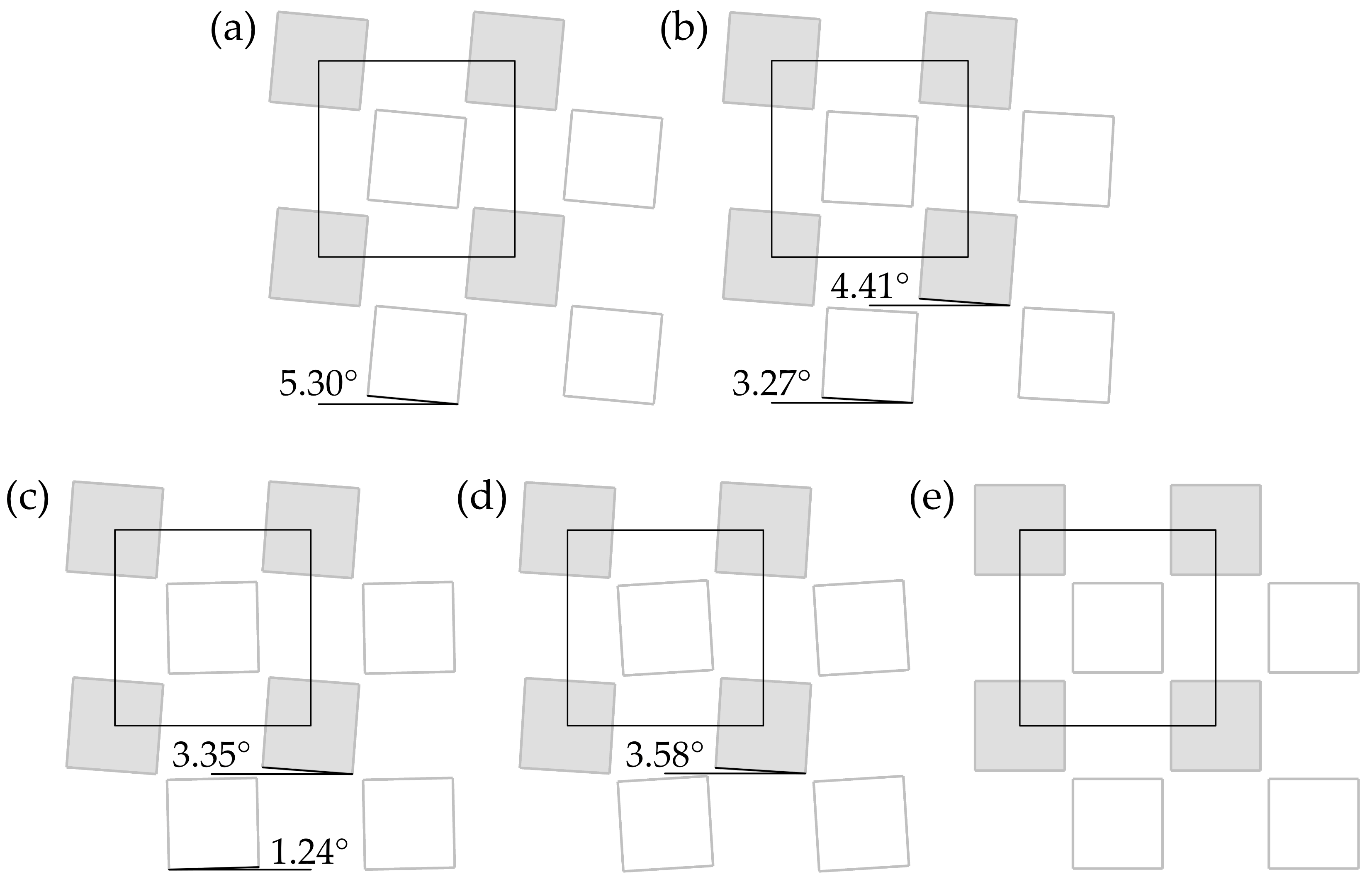
Thus, the dynamics of the crystal lattice and the structural phase transitions of Cs2Cu2[V4O12]Br2 are governed by the behavior of the four-membered [V4O12]4− rings. Indeed, the mutual orientations of these rings change significantly during the structural transitions, which is manifested by their rotation about the z axis. The rotation angle may be defined as the angle between the shortest V···V vector in the ring and the (100) plane. In polymorph IV, all rings are rotated around the z axis by 5.30° in the same direction at 100 K (Figure 6a). With increasing temperature, the rotation angle gradually decreases, reaching 4.10° at 280 K. The structural transition to polymorph III is accompanied by the reorientation of the rings in adjacent layers. At 300 K, the rotation angle decreases to 3.27° in the hk0 layer, whereas in the hk0.5 layer it increases to 4.41° (Figure 6b). At 320 K, the corresponding values are 1.24° and 3.35°, respectively (Figure 6c). In polymorph II, the rings in neighboring layers rotate in opposite directions, with a rotation angle of 3.58° at 340 K (Figure 6d). With further temperature increase, this angle gradually decreases to 1.35° at 550 K. Upon the structural transition to the aristotype, the rings become aligned with the crystallographic axes (Figure 6e), and the structure attains its highest symmetry.

4. Discussion

The new compound Cs2Cu2[V4O12]Br2 does not introduce a fundamentally new structural motif in the crystal chemistry of vanadate compounds. For example, the compound Cs2(VO)[V4O12] is known [47] that exhibits a very similar crystal chemical arrangement. In its crystal structure, the [V4O12]4− rings are linked into layers by vanadyl (VO)2+ ions, which form [1+4]-compressed tetragonal pyramids. However, the VO5 pyramids are located exclusively on one side of the layer plane, resulting in the non-centrosymmetric space group I4mm. The magnetic and electrical conductivity studies showed that this phase behaves as a dielectric, owing to the localization of V4+ electrons [48]. It is also evident that similar structures can be found not only among vanadates, but also in other crystal chemical families. Of particular interest is the phase Ba2Cu2[Si4O12] [49,50] and its mineral analog colinowensite [51]. Its structure is also largely similar to that of Cs2Cu2[V4O12]Br2, with the main difference being the coordination of the copper atoms, which in this case adopt a square-planar coordination. The compound Ba2Cu2[Si4O12] undergoes two phase transitions (I4/mmmI41/acdIbam) and is a spin-gapped antiferromagnet, arising from Cu–Cu dimers with a Cu···Cu distance of 2.74 Å [52]. In the structure of Cs2Cu2[V4O12]Br2, this distance is 3.31 Å, which may potentially lead to weaker exchange interactions and consequently different magnetic properties.
In the temperature range 100–600 K, the compound Cs2Cu2[V4O12]Br2 undergoes three structural transitions upon cooling, resulting in four distinct polymorphs: from the high-temperature aristotype I (I4/mmm) to phase II (P4/mnc), followed by the intermediate phase III (P4/m), and finally to the low-temperature phase IV (I4/m). A particularly interesting feature is the transition from the lower-symmetry phase III to the higher-symmetry phase IV, which is associated with a change in the orientation of the vanadate rings. In phase II, the rings in neighboring layers are oriented strictly in opposite directions. Upon the transition to III, the ring orientations begin to change until they become fully aligned in the same direction in IV. This transition is accompanied by a sharp change in structural information content [53,54,55]. Phase I has 2.369 bits/atom and 52.107 bits/cell. Upon cooling and the transition to phase II, the information content per unit cell doubles (104.215 bits/cell). With the transition to phase III, both the information per atom (3.278 bits/atom) and the information per unit cell (144.215 bits/cell) increase further. The transition to phase IV is accompanied by a sharp decrease in complexity to values comparable to those of the phase I. Given the rotational nature of the structural transitions, during which the [V4O12]4− rings experience relative rotations, the III ↔ IV transition could formally be described as a rotational order–disorder transition. However, no true disorder occurs at the unit-cell level. Instead, a microscopic disorder arises at the crystal scale due to the formation of two twin domains related by a twofold rotation along [110]. Thus, in phases III and IV, as in phase II, the structure contains Cu2[V4O12]0 layers whose [V4O12]4− rings are oriented differently relative to each other. The key difference is that in phase II, these layers are strictly fixed by symmetry and arranged in an ordered manner, whereas in phases III and IV such layers, although related by symmetry elements of the high-temperature phase, become disoriented with respect to each other. Taking into account this observation, the phase transition can generally be described as a pseudo-reentrant rotational order–disorder phase transition to the aristotype structure with the space group I4/mmm. It should be noted that a similar case of a low–high–low complexity sequence has been observed previously, for example, in BaTiO3 (see [56] and references therein). At the same time, such a transition cannot be regarded as a ‘pure’ reentrant transition, since the structure does not return to the aristotype structure upon cooling.

Author Contributions

Conceptualization, I.V.K. and S.V.K.; methodology, I.V.K.; validation, I.V.K., V.N.B. and S.V.K.; formal analysis, I.V.K.; investigation, I.V.K. and V.N.B.; resources, I.V.K.; data curation, I.V.K.; writing—original draft preparation, I.V.K.; writing—review and editing, V.N.B. and S.V.K.; visualization, I.V.K.; supervision, I.V.K.; project administration, I.V.K.; funding acquisition, I.V.K. All authors have read and agreed to the published version of the manuscript.

Funding

This research was funded by the Russian Science Foundation, grant 24-77-00013.

Data Availability Statement

Crystallographic data for all compounds have been deposited at the ICSD under accession number 2537764–2537784, and can be obtained from https://www.ccdc.cam.ac.uk/structures/ (accessed on 8 April 2026).

Acknowledgments

The X-ray diffraction and spectroscopic experimental data were carried out using equipment of the X-ray Diffraction Centre and the Geomodel Centre of the Research Park of St. Petersburg State University.

Conflicts of Interest

The authors declare no conflicts of interest. The funders had no role in the design of the study; in the collection, analyses, or interpretation of data; in the writing of the manuscript; or in the decision to publish the results.

Appendix A

Table A1. Fractional atomic coordinates as well as equivalent and anisotropic displacement parameters of atoms (Å2) in the polymorphs of Cs2Cu2[V4O12]Br2. For unit-cell parameters see Table 1.
Atomx/ay/bz/cUeqU11U22U33U23U13U12
100 K
Cs10½ ¾ 0.01183(3)0.01007(3)0.01007(3)0.01535(5)000
Br1½½0.80376(2)0.00930(3)0.01087(5)0.01087(5)0.00616(5)000
Cu1½½0.61962(2)0.00490(4)0.00398(5)0.00398(5)0.00673(7)000
V10.20807(3)0.74936(3)½0.00527(4)0.00339(7)0.00342(7)0.00900(7)000.00038(7)
O10.29235(10)0.65077(10)0.59808(5)0.00962(12)0.0071(3)0.0087(3)0.0131(3)0.0021(2)−0.0007(2)0.0020(2)
O20.28211(14)0.97488(13)½0.00969(18)0.0086(4)0.0051(4)0.0154(4)00−0.0006(3)
300 K
Cs10½0.75000(4)0.03442(7)0.0289(2)0.0292(2)0.04520(13)00−0.00140(8)
Br1A000.69840(6)0.02586(17)0.0309(2)0.0309(2)0.0159(4)000
Cu1A000.88041(7)0.01213(15)0.01005(16)0.01005(16)0.0163(4)000
V1A0.28406(8)0.74210(8)00.01688(12)0.0116(2)0.0117(2)0.0274(3)000.0046(2)
O1A0.1963(3)0.8372(3)0.9029(2)0.0287(5)0.0247(11)0.0263(11)0.0352(13)0.0060(10)−0.0022(10)0.0125(8)
O2A0.2208(5)0.5150(4)00.0249(7)0.0199(15)0.0154(12)0.039(2)00−0.0013(9)
Br1½½0.80151(6)0.02557(17)0.0308(2)0.0308(2)0.0150(4)000
Cu1½½0.61958(7)0.01241(15)0.01049(16)0.01049(16)0.0162(4)000
V10.21142(7)0.75320(7)½0.01136(10)0.00520(18)0.00515(18)0.0237(3)00−0.00050(17)
O10.2957(3)0.6567(3)0.59712(18)0.0211(4)0.0133(8)0.0173(8)0.0328(12)0.0059(8)−0.0022(8)0.0035(6)
O20.2803(4)0.9790(3)½0.0221(7)0.0218(14)0.0048(8)0.0398(19)00−0.0003(8)
340 K
Cs10½¾0.04006(9)0.03462(10)0.03462(10)0.05095(18)00−0.00688(10)
Br1½½0.80093(3)0.02932(10)0.03542(14)0.03542(14)0.01712(14)000
Cu1½½0.61969(3)0.01394(8)0.01183(10)0.01183(10)0.01814(15)000
V10.21474(5)0.75657(5)½0.01665(8)0.01024(13)0.01037(13)0.02933(17)000.00283(10)
O10.30052(19)0.66098(19)0.59687(11)0.0286(3)0.0213(6)0.0243(6)0.0402(7)0.0069(5)−0.0031(5)0.0088(5)
O20.2793(3)0.9833(2)½0.0275(4)0.0239(8)0.0126(7)0.0460(11)00−0.0010(6)
600 K
Cs10½¾0.0731(3)0.0604(3)0.0604(3)0.0985(7)000
Br1½½0.79671(7)0.0558(3)0.0661(4)0.0661(4)0.0352(5)000
Cu1½½0.62062(7)0.0289(3)0.0239(3)0.0239(3)0.0389(5)000
V10.22864(8)0.77136(8)½0.0342(3)0.0190(3)0.0190(3)0.0646(6)000.0055(3)
O10.3189(3)0.6811(3)0.5952(3)0.0586(10)0.0455(12)0.0455(12)0.085(2)0.0090(12)−0.0090(12)0.0170(16)
O20.2752(6)0½0.0540(13)0.046(3)0.0230(19)0.093(4)000

References

  1. Dincer, I.; Acar, C. A review on clean energy solutions for better sustainability. Int. J. Energy Res. 2015, 39, 585. [Google Scholar] [CrossRef]
  2. Sharma, V.K.; Monteleone, G.; Braccio, G.; Anyawu, C.N.; Aneke, N.N. A Comprehensive Review of Green Energy Technologies: Towards Sustainable Clean Energy Transition and Global Net-Zero Carbon Emissions. Processes 2024, 13, 69. [Google Scholar] [CrossRef]
  3. Li, X.; Zhao, L.; Yu, J.; Liu, X.; Zhang, X.; Liu, H.; Zhou, W. Water Splitting: From Electrode to Green Energy System. Nano-Micro Lett. 2020, 12, 131. [Google Scholar] [CrossRef]
  4. Pech-Rodríguez, W.J.; Suarez-Velázquez, G.G.; Meléndez-González, P.C. Semiconductor-Based Photoelectrocatalysts in Water Splitting: From the Basics to Mechanistic Insights—A Brief Review. Materials 2025, 18, 1952. [Google Scholar] [CrossRef]
  5. Kalanur, S.S.; Seetharamappa, J.; Sial, Q.A.; Pollet, B.G. State of the Art Progress in Copper Vanadate Materials for Solar Water Splitting. Nanomaterials 2023, 13, 2599. [Google Scholar] [CrossRef] [PubMed]
  6. Hassan, A.; Iqbal, T.; Tahir, M.B.; Afsheen, S. A review on copper vanadate-based nanostructures for photocatalysis energy production. Int. J. Energy Res. 2018, 43, 9–28. [Google Scholar] [CrossRef]
  7. Zhang, N.; Li, L.; Wu, M.; Li, Y.; Feng, D.; Liu, C.; Mao, Y.; Guo, J.; Chao, M.; Liang, E. Negative thermal expansion and electrical properties of α-Cu2V2O7. J. Eur. Ceram. Soc. 2016, 36, 2761–2766. [Google Scholar] [CrossRef]
  8. Wiktor, J.; Reshetnyak, I.; Strach, M.; Scarongella, M.; Buonsanti, R.; Pasquarello, A. Sizable Excitonic Effects Undermining the Photocatalytic Efficiency of β-Cu2V2O7. J. Phys. Chem. Lett. 2018, 9, 5698–5703. [Google Scholar] [CrossRef]
  9. Vali, A.; Sarker, H.P.; Cervera, B.H.; Rodríguez-Gutiérrez, I.; Hossain, M.K.; Huda, M.N.; Oskam, G.; Rajeshwar, K. Optical, Electrochemical, and Photoelectrochemical Behavior of Copper Pyrovanadate: A Unified Theoretical and Experimental Study. J. Phys. Chem. C 2021, 125, 19609–19620. [Google Scholar] [CrossRef]
  10. Jiang, C.-M.; Segev, G.; Hess, L.H.; Liu, G.; Zaborski, G.; Toma, F.M.; Cooper, J.K.; Sharp, I.D. Composition-Dependent Functionality of Copper Vanadate Photoanodes. ACS Appl. Mater. Interfaces 2018, 10, 10627–10633. [Google Scholar] [CrossRef]
  11. Guo, W.; Chemelewski, W.D.; Mabayoje, O.; Xiao, P.; Zhang, Y.; Mullins, C.B. Synthesis and Characterization of CuV2O6 and Cu2V2O7: Two Photoanode Candidates for Photoelectrochemical Water Oxidation. J. Phys. Chem. C 2015, 119, 27220–27227. [Google Scholar] [CrossRef]
  12. Kim, M.; Joshi, B.; Yoon, H.; Ohm, T.Y.; Kim, K.; Al-Deyab, S.S.; Yoon, S.S. Electrosprayed copper hexaoxodivanadate (CuV2O6) and pyrovanadate (Cu2V2O7) photoanodes for efficient solar water splitting. J. Alloys Compd. 2017, 708, 444–450. [Google Scholar] [CrossRef]
  13. Song, A.; Chemseddine, A.; Ahmet, I.Y.; Bogdanoff, P.; Friedrich, D.; Abdi, F.F.; Berglund, S.P.; van de Krol, R. Evaluation of Copper Vanadate (β-Cu2V2O7) as a Photoanode Material for Photoelectrochemical Water Oxidation. Chem. Mater. 2020, 32, 2408–2419. [Google Scholar] [CrossRef]
  14. Khan, I.; Qurashi, A. Shape Controlled Synthesis of Copper Vanadate Platelet Nanostructures, Their Optical Band Edges, and Solar-Driven Water Splitting Properties. Sci. Rep. 2017, 7, 14370. [Google Scholar] [CrossRef]
  15. Robinson, P.D.; Hughes, J.M.; Malinconico, M.L. Blossite, α-Cu22+V25+O7, a new fumarolic sublimate from Izalco volcano, El Salvador. Am. Mineral. 1987, 72, 397–400. [Google Scholar]
  16. Hughes, J.M.; Birnie, R.W. Ziesite, β-Cu2V2O7, a New Copper Vanadate and Fumarole Temperature Indicator. Am. Mineral. 1980, 65, 1146–1149. [Google Scholar]
  17. Hughes, J.M.; Brown, M.A. The crystal structure of ziesite, β-Cu2V2O7, a thortveitite-type structure with a non-linear X-O-X inter-tetrahedral bond. Neues Jahrb. Mineral. Monatsh. 1989, 1989, 41–47. [Google Scholar]
  18. Krivovichev, S.V.; Filatov, S.K.; Cherepansky, P.N.; Armbruster, T.; Pankratova, O.Y. Crystal structure of γ-Cu2V2O7 and its comparison to blossite (α-Cu2V2O7) and ziesite (β-Cu2V2O7). Can. Mineral. 2005, 43, 671–677. [Google Scholar] [CrossRef]
  19. Birnie, R.W.; Hughes, J.M. Stoiberite, Cu5V2O10, a new copper vanadate from Izalco volcano, El Salvador, Central America. Am. Mineral. 1979, 64, 941–944. [Google Scholar]
  20. Kalanur, S.S.; Seo, H. Facile growth of compositionally tuned copper vanadate nanostructured thin films for efficient photoelectrochemical water splitting. Appl. Catal. B Environ. 2019, 249, 235–245. [Google Scholar] [CrossRef]
  21. Song, A.; Berglund, S.P.; Chemseddine, A.; Friedrich, D.; Abdi, F.F.; van de Krol, R. Elucidating the optical, electronic, and photoelectrochemical properties of p-type copper vanadate (p-Cu5V2O10) photocathodes. J. Mater. Chem. A 2020, 8, 12538–12547. [Google Scholar] [CrossRef]
  22. Hughes, J.M.; Hadidiacos, C.G. Fingerite, Cu11O2(VO4)6, a new vanadium sublimate from Izalco volcano, El Salvador: Descriptive mineralogy. Am. Mineral. 1985, 70, 193–196. [Google Scholar]
  23. Pulipaka, S.; Boni, N.; Medur, P. Copper Vanadate (Cu3V2O8): (Mo, W) Doping Insights to Enhance Performance as an Anode for Photoelectrochemical Water Splitting. ACS Appl. Energy Mater. 2020, 3, 6060–6064. [Google Scholar] [CrossRef]
  24. Lumley, M.A.; Choi, K.-S. Investigation of Pristine and (Mo, W)-Doped Cu11V6O26 for Use as Photoanodes for Solar Water Splitting. Chem. Mater. 2017, 29, 9472–9479. [Google Scholar] [CrossRef]
  25. Song, A.; Liu, S.; Wang, Q.; Gao, D.; Hu, J. Assessing the Suitability of Copper Vanadate (Cu11V6O26) for Use as a Photoanode Material for Photoelectrochemical Water Oxidation. ACS Appl. Energy Mater. 2022, 5, 9512–9519. [Google Scholar] [CrossRef]
  26. Jiang, C.-M.; Farmand, M.; Wu, C.H.; Liu, Y.-S.; Guo, J.; Drisdell, W.S.; Cooper, J.K.; Sharp, I.D. Electronic Structure, Optoelectronic Properties, and Photoelectrochemical Characteristics of γ-Cu3V2O8 Thin Films. Chem. Mater. 2017, 29, 3334–3345. [Google Scholar] [CrossRef]
  27. Seabold, J.A.; Neale, N.R. All First Row Transition Metal Oxide Photoanode for Water Splitting Based on Cu3V2O8. Chem. Mater. 2015, 27, 1005–1013. [Google Scholar] [CrossRef]
  28. Song, A.; Liu, S.; Wang, Q.; Gao, D.; Hu, J. Comprehensive evaluation of copper vanadate (α-CuV2O6) for use as a photoanode material for photoelectrochemical water splitting. J. Environ. Chem. Eng. 2023, 11, 109892. [Google Scholar] [CrossRef]
  29. Kawada, T.; Tajiri, T.; Yamashita, H.; Machida, M. Molten copper hexaoxodivanadate: An efficient catalyst for SO3 decomposition in solar thermochemical water splitting cycles. Catal. Sci. Technol. 2014, 4, 780–785. [Google Scholar] [CrossRef]
  30. Hossain, M.K.; Sarker, H.P.; Sotelo, P.; Dang, U.; Rodríguez-Gutiérrez, I.; Blawat, J.; Vali, A.; Xie, W.; Oskam, G.; Huda, M.N.; et al. Phase-Pure Copper Vanadate (α-CuV2O6): Solution Combustion Synthesis and Characterization. Chem. Mater. 2020, 32, 6247–6255. [Google Scholar] [CrossRef]
  31. Girardi, L.; Rizzi, G.A.; Bigiani, L.; Barreca, D.; Maccato, C.; Marega, C.; Granozzi, G. Copper Vanadate Nanobelts as Anodes for Photoelectrochemical Water Splitting: Influence of CoOx Overlayers on Functional Performances. ACS Appl. Mater. Interfaces 2020, 12, 31448–31458. [Google Scholar] [CrossRef] [PubMed]
  32. Kornyakov, I.V.; Krivovichev, S.V. On the Polymorphism of Cu2V2O7: Synthesis and Crystal Structure of δ-Cu2V2O7, a New Polymorph. Crystals 2024, 14, 857. [Google Scholar] [CrossRef]
  33. Guchhait, S.; Ambika, D.V.; Mohanty, S.; Furukawa, Y.; Nath, R. Magnetic properties of the frustrated spin-1/2 capped kagome antiferromagnet (CsBr)Cu5V2O10. Phys. Rev. B 2024, 110, 174447. [Google Scholar] [CrossRef]
  34. Mi, L.; Huang, Y.; Qin, C.; Qin, L.; Seo, H.J. Hydrothermal synthesis and optical properties of CsV3O8 microplates. J. Lumin. 2018, 194, 414–419. [Google Scholar] [CrossRef]
  35. Rigaku Oxford Diffraction. CrysAlisPro Software System, Version 44.128a; Rigaku Oxford Diffraction: Yarnton, UK, 2025.
  36. Sheldrick, G.M. SHELXT—Integrated space-group and crystal-structure determination. Acta Crystallogr. A 2015, 71, 3. [Google Scholar] [CrossRef] [PubMed]
  37. Sheldrick, G.M. Crystal structure refinement with SHELXL. Acta Crystallogr. C 2015, 71, 3. [Google Scholar] [CrossRef]
  38. Dolomanov, O.V.; Bourhis, L.J.; Gildea, R.J.; Howard, J.A.K.; Puschmann, H. OLEX2: A complete structure solution, refinement and analysis program. J. Appl. Crystallogr. 2009, 42, 339–341. [Google Scholar] [CrossRef]
  39. Kornyakov, I.V.; Samarkina, N.K.; Izatulina, A.R.; Krzhizhanovskaya, M.G.; Krivovichev, S.V.; Gurzhiy, V.V. High-temperature powder versus single-crystal X-ray diffraction studies: Which method to choose? Thermal behavior of shumwayite, [(UO2)(SO4)(H2O)2]2·H2O. J. Appl. Crystallogr. 2025, 58, 1615–6126. [Google Scholar] [CrossRef]
  40. Moberly, J.G.; Bernards, M.T.; Waynant, K.V. Key features and updates for Origin 2018. J. Cheminf. 2018, 10, 5. [Google Scholar] [CrossRef]
  41. Griffith, W.P.; Wickins, T.D. Raman studies on species in aqueous solutions. Part I. The vanadates. J. Chem. Soc. A 1966, 1087–1090. [Google Scholar] [CrossRef]
  42. Zubkov, V.G.; Surat, L.L.; Tyutyunnik, I.F.; Berger, I.F.; Tarakina, N.V.; Slobodin, B.V.; Kuznetsov, M.V.; Denisov, T.A.; Zhuravlev, N.A.; Shulgin, B.V.; et al. Structural, vibrational, electronic, and luminescence properties of the cyclotetravanadates A2M(VO3)4 (A=Na,Ag; M=Ca,Sr). Phys. Rev. B 2008, 77, 174113. [Google Scholar] [CrossRef]
  43. De Luiz, R.F.; Urtiaga, M.K.; Mesa, J.L.; Larrea, E.S.; Iglesias, M.; Rojo, T.; Arriortua, M.I. Thermal Response, Catalytic Activity, and Color Change of the First Hybrid Vanadate Containing Bpe Guest Molecules. Inorg. Chem. 2013, 52, 2615–2626. [Google Scholar] [CrossRef]
  44. Zhang, J.-L.; Hu, J.-T.; Zhang, L.F. Raman Studies on Species in Single and Mixed Solutions of Molybdate and Vanadate. Chin. J. Chem. Phys. 2016, 29, 425–429. [Google Scholar] [CrossRef]
  45. Tolédano, J.-C.; Glazer, A.M.; Hahn, T.; Parthé, E.; Roth, R.S.; Berry, R.S.; Metselaar, R.; Abrahams, S.C. Structural Phase Transition Nomenclature: Report of an IUCr Working Group on Phase Transition Nomenclature. Acta Crystystallogr. A 1998, 54, 1028. [Google Scholar] [CrossRef]
  46. Downs, R.T.; Gibbs, G.V.; Bartelmesh, K.L.; Boisen, M.B. Variation of bond lengths and volumes of silicate tetrahedra with temperature. Am. Mineral. 1992, 77, 751. [Google Scholar]
  47. Waltersson, K.; Forslund, B. The crystal structure of Cs2V5O13. Acta Crystallogr. B 1977, 33, 784. [Google Scholar] [CrossRef]
  48. Nygren, M.; Blom, B.; Forslund, B.; Wołcyrz, M. Electrical and magnetic properties and homogeneity ranges of mixed-valence cesium-vanadium oxides. J. Solid State Chem. 1985, 59, 201. [Google Scholar] [CrossRef]
  49. Finger, L.W.; Hazen, R.M.; Hemley, R.J. BaCuSi2O6: A new cyclosilicate with four-membered tetrahedral rings. Am. Mineral. 1989, 74, 952. [Google Scholar]
  50. Janczak, J.; Kubiak, R. Structure of the cyclic barium copper silicate Ba2Cu2[Si4O12] at 300 K. Acta Crystallogr. C 1992, 48, 8. [Google Scholar] [CrossRef]
  51. Rieck, B.; Pristacz, H.; Giester, G. Colinowensite, BaCuSi2O6, a new mineral from the Kalahari Manganese Field, South Africa and new data on wesselsite, SrCuSi4O10. Mineral. Mag. 2015, 79, 1769–1778. [Google Scholar] [CrossRef]
  52. Chen, Y.; Zhang, Y.; Feng, S. Hydrothermal synthesis and properties of pigments Chinese purple BaCuSi2O6 and dark blue BaCu2Si2O7. Dyes Pigments 2014, 105, 167–173. [Google Scholar] [CrossRef]
  53. Krivovichev, S.V. Topological complexity of crystal structures: Quantitative approach. Acta Crystallogr. A 2012, 68, 393–398. [Google Scholar] [CrossRef] [PubMed]
  54. Krivovichev, S.V. Structural complexity of minerals: Information storage and processing in the mineral world. Mineral. Mag. 2013, 77, 275–326. [Google Scholar] [CrossRef]
  55. Krivovichev, S.V.; Krivovichev, V.G.; Hazen, R.M.; Aksenov, S.M.; Avdontceva, M.S.; Banaru, A.M.; Gorelova, L.A.; Ismagilova, R.M.; Kornyakov, I.V.; Kuporev, I.V.; et al. Structural and chemical complexity of minerals: An update. Mineral. Mag. 2022, 86, 183–204. [Google Scholar] [CrossRef]
  56. Krivovichev, S.V. Temperature-induced structural phase transitions in inorganic compounds: Symmetry and information-entropy analysis. Prog. Solid State Chem. 2025, 80, 100547. [Google Scholar] [CrossRef]
Figure 1. Precession image of the hk0 reciprocal lattice plane of Cs2Cu2[V4O12]Br2 at (a) 280 K, (b) 300 K, (c) 400 K, and (d) 600 K. The inset in (b) presents the same lattice plane at the same temperature but with slightly increased contrast.
Crystals 16 00252 g001
Figure 2. Raman spectra of Cs2Cu2[V4O12]Br2 at 173 K (blue spectrum) and 292 K (red spectrum).
Crystals 16 00252 g002
Figure 3. Evolution of the unit-cell parameters of Cs2Cu2[V4O12]Br2 as a function of temperature: (a) parameters a and c, and (b) unit-cell volume V.
Crystals 16 00252 g003
Figure 4. (a) Figures of thermal-expansion/contraction coefficients (TECs), (b) crystal structure, (c) {Cu2[V4O12]}0 layer and (d) four-membered [V4O12]4− ring in the structure of Cs2Cu2[V4O12]Br2. Legend: cyan = copper, purple = vanadium, red = oxygen, gray = cesium, olive-green = bromine.
Crystals 16 00252 g004
Figure 5. Evolution of V–O bond lengths with increasing temperature: (a) observed bond lengths, (b) corrected bond lengths, (c) BVS at the vanadium atom calculated from observed bond lengths, and (d) BVS at the vanadium atom calculated from corrected bond lengths. The Roman numerals at the top of the figure indicate the polymorph type.
Crystals 16 00252 g005
Figure 6. Illustration of the rotation of [V4O12]4− rings at (a) 100 K, (b) 300 K, (c) 320 K, (d) 340 K, and (e) 600 K. Each vertex of the squares represents a vanadium atom in the tetragonal ring. Legend: white squares = rings at z = 0; gray squares = rings at z = 0.5.
Crystals 16 00252 g006
Table 1. Crystallographic data, data-collection conditions, and refinement parameters for selected representative datasets of the Cs2Cu2[V4O12]Br2 structure.
Crystallographic Data
FormulaCs2Cu2[V4O12]Br2
Mr948.48
T, K100300340600
Crystal systemTetragonal
Z2
Space groupI4/mP4/mP4/mncI4/mmm
a, Å7.51509(9)7.5262(1)7.5289(1)7.5510(1)
c, Å13.7650(2)13.8743(3)13.9104(3)14.1455(5)
V, Å3777.40(2)785.89(3)788.50(3)806.54(4)
µ, mm−114.7914.6414.5914.26
Calculated density, g·cm−34.054.013.993.906
Data collection parameters
DiffractometerRigaku XtaLAB Synergy-S
Radiation typeMoKα
Crystal size, µm114 × 98 × 74313 × 195 × 75
Angle range, 2θ °5.92–78.545.41–78.705.86–78.705.76–62.36
Index range13 ≤ h ≤ −13, 12 ≤ k ≤ −13, 23 ≤ l ≤ −23−10 ≤ h ≤ 10, −6 ≤ k ≤ 10, −20 ≤ l ≤ 19
Tmin, Tmax0.33, 0.480.09, 0.58
Total reflections, unique reflections, and
reflections with [I > 2σ(I)]
17607, 1166, 115235689, 2364, 149731930, 1197, 10388989, 407, 360
Rint, Rσ3.31, 1.115.45, 2.445.79, 1.985.08, 1.55
Refinement parameters
Twin ratio0.41:0.590.41:0.59
R1 [F2 > 2σ(F2)], wR (F2), S0.94, 2.28, 1.082.18, 4.80, 1.062.26, 5.50, 1.112.81, 6.79
R1 and wR2 for all data0.96, 2.284.20, 5.702.76, 5.643.24, 6.93
Parameters32623224
ρmax и ∆ρmin,
e·Å−3
0.53, −0.451.21, −1.611.10, −1.051.05, −0.68
Table 2. Linear expressions describing the evolution in V–O bond distances with increasing temperature.
Temperature Range, KBond 1Observed Bond Lengths, ÅCorrected Bond Lengths, Å
100–280V1–O11.6675(9) − 2.5(5)T·10−51.6688(9) + 1(5)T·10−6
V1–O21.788(1) − 4.2(7)T·10−51.790(1) − 2.1(7)T·10−5
V1–O2i1.770(1) − 1.8(6)T·10−51.771(1) − 4(6)T·10−6
340–550V1–O11.659(5) − 0(1)T·10−51.657(4) + 4(1)T·10−5
V1–O21.759(5) + 1(1)T·10−51.758(5) + 4(1)T·10−5
V1–O2i1.786(5) − 4(1)T·10−51.785(5) − 0(1)T·10−5
1 Symmetry codes: (i) y − 1, −x + 1, −z + 1.
Disclaimer/Publisher’s Note: The statements, opinions and data contained in all publications are solely those of the individual author(s) and contributor(s) and not of MDPI and/or the editor(s). MDPI and/or the editor(s) disclaim responsibility for any injury to people or property resulting from any ideas, methods, instructions or products referred to in the content.