Article

Anodization Parameter-Driven Control of Nucleation, Pore Formation and Hydrophobic Behavior in Anodic Aluminum Oxide Nanostructures

by
Sezer Balkan
1 and
Metin Yurddaskal
2,3,4,*
1
The Graduate School of Natural and Applied Sciences, Dokuz Eylul University, Izmir 35390, Turkey
2
Department of Metallurgical and Materials Engineering, Dokuz Eylul University, Izmir 35390, Turkey
3
Center for Fabrication and Application of Electronic Materials, Dokuz Eylul University, Izmir 35390, Turkey
4
Department of Nanoscience and Nanoengineering, Dokuz Eylul University, Izmir 35390, Turkey
*
Author to whom correspondence should be addressed.
Crystals 2026, 16(4), 227; https://doi.org/10.3390/cryst16040227
Submission received: 24 September 2025 / Revised: 2 December 2025 / Accepted: 24 March 2026 / Published: 30 March 2026

Abstract

This study reports the fabrication of porous anodic aluminum oxide (AAO) on a 6xxx series aluminum alloy by a two-step anodization route and systematically examines how anodization parameters govern the resulting morphology and wetting behavior. AAO samples were prepared in two groups: in Group 1, the anodization voltage was varied between 20 and 60 V at a fixed time of 60 min; in Group 2, the anodization time was varied between 30 and 120 min at a fixed voltage of 30 V. All anodizations were carried out in 0.3 M oxalic acid at room temperature. The AAO structures were characterized using X-ray diffraction (XRD), scanning electron microscopy (SEM), atomic force microscopy (AFM), and contact angle measurements. The pore diameters and interpore distances were found to be 13.3–40.6 nm and 45.3–86.7 nm, respectively, in Group 1, and 19.1–23.6 nm and 41.0–44.4 nm in Group 2. Analysis of SEM images reveals that increasing the anodization voltage results in larger pore diameters, interpore spacings, and porosity, but a reduced pore density. In contrast, changes in anodization time at a fixed voltage have a more modest effect on pore geometry. The anodized surfaces exhibit a marked change in wettability, with the water contact angle increasing from ~45° for the non-anodized alloy to ~123° for the best-performing AAO surface, without any additional chemical modification. These results demonstrate that, even under simple room-temperature conditions, AAO morphology and hydrophobic behavior can be tuned in a predictable manner by appropriate choice of anodization parameters, which is relevant for the design of membranes, sensors, and functional surface coatings.

1. Introduction

Nanostructured materials, including nanorods, nanowires, nanotubes, and nanopores, offer remarkable physical, chemical, mechanical, and optical properties, making them advantageous across various applications [1,2,3,4,5,6]. A particularly compelling aspect of nanotechnology is the production and characterization of nanoporous anodic aluminum oxide (AAO) membranes through anodization. Aluminum anodization is a commercially significant and widely adopted method for creating ordered nanostructures. This process yields nanostructures composed of closely packed cells arranged in a hexagonal pattern, with nanopores situated at their centers. In recent decades, anodization has garnered considerable scientific and technological interest due to its diverse applications, including biosensors [7,8], drug delivery systems [9], corrosion resistance [10,11,12], oxygen sensors [13,14], catalysts [15], photocatalysis [16,17], DNA sensors [18] and fluorescence detection [19]. The self-organizing process that occurs during anodization in acidic electrolytes has emerged as a prevalent method for synthesizing highly ordered nanostructures [20]. Anodization typically results in two distinct types of oxide films: barrier-type anodic films and porous oxide films. The type of electrolyte employed during anodization is a critical factor determining the nature of the oxide formed on the aluminum substrate [16]. Barrier-type films are formed in alkaline solutions, such as phosphate, tartrate, and ammonium borate, whereas porous films result from anodization in electrolytes like oxalic [21,22,23,24], sulfuric [25,26,27,28], or phosphoric acid [22,29]. These porous films consist of a barrier layer in direct contact with the metal and a substantial porous layer above it, with the thickness of the porous layer being directly proportional to the anodization duration [30,31].
These specialized membranes contain regularly arranged nanostructures formed by a hexagonal pore channel. The anodization process begins with the application of voltage, leading to the formation of pores. As the voltage increases, these pores multiply and expand towards the substrate. In hard anodization, the pores typically have thinner walls in their upper regions due to the high voltage applied during the process, which intensifies oxide formation and promotes dissolution near the surface. Conversely, in mild anodization, the upper portions of the pores exhibit a broader structure. Key parameters for characterizing AAO membranes include pore diameter, pore density, porosity, pore length, and inter-pore distance [32,33,34]. The most important parameters affecting the anodic oxidation of aluminum and its oxide film properties are the applied anodization voltage or current, pH value, electrolyte type, concentration and temperature [35,36,37].
Beyond their technological importance, the formation mechanisms of porous anodic oxides remain a matter of active discussion. Classical models include the field-assisted dissolution model, in which the steady-state pore structure results from a balance between oxide formation at the metal/oxide interface and field-enhanced dissolution at the pore bases, and the viscous or plastic flow model, which emphasizes stress-driven flow of the oxide under high electric fields. Other approaches consider the role of electronic current and oxygen bubble generation in creating and propagating pore channels. Early work by O’Sullivan and Wood [38] established much of the conceptual framework for anodic film growth, while more recent studies on porous anodic alumina and anodic TiO2 nanotubes have combined current–time analysis with cross-sectional observations to clarify how local electric field distribution, dissolution kinetics, and gas evolution jointly control pore nucleation and steady-state growth. In the present work, we do not attempt a full mechanistic re-derivation; instead, we interpret the observed trends in pore diameter, interpore distance, porosity, and wetting behavior in the context of these well-established models.
The growth mechanism of porous anodic oxides has been the subject of extensive debate, and several complementary models have been proposed to describe pore initiation and steady-state growth. In the classical field-assisted dissolution picture, the high electric field at the metal/oxide and oxide/electrolyte interfaces accelerates both ionic transport and chemical dissolution, leading to self-organized pore formation. Viscous flow models, on the other hand, emphasize the stress-driven plastic deformation of the oxide, which redistributes material from the pore bottom towards the cell walls. More recent approaches have highlighted the role of electronic current and oxygen bubble generation in promoting local field intensification and pore branching during anodization. These mechanisms have been discussed for both alumina and other valve metals, such as TiO2 nanotubes, and provide a useful framework for interpreting the influence of anodization parameters on pore geometry and ordering in AAO systems [39,40,41].
In this context, the present work focuses on an industrially relevant 6xxx series aluminum alloy and explores a simple two-step anodization protocol in oxalic acid at room temperature. Two experimental groups are designed to separate the effects of voltage and time in a controlled manner: Group 1 varies the anodization voltage at a fixed time, whereas Group 2 varies the anodization time at a fixed voltage. This dual-group design enables a direct comparison of how these parameters impact key morphological metrics such as pore diameter, interpore distance, wall thickness, pore density, and porosity, as well as the resulting wetting behavior of the AAO surfaces. Unlike many previous AAO studies that employ high-purity Al and low-temperature electrolytes, we demonstrate that sub-50 nm pores and hydrophobic surfaces (contact angles up to ~123°) can be achieved on a 6xxx alloy under room-temperature conditions, without any post-treatment or low-temperature cooling. The combined analysis of morphology and contact angle thus provides practical “design maps” for tailoring AAO architectures and surface wettability for applications in membranes, sensors, and functional coatings.

2. Experimental Details

2.1. Sample Preparation

Polishing and pre-treatment timetable: Mechanical grinding was continued using SiC papers (#800, #1000, #1200, #2000) for ~2 min per grit under flowing water, followed by a 3 min cloth polish with alumina slurry (0.3 μm). The alkaline etch in 1 M NaOH was performed for 60 s at 25 °C to remove the native oxide, followed by immediate quenching in DI water. This was then followed by a 10 wt.% HNO3 neutralization dip for 60 s. Electropolishing was carried out in HClO4: EtOH (1:4 v/v) at 15 V for 120 s at 5–10 °C with vigorous stirring. All samples were rinsed in ethanol and DI water, then dried in N2 prior to anodization. These timings were consistently used for all specimens and are now reported to ensure reproducibility.
Nanoporous alumina samples were prepared from high-quality commercial aluminum 6xxx alloy rods. Specimens were cut to dimensions of 0.5 cm in thickness and 2 cm in diameter, then sanded with sandpaper of varying grits, ranging from #800 to #1200. Following this, the specimens were degreased in acetone and ethanol using an ultrasonic bath for 15 min and then dried at room temperature. Prior to anodization, alkaline etching and electropolishing were performed using 1 M NaOH, 10 wt.% HNO3, and a mixture of HClO4: EtOH (1:4 v/v).

2.2. Anodization

Classical step between the first and second anodization removes the disordered alumina formed in the first stage, exposes the imprint of hemispherical dimples in the underlying metal, and gently widens the pore mouths. A 60 min dwell was selected after preliminary trials (30, 45, 60 min) to fully clear the first oxide on our 6xxx alloy while minimizing substrate roughening; shorter times left islands of residual oxide that degraded long-range ordering after the second anodization. The extended etch therefore improves template fidelity and pore regularity, without retaining the initial oxide.
The initial anodization was conducted at room temperature in a 0.3 M oxalic acid solution. Following this, a chemical etching process was applied at 60 °C in a solution containing 6 wt.% H3PO4 and 1.8 wt.% H2CrO4 for 1 h to achieve regular pore structures. The samples were then subjected to a second anodization under the same conditions as the first. After the second anodization, samples were rinsed with distilled water, dried, and annealed at 450 °C for 3 h in air. All anodization experiments were conducted in a simple electrochemical cell equipped with a magnetic stirrer, utilizing a Pt grid as the cathode approximately 5 cm from the sample. Detailed anodization parameters are summarized in Table 1.

2.3. Materials Characterization

SEM-based morphometry was carried out using ImageJ/Fiji. version 1.54p. For each sample, at least five micrographs taken at different fields of view were analyzed, and typically more than 200 pores per image were measured (total n ≥ 1000 pores per condition). The images were first background-corrected and thresholded, and then a watershed procedure was applied to separate touching pores. Pore diameters were obtained as equivalent-circle diameters of the segmented pore areas, and center-to-center interpore distances were derived from nearest-neighbor analysis. Pore density was calculated as the number of pores per unit area. Assuming a hexagonally packed array of cylindrical pores, the porosity P was estimated from the measured pore diameter (Dp) and interpore distance (Dc) using:
P = π 2 3 D p D C 2 × 100 %
Wall thickness (W) and barrier layer thickness (B) were subsequently obtained from the geometrical relations discussed in Section 3.2. SEM-based morphometry was performed in ImageJ with the following workflow: (i) background subtraction and thresholding, (ii) watershed separation of touching pores, (iii) automated particle analysis to extract pore diameter (equivalent circle), center-to-center spacing via nearest-neighbor mapping, and pore count per area.
X-ray diffraction (XRD) analysis was performed using a Thermo Scientific ARL X’TRA diffractometer (Thermo Fisher Scientific, Ecublens, Switzerland) operating at 45 kV and 44 mA, utilizing Cu-Kα radiation (1.54185 Å). Diffraction patterns were recorded in the 2θ range from 2° to 90° at room temperature. The surface morphology, pore sizes, and densities were assessed using scanning electron microscopy (SEM, Zeiss Gemini SEM 560). Surface topographies were measured using atomic force microscopy (AFM, Nanosurf Flex) in tapping mode at ambient conditions, employing a V-shaped cantilever (length = 225 μm, width = 40 μm, tip radius = 10 nm, spring constant = 0.2 N/m). Contact angle measurements were conducted using a Biolin Scientific instrument (Thetalite 101) with a drop size of 4 μL.

3. Results and Discussion

3.1. X-Ray Analysis and Phase Structure

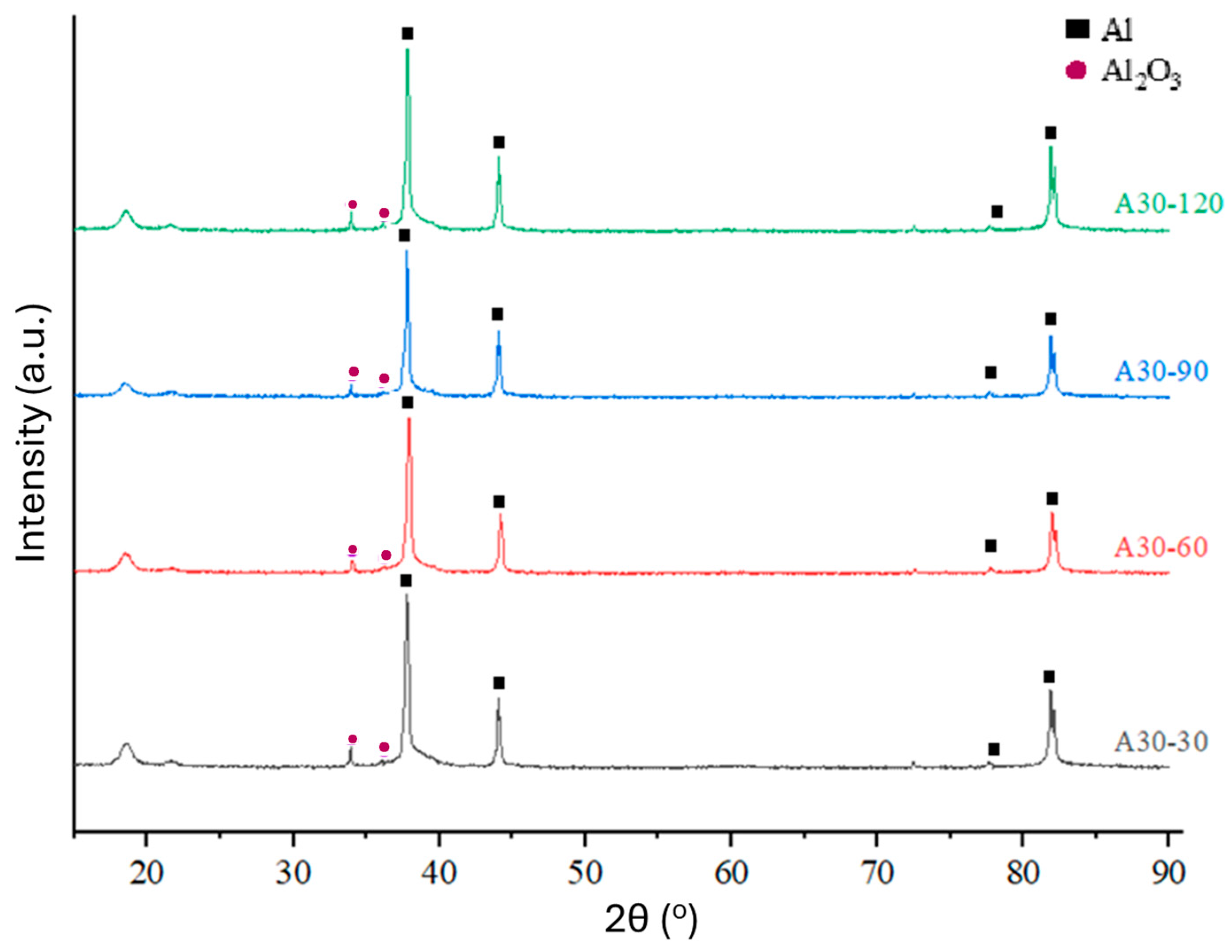
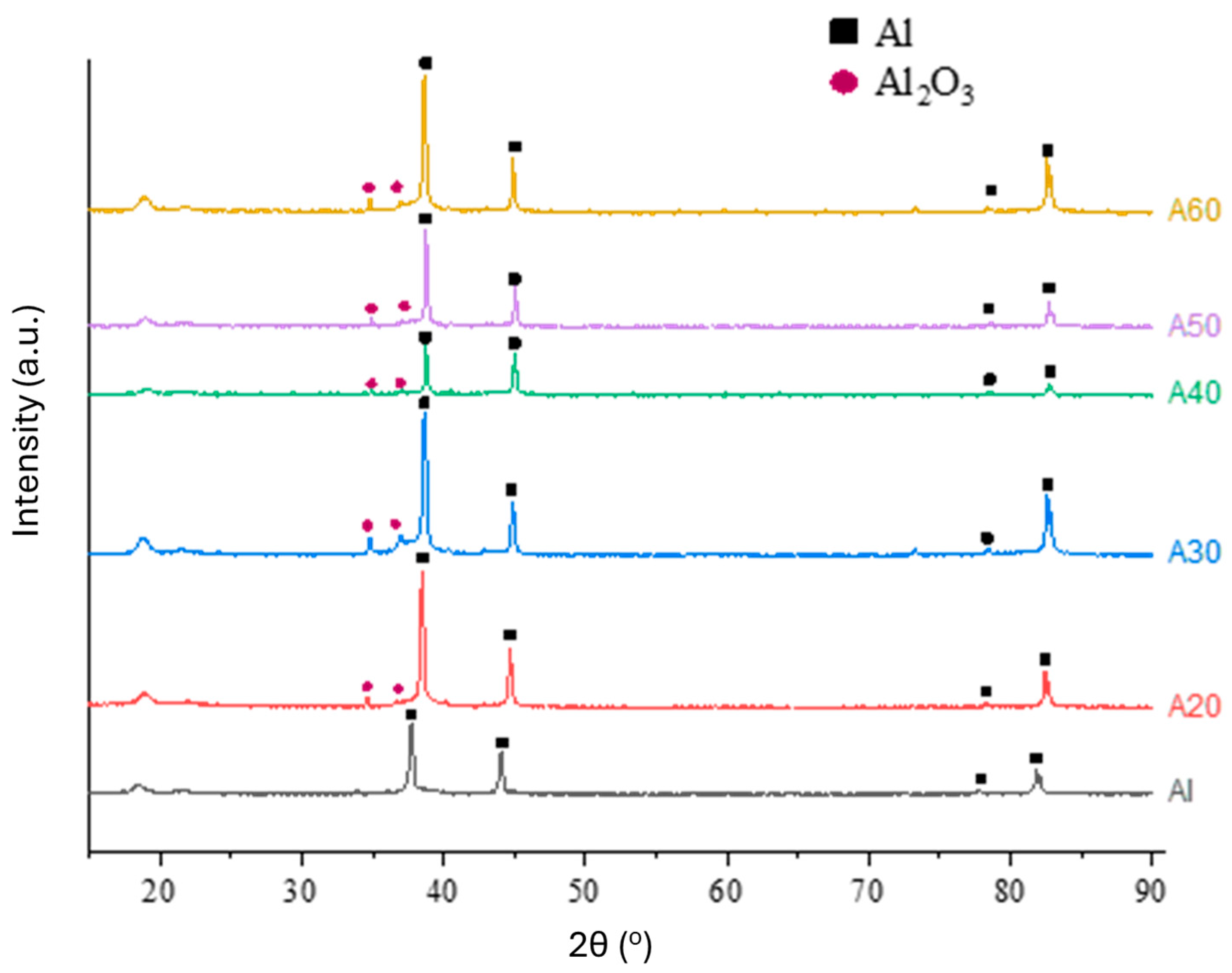
X-ray diffraction (XRD) analysis was performed to determine the crystalline structure and phase composition of the anodized aluminum samples. As shown in Figure 1, the characteristic diffraction peaks of the aluminum substrate are clearly observed at 2θ = 37.71°, 44.06°, 77.68°, and 81.84°, corresponding to the (111), (200), (311), and (222) planes, respectively, in agreement with the standard reflections of FCC Al reported in the literature [42,43]. Figure 2 and Figure 3 further demonstrate that the samples anodized in oxalic acid exhibit diffraction peaks consistent with the formation of aluminum oxide. Weak reflections at approximately 2θ = 33.90°, 34.70°, 36.09°, and 38.68° are attributed to γ-Al2O3, matching the JCPDS reference pattern (ICDD No. 46-1212) and confirming that anodization leads to the development of a thin alumina layer. These reflections are broad due to the nanocrystalline and partially amorphous nature of the oxide layer, as typically reported for anodic aluminum oxide (AAO) films [44,45,46,47].
Across all anodizing conditions, no significant changes were detected in the crystalline structure of the oxide layer. The similarity of the diffraction patterns indicates that the variations in voltage and anodization time—while strongly influencing pore morphology—do not induce phase transformations within the oxide. This result is consistent with previous reports that AAO formed in oxalic acid remains predominantly amorphous or γ-phase at conventional anodization temperatures, regardless of processing window [44,45,46,47]. A weak and broad shoulder appearing around 2θ ≈ 20° in Figure 1, Figure 2 and Figure 3, as noted by two reviewers, does not correspond to a crystalline phase and should not be interpreted as an impurity or secondary oxide. Rather, this feature is attributed to diffuse scattering from the amorphous regions of the Al2O3 barrier and porous layers, which typically exhibit only short-range order and therefore generate broad halos instead of distinct Bragg reflections. Additional contributions arise from low-angle background scattering originating from the sample holder and the instrument, a well-known effect in thin-film XRD measurements. Moreover, the very small volume fraction of nanocrystalline γ-Al2O3 within the anodic oxide can also produce broad, low-intensity features in this angular range. Consequently, the signal near 20° is best described as an amorphous scattering halo, not a true diffraction peak, and its presence confirms that the anodized films remain predominantly amorphous. No reflections associated with secondary crystalline phases—such as boehmite or hydroxide derivatives—were detected, indicating that the anodization parameters used in this work do not induce unwanted phase formation and that the oxide layers maintain consistent phase composition across all voltages and durations.

3.2. Surface Morphology

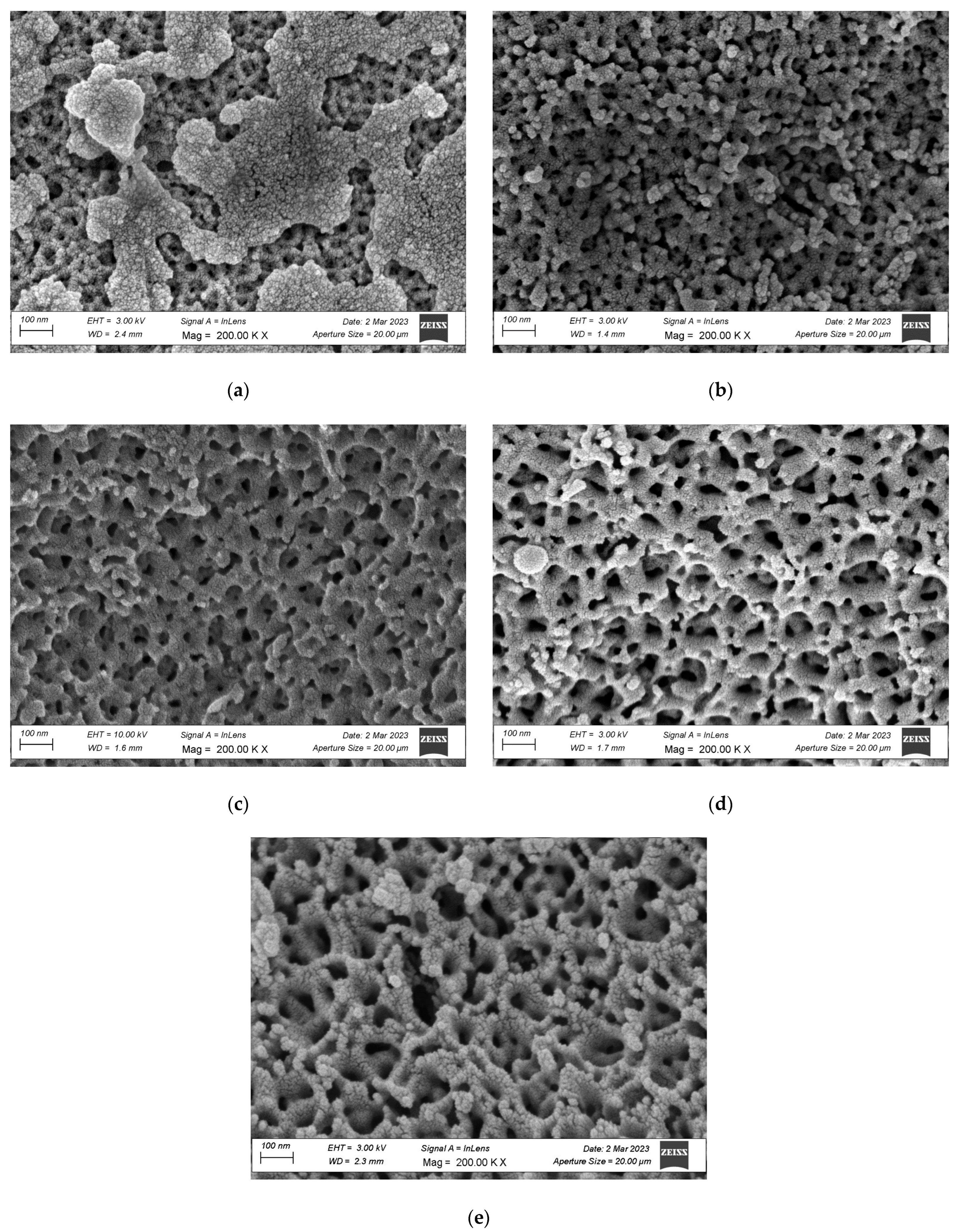
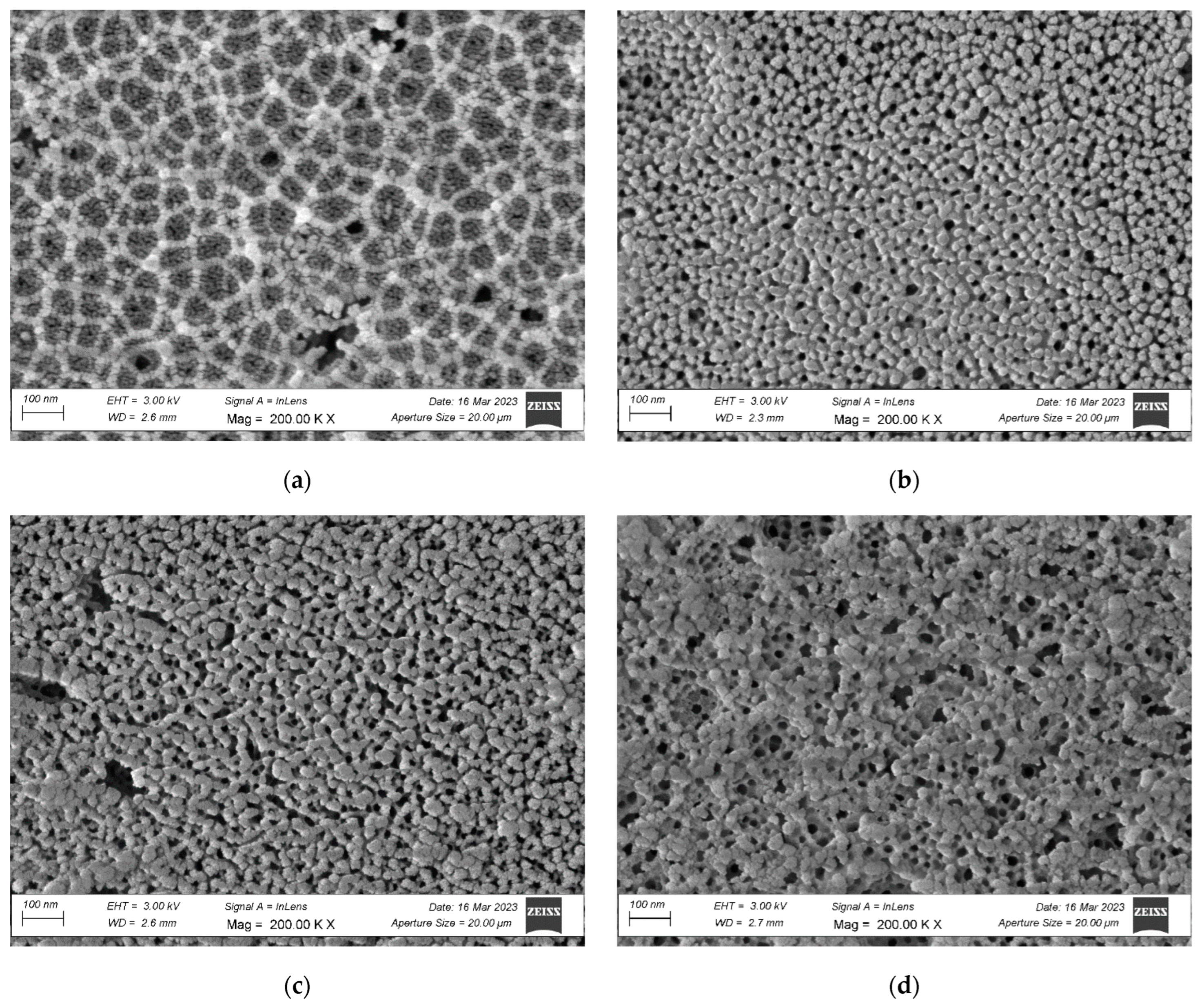
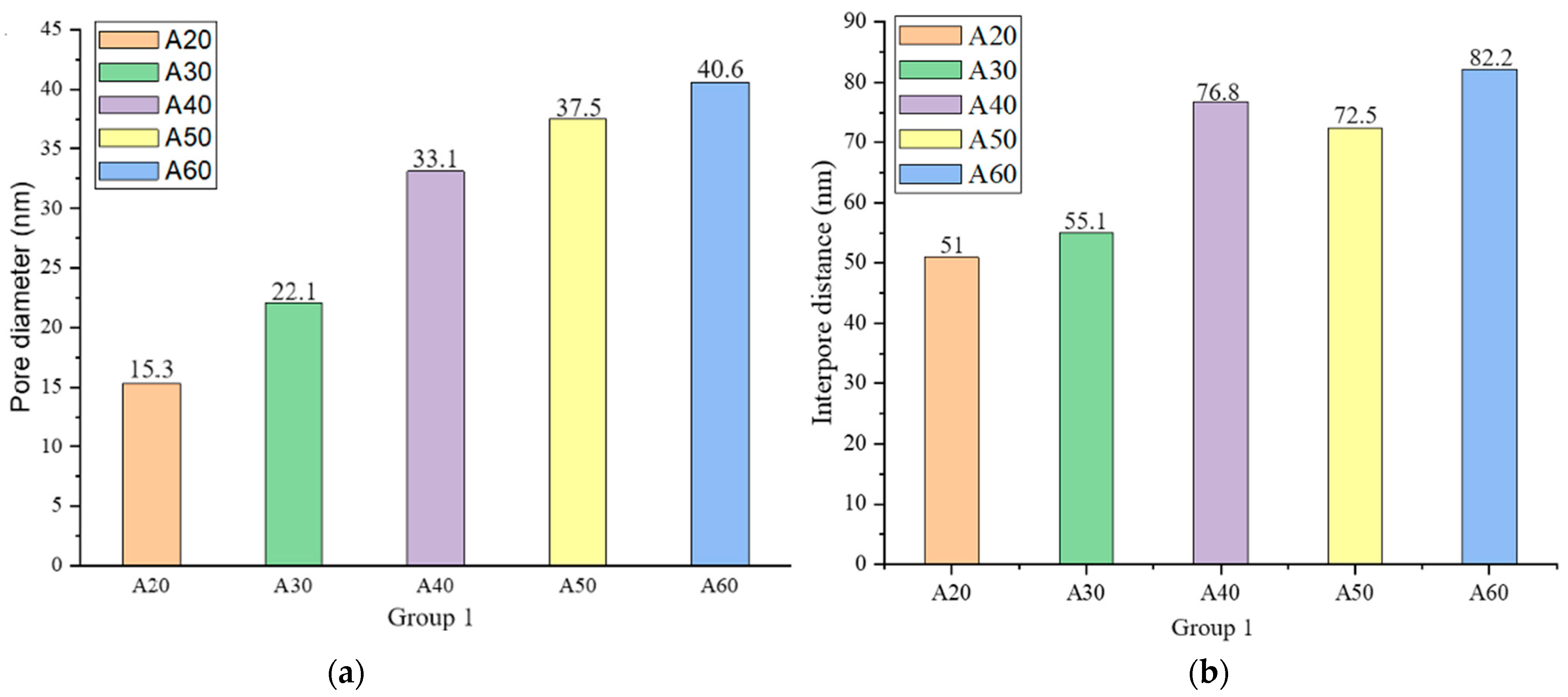
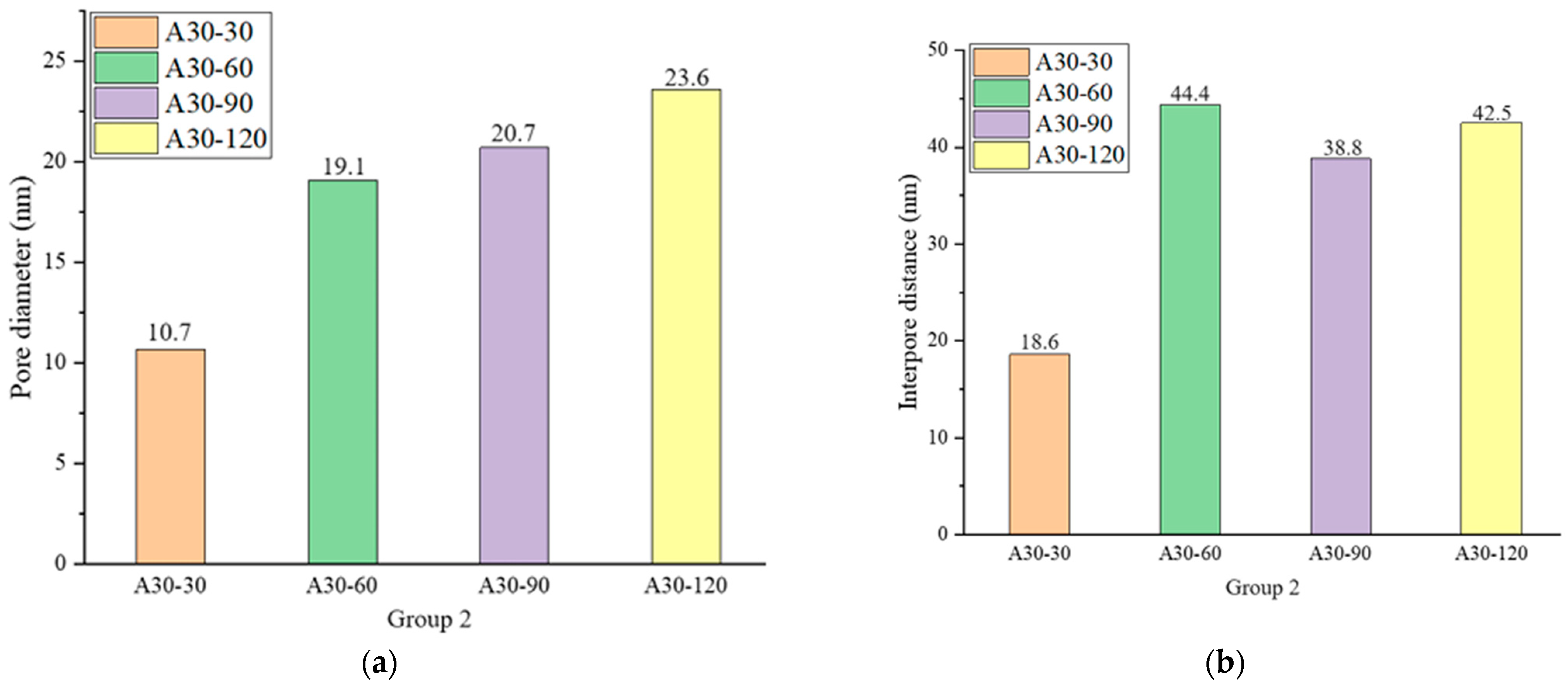
Figure 4 and Figure 5 illustrate the surface morphologies of nanostructured Al2O3 films formed on aluminum substrates under varying anodization voltages and durations, respectively. The SEM results were then utilized to ascertain the pore characteristics across the range of anodization parameters. Anodization in a 0.3 M oxalic acid solution resulted in the formation of Al2O3 films with nanopores of varying sizes, ranging from 13 to 50 nm. The morphological characteristics of Al2O3 nanopores exhibited notable changes with increasing electrolyte concentration. The application of potential and duration resulted in the formation of expanded nanopores, which exhibited irregularities. As illustrated in Figure 6 and Figure 7, the effects of potential on pore diameter and interpore distance demonstrate a linear relationship between pore diameter and anodization voltage (see Figure 6a and Figure 7a).
Furthermore, an increased applied potential corresponded to greater interpore distance, exhibiting a linear relationship (see Figure 6b and Figure 7b). As predicted, extended anodization times partially influenced pore diameter [48,49,50]. However, the 30 min anodization time exhibited a reduced impact on interpore distance compared to other durations. The key parameters for characterizing AAO membranes are as follows: pore diameter, interpore distance, pore density, and porosity. The mean pore size and interpore distance were calculated from SEM images, demonstrating a linear correlation between pore size and interpore distance at varying applied potentials. There is a broad consensus that a linear relationship exists between the potential of anodization and the diameter of pores. The relationship is characterized by proportionality constants (λp and λc) of approximately 0.9 (λp) and 2.5 nm V−1 (λc), respectively [51,52]:
Dp = λp × U
Dc = λc × U
where Dp is pore diameter, Dc is interpore distance and U denotes anodizing potential. The voltage-dependent variation in pore diameter is independent of electrolyte type. Researchers have described the porous aluminum oxide structure by detailing the outer oxide layer near the surface and the inner layer adjacent to the pore bottoms [53]. Pore diameters in the oxide layer exhibit minimal changes during anodization [54]. The relationship between pore size and anodization potential, as well as the ratio of anodization potential to a critical potential value (Umax), has been documented [55]:
Dp = 4.986 + 0.709 × U
Moreover, the correlation between anodization potential and interpore spacing has been identified in studies conducted by Hwang et al. [56]. If anodization in oxalic acid is carried out within the anodization potential range of 20 to 60 V, the relationship can be mathematically described as follows:
Dc = −5.2 + 2.75 × U
Table 2 and Table 3 summarize the calculated values of Dp and Dc for all anodization potentials, alongside data obtained from Equations (1)–(4). Notably, pore distance values for groups 1 and 2 closely align with Equations (1) and (3), minor deviations were observed in interpore distance values. Numerous studies [30,53,57] in the literature corroborate the linear relationship between applied voltage, pore diameter, and interpore distance, consistent with our findings. Nielsch et al. [51] noted that when nanopores self-organize into a perfect hexagonal pattern under optimal anodizing conditions, the ratio between pore diameter and interpore distance remains relatively constant at approximately 0.3–0.4. In our study, this ratio was determined to be 0.4, which is in agreement with the existing literature. Other significant parameters of AAO include wall thickness (W), barrier layer thickness (B), pore density (n), and porosity (a). The thickness of the porous anodic alumina wall (W) necessary for achieving an ideal hexagonal pore arrangement can be expressed as follows [58]:
W = (Dc − Dp)/2
Barrier layer thickness (B) can be determined using empirical formulas established by Ebihara et al. [59]. For anodization in oxalic acid, the following equation applies:
B = 1.12 × W
The wall and barrier layer thicknesses were calculated using Equations (5) and (6) for all anodized samples, with results compiled in Table 4 and Table 5. It should be emphasized that the barrier layer thickness values reported in Table 4 and Table 5 are not directly measured from cross-sectional SEM images but are instead estimated from the empirical relation between wall thickness and barrier layer thickness established by Ebihara et al. [59]. This approach is commonly adopted for oxalic-acid anodization and provides a reasonable estimate of B for comparative purposes, although it does not replace direct cross-sectional imaging. Likewise, the porosity values discussed in this section are derived from the SEM-based measurements of Dp and Dc using the hexagonal packing model described in Section 2.3, rather than from a separate volumetric measurement. Barrier layer thickness is a crucial parameter for characterizing porous AAO films. The production of the porous aluminum oxide layer via the self-organized two-step anodization process can yield dielectric oxide layers at the pore bottoms in AAO membranes; however, removing the barrier layer is essential for creating porous templates for nanofabrication [52]. Ebihara et al. observed slight variations in the relationship between wall thickness and barrier layer thickness during anodization in oxalic acid, with anodizing potentials ranging from 5 to 40 V. A correlation between W and B, characterized by a proportionality constant of approximately 0.66, was identified for anodizing potentials between 5 and 20 V. However, a consistent increase in the proportionality constant was noted for higher anodizing potentials, reaching a final value of approximately 0.89. The result of W/B aligns with those of Ebihara et al. AAO, characterized by the hexagonal symmetry of its cells, represents a maximally packed nanostructure, with the number of pores formed during anodization constituting a critical property of porous alumina. The pore density, defined as the total number of pores per cm2 of surface area, is given by [20]:
n = 2 × 10 14 3 × D C 2
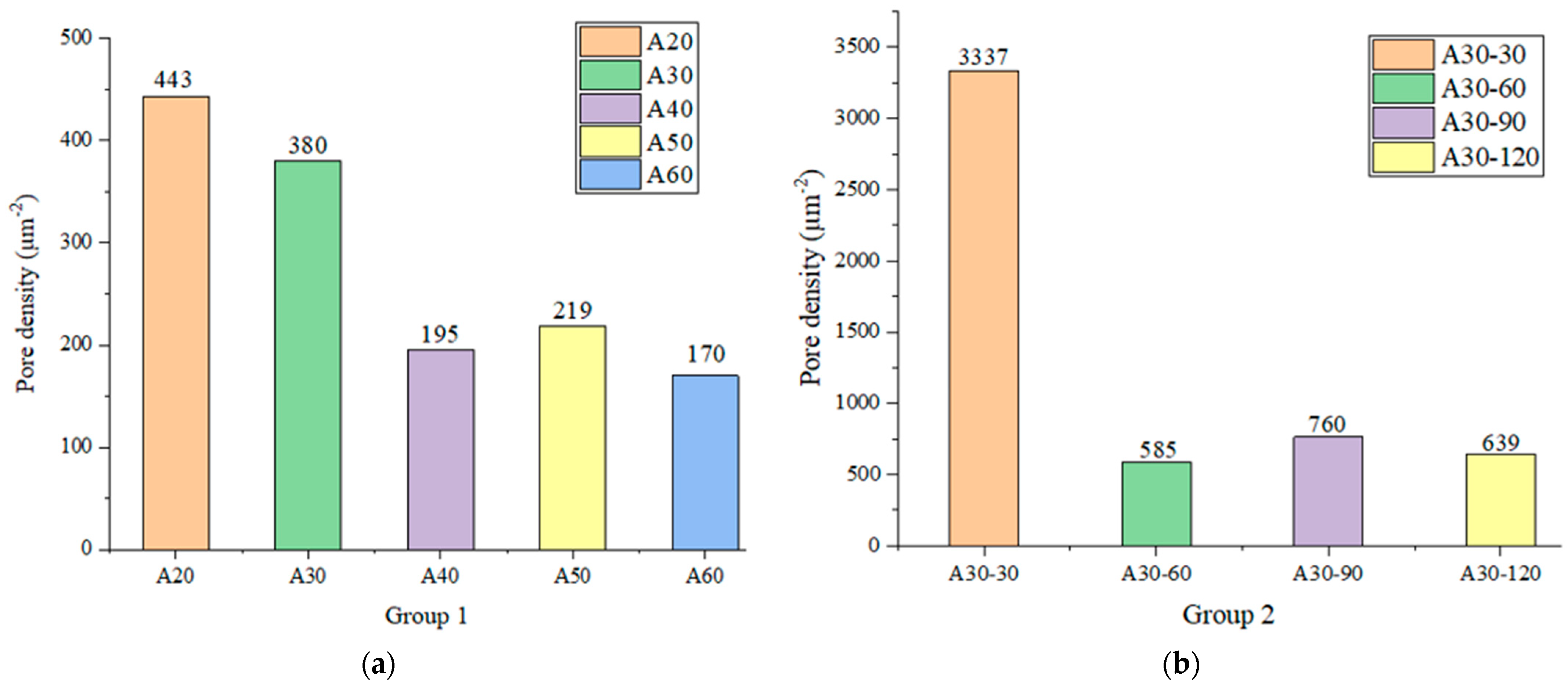
As expected from Equation (7), Figure 8 clearly illustrates that increasing anodizing potential or interpore distance decreases pore density [21,23]. In summary, an increase in anodizing potential is expected to result in an increase in interpore distance, which in turn will cause a decrease in pore density. Interpore distance is solely influenced by anodizing potential, suggesting a similar correlation with operational conditions for pore density [38,59].
As summarized in Table 2 and Table 3, the experimental interpore distances follow the expected linear increase with anodization voltage but deviate from the theoretical predictions given by Equations (2) and (4), particularly at higher voltages where the difference can reach several tens of percent. These deviations are physically reasonable and consistent with previous AAO studies performed on technical-grade aluminum. We attribute this behavior primarily to the use of a 6xxx series Al–Mg–Si alloy instead of high-purity Al, as well as to anodization at room temperature. Both the presence of alloying elements (which locally alter the electric-field distribution and oxide dissolution kinetics) and the higher electrolyte temperature (which reduces the degree of self-ordering) are known to shift the effective proportionality constants used for DC. As a result, the absolute values observed here differ from the classical “2.5 nm V−1” rule that was established mainly for high-purity Al anodized under optimized low-temperature conditions. Our results, therefore, confirm the general voltage scaling of AAO morphology but also demonstrate that meaningful deviations naturally arise when transitioning from idealized systems to technologically relevant alloys and processing environments.

3.3. Microscopic Topography

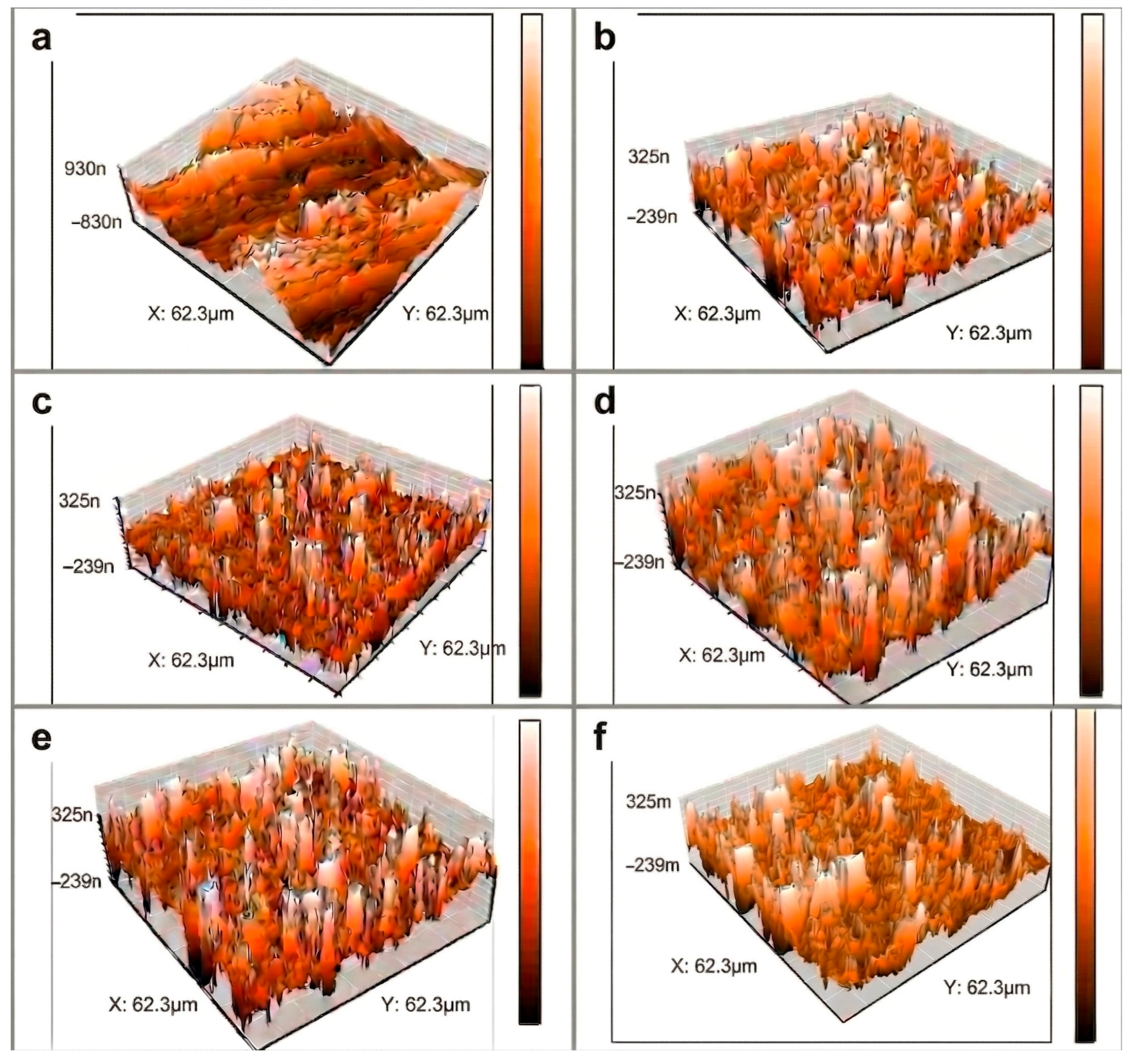
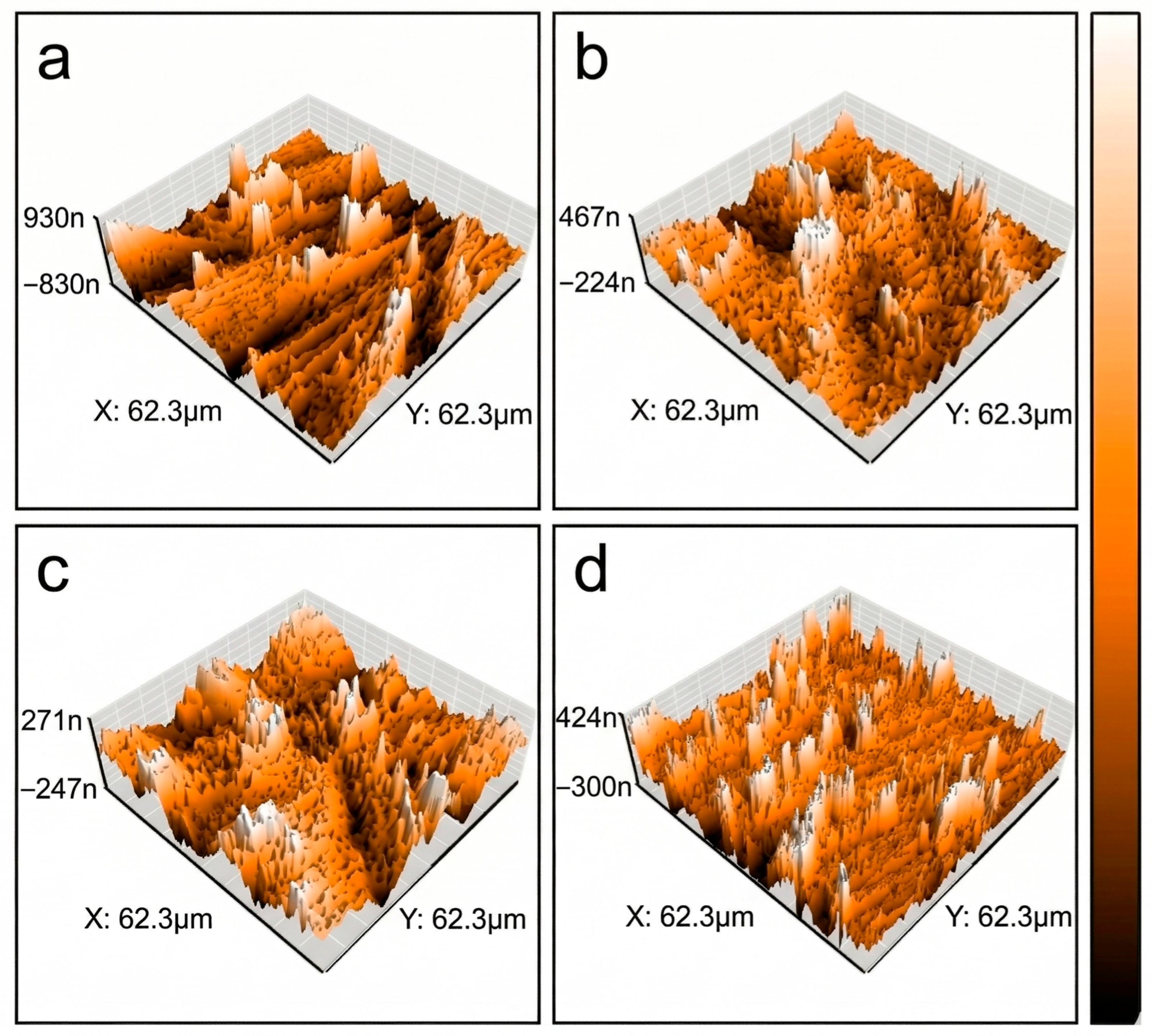
The microscopic topography of all the anodized samples in Groups 1 and 2, as well as the pure aluminum sample, was observed using AFM. AFM measurements were performed in tapping mode at ambient conditions, with a scanning rate of 1 Hz, over an area of 62.3 × 62.3 µm2 to acquire topography images. The surface roughness values are presented in Table 6 and Table 7. Figure 9 and Figure 10 illustrate the surface topographies of non-anodized aluminum and samples anodized under different parameters. After the anodization process, the aluminum surface in both groups demonstrated a more pronounced and irregular pattern of pits and peaks. The anodic layers of aluminum oxide exhibited tubular structures, indicating successful formation of nano- and microstructured alumina layers on aluminum.

3.4. Contact Angle

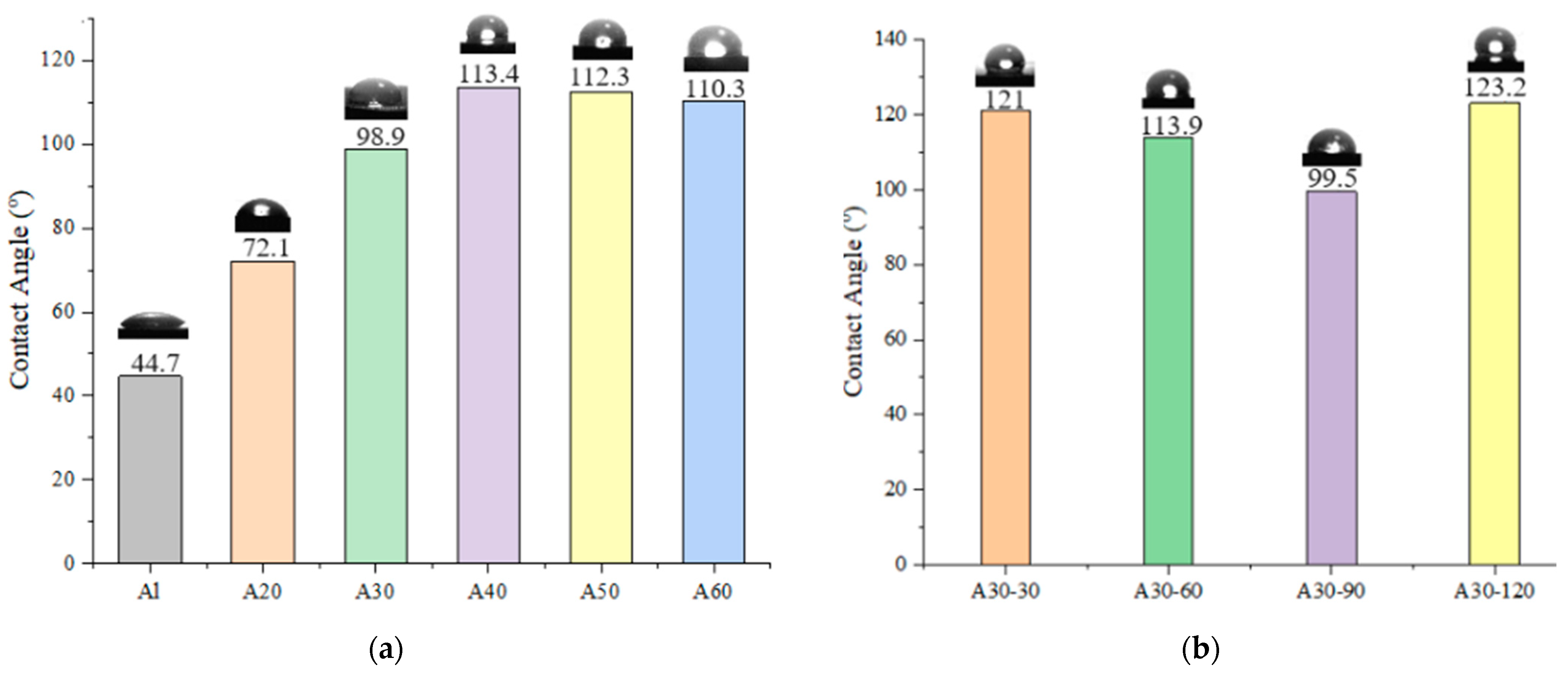
Contact-angle measurements were performed at room temperature using 4 μL of distilled water droplets dispensed via a calibrated micro-syringe. For each sample, five independent droplets were deposited at different surface locations, and the left and right contact angles were averaged at t = 2 s after deposition to minimize the effects of evaporation and capillary imbibition. The reported values are given as mean ± standard deviation, and the error bars shown in Figure 11 reflect this statistical spread. The native 6xxx aluminum alloy exhibited hydrophilic behavior with an average contact angle of ~44.7°, which is consistent with the relatively low contact angles generally reported for oxide and alumina-based ceramic surfaces due to their high surface energy and polar –OH groups [60].
After two-step anodization, a pronounced increase in water contact angle was observed, with values ranging from ~80° up to ~123.2° depending on the anodization parameters. This indicates a clear transition from hydrophilic to hydrophobic wetting behavior that is strongly influenced by the anodically induced nanoscale morphology. The formation of ordered nanopores, increased surface roughness, and, in some cases, a hierarchical texture led to a heterogeneous wetting regime. In particular, the highest contact angles (>110°) are consistent with a Cassie–Baxter-type state, in which partial air entrapment at the pore openings and within the roughness features reduces the effective solid–liquid contact fraction. Similar behavior has been reported for hierarchical AAO-based surfaces and molds used to fabricate superhydrophobic polymer replicas [61], as well as for anodized Al 6061 surfaces where superhydrophobicity is achieved without complex surface chemistries [62]. In contrast, AAO surfaces with lower pore density or less pronounced roughness are closer to the Wenzel regime, where roughness amplifies the intrinsic wetting tendency of the underlying material.
The interaction of the anodized surfaces with water can therefore be interpreted using the Wenzel and Cassie–Baxter models: in the Wenzel state, the liquid fully wets the roughness, whereas in the Cassie–Baxter state, a composite interface forms in which air pockets remain trapped beneath the droplet. Our experimental results indicate that, for the most hydrophobic samples, the solid–water contact area is minimized while the air–water interfacial area is maximized, leading to the nearly spherical droplet profiles observed in Figure 11. To ensure that the measured angles correspond to a stable wetting state rather than a transient one, droplet volume and apparent contact angle were monitored for up to 60 s; no significant decay in angle was observed for the highly hydrophobic samples, suggesting negligible imbibition-driven penetration into the pores under the measurement conditions. Additionally, annealing at 450 °C is expected to reduce the density of surface –OH groups, thereby lowering the surface energy of the anodic alumina, which further supports the elevation of contact angles in combination with the tailored pore morphology. Overall, these findings demonstrate that the two-step anodization protocol effectively tunes the wetting behavior of AAO surfaces from hydrophilic to strongly hydrophobic states by jointly controlling nanoscale roughness, pore architecture, and surface chemistry.

4. Conclusions

This study successfully fabricated nanoporous AAO structures via a two-step anodization process under systematically varied voltage and time conditions at room temperature. A comprehensive analysis was conducted on the morphological characteristics of the resulting AAO membranes, encompassing parameters such as pore diameter, interpore distance, barrier layer thickness, wall thickness, pore density, and porosity. This analysis was conducted on all samples to understand the membrane properties comprehensively. The findings demonstrate that increasing the anodization voltage (Group 1) leads to a pronounced increase in pore diameter, interpore distance, and porosity, accompanied by decreased pore density. In contrast, variations in anodization time at a fixed voltage (Group 2) yielded relatively stable values for pore morphology, indicating that voltage is the dominant parameter influencing the structural evolution of AAO nanostructures within the investigated range. Notably, both groups consistently achieved pore diameters of less than 50 nm, underscoring the method’s efficacy in producing nanoporous architectures under ambient conditions. The study revealed an alteration in morphology and a significant change in surface wettability. While aluminum in its native state exhibits hydrophilic behavior, anodization alone, without the need for post-treatment or chemical modification, resulted in a significant increase in water contact angle, achieving hydrophobic surfaces with contact angles of up to approximately 123°. This transformation underscores the potential of anodization as a facile and scalable approach for functional surface engineering. The anodization strategy developed in this work offers a high degree of tunability over AAO membrane architecture, rendering it highly suitable not only for membrane-based separation systems but also for a wide array of advanced applications. These include, but are not limited to, chemical and biological sensors, catalyst supports, drug delivery platforms, biomedical coatings, and nanoscale device templates. The employment of a dual-group comparative approach furnishes valuable insights into the independent effects of voltage and time, thereby enabling the precise design of AAO nanostructures with tailored properties for next-generation materials and technologies.

Author Contributions

S.B.: visualization, investigation, writing—original draft preparation, methodology, resources. M.Y.: supervision, writing—reviewing and editing. All authors have read and agreed to the published version of the manuscript.

Funding

This research received no external funding.

Data Availability Statement

The original contributions presented in this study are included in the article. Further inquiries can be directed to the corresponding author.

Acknowledgments

This work was supported by the infrastructural facilities of Dokuz Eylul University, Center for Production and Applications of Electronic Materials (EMUM).

Conflicts of Interest

The authors declare no conflicts of interest.

References

  1. Mustapar, N.; Liza, S.; Fukuda, K.; Mat Tahir, N.A.; Ishimatsu, J.; Yaakob, Y.; Othman, I.S. Enhanced Mechanical Properties and Tribological Performance of Anodic Oxide Coating by Using Thermal Power Plant Waste Material. Ceram. Int. 2024, 50, 38372–38390. [Google Scholar] [CrossRef]
  2. Zou, C.W.; Wang, J.; Xie, W. Synthesis and Enhanced NO2 Gas Sensing Properties of ZnO Nanorods/TiO2 Nanoparticles Heterojunction Composites. J. Colloid Interface Sci. 2016, 478, 22–28. [Google Scholar] [CrossRef]
  3. Liu, C.; Zhang, L.; Liu, R.; Gao, Z.; Yang, X.; Tu, Z.; Yang, F.; Ye, Z.; Cui, L.; Xu, C.; et al. Hydrothermal Synthesis of N-Doped TiO2 Nanowires and N-Doped Graphene Heterostructures with Enhanced Photocatalytic Properties. J. Alloys Compd. 2016, 656, 24–32. [Google Scholar] [CrossRef]
  4. Taşaltın, N.; Karakuş, S.; Taşaltın, C. Ethanol Detection Performance of Vertically Aligned V2O5 Nanowire-Based Sensor. J. Mater. Sci. Mater. Electron. 2022, 33, 13474–13483. [Google Scholar] [CrossRef]
  5. Khorsand Zak, A.; Yazdi, S.T.; Abrishami, M.E.; Hashim, A.M. A Review on Piezoelectric Ceramics and Nanostructures: Fundamentals and Fabrications. J. Aust. Ceram. Soc. 2024, 60, 723–753. [Google Scholar] [CrossRef]
  6. Ku, C.-A.; Hung, C.-W.; Chung, C.-K. Influence of Anodic Aluminum Oxide Nanostructures on Resistive Humidity Sensing. Nanomanufacturing 2024, 4, 58–68. [Google Scholar] [CrossRef]

  7. Macias, G.; Hernández-Eguía, L.P.; Ferré-Borrull, J.; Pallares, J.; Marsal, L.F. Gold-Coated Ordered Nanoporous Anodic Alumina Bilayers for Future Label-Free Interferometric Biosensors. ACS Appl. Mater. Interfaces 2013, 5, 8093–8098. [Google Scholar] [CrossRef]
  8. Vorobjova, A.I.; Tishkevich, D.I.; Outkina, E.A.; Yao, Y.; Razanau, I.U.; Zubar, T.I.; Rotkovich, A.A.; Bondaruk, A.A.; Sayyed, M.I.; Trukhanov, S.V.; et al. Fabrication of Composite Nanostructures for Impedance Biosensors Using Anodic Aluminum Oxide Templates and Carbon Nanotubes. Ceram. Int. 2024, 50, 45703–45712. [Google Scholar] [CrossRef]
  9. Kapruwan, P.; Ferré-Borrull, J.; Marsal, L.F. Nanoporous Anodic Alumina Platforms for Drug Delivery Applications: Recent Advances and Perspective. Adv. Mater. Interfaces 2020, 7, 2001133. [Google Scholar] [CrossRef]
  10. Li, J.; Wei, H.; Zhao, K.; Wang, M.; Chen, D.; Chen, M. Effect of Anodizing Temperature and Organic Acid Addition on the Structure and Corrosion Resistance of Anodic Aluminum Oxide Films. Thin Solid Film. 2020, 713, 138359. [Google Scholar] [CrossRef]
  11. Martínez-Viademonte, M.P.; Abrahami, S.T.; Hack, T.; Burchardt, M.; Terryn, H. A Review on Anodizing of Aerospace Aluminum Alloys for Corrosion Protection. Coatings 2020, 10, 1106. [Google Scholar] [CrossRef]
  12. Benea, L.; Simionescu–Bogatu, N.; Chiriac, R. Electrochemically Obtained Al2O3 Nanoporous Layers with Increased Anticorrosive Properties of Aluminum Alloy. J. Mater. Res. Technol. 2022, 17, 2636–2647. [Google Scholar] [CrossRef]
  13. Liu, C.Y.; Sadhu, A.S.; Karmakar, R.; Chu, C.S.; Lin, Y.N.; Chang, S.H.; Dalapati, G.K.; Biring, S. Strongly Improving the Sensitivity of Phosphorescence-Based Optical Oxygen Sensors by Exploiting Nano-Porous Substrates. Biosensors 2022, 12, 774. [Google Scholar] [CrossRef]
  14. Ku, C.A.; Yu, C.Y.; Hung, C.W.; Chung, C.K. Advances in the Fabrication of Nanoporous Anodic Aluminum Oxide and Its Applications to Sensors: A Review. Nanomaterials 2023, 13, 2853. [Google Scholar] [CrossRef]
  15. Qiao, N.N.; Nong, Y.L.; Liu, N.; Liang, Y. Heterogeneous Catalyst of Porous Anodic Aluminum Oxide with Al Substrate Supported Metal Nanoparticles. Mater. Chem. Phys. 2019, 225, 458–463. [Google Scholar] [CrossRef]
  16. Yang, S.; Wang, J.; Liu, C.; Ren, P.; Yang, Q.; Zhao, G. Morphology Control and Photocatalytic Properties of ZnO Sheets Grown on an AAO Template. Ceram. Int. 2021, 47, 8610–8617. [Google Scholar] [CrossRef]
  17. Dikici, T.; Yurddaskal, M.; Yildirim, S.; Celik, E. Influence of Growth Parameters on the Properties of TiO2 Films Prepared by Anodic Spark Oxidation Method and Photocatalytic Degradation of Methylene Blue. J. Aust. Ceram. Soc. 2018, 54, 451–458. [Google Scholar] [CrossRef]
  18. Makela, M.; Lin, Z.; Lin, P.T. Surface Functionalized Anodic Aluminum Oxide Membrane for Opto-Nanofluidic SARS-CoV-2 Genomic Target Detection. IEEE Sens. J. 2021, 21, 22645–22650. [Google Scholar] [CrossRef] [PubMed]
  19. Li, X.; He, Y.; Que, L. Fluorescence Detection and Imaging of Biomolecules Using the Micropatterned Nanostructured Aluminum Oxide. Langmuir 2013, 29, 2439–2445. [Google Scholar] [CrossRef] [PubMed]
  20. Eftekhari, A. Nanostructured Materials in Electrochemistry; Wiley-VCH: Weinheim, Germany, 2008; ISBN 9783527318766. [Google Scholar]
  21. Ur-Rehman, A.; Ashraf, M.W.; Shaikh, H.; Alhamidi, A.; Ramay, S.M.; Saleem, M. Yttrium Incorporated BiFeO3 Nanostructures Growth on Two Step Anodized Al2O3 Porous Template for Energy Storage Applications. Ceram. Int. 2020, 46, 7681–7686. [Google Scholar] [CrossRef]
  22. Xu, D.; Zhen, C.; Zhao, H. Microstructure and Photoluminescence Properties of Anodized Aluminum Oxide Films Treated by Argon Ion. Ceram. Int. 2021, 47, 14382–14389. [Google Scholar] [CrossRef]
  23. Yin, X.; Liu, C.R.; Meng, Y.Y.; Zhang, L.F. Study on the Anodic Bonding Mechanism of Polymer Electrolyte and Aluminum Based on MEMS Sensor Package. J. Inorg. Organomet. Polym. Mater. 2020, 30, 3055–3059. [Google Scholar] [CrossRef]
  24. Ku, C.A.; Wu, C.C.; Hung, C.W.; Chung, C.K. Influence of Normal-to-High Anodizing Voltage on AAO Surface Hardness from 1050 Aluminum Alloy in Oxalic Acid. Micromachines 2024, 15, 683. [Google Scholar] [CrossRef]
  25. Bruera, F.A.; Kramer, G.R.; Vera, M.L.; Ares, A.E. Low-Cost Nanostructured Coating of Anodic Aluminium Oxide Synthesized in Sulphuric Acid as Electrolyte. Coatings 2021, 11, 309. [Google Scholar] [CrossRef]
  26. Yanagishita, T.; Kawato, R.; Masuda, H. Highly Ordered Anodic Porous Alumina Prepared by Anodization of Al in Extremely Dilute H2SO4. J. Electrochem. Soc. 2022, 169, 073504. [Google Scholar] [CrossRef]
  27. Miramontes, J.C.; Gaona Tiburcio, C.; García Mata, E.; Esneider Alcála, M.Á.; Maldonado-Bandala, E.; Lara-Banda, M.; Nieves-Mendoza, D.; Olguín-Coca, J.; Zambrano-Robledo, P.; López-León, L.D.; et al. Corrosion Resistance of Aluminum Alloy AA2024 with Hard Anodizing in Sulfuric Acid-Free Solution. Materials 2022, 15, 6401. [Google Scholar] [CrossRef]
  28. Yurddaskal, M. Formation of Micro- and Nanostructured TiO2 Films by Anodic Oxidation for Enhanced Photocatalytic Activities. J. Inorg. Organomet. Polym. Mater. 2019, 29, 2214–2225. [Google Scholar] [CrossRef]
  29. Sundararajan, M.; Subramani, S.; Devarajan, M.; Jaafar, M. Synthesis and Analysis of Anodic Aluminum Oxide-Nanopore Structure on Al Substrates for Efficient Thermal Management in Electronic Packaging. J. Mater. Sci. Mater. Electron. 2020, 31, 9641–9649. [Google Scholar] [CrossRef]
  30. Manzoor, S.; Ashraf, M.W.; Tayyaba, S.; Tariq, M.I.; Hossain, M.K. Recent Progress of Fabrication, Characterization, and Applications of Anodic Aluminum Oxide (AAO) Membrane: A Review. CMES-Comput. Model. Eng. Sci. 2022, 135, 1007–1052. [Google Scholar] [CrossRef]
  31. Dikici, T.; Yılmaz, O.; Akalın, A.; Demirci, S.; Gültekin, S.; Yıldırım, S.; Yurddaşkal, M. Production of Zn-Doped TiO2 Film with Enhanced Photocatalytic Activity. J. Aust. Ceram. Soc. 2022, 58, 1415–1421. [Google Scholar] [CrossRef]
  32. Pu, Y.; Hu, J.; Yao, T.; Li, L.; Zhao, J.; Guo, Y. Influence of Anodization Parameters on Film Thickness and Volume Expansion of Thick- and Large-Sized Anodic Aluminum Oxide Film. J. Mater. Sci. Mater. Electron. 2021, 32, 13708–13718. [Google Scholar] [CrossRef]
  33. Aarya, S.; Kumar, Y.; Chahota, R.K. Recent Advances in Materials, Parameters, Performance and Technology in Ammonia Sensors: A Review. J. Inorg. Organomet. Polym. Mater. 2020, 30, 269–290. [Google Scholar] [CrossRef]
  34. Ku, C.A.; Hung, C.W.; Chung, C.K. A Rapid, Efficient Method for Anodic Aluminum Oxide Membrane Room-Temperature Multi-Detachment from Commercial 1050 Aluminum Alloy. Nanomaterials 2024, 14, 1216. [Google Scholar] [CrossRef] [PubMed]
  35. Belwalkar, A.; Grasing, E.; Van Geertruyden, W.; Huang, Z.; Misiolek, W.Z. Effect of Processing Parameters on Pore Structure and Thickness of Anodic Aluminum Oxide (AAO) Tubular Membranes. J. Memb. Sci. 2008, 319, 192–198. [Google Scholar] [CrossRef] [PubMed]
  36. Sundararajan, M.; Subramani, S.; Devarajan, M.; Jaafar, M. Optimization of Process Parameters of Anodic Aluminium Oxide Using an Orthogonal Array Technique for Thermal Management Applications. J. Mater. Sci. Mater. Electron. 2020, 31, 18706–18720. [Google Scholar] [CrossRef]
  37. Kartal, U.; Uzunbayir, B.; Doluel, E.C.; Yurddaskal, M.; Erol, M. The Effect of Geometrical Characteristics of TiO2 Nanotube Arrays on the Photocatalytic Degradation of Organic Pollutants. J. Inorg. Organomet. Polym. Mater. 2023, 33, 2848–2860. [Google Scholar] [CrossRef]
  38. O’Sullivan, J.P.; Wood, G.C. The Morphology and Mechanism of Formation of Porous Anodic Films on Aluminium. Proc. R. Soc. Lond. A. Math. Phys. Sci. 1970, 317, 511–543. [Google Scholar] [CrossRef]
  39. Zhai, P.; Li, P.; Li, B.; Liu, L.; Li, C.; Qin, L.; Ma, J.; Zhu, X. Factors Affecting Pore Length During Anodizing of Aluminum in Phosphoric Acid Electrolytes. Int. J. Electrochem. Sci. 2025, 20, 101048. [Google Scholar] [CrossRef]
  40. Zhuang, Y.; Li, P.; Qin, L.; Zhang, S.; Chen, B.; Zhu, Y.; Wang, B.; Zhu, X. Real Role of Fluoride Ions in the Growth of Anodic TiO2 Nanotubes. J. Phys. Chem. C 2024, 128, 5741–5748. [Google Scholar] [CrossRef]
  41. Zhang, Y.; Zhang, J.Z. Formation Mechanism of Nanopores in Dense Films of Anodic Alumina. Trans. Nonferrous Met. Soc. China 2024, 34, 2918–2927. [Google Scholar] [CrossRef]
  42. Xu, X.; Liu, Z.; Zhang, B.; Chen, H.; Zhang, J.; Wang, T.; Zhang, K.; Zhang, J.; Huang, P. Effect of Mn Content on Microstructure and Properties of 6000 Series Aluminum Alloy. Appl. Phys. A Mater. Sci. Process 2019, 125, 490. [Google Scholar] [CrossRef]
  43. Hezil, N.; Fellah, M. Synthesis and Structural and Mechanical Properties of Nanobioceramic (α-Al2O3). J. Aust. Ceram. Soc. 2019, 55, 1167–1175. [Google Scholar] [CrossRef]
  44. Guo, F.; Cao, Y.; Wang, K.; Zhang, P.; Cui, Y.; Hu, Z.; Xie, Z. Effect of the Anodizing Temperature on Microstructure and Tribological Properties of 6061 Aluminum Alloy Anodic Oxide Films. Coatings 2022, 12, 314. [Google Scholar] [CrossRef]
  45. Pan, S.; Liang, L.; Lu, B.; Li, H. Microstructure Evolution for Oxide Film of Anodic Aluminum Foil Used in High Voltage Electrolytic Capacitor. J. Alloys Compd. 2020, 823, 153795. [Google Scholar] [CrossRef]
  46. Roslyakov, I.V.; Kolesnik, I.V.; Levin, E.E.; Katorova, N.S.; Pestrikov, P.P.; Kardash, T.Y.; Solovyov, L.A.; Napolskii, K.S. Annealing Induced Structural and Phase Transitions in Anodic Aluminum Oxide Prepared in Oxalic Acid Electrolyte. Surf. Coat. Technol. 2020, 381, 125159. [Google Scholar] [CrossRef]
  47. Mehdizade, M.; Eivani, A.R.; Soltanieh, M. Characterization of the Anodic Oxide Layer Deposited on Severely Deformed and Aged AA6063 Aluminum Alloy. J. Mater. Res. Technol. 2021, 15, 68–85. [Google Scholar] [CrossRef]
  48. Kim, J.; Jeong, C. Research on Variation in Nanopore Parameters and Surface Characteristics of Anodic Aluminum Oxide (AAO) Films with Time-Controlled Anodization Processes. J. Mater. Sci. 2024, 59, 10556–10571. [Google Scholar] [CrossRef]
  49. Gasco-Owens, A.; Veys-Renaux, D.; Rocca, E. Designing Bipolar Anodizing towards White Anodic Aluminum Oxide (AAO). Surf. Interfaces 2024, 53, 105103. [Google Scholar] [CrossRef]
  50. Sundararajan, M.; Devarajan, M.; Jaafar, M. Investigation of Surface and Mechanical Properties of Anodic Aluminium Oxide (AAO) Developed on Al Substrate for an Electronic Package Enclosure. Surf. Coat. Technol. 2020, 401, 126273. [Google Scholar] [CrossRef]
  51. Nielsch, K.; Choi, J.; Schwirn, K.; Wehrspohn, R.B.; Gösele, U. Self-Ordering Regimes of Porous Alumina: The 10% Porosity Rule. Nano Lett. 2002, 2, 677–680. [Google Scholar] [CrossRef]
  52. Zaraska, L.; Sulka, G.D.; Szeremeta, J.; Jaskuła, M. Porous Anodic Alumina Formed by Anodization of Aluminum Alloy (AA1050) and High Purity Aluminum. Electrochim. Acta 2010, 55, 4377–4386. [Google Scholar] [CrossRef]
  53. Eessaa, A.K.; El-Shamy, A.M. Review on Fabrication, Characterization, and Applications of Porous Anodic Aluminum Oxide Films with Tunable Pore Sizes for Emerging Technologies. Microelectron. Eng. 2023, 279, 112061. [Google Scholar] [CrossRef]
  54. Sulka, G.D.; Kapusta-Kołodziej, J.; Brzózka, A.; Jaskuła, M. Fabrication of Nanoporous TiO2 by Electrochemical Anodization. Electrochim. Acta 2010, 55, 4359–4367. [Google Scholar] [CrossRef]
  55. Palibroda, E. Le Mécanisme Du Développement de l’oxyde Poreux de l’aluminium II. L’oxyde Poreux et La Tension Électrique de La Couche Barrière. Surf. Technol. 1984, 23, 341–351. [Google Scholar] [CrossRef]
  56. Hwang, S.-K.; Jeong, S.-H.; Hwang, H.-Y.; Lee, O.-J.; Lee, K.-H. Fabrication of Highly Ordered Pore Array in Anodic Aluminum Oxide. Korean J. Chem. Eng. 2002, 19, 467–473. [Google Scholar] [CrossRef]
  57. Liu, S.; Tian, J.; Zhang, W. Fabrication and Application of Nanoporous Anodic Aluminum Oxide: A Review. Nanotechnology 2021, 32, 222001. [Google Scholar] [CrossRef] [PubMed]
  58. Rheima, A.M.; Sabri Abbas, Z.; Kadhim, M.M.; Hashim Mohammed, S.; Yahaia Alhameedi, D.; Rasen, F.A.; Al-Bayati, A.D.J.; Ramadan, M.F.; Talib Abed, Z.; Salam Jaber, A.; et al. Aluminum Oxide Nano Porous: Synthesis, Properties, and Applications. Case Stud. Chem. Environ. Eng. 2023, 8, 100428. [Google Scholar] [CrossRef]
  59. Ebihara, K.; Takahashi, H.; Nagayama, M. Structure and Density of Anodic Oxide Films Formed on Aluminum in Oxalic Acid Solutions. J. Metal. Finish. Soc. Jpn. 1983, 34, 548–553. [Google Scholar] [CrossRef]
  60. Ismail, H.; Ahmad, A.; Mohamad, H. Characteristics of Akermanite-Gehlenite and Diopside Bioceramics Derived from CaO-MgO-Al2O3-SiO2 System as a Potential Bone Substitute Material. J. Aust. Ceram. Soc. 2023, 59, 1361–1371. [Google Scholar] [CrossRef]
  61. Balasankar, A.; Venkatesan, R.; Jeong, D.Y.; Oh, T.H.; Kim, S.C.; Vetcher, A.A.; Ramasundaram, S. Facile Fabrication of Hierarchical Structured Anodic Aluminum Oxide Molds for Large-Scale Production of Superhydrophobic Polymer Films. Polymers 2024, 16, 2344. [Google Scholar] [CrossRef]
  62. Mokhtari, S.; Karimzadeh, F.; Abbasi, M.H.; Raeissi, K. Development of Super-Hydrophobic Surface on Al 6061 by Anodizing and the Evaluation of Its Corrosion Behavior. Surf. Coat. Technol. 2017, 324, 99–105. [Google Scholar] [CrossRef]
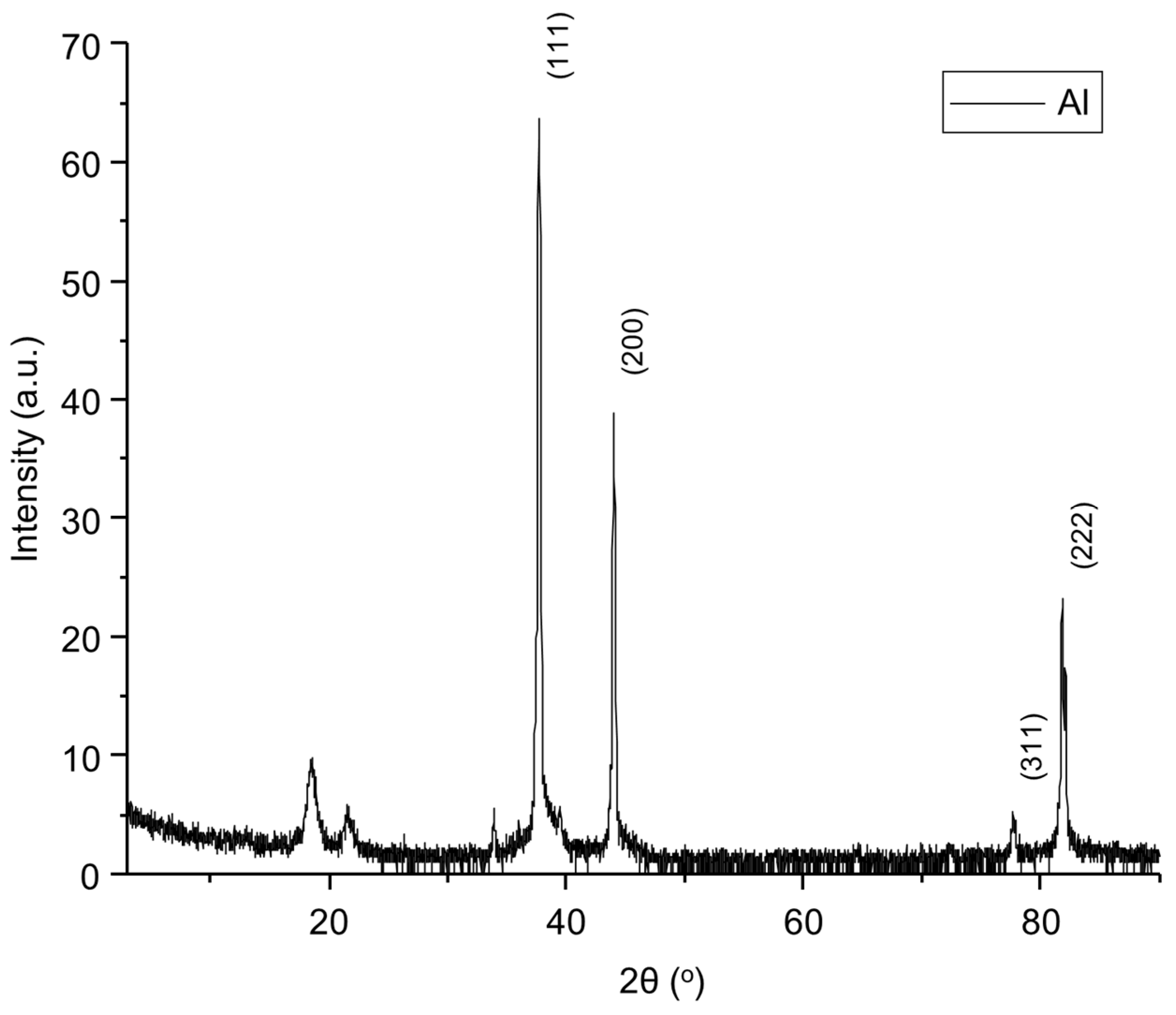
Figure 1. XRD pattern of the non-anodized 6xxx aluminum alloy.
Crystals 16 00227 g001
Figure 2. X-ray diffraction patterns of Group 1 samples anodized at different voltages.
Crystals 16 00227 g002
Figure 3. X-ray diffraction patterns of Group 2 samples anodized for different times.
Crystals 16 00227 g003
Figure 4. SEM images of Group 1 prepared different anodization voltages at (a) 20V, (b) 30V, (c) 40V, (d) 50V and (e) 60V.
Crystals 16 00227 g004
Figure 5. SEM images of Group 2 prepared different anodization times for (a) 30 min, (b) 60 min, (c) 90 min and (d) 120 min.
Crystals 16 00227 g005
Figure 6. The effect of applied potential on (a) pore diameter and (b) interpore distance of anodic alumina at different potentials. For each data point, at least five SEM micrographs were analyzed, yielding typically more than 1000 pore measurements per condition.
Crystals 16 00227 g006
Figure 7. The effect of applied potential on (a) pore diameter and (b) interpore distance of anodic alumina at different anodizing times. Each point represents the average of ≥1000 pore-to-pore center measurements obtained from five independent SEM images.
Crystals 16 00227 g007
Figure 8. Pore density values of the (a) Group 1 and (b) Group 2. Values shown correspond to mean measurements from at least five SEM images per condition (n ≥ 1000 pores).
Crystals 16 00227 g008
Figure 9. AFM images of the (a) non-anodized aluminum and anodized at (b) 20V, (c) 30V, (d) 40V, (e) 50V, (f) 60V.
Crystals 16 00227 g009
Figure 10. AFM images of the (a) non-anodized aluminum and anodized for (b) 60 min, (c) 90 min, (d) 120 min.
Crystals 16 00227 g010
Figure 11. The contact angle results of the samples (a) Group 1 and (b) Group 2.
Crystals 16 00227 g011
Table 1. The parameters of the anodized samples.
Group NoSample CodeVoltageTimeOther Parameters
Group 1A2020 V60 minThe distance between the sample and cathode = 5 cm
Electrolyte temperature = 24 °C
A3030 V
A4040 V
A5050 V
A6060 V
Group 2A30–3030 V30 minThe distance between the sample and cathode = 5 cm
Electrolyte temperature = 24 °C
A30–6060 min
A30–9090 min
A30–120120 min
Table 2. The surface characteristics calculated pore diameter and interpore distance values of Group 1.
Group 1Pore Distance (Dp) (nm)Interpore Distance (Dc) (nm)
This WorkData from
Equation (1)
Data from
Equation (3)
This WorkData from
Equation (2)
Data from Equation (4)Deviation (%)
20 V15.31819.1515049.8+2.4
30 V22.12726.255.17577.3−28.7
40 V33.13633.376.8100104.8−26.7
50 V37.54540.472.5125132.3−45.2
60 V40.65447.582.2150159.8−48.6
Table 3. The surface characteristics calculated pore diameter and interpore distance values of Group 2.
Group 2 Pore Distance (Dp) (nm)Interpore Distance (Dc) (nm)
This WorkData from
Equation (1)
Data from
Equation (3)
This WorkData from
Equation (2)
Data from
Equation (4)
Deviation (%)
30 min10.72726.218.67577.3−75.9
60 min19.12726.244.47577.3−42.6
90 min20.72726.238.87577.3−49.8
120 min23.62726.242.57577.3−45.0
Table 4. The wall thickness and barrier layer thickness values of Group 1.
Group 1Wall Thickness (W) (nm)Barrier Layer Thickness (B) (nm)W/B
20 V17.819.90.89
30 V16.518.40.89
40 V21.824.40.89
50 V17.519.60.89
60 V20.823.20.89
Table 5. The wall thickness and barrier layer thickness values of Group 2.
Group 2Wall Thickness (W) (nm)Barrier Layer Thickness (B) (nm)W/B
30 min3.954.420.89
60 min12.614.10.89
90 min9.0510.10.89
120 min9.4510.50.90
Table 6. Surface roughness values of the non-anodized aluminum and Group 1 anodized at different voltages.
SampleAlA20A30A40A50A60
Ra0.350.210.620.500.390.41
Ry2.941.915.045.783.223.4
Rz2.521.333.993.892.472.50
Rq0.570.300.810.760.500.53
Table 7. Surface roughness values of Group 2 anodized for different times.
SampleA30–30A30–60A30–90A30–120
Ra1.910.641.160.72
Ry10.72.514.356.74
Rz8.801.516.185.05
Rq2.40.41.581.09
Disclaimer/Publisher’s Note: The statements, opinions and data contained in all publications are solely those of the individual author(s) and contributor(s) and not of MDPI and/or the editor(s). MDPI and/or the editor(s) disclaim responsibility for any injury to people or property resulting from any ideas, methods, instructions or products referred to in the content.