Article

Effect of Fe Content on the Microstructure and Properties of 5083 Aluminum Alloy

1
School of Resources, Environment and Materials, Guangxi University, Nanning 530004, China
2
Key Laboratory of High-Performance Structural Materials and Thermal-Surface Processing of Education Department of Guangxi Zhuang Autonomous Region, Guangxi University, Nanning 530004, China
3
Guangxi Key Laboratory of Aluminum Alloy Materials and Processing, Guangxi Nannan Aluminum Processing Co., Ltd., Nanning 530031, China
*
Authors to whom correspondence should be addressed.
Crystals 2026, 16(3), 192; https://doi.org/10.3390/cryst16030192
Submission received: 29 January 2026 / Revised: 4 March 2026 / Accepted: 5 March 2026 / Published: 11 March 2026

Abstract

To address the challenge of controlling Fe impurity content during the recycling of aluminum alloys, this study utilized commercial 5083 aluminum alloy as a matrix to prepare alloy samples with four different Fe contents via smelting. The effects of Fe content on the microstructure, mechanical properties, and corrosion resistance of the as-cast 5083 aluminum alloy were systematically investigated. The results indicate that increasing the Fe content induces a significant morphological evolution of the Fe-rich phases, transitioning from compact Chinese-script α-Al(Fe,Mn)Si phases at low Fe levels to coarse needle-like β-AlFeSi phases. Concurrently, both the quantity and size of the second phases increase significantly. Mechanical testing reveals that the hardness of the alloy gradually rises from 67 HV to 72 HV due to second-phase strengthening. The tensile strength shows a trend of initially increasing and then decreasing, peaking at 0.45 wt.% Fe; however, excessive Fe leads to the formation of needle-like phases that cause stress concentration, resulting in a decline in tensile strength. The elongation decreases gradually with increasing Fe content, with a maximum reduction of 19.7%. Electrochemical tests show that higher Fe content increases the self-corrosion current density and decreases the capacitive loop radius, indicating a significant degradation in the alloy’s corrosion resistance. This work provides an experimental basis for the tolerance control of Fe impurities and the performance optimization of recycled 5083 aluminum alloys.

1. Introduction

The global aluminum industry stands at a pivotal juncture in the mid-2020s, driven by an urgent necessity to decarbonize metallurgical supply chains and transition towards a truly circular economy. As of 2025, the demand for aluminum products, particularly in the transportation and marine sectors, has surged, with global consumption projected to increase by over 80% by 2050. This growth is inextricably linked to the “lightweighting” revolution in automotive and aerospace engineering, where high-strength-to-weight ratio materials are essential for improving fuel efficiency and extending the range of electric vehicles. However, primary aluminum production remains energy-intensive, consuming approximately 14,000–17,000 kWh per tonne and generating significant perfluorocarbon and CO2 emissions [1,2]. However, secondary aluminum production—recycling—consumes only about 5% of the energy required for primary extraction from bauxite ore, releasing approximately 95% fewer greenhouse gases. The integration of recycled material, or “scrap,” into high-value wrought alloy production is therefore not merely an economic opportunity but an environmental imperative [3].
5083 aluminum alloy, a typical Al-Mg series corrosion-resistant alloy, has been widely used in aerospace and transportation industries owing to its low density, excellent thermal and electrical conductivity, vibration damping, and electromagnetic shielding properties [4]. However, with the surging demand for aluminum recycling, the development and utilization of recycled aluminum have become a critical pathway for achieving material sustainability. During the recycling process, iron (Fe) is the most difficult impurity element to remove and tends to accumulate. Although the equilibrium solid solubility of Fe in pure aluminum is extremely low (0.05 wt.%) [5], the precipitation behavior in 5083 alloys is far more complex due to the presence of Mn and Si. In this multicomponent system, the phase selection is governed by the competitive formation between the equilibrium α-phase and the metastable β-phase. Importantly, the interaction between Mn, Si, and Fe plays a decisive role. Mn is known to substitute for Fe atoms in the intermetallic lattice, promoting the formation of the compact, body-centered cubic α-Al(Fe,Mn)Si phase. Si is also essential for stabilizing this phase. However, when the Fe content exceeds the capacity of available Mn, the thermodynamic stability shifts. The insufficient Mn/Si interaction leads to the precipitation of the monoclinic β-AlFeSi phase (or Al3Fe), which shows a detrimental needle-like morphology. Therefore, the microstructural evolution is not merely a function of Fe supersaturation but is dictated by the stoichiometric balance between Fe, Mn, and Si.
Research indicates that the morphology, size, and distribution of Fe-rich phases are critical factors determining alloy performance. Generally, Fe forms polygonal or skeleton-like α-Fe phases (commonly referred to as “Chinese-script” morphology in the literature due to their intricate branching shape), as well as needle-like or platelet-like β-Fe phases in aluminum alloys [6]. Among them, the Chinese-script α-phase shows good bonding with the matrix and is less detrimental to properties, whereas the coarse needle-like β-phase is considered a harmful phase. In terms of mechanical properties, the hard and brittle needle-like β-phase severely severs the continuity of the aluminum matrix. Under stress, it easily causes stress concentration at its tips, acting as a source for crack initiation and accelerating crack propagation, thereby significantly reducing the strength, ductility, and fatigue life of the alloy [7,8,9,10,11,12]. From a casting perspective, needle-like phases can impede the flow of the melt and induce micro-porosity between dendrites, increasing the porosity rate [13]. In corrosive environments, Fe-rich phases act as cathodes to form micro-galvanic corrosion couples with the aluminum matrix, accelerating matrix dissolution and deteriorating corrosion resistance [14]. Therefore, controlling the morphology and evolution of Fe-rich phases is central to enhancing the performance of recycled aluminum alloys.
While the behaviors of Fe impurities have been extensively studied in Al-Si casting alloys [10] and high-pressure die-cast Al-Mg systems [15], significant knowledge gaps remain regarding the specific evolution of Fe-rich phases in recycled 5083 wrought aluminum alloys. Unlike Al-Si alloys dominated by eutectic Si, or die-cast Al-Mg alloys where Fe is often tolerated to prevent die soldering under rapid cooling, the 5083 system relies heavily on Mn alloying for strengthening under gravity casting conditions. Consequently, the specific evolution mechanism of Fe-rich phases and their correlation with microstructural and property degradation in this system have not been comprehensively understood. Distinct from the grain size control in previous works [16], this study systematically investigates the effects of Fe elements on the microstructural evolution and comprehensive properties of 5083 aluminum alloy by synthesizing alloys with varying Fe contents. The aim is to provide a theoretical basis for the tolerance control of composition and impurity phase for high-quality recycled 5083 aluminum alloys.

2. Materials and Methods

Commercial 5083 aluminum alloy and Al-10Fe master alloy were selected as raw materials. The melting process was conducted in a well-type resistance furnace (SG2-7.5-12, Shanghai Shiyan Electric Furnace Co., Ltd., Shanghai, China). The melt temperature was controlled within the range of 750–760 °C. After refining and degassing with C2Cl6, followed by a holding period and slag skimming, the melt was cast into molds. The chemical compositions of the commercial 5083 aluminum alloy and the Al-10Fe master alloy are listed in Table 1 and Table 2, respectively. To ensure the accuracy of the alloying process, the actual chemical compositions of the as-cast ingots were quantitatively analyzed using XRF spectrometry (S8 TIGER, Bruker, Karlsruhe, Germany). The measured compositions are presented in Table 3. The analysis confirms that the actual Fe contents (0.262, 0.463, 0.664, and 0.871 wt.%) align closely with the nominal design values (0.25, 0.45, 0.65, and 0.85 wt.%).
Four distinct experimental alloys were designed to simulate varying degrees of contamination in recycled aluminum streams, ranging from high-purity primary metal equivalents to heavily contaminated scrap:
Alloy A (Baseline): 0.25 wt.% Fe—Represents high-quality recycled or primary 5083.
Alloy B: 0.45 wt.% Fe—Represents the upper limit of many current industrial specifications.
Alloy C: 0.65 wt.% Fe—Represents a “mixed scrap” scenario common in unrefined recycling streams.
Alloy D: 0.85 wt.% Fe—Represents heavily contaminated material, often categorized as “downcycling” grade.
The alloy preparation was conducted in a laboratory-scale well-type resistance furnace using high-density graphite crucibles (SG2-7.5-12, Shanghai Shiyan Electric Furnace Co., Ltd., Shanghai, China), which were coated with a boron nitride wash and pre-fired at 300 °C for 2 h to prevent iron contamination and eliminate volatiles. Commercial 5083 ingots were subsequently melted at a controlled temperature of 750–760 °C to optimize fluidity while minimizing magnesium oxidation; once the melt stabilized, calculated quantities of Al-10Fe master alloy were added and manually stirred with a preheated high-purity graphite rod for 5 min to ensure homogeneity. To remove dissolved hydrogen and non-metallic inclusions, the melt was treated with 0.5 wt.% hexachloroethane (C2Cl6) flux and held for 10 min, a method selected for its high laboratory efficiency despite shifting industrial preferences toward inert gas degassing. Finally, after skimming the surface dross, the melt was poured into a permanent steel mold preheated to 250 °C to control cooling rates and prevent defects such as cold shuts, after which the castings were air-cooled to room temperature.
Specimens (15 mm × 15 mm × 5 mm) were sectioned from the geometric center of the solidified ingots to minimize artifacts associated with the chill zone and macro-segregation near the riser, and subsequently mounted in a conductive thermosetting phenolic resin. The samples underwent a standard metallographic preparation sequence, beginning with planar grinding using SiC papers of increasing fineness (240 to 2000 grit) under water lubrication, followed by rough polishing with a 3 mm diamond suspension on a napless cloth, and concluding with a 0.05 mm colloidal silica suspension to achieve a deformation-free mirror finish. To reveal grain boundaries and second-phase intermetallics, the polished surfaces were chemically etched for 10–20 s using Keller’s Reagent, immediately followed by warm water rinsing and ethanol drying. Microstructural characterization was performed using optical microscopy (PA53MET, Motic, Xiamen, China) and scanning electron microscopy (TM4000, Hitachi, Tokyo, Japan) at an accelerating voltage of 20 kV, while energy-dispersive X-ray spectroscopy (Rigaku D/MAX 2500V, Rigaku, Tokyo, Japan) was employed for semi-quantitative elemental analysis to discriminate between Al-Fe-Mn-Si and Al-Fe-Si phases.
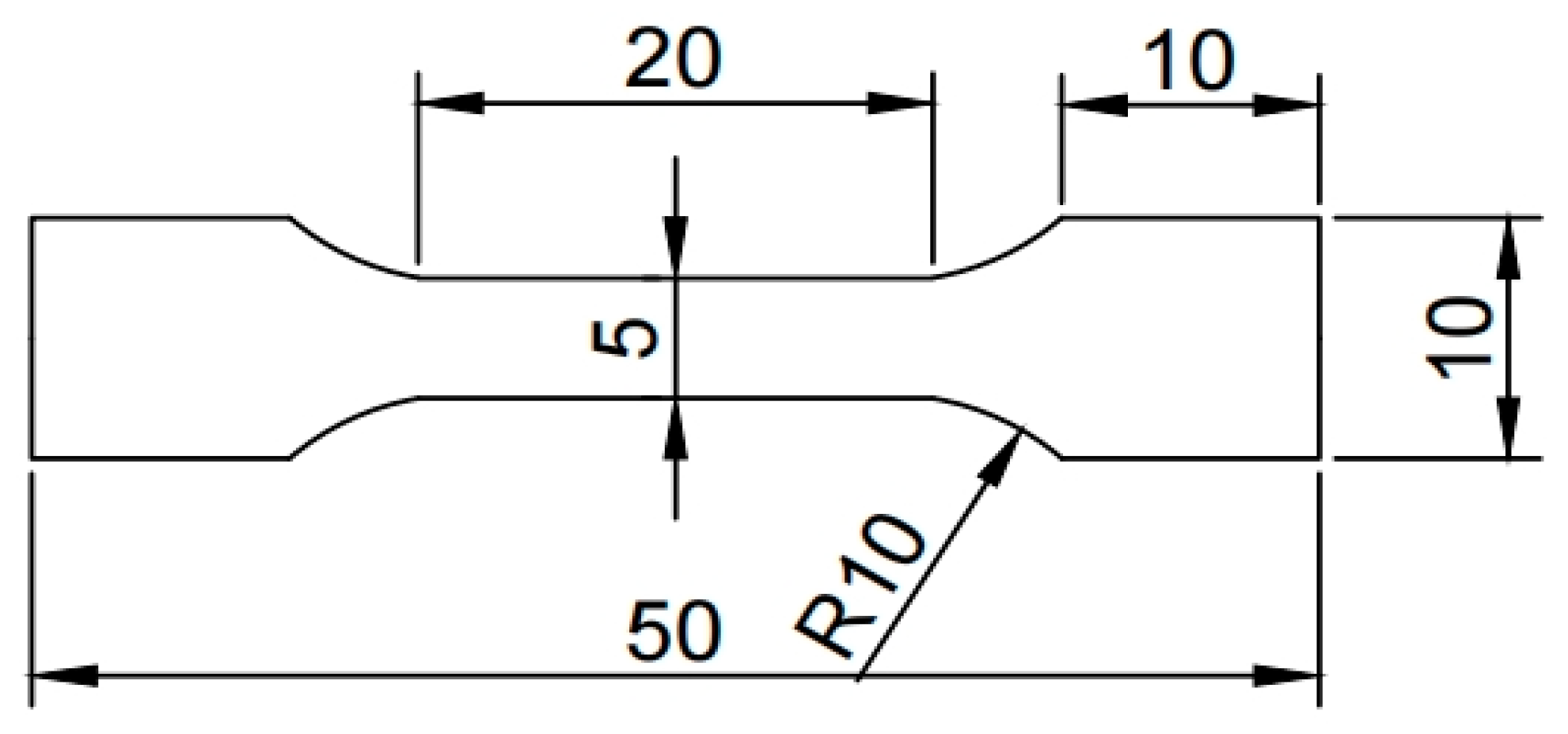
Tensile tests were conducted in accordance with GB/T 16865-2023 [17]. Standard tensile specimens with a gauge length of 20 mm were extracted from the exact center of the ingot using wire electrical discharge machining, with specific dimensions illustrated in Figure 1. After sectioning, the specimens were cleaned with kerosene and anhydrous ethanol to remove surface contaminants, followed by light grinding with sandpaper to eliminate machining marks. Tensile properties of alloys with different Fe contents were evaluated at room temperature using an Instron 8801 universal testing machine (Instron, Norwood, MA, USA), with a crosshead speed set to 1 mm/min. For each alloy composition, three parallel specimens (n = 3) were tested to ensure statistical reliability. The reported tensile strength and elongation values represent the average of these three measurements, with error bars indicating the standard deviation. Microhardness testing was performed using an NVM-1000A nano/micro indentation hardness tester (Shanghai Lunjie Electromechanical Instrument Co., Ltd., Shanghai, China). The samples were ground and polished to a mirror finish. To ensure statistical reliability and minimize the influence of microstructural heterogeneity, seven uniformly distributed indentations (n = 7) were performed on each sample. The reported hardness values represent the mean ± standard deviation of these seven measurements, providing a robust assessment of the alloy’s mechanical properties. The test parameters were set as follows: a load duration of 15 s and an applied load of 0.5 kgf. Experimental data were analyzed using Origin software (Version 2024, OriginLab Corporation, Northampton, MA, USA) to generate a plot illustrating the variation in hardness of the 5083 aluminum alloys with different iron contents.
Electrochemical performance testing was conducted using a CHI750E electrochemical workstation (Shanghai Chenhua Instrument Co., Ltd., Shanghai, China) configured with a standard three-electrode cell. A 3.5 wt.% NaCl solution served as the corrosive electrolyte. The aluminum alloy sample acted as the working electrode, a platinum plate as the counter electrode, and a saturated calomel electrode (SCE) as the reference electrode. The exposed testing area was 1 cm2. Electrochemical impedance spectroscopy (EIS) measurements were first performed at the open circuit potential, with an applied sinusoidal perturbation signal frequency sweeping from 10−2 Hz to 105 Hz and an amplitude of 5 mV. This was followed by potentiodynamic polarization curve testing, conducted at a constant scan rate of 1 mV/s. The entire testing procedure was carried out at room temperature. The acquired EIS data and polarization curves were subsequently fitted and analyzed.

3. Discussion

3.1. Microstructure of the As-Cast Alloy

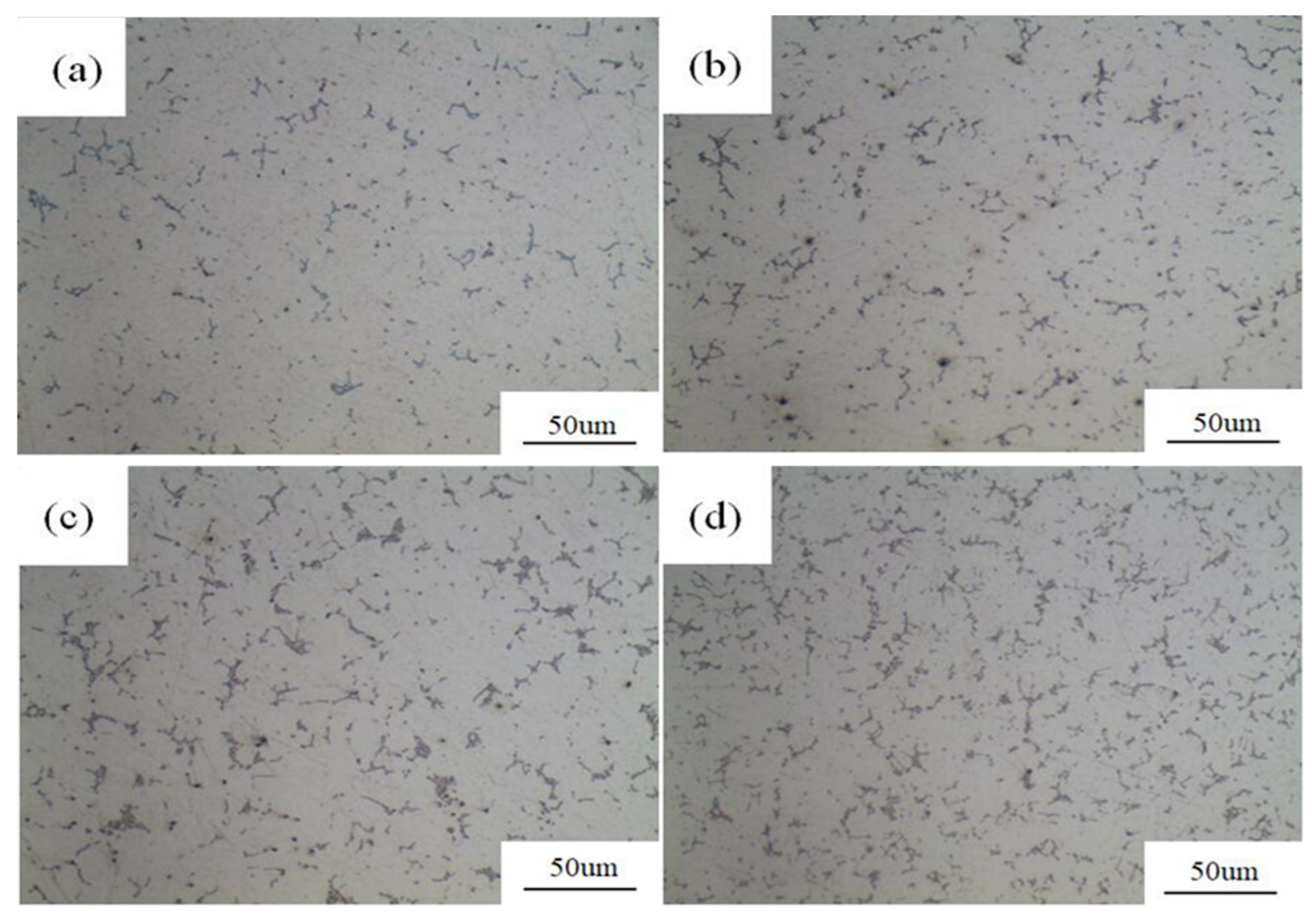
The as-cast phases of the 5083 aluminum alloy consist primarily of the Al matrix, (Fe,Mn)Al6, Al3Mg2, and a small amount of Mg2Si [16]. In this study, four groups of alloys with varying Fe contents (0.25 wt.%, 0.45 wt.%, 0.65 wt.%, and 0.85 wt.%) were prepared. Their corresponding as-cast metallographic microstructures are presented in Figure 2a–d, all obtained at a magnification of 200×.
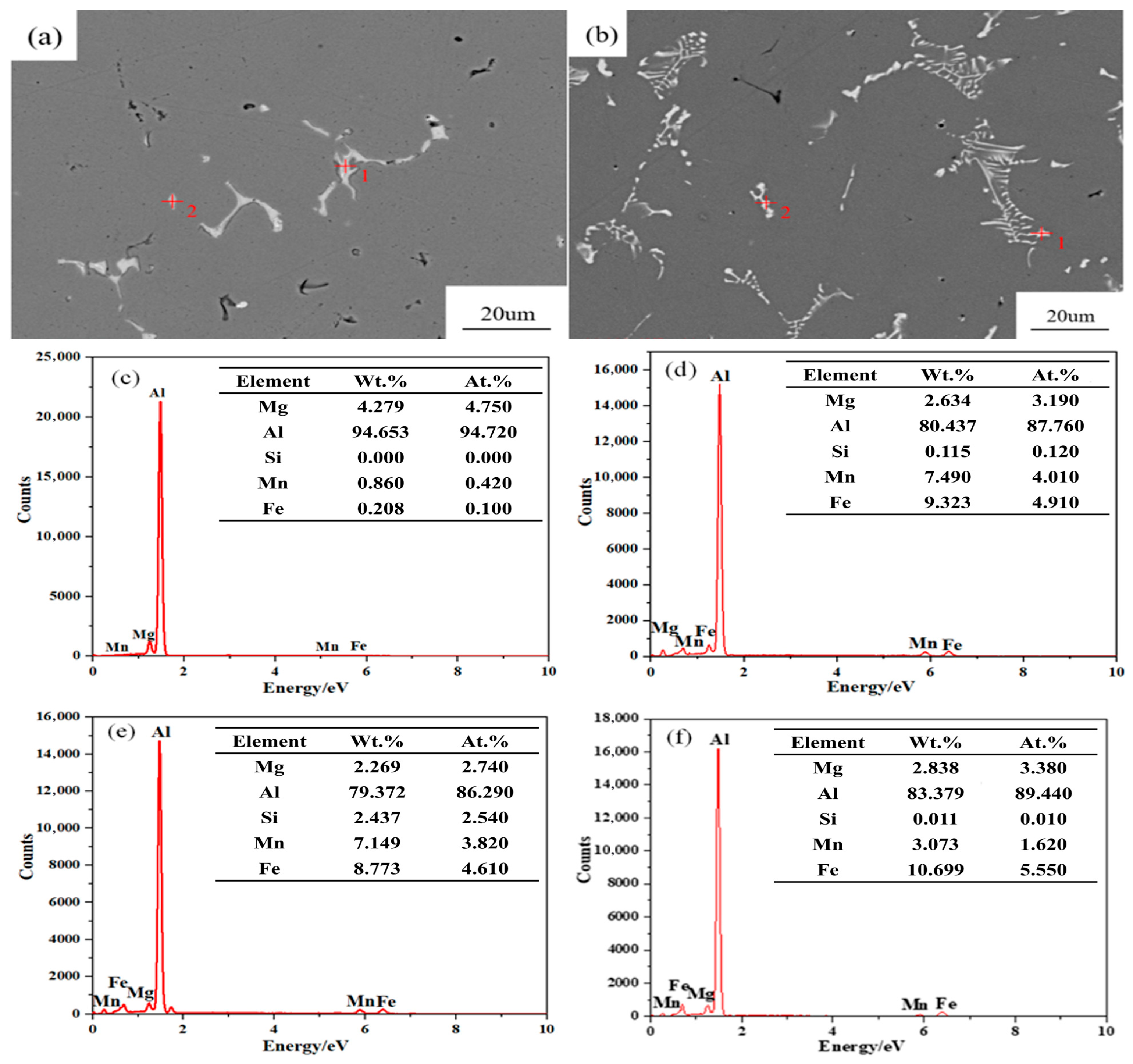
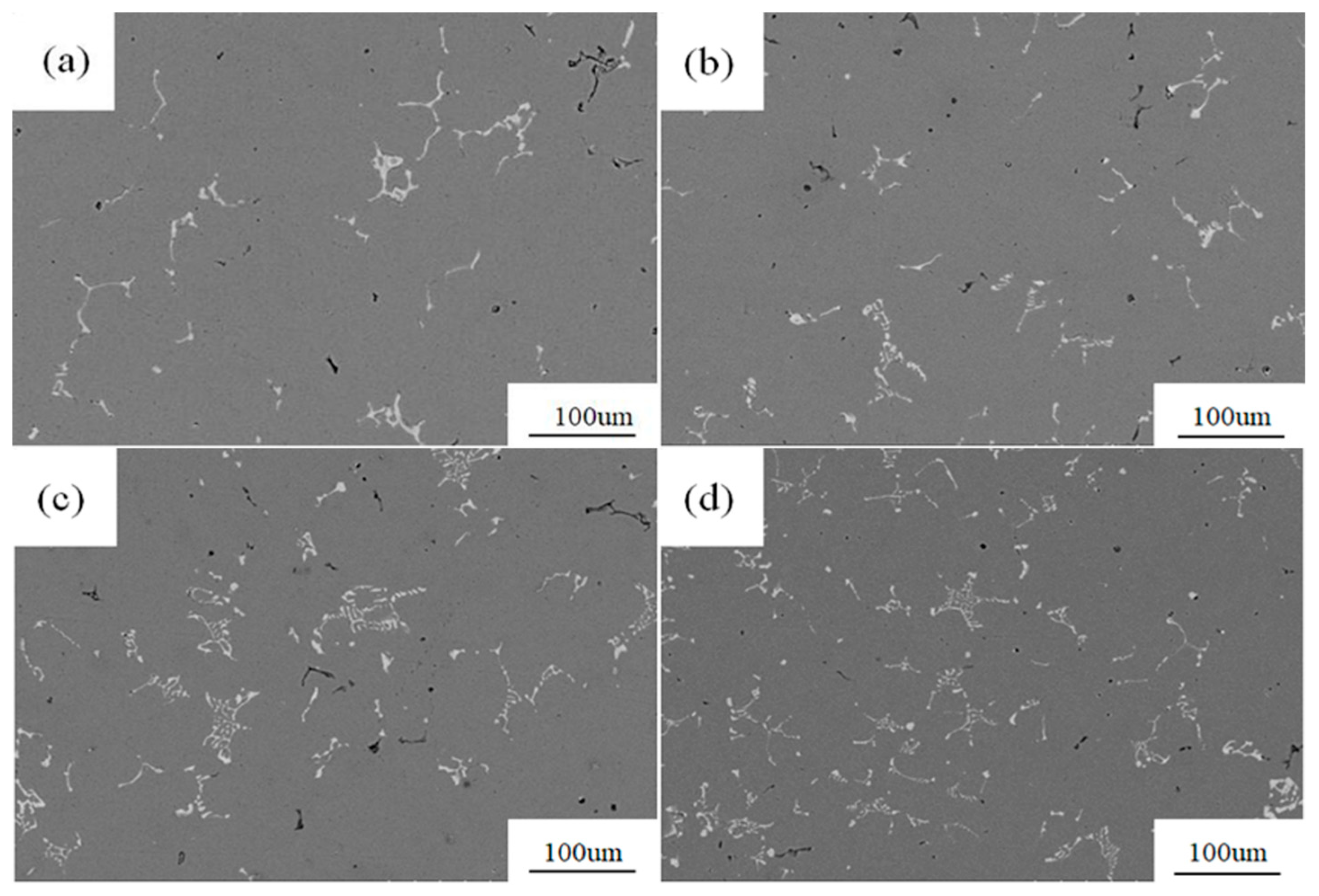
Figure 2, Figure 3 and Figure 4 illustrate the microstructural evolution of the as-cast alloys as a function of Fe content. The matrix is identified as α-Al, while the primary second phases appear as light gray constituents. To identify the specific phase stoichiometries, quantitative EDS point analysis was performed on the marked regions in Figure 3, and the detailed chemical compositions are listed in Table 4.
At a low Fe content (0.25 wt.%), the Fe-rich phases show irregular Chinese-script or skeleton-like morphologies. As shown in Table 4 (Point 2), this phase contains 4.91 wt.% Fe and 4.01 wt.% Mn, yielding an Fe/Mn mass ratio of approximately 1.2. This ratio is consistent with the stoichiometry of the α-Al(Fe,Mn)Si phase, which is relatively compact and causes minimal disruption to the continuity of the matrix.
As the Fe content increases to 0.85 wt.%, a large amount of coarse needle-like phases precipitate within the microstructure. According to Table 4 (Point 2), these needle-like phases show a significantly higher Fe content (5.55 wt.%) and lower Mn content (1.62 wt.%), resulting in an increased Fe/Mn ratio of 3.4. This distinct chemical composition identifies them as the β-phase. This morphological and chemical evolution suggests that excessive Fe induces a transition of the Fe-rich phases from the favorable α-phase to the detrimental needle-like β-phase. It is worth noting that the base alloy contains 0.38 wt.% Si (Table 1), which plays a fundamental role in the phase selection of the 5083 system. In Al-Mg alloys, the presence of Si is the prerequisite for the formation of ternary or quaternary Al-Fe-Si-(Mn) intermetallics rather than binary Al-Fe phases. The Si content was constant in all samples. However, it provided the thermodynamic environment for the precipitation of both α-Al(Fe,Mn)Si and β-AlFeSi phases. At low Fe levels (0.25 wt.%), the Si interacts with the abundant Mn to stabilize the compact, body-centered cubic α-phase. However, as the Fe content increases to 0.85 wt.%, the relative surplus of Fe (and the local depletion of Mn) drives the reaction with Si to form the monoclinic β-AlFeSi phase. Therefore, the phase evolution observed in this study is a result of the synergistic interaction between the increasing Fe content and the available Si, regulated by the Mn/Fe ratio.
The quantity of the gray Fe-containing phases in the metallographic structure increases visibly with increasing Fe content. Although quantitative phase fraction analysis was not performed, the significant morphological transition from compact α-phase to coarse, acicular β-phase (as confirmed by the EDS ratios in Table 4) is considered the dominant microstructural factor responsible for the deterioration of mechanical properties, outweighing the influence of phase volume fraction alone.

3.2. Effect of Iron Content on the Properties of Aluminum Alloys

3.2.1. Microhardness

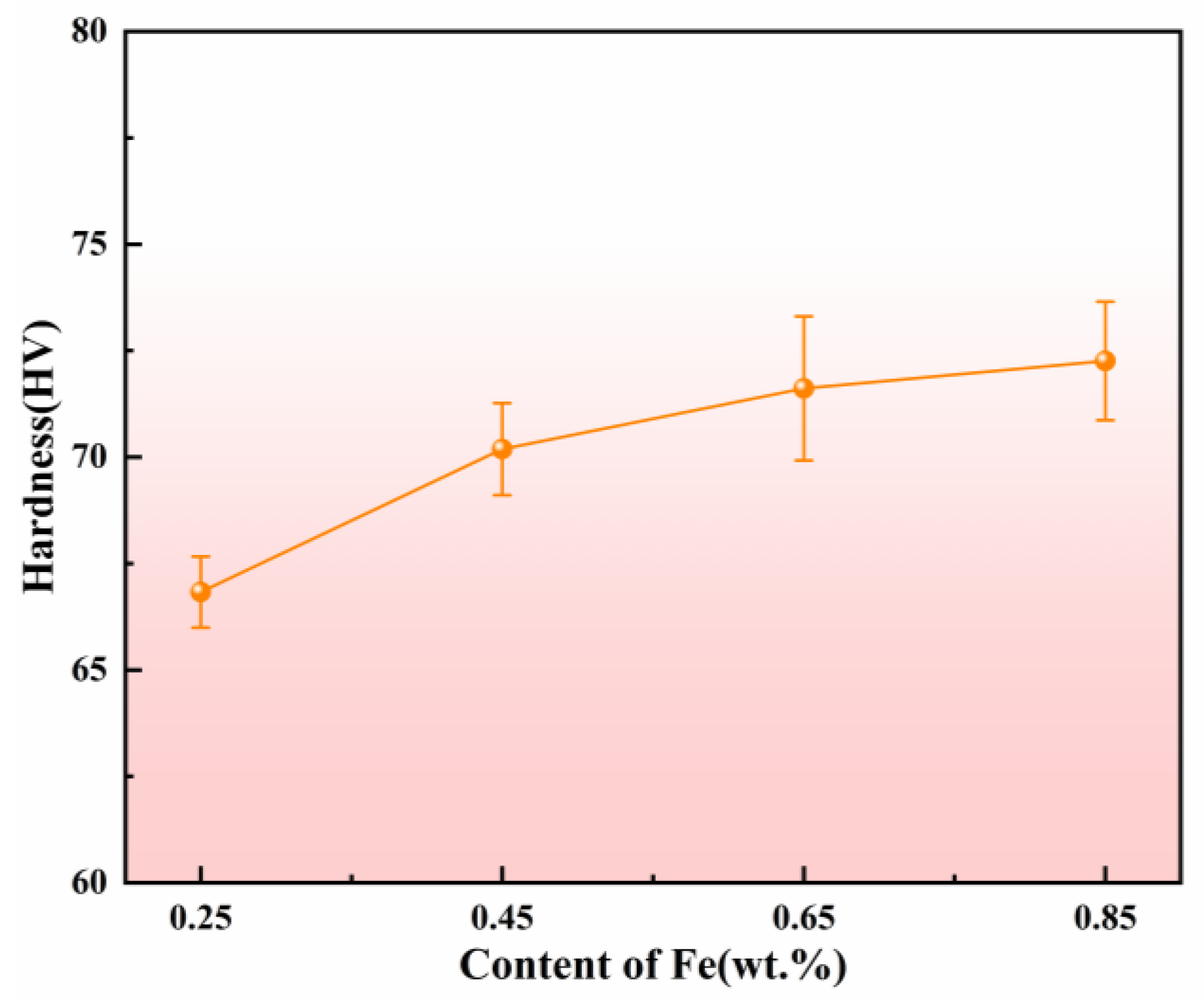
As illustrated in Figure 5, the hardness of the aluminum alloy increased with Fe content. The hardness value increases from 67 HV at 0.25 wt.% Fe to 72 HV at the maximum Fe content of 0.85 wt.%, representing an increment of 7.5%. These results suggest that Fe content exerts a significant influence on the hardness of the alloy. The observed improvement is mainly due to the second-phase strengthening mechanism.
Since the maximum solid solubility of Fe in pure aluminum is limited to 0.05% [18], Fe predominantly exists in the form of alloy phases. In the presence of alloying elements or additional impurities at room temperature, the solubility of Fe decreases further to approximately 0.01% [18]. Consequently, during solidification, a significant amount of Fe precipitates as intermetallic compounds, serving as second-phase particles, which are typically Al-Fe and Al-Mg-Fe phases. These Fe-rich phases inherently possess higher hardness than the aluminum matrix, acting as hard obstacles to dislocation motion [15]. As the Fe content increases, the volume fraction and density of these hard second-phase particles within the matrix rise significantly. These hard phases, distributed dispersedly or in a reticular pattern, effectively impede dislocation slip and motion, thereby improving the overall hardness of the alloy. Although a minor amount of solid solution Fe atoms may induce lattice distortion, second-phase strengthening plays the dominant role under the high-Fe conditions examined in this study.

3.2.2. Tensile Properties

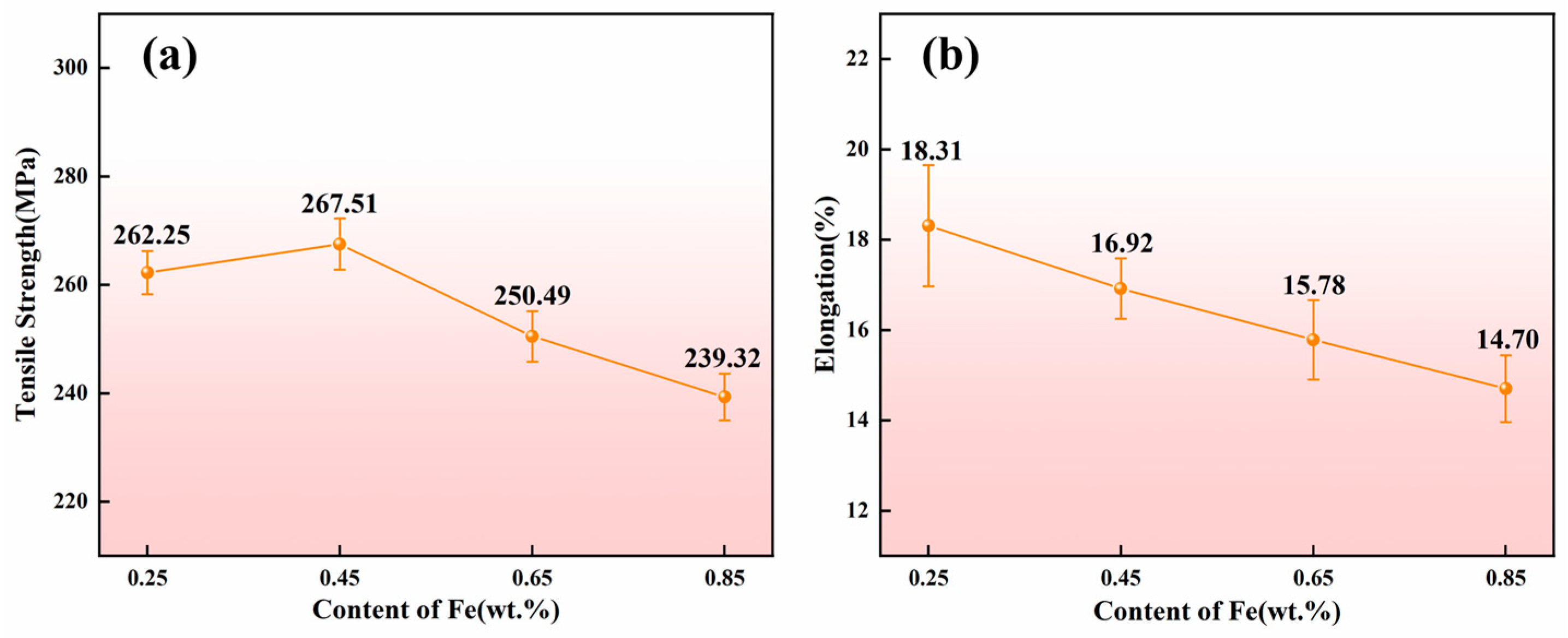
Figure 6a shows that the tensile strength increased at first and then decreased with adding Fe. At 0.25 wt.% Fe, the tensile strength was 262.3 MPa and reaches a peak value of 267.5 MPa as the Fe content increases to 0.45 wt.%. However, with a further increase in Fe content to 0.65 wt.% and 0.85 wt.%, the tensile strength begins to decline, dropping from 267.5 MPa to 250.5 MPa, and finally to 239.3 MPa. At lower Fe contents (0.25–0.45 wt.%), the improvement in tensile strength is primarily attributed to the second-phase strengthening mechanism. During this stage, the precipitated fine Fe-rich phases are dispersedly distributed within the aluminum matrix, effectively hindering dislocation motion. However, as the Fe content increases further, the Fe-rich phases gradually coarsen and evolve into the β-phase with a long needle-like structure. These coarse, brittle phases severely sever the continuity of the matrix and act as crack initiation sites during tensile deformation, resulting in a sharp deterioration in both strength and ductility [15]. As the tensile strength gradually decreases from 267.5 MPa to 239.3 MPa with continuing Fe addition, a critical threshold is identified at 0.45 wt.% Fe. Beyond this limit, the strengthening effect of the second phases is overridden by the stress concentration induced by coarse needle-like β-phases, resulting in a significant deterioration of mechanical properties.
As illustrated in Figure 6b, the elongation of the aluminum alloy shows a continuous downward trend with increasing Fe content. The elongation reaches a maximum of 18.3% at 0.25 wt.% Fe. Subsequently, it decreases to 16.9% at 0.45 wt.% Fe (a reduction of 7.6%), 15.8% at 0.65 wt.% Fe (a reduction of 13.8%), and finally drops to a minimum of 14.7% at 0.85 wt.% Fe, representing a total reduction of 19.7%.
At elevated Fe levels, Fe-rich phases precipitate within the as-cast 5083 aluminum alloy. These phases, characterized as hard and brittle constituents, possess inherently poor plasticity. This observation aligns with the ‘pore nucleation theory’ [19], which emphasizes that the β-AlFeSi phase acts as a heterogeneous nucleation site during solidification. These phases impede melt feeding, thereby promoting the formation of solidification defects such as shrinkage cavities and porosity. During subsequent tensile deformation, these brittle phases act as stress concentration sites, facilitating crack initiation and thereby reducing the elongation of the alloy [20]. At higher Fe contents, Fe-rich intermetallic compounds—particularly the needle-like phases—induce significant stress concentration in their vicinity under applied stress, which triggers crack initiation and accelerates crack propagation. The porosity and gas bubbles associated with these Fe-rich phases within the matrix reduce the effective load-bearing area of the recycled aluminum alloy. This exerts a detrimental effect on the ultimate tensile strength, yield strength, and elongation. The impact on elongation is significantly more pronounced than on tensile or yield strength [21,22].
To deeply elucidate the mechanism behind the peak performance at 0.45 wt.% Fe, the role of the Mn/Fe ratio is critical. The experimental alloy contains 0.51 wt.% Mn. At 0.25 wt.% Fe, the Mn/Fe mass ratio is approximately 2.0, which effectively promotes the formation of the compact α-Al(Fe,Mn)Si phase. Interestingly, the peak tensile strength observed at 0.45 wt.% Fe corresponds to a Mn/Fe ratio of 1.1. This suggests that a Mn/Fe ratio near 1.1 serves as a critical thermodynamic threshold for the 5083 system. Above this Fe level, the available Mn is insufficient to modify the Fe-rich phases, triggering the dominant precipitation of coarse needle-like β-AlFeSi phases. In addition, compared to the standard industrial limit for Fe in 5083 alloys, our findings indicate that recycled 5083 alloys can tolerate a slightly higher Fe content (up to 0.45 wt.%) without compromising mechanical integrity, provided the Mn content is sufficient to maintain the Mn/Fe ratio above unity. This finding offers a quantifiable tolerance window for the utilization of high-Fe scrap in secondary aluminum production.

3.2.3. Corrosion Resistance

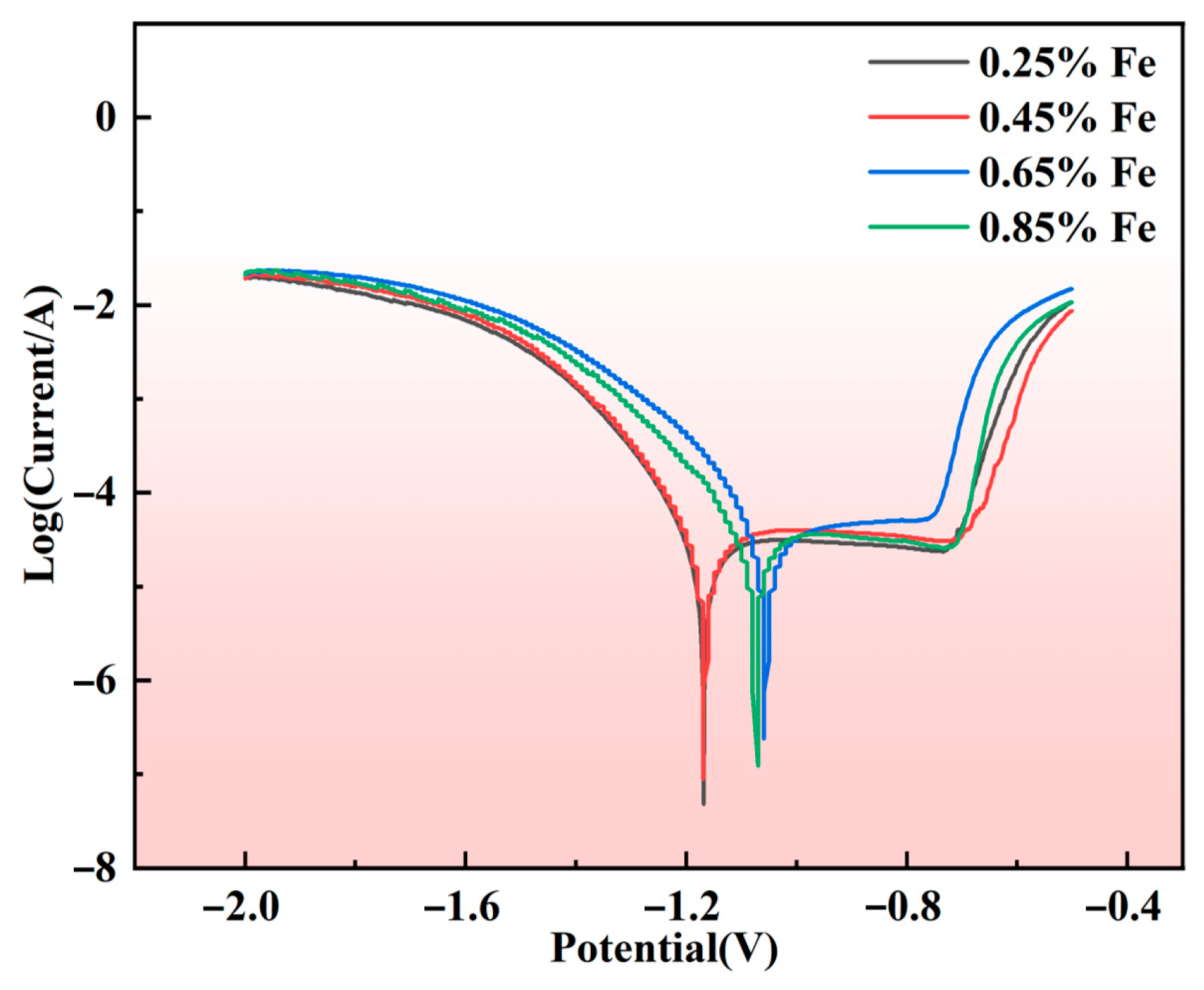
Fe content exerts a significant influence on the corrosion resistance of the alloy. During the solidification of the aluminum alloy, the precipitation of Fe leads to the formation of various intermetallic compounds. These second phases show a distinct potential difference relative to the aluminum matrix, which can induce micro-galvanic corrosion [14], thereby exacerbating the tendency for localized corrosion. Fe-rich phases typically grow with needle-like or platelet-like morphologies, disrupting the continuity of both the aluminum matrix and the surface oxide film, which further impairs the corrosion resistance of the material [23]. Figure 7 presents the potentiodynamic polarization curves of the four groups of 5083 aluminum alloy specimens with varying Fe contents in a 3.5 wt.% NaCl solution. As observed from the Tafel curves, the cathodic branches of the different samples are remarkably similar, indicating consistency in their cathodic reduction behavior. However, significant differences exist in the anodic branches, suggesting that the samples show distinct anodic corrosion behaviors. Additionally, it is evident that all four groups display a passivation region followed by a breakdown region. Table 5 lists the electrochemical parameters from the polarization curves and EIS. As the Fe content increases from 0.25 wt.% to 0.85 wt.%, the corrosion current density, which serves as a kinetic indicator of the corrosion rate, shows a distinct upward trend, rising from 2.753 × 10⁻² μA·cm−2 to 4.699 × 10⁻² μA·cm−2. This indicates a progressive degradation in the corrosion resistance of the alloy matrix. Importantly, this trend is corroborated by the electrochemical impedance spectroscopy (EIS) analysis. The charge transfer resistance (Rt), extracted from the equivalent circuit modeling, represents the energy barrier for the corrosion reaction at the electrolyte/electrode interface. As listed in Table 5 the Rt values decrease monotonically from 1.837 × 10⁴ Ω·cm2 to 1.271 × 10⁴ Ω·cm2 with increasing Fe content. According to the Stern-Geary relationship, the reduction in Rt facilitates the electron transfer process, directly accounting for the observed increase in Icorr. This consistency between the thermodynamic (Ecorr) and kinetic (Rt) parameters confirms that the potential difference between the noble Fe-rich phases and the α-Al matrix promotes micro-galvanic coupling, thereby accelerating the dissolution of the aluminum matrix.
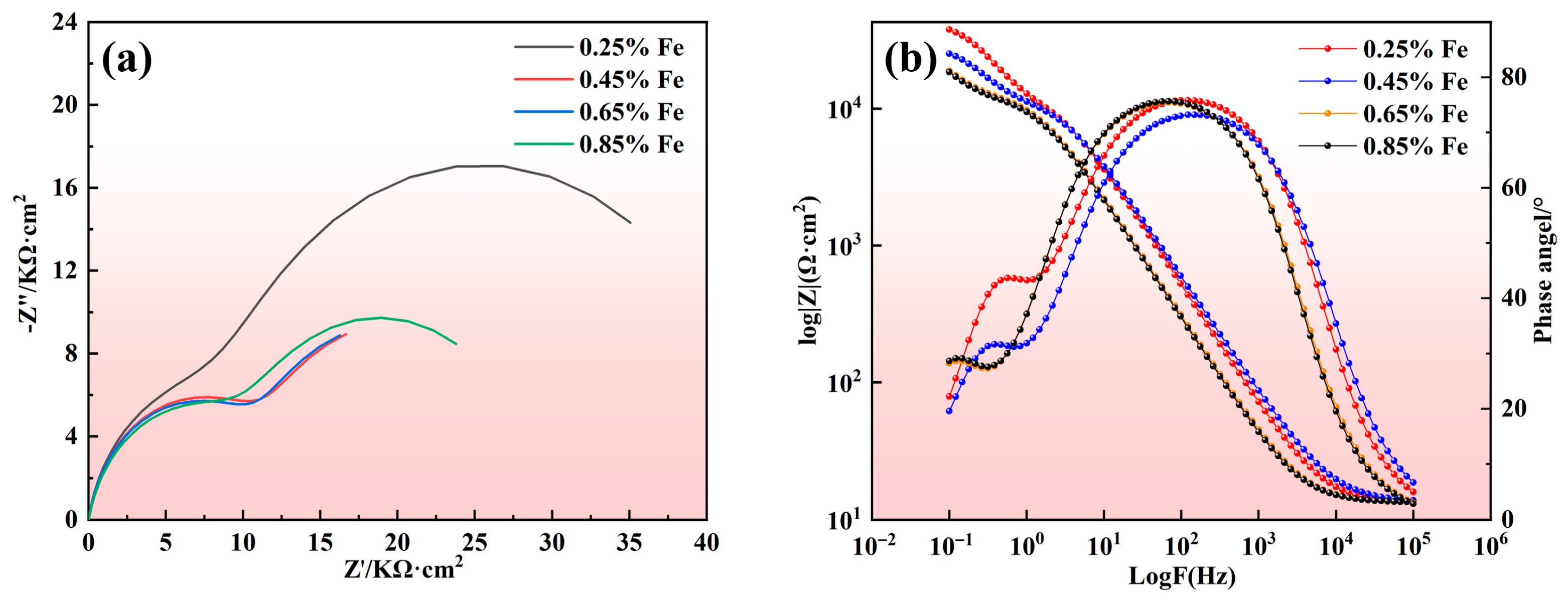
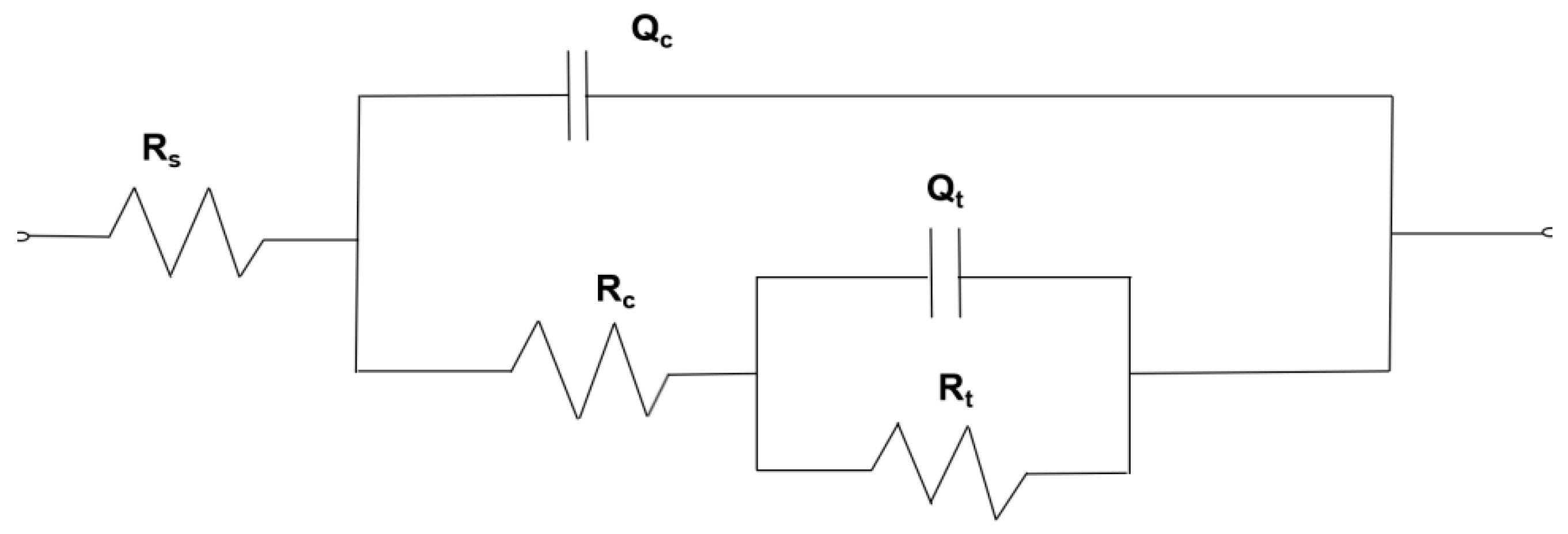
To accurately analyze the electrochemical behavior of the samples with varying Fe contents in a 3.5 wt.% NaCl solution, the equivalent circuit model illustrated in Figure 8 was employed for fitting the Electrochemical Impedance Spectroscopy (EIS) data. In this model, Rs represents the solution resistance between the working electrode and the reference electrode, Rc denotes the resistance of the metal oxide film, and Rt corresponds to the charge transfer resistance. The Rt value reflects the resistance encountered by electron transfer during the electrochemical reaction; generally, a higher charge transfer resistance indicates a greater tendency for the metal to undergo polarization (implying higher corrosion resistance). Due to the porous structure of the metal oxide film, a Constant Phase Element (CPE), denoted as Qc, is utilized to characterize the electrochemical behavior at the interface between the electrolyte and the metal oxide film. Similarly, Qt is employed to characterize the electrochemical response at the interface between the metal oxide film and the substrate matrix. Based on this equivalent circuit, Figure 9 presents the experimental and fitted EIS spectra (Nyquist and Bode plots). The experimental data were fitted using ZSimpWin software (Version 3.60, EChem Software, Ann Arbor, MI, USA) to ensure the reliability of the parameters.
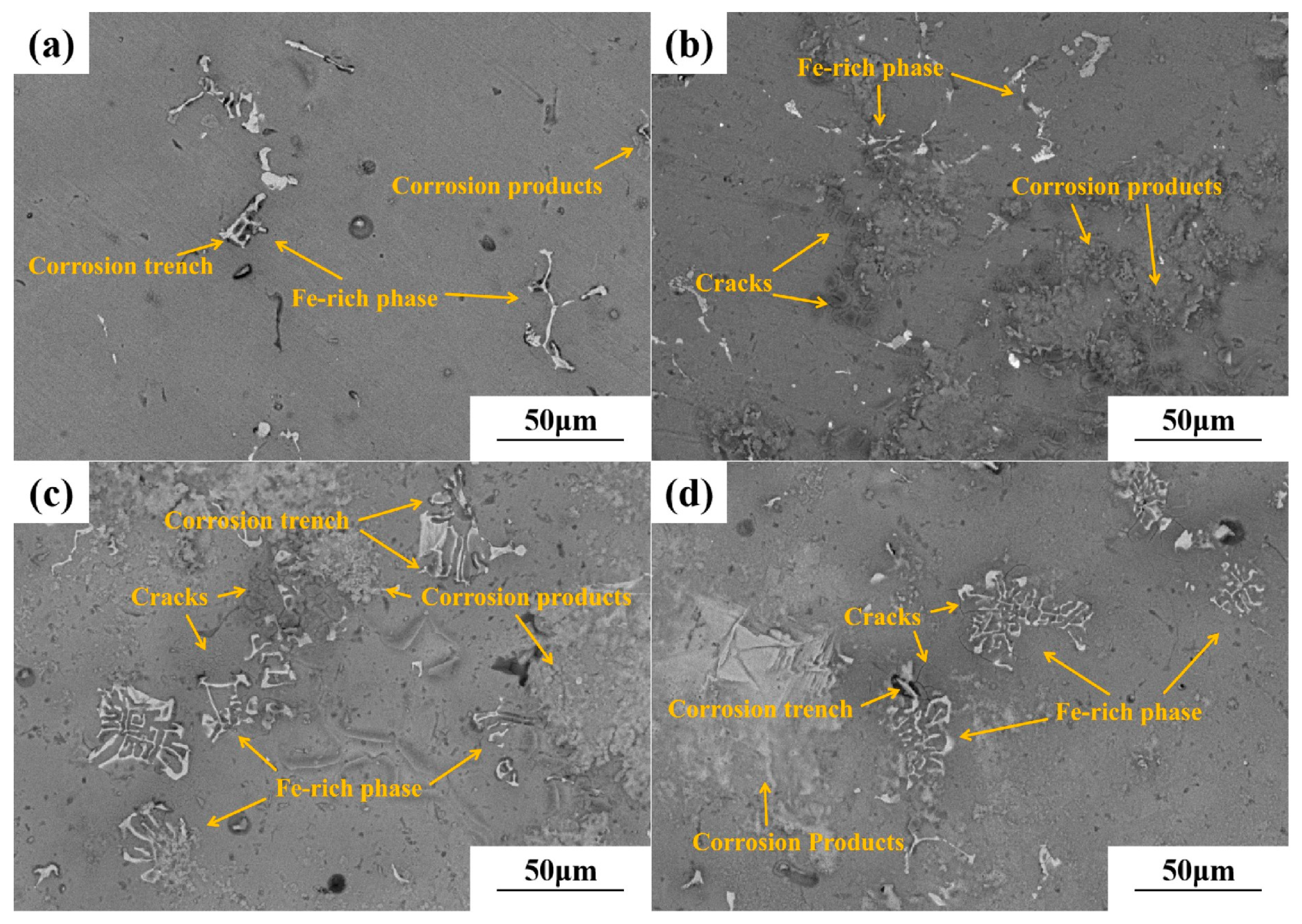
Observation of the Nyquist data reveals that all specimens show capacitive behavior during the immersion corrosion process. In the Nyquist plots, a larger diameter of the capacitive loop corresponds to superior corrosion resistance. Concurrently, it is observed that as the Fe content increases from 0.25 wt.% to 0.85 wt.%, the diameter of the capacitive loop decreased continuously. This indicates that adding Fe reduced the corrosion resistance in the corrosion resistance of the alloy. Correspondingly, in the Bode plots, a higher impedance modulus value (|Z|) at low frequencies indicates better corrosion resistance. As shown in Figure 9b, the specimen with 0.25 wt.% Fe shows the highest |Z| value at low frequencies, and |Z| follows a decreasing trend with increasing Fe content. This electrochemical degradation is visually confirmed by the corrosion morphologies shown in Figure 10. The corrosion morphology presented in Figure 10 clearly reveals that corrosion pits preferentially nucleate along the periphery of Fe-rich phases and propagate deep into the matrix, ultimately resulting in severe localized corrosion. When the Fe content reaches 0.65 wt.%, distinct changes in the morphology and quantity of Fe-rich phases are visible. The Fe-rich phases transition from initially sparse blocky or Chinese-script shapes into coarse needle-like and fish-bone morphologies. Concurrently, these fish-bone structures tend to fragment and evolve into numerous independent needle-like phases. The initiation of intergranular corrosion cracks is clearly visible, with the majority of these cracks clustered in the vicinity of the intermetallic phases. When the Fe content reaches 0.85 wt.%, deep pits and cavities are clearly evident beneath the Fe-rich phases. Therefore, as the Fe content increases, these phenomena become increasingly pronounced, accompanied by the emergence of distinct intergranular corrosion cracks, which serves as a manifestation of the deteriorated corrosion resistance.

3.3. Implications for Downstream Processing

Although 5083 aluminum alloy is primarily utilized in wrought tempers rather than the as-cast state, the microstructural quality of the initial ingot is decisive for its downstream processability. The coarse, needle-like β-AlFeSi phases identified in the high-Fe alloys (≥0.65 wt.%) possess inherent brittleness and distinct hardness mismatch with the α-Al matrix. During subsequent hot or cold rolling processes, these phases cannot deform coordinately with the matrix; instead, they tend to fracture and decohere from the matrix, serving as nucleation sites for voids and cracks. This ‘hereditary effect’ significantly increases the risk of edge cracking and surface defects during rolling, severely limiting the hot workability of recycled ingots. Therefore, strictly controlling the Fe content below the critical threshold of 0.45 wt.% (or maintaining a Mn/Fe ratio > 1.1) in the as-cast stage is not only essential for mechanical integrity but also a prerequisite for ensuring the smooth production of high-quality wrought sheets. This study provides a foundational guideline for optimizing the impurity tolerance of recycled 5083 ingots prior to deformation processing.

4. Conclusions

(1)
In the 5083 aluminum alloy, the quantity of Fe-rich phases increases continuously with rising Fe content. Since these Fe-rich phases impede lattice slip and dislocation motion, thereby enhancing the crystal hardness, the hardness value increases from 67 HV to 72 HV as the Fe content rises from 0.25 wt.% to 0.85 wt.%.
(2)
The increase in Fe content significantly alters the morphology and composition of the second phases in the 5083 aluminum alloy. At low Fe contents, the Fe-rich phases predominantly appear as the Chinese-script α-Al(Fe,Mn)Si phase; conversely, at high Fe contents, these phases gradually transform into the coarse, needle-like β-AlFeSi phase.
(3)
The Fe content exerts a dual influence on the mechanical properties of the 5083 aluminum alloy. At low Fe levels (≤0.45 wt.%), second-phase strengthening plays a dominant role, enhancing the alloy’s strength with increasing Fe content. Conversely, when the Fe content is excessive (>0.45 wt.%), the detrimental effects of coarse, needle-like Fe-rich phases become pronounced, resulting in a significant decline in both tensile strength and elongation. Elongation is the most sensitive parameter to Fe content, with a maximum reduction reaching 19.7%.
(4)
As the Fe content increases from 0.25 wt.% to 0.85 wt.%, the corrosion resistance of the 5083 aluminum alloy gradually decreases. The number of corrosion-induced cracks and pits increases progressively, and the cracks predominantly propagate along the periphery of the Fe-rich phases.

Author Contributions

Conceptualization, J.C. and H.T.; methodology, J.C.; validation, J.C., W.Z. and J.L.; investigation, J.L. and X.Z.; resources, J.C.; data curation, H.T.; writing—original draft preparation, J.C.; writing—review and editing, J.C.; visualization, X.L. and Q.Z.; supervision, H.Y., K.H., S.L. and C.W.; project administration, H.T.; funding acquisition, H.T. All authors have read and agreed to the published version of the manuscript.

Funding

This research was funded by Guangxi Science and Technology Major Program (AA23062027) (AA24206035), National Undergraduate Innovation and Entrepreneurship Training Program (S202510593003) (S202510593199).

Data Availability Statement

The data presented in this study are available on request from the corresponding author.

Acknowledgments

The authors gratefully acknowledge the Guangxi Key Laboratory of Processing for Non-ferrous Metals and Featured Materials, Guangxi University, for their support and for providing the experimental facilities used in this research.

Conflicts of Interest

Xu Zheng, Kezhun He, Qizhong Zhao, Hongchi Yang, and Xianye Lu were employed by the Guangxi Nannan Aluminum Processing Co., Ltd. The remaining authors declare that the research was conducted in the absence of any commercial or financial relationships that could be construed as a potential conflict of interest.

References

  1. International Aluminium Institute. Global Aluminium Cycle. 2016. Available online: https://international-aluminium.org/ (accessed on 10 February 2026).
  2. Ritchie, H.; Rosado, P.; Roser, M. CO2 and Greenhouse Gas Emissions. Our World in Data. 2023. Available online: https://ourworldindata.org/co2-and-greenhouse-gas-emissions/ (accessed on 10 February 2026).
  3. Raabe, D.; Ponge, D.; Uggowitzer, P.J.; Roscher, M.; Paolantonio, M.; Liu, C.; Antrekowitsch, H.; Kozeschnik, E.; Seidmann, D.; Gault, B.; et al. Making sustainable aluminum by recycling scrap: The science of “dirty” alloys. Prog. Mater. Sci. 2022, 128, 100947. [Google Scholar] [CrossRef]
  4. Zhou, K.; Jia, X.-L.; Zhang, H.; Zhang, X.; Sun, H. Experimentation and Optimization of Integrated CNC Milling for Thin-Walled 5083 Aluminum-Magnesium Alloy Components. Equip. Manuf. Technol. 2018, 9, 116–120+127. [Google Scholar]
  5. Jiang, L.; Marceau, R.K.W.; Dorin, T. Improved Iron-Tolerance in Recycled Aluminum Alloys via Direct Strip Casting Process. J. Sustain. Metall. 2024, 10, 435–441. [Google Scholar] [CrossRef]
  6. Hatch, J.E. Aluminum: Properties and Physical Metallurgy; ASM International: Metal Park, OH, USA, 1984. [Google Scholar]
  7. Liang, K.Y.; Huang, H.C.; Tseng, C.Y.; Chen, M.C.; Lee, S.L.; Lin, C.C.; Su, T.C. Effects of Fe, Si, Cu, and TiB2 Grain Refiner Amounts on the Hot Tearing Susceptibility of 5083, 6061, and 7075 Aluminum Ingots. Metals 2024, 14, 15. [Google Scholar] [CrossRef]
  8. Qian, W.-T.; Song, F.-C.; Ge, S.-J.; Wang, J.; Sun, F.-F.; Han, G.-P. Microstructural Characteristics and Chemical Composition of Typical Inclusions in Cast Aluminum Alloys. China Foundry 2023, 72, 153–159. [Google Scholar]
  9. Zhou, Y.-L.; Zhang, J.-C.; Lin, S.-P.; Zhong, G. Effect of Iron Content on Thermal Conductivity and Mechanical Properties of Cast Aluminum Alloys. Spec. Cast. Nonferrous Alloys 2021, 41, 416–419. [Google Scholar]
  10. Sun, Y.-Z.; Yu, C.; Li, S.-C.; Qiu, H.-X.; Zhang, G.-W. Analysis of the Morphology and Effects of Iron in Aluminum-Silicon Alloys. China Foundry 1998, 7, 42–46. [Google Scholar]
  11. Chen, X.-W.; Kuang, Z.-Q.; Wang, S.-C.; Fu, Y.-C.; Fan, W.-Z. Research on Melt Purification, Refinement, and Modification Technologies for Recycled Aluminum Alloys. Eng. Technol. Res. 2023, 8, 4–7. [Google Scholar]
  12. He, X.-F.; Liu, B.; Zhang, S.-G. Current Status of Control Technologies for Fe Impurities in Recycled Aluminum Alloys. Chem. Ind. Eng. Prog. 2021, 40, 5251–5269. [Google Scholar]
  13. Yu, M.-X.; Fan, C.; Zhang, J.; Wang, T.-Z.; Wei, W.; Tang, Q.-C. The Effect of Fe Content on the Microstructure and Properties of Recycled Aluminum-Silicon Alloys. Hot Work. Technol. 2024, 53, 108–113+117. [Google Scholar]
  14. Ambat, R.; Davenport, A.J.; Scamans, G.M.; Afseth, A. Effect of iron-containing intermetallic particles on the corrosion behaviour of aluminium. Corros. Sci. 2006, 48, 3455–3471. [Google Scholar] [CrossRef]
  15. Zhu, X.; Blake, P.; Dou, K.; Ji, S. Strengthening die-cast Al-Mg and Al-Mg-Mn alloys with Fe as a beneficial element. Mater. Sci. Eng. A-Struct. Mater. Prop. Microstruct. Process. 2018, 732, 240–250. [Google Scholar] [CrossRef]
  16. Huang, L.; Zhao, Q.-Z.; Yang, H.-C.; He, K.-Z. Comparative Study of Different Grain Refiners on Grain Refinement of 5083 Aluminum Alloy Ingots. Equip. Manuf. Technol. 2023, 8, 17–20. [Google Scholar]
  17. GB/T 16865-2023; Test Pieces and Method for Tensile Testing for Wrought Aluminum and Magnesium Alloys Products. Standardization Administration of the People’s Republic of China: Beijing, China, 2023.
  18. Chanyathunyaroj, K.; Moonrin, N.; Laungsopapun, G.; Phetchcrai, S. Corrosion Fatigue Study of 6061 Aluminum Alloy: The Effect of Coatings on the Fatigue Characteristics. Metall. Mater. Trans. A 2022, 53, 2874–2889. [Google Scholar] [CrossRef]
  19. Zhang, H.-T.; Tang, W.; Wang, D.-T.; Liu, X.-T.; Li, X.-Z.; Changhai, B.-W. Research Progress on the Detrimental Effects and Removal Methods of Fe in Aluminum Alloys. Light Alloy Fabr. Technol. 2021, 49, 7–14. [Google Scholar]
  20. Liu, Y.; Luo, L.; Han, C.; Ou, L.; Wang, J.; Liu, C. Effect of Fe, Si and Cooling Rate on the Formation of Fe- and Mn-rich Intermetallics in Al–5Mg–0.8Mn Alloy. J. Mater. Sci. Technol. 2016, 4, 305–312. [Google Scholar] [CrossRef]
  21. Zhang, Y.; Wang, T.; Li, T. Crystallization Behavior of Iron-Containing Intermetallic Compounds in Al-Si Alloy Under Ultrasonic Treatment. Light Met. 2019, 6, 1631–1635. [Google Scholar]
  22. Musza, A.; Ugi, D.; Vida, Á.; Chinh, N.Q. Study of Anodic Film’s Surface and Hardness on A356 Aluminum Alloys. Using Scanning Electron Microscope and In-Situ Nanoindentation. Coatings 2022, 12, 1528. [Google Scholar] [CrossRef]
  23. Meng, D.; Xia, D.-Z.; Fan, Y.-H.; Xue, S.; Yan, L.-L. Study on the Influence Mechanism of Fe on Microstructure and Properties of Al-Si Recycled Aluminum Alloys and Their Control Technologies. Hot Work. Technol. 2024, 53, 7–13. [Google Scholar]
Figure 1. Size specification of tensile specimen.
Crystals 16 00192 g001
Figure 2. Metallographic organization of 5083 aluminum alloy in cast state with different Fe content: (a) 0.25 wt.%; (b) 0.45 wt.%; (c) 0.65 wt.%; (d) 0.85 wt.%.
Crystals 16 00192 g002
Figure 3. SEM morphologies and specific EDS phase analyses of the as-cast 5083 aluminum alloys: (a) SEM image of the alloy with 0.25 wt.% Fe, showing predominantly Chinese-script phases; (b) SEM image of the alloy with 0.85 wt.% Fe, showing a mix of coarse needle-like and skeleton-like phases; (c,d) EDS spectra corresponding to Point 1 and Point 2 marked in (a), confirming the composition of the Mn-rich α-Al(Fe,Mn)Si phases; (e,f) EDS spectra corresponding to Point 1 and Point 2 marked in (b). Note that Point 1 retains a higher Mn/Fe ratio, whereas Point 2 shows a high Fe concentration characteristic of the needle-like β-AlFeSi phase, evidencing the phase transformation mechanism.
Crystals 16 00192 g003
Figure 4. Scanning images of 5083 aluminum alloy with different Fe content in cast state: (a) 0.25 wt.%; (b) 0.45 wt.%; (c) 0.65 wt.%; (d) 0.85 wt.%.
Crystals 16 00192 g004
Figure 5. Hardness distribution.
Crystals 16 00192 g005
Figure 6. Tensile strength and Elongation: (a) Tensile strength; (b) Elongation.
Crystals 16 00192 g006
Figure 7. Tafel curves of different samples.
Crystals 16 00192 g007
Figure 8. Electrochemical test impedance equivalent circuit mode.
Crystals 16 00192 g008
Figure 9. Impedance spectra of different samples: (a) Nyquist; (b) Bode.
Crystals 16 00192 g009
Figure 10. Electrochemical corrosion morphology of 5083 aluminum alloy with different Fe content in cast state: (a) 0.25 wt.%; (b) 0.45 wt.%; (c) 0.65 wt.%; (d) 0.85 wt.%.
Crystals 16 00192 g010
Table 1. 5083 aluminum alloy chemical composition (wt.%).
SiFeCuMnMgCrNiZnTiNaAl
0.380.250.030.514.320.11-0.040.02-Balance
Table 2. Chemical composition of AlFe10 intermediate alloy (wt.%).
SiFeNiCuZnCrMnTiPbAl
0.1210.11-0.010.010.010.001--Balance
Table 3. Chemical compositions of the experimental alloys measured by XRF (wt.%).
Alloy GroupFe (Nominal)Fe (Actual)
Low-Fe0.250.242
Med-Fe0.450.463
High-Fe A0.650.664
High-Fe B0.850.871
Table 4. Chemical composition of the typical phases in as-cast 5083 alloys analyzed by EDS (corresponding to points in Figure 3).
Alloy (wt.% Fe)Point LocationMgAlSiFeMn
0.25 wt.%14.7594.720.000.100.42
0.25 wt.%23.1987.760.124.914.01
0.85 wt.%12.7486.292.544.613.82
0.85 wt.%23.3889.440.015.551.62
Table 5. Electrochemical corrosion parameters of 5083 alloys derived from potentiodynamic polarization curves and EIS spectra in 3.5 wt.% NaCl solution.
SamplesIcorr (μA·cm−2)Ecorr (V)Cat.Slp (V−1)Ano.Slp(V−1)Rt (Ω·cm2)
0.25 wt.%Fe2.753 × 10−2−1.1698.9611.5411.837 × 104
0.45 wt.%Fe3.224 × 10−2−1.178.7291.8811.692 × 104
0.65 wt.%Fe4.002 × 10−2−1.0568.1641.8081.566 × 104
0.85 wt.%Fe4.699 × 10−2−1.076.9771.0461.271 × 104
Disclaimer/Publisher’s Note: The statements, opinions and data contained in all publications are solely those of the individual author(s) and contributor(s) and not of MDPI and/or the editor(s). MDPI and/or the editor(s) disclaim responsibility for any injury to people or property resulting from any ideas, methods, instructions or products referred to in the content.