3.1. Structural Properties
In order to study the structural properties of the VOCl
2 (AFM-3) system, with Pmm2 space-group, we use the
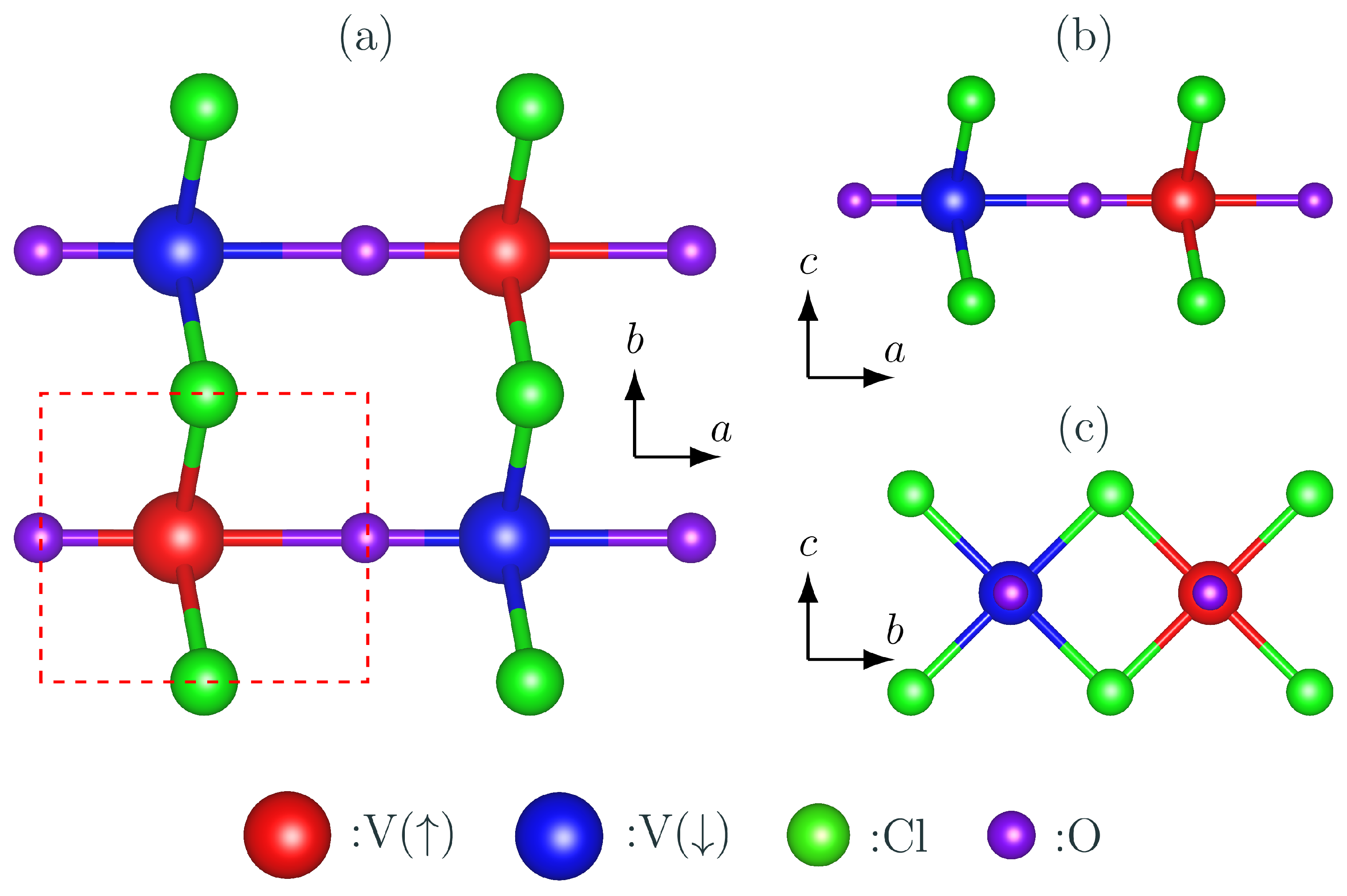
supercell shown in
Figure 1a. After the optimization process of the crystal structure, the lattice parameters for the
unit-cell were obtained using the Birch–Murnaghan equation of state [
37] and the obtained results are summarized in
Table 1, which appear to be in agreement with the theoretical and experimental results reported in the literature [
11,
12,
40]. For the modified V
1−xX
xOCl
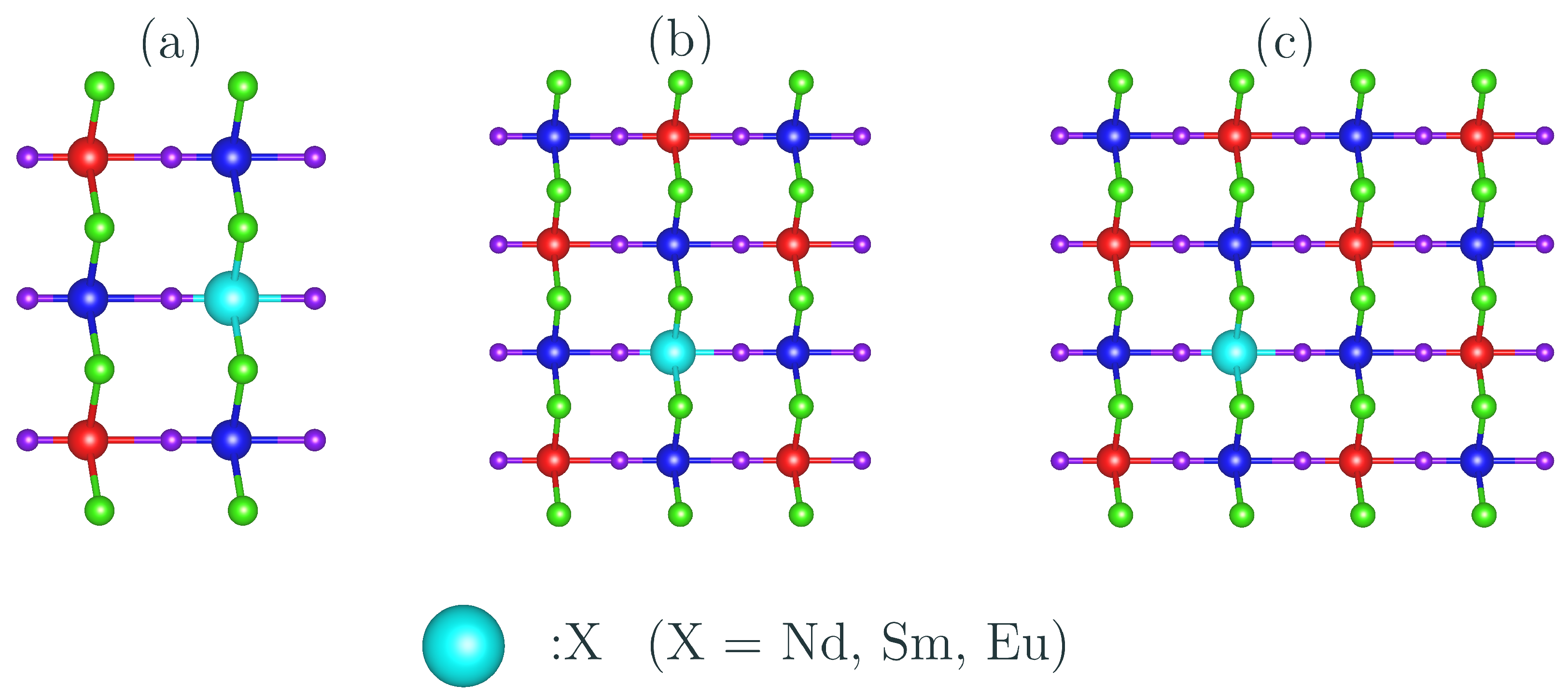
2 system (with X = Nd, Sm, and Eu), the initial crystalline structure is represented in
Figure 2, where a V(↑) atom has been substituted by a rare-earth ion (represented by sky-blue sphere). In this case, after the crystal structure optimization process, considering the energy minimization, noticeable changes are observed in the obtained lattice parameters, being also dependent on the doping concentration (see
Table 1). For instance, for the V
0.834X
0.166OCl
2 composition it can be seen that
a increases by
% (
Å),
% (
Å) and
% (
Å), for the Nd, Sm, and Eu RE elements, respectively, whereas
b increases by
% (
Å),
% (
Å) and
% (
Å), respectively for Nd, Sm, and Eu. Furthermore, the unit-cell angle (
) increases by
%,
%, and
%, respectively, for the Nd, Sm, and Eu RE elements. On the other hand, for the
concentration, it was observed that the lattice parameters
a and
b also increase, with variation for
a around
%,
% and
%, and that for
b around
%,
% and
%, for Nd, Sm, and Eu, respectively. However, no change was observed in the crystal angle for this composition. For the highest doping concentration (
), both lattice parameters (
a and
b) increase, with the variation in
a being around
%,
% and
% and that in
b being around
%,
%, and
%, for the Nd, Sm, and Eu elements, respectively. For this composition, the observed changes in
are also negligible. The observed behavior in the lattice parameters with increasing both the doping concentration and RE element correlates with the ionic radii of the substitutional cations as well as the chemical bonds between nearest neighbors.
The thermodynamic stability of the optimized crystal structures of the modified V
1−xX
xOCl
2 systems is given by the formation energies defined by
where
E(V
1−xX
xOCl
2) is the total energy of the modified system,
E(VOCl
2) is the total energy of the VOCl
2 supercell equivalent to the V
1−xX
xOCl
2 system, and
and
parameters are the chemical potentials of the doping cation (X) and the V atom, respectively [
41,
42,
43]. The calculated values for
are reported in
Table 1, where a formation energy value of around
eV for the pure VOCl
2 system has been obtained, which guarantees the stability of the crystalline structure and the charge redistribution. For the modified V
1−xX
xOCl
2 systems, the formation energy values are lower than those obtained for the pure VOCl
2 system and decrease as the doping concentration decreases. That is, the formation energy for the V
0.938X
0.062OCl
2 (with X = Nd, Sm, and Eu) composition is lower than that for the V
0.917X
0.083OCl
2 system, which in turn is lower than that for the V
0.834X
0.166OCl
2 system. The V
0.938X
0.062OCl
2 composition described using
supercells has the highest thermodynamic stability. These results reveal that at lower concentrations of the substitutional RE cations, the probability for the formation of the crystal structure is higher, in particular for the Sm element.
3.3. Electronic Properties for the V1−xXxOCl2 (with X = Nd, Sm, Eu)
Considering the initial models used for the V
1−xX
xOCl
2 system (as shown in
Figure 2), and the structural parameters reported in
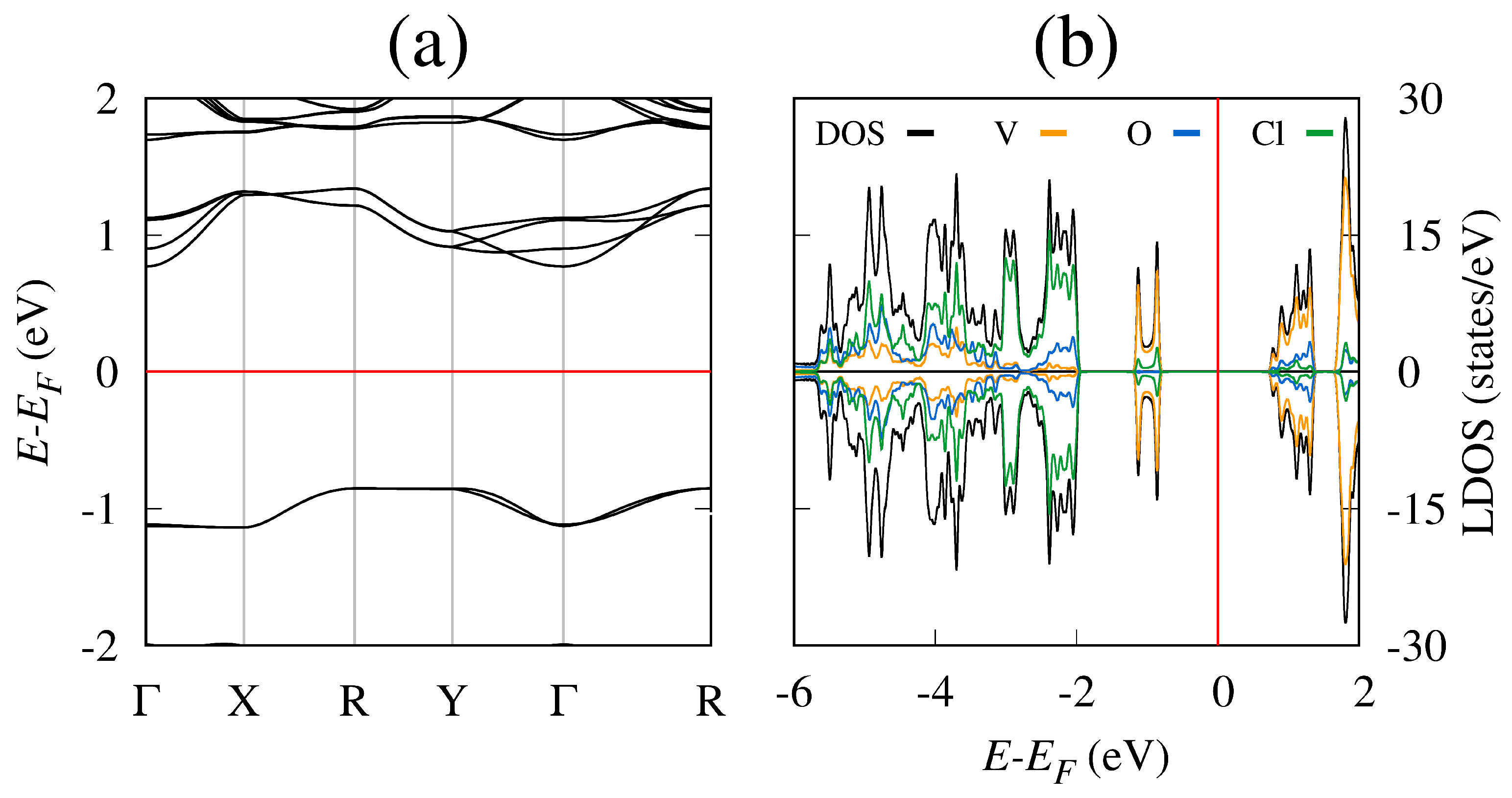
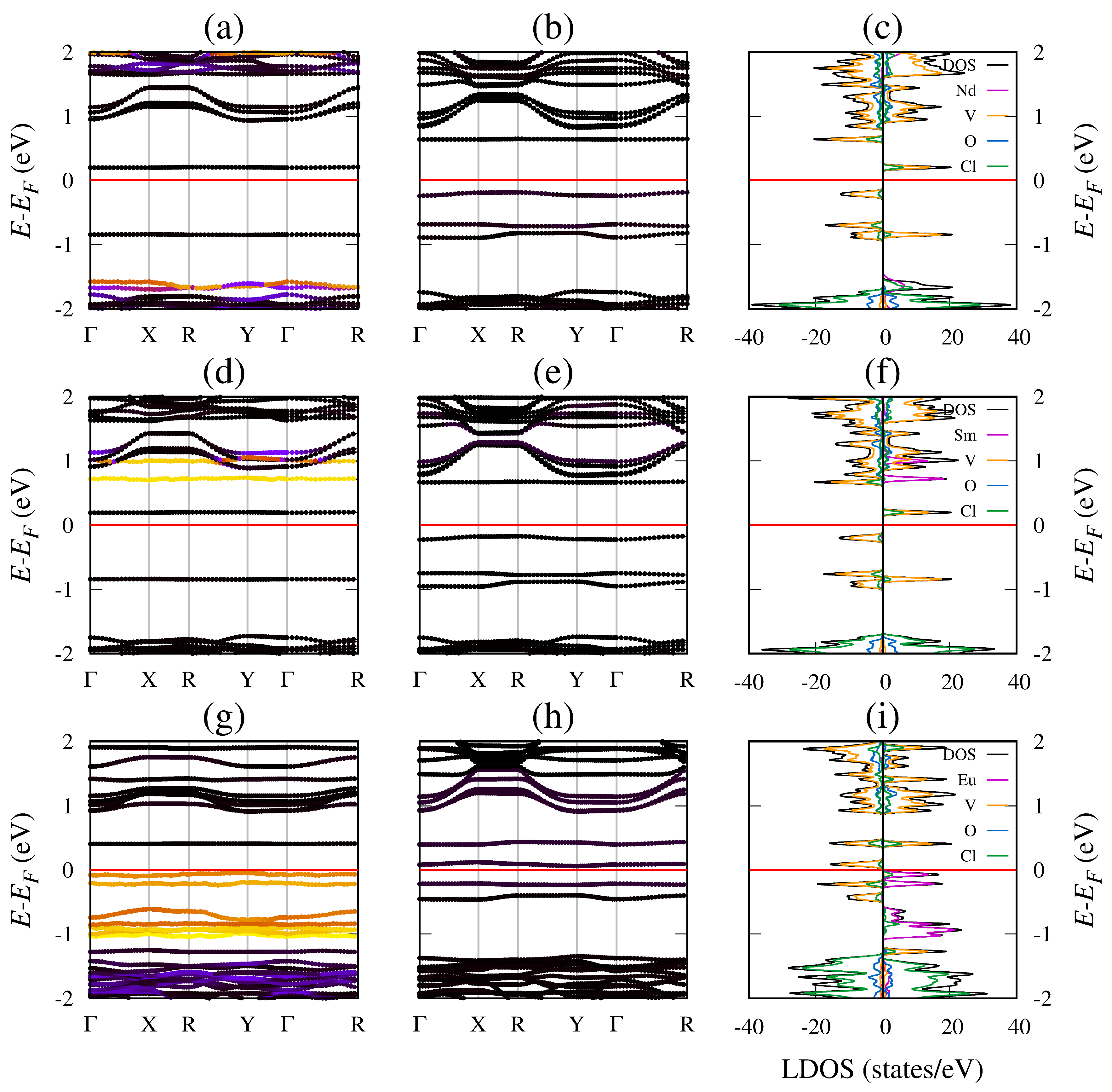
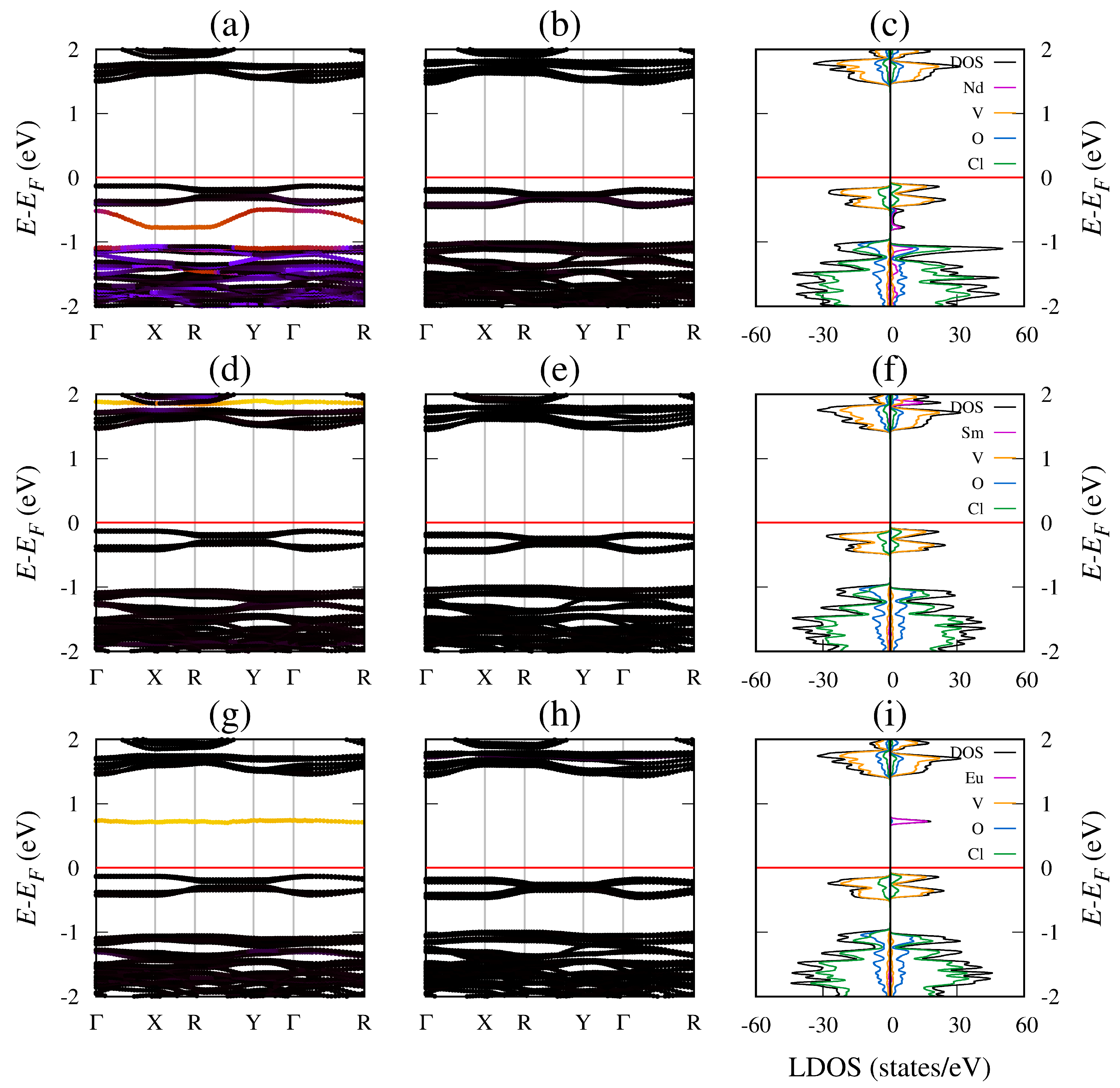
Table 1, we performed the self-consistent calculation of the Kohn–Sham energy levels and wave functions, whose results were used for the construction of the band structures and local density of states represented in
Figure 4.
Figure 4a describes the fat-bands for the V
0.834Nd
0.166OCl
2 composition, including the spin-up projected density-of-states (PDOS) contribution of the Nd(up) orbitals, corresponding to the occupied states with
energies around
eV for the 3
d-states of V. The conduction band states around
eV correspond to the hybridization of the 3
d-states of V and the 2
p unoccupied states of Cl. The 4
f occupied states’ contribution for Nd to the valence band is observed in orange color for the
energy around
eV, and around
eV in the conduction band.
Figure 4b shows the band structure for spin-down electrons of the V
0.834Nd
0.166OCl
2 system, where the contribution of the Nd-4
f down states has been included, which is negligible compared to the other atoms contributions. In this band structure, the occupied states for the
energy around
and
eV correspond to the 3
d spin-down electrons of V, and the conduction band states for energy around
eV correspond to the 3
d unoccupied states of V. The semiconductor behavior of the V
0.834Nd
0.166OCl
2 system is guaranteed with the calculated indirect bandgap, reaching an energy value around
eV, with occupied states showing higher energy in the valence band near to the R point and unoccupied states showing lower energy in the conduction band near the Γ point in the first Brillouin zone. The local density of states (LDOS) for each atom and the density of states (DOS) represented in
Figure 4c confirm the results obtained by the band structures of the V
0.834Nd
0.166OCl
2 composition, shown in
Figure 4a,b, and also confirm the calculated total magnetization (M
T) value around
/cell, which is explained by the difference between the spin-up and spin-down electron density of states of the modified system. This total magnetization and the calculated absolute magnetization of
/cell evidence the imbalance in the number of spin-up electrons and spin-down electrons, modifying the antiferromagnetic behavior, mainly due to the 4
f electrons of Nd presence, transforming the AFM-3 behavior of VOCl
2 to Ferrimagnetic behavior in the V
0.834Nd
0.166OCl
2 system. The V, O and Cl atoms maintain an important contribution to the valence band formation of
energies between
and
eV, with the contribution of the spin-up 4
f-states of Nd being determinant for
energies between
and
eV.
Figure 4d depicts the fat-bands for the V
0.834Sm
0.166OCl
2 composition, including the PDOS of the 4
f-states of spin-up Sm orbitals, corresponding to the occupied states with
energies around
eV for the 3
d-states of V. The conduction band states observed around
eV correspond to the hybridization of the 3
d-states of V and the 2
p unoccupied states of Cl, similar to the V
0.834Nd
0.166OCl
2 composition. The 4
f unoccupied spin-up states of Sm are important for the conduction band formation, as shown by the energy levels in yellow colors for the
energies around
and
eV.
Figure 4e shows the band structure for spin-down electrons of the V
0.834Sm
0.166OCl
2 system, where the PDOS of 4
f down-states is negligible, when compared to the contributions of the other atoms. In this band structure the occupied states for the
energy around
and
eV correspond to the 3
d spin-down electrons of V, and the conduction band states for energy around
eV correspond to the 3
d unoccupied states of V. The calculated indirect bandgap between the R and Γ point in the first Brillouin zone of
eV reveals the semiconductor behavior of the V
0.834Sm
0.166OCl
2 composition. The LDOS per atom and the DOS shown in
Figure 4f confirm the band structure results, with a total magnetization (
) value of
/cell, which, together with the obtained values for the absolute magnetization around
/cell, reveals the ferrimagnetic behavior of the V
0.834Sm
0.166OCl
2 composition, mainly due to the presence of the 4
f-electrons of Sm. For energy values between
and
eV the V, O and Cl maintain their important contribution for the formation of the valence band.
The spin-up band structure for the V
0.834Eu
0.166OCl
2 composition is shown in
Figure 4g, including the PDOS of the 4
f spin-up states of Eu (shown by yellow color), which, in contrast to the 4
f spin-up electrons of Nd and Sm, constitutes the valence band close to the Fermi level, forming hybridizations with the 3
d spin-down electrons of V. The occupied states with
energies around
eV correspond to the 4
f-electrons of Eu. In the conduction band, for
energies around
eV, the unoccupied 3
d and 2
p states of V and Cl, respectively, hybridize.
Figure 4h shows the spin-down band structure for the V
0.834Eu
0.166OCl
2 composition, where the PDOS of 4
f down-states is negligible. On the other hand, for
energy values around
and
eV, the 3
d spin-down unoccupied states of V are important. In addition, the calculated indirect bandgap of
eV reveals the semiconductor behavior of the V
0.834Eu
0.166OCl
2 system. The LDOS per atom and the DOS shown in
Figure 4i also confirm the results for the band structures, and the total magnetization (M
T) around
/cell, with the absolute magnetization of
/cell, reveals the ferrimagnetic behavior of the V
0.834Eu
0.166OCl
2 composition, due to the influence of the 4
f-electrons of Eu. For energy values between
eV and
eV the V, O and Cl also maintain their important contribution for the formation of the valence band.
The initial configuration to study the V
1−xX
xOCl
2 (with X = Nd, Sm and Eu) system for
concentration is represented in
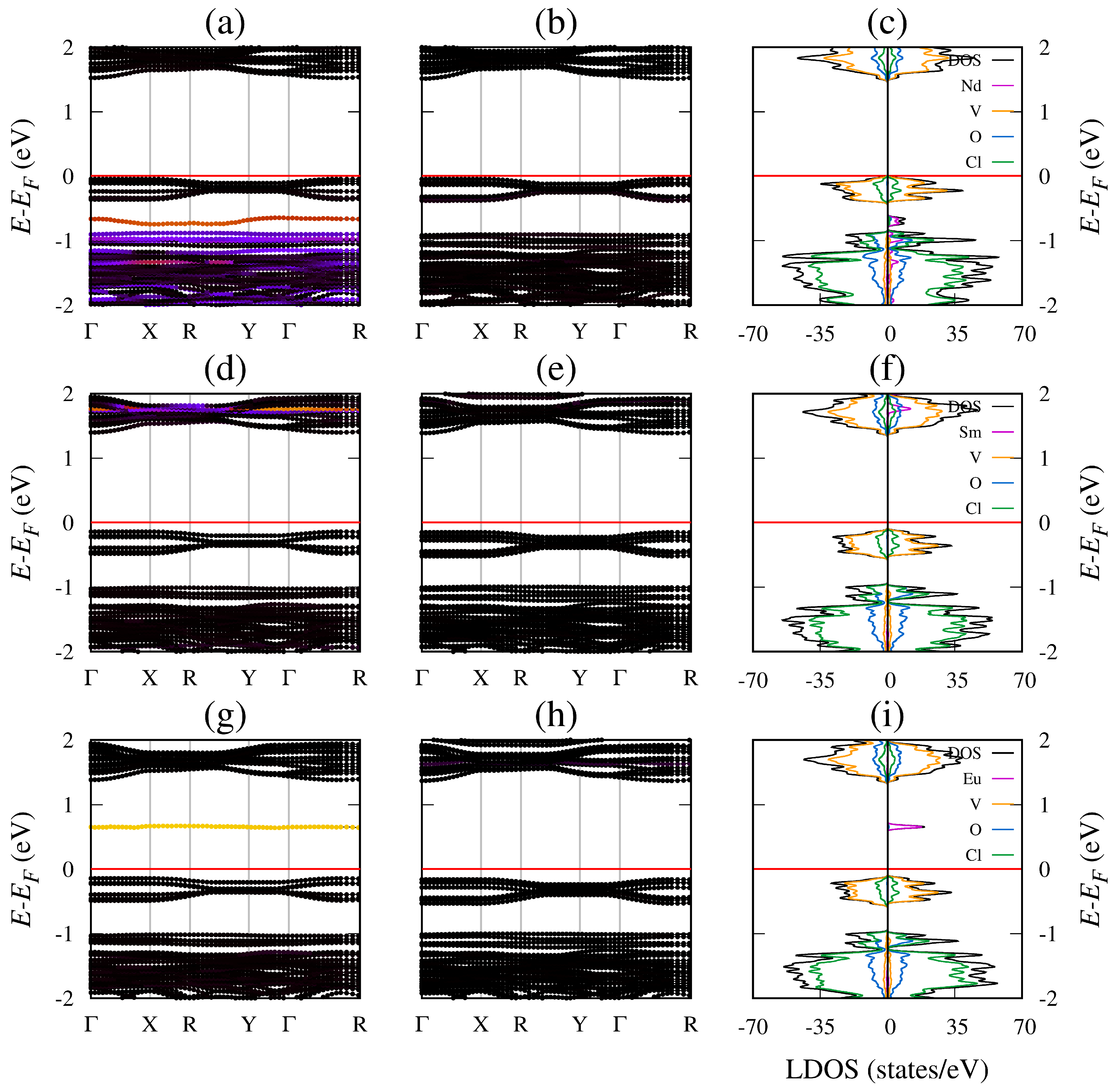
Figure 2b, and the results of the band structure, LDOS and DOS, obtained using the Kohn–Sham energies and wave functions, is represented in
Figure 5. The band structure for the V
0.917Nd
0.083OCl
2 composition around the Fermi energy, described by
eV, is shown in
Figure 5a, including the PDOS of the Nd-4
f spin-up states. The occupied states with
energies between
and
eV correspond to the hybridization of the 3
d-states of V, while those with energies between
and
eV correspond to the 3
p-states of Cl. The 4
f spin-up states of Nd, represented by orange color, also have an important contribution. For
energies below
eV up to
eV, the Nd-4
f, V-3
d, O-2
p and Cl-3
p spin-up states exhibit chemical bonds, as described in violet color. The conduction band for energies above
eV corresponds to the V-3
d spin-up states.
Figure 5b shows the spin-down band structure for the V
0.917Nd
0.083OCl
2 composition, with Nd-4
f spin-down states, which is negligible compared to the other atoms’ contributions. The occupied states for energies around
and
eV correspond to the V-3
d down-spin electrons, whereas the states above
eV are associated with V-3
d unoccupied states. The direct bandgap of
eV reveals the semiconductor behavior of the V
0.917Nd
0.083OCl
2 system, calculated at the Γ point in the first Brillouin zone. The LDOS per atom and the DOS shown in
Figure 5c confirm the electronic properties observed in
Figure 5a,b for this composition. The obtained values for the total magnetization and the absolute magnetization around
/cell and
/cell, respectively, reveal the structural change from an antiferromagnetic to a ferrimagnetic behavior for the V
0.917Nd
0.083OCl
2 system.
Figure 5d represents the spin-up band structure for the V
0.917Sm
0.083OCl
2 composition, with 4
f spin-up PDOS of Sm. The occupied states for
energies between
and
eV correspond to the V-3
d and Cl-3
p hybridized states. On the other hand, the Nd-4
f spin-up states are negligible between −0.2 and −4.5 eV, but have an important contribution to the valence bands between −4.5 and −5.5 eV. For energies between −1.0 and −6.0 eV, the spin-up states of V, O and Cl constitute the valence band. Around 1.9 eV, the Nd-4
f spin-up states (represented by yellow lines) also have important contributions to the conduction band.
Figure 5e shows the spin-down band structure of the V
0.917Sm
0.083OCl
2 system, where the Sm-4
f spin-down PDOS is negligible. As can be seen, the occupied states for
energies between −0.2 and −0.4 eV correspond to the 3
d spin-down electrons of V, while the observed ones in the conduction band above 1.5 eV correspond to unoccupied 3
d states of V. The calculated direct bandgap at the Γ point was found to be around 1.57 eV and reveals the semiconductor behavior of the V
0.917Sm
0.083OCl
2 composition. The LDOS per atom and DOS shown in
Figure 5f confirm the results of the band structures, where the observed value for the total magnetization (M
T) around
/cell, together with the absolute magnetization obtained around
/cell, indicates the ferrimagnetic behavior of the V
0.917Sm
0.083OCl
2 composition, promoted by the 4
f electrons of Sm.
The spin-up band structure with Eu-4
f spin-up PDOS for the V
0.917Eu
0.083OCl
2 composition is represented in
Figure 5g, where the occupied states located between
and
eV correspond to the 3
d-states of V, with the 4
f spin-up states of Eu being negligible. As observed, yellow lines around
eV in the conduction band represent the Eu-4
f unoccupied spin-up states. For energy values above
eV, the unoccupied states associated with V, O and Cl are important to form the conduction band. The spin-down band structure shown in
Figure 5h reveals that the Eu-4
f spin-down states have a negligible contribution for the formation of the band structure near the Fermi energy level. However, it is noticed that the V-3
d spin-down occupied states have important contributions for the formation of the valence band between
and
eV, as well as for the formation of the conduction band above
eV. The indirect bandgap of
eV is calculated between the R and Γ points in the first Brillouin zone, revealing the semiconductor behavior of the V
0.917Eu
0.083OCl
2 composition. The LDOS per atom and the DOS shown in
Figure 5i confirm the results of the band structures. At the same time, the total magnetization value of
/cell, together with the absolute magnetization of
/cell, reveals the ferrimagnetic behavior of the V
0.917Eu
0.083OCl
2 system, promoted by the presence of the Eu-4
f electrons.
In order to study the properties of the V
1−xX
xOCl
2 system, for
, represented by the initial model of
Figure 2c, we present in
Figure 6 the results of the band structures, LDOS and DOS, where the spin-up band structure for the V
0.938Nd
0.062OCl
2 system with Nd-4
f spin-up PDOS is shown in
Figure 6a. The valence band below the Fermi level (
eV) up to
eV is formed by V and Cl spin-up states. For energies around −0.7 eV the Nd-4
f spin-up states (represented by orange lines) have remarkable contributions. It can be observed that from
up to
eV there is a formation of Cl-dominant states, followed by the contributions of O, Nd (violet lines) and V. In the conduction band, above
eV, the 3
d-states of V are predominant.
Figure 6e shows the spin-down band structure for the V
0.938Nd
0.062OCl
2 system, where the contribution of the Nd-4
f spin-down states is almost zero. The energy bandgap of
eV, calculated by the energy difference between the highest occupied state (around the X point) and the lowest unoccupied state (Γ point), reveals the semiconductor behavior of the V
0.938Nd
0.062OCl
2 system. The LDOS per atom and the DOS shown in
Figure 6c confirm the results shown in
Figure 6a,b. The total magnetization value of
/cell and the obtained absolute magnetization around
/cell reveal the change from antiferromagnetic to ferrimagnetic behavior of the modified system, induced by the presence of the 4
f-electrons of Nd. The V, O, and Cl have important contributions to the valence band between
and
eV, with a predominance of the Cl states.
Figure 6d represents the spin-up band structure near the Fermi energy for the V
0.938Sm
0.062OCl
2 composition, where the valence bands with energies between
and
eV correspond mainly to the 3
d-states of V, while the contribution of the spin-up states of Nd is negligible. In contrast, for the unoccupied states of the conduction band, around
eV, the 4
f states of Sm have a considerable contribution, although lower than the contribution of V.
Figure 6e shows the spin-down band structure of the V
0.938Sm
0.062OCl
2 system, where the contribution of the Sm-4
f spin-down states is negligible. The semiconductor behavior of the V
0.938Sm
0.062OCl
2 system is revealed by the presence of an indirect bandgap around
eV, with the highest energy occupied states in the valence band (near to the X point) and the lowest energy unoccupied states in the conduction band at the Γ point of the first Brillouin zone. The LDOS per atom and the DOS shown in
Figure 6f reinforce the results shown by the band structures. The total magnetization of
/cell and the absolute magnetization value of
/cell reveal the ferrimagnetic behavior of the V
0.938Sm
0.062OCl
2 system. For energies between
and
eV (in the valence band) and between
and
eV (in the conduction band), the V, O, and Cl atoms also have significant contribution, with the Cl states being more important, followed by the O, V and Sm-4
f states, respectively.
The spin-up band structure of the V
0.938Eu
0.062OCl
2 composition, shown in
Figure 6g with Eu-4
f spin-up PDOS, reveals that the valence band for energies between
and
eV is formed mainly by V and Cl states, with predominant V states. Yellow lines around
eV in the conduction band represent the Eu-4
f unoccupied spin-up states. Above
eV, the unoccupied states are associated with the V, O and Cl states.
Figure 6h shows the band structure for the down-spin electrons of the V
0.938Eu
0.062OCl
2 system, where the contribution of the Eu-4
f spin-down states are negligible. The semiconductor behavior for this composition is revealed by the calculated indirect bandgap around
eV, with the highest energy occupied states in the valence band (near the X point) and the lowest energy unoccupied states in the conduction band, near the Y point in the first Brillouin zone. The LDOS per atom and DOS shown in
Figure 6i confirm the results shown by the band structures. The total magnetization value of
/cell and the absolute magnetization found around
/cell reveal the ferrimagnetic behavior of the V
0.938Eu
0.062OCl
2 system. The Eu-4
f spin-up states have important contributions in the valence band for energies between
and
eV. The
Table 2 summarizes all total magnetization
and absolute magnetization
, calculated using the Projected Density of States.
Table 3 summarizes the magnetic moment contribution of the rare-earth (RE) cations and the magnetic moment (
M) associated with vanadium (V); the obtained results reinforce the idea that the magnetic behavior of the modified systems is mainly due to the presence of the doping elements. That is, while the RE dopant carries the dominant positive moment, the V sublattice develops an antiparallel (negative) net moment, which is consistent with ferrimagnetism.
3.4. Ferroelectric Properties
For the analysis of the ferroelectric behavior in the studied compositions, we consider that, according to the above discussed results, the band structure and the density of states revealed semiconductor behavior, which allows us to use the modern theory of electric polarization [
38,
39]. This approach expresses the spontaneous polarization using the Berry phases of occupied Kohn–Sham wave functions and an adiabatic pathway connecting a centrosymmetric and polar state, where the 2D polarization is calculated as the product of the 3D polarization and the monolayer thickness. The calculated spontaneous polarization for VOCl
2 (AFM-3) was found to be around 308.77 pC/m and can be associated with the Berry phases of the wave functions and the spatial symmetry break by the V ions’ displacement in
Å from their centrosymmetric position. In the modified systems, the observed changes in the spontaneous polarization are mainly related to the symmetry changes promoted by the rare-earth ion displacement, with respect to the V host ion’s position. For instance, in the V
0.834Nd
0.166OCl
2 composition the spontaneous polarization decreases to 296.36 pC/m, due to the Nd displacement of
Å, the near-oxygen average displacement of
Å, and the near-Cl ion displacement at
Å. On the other hand, the spontaneous polarization value of 333.91 pC/m for the V
0.834Sm
0.166OCl
2 system is generated by the Sm displacement of
Å and two near-V neighbors’ displacement at
Å, in addition to the O and Cl near-neighbor displacements. At the same time, the polarization value of 341.65 pC/m obtained for the V
0.834Eu
0.166OCl
2 system is generated by the Eu displacement of
Å, a V near-neighbor displacement of
Å, a near-oxygen displacement of
Å and near-Cl displacement of
Å. Also, it was found that the observed changes in the spontaneous polarization for all the other V
1−xSm
xOCl
2 studied systems are related to the displacement of the dopant ions and their nearest neighbors. The results are summarized in
Table 2, and can be verified using the effective Born charges. For all the cases, the polarization direction is located in the
a-
b plane of the crystal structure and is reported in pC/m (2D units). The calculated spontaneous polarization in the
z-direction (perpendicular to the
a-
b plane) is negligible for all the cases. As can be seen, for the V
0.834Sm
0.166OCl
2 and V
0.834Eu
0.166OCl
2 systems, the 2D spontaneous polarization increases, when compared with the pure VOCl
2 system, by 8.14% and 10.65% respectively, whereas for all the other cases lower 2D spontaneous polarization values have been found. Regarding the dependence of spontaneous electrical polarization
on the concentration of rare-earth ions, it can be observed that, for the V
1−xX
xOCl
2 studied systems, the calculated spontaneous polarization is lower for
and shows an intermediate value for
in all the cases. On the other hand,
reaches the highest value for
; the
values’ difference is around 22.95, 65.89 and 98.24 pC/m for X = Nd, Sm, and Eu, respectively. These results indicate a higher and smaller change in
in the presence of Eu and Nd, respectively. It is worthwhile to point out that the direction of the polarization in the V
1−xX
xOCl
2 compound changes along the
a-
b plane, from the –
x direction for the pure VOCl
2 system to approximately the +
x direction for the doped compositions, except in the case of the V
0.938Eu
0.062OCl
2 system, where the deviation angle is small. According to the data reported in
Table 2, the more noticeable change in the direction of the polarization occurs for the V
0.917Sm
0.166OCl
2 composition.
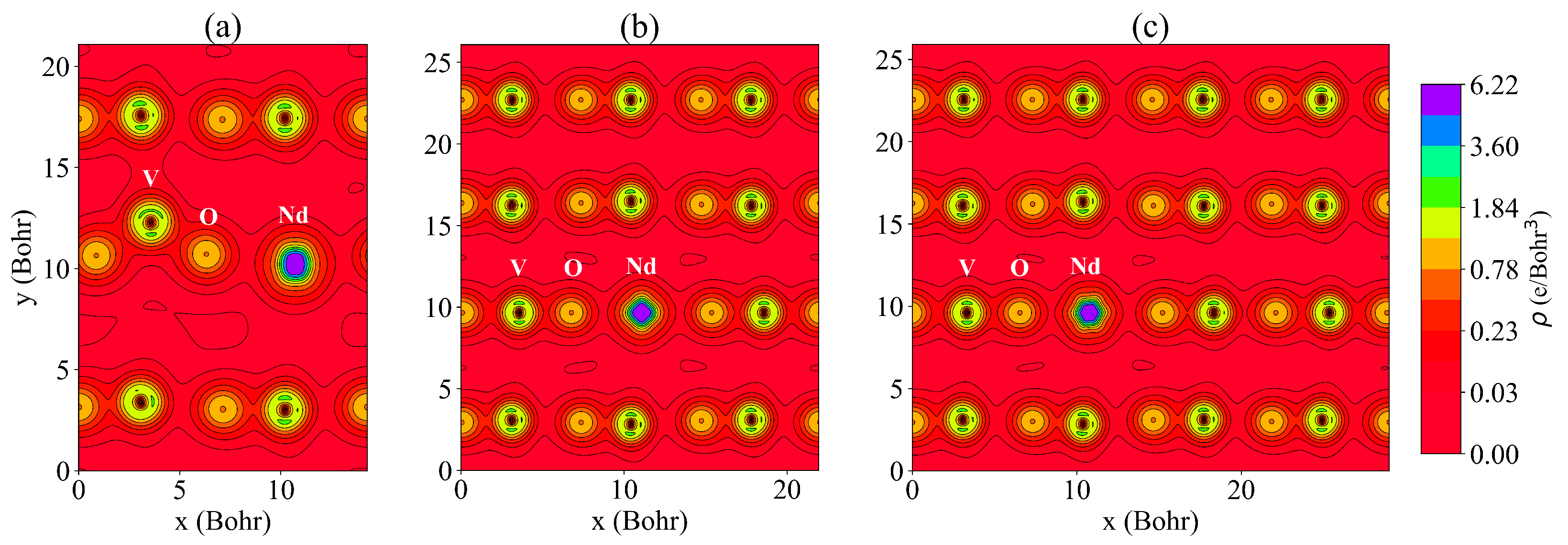
The observed changes in the spontaneous polarization can be explained by the electron charge density distortions caused by the presence of the rare-earth ions, as well as pseudo-Jahn–Teller distortions.
Figure 7 shows the charge density on the
a-
b plane for the V
1−xNd
xOCl
2 system for different concentrations (
x), where the highest displacement (
Å) of the Nd ions is found for
, as observed in
Figure 7a. It is important to emphasize that an identical configuration is observed in the charge density distribution for the V
1−xSm
xOCl
2 and V
1−xEu
xOCl
2 systems, except for a small increase in the intensity of the charge density at the positions of the Sm and Eu dopants.
The observed trends are consistent with previous reports on two-dimensional VOX
2 (X = Cl, Br, I) multiferroics, where ferroelectricity and magnetism originate from the same transition-metal cation [
11,
14]. Similar to rare-earth-doped bulk multiferroics such as BiFeO
3, dopant-induced lattice distortions modulate the electric polarization, whereas changes in the
hybridization govern bandgap evolution [
18]. Within the modern Berry-phase framework, the spontaneous polarization is governed by both ionic displacements and electronic charge redistribution [
38]. However, rare-earth substitution modifies local V-centered coordination, changing the bond lengths and angles and, in some cases, inducing Jahn–Teller-like distortions [
39]. In this context, such V-centered distortions (including possible Jahn–Teller-like local symmetry lowering) can modify V-O/Cl bond lengths, thereby changing both the ionic contribution to the polarization and the degree of
hybridization. These effects directly influence the magnitude of the polar distortion and the associated charge transfer, explaining the observed change of the polarization with the dopant type (X = Nd, Sm and Eu) and concentration (
x = 0.166, 0.083 and 0.062) [
38,
39].
From the experimental point of view, rare-earth substitution is a standard route in solid-state chemistry for tuning ferroic responses (as widely demonstrated in bulk multiferroics); the predicted energetic favorability suggests plausible thermodynamic accessibility [
18]. On the other hand, layered/van der Waals-type 2D materials can often be exfoliated from bulk precursors, or even grown from advanced thin-film growth routes, which include the Molecular Beam Epitaxy (MBE) and Chemical Vapor Deposition (CVD) techniques, depending on chemistry. Furthermore, according to the literature reports, a pristine VOCl
2 monolayer has been proposed to be synthesized as mechanically strippable from a layered bulk parent, suggesting that exfoliation-based routes may be viable [
11]. While direct experimental reports on RE-doped VOCl
2 monolayers are (to the best of our knowledge) still lacking, chemical exfoliation has been demonstrated for the related layered oxychloride VOCl
2 down to the monolayer limit [
10], thus supporting the practical accessibility of vanadium oxyhalide monolayers. On the other hand, rare-earth (RE) substitution could, in principle, be pursued during bulk crystal growth (followed by exfoliation), or via post-synthetic routes (e.g., ion-exchange/intercalation-assisted strategies), depending on the phase stability. In the present study, the VOCl
2 system belongs to the VOX
2 family where both magnetism and ferroelectricity can originate from the same transition-metal cation, enabling large polarization with strong magnetoelectric coupling, as indeed recently reported for VOCl
2-related monolayers [
11,
14]. However, compared to other 2D multiferroics (e.g., NbOI
2-based 2D materials) [
14,
46,
47], it can be seen that the studied VOCl
2-based system is distinctive in both magnetism and ferroelectricity responses, originating from the same V cation, offering enhanced tunability and potentially stronger magnetoelectric coupling.




 ,
,