


Abstract
This study investigates the elaboration, structural characteristics, and antibacterial performance of silver-based nanoparticles obtained via a hydrolytic chemical route, with and without assistance from ultrasound and microwave irradiation. Two silver nitrate precursor concentrations (1 M and 2 M) were employed to evaluate the influence of synthesis conditions on phase composition, morphology, and antimicrobial efficiency. The obtained powders were characterized by ATR-FTIR, X-ray diffraction (XRD), and scanning electron microscopy (SEM). XRD analysis revealed that drying at 120 °C led to oxide-rich systems dominated by Ag2O, with minor contributions from metallic Ag and carbonate species, while calcination at 550 °C resulted in complete phase transformation into highly crystalline metallic silver. SEM observations demonstrated that precursor concentration and synthesis assistance strongly affect particle size, aggregation degree, and surface morphology. Ultrasound- and microwave-assisted synthesis promoted finer crystallite sizes and more homogeneous particle distributions compared to non-assisted routes. The antibacterial activity was evaluated against Escherichia coli (Gram-negative) and Clostridium perfringens (Gram-positive, anaerobic, spore-forming). Oxide-rich samples, particularly Ox.Ag/2 M, exhibited rapid and complete bacterial inactivation within 30 min, while metallic silver samples showed time-dependent antibacterial behavior, achieving full inhibition after 4 h. The results demonstrate that antibacterial efficiency is governed by a synergistic interplay between silver oxidation state, nanoscale morphology, and surface reactivity. These findings highlight the potential of tailored silver-based nanomaterials as effective antibacterial materials for biomedical, food safety, and environmental applications.
1. Introduction
The rapid emergence of antibiotic resistance has made it one of the most pressing threats to global public health. This crisis has boosted the search for new antimicrobial agents and therapeutic strategies. In this context, nanomaterials, especially those based on silver, have attracted considerable attention due to their unique antimicrobial properties, which differ from those of macroscopic forms [1,2,3,4]. Silver has long been recognized for its antimicrobial activity, having been used since ancient times to purify water and prevent infections. Silver (Ag) can exist in three distinct oxidative states: silver(I) oxide—Ag2O, silver(II) oxide—AgO, and silver(III) oxide—Ag2O3. These oxidized forms of silver exhibit a wide range of applications, particularly due to their remarkable chemical and electrochemical properties [4,5,6,7,8,9]. Silver oxides are extensively utilized in fields such as medicine and the energy industry [10,11,12,13,14,15,16,17,18]. For instance, Ag2O and AgO are key components in the production of certain alkaline batteries, particularly those incorporating zinc (Zn), enhancing the efficiency and stability of these electrochemical energy storage devices [8,9,10]. In the medical sector, silver oxides are employed in the fabrication of devices due to their well-documented antibacterial and antifungal properties, making them suitable for coating medical equipment, surgical tools, and surfaces exposed to microbial contamination [11]. These compounds play a crucial role in inhibiting the proliferation of pathogenic microorganisms, contributing to the maintenance of hygiene and safety standards in clinical and hospital environments. This multi-target mode of action provides a significant advantage over conventional antibiotics, which are more prone to resistance development [16,17]. In addition to silver oxides and metallic silver, silver chloride (AgCl) is another relevant silver-based compound exhibiting notable antimicrobial activity. AgCl is frequently reported as a secondary or by-product phase in green synthesis approaches employing plant extracts, where Ag+ ions can interact with chloride-containing biomolecules or residual ions. Owing to its low solubility, AgCl can act as a sustained source of Ag+ ions, contributing to long-term antimicrobial effects, and has been extensively investigated as an antibacterial material (ABM) [18].
From a chemical standpoint, Ag2O and AgO are relatively easy to synthesize through conventional methods, such as the reaction between silver salts and strong bases under controlled pH and temperature conditions. Their straightforward synthesis has facilitated broad adoption in commercial and industrial applications.
In contrast, silver (III) oxide (Ag2O3) presents considerable challenges in terms of synthesis and stability. For example, Zhang et al. [19] demonstrated a one-step synthesis of monodisperse silver nanoparticles under Langmuir monolayers using vitamin E, which simultaneously acted as a reducing and stabilizing agent, allowing for precise control of particle size and dispersion. Other common approaches include reduction with sodium citrate or sodium borohydride. Physical methods such as laser ablation or vapor condensation are also employed, offering high product purity albeit at higher production costs.
Ag2O nanoparticles are generally synthesized through chemical precipitation methods, particularly by reacting silver salts with a base. Conventional chemical precipitation methods, while simple and scalable, frequently suffer from limitations related to particle agglomeration, broad size distributions, and limited control over crystallinity and morphology [15,19,20]. Compared to its lower oxidation state counterparts, Ag2O3 is significantly more difficult to obtain under industrial conditions due to the inherent thermodynamic and kinetic instability associated with its high oxidation state [5,6,13]. Beyond environmental and health concerns, the synthesis of Ag2O3 via perchlorate salts also presents a substantial physicochemical hazard: the risk of explosion. Perchlorates are generally highly reactive compounds, especially in the presence of combustible materials or under elevated temperatures [11,12,13,14,15,16,17].
In recent years, the “green synthesis” of nanomaterials has gained substantial attention due to its environmental benefits, notably by minimizing or eliminating the use of toxic chemicals and extreme reaction conditions [2,6,13,14,15]. This approach typically involves biological agents such as plant extracts, microorganisms, or biopolymers, which serve as reducing and/or stabilizing agents.
Both silver nanoparticles (AgNPs) and silver oxide nanoparticles (OxAgNPs) exhibit outstanding antimicrobial properties, rendering them highly valuable in biomedical and hygienic applications [21].
Although the antimicrobial mechanisms of silver-based nanomaterials are still under active investigation, increasing evidence indicates that the release of Ag+ ions plays a dominant role [12,13,14,15,16,17,22]. Recent studies employing gel-based immobilization approaches, in which nanoparticles are physically trapped and direct particle–cell contact is minimized, have demonstrated that significant antibacterial activity is preserved due to sustained silver ion release. These findings support the hypothesis that ion-mediated mechanisms represent a primary pathway in silver-induced antimicrobial activity, while nanoparticle morphology and surface chemistry mainly regulate the kinetics of Ag+ availability [23].
Although less studied than AgNPs, Ag2O nanoparticles also exhibit significant antimicrobial activity [11], largely attributed to the release of Ag+ ions and, under certain conditions, the generation of reactive oxygen species [12]. Sunita and Yegoti emphasized the potential of silver oxide nanoparticles in prolonging food shelf life due to their disinfectant properties [11]. The nanometer size of AgNPs and Ag2O allows them to adhere to the surface of the bacterial cell. Electrostatic interactions between nanoparticles (which can have a surface charge) and the cell membrane (often negative) facilitate this adsorption. The adhesion of nanoparticles can induce the formation of pores or micro-cracks in the cell membrane, leading to the loss of essential cellular content (e.g., ions, ATP, DNA) and membrane depolarization, which compromises cell viability [16].
Studies have shown that at high concentrations, AgNPs can exhibit cytotoxicity to human cells and induce oxidative stress. Reidy et al. provide a critical review of the mechanisms of release, transformation and toxicity of silver nanoparticles, highlighting the need for in-depth studies on long-term exposure and impact on human health [23]. Similarly, the toxicity of silver oxide nanoparticles must be rigorously assessed.
The major concern about Escherichia coli (E. coli), an abundant Gram-negative bacterium, lies in its rapid ability to develop resistance to multiple classes of antibiotics, including state-of-the-art antibiotics. The study by Feng et al. [17] highlighted that silver ions can induce distinct morphological changes in E. coli, including cytoplasmic membrane detachment and DNA condensation, suggesting a robust and different action from that of antibiotics. The investigation of the activity of Ag and Ag2O nanoparticles on E. coli is therefore crucial not only to provide solutions against resistant strains, but also to contribute to the development of water purification systems and food safety strategies, given the role of E. coli as an indicator of contamination [16,17,24,25,26,27,28,29,30].
Antimicrobial evaluations of silver-based nanomaterials have predominantly targeted Gram-negative and Gram-positive aerobic bacteria, with E. coli being one of the most investigated model organisms. In comparison, strict anaerobic and spore-forming pathogens, such as Clostridium perfringens (C. perfringens), remain largely underrepresented in nanomaterial-based antibacterial research, despite their major relevance to food safety and public health. C. perfringens is a Gram-positive, strict anaerobic and spore-forming bacterium, recognized as a leading cause of food poisoning worldwide, especially through contamination of meat products [23]. Its ability to form heat-resistant spores allows it to survive cooking processes and proliferate under anaerobic conditions, posing a major challenge for the food industry and consumer safety. Beyond food poisoning, C. perfringens can cause severe infections, such as gas gangrene, with lethal risk. While much of the antimicrobial research focuses on aerobic pathogens, the study of effective agents against anaerobic and sporulated bacteria, such as C. perfringens, is essential to fill existing gaps in microbiological control strategies. When discussing antibacterial performance, it is important to distinguish between metabolic oxygen requirements and bacterial cell wall structure. Although many bacteria, including E. coli, can grow under both aerobic and anaerobic conditions, the primary biological contrast addressed in this study is between Gram-negative and Gram-positive bacteria. E. coli is characterized by an outer membrane rich in lipopolysaccharides, whereas C. perfringens is a spore-forming bacterium with a thick peptidoglycan cell wall. These structural differences are expected to significantly influence bacterial susceptibility to silver-based ABM.
In this context, the novelty of the present study does not rely on introducing a new material system, but on a comparative evaluation of synthesis assistance methods, phase composition, and time-dependent antibacterial response. This work examines silver-based nanoparticles synthesized by a hydrolytic route assisted by ultrasound and microwave irradiation and directly compares them with non-assisted systems prepared under identical chemical conditions. While ultrasound- or microwave-assisted syntheses have been individually reported, their combined influence on phase composition, morphology, and antibacterial performance has received limited attention.
In addition, this study compares oxide-rich and metallic silver systems obtained through thermal treatment, highlighting differences between short- and extended-contact antibacterial activity. The inclusion of C. perfringens, a strict anaerobic bacterium rarely addressed in nanoparticle-based antibacterial studies, further extends the relevance of the comparative analysis.
Overall, the novelty of this work lies in clarifying how synthesis assistance and silver oxidation state jointly influence antibacterial behavior, rather than proposing silver nanoparticles as a new antibacterial concept.
In this context, the present study investigates the influence of synthesis conditions on the structure, morphology, and antibacterial performance of silver-based nanoparticles obtained via a hydrolytic chemical route, with and without assistance from ultrasound (US) and microwave irradiation (MAE). Emphasis is placed on the comparison between oxide-rich silver systems and metallic silver, as well as on the analysis of time-dependent antibacterial response. This approach aims to clarify the relationship between the silver oxidation state, structural characteristics, and antibacterial efficiency against both aerobic and anaerobic microorganisms.
Thus, the objectives of this study are as follows:
- To systematically compare silver nanoparticles synthesized via assisted US and MAE and non-assisted hydrolytic routes under identical chemical conditions;
- To correlate the silver oxidation state and the associated structural and morphological features with the kinetics of antibacterial activity evaluated at different contact times;
- To highlight the antibacterial behavior of silver-based materials against spore-forming anaerobic bacteria, with particular focus on C. perfringens, a microorganism rarely addressed in nanoparticle-based antibacterial studies.
2. Materials and Methods
2.1. Materials
For the synthesis of silver-based particles, silver nitrate (AgNO3) was used as the precursor, purchased from Chimreactiv SRL, Bucharest, Romania, along with demineralized water and potassium hydroxide (KOH), acquired from Roth, Newport Beach, CA, USA. Two synthesis routes were explored using different concentrations of AgNO3:1 M and 2 M, each dissolved in 50 mL of demineralized water. The use of varying precursor concentrations is essential for optimizing the AgNO3 concentration relative to the other reagents and for maintaining strict control over the synthesis conditions, which is critical for obtaining well-defined nanoparticles. A fixed concentration of KOH (1 M) was used as the hydrolyzing agent.
After dissolving the precursors, the hydrolyzing agent was added dropwise under continuous monitoring of pH using a Eutech pH meter (ThermoScientific, Eutech Instruments Pte Ltd., Singapore). After completion of the hydrolysis reaction, the resulting precipitate was processed following two distinct routes. In the first route, the precipitate was left untreated, without exposure to US or MAE irradiation. In the second route, the precipitate was subjected to ultrasonic treatment for 10 min at 42 kHz using a JP Selecta Ultrasons-Digit ultrasonic bath (Codyson Electrical Co., Ltd., Shenzhen, China), followed by MAE irradiation at 850 W for 3 min in a Samsung microwave oven (Suwon, Gyeonggi Province, South Korea).
The precipitates were then filtered and washed with demineralized water. Drying was carried out at 120 °C for 2 h in a Biobase drying oven (Bioland Co., Ltd., Jinan, China). After drying, the resulting powders were collected and labeled. Each powder was further subjected to calcination at 550 °C for 2 h in an MKF-05 muffle furnace (Mikrotest, Ankara, Turkiye). The samples are presented in Table 1.
Table 1.
Sample description.
2.2. Characterization Methods
The synthesized particles were characterized using complementary qualitative, structural, and morphological techniques, including Attenuated Total Reflectance–Fourier Transform Infrared Spectroscopy (ATR-FTIR), X-ray Diffraction (XRD), and electron microscopy. ATR-FTIR (BrukerOptik GmbH, Ettlingen, Germany), measurements were performed to evaluate the chemical purity of all samples using a Bruker Tensor 27 spectrometer, operating in the 4000–350 cm−1 spectral range with a resolution of 4 cm−1.
Structural analysis was carried out by X-ray diffraction using a Rigaku diffractometer (Rigaku Corporation, Tokyo, Japan). The morphology of the particles was examined by scanning electron microscopy (SEM) using a Hitachi SU5000 instrument equipped with secondary electron detectors (Hitachi High-Tech Corporation Hitachi, Hitachinaka, Japan). Prior to analysis, the samples were mounted on adhesive carbon tape and observed under high-vacuum conditions, employing an accelerating voltage of 25 kV and an emission current of 128 µA.
2.3. Testing the Bactericidal Effect
To assess the antibacterial activity, reference bacterial strains were used: E. coli ATCC WDCM 00013/VT 000132 and C. perfringens CRM 13170L. The specific culture media used for the growth of these reference strains under controlled environmental conditions included Chromocult Coliform Agar (CCA), Tryptose Sulfite Cycloserine Agar (Base)—TSC, and D-Cycloserine, all purchased from Merck KGaA (Darmstadt, Germany). Additional materials employed in the experimental procedure included sterile distilled water, sterile laboratory glassware (e.g., sterile test tubes, sterile pipettes, sterile graduated cylinders), 0.45 μm membrane filters, Anaerocult (Merck KGaA (Darmstadt, Germany). A for anaerobic conditions, a sterile filtration system with funnels, a laminar flow microbiological hood, and incubators set at 37 °C, 25 °C, and 44 °C. Sterile distilled water, which has no nutritional value for bacteria, was used to perform the bacterial suspension and test samples. The vegetative form of C. perfringens is sensitive without nutritional support.
An artificially inoculated sample was prepared by enriching it with E. coli and C. perfringens to evaluate the bactericidal and bacteriostatic effects of the silver-based powders. Each powder sample was weighed and added to the bacterial suspension, like [31]. The reference strain mix was made to replicate the natural conditions of the bacterial environment and test the antibacterial potential under these conditions. According to standardized microbiological verification protocols, method performance should be evaluated using natural samples containing mixed microbial populations or artificially inoculated samples enriched with reference bacterial strains (ATCC), as microorganisms rarely occur in isolation in real environments. In the present study, the interaction between E. coli and C. perfringens was considered negligible due to the short contact time (≤4 h) and their distinct environmental requirements. Furthermore, bacterial competition was eliminated during enumeration by using selective culture conditions: C. perfringens was determined on TSC agar supplemented with cycloserine, which inhibits E. coli, under anaerobic conditions, whereas E. coli was quantified on Chromocult Coliform Agar under aerobic incubation.
Samples 1–4 were bacteriologically analyzed in the first stage. A 2 mg of each powder sample was weighed and added to the bacterial suspension. The estimated microbial load, expected to increase on the control medium, was about 250 CFU/mL of Escherichia coli/mL and about 1.5 × 10³ CFU/mL of Clostridium perfringens. Samples 5–8 were tested in the second stage. The estimated microbial load, expected to increase on the control medium, was about 200 colonies of Escherichia coli and 1.5 × 10³ CFU/mL.
The samples are homogenized several times during the incubation process at a temperature of 25 °C, using a Vortex V-1 Plus-Biosan stirrer so that the nanoparticles remain in suspension for as long as possible.
Prior to being introduced into test tubes containing 10 mL of artificial bacterial suspension, the nanostructured powders were sterilized under UV light inside the microbiological hood for 15 min. The artificial test sample consisted of 8 mL sterile distilled water, 1 mL E. coli suspension, and 1 mL C. perfringens suspension. The positive control (M+) consisted of 8 mL sterile distilled water and 2 mL bacterial suspension (1 mL E. coli, 1 mL C. perfringens), while the negative control (M−) consisted of 10 mL sterile distilled water. All antibacterial experiments were performed in triplicate. According to laboratory protocol, the experimental uncertainty of CFU C. perfringens determination was estimated to be within ±22%, and for E. coli ±25%, according to laboratory protocol. For clarity, only representative samples are presented. The selection was based on reproducible trends observed in repeated experiments and did not affect the overall conclusions of the study.
3. Results
3.1. Qualitative Analysis by Spectroscopy
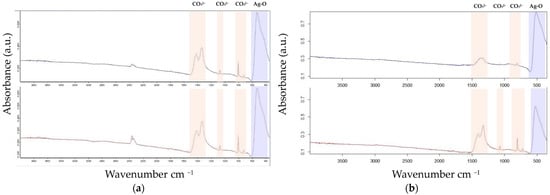
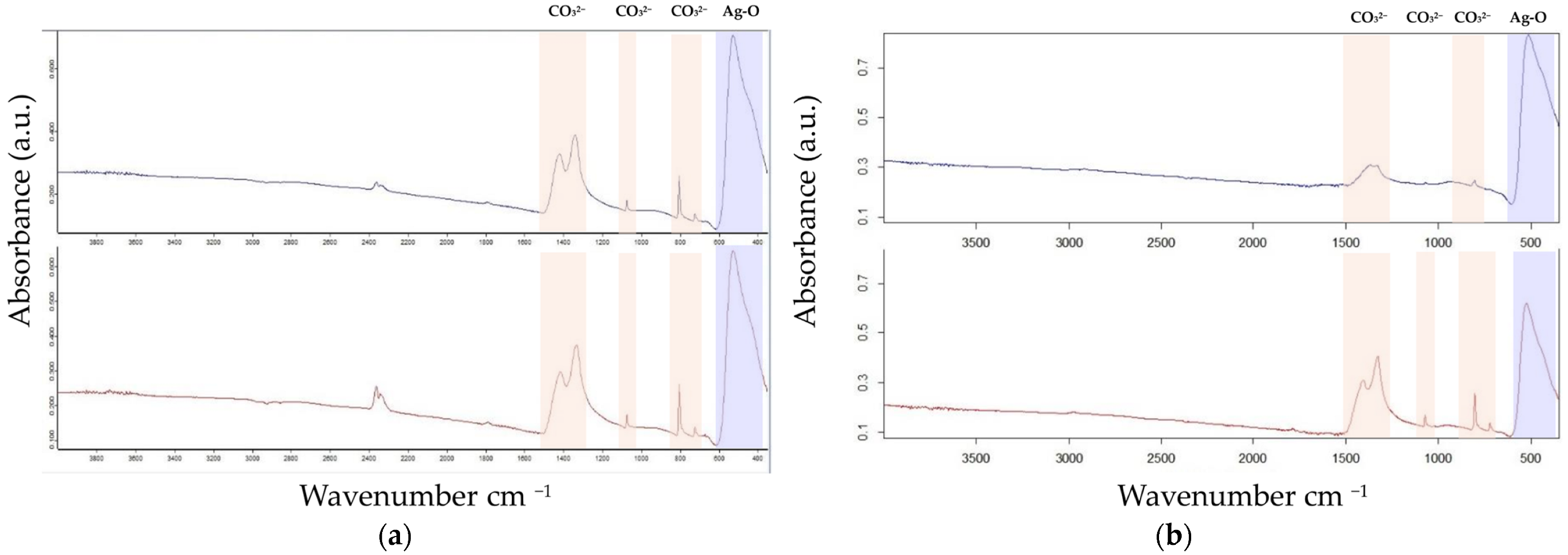
Fourier-transform infrared (FTIR) spectroscopy was employed as a qualitative analytical technique specifically suited for nanostructured samples. All measurements were carried out at room temperature, and the corresponding spectra are shown in Figure 1.
Figure 1.
ATR-FTIR spectra of (a) POx. and (b) Ox.Ag at 120 °C: blue (1 M) and violet (2 M).
Figure 1 presents the ATR-FTIR spectra of powders obtained by conventional hydrolytic synthesis and by hydrolytic synthesis assisted by US and MAE irradiation, using different AgNO3 concentrations. In all samples, absorption bands observed in the 520–560 cm−1 range are attributed to Ag–O stretching vibrations, indicating the formation of silver oxide species. Additional bands located between 1330 and 1414 cm−1 are assigned to the ν3(CO32−) asymmetric stretching mode of carbonate groups. The presence of carbonate species is further confirmed by bands around ~796 cm−1 or within the 860–880 cm−1 range, corresponding to the ν2(CO32−) bending vibration. A band centered near ~1065 cm−1 can be associated with the ν1(CO32−) symmetric stretching mode, which is typically enhanced in ATR measurements for surface or structurally distorted carbonate species. Broad absorption bands in the 3300–3500 cm−1 region are assigned to O–H stretching vibrations of adsorbed water.
The ATR-FTIR results indicate a clear influence of both precursor concentration and synthesis assistance on the surface chemistry of the silver-based materials. Conventional hydrolysis favors the formation of carbonate species, with their intensity increasing at higher AgNO3 concentrations. In contrast, US and MAE-assisted synthesis reduces surface carbonation and enhances the formation of Ag–O bonds. Subsequent calcination at 550 °C leads to the decomposition of carbonate species and the stabilization of silver oxide phases, yielding structurally purer materials, particularly for samples synthesized under assisted conditions.
3.2. Particle Structure
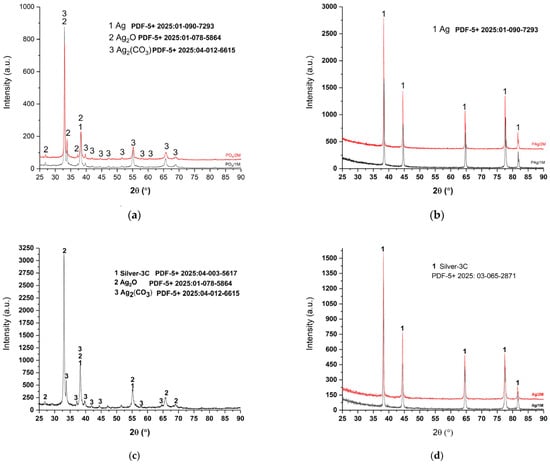
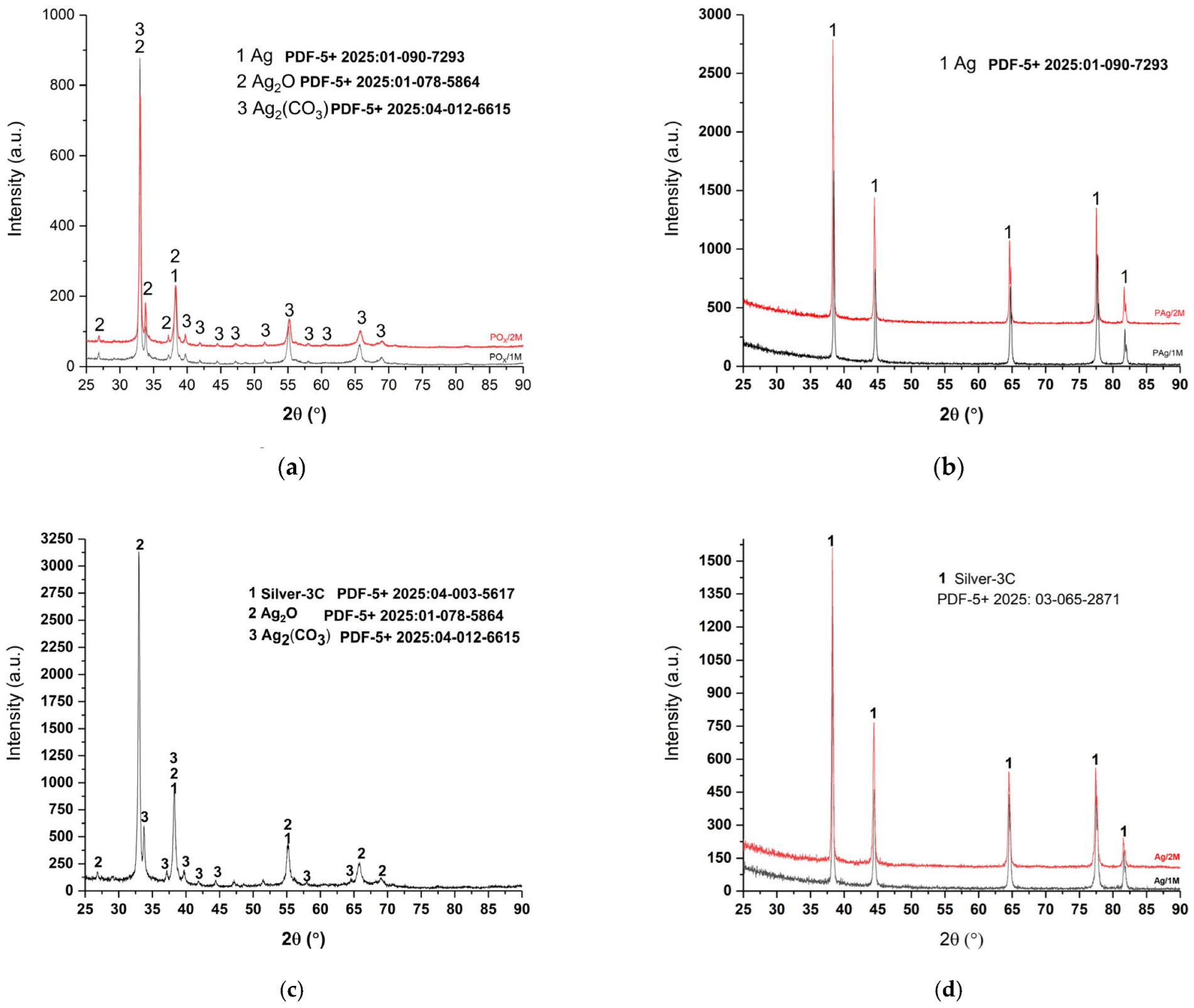
The crystalline structure and phase evolution of the silver-based powders were investigated by X-ray diffraction (XRD), with particular emphasis on the influence of precursor concentration, thermal treatment, and US and MAE-assisted synthesis. The XRD patterns of the hydrolytically synthesized samples dried at 120 °C are presented in Figure 2a for POx.Ag/1 M and POx.Ag/2 M, and in Figure 2c for Ox.Ag/2 M.
Figure 2.
An overlay of the XRD spectra for particles synthesized via hydrolytic method after (a) drying at 120 °C; (b) calcination at 550 °C; US and MAE (c) drying at 120 °C; (d) calcination at 550 °C.
For the dried samples, the diffraction profiles reveal a multiphase system dominated by silver(I) oxide (Ag2O). The main reflections observed at 2θ values characteristic of Ag2O can be indexed according to the PDF-5+ 2025 reference card no. 01-078-5864, confirming the formation of crystalline Ag2O during alkaline hydrolysis.
For the samples synthesized under ultrasound and microwave assistance and dried at 120 °C (Figure 2c, Figure S1, Table S1), the XRD pattern exhibits the characteristic low-angle reflection of Ag2O at approximately 27°, corresponding to the (110) plane of cubic Ag2O (PDF-5+ card no. 01-078-5864). This confirms that the formation of Ag2O is preserved under assisted synthesis conditions. In addition to the dominant oxide phase, weak diffraction peaks corresponding to metallic silver (Ag0, PDF-5+ card no. 01-090-7293) are detected, indicating partial reduction in Ag+ species. This reduction is most likely associated with surface-related redox processes occurring during drying, promoted by hydroxylated surfaces and structural defects. Therefore, US and MAE do not suppress Ag2O formation, but rather influence phase distribution and crystallite size.
Furthermore, several low-intensity reflections assigned to silver carbonate Ag2CO3 (PDF-5+ card no. 04-012-6615) are observed, particularly in the POx.Ag/2 M sample. During alkaline hydrolysis, silver ions initially form silver hydroxide or silver oxide intermediates. Upon drying at 120 °C, these species can react with atmospheric carbon dioxide CO2, which is unavoidably present in air, leading to the formation of silver carbonate Ag2CO3 on the particle surface. The detection of Ag2CO3 is supported by both XRD and ATR-FTIR analyses and is more pronounced for samples synthesized at higher precursor concentration, where increased surface reactivity favors CO2 adsorption.
Overall, these results demonstrate that drying at 120 °C stabilizes an oxide-rich silver system consisting mainly of Ag2O, with minor contributions from metallic Ag and carbonate phases.
The XRD patterns of the calcined samples obtained after thermal treatment at 550 °C for 2 h are shown in Figure 2b (PAg/1 M and PAg/2 M) and Figure 2d (Ag/1 M and Ag/2 M synthesized under US and MAE irradiation). In contrast to the dried powders, all calcined samples exhibit diffraction peaks exclusively corresponding to metallic silver with a face-centered cubic (fcc) structure (Silver-3C). The reflections at 2θ ≈ 38.1°, 44.3°, 64.4°, 77.5°, and 81.6° are in excellent agreement with PDF-5+ 2025 card no. 01-090-7293. The absence of additional peaks associated with silver oxides or carbonate phases confirms complete phase transformation and high phase purity after calcination.
The sharp and intense diffraction peaks observed for all calcined samples indicate a high degree of crystallinity and significant grain growth induced by thermal treatment. Crystallite size estimation using the Williamson–Hall method further highlights the effect of the synthesis route. The samples obtained without US and MAE assistance (PAg series) exhibit larger crystallite sizes, reflecting enhanced coalescence during calcination. In contrast, the Ag/1 M and Ag/2 M samples synthesized via hydrolysis assisted by US and MAE irradiation show smaller crystallite sizes, approximately 59 nm and 45 nm, respectively. This reduction in crystallite size is attributed to the combined effects of acoustic cavitation and MAE volumetric heating, which promote homogeneous nucleation and limit excessive crystal growth prior to calcination.
Overall, the XRD analysis clearly demonstrates a two-step structural evolution. The first step, corresponding to drying at 120 °C, yields oxide-rich silver materials dominated by Ag2O with minor metallic and carbonate phases. The second step, calcination at 550 °C, induces complete decomposition of carbonate species and reduction of silver oxides, resulting in highly crystalline metallic silver. Moreover, the application of ultrasound and microwave irradiation during synthesis plays a key role in refining crystallite size and controlling structural homogeneity, which has direct implications for the surface reactivity and antibacterial performance discussed in subsequent sections.
3.3. Particle Morphology and Size Distribution
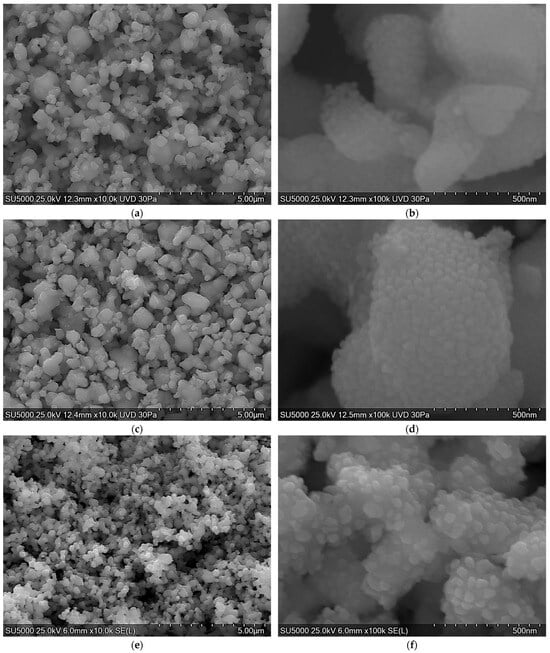
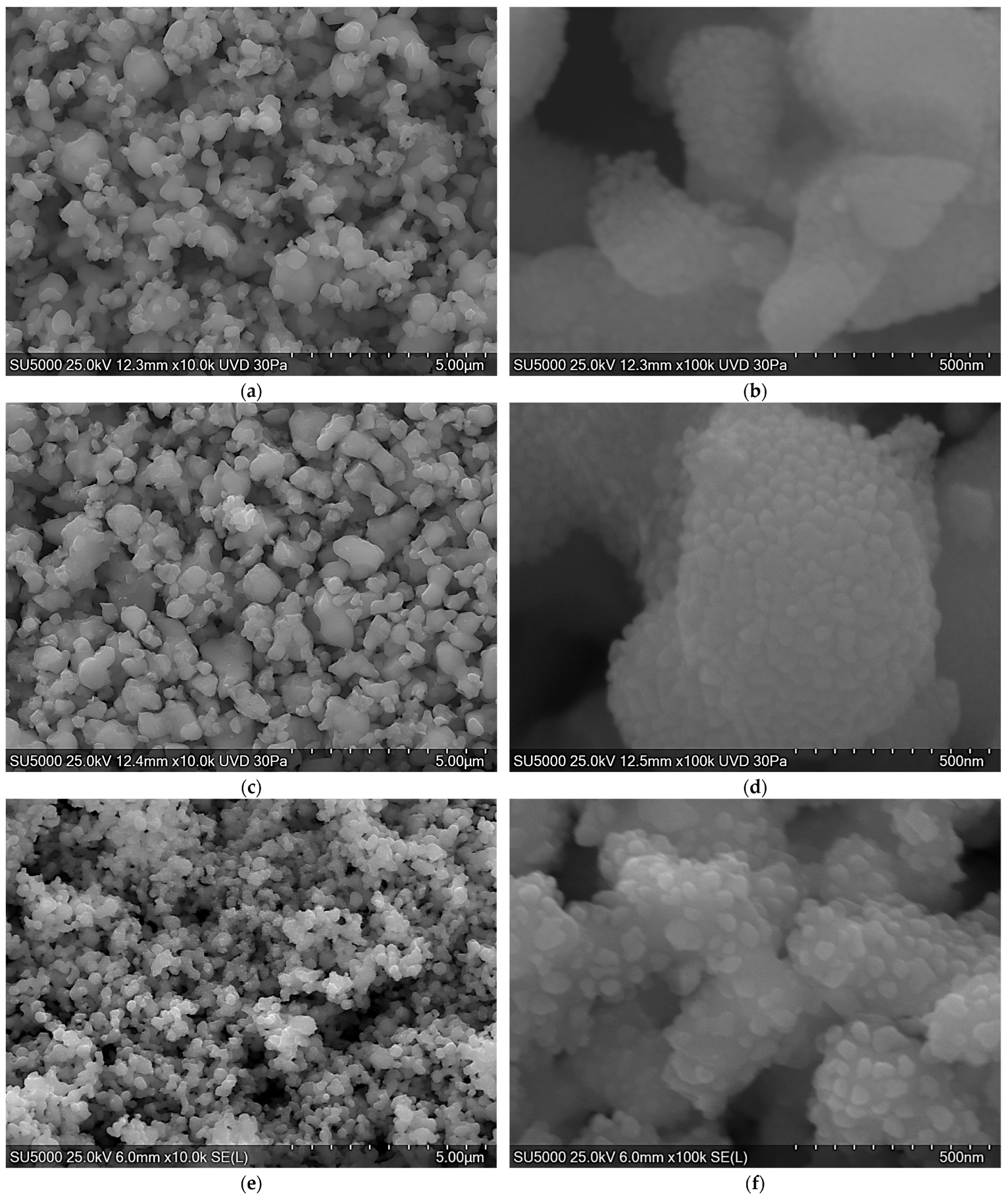
Morphological characterization was performed based on SEM micrographs acquired at different magnifications. Precursor concentration is a key parameter in nanoparticle synthesis, as it directly affects nucleation kinetics and crystal growth, thereby governing particle morphology, size, and aggregation degree. In this context, silver(I) oxide particles synthesized using identical routes but different silver nitrate concentrations, namely 1 M (POx.Ag/1 M) and 2 M (POx.Ag/2 M), were comparatively analyzed. The images in Figure 3 and Figure 4 highlight scale-dependent morphological features. At lower magnifications, the micrographs mainly reveal the overall aggregation state and compactness of the particle assemblies, whereas higher magnifications allow for the observation of primary nanoparticles, their shape, surface texture, and degree of interparticle fusion. This multiscale analysis provides complementary information on both macroscopic aggregation and nanoscale structural characteristics.
Figure 3.
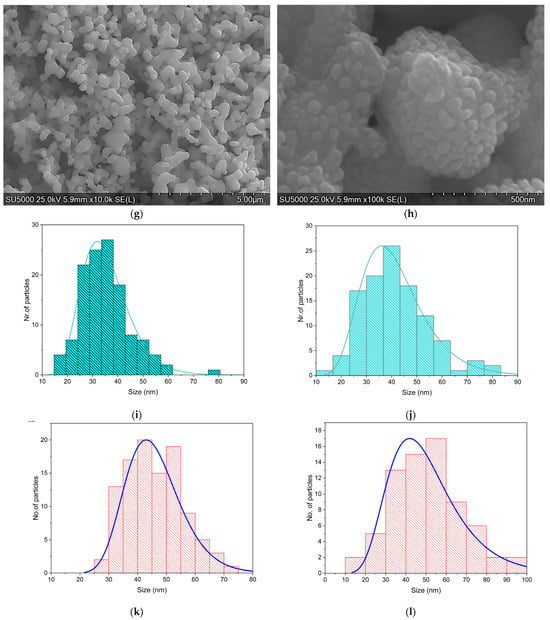
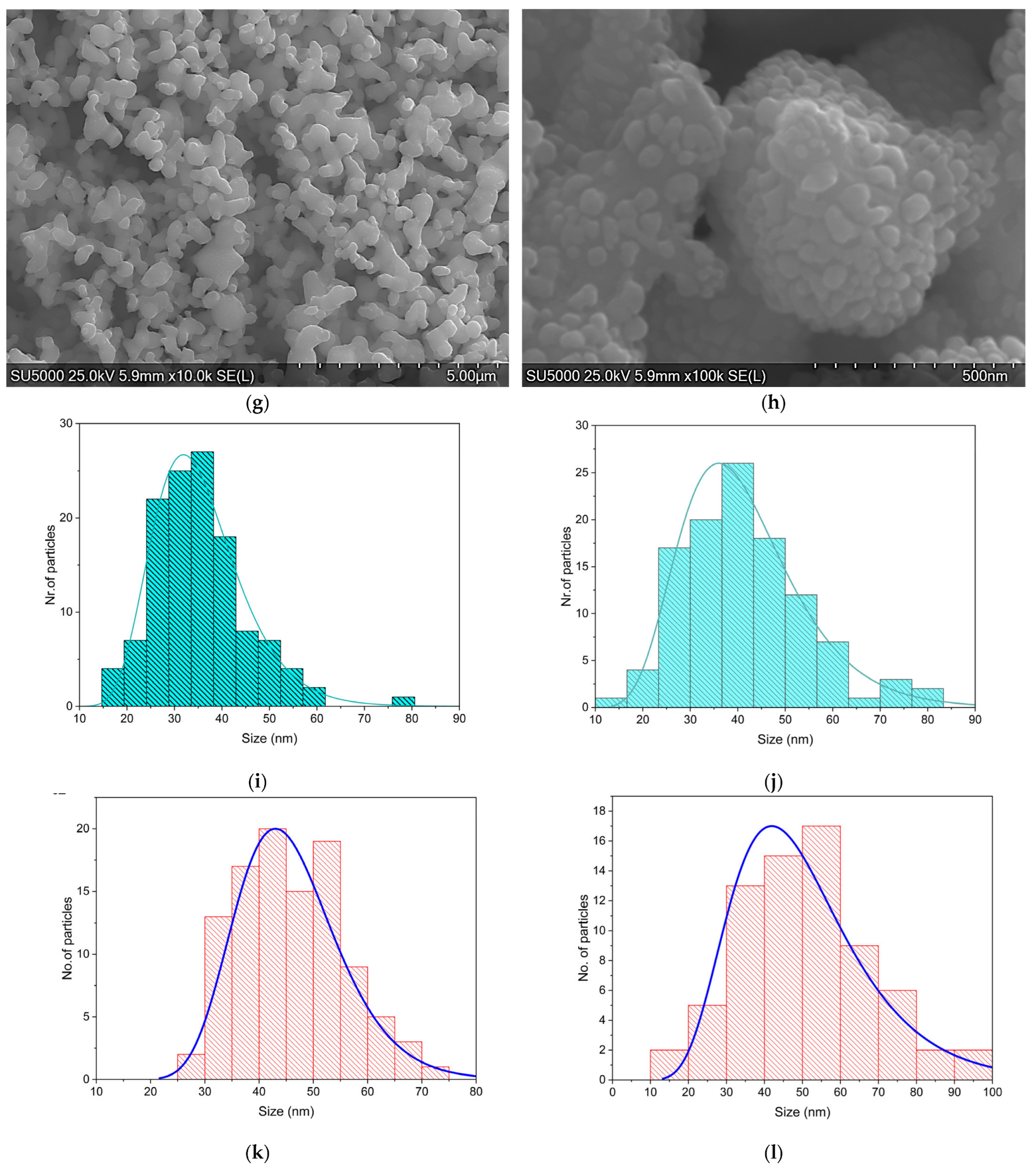
SEM micrographs of POx.Ag/1 M (a) at 10,000× magnification; (b) at 100,000× magnification; POx.Ag/2 M (c) at 10,000× magnification; (d) at 100,000× magnification; Ox.Ag/1 M (e) at 10,000× magnification; (f) at 100,000× magnification; Ox.Ag/2 M at (g) 10,000× magnification; (h) at 100,000× magnification; Particle size distribution of (i) POx.Ag/1 M; (j) POx.Ag/2 M; (k) Ox.Ag/1 M; (l) Ox.Ag/2 M.
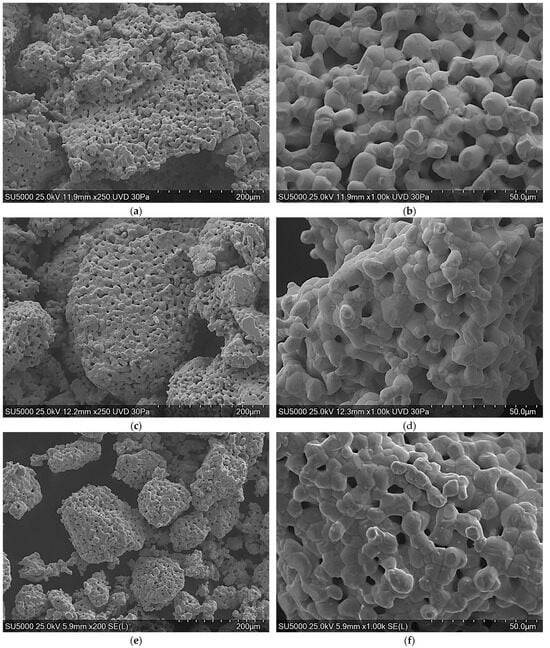
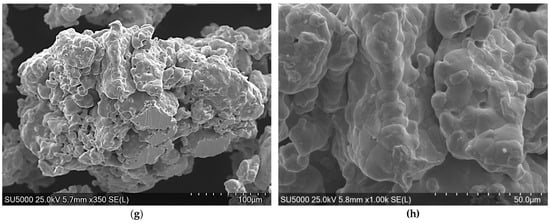
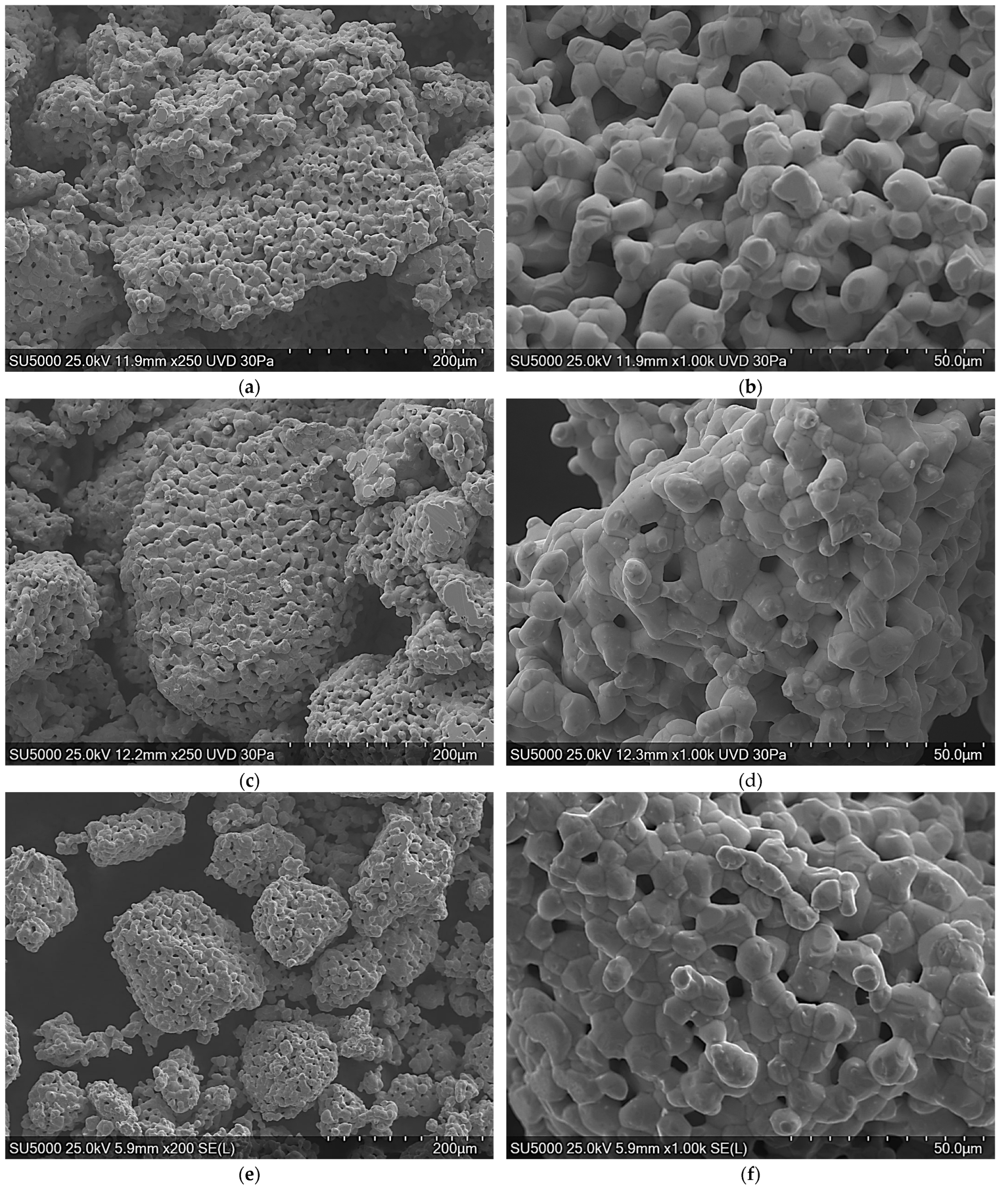
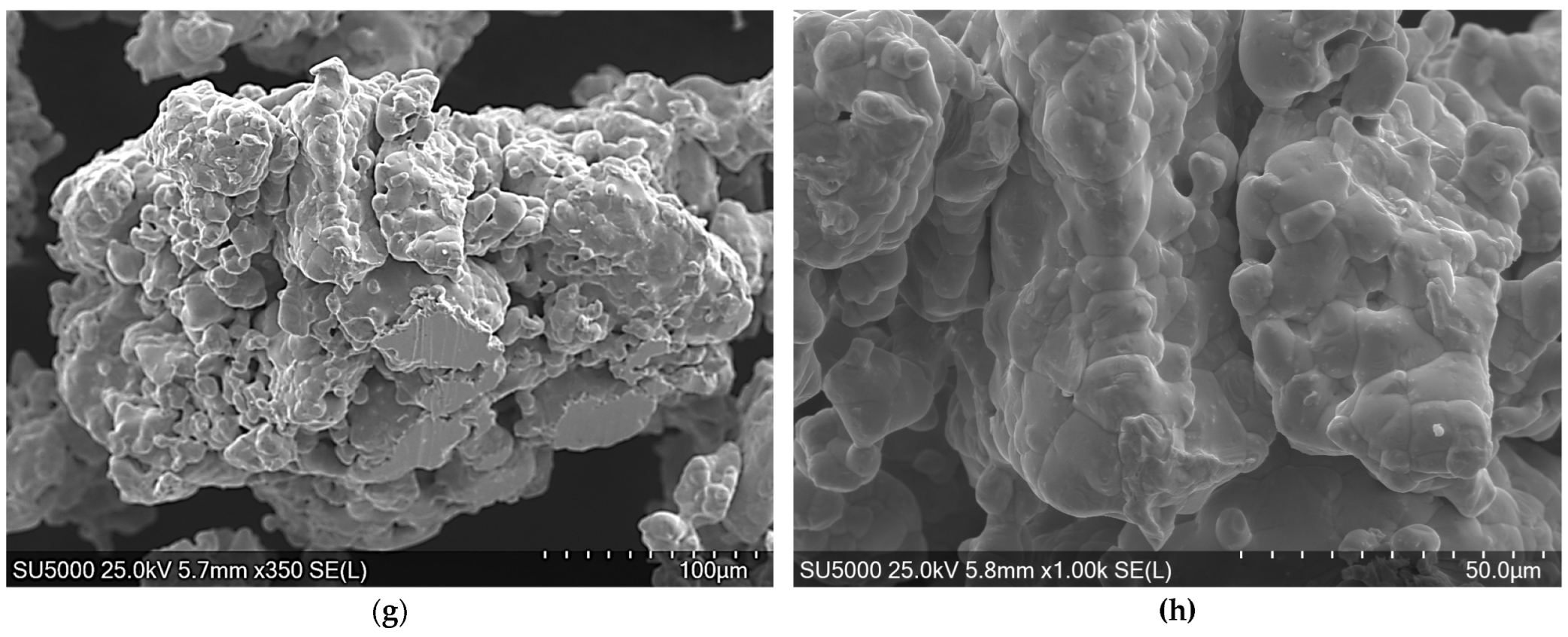
Figure 4.
SEM micrographs and particle size distributions of PAg/1 M (a) at 250× magnification; (b) at 1000× magnification; PAg/2 M (c) at 250× magnification; (d) at 1000× magnification; Ag/1 M (e) at 200× magnification; (f) at 1000× magnification; Ag/2 M (g) 350× magnification; (h) at 1000× magnification.
SEM images of the POx.Ag/1 M sample (Figure 3a,b) reveal a morphology typical of silver oxides rapidly precipitated in concentrated alkaline media. The material consists of fine primary nanoparticles that are strongly aggregated into compact micrometric structures. This morphology results from the rapid hydrolysis of silver nitrate in 1 M KOH, which promotes fast nucleation followed by aggregation. In contrast, the POx.Ag/2 M sample (Figure 3c,d) exhibits a denser and more compact morphology. The increased AgNO3 concentration favors enhanced crystal growth and aggregate coalescence rather than nucleation-dominated processes, leading to larger and more compact assemblies.
SEM micrographs of the Ox.Ag/1 M sample (Figure 3e,f) show predominantly spheroidal nanoparticles with slightly rounded contours, indicating relatively isotropic growth during synthesis. Particle agglomeration is evident, as commonly observed for silver oxide systems, suggesting strong interparticle interactions. Despite aggregation, individual nanoparticles remain distinguishable, forming an interconnected network-like structure. The corresponding particle size distribution (Figure 3i) exhibits a unimodal, bell-shaped profile that can be approximated by a normal distribution. Most particles fall within the 30–65 nm range, with sizes extending from approximately 20 nm to 75 nm, indicating relatively uniform growth and moderate size dispersion.
For the Ox.Ag/2 M sample, SEM images (Figure 3g,h) reveal a markedly different morphology, characterized by pronounced coalescence and three-dimensional aggregation. The particles display polygonal, elongated, or irregular shapes and are frequently fused together, forming dense aggregates. This morphology reflects accelerated growth kinetics at higher precursor concentration, where nucleation is rapidly followed by uncontrolled coalescence. The particle size distribution (Figure 3j) is broader than that of the 1 M counterpart, spanning approximately from 10 nm to 100 nm, with most particles concentrated between 30 nm and 80 nm. The presence of a tail toward larger sizes indicates increased polydispersity and non-uniform growth.
A direct comparison between Ox.Ag/1 M and Ox.Ag/2 M highlights the strong influence of precursor concentration on nanoparticle morphology. At 1 M, a balance between nucleation and growth leads to smaller, more uniformly shaped particles, whereas at 2 M, accelerated kinetics favor coalescence and the formation of irregular, densely aggregated structures.
Regarding the monodispersity of Ox.Ag/2 M particles (Figure 3f), the observed size distribution is relatively broad, ranging from approximately 10 nm to 100 nm. Nevertheless, most particles are concentrated in a narrower interval between 30 nm and 80 nm, with the highest count (around 17 particles) occurring in the 50–60 nm range. The presence of a “tail” toward larger sizes, up to 100 nm, indicates slightly increased polydispersity compared to other synthesis methods or literature reports, suggesting variability in particle growth under these specific conditions.
A comparison of the SEM images for Ox.Ag/1 M and Ox.Ag/2 M clearly illustrates the direct influence of precursor concentration on nanoparticle morphology. At a concentration of 1 M, the particles are smaller, better dispersed, and display a more spheroidal morphology, suggesting an optimal balance between nucleation and growth. In contrast, at 2 M, the accelerated kinetics favor coalescence and the formation of irregular, aggregated structures with variable sizes.
Figure 4 presents SEM micrographs and particle size distributions of silver-based materials after calcination. Calcination of the POx.Ag/1 M precursor at 550 °C, resulting in the PAg/1 M sample, induces extensive coalescence of the primary nanoparticles and the formation of large, platy aggregates with dimensions reaching several hundred micrometers (Figure 4a,b). The surfaces of these aggregates exhibit a fine granular texture, indicative of partial sintering of the initial nanoparticles and the development of hierarchical porosity. These morphological changes reflect substantial structural reorganization during thermal treatment.
For the PAg/2 M sample (Figure 4c,d), calcination leads to the formation of quasi-spherical aggregates with a spongy internal morphology and pronounced hierarchical porosity. This structure is attributed to enhanced solid-state diffusion and partial sintering processes promoted by the higher Ag+ concentration. Compared to the 1 M counterpart, the PAg/2 M sample exhibits a more compact yet internally developed architecture.
The Ag/1 M sample synthesized via hydrolytic routes assisted by US and MAE irradiation displays relatively well-defined quasi-spherical aggregates with a comparatively narrow size distribution, as shown in Figure 4e,f. The combined effects of acoustic cavitation and volumetric microwave heating limit excessive agglomeration and promote more homogeneous nucleation. In contrast, the Ag/2 M sample obtained under assisted conditions consists of compact, polyhedral aggregates with stratified surfaces, as shown in Figure 4e,g. Although US and MAE irradiation contribute to nucleation homogenization, their influence is partially offset by densification and coalescence processes associated with the higher precursor concentration.
3.4. Influence of Hydrolysis Conditions on Morphology of Silver-Based Nanoparticles
For hydrolytically synthesized silver oxide powders (POx.Ag), the AgNO3 precursor concentration controls the balance between nucleation and crystal growth. At 1 M AgNO3 (POx.Ag/1 M), rapid nucleation in highly alkaline media produces very fine primary nanoparticles that aggregate into compact micrometric clusters (Figure 3a,b).
Increasing concentration to 2 M (POx.Ag/2 M) promotes post-nucleation growth and coalescence, leading to denser aggregates (Figure 3c,d). The corresponding particle size distribution (Figure 3i) is unimodal and relatively narrow, with most particles in the 25–45 nm range.
A similar trend is observed for Ox.Ag samples. At 1 M AgNO3 (Ox.Ag/1 M), predominantly spheroidal and relatively uniform nanoparticles are formed (Figure 3e,f), with a narrow particle size distribution centered in the 30–55 nm range (Figure 3k). In contrast, Ox.Ag/2 M (Figure 3g,h) exhibits irregular, fused particles forming dense aggregates, accompanied by a broader size distribution extending up to ~100 nm and displaying a pronounced tail toward larger sizes (Figure 3l), indicative of enhanced growth and coalescence at higher precursor concentration.
Thermal treatment at 550 °C induces significant morphological changes in both POx.Ag samples, leading to metallic silver-rich materials (PAg). For PAg/1 M, SEM images (Figure 4a,b) reveal the formation of large aggregates with dimensions reaching several hundred micrometers. The granular surface texture suggests partial sintering of the initial nanoparticles and surface structural reorganization.
Calcination of POx.Ag/2 M yields PAg/2 M with quasi-spherical aggregates and a spongy morphology characterized by pronounced internal porosity (Figure 4 c,d). The higher initial Ag+ concentration enhances solid-state diffusion during calcination, favoring the development of an interconnected porous network rather than compact structures.
The application of US and MAE irradiation during hydrolytic synthesis further influences particle morphology. For Ag/1 M synthesized under US and MW, SEM images show relatively well-individualized quasi-spherical aggregates with a narrower size distribution, reflecting more homogeneous nucleation (Figure 4e,f). For Ag/2 M, although US and MW contribute to nucleation homogenization, their effect is partially offset by the high precursor concentration, resulting in more compact, polyhedral aggregates dominated by growth and densification processes (Figure 4g,h).
3.5. Antibacterial Activity
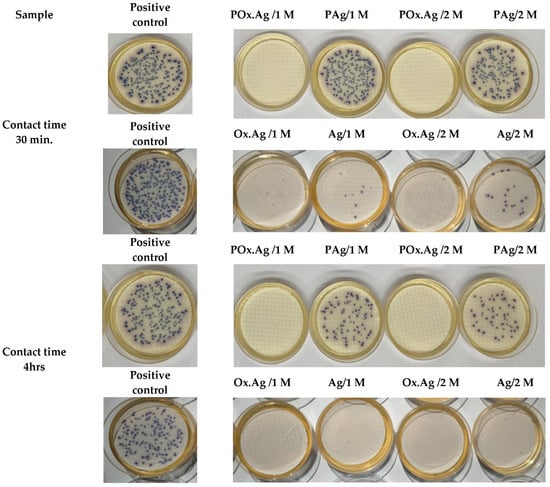
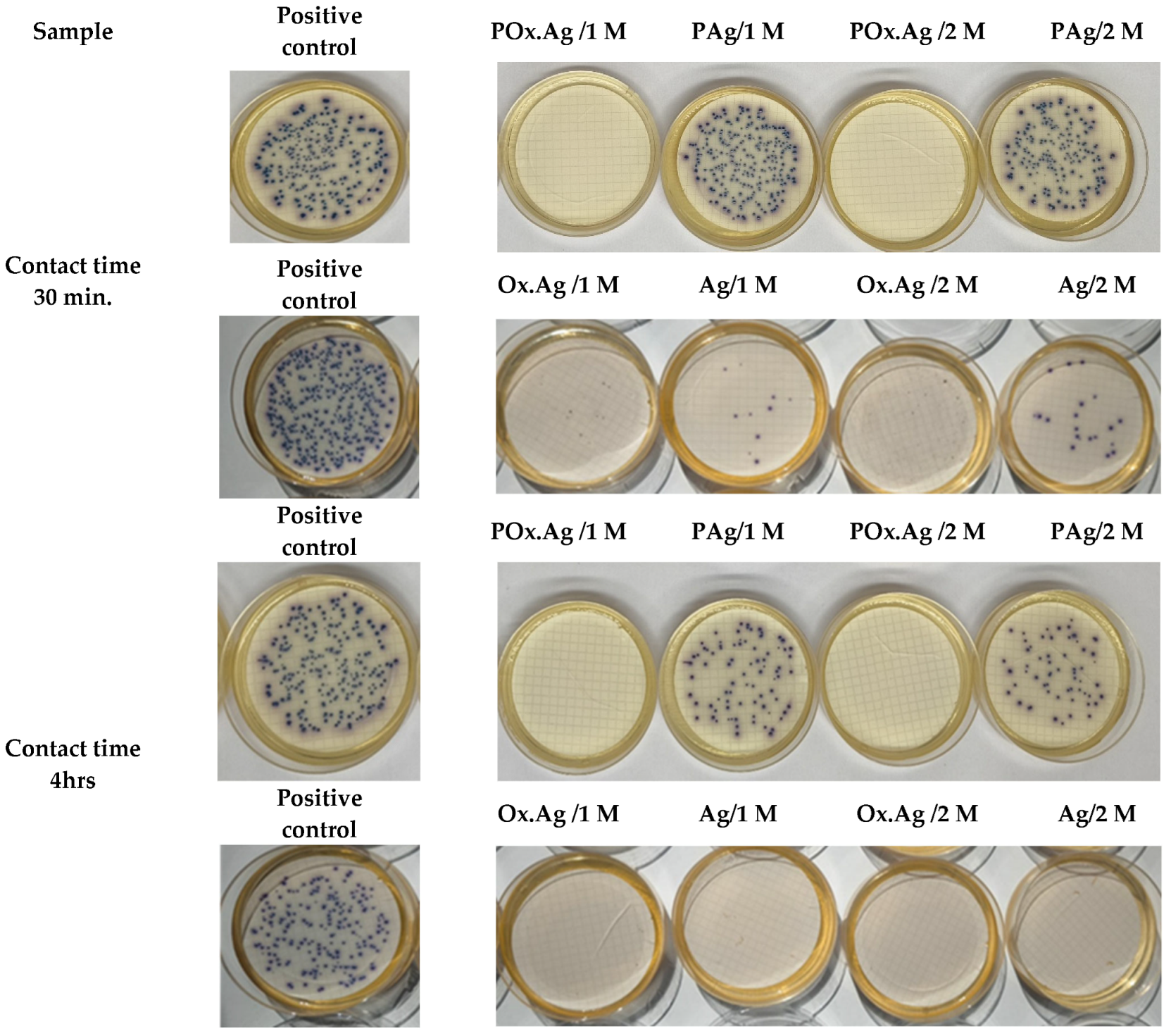
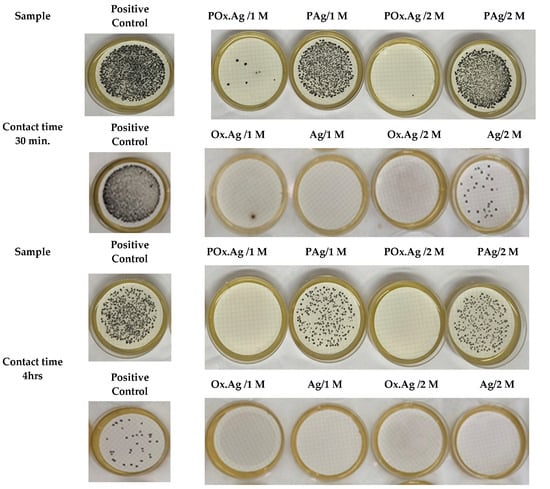
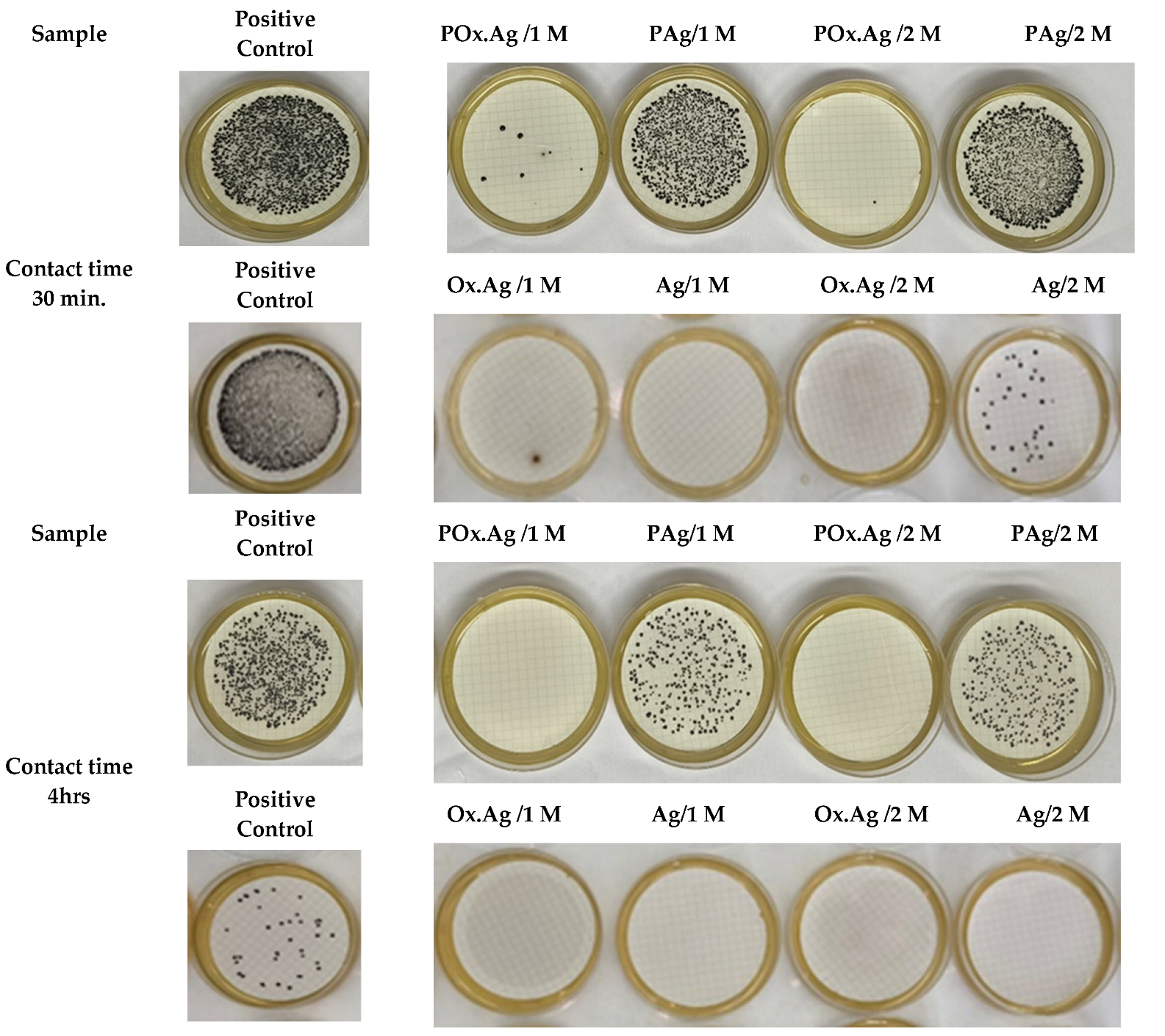
After immersion of the powders into the test tubes containing the microbial suspensions, an immediate transfer was performed from all four samples and control groups (positive control—M+, negative control—M−) onto selective media: Chromocult Coliform Agar (CCA) and Tryptose Sulfite Cycloserine Agar (TSC). The contact time between the Ag-based powders and the microorganisms was approximately 30 min. The agar plates were incubated aerobically at 37 °C for 24 h for E. coli detection, and anaerobically at 44 °C for 24 h for C. perfringens determination.
The remaining liquid samples were stored at 25 °C for 4 h, after which 1 mL from each was filtered through a 0.45 μm membrane. The membranes carrying the microbial load were then placed on the respective selective media (CCA and TSC) and incubated at their corresponding temperatures (37 °C and 44 °C) for 24 h. Colony counting was performed the following day. The images of CFU (colony forming units) of all samples are presented in Figure 5 and Figure 6.
Figure 5.
CCA medium with E. coli colonies.
Figure 6.
TSC medium with C. perfringens colonies.
Table 2 presents the microbiological test results for E. coli and C. perfringens across the four samples, evaluated at two contact times: approximately 30 min and 4 h.
Table 2.
Results of microbiological tests.
After ~30 min, samples 1, 3, 5, and 7 demonstrated excellent antibacterial efficacy, eliminating both E. coli and C. perfringens (0 CFU/mL). After 4 h, all samples showed improved performance against bacteria.
The decrease in CFU observed for the positive control after 4 h is attributed to bacterial stress induced by nutrient-free conditions and does not affect the comparative evaluation of antibacterial activity. Importantly, positive control still shows measurable CFU values at 4 h (Figure 6 and Table 2), confirming bacterial survival in the absence of silver-based materials. In contrast, all the samples containing silver nanoparticles exhibit either complete or near-complete bacterial inactivation. Therefore, the comparison between control and treated samples remains valid and demonstrates the antibacterial effect of the silver-based materials beyond the baseline viability decrease observed in the control.
3.6. Correlation Between Structural and Morphological Features and Antibacterial Performance
The antibacterial performance of the synthesized silver-based materials is strongly correlated with their structural and morphological characteristics, as revealed by SEM and XRD analyses. The results indicate that particle size, degree of aggregation, surface roughness, and phase composition collectively govern the interaction between the nanomaterials and bacterial cells.
For the hydrolytically synthesized silver oxide samples (POx.Ag/1 M and POx.Ag/2 M), SEM observations showed the formation of fine primary nanoparticles aggregated into compact micrometric clusters. In the case of POx.Ag/1 M, rapid nucleation under alkaline conditions led to loosely packed aggregates composed of nanosized primary particles, providing a high density of exposed reactive sites. This morphology is favorable for antibacterial applications, as it promotes effective surface contact with bacterial membranes and facilitates Ag+ ion release. Consequently, POx.Ag/1 M exhibited complete inhibition of E. coli and near-complete inactivation of C. perfringens after 30 min, followed by total inactivation at 4 h.
Increasing the precursor concentration to 2 M (POx.Ag/2 M) resulted in denser and more compact aggregates due to enhanced crystal growth and coalescence, as observed in SEM images. Despite the reduced surface accessibility compared to the 1 M sample, POx.Ag/2 M demonstrated superior antibacterial performance at short contact times, particularly against C. perfringens. This behavior suggests that higher silver content and increased availability of oxidized silver species compensate for the denser morphology by promoting a higher flux of bioactive Ag+ ions.
A distinct morphological evolution was observed for the oxide samples synthesized under US and MAE assistance (Ox.Ag/1 M and Ox.Ag/2 M). Ox.Ag/1 M exhibited predominantly spheroidal nanoparticles with moderate aggregation and a narrow particle size distribution (30–65 nm). The relatively uniform morphology and limited agglomeration enhance nanoparticle–bacteria interactions and support rapid antibacterial action. This is consistent with the observed complete inhibition of E. coli and strong reduction in C. perfringens after 30 min, followed by full inactivation at 4 h.
In contrast, Ox.Ag/2 M displayed irregular, polygonal, and partially fused nanoparticles forming dense three-dimensional aggregates, as evidenced by SEM and a broader particle size distribution extending up to ~100 nm. Although this morphology indicates increased coalescence and polydispersity, Ox.Ag/2 M achieved the highest antibacterial efficiency, completely eradicating both bacterial strains within 30 min. Irregular particle morphology enhances direct nanoparticle–bacteria contact, contributing to improved antibacterial activity. This result highlights the dominant role of surface chemistry and mixed silver oxide phases over morphological uniformity alone. The presence of multiple oxidation states and defect-rich surfaces likely enhances Ag+ release and reactive oxygen species generation, which are critical for rapid bactericidal activity.
The calcined metallic silver samples (PAg and Ag series) exhibited extensive particle coalescence and the formation of large aggregates, exceeding the nanoscale. SEM images revealed compact polyhedral structures with reduced accessible surface area. Correspondingly, these samples showed limited antibacterial activity at short contact times, particularly against C. perfringens. However, prolonged exposure (4 h) resulted in complete bacterial inactivation, indicating a time-dependent antibacterial mechanism governed by gradual Ag+ ion release from the metallic surface.
Overall, the comparative analysis demonstrates that oxide-rich samples with nanoscale primary particles, moderate aggregation, and heterogeneous surface chemistry exhibit superior antibacterial performance, especially at short contact times. While high crystallinity and metallic silver phases contribute to long-term antibacterial effects, rapid bactericidal action is primarily associated with oxidized silver phases, nanoscale morphology, and accessible reactive surfaces. These findings confirm that the antibacterial efficiency of silver-based nanomaterials arises from a complex interplay between morphology, phase composition, and surface chemistry, emphasizing the importance of synthesis route optimization for targeted antimicrobial applications [32].
These findings align with previous literature reports. For instance, Laouini et al. [13] synthesized Ag/Ag2O nanoparticles via green routes using Phoenix dactylifera extract, observing quasi-spherical particles (~20–40 nm) with dominant Ag2O peaks in XRD and high antimicrobial activity. Similarly, Rashmi et al. [14] reported monodisperse Ag2O particles (~25–35 nm) using a facile green synthesis method, with FTIR confirming Ag–O bonding at ~520–560 cm−1 and XRD indicating a cubic crystal structure with no secondary phases. In contrast, Korkmaz and Karadağ [20] employed microwave-assisted synthesis to obtain mixed-phase Ag2O/AgO nanoparticles, with XRD patterns showing overlapping peaks of Ag, Ag2O, and AgO. Their SEM images revealed irregular polygonal particles with sizes ranging from 40 to 100 nm, like our Ox.Ag/2 M sample. The broad size distribution and partial crystallite fusion were attributed to rapid nucleation and localized heating under microwave exposure.
From a crystallographic perspective, most Ag2O nanoparticles reported in the literature adopt a face-centered cubic (FCC) structure (space group Pn3m) according to PDF card 01-078-5864. These reflections were consistently observed in our Ox.Ag/1 M sample, confirming the phase purity and crystallinity. However, the presence of minor AgO or metallic Ag peaks in Ox.Ag/2 M is consistent with reports where high precursor concentrations or prolonged irradiation induced phase transformations or reduction during synthesis.
Morphologically, the lamellar and porous networks observed in Ox.Ag/1 M are comparable to those described by Sunita and Yegoti [12], who reported flower-like Ag2O nanostructures with high surface area, suitable for antibacterial coatings and food packaging applications. Their study also highlighted the role of controlled pH and biological reductants in suppressing agglomeration and promoting uniform nucleation.
Overall, the comparison confirms that our Ox.Ag/1 M sample demonstrates morphology and structural features consistent with controlled, efficient synthesis protocols reported in green chemistry and soft-template methods, whereas Ox.Ag/2 M reflects features seen in high-energy or uncontrolled regimes, with phase heterogeneity and reduced monodispersity. This correlation underscores the critical importance of synthesis parameter optimization for silver-based nanoparticles toward targeted applications.
To better understand the relationship between synthesis parameters, material structure and morphology, and antimicrobial efficacy, a quantitative correlation was established among nanoparticle morphology, crystallinity, and antibacterial performance
X-ray diffraction (XRD) analysis revealed that the Ag/1 M sample exhibited the highest crystallinity, with an average crystallite size of 36.55 nm, followed by Ag/2 M with 38.98 nm. In contrast, the uncalcined oxide-rich samples (Ox.Ag/1 M and Ox.Ag/2 M) featured mixed-phase compositions (Ag2O and traces of metallic Ag), indicative of lower overall crystallinity but greater chemical diversity, which may favor the release of bioactive silver ions (Ag+).
To integrate these findings, an antibacterial efficiency score (0–6) was assigned to each sample based on CFU reduction at 30 min. Ox.Ag/2 M achieved the maximum score (6), followed by Ox.Ag/1 M and Ag/1 M (5 each), and Ag/2 M (2). These scores were then compared to morphology and crystallinity descriptors. The analysis showed that while high crystallinity (e.g., Ag/1 M) contributes to performance, superior antibacterial activity correlates more strongly with factors such as particle dispersion, size uniformity, and the presence of oxidized silver phases. Notably, Ox.Ag/2 M, despite its broader particle distribution and lower morphological uniformity, achieved superior antimicrobial results—highlighting the critical role of surface chemistry and Ag+ bioavailability over structural perfection.
This correlation underscores that the antibacterial efficiency of silver-based nanomaterials depends on a complex interplay of physical and chemical properties, where controlled oxidation states and nanoscale morphology play decisive roles. Thus, optimizing synthesis parameters to tune these attributes is essential for designing effective ABM.
4. Conclusions
In this work, silver oxide and metallic silver nanoparticles were successfully synthesized via a hydrolytic chemical route, both with and without assistance from US and MAE irradiation, using silver nitrate precursor concentrations of 1 M and 2 M. Structural and morphological analyses confirmed that synthesis parameters play a decisive role in determining phase composition, crystallinity, particle size, and aggregation behavior.
XRD results demonstrated a clear two-stage structural evolution. Drying at 120 °C stabilized oxide-rich systems dominated by Ag2O, accompanied by minor metallic silver and carbonate phases, whereas calcination at 550 °C induced complete decomposition of secondary phases and yielded highly crystalline metallic silver. SEM analysis revealed that a lower precursor concentration favored more uniform, nanoscale particles, while a higher concentration promoted particle coalescence and dense aggregation. The application of US and MAE irradiation effectively limited excessive grain growth and refined crystallite size, leading to enhanced structural homogeneity.
Antibacterial assays against E. coli and C. perfringens demonstrated that oxide-rich silver-based nanoparticles exhibit superior antibacterial performance at short contact times, achieving complete bacterial inactivation within 30 min. In contrast, metallic silver samples displayed a slower, time-dependent antibacterial response, reaching full inhibition after prolonged exposure. The outstanding performance of Ox.Ag/2 M highlights the dominant role of silver oxidation state and surface chemistry over morphological uniformity alone. Based on experimental observations, the dominant antimicrobial mechanism in the present study is most likely ion-mediated. Oxide-rich silver systems exhibit enhanced antibacterial efficiency, which can be attributed to their oxidation state and surface chemical reactivity, favoring Ag+ ion release. In this context, silver oxide phases play a key role in governing antimicrobial activity, while morphological features mainly influence the accessibility and dynamics of ion release rather than acting as a direct contact-based mechanism. Overall, this study demonstrates that the antibacterial efficiency of silver-based nanomaterials arises from a complex interplay between oxidation state, nanoscale morphology, crystallinity, and surface accessibility. By tailoring synthesis parameters, particularly precursor concentration and synthesis assistance, silver-based ABM with controlled and enhanced performance can be obtained. These findings provide valuable insights for the rational design of advanced antimicrobial materials with potential applications in medical devices, food safety, water purification, and environmental protection.
Future work should focus on elucidating detailed antibacterial mechanisms, including reactive oxygen species generation and membrane interactions, as well as evaluating cytotoxicity and long-term biocompatibility to support safe and effective real-world applications.
Supplementary Materials
The following supporting information can be downloaded at https://www.mdpi.com/article/10.3390/cryst16020124/s1, Figure S1: Qualitative analysis; Table S1: Qualitative analysis results.
Author Contributions
Conceptualization, A.-G.S. and M.O.; methodology, A.-G.S.; software, D.A.N.; validation, E.M.M. and S.G.M.; formal analysis, E.M.M. and M.C.D.; investigation, G.V.B., E.M.M., S.G.M., D.A.N. and D.I.; resources, A.-G.S.; data curation, A.-G.S.; writing—original draft preparation, A.-G.S.; writing—review and editing, A.-G.S. and M.O.; visualization, A.-G.S.; supervision, M.O. All authors have read and agreed to the published version of the manuscript.
Funding
This research received no external funding.
Data Availability Statement
The original contributions presented in this study are included in the article. Further inquiries can be directed to the corresponding author.
Conflicts of Interest
The authors declare no conflicts of interest.
References
- Bruna, T.; Maldonado-Bravo, F.; Jara, P.; Caro, N. Silver Nanoparticles and Their Antibacterial Applications. Int. J. Mol. Sci. 2021, 22, 7202. [Google Scholar] [CrossRef] [Scilit]
- Danish, M.S.S.; Estrella-Pajulas, L.L.; Alemaida, I.M.; Grilli, M.L.; Mikhaylov, A.; Senjyu, T. Green synthesis of silver oxide nanoparticles for photocatalytic environmental remediation and biomedical applications. Metals 2022, 12, 769. [Google Scholar] [CrossRef] [Scilit]
- Duman, H.; Eker, F.; Akdaşçi, E.; Witkowska, A.M.; Bechelany, M.; Karav, S. Silver nanoparticles: A comprehensive review of synthesis methods and chemical and physical properties. Nanomaterials 2024, 14, 1527. [Google Scholar] [CrossRef] [Scilit]
- Gherasim, O.; Puiu, R.A.; Bîrca, A.C.; Burduşel, A.C.; Grumezescu, A.M. An updated review on silver nanoparticles in biomedicine. Nanomaterials 2020, 10, 2318. [Google Scholar] [CrossRef] [Scilit] [PubMed]
- Singh, P.; Pandit, S.; Jers, C.; Joshi, A.S.; Garnæs, J.; Mijakovic, I. Silver nanoparticles produced from Cedecea sp. exhibit antibiofilm activity and remarkable stability. Sci. Rep. 2021, 11, 92006. [Google Scholar] [CrossRef] [Scilit] [PubMed]
- Albert, H.M.; Mendam, K.; Bansod, P.G.; Rao, M.S.S.; Asatkar, A.; Chakravarthi, M.K.; Mallesh, M.P. Biosynthesis, spectroscopic, and antibacterial investigations of silver nanoparticles. J. Fluoresc. 2024, 34, 2009–2017. [Google Scholar] [CrossRef] [Scilit]
- Farag, O.F.; El-Sayed, A.S.A.; Abdel Fattah, E.M. One-Step Synthesis of Ag Nanoparticles Incorporated PVA Nanocomposite via Plasma Reduction Route. Sci. Rep. 2025, 15, 37006. [Google Scholar] [CrossRef] [Scilit]
- Hassan, M.A.M.; Agool, I.R.; Raoof, L.M. Silver Oxide Nanostructure prepared on porous silicon for optoelectronic application. Appl. Nanosci. 2014, 4, 429–447. [Google Scholar] [CrossRef] [Scilit]
- Ramakrishnaiah, T.; Vinay, D.; Hegde, G.S.; Siddivinayaka, T.S.; Vasudevan, K.T.; Jagannathan, A. Structural and pptical properties of AgO nanoparticles synthesized using solid state combustion. IOP Conf. Ser. Mater. Sci. Eng. 2024, 1300, 012035. [Google Scholar] [CrossRef] [Scilit]
- Cunliffe, A.J.; Askew, P.D.; Stephan, I.; Iredale, G.; Cosemans, P.; Simmons, L.M.; Verran, J.; Redfern, J. How Do We Determine the efficacy of an antibacterial surface? A Review of standardised antibacterial material testing methods. Antibiotics 2021, 10, 1069. [Google Scholar] [CrossRef] [Scilit]
- Ertaş, E.; Doğan, S.; Baran, A.; Baran, M.F.; Evcil, M.; Kurt, B.; Güneş, Z.; Aslan, K.S. Preparation and characterization of silver-loaded magnetic activated carbon produced from Crataegus monogyna for antimicrobial and antioxidant applications. ChemistrySelect 2025, 10, e202405558. [Google Scholar] [CrossRef] [Scilit]
- Sunita, D.; Yegoti, J. Effect of biosynthesized silver oxide nanoparticles in increasing the shelf life of different foods. J. Sci. Res. 2020, 64, 7–12. [Google Scholar] [CrossRef] [Scilit]
- Laouini, S.E.; Bouafia, A.; Soldatov, A.V.; Algarni, H.; Tedjani, M.L.; Ali, G.A.M.; Barhoum, A. Green synthesized of Ag/Ag2O nanoparticles using aqueous leaves extracts of Phoenix dactylifera and their azo dye photodegradation. Membranes 2021, 11, 468. [Google Scholar] [CrossRef] [Scilit] [PubMed]
- Rashmi, B.N.; Harlapur, S.F.; Avinash, B.; Ravikumar, C.R.; Nagaswarupa, H.P.; Kumar, M.A.; Gurushantha, K.; Santosh, M.S. Facile green synthesis of silver oxide nanoparticles and their electrochemical, photocatalytic and biological studies. Inorg. Chem. Commun. 2020, 111, 107580. [Google Scholar] [CrossRef] [Scilit]
- Sharma, R.K.; Yadav, S.; Dutta, S.; Kale, H.B.; Warkad, I.R.; Zbořil, R.; Varma, R.S.; Gawande, M.B. Silver nanomaterials: Synthesis and (electro/photo) catalytic applications. Chem. Soc. Rev. 2021, 50, 11293–11380. [Google Scholar] [CrossRef] [Scilit] [PubMed]
- Ullah, Z.; Gul, F.; Iqbal, J.; Abbasi, B.A.; Kanwal, S.; Chalgham, W.; El-Sheikh, M.A.; Diltemiz, S.E.; Mahmood, T. Biogenic Synthesis of Multifunctional Silver Oxide Nanoparticles (Ag2ONPs) Using Parieteria alsinaefolia Delile Aqueous Extract and Assessment of Their Diverse Biological Applications. Microorganisms 2023, 11, 1069. [Google Scholar] [CrossRef] [Scilit]
- Feng, Q.L.; Wu, J.; Chen, G.Q.; Cui, F.Z.; Kim, T.N.; Kim, J.O. A mechanistic study of the antibacterial effect of silver ions on Escherichia coli and Staphylococcus aureus. J. Biomed. Mater. Res. 2000, 52, 662–668. [Google Scholar] [CrossRef] [Scilit]
- Durán, N.; Nakazato, G.; Seabra, A.B. Antimicrobial activity of biogenic silver nanoparticles and silver chloride nanoparticles: An overview and comments. Appl. Microbiol. Biotechnol. 2016, 100, 6555–6570. [Google Scholar] [CrossRef] [Scilit]
- Zhang, L.; Shen, Y.; Xie, A.; Li, S.; Jin, B.; Zhang, Q. One-step synthesis of monodisperse silver nanoparticles beneath vitamin E Langmuir monolayers. J. Phys. Chem. B 2006, 110, 6615–6620. [Google Scholar] [CrossRef] [Scilit]
- Korkmaz, N.; Karadağ, A. Microwave-assisted green synthesis of Ag, Ag2O, and Ag2O3 nanoparticles. J. Turk. Chem. Soc. A 2021, 8, 585–592. [Google Scholar] [CrossRef] [Scilit]
- Nguyen, N.P.U.; Dang, N.T.; Doan, L.; Nguyen, T.T.H. Synthesis of Silver Nanoparticles: From Conventional to ‘Modern’ Methods—A Review. Processes 2023, 11, 2617. [Google Scholar] [CrossRef] [Scilit]
- Liga, S.; Vodă, R.; Lupa, L.; Moacă, E.-A.; Muntean, D.; Barbu-Tudoran, L.; Suciu, M.; Socoliuc, V.; Péter, F. Synthesis of Ag2O/Ag Nanoparticles Using Puerarin: Characterization, Cytotoxicity, In Ovo Safety Profile, Antioxidant, and Antimicrobial Potential Against Nosocomial Pathogens. J. Funct. Biomater. 2025, 16, 258. [Google Scholar] [CrossRef] [Scilit] [PubMed]
- Reidy, B.; Haase, A.; Luch, A.; Dawson, K.A.; Lynch, I. Mechanisms of silver nanoparticle release, transformation and toxicity: A critical review of current knowledge and recommendations for future studies and applications. Materials 2013, 6, 2295–2312. [Google Scholar] [CrossRef] [Scilit]
- Lu, R.; Yang, D.; Cui, D.; Wang, Z.; Guo, L. Egg white-mediated green synthesis of silver nanoparticles with excellent biocompatibility and enhanced radiation effects on cancer cells. Int. J. Nanomed. 2012, 7, 2073–2080. [Google Scholar] [CrossRef] [Scilit]
- Sun, Y.; Yin, Y.; Mayers, B.T.; Herricks, T.; Xia, Y. Uniform Silver Nanowires Synthesis by reducing AgNO3 with ethylene glycol in the presence of seeds and poly(vinyl pyrrolidone). Chem. Mater. 2002, 14, 4736–4745. [Google Scholar] [CrossRef] [Scilit]
- Rehan, M.; Khattab, T.A.; Barohum, A.; Gätjen, L.; Wilken, R. Development of Ag/AgX (X = Cl, I) nanoparticles toward antimicrobial, UV-protected and self-cleanable viscose fibers. Carbohydr. Polym. 2018, 197, 227–236. [Google Scholar] [CrossRef] [Scilit]
- Kumar, S.; Verma, A.; Pal, S.; Sinha, I. Curcumin-Functionalized Ag/Ag2O Nanocomposites: Efficient Visible-Light Z-scheme Photocatalysts. Photochem. Photobiol. 2018, 94, 641–649. [Google Scholar] [CrossRef] [Scilit]
- Shah, A.; Haq, S.; Rehman, W.; Waseem, M.; Shoukat, S.; Rehman, M.-U. Photocatalytic and antibacterial activities of paeonia emodi mediated silver oxide nanoparticles. Mater. Res. Express 2019, 6, 45045. [Google Scholar] [CrossRef] [Scilit]
- Rajabi, A.; Ghazali, M.J.; Mahmoudi, E.; Azizkhani, S.; Sulaiman, N.H.; Mohammad, A.W.; Mustafah, N.M.; Ohnmar, H.; Naicker, A.S. Development and antibacterial application of nanocomposites: Effects of molar ratio on Ag2O–CuO nanocomposite synthesised via the microwave-assisted route. Ceram. Int. 2018, 44, 21591–21598. [Google Scholar] [CrossRef] [Scilit]
- Arif, D.; Niazi, M.B.K.; Ul-Haq, N.; Anwar, M.N.; Hashmi, E. Preparation of antibacterial cotton fabric using chitosan-silver nanoparticles. Fibers Polym. 2015, 16, 1519–1526. [Google Scholar] [CrossRef] [Scilit]
- Istrate, D.; Oproescu, M.; Modan, E.M.; Moga, S.G.; Negrea, D.A.; Schiopu, A.-G. Nanoscale Nickel Oxide: Synthesis, Characterization, and Impact on Antibacterial Activity Against Representative Microorganisms. ChemEngineering 2025, 9, 77. [Google Scholar] [CrossRef] [Scilit]
- Schiopu, A.-G.; Iordache, D.M.; Oproescu, M.; Cursaru, L.M.; Ioța, A.-M. Tailoring the synthesis method of metal oxide nanoparticles for desired properties. Crystals 2024, 14, 899. [Google Scholar] [CrossRef] [Scilit]

Disclaimer/Publisher’s Note: The statements, opinions and data contained in all publications are solely those of the individual author(s) and contributor(s) and not of MDPI and/or the editor(s). MDPI and/or the editor(s) disclaim responsibility for any injury to people or property resulting from any ideas, methods, instructions or products referred to in the content. |
© 2026 by the authors. Licensee MDPI, Basel, Switzerland. This article is an open access article distributed under the terms and conditions of the Creative Commons Attribution (CC BY) license.