Article

Microstructures of Fe-16wt%S-2wt%Si in Partial and Complete Melt Regions at High Pressures: Implications for Dynamics in Small Planetary Cores


Department of Earth Sciences, The University of Western Ontario, London, ON N6A 3K7, Canada
*
Author to whom correspondence should be addressed.
Crystals 2026, 16(2), 113; https://doi.org/10.3390/cryst16020113
Submission received: 19 December 2025 / Revised: 26 January 2026 / Accepted: 2 February 2026 / Published: 5 February 2026
(This article belongs to the Section Crystalline Metals and Alloys)

Abstract

Regions of partial melt of Fe-S-Si alloys at high pressures may arise during planetary formation or at the boundary of the inner and outer cores of small terrestrial planetary bodies. Melting experiments were performed on Fe-16wt%S-2wt%Si samples in a multi-anvil apparatus across the range 2–13 GPa with quench temperatures in partial and complete melt regions. A phase diagram is constructed from electron microprobe analyses, back-scattered electron imaging, and electrical resistivity measurements. Microstructures arising in post-quench samples include Turing patterns of Fe and FeS in the partial melt, dendritic Fe structures with tertiary arms in the partial and complete melt, and Fe-S-Si miscible regions in the complete melt. These melt structures may arise broadly or locally in small Fe-S planetary cores with consequences for the energetics of the core.

1. Introduction

The energetics of terrestrial planetary cores are responsible for such phenomena as inner core crystallization and the magnetic field of the Earth. These influence the overall planetary energy budget. In addition to Fe and Ni, lighter elements are expected to comprise several wt% of these cores due to evidence such as the composition of primitive meteorites and core density inferred from seismic data [1,2]. S is thought to have condensed in large amounts and accompanied Fe into the core during planetary formation [3,4]. Other elements that are likely present include Si, O, C, and H [5,6].
The phases in planetary cores play a crucial role in determining their dynamics since relative buoyancy and miscibility can be controlling factors. During planetary formation, several sources of primitive heating may have led to partial melting in various regions of Earth and smaller planetary bodies. After core formation, phase transitions occur over time primarily due to cooling at constant pressure, which is dependent on the interplay of the evolving thermal gradient with the solidus and liquidus. For example, if the thermal gradient is steeper than the liquidus, crystallization may proceed in a top-down direction [7], resulting in phenomena such as Fe-S snow, as first discussed for Mercury [8]. The phase boundaries of the core are dependent not only upon the pressure (which may be taken as constant once the planet has fully accreted) but also on the temperature and composition of the core at each depth, which changes with time due to gradual heat loss and possible inner core solidification.
In the core of Earth and similar objects, the inner core boundary marks an important contrast in phase. In addition to the solid inner core and liquid outer core, a region of solid and liquid mix, termed mush or slurry, may exist across a depth range at this boundary [9,10]. In other terrestrial cores, mush and phase change phenomena related to top-down crystallization may occur. The phase boundary, microstructure, and miscibility relationships of these Fe alloys during crystallization may have broader implications for the dynamics of planetary cores. The complexity of phase transitions introduces a need for experiments modeling the structural patterns occurring throughout the melt as determined by quench microstructures.
The sample composition for this study, Fe with 16 wt% S and 2 wt% Si (Fe-16S-2Si) was chosen to reflect specific estimates of the light element composition of asteroid 4 Vesta based on geochemical studies of HED meteorites [11,12]. The composition additionally approximates the S amount in the Martian core, which has been variously estimated in the range 10–20 wt% [4,13]. Sub-Earths that formed at similar low temperature conditions likely contain a similarly large proportion of S in the core [14]. The amount of Si that enters a core is dependent on several factors, including the mechanism of entry and the miscibility limit of Si in the liquid Fe-S system [15,16] or in the presence of silicate where oxygen fugacity plays a role [17].
Many previous studies have contributed to the phase diagram of the Fe-S system in the pressure range of this study. The binary Fe-S system at 1 atm displays a eutectic point at 26 wt% S with a region of partial melt on the low-S side of the eutectic, which begins at 1260 K [18]. While the eutectic composition shifts to lower temperatures [19,20,21,22] and lower wt% S at high pressures [23,24,25] in the pressure range of this study, the eutectic composition remains at a higher amount of S relative to the sample composition of 16 wt% S [26].
The interaction of Si with the Fe-S system may affect properties of the liquid state, including melting temperature and miscibility. The melting curves of Fe-Si alloys have been observed with melting temperatures generally in the range 1650–1850 K for the pressures and composition of this study [27,28]. While the eutectic composition of Fe-Si decreases to below 2 wt% Si at 127 GPa [29], the pressures of this study are more than an order of magnitude below that pressure. Buono and Walker [21] found a negligible change in the eutectic temperature of the Fe-FeS system with increasing pressure up to at least 8 GPa.
Melting and miscibility experiments investigating specific compositions in the binary or ternary Fe(-S)(-Si) system have previously been performed [30,31,32]. In the ternary Fe-S-Si system, the highest temperatures of the samples analyzed were most often past the liquidus. Sakairi et al. [33] observed the phases of Fe-S-Si alloys at 20–60 GPa. Morard and Katsura [15] focused on superliquidus samples to study the immiscibility of a range of Fe-S-Si alloys. In the partial melt region, Sanloup and Fei [34] constructed a complete phase diagram of Fe-18.5wt%S-8wt%Si for 1700–2300 K and 10–27 GPa from sample analysis on the scale of tens of microns. These results provide context for this study, which focuses instead on the progression of quench microstructures on the submicron scale with increasing temperature for comparatively lower pressures and a lower Si amount.

2. Materials and Methods

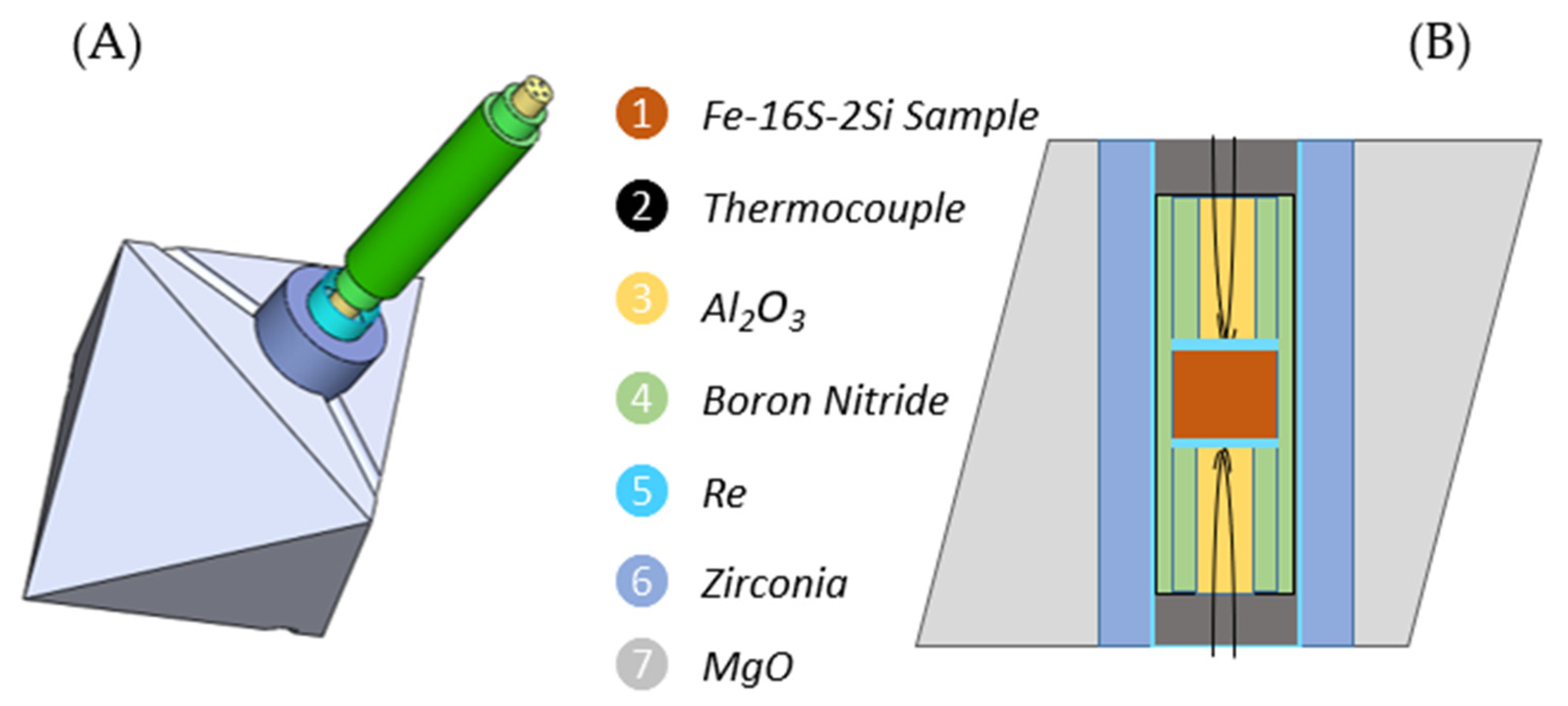
Experiments at high temperatures and pressures were performed in large-volume presses. A 1000-ton cubic press [35,36,37] was used for experiments at static pressures of 2–5 GPa, while a 3000-ton multi-anvil press [38,39] was used for experiments at 5–11 GPa. Pyrophyllite cubic cells of edge length 32 mm were used for experiments at 2–5 GPa; Cr2O3-doped MgO octahedra of edge length 18 mm for experiments 5 or 7 GPa; and Cr2O3-doped MgO octahedra of edge length 14 mm for experiments 9 or 11 GPa. Heating was controlled by applying an AC current across a graphite or Re cylindrical furnace crossing through the pressure cell and insulated by zirconia.
Samples were prepared from powders of Fe (ESPI Metals, 99.95% purity, Ashland, OR, USA), FeS (Thermo Fisher Scientific, 99.98% purity, Waltham, MA, USA), and Fe-9wt%Si (Goodfellow Cambridge Ltd., 99.5% purity, Huntingdon, UK). These powders were weighed and mixed according to stoichiometric relations to arrive at a sample composition of Fe with 16 wt% S and 2 wt% Si, referred to as Fe-16S-2Si. The powders were mixed in air for approximately an hour. Afterward, they were stored for the long term in a desiccator to ensure an airtight and low humidity environment. Powder samples were held within a cylindrical BN container and contacted a thin Pt or Re disk at each end, which in turn each contacted a Type C or Type S thermocouple by which in-situ temperature data were recorded. Further details of the cell designs are found in Lenhart et al. [40] (Samples 011–020) and Lenhart et al. [41] (Samples 476–522) (Appendix A).
Each experiment began with a preheating stage wherein the sample was slowly heated to ~1075 K and held isothermally for approximately thirty minutes to ensure annealing of the sample and to ensure good contact between the sample and the thermocouples. The furnace heating was then stopped and the quenched sample temperature returned to ~300 K. In the data collection stage, the sample was heated to the maximum temperature as reported for each experiment. In the solid state, heating proceeded at a rate of ~100 K per minute. At ~1250 K, the heating was quickened to more effectively contain the sample as it began to melt. The sample stayed at the terminal temperature up to ~2100 K on a time scale of tens of seconds, after which the heating was quickly stopped and the temperature decreased to ambient conditions. Cooling rates through the solidification temperature range were typically ~150 K per second in the 1000-ton press (Samples 011–020) and ~700 K per second in the 3000-ton press (Samples 476–522), consistent with typical multi-anvil quench rates [42]. Samples were polished to a cross-section after being returned to ambient conditions.
Electron microprobe analysis (EMPA) was carried out with a JXA-8530F electron microprobe (JEOL, Tokyo, Japan) at the Earth and Planetary Materials Analysis Laboratory at the University of Western Ontario. A probe current of 60 nA and an accelerating voltage of 15 kV were used. Samples were mounted in an epoxy disk. The standards were in their elemental forms for every element studied except S, for which the standard material was pyrite. Back scattered electron (BSE) images captured various quench microstructures in the sample cross-section recovered from temperatures across the melting region of Fe-16S-2Si. Wavelength Dispersive Spectroscopy (WDS) was performed at points across all the samples of the study. Energy Dispersive Spectroscopy (EDS) mapping was additionally performed for many of the samples. WDS accurately measured the composition of several specific grains or regions of interest using a beam size of 1–10 microns. EDS provided compositional maps, which were used to estimate the overall composition of broader regions of interest.

3. Results

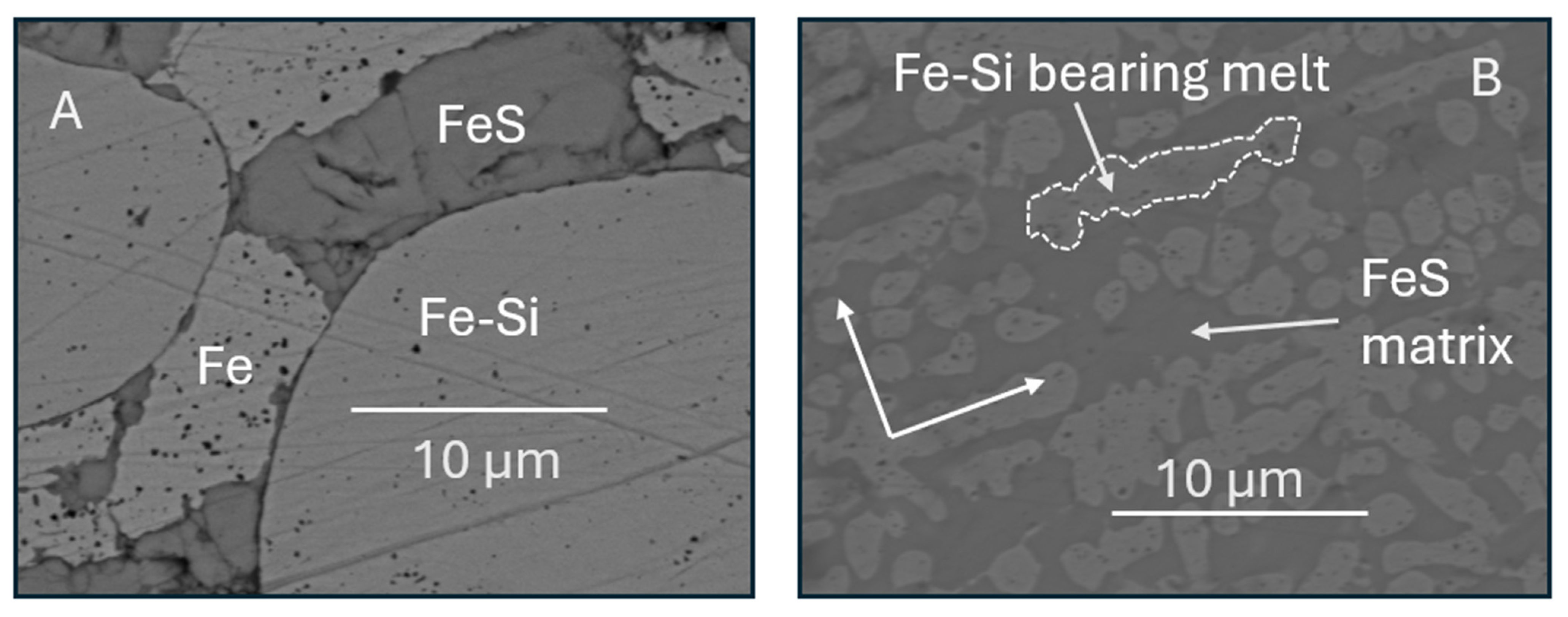
Several phases of the Fe-16S-2Si sample composition are observed at ambient temperature (Figure 1A) and above the liquidus (Figure 1B) in BSE images with compositions supported by WDS and EDS techniques.
Below and just above the eutectic melt, grains reflecting the compositions of the three powders used to mix the sample are observed in BSE images and confirmed by WDS analyses. FeS grains appear darker in BSE images due to the high amount of S. Fe grains are observed to experience greater deformation than Fe-9wt%Si due to the higher malleability of Fe under pressure. For samples recovered from above the liquidus, an alternating pattern of Fe-Si and FeS zones is observed (Figure 1B). In these samples, a relatively uniform checkerboard pattern forms from rounded or lobate Fe-Si alloy on the scale of microns. Because S is not soluble in solid Fe as an alloy up to 20 GPa [15,43], a separate FeS phase is observed in all samples recovered from above the eutectic temperature, forming a matrix. Above the liquidus, S and Fe are expected to be well mixed, which has previously been confirmed by the structure factor of Fe-S liquids at high pressures [44].

3.1. Compositional Analysis

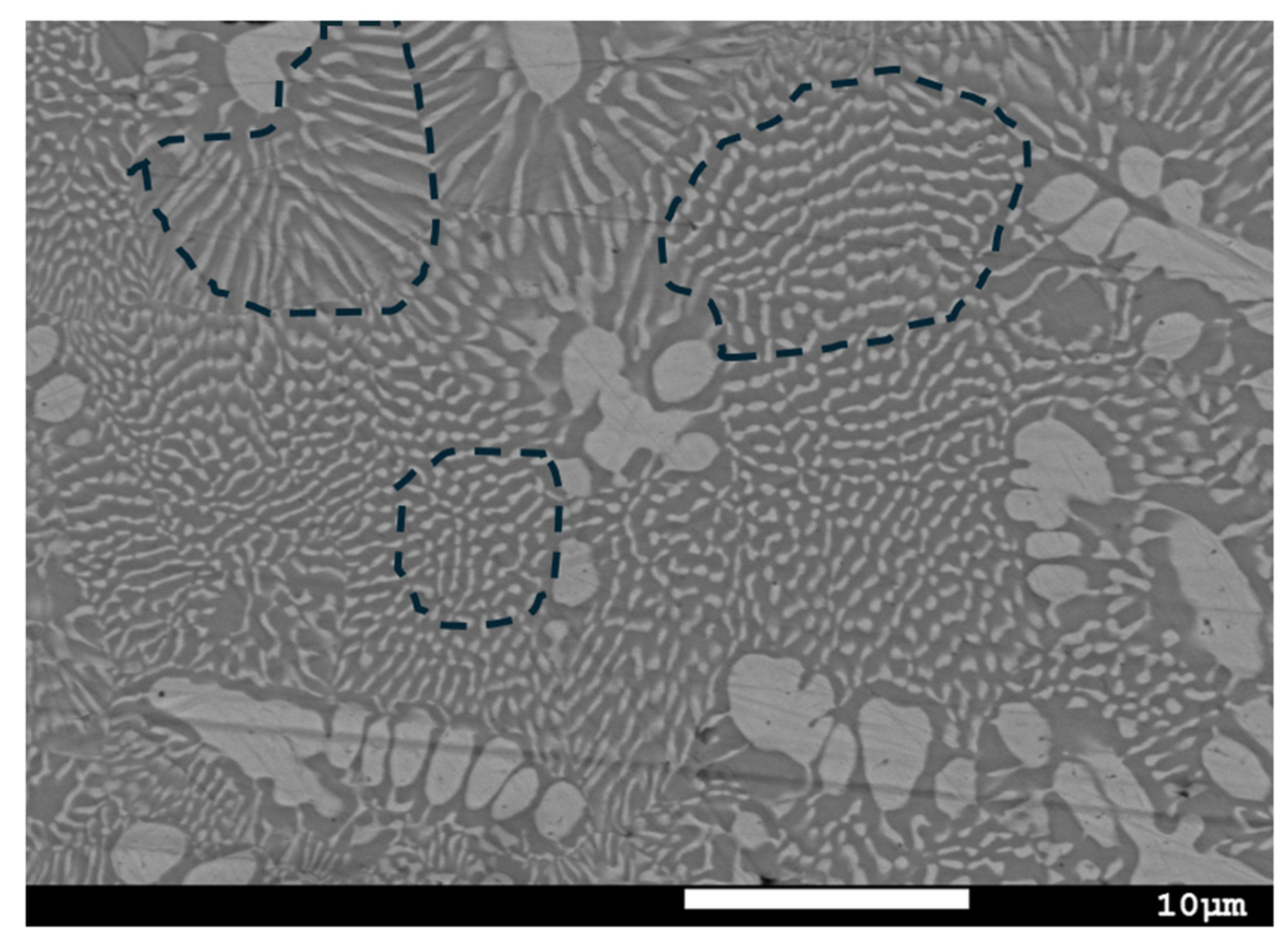
The elemental compositions of the sample points within a diameter of 1 micron were measured with WDS. Vermicular patterns on the submicron scale arise only in samples quenched within the partial melt region. The bands of this pattern alternate between FeS and Fe, with an overall composition of 70–80 wt% Fe and 20–30 wt% S as shown in Table 1.

3.2. Progression of Microstructures Across the Melt Region

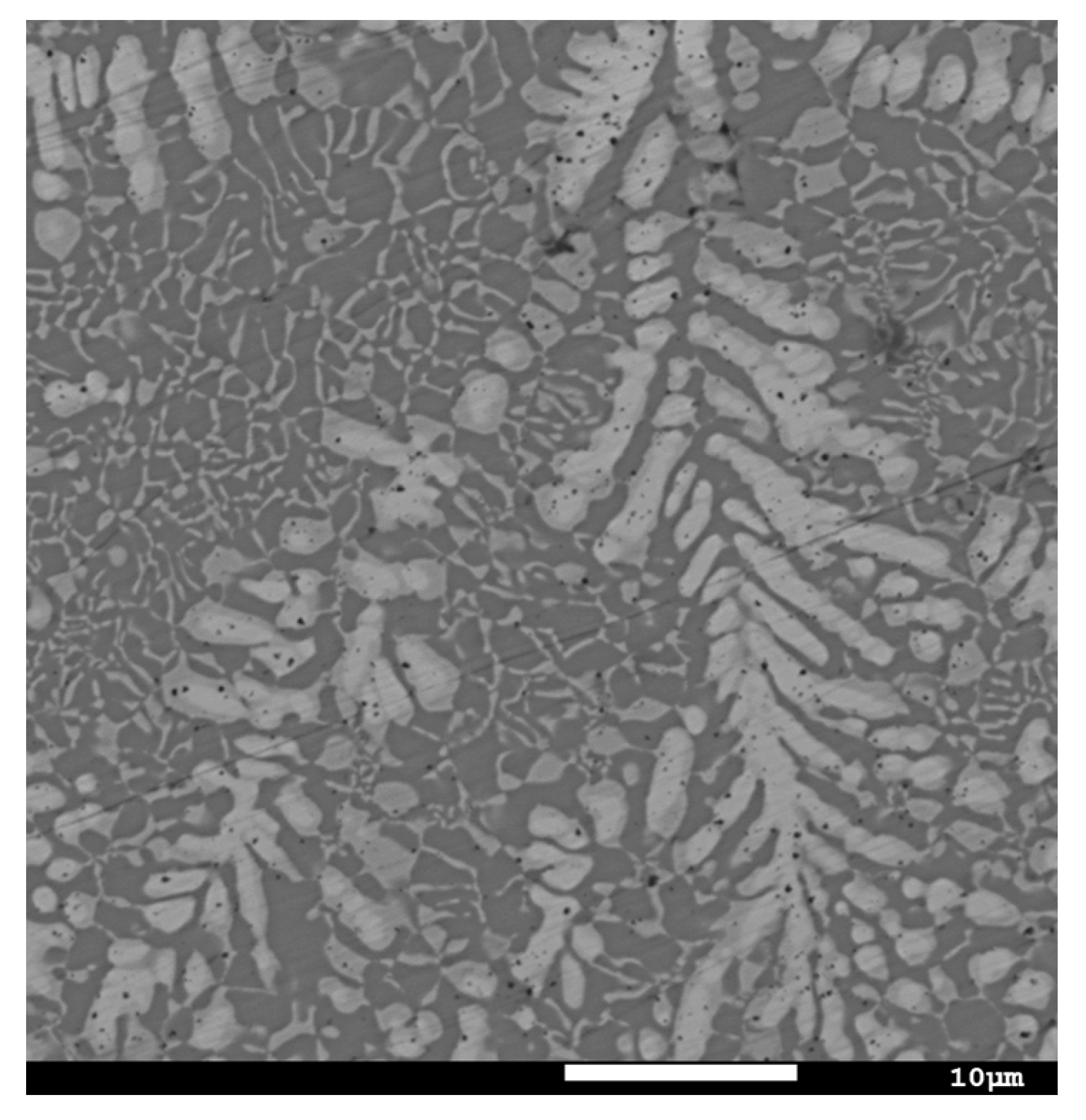
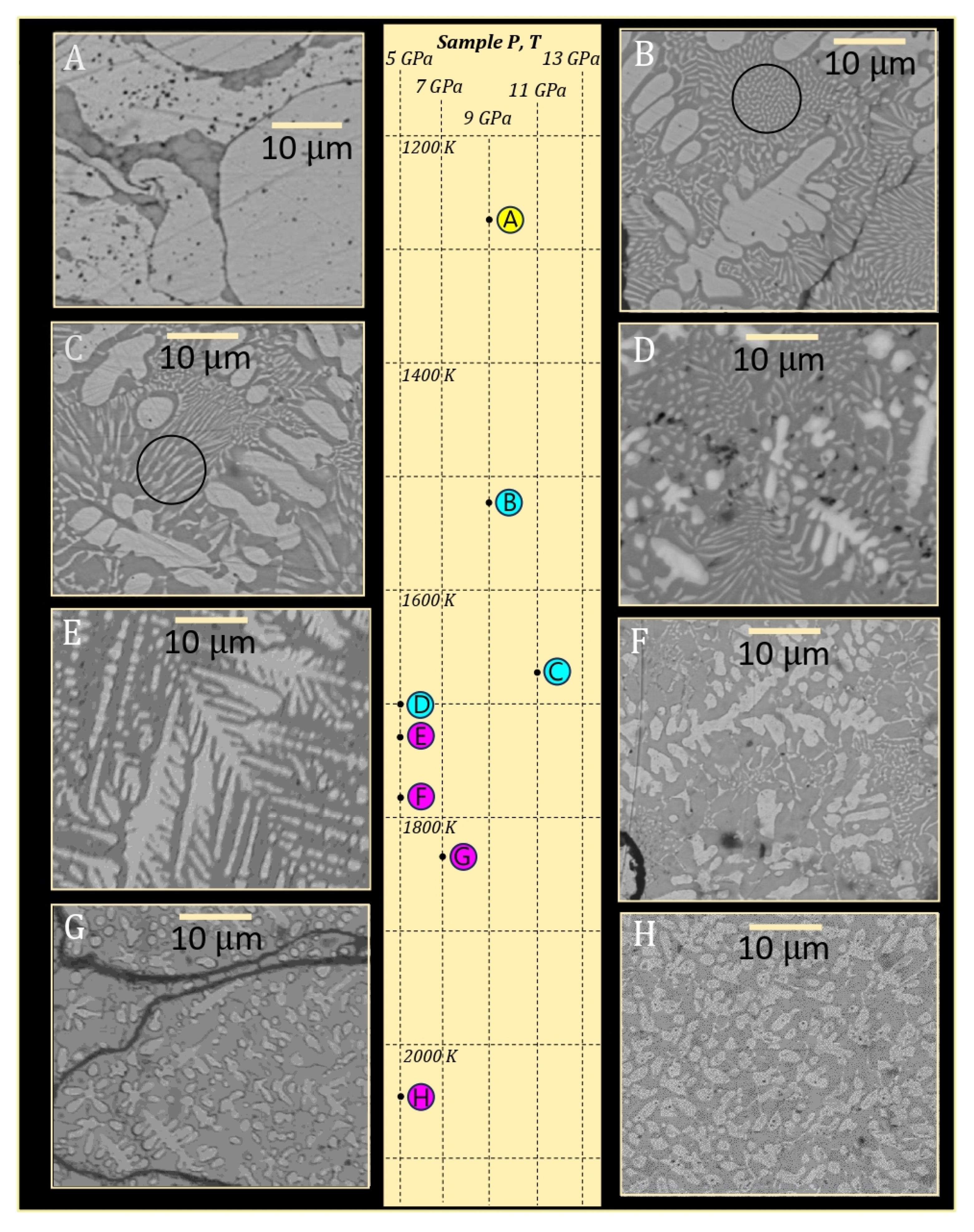
BSE images from various samples of this study reveal a progression of quench patterns throughout the partial melt region (Figure 2). Dendrites of Fe form within the Fe-S liquid matrix. These generally increase in number and alignment with increasing temperature throughout the region of melt. At the highest superliquidus temperatures reached, the individual dendrites merge into a checkerboard pattern of FeS and Fe with small amounts of Si (Figure 2H). Similar patterns have been observed in quenches of Fe-S alloyed with other light elements [45,46].
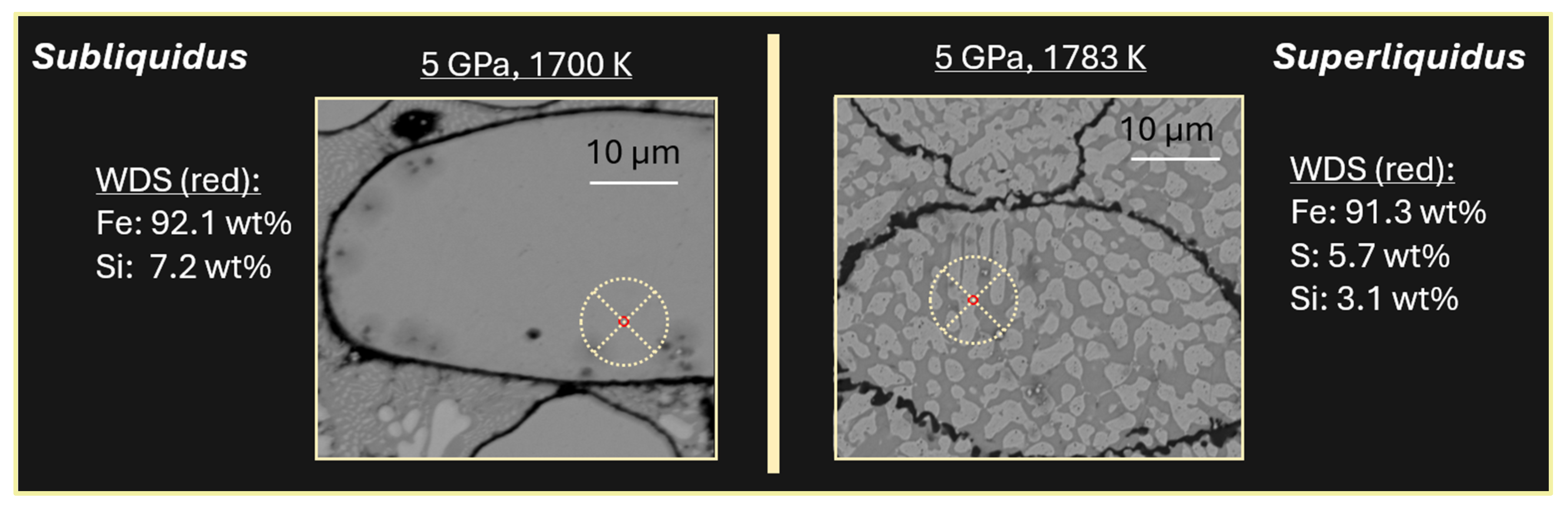
The Si component largely follows an independent process of melting throughout the quench microstructure of Fe-16S-2Si samples (Figure 3). Inside the Si-rings, the composition remains largely Fe-Si below the liquidus as shown in the left side of Figure 3. At superliquidus temperatures shown on the right side of Figure 3, the material inside the rings closely resembles the rest of the sample, with an alternating mix of FeS and Fe-Si-bearing regions. In these superliquidus samples, the Si is found preferentially in the Fe dendritic patterns after quenching.

4. Discussion

4.1. Phase Diagram

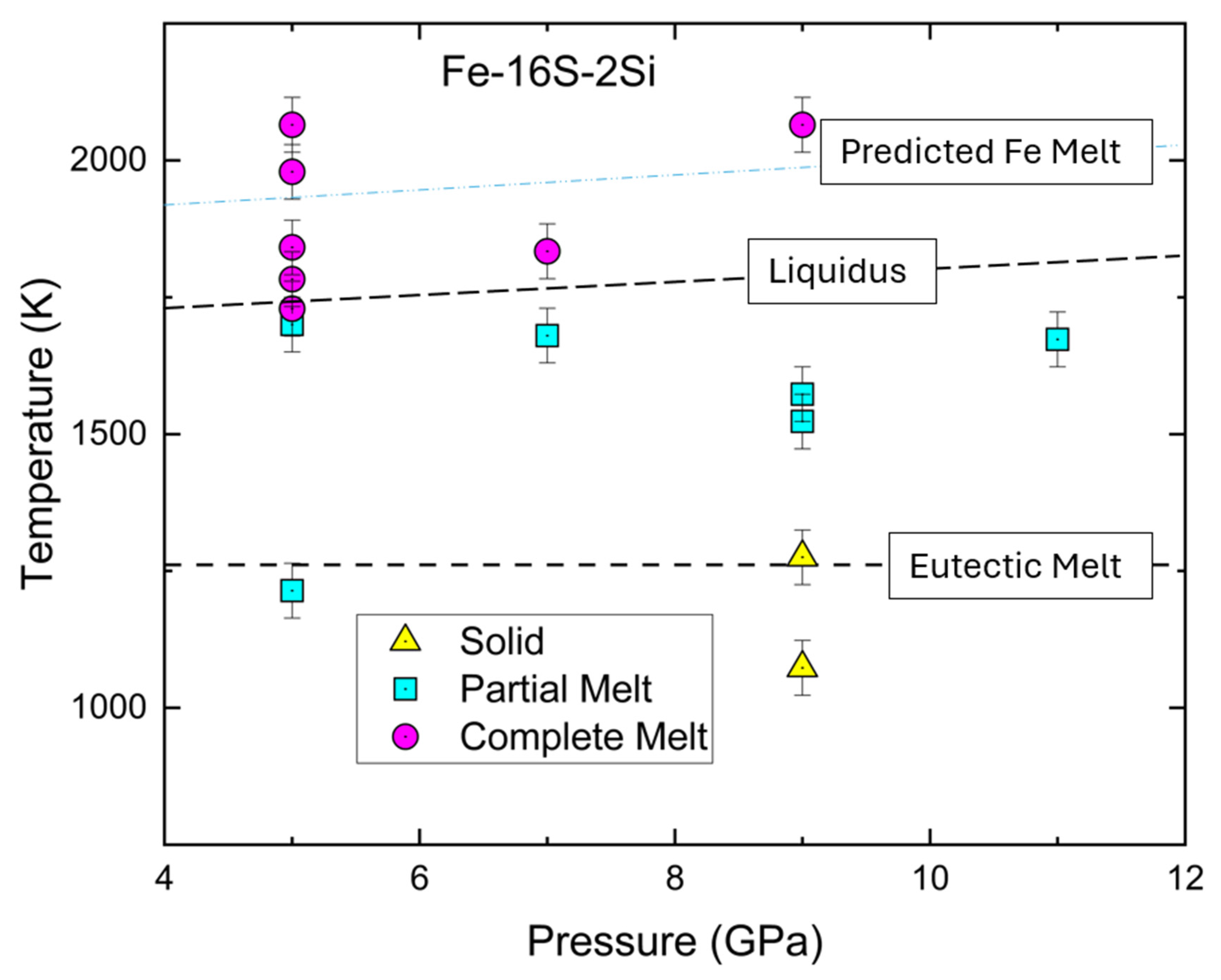
Considering the phases and microstructures observed in each sample and incorporating previous results on measurements of electrical resistivity on this same composition [41], a phase diagram of Fe-16S-2Si may be constructed as shown in Figure 4. The melting boundaries are inferred from sample microstructures and from resistivity data [47] of the Fe-16S-2Si system [41], in which a sharp decrease in resistivity with temperature corresponds to a melting boundary. The eutectic melt matches commonly cited values for Fe-S alloys [18]. The addition of S and Si commonly decreases the melting temperature of Fe [33], as observed in the quench microstructures of these samples. The melt of pure Fe is added for reference [48,49,50].

4.2. Reaction–Diffusion Patterns

Below the liquidus and above the eutectic melt, the FeS melt displays smooth submicron bands (Figure 2B–D). These likely originate as Turing patterns, which arise in reaction–diffusion systems [51]. Specifically, the banding (Figure 2C) and nearby spherules (Figure 2C) closely resemble the patterns described by the Gray–Scott Model [52], which is based on Fick’s second law of diffusion for the concentrations of two chemical species, u and v, the diffusion coefficients, Dv and Du, of species u and v, respectively, in the partial melt matrix, feed rate, F, and reaction rate, k:
u t = D u 2 u     u v 2 + F ( 1     u )
v t = D v 2 v + u v 2 F + k v
Similar patterns have been reported but not analyzed in detail in studies of the Fe-Ce-Si [53] and the Fe-21wt%S [44] systems. In the samples observed in Figure 2B–D, the broadest areas of pure FeS tend to crystallize at the boundary of larger Fe grains. The longest thin striations of Fe within the FeS matrix then form perpendicular to this boundary (Figure 2C, circled region; Appendix B). Tens of microns away from the Fe grains, the Fe bands develop into spherules within the FeS matrix (Figure 2B, circled region). Notably, the bands disappear above the liquidus, being replaced by an FeS matrix interrupted by Fe dendrites and occasional jagged bands of Fe (Figure 2E,F). At the highest temperatures of this study, the Fe dendrites form into a checkerboard pattern, which is likely the result of tertiary dendritic arms forming parallel to the primary arms (Figure 2G).

4.3. Miscibility Limit with Pressure

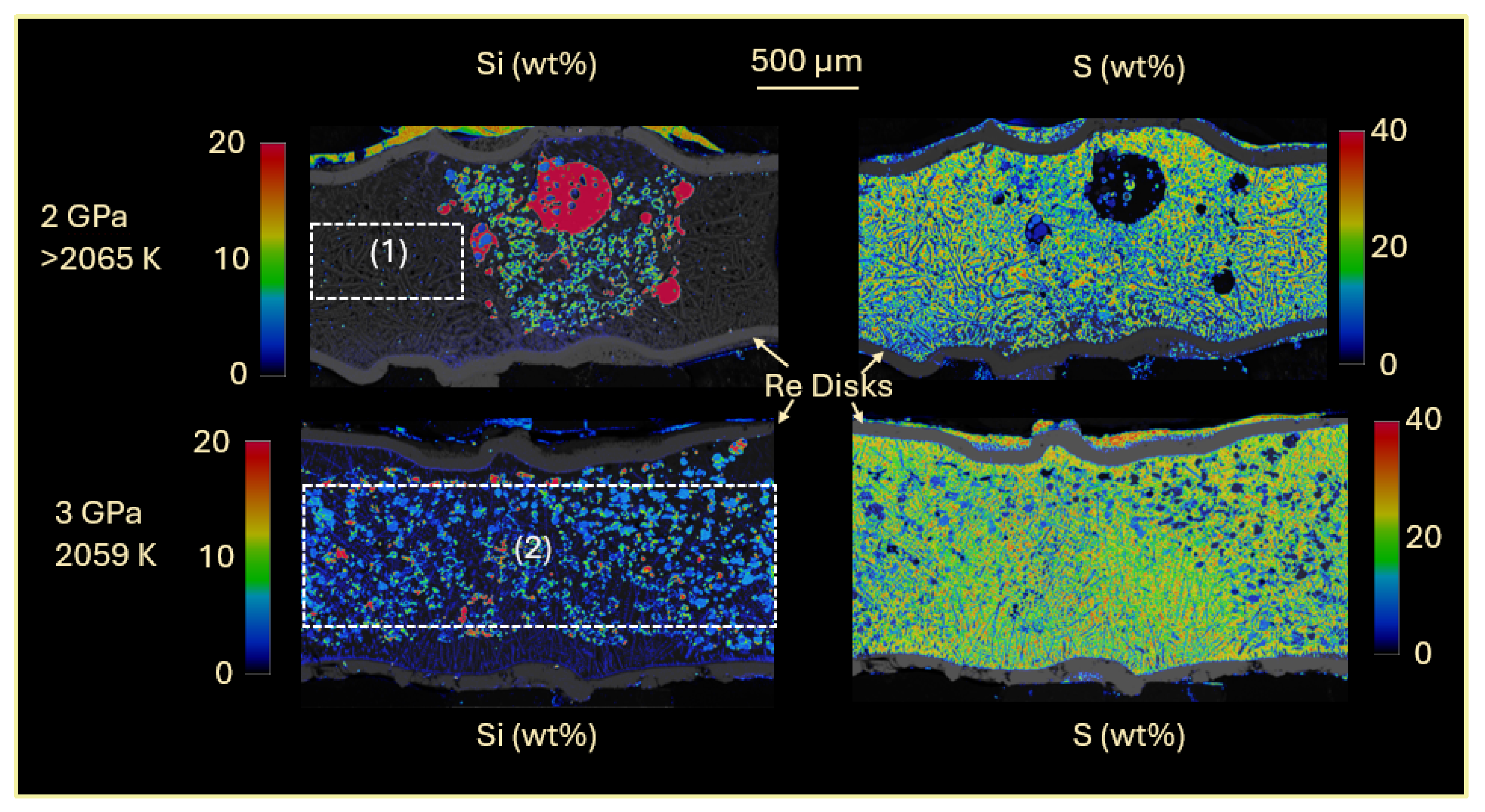
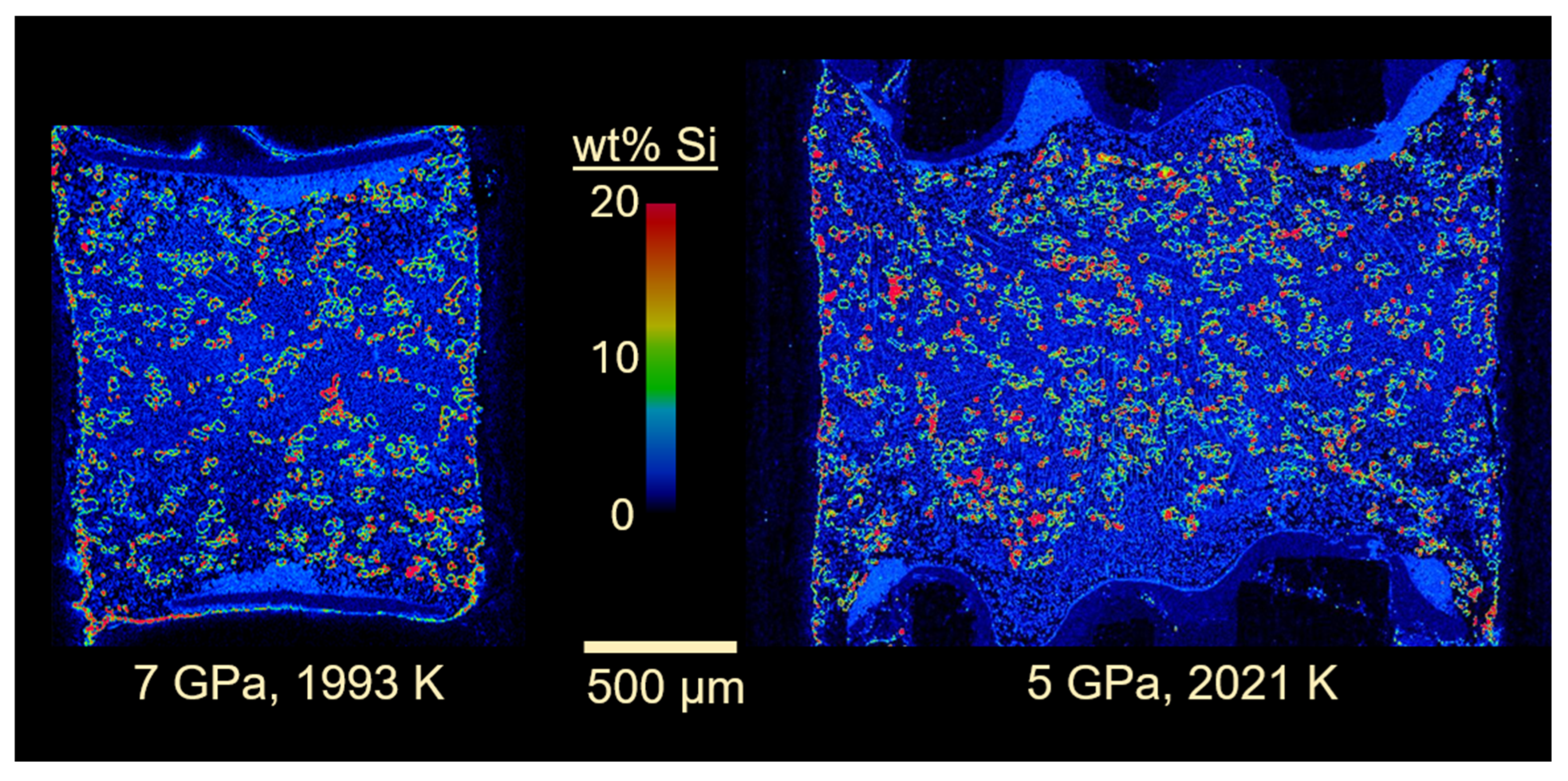
A secondary area of focus of this study is the pressure range in which S and Si mix within the Fe liquid. Calculations by Chabot et al. [16] estimate the pressure limit for miscibility of Fe-16S-2Si to be slightly below 6 GPa. In the ternary diagram of Figure 6 in Morard and Katsura [15], the same miscibility limit is estimated as at or below 4 GPa at temperatures similar to those of the current study, which makes the two studies in reasonable agreement. Experiments of this study find a notable difference in microstructures of samples recovered from 2 GPa and 3 GPa, as revealed in EDS maps (Figure 5). The miscibility limit of Fe-16S-2Si likely crosses through this pressure region. Results from Littleton et al. [54] of Fe-3wt%S-14wt%Si recovered at 3 GPa do not display this immiscibility microstructure, which gives an upper limit of the experimentally observed pressure limit for miscibility of this composition as 3 GPa, lower than estimations by Chabot et al. [16] of ~6 GPa.
Several textural zones are observed in immiscible samples recovered from 2 GPa and above the liquidus as shown in Figure 5 (top). In contrast with samples recovered from higher pressures and similar temperatures, which comprise ~2 wt% Si distributed throughout (Figure 5 in the boxed region labeled (2)), large portions of the sample recovered from only 2 GPa contain negligible Si (Figure 5 in the boxed region labeled (1)). In the samples studied recovered from 2 GPa, Fe-Si regions generally collect toward the center of the BN sample container. This may be a function of the interfacial tension of the two melts indicating immiscibility at these P, T conditions. Within a broader Fe-S matrix, spherules of Fe-Si on the scale of tens of microns are observed. The compositions of specific Si-rich regions were measured using WDS (Figure 6).
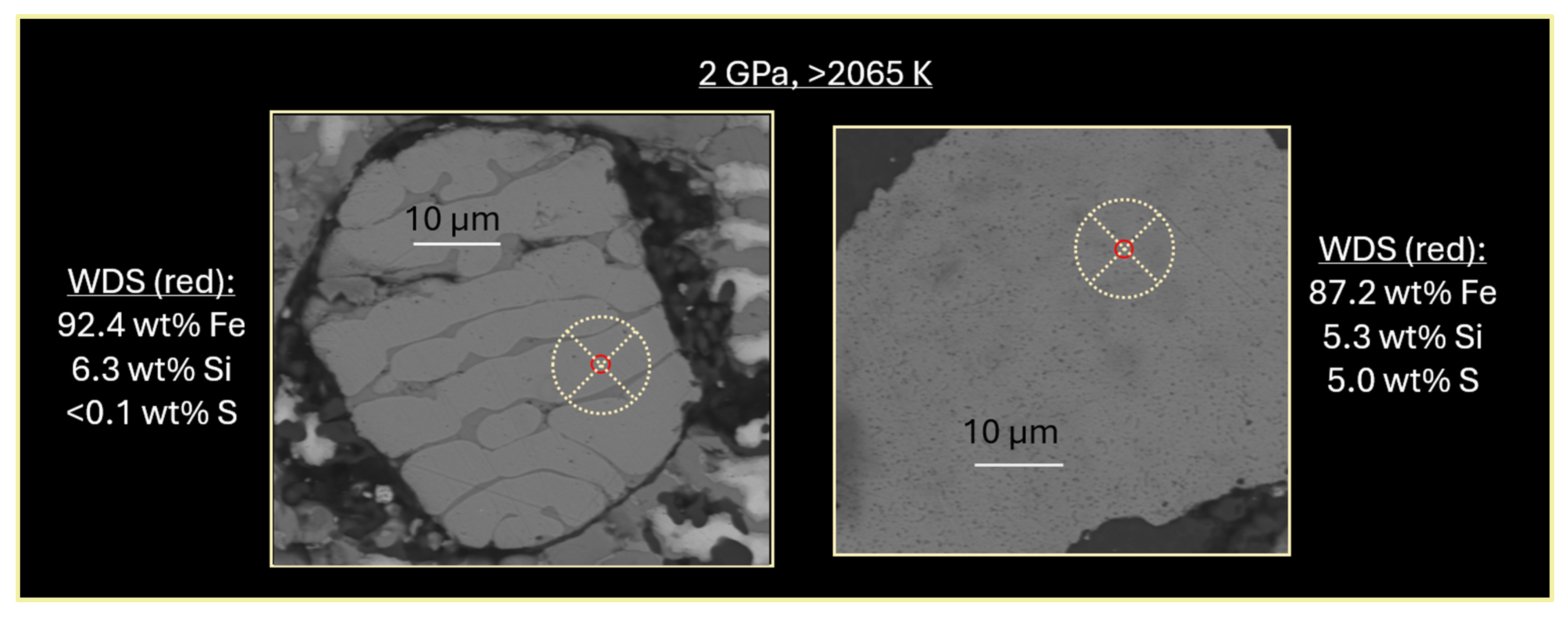
One Fe-Si grain (Figure 6, left) contains 6.3 wt% Si and <0.1 wt% S, with what appears to be FeS filling in cracks in the grain as the temperature drops. This is in contrast with the superliquidus regions from higher pressures shown in Figure 3 in which the Si grain homogenizes with the rest of the sample, and Si crystallizes as an alloy in the Fe-rich regions such as dendrites. Because no large Fe-Si grains remain in samples from higher pressures and similar superliquidus temperatures, the left image of Figure 6 is further evidence of immiscibility of liquid Fe-16S-2Si at 2 GPa and lower. However, a different region from the same sample at 2 GPa (Figure 6, right) is solidified from an Fe-S-Si liquid mix, despite the immiscibility of Fe-S and Fe-Si in the sample overall. The Fe-S-Si liquid mix region contains 5.0 wt% S and 5.3 wt% Si, which is near the miscibility limit in this pressure range as calculated by Chabot et al. [16]. A local variation in composition may have led to this mix near the maximal combined amounts of S and Si in liquid Fe.

4.4. Planetary Applications

The results of this study have consequences for the phenomena arising near the phase boundary of the liquid and solid cores of small terrestrial planetary bodies. If a liquid Fe alloy planetary core comprises S at large or local scales, Turing patterns may arise as the Fe-FeS mix cools to near its eutectic temperature. At such conditions, the arrangement of FeS and Fe at the micron scale may have important consequences for physical properties such as electrical conductivity and thermal expansivity in a mush layer at the inner core boundary of a small terrestrial planet. As opposed to the homogeneous case, regions where Turing patterns develop may constrain heat to flow dominantly in series across the bands in succession or dominantly in parallel preferentially through one composition. Supposing that heat flow in parallel through the banding patterns dominates due to the geometric arrangement of the bands perpendicular to the boundary of the Fe regions (Figure 2C) predicted by the Gray–Scott model, then heat would preferentially flow through the less thermally resistive band composition, Fe. This would slightly increase the thermal conductivity of Fe-S alloys in the case of Fe-FeS banding compared to a homogeneous system, leading to a higher total adiabatic heat flow through the core. The presence of either Si or much more Fe above the liquidus appears to disrupt the Turing patterns; the higher crystallization temperature of other light elements in liquid Fe alloy partial melts may therefore be important for the occurrence of this phenomenon. Dendrites of Fe have the capacity to form primary, secondary, and tertiary arms in an Fe-S alloy partial melt at these pressures. This may occur locally at the top of a liquid core in a top-down crystallization regime [10].
The previously discussed lower pressure limit of 12–15 GPa for the miscibility of S and Si together in liquid Fe [34] has been experimentally confirmed by this study to decrease with lower amounts of S or Si compared to Fe-18.5wt%S-8wt%Si experiments in their study. Specifically, the miscibility limit was observed between 2 and 3 GPa for Fe-16S-2Si. A liquid Fe alloy region of 5.0 wt% S and 5.3 wt% Si quenched from 2 GPa and >2065 K was observed. It may be concluded that even at relatively low pressures of ~3 GPa, ~2 wt% Si may mix with liquid Fe-S for the moderate amounts of S likely present in Mars and similar objects, and ~5 wt% each of S and Si may mix in liquid Fe at ~2 GPa. This may affect estimates of the amounts of S or Si that arrive in various planetary cores during planetary formation as well as predictions of whether a specific planetary core is well mixed or separated into layers of Fe-S and Fe-Si.
In the cores of small terrestrial planetary objects such as asteroid 4 Vesta, stratification between Fe-S and Fe alloys of other light elements such as Si may occur. The Fe-S layer would likely maintain a lower density both due to a higher percentage of light elements and due to the lower density of liquid FeS relative to liquid FeSi at the pressures of this study [55,56]. Fe-S would therefore rise to the top of the core, leaving Fe-Si at the center for the case of an entirely liquid core. Due to this core stratification, a small amount of Si would have a disproportionately large effect on the characteristic length of core convection (L), which is a key parameter in generating a magnetic dynamo according to the magnetic Reynolds number (Rem), for electrical resistivity (ρ), characteristic core fluid velocity (V), and magnetic permeability (μ):
R e m = μ 0 V L / ρ
A small amount of Si may therefore decrease the likelihood of a dynamo for Fe-S alloy cores at pressures on the scale of 1 GPa or lower. For example, in the case of 15wt%Si in the Fe-Si portion of the immiscible Fe-16S-2Si system, a central spherical volume comprising only Fe-Si would account for approximately 50% of the core radius. For the same overall composition, an Fe-Si layer of less than 15 wt% Si, as is likely, corresponds to a larger fraction of the core due to an increased mass of Fe relative to Fe-15wt%Si. This decrease in fraction of the radius for the case of immiscibility corresponds to a proportional drop in both the characteristic length, L, and the magnetic Reynolds number, Rem, thereby decreasing the likelihood of a dynamo formed by Taylor columns in the Fe-S layer if Rem is at the same order of magnitude as its critical value. While the electrical resistivity of an immiscible Fe-S layer would likely be slightly higher than the Fe-S-Si mix due to a higher light element proportion, this effect on the magnetic Reynolds number would be small compared to the effect of characteristic length.

5. Conclusions

Several phases and microstructures are observed via BSE imaging in the Fe-16S-Si samples recovered from high pressures and temperatures. Upon cooling, the liquid region of the partial melt displays bands of separate FeS and pure Fe phases on the submicron scale interpreted as Turing patterns. Dendritic patterns of Fe are observed to form with increasing organization with increasing temperature from samples recovered from temperatures throughout the melt. FeS-Fe banding present on the scale of hundreds of nanometers is seen only throughout the partial melt. At the completion of melting, FeS and Si-bearing Fe form patterns of relatively even regions on the scale of microns upon quenching. The compositions and pressure of miscibility of S and Si in liquid Fe observed in the samples are lower than the estimations by Chabot et al. [16]. Models of small terrestrial planetary cores should consider the microstructures of Fe-S-Si alloys when making physical predictions of mixed phase regions.

Author Contributions

Conceptualization, E.L.; methodology, E.L. and W.Y.; validation, W.Y. and R.A.S.; formal analysis, E.L.; investigation, E.L. and W.Y.; resources, R.A.S. and W.Y.; data curation, E.L.; writing—original draft preparation, E.L.; writing—review and editing, W.Y. and R.A.S.; supervision, W.Y. and R.A.S.; project administration, R.A.S. and W.Y.; funding acquisition, R.A.S. and W.Y. All authors have read and agreed to the published version of the manuscript.

Funding

This research was funded by the Natural Sciences and Engineering Research Council of Canada, grant numbers [RGPIN-2022-04427, DGECR-2022-00151] (W.Y.) and [RGPIN-2018-05021] (R.A.S.), and by the Queen Elizabeth II Scholarship (E.L.).

Data Availability Statement

The raw data supporting the conclusions of this article will be made available by the authors on request.

Acknowledgments

We are grateful for technical support from the staff at the University of Western Ontario. Jonathan Jacobs machined parts needed for the experiments. Stephen Wood carried out polishing the samples for EMPA. Liane Loiselle, Joshua Laughton, and Neeraja Chinchalkar performed or assisted in electron microprobe analysis.

Conflicts of Interest

The authors declare no conflicts of interest.

Abbreviations

The following abbreviations are used in this manuscript:
BSEBackscattered electron
EDSEnergy dispersive spectroscopy
Fe-16S-2SiFe alloy with 16 wt% S and 2 wt% Si
HEDHowardite-eucrite-diogenite meteorites
PPressure
TTemperature
WDSWavelength dispersive spectroscopy

Appendix A

Both cubic and octahedral pressure cell designs were used in this study.
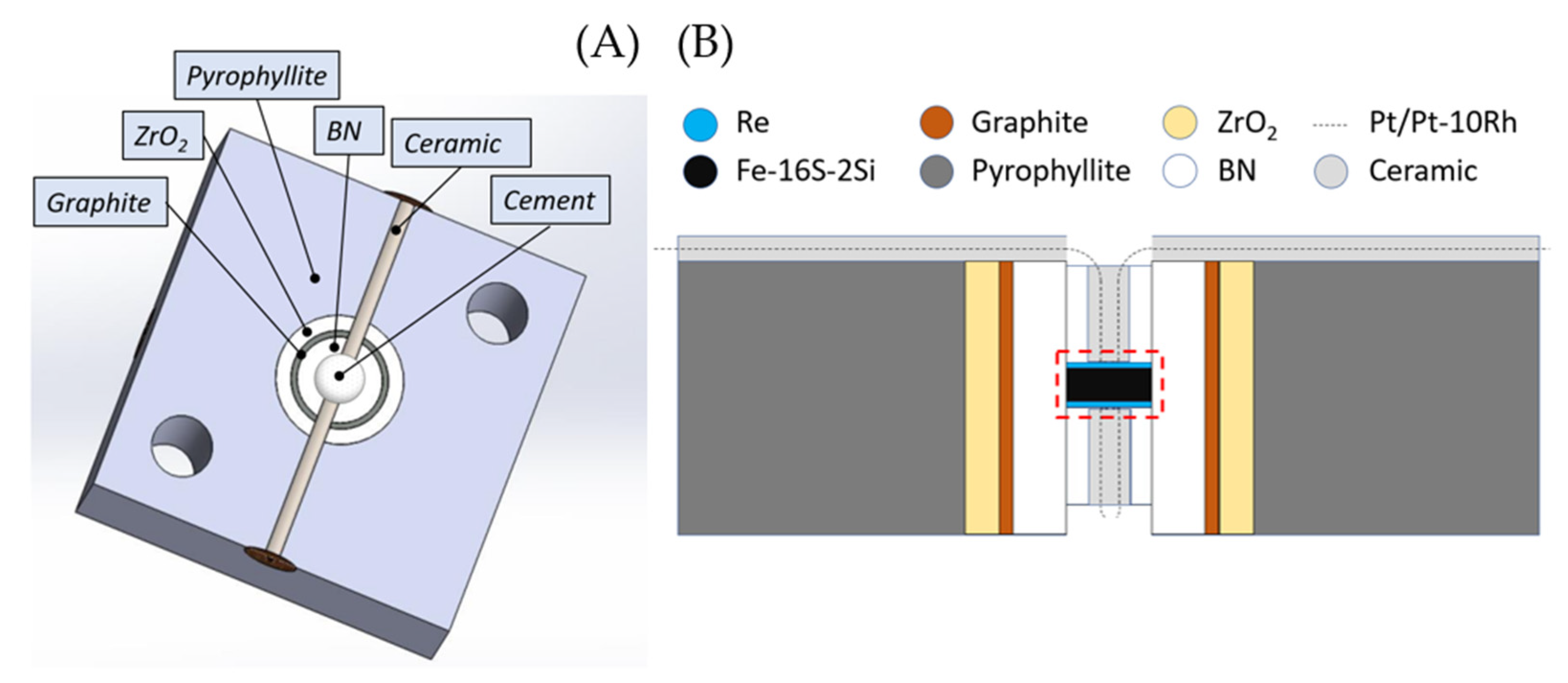
Figure A1. The cubic pressure cell design used for samples 011–020. (A) The 3D assembly of the central layer of the cell. Pre-pressurization edge length is 3.18 cm. (B) A cross-section of (A) with labeled components. Cement fills the spaces at the bends in the wires at the top and the bottom. The red dashed box represents the region shown in Figure 5 of the main paper.
Crystals 16 00113 g0a1
Figure A2. The octahedral pressure cell design generally used for samples 476–522. (A) The 3D assembly of the cell components. Pre-pressurization edge length is 18 mm. (B) A cross-section of (A) with labeled components. Parts are shown in correct proportions except for the thermocouple and the Re furnace.
Crystals 16 00113 g0a2

Appendix B

Additional BSE and EDS images of Fe-16S-2Si samples recovered from high pressures and temperatures.
Figure A3. Common morphologies of the FeS-Fe vermicular banding and spherules in dash-bounded regions, dependent on grain boundaries and proximity to Fe. Sample recovered from 1673 K and 11 GPa.
Crystals 16 00113 g0a3
Figure A4. A superliquidus sample (>2065 K) recovered from the highest pressure of this study, 13 GPa. As opposed to vermicular banding and spherules of Fe, polygonal FeS patterning is observed in the spaces between the Fe-Si bearing dendrites. This may also originate as a Turing pattern with a higher feed rate than in the samples recovered from lower pressures.
Crystals 16 00113 g0a4
Figure A5. Several samples recovered from superliquidus conditions in the Fe-16S-2Si miscible region ≥ 3 GPa. Coloration representing EDS results shows the Si to be distributed across the samples rather than concentrated in the center as in the 2 GPa sample of Figure 5. Si is observed preferentially alloyed in the Fe.
Crystals 16 00113 g0a5

References

  1. Poirier, J.-P. Light elements in the Earth’s outer core: A critical review. Phys. Earth Planet. Inter. 1994, 85, 319–337. [Google Scholar] [CrossRef]
  2. Stähler, S.C.; Khan, A.; Banerdt, W.B.; Lognonné, P.; Giardini, D.; Ceylan, S.; Drilleau, S.; Duran, A.C.; Garcia, R.F.; Huang, Q.; et al. Seismic detection of the martian core. Science 2021, 373, 443–448. [Google Scholar] [CrossRef]
  3. Rama Murthy, V.; Hall, H.T. The chemical composition of the Earth’s core: Possibility of sulphur in the core. Phys. Earth Planet. Inter. 1970, 2, 276–282. [Google Scholar] [CrossRef]
  4. Dreibus, G.; Wänke, F. Mars, a volatile-rich planet. Meteoritics 1985, 20, 367–381. [Google Scholar]
  5. Hirose, K.; Wood, B.; Voçadlo, L. Light elements in the Earth’s core. Nat. Rev. Earth Environ. 2021, 2, 645–658. [Google Scholar] [CrossRef]
  6. Fischer, R.A.; McDonough, W.F. Earth’s Core Composition and Core Formation. In Treatise on Geochemistry, 3rd ed.; Anbar, A.D., Weis, D., Eds.; Elsevier: Amsterdam, The Netherlands, 2025; Volume 1, pp. 17–71. [Google Scholar]
  7. Williams, Q. Bottom-up versus top-down solidification of the cores of small solar system bodies: Constraints on paradoxical cores. Earth Planet. Sci. Lett. 2009, 284, 564–569. [Google Scholar] [CrossRef]
  8. Chen, B.; Li, J.; Hauck, S.A., II. Non-ideal liquidus curve in the Fe-S system and Mercury’s snowing core. Geophys. Res. Lett. 2008, 35, L07201. [Google Scholar] [CrossRef]
  9. Loper, D.E.; Roberts, P.H. A study of conditions at the inner core boundary of the earth. Phys. Earth Planet. Inter. 1981, 24, 302–307. [Google Scholar] [CrossRef]
  10. Deguen, R.; Abloussière, T.; Brito, D. On the existence and structure of a mush at the inner core boundary of the Earth. Phys. Earth Planet. Inter. 2007, 164, 36–49. [Google Scholar] [CrossRef]
  11. Pringle, E.A.; Savage, P.S.; Badro, J.; Barrat, J.-A.; Moynier, F. Redox state during core formation on asteroid 4-Vesta. Earth Planet. Sci. Lett. 2013, 373, 75–82. [Google Scholar] [CrossRef]
  12. Steenstra, E.S.; Dankers, D.; Berndt, J.; Klemme, S.; Matveev, S.; van Westrenen, W. Significant depletion of volatile elements in the mantle of asteroid Vesta due to core formation. Icarus 2019, 317, 669–681. [Google Scholar] [CrossRef]
  13. Brennan, M.C.; Fischer, R.A.; Irving, J.C.E. Core formation and geophysical properties of Mars. Earth Planet. Sci. Lett. 2020, 530, 115923. [Google Scholar] [CrossRef]
  14. Lv, C.; Liu, J. Early planetary processes and light elements in iron-dominated cores. Acta Geochim. 2022, 41, 625–649. [Google Scholar] [CrossRef]
  15. Morard, G.; Katsura, T. Pressure–temperature cartography of Fe–S–Si immiscible system. Geochim. Cosmochim. Acta 2010, 74, 3659–3667. [Google Scholar] [CrossRef]
  16. Chabot, N.L.; Wollack, E.A.; Klima, R.L.; Minitti, M.E. Experimental constraints on Mercury’s core composition. Earth Planet. Sci. Lett. 2014, 390, 199–208. [Google Scholar] [CrossRef]
  17. Kilburn, M.R.; Wood, B.J. Metal-silicate partitioning and the incompatibility of S and Si during core formation. Earth Planet. Sci. Lett. 1997, 152, 139–148. [Google Scholar] [CrossRef]
  18. Kubaschewski, I. Iron-Sulphur. In IRON—Binary Phase Diagrams; Springer: Berlin/Heidelberg, Germany; Düsseldorf, Germany, 1982; pp. 125–128. [Google Scholar]
  19. Ryzhenko, B.; Kennedy, G.C. The effect of pressure on the eutectic in the system Fe-FeS. Am. J. Sci. 1973, 273, 803–810. [Google Scholar] [CrossRef]
  20. Morard, G.; Sanloup, C.; Fiquet, G.; Mezouar, M.; Rey, N.; Poloni, R.; Beck, P. Structure of eutectic Fe–FeS melts to pressures up to 17 GPa: Implications for planetary cores. Earth Planet. Sci. Lett. 2007, 263, 128–139. [Google Scholar] [CrossRef]
  21. Buono, A.S.; Walker, D. H, not O or pressures, causes eutectic T depression in the Fe-FeS system to 8 GPa. Meteorit. Planet. Sci. 2015, 50, 547–554. [Google Scholar] [CrossRef]
  22. Littleton, J.A.H.; Secco, R.A.; Yong, W. Thermal Convection in the Core of Ganymede Inferred from Liquid Eutectic Fe-FeS Electrical Resistivity at High Pressures. Crystals 2021, 11, 875. [Google Scholar] [CrossRef]
  23. Brett, R.; Bell, P.M. Melting relations in the Fe-rich portion of the system Fe-FeS at 30 kb pressure. Earth Planet. Sci. Lett. 1969, 6, 479–482. [Google Scholar] [CrossRef]
  24. Usselman, T.M. Experimental approach to the state of the core; Part I, The liquidus relations of the Fe-rich portion of the Fe-Ni-S system from 30 to 100 kb. Am. J. Sci. 1975, 275, 278–290. [Google Scholar] [CrossRef]
  25. Hauck, S.E., II; Aurnou, J.M.; Dombard, A.J. Sulfur’s impact on core evolution and magnetic field generation on Ganymede. J. Geophys. Res. Planets 2006, 111, E09008. [Google Scholar] [CrossRef]
  26. Fei, Y.; Li, J.; Bertka, C.M.; Prewitt, C.T. Structure type and bulk modulus of Fe3S, a new iron-sulfur compound. Am. Mineral. 2000, 85, 1830. [Google Scholar] [CrossRef]
  27. Santamaría-Pérez, D.; Boehler, R. FeSi melting curve up to 70 GPa. Earth Planet. Sci. Lett. 2008, 265, 743–747. [Google Scholar] [CrossRef]
  28. Fischer, R.A.; Campbell, A.J.; Reaman, D.M.; Miller, N.A.; Heinz, D.L.; Dera, P.; Prakapenka, V.B. Phase relations in the Fe–FeSi system at high pressures and temperatures. Earth Planet. Sci. Lett. 2013, 373, 54–64. [Google Scholar] [CrossRef]
  29. Ozawa, H.; Hirose, K.; Yonemitsu, K.; Ohishi, Y. High-pressure melting experiments on Fe–Si alloys and implications for silicon as a light element in the core. Earth Planet. Sci. Lett. 2016, 456, 47–54. [Google Scholar] [CrossRef]
  30. Andrault, D.; Bolfan-Casanova, N.; Ohtaka, O.; Fukui, H.; Arima, H.; Fialin, M.; Funakoshi, K. Melting diagrams of Fe-rich alloys determined from synchrotron in-situ measurements in the 15–23 GPa pressure range. Phys. Earth Planet. Inter. 2009, 174, 181–191. [Google Scholar] [CrossRef]
  31. Tateno, S.; Hirose, K.; Sinmyo, R.; Morard, G.; Hirao, N.; Ohishi, Y. Melting experiments on Fe-Si-S alloys to core pressures; silicon in the core? Am. Miner. 2018, 103, 742–748. [Google Scholar] [CrossRef]
  32. Boccato, S.; Torchio, R.; Anzellini, S.; Boulard, E.; Guyot, F.; Irifune, T.; Harmand, M.; Kantor, I.; Miozzi, F.; Parisiades, P.; et al. Melting properties by X-ray absorption spectroscopy: Common signatures in binary Fe-C, Fe-O, Fe-S and Fe-Si systems. Sci. Rep. 2020, 10, 11663. [Google Scholar] [CrossRef] [PubMed]
  33. Sakairi, T.; Ohtani, E.; Kamada, S.; Sakai, T.; Sakamaki, T.; Hirao, N. Melting relations in the Fe–S–Si system at high pressure and temperature: Implications for the planetary core. Prog. Earth Planet. Sci. 2017, 4, 10. [Google Scholar] [CrossRef]
  34. Sanloup, C.; Fei, Y. Closure of the Fe–S–Si liquid miscibility gap at high pressure. Phys. Earth Planet. Inter. 2004, 47, 57–65. [Google Scholar] [CrossRef]
  35. Secco, R.A. High p, T physical property studies of Earth’s interior: Thermoelectric power of solid and liquid Fe up to 6.4 GPa. Can. J. Phys. 1995, 73, 287–294. [Google Scholar] [CrossRef]
  36. Secco, R.A.; Liu, H.; Imanaka, N.; Adachi, G.; Rutter, M.D. Electrical conductivity and amorphization of of Sc2(WO4)3 at high pressures and temperatures. J. Phys. Chem. Solids 2002, 63, 425–431. [Google Scholar] [CrossRef]
  37. Ezenwa, I.C.; Secco, R.A.; Yong, W.; Pozza, M.; Alfè, D. Electrical resistivity of solid and liquid Cu up to 5 GPa: Decrease along the melting boundary. J. Phys. Chem. Solids 2017, 110, 386–393. [Google Scholar] [CrossRef]
  38. Silber, R.E.; Secco, R.A.; Yong, W.; Littleton, J.A.H. Heat Flow in Earth’s Core From Invariant Electrical Resistivity of Fe-Si on the Melting Boundary to 9 GPa: Do Light Elements Matter? J. Geophys. Res. Solid Earth 2019, 124, 5521–5543. [Google Scholar] [CrossRef]
  39. Yong, W.; Secco, R.A.; Littleton, J.A.H.; Silber, R.E. The Iron Invariance: Implications for Thermal Convection in Earth’s Core. Geophys. Res. Lett. 2019, 46, 11065–11070. [Google Scholar] [CrossRef]
  40. Lenhart, E.M.; Yong, W.; Secco, R.A. The Electrical Resistivity of Liquid Fe-16wt%S-2wt%Si at High Pressures and the Effect of S and Si on the Dynamo in the Ancient Vestan Core. Crystals 2024, 14, 565. [Google Scholar]
  41. Lenhart, E.M.; Yong, W.; Secco, R.A. Electrical Resistivity of Liquid Fe-16S-2Si up to 13 GPa With Implications for the Adiabatic Heat Flux Through the Core of Exoplanet TRAPPIST-1h. J. Geophys. Res. Planets 2025, 130, e2025JE009203. [Google Scholar]
  42. Bondar, D.; Fei, H.; Withers, A.C.; Katsura, T. A rapid-quench technique for multi-anvil high-pressure-temperature experiments. Rev. Sci. Instrum. 2020, 91, 065105. [Google Scholar] [CrossRef]
  43. Li, J.; Fei, Y.; Mao, H.K.; Hirose, K.; Shieh, S.R. Sulfur in the Earth’s inner core. Earth Planet. Sci. Lett. 2001, 193, 509–514. [Google Scholar] [CrossRef]
  44. Xu, F.; Morard, G.; Guignot, N.; Rivoldini, A.; Manthilake, G.; Chantel, J.; Xie, L.; Yoneda, A.; King, A.; Boulard, E.; et al. Thermal Expansion of Liquid Fe-S Alloy at High Pressure. Earth Planet. Sci. Lett. 2021, 563, 116884. [Google Scholar] [CrossRef]
  45. Pommier, A.; Davies, C.J.; Zhang, R. A Joint Experimental-Modeling Investigation of the Effect of Light Elements on Dynamos in Small Planets and Moons. J. Geophys. Res. 2020, 125, e2020JE006492. [Google Scholar] [CrossRef]
  46. Zhai, K.; Yin, Y.; Zhai, S. New constraints on the abundances of phosphorus and sulfur in the lunar core: High-pressure and high-temperature experimental study of the FeSP ternary system. Geochim. Cosmochim. Acta 2022, 334, 1–13. [Google Scholar] [CrossRef]
  47. Berrada, M.; Secco, R.A. Phase diagrams of Fe–Si alloys at 3–5 GPa from electrical resistivity measurements. Phys. Chem. Miner. 2022, 49, 42. [Google Scholar] [CrossRef]
  48. Strong, H.M. The Experimental Fusion Curve of Iron to 96,000 Atmospheres. J. Geophys. Res. 1959, 64, 653–659. [Google Scholar] [CrossRef]
  49. Silber, R.E.; Secco, R.A.; Yong, W.; Littleton, J.A.H. Electrical resistivity of liquid Fe to 12 GPa: Implications for heat flow in cores of terrestrial bodies. Sci. Rep. 2018, 8, 10758. [Google Scholar] [CrossRef] [PubMed]
  50. Ezenwa, I.C.; Fei, Y. High Pressure Melting Curve of Fe Determined by Inter-Metallic Fast Diffusion Technique. Geophys. Res. Lett. 2023, 50, e2022GL102006. [Google Scholar] [CrossRef]
  51. Turing, A.M. The Chemical Basis for Morphogenesis. Philos. Trans. R. Soc. Lond. 1952, 237, 37–72. [Google Scholar] [CrossRef]
  52. Gray, P.; Scott, S.K. Autocatalytic reactions in the isothermal continuous stirred tank reactor. Oscillations and instabilities in the system A+2B→3B.; B→C. Chem. Eng. Sci. 1984, 39, 1087–1097. [Google Scholar] [CrossRef]
  53. Li, X.; Chen, C.; Wang, T.; Guo, Z.; Wang, H.; Wang, H.; Xue, L.; Tian, J.; Sun, Y. Inclusions and phases in Fe-RE-Si steelmaking alloys and their effect on evolution of inclusions in non-oriented silicon steels. J. Rare Earths 2026, 44, 377–387. [Google Scholar] [CrossRef]
  54. Littleton, J.A.H.; Yong, W.; Secco, R.A. Electrical resistivity of the Fe–Si–S ternary system: Implications for timing of thermal convection shutdown in the lunar core. Sci. Rep. 2022, 12, 19031. [Google Scholar] [CrossRef]
  55. Nishida, K.; Ohtani, E.; Urakawa, S.; Suzuki, A.; Sakamaki, T.; Terasaki, H.; Katayama, Y. Density measurement of liquid FeS at high pressures using synchrotron X-ray absorption. Am. Mineral. 2011, 96, 864–868. [Google Scholar] [CrossRef]
  56. Tateyama, R.; Ohtani, E.; Terasaki, H.; Nishida, K.; Shibazaki, Y.; Suzuki, A.; Kikegawa, T. Density measurements of liquid Fe–Si alloys at high pressure using the sink–float method. Phys. Chem. Miner. 2011, 38, 801–807. [Google Scholar] [CrossRef]
Figure 1. Phases and microstructures of Fe-16S-2Si found through BSE imaging and WDS analysis: (A) Grains of the sample after pressurization to 9 GPa at ambient temperature; (B) Quench microstructure of the sample after heating above the liquidus to 2021 K at 5 GPa. Perpendicular arrows indicate dendritic orientation.
Crystals 16 00113 g001
Figure 2. Progression of structures within Fe-16S-2Si samples with increasing quench temperature (AH). Colors indicate degree of melting (none , partial , complete ). Discussion of the microstructures of individual samples, including circled areas, is given in Section 4.2.
Crystals 16 00113 g002
Figure 3. BSE images with approximate WDS spot areas (red circle within yellow dashed circle) and results for representative Si-rich regions of the sample below the liquidus (left) and above the liquidus (right).
Crystals 16 00113 g003
Figure 4. Phase diagram of Fe-16S-2Si. Solid and melt symbols are from EMPA analyses (microstructures from BSE images and compositions from WDS analyses) in this study and phase boundary lines are inferred from sudden drops in electrical resistivity measurements [41] with estimated Fe melt added for reference [48,49,50].
Crystals 16 00113 g004
Figure 5. Fe-16S-2Si sample recovered from 2 to 3 GPa and above the liquidus. Si (left column) concentrates in one region of the sample at 2 GPa (top) and spreads throughout the sample at 3 GPa (bottom). EDS mapping results overlie BSE images. Boxes marked in white dashes are estimated by EDS to comprise (1) 14.9 wt% S and 0.0 wt% Si; (2) 2.1 wt% Si and 16.7 wt% S.
Crystals 16 00113 g005
Figure 6. BSE images of Fe-Si regions of an Fe-16S-2Si sample recovered from 2 GPa and >2065 K. Approximate WDS spot areas are marked by the large yellow dotted circle with the target spot indicated by the small red circle. Small (~1%) amounts of the WDS spots are contaminant metals from the Re disks and S-type thermocouples. The miscibility of Si and S in liquid Fe varies with local conditions.
Crystals 16 00113 g006
Table 1. WDS point analyses of various microstructures observed in Fe-16S-2Si samples recovered from 5 to 13 GPa and across the melt (subsolidus to superliquidus). Runs noted with (*) were in a 1000-ton cubic press and others were in a 3000-ton multi-anvil press.
Run
(Sample # _Point)
T (K)P (GPa)Sample RegionComposition (wt%)
SiFeReSPtWTotal
505_0510739FeS0.0063.61n.d.36.980.000.18100.77
505_12 Fe0.0498.74n.d.0.050.020.2299.05
505_03 Fe-Si Grain8.3094.100.030.13n.d.0.24102.80
504_0312759FeS1.4567.87n.d.29.060.020.2898.68
504_01 Fe-Si Grain8.8790.00n.d.0.04n.d.n.d.98.92
504_02 Fe0.0498.860.000.03n.d.0.2799.19
503_1215239Fe-Si Grain4.1996.99n.d.1.360.010.41102.95
503_13 Fe + FeS Matrix0.3879.110.0621.05n.d.0.26100.86
514_08167311Fe-Si Grain5.5595.680.060.05n.d.0.13101.47
514_07 Fe + FeS Matrix0.0379.980.0921.83n.d.0.19102.12
514_15 Fe0.47104.37n.d.0.160.030.30105.32
493_0616807Fe-Si Grain7.8292.46n.d.0.15n.d.0.14100.56
493_03 Fe + FeS Matrix0.0677.67n.d.22.85n.d.n.d.100.58
493_01 Fe0.05103.58n.d.1.420.080.28105.41
015_10 *17005Fe0.0185.660.5412.75n.d.n.d.98.96
015_03 * Fe-Si Grain7.2192.12n.d.0.100.01n.d.99.44
015_12 * Fe-Si Grain6.8793.090.020.080.02n.d.100.06
015_13 * Fe-Si Grain6.5493.38n.d.0.09n.d.n.d.100.01
015_05 * Fe + FeS Matrix0.0175.18n.d.23.800.04n.d.99.03
015_06 * Fe + FeS Matrix0.0074.210.0924.740.02n.d.99.06
015_07 * Fe + FeS Matrix0.0075.300.0823.77n.d.n.d.99.16
015_08 * Fe + FeS Matrix0.0271.370.0727.740.02n.d.99.22
476_0417295Fe + FeS Matrix0.0473.852.5720.05n.d.n.d.96.51
481_08 17835Fe-Si + FeS3.1391.260.375.74n.d.0.34100.84
481_02 Fe-Si4.7496.320.070.60n.d.0.15101.88
481_14 Fe + FeS Matrix0.0475.900.0725.57n.d.0.19101.77
483_0518347FeS0.7167.090.0525.710.001.7395.29
483_06 Fe-S-Si mix1.2271.522.0819.710.000.8895.42
489_0819795Fe + FeS Matrix0.0666.680.0127.170.01n.d.93.92
489_09 Fe + FeS Matrix0.1872.280.2022.59n.d.n.d.95.25
519_14>206513Fe-S-Si mix1.5380.520.6416.220.00n.d.98.91
519_08 FeS0.0263.130.1935.840.02n.d.99.20
519_17 Fe + FeS Matrix0.0575.430.1623.40n.d.n.d.99.04
519_16 Fe + FeS Matrix0.0575.190.4023.120.00n.d.98.76
014_10 *>20655Fe-S-Si liquid5.8488.270.724.430.01n.d.99.27
020-08 *>20652FeSn.d.60.730.1035.610.02n.d.96.46
020-14 * Fe-S-Si liquid5.2485.350.594.292.48n.d.97.96
n.d. means not determined.
Disclaimer/Publisher’s Note: The statements, opinions and data contained in all publications are solely those of the individual author(s) and contributor(s) and not of MDPI and/or the editor(s). MDPI and/or the editor(s) disclaim responsibility for any injury to people or property resulting from any ideas, methods, instructions or products referred to in the content.