
Article

Histological and Microstructural Evaluation of Strontium Apatite-Reinforced Mineral Trioxide Aggregate Composites in Experimental Rat Tibial Bone Defects
1
Department of Endodontics, Faculty of Dentistry, Firat University, Elazig 23100, Turkey
2
School of Aviation, Aircraft Airframe-Engine Maintenance, Firat University, Elazig 23119, Turkey
3
Department of Automotive Engineering, Faculty of Technology, Firat University, Elazig 23119, Turkey
4
Department of Periodontology, Faculty of Dentistry, Firat University, Elazig 23100, Turkey
5
Department of Pathology, Faculty of Medicine, Firat University, Elazig 23100, Turkey
*
Author to whom correspondence should be addressed.
Crystals 2026, 16(2), 107; https://doi.org/10.3390/cryst16020107
Submission received: 25 December 2025 / Revised: 23 January 2026 / Accepted: 26 January 2026 / Published: 31 January 2026
(This article belongs to the Section Crystalline Metals and Alloys)

Abstract

Mineral trioxide aggregate (MTA) is a calcium silicate-based endodontic biomaterial widely used for its biocompatibility, sealing ability, and osteoconductive potential; however, further enhancement of its bone regenerative capacity without compromising structural stability remains of interest. Strontium apatite (SrAp), a bioactive calcium phosphate phase structurally analogous to bone mineral, may promote osteogenic activity and bone regeneration. In this study, standardized cylindrical defects (2.5 mm diameter, 4 mm depth) were created in the right tibial metaphysis of systemically healthy rats and allocated to four groups: empty defect (control), pure MTA, 25SrAp–MTA, and 50SrAp–MTA. SrAp nanoparticles were synthesized hydrothermally and incorporated into the MTA matrix at predefined weight fractions. Materials were characterized using X-ray diffraction (XRD), Fourier transform infrared spectroscopy (FT-IR), scanning electron microscopy (SEM), and energy-dispersive X-ray spectroscopy (EDX). After 8 weeks, tibial specimens were harvested and processed for H&E histology; fibrous tissue formation, new bone formation, and osteoblastic cell presence were semi-quantitatively scored. XRD and FT-IR confirmed that SrAp incorporation preserved the fundamental Ca-silicate phase architecture and hydration chemistry of MTA, indicating chemical and crystallographic stability. SEM–EDX demonstrated progressive microstructural densification with increasing SrAp content, with reduced intergranular porosity and homogeneous SrAp distribution. Histologically, both SrAp–MTA groups exhibited significantly higher new bone formation and osteoblastic activity than untreated controls (p < 0.05), while fibrotic tissue formation did not differ significantly among groups. Although SrAp–MTA composites did not show statistically significant superiority over pure MTA after multiple-comparison adjustment, they demonstrated consistent osteogenic trends relative to empty defects. Overall, SrAp reinforcement yields a chemically compatible and structurally stable MTA-based composite that supports an enhanced osteogenic response in vivo without increasing fibrosis, suggesting potential utility in endodontic surgery and bone defect repair; longer-term and quantitative analyses are warranted to optimize SrAp content and confirm long-term performance.

1. Introduction

Various pathological conditions may develop in the periapical region of teeth, presenting as radiolucent or radiopaque lesions. The most common periapical lesions are primarily associated with persistent infection within the root canal system [1]. Apical periodontitis is an inflammatory disease caused by microbial infection of the root canal system, involving intraradicular and, in some cases, extraradicular infections, and is characterized by progressive periapical bone destruction mediated by host immune responses [2,3]. The pathophysiology of apical periodontitis is closely linked to increased osteoclastic activity, upregulation of pro-inflammatory cytokines such as IL-1β, TNF-α, and IL-6, and disruption of the RANKL/OPG balance in favor of bone resorption. Consequently, successful treatment requires not only elimination of intracanal infection but also restoration of periapical tissue homeostasis and promotion of new bone formation.
Management of persistent or recurrent apical periodontitis following primary endodontic therapy includes orthograde retreatment, periapical surgery, or intentional replantation in selected cases [4]. However, in situations where nonsurgical retreatment is not feasible due to complex canal anatomy, obstructed canals, fractured instruments, extensive posts, or apical blockage, surgical intervention becomes the treatment of last resort to preserve the affected tooth [5]. In this context, prognostic factors associated with apical surgery with root-end filling have been systematically analyzed in a meta-analysis [5]. There is broad clinical consensus that periapical surgery is the preferred approach when nonsurgical endodontic treatment is neither possible nor indicated [6].
During apical surgery, root-end resection exposes an apical dentin surface surrounded by cementum and containing the root canal lumen. Following apical resection, achieving an effective apical seal is critical to prevent periapical leakage of bacteria, toxins, and tissue fluids. For this purpose, a retrograde cavity is typically prepared and filled with a root-end filling material. Over time, numerous materials have been employed for retrograde filling, including amalgam, gutta-percha, zinc oxide–eugenol cements, glass ionomer cements, Cavit, composite resins, and mineral trioxide aggregate (MTA). However, an ideal retrograde material is expected to simultaneously fulfill multiple requirements, such as biocompatibility, sealing ability, dimensional stability, radiopacity, setting in moist conditions, antimicrobial properties, and the capacity to support periapical healing [7].
Mineral trioxide aggregate, a calcium silicate-based cement, has gained widespread acceptance in endodontics due to its superior biocompatibility, excellent sealing properties, and favorable clinical performance. MTA is currently used in various clinical applications, including root-end fillings, perforation repair, pulp capping, pulpotomy, and apexification. When applied in apical surgery, MTA has demonstrated significantly lower micro leakage compared with traditional retrograde materials [8]. The biological activity of MTA is largely attributed to its hydration-induced calcium ion release, alkaline pH environment, and subsequent formation of calcium phosphate precipitates that promote biomineralization. Accordingly, MTA is now regarded not merely as a passive sealing material but as a bioactive cement capable of modulating biological responses in the surrounding tissues.
Despite its proven clinical success, periapical healing following MTA application cannot be explained solely by its sealing ability. Increasing evidence suggests that the interaction between the material and the surrounding bone tissue, particularly its influence on osteogenesis, inflammatory modulation, and fibrotic response, plays a crucial role in treatment outcomes. Consequently, enhancing the biofunctional properties of MTA through incorporation of osteoconductive and osteoinductive phases capable of actively supporting bone regeneration has become an important focus of contemporary research.
Sr-apatite represents a bioactive calcium phosphate phase in which strontium partially or fully substitutes calcium within the apatite lattice. This substitution not only preserves the crystallographic similarity to biological apatite but also introduces distinct physicochemical and biological advantages. Sr-apatite exhibits high biocompatibility, enhanced radiopacity, and chemical affinity to mineralized tissues, making it particularly attractive for bone-related dental applications. Unlike simple ionic doping strategies, Sr-apatite functions as a structurally stable osteoconductive phase capable of sustained ionic interaction with the surrounding biological environment [9,10,11,12]. In contrast to stoichiometric hydroxyapatite (HA), Sr-substituted apatites can provide an additional “pharmacological” ion component, because Sr2+ is known to modulate bone remodeling by promoting osteoblastic activity while concomitantly attenuating osteoclastogenesis through pathways linked to RANKL/OPG regulation. Therefore, Sr-apatite is not only osteoconductive (as HA typically is) but may also be osteostimulatory via controlled Sr2+ availability at the material–tissue interface [10,11,12,13,14].
Previous studies have demonstrated that strontium-containing apatite phases can stimulate osteoblast proliferation and differentiation, enhance expression of osteogenic markers such as alkaline phosphatase (ALP), collagen type I (COL1) and osteocalcin (OCN), and simultaneously suppress osteoclast-mediated bone resorption. These effects arise from both the apatite-based surface chemistry, which favors protein adsorption and cell attachment, and the gradual release of strontium ions from the apatite lattice, which modulates bone remodeling pathways. As a result, Sr-apatite is considered a multifunctional biomaterial phase that actively promotes mineralized tissue formation rather than serving solely as a passive filler [10,11,12,13,14].
Accordingly, the “amount of Sr” incorporated into the composite is expected to influence bioactivity through two coupled mechanisms: increasing Sr-apatite fraction raises the density of apatite-rich interfacial sites available for cell/material interaction and may increase the local availability of Sr2+ released from the apatite lattice, whereas excessive loading may promote particle agglomeration and reduce matrix continuity, potentially limiting the effective bioactive surface area and transport pathways. This non-linear, window-type behavior is widely recognized in bioactive composites and motivates evaluation of distinct reinforcement levels rather than assuming a strictly proportional dose response [13,14,15,16,17,18].
Incorporation of strontium apatite into calcium silicate-based matrices such as MTA therefore represents a promising strategy to combine the sealing ability and hydration-driven bioactivity of MTA with the osteoconductive and osteostimulatory properties of apatite-based phases. In this composite design, MTA provides a chemically stable, moisture-tolerant matrix, while Sr-apatite acts as a biofunctional phase capable of enhancing bone regeneration at the defect site. Importantly, the biological response elicited by Sr-apatite–reinforced composites is expected to be dependent on the amount of Sr-apatite incorporated, as excessive loading may alter matrix continuity, while insufficient content may limit biological effectiveness [13,14,15,16,17,18]. Compared with other bioactive ions frequently explored in mineralized tissue engineering (e.g., Mg2+, Si4+/silicate species, and F), Sr2+ is particularly notable because it is consistently associated with a dual-action remodeling profile supporting osteoblastic bone formation while reducing osteoclastic resorption, whereas Mg and Si are often discussed primarily in the context of osteogenic stimulation and matrix mineralization, and F is commonly linked to apatite stability and acid resistance rather than a balanced remodeling response. In this respect, Sr-apatite offers a rational route to introduce Sr-mediated remodeling cues in a structurally stable apatite carrier phase while retaining the clinically established Ca-silicate cement platform of MTA [9,10,11,12,13,14].
In this context, the present study aims to investigate the effects of strontium apatite–reinforced MTA composites containing different weight percentages of Sr-apatite on osteoblastic activity, new bone formation and fibrotic tissue development in experimentally created tibial bone defects. By providing histological evidence of how Sr-apatite incorporation modulates bone regeneration parameters, this study seeks to contribute to the rational design of more biofunctional retrograde filling materials for apical surgery and other bone-related endodontic applications.

2. Materials and Methods

2.1. Preparation of Pure MTA and Strontium Apatite-Reinforced MTA Composites

MTA and strontium apatite–reinforced MTA (SrAp–MTA) composites were prepared using a standardized powder–liquid mixing protocol to reduce preparation-related variability and to ensure that SrAp content was the only intended compositional variable among groups. Commercial white mineral trioxide aggregate (Angelus White MTA, Angelus, Londrina, PR, Brazil) was used as the base cement. For the synthesis of strontium apatite, strontium nitrate (Sr(NO3)2, Acros Organics, Geel, Belgium) and diammonium hydrogen phosphate ((NH4)2HPO4, Fluka Analytical, Buchs, Switzerland) were used as precursor reagents. Parameters known to affect hydration kinetics, phase development, and microstructural maturation of calcium silicate-based cements, namely the powder-to-liquid ratio, mixing time, mixing substrate, ambient conditions during manipulation, placement/compaction procedure, mold geometry, and curing conditions, were kept identical for all specimens. Accordingly, any subsequent differences observed in crystallographic features were evaluated by X-ray diffraction (Empyrean, PANalytical, Almelo, The Netherlands), changes in bonding environments were assessed by FT-IR spectroscopy (Nicolet iS5, Thermo Scientific, Waltham, MA, USA), and microstructural features and elemental distribution were examined using SEM–EDX (Sigma 300, ZEISS, Oberkochen, Germany), while the biological response was analyzed by histology.
Strontium apatite was synthesized prior to composite fabrication and subsequently blended with MTA at two predefined incorporation levels to obtain compositionally distinct composites. The experimental materials were coded as MTA (control), 25SrAp–MTA, and 50SrAp–MTA, representing unmodified MTA and two SrAp-containing formulations prepared under identical processing conditions [16,19,20,21].

2.1.1. Hydrothermal Synthesis of SrAp

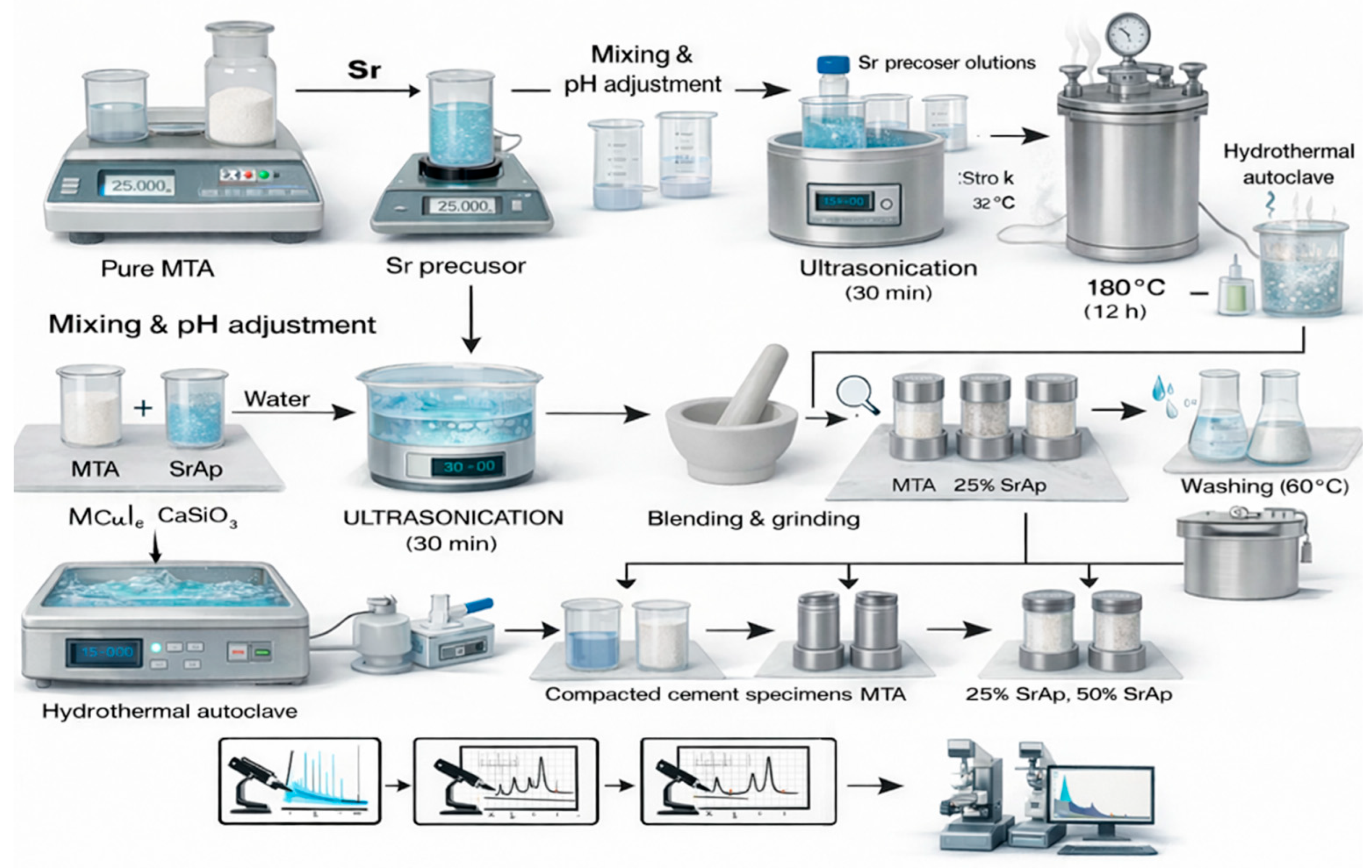
SrAp powder was synthesized using a hydrothermal route adapted from a previously reported protocol. Briefly, two precursor solutions were prepared separately. First, 0.1 M strontium nitrate (Sr(NO3)2) was dissolved in 30 mL distilled water (Solution 1). In parallel, 0.06 M diammonium hydrogen phosphate ((NH4)2HPO4; reported as H9N2O4P) was dissolved in 30 mL distilled water (Solution 2).
Each solution was magnetically stirred at room temperature for 30 min to ensure complete dissolution and chemical uniformity. Solution 2 was then added dropwise into Solution 1 under continuous stirring to control local supersaturation and to promote homogeneous nucleation. The combined suspension was stirred for an additional 30 min at room temperature. The pH of the mixed suspension was adjusted to pH = 10 by dropwise addition of ammonia solution (NH3) while maintaining continuous stirring. After pH adjustment, the suspension was further stirred for 10 min, followed by ultrasonication for 30 min to reduce agglomeration and enhance dispersion prior to hydrothermal treatment. The final suspension was transferred into a hydrothermal autoclave and subjected to hydrothermal crystallization at 180 °C for 12 h. Upon completion, the autoclave was allowed to cool slowly to room temperature to minimize thermal shock and preserve crystal integrity. The resulting precipitate was collected by filtration, washed several times with distilled water to remove residual ions, and dried at 60 °C for 5 h. Finally, the dried SrAp powder was gently ground in a mortar to obtain a fine, free-flowing powder suitable for reproducible composite blending [20,21].

2.1.2. Preparation of SrAp–MTA Composite Powders

To prepare SrAp–MTA composites, SrAp powder was incorporated into MTA at two predefined levels (25SrAp–MTA and 50SrAp–MTA). These two compositions were selected to represent moderate and relatively high SrAp loadings while maintaining the cementitious character, hydration capability, and handling performance of MTA. In cement-based systems, increasing the fraction of a comparatively less-reactive ceramic phase progressively reduces the effective amount of reactive cement, which may alter hydration kinetics, setting behavior, and the continuity of the hardened matrix. Accordingly, 25 wt% and 50 wt% SrAp were considered practically processable and mechanistically informative substitution levels that provide a clear compositional contrast without excessively diluting the MTA phase.
For each formulation, the required masses of MTA and SrAp powders were weighed and dry-blended in an agate mortar for approximately 15 min using rotational and cross-folding motions until the mixture appeared macroscopically homogeneous. The dry homogenization step was applied to reduce the risk of SrAp-rich microdomains that could act as preferential nucleation sites during hydration and bias microstructural development. Homogeneous powder blending is critical in cementitious systems because early C–S–H formation and Ca-bearing phase evolution are highly sensitive to local compositional gradients [18,22,23,24]. In addition, minimizing compositional heterogeneity at the powder stage improves the reproducibility of hydration/setting reactions and reduces the likelihood of localized SrAp accumulation confounding phase evolution and microstructural interpretation.

2.1.3. Paste Formation, Molding and Curing

For all groups, a constant powder-to-water ratio of 3:1 (w/w) was maintained to enable direct comparison independent of liquid content. Mixing was conducted on a sterile glass slab using a stainless-steel spatula. Powder was gradually incorporated into distilled water and spatulated for approximately 60 s until a uniform, lump-free paste was obtained. A fixed mixing duration was applied to minimize variability in shear history, as shear influences dispersion quality, particle packing, and early hydration behavior.
Immediately after mixing, the fresh pastes were placed into cylindrical molds (stainless steel or PTFE/Teflon) using incremental filling to minimize air entrapment. Molds were slightly overfilled and the surface was leveled using a Mylar strip and glass slide under gentle pressure to obtain a flat, standardized surface and consistent specimen geometry. This procedure reduces variability in surface roughness and helps ensure comparable conditions for subsequent structural (XRD), spectroscopic (FT-IR) and microstructural (SEM–EDX) analyses.
All specimens were initially cured at 37 °C under high humidity (95% RH) for 24 h to support controlled early hydration under saturated conditions. Following demolding, samples were transferred into sealed containers containing distilled water or phosphate-buffered saline (PBS), depending on the downstream analysis protocol, and stored at 37 °C until characterization. Wet storage was selected to prevent dehydration-induced micro cracking and to allow maturation of hydration products under physiologically relevant conditions.
A schematic overview of the complete preparation workflow, including SrAp synthesis and composite fabrication steps, is provided in Figure 1 [18,22,24].

2.2. Structural, Morphological, and Chemical Characterization Techniques

In this study, the structural, morphological, and chemical characteristics of pure MTA and strontium apatite-reinforced MTA (SrAp–MTA) composites were systematically investigated using XRD, FT-IR, SEM and EDX/EDS. These complementary techniques were employed to elucidate phase stability, bonding environments, microstructural organization and elemental distribution as a function of SrAp incorporation level.
In addition to the composite samples, the synthesized SrAp nanoparticles (SrAp NPs) were characterized independently to confirm successful apatite phase formation, crystallinity, morphology, and elemental composition prior to incorporation into the MTA matrix. For this purpose, XRD, FT-IR, field-emission SEM (FE-SEM), and EDX analyses were performed on SrAp NPs as a standalone material. This dual-level characterization strategy (SrAp NPs and SrAp–MTA composites) enabled verification of the reinforcement phase identity and facilitated interpretation of composite-related structural and biological outcomes.
Crystalline phase composition, phase purity, and the influence of SrAp incorporation on the Ca-silicate framework were examined by XRD analysis. Diffraction measurements were carried out using a diffractometer equipped with Cu Kα radiation (λ = 1.5406 Å), operated at 40 kV and 40 mA. Diffraction patterns were collected over a 2θ range of 10–90° with a constant step size. Phase identification was performed by comparing the observed diffraction peaks with reference patterns corresponding to characteristic MTA phases, including tricalcium silicate, dicalcium silicate, and portlandite, while SrAp-related reflections were evaluated to verify the presence and structural persistence of the reinforcement phase within the composite. Changes in peak positions, relative intensities, and peak broadening were assessed qualitatively to evaluate crystallinity, phase stability, and potential lattice-related effects associated with SrAp incorporation [18,22,23,24].
FT-IR spectroscopy was used to analyze chemical bonding environments, hydration products, and functional group distribution within the MTA matrix. Spectra were recorded over the 4000–400 cm−1 range. Particular attention was given to O–H stretching vibrations associated with hydroxyl groups and physically adsorbed water, H–O–H bending modes of structural water, carbonate-related bands arising from carbonation processes, and Si–O/Si–O–Si vibrational modes characteristic of calcium silicate hydrate (C–S–H) phases. In parallel, FT-IR analysis of SrAp NPs was conducted to confirm characteristic phosphate-related vibrational regions of apatite (e.g., PO43−-associated bands) and to provide a reference signature for interpreting the composite spectra. Variations in band intensity and profile were used to assess whether SrAp incorporation altered hydration chemistry or functional group stability without inducing new chemical bond formation within the MTA network [18,22,23,24].
Microstructural organization and surface morphology were examined using SEM. High-resolution micrographs were acquired to observe particle morphology, interparticle connectivity, pore structure, and hydration-related microstructural features such as C–S–H gel formation and portlandite crystal development. SEM analysis provided qualitative insight into the influence of SrAp incorporation on particle packing density, microstructural refinement, and the physical distribution of the reinforcement phase within the cement matrix. For SrAp NPs, FE-SEM imaging was additionally performed to obtain higher-resolution morphological information, including particle size, agglomeration tendency, and surface texture, which are critical parameters affecting dispersion behavior and interfacial interactions in SrAp–MTA composites [18,22,23,24].
Elemental composition and spatial distribution of constituent elements were investigated using EDX/EDS in conjunction with SEM/FE-SEM. For the composite specimens, in addition to Ca, Si, O and Bi elements intrinsic to MTA, the presence and distribution of Sr were specifically examined to confirm successful incorporation and assess elemental homogeneity. EDX point analysis and elemental mapping were conducted to evaluate Sr spatial distribution and to identify potential Sr-rich regions or compositional gradients. For SrAp NPs, EDX analysis was performed to confirm the expected elemental signature of the apatite phase (primarily Ca/P with Sr contribution depending on substitution level), thereby supporting successful synthesis of the reinforcement phase prior to composite fabrication [18,22,23,24].
The combined use of XRD, FT-IR, SEM/FE-SEM and EDX/EDS enabled a comprehensive multi-scale evaluation of the phase structure, bonding environments, microstructural features, and elemental distribution of both SrAp NPs and SrAp–MTA composites. This integrated characterization framework allowed direct correlation of crystalline phase stability with spectroscopic signatures and microstructural/elemental observations, providing a robust basis for interpreting the physicochemical behavior and biological performance of SrAp-reinforced MTA systems.

2.3. Animals and Study Design

All experimental procedures were approved by the Fırat University Animal Experiments Ethics Committee (Approval No. 2021/16). The in vivo study was designed, conducted, and reported in accordance with the ARRIVE (Animal Research: Reporting of In Vivo Experiments) guidelines (Supplementary File S1). Experiments were conducted in strict accordance with internationally accepted guidelines for the care and use of laboratory animals, including the National Research Council/NIH Guide for the Care and Use of Laboratory Animals (8th ed., 2011) and Directive 2010/63/EU on the protection of animals used for scientific purposes. The experimental protocol was designed in line with the 3Rs principles (Replacement, Reduction, and Refinement) to minimize animal use and to reduce pain, suffering, and distress.
Sample size determination was performed using statistical power analysis, which indicated that a minimum of eight animals per group would be sufficient to detect biologically meaningful differences. To compensate for the potential risk of perioperative or postoperative animal loss, the number of animals was increased to ten per group. Accordingly, a total of 40 rats were included in the study. Animals were randomly allocated into four experimental groups (n = 10 per group) to minimize selection bias [25,26,27,28].
Standardized bone defects were surgically created in the right tibial metaphysis of the rats. All defects were prepared in the corticocancellous bone region using a calibrated surgical drill under sterile conditions. Each defect measured 2.5 mm in diameter and 4 mm in depth, ensuring uniform defect geometry across all experimental groups. This defect size was selected to provide a reproducible and biologically relevant model for evaluating bone regeneration and biomaterial–tissue interactions [25,26,27,28].
MTA and SrAp–reinforced MTA (SrAp–MTA) formulations were prepared prior to implantation, as described in Section 2.1. Strontium apatite was incorporated into the MTA matrix at two predefined weight percentages, resulting in experimental materials designated as 25SrAp–MTA and 50SrAp–MTA, respectively [25,26,27,28].
The experimental groups were defined as follows:
Group 1—Control group (n = 10):
A standardized tibial bone defect was created, and no biomaterial was implanted. This group served as a negative control to evaluate spontaneous bone healing.
Group 2—MTA group (n = 10):
Following defect creation, the defect cavity was filled with pure MTA. Animals were euthanized at the end of the 8-week healing period.
Group 3—25SrAp–MTA group (n = 10):
Bone defects were filled with MTA reinforced with 25 wt% strontium apatite. Animals were euthanized after 8 weeks to assess the effect of moderate SrAp incorporation on bone regeneration.
Group 4—50SrAp–MTA group (n = 10):
Bone defects were filled with MTA reinforced with 50 wt% strontium apatite. Animals were euthanized at the 8-week endpoint to evaluate the influence of higher SrAp content on bone healing.
All surgical procedures were performed under appropriate anesthesia, and postoperative care was provided to minimize pain and distress. At the predetermined endpoint, animals were euthanized according to ethical protocols, and the tibial specimens were harvested for subsequent structural, chemical, microstructural, and histological analyses.
By maintaining identical surgical conditions, defect geometry, healing duration, and handling protocols across all groups, the study design enabled reliable comparison of the biological response to pure MTA and SrAp–MTA composites. This controlled experimental framework ensured that observed differences in bone regeneration and tissue–material interactions could be attributed primarily to the presence and concentration of strontium apatite within the MTA matrix [25,26,27,28].

2.4. Surgical Procedure

All surgical interventions were performed under general anesthesia and aseptic conditions. As stated in Section 2.3, the in vivo study was designed, conducted, and reported in accordance with the ARRIVE (Animal Research: Reporting of In Vivo Experiments) guidelines and other applicable animal welfare regulations (Supplementary File S1). A total of forty adult male Sprague Dawley rats (350–400 g, 6–12 months old) were obtained from the Fırat University Experimental Research Center. Animals were housed under standard laboratory conditions (12 h light/12 h dark cycle; controlled temperature and humidity) with ad libitum access to food and water, and were acclimatized to the facility prior to surgery.
Following induction of anesthesia, the surgical area over the right tibial region was shaved and disinfected using standard antiseptic protocols. A full-thickness skin and periosteal incision was made, and blunt dissection was carefully performed to expose the tibial crest. Access to the metaphyseal region was achieved by gentle incision through the periosteum using a sterile scalpel [11,29,30]. Anesthesia was induced via intraperitoneal administration of ketamine (40 mg/kg; Ketasol 10% injectable solution, VetViva Richter GmbH, Wels, Austria) and xylazine (10 mg/kg; Rompun, Bayer, Leverkusen, Germany). An adequate surgical plane was confirmed by the absence of the pedal withdrawal and palpebral reflexes, reduced jaw tone, and a stable respiratory pattern. Depth of anesthesia was reassessed at regular intervals throughout the procedure (approximately every 10 min) and maintained by clinical monitoring of respiratory rate/pattern, mucous membrane color, and reflex responses. To prevent perioperative hypothermia, animals were positioned on a thermostatically controlled warming pad and covered with sterile drapes. No supplemental anesthetic dosing, rescue anesthesia, or supplemental oxygen was required in any animal during the surgical procedures. Intraoperative animal welfare was supported by strict aseptic technique and continuous saline irrigation during drilling to minimize thermal injury and tissue trauma.
Standardized bone defects were created in the metaphyseal corticocancellous bone using a low-speed surgical drill under continuous irrigation with sterile physiological saline to prevent thermal injury and bone necrosis. Each defect was prepared with a diameter of 2.5 mm and a depth of 4 mm, ensuring consistent defect geometry across all experimental groups. Immediately after defect preparation, the designated biomaterials pure MTA, 25SrAp–MTA and 50SrAp–MTA were placed into the defect cavities according to group allocation [29,30]. Animals were randomly assigned to four experimental groups corresponding to the tested formulations (n = 10 per group) using a simple randomization approach while ensuring comparable group-wise mean body weights prior to surgery. The implanted SrAp–MTA pastes were prepared under sterile conditions and mixed freshly immediately before implantation to minimize contamination risk and to ensure consistent handling/setting behavior at the time of placement.
Following biomaterial placement, the surgical site was closed in layers using resorbable sutures (3-0) to achieve adequate soft tissue adaptation and wound stability. Perioperative antimicrobial prophylaxis was provided as a single dose of procaine penicillin G (40 mg/kg; Penovet®, Vilsan, Ankara, Turkey) administered intramuscularly at anesthesia induction (approximately 30 min before skin incision) to minimize the risk of surgical-site infection associated with cortical drilling and biomaterial implantation, despite strict aseptic technique and per institutional veterinary recommendation. This regimen was not prompted by intraoperative contamination or postoperative complications, and no additional postoperative antibiotic dosing was performed. The same prophylaxis protocol was applied to all experimental groups. Postoperative analgesia was administered for 3 days using tramadol hydrochloride (10 mg/kg; Contramal®, Grünenthal, Aachen, Germany) with the same route and timing applied consistently across animals. All animals were closely monitored during the postoperative period for signs of infection, impaired mobility, or wound-related complications [11,29,30]. Animals were monitored daily for wound integrity, signs of infection, behavioral changes, and stress indicators; no perioperative mortality, wound dehiscence, or clinical infection was observed throughout the follow-up period [30].
At the end of the 8-week experimental period, all animals were humanely euthanized in accordance with established ethical guidelines. The right tibial samples containing the defect sites were carefully harvested for further evaluation. Retrieved bone samples were subjected to decalcification procedures prior to histological processing. Subsequent histological analyses were performed to assess new bone formation, fibrotic tissue development, and osteoblastic cell activity, thereby enabling comprehensive evaluation of the biological response and regenerative performance associated with the implanted SrAp–MTA composites [11,29,30]. Euthanasia was performed at 8 weeks using carbon dioxide (CO2) inhalation in accordance with the American Veterinary Medical Association (AVMA) Guidelines for the Euthanasia of Animals (2020) and the approved institutional protocol. Briefly, animals were placed individually in a dedicated euthanasia chamber that was not pre-filled; compressed CO2 was introduced using a gradual displacement method at a flow rate corresponding to approximately 20% of the chamber volume per minute until loss of consciousness, and the flow was maintained for at least 1 min after respiratory arrest (total exposure ≥ 5 min). No pre-sedation was performed and supplemental oxygen was not required. Death was confirmed prior to tissue harvesting by the absence of respiration and heartbeat (auscultation) for at least 1 min and loss of the corneal reflex; cervical dislocation was subsequently performed as a secondary physical method to ensure irreversibility. All animals initially allocated to groups were included in the final histological analysis (final n = 10 per group); no exclusions or losses occurred during the experimental period [30].

2.5. Histological Procedure

Harvested tibial specimens were fixed in 10% neutral buffered formalin for 72 h to preserve tissue architecture. Following fixation, samples were subjected to decalcification in 10% formic acid until complete mineral removal was achieved. The decalcification process was carefully monitored to ensure adequate soft tissue preservation while allowing optimal sectioning quality.
After decalcification, all tibial samples were thoroughly rinsed, dehydrated through a graded alcohol series and embedded in paraffin blocks according to standard histological protocols. Paraffin-embedded samples were sectioned longitudinally at a thickness of 6 µm using a rotary microtome and mounted on glass slides for microscopic evaluation [11,31,32]. From each specimen, multiple sections spanning the defect region were obtained to reduce sampling bias. For semi-quantitative scoring, section-level scores were aggregated to yield a single representative value per animal (i.e., mean score per animal), and subsequent group comparisons were performed using these per-animal aggregated scores [30].
Histological analysis was performed using hematoxylin and eosin (H&E) staining, which enabled detailed assessment of general tissue morphology, cellular organization, and bone remodeling characteristics within the defect region. Stained sections were examined under a light microscope by an experienced observer blinded to the experimental groups to minimize evaluation bias. All histological evaluations were performed in a blinded manner by an experienced histopathologist who was unaware of group allocation [30].
Semi-quantitative histological scoring was conducted to evaluate osteoblastic activity, new bone formation, and fibrotic tissue development within the defect area. Osteoblastic activity was scored as follows: absence of osteoblast-containing cells (score 0), mild osteoblast presence (score 1), moderate osteoblast presence (score 2), and dense osteoblast presence (score 3). New bone formation was graded as no detectable bone formation (score 0), low-level bone formation (score 1), moderate bone formation (score 2), and extensive new bone formation throughout the defect region (score 3). Fibrotic tissue response was scored as absence of visible fibrotic tissue (score 0), superficial or focal fibrotic tissue presence (score 1), superficial diffuse or deeply localized fibrotic tissue formation (score 2) and deep, extensive, and widespread fibrotic tissue development (score 3) [11,31,32]. The exact analyzed sample size was n = 10 animals per group for all endpoints.
This standardized histological evaluation framework enabled systematic comparison of tissue responses among experimental groups and provided qualitative and semi-quantitative insight into bone regeneration dynamics, cellular activity, and fibrotic reactions associated with pure MTA and strontium-modified MTA composites [11,31,32]. Any fatal or non-fatal complication was not detected during the experimental period, and therefore no animals were excluded from analysis.

3. Results

3.1. Characterization of Strontium Apatite (SrAp) Nanoparticles

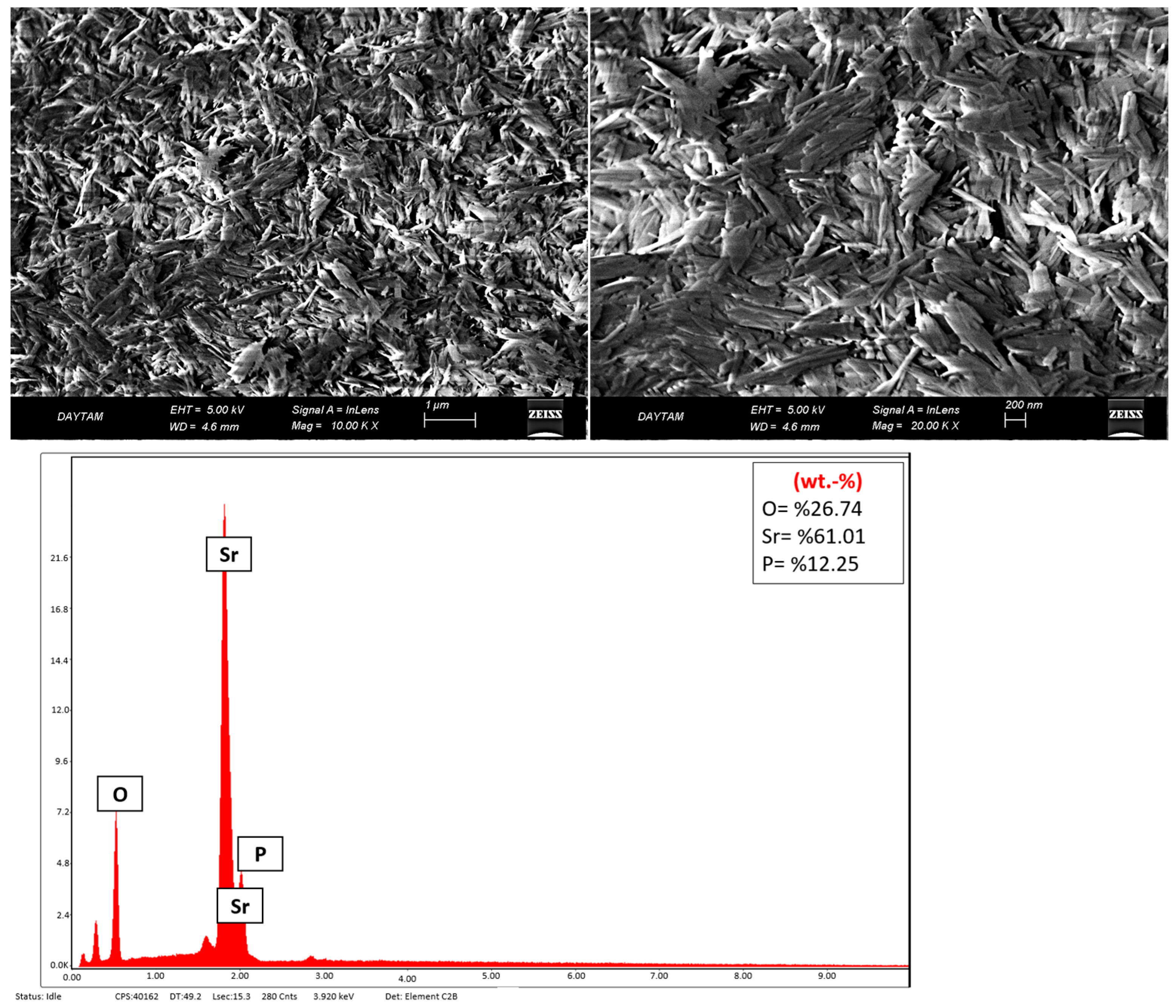
The surface morphology and microstructural characteristics of the synthesized SrAp nanoparticles were examined using FE-SEM, while the elemental composition was evaluated by EDX (Figure 2).
SEM micrographs acquired at different magnifications reveal that the SrAp nanoparticles exhibit a distinctly anisotropic morphology, predominantly composed of elongated, plate-like and rod-shaped crystallites densely packed into agglomerated assemblies. At lower magnification, the microstructure appears as a highly interlocked network of acicular and lamellar particles, indicating extensive crystal growth and strong interparticle interactions during hydrothermal synthesis. This morphology is characteristic of apatite phases synthesized under hydrothermal conditions, where preferential crystal growth along specific crystallographic directions leads to anisotropic particle geometries [20,21].
Higher-magnification SEM images further demonstrate that the individual SrAp crystallites possess nanoscale dimensions, with lengths extending into the submicron range and widths on the order of several tens of nanometers. The particles are arranged in overlapping and partially aligned configurations, forming compact agglomerates rather than isolated nanoparticles. Such agglomeration behavior is commonly observed in nanocrystalline apatites and can be attributed to a combination of high surface energy, hydrogen bonding interactions, and electrostatic attraction between surface functional groups. Importantly, despite agglomeration, the crystallites maintain well-defined edges and sharp contours, indicating a high degree of crystallinity, which is consistent with the sharp diffraction peaks observed in the XRD analysis.
The observed plate- and rod-like morphology is also indicative of a structurally ordered apatite lattice, as anisotropic growth is typically associated with controlled nucleation and directional crystal development. This morphological feature is advantageous for biomedical applications, as elongated apatite nanoparticles can provide increased surface area and enhanced interfacial contact when incorporated into composite matrices, such as MTA-based systems [24].
Elemental composition of the SrAp nanoparticles was analyzed by EDX spectroscopy (Figure 2). The EDX spectrum confirms the presence of strontium (Sr), phosphorus (P), and oxygen (O) as the dominant elements, which is consistent with the chemical composition of strontium apatite. No extraneous elemental peaks corresponding to potential contaminants or secondary phases were detected, indicating high chemical purity of the synthesized nanoparticles. The absence of calcium-related signals further supports the successful substitution of calcium sites by strontium within the apatite lattice [20,21,33,34].
Quantitative EDX analysis revealed weight percentages dominated by Sr and P, with oxygen contributing to the phosphate framework, yielding an elemental ratio consistent with a phosphate-based strontium apatite structure. Minor deviations from ideal stoichiometry may be attributed to surface hydroxylation, adsorbed water, or slight non-stoichiometry inherent to nanocrystalline apatite systems. Such compositional features are commonly reported for hydrothermally synthesized apatite nanoparticles and do not detract from phase integrity.
Overall, SEM and EDX analyses confirm that the applied hydrothermal synthesis protocol produces nanocrystalline, anisotropically shaped, and chemically homogeneous SrAp nanoparticles. The combination of elongated apatite crystallites, high crystallinity, and phase-pure elemental composition provides strong morphological and chemical evidence supporting the suitability of SrAp nanoparticles as a bioactive reinforcement phase for incorporation into MTA-based composite materials. These microstructural and compositional characteristics are expected to facilitate effective interfacial interaction with the cementitious matrix and contribute to the enhanced biological performance observed in SrAp–MTA systems [20,21,33,34].
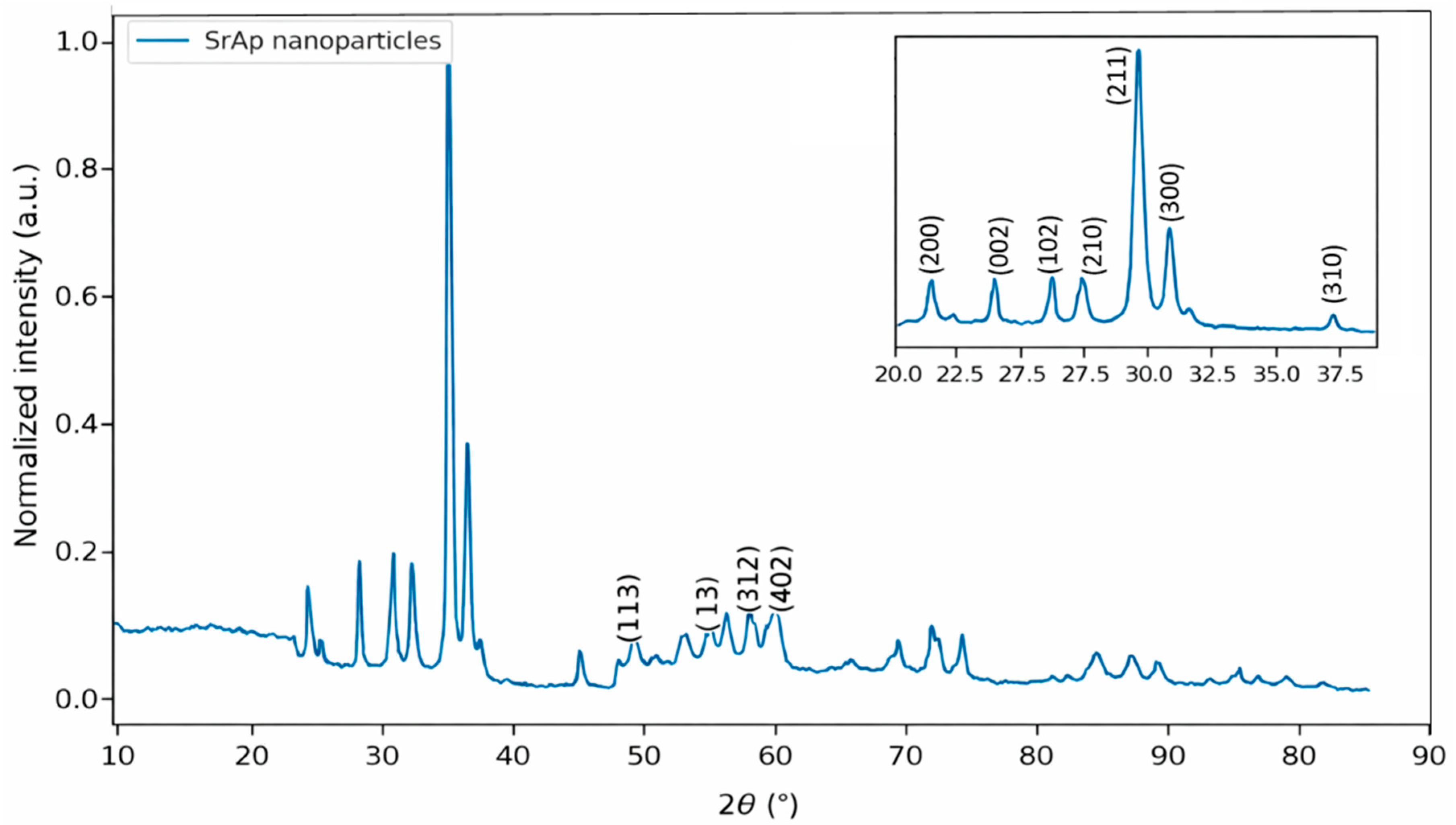
The crystalline structure and phase purity of the hydrothermally synthesized SrAp nanoparticles were investigated by X-ray diffraction analysis in the 2θ range of 10–90° (Figure 3). The diffraction pattern exhibits a well-defined set of sharp and intense reflections, indicating the formation of a highly crystalline apatite phase with no detectable secondary phases or impurity-related peaks.
The observed diffraction peaks are in excellent agreement with the standard hexagonal apatite structure of strontium apatite (JCPDS No. 33-1348), confirming successful SrAp phase formation. The most intense reflections were detected at approximately 2θ ≈ 21.0°, 24.5°, 26.7°, 28.0°, 30.6°, and 31.7°, corresponding to the (200), (002), (102), (210), (211) and (300) crystallographic planes, respectively. These peaks represent the characteristic fingerprint of strontium apatite and are commonly reported for SrAp synthesized via hydrothermal routes. The presence of a dominant (211) reflection near 30–31°, accompanied by well-resolved (002) and (300) planes, further confirms the preservation of the apatite lattice symmetry and long-range crystalline order [20,21].
The enlarged view of the 20–40° region (inset in Figure 3) highlights the clear separation and high intensity of the apatite-specific reflections, particularly the (200), (002), (102), (210), (211) and (300) planes. The absence of peak splitting or anomalous peak broadening in this region indicates structural homogeneity and suggests that the synthesized SrAp nanoparticles possess a uniform crystallographic environment. Such peak definition is typically associated with controlled crystal growth and reduced lattice disorder, which are characteristic advantages of the hydrothermal synthesis method [20,21,35,36].
At higher diffraction angles, additional reflections observed at approximately 38.4°, 41.6°, 44.7°, 46.1°, 47.0°, 48.5° and 50.0° can be indexed to the (310), (113), (222), (312), (213), (321) and (402) planes, respectively. The systematic presence of these higher-order reflections confirms the single-phase nature of the synthesized SrAp nanoparticles and excludes the formation of secondary calcium phosphate or strontium oxide phases. This observation is consistent with previous reports, which indicate that Sr2+ ions can fully occupy the calcium sites in the apatite lattice without disrupting the overall hexagonal framework when synthesized under hydrothermal conditions [20,21,35,36].
No diffraction peaks corresponding to SrO, SrCO3, CaO, or other non-apatitic phases were detected throughout the scanned 2θ range, demonstrating the chemical purity of the synthesized nanoparticles. The relatively sharp peak profiles, combined with moderate peak widths, indicate that the particles are nanocrystalline in nature, which is a desirable feature for biomedical applications due to the enhanced surface area and increased biological reactivity associated with nanoscale apatites [20,21,35,36].
Overall, the XRD results confirm that the applied hydrothermal synthesis protocol yields phase-pure, highly crystalline strontium apatite nanoparticles with a well-defined hexagonal apatite structure. The crystallographic characteristics observed in Figure 3 provide a robust structural basis for subsequent incorporation of SrAp nanoparticles into the MTA matrix and support their suitability as a bioactive reinforcement phase in SrAp–MTA composite systems [20,21,35,36].
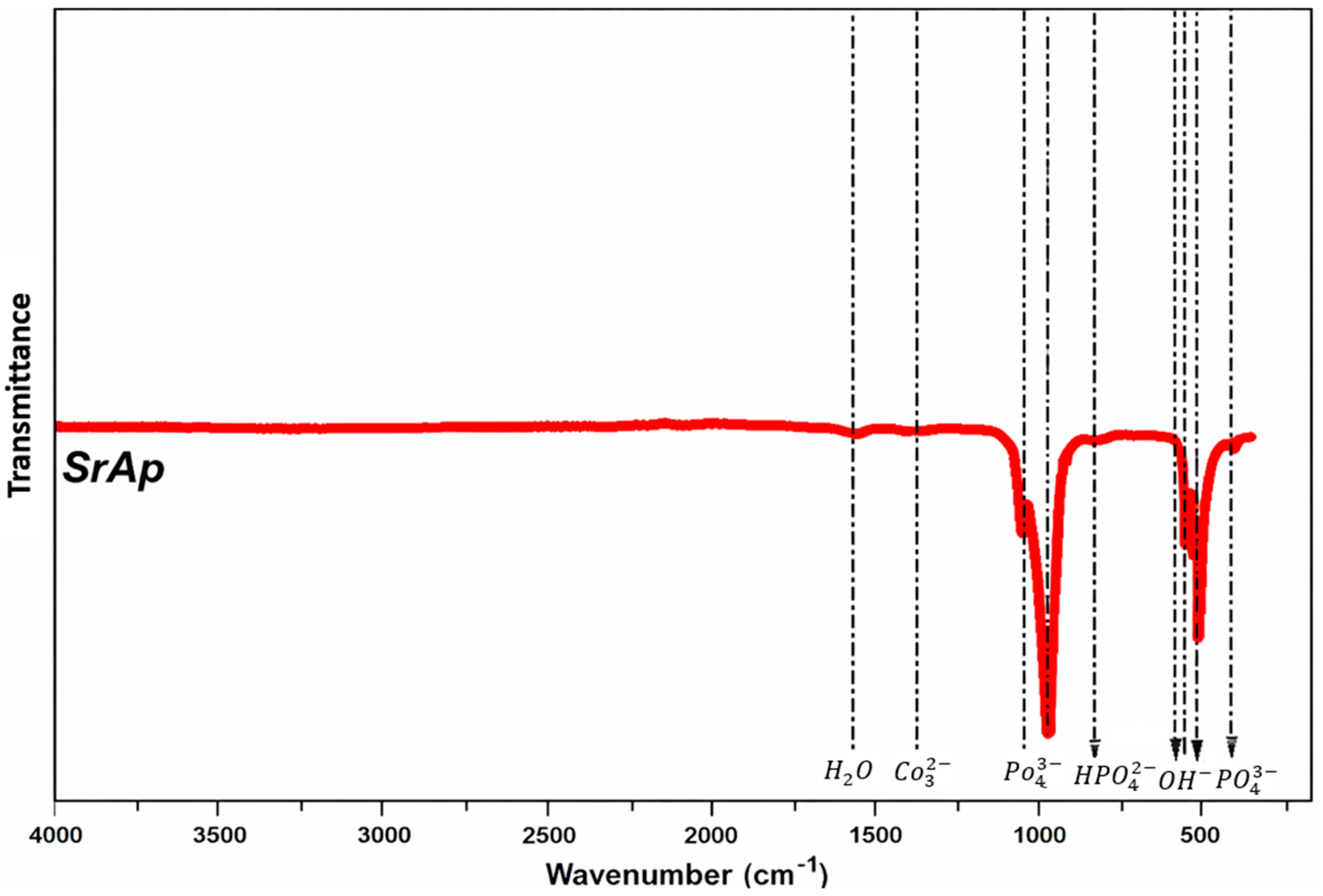
The functional group composition and chemical bonding environment of the synthesized SrAp nanoparticles were examined by FT-IR spectroscopy over the wavenumber range of 4000–400 cm−1 (Figure 4). The resulting spectrum exhibits well-defined vibrational bands characteristic of phosphate-based apatite structures, confirming the successful formation of the SrAp phase.
A broad absorption band observed in the 2500–3700 cm−1 region is attributed to the O–H stretching vibrations of physically adsorbed and/or structurally bound water molecules on the nanoparticle surface. This band is accompanied by a weaker signal around ~1600 cm−1, corresponding to the H–O–H bending vibration of molecular water. The presence of these bands is typical for hydrothermally synthesized apatite nanoparticles and reflects surface hydration and hydrogen bonding effects [20,21,35,36].
The band detected at approximately 1438 cm−1 is assigned to the asymmetric stretching vibration of carbonate ions (CO32−). This carbonate-related feature is commonly associated with surface carbonation resulting from interaction with atmospheric CO2 and is frequently reported in calcium- and strontium-based apatite systems [20,21,35,36].
Phosphate-related vibrations dominate the FT-IR spectrum and constitute the characteristic fingerprint of the apatite structure. Intense absorption bands observed in the 1010–1078 cm−1 range correspond to the ν3 asymmetric stretching modes of PO43− groups, while the band located at approximately 949 cm−1 is attributed to the ν1 symmetric stretching vibration of PO43−. The simultaneous presence and high intensity of these bands confirm the phosphate-rich nature of the synthesized SrAp nanoparticles.
In the lower wavenumber region, absorption bands appearing between 555 and 592 cm−1 are assigned to the ν4 bending modes of PO43−, whereas the weak band around 457 cm−1 corresponds to additional phosphate lattice vibrations. These low-frequency phosphate modes further substantiate the formation of a well-defined apatite framework [20,21,35,36].
The band detected near 623 cm−1 is associated with the vibrational modes of hydroxyl (OH) groups within the apatite lattice, indicating the presence of hydroxylated apatite characteristics. Moreover, the absorption band observed at approximately 870 cm−1 is attributed to HPO42− (hydrogen phosphate) groups, which are often detected in nanocrystalline apatites and may be related to surface protonation or slight non-stoichiometry inherent to nanoscale apatite systems.
Overall, the FT-IR analysis confirms that the synthesized SrAp nanoparticles possess a phosphate-based apatite structure, as evidenced by the dominance of PO43−1, ν3, and ν4) vibrational modes. The accompanying OH, H2O, CO32−, and HPO42− bands provide additional insight into the surface chemistry and hydration state of the nanoparticles. These chemical features support the suitability of SrAp nanoparticles as a bioactive reinforcement phase for subsequent incorporation into the MTA matrix, contributing to the functional performance of SrAp–MTA composite systems [20,21,35,36].

3.2. Characterization of SrAP–Reinforced MTA Composites

3.2.1. XRD Analysis

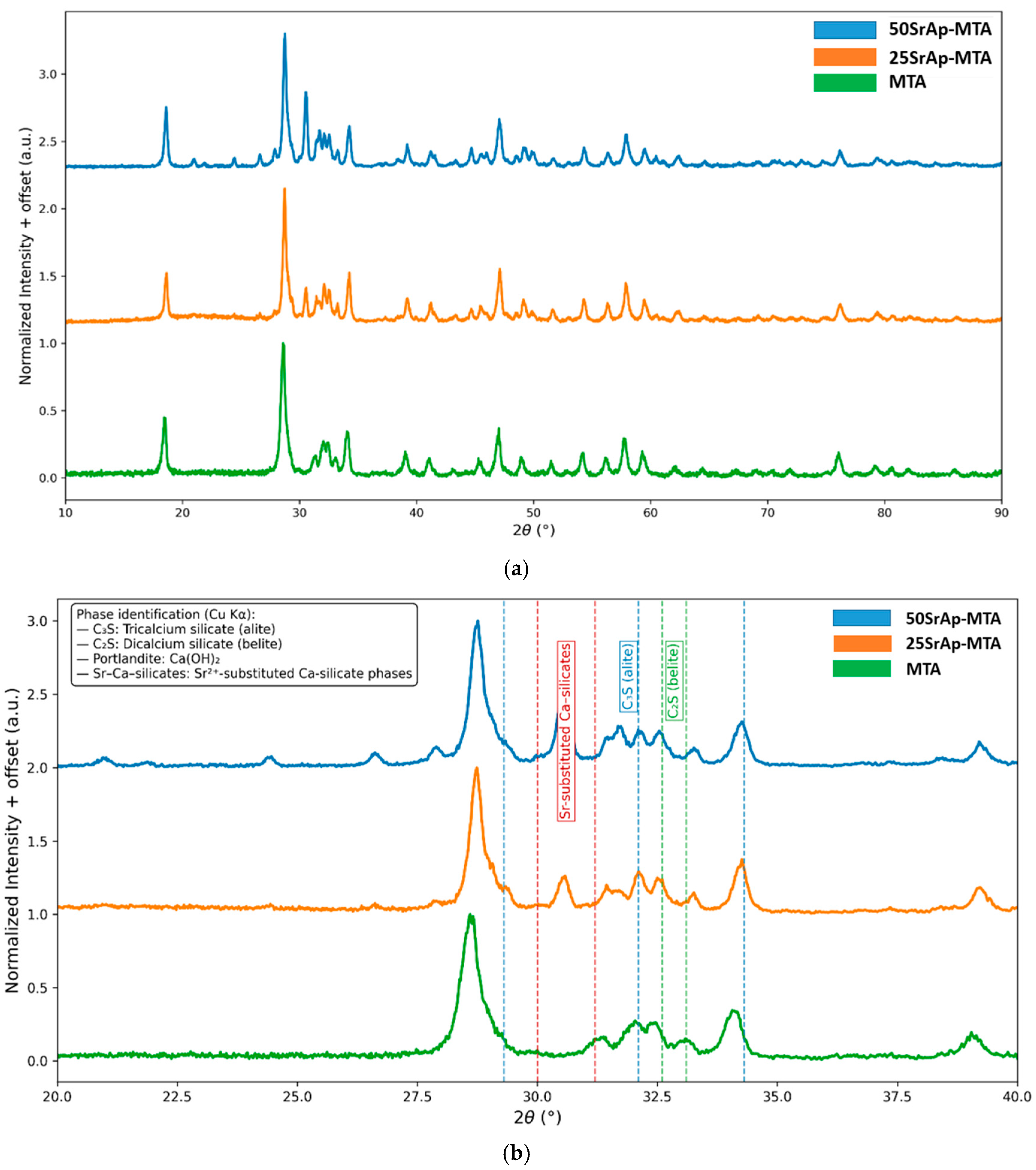
XRD patterns of pure MTA, 25SrAp–MTA, and 50SrAp–MTA were analyzed to determine the phase assemblage, crystallographic stability of the Ca-silicate cement matrix, and the structural persistence of the SrAp reinforcement phase within the composites (Figure 5). Across all compositions, the diffractograms were dominated by reflections associated with the characteristic crystalline constituents of MTA, indicating that incorporation of SrAp does not disrupt the primary Ca-silicate phase framework of the cementitious matrix.
The diffraction profile of pure MTA exhibited sharp and well-defined peaks, particularly concentrated in the 20–40° 2θ region, consistent with a highly crystalline calcium silicate-based system. The major reflections in this interval are attributable to Ca-silicate phases and hydration-related crystalline products, including signals consistent with tricalcium silicate (C3S), dicalcium silicate (C2S) and portlandite (Ca(OH)2). The absence of pronounced diffuse scattering suggests a limited amorphous contribution, providing a reliable structural baseline for comparative evaluation of SrAp-containing composites [16,37,38,39,40].
Upon incorporation of SrAp at the 25 wt% level (25SrAp–MTA), the overall diffraction envelope of the composite remained largely comparable to that of pure MTA, with no systematic peak shifts observed for the principal Ca-silicate reflections. The preservation of peak positions and symmetry indicates that SrAp acts primarily as a physically integrated reinforcement phase rather than inducing lattice-level substitution within the Ca-silicate framework. In addition to the retained MTA-related peaks, SrAp-containing specimens are expected to display apatite-associated reflections most prominently within the apatite fingerprint region (typically around ~25–33° 2θ and related higher-angle reflections) which may partially overlap with Ca-silicate peaks due to the congested nature of this diffraction interval. Consequently, the SrAp contribution is best interpreted through changes in relative peak intensities and the emergence/strengthening of apatite-consistent features, rather than through shifts in Ca-silicate peak positions [16,37,38,39,40].
At the higher reinforcement level (50SrAp–MTA), the SrAp contribution becomes more pronounced, reflected by more evident intensity redistribution in the diffractogram, particularly within the apatite-sensitive regions. Importantly, the characteristic MTA peak positions remain conserved, confirming that increasing SrAp content does not compromise the crystallographic identity of the Ca-silicate matrix. The intensification of apatite-consistent reflections with increasing SrAp loading is consistent with a two-phase composite model, in which SrAp persists as a stable crystalline phase within the cement matrix. Any minor changes in relative peak heights among MTA-associated reflections are most plausibly attributed to dilution effects, scattering contrast differences, and microstructural packing/orientation variations introduced by the particulate SrAp phase, rather than formation of new reaction-derived crystalline products [16,37,38,39,40].
Across the SrAp–MTA series, no additional diffraction peaks indicative of undesired secondary reaction phases were observed. This finding supports that SrAp incorporation does not trigger an adverse phase transformation within MTA and that the composite remains structurally stable. While XRD cannot fully exclude the presence of poorly crystalline or amorphous minor products, the retention of the dominant MTA peak framework together with the persistence of crystalline SrAp signatures indicates that the composite behavior is governed primarily by physical coexistence and phase superposition rather than by reaction-driven phase evolution.
Overall, the XRD results demonstrate that SrAp incorporation yields a composite structure in which (i) the Ca-silicate cement matrix retains its crystallographic stability and (ii) the SrAp reinforcement phase remains structurally present and increasingly detectable with higher loading. These findings provide crystallographic evidence that SrAp functions as a stable bioactive reinforcement phase within MTA-based composites, forming a phase-coherent system suitable for subsequent physicochemical and biological evaluation [16,37,38,39,40].

3.2.2. FT-IR Analysis: Functional Group Distribution and Chemical Stability

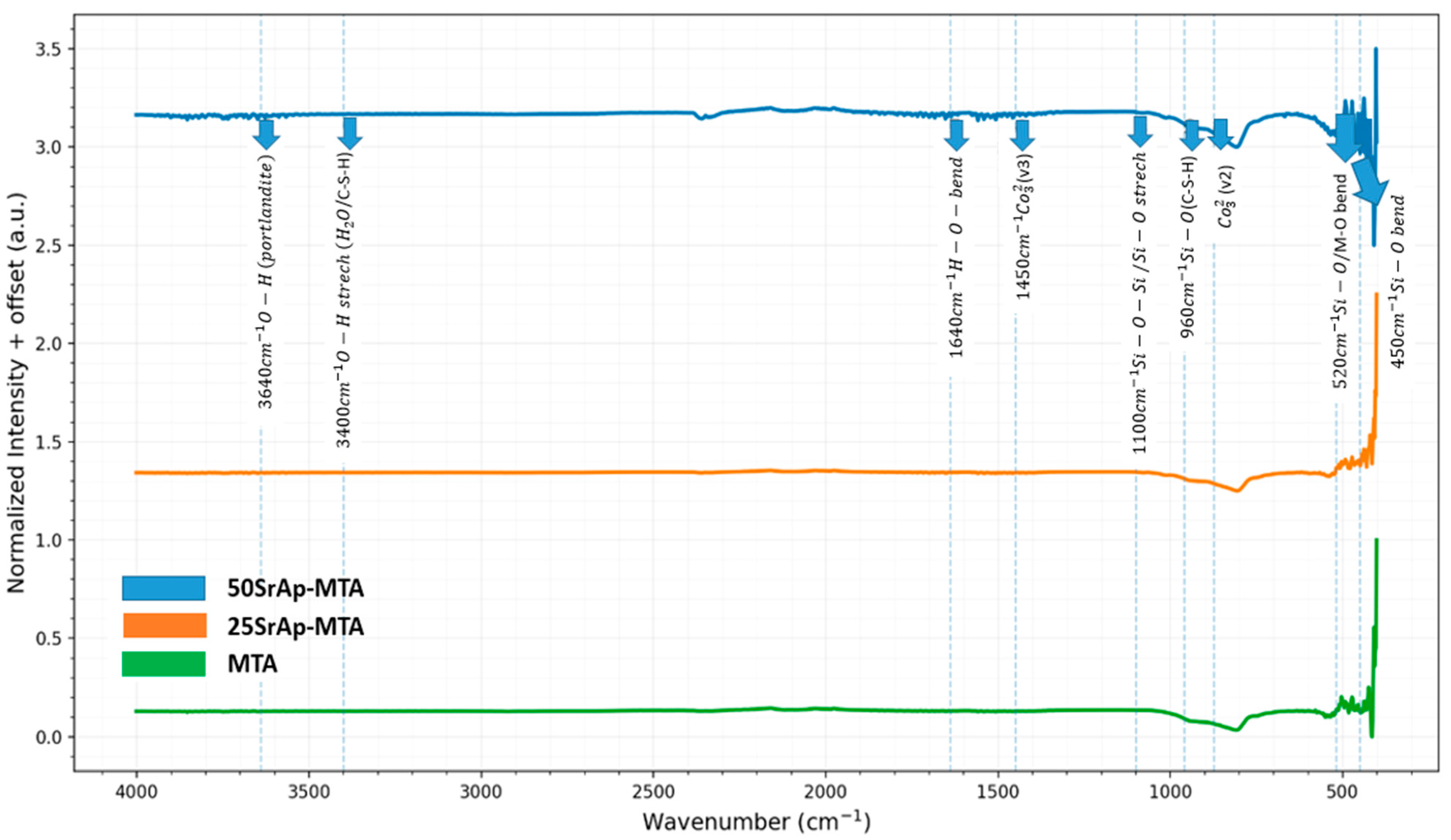
The FT-IR spectra of pure MTA, 25SrAp–MTA, and 50SrAp–MTA were evaluated to (i) determine whether incorporation of strontium apatite (SrAp) alters the functional group stability of the hydrated Ca-silicate cement matrix and (ii) assess the extent to which phosphate-based vibrational features originating from SrAp are detectable within the composite spectra (Figure 6). The preservation of a broadly comparable spectral morphology among all specimens across the 4000–400 cm−1 region indicates that SrAp addition does not induce reaction-derived chemical functional groups and does not cause disruptive chemical restructuring of the MTA hydration products. Instead, the spectral changes observed in SrAp-containing groups primarily reflect superposition of SrAp vibrational bands and intensity redistribution within regions where apatite and cement hydration products exhibit overlapping absorption features [33,34,37,38,39].
The FT-IR spectrum of pure MTA displayed the characteristic absorption profile of hydrated calcium silicate-based cements. The broad band extending through ~3200–3600 cm−1 corresponds to O–H stretching vibrations originating from hydroxyl groups and physically adsorbed/structurally bound water associated with hydration products. The weaker band at ~1600–1650 cm−1 is attributable to H–O–H bending vibrations of molecular water. Absorption features located in the ~1400–1500 cm−1 region are assigned to carbonate species (CO32−), typically formed through atmospheric carbonation of Ca-bearing hydration products during setting and storage. The dominant cement fingerprint region, spanning approximately ~900–1100 cm−1, is associated with Si–O and Si–O–Si stretching vibrations of the silicate network, particularly calcium silicate hydrate (C–S–H). Lower-wavenumber bands below ~600 cm−1 reflect Si–O bending modes and metal–oxygen lattice vibrations related to Ca-silicate phases, consistent with the crystalline/hydrated phase framework observed by XRD [33,37,41].
Following incorporation of SrAp at the 25 wt% level (25SrAp–MTA), the overall spectral envelope remained closely aligned with that of pure MTA, demonstrating that the principal hydration chemistry of the cement matrix is preserved. The O–H stretching band (3200–3600 cm−1) and the water bending band (~1600–1650 cm−1) persisted without meaningful positional shifts, indicating that SrAp addition does not disrupt the hydrogen-bonding environment of hydration products. Similarly, the silicate stretching region (~900–1100 cm−1) maintained its characteristic broad C–S–H-related band profile, supporting the conclusion that the Ca-silicate backbone remains chemically stable in the presence of SrAp. Importantly, in SrAp-reinforced systems, phosphate-based apatite vibrations are expected to contribute to the composite spectrum; however, the diagnostic phosphate bands of apatite partially coincide with the cement’s dominant silicate envelope, which can mask discrete SrAp peaks. In particular, SrAp typically exhibits strong PO43− ν3 stretching vibrations in the ~1010–1078 cm−1 range and PO43− ν1 stretching near ~950 cm−1, as well as PO43− ν4 bending modes around ~555–592 cm−1, and OH-related features near ~620–630 cm−1 depending on apatite chemistry. When SrAp is embedded within hydrated MTA, the ν3 phosphate region overlaps directly with the C–S–H Si–O stretching band (900–1100 cm−1). Therefore, the SrAp contribution in 25SrAp–MTA is most plausibly expressed as subtle increases in band intensity, shoulder development, or band-shape modulation within the silicate fingerprint region, rather than as the emergence of entirely new, well-separated peaks [33,37,41].
In the 50SrAp–MTA composite, the higher SrAp loading is expected to yield a more pronounced SrAp spectral contribution. In practice, increasing SrAp content increases the relative fraction of phosphate-rich phase in the composite, thereby enhancing the phosphate-associated absorbance superimposed on the cement spectrum. Consequently, spectral changes are anticipated to become more evident in two key domains: (i) the ~900–1100 cm−1 region, where phosphate ν3 modes may strengthen the overall absorbance and alter the broad-band contour of the C–S–H silicate envelope; and (ii) the <650 cm−1 region, where apatite-related phosphate bending modes (ν4) and hydroxyl-associated bands can contribute additional absorbance features alongside the cement lattice vibrations. Despite these intensity-based changes, the lack of systematic band shifts in the O–H/H2O and silicate-associated regions indicates that SrAp incorporation does not chemically transform the cement network; rather, SrAp remains a chemically compatible reinforcement phase whose vibrational signature is increasingly detectable as its mass fraction rises [33,37,41].
Carbonate-associated bands in the ~1400–1500 cm−1 region deserve specific consideration in SrAp–MTA composites. Carbonate signals in these systems can arise from multiple sources: (i) carbonation of Ca-bearing hydration products in MTA, (ii) surface carbonation of SrAp (apatite surfaces can incorporate carbonate species through interaction with atmospheric CO2), and (iii) interfacial environments where SrAp and hydration products provide additional nucleation/adsorption sites for carbonate formation. Thus, any enhancement or fluctuation in carbonate band intensity with increasing SrAp content is more appropriately interpreted as an effect of surface chemistry and carbonation susceptibility of the composite microenvironment rather than as evidence for formation of new chemically distinct phases. Crucially, the persistence of the characteristic silicate and hydroxyl/water bands without the appearance of unexpected new absorption regions supports chemical stability of the matrix and argues against reaction-driven formation of new functional groups [33,37,41].
From a composite chemistry perspective, the FT-IR results collectively indicate that SrAp addition influences the spectrum primarily through physical coexistence and interfacial contact rather than through covalent bond formation or irreversible chemical rearrangement. SrAp provides a phosphate-rich phase that can coexist with the C–S–H dominated silicate network of MTA; this coexistence is reflected spectroscopically by the persistence of MTA’s hydration bands and the progressive prominence of phosphate-related vibrational contributions as SrAp loading increases. Any minor band-shape differences observed across groups can be reasonably attributed to variations in microstructural packing density, degree of hydration, local refractive index, and the extent of surface-bound water, all of which can modulate FT-IR band intensities in heterogeneous cementitious composites [33,37,41].
Overall, FT-IR analysis confirms that SrAp reinforcement yields a composite system in which the fundamental functional group architecture of hydrated MTA is preserved, while SrAp contributes additional phosphate-based vibrational features that become more evident with increasing SrAp content. This interpretation is consistent with XRD findings supporting a phase-stable composite structure, and it further supports the premise that SrAp functions as a bioactive reinforcement phase within the MTA matrix without compromising the chemical stability of the cement network [33,37,41].

3.2.3. SEM–EDX Analysis: Microstructural Organization and Elemental Distribution

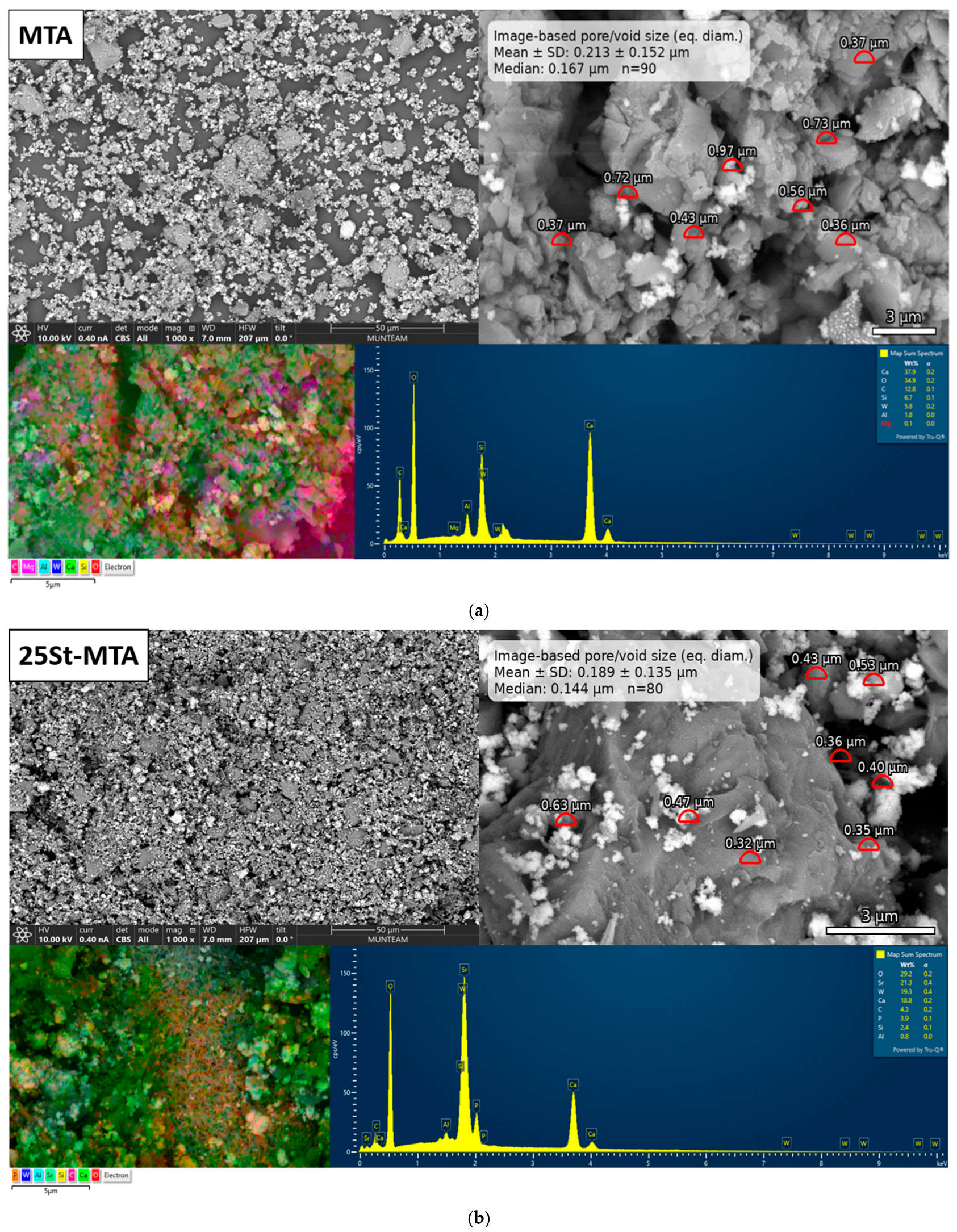
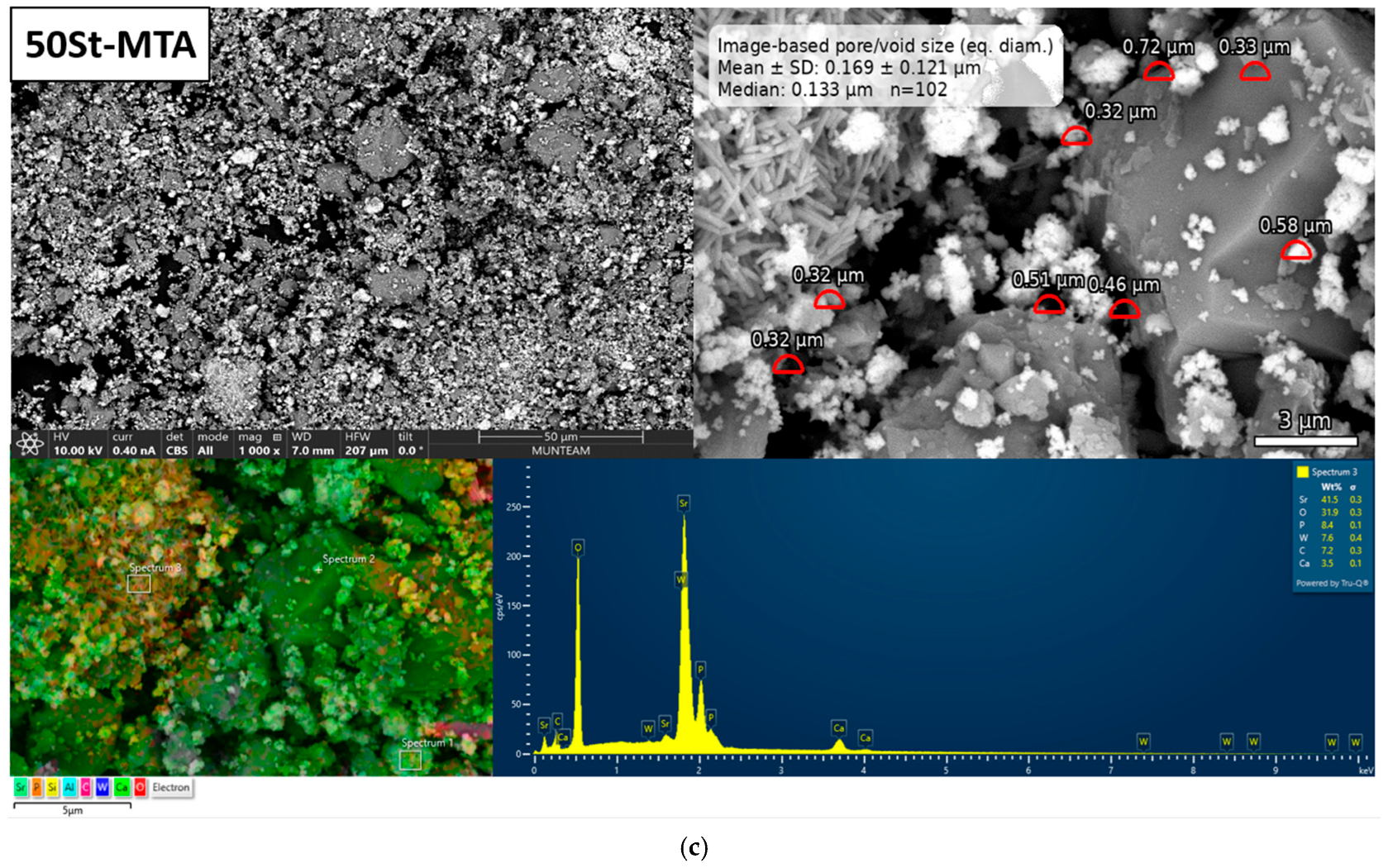
SEM and EDX were employed to characterize the microstructural organization and elemental distribution of pure MTA, 25SrAp–MTA, and 50SrAp–MTA composites (Figure 7). SEM provides direct visualization of particle morphology, packing density, and pore architecture, whereas EDX verifies the chemical identity of the matrix and confirms the presence and distribution of the SrAp reinforcement phase. The combined SEM–EDX dataset enables assessment of whether SrAp incorporation modifies the composite predominantly through physical phase coexistence and microstructural refinement rather than through reaction-driven phase transformation. To substantiate the microstructural “size reduction/densification” statements, a quantitative pore/void size analysis was additionally performed on the high-magnification SEM micrographs using a scale-calibrated image analysis workflow consistent with ImageJ-based measurements. Image analysis was carried out using ImageJ software (Version 1.53t, National Institutes of Health, Bethesda, MD, USA). The 3 µm scale bar was used for calibration, void features were segmented by intensity-based thresholding after contrast enhancement, and the equivalent circular diameter (ECD) was calculated for each detected void. Results are reported as mean ± standard deviation, median, and the number of analyzed voids (n).
SEM micrographs of pure MTA show a discontinuous and heterogeneous microstructure typical of hydrated calcium silicate-based cements (Figure 7a). The surface is dominated by angular, irregularly shaped grains and fractured-like fragments forming loosely packed agglomerates with pronounced intergranular voids and non-uniform particle-to-particle contact. Such voided morphology is consistent with incomplete packing and heterogeneous precipitation of hydration products within the cement matrix. Bright, high-contrast microdomains dispersed across the surface indicate regions with higher average atomic number and/or denser crystalline domains, commonly associated with Ca-rich hydration products and portlandite-related crystallization. The overall microstructural texture suggests a matrix composed of multiple coexisting microdomains (dense crystalline regions, loosely packed particle clusters, and void-rich zones), highlighting the intrinsic heterogeneity of unmodified MTA. Correspondingly, EDX analysis identifies Ca, Si and O as the dominant elements, consistent with the Ca-silicate cement framework. Minor signals attributed to Al, Mg, and W are interpreted as trace raw-material constituents or instrumental/background contributions and do not indicate the formation of new reaction products. Collectively, pure MTA provides a baseline morphology characterized by limited microstructural continuity and substantial porosity, against which the effect of SrAp reinforcement can be evaluated [11,26,30]. Consistent with these observations, image-based quantification yielded a relatively larger pore/void characteristic size for MTA (mean ECD: 0.213 ± 0.152 µm; median: 0.167 µm; n = 90), supporting the qualitative assessment of a more open and voided microstructure.
Incorporation of SrAp at the 25 wt% level (25SrAp–MTA) results in a clearly modified surface architecture (Figure 7b). SEM images demonstrate a shift toward higher packing density, evidenced by reduced void size, fewer open intergranular gaps, and improved particle-to-particle bridging. In addition to the retained angular MTA grains, numerous fine particulate features are visible on grain surfaces and within interparticle regions. These finer features are consistent with SrAp nanoparticle aggregates physically distributed within the matrix, acting as a microfiller that occupies void space and increases microstructural continuity. The microstructure appears more coherent, with a greater frequency of particle contacts and fewer “free” void boundaries. Importantly, the primary grain morphology of MTA remains recognizable, suggesting that SrAp does not chemically decompose or dissolve the matrix but instead contributes through physical integration at particle surfaces and interfacial regions. Quantitatively, the pore/void size distribution shifted toward smaller values relative to pure MTA, with a lower mean ECD (0.189 ± 0.135 µm) and median (0.144 µm) (n = 80), corroborating the visually observed reduction in open void space and improved packing.
EDX spectra obtained from 25SrAp–MTA confirm the presence of Sr in addition to Ca, Si and O (Figure 7/associated panels), verifying successful incorporation of the SrAp phase into the composite. From a compositional standpoint, the simultaneous presence of Ca and Sr is consistent with phase coexistence (Ca-silicate cement + SrAp), rather than direct cation substitution within a single crystal lattice. Where elemental mapping is available, Sr distribution appears relatively uniform across the examined areas, indicating that SrAp is not confined to isolated clusters but is dispersed throughout the matrix. The absence of distinct, highly localized Sr-rich regions at this loading level supports effective mixing and suggests that SrAp is present as a dispersed particulate phase embedded within the hydrated cement microstructure. The preservation of strong Ca and Si signals further indicates that the Ca-silicate matrix remains the continuous phase of the composite [11,26,30]. In microstructural terms, this supports a reinforcement mechanism dominated by physical dispersion and interfacial contact rather than reaction-driven conversion of the Ca–Si hydration network.
In addition, the Sr/P ratio was calculated from the quantitative EDX wt% values by converting mass fractions to atomic amounts ( w t . ) using the Map Sum Spectrum for 25SrAp–MTA (Sr = 21.3 wt% and P = 4.3 wt%); the resulting Sr/P atomic ratio was Sr/P ≈ (21.3/87.62)/(4.3/30.97) ≈ 1.75. This value is close to the theoretical apatite Sr/P stoichiometry (10/6 ≈ 1.67), with the modest deviation attributable to the semi-quantitative nature of EDX, peak overlap, and the contribution of the cementitious matrix in the analyzed interaction volume.
At higher SrAp content (50SrAp–MTA), microstructural effects become more pronounced (Figure 7c). SEM observations show a markedly more consolidated and compact surface, with diminished grain boundary definition and further reduction in open porosity. The surface is extensively decorated with fine granular features and clustered microdomains, producing a more continuous topology compared to both pure MTA and 25SrAp–MTA. In regions with dense clustering, acicular/lamellar-looking assemblies may appear, consistent with SrAp’s intrinsic anisotropic crystallite habit and its tendency to form agglomerates at higher loading. From a materials viewpoint, this morphology suggests that increasing SrAp content increases the likelihood of SrAp–SrAp contacts and the formation of SrAp-rich micro domains while still being embedded within the cementitious matrix. Such micro domains can contribute to local densification by filling pores and acting as solid bridges between cement grains, thereby improving overall interparticle coherence. Image-based measurements confirmed this concentration-dependent densification trend: 50SrAp–MTA exhibited the smallest pore/void characteristic size among the groups (mean ECD: 0.169 ± 0.121 µm; median: 0.133 µm; n = 102), providing quantitative support for the “size reduction” and microstructural consolidation claims.
EDX analysis of 50SrAp–MTA shows increased Sr peak intensity relative to 25SrAp–MTA (Figure 7/associated panels), consistent with higher SrAp fraction. Importantly, Ca and Si peaks remain clearly present, indicating that the Ca-silicate matrix continues to contribute significantly to the composite composition and remains structurally dominant. Elemental distribution data support that Sr is widely present across the inspected surface, with occasional localized intensity variations expected at higher reinforcement levels due to SrAp-rich micro domains. Critically, no elemental signatures indicative of undesired secondary reaction products are detected, reinforcing the interpretation that SrAp is incorporated as a stable reinforcement phase rather than triggering reaction-driven formation of new Sr-bearing compounds [11,26,30]. Thus, the SEM–EDX evidence aligns with a two-phase composite scenario in which SrAp is retained as a chemically stable particulate phase interfaced with, but not transforming, the Ca–Si hydration assemblage.
Using the quantitative EDX wt% values for 50SrAp–MTA (Sr = 41.5 wt% and P = 8.4 wt% in the reported spectrum), the calculated Sr/P atomic ratio was Sr/P ≈ (41.5/87.62)/(8.4/30.97) ≈ 1.75. Notably, the Sr/P ratio remained essentially comparable between 25SrAp–MTA and 50SrAp–MTA within measurement uncertainty, suggesting that increasing SrAp loading primarily increases the abundance/distribution of the SrAp phase (and thus Sr signal intensity and Sr-bearing interfacial area), rather than altering the intrinsic SrAp stoichiometry. Consequently, differences in composite behavior between formulations are more plausibly linked to loading-dependent microstructural effects (pore filling, packing density, and formation of SrAp-rich micro domains) and to the extent of SrAp-exposed interfacial sites, rather than to a systematic change in Sr/P chemistry of the apatite phase.
From an interfacial perspective, the SEM–EDX observations collectively indicate that SrAp incorporation modifies the composite primarily through pore filling, enhanced particle packing, and increased interfacial contact area between the cement hydration products and the apatite phase. The progressive reduction in visible voids and the increased surface coverage by fine particulate features in SrAp-containing groups are consistent with a microstructural densification mechanism. The quantitative ECD analysis supports this interpretation by demonstrating a monotonic decrease in pore/void characteristic size from MTA → 25SrAp–MTA → 50SrAp–MTA (0.213 → 0.189 → 0.169 µm in mean ECD), thereby converting qualitative micrographs into a measurable microstructural descriptor. Such densification is significant for bioactive cement systems, as reduced porosity and improved interparticle connectivity can influence fluid transport, ion exchange, and mechanical stability at the implant site. In parallel, the presence of a phosphate-based apatite phase dispersed throughout the matrix provides chemically relevant interfacial sites that may support mineralized tissue interactions, without requiring chemical alteration of the Ca-silicate hydration network.
Overall, SEM–EDX results demonstrate that SrAp reinforcement yields a composite system in which the Ca-silicate cement matrix retains its fundamental chemical identity while undergoing measurable microstructural refinement. Compared with pure MTA, SrAp–MTA composites exhibit a concentration-dependent transition toward a denser and more cohesive microstructure, accompanied by clear Sr elemental signatures confirming incorporation of the reinforcement phase. These findings corroborate XRD and FT-IR results, which collectively support a stable two-phase composite architecture governed by physical coexistence and interfacial integration, rather than chemical phase transformation. The resulting microstructural organization provides a robust basis for interpreting the enhanced biological response observed in SrAp–MTA groups in vivo [11,26,30]. Importantly, the added image-based quantification provides independent support for the reported microstructural refinement, strengthening the linkage between compositional reinforcement level and microstructural densification.

3.3. Histological Evaluation: Fibrous Tissue, New Bone Formation, and Osteoblast Activity

Histological healing responses within the surgically created rat tibial defects were evaluated using a semi-quantitative scoring system assessing fibrotic tissue formation, new bone formation, and osteoblastic cell presence. Group comparisons were performed using the Kruskal–Wallis test, followed by Dunn–Bonferroni post hoc analysis where appropriate. All histological data are presented as median values with minimum–maximum ranges (Table 1).

3.4. Fibrotic Tissue Formation

Analysis of fibrotic tissue scores revealed no statistically significant difference among the four experimental groups (Kruskal–Wallis, p = 0.227). Median fibrosis scores were comparable across groups, remaining within a low-grade range: Control: 1 (1–1), MTA: 1 (1–2), 25St-MTA: 1.5 (1–2) and 50St-MTA: 1 (1–2) (Table 1). Although the 25St-MTA group exhibited a slightly higher median value, this numerical variation did not translate into a statistically significant group separation. These findings indicate that strontium incorporation did not measurably influence fibrotic tissue development within the 8-week observation period [31,32,42,43].

3.5. New Bone Formation

In contrast, new bone formation differed significantly among groups (Kruskal–Wallis, p = 0.031). The control group demonstrated uniformly low scores (1 (1–1)), reflecting limited spontaneous bone regeneration. The MTA group showed a similar central tendency (1 (1–2)), indicating that placement of MTA alone did not result in a statistically distinguishable increase in new bone formation compared with untreated defects. Both strontium-modified groups exhibited higher median scores (25St-MTA: (2 (1–2)); 50St-MTA: (2 (1–2)), suggesting a shift toward enhanced mineralized tissue formation.
Post hoc Dunn–Bonferroni analysis demonstrated that the significant overall group effect was driven by differences between the control group and the strontium-containing groups. Specifically, Control vs. 25St-MTA (p* = 0.012) and Control vs. 50St-MTA (p* = 0.010) were statistically significant, whereas Control vs. MTA was not (p* = 1.000). No statistically significant differences were detected between MTA and 25St-MTA, MTA and 50St-MTA, or between the two strontium-modified groups (p* = 1.000 for all comparisons) [44,45,46].

3.6. Osteoblastic Cell Presence

Osteoblastic activity exhibited a pattern closely paralleling new bone formation. The Kruskal–Wallis test indicated a significant intergroup difference (p = 0.031). Median osteoblast scores were 1 (1–1) in the control group and 1 (1–2) in the MTA group, whereas both strontium-modified groups demonstrated increased scores (25St-MTA: (2 (1–2)); 50St-MTA: (2 (1–2)). Post hoc analysis confirmed significant differences between the control group and each Sr-containing group (Control vs. 25St-MTA: p* = 0.012; Control vs. 50St-MTA: p* = 0.010), while no differences were observed between Control vs. MTA or among the material-treated groups themselves (p* > 0.05) [10,12,13,15].

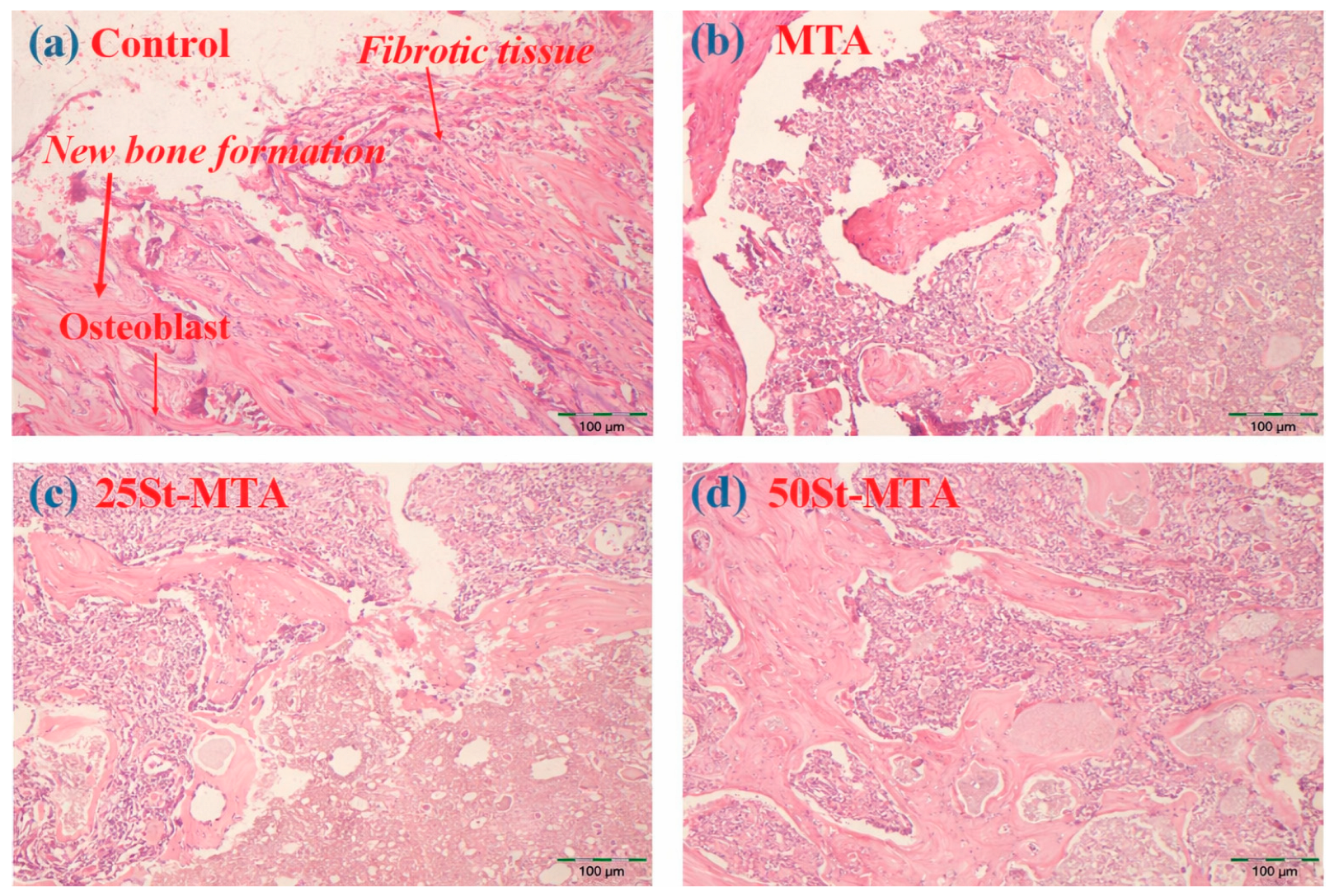
3.7. Histomorphological Observations

Microscopic examination of representative H&E-stained sections supported the quantitative histological findings (Figure 8). In the control group, the defect area was predominantly occupied by loosely organized connective tissue with sparse cellularity and minimal trabecular bone formation, which was largely confined to the defect margins. Osteoid deposition was limited, and osteoblastic lining along the defect borders was rarely observed. Fibrotic tissue appeared as thin, discontinuous bands without a consistent spatial organization [12,13,31,32,42].
In specimens treated with pure MTA, partial improvement in tissue organization was evident. Increased cellular density and localized osteoid matrix deposition adjacent to native bone surfaces were observed; however, newly formed trabeculae were generally thin and irregular, and continuity of mineralized tissue across the defect remained incomplete. Osteoblasts were primarily localized at the bone–material interface, while fibrotic tissue persisted as superficial or focal bands within the central defect region.
In contrast, sections from the 25St-MTA group exhibited a more advanced histomorphological profile, characterized by thicker and more interconnected trabeculae extending toward the center of the defect. Osteoid bands were more clearly defined, and osteoblastic cells were frequently observed lining the surfaces of newly formed trabeculae, indicative of active bone remodeling. Fibrotic tissue was limited in extent and predominantly localized to peripheral regions [12,13,31,32,42].
Similarly, the 50St-MTA group demonstrated pronounced bone-related features, including relatively mature trabecular structures with improved spatial continuity and widespread osteoid-rich regions. Osteoblasts were distributed along trabecular surfaces in a pattern suggestive of sustained osteogenic activity, while fibrotic tissue remained minimal and localized.
Overall, the histological scoring outcomes demonstrated a parameter-dependent response to strontium modification of MTA. While fibrotic tissue formation did not differ significantly among groups (Kruskal–Wallis, p = 0.227), both new bone formation and osteoblastic cell presence exhibited statistically significant intergroup differences (p = 0.031 for each parameter). Post hoc Dunn–Bonferroni analysis indicated that these differences were driven by comparisons between the control group and the Sr-containing MTA groups, as Control vs. 25St-MTA (p* = 0.012) and Control vs. 50St-MTA (p* = 0.010) were significant for both osteogenesis-related endpoints, whereas Control vs. MTA was not significant (p* = 1.000). No statistically significant differences were detected among the material-treated groups (MTA vs. 25St-MTA, MTA vs. 50St-MTA, and 25St-MTA vs. 50St-MTA; p* > 0.05), indicating comparable performance between the two strontium incorporation levels within the applied scoring resolution and the 8-week endpoint. These findings are consistent with the representative histomorphological features observed in Figure 8, where the Sr-modified groups displayed more organized trabecular architecture and more frequent osteoblastic lining compared with the control and pure MTA groups, without an accompanying increase in fibrotic tissue development [12,13,31,32,42].
Microscopic examination of representative H&E-stained sections further supported the quantitative histological findings (Figure 8). In the control group, the defect area was predominantly occupied by loose connective tissue with sparse cellularity and limited evidence of organized bone trabeculae. Newly formed bone structures were minimal and mainly confined to the defect margins, while the central region remained largely unmineralized. Osteoid deposition was scarce, and osteoblastic lining along the defect borders was rarely observed. Fibrotic tissue appeared as thin, discontinuous bands without a defined spatial pattern [12,13,31,32,42].
In samples treated with pure MTA, partial improvement in tissue organization was evident. The defect region exhibited increased cellular density compared with the control group, accompanied by localized areas of osteoid matrix deposition adjacent to the native bone surface. However, newly formed trabeculae were generally thin and irregular, and the continuity of mineralized tissue across the defect was incomplete. Osteoblasts were present mainly at the bone–material interface, while fibrotic tissue remained visible within the central defect region, typically localized as superficial or focal fibrotic bands [12,13,31,32,42].
In contrast, sections from the 25SrAp-MTA group demonstrated a more advanced histomorphological profile. The defect area showed increased trabecular organization, with thicker and more interconnected newly formed bone structures extending toward the center of the defect. Osteoid bands were more clearly defined, and osteoblastic cells were frequently observed lining the surfaces of newly formed trabeculae, indicating active bone remodeling. Cellular density within the defect was noticeably higher than in both the control and pure MTA groups. Fibrotic tissue, when present, was limited in extent and predominantly localized to peripheral regions of the defect [12,13,31,32,42]. Similarly, the 50SrAp-MTA group exhibited pronounced bone-related histomorphological features. Newly formed trabeculae appeared relatively mature, displaying improved continuity and spatial distribution within the defect site. Osteoid-rich regions were evident, and osteoblasts were distributed along trabecular surfaces with a pattern suggestive of sustained osteogenic activity. Fibrotic tissue was minimal and mainly restricted to isolated areas, without forming extensive or deeply penetrating fibrotic bands. The overall tissue architecture in this group reflected a denser and more mineralized healing pattern compared with the control and MTA groups [12,13,31,32,42].
Collectively, the histomorphological observations illustrated in Figure 8 corroborate the semi-quantitative scoring results, demonstrating that strontium-modified MTA composites are associated with enhanced trabecular organization, increased osteoid formation, and higher osteoblastic cell presence, while not markedly increasing fibrotic tissue development. These microscopic features provide visual confirmation of the osteogenic shift observed in the Sr-containing groups and reinforce the quantitative findings presented in Table 1 [12,13,31,32,42].

4. Discussion

The present study evaluated the biological and physicochemical behavior of SrAp–reinforced MTA composites using an integrated experimental framework combining crystallographic (XRD), molecular (FT-IR), microstructural/compositional (SEM–EDX), and in vivo histological analyses in a standardized rat tibial defect model. This design enables a mechanistic interpretation of how SrAp incorporation influences MTA at multiple hierarchical scales, spanning phase stability, interfacial organization, and tissue-level response. Collectively, the findings indicate that SrAp can be incorporated into MTA as a chemically compatible and structurally stable reinforcement phase while preserving the intrinsic Ca-silicate cement character of the matrix.
At the crystallographic level, XRD demonstrated that incorporation of SrAp at 25 wt% and 50 wt% does not disrupt the primary Ca-silicate phase architecture of MTA. The characteristic reflections attributed to Ca-silicate phases and hydration-related crystalline products remained detectable across all formulations, and no systematic peak shifts or additional reaction-derived phases were observed. These results argue against reaction-driven lattice substitution or destabilization of the cement framework. Instead, the diffraction profiles are more consistently interpreted within a two-phase composite model, where MTA retains its crystallographic identity and SrAp persists as a discrete crystalline phase. Partial peak overlap in the congested 20–40° 2θ region is expected in apatite/Ca-silicate composites and is best explained by superposition rather than new phase formation [24,37,38,39,40].
The FT-IR spectra provide molecular-level support for this interpretation. Across all groups, the persistence of the characteristic hydration-related signatures—broad O–H stretching (≈3200–3600 cm−1), H–O–H bending (≈1600–1650 cm−1) and the dominant C–S–H-related silicate stretching envelope (≈900–1100 cm−1)—indicates that the hydration chemistry and silicate network development of MTA remain fundamentally conserved after SrAp addition. The appearance of phosphate-associated modes in SrAp-containing samples predominantly as band-shape modulation and intensity redistribution (rather than distinct new peaks) is consistent with spectral overlap between apatite PO4−3  ν 3 / ν 4 modes and cement silicate bands, supporting physical coexistence with interfacial integration rather than formation of new reaction-driven functional groups [24,33,47].
Microstructural and elemental observations from SEM–EDX extend the structural conclusions into the mesoscale domain. Pure MTA exhibited the expected heterogeneous, porous morphology typical of hydrated Ca-silicate cements, with angular grains, loosely packed agglomeration, and pronounced intergranular voids—features that are known to influence both mechanical continuity and tissue–material interaction. In contrast, SrAp incorporation produced a concentration-dependent shift toward a more consolidated surface architecture. At 25 wt% SrAp, reduced void size and improved particle-to-particle bridging were evident, alongside fine particulate features distributed on grain surfaces and within interparticle regions. This morphology is consistent with a microfiller/interfacial-phase effect, whereby SrAp occupies void space, increases packing density, and enhances microstructural continuity. At 50 wt% SrAp, densification became more pronounced, with extensive coverage by fine granular and clustered microdomains. Such clustering at higher loading is consistent with increased SrAp–SrAp contacts and the emergence of SrAp-rich micro domains embedded within the cementitious matrix [18,23].
EDX further corroborated these interpretations by confirming the presence of Sr in SrAp–MTA composites with a concentration-dependent increase in Sr signal intensity, while Ca and Si remained prominent, indicating that the Ca-silicate matrix continues to be the dominant continuous phase. Importantly, no elemental signatures indicative of undesired secondary reaction products were detected, supporting chemical compatibility and reinforcing that SrAp incorporation proceeds primarily through stable phase coexistence rather than reaction-driven formation of new Sr-bearing compounds [13,38].
The histological findings provide the in vivo context for the above physicochemical and microstructural outcomes. The absence of significant differences in fibrotic tissue formation among groups suggests that SrAp incorporation does not exacerbate fibrotic or foreign-body-type responses under the present conditions, which is essential for bone-contacting biomaterials. In parallel, enhanced new bone formation and osteoblastic cell presence in SrAp–MTA groups compared with untreated controls indicates a positive osteogenic contribution associated with the Sr-containing apatite phase. This aligns with the established osteoconductive behavior of apatite-based ceramics and with prior evidence that Sr-containing apatites can support osteoblast activity and bone formation through interfacial surface chemistry and Sr2+-mediated modulation of bone remodeling pathways [32,42].
However, SrAp–MTA composites did not exhibit statistically significant superiority over pure MTA for osteogenesis-related endpoints after multiple-comparison adjustment. This outcome should be interpreted in light of the strong baseline bioactivity of MTA. MTA promotes mineralization through hydration-driven Ca2+ release, elevated local pH, and formation of calcium phosphate precipitates at the interface; together these mechanisms can produce robust osteogenic responses that reduce the detectable incremental benefit of additional bioactive phases within the sensitivity window of the chosen model. Thus, a ceiling effect is plausible, particularly when SrAp-containing groups are benchmarked directly against MTA rather than against untreated defects [8,48,49,50,51,52].
Likewise, the lack of a statistically significant difference between 25 wt% and 50 wt% SrAp suggests a dose–response plateau. In bioactive composites, increasing reinforcement content does not necessarily translate linearly into biological gain. Once a sufficient density of bioactive interfacial sites is achieved, further increases can preferentially increase agglomeration and SrAp-rich micro domain formation rather than uniformly increasing effective surface area for cell interaction. SEM evidence of more pronounced clustering at 50 wt% supports this mechanism-based explanation. Such microdomain formation can alter local microtopography and transport pathways in ways that offset additional benefits, consistent with plateau-type behavior reported in related apatite/Sr-containing systems [18,48,49,50,51,52].
From a translational perspective, the results are clinically encouraging because SrAp incorporation preserved the Ca-silicate phase identity and hydration chemistry of MTA while modifying microstructural organization and supporting osteogenic response relative to untreated controls. Given the established clinical handling paradigm and use history of MTA, SrAp–MTA composites may be viewed as an incremental materials modification rather than a fundamentally new biomaterial class. Nevertheless, translation must be considered within the current evidentiary constraints: the 8-week endpoint captures early healing trends but cannot resolve long-term remodeling, maturation of trabecular architecture, or interfacial stability over extended periods. Moreover, reliance on semi-quantitative histological scoring may limit sensitivity for detecting modest but clinically relevant differences that could be resolved by quantitative histomorphometry and/or micro-CT volumetric metrics (e.g., BV/TV, Tb.Th, Tb.N) [28,49]. Complementary characterization of mechanical performance, porosity distribution, and time-resolved ion release under physiological conditions would further strengthen structure–property–biology linkages and support translation.
In summary, the present data support a stable two-phase SrAp–MTA composite architecture in which the Ca-silicate cement matrix retains its crystallographic and hydration characteristics while SrAp contributes primarily through physical coexistence, interfacial integration, and microstructural refinement. Although SrAp–MTA did not significantly outperform pure MTA under the current model and statistical stringency, the combined XRD/FT-IR/SEM–EDX and histological evidence indicates that SrAp can be incorporated without compromising matrix integrity and can enhance osteogenic response relative to untreated defects. These findings provide a rational basis for further optimization of SrAp content, composite architecture, and outcome quantification strategies to advance MTA-based biomaterials for bone regeneration and endodontic applications [49,50].

5. Conclusions

In this study, the physicochemical characteristics and in vivo biological performance of strontium apatite–reinforced mineral trioxide aggregate (SrAp–MTA) composites were systematically evaluated using a combined experimental approach encompassing XRD, FT-IR, SEM–EDX, and histological analysis in a rat tibial bone defect model. Pure MTA, 25SrAp–MTA, and 50SrAp–MTA formulations were comparatively investigated to elucidate the influence of SrAp incorporation on structural stability, microstructural organization, and bone regeneration-related tissue responses.
The structural characterization results demonstrated that incorporation of SrAp does not compromise the intrinsic Ca-silicate phase architecture of MTA. XRD analysis confirmed preservation of the characteristic crystalline phases of MTA across all compositions, with no evidence of reaction-derived secondary phases, indicating that SrAp functions as a structurally stable reinforcement phase rather than inducing phase transformation within the cement matrix. FT-IR analysis further supported these findings by showing that the fundamental hydration-related functional groups of MTA remain intact following SrAp incorporation, while phosphate-associated vibrational features attributable to SrAp become increasingly detectable with higher reinforcement levels through spectral superposition rather than chemical bond rearrangement.
Microstructural and elemental analyses revealed that SrAp incorporation leads to progressive microstructural refinement of the MTA matrix. SEM observations showed a transition from a loosely packed and heterogeneous morphology in pure MTA to a denser and more cohesive microstructure in SrAp–MTA composites, characterized by reduced intergranular porosity and enhanced particle interconnectivity. EDX analysis confirmed the successful and concentration-dependent incorporation of SrAp, with Sr signals distributed throughout the composite while preserving the dominance of Ca-silicate-related elements. These findings indicate that SrAp acts as a microfiller and interfacial phase, improving microstructural continuity without altering the chemical identity of the matrix.
Histological evaluation revealed that SrAp–MTA composites promote enhanced osteogenic responses compared with untreated control defects, as evidenced by increased new bone formation and osteoblastic cell presence. Importantly, incorporation of SrAp did not lead to a statistically significant increase in fibrotic tissue formation, indicating that the reinforcement phase does not exacerbate adverse tissue reactions. Although SrAp–MTA groups did not demonstrate statistically significant superiority over pure MTA under the applied scoring system and observation period, the consistent enhancement relative to controls suggests that SrAp contributes positively to the bone healing environment while maintaining the already favorable biological profile of MTA.
Collectively, these results indicate that SrAp–MTA composites combine the chemical and structural stability of Ca-silicate cements with the osteoconductive characteristics of apatite-based phases, resulting in a bio functional composite system suitable for bone-contacting applications. The absence of dose-dependent differences between 25SrAp–MTA and 50SrAp–MTA suggests the presence of an efficacy plateau within the investigated concentration range, highlighting the importance of optimizing reinforcement levels rather than maximizing additive content.
Within the limitations of the present study, SrAp–MTA composites demonstrate promising potential as bioactive endodontic and bone-regenerative materials, particularly in applications requiring structural stability, biocompatibility, and support for osteogenic processes. Future studies incorporating longer healing periods, quantitative bone morphometric analysis, mechanical testing, and ion release profiling are warranted to further elucidate the long-term performance and clinical relevance of SrAp–MTA systems.

Supplementary Materials

The following supporting information can be downloaded at: https://www.mdpi.com/article/10.3390/cryst16020107/s1, Supplementary File S1: Completed ARRIVE (Animal Research: Reporting of In Vivo Experiments) checklist for the present in vivo study, detailing compliance with the ARRIVE 2.0 guidelines.

Author Contributions

F.Ö. contributed to the study design, coordinated the experimental workflow, participated in the surgical procedures, and assisted in data interpretation and manuscript preparation. C.K.M. was responsible for the synthesis, preparation, and laboratory production of the SrAp–MTA composite materials. T.G. contributed to the material formulation process, including composite preparation, quality control of the produced samples, and laboratory support during structural characterization. M.A. contributed to the production of composite materials and participated in physicochemical and microstructural characterization experiments, including XRD, FT-IR, and SEM–EDX analyses. B.A. contributed to the production of the composite materials and supported the structural and microstructural characterization of the prepared samples. Z.T. participated in the experimental protocol, assisted in surgical procedures and data collection, and contributed to the interpretation of histological and structural findings. S.D. contributed to the experimental design, assisted with the animal model procedures, data management, and manuscript revision. İ.H.Ö. performed all pathological and histological procedures, including tissue processing, sectioning, staining, and microscopic evaluation. All authors reviewed, edited, and approved the final version of the manuscript. All authors have read and agreed to the published version of the manuscript.

Funding

This research was funded by Firat University Research Fund grant number (SHY.24.04 and ADEP.25.63).

Institutional Review Board Statement

All in vivo procedures were approved by the Fırat University Animal Experiments Ethics Committee (Approval No. 2021/16). The in vivo study was designed, conducted, and reported in accordance with the ARRIVE (Animal Research: Reporting of In Vivo Experiments) guidelines, applicable national regulations, the National Research Council/NIH Guide for the Care and Use of Laboratory Animals (8th ed., 2011), and Directive 2010/63/EU on the protection of animals used for scientific purposes. Humane endpoints and euthanasia procedures were aligned with the American Veterinary Medical Association (AVMA) Guidelines for the Euthanasia of Animals (2020). Animal housing, perioperative welfare measures (anesthesia, analgesia, antibiotic prophylaxis), postoperative monitoring, and endpoint procedures were implemented to ensure methodological transparency and reproducibility.

Data Availability Statement

The data presented in this study are available on request from the corresponding author.

Acknowledgments

The authors thank the Firat University Research Fund (SHY.24.04 and ADEP.25.63) for their financial contribution to this research and support.

Conflicts of Interest

The authors declare no conflicts of interest.

References

  1. Abbott, P.V. Classification, diagnosis and clinical manifestations of apical periodontitis. Endod. Top. 2004, 8, 36–54. [Google Scholar] [CrossRef]
  2. Siqueira, J.F., Jr.; Rôças, I.N.; Ricucci, D.; Hülsmann, M. Causes and management of post-treatment apical periodontitis. Br. Dent. J. 2014, 216, 305–312. [Google Scholar] [CrossRef]
  3. Kakehashi, S.; Stanley, H.R.; Fitzgerald, R.J. The effects of surgical exposures of dental pulps in germ-free and conventional laboratory rats. Oral Surg. Oral Med. Oral Pathol. 1965, 20, 340–349. [Google Scholar] [CrossRef]
  4. Salehrabi, R.; Rotstein, I. Epidemiologic evaluation of the outcomes of orthograde endodontic retreatment. J. Endod. 2010, 36, 790–792. [Google Scholar] [CrossRef]
  5. von Arx, T.; Penarrocha, M.; Jensen, S. Prognostic factors in apical surgery with root-end filling: A meta-analysis. J. Endod. 2010, 36, 957–973. [Google Scholar] [CrossRef]
  6. Schulz, M.; von Arx, T.; Altermatt, H.J.; Bosshardt, D. Histology of periapical lesions obtained during apical surgery. J. Endod. 2009, 35, 634–642. [Google Scholar] [CrossRef]
  7. Bodrumlu, E. Biocompatibility of retrograde root filling materials: A review. Aust. Endod. J. 2008, 34, 30–35. [Google Scholar] [CrossRef]
  8. Roberts, H.W.; Toth, J.M.; Berzins, D.W.; Charlton, D.G. Mineral trioxide aggregate material use in endodontic treatment: A review of the literature. Dent. Mater. 2008, 24, 149–164. [Google Scholar] [CrossRef]
  9. Huang, M.; Hill, R.G.; Rawlinson, S.C.F. Strontium (Sr) elicits odontogenic differentiation of human dental pulp stem cells (hDPSCs): A therapeutic role for Sr in dentine repair? Acta Biomater. 2016, 38, 201–211. [Google Scholar] [CrossRef]
  10. Verberckmoes, S.C.; De Broe, M.E.; D’Haese, P.C. Dose-dependent effects of strontium on osteoblast function and mineralization. Kidney Int. 2003, 64, 534–543. [Google Scholar] [CrossRef] [PubMed]
  11. Akbulut, Y.D.; Gul, M.D.; Dundar, S.D.; Ozcan, E.C.M.; Ozercan, I.H.M.; Bozoglan, A.D.; Karasu, N.M.; Acikan, I.D.; Bingül, M.B.D. Evaluation of effects of systemic zoledronic acid application on bone maturation in the consolidation period in distraction osteogenesis. J. Craniofac. Surg. 2021, 32, 2901–2905. [Google Scholar] [CrossRef]
  12. Marie, P.J.; Ammann, P.; Boivin, G.; Rey, C. Mechanisms of action and therapeutic potential of strontium in bone. Calcif. Tissue Int. 2001, 69, 121. [Google Scholar] [CrossRef] [PubMed]
  13. Wong, C.T.; Lu, W.W.; Chan, W.K.; Cheung, K.M.C.; Luk, K.D.K.; Lu, D.S.; Rabie, A.B.M.; Deng, L.F.; Leong, J.C.Y. In vivo cancellous bone remodeling on a strontium-containing hydroxyapatite (sr-HA) bioactive cement. J. Biomed. Mater. Res. Part A 2004, 68, 513–521. [Google Scholar] [CrossRef]
  14. Peng, S.; Zhou, G.; Luk, K.D.; Cheung, K.M.; Li, Z.; Lam, W.M.; Zhou, Z.; Lu, W.W. Strontium promotes osteogenic differentiation of mesenchymal stem cells through the Ras/MAPK signaling pathway. Cell. Physiol. Biochem. 2009, 23, 165–174. [Google Scholar] [CrossRef] [PubMed]
  15. Torabinejad, M.; Parirokh, M. Mineral trioxide aggregate: A comprehensive literature review—Part II: Leakage and biocompatibility investigations. J. Endod. 2010, 36, 190–202. [Google Scholar] [CrossRef] [PubMed]
  16. Camilleri, J. Hydration mechanisms of mineral trioxide aggregate. Int. Endod. J. 2007, 40, 462–470. [Google Scholar] [CrossRef]
  17. Pelepenko, L.E.; Marciano, M.A.; Francati, T.M.; Bombarda, G.; Antunes, T.B.M.; Sorrentino, F.; Martin, R.A.; Boanini, E.; Cooper, P.R.; Shelton, R.M.; et al. Can strontium replace calcium in bioactive materials for dental applications? J. Biomed. Mater. Res. Part A 2022, 110, 1892–1911. [Google Scholar] [CrossRef]
  18. Zhang, J.; Liu, W.; Schnitzler, V.; Tancret, F.; Bouler, J.-M. Calcium phosphate cements for bone substitution: Chemistry, handling and mechanical properties. Acta Biomater. 2014, 10, 1035–1049. [Google Scholar] [CrossRef]
  19. Gandolfi, M.G.; Taddei, P.; Siboni, F.; Modena, E.; Ciapetti, G.; Prati, C. Development of the foremost light-curable calcium-silicate MTA cement as root-end in oral surgery: Chemical–physical properties, bioactivity and biological behavior. Dent. Mater. 2011, 27, e134–e157. [Google Scholar] [CrossRef]
  20. Gurgenc, T. Structural characterization and dielectrical properties of Ag-doped nano-strontium apatite particles produced by hydrothermal method. J. Mol. Struct. 2021, 1223, 128990. [Google Scholar] [CrossRef]
  21. Oztekin, F.; Gurgenc, T.; Dundar, S.; Ozercan, I.H.; Eskibaglar, M.; Ozcan, E.C.; Bingul, M.B.; Habek, O. In vivo effects of nanotechnologically synthesized and characterized fluoridated strontium apatite nanoparticles in the surgical treatment of endodontic bone lesions. Crystals 2022, 12, 1192. [Google Scholar] [CrossRef]
  22. Camilleri, J. Evaluation of selected properties of mineral trioxide aggregate sealer cement. J. Endod. 2009, 35, 1412–1417. [Google Scholar] [CrossRef]
  23. Bohner, M. Design of ceramic-based cements and putties for bone graft substitution. Eur. Cell Mater. 2010, 20, 3–10. [Google Scholar] [CrossRef]
  24. Darvell, B.W.; Wu, R.C.T. “MTA”—An hydraulic silicate cement: Review update and setting reaction. Dent. Mater. 2011, 27, 407–422. [Google Scholar] [CrossRef]
  25. Percie du Sert, N.; Bamsey, I.; Bate, S.T.; Berdoy, M.; Clark, R.A.; Cuthill, I.; Fry, D.; Karp, N.A.; Macleod, M.; Moon, L.; et al. The experimental design assistant. PLoS Biol. 2017, 15, e2003779. [Google Scholar] [CrossRef] [PubMed]
  26. European Parliament and of the Council. Directive 2010/63/EU on the protection of animals used for scientific purposes. Off. J. Eur. Union L 2010, 276, 33. [Google Scholar]
  27. Dell, R.B.; Holleran, S.; Ramakrishnan, R. Sample size determination. ILAR J. 2002, 43, 207–213. [Google Scholar] [CrossRef]
  28. Horstmann, P.F.; Raina, D.B.; Isaksson, H.; Hettwer, W.; Lidgren, L.; Petersen, M.M.; Tägil, M. Composite biomaterial as a carrier for bone-active substances for metaphyseal tibial bone defect reconstruction in rats. Tissue Eng. Part A 2017, 23, 1403–1412. [Google Scholar] [CrossRef] [PubMed]
  29. An, Y.H.; Friedman, R.J. Animal models of bone defect repair. In Animal Models in Orthopaedic Research; CRC Press: Boca Raton, FL, USA, 2020; pp. 241–260. [Google Scholar]
  30. Du Sert, N.P.; Ahluwalia, A.; Alam, S.; Avey, M.T.; Baker, M.; Browne, W.J.; Clark, A.; Cuthill, I.C.; Dirnagl, U.; Emerson, M.; et al. Reporting animal research: Explanation and elaboration for the ARRIVE guidelines 2.0. PLoS Biol. 2020, 18, e3000411. [Google Scholar]
  31. Olsson, B.; Sliwkowski, A.; Langeland, K. Subcutaneous implantation for the biological evaluation of endodontic materials. J. Endod. 1981, 7, 355–369. [Google Scholar] [CrossRef] [PubMed]
  32. Modaresi, J.; Yavari, S.A.S.; Dianat, S.O.; Shahrabi, S. A comparison of tissue reaction to MTA and an experimental root-end restorative material in rats. Aust. Endod. J. 2005, 31, 69–72. [Google Scholar] [CrossRef] [PubMed]
  33. Dorozhkin, S.V. Nanodimensional and nanocrystalline apatites and other calcium orthophosphates in biomedical engineering, biology and medicine. Materials 2009, 2, 1975–2045. [Google Scholar] [CrossRef]
  34. Zhang, F.; Zhao, Z.; Tan, R.; Xu, W.; Jiang, G.; Song, W. Efficient and selective immobilization of Pb2+ in highly acidic wastewater using strontium hydroxyapatite nanorods. Chem. Eng. J. 2012, 203, 110–114. [Google Scholar] [CrossRef]
  35. Zhang, W.; Cao, N.; Chai, Y.; Xu, X.; Wang, Y. Synthesis of nanosize single-crystal strontium hydroxyapatite via a simple sol–gel method. Ceram. Int. 2014, 40, 16061–16064. [Google Scholar] [CrossRef]
  36. Ge, M.; Ge, K.; Gao, F.; Yan, W.; Liu, H.; Xue, L.; Jin, Y.; Ma, H.; Zhang, J. Biomimetic mineralized strontium-doped hydroxyapatite on porous poly(L-lactic acid) scaffolds for bone defect repair. Int. J. Nanomed. 2018, 13, 1707–1721. [Google Scholar] [CrossRef]
  37. Camilleri, J.; Sorrentino, F.; Damidot, D. Characterization of un-hydrated and hydrated BioAggregate™ and MTA Angelus™. Clin. Oral Investig. 2015, 19, 689–698. [Google Scholar] [CrossRef]
  38. Bolhari, B.; Chitsaz, N.; Nazari, S.; Behroozibakhsh, M.; Sooratgar, A.; Hashemian, A. Effect of fluorohydroxyapatite on biological and physical properties of MTA Angelus. Sci. World J. 2023, 2023, 7532898. [Google Scholar] [CrossRef]
  39. Abdallah, A.H.; Ebrahim, N.; Saeed, S.; Abdallah, A.N.; Elsharkawy, S.H.; Abdelgalil, A.I.; El Ghoul, W.S.; Mohamed, Y.M.A.; Shamaa, A.A. Implementation of nanographene oxide combined with mineral trioxide aggregate and hydroxyapatite biopolymer in regeneration of critical-sized bone defect in rats. Sci. Rep. 2025, 15, 32494. [Google Scholar] [CrossRef] [PubMed]
  40. Thirumurugan, S.; Lin, Y.-C.; Lin, G.-Y.; Fan, K.-S.; Liang, Y.-H.; Kuo, Y.-J.; Chung, R.-J. Study of strontium-doped tricalcium silicate/hydroxyapatite composite cement prepared through sol–gel process. J. Aust. Ceram. Soc. 2022, 58, 1357–1366. [Google Scholar] [CrossRef]
  41. Madupalli, H.; Pavan, B.; Tecklenburg, M.M.J. Carbonate substitution in the mineral component of bone: Discriminating the structural changes simultaneously imposed by carbonate in A and B sites of apatite. J. Solid State Chem. 2017, 255, 27–35. [Google Scholar] [CrossRef]
  42. Torabinejad, M.; Ford, T.R.P.; McKendry, D.J.; Abedi, H.R.; Miller, D.A.; Kariyawasam, S.P. Histologic assessment of mineral trioxide aggregate as a root-end filling in monkeys. J. Endod. 1997, 23, 225–228. [Google Scholar] [CrossRef] [PubMed]
  43. Aksu, S.; Delikan, E.; Küçük, A.Ö.; Asoğlu, Z.D.; Yılmaz, Ş.N. The osteoinductive potential of different root-end filling materials in a rat femur model. Sci. Rep. 2024, 14, 2078. [Google Scholar] [CrossRef]
  44. Park, J.; Kang, D.; Hanawa, T. New bone formation induced by surface strontium-modified ceramic bone graft substitute. Oral Dis. 2016, 22, 53–61. [Google Scholar] [CrossRef]
  45. Huang, T.-H.; Kao, C.-T.; Shen, Y.-F.; Lin, Y.-T.; Liu, Y.-T.; Yen, S.-Y.; Ho, C.-C. Substitutions of strontium in bioactive calcium silicate bone cements stimulate osteogenic differentiation in human mesenchymal stem cells. J. Mater. Sci. Mater. Med. 2019, 30, 68. [Google Scholar] [CrossRef]
  46. Xu, H.; Zhu, L.; Tian, F.; Wang, C.; Wu, W.; Lu, B.; Yan, L.; Jia, S.; Hao, D. In vitro and in vivo evaluation of injectable strontium-modified calcium phosphate cement for bone defect repair in rats. Int. J. Mol. Sci. 2022, 24, 568. [Google Scholar] [CrossRef]
  47. Camilleri, J.; Sorrentino, F.; Damidot, D. Investigation of the hydration and bioactivity of radiopacified tricalcium silicate cement, Biodentine and MTA Angelus. Dent. Mater. 2013, 29, 580–593. [Google Scholar] [CrossRef] [PubMed]
  48. Sarkar, N.K.; Caicedo, R.; Ritwik, P.; Moiseyeva, R.; Kawashima, I. Physicochemical basis of the biologic properties of mineral trioxide aggregate. J. Endod. 2005, 31, 97–100. [Google Scholar] [CrossRef]
  49. Bouxsein, M.L.; Boyd, S.K.; Christiansen, B.A.; Guldberg, R.E.; Jepsen, K.J.; Müller, R. Guidelines for assessment of bone microstructure in rodents using micro–computed tomography. J. Bone Miner. Res. 2010, 25, 1468–1486. [Google Scholar] [CrossRef]
  50. Parfitt, A.M.; Drezner, M.K.; Glorieux, F.H.; Kanis, J.A.; Malluche, H.; Meunier, P.J.; Ott, S.M.; Recker, R.R. Bone histomorphometry: Standardization of nomenclature, symbols, and units: Report of the ASBMR Histomorphometry Nomenclature Committee. J. Bone Miner. Res. 1987, 2, 595–610. [Google Scholar] [CrossRef] [PubMed]
  51. Demirel, M.; Aksakal, B. Enhanced bone regeneration in rabbit tibial defects implanted with newly fabricated bioceramic bone grafts. Int. J. Appl. Ceram. Technol. 2015, 12, 254–263. [Google Scholar] [CrossRef]
  52. Demirel, M.; Kaya, A.İ.; Aksakal, B. Synthesizing the strontium carbonate and silver doped bioceramic bone graft: Structure-properties and cell viability. Int. J. Appl. Ceram. Technol. 2020, 17, 333–341. [Google Scholar] [CrossRef]
Figure 1. Schematic production flow diagram illustrating the preparation steps of pure MTA, 25SrAp-MTA and 50SrAp-MTA composites.
Crystals 16 00107 g001
Figure 2. FE-SEM micrographs and corresponding EDX spectrum of SrAp nanoparticles, illustrating anisotropic morphology and elemental composition.
Crystals 16 00107 g002
Figure 3. XRD pattern of hydrothermally synthesized strontium apatite (SrAp) nanoparticles recorded in the 2θ range of 10–90°, confirming phase purity and hexagonal apatite structure.
Crystals 16 00107 g003
Figure 4. FT-IR spectrum of synthesized SrAp nanoparticles in the 4000–400 cm−1 range, showing characteristic phosphate and hydroxyl vibrational bands.
Crystals 16 00107 g004
Figure 5. XRD patterns of pure MTA, 25SrAp–MTA, and 50SrAp–MTA composites, demonstrating preservation of the calcium silicate phase framework and the structural presence of the SrAp re-inforcement phase. (a) 10–90°, and (b) 20–40°.
Crystals 16 00107 g005
Figure 6. FT-IR spectra of pure MTA, 25SrAp–MTA, and 50SrAp–MTA composites, indicating chemical stability of MTA hydration products and superposition of SrAp-related phosphate bands.
Crystals 16 00107 g006
Figure 7. SEM micrographs of (a) pure MTA, (b) 25SrAp–MTA, and (c) 50SrAp–MTA composites at comparable magnifications, showing concentration-dependent microstructural densification.
Crystals 16 00107 g007aCrystals 16 00107 g007b
Figure 8. Representative hematoxylin–eosin (H&E)–stained histological sections of tibial bone defects in the Control, MTA, 25SrAp–MTA, and 50SrAp–MTA groups after 8 weeks, illustrating differences in fibrotic tissue formation, new bone formation, and osteoblastic activity. (a) Control, (b) MTA, (c) 25St-MTA and (d) 50 St-MTA.
Crystals 16 00107 g008
Table 1. Histopathological evaluation of fibrotic tissue formation, new bone formation, and osteoblast presence among experimental groups.
ParameterGroup 1Group 2Group 3Group 4pp*
Fibrotic tissue1 (1–1)1 (1–2)1.5 (1–2)1 (1–2)0.227-
New bone1 (1–1)1 (1–2)2 (1–2)2 (1–2)0.0311–2:1.000
1–3:0.012
1–4:0.010
2–3:1.000
2–4:1.000
3–4:1.000
Osteoblast1 (1–1)1 (1–2)2 (1–2)2 (1–2)0.0311–2:1.000
1–3:0.012
1–4:0.010
2–3:1.000
2–4:1.000
3–4:1.000
p: Kruskal–Wallis test; p*: Post hoc Bonferroni test.
Disclaimer/Publisher’s Note: The statements, opinions and data contained in all publications are solely those of the individual author(s) and contributor(s) and not of MDPI and/or the editor(s). MDPI and/or the editor(s) disclaim responsibility for any injury to people or property resulting from any ideas, methods, instructions or products referred to in the content.