Article

Tailoring the Synthesis of Highly Tetragonal BaTiO3 Nanoparticles by Regulating Aging Time and Calcination Temperature Using Sol–Gel Route


1
Key Laboratory of Inorganic Nonmetallic Crystalline and Energy Conversion Materials, College of Materials and Chemical Engineering, China Three Gorges University, Yichang 443002, China
2
Hubei Three Gorges Laboratory, Yichang 443007, China
3
College of Mechanical and Power Engineering, Hubei Engineering Research Center for Graphite Additive Manufacturing Technology and Equipment, China Three Gorges University, Yichang 443002, China
*
Author to whom correspondence should be addressed.
Crystals 2026, 16(2), 102; https://doi.org/10.3390/cryst16020102
Submission received: 4 January 2026 / Revised: 21 January 2026 / Accepted: 23 January 2026 / Published: 30 January 2026
(This article belongs to the Section Inorganic Crystalline Materials)

Abstract

High-quality BaTiO3 nanopowders were synthesized via a sol–gel method using butyl titanate and barium serving as precursors. This study systematically investigates the influence of calcination temperature (600–1000 °C) and gel aging time (2–10 h) on the phase evolution and microstructure of the nanoparticles. A pure tetragonal phase with a high tetragonality (c/a ratio of 1.0100) and an average particle size of 140 nm was achieved at 1000 °C. X-ray photoelectron spectroscopy and Ultraviolet–Visible diffuse reflectance spectroscopy analyses revealed that high-temperature calcination induced the formation of oxygen vacancies and Ti3+ defects, leading to a narrowing of the optical bandgap from 3.01 eV to 2.98 eV. An optimal aging time of 4 h yielded uniform nanoparticles with a high specific surface area, whereas prolonged aging (>6 h) resulted in the re-emergence of BaCO3 impurities and severe agglomeration due to the formation of a rigid gel network. This work provides a precise processing window for fabricating high-purity, highly tetragonal BaTiO3 nanopowders suitable for the next generation of miniaturized electronic devices.

1. Introduction

Barium titanate (BaTiO3) crystallizes in the prototypical ABO3 perovskite structure and has held a pivotal position in the field of electronic ceramics since its discovery in the 1940s [1]. Due to its superior dielectric permittivity, ferroelectricity, and positive temperature coefficient of resistivity (PTCR) behavior, BaTiO3 is indispensable in applications such as multilayer ceramic capacitors (MLCCs), PTC thermistors, piezoelectric transducers, memory devices, and optical components [2,3]. The rapid trend toward miniaturization, integration, and high performance in electronic devices has imposed stringent requirements on the dimensions and quality of electronic components. For BaTiO3, the core dielectric material in MLCCs, characteristics such as grain size, distribution, and phase purity directly dictate device performance and reliability [4,5,6,7].
To meet miniaturization demands, the dielectric layer thickness in MLCCs has been reduced to 1 μm or less. This necessitates a ceramic grain size below 200 nm to accommodate the minimum requirement of five grains per layer for reliability, while simultaneously maintaining a tetragonality exceeding 1.0080 [8,9]. Traditional solid-state reaction methods, which utilize BaCO3 and TiO2 precursors reacting at temperatures above 1000 °C [10], offer cost-effective and simple processing suitable for large-scale production. Nevertheless, products obtained via this technique are typically characterized by extensive agglomeration, lack of chemical uniformity, and coarse granularity, rendering them unsuitable for next-generation miniaturized devices [11]. Consequently, various wet chemical techniques have been proposed, including hydrothermal synthesis [12], microwave-assisted synthesis [13], oxalate-based synthesis [14], coprecipitation [15], microemulsion synthesis [16], and sol–gel synthesis [17,18,19]. Among these, the sol–gel route demonstrates significant merits for synthesizing nanoscale BaTiO3 [20]. This approach employs metal alkoxides or inorganic salts as precursors to form a sol through hydrolysis and condensation [21]. Recent research has demonstrated the versatility of functionalized BaTiO3 for diverse applications, particularly in photocatalysis. For instance, Kaptagay et al. reported that rhodium (Rh) doping significantly modulates the optical properties and enhances the photocatalytic activity of BaTiO3 [22]. Similarly, Ivanov et al. explored the physicochemical properties of BaTiO3/CuO nanocomposites, highlighting their potential under visible and UV light irradiation [23]. On the other hand, recent studies have introduced innovative strategies to overcome the size-effect-induced suppression of tetragonality. For instance, Mohamed-Noriega et al. developed a water-free solvothermal approach using methanol, demonstrating that eliminating the aqueous environment significantly minimizes lattice hydroxyl defects and promotes tetragonality [24]. In parallel, Liu et al. explored thermal processing effects, reporting that fast heating rates favor the formation of the tetragonal phase in sol–gel-derived thin films [25].
Distinct from recent approaches that rely on extrinsic modifications, in this study, BaTiO3 nanopowders are prepared via the sol–gel route, which has the potential to achieve high purity and compositional homogeneity. Distinct from previous studies that focus on single-variable optimization, this work aims to establish a coupled process–structure–defect–property relationship, systematically investigate how the aging time regulates the precursor gel network and carbonate evolution, and how the calcination temperature dictates the phase transition (tetragonality), oxygen vacancy concentration, and bandgap narrowing. This provides a comprehensive physical picture for the controllable synthesis of high-quality BaTiO3.

2. Materials and Methods

2.1. Chemicals and Reagents

The starting materials used in this study included butyl titanate (Ti(OC4H9)4, 98%), barium acetate ((CH3COO)2Ba, 99%), and PEG-2000, all purchased from McLean Biochemical Technology Co., Ltd. (Shanghai, China). Acetic acid (CH3COOH, 99.5%) was supplied by Kemiou Chemical Reagent Co., Ltd. (Tianjin, China), while anhydrous ethanol (CH3CH2OH, 99.7%) was acquired from Sinopharm Chemical Reagent Co., Ltd. (Shanghai, China). These analytically pure reagents were utilized as received.

2.2. Preparation Method

First, 0.02 mol of butyl titanate was added to 40 mL of ethanol and stirred at 600 rpm for 0.5 h. Separately, 0.02 mol of barium acetate was dissolved in 20 mL of glacial acetic acid under the same stirring conditions. The barium acetate solution was then added dropwise to the butyl titanate solution under constant stirring at room temperature. To induce hydrolysis, 9 mL of deionized water was introduced into the mixture. Subsequently, 1 wt% PEG-2000 was incorporated, and stirring was continued for another hour. The reaction mixture was aged in a water bath for various durations (2, 4, 6, 8, and 10 h) to facilitate the gelation process. Drying of the precursor gels was carried out in a vacuum oven at 100 °C for 12 h, ground into fine powders, and calcined at temperatures ranging from 600 to 1000 °C within 3 h of hold time. The calcination was performed in air (uncovered crucibles) with a heating rate of 5 °C/min and a natural cooling rate. Finally, the calcined powders were redispersed in ethanol at a ratio of 1:100, sonicated for 30 min, and dried in an oven at 100 °C for 6 h to obtain the final barium titanate samples for characterization. The primary process parameters of the samples are shown in Table 1.

2.3. Characterization

The crystal structure and phase purity of the samples were determined by X-ray diffraction (XRD, D8 Advance, Bruker, Karlsruhe, Germany) with a Cu-Kα radiation source at a scanning rate of 8°/min. The XRD patterns were collected in the 2θ range of 5–80° with a step size of 0.02° and a counting time of 1 s. Chemical bonding and structural characteristics were investigated using Fourier transform infrared spectroscopy (FT-IR, VERTEX 80, Bruker Optik GmbH, Ettlingen, Germany) and laser confocal Raman spectroscopy (Thermo Scientific DXR, Thermo Fisher Scientific, Madison, WI, USA). The surface morphology and microstructure of the barium titanate were examined via field emission scanning electron microscopy (SEM, JSM-7500F, JEOL Ltd., Tokyo, Japan) and transmission electron microscope (TEM, TALOS-F200X, Thermo Fisher Scientific, Waltham, MA, USA), while the surface composition and valence states were characterized by X-ray photoelectron spectroscopy (XPS, AXIS Supra, Kratos Analytical Ltd., Manchester, UK). Thermal behavior, including mass changes and thermal effects, was evaluated using a simultaneous thermal analyzer (STA 449 F5, NETZSCH-Gerätebau GmbH, Selb, Germany) to generate TG-DSC curves. Additionally, UV–visible diffuse reflectance spectroscopy was recorded on a UV-2600i spectrophotometer (Shimadzu Corporation, Kyoto, Japan). Finally, the specific surface area and pore size distribution were derived from adsorption/desorption isotherms measured using a BELSORP-max fully automated gas adsorption analyzer (MicrotracBEL Corp., Osaka, Japan).

3. Results and Discussion

3.1. TG-DSC Analysis for Precursor

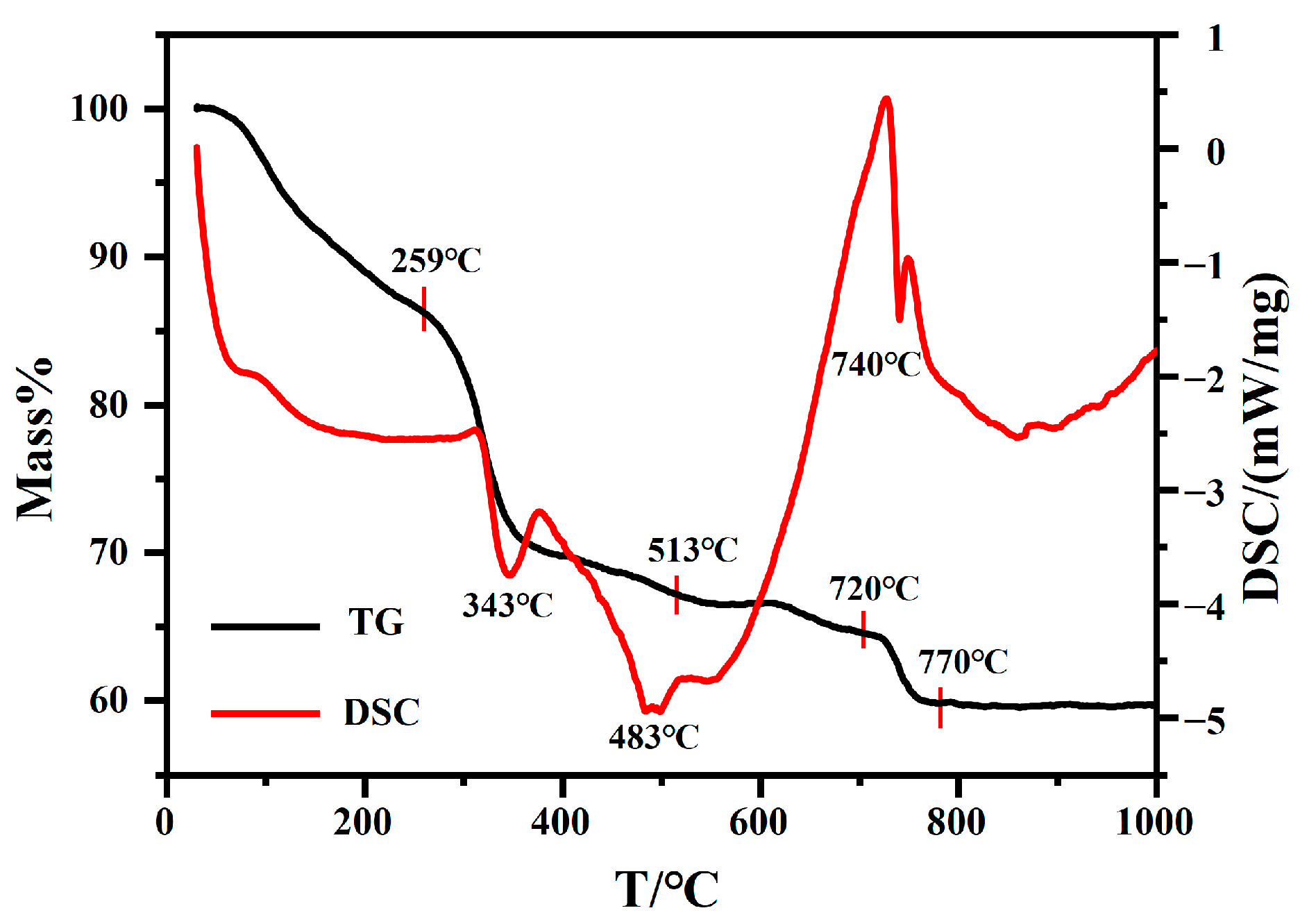
Figure 1 illustrates the thermogravimetric and differential scanning calorimetry (TG-DSC) analysis of the barium titanate dry gel across a temperature range of 30 °C to 1000 °C. The TGA profile reveals a total weight loss of 40%, indicating that three clearly defined stages are observed during the thermal decomposition of the precursor. The first stage, spanning 30–259 °C, exhibits a weight loss of approximately 13.7%, which is primarily attributed to the evaporation of residual solvents within the gel network [16]. With a total mass reduction of approximately 20%, the second decomposition stage takes place in the interval of 259–513 °C. This phase coincides with two exothermic peaks at 343 °C and 483 °C on the DSC curve. Specifically, the peak at 343 °C is ascribed to the decomposition of titanium acetate into TiO2 and acetic anhydride, while the peak at 483 °C corresponds to the decomposition of barium acetate into barium carbonate and other pyrolysis products [26]. The third stage is taken place in the range of 720–770 °C, accompanied by a weight loss of 6.4%. The distinct exothermic peak at 740 °C observed in this region could be the reaction between barium carbonate and titanium dioxide, which results in the generation of the barium titanate phase and the release of carbon dioxide [27].

3.2. Effect of Calcination Temperature on Nano-BaTiO3 Powder

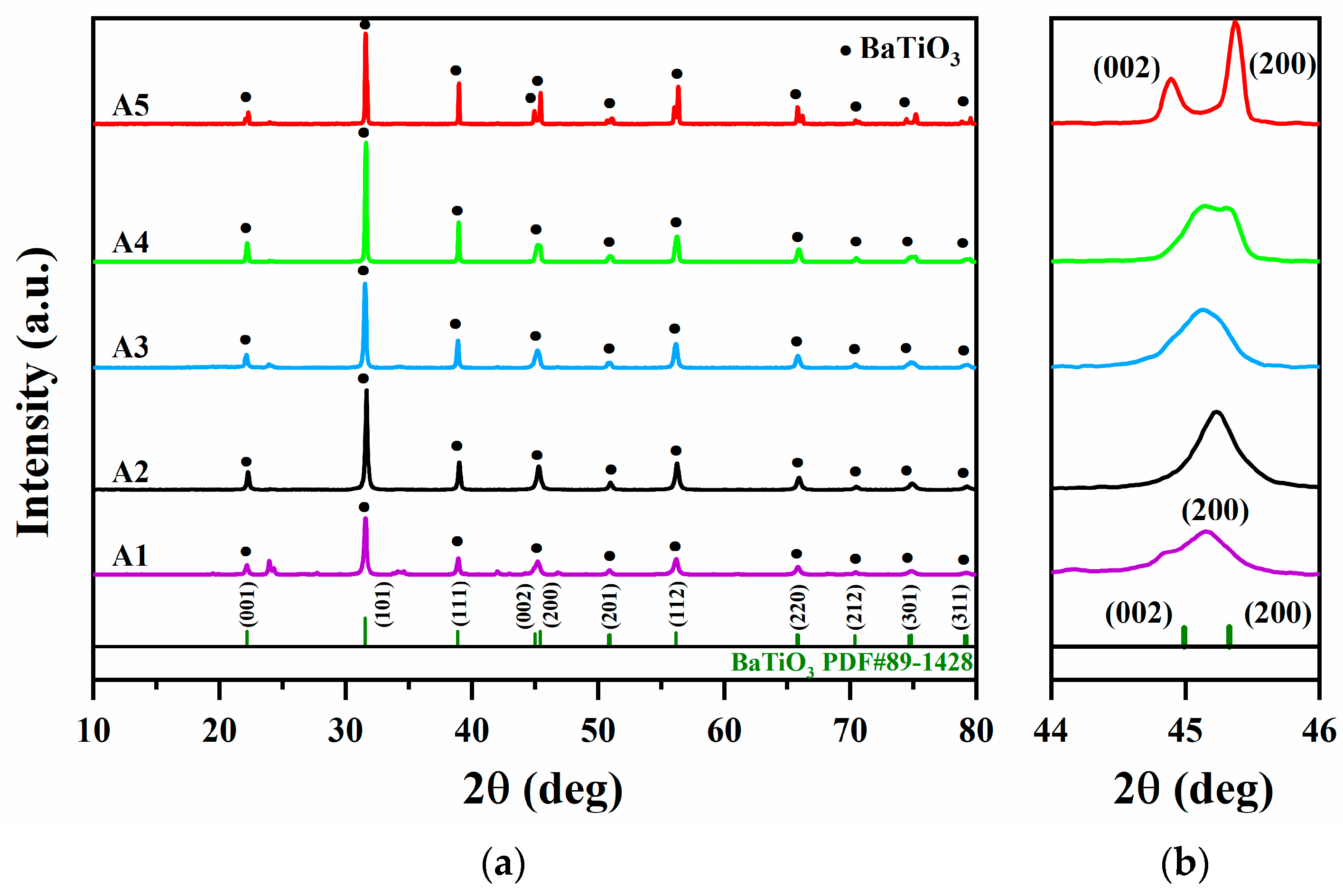
The XRD patterns of BaTiO3 samples obtained at different calcination temperatures are shown in Figure 2. The minor impurity peaks at 24°, 34°, 43°, and 46° are exhibited in the A1 sample calcined at 600 °C, which can be indexed to BaCO3. This means that at 600 °C, the precursor decomposition was incomplete, preventing the full removal of organic moieties from the gel. Additionally, trace BaCO3 could be formed due to the reaction between the gel and atmospheric CO2. With increasing calcination temperature, these impurity peaks disappear, while the strengthening of the characteristic BaTiO3 peaks increases, suggesting improved crystallinity.
The distinction between the cubic and tetragonal phases of BaTiO3 is primarily identified by the splitting of the diffraction peak near 2θ ≈ 45°. For samples calcined between 600 and 800 °C, the (200) reflection appears as a single peak, indicating that BaTiO3 exists in the cubic phase. At 900 °C (Sample A4), as shown in Figure 2b, the peak at 2θ ≈ 45° had been broadened and the signs of splitting had occurred, signaling an increase in tetragonal character for BaTiO3 nanoparticles [28,29,30]. Upon reaching 1000 °C, the A5 sample exhibits a distinct splitting into (002) and (200) peaks. This pattern is well-correlated with the standard tetragonal BaTiO3 card (PDF#89-1428), confirming the formation of the P4mm (99) space group. The average crystallite sizes were calculated using the Scherrer formula, while the c/a ratio, which serves as a critical indicator of tetragonality, was determined via XRD refinement, as shown in Table 2. According to the literature [31], a c/a ratio exceeding 1.0087 denotes a fully developed tetragonal phase. As indicated in Table 2, a c/a ratio of 1.0100 was achieved in sample A5, confirming that a dominant tetragonal phase was obtained at 1000 °C.
To further evaluate the quality of the synthesized powders, these values were compared with standard commercial products. Commercial hydrothermal BaTiO3 powders typically exhibit a fine particle size (100 nm) but a relatively lower tetragonality (c/a ≈ 1.008) due to the entrapped hydroxyl defects. On the other hand, commercial solid-state powders possess high tetragonality (c/a > 1.010) but generally suffer from coarser particle sizes (200–500 nm) and broader size distributions. The BaTiO3 powders prepared in this study exhibit high tetragonality while simultaneously possessing a significantly finer particle size, demonstrating promising application prospects in the field of electronic ceramics.
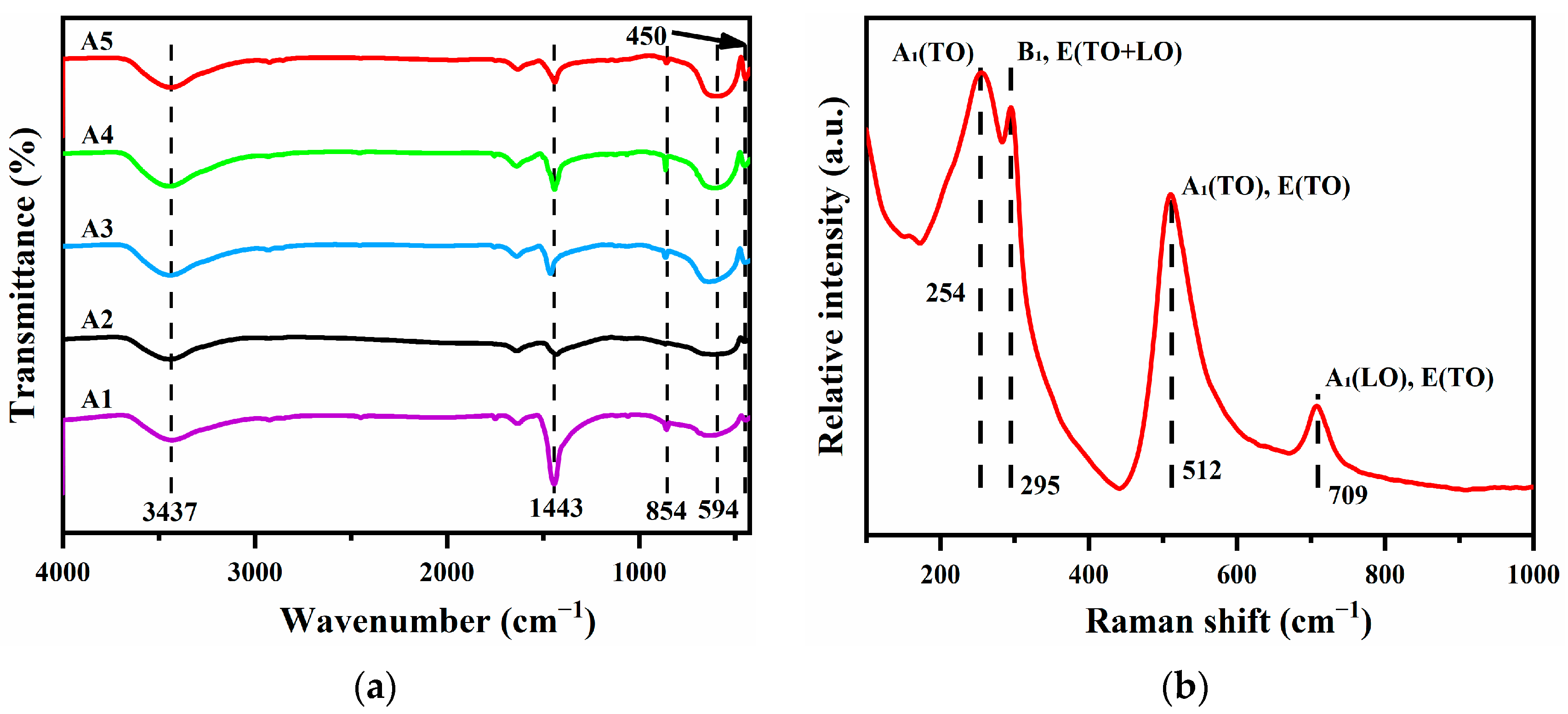
To identify the functional groups and chemical bonds, the samples were examined by FT-IR spectroscopy. As presented in Figure 3a, five distinct characteristic absorption bands are observable in the spectra of samples calcined at various temperatures. According to the relevant literature [32], the absorption band near 3437 cm−1 is ascribed to the vibrations of the O-H groups that have been adsorbed from the air. The bands at 1443 cm−1 and 854 cm−1 correspond to the stretching and deformation vibrations of the carbonate group (CO32−) in BaCO3 [33], respectively. Meanwhile, the bands at 450 cm−1 and 594 cm−1 represent the deformation and stretching vibrations of Ti-O bonds within the TiO6 octahedra, serving as the primary characteristic fingerprints of BaTiO3 [33]. Notably, the CO32− absorption band at 1443 cm−1 is significantly more intense in the sample A1, indicating a higher BaCO3 content, which has been corroborated by the XRD results.
To definitively confirm the formation of tetragonal BaTiO3 nanoparticles, sample A5 was characterized by Raman spectroscopy, as shown in Figure 3b. Tetragonal BaTiO3 belongs to the P4mm space group, which possesses characteristic Raman-active optical phonon modes defined as 3A1 + 4E + B1 [34]. As illustrated in Figure 3b, the sample exhibits distinct Raman peaks at 254 cm−1, 295 cm−1, 512 cm−1, and 709 cm−1 [35]. Specifically, the sharp peaks at 295 cm−1 (assigned to E(TO + LO)) and 709 cm−1 (assigned to A1(LO)) are intrinsic features of the tetragonal phase. The presence of these specific modes in the Raman spectrum confirms that pure tetragonal BaTiO3 is successfully obtained after calcination at 1000 °C for 3 h.
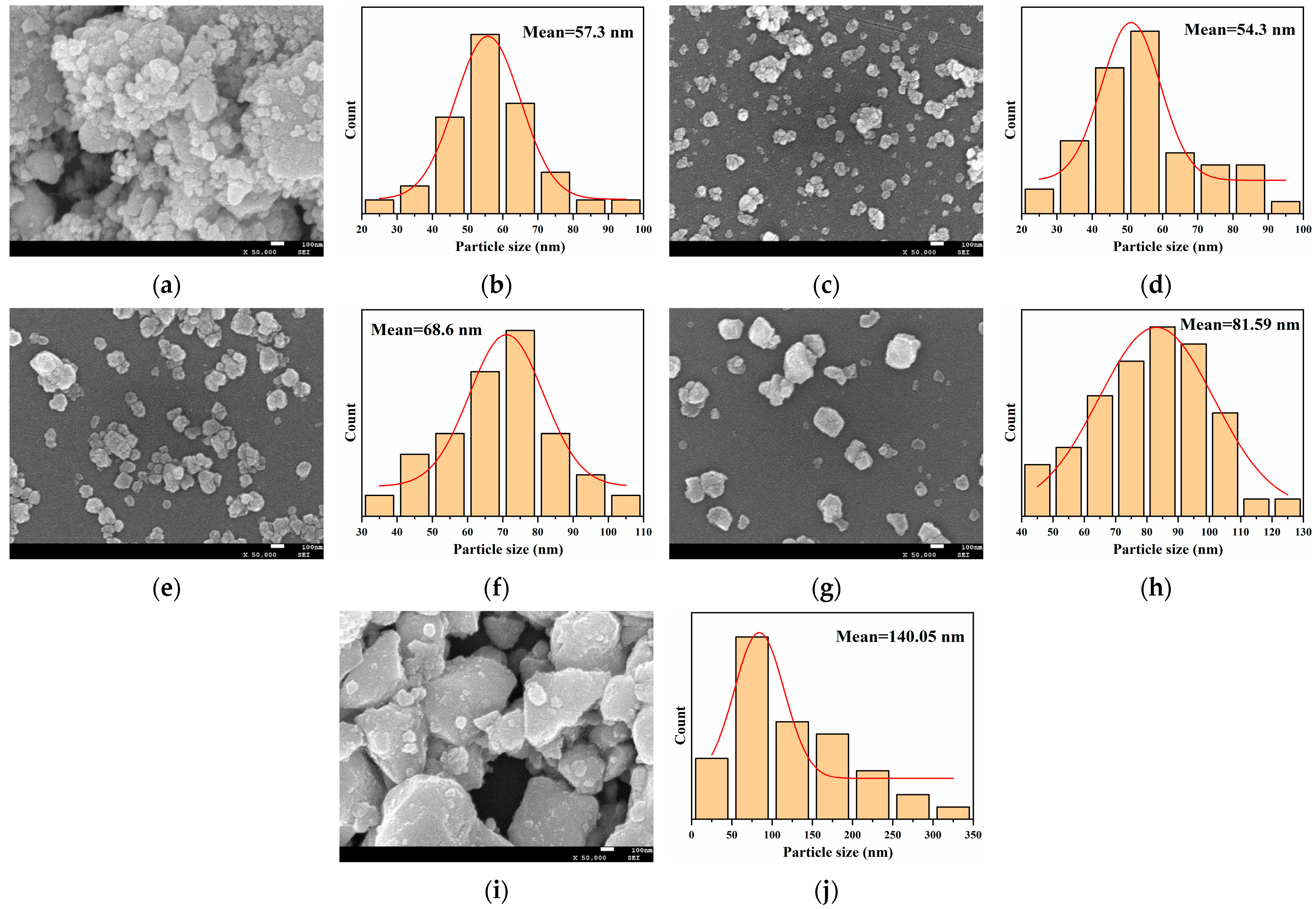
The morphology and microstructure of the synthesized samples were characterized using scanning electron microscopy (SEM). The nano-BaTiO3 with controllable particle sizes was successfully synthesized by precisely regulating the calcination temperature as shown in Figure 4. The larger particle size observed in SEM compared to the crystallite size from XRD indicates that the particles are polycrystalline or agglomerated. As depicted in Figure 4a, for the sample calcined at 600 °C, a broad particle size distribution is observed, which could be the presence of barium carbonate in the previous XRD and FT-IR findings, which can likely be attributed to the larger dimensions of BaCO3 particles compared to those of BaTiO3. Meanwhile, extensive and loose flocculent agglomerates were observed, indicating that while BaTiO3 crystallization had been initiated, the process was incomplete, thereby limiting particle growth. An average particle size of approximately 57.28 nm has been revealed using statistical analysis, and a broad unimodal peak is displayed within the distribution curve. Upon increasing the temperature to 700 °C and 800 °C, the BaCO3 phase is eliminated, and the particle size is increased, with the samples existing primarily in the cubic phase. At 900 °C, the particle size had been further enlarged to an average of 81.59 nm; this change could be coincided with the phase transition from cubic to tetragonal. When the temperature reaches 1000 °C, the particle size increases significantly to 140.05 nm. Large, angular and block-like crystals are observed in the sample, suggesting that driven by grain boundary migration, smaller agglomerated grains had coalesced and grown into larger and well-defined crystals. At this stage, the transformation of the tetragonal phase is complete. In summary, both the grain size and crystal phase of BaTiO3 could be effectively modulated by adjusting the calcination temperature.
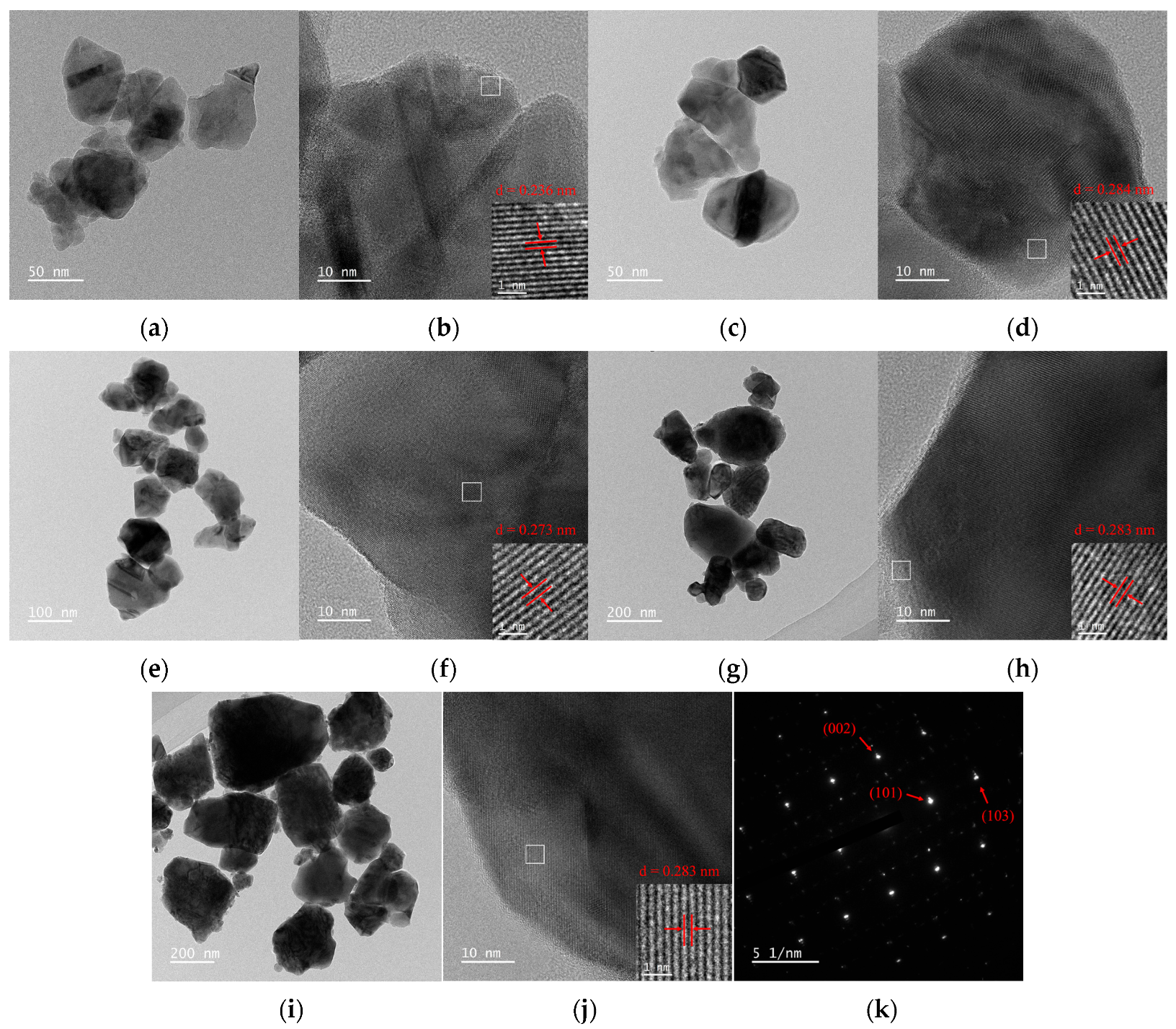
To further elucidate the microstructural evolution and phase transformation of the synthesized powders, the transmission electron microscopy (TEM) and high-resolution TEM (HRTEM) were conducted on samples A1 to A5 and calcined at different temperatures. Sample A1, calcined at 600 °C, is characterized by small, agglomerated particles with irregular boundaries, indicative of an incipient stage of crystallization. In contrast, sample A5, calcined at 1000 °C, reveals significantly larger, well-defined grains with distinct edges, which is well-correlated with the SEM observations.
Well-developed lattice fringes for (110) or (111) crystal planes are clearly observed at particles of samples A1, A2, A3, A4, and A5, respectively. Sample A1 exhibits an interplanar spacing of 0.236 nm, as shown in Figure 5b, which is indexed to the (111) plane of BaTiO3. The relatively indistinct lattice fringes in this sample suggest lower crystallinity or the presence of amorphous domains. Conversely, sample A5 displays clearly continuous lattice fringes with a measured d-spacing of 0.283 nm, as shown in Figure 5j, corresponding to the (110) plane of BaTiO3. Furthermore, the selected area electron diffraction (SAED) is conducted on sample A5, as shown in Figure 5k. The sharp and discrete diffraction spots are observed in the pattern of sample A5, which confirms its single-crystalline nature and could be indexed as a tetragonal structure.
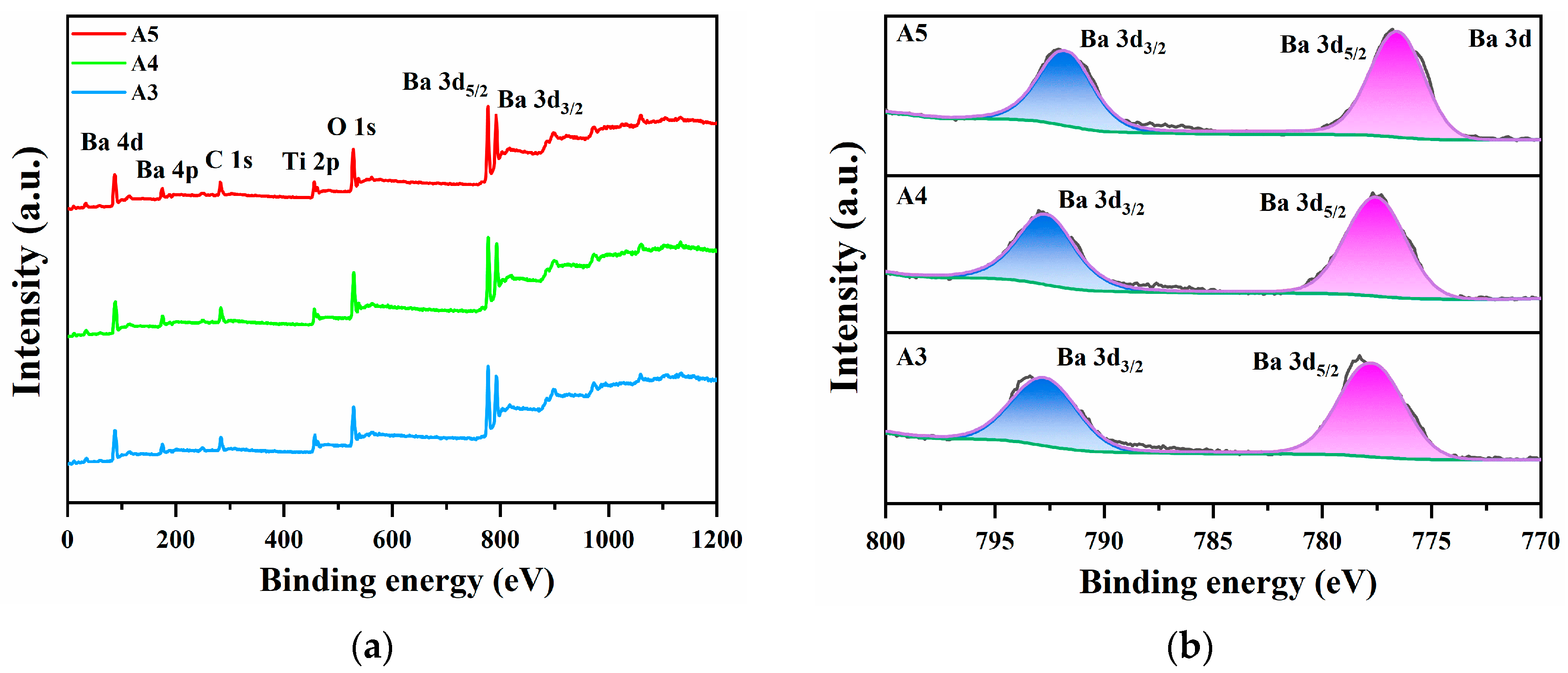
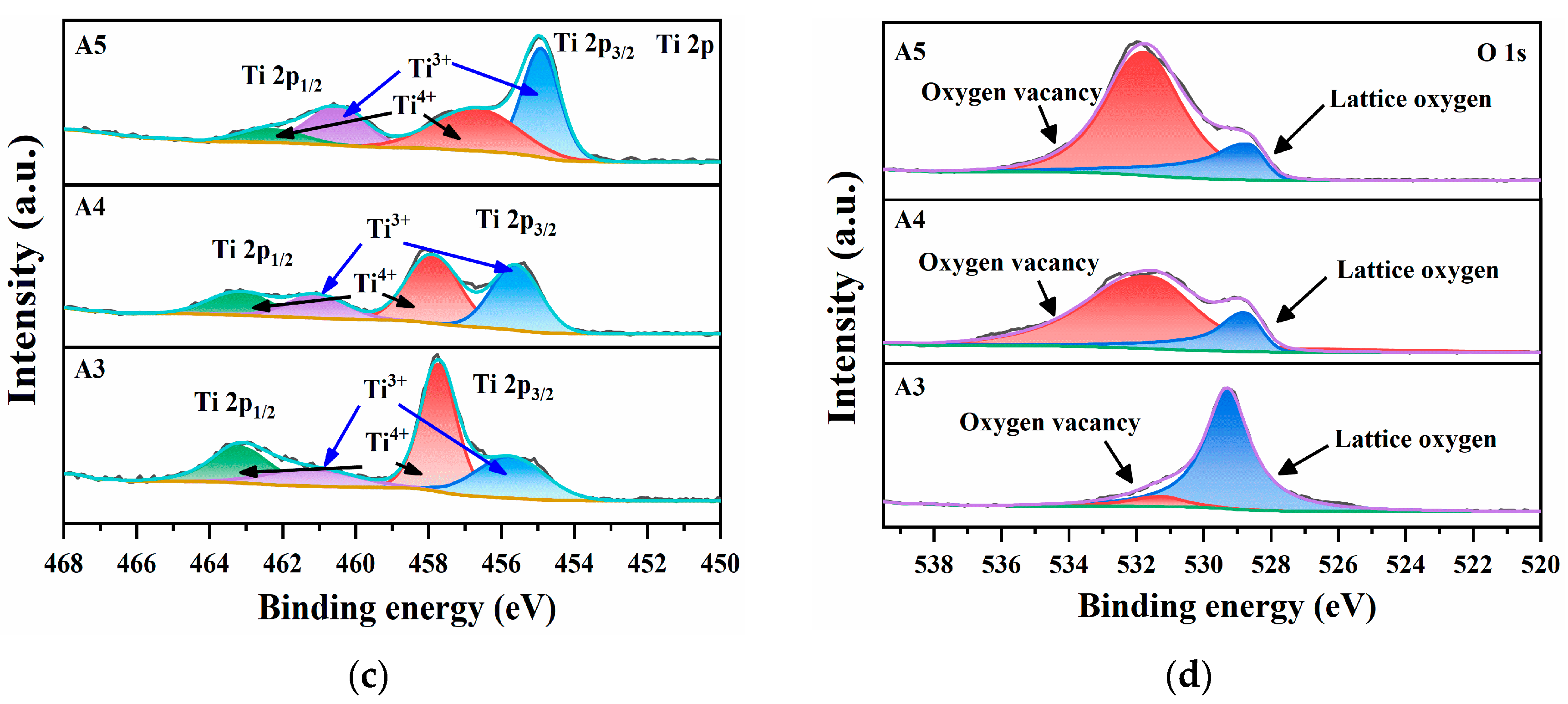
The elemental composition and chemical states of samples A3, A4, and A5 were investigated using XPS. The presence of Ba, Ti, C, and O had been confirmed in the XPS survey spectrum as shown in Figure 6a, verifying the successful preparation of nano-BaTiO3 powder. Figure 6b presents the high-resolution Ba 3d XPS spectrum. Two distinct peaks located at 777.71 eV and 792.74 eV are attributed to the Ba 3d5/2 and Ba 3d3/2 spin–orbit doublets, respectively. The binding energies agree with the Ba2+ oxidation state in the perovskite lattice [36]. Figure 6c displays the high-resolution Ti 2p spectrum, which can be fitted into two distinct oxidation states. The dominant peaks at 458.16 eV (Ti 2p3/2) and 463.89 eV (Ti 2p1/2) are attributed to Ti4+ ions in the octahedral coordination of the BaTiO3 lattice. Conversely, the peaks at 456.09 eV (Ti 2p3/2) and 461.77 eV (Ti 2p1/2) correspond to Ti3+ species [37,38,39]. The high-resolution O 1s XPS spectra (Figure 6d) display a peak at 528.68 eV, assigned to the lattice oxygen (O2−) in the BaTiO3 structure. The peak located at 531.75 eV is generally attributed to non-lattice oxygen. This higher binding energy component (531.75 eV) represents a collective contribution from both intrinsic oxygen vacancy regions and extrinsic surface species, such as hydroxyl groups (-OH) and adsorbed oxygen, which are inevitable in sol–gel-derived nanopowders. The presence of Ti3+ is intrinsically linked to the formation of oxygen vacancies. During high-temperature sintering, lattice oxygen is released into the environment (Equation (1)), creating oxygen vacancies and free electrons. To maintain charge neutrality, Ti4+ ions capture these electrons and are reduced to Ti3+ (Equation (2)). Notably, with the rise in calcination temperature, the intensity of the Ti3+ peaks rises. This trend suggests that higher temperatures promote the release of lattice oxygen, thereby generating a higher concentration of oxygen vacancies and Ti3+ defects.
O O X 1 2 O 2 + V O . . + 2 e
T i 4 + + e T i 3 +
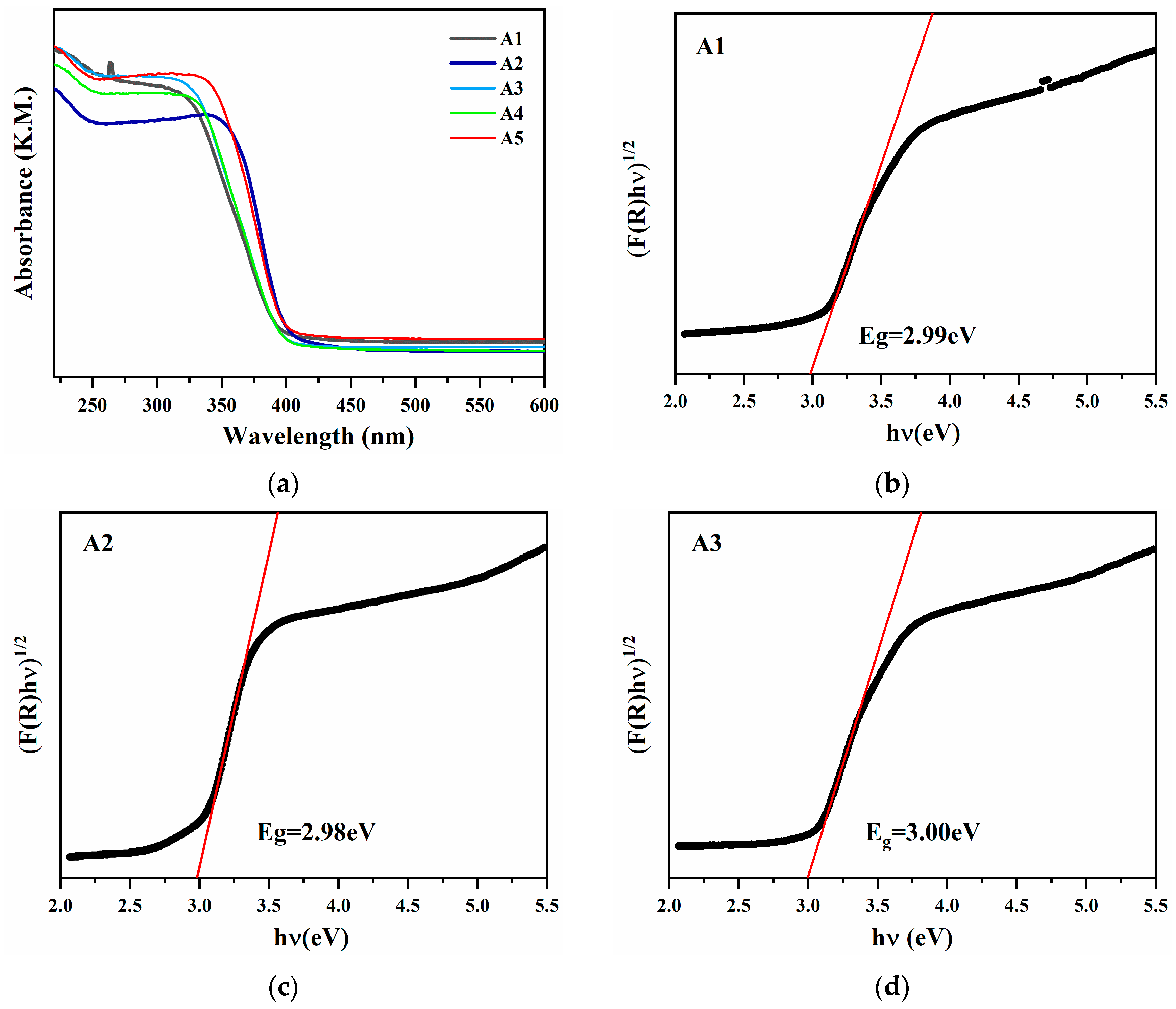
The diffuse reflectance properties were investigated using UV–Vis diffuse reflectance spectroscopy (DRS), as shown in Figure 7a. For sample preparation, the powders were mixed with BaSO4 as a reference and pressed into a holder for measurement. It is revealed that the absorption edge of the BaTiO3 synthesized at 1000 °C exhibits a distinct red shift toward the visible region. The bandgap energy ( E g ) was estimated using the Tauc method based on the K-M function [40].
F R = 1 R 2 2 R = K S
F R h ν 1 n = B h ν E g
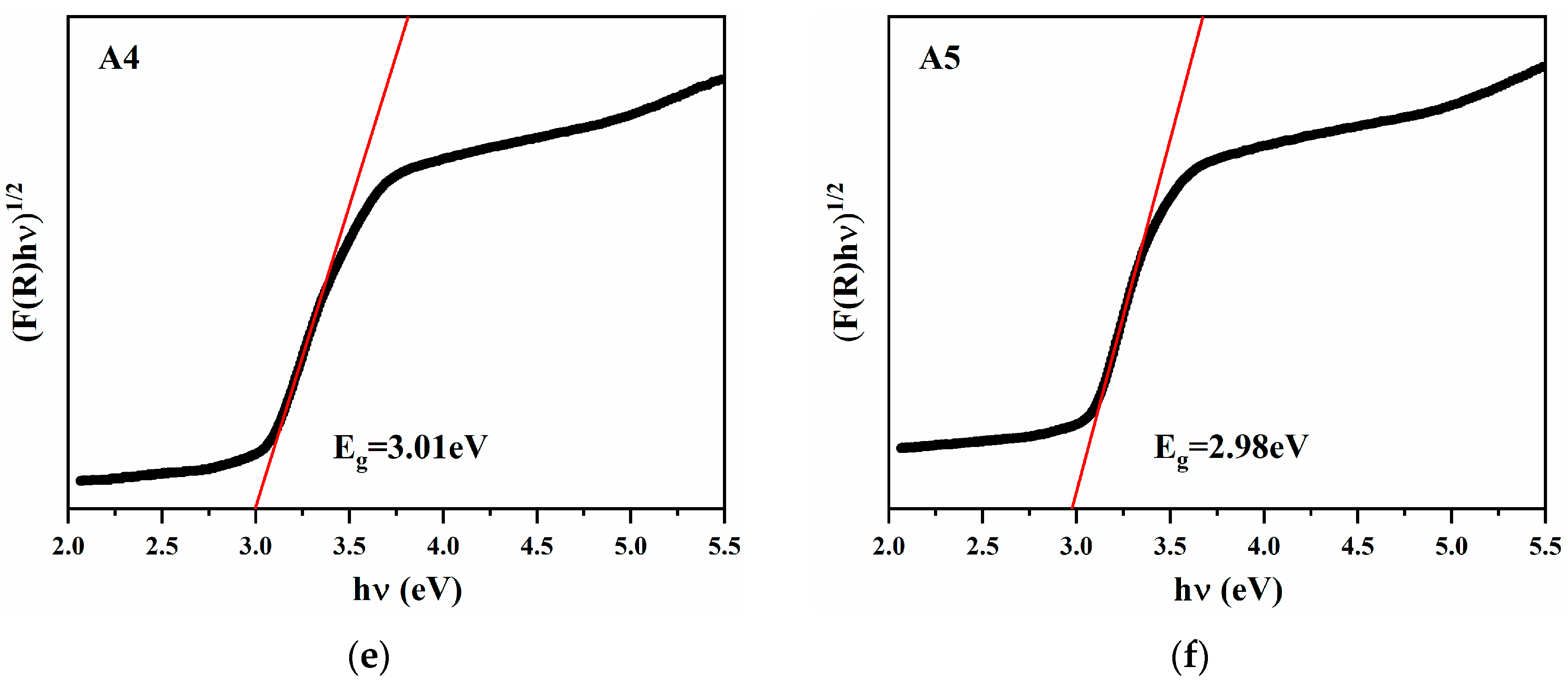
In the equation, h is Planck’s constant; ν is the frequency of light; E g is the bandgap; R is the reflectance (expressed as a percentage); K is the absorption coefficient; S is the reflectance coefficient; B is the proportionality constant; and n is determined by the type of electronic transition, being 2 for indirect bandgap semiconductors and 1/2 for direct bandgap semiconductors. BaTiO3 is an indirect bandgap semiconductor, so n = 2 . The bandgap was determined by plotting ( F ( R ) h ν ) 1 / 2 against the photon energy ( h ν ) and extrapolating the linear portion of the curve to the x-axis. The resulting Tauc plots are presented in Figure 7b–d. The calculated E g values for samples calcined at 600 °C, 700 °C, 800 °C, 900 °C, and 1000 °C are 2.99 eV, 2.98 eV, 3.00 eV, 3.01 eV, and 2.98 eV, respectively. Theoretically, the enhanced crystallinity associated with higher calcination temperatures (e.g., 1000 °C) is typically expected to widen the bandgap. However, the anomalous bandgap at 600 °C is likely associated with the size effect, in conjunction with influences from incomplete crystallization and residual carbonaceous impurities. And the observed narrowing of the bandgap to 2.98 eV at 1000 °C contradicts this trend. Based on the XPS analysis discussed previously, this phenomenon is attributed to the increased concentration of oxygen vacancies formed at high temperature. These vacancies introduce localized donor states below the conduction band, effectively causing a red shift in the absorption edge and a consequent reduction in the optical bandgap.

3.3. Effect of Aging Time on Nano-BaTiO3 Powder

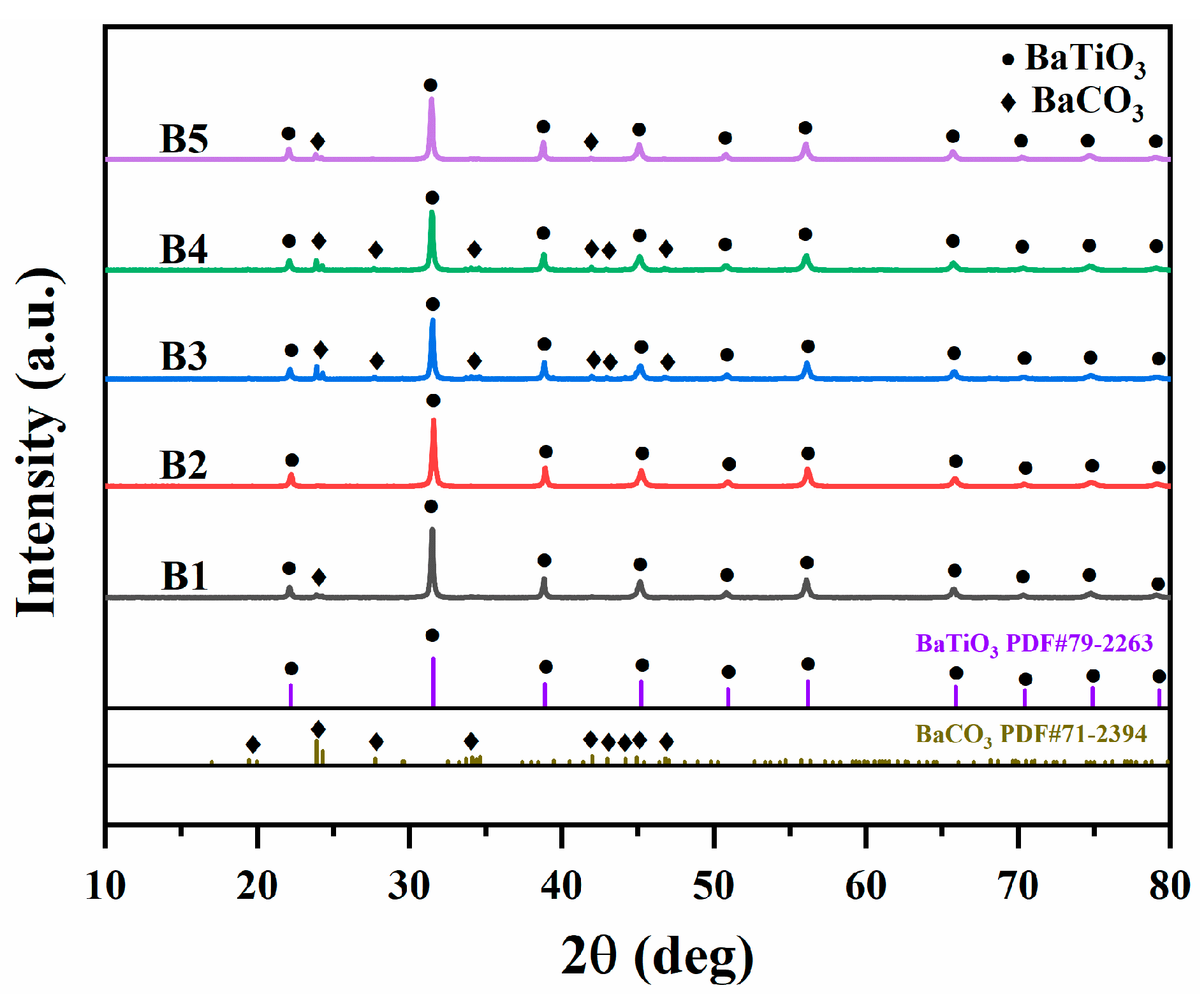
The crystal structure evolution of BaTiO3 synthesized at different aging times (2 h, 4 h, 6 h, 8 h and 10 h) was investigated via XRD. As depicted in Figure 8, diffraction peaks located at 22.2°, 31.6°, 38.9°, 45.2°, 56.2°, 65.9°, and 74.9° align well with the standard cubic BaTiO3 pattern (PDF#79-2263), confirming the formation of the Pm-3m space group. Notably, when the aging time extends to 6 h, the diffraction peaks associated with barium carbonate impurities are intensified significantly. It is attributed to the prolonged exposure to atmospheric CO2, which is dissolved to form carbonate ions (CO32−), thereby facilitating the precipitation of BaCO3. However, upon aging for 10 h, the intensity of the BaCO3 peaks diminish, indicating a reduction in impurity content. This phenomenon is plausibly ascribed to the enhanced densification and stability of the gel network at this stage. The consequent shrinkage and closure of pores create a compact barrier that effectively hinders the diffusion of external CO2 into the gel interior, thereby mitigating further carbonation. Grain sizes calculated using the Scherrer formula during varied aging times for B1, B2, B3, B4, and B5 were determined to be 41.7 nm, 35.5 nm, 40.1 nm, 44.2 nm, and 47.4 nm, respectively.
The non-monotonic evolution of the BaCO3 phase can be elucidated by the competition between hydrolysis and polycondensation during aging. Initially (0–6 h), the hydrolysis of alkoxides prevails, forming a loose and open gel network. This structure facilitates the diffusion of atmospheric CO2 and its reaction with active Ba2+, leading to an increase in BaCO3 content [41]. However, with prolonged aging (up to 10 h), polycondensation reactions become dominant. According to Brinker and Scherer [21], this stage is characterized by the spontaneous shrinkage and stiffening of the gel network. This process significantly densifies the gel skeleton and reduces porosity, thereby acting as a physical barrier that restricts CO2 diffusion [42].
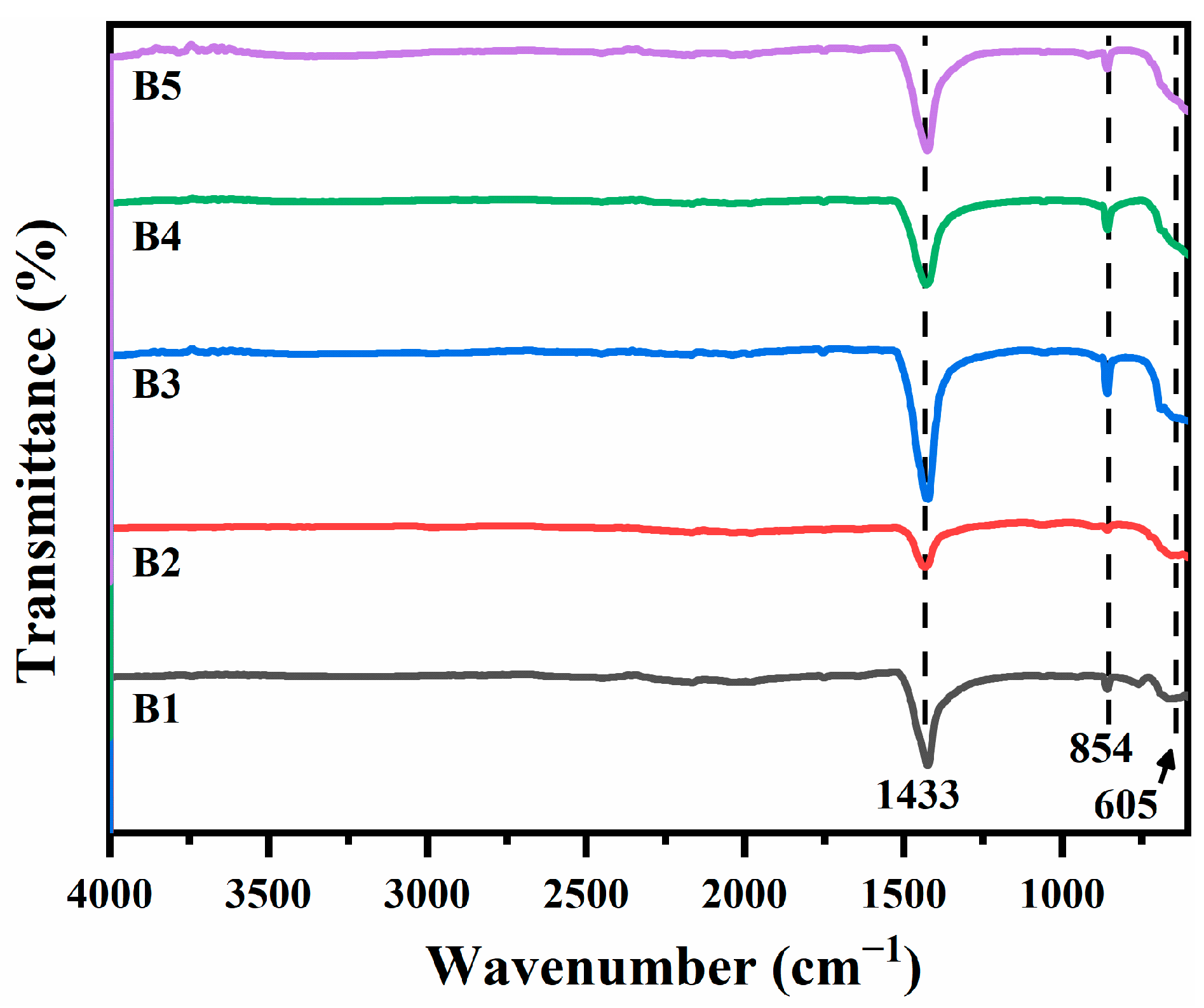
To identify the functional groups and chemical bonds, the samples were examined by FT-IR spectroscopy. As illustrated in Figure 9, three distinct characteristic absorption bands are discernible in the infrared spectra of samples aged for different durations. According to the relevant literature, the absorption bands at 1443 cm−1 and 854 cm−1 are assigned to the stretching and deformation vibrations of the carbonate group (CO32−) in BaCO3, respectively. Meanwhile, the band at 605 cm−1 corresponds to the stretching vibration of Ti-O bonds within TiO6 octahedra, which serves as a primary characteristic fingerprint of BaTiO3. As depicted in Figure 9, sample B3 exhibits a significantly more intense carbonate absorption band at 1443 cm−1 compared to sample B5, indicating a higher concentration of BaCO3 impurities in B3. This observation corroborates the findings from the XRD analysis.
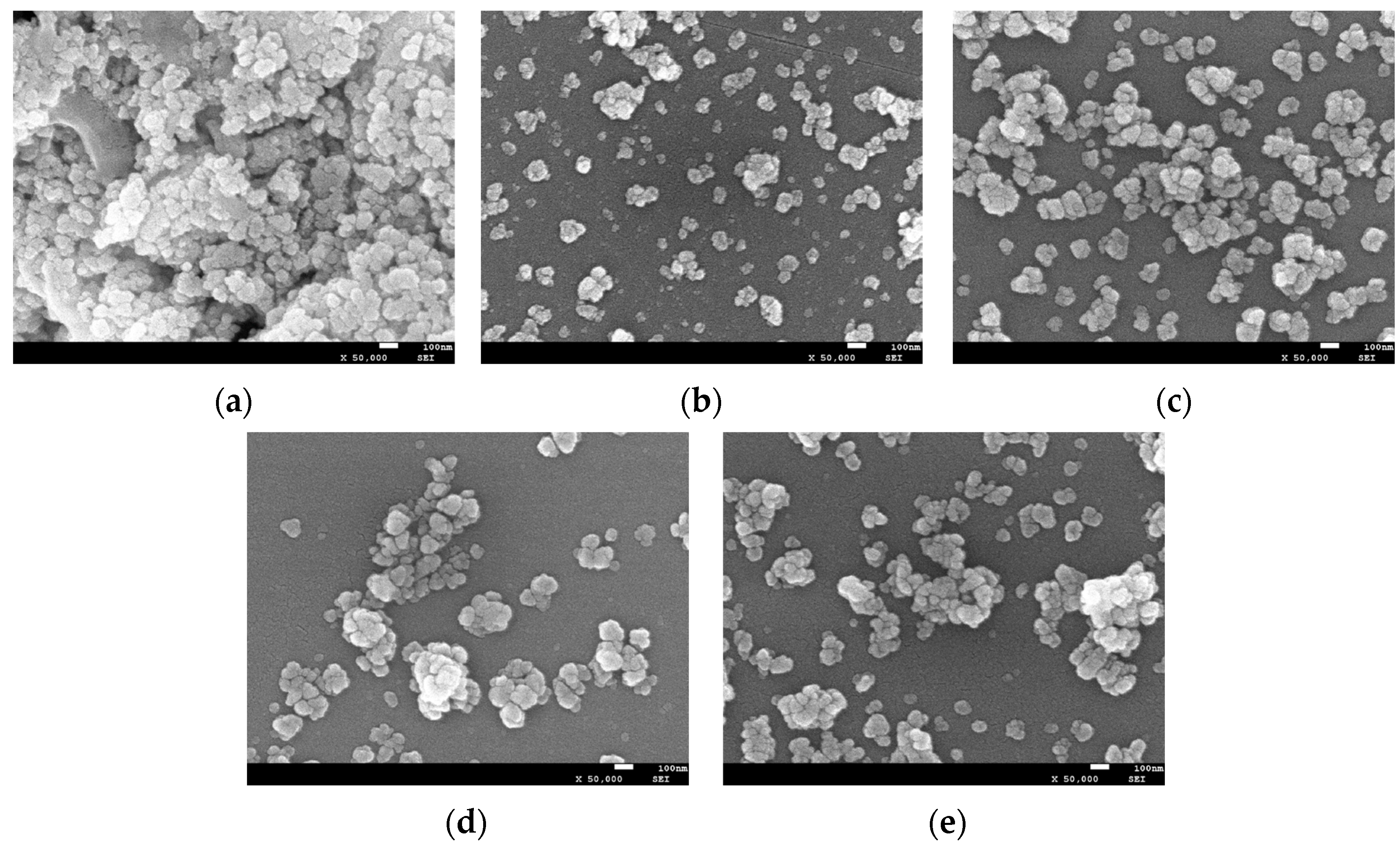
Scanning electron microscopy (SEM) was employed to characterize the morphology and microstructure of the samples, as illustrated in Figure 10. For the sample aged for 2 h, severe agglomeration resulted in an irregular morphology, where numerous fine primary particles are sintered into hard agglomerates. It is likely attributed to compositional inhomogeneity in the precursor and the vigorous decomposition of organic components. Conversely, at 4 h of aging, a uniform gel composition and complete gelation had been achieved from the precursor, yielding nanoparticles with uniform size and excellent dispersibility after heat treatment. However, upon extending the aging time to 6 h, the onset of particle agglomeration was observed. With a further increase to 8–10 h, severe agglomeration had been re-emerged. This degradation is ascribed to the excessive rigidity and density of the gel network caused by prolonged aging, which facilitates sintering and agglomeration during the subsequent high-temperature treatment. It is confirmed that varying the aging time had a negligible influence on the grain size but significantly impacted the dispersion of the particles.
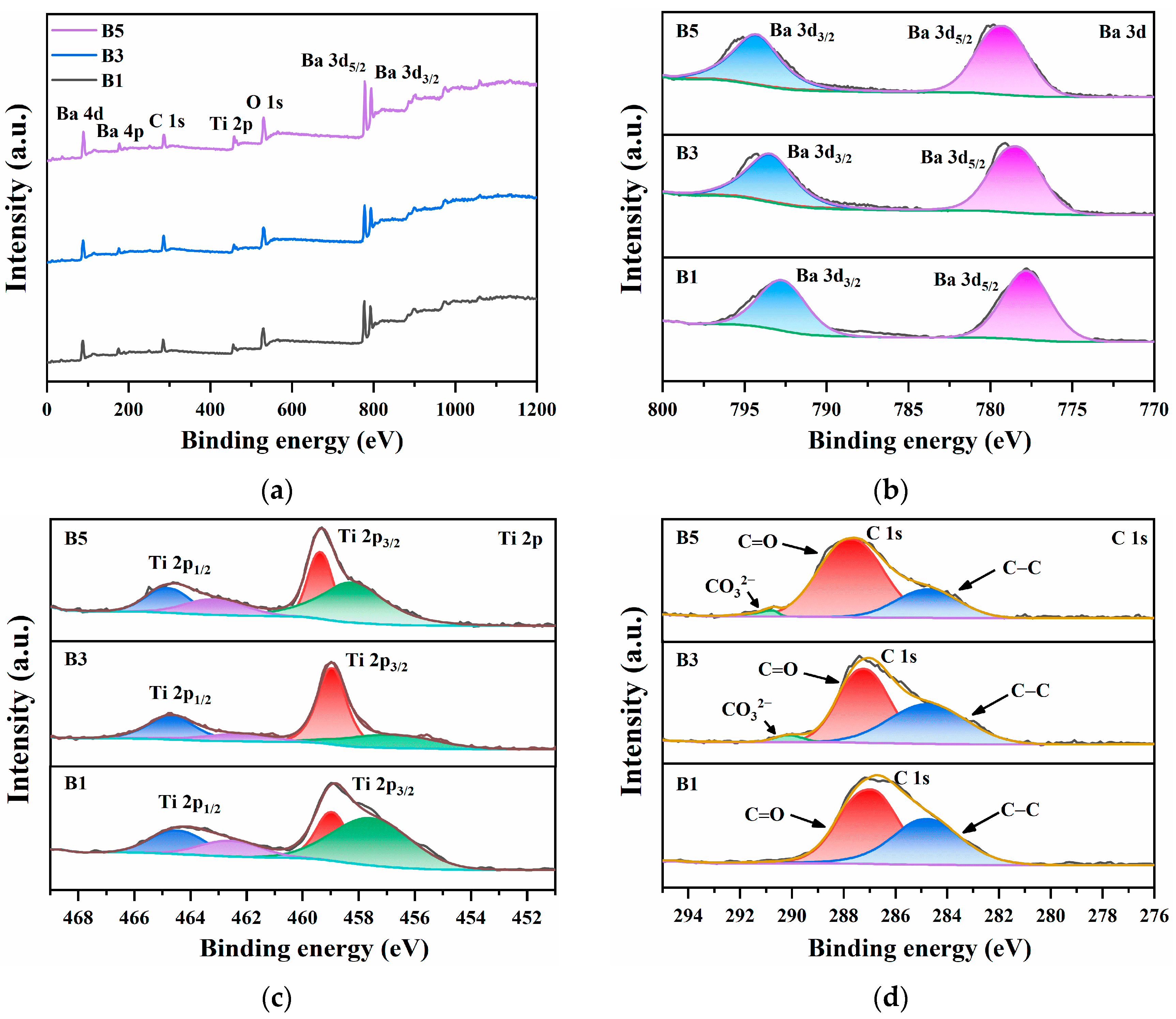
The elemental composition and chemical states of samples B1, B3, and B5 were investigated using XPS. The presence of Ba, Ti, C, and O had been confirmed in the XPS survey spectrum as shown in Figure 11a, verifying the successful synthesis of nano-BaTiO3 powder. Figure 11b illustrates the high-resolution Ba 3d spectrum. The peaks observed at 777.80 eV and 792.70 eV are attributed to the Ba 3d5/2 and Ba 3d3/2 spin–orbit split components, respectively, confirming the presence of the Ba2+ oxidation state. Figure 11c displays the high-resolution Ti 2p spectrum, where the peaks at 462.51 eV and 464.44 eV are attributed to the Ti 2p1/2 orbital, while those at 458.95 eV and 457.54 eV correspond to the Ti 2p3/2 orbital. These binding energies are consistent with the typical characteristics of Ti species in an oxide environment. The high-resolution C 1s spectrum is presented in Figure 11d. The peak at 284.76 eV is assigned to adventitious C-C bonds and functions as the internal standard. The component at 286.95 eV is attributed to C=O species derived from acetate groups. Notably, in sample B3, the peak located at 290.13 eV is ascribed to carbonate species (CO32−), signifying the presence of surface barium carbonate. In contrast, sample B5 exhibits a reduced intensity for this carbonate peak, indicating a lower concentration of surface BaCO3. This finding corroborates the results obtained from the preceding XRD and FT-IR analyses.
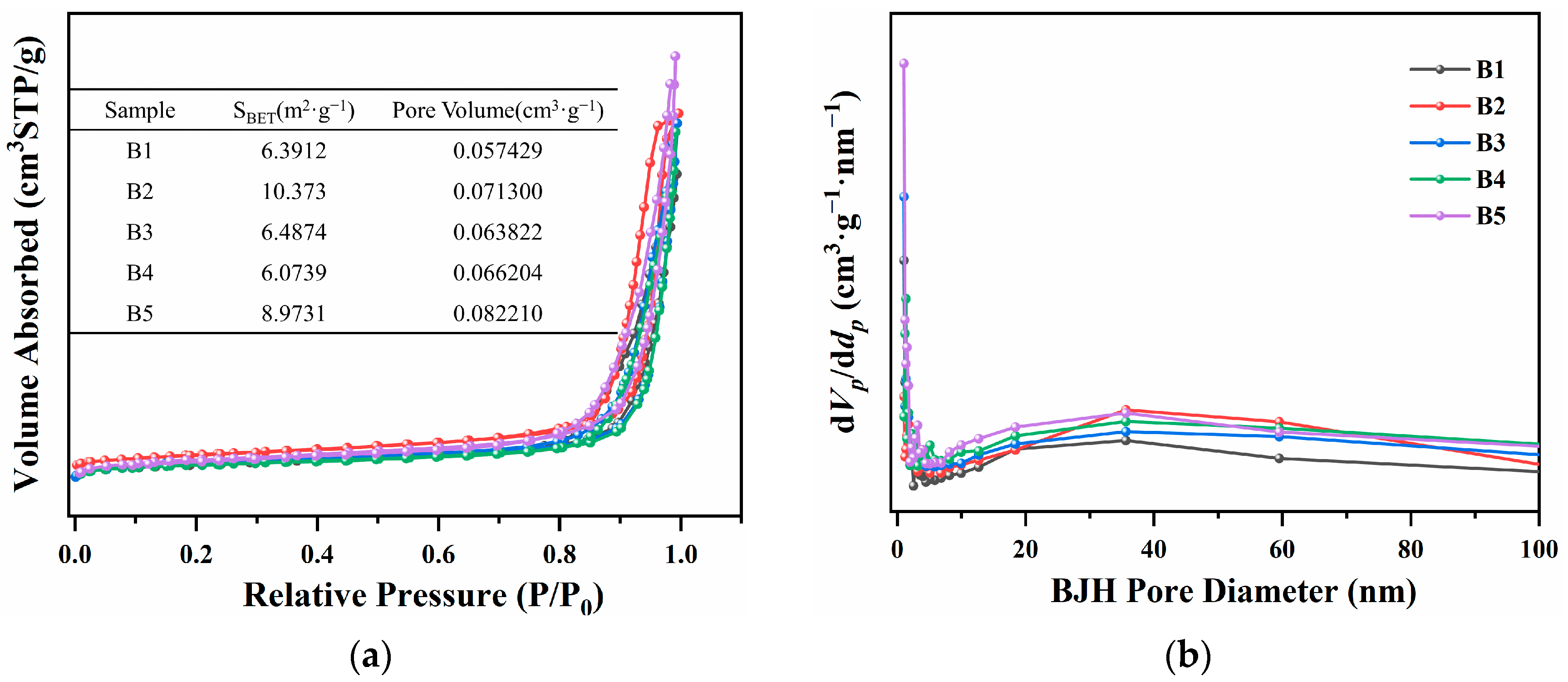
Nitrogen adsorption–desorption measurements were carried out to calculate the specific surface area and evaluate the pore characteristics of the samples. As illustrated in Figure 12, the Y-axis (cm3 STP/g) represents the volume of gas adsorbed at standard temperature and pressure per gram of sample, while the X-axis (P/P0) represents the relative pressure. All samples exhibit Type III isotherms, which correspond to weak adsorbent–adsorbate interactions. These isotherms are characterized by distinct hysteresis loops, indicative of the presence of flat, slit-like pores. Table in Figure 12a lists the specific surface area (SBET) and pore volume measured by isotherms at different aging times. Significant variations in specific surface area were observed among samples subjected to different aging times, suggesting that the aging process critically influences the sintering activity and grain growth behavior of the final product. Notably, sample B2 (aged for 4 h) displays the highest specific surface area and pore volume. It implies that this sample possesses the smallest grain size, which aligns with the crystallite size of the calculations presented earlier. Furthermore, it is well-established that powders with a high specific surface area possess elevated surface energy, which serves as a thermodynamic driving force, enhancing sintering activity during the subsequent sintering processes of ceramic, thereby facilitating densification at lower temperatures. Although the sample aged for 10 h also exhibits a relatively large specific surface area, excessive aging introduces deleterious BaCO3 impurities and promotes powder agglomeration. As shown in Figure 12b, the Y-axis represents the derivative of pore volume with respect to the pore diameter, showing the distribution of pore sizes. The BJH (Barrett–Joyner–Halenda) pore size distribution curves reveal a predominance of pores within the 0–10 nm range. The observed fluctuations in the distribution curves are attributed to the derivative nature of the BJH method, which inherently amplifies experimental noise. Furthermore, the disordered inter-particle voids formed by the random stacking of BaTiO3 nanoparticles contribute to the complex and broad pore size distribution. Pores of moderate size are favorable for mass transport kinetics, whereas excessively small or large pores may impede effective transport. It is suggested that the optimal aging duration is 4 h, which secures a sufficiently high specific surface area and homogeneity to suppress excessive BaCO3 formation, while avoiding the severe agglomeration associated with prolonged aging.

4. Conclusions

In this work, nano-sized BaTiO3 powders were successfully prepared via a sol–gel route. The influence of processing parameters on the crystallographic structure, morphology, and defect chemistry was thoroughly analyzed. The crystal structure of BaTiO3 transformed from a cubic phase to a tetragonal phase with increasing calcination temperature. A fully developed tetragonal phase with a c/a ratio of 1.0100 was obtained at 1000 °C, confirming the high quality of the synthesized powder. High-temperature calcination facilitated the release of lattice oxygen, resulting in the generation of oxygen vacancies and the reduction of Ti4+ to Ti3+. This defect generation introduced donor states below the conduction band, causing a red shift in the absorption edge and reducing the bandgap energy from 3.01 eV to 2.98 eV. The aging time played a decisive role in determining the homogeneity and purity of the precursors. Shorter aging times (2 h) led to inhomogeneous gels and agglomeration, while excessive aging times (>6 h) caused the rigidity of the gel network to increase and promoted the absorption of atmospheric CO2, leading to the reformation of BaCO3 impurities. The optimal production of well-dispersed nanoparticles with a size of 35.5 nm were obtained within 4 h at 700 °C, which is minimal agglomeration. In summary, this study demonstrates the simultaneous control of particle dispersion, tetragonality, oxygen-vacancy concentration, and optical bandgap through a dual-tuning strategy involving aging time and calcination temperature. The synthesized BaTiO3 powders with controllable size, high purity, and excellent tetragonality could be potential for the application of electronic ceramics.

Author Contributions

Methodology, S.L.; software, H.-W.L. and H.-X.Z.; writing—original draft, S.L.; writing—review and editing, Y.-H.S. and D.Z.; funding acquisition Y.-H.S.; data curation, S.L. and Y.Y.; investigation, L.L. and X.-P.J.; software, H.-W.L. and H.-X.Z. All authors have read and agreed to the published version of the manuscript.

Funding

This work was supported by the National Key Research and Development Program of China (No. 2023YFB3812200).

Data Availability Statement

The original contributions presented in this study are included in the article. Further inquiries can be directed to the corresponding author.

Conflicts of Interest

The authors declare no conflicts of interest.

References

  1. Haertling, G.H. Ferroelectric Ceramics: History and Technology. J. Am. Ceram. Soc. 1999, 82, 797–818. [Google Scholar] [CrossRef]
  2. Lu, W.; Quilitz, M.; Schmidt, H. Nanoscaled BaTiO3 powders with a large surface area synthesized by precipitation from aqueous solutions:: Preparation, characterization and sintering. J. Eur. Ceram. Soc. 2007, 27, 3149–3159. [Google Scholar] [CrossRef]
  3. Acosta, M.; Novak, N.; Rojas, V.; Patel, S.; Vaish, R.; Koruza, J.; Rossetti, G.A., Jr.; Rödel, J. BaTiO3-based piezoelectrics: Fundamentals, current status, and perspectives. Appl. Phys. Rev. 2017, 4, 041305. [Google Scholar] [CrossRef]
  4. Pithan, C.; Hennings, D.; Waser, R. Progress in the Synthesis of Nanocrystalline BaTiO3 Powders for MLCC. Int. J. Appl. Ceram. Technol. 2005, 2, 1–14. [Google Scholar] [CrossRef]
  5. Hongo, K.; Kurata, S.; Jomphoak, A.; Inada, M.; Hayashi, K.; Maezono, R. Stabilization Mechanism of the Tetragonal Structure in a Hydrothermally Synthesized BaTiO3 Nanocrystal. Inorg. Chem. 2018, 57, 5413–5419. [Google Scholar] [CrossRef]
  6. Saleem, M.; Butt, M.S.; Maqbool, A.; Umer, M.A.; Shahid, M.; Javaid, F.; Malik, R.A.; Jabbar, H.; Waseem Khalil, H.M.; Hwan, L.D.; et al. Percolation phenomena of dielectric permittivity of a microwave-sintered BaTiO3–Ag nanocomposite for high energy capacitor. J. Alloys Compd. 2020, 822, 153525. [Google Scholar] [CrossRef]
  7. Özen, M.; Mertens, M.; Snijkers, F.; Cool, P. Hydrothermal synthesis and formation mechanism of tetragonal barium titanate in a highly concentrated alkaline solution. Ceram. Int. 2016, 42, 10967–10975. [Google Scholar] [CrossRef]
  8. Zhu, C.; Zhao, Q.; Cai, Z.; Guo, L.; Li, L.; Wang, X. High reliable non-reducible ultra-fine BaTiO3-based ceramics fabricated via solid-state method. J. Alloys Compd. 2020, 829, 154496. [Google Scholar] [CrossRef]
  9. Han, J.-M.; Joung, M.-R.; Kim, J.-S.; Lee, Y.-S.; Nahm, S.; Choi, Y.-K.; Paik, J.-H. Hydrothermal Synthesis of BaTiO3 Nanopowders Using TiO2 Nanoparticles. J. Am. Ceram. Soc. 2014, 97, 346–349. [Google Scholar] [CrossRef]
  10. Hsiang, H.-I.; Chang, Y.-L.; Fang, J.-S.; Yen, F.-S. Polyethyleneimine surfactant effect on the formation of nano-sized BaTiO3 powder via a solid state reaction. J. Alloys Compd. 2011, 509, 7632–7638. [Google Scholar]
  11. Xue, P.; Hu, Y.; Xia, W.; Wu, H.; Zhu, X. Molten-salt synthesis of BaTiO3 powders and their atomic-scale structural characterization. J. Alloys Compd. 2017, 695, 2870–2877. [Google Scholar] [CrossRef]
  12. Ma, Y.; Vileno, E.; Suib, S.L.; Dutta, P.K. Synthesis of Tetragonal BaTiO3 by Microwave Heating and Conventional Heating. Chem. Mater. 1997, 9, 3023–3031. [Google Scholar] [CrossRef]
  13. Masuda, Y.; Yamada, T.; Koumoto, K. Synthesis of Acicular BaTiO3 Particles using Acicular Barium Oxalates. Cryst. Growth Des. 2008, 8, 169–171. [Google Scholar] [CrossRef]
  14. Zhang, X.; Yue, J.; Zhao, Y.; Yan, Z.; Zhu, G.; Liu, L.; Xu, H.; Yu, A. Synthesis of tetragonal BaTiO3 nano-particle via a novel tartaric acid co-precipitation process. Ceram. Int. 2021, 47, 7263–7267. [Google Scholar] [CrossRef]
  15. Sakabe, Y.; Yamashita, Y.; Yamamoto, H. Dielectric properties of nano-crystalline BaTiO3 synthesized by micro-emulsion method. J. Eur. Ceram. Soc. 2005, 25, 2739–2742. [Google Scholar] [CrossRef]
  16. Li, W.; Xu, Z.; Chu, R.; Fu, P.; Hao, J. Structure and electrical properties of BaTiO3 prepared by sol–gel process. J. Alloys Compd. 2009, 482, 137–140. [Google Scholar] [CrossRef]
  17. Hao, Y.; Wang, X.; Zhang, H.; Guo, L.; Li, L. Sol–gel based synthesis of ultrafine tetragonal BaTiO3. J. Sol-Gel Sci. Technol. 2013, 67, 182–187. [Google Scholar] [CrossRef]
  18. Wu, Y.T.; Wang, X.F.; Yu, C.L.; Li, E.Y. Preparation and Characterization of Barium Titanate (BaTiO3) Nano-Powders by Pechini Sol-Gel Method. Mater. Manuf. Process. 2012, 27, 1329–1333. [Google Scholar] [CrossRef]
  19. Livage, J.; Henry, M.; Sanchez, C. Sol-gel chemistry of transition metal oxides. Prog. Solid State Chem. 1988, 18, 259–341. [Google Scholar] [CrossRef]
  20. Jiang, M.; Lu, J.; Chen, Y.; Chen, J.; Cao, X.; Wang, H. Non-hydrolytic sol-gel synthesis of BaTiO3 nano-powder: Effect of calcination temperature and modified titanium source on particles. Mater. Today Commun. 2024, 38, 108494. [Google Scholar] [CrossRef]
  21. Brinker, C.J.; Scherer, G.W. CHAPTER 6—Aging of Gels. In Sol-Gel Science; Brinker, C.J., Scherer, G.W., Eds.; Academic Press: San Diego, CA, USA, 1990; pp. 356–405. [Google Scholar]
  22. Kaptagay, G.A.; Satanova, B.M.; Abuova, A.U.; Konuhova, M.; Zakiyeva, Z.Y.; Tolegen, U.Z.; Koilyk, N.O.; Abuova, F.U. Effect of rhodium doping for photocatalytic activity of barium titanate. Opt. Mater. X 2025, 25, 100382. [Google Scholar] [CrossRef]
  23. Ivanov, K.; Melnik, E.; Sirotkin, N.; Agafonov, A. The physicochemical properties of BaTiO3/CuO nanocomposites and their photocatalytic activity under visible and UV light irradiation. Opt. Mater. 2025, 168, 117494. [Google Scholar]
  24. Mohamed-Noriega, N.; Grothe, J.; Kaskel, S. Synthesis of Tetragonal BaTiO3 Nanoparticles in Methanol. Nanomaterials 2025, 15, 1226. [Google Scholar]
  25. Yu, J.; Jiang, Q.; Jia, Q.; Zhang, L.; Chiu, W.; Zeng, H. Designing a glass nanoshell on barium titanium trioxide to suppress nanocrystal growth during sintering for fine-grain dielectric ceramics. J. Mater. 2025, 11, 100883. [Google Scholar] [CrossRef]
  26. Park, M.B.; Hwang, S.J.; Cho, N.H. Effect of the grain size and chemical features on the phase transition and physical characteristics of nano-grained BaTiO3 ceramics. Mater. Sci. Eng. B 2003, 99, 155–158. [Google Scholar] [CrossRef]
  27. Li, Q.L.; Chen, S.T.; Yao, P.; Wei, G.; Qu, Y.H. Thermal Decomposation Mecharism of the Nano-BaTiO2 Formation. Acta Phys.-Chim. Sin. 2000, 16, 170–174. [Google Scholar] [CrossRef]
  28. Tangwiwat, S.; Milne, S.J. Barium titanate sols prepared by a diol-based sol–gel route. J. Non-Cryst. Solids 2005, 351, 976–980. [Google Scholar] [CrossRef]
  29. Wang, P.; Fan, C.; Wang, Y.; Ding, G.; Yuan, P. A dual chelating sol–gel synthesis of BaTiO3 nanoparticles with effective photocatalytic activity for removing humic acid from water. Mater. Res. Bull. 2013, 48, 869–877. [Google Scholar] [CrossRef]
  30. Mi, L.; Zhang, Q.; Wang, H.; Wu, Z.; Guo, Y.; Li, Y.; Xiong, X.; Liu, K.; Fu, W.; Ma, Y.; et al. Synthesis of BaTiO3 nanoparticles by sol-gel assisted solid phase method and its formation mechanism and photocatalytic activity. Ceram. Int. 2020, 46, 10619–10633. [Google Scholar] [CrossRef]
  31. Yoon, D.-H. Tetragonality of Barium Titanate Powder for a Ceramic Capacitor Application. J. Ceram. Process. Res. 2006, 7, 343–354. [Google Scholar]
  32. Clabel H, J.L.; Awan, I.; Pinto, A.; Nogueira, I.; Bezzon, V.; Leite, E.; Balogh, D.; Mastelaro, V.; Ferreira, S.; Marega, E. Insights on the mechanism of solid state reaction between TiO2 and BaCO3 to produce BaTiO3 powders: The role of calcination, milling, and mixing solvent. Ceram. Int. 2019, 46, 2987–3001. [Google Scholar] [CrossRef]
  33. Luo, G.; Zhang, G.; Bai, L.; Zhang, Y.; Fan, Y.; Han, Y.; Guo, X.; Li, M.; Tu, R.; Shen, Q. Synthesis of tetragonal BaTiO3 powder with size and dispersity optimization via synergy mechanisms of combined dispersants. J. Alloys Compd. 2023, 944, 169079. [Google Scholar] [CrossRef]
  34. Ding, H.; Lin, L.; Gu, D.; Shang, S. Synthesis and surface modification of submicron BaTiO3 powders via a facile surfactant-assisted method. Ceram. Int. 2020, 46, 22040–22048. [Google Scholar] [CrossRef]
  35. Devi, L.G.; Krishnamurthy, G. TiO2- and BaTiO3-Assisted Photocatalytic Degradation of Selected Chloroorganic Compounds in Aqueous Medium: Correlation of Reactivity/Orientation Effects of Substituent Groups of the Pollutant Molecule on the Degradation Rate. J. Phys. Chem. A 2011, 115, 460–469. [Google Scholar] [CrossRef]
  36. Perry, C.H.; Hall, D.B. Temperature Dependence of the Raman Spectrum of BaTiO3. Phys. Rev. Lett. 1965, 15, 700–702. [Google Scholar] [CrossRef]
  37. Cho, W.-S.; Hamada, E. Planar defects and luminescence of BaTiO3 particles synthesized by a polymerized complex method. J. Alloys Compd. 1998, 268, 78–82. [Google Scholar] [CrossRef]
  38. Tang, Z.; Zhou, Z.; Zhang, Z. Experimental study on the mechanism of BaTiO3-based PTC–CO gas sensor. Sens. Actuators B Chem. 2003, 93, 391–395. [Google Scholar] [CrossRef]
  39. Das, R.N.; Pramanik, P. Chemical synthesis of nanocrystalline lead zirconate-titanate powders using tartarate precursor. Mater. Lett. 1999, 40, 251–254. [Google Scholar] [CrossRef]
  40. Tauc, J.; Grigorovici, R.; Vancu, A. Optical properties and electronic structure of amorphous germanium. Phys. Status Solidi (b) 1966, 15, 627–637. [Google Scholar]
  41. Kaushik, V.; Kumar, V.; Kumar, D.; Kumar, R.; Singh, V.; Kumar, M.; Sharma, S.K. Effect of aging on microstructural and optical properties of sol-gel dip coated BaTiO3 thin films. Appl. Surf. Sci. Adv. 2023, 16, 100418. [Google Scholar] [CrossRef]
  42. Yao, Z.; Liu, H.; Liu, Y.; Wu, Z.; Shen, Z.; Liu, Y.; Cao, M. Structure and dielectric behavior of Nd-doped BaTiO3 perovskites. Mater. Chem. Phys. 2008, 109, 475–481. [Google Scholar] [CrossRef]
Figure 1. TG-DSC curve of the precursor gel powder. The black curve represents the TG profile (weight loss), and the red curve denotes the DSC profile (heat flow).
Crystals 16 00102 g001
Figure 2. (a) XRD patterns of BaTiO3 samples A1–A5, calcined at 600, 700, 800, 900, and 1000 °C, respectively. (b) XRD data for the (200) reflection of the prepared BaTiO3.
Crystals 16 00102 g002
Figure 3. (a) FT-IR spectra of BaTiO3 samples A1–A5, calcined at 600, 700, 800, 900, and 1000 °C, respectively. (b) Raman spectra of the A5 (1000 °C) sample.
Crystals 16 00102 g003
Figure 4. SEM micrographs and particle size distribution of (a,b) sample A1, (c,d) sample A2, (e,f) sample A3, (g,h) sample A4, and (i,j) sample A5.
Crystals 16 00102 g004
Figure 5. TEM image and HRTEM image of (a,b) sample A1, (c,d) sample A2, (e,f) sample A3, (g,h) sample A4, (i,j) sample A5, and (k) SAED pattern of sample A5.
Crystals 16 00102 g005
Figure 6. (a) XPS full spectrum of A3, A4, and A5 samples; (b) high-resolution spectra of Ba 3d of A3, A4, and A5 samples; (c) high-resolution spectra of Ti 2p of A3, A4, and A5 samples; (d) high-resolution spectra of O 1s of A3, A4, and A5 samples.
Crystals 16 00102 g006aCrystals 16 00102 g006b
Figure 7. (a) UV–Vis DRS spectra of A1–A5 samples, calcined at 600, 700, 800, 900, and 1000 °C; (bf) forbidden bandgap of A1–A5 samples.
Crystals 16 00102 g007aCrystals 16 00102 g007b
Figure 8. XRD patterns of BaTiO3 samples B1–B5 obtained with aging times of 2, 4, 6, 8, and 10 h.
Crystals 16 00102 g008
Figure 9. FT-IR spectra of BaTiO3 samples B1–B5 obtained with aging times of 2, 4, 6, 8, and 10 h.
Crystals 16 00102 g009
Figure 10. SEM images and particle size distribution of (a) sample B1, (b) sample B2, (c) sample B3, (d) sample B4, and (e) sample B5.
Crystals 16 00102 g010
Figure 11. (a) XPS full spectrum of B1, B3, and B5 samples; (b) high-resolution spectra of Ba 3d of B1, B3, and B5 samples; (c) high-resolution spectra of Ti 2p of B1, B3, and B5 samples; and (d) high-resolution spectra of C 1s of B1, B3, and B5 samples.
Crystals 16 00102 g011
Figure 12. (a) N2 adsorption–desorption isotherms of B1–B5 samples. (b) Pore size distribution curves.
Crystals 16 00102 g012
Table 1. Primary process parameters of the samples.
SampleAging
Time (h)
Calcination
Temperature (°C)
Hold Time (h)
A146003
A247003
A348003
A449003
A5410003
B127003
B247003
B367003
B487003
B5107003
Table 2. The summary of the grain size and the lattice parameters of nano-BaTiO3 under different calcining temperatures.
SampleCalcination
Temperature (°C)
Size (nm)c/a
A160032.11.0000
A270035.51.0020
A380040.81.0042
A490065.51.0047
A51000>1001.0100
Disclaimer/Publisher’s Note: The statements, opinions and data contained in all publications are solely those of the individual author(s) and contributor(s) and not of MDPI and/or the editor(s). MDPI and/or the editor(s) disclaim responsibility for any injury to people or property resulting from any ideas, methods, instructions or products referred to in the content.