


Abstract
One of the main challenges facing the pharmaceutical industry today is the low solubility of active pharmaceutical ingredients (APIs), which leads to low bioavailability, reduced therapeutic efficacy, and the need for higher drug doses. Eutectic solvents (ES) offer a promising solution by effectively dissolving APIs, creating API-ES systems that can significantly improve drug solubility and delivery. In this study, three distinct ESs were prepared by combining various components, with their successful formation confirmed through Fourier Transform Infrared Spectroscopy. Key physicochemical properties, including the density, viscosity, and pH of the prepared solvents, were subsequently determined. Ceritinib (CRT), an API utilized in the treatment of non-small cell lung cancer, was then incorporated into the prepared ESs to yield the API-ES systems. A comparative analysis was conducted to assess the release profiles of pure CRT versus CRT within the API-ES systems. Furthermore, the permeability and diffusion coefficient of the drug within these systems were also determined. The results conclusively demonstrated that the formation of the API-ES system increased the solubility of CRT in water. This achievement represents a vital initial step toward optimizing the delivery of this drug and highlights the significant potential for developing a novel, improved pharmaceutical formulation.
1. Introduction
The modern pharmaceutical industry faces many challenges. In addition to problems related to production, availability of raw materials and environmental regulations, one of the leading problems is the development of new drugs. The development process is expensive and complex and can last from 10 to 15 years, with no guarantee that the drug will pass all the clinical testing phases and enter production [1]. Namely, due to various problems, many drugs do not pass the clinical testing phases, which causes significant financial losses to the pharmaceutical industry. Therefore, instead of developing new drugs, the pharmaceutical industry strives to improve existing ones. One of the biggest problems in drug formulation is the solubility of the active pharmaceutical ingredient (API) in water, because it affects the body’s ability to absorb the drug. A large number of approved drugs and drugs under development have poor solubility in water [1,2,3]. Due to their ability to dissolve the API without changing its chemical properties, deep eutectic solvents (DES) and eutectic solvents (ES) have attracted significant attention as a potential solution for improving drug delivery [4]. They are a relatively new class of solvents and represent a viable alternative to traditional organic solvents used in the synthesis of APIs in the pharmaceutical industry. DESs and ES can be defined as mixtures of components that have a melting point lower than the melting point of the individual components of which they are composed [5,6]. Although classical DES refers to a fixed molar ratio that yields the lowest melting point, drug dissolution systems often use a broader range of ratios in which the system remains liquid at room temperature. Even if the ratio is not at the eutectic point, interactions between the components are still present [4,5]. These solvents are generally considered to be environmentally friendly, among other things, because they are biodegradable, non-toxic, cheap and easy to prepare [7]. They can be prepared from raw materials from natural sources, and no secondary products are formed during their preparation. However, for such solvents to be safe for use, their toxicity and biodegradability need to be tested. In some cases, a synergistic effect may occur, which could result in DESs being more toxic than their individual components [7,8]. Besides their non-toxicity, these solvents are non-flammable, stable liquids over a wide temperature range, and are chemically tailorable, allowing them to be used in the production of new, stable formulations in the pharmaceutical industry [6,9]. The preparation of DES with an API as a hydrogen bond donor (HBD) or hydrogen bond acceptor (HBA) creates a therapeutic deep eutectic solvent (THEDES). The possibility of preparing such solvents has been tested on a number of APIs, including ibuprofen [10,11,12,13], ketoprofen [13], diclofenac diethylamine [14], celecoxib [15], lidocaine [13,16,17], acetylsalicylic acid [18,19], benzoic acid [19], phenylacetic acid [19], pirfenidone [20], methotrexate [21], metronidazole [22], ranitidine [23] and fosamprenavir calcium [24]. DESs that contain an API as a dissolved component in a previously prepared solvent are called API-DES systems [25], and these types of formulations have been used for improving drug delivery of several APIs such as piroxicam [26,27], aprepitant [26], indomethacin [26], clavulanic acid [28], naproxen [27], doxorubicin [29], acetylsalicylic acid [30], celecoxib [27], ibuprofen [31], and ketoprofen [30].
Unlike conventional solvents, DES and ES systems form an intricate hydrogen-bonding network that creates a synergistic effect, significantly enhancing the solubility of poorly water-soluble APIs. These types of structures provide superior thermodynamic stability, preventing rapid drug precipitation upon dilution in physiological fluids, which is a common limitation of organic solvents. This not only optimizes the chemical environment for the API but also facilitates improved membrane permeability, as the DES and ES components can act as functional permeation enhancers, ultimately leading to higher bioavailability compared to pure acidic or organic media [3,32,33]. Furthermore, the tunability of ESs through adjustment of molar ratios enables precise control of viscosity and polarity. Because ES systems allow for greater variation in molar composition compared to strictly defined DESs, they offer possibilities for tailoring API properties. Although terminology in this field is still evolving, the growing body of research underscores the significance of these systems in pharmaceutical development [34,35,36].
This study investigated the possibility of improving the solubility and permeability of ceritinib (CRT) by using different ESs as a medium for dissolving CRT. CRT is a BCS class IV drug, an anaplastic lymphoma kinase (ALK) inhibitor used in the treatment of ALK-positive metastatic non-small cell lung cancer, and offers the possibility of treatment for patients who have shown resistance to crizotinib [37]. Class IV drugs are the least suitable for oral administration because they are difficult to dissolve in digestive juices, and even the portion that does dissolve has difficulty passing through the intestinal wall into the bloodstream. By changing the formulation, the goal is to increase the drug concentration at the absorption site, which directly increases its effectiveness. Additionally, to achieve a therapeutic effect, class IV drugs often must be given in very high doses, which places an unnecessary burden on the liver and digestive system [38,39]. Three different ESs were prepared, which were obtained by mixing lactic acid with various non-toxic components in certain molar ratios. Their physicochemical characteristics and toxicity to the bacterium Vibrio fischeri were determined. By adding CRT to the prepared ESs, API-ES systems were obtained. Improved solubility and permeability were established for the selected API-ES system compared to pure powdered CRT.
2. Materials and Methods
All chemicals used for the preparation of ESs (Table 1) were vacuum-dried at 60 °C for 8 h. CRT dihydrochloride was purchased from Hui Chem Co., Ltd. (Shanghai, China). CRT form A used for the preparation of API-ES was produced through a combination of cooling crystallization and pH adjustment [40].
Table 1.
List of chemicals.
2.1. ES Preparation and Characterization
Three ESs were prepared by weighing previously dried components in specified molar ratios, mixing them on a magnetic mixer at 300 rpm, and heating to 70 °C until a homogeneous liquid formed. The prepared solvents and their corresponding molar ratios are shown in Table 2. Due to its high viscosity and density, deionized water was added to Gly-Fru-LA 2:1:2 to facilitate further work. After preparation, the ESs were stored at room temperature and have remained stable liquids over time.
Table 2.
Prepared ESs.
The prepared ESs were characterized by measuring their density, viscosity and pH value at a temperature of 37 °C. Density was measured using a digital Mettler Toledo 30PX densitometer (Greifensee, Switzerland). Measurements were repeated three times for each solvent and the mean density value was calculated. The viscosity of the solvents was determined on a Brookfield DV-111 ULTRA viscometer (Toronto, ON, Canada), using a concentric SC4-21 spindle. pH values of 0.5 M solutions of each ES were determined using a WTW InoLab pH/Cond 740 device (Xylem Analytics, Weilheim, Germany) and a Sentix 91 pH electrode (Xylem Analytics, Weilheim, Germany).
2.2. Ecotoxicity Testing
The ecotoxicity of the prepared ESs was evaluated using the Gram-negative, rod-shaped bacterium Vibrio fischeri. The aerobic ecotoxicity assessment was carried out in accordance with the standard HRN/EN ISO 11348-3:2007, Water quality—Determination of the inhibitory effect of water samples on the light emission of Vibrio fischeri [41]. The method is based on the evaluating the reduction in the physiological activity of a pure culture of the bacterium Vibrio fischeri in the presence of toxic substances, i.e., the ES sample. Luminescence intensity was measured at the start of the test and after 30 min for both the control and each prepared dilution. The test was performed using a Lumistox 300 luminometer (Hach Lange, Loveland, CO, USA) in combination with a Lumistherm (Hach Lange, Loveland, CO, USA) thermostated incubation block. The instrument provides two results: EC20 and EC50, which represent the volume fraction (%) of the sample causing a 20% and 50% reduction in luminescence, respectively. After the test, the inhibition was calculated according to the equation:
where INH is the inhibition (%), Lucontrol is the bioluminescence intensity of the control sample after 30 min, and Lusample is the bioluminescence intensity of the sample after 30 min.
2.3. API-ES and Capsule Preparation
Certain amounts of CRT were added to the previously prepared ESs and mixed on a magnetic mixer at 300 rpm and 25 °C until the CRT dissolved. To conduct the dissolution test of pure CRT and prepared API-ES systems, capsules were filled with 150 mg of CRT and equivalent weights of API-ES systems containing 150 mg of CRT, which corresponds to one commercial dose.
2.4. FTIR Analysis of ES and API-ES
The formation of hydrogen bonds between the components (formation of ES), as well as the solubilization of API in ES, was confirmed by FTIR analysis using a Bruker Vertex 70 ATR-FTIR device (Billerica, MA, USA) at a resolution of 4 cm−1 and a spectral range of 400 to 4000 cm−1 with 32 scans. Data were collected using OPUS (version 7.2.139.1294), and MestReNova (version 6.0.2-5475) was used for processing and plotting the spectra.
2.5. Nuclear Magnetic Resonance Spectroscopy
Nuclear magnetic resonance (1H NMR) spectroscopy analyses of CRT, ES and API-ES systems were performed on a Bruker Avance 600 device (Billerica, MA, USA). The analyses were performed at room temperature using deuterated chloroform, with tetramethylsilane as the internal standard. For the 1H NMR experiments, data were collected with 128 scans and a recycle delay of 10 s, maintaining a spectral width of 12 019 Hz and an FID resolution of 0.55 Hz.
2.6. Dissolution Test
The release profile of CRT over time was monitored from capsules containing the Gne-LA 1:9-CRT, Gly-Fru-LA-W 2:1:2:3.4-CRT and Gly-LA 1:3-CRT API-ES systems and pure powdered CRT. The in vitro experiments were conducted under controlled laboratory conditions, following FDA guidelines [42] using the USP Apparatus II. The medium used was 900 mL of 0.01 M HCl solution, pH 2, and the temperature was maintained at 37 ± 0.5 °C. In order to ensure thorough mixing, a paddle impeller (Zhengzhou Nanbei Instruments, Zhengzhou, China) with a speed of 60 rpm was used. The samples were taken at predetermined time intervals and analyzed using a UV-1280 UV/VIS spectrophotometer (Shimadzu, Kyoto, Japan) at a wavelength of 265.8 nm to determine the amount of CRT in all samples. For the preparation of the calibration curve, a 100 mg∙L−1 CRT solution in 0.01 M hydrochloric acid was prepared, diluted, and the absorbance of these dilutions was measured at the same wavelength. The concentration of released CRT was calculated using the calibration curve equation:
The percentage of released CRT and the release profile from the prepared capsules was determined using the without volume correction tab in the Excel add-in DDSolver.
2.7. Determination of API-ES Solubility, Permeability and Diffusion Coefficients
The solubility of the prepared API-ES systems in water at 37 °C was determined by dissolving a mass of API-ES that met the high solubility criterion in 100 mL of water. The permeability test through a semipermeable membrane was carried out with Franz glass diffusion cells on the RYJ 68 device (Xiangtan Xiangyi Instrument Ltd., Xiangtan, China). The measurements were carried out in a setup consisting of three Franz diffusion cells with two chambers, at a temperature of 37 °C and a mixing rate of 300 rpm. In each cell, a 0.01 M HCl solution filled both the donor and acceptor compartments, which were separated by a membrane containing a weighed amount of the sample. Pure CRT is added to one cell, API-ES to the second cell and 0.01 M HCl solution to the third cell, which is used to replenish the first two cells after sampling. For sampling, 200 μL is taken from the acceptor cell over 8 h and 200 μL of the HCl solution is returned to the cell to keep the total volume in the cell constant. The samples were diluted to 5 mL in flasks and analyzed using a UV/VIS spectrophotometer (Shimadzu, Kyoto, Japan) at a wavelength of 265.8 nm.
The permeability coefficient, P for both API and API-ES was determined using the following equation:
where Ct represents the concentration in the receptor compartment at time t, C0 is the initial concentration in the donor compartment, V denotes the total volume of both compartments, and A is the effective permeation area. The permeability coefficient, P was derived from the slope of the curve plotted as versus time.
Furthermore, the diffusion coefficient, D of API and API-ES across the membrane was calculated based on Fick’s Law of diffusion, utilizing the following equation:
In Equation (4), D is the diffusion coefficient. Ci and Cf represent the initial and final (equilibrium) concentrations, respectively, while Ct is the concentration at time t in the receptor compartment. V1 and V2 are the liquid volumes of the donor and receptor compartments, respectively. The membrane’s thickness is denoted by h, and A is the effective diffusion area of the membrane [43,44].
3. Results and Discussion
3.1. ES Preparation and Characterization
Since the application of ESs largely depends on their physicochemical properties, the prepared solvents were characterized by determining the density, acidity and viscosity at 37 °C (Table 3). The measurements were performed at 37 °C due to the potential application of the resulting API-ES in the pharmaceutical industry, and release and permeability tests that are also performed at that temperature. Lactic acid was used as HBD in the prepared ESs. It functions not only as a solvent but also as an active participant that, through hydrogen bonding and polarity tuning, extracts API molecules from their solid lattice and maintains their stability in the solution. The molar ratios in ES were selected by the stability of the liquid phase (Gne-LA) and the physical properties of the eutectic mixtures. For the Gly-Fru-LA and Gly-LA systems, particular emphasis was placed on viscosity, as excessive values represent a technical barrier to the successful incorporation of the API into the system.
Table 3.
Measured pH values, density, ρ, and viscosity, η, at a temperature of 37 °C.
The densities of the prepared ESs are higher than the density of water, ranging from 1.214 to 1.285 g∙cm−3. The lowest density is that of the Gly-LA 1:3 solvent, while the highest density is found in the system Gly-Fru-LA-W 2:1:2:3.4, due to the presence of fructose. Fructose, with its large number of hydroxyl groups, facilitates the formation of a greater number of hydrogen bonds within the liquid. This reduces the available free space in the ES structure, increasing its density and leading to stronger intermolecular forces, resulting in the highest viscosity among all prepared ESs, regardless of the addition of water. Water was added to this ES, without which it would not be possible to dissolve CRT due to its high density and viscosity. The addition of a small amount of water (around 10 wt.%) did not cause the hydrogen bonds to break, as previous research [45,46] has determined that hydrogen bonds in ES are stable up to the addition of 50 wt.% water.
The viscosities of the prepared solvents vary significantly depending on the components used for preparation, their ratio, and the portion of added water. The viscosities of ES range from 0.0508 Pa∙s to 0.1586 Pa∙s, with the least viscous solvent being Gly-LA 1:3. Table 3 shows that the pH values of all 0.5 M aqueous ES solutions are very acidic, in the range from 2.09 to 2.61. The highest acidity is found in Gly-LA 1:3 due to the high portion of lactic acid containing -COOH functional groups, which increases the acidity of ES. The least acidic solvent is Gly-Fru-LA-W 2:1:2:3.4, which contains glycerol and fructose. The higher pH value of this solvent resulted from its HBD components being polyols, which have lower acidity compared to organic acids [47].
3.2. Ecotoxicity Test and Selection of ES for Further Work
The ecotoxicity testing of prepared ESs was conducted to assess their potential environmental impact using the bioluminescent bacterium Vibrio fischeri. ES Gly-LA 1:3 was the most acidic formulation, while the remaining two ESs, Gly-Fru-LA-W 2:1:2:3.4 and Gne-LA 1:9 represent the least acidic systems, with the latter containing an amino acid, which may influence biological interactions. The aim of this testing was to preliminarily evaluate the ecological safety of the prepared ESs by measuring their inhibitory effects on bacterial luminescence, a widely used indicator of acute aquatic toxicity. The test results include the percentage of luminescence inhibition, as well as EC20 and EC50 values, which are presented in Table 4.
Table 4.
Inhibitions of the tested ESs and obtained EC20 and EC50 values.
The values obtained for Gly-LA 1:3 and Gly-Fru-LA-W 2:1:2:3.4 indicate a low level of luminescence inhibition in Vibrio fischeri, with estimated EC20 values of 23.98 g∙L−1 and 12.65 g∙L−1, respectively. The test results further revealed that Gne-LA 1:9 exhibited a negative inhibition, suggesting that it acts as a potential nutrient source, providing carbon and energy to Vibrio fischeri, and can therefore be considered non-toxic. Since none of the tested ES samples caused inhibition greater than 50% under the tested conditions, EC50 values could not be determined. According to standard classification criteria, a substance is considered toxic if its EC50 is below a defined threshold, typically <10 mg∙L−1 (0.01 g∙L−1) for acute aquatic toxicity [48]. Given that EC50 values were not reached and the measured EC20 values were significantly higher than this threshold, all tested ESs can be classified as non-toxic to Vibrio fischeri under the applied test conditions.
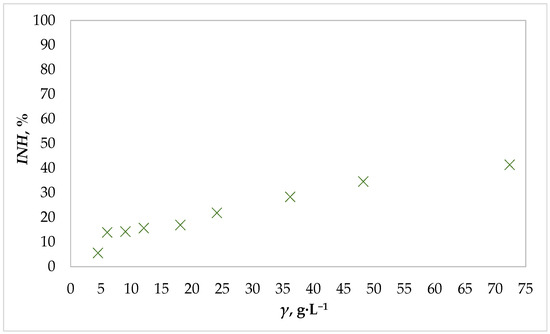
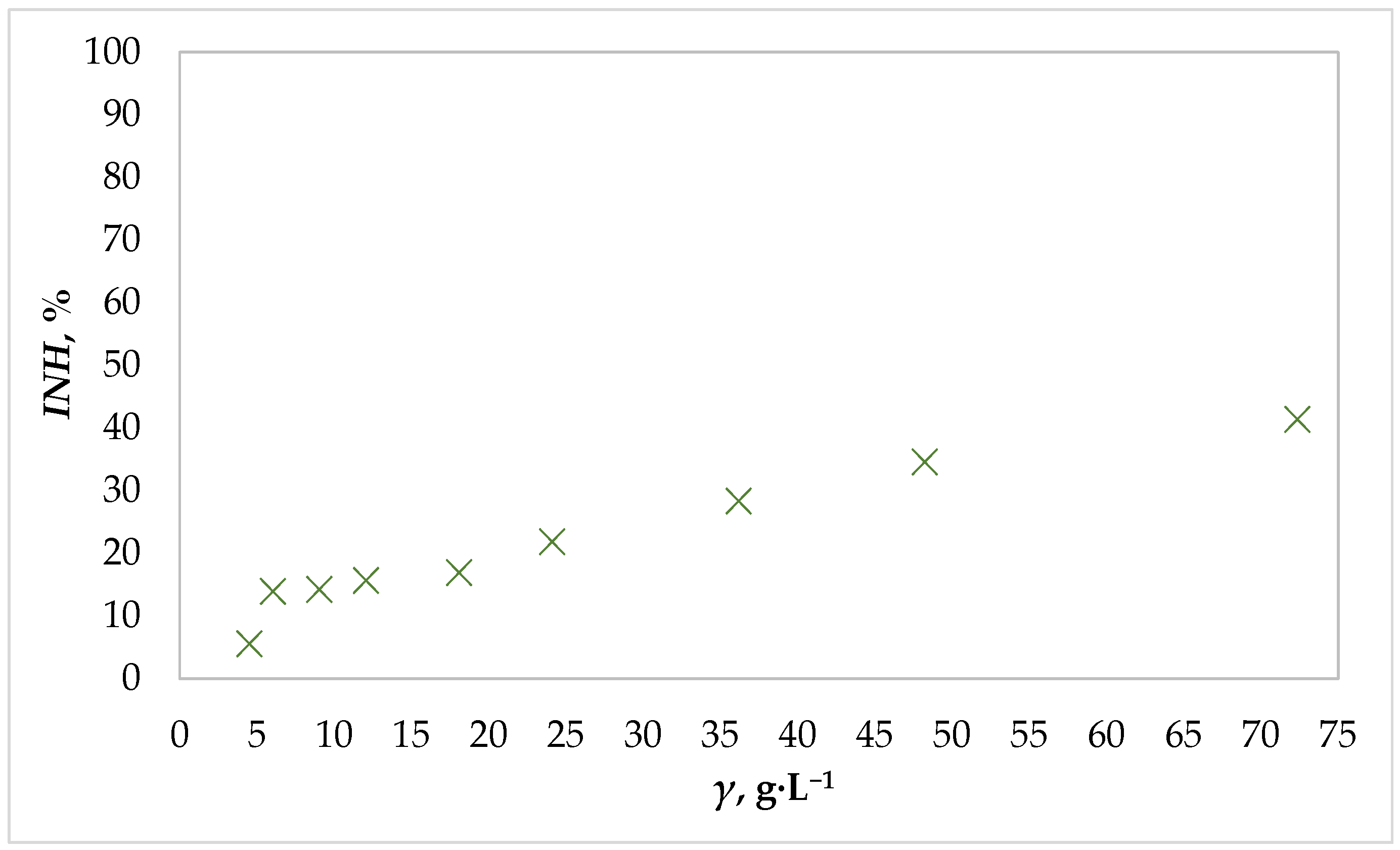
Figure 1 illustrates the concentration-dependent inhibitory effect for the ES Gly-Fru-LA-W 2:1:2:3.4, showing a gradual increase in inhibition with rising concentration of the test substance, consistent with dose–response behavior. These findings align with previous studies indicating that many natural component-based ESs exhibit low or negligible ecotoxicity, particularly those formulated with amino acids, sugars, organic acids, and polyols [49,50]. According to the literature [50,51] choline chloride-based ESs with glycerol or urea showed minimal inhibition towards aquatic microorganisms. Furthermore, Halder et al. [52] emphasized that the toxicity of ESs is highly dependent on the nature of the HBD, with organic acids generally being more toxic than polyols or amino acids. Complementary to this finding, it has also been observed that an increased number of HBDs tends to reduce the overall toxic potential of ESs. In this context, the low inhibition observed for Gne-LA 1:9 containing an amino acid as the HBD aligns with literature reports that associate amino acid–based ESs with improved biocompatibility and reduced ecotoxicity.
Figure 1.
The concentration-dependent inhibitory effect for the ES Gly-Fru-LA-W 2:1:2:3.4.
Taken together, the results of this study support the conclusion that the prepared ESs, particularly those containing amino acids or sugar-based components, exhibit low environmental impact and represent promising candidates for further application in green and sustainable technologies, provided their toxicity remains low across broader biological test systems and environmental matrices.
3.3. Preparation of API-ES
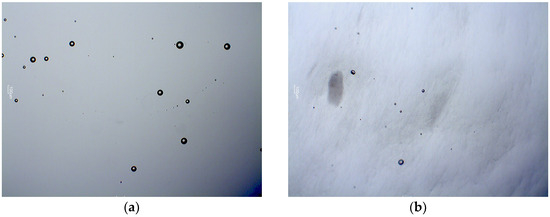
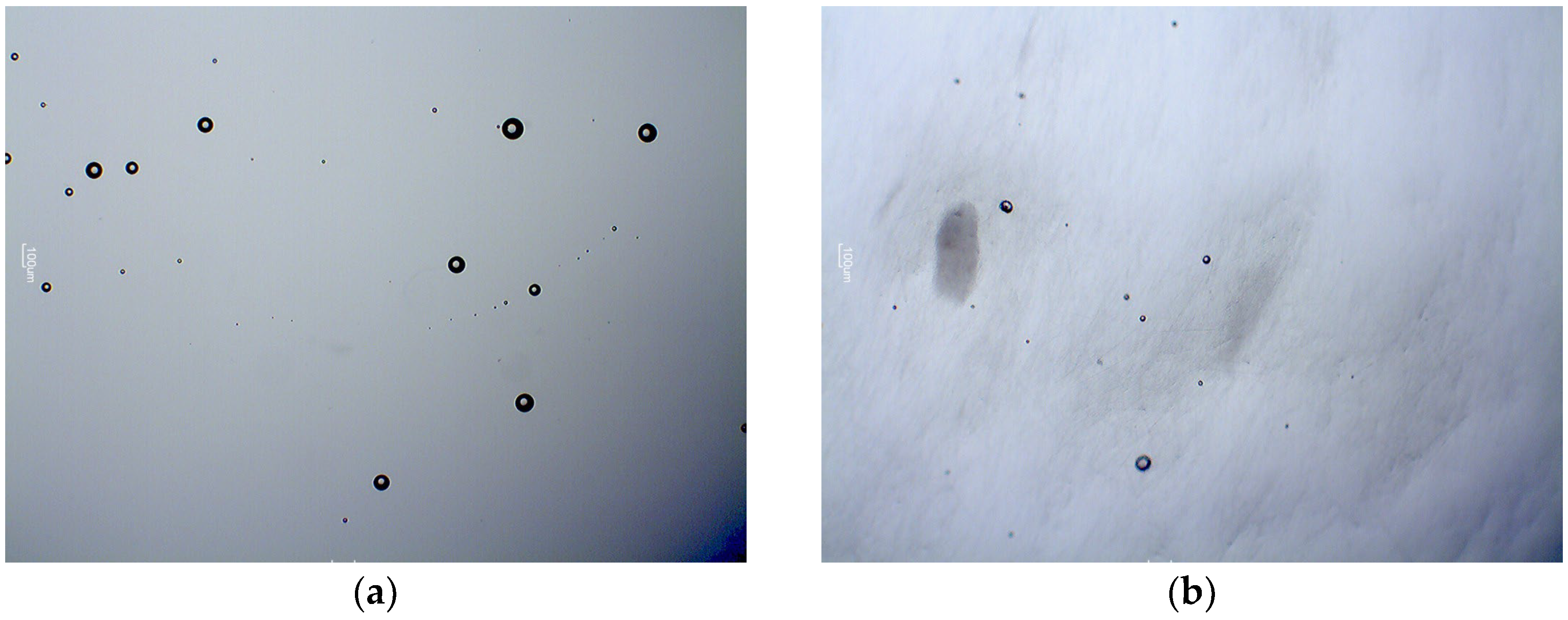
After conducting the ecotoxicity tests, CRT was gradually added to a weighed amount of prepared ES to obtain API-ES systems. These API-ES systems, containing 15 wt.%, remained stable for over six months, as evidenced by micrographs recorded 3 months after preparation (Figure 2). Adding a higher percentage of CRT to ES led to precipitation of CRT. Figure 2 shows micrographs of the prepared Gne-LA 1:9-CRT API-ES system with (a) 15 wt.% CRT, and (b) with 18 wt.% CRT. With the addition of 18 wt.% CRT, crystallization occurred after a certain time at room temperature, forming a paste, as visible in the micrograph (Figure 2b). As the system with 15 wt.% remained stable for a longer period, it was decided that, for further preparation of the API-ES systems, a maximum CRT content of 15 wt.% would be used. This concentration was also sufficient to load a single capsule with an API-ES system quantity that delivers 150 mg of CRT, matching one dose of the commercial dosage form.
Figure 2.
Micrographs of prepared Gne-LA API-ES systems containing (a) 15 or (b) 18 wt.% of CRT at a 40× magnification (recorded 3 months after preparation).
3.4. FTIR and 1H NMR Characterization of ES and API-ES
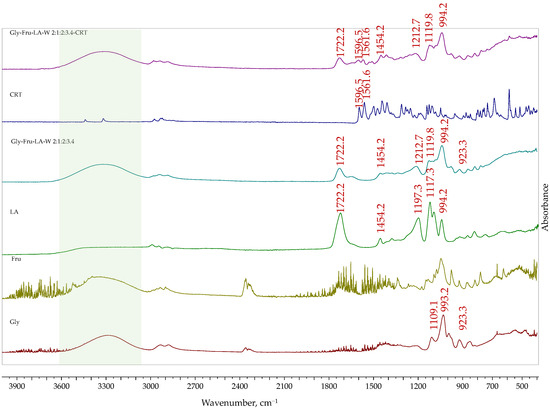
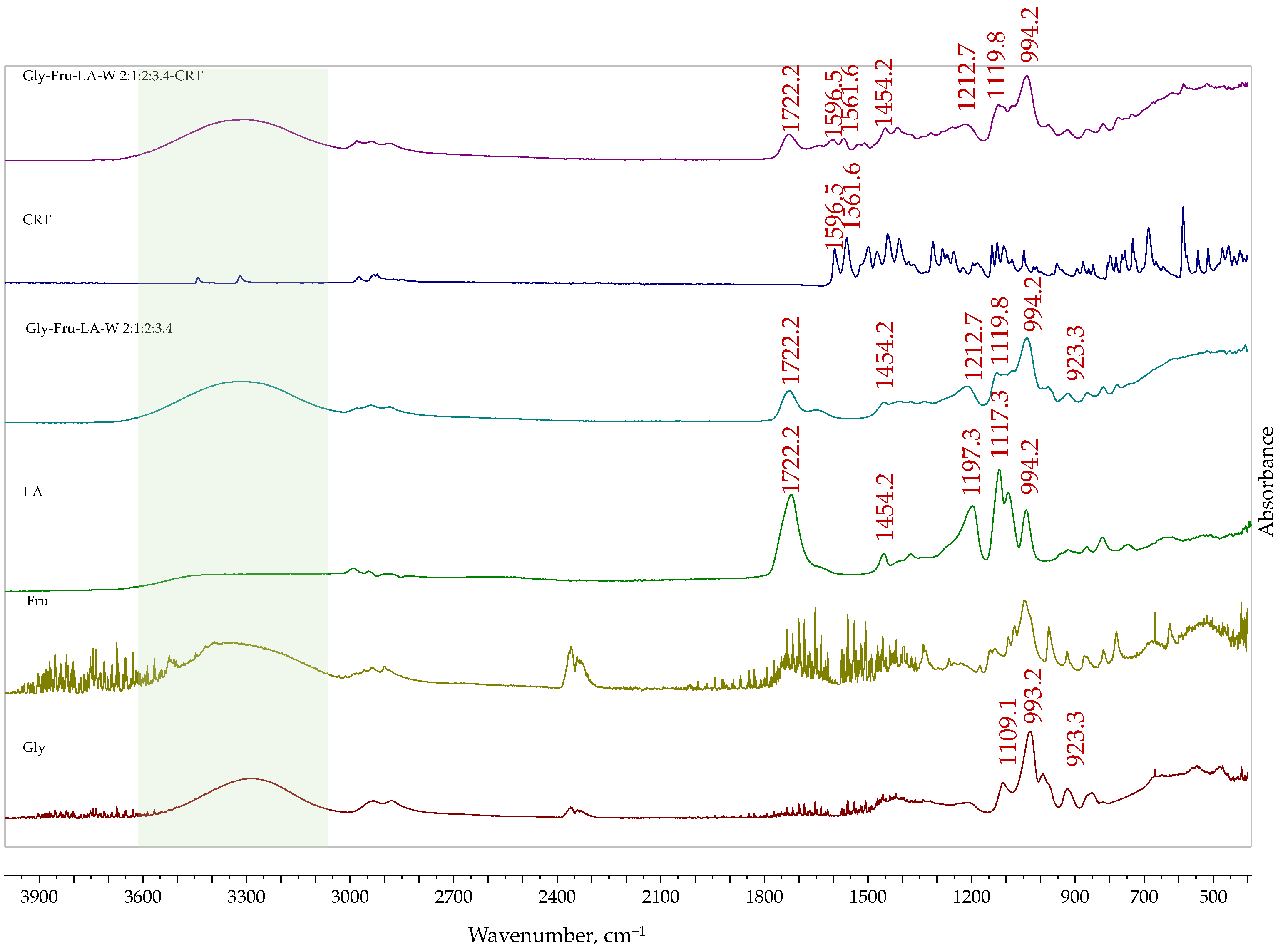
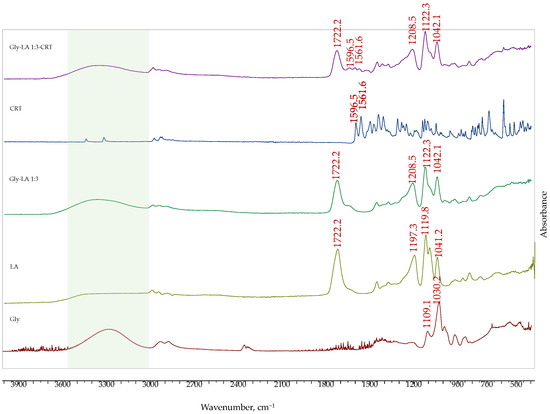
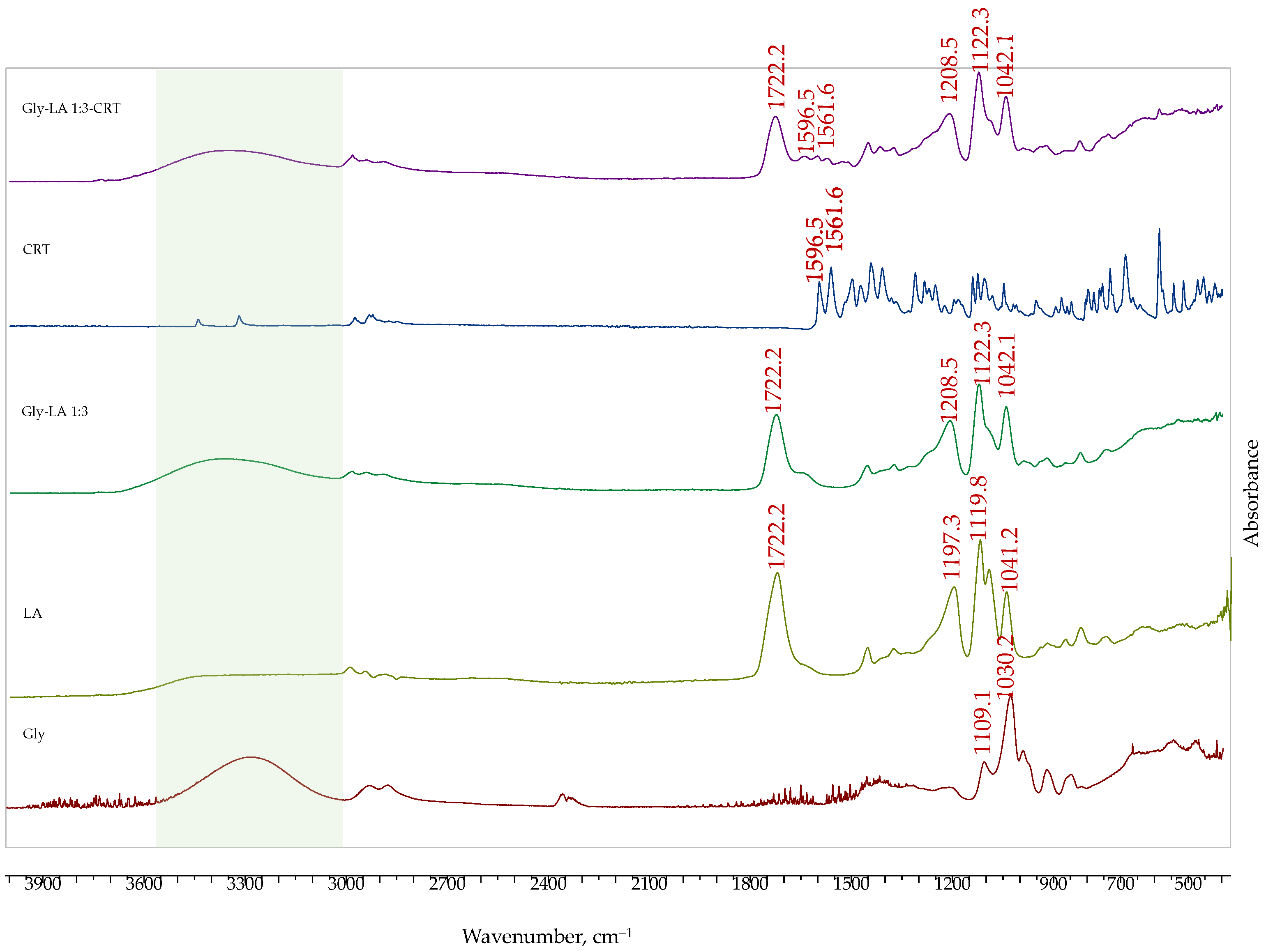
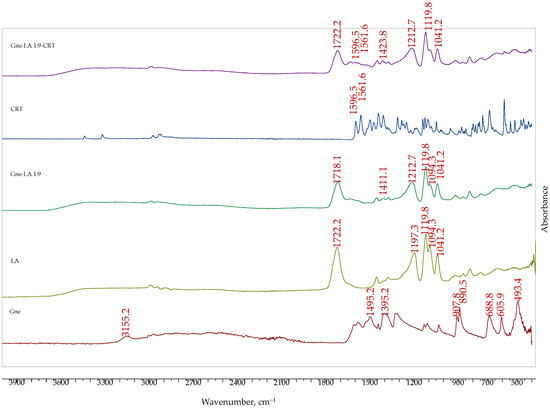
The preparation of three ESs by combining lactic acid with fructose, glycerol and/or glycine was confirmed using FTIR analysis (Figure 3, Figure 4 and Figure 5). Characteristic changes were observed in the FTIR spectra of the ESs, indicating the formation of hydrogen bonds and a stable ES structure. In ESs containing both glycerol and lactic acid (Figure 3 and Figure 4), a shift in the band corresponding to O-H stretching and a visible broadening and lowering of the peak at 3600–3000 cm−1 were observed (marked with blue rectangular). The carbonyl group signal of lactic acid at 1722 cm−1 remains present in all prepared ESs, but the intensity and width of the bands in the -OH stretching region change. This indicates the formation of a strong hydrogen-bond network between glycerol, fructose, and lactic acid. [53]. In the C-O stretching and O-H bending region (below 1500 cm−1), almost all peaks of the individual components were slightly shifted, broadened and/or changed in intensity in ESs. This confirms that a stable structure has formed [54,55].
Figure 3.
FTIR spectra of Gly, Fru, LA, Gly-Fru-LA-W 2:1:2:3.4, CRT and Gly-Fru-LA-W 2:1:2:3.4-CRT.
Figure 4.
FTIR spectra of Gly, LA, Gly-LA 1:3, CRT and Gly-LA 1:3-CRT.
Figure 5.
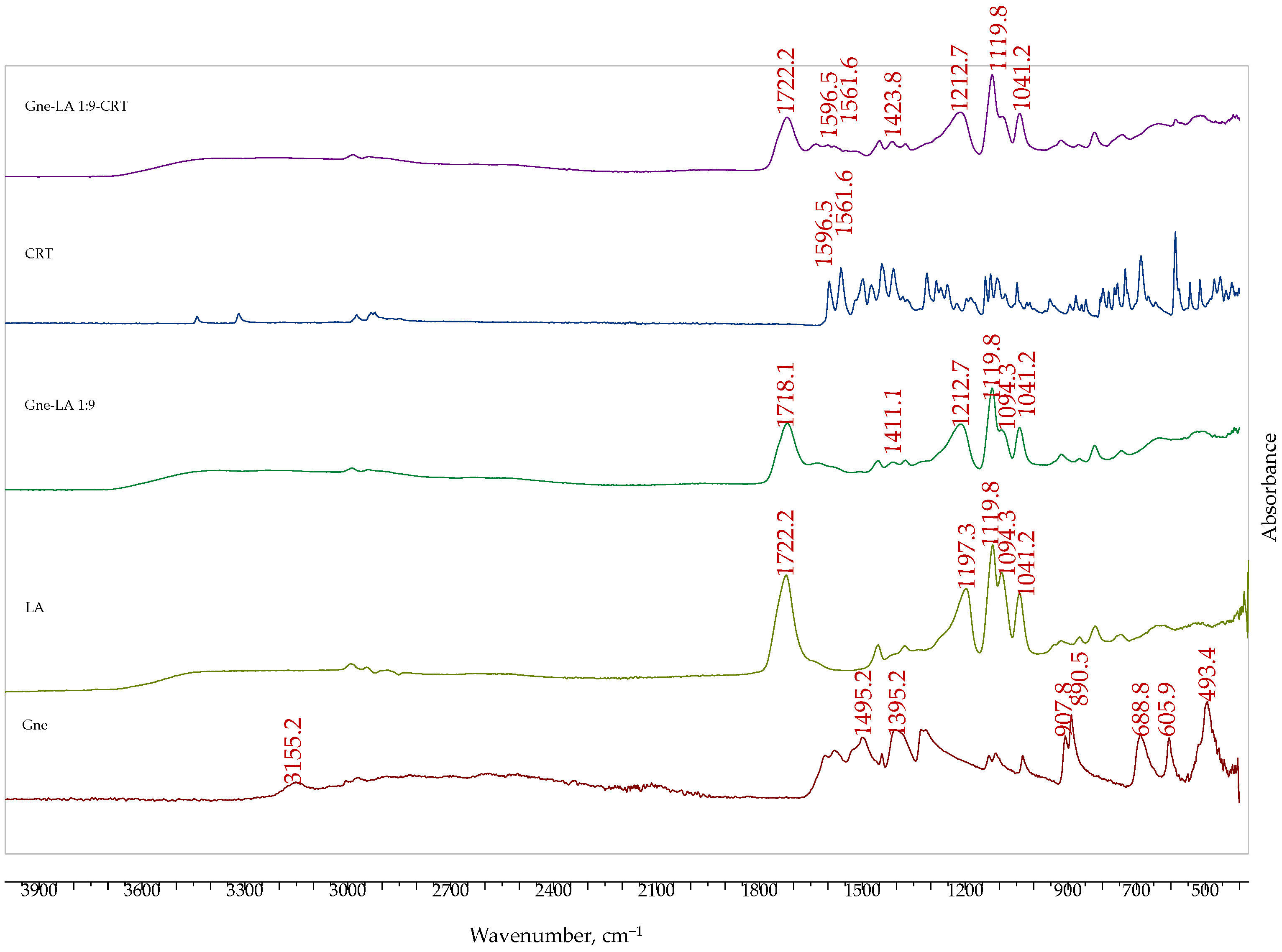
FTIR spectra of Gne, LA, Gne-LA 1:9, CRT and Gne-LA 1:9-CRT.
In the Gne-LA ES (Figure 5), a reorganization of the glycine and lactic acid molecules was observed, as evidenced by changes in the vibrational peaks. Proton transfer from the lactic acid to the amino group of glycine was confirmed, as evidenced by the disappearance/weakening of the glycine peaks at 3155.2 and 1495.2 cm−1. In addition, the reduction in the intensity of the peaks of glycine at 907.8, 890.5, 688.8, 605.9 and 493.4 cm−1 in the ES confirms that glycine is no longer in its pure, crystalline state, but is actively involved in the coordination and interactive network of the ES.
FTIR analysis was performed on all prepared API-ES systems to confirm that adding CRT resulted in dissolution and the formation of new hydrogen bonds, rather than a chemical reaction. The resulting spectra are presented in Figure 3, Figure 4 and Figure 5. The figures compare the spectra of pure components, ES, CRT and the spectrum of the resulting API-ES. In all the attached FTIR spectra of API-ES, changes are minor compared to pure ES. Due to the low concentration of CRT, the peaks are faint and overlap with the ES peaks in the range from 1600 to 1200. Low-intensity peaks are visible at 1596.5 cm−1 and 1561.6 cm−1 [56]. To confirm the dissolution of API in all prepared ESs, the 1H NMR spectra of pure CRT, the prepared solvents, and API-ES were obtained (Figures S1–S3). In the spectrum of pure CRT, sharp signals from aromatic protons characteristic of the CRT structure appear in the 7.0 to 8.5 ppm range, while the aliphatic region (1.0 to 4.5 ppm) shows multiplets corresponding to protons of isopropyl groups and other saturated segments of the molecule. The spectra of the solvents are much simpler and are dominated by signals characteristic of the individual solvent components. Figures S1–S3, which compare the spectra in the API-ES system, show that 15 wt.% of CRT was successfully incorporated into the ES liquid. The CRT signals in the range of 7.0–8.5 ppm remain present, confirming that the API is chemically stable and dissolved in the ES. Small shifts in the CRT signal are noticeable compared to the pure substance. These shifts indicate the formation of intermolecular hydrogen bonds between CRT and the ES components.
3.5. Dissolution Test
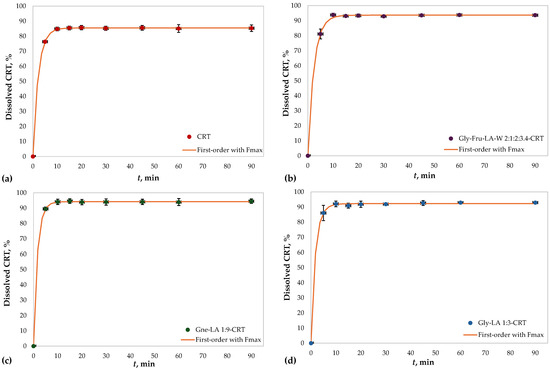
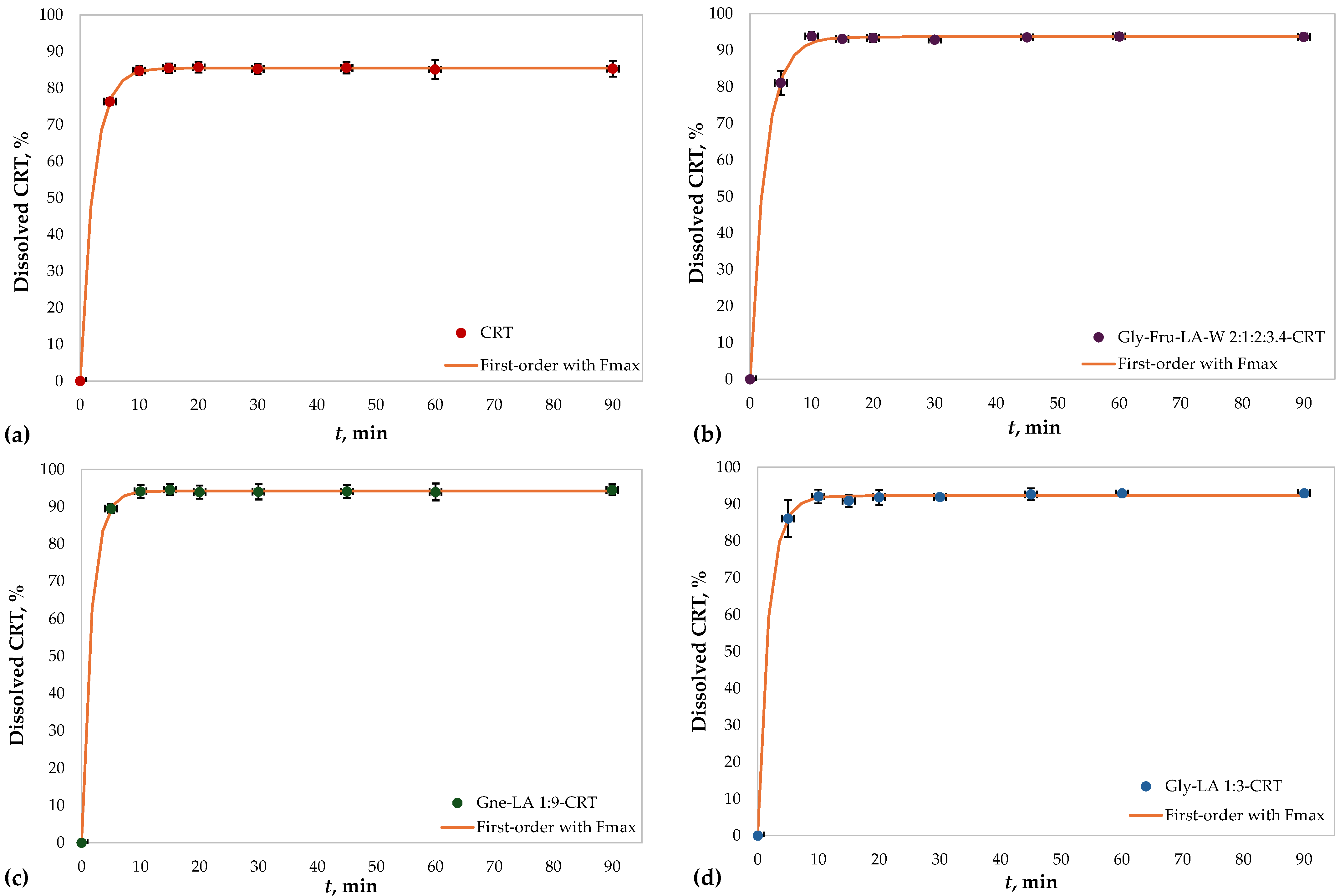
After FTIR and 1H NMR analyses confirmed that no chemical reaction occurred upon the addition of CRT to the prepared ESs, dissolution tests were performed on both pure CRT and the obtained API-ES systems to determine if there would be an improvement in CRT release from these formulations. The resulting release profiles (Figure 6a–d) indicate that while the overall shape of the release curves remained consistent, the CRT release from API-ES systems is higher than that of pure powdered API. The Gne-LA 1:9-CRT system achieved the highest release of CRT compared to the powdered drug with an increase of approximately 8%. Specifically, the CRT powder reached about 85–86% dissolution within 15–20 min (Figure 6a), whereas the Gne-LA 1:9 formulation demonstrated faster dissolution, releasing around 94–95% of the drug within the first 5 min (Figure 6c). This enhancement in the release rate may be the result of the difference in physicochemical properties of the liquid API-ES system versus the powdered API, including the acidity of the API-ES. Despite the desirable increase, the extremely rapid release profile observed with this cytostatic drug formulation is not optimal due to concerns about potential peak toxicity [57]. A suitable formulation (incorporation in biopolymers) for API-ES would probably change the release profile and improve its application [1,58].
Figure 6.
The dissolution profiles of (a) pure CRT, (b) Gly-Fru-LA-W 2:1:2:3.4-CRT, (c) Gne-LA 1:9-CRT and (d) Gly-LA 1:3-CRT with the selected mathematical model.
The obtained release profiles were mathematically described using DDSolver by the First-order with Fmax (Equation (5)) model, whose parameters, SD, RSD and adjusted determination coefficient, R2adj values are shown in Table 5.
Table 5.
Parameters, SD, RSD and R2adj values for the First-order with Fmax model, Equation (5).
The First-order with Fmax model was designed to describe drug release kinetics where the release follows first-order kinetics and does not result in total release, but rather in a maximum release value (Fmax). It is especially useful when experimental data demonstrate that some of the API is not released, such as due to low solubility [59]. The First-order with Fmax model provided a particularly good fit for all tested samples, with the R2adj values above 0.99 (Table 5). In addition, the presence of a plateau in the dissolution profiles indicates that the Fmax value has been reached (Figure 6a–d), which further supports the suitability of this model. Based on its favorable ecotoxicity results, good stability, and highest recorded CRT release, the Gne-LA 1:9-CRT system was chosen for further investigation.
3.6. Determination of Permeability and Diffusion Coefficients
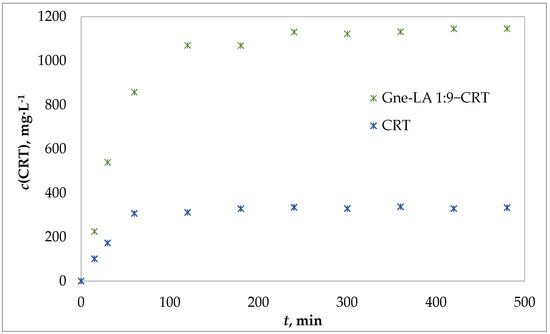
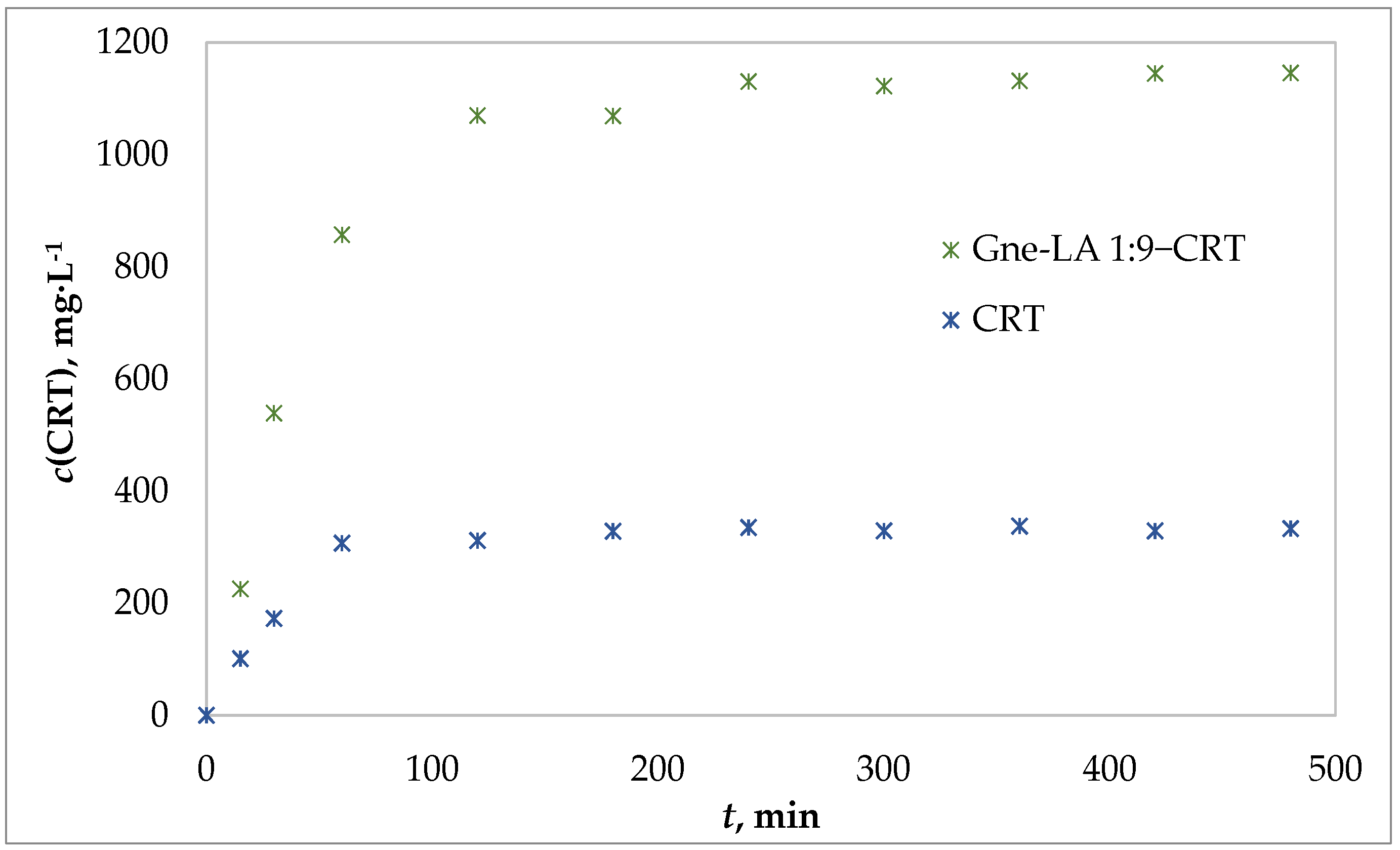
Permeability testing was performed for pure powdered CRT and the selected API-ES system Gne-LA 1:9-CRT containing an equivalent amount of CRT. The concentrations used in these tests (1950 mg∙L−1 in both cells) were higher than those in the dissolution test, as they were determined by the amount of the API–ES system needed to uniformly cover the entire surface of the semipermeable membrane. Figure 7 shows the dissolution profiles in the Franz diffusion cell, expressed as the fraction of dissolved CRT over time. The profiles exhibit an initial linear dependence, followed by a decrease in the dissolution rate in both cases. When comparing the dissolution rates of pure powder and API-ES, it is visible that CRT from the API-ES system dissolves significantly faster and to a greater extent, while the powdered form shows clear solubility limitations. A significant increase in CRT solubility from the API-ES system is observed, with a maximum of approximately 60%, compared to less than 20% for the powdered CRT.
Figure 7.
Change in concentration of CRT in the acceptor part of the Franz cell.
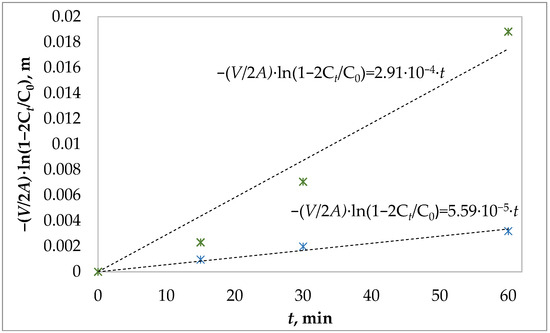
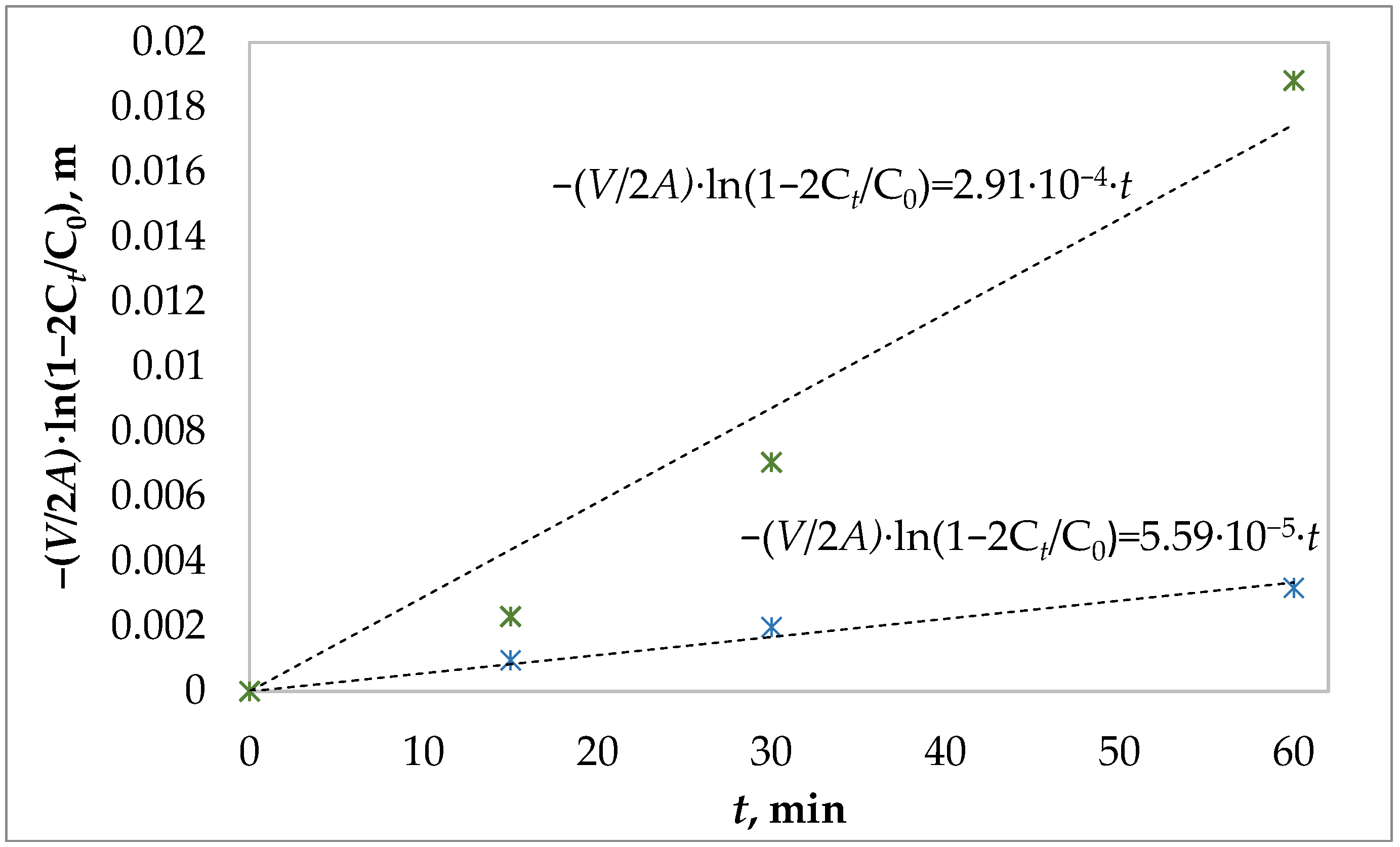
The permeability coefficient was calculated from the slope of the linear part of the release profiles (Figure 8), in which the concentration changes significantly and the process takes place at steady state. The API-ES system showed a significantly higher concentration of released substance than pure CRT, indicating that ES greatly enhances API permeation. This is supported by the permeability coefficient (Table 6) values of 5.59 × 10⁻⁷ cm∙s−1 for powdered CRT and 29.10 × 10⁻⁷ cm∙s−1 for the Gne-LA 1:9-CRT system. This multi-fold increase is likely due to the acidity of the ES and the formulation’s effect on mass transfer. Notably, while permeability increased sharply, the diffusion coefficients remained similar for both systems (Table 6). This suggests that the structural interactions within the API-ES complex do not significantly affect the mobility of the API within the membrane; instead, the improvement results from the much higher equilibrium concentration in the donor chamber compared to the nearly insoluble pure CRT.
Figure 8.
The linear parts of the release profiles with corresponding equations.
Table 6.
Solubility, S, permeability, P, and diffusion coefficients, D, of CRT and Gne-LA 1:9-CRT.
Table 6 also presents the solubility values of the drug dose in 100 mL of water for pure CRT and CRT dissolved in Gne-LA 1:9. A significant change in solubility is observed. For the Gne-LA system, the obtained value significantly exceeds the threshold that defines a highly soluble drug (a single dose dissolves in 250 mL or less of water across a pH range of 1 to 8) [60].
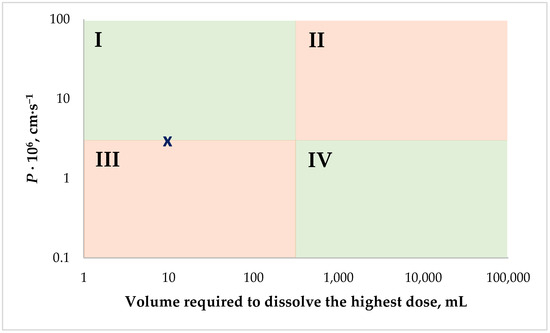
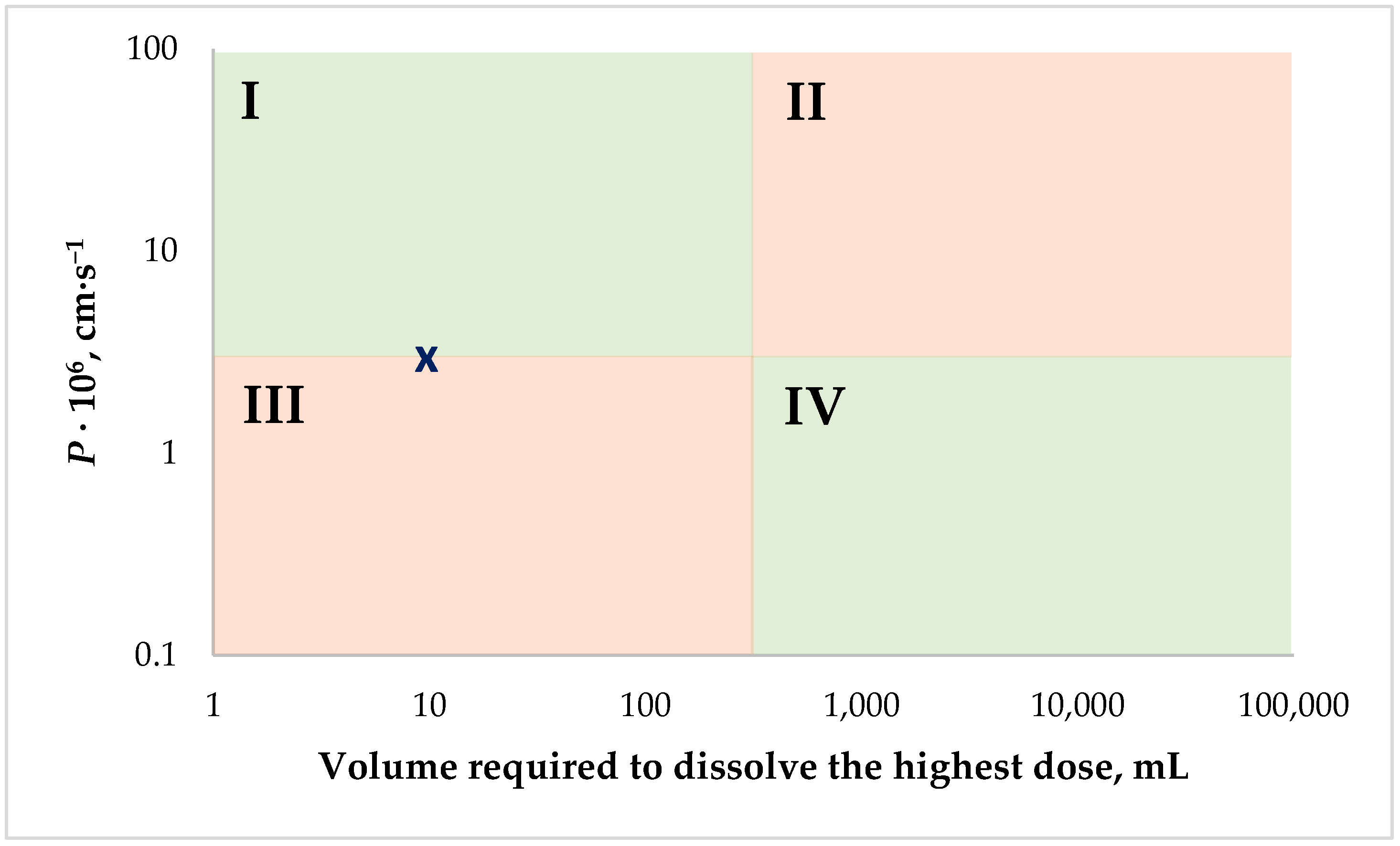
CRT is a BCS class IV compound, characterized by both low solubility in water and low permeability through the intestinal membrane. However, the API-ES formulation modified this profile, resulting in a shift to BCS class III, as clearly depicted by the X in the classification plot (Figure 9). Specifically, the formulation achieves high solubility, moving the drug below the 250 mL volume threshold. Despite its low permeability (Table 6), the high solubility ensures that a sufficient concentration gradient is maintained for passive transport. As a result, the absorption of the drug is now primarily limited by its rate of permeation across the intestinal wall (a class III characteristic).
Figure 9.
BCS classification (classes I–IV) of the Gne-LA 1:9-CRT API-ES formulation.
4. Conclusions
Three different ESs were prepared by combining lactic acid with various non-toxic components such as fructose, glycerol and/or glycine. Their stable formation was confirmed by FTIR analysis, which showed characteristic changes in the vibrational bands indicating the formation of hydrogen bonds and a stable ES structure. Ecotoxicity tests showed low toxicity to Vibrio fischeri, with Gne-LA 1:9 being the most promising solvent, as it showed no inhibition. Preparation of API-ES systems with 15 wt.% CRT was confirmed by FTIR and 1H NMR analysis, indicating successful dissolution and molecular interactions without chemical reaction. The API-ES formulations showed a fast drug release, with a maximum 8% improvement in release compared to pure CRT powder. Permeability studies confirmed a significant increase in the permeability coefficient for CRT from the API-ES system, suggesting improved mass transfer. The efficient solubilization of CRT by ES results in a strong interaction, which is the key mechanism for achieving high solubility of CRT. The Gne-LA 1:9-CRT formulation successfully moved the BCS class IV compound (low solubility and permeability) to BCS class III by achieving high solubility, resulting in absorption now being primarily limited by low permeability.
Overall, these results emphasize that ESs, particularly amino acid-based systems, are promising solutions for the development of novel and more effective formulations for poorly soluble APIs. It is also important to stress that solutions for the formulation of API-ES should be established to adjust the release profile based on the unique drug’s application. As the studied drug formulation is intended for oral administration in humans, further development and application require cytotoxicity studies.
Supplementary Materials
The following supporting information can be downloaded at: https://www.mdpi.com/article/10.3390/cryst16010077/s1, Figure S1: 1H NMR spectra of Gly, Fru, LA, Gly-Fru-LA-W 2:1:2:3.4, CRT and Gly-Fru-LA-W 2:1:2:3.4-CRT; Figure S2: 1H NMR spectra of Gly, LA, Gly-LA 1:3, CRT and Gly-LA 1:3-CRT; Figure S3: 1H NMR FTIR spectra of Gne, LA, Gne-LA 1:9, CRT and Gne-LA 1:9-CRT.
Author Contributions
Conceptualization, J.P.K. and I.Z.; methodology, D.K.G., J.P.K., M.M.N. and I.Z.; validation, J.P.K. and I.Z.; formal analysis, J.P.K., D.K.G., M.M.N. and I.Z.; investigation, V.E., L.K., M.M.N., D.P. and I.Z.; resources, J.P.K. and D.K.G.; writing—original draft preparation, J.P.K., D.K.G. and I.Z.; writing—review and editing, J.P.K. and I.Z.; visualization, V.E., L.K., D.P., J.P.K. and I.Z.; supervision, J.P.K. All authors have read and agreed to the published version of the manuscript.
Funding
This research was conducted within the framework of the project LiBiDES financed by the European Union’s—NextGenerationEU fund from the source 581—The recovery and resilience mechanism in the frame of Programme financing of public higher education institutions and public scientific institutes.
Data Availability Statement
Data available on request.
Acknowledgments
During the preparation of this manuscript, the authors used InstaText to check the grammar of the manuscript and Zotero (version 7.0.30) to generate references. The authors have reviewed and edited the output and take full responsibility for the content of this publication.
Conflicts of Interest
The authors declare no conflicts of interest.
References
- Pedro, S.N.; Freire, M.G.; Freire, C.S.R.; Silvestre, A.J.D. Deep Eutectic Solvents Comprising Active Pharmaceutical Ingredients in the Development of Drug Delivery Systems. Expert Opin. Drug Deliv. 2019, 16, 497–506. [Google Scholar] [CrossRef] [Scilit]
- Kumari, L.; Choudhari, Y.; Patel, P.; Gupta, G.D.; Singh, D.; Rosenholm, J.M.; Bansal, K.K.; Kurmi, B.D. Advancement in Solubilization Approaches: A Step towards Bioavailability Enhancement of Poorly Soluble Drugs. Life 2023, 13, 1099. [Google Scholar] [CrossRef] [Scilit] [PubMed]
- Xie, B.; Liu, Y.; Li, X.; Yang, P.; He, W. Solubilization Techniques Used for Poorly Water-Soluble Drugs. Acta Pharm. Sin. B 2024, 14, 4683–4716. [Google Scholar] [CrossRef] [Scilit] [PubMed]
- Oyoun, F.; Toncheva, A.; Henríquez, L.C.; Grougnet, R.; Laoutid, F.; Mignet, N.; Alhareth, K.; Corvis, Y. Deep Eutectic Solvents: An Eco-friendly Design for Drug Engineering. ChemSusChem 2023, 16, e202300669. [Google Scholar] [CrossRef] [Scilit] [PubMed]
- Hansen, B.B.; Spittle, S.; Chen, B.; Poe, D.; Zhang, Y.; Klein, J.M.; Horton, A.; Adhikari, L.; Zelovich, T.; Doherty, B.W.; et al. Deep Eutectic Solvents: A Review of Fundamentals and Applications. Chem. Rev. 2021, 121, 1232–1285. [Google Scholar] [CrossRef] [Scilit]
- Pedro, S.N.; Freire, C.S.R.; Silvestre, A.J.D.; Freire, M.G. Deep Eutectic Solvents and Pharmaceuticals. Encyclopedia 2021, 1, 942–963. [Google Scholar] [CrossRef] [Scilit]
- Sharma, A.; Lee, B.-S. Toxicity Test Profile for Deep Eutectic Solvents: A Detailed Review and Future Prospects. Chemosphere 2024, 350, 141097. [Google Scholar] [CrossRef] [Scilit]
- Martínez, G.M.; Townley, G.G.; Martínez-Espinosa, R.M. Controversy on the Toxic Nature of Deep Eutectic Solvents and Their Potential Contribution to Environmental Pollution. Heliyon 2022, 8, e12567. [Google Scholar] [CrossRef] [Scilit]
- Sharma, A.; Park, Y.R.; Garg, A.; Lee, B.-S. Deep Eutectic Solvents Enhancing Drug Solubility and Its Delivery. J. Med. Chem. 2024, 67, 14807–14819. [Google Scholar] [CrossRef] [Scilit]
- Aroso, I.M.; Craveiro, R.; Rocha, Â.; Dionísio, M.; Barreiros, S.; Reis, R.L.; Paiva, A.; Duarte, A.R.C. Design of Controlled Release Systems for THEDES—Therapeutic Deep Eutectic Solvents, Using Supercritical Fluid Technology. Int. J. Pharm. 2015, 492, 73–79. [Google Scholar] [CrossRef] [Scilit]
- Pedro, S.N.; Mendes, M.S.M.; Neves, B.M.; Almeida, I.F.; Costa, P.; Correia-Sá, I.; Vilela, C.; Freire, M.G.; Silvestre, A.J.D.; Freire, C.S.R. Deep Eutectic Solvent Formulations and Alginate-Based Hydrogels as a New Partnership for the Transdermal Administration of Anti-Inflammatory Drugs. Pharmaceutics 2022, 14, 827. [Google Scholar] [CrossRef] [Scilit] [PubMed]
- Silva, E.; Oliveira, F.; Silva, J.M.; Matias, A.; Reis, R.L.; Duarte, A.R.C. Optimal Design of THEDES Based on Perillyl Alcohol and Ibuprofen. Pharmaceutics 2020, 12, 1121. [Google Scholar] [CrossRef] [Scilit] [PubMed]
- Martins, M.A.R.; Silva, L.P.; Jorge, P.S.; Abranches, D.O.; Pinho, S.P.; Coutinho, J.A.P. The Role of Ionic vs. Non-Ionic Excipients in APIs-Based Eutectic Systems. Eur. J. Pharm. Sci. 2021, 156, 105583. [Google Scholar] [CrossRef] [Scilit] [PubMed]
- Lv, J.; Ou, X.; Fang, Y.; Wu, M.; Zheng, F.; Shang, L.; Lei, K.; Liu, Y.; Zhao, Y. The Study of Deep Eutectic Solvent Based on Choline Chloride and L-(+)-Tartaric Acid Diethyl Ester for Transdermal Delivery System. AAPS PharmSciTech 2022, 23, 252. [Google Scholar] [CrossRef] [Scilit]
- Hong, S.-H.; Dinh, L.; Abuzar, S.; Lee, E.; Hwang, S.-J. Synthesis of Celecoxib-Eutectic Mixture Particles via Supercritical CO2 Process and Celecoxib Immediate Release Tablet Formulation by Quality by Design Approach. Pharmaceutics 2022, 14, 1549. [Google Scholar] [CrossRef] [Scilit]
- Li, L.; Cai, B.; Li, H.; Wei, J.; Tao, L.; Ma, P. Dermal Effects and Pharmacokinetic Evaluation of the Lidocaine/Prilocaine Cream in Healthy Chinese Volunteers. BMC Pharmacol. Toxicol. 2023, 24, 51. [Google Scholar] [CrossRef] [Scilit]
- Gala, U.; Chuong, M.C.; Varanasi, R.; Chauhan, H. Characterization and Comparison of Lidocaine-Tetracaine and Lidocaine-Camphor Eutectic Mixtures Based on Their Crystallization and Hydrogen-Bonding Abilities. AAPS PharmSciTech 2015, 16, 528–536. [Google Scholar] [CrossRef] [Scilit]
- Saha, M.; Rahman, M.S.; Hossain, M.N.; Raynie, D.E.; Halim, M.A. Molecular and Spectroscopic Insights of a Choline Chloride Based Therapeutic Deep Eutectic Solvent. J. Phys. Chem. A 2020, 124, 4690–4699. [Google Scholar] [CrossRef] [Scilit]
- Aroso, I.M.; Silva, J.C.; Mano, F.; Ferreira, A.S.D.; Dionísio, M.; Sá-Nogueira, I.; Barreiros, S.; Reis, R.L.; Paiva, A.; Duarte, A.R.C. Dissolution Enhancement of Active Pharmaceutical Ingredients by Therapeutic Deep Eutectic Systems. Eur. J. Pharm. Biopharm. 2016, 98, 57–66. [Google Scholar] [CrossRef] [Scilit]
- Kang, J.-H.; Yang, M.-S.; Kwon, T.K.; Kim, D.-W.; Park, C.-W. Inhaled Deep Eutectic Solvent Based-Nanoemulsion of Pirfenidone in Idiopathic Pulmonary Fibrosis. J. Control. Release 2022, 352, 570–585. [Google Scholar] [CrossRef] [Scilit]
- Li, M.; Cui, H.; Cao, Y.; Lin, Y.; Yang, Y.; Gao, M.; Zhang, W.; Wang, C. Deep Eutectic Solvents—Hydrogels for the Topical Management of Rheumatoid Arthritis. J. Control. Release 2023, 354, 664–679. [Google Scholar] [CrossRef] [Scilit] [PubMed]
- Li, S.; Culkin, A.; Jones, D.S.; Andrews, G.P. Development of Polycaprolactone-Based Metronidazole Matrices for Intravaginal Extended Drug Delivery Using a Mechanochemically Prepared Therapeutic Deep Eutectic System. Int. J. Pharm. 2021, 593, 120071. [Google Scholar] [CrossRef] [Scilit] [PubMed]
- Abbott, A.P.; Ahmed, E.I.; Prasad, K.; Qader, I.B.; Ryder, K.S. Liquid Pharmaceuticals Formulation by Eutectic Formation. Fluid Phase Equilibria 2017, 448, 2–8. [Google Scholar] [CrossRef] [Scilit]
- Prlić Kardum, J.; Zokić, I.; Sander, A.; Pelin, P. A Novel Formulation of Fosamprenavir Calcium: Therapeutic Deep Eutectic Solvent with Enhanced Properties. Crystals 2025, 15, 350. [Google Scholar] [CrossRef] [Scilit]
- Huang, C.; Chen, X.; Wei, C.; Wang, H.; Gao, H. Deep Eutectic Solvents as Active Pharmaceutical Ingredient Delivery Systems in the Treatment of Metabolic Related Diseases. Front. Pharmacol. 2021, 12, 794939. [Google Scholar] [CrossRef] [Scilit]
- Palmelund, H.; Andersson, M.P.; Asgreen, C.J.; Boyd, B.J.; Rantanen, J.; Löbmann, K. Tailor-Made Solvents for Pharmaceutical Use? Experimental and Computational Approach for Determining Solubility in Deep Eutectic Solvents (DES). Int. J. Pharm. X 2019, 1, 100034. [Google Scholar] [CrossRef] [Scilit]
- Mokhtarpour, M.; Shekaari, H.; Zafarani-Moattar, M.T.; Golgoun, S. Solubility and Solvation Behavior of Some Drugs in Choline Based Deep Eutectic Solvents at Different Temperatures. J. Mol. Liq. 2020, 297, 111799. [Google Scholar] [CrossRef] [Scilit]
- Olivares, B.; Martínez, F.; Rivas, L.; Calderón, C.; Munita, J.M.; Campodonico, P.R. A Natural Deep Eutectic Solvent Formulated to Stabilize β-Lactam Antibiotics. Sci. Rep. 2018, 8, 14900. [Google Scholar] [CrossRef] [Scilit]
- Zainal-Abidin, M.H.; Hayyan, M.; Ngoh, G.C.; Wong, W.F. Doxorubicin Loading on Functional Graphene as a Promising Nanocarrier Using Ternary Deep Eutectic Solvent Systems. ACS Omega 2020, 5, 1656–1668. [Google Scholar] [CrossRef] [Scilit]
- Lu, C.; Cao, J.; Wang, N.; Su, E. Significantly Improving the Solubility of Non-Steroidal Anti-Inflammatory Drugs in Deep Eutectic Solvents for Potential Non-Aqueous Liquid Administration. Med. Chem. Commun. 2016, 7, 955–959. [Google Scholar] [CrossRef] [Scilit]
- Phaechamud, T.; Tuntarawongsa, S.; Charoensuksai, P. Evaporation Behavior and Characterization of Eutectic Solvent and Ibuprofen Eutectic Solution. AAPS PharmSciTech 2016, 17, 1213–1220. [Google Scholar] [CrossRef] [Scilit] [PubMed]
- Pandey, V.; Kaundal, R.S.; Pandey, T. Exploring Green Chemistry in Pharmaceutical Crystallization: The Role of Deep Eutectic Solvents in Enhancing Drug Performance and Sustainability. Chem. Afr. 2025, 8, 4111–4126. [Google Scholar] [CrossRef] [Scilit]
- Nica, M.-A.; Anuța, V.; Nicolae, C.A.; Popa, L.; Ghica, M.V.; Cocoș, F.-I.; Dinu-Pîrvu, C.-E. Exploring Deep Eutectic Solvents as Pharmaceutical Excipients: Enhancing the Solubility of Ibuprofen and Mefenamic Acid. Pharmaceuticals 2024, 17, 1316. [Google Scholar] [CrossRef] [Scilit] [PubMed]
- Nasrallah, S.; Alhadid, A.; Minceva, M. Revealing the Solubility Enhancement of Active Pharmaceutical Ingredients through Eutectic Mixtures Formation: A Parameter Study. Cryst. Growth Des. 2024, 24, 6364–6372. [Google Scholar] [CrossRef] [Scilit]
- Huang, X.; Dong, W.; Luo, X.; Xu, L.; Yang, D.; Wang, Y. Low-Melting Mixture Solvents as Novel Solubilizing Agents: Improving Tolvaptan Formulation and Therapeutic Efficacy. J. Mol. Liq. 2024, 414, 126179. [Google Scholar] [CrossRef] [Scilit]
- Singh Raman, A.P.; Jain, P.; Kumar, A.; Singh, P.; Kumari, K.; Bahadur, I.; Mohammad, F.; Kaushik, N.K. Eutectic Mixtures to Enhance the Solubility of Active Pharmaceutical Ingredients: Density Functional Theory and Infrared Spectroscopy Approaches. ChemistrySelect 2023, 8, e202300824. [Google Scholar] [CrossRef] [Scilit]
- Chennuru, R.; Koya, R.T.; Kommavarapu, P.; Narasayya, S.V.; Muthudoss, P.; Vishweshwar, P.; Babu, R.R.C.; Mahapatra, S. In Situ Metastable Form: A Route for the Generation of Hydrate and Anhydrous Forms of Ceritinib. Cryst. Growth Des. 2017, 17, 6341–6352. [Google Scholar] [CrossRef] [Scilit]
- Markovic, M.; Zur, M.; Ragatsky, I.; Cvijić, S.; Dahan, A. BCS Class IV Oral Drugs and Absorption Windows: Regional-Dependent Intestinal Permeability of Furosemide. Pharmaceutics 2020, 12, 1175. [Google Scholar] [CrossRef] [Scilit]
- Ghadi, R.; Dand, N. BCS Class IV Drugs: Highly Notorious Candidates for Formulation Development. J. Control. Release 2017, 248, 71–95. [Google Scholar] [CrossRef] [Scilit]
- Zokić, I.; Prlić Kardum, J. Crystallization Behavior of Ceritinib: Characterization and Optimization Strategies. ChemEngineering 2023, 7, 84. [Google Scholar] [CrossRef] [Scilit]
- ISO 11348-3:2007/Amd 1:2018; Water Quality—Determination of the Inhibitory Effect of Water Samples on the Light Emission of Vibrio fischeri (Luminescent Bacteria Test)—Part 3: Method Using Freeze-Dried Bacteria—Amendment 1. ISO Publishing: Geneva, Switzerland, 2018.
- Dissolution Methods. Available online: https://www.accessdata.fda.gov/scripts/cder/dissolution/dsp_getallData.cfm (accessed on 18 July 2025).
- Duarte, A.R.C.; Ferreira, A.S.D.; Barreiros, S.; Cabrita, E.; Reis, R.L.; Paiva, A. A Comparison between Pure Active Pharmaceutical Ingredients and Therapeutic Deep Eutectic Solvents: Solubility and Permeability Studies. Eur. J. Pharm. Biopharm. 2017, 114, 296–304. [Google Scholar] [CrossRef] [Scilit] [PubMed]
- Santos, F.; Leitão, P.S.M.I.; Duarte, A.R.C. Properties of Therapeutic Deep Eutectic Solvents of L-Arginine and Ethambutol for Tuberculosis Treatment. Molecules 2018, 24, 55. [Google Scholar] [CrossRef] [Scilit] [PubMed]
- Negi, T.; Kumar, A.; Sharma, S.K.; Rawat, N.; Saini, D.; Sirohi, R.; Prakash, O.; Dubey, A.; Dutta, A.; Shahi, N.C. Deep Eutectic Solvents: Preparation, Properties, and Food Applications. Heliyon 2024, 10, e28784. [Google Scholar] [CrossRef] [Scilit] [PubMed]
- Panić, M.; Radošević, K.; Radojčić Redovniković, I.; Zagajski Kučan, K.; Sander, A.; Halambek, J.; Prlić Kardum, J.; Mitar, A. Physicochemical Properties, Cytotoxicity, and Antioxidative Activity of Natural Deep Eutectic Solvents Containing Organic Acid. Chem. Biochem. Eng. Q. 2019, 33, 1–18. [Google Scholar] [CrossRef] [Scilit]
- Lomba, L.; Werner, Á.; Giner, B.; Lafuente, C. Deep Eutectic Solvents Formed by Glycerol and Xylitol, Fructose and Sorbitol: Effect of the Different Sugars in Their Physicochemical Properties. Molecules 2023, 28, 6023. [Google Scholar] [CrossRef] [Scilit]
- De, B.J.; Hansen, B.G.; Johansson, S.; Luotamo, M.; Munn, S.J.; Musset, C.; Olsen, S.I.; Olsson, H.; Paya-Perez, A.B.; Pedersen, F.; et al. Technical Guidance Document on Risk Assessment. Part 1. Part 2. Available online: https://publications.jrc.ec.europa.eu/repository/handle/JRC23785 (accessed on 23 December 2025).
- Macário, I.P.E.; Jesus, F.; Pereira, J.L.; Ventura, S.P.M.; Gonçalves, A.M.M.; Coutinho, J.A.P.; Gonçalves, F.J.M. Unraveling the Ecotoxicity of Deep Eutectic Solvents Using the Mixture Toxicity Theory. Chemosphere 2018, 212, 890–897. [Google Scholar] [CrossRef] [Scilit]
- De Morais, P.; Gonçalves, F.; Coutinho, J.A.P.; Ventura, S.P.M. Ecotoxicity of Cholinium-Based Deep Eutectic Solvents. ACS Sustain. Chem. Eng. 2015, 3, 3398–3404. [Google Scholar] [CrossRef] [Scilit]
- Radošević, K.; Železnjak, J.; Cvjetko Bubalo, M.; Radojčić Redovniković, I.; Slivac, I.; Gaurina Srček, V. Comparative in Vitro Study of Cholinium-Based Ionic Liquids and Deep Eutectic Solvents toward Fish Cell Line. Ecotoxicol. Environ. Saf. 2016, 131, 30–36. [Google Scholar] [CrossRef] [Scilit]
- Halder, A.K.; Cordeiro, M.N.D.S. Probing the Environmental Toxicity of Deep Eutectic Solvents and Their Components: An In Silico Modeling Approach. ACS Sustain. Chem. Eng. 2019, 7, 10649–10660. [Google Scholar] [CrossRef] [Scilit]
- Widjaja, T.; Hendrianie, N.; Nurkhamidah, S.; Altway, A.; Yusuf, B.; F, F.; Rohma, A.A.Z.; Pahlevi, A. Poly Lactic Acid Production Using the Ring Opening Polymerization (ROP) Method Using Lewis Acid Surfactant Combined Iron (Fe) Catalyst (Fe(DS)3). Heliyon 2023, 9, e17985. [Google Scholar] [CrossRef] [Scilit]
- Ghadamgahi, S.M.; Babakhani, A.; Barati Darband, G.; Shalchian, H.; Behmadi, R. Solvometallurgical Properties of Choline Chloride-Based Deep Eutectic Solvents for Copper Extraction from Chalcopyrite: Optimization and Analysis. Mining 2025, 5, 8. [Google Scholar] [CrossRef] [Scilit]
- Shurvell, H.F. Spectra–Structure Correlations in the Mid- and Far-Infrared. In Handbook of Vibrational Spectroscopy; Chalmers, J.M., Griffiths, P.R., Eds.; Wiley: Hoboken, NJ, USA, 2001; ISBN 978-0-471-98847-2. [Google Scholar]
- Janakiraman, K.; Madhav, K.V.; Chaitanya Padavala, S.K.; Pamujula, N.H. Enhanced Bioavailability through Quality by Design Optimization of Ceritinib Nanostructured Lipid Carriers: Formulation, Characterization, and Stability Evaluation. J. Appl. Pharm. Sci. 2024, 14, 53–61. [Google Scholar] [CrossRef] [Scilit]
- Pacheco, C.; Baião, A.; Ding, T.; Cui, W.; Sarmento, B. Recent Advances in Long-Acting Drug Delivery Systems for Anticancer Drug. Adv. Drug Deliv. Rev. 2023, 194, 114724. [Google Scholar] [CrossRef] [Scilit]
- Rajeshwari, S.R. Formulation Approaches for Deep Eutectic Solvents Solubilized APIs. J. Res. Appl. Sci. Biotechnol. 2024, 3, 142–162. [Google Scholar] [CrossRef] [Scilit]
- Ojsteršek, T.; Vrečer, F.; Hudovornik, G. Comparative Fitting of Mathematical Models to Carvedilol Release Profiles Obtained from Hypromellose Matrix Tablets. Pharmaceutics 2024, 16, 498. [Google Scholar] [CrossRef] [Scilit]
- Verbeeck, R.K.; Junginger, H.E.; Midha, K.K.; Shah, V.P.; Barends, D.M. Biowaiver Monographs for Immediate Release Solid Oral Dosage Forms Based on Biopharmaceutics Classification System (BCS) Literature Data: Chloroquine Phosphate, Chloroquine Sulfate, and Chloroquine hydrochloride. J. Pharm. Sci. 2005, 94, 1389–1395. [Google Scholar] [CrossRef] [Scilit]

Disclaimer/Publisher’s Note: The statements, opinions and data contained in all publications are solely those of the individual author(s) and contributor(s) and not of MDPI and/or the editor(s). MDPI and/or the editor(s) disclaim responsibility for any injury to people or property resulting from any ideas, methods, instructions or products referred to in the content. |
© 2026 by the authors. Licensee MDPI, Basel, Switzerland. This article is an open access article distributed under the terms and conditions of the Creative Commons Attribution (CC BY) license.