Article

A Fast-Response Vertical-Alignment In-Plane-Switching-Mode Liquid Crystal Display

1
National Engineering Lab for TFT-LCD Materials and Technologies, Department of Electronic Engineering, Shanghai Jiao Tong University, Shanghai 200240, China
2
CSNDC Subsystem Display Tech, Lenovo (Shanghai) Information Technology Co., Ltd., Shanghai 200120, China
*
Authors to whom correspondence should be addressed.
Crystals 2026, 16(1), 76; https://doi.org/10.3390/cryst16010076 (registering DOI)
Submission received: 8 December 2025 / Revised: 19 January 2026 / Accepted: 20 January 2026 / Published: 22 January 2026
(This article belongs to the Collection Liquid Crystals and Their Applications)

Abstract

Fast-response liquid crystal (LC) displays have attracted attention for use as gaming displays with high frame rate and field-sequential displays. This work presents an LC display mode with vertical alignment and horizontal electric field driving, which achieves millisecond-scale response time. The proposed LC display mode may achieve an average grayscale-to-grayscale response time of 1.42 ms using low-rotational-viscosity LC material, optimized device architecture, and overdrive, offering a potential application for gaming displays and color-sequential displays.

1. Introduction

Liquid crystal displays (LCDs) are the preeminent display solutions in the current market, with ubiquitous applications across multifarious sectors. Given the advancements that have been made to improve their contrast ratio, viewing angle, and color accuracy, slow response time is one of the most notable issues for LCD development [1].
For material-based approaches to improve response time, nematic liquid crystals (NLCs) with low rotational viscosity and high dielectric anisotropy could improve response time [2]. However, there is a fundamental trade-off between viscosity, birefringence, and temperature stability [3]. Blue phase liquid crystals (BPLCs) exhibit exceptionally fast response, attributed to their unique isotropic-to-anisotropic electro-optic switching mechanism and alignment-free, self-assembled cubic nanostructures that eliminate slow surface anchoring dynamics [4]. However, BPLCs require high operating voltages due to their Kerr effect-dominated response, and they suffer from noticeable hysteresis in grayscale transitions as well as weak temperature stability [5]. Ferroelectric liquid crystals (FLCs) excel in ultimate switching speed, and their grayscale and stability issues in practical implementation could be solved by the advantages of using controllable anchoring energy, where photoalignment provides FLC samples with uniform alignment and a high contrast ratio [6]. Nevertheless, FLCs also face challenges related to manufacturability, making them difficult to scale up for commercially viable mass production [7].
For device structure and mode innovation, in-plane switching (IPS) mode is renowned for its excellent wide viewing angles and stable color reproduction, yet it typically suffers from relatively low transmittance and a higher operating voltage [8]. The Fringe-Field Switching (FFS) mode, as an evolution of IPS, achieves higher transmittance and better image quality under low-voltage driving by utilizing both horizontal and vertical fringe fields, but it may still face challenges in achieving ultra-fast response times required for high-refresh-rate applications [9]. Meanwhile, the Polymer-Stabilized Vertical Alignment (PS-VA) mode provides superior static contrast ratios and fast response, particularly in terms of the fall time, but the introduction of a polymer network can lead to increased driving voltage and potential long-term reliability concerns [10]. Other structural solutions have also been proposed, such as using alternating (or multi-) rubbing directions to alter the virtual wall pitch length, and hence also alter the response speed and transmission of fast-response LC devices [11]. Some studies have proposed new designs using a three-electrode design while maintaining the fast response speed of these devices [12]. Optically Compensated Bend (OCB) mode is designed in a pre-tilted bend state which allows the LC molecules to switch primarily through a bend deformation and achieves fast response [13]. However, this mode, which is sensitive to cell gap variations, requires a high bias voltage to induce the bend state and temperature-dependent optical compensation films to maintain the contrast ratio, resulting in an increase in the cost [14]. The overdrive technique accelerates switching speed by inputting a time-dependent waveform that initially exceeds the target voltage [15]. Alternative electro-optic modes can be employed to improve the response time, for instance, black insertion [16], blinking backlights [17], double frame rate [18] and motion-compensated inverse filtering [19].
Despite these advancements [20], there remains a persistent demand for an LC mode that can achieve ultra-fast response [21]. To solve these problems, a vertical alignment in-plane switching (V-IPS) mode [22] with low-rotational-viscosity positive LC materials is demonstrated which may achieve a fast response time that is reduced to the 1 ms level, offering potential applications for gaming displays and color-sequential displays.

2. Materials and Methods

The response time of an LC device is fundamentally governed by the electro-optic dynamics of LC molecule reorientation. The interdigitated pixels and common electrodes generate a predominantly horizontal electric field, inducing a torque that rotates the LC directors azimuthally. This specific reorientation mechanism is central to its optical modulation and determines its temporal characteristics. This transient behavior is classically described by a balance of viscous and elastic torques under the influence of an electric field, often approximated by the following simplified equation for the total response time, where γ1 is the rotational viscosity of the LC material, K is the effective elastic constant, and d is the cell gap. According to the physical model of the response time shown in Equation (1), the intrinsic response time is proportional to γ1/K and the square of d. In a real situation, the anchoring energy plays an important role in affecting the LC response time. Within a weak anchoring regime, the LC decay time is inversely proportional to the anchoring energy. For instance, if we can find a polyimide that has a somewhat larger anchoring with the LC material, then the decay time can be improved [23]. Strong anchoring facilitates faster relaxation of the LC device and effectively reduces the decay time, while on the other hand, it may necessitate an increased driving voltage.
τ fall = γ 1 d 2 π 2 K
Due to the relatively small twist elastic constant (K22) of the LC materials, the IPS mode always shows a slower response time compared with the vertical alignment (VA) mode. To improve the response time, the V-IPS mode is proposed, which involves the vertical alignment of positive LC molecules with a horizontal electric field. Owing to its out-of-plane-to-in-plane reorientation mechanism, the V-IPS mode could achieve a fast response time because of the relatively large splay elastic constant, K11, and bend elastic constant, K33. The application of a horizontal electric field could effectively drive the reorientation of positive LC molecules. A schematic cross-section of the V-IPS device architecture is presented in Figure 1.

3. Simulation

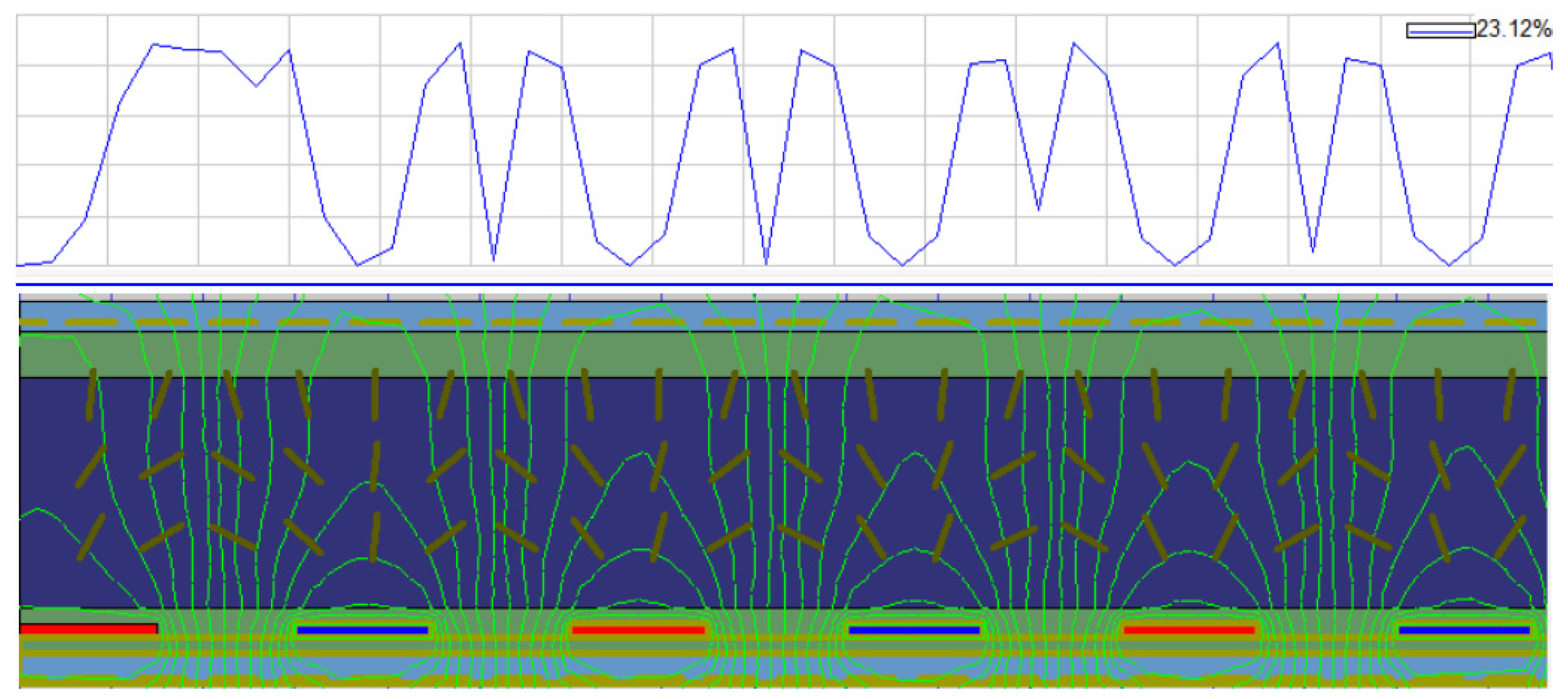
The response time and transmittance of our V-IPS device was simulated with the DIMOS.2D (Version 3.0.0, AUTRONIC-MELCHERS) software. The LC cell comprises the following layers in sequence from top to bottom: glass substrate, Si3N4 passivation layer, vertical alignment layer, LC layer, vertical alignment layer, ITO electrode layer, and glass substrate. Considering the mass production process capability, optical transmittance, and fast response of the device, the cell gap is set as 3 μm, and the width and spacing of the interdigitated electrodes are also set as 3 μm. Homeotropic boundary conditions with a pretilt angle of 88 degrees were applied at both substrates. A schematic cross-section of the V-IPS device architecture and the transmittance curve in simulation is presented in Figure 2, where the pixel electrodes are highlighted in red, and the common electrodes are highlighted in blue. The material parameters of the LC used in the simulation are specified in Table 1.
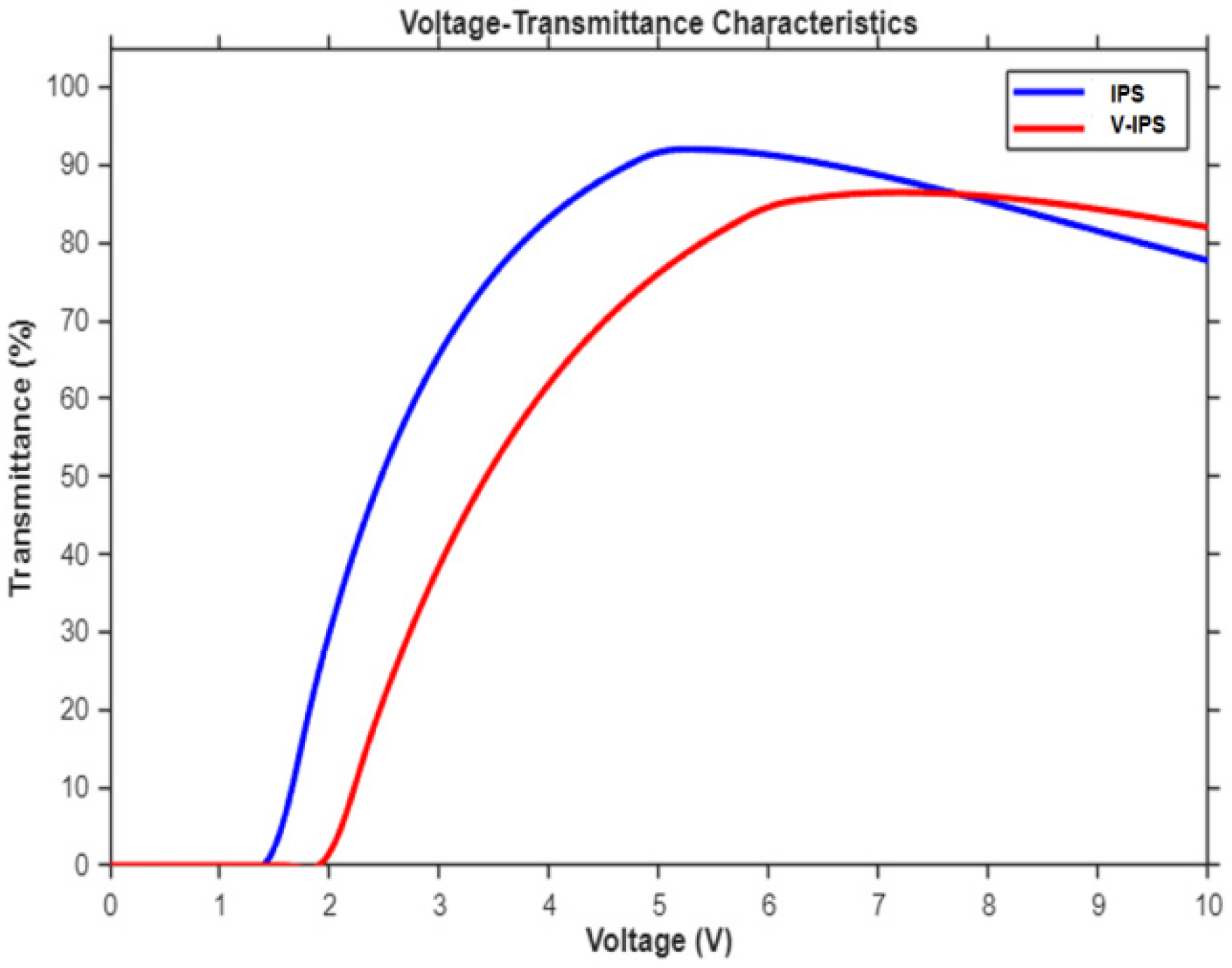
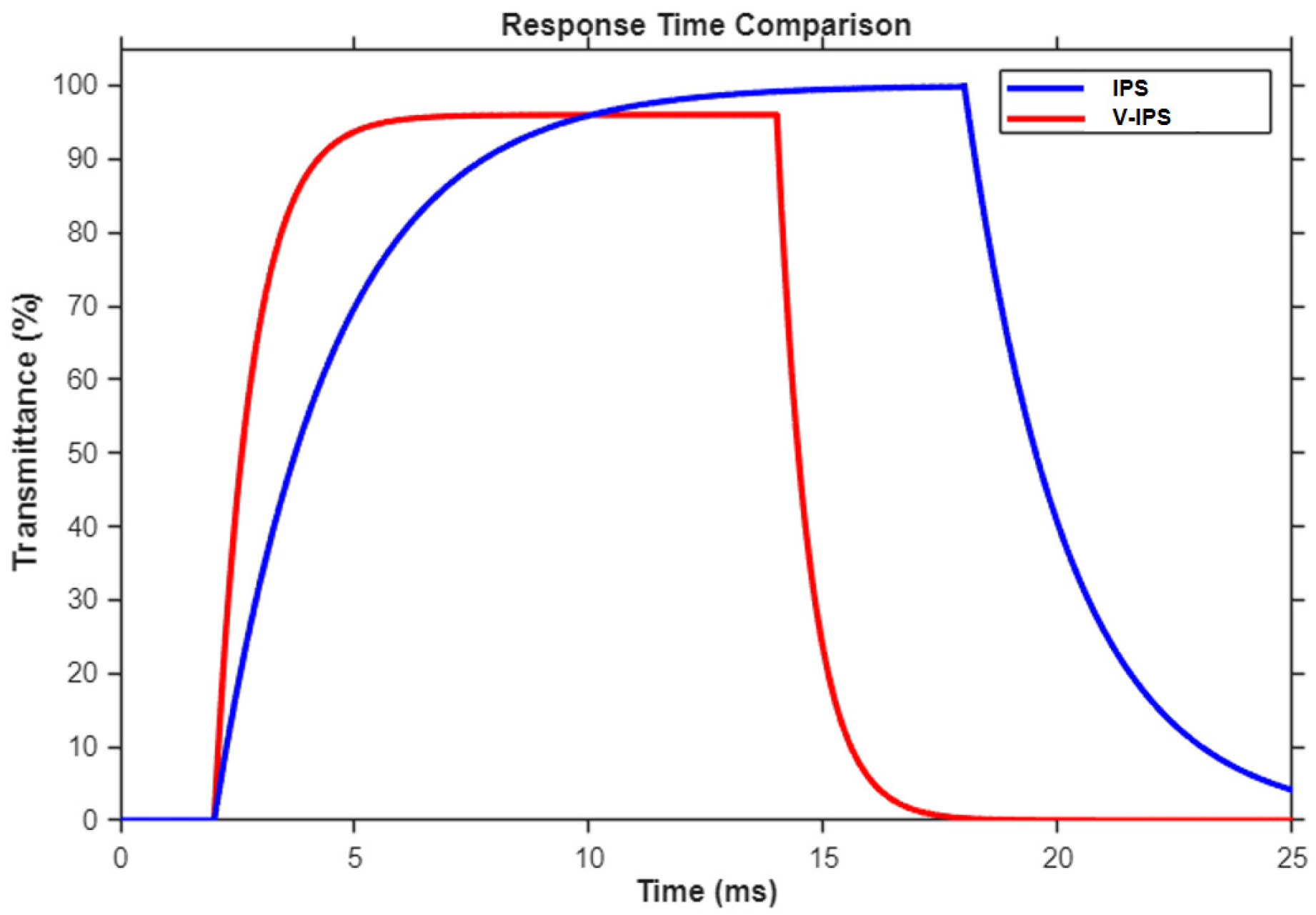
The voltage–transmittance (V-T) curves and response times of the V-IPS and conventional IPS modes were compared using LC devices with equivalent structural parameters. To control variables, the material properties detailed in Table 1 were maintained consistently across the V-IPS and IPS mode devices. Figure 3 depicts the normalized V-T curve of IPS and V-IPS cells with the width and spacing of the interdigitated electrodes of 3 μm. The on-state voltage (Von) of the IPS and V-IPS modes is 5.0 V and 6.2 V, respectively. The relatively high Von of the V-IPS mode can be attributed to the vertical alignment of the LC molecules. According to the V-T curve of the IPS and V-IPS modes, the response waveforms of the switch-on and switch-off processes of the two modes are simulated. As shown in Figure 4, the rising times of the V-IPS and IPS modes are 2.9 ms and 4.1 ms, respectively, and the falling times of the V-IPS and IPS modes are 1.7 ms and 7.8 ms, respectively. It can be seen that both the rising and falling times of the V-IPS mode show much improvement compared with those of the IPS mode. The transmittance of the V-IPS mode is similar to that of the IPS mode with the same structural parameters (22.9% and 23.9%).
To investigate the influence of interelectrode spacing on the transmittance and response time of the V-IPS mode, the electrode spacing was set from 5 μm to 3 μm with the fixed electrode width 3 μm, in accordance with current manufacturing constraints, as shown in Table 2. The simulation results show that the rising time decreased from 5.1 ms to 2.9 ms, and the falling time decreased from 2.4 ms to 1.7 ms, when the spacing of the interdigitated electrodes was decreased from 5 μm to 3 μm. Meanwhile, the transmittance results under different electrode spacings were similar, only decreasing from 23.3% to 22.9%. The simulation results showed that short electrode spacing improved the response time significantly and almost retained the same transmittance. Therefore, the optimized electrode spacing was set as 3 μm with an electrode width of 3 μm.
To investigate the influence of pretilt angles on the response time and transmittance of the V-IPS mode, we simulated results for varying pretilt angles while keeping the device structure and applied voltage constant, as shown in Table 3. The simulation results show that the response time reduced from 3.3 ms to 2.9 ms when the pretilt angle was decreased from 90° to 88°. As the pretilt angle continued to decrease, the response time showed no variation. Meanwhile, the transmittance was similar under different pretilt angles, only decreasing from 22.9% to 22.8%. The simulation results showed that decreasing the pretilt angle improved the response time and almost retained the same transmittance. Therefore, the optimized pretilt angle was set as 88°.

4. Experimental Results and Analysis

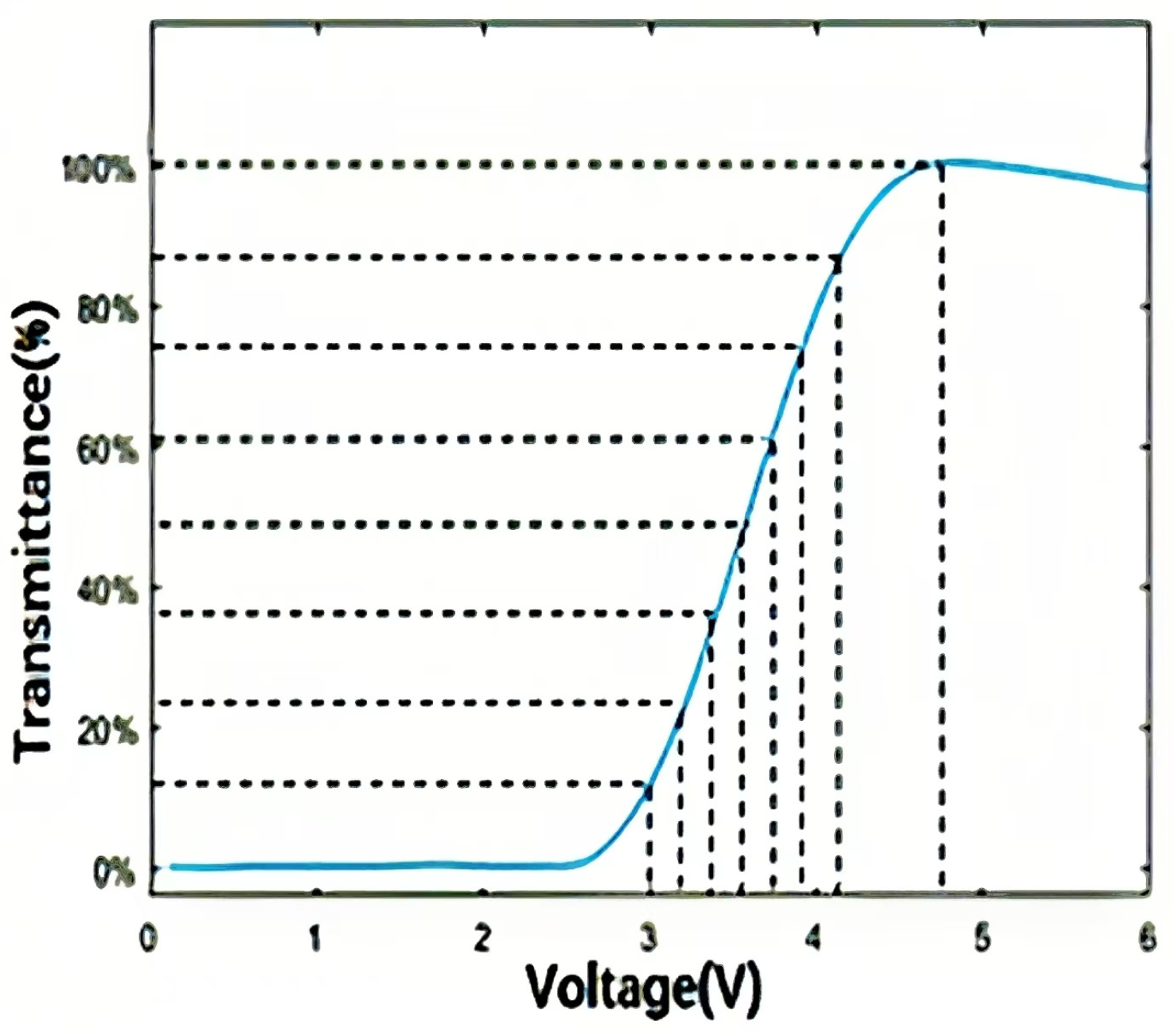
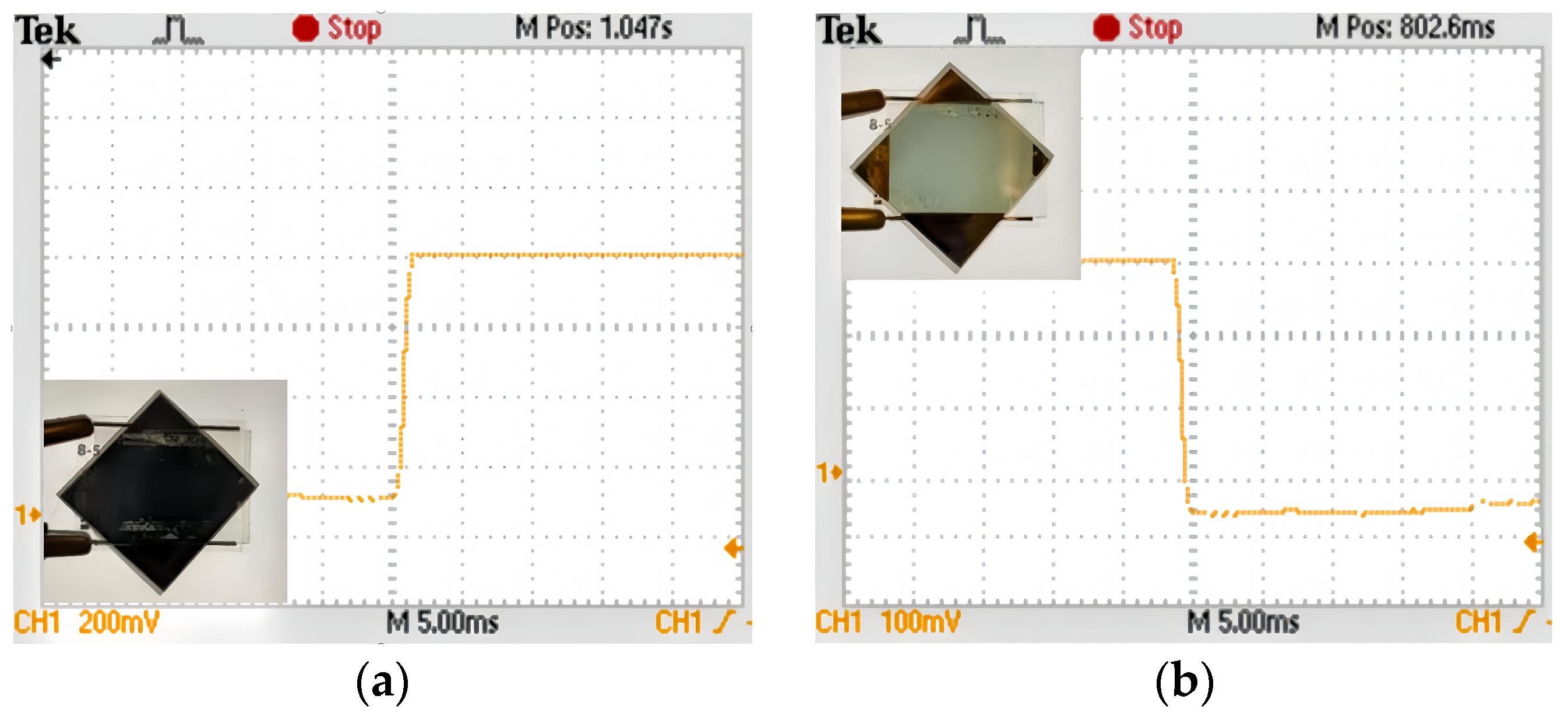
According to the simulation results, V-IPS mode cells with a cell gap of 3 μm, electrode width of 3 μm, and electrode spacing of 3 μm were fabricated. LC material, the physical parameters of which are illustrated in Table 1, was inserted into the cells. Figure 5 depicts the measured normalized V-T curve of the V-IPS cells. Figure 6 shows the measured response time of the V-IPS cells and their on/off states; the rising time is about 1.7 ms and the falling time is about 1.8 ms. A comparison with the simulation results reveals that while the fall time is in close agreement, the rise time demonstrates a more favorable outcome than initially anticipated.
With the aim of comparing the viewing angle of the IPS and V-IPS modes, we measured the relative contrast ratio at ±30° and ±60°, using the on-axis contrast as the 100% reference, as shown in Table 4 and Table 5. The V-IPS mode has a narrower viewing angle than its IPS counterpart, which stems from the constraints imposed by the vertical alignment of the LC molecules.
Grayscale-to-grayscale (GTG) response time quantifies the switching speed between any two intermediate gray levels, which provides a more accurate characterization of the visual presentation quality. It is defined as the mean transition time between the specified initial and final gray levels. A total of 255 grayscale levels were divided into nine segments for GTG response time measurement in order to avoid excessive measurement volume resulting from overly fine partitioning. The corresponding measured voltages of grayscale are presented in Table 6.
t a v g = t 0 31 + t 31 0 + t 0 63 + t 63 0 + + t 223 255 + t 255 223 72
The measurement results of GTG response time between different grayscale levels are presented in Table 7, with the average GTG response time numerator being the sum of these values. The average GTG response time was 2.37 ms. The average GTG rising time is 2.96 ms, whereas the average GTG falling time is only 1.84 ms. With an increase in the difference between the starting and ending voltages, the rising time increased and then decreased. This phenomenon arises from the distinct effects of voltage on molecular dynamics. In the low-voltage regime, the increase in the steady-state tilt angle outpaces the acceleration of molecular rotation, causing the response time to rise. Conversely, beyond a certain voltage threshold, the rotational acceleration dominates, leading to a net reduction in response time. From the measurement results, we can see that most of the GTG falling time values are less than 2 ms, but the GTG rising time, especially between low gray levels, are relatively slow. Switching on is voltage-driven, but switching off is achieved by a relaxation process. The relatively fast intrinsic response time is a direct consequence of employing the vertically aligned mode together with the LC material whose parameters are listed in Table 1. Therefore, we introduced driving optimization to improve the GTG rising time.
Overdrive is an effective technique for optimizing the rising edge response time of the device, which solves the limitations of materials by manipulating the driving waveform. Based on the varying response time in the rising edge region, the magnitude of the overdrive voltage is a critical factor. If the overdrive voltage is too low, the response time can not be decreased significantly, and if the overdrive voltage is too high, a peaking waveform will appear. To improve the GTG rising time effectively, the corresponding overdrive voltage was optimized for every grayscale, as presented in Table 8. For each GTG voltage level, three independent measurements were conducted, and the average value was calculated to mitigate the influence of anomalous data points.
Comparing the measurement results in Table 8 and Table 9, it can be seen that the average GTG rising time is decreased from 2.96 ms to 0.96 ms, and the average GTG response time is decreased from 2.37 ms to 1.42 ms. The overdrive technique improved the GTG response time significantly. Finally the V-IPS-mode cell with an optimized electrode structure achieved a fast response time, GTG 1.42 ms, using low-rotational-viscosity LC materials and the overdrive technique.

5. Conclusions

A vertical-alignment LC device with in-plane electric field driving is demonstrated to achieve a fast response time. With low-rotational-viscosity LC materials, optimized structure, and overdrive technique, the proposed device achieved an average GTG response time of 1.42 ms while maintaining high transmittance, offering a potential application for gaming displays and color-sequential displays.

Author Contributions

Conceptualization, Y.L.; methodology, F.J.; validation, J.W.; formal analysis, F.J.; resources, J.L. and K.C.; data curation, F.J. and K.C.; writing—original draft preparation, F.J.; writing—review and editing, J.L.; supervision, J.L. and W.L.; project administration, Y.L.; funding acquisition, W.L. All authors have read and agreed to the published version of the manuscript.

Funding

This research was funded by the National Key Research and Development Program of China (2023YFB3611500) and the National Natural Science Foundation of China (62175148).

Data Availability Statement

The original contributions presented in this study are included in the article. Further inquiries can be directed to the corresponding authors.

Acknowledgments

We are thankful to the National Engineering Lab for TFT-LCD Materials and Technologies, Department of Electronic Engineering, Shanghai Jiao Tong University, for providing the research facilities.

Conflicts of Interest

Authors Yi Li, Jing Wang, Kefeng Chen and Wei Li were employed by the company Lenovo (Shanghai) Information Technology Co., Ltd. The authors declare no conflicts of interest.

Abbreviations

The following abbreviations are used in this manuscript:
LCLiquid Crystal
LCDsLiquid Crystal Displays
NLCsNematic Liquid Crystals
OCBOptically Compensated Bend
BPLCsBlue Phase Liquid Crystals
FLCs Ferroelectric Liquid Crystals
V-IPSVertical-alignment In-Plane Switching
IPSIn-Plane Switching
VAVertical Alignment
GTGGrayscale-To-Grayscale

References

  1. Jo, S.I.; Yoon, S.-S.; Park, S.R.; Lee, J.-H.; Jun, M.-C.; Kang, I.-B. 44-2: Invited Paper: Fast Response Time Advanced High Performance In-plane Switching (AH-IPS) Mode for High Resolution Application. SID Symp. Dig. Tech. Pap. 2018, 49, 581–584. [Google Scholar] [CrossRef]
  2. Ge, Z.B.; Rao, L.H.; Gauza, S.; Wu, S.T. High birefringence liquid crystals for fast switching applications. J. Disp. Technol. 2009, 5, 250–256. [Google Scholar] [CrossRef]
  3. Pai, C.-H.; Cho, T.-Y.; Tsai, S.-C.; Chiu, C.-Y.; Chen, T.-S.; Lin, H.-C.; Su, J.-J.; Lien, A. Performance analysis of in-plane switching mode with low viscosity mixtures. J. Soc. Inf. Disp. 2010, 18, 960–967. [Google Scholar] [CrossRef]
  4. Ge, Z.; Gauza, S.; Jiao, M.; Xianyu, H.; Wu, S.-T. Electro-optics of polymer-stabilized blue phase liquid crystal displays. Appl. Phys. Lett. 2009, 94, 101104. [Google Scholar] [CrossRef]
  5. Cui, Y.F.; Wang, H.; He, W.L.; Zhang, Y.Q.; Zhang, L.; Yang, Z.; Cao, H.; Wang, D.; Li, Y.Z. Advances in blue-phase liquid crystal network polymers and their applications. Liq. Cryst. Disp. 2022, 37, 2. [Google Scholar]
  6. Guo, Q.; Yan, K.; Chigrinov, V.; Zhao, H.; Tribelsky, M. Ferroelectric Liquid Crystals: Physics and Applications. Crystals 2019, 9, 470. [Google Scholar] [CrossRef]
  7. Kudreyko, A.; Lapanik, V.; Chigrinov, V. Investigation of anchoring effects in ferroelectric liquid crystals. Phys. B Condens. Matter 2025, 717, 417761. [Google Scholar] [CrossRef]
  8. Toshiharu, M.; Shunichi, K. Development of Fast Response IPS mode. In Proceedings of Japanese Liquid Crystal Society Annual Meeting; The Japanese Liquid Crystal Society: Tokyo, Japan, 2021; p. 1CS3. [Google Scholar]
  9. Lee, S.H.; Lee, S.L.; Kim, H.Y. A New Liquid-Crystal Display Operated by a Fringe-Field Switching. Appl. Phys. Lett. 1998, 73, 2881. [Google Scholar]
  10. Chen, F.; Chou, R.; Chuang, S.; Huang, L.; Guo, L.; Li, D. 31-1: Invited Paper: C-PS-VA and SA-VA—Technologies for Next Generation TV LCDs. SID Symp. Dig. Tech. Pap. 2024, 55, 394–397. [Google Scholar] [CrossRef]
  11. Chen, S.R.; Choi, W.K. Fast-Response FFS LC Device with Multi-rubbing Angle for VR Applications. SID Int. Symp. 2024, 55, 2075–2077. [Google Scholar] [CrossRef]
  12. Choi, W.K.; Tseng, B.K.; Tung, C.H. P-172: A New Fast-Response VA-FFS LC Device Using Three-Electrode Design with Improved Transmission for VR Applications. SID Symp. Dig. Tech. Pap. 2025, 56, 2111–2113. [Google Scholar] [CrossRef]
  13. Nakanishi, Y.; Shibasaki, M.; Hanaoka, K.; Inoue, Y.; Tarumi, K.; Bremer, M.; Klasen-Memmer, M.; Greenfield, S.; Harding, R. Liquid Crystal Composition and Display Device. U.S. Patent 7,169,449, 30 January 2007. [Google Scholar]
  14. Miyashita, T.; Uchida, T. Optically Compensated Bend Mode(OCB Mode) with Wide Viewing Angle and Fast Response. Ieice Trans. Electron. 1996, 79, 1076–1082. [Google Scholar]
  15. Scheffer, T.J.; Clifton, B. Active addressing method for high contrast video rate STN displays. Sid92 Symp Dig. 1992, 228–231. [Google Scholar]
  16. Nose, T.; Suzuki, M.; Saski, D.; Imai, M.; Hayama, H. A black stripedriving scheme for displaying motion pictures on LCDs. SID Symp. Dig. Tech Pap. 2001, 32, 994–997. [Google Scholar] [CrossRef]
  17. Liao, L.; Chen, C.; Huang, Y.; Yeh, S. 57.4: Fast MPRT with High Brightness LCD by 120Hz Local Blinking HDR Systems. SID Symp. Dig. Tech. Pap. 2009, 40, 862–865. [Google Scholar] [CrossRef]
  18. Itoh, G.; Mishima, N. Novel frame interpolation method for highimage quality LCDs. J. Inf. Disp. 2004, 5, 1–7. [Google Scholar] [CrossRef]
  19. Klompenhouwer, M.A.; Velthoven, L.J. Motion blur reduction for liquidcrystal displays: Motion compensated inverse filtering. In Visual Communications and Image Processing 2004; SPIE: Bellingham, WA, USA, 2004; Volume 5308. [Google Scholar]
  20. Li, X.; Wang, J.; Wu, L.; Hu, W. Research Progress and Prospect of Ultrafast Response Liquid Crystal Technology. Liq. Cryst. Disp. 2025, 40, 187–200. [Google Scholar] [CrossRef]
  21. Peng, F.; Gou, F.; Chen, H.; Huang, Y.; Wu, S. A submillisecond-response liquid crystal for color sequential projection displays. J. Soc. Inf. Disp. 2016, 24, 241–245. [Google Scholar] [CrossRef]
  22. Lee, S.H.; Kim, H.Y.; Park, I.C.; Rho, B.G.; Park, J.S.; Park, H.S.; Lee, C.H. Rubbing-free, vertically aligned nematic liquid crystal display controlled by in-plane field. Appl. Phys. Lett. 1997, 71, 2851–2853. [Google Scholar]
  23. Nie, X.; Lu, R.; Xianyu, H.; Wu, T.X.; Wu, S.-T. Anchoring energy and cell gap effects on liquid crystal response time. J. Appl. Phys. 2007, 101, 103110. [Google Scholar] [CrossRef]
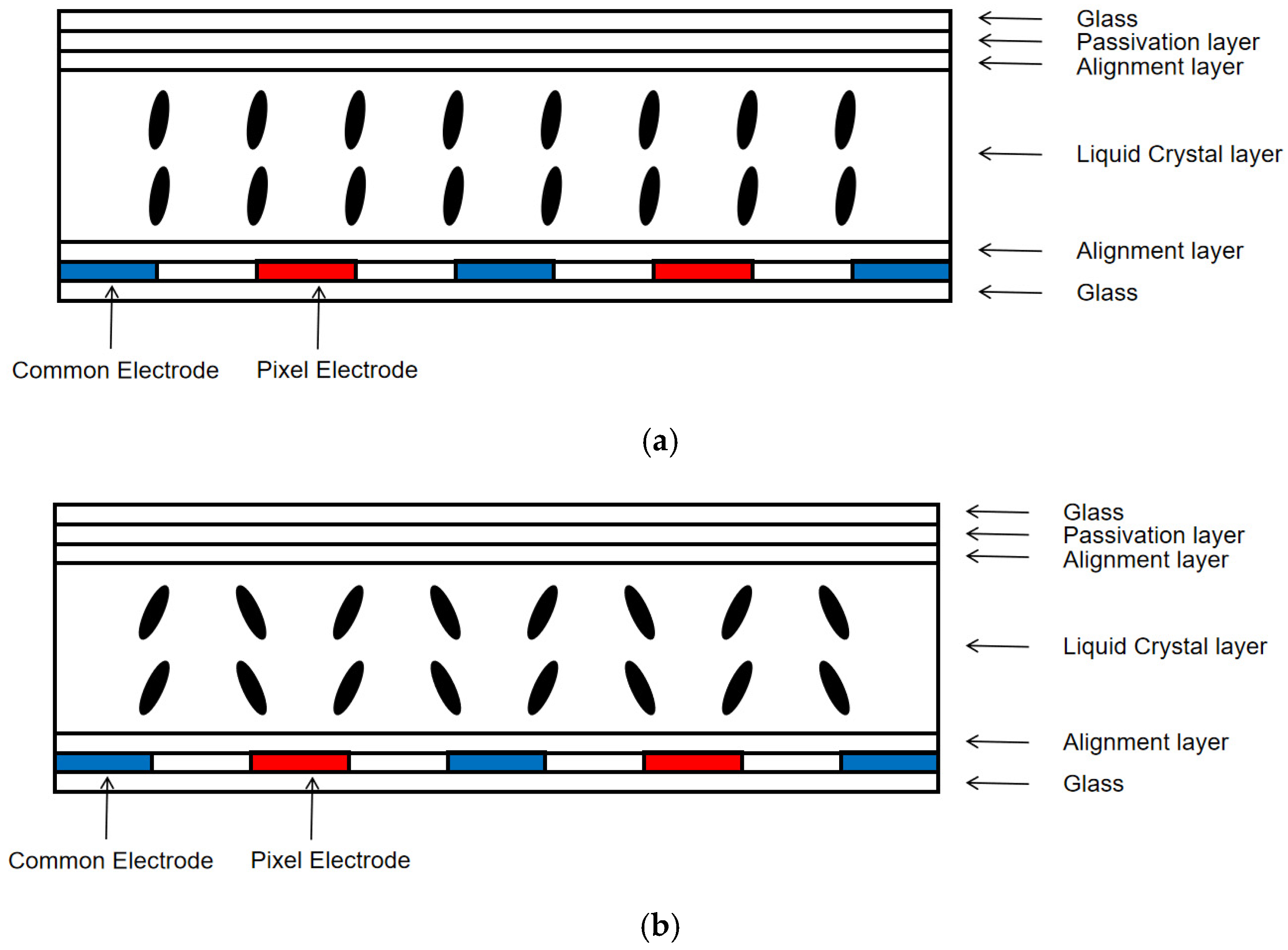
Figure 1. Schematic cross-section of V-IPS mode and the LC orientations: (a) voltage-off state; (b) voltage-on state.
Crystals 16 00076 g001
Figure 2. Electric field distribution and LC molecular orientation state of V-IPS mode.
Crystals 16 00076 g002
Figure 3. Simulated voltage-dependent optical transmittance characteristics.
Crystals 16 00076 g003
Figure 4. Simulated response time curves of IPS and V-IPS mode devices.
Crystals 16 00076 g004
Figure 5. Measurement of grayscale voltage-dependent optical transmittance characteristics.
Crystals 16 00076 g005
Figure 6. (a) Measurement of rising edge response time; (b) measurement of falling edge response time.
Crystals 16 00076 g006
Table 1. DIMOS.2D simulation parameters.
Δn (589 nm, 25 °C)0.142
ne (589 nm, 25 °C)1.640
no (589 nm, 25 °C)1.498
Δε (1 kHz, 25 °C)4.2
ε∥ (1 kHz, 25 °C)7.0
ε⊥ (1 kHz, 25 °C)2.8
K11 (25 °C)13.6
K22 (25 °C)8.2
K33 (25 °C)14.2
γ1 (25 °C)46
Table 2. Impact of electrode spacing variations on the response time and transmittance.
V-IPS
(G = 5 μm)
V-IPS
(G = 4 μm)
V-IPS
(G = 3 μm)
IPS
(G = 3 μm)
Rising time5.1 ms3.9 ms2.9 ms4.1 ms
Falling time2.4 ms2.0 ms1.7 ms7.8 ms
Transmittance23.3%23.1%22.9%23.9%
Table 3. Impact of pretilt angle variations on the response time and transmittance.
Pretilt Angles90°89°88°87°86°85°
Rising time3.3 ms3.0 ms2.9 ms2.9 ms2.9 ms2.9 ms
Falling time1.8 ms1.7 ms1.7 ms1.7 ms1.7 ms1.7 ms
Transmittance22.9%22.9%22.9%22.9%22.8%22.8%
Table 4. Impact of viewing angle of the IPS and V-IPS modes in the horizontal direction.
Viewing Angle+30°+60°−30°−60°
IPS100%≈75%≈30%≈75%≈30%
V-IPS100%≈40%≈10%≈40%≈10%
Table 5. Impact of viewing angle of the IPS and V-IPS modes in the vertical direction.
Viewing Angle+30°+60°−30°−60°
IPS100%≈70%≈20%≈70%≈20%
V-IPS100%≈25%≈10%≈25%≈10%
Table 6. Measurement of grayscale and corresponding voltages.
GrayscaleVoltage (V)
00
311.8
632.3
952.7
1273.1
1593.5
1914
2234.6
2556.2
Table 7. Measurement of GTG response characteristics of the V-IPS cell.
Start Voltage (V)
End voltage (V) 01.82.32.73.13.544.66.2
0N/A1.8 ms2.8 ms1.6 ms1.4 ms1.7 ms1.9 ms1.5 ms1.8 ms
1.83.6 msN/A2.6 ms1.4 ms1.5 ms1.4 ms1.8 ms1.7 ms1.8 ms
2.33.2 ms2.7 msN/A2.3 ms1.9 ms1.1 ms1.4 ms1.6 ms1.7 ms
2.74.5 ms4.2 ms3.8 msN/A2.1 ms1.9 ms1.2 ms1.4 ms2.0 ms
3.14.2 ms4 ms4.2 ms4 msN/A2.6 ms1.8 ms1.3 ms1.9 ms
3.53.3 ms3.8 ms4.1 ms3.3 ms2.2 msN/A1.4 ms1.2 ms2.3 ms
44.1 ms4.2 ms4.2 ms2.5 ms2 ms2.4 msN/A1.8 ms2 ms
4.63.6 ms3.1 ms3.8 ms2.1 ms2.1 ms2.1 ms2.6 msN/A2.1 ms
6.21.7 ms1.8 ms1.9 ms1.6 ms1.4 ms1.9 ms1.6 ms1.2 msN/A
Table 8. Measurement of grayscale and corresponding overdrive voltage.
GrayscaleVoltage (V)Overdrive Voltage (V)
000
311.82.5
632.33
952.73.5
1273.13.5
1593.54
19144.5
2234.65
2556.26.5
Table 9. Measurement of GTG response characteristics of V-IPS cell with overdrive.
Start Voltage (V)
01.82.32.73.13.544.66.2
End voltage (V)0N/A1.8 ms2.8 ms1.6 ms1.4 ms1.7 ms1.9 ms1.5 ms1.8 ms
1.80.9 msN/A2.6 ms1.4 ms1.5 ms1.4 ms1.8 ms1.7 ms1.8 ms
2.30.9 ms0.8 msN/A2.3 ms1.9 ms1.1 ms1.4 ms1.6 ms1.7 ms
2.71 ms1 ms0.8 msN/A2.1 ms1.9 ms1.2 ms1.4 ms2.0 ms
3.11 ms1.1 ms0.9 ms0.6 msN/A2.6 ms1.8 ms1.3 ms1.9 ms
3.51.1 ms1.2 ms0.9 ms0.8 ms0.7 msN/A1.4 ms1.2 ms2.3 ms
41 ms0.9 ms1 ms0.9 ms0.8 ms0.7 msN/A1.8 ms2 ms
4.61.2 ms1.1 ms1.1 ms1.2 ms0.9 ms0.8 ms0.6 msN/A2.1 ms
6.20.9 ms1.3 ms0.8 ms1.2 ms1.2 ms1.5 ms1.6 ms1.2 msN/A
Disclaimer/Publisher’s Note: The statements, opinions and data contained in all publications are solely those of the individual author(s) and contributor(s) and not of MDPI and/or the editor(s). MDPI and/or the editor(s) disclaim responsibility for any injury to people or property resulting from any ideas, methods, instructions or products referred to in the content.