Review

Recovery of Critical Metals from Waste-Printed Circuit Boards for Sustainable Energy Transition

by
Lucian-Cristian Pop
1,2,*,
Szabolcs Szima
2 and
Szabolcs Fogarasi
1,2,*
1
Department of Chemical Engineering, Faculty of Chemistry and Chemical Engineering, Babeş-Bolyai University, 400028 Cluj-Napoca, Romania
2
Interdisciplinary Research Institute on Bio Nano Sciences, Babeş-Bolyai University, 400271 Cluj-Napoca, Romania
*
Authors to whom correspondence should be addressed.
Crystals 2026, 16(1), 67; https://doi.org/10.3390/cryst16010067
Submission received: 24 November 2025 / Revised: 12 January 2026 / Accepted: 15 January 2026 / Published: 20 January 2026
(This article belongs to the Special Issue Exploring New Materials for the Transition to Sustainable Energy)

Abstract

It is undeniable that rapid population increase coupled with growing resource constraints are making the demand for smart and sustainable solutions more urgent than ever to secure future resources for the transition to sustainable energy production. To address these issues, it is necessary to define innovative approaches that can exploit more efficiently and extensively the resources we have at our disposal. Consequently, this paper provides an overview of the potential benefits of processing waste-printed circuit boards (WPCBs) that are generated in large quantities and, due to their high metal content, can emerge as an adequate and profitable supply of critical metals, such as copper, aluminum, and nickel, which are essential for green energy transition. The review promotes the idea of industrial symbiosis as a concept that goes beyond circular economy and can integrate WPCB treatment and manufacturing processes related to sustainable energy transition, although they are different industrial sectors that can be even regionally separated. Major metal recovery processes from WPCBs are examined and discussed, with the primary focus on the performances of copper, aluminum, and nickel production, while additional metals relevant to the energy transition are also highlighted. Finally, the review paper argues and exemplifies that the recovered metals from WPCBs have the required properties to be supplied into the manufacturing processes of wind turbines, solar panels, and lithium-ion batteries.

1. Introduction

The transition to green energy is one of the key steps required to achieve a sustainable green economy which relies on renewable energy sources and efficient energy storage systems [1,2]. Based on various scenarios defined in the literature, predictions indicate a rapid and massive growth in the capacity of clean energy systems [2,3]. Compared to the global output in 2022, by 2050, wind turbines will supply 15 times more energy and solar panels 25 times more, while the storage capacity of batteries will increase by an astonishing 60 times [4,5]. Clearly, all these tendences come with several advantages, like decreasing CO2 emissions by approximately 10 Gt, reducing the population without electricity access by more than 95%, and ensuring energy security [5]. But, at the same time, sustainable energy transition faces some important issues, like the increased demand for specific resources such as copper, aluminum, and nickel, which are more important than cobalt and lithium if several clean energy technologies are considered [4,6,7]. Studies revealed that a wind turbine with a 3 MW capacity contains approximately 4700 kg of copper, 1000 kg of aluminum, and 1000 kg of nickel, while spent lithium-ion batteries contain 170 kg of copper, 80 kg of aluminum, and 70–150 kg of nickel for an average of a 150 kWh capacity [6,8,9,10]. These metals are also important for other industrial sectors, but renewable energy systems (including production, storage, and grid components) can require 50 times more copper and 90 times more aluminum than, for example, fossil fuel combustion-based power plants [11]. As a result, it has been estimated that, between 2022 and 2025, the total copper demand will reach 550–650 Mt, nickel demand will reach 100 Mt, and aluminum demand will reach 950 Mt [4]. The importance of copper is also highlighted by the fact that the amount of copper required for the next 25 years equals the amount which humanity produced in the last 5000 years [4,10]. Still, primary resources are not depleted and can supply all cumulative primary demand until 2050, but estimated reserves are sufficient only for aluminum. In the case of copper and nickel, reserves are insufficient and need to be expanded by 30% and 70%, which means that economically and technically less adequate resources need to be processed, especially after 2030 [12,13]. Unfortunately, the expansion of mining production requires some serios economic efforts, more than USD 300 billion investment for copper and USD 135 billion in the case of nickel until 2040 [12]. In addition, dropping ore quality and rising production cost coupled with more difficult compliance with environmental regulations are the main driving forces for reaching a 30% supply deficit for copper by 2035 [14] and exceeding primary production for nickel by 2030 [15,16].
Considering all these difficulties associated with primary metal supplies, it seems that humanity is caught between two fires while trying to maintain a balance between renewable energy transition and conservation of the biosphere and other valuable and indispensable resources. Giving hope for a sustainable world, recent studies showed that it is possible to sustain an equilibrium between global development and conservation if significant changes are applied to the ways we provide resources [17]. Among the key challenges of modern society for achieving this goal is to view waste and byproducts as a secondary resource. Baum et al. demonstrated that, from the amount of spent lithium-ion batteries accumulated globally in 2019, it is possible to recover 15,000 tons of aluminum, 45,000 tons of copper, 60,000 tons of cobalt, 75,000 tons of lithium, and 90,000 tons of iron [18]. Similarly, the International Energy Agency (IEA), focusing on copper and aluminum recycling from grid infrastructure, estimates that more than 9 Mt primary copper supply and 32.5 Mt of primary aluminum supply could be replaced in 2040 [19]. Summarized data provided by the IEA on recycling potential shows that the demand for the energy transition could be met by secondary supply by 30% in the case of aluminum, 45% for copper, and 48% for nickel. In addition, the recycling of metals is between 50 and 90% more energy-efficient than classical methods involving natural resources, and, together with other advantages, it has generated more than USD 28 billion in 2022 [11,17].
Based on the above discussions, the current review intends to emphasize the importance and beneficial impact of waste recycling on sustainable energy transition, but particularly in the case of WCPBs. According to the literature data, WCPBs account for roughly 6 wt.% of e-waste and contain, on average, 25 wt.% copper, 8 wt.% aluminum, and approximately 3 wt.% nickel, greatly exceeding the content in these metals of mineral resources [20]. Also, WCPBs have the advantage over primary resources in terms of abundance, considering that there is no short supply or threat of depletion, since WPCBs are increasingly generated, reaching more than 80 Mt/year by 2030 [21,22]. While natural resources are unevenly distributed over the globe and their exploration is significantly influenced by politics and policies, WPCBs are present all over the world and every nation has in its reach a concentrated source of metals. Recycling can also reduce the carbon footprint related to clean energy transition by producing critical metals with less than 80% greenhouse gas emissions in comparison to classical processes based on mineral resources [17]. For example, the carbon footprint of Cu production from ores is 7 kgCO2 eq/kg Cu, while in the case of Cu recovery it is reduced to 0.65 kgCO2 eq/kg Cu, which represents a tenfold difference between the two processes [23,24]. The carbon footprint of aluminum production drops from 16 tCO2-eq/tone to 0.5 tCO2-eq/tone if recycling is applied instead of primary production [12]. According to estimates, this approach, combined with production efficiency improvements, would significantly reduce cumulative CO2 emissions to about 16 GtCO2-eq for the period 2022–2050 [4]. However, the biggest gain from recycling WPCBs is not only the recovery of critical metals, but, in many situations, it enables the production of prefabricated products with the required properties to be directly used in energy transition as well. Many of the copper recovery concepts reported in the literature involve electrochemical processes which have the ability to produce copper sheets and even detachable foils [25,26]. Depending on the particularities of the electrochemical recovery processes, the specific energy consumption for copper sheet production from WPCBs is in the range of 5.7–8.4 MJ/kg Cu [27,28], which is more than five times lower than from primary resources [4,29]. What makes these recovery processes even more attractive is the fact that the purity of the obtained copper is more than 99 wt.%, which makes it suitable for electrical applications like current collector in lithium-ion batteries or photovoltaic panels [28]. Other researchers obtained copper nanomaterials by the recycling of WPCBs that are excellent electrocatalysts for hydrogen production, competing with precious metals in the field [30,31]. Studies also highlight the possibility of obtaining nickel-based nanocatalysts for hydrogen evolution reactions utilizing NiSO4 [31,32], as the literature indicates [33,34,35]; nickel-based nanocatalysts also have applications in storage technologies [36,37,38]. Also, different compounds obtained in the recycling of WPCBs can be useful raw materials for clean energy technologies, in particular NiSO4 [39,40,41], which is a key component for the synthesizing of cathode materials for lithium-ion batteries [42,43].
This review aims to perform a comprehensive assessment of the literature to present in more detail and with clear examples the synergies that can arise from the industrial symbiosis of WPCBs recycling and sustainable energy transition. The paper includes two main sections. The first section deals with different recycling technologies defined for the treatment of WPCBs, focusing on the recovery of copper, aluminum, and nickel, while the second section exemplifies how WPCBs recycling could supply the necessary critical metals demand for a sustainable energy transition.

2. Recycling Technologies

Metal recovery from WPCBs has caught significant attention, as these “waste” materials are rich in resources, as they contain several metals of “urban mines”. According to Table 1, metals account for more than 30 wt.% of WPCBs, among which Cu has the highest concentration, followed by Fe, Al, and Ni, but essentially all metals exceed their content in primary mineral resources.
It can also be noticed that WPCBs contain a great deal of Sn and, depending on the model and year of fabrication of PCBs, Sn content can even exceed Ni concentrations. However, in the context of green energy transition, Sn is considerably less critical for industrial application compared to Ni, Cu, and Al; hence, its recovery was not discussed in this review. For the same reason, the discussion was not focused on Fe either, despite its relatively high concentration in WPCBs, as its recovery from WPBCs is not essential given the availability of abundant other alternative sources. It is also important to mention that Sn is present mainly in the from Sn-Pb solder alloy, from which is harder to be separated, and probably this is the reason why its recovery needs to be further studied to be more clearly defined in the literature.
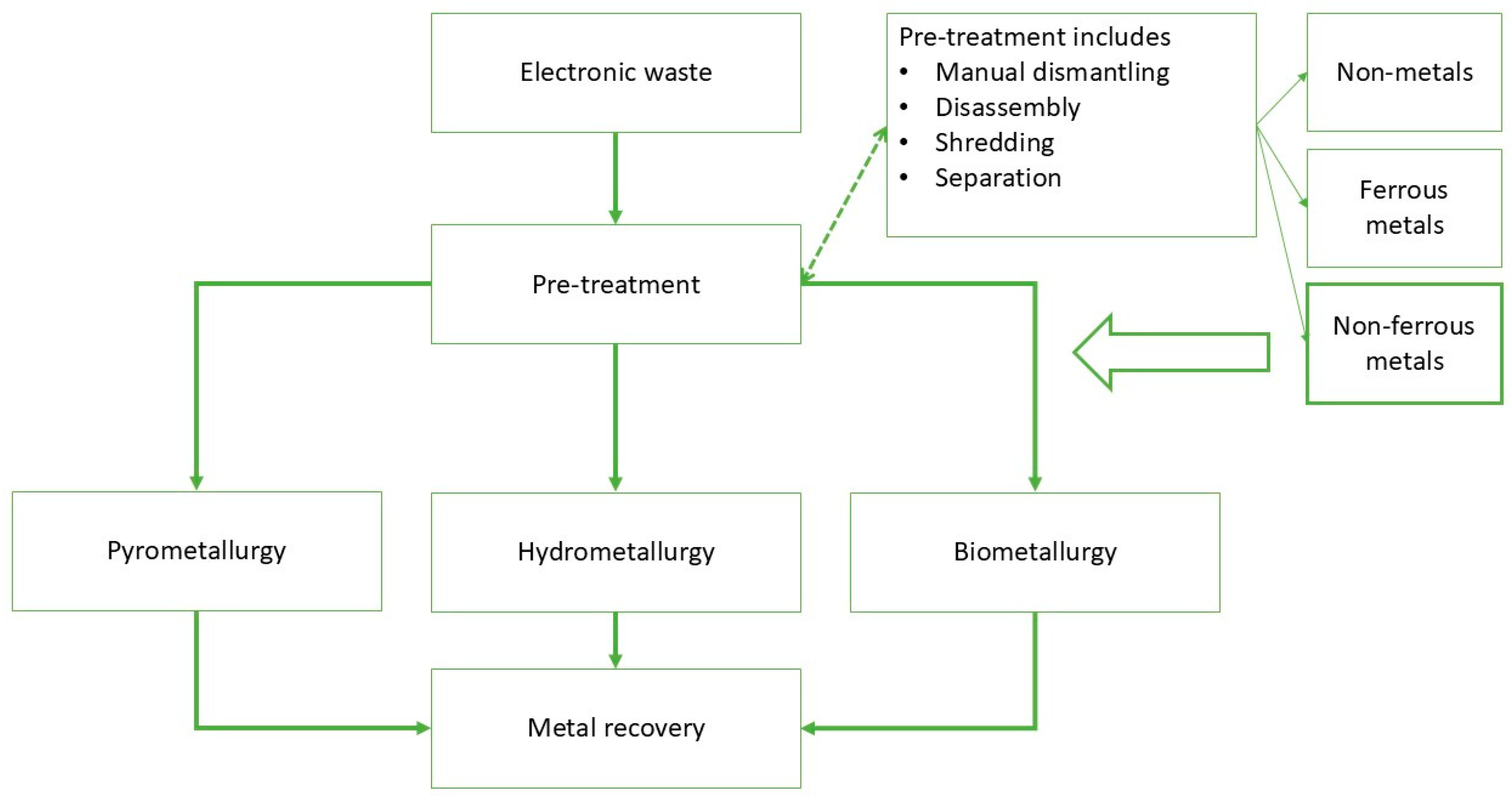
For the recovery of these materials, several separation steps are needed, especially because they can be used in mixtures. Electronic waste initially goes through a pre-treatment process, that includes dismantling (usually performed manually) and disassembly, where the major parts are taken apart and an initial separation is performed, separating metallic and non-metallic components and, more importantly, removing hazardous materials. Next, the waste goes through shredding and another automated separation process, separating non-metals, ferrous metals, and non-ferrous metals. In this chapter, the most widely discussed separation techniques of non-ferrous metals are going to be presented, namely pyrometallurgy, hydrometallurgy, and biometallurgy. The resulting metals from these processes usually need additional purification steps before they can be used again. Figure 1 presents a brief overview of the recovery of ferrous metals, non-ferrous metals, and non-metals from electronic waste.
Aluminum is, in general, separated and recycled through physical separation and does not require metallurgical intervention. Larger aluminum parts of the WPCB, such as aluminum sinks, can be easily removed during disassembly, while smaller components are separated after the shredding of WPCBs by using eddy current separators [45]. The resulting metal can be forwarded to aluminum refiners and remelters [46]. Yoo et al. [47] proved the efficiency of this process by applying the mechanical separation of metallic components from WPCBs. The WPCBs were shredded and milled in a stamp mill and the resulting fractions were separated depending on their grain size. All that was <5 mm was separated using a gravity separator, while the heavy fraction and all that was >5 mm entered a magnetic separator. Using the magnetic separator in two stages (initially 700 Gauss and then 3000 Gaus), iron and nickel was removed from the mixture and aluminum could be separated with high yields.
Annually, about 300 t of critical metals (Pd, Pt, Nb, Ag, and Au) are used in manufacturing electric equipment [48], thanks to their good electric conductivity. Through the process, they are combined with several other metals and non-metallic materials, making their separation a challenge. Thus, a pre-treatment step involving, for instance, manual separation, can ease the recovery process of critical metals.

2.1. Pyrometallurgy

Pyrometallurgical processing is one of the most widely used techniques for the recovery of metals from electronic wastes [49]. The process usually involves either smelting, sintering, melting, or blast furnaces for gaseous reaction conditions at elevated temperatures. In this process, pre-treatment is a necessary step for large-scale pyrometallurgical processes to improve metal recycling efficiency. The advantage of the process is that it is rather simple; the mixture containing the metal has to be heated to a designated temperature where the impurities are removed. A major drawback of the technique is that, in order for the process to be applied, the concentration of the metal in the starting material has to have a certain threshold.
Three major pyrometallurgical processes are used for metal processing: flash smelting, roasting, and slag smelting. Flash smelting is used for the production of non-ferrous metals from sulfides. The particles are ground and dried before entering the furnace, where there are mixed with oxygen or oxygen-enriched air. Despite the complex processes involved in the furnace, it is the most widely used sulfide smelting process [50]. Roasting is recommended to be used in the case when carbonaceous materials are present in the metal mixture. Roasting is typically performed in either circulating or bubbling fluidized beds. The operating conditions have to be individually selected based on the input material, the roasting method, the particle size, and gas velocity, to limit the formation of toxic components (arsenic and mercury) [51]. Slag smelting differs from flash smelting in the sense that, through the addition of reagents, a slag is formed in the reactor and the two phases are formed: the slag is eliminated and, below this phase, the liquid metal is recovered.
In the case of copper, two smelting options are used. The first one is flash smelting (the most widely used process for copper production from ores) where the feed is grained and fed into the furnace along with fuel. The second option is slag smelting, where the feed is fed directly into a molten pool containing the molten metal and slag. The molten material is vigorously stirred by the gases formed in the process and thus equilibrium is quickly achieved. The inner temperature ranges around 600 to 900 °C, but in the case of copper this can also reach 1200° C [52]. By operating at lower temperatures, impurities may be left in the metal [53]. In the case when high-purity copper is needed, subsequent refining and purifying procedures are necessary. In the end, the metal is usually transformed into ingots.
Pyrometallurgy is widely used and has been in several copper recycling processes. The main advantage being that, by this process, the organic materials found in the WPCBs are easily removed from the mixture. Although organic impurities are easily removed, these can also be recycled, if an adequate pre-sorting is performed. Several recycling techniques have been proposed in the literature for the organic components of the WPCBs; thus, initial separation and recycling of these fractions can offer a more environmentally friendly process, improve the economics, and reduce the amount of greenhouse gases produced [54,55].
Roasting and smelting are pyrometallurgical extractive processes used for the recovery of metals from WPCBs at high temperatures. Roasting is an exothermic process, and carbon or coke is used as a reducing agent. In the case of pyrometallurgy, a copper purity of 99.99% can be achieved [56]. If the obtained purity is not satisfactory, additional purification may be added. For copper and aluminum purification, electrolytic refining is used. Within an electrolytic cell, the copper with impurities is added into the cell and acts as the anode, and the high-purity copper is deposited on the cathode. The impurities are either left on the anode or stay in the solution within the electrolytic cell. nickel is in general purified through the Mond process (vapor phase refining) [57,58]. In the process, the metal is converted into a volatile compound; next, it is purified, and then the metallic compound is decomposed to obtain the high-purity metal. Liu et al. [59] determined the optimal conditions for the roasting process for the recovery of critical metals from batteries to be a temperature of 650 °C, a coke ratio of 10%, and a reaction duration of 30 min. Subsequent leaching of valuable metals from the roasted material resulted in the following recovery rates: 93.67% for lithium, 93.33% for nickel, 98.08% for cobalt, and 98.68% for manganese. Two main operating conditions are known for roasting: salt-assisted roasting and microwave roasting. Smelting is another widely used approach for metal recovery from WPCBs. The general idea of the process consists of heating the mixture above its melting point and the metals are separated in liquid form [53]. In this process, the WPCBs can be directly fed into the reactor and thus the carbonaceous components from the waste are also added. Thanks to the high temperatures, gaseous products are formed that in turn are responsible for the vigorous nature of the process, achieving equilibrium quickly. Several pieces of smelting equipment are used, the Mitsubishi continuous smelter and the Noranda reactor system being only two of the available options. A comparison of these techniques is presented in Table 2.
Several pyrometallurgical plants processing waste electrical and electronic equipment (WEEE) are running around the globe. One example would be the Rönnskär smelter, that initially operated with natural ores and in 2012 started processing WEEE. Considered one of the world’s largest recycling plants, it can process annually around 120,000 tons of waste.
Additionally, the Umicore facility located in Belgium can process around 25,000 tons of WEEE annually, using an Isa smelt furnace, and can produce high-purity copper using electrolytic refining. The plant can produce 30,000 tons of Cu, 2400 tons of Ag, 100 tons of Au, and 50 tons of Pt group metals with a recovery efficiency of over 95%. Originally designed to use coke as a fuel and reducing agent, the plant can also utilize the organic matter from WEEE, that in turn reduces energy costs [48].

2.2. Hydrometallurgy

Hydrometallurgy is a basic technique of metallurgy used for the extraction of metals from ores and recycled or residual material. Usually, an aqueous solution is used, either in acidic or alkaline media. In contrast with pyrometallurgy, hydrometallurgy offers an economic option for obtaining metals from low concentration ores or concentrator tailings. The process can be readily used for the recovery of metals from pre-sorted and treated WPCBs by controlled chemical reactions. It involves the use of chemical leaching agents to selectively separate the desired metal from the mixture. Hydrometallurgy has several advantages over pyrometallurgical options, as this involves a low level of toxic gas formation and little to no dust is formed in the process. The energy demand of the process is lower and the metal is obtained in high purity, making it more environmentally friendly. The reported purity levels for the obtained metal in these techniques are very high; Han et al. [60] reported purity levels of over 98% for both copper and aluminum. If the obtained purity is not sufficient, additional purification can be implemented, as mentioned in the previous chapter. In addition, the process requires simple working conditions, driving the equipment costs lower [61].
The process involves two distinct steps: (i) the chemical leaching of the metal and (ii) metal extraction through precipitation, solvent extraction, or ion exchange [62]. The process has shown great interest recently, as the demand for a sustainable metal recovery technique is growing. The central issue with hydrometallurgy is the increased acid consumption and the wastewater generated during the process, which needs proper handling before disposal. Another drawback of the process is the limiting factor in the reaction kinetics that needs to be taken into consideration. Table 3 lists several examples of hydrometallurgical processes. Acid leaching is the most widely used, and cyanide leaching, although used on a large scale, is considered to have the highest toxicity. In the process of finding a more environmentally friendly technique than acid or cyanide leaching, several new ligands have been proposed for use, such as ethylenediaminetetraacetic acid (EDTA), DTPA (Diethylenetriaminepentaacetic acid), and NTA (Nitrilotriacetic acid). However, these are less developed techniques [48].
Hydrometallurgy offers an alternative technique to pyrometallurgy that uses lower temperatures and thus reduces the investment cost. Another significant advantage of this technique is that it can recover metals from sources with much lower concentrations.
The chemical leaching techniques listed are presented briefly in the following paragraphs and a comparison is provided afterwards, where the strong points and weaknesses are presented.

2.2.1. Chemical Leaching with Acids

Acid leaching is the most widely used hydrometallurgical process. H2SO4, HCl, and HNO3 are widely used and have been studied extensively, mainly thanks to their low cost. Metals with low electrochemical potential (ex: Zn, Fe) can be easily leached; however, for Cu or Ni and other precious metals, strong acidic conditions are needed (ex. HNO3), or the addition of an oxidizing agent (H2O2, FeCl3, Cl2 or O3) [63]. Al requires different reaction conditions; Han et al. [60] used phosphate to recover Al from solar panels. A few examples of chemical leaching with acids are presented in Table 4 below.
Bas et al. [66] used HNO3 to recover copper from scrap TV boards and performed several experiments to evaluate the reaction conditions. Increasing the HNO3 concentration from 1 M to 5 M, the leaching rate of Cu and Ag also increased (from 88% to 99%). A leaching ratio of around 99% was achieved with a 2 M HNO3 concentration, 70 °C, and 6 w/v% pulp density. A similar trend was observed in the case of the Ag leaching, with significantly lower yields (68%, with 2 M HNO3) because of its higher reduction potential. The study suggests that, in the case of precious metals, increasing the leaching agent’s concentration could lead to a higher leaching rate [48]. At ambient conditions, H2SO4 failed to recover a considerable amount of Cu (1 M H2SO4, 96 h leached only a little over 8%). Applying pressure and higher temperature can result in an immediate total conversion of Cu (1 M H2SO4, 120 °C, and 2 MPa) [67].
Aqua regia, a mixture prepared from concentrated nitric acid and hydrochloric acid in a volumetric ratio of 1:3, is considered a universal solvent, being capable of leaching all kinds of metals and thus having a low selectivity. Besides the low selectivity, another major drawback is that it is highly corrosive, making its large-scale application restricted. Sulfuric acid, on the other hand, has a lower corrosivity, can be easily regenerated, and is rather cheap, making it a better candidate for industrial applications. Nonetheless, aqua regia is an ideal candidate for the recovery of Au from WPCBs, as demonstrated by Park and Fray [68]. In their work, they obtained a 97% Au recovery while the amount of Ag leached was only 2%, while the Pd precipitated. The reaction conditions were 20 °C, the liquid-to-solid ratio was 20 mL/g, and the solution was agitated for 3 h.
The addition of an oxidizing agent can improve the kinetics of the process. Birloaga et al. [69] added H2O2 to the sulfuric acid-based leaching solution which thus resulted in the total leaching of Cu from the solution. Increasing the temperature was not necessary and no improvement was observed at higher temperatures, mainly thanks to the high oxidation potential of the hydrogen peroxide. Besides hydrogen peroxide, Cu2+ and Fe3+ ions and O2 have also been used as an oxidizing agent, showing good results. Yazici and Deveci [64] proved the efficiency of this process by leaching over 90% of the Cu, Fe, Ni, and Ag from WPCBs using Cu2+ as an oxidizing agent in a chloride solution. Additionally, around 60% of the Pd had also been leached. The Pd efficiency had been improved when O2 was added to improve the Cu2+ regeneration. Major attention must be given in this case to the hindering of Cu+ (and subsequent CuCl) formation, as this will precipitate and hinder the leaching process.
In a subsequent study, Yazici and Deveci used HCl–CuCl2–NaCl, a chloride solution for the leaching of Cu. The Cu2+ ion formed with Cl ion (ligand), the stable cuprous ion (Cu+). With a Cu2+ concentration of 79 mM, 98% of the Cu was efficiently leached within 2 h. The process can be described by the following reactions:
Cu0 + Cu2+ = 2Cu+
Cu+ + nCl = CuCln1−n (n = [1, 4])
Cu0 + Cu2+ + 2Cl = 2CuCl (s)
Cu0 + Cu2+ + 4Cl = 2CuCl2 (aq)
In the study, they determined that increasing the temperature and the Cu2+ concentration will enhance the leaching process.
Dias et al. [70] compared the Cu leaching methods of copper recovery from printed circuit boards in both acidic and alkaline medium. In the comparison for the acidic route, sulfuric acid and hydrogen peroxide were used and a copper recovery of up to 90% was achieved. H2O2 was added gradually to maintain the oxidizing environment. For the alkaline route, they used ammonium sulfate (NH4)2SO4 and ammonia. Hydrogen peroxide was also added to the mixture. The leaching efficiency in this case was only 49%, mainly because of the formation of complexes in the alkaline media.
Acid leaching can be readily used for metal extraction; however, certain boundaries have to be considered in their application. Metals with low electrochemical potential can be easily leached in acidic media, but for certain metals (as for Cu and Ni) the addition of an oxidizing agent is required. Additionally, the use of an oxidizing agent can significantly reduce the reaction time and improve the leaching rate (leaching rates over 90% within hours). The oxidizing agent can be H2O2; however, as presented above, other oxidizing agents can also be used. In certain cases, the leached metal’s own ions can also be used as an oxidizing agent, as presented in the example of copper. Alkaline leaching agents have also been investigated in the literature; however, these techniques failed to deliver similarly high results, as observed in the case of acid leaching.
A major drawback of acid leaching is the high consumption of acids and the acidic media of the technique, requiring complex units in the construction phase. This can drive the capital cost of a leaching plant up.

2.2.2. Chemical Leaching

Cyanide leaching—or, as it is also known, the MacArthur-Forest process—is a standard process for gold and silver recovery from ores. This process is widely used for the recovery of precious metals both from ores and WPCBs. The technology has a great history of being employed for centuries, mainly because of its ease to use, high efficiency, and low cost. Over 90% of Au, Ag, Pd, and Pt metals can be recovered by the process [71,72]. Despite its widespread use, the process is one with high risks, because of the possibility of HCN formation; this can be prevented by keeping the pH of the cyanide solution above 8.5. Consequently, this process poses a serious threat to the handling of the unit, the environment, and the local population. In response to these issues, a great deal of effort has been put into finding safer alternatives to the process, especially by finding new leaching agents (like halides and thiosulfates). As described by Akcil et al. [73], Au leaching by cyanide solution can be described by the following process:
2Au + 4CN = 2Au(CN)2 + 2e
½O2 + H2O + 2e = 2OH
The step-by-step process of the anodic cyanidation process involves three steps: (i) Au diffuses from the metal surface in the metal–film interface and loses an electron; (ii) on the film–solution interface, AuCN is formed, and (iii) by reacting with another CN ion, Au(CN)2 forms and diffuses into the alkaline solution [73]. Alternative leaching agents use a similar method for dissolving the metal; however, the process is safer and easier to handle. The metal is retrieved from the solution by a reduction method.
Montero et al. [74] recovered precious metals from crushed WPCBs and managed to recover about 62% of Cu, 51% of Ag, 46% of Au, and 47% of Nb. Quinet et al. [75] used a two-step process to significantly improve the recovery rates. In the first step, WPCBs have been treated with oxidative sulfuric acid (sulfuric acid with Fe3+ (0.015 M), O2 (80 L/kg/h) as an oxidizing agent), and oxidative chloride (hydrochloric acid with HNO3 and H2O2 as an oxidizing agent), and subsequently the solution was treated with a NaCN solution. The overall recovery rates were 99%, 95%, and 93% for Pd, Au, and Ag, respectively.
Because of the risks involved with cyanide leaching, the discovery of suitable alternatives to the process is of great interest. Thus, several alternative leaching agents have been investigated with good results. A few alternatives to cyanide leaching methods are leaching with thiourea, thiosulfate, or halides [76].
Halide leaching has been employed for gold leaching and it has been widely used in the mining of these metals, but it has not been applied for the recycling of WEEE. In the industry, only the chloride/chlorine process has been applied for the separation of Au from ores. The general mechanism of the process can be described by the following reactions:
2M + Ha2 + 2Ha = 2MHa2
2M + 3Ha2 + 2Ha = 2MHa4
where the M represents the critical metals and Ha the halide element.
Leaching of gold and copper from scrap mobile phones was performed by Kim et al. [77] through electrochlorination (chlorine gas is generated in situ by an electric current from a chloride solution). A total of 97% of copper and 93% of Au was recovered. The advantage of this process is that it is less toxic, less corrosive, and highly selective towards precious metals. Altansukh [78] reported Au leaching rates of over 99% from WPCBs using the I2/KI solution. A major advantage of the process is that it has a fast kinetic reaction; however, a major drawback of the process is an economic one. Large quantities of iodine are needed, increasing the costs associated with the process.
Thiourea (CS(NH2)2) leaching is an alternative leaching process to cyanide leaching that uses a more environmentally friendly lixiviant, while it also delivers a high leaching rate. The leaching performance depends on the redox potential, the thiourea concentration, and the pH. The base chemical reaction in the case of Au is the following:
Au + 2CS(NH2)2 = Au[CS(NH2]2+ + e
By forming the complex mentioned above, the process can achieve 99% leaching yield in the case of Au. Raising the redox potential with Fe3+ ions, for example, can enhance the Au recovery [79]. Thiourea can also leach other metals found in the acidic thiourea medium, such as Cu, Fe, Ni, Pb, Zn, and Ag, if the acidic medium is maintained at the optimal pH (pH = 1–2). Additionally, the leaching of Ag is not affected by the presence of Fe3+ in the leaching medium because of the fast kinetics [79].
Thiosulfate leaching can replace cyanide for the leaching of critical metals as it offers a more environmentally friendly process that is less toxic, less corrosive, of low cost, and with a relatively high selectivity, making it an ideal candidate for leaching applications. Thiosulfate is unstable in low pH values; thus, the reaction must be carried out at high pH values (generally at around 9–10). The leaching rate is very low, even with the addition of oxidants; however, cupric ammonia (addition of Cu2+ and NH3) can act as a catalyst, improving the reaction rates. The chemical reaction in the case of Au is presented below:
Au + 5S2O32− + Cu(NH3)42+ = Au(S2O3)23− + 4NH3 + Cu(S2O3)35−
2Cu(S2O3)35− + 8NH3 + 1/2O2 + H2O = 2Cu(NH3)42+ + 2OH + 6S2O32−
Most reported recovery rates of metals through thiosulfate stay low (below 15%), either from intact WPCBs or pulverized WPCBs [80,81,82]. Only by increasing the reaction time could the leaching rate be increased to 95% of Au and Ag. Although the thiosulfate route seems an environmentally friendly route, the slow kinetics and high thiosulfate consumption make the process inefficient [48].
In contrast to acid leaching, the techniques presented in this chapter use alkaline media for the leaching of metals. Cyanide leaching is a widely used technique, having a great deal of experience in operational data; however, significant attention has to be given to the pH within the process, because of the possibility of highly toxic hydrogen cyanide formation. Several alternatives have been presented in the literature with promising results; however, these are still far from the technological maturity of cyanide leaching. These unknown factors in the end can drive deployment costs up.

2.2.3. Chemical Leaching Using Chelating Agents

In complexometry, chelating agents are used for complexing metallic ions to form soluble components (metal–ligand complexes). Several chelating agents are presented in the literature, the most widely discussed being EDTA, DTPA (Diethylenetriaminepentaacetic acid), and NTA (Nitrilotriacetic acid); additionally, oxalic acid and citric acid have been proposed as possible chelating agents. These lixiviants are multidentate chelating agents that have been used to eliminate heavy metals from industrial waste and similar byproducts, but also from soils [83]. Complexometry can be used for the recovery of metals from WPCBs and several studies have been performed proving its applicability in Pb, Cr, Cu, Cd, and Zn recovery [84,85,86]. Studies show that around 86% of Cu, Cd, Pb, and Zn can be recovered using EDTA. Jadhao et al. [87] used a 0.5 M EDTA solution to recover Cu at 100 °C and at a pH of 7. After three hours, the achieved recovery rate of Cu was 84%; although a detailed kinetic study is presented, the recovered metal purity is not mentioned in the article. The major advantage of EDTA is that it can be recycled for subsequent leaching. In the same article, the authors achieved a 96% EDTA recovery in the process by lowering the pH. At low pH, the EDTA precipitates from the solution and can easily be recycled. A drawback of the EDTA process is the great pH difference between the chelating (pH 8–9) and dechelating (pH 2–3) solution, that requires a large quantity of acid and alkali.
DTPA has been applied for the separation of metals from WPCBs like Cu, Zn, and Ni. Verma et al. recovered more than 99% of Cu and Zn and over 81% of Ni from electronic waste under mild reaction conditions. The temperature was set to 20 °C, the DTPA concentration was around 0.3 and 0.7 M and the reaction took around five days in alkaline solution [88].
Eliot and Shastri recommended the use of environmentally friendly and recyclable ligands to lower the environmental effect of the metal recycling process. The use of DTPA, NTA, oxalic acid, and citric acid have been recommended as suitable candidates for the extraction of Cu, Zn, Pb, and Cr. Moreover, citric and oxalic acids are the main lixiviant agents used for the extraction of rare earth metals.
Significant efforts have been put into the design of new, environmentally friendly ligands for metal recovery. For example, Vance et al. [89] proposed a new method for copper leaching that is more eco-friendly. In the study, they designed, synthesized, and tested a new set of ligands for the leaching of copper in order to avoid the use of organic solvents. Two ditopic ligands (an oxime and a pyrazole based) were synthesized, facilitating the precipitation in mildly acidic conditions. Both ligands demonstrated high selectivity for Cu(II) over Ni(II), Zn(II), Co(II), and Fe(III) in competitive environments. Copper stripping from the precipitates was achieved using 2 M H2SO4, enabling ligand recovery and reuse across three cycles. In the case of copper recovery from WPCBs, a leaching yield of 96% was achieved with a purity level of over 98%.
Chelating agents present a promising technique for metal recovery through hydrometallurgy, as they can readily leach several critical metals with high yields (over 85%). A major advantage of this technique is that the chelating agents can be recycled; however, the pH difference between the chelating and dechelating conditions have to be considered. Currently, this is a central drawback.

2.3. Biometallurgy

Biometallurgy groups a series of processes that employ microorganisms to leach metals from their sources, being either ores or electronic waste. Its main advantage over pyrometallurgical and hydrometallurgical processes is the reduced energy need, simple mechanism, low consumption of chemicals, and reduced capital requirement, but, more importantly, the naturally benign nature of the process [87,90]. The general principle of the process is similar to hydrometallurgy: the metal is transformed into metallic salts and then separated. The major difference is that, while in the case of hydrometallurgy chemical reagents are used, in the case of biometallurgy, the reagents are produced in situ by microorganisms. The metal ions either bind to these organisms or are consumed by them, thus resulting in selective metal recovery [91]. Or, in other words, in biometallurgy, sulfur and iron-oxidizing microorganisms are used to recover both base and critical metals (Cu, Zn, Al, Co, Ni, Au, Ag). From a mechanistic point of view, the process can be described as a direct microorganism attack on the surface of the metal, as supported by several studies [92,93]. Alternatively, fungal bioleaching can also be employed. In this process, the fungi produce organic acids (citric, oxalic, gluconic, and others), as byproducts that can act as chelating agents in the process, further improving the process. In the recovery of metals from WPCBs, both bacterial strains (Acidithiobacillus ferrooxidans) and fungal strains (Aspergillus niger) have been employed [94,95]. Saidan et al. [96] used heterotrophic microorganisms for the synthesis of organic acids (oxalic acid, malic acid, and citric acid) that in turn improved the leaching of copper from electronic waste by lowering the pH and complexation. As an example of copper leaching, the following chemical reactions are performed by the microorganisms for dissolving copper:
2H3O+ + 2e = H2 + 2H2O
Cu = Cu2+ +2e
Aspergilus niger was investigated by Bahaloo-Horeh et al. [97] for the leaching of metals from spent batteries. The metals in question are Cu, Li, Mn, Al, Co, and Ni. Their conclusion is that the highest recovery was obtained with a 2% pulp density in the case of Cu, Li, Mn, and Al and 1% pulp density in the case of Co and Ni, respectively. It was also concluded that, out of all the organic acids produced by the A. niger, citric acid dominated the leaching process. Similarly, Faraji et al. [98] evaluated the process of metal leaching by applying A. niger and performed kinetic studies to better understand the process. Following the 30-day trial, their conclusion was that the leaching process is controlled by the diffusion of the metal within the solution and by the chemical reaction. The zinc, copper, and nickel recovery rates were 100%, 85%, and 80%, respectively.
Ristovic et al. [99] used iron-oxidizing bacteria for the bioleaching of copper from flotation waste at the Bor copper mine in Serbia. The goal of the study was to investigate the leaching process in both acidic and alkaline media. The highest copper leaching rate in alkaline media was obtained after nine days and topped at 67%. The leaching rate in acidic media with nutrient addition enhanced the degradation of sulfides and resulted in a leaching rate of 74%. In another study, Constantin et al. [100] used indirect bioleaching for Ni and Co recovery from superalloy residue powders. They used acidolysis for the evaluation of the process, due to its simplicity and high recovery rates. The agitation speed of 270 rpm proved to have the optimal metal surface–oxidizing agent interaction. In the case of the Ni 30167, after 24 h, a dissolution rate of 60% and 70% was observed in the case of Ni and Co, respectively. In the case of the Re 30168 alloy, after 48 h, a dissolution rate of 60% and 50% was observed for the Ni and Co, respectively. In the case of these metals, the use of an oxidizing agent did not improve the leaching rate, as metals like Al, Cr, Ni, and Co tend to form a passivation oxide layer, thus limiting the access of the acid to the metal.
The acidithiobacillus genus has been successfully applied for the leaching of rare metals. For example, Acidithiobacillus thiooxidans has been successfully applied for the complete recovery of indium from LCDs [101]. The study used three approaches in the investigation: the first system used an Fe-based system, the second one a S-based system, and the third one was a mixture of the two. Their conclusion is that the S-based system resulted in the highest leaching rate. Although biohydrometallurgy shows promising results in leaching metals, because of the long reaction times, mass deployment has not been achieved.
The main advantage of these processes is that they have a very low environmental impact, lowering waste and toxic emissions; they reduce energy costs, as the reaction’s conditions are milder; the toxicity risk is significantly lower, as benign chemicals are used; and, by selecting the appropriate organism, very high selectivity can be achieved in the process. Despite the promising proprieties of these processes, a great deal of effort has to be put into the research of these techniques. The major issues are that they have only been used on a laboratory scale and, more importantly, the issue of the long leaching times has to be improved.

2.4. Technological Constraints

To select the best technique for the recovery of a critical metal, the possible chemical processes have to be evaluated, the advantages of each alternative have to be weighed, and, last but not least, the presence of other metals and organic components should be taken into consideration. In the case of pyrometallurgy, very high operating temperatures are required, and an increased critical metal input concentration is required. Table 5 summarizes the reaction conditions presented in Section 2.2. For the recovery of these critical metals, a lower temperature is required and the reaction is carried out; within a few hours, a generally high metal recovery rate is achieved. In this case, a lower critical metal concentration is also acceptable. Similarly, biohydrometallurgy can be applied to lower critical metal concentrations and offers a similar path to metal recovery, the advantage being that more benign chemicals are used; however, the reactions times are higher.
If the purity of the recovered metals differs from the required values in the case of energy transition applications, additional purification procedures can be added. The possible metal recovery processes presented above are listed in Table 6 below and their advantages and disadvantages are discussed.
In WPCBs, generally, there is a mixture of metals, and thus an order has to be selected for how to separate them from the mixture. Sheng and Etsell [106] employed a multistep process for the recovery of Au and Cu. In the first step, they used HNO3 to separate the Cu and then employed aqua regia to leach the Au. Due to the corrosive nature of acids used in the process, the construction of a chemical reactor for this process is not practical, nor is it economically viable.
Kamberovic et al. [107] presents a chemically validated hydrometallurgical protocol for the selective recovery of base and critical metals from WPCBs. The process integrates several chemical operations (leaching, cementation, precipitation, reduction, and electrowinning). The entire process is designed for high efficiency and selectivity. The obtained results in the lab for metal recovery are as follows: 92.4% for Cu, 98.5% for Pb, 96.8% for Ag, and >99% for Au. In the process, sulfuric acid, nitric acid, and aqua regia were used. Tin recovery was also achieved (this is generally challenging), and this was addressed through a novel two-step phase separation technique, achieving 55.4% recovery. The developed route follows a chemically rational sequence: (i) Cu extraction via leaching and precipitation, (ii) Sn separation through phase manipulation, (iii) Pb and Ag recovery via cementation and reduction, and (iv) Au isolation through electrowinning. Scaled-up laboratory trials confirmed the chemical feasibility and operational efficiency of the method, making it a promising solution for selective metal recovery from WPCBs. Kumari et al. [108] present a multistep hydrometallurgical process for the step-by-step recovery of Cu, Fe, Ni, and Pb from WPCBs. The metallic content is separated through pyrolysis at 300 °C, yielding an ash material, which is scrubbed to enrich the metallic content. High-metal fractions are leached with 4 M HNO3 at 90 °C for 60 min, dissolving Cu, Fe, Pb, and 57.5% Ni. The components of the leachate are separated in order: First, the nitric acid is recovered with 98% efficiency. Next, Fe is precipitated, Cu is extracted, and a metal sheet is obtained through electrowinning. The remaining Ni and Pb are subsequently separated [108].
Cottes et al. [109] chose a different approach and evaluated a WEEE processing plant from an economic point of view. Starting with the current amount of waste generated in the Friuli-Venezia Giulia region (Northeastern Italy), the economic indicators of a plant were evaluated and an investment cost and the payback time were calculated. The plant investment cost was in the range of EUR 7–35 M for a plant that can process 8000–40,000 tons of WEEE annually. The payback time was estimated in the range of 4.3–10 years, mostly depending on the capacity factor and market price fluctuations. It has to be mentioned that the calculations include price premiums for the economic analysis obtained for the treatment of the WEEE that play a crucial role among the economic indicators.
For the extraction of the critical metals from the leachate, several techniques have been proposed in the literature, the most important being cementation [110] and electrowinning. The cementation process is based on the reduction potential difference in metals for critical metal recovery (copper, nickel, or aluminum). For example, in the case of Cu, a metal with a higher reduction potential would be needed for recovery, like iron or zinc. Electrowinning can be described as the electrolysis of metal ions following the leaching process by electrodeposition. It has been successfully used for critical metal recovery from both acidic media and alkali solutions [61]. A major deficiency observed in several articles cited in this chapter is the lack of data on recovered metal purity, although, in rare cases, this is mentioned (and in general it is rather high), for technological deployment purity levels are essential information.

3. Critical Metals Demand for Sustainable Energy Transition

3.1. Copper Demand

Copper mining will not be abundant enough to meet the ever-increasing demand caused by the energy transition, even though new copper reserves are discovered globally every year. To overcome this impasse, recycling copper from end-of-life products thus becomes another source that cannot be ignored. It is worth noting that copper has the remarkable property of being 100% recyclable at countless times, practically indefinitely, without losing the physical and chemical properties that make it so widely used in technology [111]. Currently, copper recovered from recycling electronic waste, also known as e-waste, accounts for about one third of the global copper supply (62 million tons per year). Recovered copper can save up to 85% of the energy required for conventional mining and extraction. However, there are factors that limit reuse, including contamination, separation costs, product design, quality standards, etc. [111].
The utilization of recycled copper has not kept up with the increase in material consumption thus far, despite expanding policy aspirations. The proportion of secondary supply, which includes direct-use scrap, out of overall demand decreased from 37% in 2015 to 33% in 2023 [17].

3.1.1. Demand for Copper in Electric Vehicles

An electric vehicle, which contains significantly more copper than a conventional one (three to four times more), relies on electric motors as a main component of the ongoing electrification in the automotive market. The stationary component of the motor, the stator, consists of a steel stack with copper windings made of numerous small round wires wound together around the stator to generate an electromagnetic field [112]. Beyond the motor itself, copper is used throughout the architecture of electric vehicles. According to Cathles and Simon, producing an internal combustion engine vehicle involves 24 kg of copper, while producing an electric vehicle necessitates 60 kg [113]. Nguyen et al. reported that a conventional car contains approximately 23 kg of copper, a hybrid vehicle about 40 kg, and a battery electric vehicle requires 60 and 83 kg of Cu per unit [114].

3.1.2. Demand for Copper in Batteries

Considering the use of copper in the construction of lithium-ion batteries, it is expected to remain a key material in the foreseeable future [115].
The copper current collector is a vital component in Li metal batteries, which have various uses in many sectors, such as electric vehicles and smart phones.
Copper, in the form of copper foil, acts as both the Li host and at the same time the link for electron transfer between the external circuit and Li metal (anode current collector). It is commonly used in these applications due to some specific properties, such as great electrical conductivity, excellent ductility, high chemical stability (does not react with Li at ambient temperature), and affordability [116].

3.1.3. Demand for Copper in Wind Turbines

Wind power is expected to increase its participation in global electricity generation from 5% today to 30% by 2050 [117]. For example, in 2023, the total installed capacity of wind power worldwide surpassed the 1 terawatt (TW) milestone.
Copper is present in wind turbines, forming part of generators, transformers, and the network of cables and associated equipment, and is also used in lightning protection systems. Wind farms often incorporate copper in their lightning protection systems [118]. On average, each MW of wind capacity consumes approximately 6 t of copper. To highlight the growing demand for copper in this sector, it is enough to note that the expansion of wind power in China is expected to drive copper demand to 8–10 Mt by 2050 [119].

3.1.4. Demand for Copper in Solar Cells

Achieving a significant impact on climate change requires increasing the annual photovoltaic module production rate from about 135 GW in 2020 to about 3 TW by 2030. Copper use in this sector can vary from about 2 to 5 tCu/MWp (more copper for smaller plants), where MWp (megawatt-peak) represents the maximum power output of a solar photovoltaic system. Approximately 25% of the copper is used in the photovoltaic panels themselves, while the remaining 75% is used in the balance of plant, the supporting components, and the infrastructure required to operate the solar farm and deliver power. The amount of copper used in the solar energy sector is similar to that used in the onshore wind energy sector and lower than that used in the offshore wind energy sector [120,121].
Wind and solar photovoltaic technologies are projected to remain the dominant sources of renewable energy, expanding by approximately 3–5 times and 6–9 times, respectively, by 2040. According to Chen et al., the associated electrical grids will cumulatively require 27–81 Mt of copper, 20–67 Mt of steel, and 11–31 Mt of aluminum by 2050 [122].

3.2. Demand for Aluminum

The high recyclability of aluminum, which allows the production of a given mass from recycled scrap to require only about 5% of the energy needed to produce the same amount from bauxite (the world’s main source of aluminum), is a critical factor contributing to its large-scale utilization in the manufacturing industry, particularly in the automotive sector [123].
One of the primary concerns is the ongoing, energy-intensive extraction of primary aluminum required to meet the increasing global demand. The share for recycled aluminum, that profits from well-set waste management programs and favorable regulations, increased slightly from 32% in 2015 to 35% in 2023 [17].
The transition toward a sustainable society focused on lightweight electric vehicles has significantly increased the use of aluminum in the transportation sector, which now represents about 35–40% of global aluminum consumption. The substitution of conventional steels with high-purity aluminum decreases vehicle mass, and thus enhances fuel efficiency; typically, a 10% reduction in weight results in about a 5% improvement in fuel economy [46,124].

3.2.1. Demand for Aluminum in Solar Panels

Aluminum is widely used in the manufacture of photovoltaic systems, including Back Surface Field (BSF) and Passivated Emitter Rear Contact (PERC) solar cells, inverters, structural brackets, and frames employed to support and secure solar panels, but also as a material for electrical contact.
For instance, China has experienced, in recent years, a substantial increase in the usage of aluminum-containing materials, from approximately 36 t in 2000 to 1.8 million t in 2020, while the cumulative output of photovoltaic modules reached 610 GW during the same period (China Photovoltaic Industry Association, CPIA, 2020) [125].

3.2.2. Demand for Aluminum in Wind Turbines

According to the 2023 U.S. National Renewable Energy Laboratory (NREL) report, aluminum used in wind turbines can be found in power cables and nacelle/tower internal equipment [126]. The material intensity of aluminum exhibits substantial differences across various wind turbine sub-technologies, ranging from 150 to 1400 kg/MW [127].

3.2.3. Demand for Aluminum in Batteries

In a typical lithium-ion cell, aluminum or aluminum alloys foil serves as the cathode current collector. Usually, aluminum foil having a purity greater than 99.5% with a thickness of approximately 16 μm is employed for this function. According to the same report, aluminum foil constitutes approximately 6.9 wt.% of a lithium-ion cell [128]. Also, the low weight of aluminum (2.7 g/cm3) enhances the energy density of battery systems while making it an ideal choice for structural components such as battery casings. It should be noted that aluminum’s high thermal conductivity (237 W/(m·K) enables efficient heat dissipation in lithium-ion batteries, enhancing thermal stability and thus maintaining the optimal performance and safety [129]. It is estimated that about 0.5–0.7 kg of aluminum is needed per kWh of lithium-ion cell capacity and that an electric vehicle battery consists of 18.9% (35 kg) aluminum.

3.3. Demand for Nickel

According to The International Energy Agency (IEA), the total nickel demand in 2024 was ~3.37 Mt (thousand tonnes) and is projected to grow to ~4.39 Mt by 2030 and ~5.69 Mt by 2040 [17]. However, the share for recycled nickel diminished from 33% in 2015 to 26% in 2023 [130]. With this in mind, Olafsdóttir et al. developed, in 2021, a model of global nickel mining, supply, recycling, and stocks, projecting extraction peaks around the middle of the century (2050) and potential depletion by ~2130 if recycling is not improved [131]. Three years later, in 2024, Campbell et al. used system-dynamics modeling to examine nickel demand, recycling, and supply by the end of this century (2100). They found that, with a strong recycling rate, by ~2062–2096, recycled nickel could supply ~90% of demand [132].

3.3.1. Demand for Nickel in Wind Turbines

In the construction of wind turbines, nickel, typically in the range of 7–10 wt.%, is incorporated as an alloying element in stainless steel in order to enhance mechanical strength and corrosion resistance [127]. The material intensity of nickel, analogous to that of aluminum, demonstrates notable variability among different wind turbine sub-technologies, with estimated values ranging between approximately 370 and 490 kg per megawatt (MW) of installed capacity [133].
For example, China now has many wind farms, and so, in 2024, its cumulative installed wind power capacity was 520 GW, representing approximately 50% of the global installed wind power capacity [134]. Considering the power installed in this country, Ren et al. use a dynamic material flow analysis for China’s wind power expansion to 2050. They manage to estimate the cumulative nickel demand for wind power in China at 2.1–2.8 Mt, representing up to 100% of nickel reserves in China [127].
In the USA, the cumulative installed capacity of wind energy for 2024 amounts to 153 GW, which makes it the 2nd largest wind energy producer. According to an analysis performed in 2023 by the National Renewable Energy Laboratory on vulnerable materials used in wind energy production in the United States, in a “High Deployment” scenario, the demand for nickel for wind energy could reach 1200% of domestic nickel production in 2020 between 2030 and 2045 [135].

3.3.2. Demand for Nickel in Solar Panels

The topic of nickel in solar cells is quite niche; direct studies on the specific demand for nickel in solar cells are limited. A study suggests that nickel is used across numerous clean energy technologies, excluding photovoltaic solar generation itself [136].
There is nonetheless a growing body of related scientific studies. The majority of them focus on nickel oxide used as a hole transport layer in perovskite solar cells [137], although nickel is also employed in some other types of solar cells, such as dye-sensitized solar cells, to suppress charge recombination [138].

3.3.3. Demand for Nickel in Batteries

Unlike nickel–cadmium (NiCd) and nickel–metal hydride (NiMH) batteries, which offer energy densities of up to approximately 60 Wh/kg and 80 Wh/kg, respectively, modern high-voltage lithium-ion batteries can achieve energy densities as high as 270 Wh/kg (Table 7). This substantial improvement in energy density is fundamental for mobile applications such as smartphones, laptops, and electric vehicles. Consequently, since around 2010, lithium-ion batteries have largely replaced nickel–hydride (and lead–acid batteries) in these applications [139]. Nevertheless, nickel manganese cobalt oxide (NMC) with various compositions will still be present on the battery market in 2030, representing a significant share of the total batteries produced [140].

4. Summary, Knowledge Gap, and Perspectives for Future Research

The literature review indicates that, even after decades of considerable research and numerous promising results, humanity still struggles to implement adequate and lasting solutions to key problems such uncontrolled waste generation, depletion of primary resources, and sustainable energy/industrial production, which all together are threats not only for our survival but for the whole biosphere. Despite the fact that significant efforts have been made to prevent environmental catastrophe, the processing of WPCBs has a long way to go before it reaches the desired level of technological maturity and large-scale implementation worldwide. Surprisingly, there is an unclear gap between scientific research and industrial production, considering that the number and capacity of industrial-scale recycling plants is not enough to satisfy recycling demands, even if published results present high performance approaches. Current circular material use is below 3% in Romania and an average of 11.5% in the case of the European Union, while the global average recycling rate is around 20%; as a result, in 2022, approximately USD 62 billion were lost due to insufficient recycling [17,150]. There is a vast amount of untapped recoverable metals that need to be brought to the attention of industrial players and policymakers by enforcing stricter regulations and unifying recycling legislation globally. The literature assay also exposes a faulty yet widely used concept in recycling, summarized by the principle “only take what I need”, meaning that only some components are targeted in the recycling process without offering a comprehensive solution. Probably for this reason, some studies focus on recovering metals that are in high concentrations or of high economic value while other metals are overlooked or lost in the process. Although laboratory-scale studies have been conducted in this area, limited attention has been given to evaluating the scalability, economic viability, and environmental impact of the industrial-scale production of overall recycling processes. Process simulation software can help to achieve these ambitious targets by offering the necessary tools to model, simulate, and analyze complex processes concepts at large-scale operation, revealing the economic and environmental implications of industrial-level production. These tools can facilitate the implementation of industrial symbiosis by connecting and integrating WPCBs recycling and sustainable energy transition into cogeneration and co-production systems. Future studies need to focus on novel concepts to integrate waste treatment and manufacturing/energy generation processes into advanced systems with flexible operating capacities to exploit the synergy of simultaneous waste processing, manufacturing, and energy generation. The connection and integration of different industrial sectors and processes into cogeneration–coproduction processes with multiple products is one of the key steps that need to be completed and mastered to achieve a sustainable industry, one which can provide the needs of the present without compromising the ability of future generations to meet their own needs.

Author Contributions

Conceptualization, L.-C.P., S.S. and S.F.; writing—original draft preparation, L.-C.P., S.S. and S.F.; writing—review and editing, L.-C.P. and S.F.; supervision, L.-C.P. and S.F.; funding acquisition, S.F. All authors have read and agreed to the published version of the manuscript.

Funding

This work was supported by a grant from the Ministry of Research, Innovation and Digitization, CNCS—UEFISCDI, project number PN-IV-P2-2.1-TE-2023-1152, within PNCDI IV.

Data Availability Statement

The original contributions presented in this study are included in the article. Further inquiries can be directed to the corresponding authors.

Conflicts of Interest

Author Szabolcs Szima is employed by the company MDPI. The remaining authors declare that the research was conducted in the absence of any commercial or financial relationships that could be construed as a potential conflict of interest.

References

  1. IEA. Renewables 2025; IEA: Paris, France, 2025; Available online: https://www.iea.org/reports/renewables-2025 (accessed on 20 November 2025).
  2. IEA. World Energy Investment 2025; IEA: Paris, France, 2025; Available online: https://www.iea.org/reports/world-energy-investment-2025 (accessed on 20 November 2025).
  3. IEA. World Energy Outlook 2023; IEA: Paris, France, 2023; Available online: https://www.iea.org/reports/world-energy-outlook-2023 (accessed on 20 November 2025).
  4. Energy Transitions Commission. Material and Resource Requirements for the Energy Transition; Energy Transitions Commission: London, UK, 2023; Available online: https://www.energy-transitions.org/publications/material-and-resource-energy-transition/ (accessed on 20 November 2025).
  5. IEA. World Energy Outlook 2025; IEA: Paris, France, 2025; Available online: https://www.iea.org/reports/world-energy-outlook-2025 (accessed on 20 November 2025).
  6. Calderon, J.L.; Smith, N.M.; Bazilian, M.D.; Holley, E. Critical mineral demand estimates for low-carbon technologies: What do they tell us and how can they evolve? Renew. Sustain. Energy Rev. 2024, 189, 113938. [Google Scholar] [CrossRef]
  7. Nakajima, K.; Daigo, I.; Nansai, K.; Matsubae, K.; Takayanagi, W.; Tomita, M.; Matsuno, Y. Global distribution of material consumption: Nickel, copper, and iron. Resour. Conserv. Recycl. 2018, 133, 369–374. [Google Scholar] [CrossRef]
  8. Jung, J.C.-Y.; Sui, P.-C.; Zhang, J. A review of recycling spent lithium-ion battery cathode materials using hydrometallurgical treatments. J. Energy Storage 2021, 35, 102217. [Google Scholar] [CrossRef]
  9. Dilshara, P.; Abeysinghe, B.; Premasiri, R.; Dushyantha, N.; Ratnayake, N.; Senarath, S.; Sandaruwan Ratnayake, A.; Batapola, N. The role of nickel (Ni) as a critical metal in clean energy transition: Applications, global distribution and occurrences, production-demand and phytomining. J. Asian Earth Sci. 2024, 259, 105912. [Google Scholar] [CrossRef]
  10. Tabelin, C.B.; Park, I.; Phengsaart, T.; Jeon, S.; Villacorte-Tabelin, M.; Alonzo, D.; Yoo, K.; Ito, M.; Hiroyoshi, N. Copper and critical metals production from porphyry ores and E-wastes: A review of resource availability, processing/recycling challenges, socio-environmental aspects, and sustainability issues. Resour. Conserv. Recycl. 2021, 170, 105610. [Google Scholar] [CrossRef]
  11. Chazel, S.; Bernard, S.; Benchekroun, H. Energy transition under mineral constraints and recycling: A low-carbon supply peak. Resour. Energy Econ. 2023, 72, 101356. [Google Scholar] [CrossRef]
  12. IEA. Global Critical Minerals Outlook 2025; IEA: Paris, France, 2025; Available online: https://www.iea.org/reports/global-critical-minerals-outlook-2025 (accessed on 20 November 2025).
  13. Guj, P.; Schodde, R. Will future copper resources and supply be adequate to meet the net zero emission goal? Geosyst. Geoenviron. 2025, 4, 100320. [Google Scholar] [CrossRef]
  14. Parpan, G.; Andrieu, B.; Vidal, O.; Delannoy, L.; Le Boulzec, H.; Gervais, M.; Jégourel, Y.; Delalande, S. Examining copper supply consistency in socioeconomic pathways: A mine-level dynamic approach. Resour. Conserv. Recycl. 2026, 225, 108633. [Google Scholar] [CrossRef]
  15. Valero, A.; Valero, A.; Calvo, G.; Ortego, A. Material bottlenecks in the future development of green technologies. Renew. Sustain. Energy Rev. 2018, 93, 178–200. [Google Scholar] [CrossRef]
  16. Shi, H.; Heng, J.; Duan, H.; Li, H.; Chen, W.; Wang, P.; Cui, L.; Wang, S. Critical mineral constraints pressure energy transition and trade toward the Paris Agreement climate goals. Nat. Commun. 2025, 16, 4496. [Google Scholar] [CrossRef]
  17. IEA. Recycling of Critical Minerals; IEA: Paris, France, 2024; Available online: https://www.iea.org/reports/recycling-of-critical-minerals (accessed on 20 November 2025).
  18. Baum, Z.J.; Bird, R.E.; Yu, X.; Ma, J. Lithium-Ion Battery Recycling─Overview of Techniques and Trends. ACS Energy Lett. 2022, 7, 712–719. [Google Scholar] [CrossRef]
  19. IEA. The Role of Critical Minerals in Clean Energy Transitions; IEA: Paris, France, 2021; Available online: https://www.iea.org/reports/the-role-of-critical-minerals-in-clean-energy-transitions (accessed on 20 November 2025).
  20. Yang, F.; Wu, Y.; Zhang, Q. Towards resource regeneration: A focus on copper recovery from electronic waste. J. Clean. Prod. 2024, 484, 144286. [Google Scholar] [CrossRef]
  21. Van Yken, J.; Boxall, N.J.; Cheng, K.Y.; Nikoloski, A.N.; Moheimani, N.R.; Kaksonen, A.H. E-Waste Recycling and Resource Recovery: A Review on Technologies, Barriers and Enablers with a Focus on Oceania. Metals 2021, 11, 1313. [Google Scholar] [CrossRef]
  22. Seif, R.; Salem, F.Z.; Allam, N.K. E-waste recycled materials as efficient catalysts for renewable energy technologies and better environmental sustainability. Environ. Dev. Sustain. 2023, 26, 5473–5508. [Google Scholar] [CrossRef]
  23. Ekman Nilsson, A.; Macias Aragonés, M.; Arroyo Torralvo, F.; Dunon, V.; Angel, H.; Komnitsas, K.; Willquist, K. A Review of the Carbon Footprint of Cu and Zn Production from Primary and Secondary Sources. Minerals 2017, 7, 168. [Google Scholar] [CrossRef]
  24. Chen, J.; Wang, Z.; Wu, Y.; Li, L.; Li, B.; Pan, D.A.; Zuo, T. Environmental benefits of secondary copper from primary copper based on life cycle assessment in China. Resour. Conserv. Recycl. 2019, 146, 35–44. [Google Scholar] [CrossRef]
  25. Fogarasi, S.; Imre-Lucaci, F.; Egedy, A.; Imre-Lucaci, Á.; Ilea, P. Eco-friendly copper recovery process from waste printed circuit boards using Fe3+/Fe2+ redox system. Waste Manag. 2015, 40, 136–143. [Google Scholar] [CrossRef]
  26. Li, Y.; Wei, X.; Liu, H.; Sun, Y. Flotation-assisted electrodeposition process to recover copper from waste printed circuit boards. Chem. Eng. J. 2024, 497, 154747. [Google Scholar] [CrossRef]
  27. Fogarasi, S.; Imre-Lucaci, A.; Imre-Lucaci, F. Dismantling of Waste Printed Circuit Boards with the Simultaneous Recovery of Copper: Experimental Study and Process Modeling. Materials 2021, 14, 5186. [Google Scholar] [CrossRef]
  28. Haccuria, E.; Ning, P.; Cao, H.; Venkatesan, P.; Jin, W.; Yang, Y.; Sun, Z. Effective treatment for electronic waste-Selective recovery of copper by combining electrochemical dissolution and deposition. J. Clean. Prod. 2017, 152, 150–156. [Google Scholar] [CrossRef]
  29. Elshkaki, A.; Graedel, T.E.; Ciacci, L.; Reck, B.K. Copper demand, supply, and associated energy use to 2050. Glob. Environ. Change 2016, 39, 305–315. [Google Scholar] [CrossRef]
  30. Li, X.-G.; Shi, S.-X.; Yan, S.; Li, L.; Qin, X.-Z.; Zhu, X.-N. Sustainable strategies for recovering metallic copper from waste printed circuit boards: Clean leaching and micro-nano copper powder preparation. J. Environ. Chem. Eng. 2024, 12, 113220. [Google Scholar] [CrossRef]
  31. Jothi, V.R.; Bose, R.; Rajan, H.; Jung, C.; Yi, S.C. Harvesting Electronic Waste for the Development of Highly Efficient Eco-Design Electrodes for Electrocatalytic Water Splitting. Adv. Energy Mater. 2018, 8, 1802615. [Google Scholar] [CrossRef]
  32. Xia, Q.; Song, Q.; Xu, Z. Electrorefining and electrodeposition for metal separation and purification from polymetallic concentrates after waste printed circuit board smelting. Waste Manag. 2023, 158, 146–152. [Google Scholar] [CrossRef]
  33. Khayyam Nekouei, R.; Tudela, I.; Pahlevani, F.; Sahajwalla, V. Current trends in direct transformation of waste printed circuit boards (WPCBs) into value-added materials and products. Curr. Opin. Green Sustain. Chem. 2020, 24, 14–20. [Google Scholar] [CrossRef]
  34. Gawande, M.B.; Goswami, A.; Felpin, F.-X.; Asefa, T.; Huang, X.; Silva, R.; Zou, X.; Zboril, R.; Varma, R.S. Cu and Cu-Based Nanoparticles: Synthesis and Applications in Catalysis. Chem. Rev. 2016, 116, 3722–3811. [Google Scholar] [CrossRef] [PubMed]
  35. Hernández-Saravia, L.P.; Carmona, E.R.; Villacorta, A.; Carevic, F.S.; Marcos, R. Sustainable use of mining and electronic waste for nanomaterial synthesis with technological applications: State of the art and future directions. Green Chem. Lett. Rev. 2023, 16, 2260401. [Google Scholar] [CrossRef]
  36. Rajkumar, S.; Elanthamilan, E.; Wang, S.-F.; Chryso, H.; Balan, P.V.D.; Merlin, J.P. One-Pot Green Recovery of Copper Oxide nanoparticles from Discarded Printed Circuit Boards for electrode material in Supercapacitor Application. Resour. Conserv. Recycl. 2022, 180, 106180. [Google Scholar] [CrossRef]
  37. Ameri, B.; Davarani, S.S.H.; Roshani, R.; Moazami, H.R.; Tadjarodi, A. A flexible mechanochemical route for the synthesis of copper oxide nanorods/nanoparticles/nanowires for supercapacitor applications: The effect of morphology on the charge storage ability. J. Alloys Compd. 2017, 695, 114–123. [Google Scholar] [CrossRef]
  38. Abd Elkodous, M.; Hamad, H.A.; Abdel Maksoud, M.I.A.; Ali, G.A.M.; El Abboubi, M.; Bedir, A.G.; Eldeeb, A.A.; Ayed, A.A.; Gargar, Z.; Zaki, F.S.; et al. Cutting-edge development in waste-recycled nanomaterials for energy storage and conversion applications. Nanotechnol. Rev. 2022, 11, 2215–2294. [Google Scholar] [CrossRef]
  39. Jadhao, P.R.; Pandey, A.; Pant, K.K.; Nigam, K.D.P. Efficient recovery of Cu and Ni from WPCB via alkali leaching approach. J. Environ. Manag. 2021, 296, 113154. [Google Scholar] [CrossRef]
  40. Li, X.G.; Gao, Q.; Jiang, S.Q.; Nie, C.C.; Zhu, X.N.; Jiao, T.T. Review on the gentle hydrometallurgical treatment of WPCBs: Sustainable and selective gradient process for multiple valuable metals recovery. J. Environ. Manag. 2023, 348, 119288. [Google Scholar] [CrossRef]
  41. Ashraf, W.M.; Jadhao, P.R.; Panda, R.; Pant, K.K.; Dua, V. Towards circular economy of wasted printed circuit boards of mobile phones fuelled by machine learning and robust mathematical optimization framework. Resour. Conserv. Recycl. Adv. 2024, 23, 200226. [Google Scholar] [CrossRef]
  42. Amanyazova, B.; Sailaukhanova, M.; Kurmanbayeva, I.; Kylyshbayeva, A.; Tugelbay, S.; Tatykayev, B.; Bakenov, Z.; Umirov, N. Advances in battery-grade nickel sulfate production. Sep. Purif. Technol. 2026, 382, 135672. [Google Scholar] [CrossRef]
  43. Wijareni, A.S.; Widiyandari, H.; Purwanto, A.; Arif, A.F.; Mubarok, M.Z. Morphology and Particle Size of a Synthesized NMC 811 Cathode Precursor with Mixed Hydroxide Precipitate and Nickel Sulfate as Nickel Sources and Comparison of Their Electrochemical Performances in an NMC 811 Lithium-Ion Battery. Energies 2022, 15, 5794. [Google Scholar] [CrossRef]
  44. Touze, S.; Hubau, A.; Ghestem, J.P.; Moreau, P.; Lafaurie, N.; Noireaux, J. Estimation of the uncertainty of metal content in a batch of waste printed circuit boards from computer motherboards. Waste Manag. 2024, 189, 325–333. [Google Scholar] [CrossRef]
  45. Dorneanu, S.-A. Electrochemical Recycling of Waste Printed Circuit Boards in Bromide Media. Part I: Preliminary Leaching and Dismantling Tests. Stud. UBB Chem. 2017, 62, 177–186. [Google Scholar] [CrossRef]
  46. Al-Alimi, S.; Yusuf, N.K.; Ghaleb, A.M.; Lajis, M.A.; Shamsudin, S.; Zhou, W.; Altharan, Y.M.; Abdulwahab, H.S.; Saif, Y.; Didane, D.H.; et al. Recycling aluminium for sustainable development: A review of different processing technologies in green manufacturing. Results Eng. 2024, 23, 102566. [Google Scholar] [CrossRef]
  47. Yoo, J.-M.; Jeong, J.; Yoo, K.; Lee, J.-C.; Kim, W. Enrichment of the metallic components from waste printed circuit boards by a mechanical separation process using a stamp mill. Waste Manag. 2009, 29, 1132–1137. [Google Scholar] [CrossRef] [PubMed]
  48. Gulliani, S.; Volpe, M.; Messineo, A.; Volpe, R. Recovery of metals and valuable chemicals from waste electric and electronic materials: A critical review of existing technologies. RSC Sustain. 2023, 1, 1085–1108. [Google Scholar] [CrossRef]
  49. Cui, J.; Jørgen Roven, H. Electronic Waste. In Waste A Handbook for Management; Academic Press: Cambridge, MA, USA, 2011; pp. 281–296. [Google Scholar] [CrossRef]
  50. Sohn, H.Y. Chapter 2.4—Process Modeling in Non-Ferrous Metallurgy. In Treatise on Process Metallurgy; Elsevier: Amsterdam, The Netherlands, 2014; Volume 3, pp. 701–838. [Google Scholar] [CrossRef]
  51. Miller, J.D.; Wan, R.-Y.; Díaz, X. Chapter 49—Preg-Robbing Gold Ores. In Gold Ore Processing, 2nd ed.; Elsevier: Amsterdam, The Netherlands, 2016; pp. 885–907. [Google Scholar] [CrossRef]
  52. Blais, C.; Le Dinh, A.Q.; Loranger, É.; Abdul-Nour, G. Precious Metals Recovery Process from Electronic Boards: Case Study of a Non-Profit Organization (QC, Canada). Sustainability 2024, 16, 2509. [Google Scholar] [CrossRef]
  53. Vuppaladadiyam, S.S.V.; Thomas, B.S.; Kundu, C.; Vuppaladadiyam, A.K.; Duan, H.; Bhattacharya, S. Can e-waste recycling provide a solution to the scarcity of rare earth metals? An overview of e-waste recycling methods. Sci. Total Environ. 2024, 924, 171453. [Google Scholar] [CrossRef]
  54. Lahtela, V.; Hamod, H.; Kärki, T. Assessment of critical factors in waste electrical and electronic equipment (WEEE) plastics on the recyclability: A case study in Finland. Sci. Total Environ. 2022, 830, 155627. [Google Scholar] [CrossRef]
  55. Wagner, F.; Peeters, J.R.; De Keyzer, J.; Janssens, K.; Duflou, J.R.; Dewulf, W. Towards a more circular economy for WEEE plastics–Part A: Development of innovative recycling strategies. Waste Manag. 2019, 100, 269–277. [Google Scholar] [CrossRef]
  56. Ruiz-Ruiz, D.M.; Ramírez-Ramírez, L.J.; Almaraz-Gómez, A.; Bautista-Aguilar, A.H.; Chacón-Nava, J.G.; Plascencia, G. Improving the Efficiencies of Copper Pyrometallurgy Through Exergy Assessment. Thermo 2025, 5, 58. [Google Scholar] [CrossRef]
  57. Morrison, A.; Leitch, J.J.; Szymanski, G.; Moula, G.; Barlow, B.; Burgess, I.J.; Shobeir, B.; Huang, H.; Lipkowski, J. Electrochemical dissolution of nickel produced by the Mond method under alternating temperatures and nickel carbonyl gas pressures. Electrochim. Acta 2018, 260, 684–694. [Google Scholar] [CrossRef]
  58. Mond, L.; Langer, C.; Quincke, F.L. Action of carbon monoxide on nickel. J. Chem. Soc. Trans. 1890, 57, 749–753. [Google Scholar] [CrossRef]
  59. Liu, P.; Xiao, L.; Tang, Y.; Chen, Y.; Ye, L.; Zhu, Y. Study on the reduction roasting of spent LiNixCoyMnzO2 lithium-ion battery cathode materials. J. Therm. Anal. Calorim. 2018, 136, 1323–1332. [Google Scholar] [CrossRef]
  60. Han, Q.; Gao, Y.; Su, T.; Qin, J.; Wang, C.; Qu, Z.; Wang, X. Hydrometallurgy recovery of copper, aluminum and silver from spent solar panels. J. Environ. Chem. Eng. 2023, 11, 109236. [Google Scholar] [CrossRef]
  61. Ni, K.; Lu, Y.; Wang, T.; Kannan, K.; Gosens, J.; Xu, L.; Li, Q.; Wang, L.; Liu, S. A review of human exposure to polybrominated diphenyl ethers (PBDEs) in China. Int. J. Hyg. Environ. Health 2013, 216, 607–623. [Google Scholar] [CrossRef] [PubMed]
  62. Hsu, E.; Barmak, K.; West, A.C.; Park, A.-H.A. Advancements in the treatment and processing of electronic waste with sustainability: A review of metal extraction and recovery technologies. Green Chem. 2019, 21, 919–936. [Google Scholar] [CrossRef]
  63. Flores, D.J.; Graber, T.A.; Angel-Castillo, A.H.; Hernández, P.C.; Taboada, M.E. Use of Hydrogen Peroxide as Oxidizing Agent in Chalcopyrite Leaching: A Review. Metals 2025, 15, 531. [Google Scholar] [CrossRef]
  64. Yazici, E.Y.; Deveci, H. Extraction of metals from waste printed circuit boards (WPCBs) in H2SO4–CuSO4–NaCl solutions. Hydrometallurgy 2013, 139, 30–38. [Google Scholar] [CrossRef]
  65. Behnamfard, A.; Salarirad, M.M.; Veglio, F. Process development for recovery of copper and precious metals from waste printed circuit boards with emphasize on palladium and gold leaching and precipitation. Waste Manag. 2013, 33, 2354–2363. [Google Scholar] [CrossRef]
  66. Bas, A.D.; Deveci, H.; Yazici, E.Y. Bioleaching of copper from low grade scrap TV circuit boards using mesophilic bacteria. Hydrometallurgy 2013, 138, 65–70. [Google Scholar] [CrossRef]
  67. Kumari, A.; Jha, M.K.; Lee, J.C.; Singh, R.P. Clean process for recovery of metals and recycling of acid from the leach liquor of PCBs. J. Clean. Prod. 2016, 112, 4826–4834. [Google Scholar] [CrossRef]
  68. Park, Y.J.; Fray, D.J. Recovery of high purity precious metals from printed circuit boards. J. Hazard. Mater. 2009, 164, 1152–1158. [Google Scholar] [CrossRef] [PubMed]
  69. Birloaga, I.; Coman, V.; Kopacek, B.; Vegliò, F. An advanced study on the hydrometallurgical processing of waste computer printed circuit boards to extract their valuable content of metals. Waste Manag. 2014, 34, 2581–2586. [Google Scholar] [CrossRef]
  70. Dias, J.; de Holanda, J.N.F.; Pinho, S.C.; de Miranda Júnior, G.M.; da Silva, A.G.P. Systematic LCA-AHP Approach to Compare Hydrometallurgical Routes for Copper Recovery from Printed Circuit Boards: Environmental Analysis. Sustainability 2024, 16, 8002. [Google Scholar] [CrossRef]
  71. Udayakumar, S.; Razak, M.I.B.A.; Ismail, S. Recovering valuable metals from Waste Printed Circuit Boards (WPCB): A short review. Mater. Today Proc. 2022, 66, 3062–3070. [Google Scholar] [CrossRef]
  72. Han, J.; Dai, S.; Deng, J.; Que, S.; Zhou, Y. Technology for Aiding the Cyanide Leaching of Gold Ores. Separations 2024, 11, 228. [Google Scholar] [CrossRef]
  73. Akcil, A. A New Global Approach of Cyanide Management: International Cyanide Management Code for the Manufacture, Transport, and Use of Cyanide in the Production of Gold. Miner. Process. Extr. Metall. Rev. 2010, 31, 135–149. [Google Scholar] [CrossRef]
  74. Montero, R.; Guevara, A.; Torre, E. Recovery of Gold, Silver, Copper and Niobium from Printed Circuit Boards Using Leaching Column Technique. J. Earth Sci. Eng. 2012, 2, 590. [Google Scholar]
  75. Quinet, P.; Proost, J.; Van Lierde, A. Recovery of precious metals from electronic scrap by hydrometallurgical processing routes. Min. Metall. Process. 2005, 22, 17–22. [Google Scholar] [CrossRef]
  76. Zhang, Y.; Liu, S.; Xie, H.; Zeng, X.; Li, J. Current Status on Leaching Precious Metals from Waste Printed Circuit Boards. Procedia Environ. Sci. 2012, 16, 560–568. [Google Scholar] [CrossRef]
  77. Kim, E.; Kim, M.; Lee, J.; Pandey, B.D. Selective recovery of gold from waste mobile phone PCBs by hydrometallurgical process. J. Hazard. Mater. 2011, 198, 206–215. [Google Scholar] [CrossRef] [PubMed]
  78. Altansukh, B.; Haga, K.; Ariunbolor, N.; Kawamura, S.; Shibayama, A. Leaching and Adsorption of Gold from Waste Printed Circuit Boards Using Iodine-Iodide Solution and Activated Carbon. Eng. J. 2016, 20, 29–40. [Google Scholar] [CrossRef]
  79. Gurung, M.; Adhikari, B.B.; Kawakita, H.; Ohto, K.; Inoue, K.; Alam, S. Selective Recovery of Precious Metals from Acidic Leach Liquor of Circuit Boards of Spent Mobile Phones Using Chemically Modified Persimmon Tannin Gel. Ind. Eng. Chem. Res. 2012, 51, 11901–11913. [Google Scholar] [CrossRef]
  80. Ficeriová, J.; Baláž, P.; Gock, E. Leaching of gold, silver and accompanying metals from circuit boards (PCBs) waste. Acta Montan. Slovaca 2011, 16, 128–131. [Google Scholar]
  81. Petter, P.M.H.; Veit, H.M.; Bernardes, A.M. Evaluation of gold and silver leaching from printed circuit board of cellphones. Waste Manag. 2014, 34, 475–482. [Google Scholar] [CrossRef]
  82. Petter, P.M.H.; Veit, H.M.; Bernardes, A.M. Leaching of gold and silver from printed circuit board of mobile phones. Rem. Rev. Esc. Minas 2015, 68, 61–68. [Google Scholar] [CrossRef]
  83. Chauhan, G.; Pant, K.K.; Nigam, K.D.P. Chelation technology: A promising green approach for resource management and waste minimization. Environ. Sci. Process. Impacts 2014, 17, 12–40. [Google Scholar] [CrossRef]
  84. Peters, R.W. Chelant extraction of heavy metals from contaminated soils. J. Hazard. Mater. 1999, 66, 151–210. [Google Scholar] [CrossRef] [PubMed]
  85. Hong, K.J.; Tokunaga, S.; Kajiuchi, T. Extraction of heavy metals from MSW incinerator fly ashes by chelating agents. J. Hazard. Mater. 2000, 75, 57–73. [Google Scholar] [CrossRef] [PubMed]
  86. Huber, F.; Blasenbauer, D.; Aschenbrenner, P.; Fellner, J. Chemical composition and leachability of differently sized material fractions of municipal solid waste incineration bottom ash. Waste Manag. 2019, 95, 593–603. [Google Scholar] [CrossRef]
  87. Jadhao, P.; Chauhan, G.; Pant, K.K.; Nigam, K.D.P. Greener approach for the extraction of copper metal from electronic waste. Waste Manag. 2015, 57, 102–112. [Google Scholar] [CrossRef] [PubMed]
  88. Verma, A.; Trivedi, A.; Hait, S. Extraction of Selected Metals from High-Grade Waste Printed Circuit Board Using Diethylene Triamine Penta-acetic Acid. In Urban Mining and Sustainable Waste Management; Springer: Singapore, 2020; pp. 49–57. [Google Scholar] [CrossRef]
  89. Vance, S.S.M.; Chatzisymeon, E.; Morrison, C.A.; Love, J.B. Recovering copper from e-waste: Recyclable precipitation versus solvent extraction with carbon emission assessment. Green Chem. 2025, 27, 3789–3804. [Google Scholar] [CrossRef]
  90. Li, J.; Xu, T.; Liu, J.; Wen, J.; Gong, S. Bioleaching metals from waste electrical and electronic equipment (WEEE) by Aspergillus niger: A review. Environ. Sci. Pollut. Res. 2021, 28, 44622–44637. [Google Scholar] [CrossRef]
  91. Cui, J.; Zhang, L. Metallurgical recovery of metals from electronic waste: A review. J. Hazard. Mater. 2008, 158, 228–256. [Google Scholar] [CrossRef]
  92. Rendón-Castrillón, L.; Ramírez-Carmona, M.; Ocampo-López, C.; Gómez-Arroyave, L. Bioleaching Techniques for Sustainable Recovery of Metals from Solid Matrices. Sustainability 2023, 15, 10222. [Google Scholar] [CrossRef]
  93. Bennett, J.C.; Tributsch, H. Bacterial leaching patterns on pyrite crystal surfaces. J. Bacteriol. 1978, 134, 310–317. [Google Scholar] [CrossRef]
  94. Mikoda, B.; Potysz, A.; Kmiecik, E. Bacterial leaching of critical metal values from Polish copper metallurgical slags using Acidithiobacillus thiooxidans. J. Environ. Manag. 2019, 236, 436–445. [Google Scholar] [CrossRef]
  95. Akbari, S.; Ahmadi, A. Recovery of copper from a mixture of printed circuit boards (PCBs) and sulphidic tailings using bioleaching and solvent extraction processes. Chem. Eng. Process.-Process Intensif. 2019, 142, 107584. [Google Scholar] [CrossRef]
  96. Saidan, M.; Brown, B.; Valix, M. Leaching of Electronic Waste Using Biometabolised Acids. Chin. J. Chem. Eng. 2012, 20, 530–534. [Google Scholar] [CrossRef]
  97. Bahaloo-Horeh, N.; Mousavi, S.M. Enhanced recovery of valuable metals from spent lithium-ion batteries through optimization of organic acids produced by Aspergillus niger. Waste Manag. 2017, 60, 666–679. [Google Scholar] [CrossRef]
  98. Faraji, F.; Golmohammadzadeh, R.; Rashchi, F.; Alimardani, N. Fungal bioleaching of WPCBs using Aspergillus niger: Observation, optimization and kinetics. J. Environ. Manag. 2018, 217, 775–787. [Google Scholar] [CrossRef]
  99. Ristović, I.; Štyriaková, D.; Štyriaková, I.; Šuba, J.; Širadović, E. Bioleaching Process for Copper Extraction from Waste in Alkaline and Acid Medium. Minerals 2022, 12, 100. [Google Scholar] [CrossRef]
  100. Constantin, A.D.; Hall, S.; Pourhossein, F.; Farnaud, S. Strategies for Nickel and Cobalt Mobilisation from Ni-Based Superalloy Residue Powders Using a Sustainable and Cost-Effective Bioleaching Method. Processes 2025, 13, 2157. [Google Scholar] [CrossRef]
  101. Xie, Y.; Wang, S.; Tian, X.; Che, L.; Wu, X.; Zhao, F. Leaching of indium from end-of-life LCD panels via catalysis by synergistic microbial communities. Sci. Total Env. 2019, 655, 781–786. [Google Scholar] [CrossRef] [PubMed]
  102. Sheng, P.P.; Etsell, T.H. Recovery of gold from computer circuit board scrap using aqua regia. Waste Manag. Res. 2007, 25, 380–383. [Google Scholar] [CrossRef] [PubMed]
  103. Kamberovi, Ž. Hydrometallurgical Process for Selective Metals Recovery from Waste-Printed Circuit Boards. Metals 2018, 8, 441. [Google Scholar] [CrossRef]
  104. Kumari, A.; Jha, M.K.; Singh, R.P. Recovery of metals from pyrolysed PCBs by hydrometallurgical techniques. Hydrometallurgy 2016, 165, 97–105. [Google Scholar] [CrossRef]
  105. Cottes, M.; Mainardis, M.; Simeoni, P. Assessing the Techno-Economic Feasibility of Waste Electric and Electronic Equipment Treatment Plant: A Multi-Decisional Modeling Approach. Sustainability 2023, 15, 16248. [Google Scholar] [CrossRef]
  106. Das, B.R.; Dash, B.; Tripathy, B.C.; Bhattacharya, I.N.; Das, S.C. Production of η-alumina from waste aluminium dross. Miner. Eng. 2007, 20, 252–258. [Google Scholar] [CrossRef]
  107. Koyama, K.; Tanaka, M.; Lee, J.C. Copper Leaching Behavior from Waste Printed Circuit Board in Ammoniacal Alkaline Solution. Mater. Trans. 2006, 47, 1788–1792. [Google Scholar] [CrossRef]
  108. Birloaga, I.; De Michelis, I.; Ferella, F.; Buzatu, M.; Vegliò, F. Study on the influence of various factors in the hydrometallurgical processing of waste printed circuit boards for copper and gold recovery. Waste Manag. 2013, 33, 935–941. [Google Scholar] [CrossRef]
  109. Zhang, Z.; Zhang, F.S. Selective recovery of palladium from waste printed circuit boards by a novel non-acid process. J. Hazard. Mater. 2014, 279, 46–51. [Google Scholar] [CrossRef]
  110. Stefanowicz, T.; Osińska, M.; Napieralska-Zagozda, S. Copper recovery by the cementation method. Hydrometallurgy 1997, 47, 69–90. [Google Scholar] [CrossRef]
  111. Podobińska-Staniec, M.; Wiktor-Sułkowska, A.; Kustra, A.; Lorenc-Szot, S. Copper as a Critical Resource in the Energy Transition. Energies 2025, 18, 969. [Google Scholar] [CrossRef]
  112. Drexler, D.; Kampker, A.; Born, H.; Nankemann, M.; Hartmann, S.; Kulawik, T. Advances in electric motors: A review and benchmarking of product design and manufacturing technologies. Elektrotech. Inftech. 2025, 142, 312–345. [Google Scholar] [CrossRef]
  113. Cathles, L.M.; Simon, A.C. Copper Mining and Vehicle Electrification. Available online: https://par.nsf.gov/biblio/10589468 (accessed on 20 November 2025).
  114. Nguyen, R.T.; Eggert, R.G.; Severson, M.H.; Anderson, C.G. Global Electrification of Vehicles and Intertwined Material Supply Chains of Cobalt, Copper and Nickel. Resour. Conserv. Recycl. 2021, 167, 105198. [Google Scholar] [CrossRef]
  115. Khatibi, H.; Hassan, E.; Frisone, D.; Amiriyan, M.; Farahati, R.; Farhad, S. Recycling and Reusing Copper and Aluminum Current-Collectors from Spent Lithium-Ion Batteries. Energies 2022, 15, 9069. [Google Scholar] [CrossRef]
  116. Qiu, J.; Qiu, R.; Mao, Z.; Han, Y.; Madhusudan, P.; Wang, X.; Wang, C.; Qi, C.; Yu, X.; Zeng, S.; et al. A review on copper current collector used for lithium metal batteries: Challenges and strategies. J. Energy Storage 2024, 100, 113683. [Google Scholar] [CrossRef]
  117. Farina, A.; Anctil, A. Material consumption and environmental impact of wind turbines in the USA and globally. Resour. Conserv. Recycl. 2022, 176, 105938. [Google Scholar] [CrossRef]
  118. Morozovska, K.; Bragone, F.; Svensson, A.X.; Shukla, D.A.; Hellstenius, E. Trade-offs of wind power production: A study on the environmental implications of raw materials mining in the life cycle of wind turbines. J. Clean. Prod. 2024, 460, 142578. [Google Scholar] [CrossRef]
  119. Wang, Z.; Hu, C.; Wang, H.; Dai, T.; Xu, X.; Liu, L. Material demand and recycling potential driven by wind power expansion in China. J. Environ. Manag. 2024, 370, 122840. [Google Scholar] [CrossRef] [PubMed]
  120. Zhang, Y.; Kim, M.; Wang, L.; Verlinden, P.; Hallam, B. Design considerations for multi-terawatt scale manufacturing of existing and future photovoltaic technologies: Challenges and opportunities related to silver, indium and bismuth consumption. Energy Environ. Sci. 2021, 14, 5587. [Google Scholar] [CrossRef]
  121. Bošnjaković, M.; Santa, R.; Crnac, Z.; Bošnjaković, T. Environmental Impact of PV Power Systems. Sustainability 2023, 15, 11888. [Google Scholar] [CrossRef]
  122. Chen, Z.; Kleijn, R.; Lin, H.X. Metal Requirements for Building Electrical Grid Systems of Global Wind Power and Utility-Scale Solar Photovoltaic until 2050. Environ. Sci. Technol. 2023, 57, 1080–1091. [Google Scholar] [CrossRef]
  123. Soo, V.K.; Peeters, J.; Paraskevas, D.; Compston, P.; Doolan, M.; Duflou, J.R. Sustainable aluminium recycling of end-of-life products: A joining techniques perspective. J. Clean. Prod. 2018, 178, 119–132. [Google Scholar] [CrossRef]
  124. Flórez-Orrego, D.; Dardor, D.; Germanier, R.; Margni, M.; Maréchal, F. A systemic study for decarbonizing secondary aluminium production via waste heat recovery, carbon management and renewable energy integration. Energy Convers. Manag. 2025, 341, 120021. [Google Scholar] [CrossRef]
  125. Lei, Y.; Xu, X.; Li, J.; Wang, H.; Yue, Q.; Chen, W.-Q. Material flows and embodied carbon emissions of aluminum used in China’s photovoltaic industry from 2000 to 2020. Resour. Conserv. Recycl. 2025, 215, 108055. [Google Scholar] [CrossRef]
  126. Eberle, A.; Cooperman, A.; Walzberg, J.; Hettinger, D.; Tusing, R.F.; Berry, D.; Inman, D.; Sirnivas, S.; Marquis, M.; Ennis, B.; et al. Materials Used in U.S. Wind Energy Technologies: Quantities and Availability for Two Future Scenarios; NREL/TP-6A20-81483; National Renewable Energy Laboratory: Golden, CO, USA, 2023. Available online: https://www.nrel.gov/docs/fy23osti/81483.pdf (accessed on 20 November 2025).
  127. European Commission, Joint Research Center. Material Requirements for Wind Turbines; European Commission: Brussels, Belgium, 2024. [Google Scholar]
  128. Shukla, N.; Kiridena, S.; Pushparajan, N.; Molyneaux, L.; Spencer, N.; Arora, A.; Diwakar, K.C.; Rahman, T.; Nanjundan, A.K.; Watts, J.; et al. Battery Component Manufacturing in Australia: An Extended Analysis and Evaluation of the Current Status, Potential Opportunities and Key Challenges; Department of Natural Resources and Mines, Manufacturing and Regional and Rural Development, Griffith University: Gold Coast, Australia, 2025. [Google Scholar]
  129. Xu, L.; Wang, S.; Xi, L.; Li, Y.; Gao, J. A Review of Thermal Management and Heat Transfer of Lithium-Ion Batteries. Energies 2024, 17, 3873. [Google Scholar] [CrossRef]
  130. IEA. Nickel; IEA: Paris, France, 2025; Available online: https://www.iea.org/reports/nickel-2 (accessed on 20 November 2025).
  131. Olafsdottir, A.H.; Sverdrup, H.U. Modelling Global Nickel Mining, Supply, Recycling, Stocks-in-Use and Price Under Different Resources and Demand Assumptions for 1850–2200. Min. Metall. Explor. 2021, 38, 819–840. [Google Scholar] [CrossRef]
  132. Nell, K.; Valenta, R.K.; Forbes, G.; Yahyaei, M.; Ilyas, H.M.A. Sustainable Resource Management: The End of Nickel Mining? Recycling 2024, 9, 102. [Google Scholar] [CrossRef]
  133. Verma, S.; Paul, A.R.; Haque, N. Assessment of Materials and Rare Earth Metals Demand for Sustainable Wind Energy Growth in India. Minerals 2022, 12, 647. [Google Scholar] [CrossRef]
  134. Global Wind Energy Council Report. 2025. Available online: https://www.gwec.net/ (accessed on 20 November 2025).
  135. Ren, K.; Tang, X.; Wang, P.; Willerström, J.; Höök, M. Bridging energy and metal sustainability: Insights from China’s wind power development up to 2050. Energy 2021, 227, 120524. [Google Scholar] [CrossRef]
  136. Miller, H.; Dikau, S.; Svartzman, R.; Dees, S. The Stumbling Block in ‘the rRace of Our Lives’: Transition-Critical Materials, Financial Risks and the NGFS Climate Scenarios; Centre for Climate Change Economics and Policy Working Paper 417/Grantham Research Institute on Climate Change and the Environment Working Paper 393; London School of Economics and Political Science: London, UK, 2023. [Google Scholar]
  137. Park, H.; Chaurasiya, R.; Jeong, B.H.; Sakthivel, P.; Park, H.J. Nickel Oxide for Perovskite Photovoltaic Cells. Adv. Photonics Res. 2021, 2, 2000178. [Google Scholar] [CrossRef]
  138. Mujawar, A.; Shaikh, K.; Lokhande, P.; Supekar, A.; Naik, N.; Kowshik, S.; Jadkar, S. Effect of nickel oxide concentration on titanium oxide bilayer photoanode for dye-sensitized solar cell application. J. Mater. Sci. Mater. Electron. 2024, 35, 1387. [Google Scholar] [CrossRef]
  139. Liu, W.; Liu, W.; Li, X.; Liu, Y.; Ogunmoroti, A.E.; Li, M.; Bi, M.; Cui, Z. Dynamic material flow analysis of critical metals for lithium-ion battery system in China from 2000–2018. Resour. Conserv. Recycl. 2021, 164, 105122. [Google Scholar] [CrossRef]
  140. Maisel, F.; Neef, C.; Marscheider-Weidemann, F.; Nissen, N.F. A forecast on future raw material demand and recycling potential of lithium-ion batteries in electric vehicles. Resour. Conserv. Recycl. 2023, 192, 106920. [Google Scholar] [CrossRef]
  141. Martinez, A.C.; Maurel, A.; Aranzola, A.P.; Grugeon, S.; Panier, S.; Dupont, L.; Hernandez-Viezcas, J.A.; Mummareddy, B.; Armstrong, B.L.; Cortes, P.; et al. Additive manufacturing of LiNi1/3Mn1/3Co1/3O2 battery electrode material via vat photopolymerization precursor approach. Sci. Rep. 2022, 12, 19010. [Google Scholar] [CrossRef] [PubMed]
  142. Park, B.-N. Electrochemical Properties of Ultrathin LiNi1/3Mn1/3Co1/3O2 (NMC111) Slurry-Cast Li-Ion Battery. Crystals 2024, 14, 882. [Google Scholar] [CrossRef]
  143. Hasselwander, S.; Meyer, M.; Österle, I. Techno-Economic Analysis of Different Battery Cell Chemistries for the Passenger Vehicle Market. Batteries 2023, 9, 379. [Google Scholar] [CrossRef]
  144. Ajayi, S.O.; Ehi-Eromosele, C.O.; Liu, X.; Mathe, M.K. Improving cycling performance and high rate capability of LiNi0.5Mn0.3Co0.2O2 cathode materials by sol-gel combustion synthesis. J. Phys. Chem. Solids 2025, 196, 112352. [Google Scholar] [CrossRef]
  145. Li, W.; Housel, L.M.; Wheeler, G.P.; Bock, D.C.; Takeuchi, K.J.; Takeuchi, E.S.; Marschilok, A.C. Thermodynamic Analysis of LiNi0.6Mn0.2Co0.2O2 (NMC622) Voltage Hysteresis Induced through High Voltage Charge. ACS Appl. Energy Mater. 2021, 4, 12067–12073. [Google Scholar] [CrossRef]
  146. Sun, X.-G.; Jafta, C.J.; Tan, S.; Borisevich, A.; Gupta, R.B.; Paranthaman, M.P. Facile Surface Coatings for Performance Improvement of NMC811 Battery Cathode Materia. J. Electrochem. Soc. 2022, 169, 020565. [Google Scholar] [CrossRef]
  147. Savina, A.A.; Abakumov, A.M. Benchmarking the electrochemical parameters of the LiNi0.8Mn0.1Co0.1O2 positive electrode material for Li-ion batteries. Heliyon 2023, 9, e21881. [Google Scholar] [CrossRef]
  148. Nam, G.W.; Park, N.-Y.; Park, K.-J.; Yang, J.; Liu, J.; Yoon, C.S.; Sun, Y.-K. Capacity Fading of Ni-Rich NCA Cathodes: Effect of Microcracking Extent. ACS Energy Lett. 2019, 4, 2995–3001. [Google Scholar] [CrossRef]
  149. Liu, W.; Oh, P.; Liu, X.; Lee, M.; Cho, W.; Chae, S.; Kim, Y.; Cho, J. Nickel-Rich Layered Lithium Transition-Metal Oxide for High-Energy Lithium-Ion Batteries. Angew. Chem. Int. Ed. 2015, 54, 4440–4457. [Google Scholar] [CrossRef]
  150. Chepeliev, M.; Aguiar, A.; Farole, T.; Liverani, A.; van der Mensbrugghe, D. Circular economy transition in Europe requires ambitious policies beyond climate mitigation. Resour. Conserv. Recycl. 2026, 225, 108591. [Google Scholar] [CrossRef]
Figure 1. Recycling process of WPCBs resulting from electronic and electric waste.
Crystals 16 00067 g001
Table 1. Average concentration (wt.%) of the most important metals in the WPCBs samples [44].
CuAlNiSnPbCrZnFeAg
22.65.315.194.834.864.372.529.550.367
Table 2. Operational conditions for pyrometallurgical processes [53].
ProcessTechniqueMediaTemperature [°C]Emissions
PyrolysisWithout halogen fixationInert200–1150CO2, SO2, CO, NOx, brominated compounds
With halogen fixationInert200–1150CO2, SO2, CO, NOx,
Roasting Reducing environment (coal or coke)170–470CO, NOx, SO2
Salt-assisted roastingSulfation agents (SO2, MgSO4) SOx
Smelting Reducing environment (coal or coke) Particles: carbon and metal dust
Heavy metal fumes: Zn, Pb, Sn
Other gases: CO2, CO, SO2, NOx, brominated compounds
Table 3. Main hydrometallurgical techniques presented in this review. It has to be mentioned that, in the techniques listed in the second and third columns, an oxidizing agent has to be added to the system; in the case of the techniques listed in the first column, this is not necessary.
Chemical Leaching with AcidsChemical LeachingChemical Leaching with Ligands
HClCyanideEDTA
H2SO4HalidesDTPA
HNO3ThioureaNTA
Aqua RegiaThiosulfate
Table 4. Copper chemical leaching conditions and recovery ratios. In the examples, the acid concentration is added and, where is reported, the pulp concentration is also mentioned.
Cu SourceChemical ReagentConditions
Temp/Time
Particle SizeCu RecoverySource
Computer PCBs½ M H2SO4 + 1:2 S:L80 °C/2 h<0.25 mm100%[64]
WPCBs½ M H2SO4 + 35% H2O225 °C/3 h<0.3 mm86%[65]
WPCBs2–5 M HNO330–70 °C/2 hn.a.99.9%[66]
Note: S:L represents the solid-to-liquid ratio in the reaction medium; n.a. refers to information not available.
Table 5. Metal leaching techniques and their details.
Nr. crtRecovered MetalLeaching SolutionOperating ConditionsMetal Recovery Rate [%]Reference
1Cu4 M HNO390 C, 1 h99.9[101]
2Ni4 M HNO390 C, 1 h57[101]
3Al30% H2SO490 C, 3 h84%[102]
4Cu0.3 M Cu (II), 5 M NH3, 1 M (NH4)2SO425 C, 5 h82[103]
5Ni0.5–7.5 g/L Cu2+,
4.7–46.6 g/L Cl
20–80 C, 2–4 h>91[61]
6Cu0.5–7.5 g/L Cu2+,
4.7–46.6 g/L Cl
20–80 C, 2–4 h>91[61]
7Fe4 M HNO390 C, 1 h99.9[101]
8Pb4 M HNO390 C, 1 h99.9[101]
9PdChloride medium (HCl and NaCl), oxidative leaching (HNO3 and H2O2)75 C93–95[73]
10AgHNO325–60 C, 2 h10[79]
11Fe0.5–7.5 g/L Cu2+,
4.7–46.6 g/L Cl
20–80 C, 2–4 h>91[61]
12Ag0.5–7.5 g/L Cu2+,
4.7–46.6 g/L Cl
20–80 C, 2–4 h>91[61]
13Au2 M H2SO4, 30% H2O230 C, 2 h90[104]
14Pd10% diisoamyl sulfide2 min99.5[105]
Table 6. Advantages and disadvantages of WPCBs recycling technologies.
MethodAdvantagesDisadvantages
PyrometallurgyMature technology
Widely applied
Low selectivity
High energy consumption
High operating temperatures
Hydrometallurgy
Chemical leaching with acids
HClMature technology
Widely applied
Low selectivity
Simple reactions
High need of acid and alkali solution
A great deal of waste material generated
High capital costs due to the corrosive solutions
High toxicity
Low acceptance in the population
H2SO4
HNO3
Aqua Regia
Chemical leaching with chemicals
CyanideSimple reactions with simple materials
Low selectivity
Widely applied technology
High toxicity
Highly corrosive materials
Alkali/acidic medium needed
Widely rejected by the general population
Halides
ThioureaLow toxicity
Better selectivity
Benign materials
Less developed technology
Slow kinetics
Thiosulfate
Chemical leaching with ligands
EDTALow toxicity
Simple chemicals are used
Ligands can be recycled
High difference between chelation and de-chelation pH
DTPA
NTA
Biometallurgy
Aspergilus nigerEnvironmentally friendly technology
Benign reaction conditions
Low need of chemicals
High reaction times
Low concentrations
High capital costs due to large volumes
Acidithiobacillus thiooxidans
Table 7. Electrochemical properties of some commercial nickel-based cathode materials.
Ni-Based Cathode MaterialChemical FormulaSpecific Capacity (mAh/g)Gravimetric Energy Density (Wh/kg)Typical Ni Content (%)
NMC-111LiNi0.33Mn0.33Co0.33O2140–155 [141,142]140–190 [143]33
NMC-532LiNi0.5Mn0.3Co0.2150–180 [144]220–250 [143]50
NMC-622LiNi0.6Mn0.2Co0.2170–210 [145]255–290 [143]60
NMC-811LiNi0.8Mn0.1Co0.1O2~200 [146,147]250–320 [143]80
Li-NCALiNi0.84Co0.12Al0.04O2200 [148]250–30051
LiNiO2 LiNiO2 up to 270 [149]800 [149]61
NMC—nickel manganese cobalt oxide, LiNixMnyCozO2 (x + y + z = 1), Li-NCA—lithium nickel cobalt aluminum oxide.
Disclaimer/Publisher’s Note: The statements, opinions and data contained in all publications are solely those of the individual author(s) and contributor(s) and not of MDPI and/or the editor(s). MDPI and/or the editor(s) disclaim responsibility for any injury to people or property resulting from any ideas, methods, instructions or products referred to in the content.