


Abstract
Ni-Mo alloy coating has shown exciting potential as a candidate to replace chromium coating. In this paper, Ni-Mo alloy coatings were successfully electrodeposited from a citrate/ammonia bath, and the effect of the bath pH values over a wide range (4–10) on the characteristics and corrosion resistance of Ni-Mo alloy coating was studied in detail. Results show that all the deposited Ni-Mo alloy coatings consist of a crystalline solid-solution Ni(Mo) fcc structure. An increase in bath pH values could facilitate the deposition of Mo, thereby increasing the Mo content and decreasing the crystallite size of Ni-Mo alloy coatings. However, there are subtle gaps between the coarse grains on the surface of the Ni-Mo alloy coating deposited at pH 10. These subtle gaps tend to form between the coarse grains on the surface of the electrodeposited Ni-Mo alloy coating because of the relatively high Mo content, refined grains, and appropriate morphology. The Ni-Mo alloy coating deposited at pH 9 exhibits optimal corrosion resistance, attributed to its lowest corrosion current density icorr (7.31 × 10⁻⁶ A cm−2), the strongest polarization resistance (11.13 kΩ·cm−2), and impedance value, which are mainly contributed to by the coating resistance and charge-transfer resistance.
1. Introduction
Carbon steel, typically containing less than 1.5% carbon content and small quantities of Mn, Si, P, and S, is one of the most widely utilized structural materials, due to its cost-effective and satisfactory mechanical properties [1,2]. However, the disadvantages of carbon steel in corrosion performance pose a significant challenge in the practical application [3]. To date, a variety of surface treatment technologies have been utilized to address this issue [4]. Notably, electrodeposition has been recognized as a facile, precisely controllable fabrication process to obtain protective coatings with high anti-corrosion performance [5].
Recently, electrodeposited chromium and cadmium coatings have been extensively applied in many fields because of their excellent tribological and corrosion performance [6]. Unfortunately, both the chromic acid used in chromium electrodeposition and the cyanide solutions used in cadmium electrodeposition are toxic and carcinogenic [7]. Considering environmental protection and human health, the need to develop a safe coating with performance comparable to or better than chromium and cadmium coatings has stimulated intense research efforts.
Molybdenum (Mo) is the same group element as Cr (VI B group), and its alloy coating with iron group elements (e.g., Ni, Co, Fe) has shown exciting potential as a candidate to replace chromium and cadmium coatings [8,9,10,11]. Considering the high cost of Co-based coatings and the comparatively inferior corrosion resistance of Fe-based coatings, Ni-Mo alloy coatings are more desirable and have practical significance in industries [12,13]. To obtain the Ni-Mo alloy coatings with desired microstructures and corrosion resistance, the impacts of numerous plating parameters (i.e., cathode current densities, plating bath temperature, bath composition, pH values, etc.) have been explored by many scientists and engineers [14,15,16,17]. Generally, the electrodeposition of Ni-Mo alloy coatings is predominantly conducted in citrate/ammonia-containing plating baths, where the intermediate, mixed complexes (i.e., [[NiCit]−, MoO4(Cit)H]4−, [(MoO4)(Cit)(H)2]3−, [Ni (Cit)MoO2]ads, etc.) directly influence the Mo content, phase composition, and anti-corrosion performance of the obtained coatings [14,15,16,17,18,19,20]. The existence state of these intermediates is determined by the H+ concentration in the plating bath. Consequently, the pH value of the plating baths is particularly crucial for obtaining high-performance Ni-Mo alloy coatings, and its rational regulation constitutes a key strategy for tailoring the microstructure and corrosion resistance of the deposits [14,18]. In addition, the catalytic properties of Ni-Mo alloys inevitably lead to the hydrogen evolution reaction (HER) accompanying the deposition process of these coatings [21], thereby resulting in two critical drawbacks: (1) HER would consume electrons on the cathode and then decrease the current efficiency of electrodeposition [22]; (2) formation of hydrogen gas build up tensile stresses and then lead to formation of micro-cracks, which is unfavorable for corrosion resistance [23,24]. The process of HER is also closely related to the H+ in the plating baths. Thus, the pH value is extremely critical for Ni-Mo alloy electrodeposition. However, systematic investigations into the effects of pH variation across the acidic-to-alkaline spectrum on the microstructure, composition, and corrosion resistance of electrodeposited Ni-Mo alloys remain relatively limited.
In this work, a detailed investigation was performed into how plating bath pH (ranging from 4 to 10) influences the deposition behavior and corrosion performance of Ni-Mo alloy coatings. The results show that the increase in bath pH values would increase the Mo content in the deposited Ni-Mo alloy coatings and then decrease the crystallite size, which are the merits that can improve their corrosion resistance. However, subtle gaps tend to form between the coarse grains on the surface of the electrodeposited Ni-Mo alloy coating deposited at pH 10, which are adverse to the corrosion resistance of the Ni-Mo alloy coating. Benefiting from the high Mo content, refined grains, and appropriate morphology, the optimum bath pH value is determined to be 9, and the obtained coating exhibits the best corrosion resistance.
2. Experiment
2.1. Electrodeposition of Ni-Mo Alloy Coatings
The plating bath for the electrodeposition of Ni-Mo alloy coatings was prepared by dissolving the analytical grade reagents (Shanghai Aladdin Biochemical Technology Co., Ltd., Shanghai, China) in deionized water, which contained 0.228 mol/L NiSO4·6H2O, 0.034 mol/L Na2MoO4·2H2O, 0.342 mol/L Na3C6H5O7, 0.596 mol/L NH4Cl, 0.010 mol/L Na2SO4, and 0.000347 mol/L lauryl sodium sulfate (SDS). The pH value of the baths (4, 5, 6, 8, 9, and 10, respectively) was adjusted by dropwise addition of 1 mol/L H2SO4 or 3 mol/L NaOH solutions.
Firstly, low-carbon steel substrate (Baoshan Iron & Steel Co. Ltd., Shanghai, China) was successively ground with 400#, 800#, 1200#, and 2000# SiC abrasive papers to a mirror finish, then cleaned with acetone and distilled water. Before electrodeposition, the low-carbon steel cathode was sealed with epoxy resin to form an exposed area of 1 × 1 cm, activated in a 0.5 mol/L HCl solution for 15 s, rinsed thoroughly with deionized water, and dried in air. Subsequently, galvanostatic electrodeposition (current density: 0.002 A·cm−2, temperature: 45 °C, time: 30 min) was adopted for the electrodeposition process using an electrochemical workstation (CHI660D, Shanghai Chenhua Instrument Co., Ltd., Shanghai, China), with the aid of a platinum sheet anode (2 × 2 cm) and a low-carbon steel cathode at a distance of 30 mm. During the electrodeposition process, the plating bath was magnetically stirred (200 rpm) to facilitate the mass transfer. Finally, the coated samples were retrieved, rinsed thoroughly with deionized water, and dried with cold air.
2.2. Characterization and Performance Evaluation
The surface morphology of the Ni-Mo alloy coatings was observed using a field emission scanning electron microscope (SEM, Thermo Fisher Quattro S, Thermo Fisher Scientific Inc., Waltham, MA, USA), the elemental composition was determined by an energy-dispersive X-ray spectrometer (EDS, Oxford Instruments, Oxfordshire, UK), and the phase composition was identified by X-ray diffraction (XRD, Bruker D8 Advance, Bruker AXS GmbH, Karlsruhe, Germany) with Cu Kα radiation (λ = 1.5406 Å).
The corrosion resistance was evaluated via potentiodynamic polarization measurements (scan rate: 1 mV/s) and electrochemical impedance spectroscopy (EIS, at open circuit potential (Eocp); frequency range: 10−2–105 Hz) using a CS2350H electrochemical workstation (Wuhan Corrtest Instruments Corp., Ltd., Wuhan, China) in a three-electrode cell, of which a 4 cm2 platinum plate was used as the counter electrode, a saturated calomel electrode (SCE) as the reference electrode, and the Ni-Mo alloy coated sample as the working electrode. All tests were carried out in a 3.5 wt.% NaCl solution at room temperature, and performed on fresh individual samples, which were immersed in the 3.5 wt.% NaCl solution for 60 min to attain a steady state before data acquisition. In addition, three parallel samples were tested for each electrochemical measurement to guarantee reproducibility. The corrosion potential and corrosion current density (Ecorr and icorr) were collected by fitting the anodic and cathodic branches (Tafel extrapolation) using the CS Studio 5 analysis software. The obtained EIS data were subsequently fitted using ZSimpWin software.
3. Results and Discussion
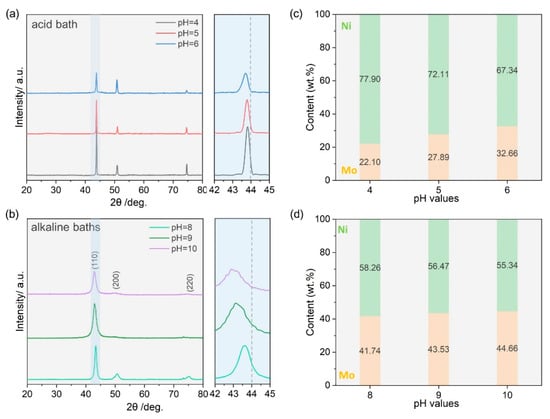
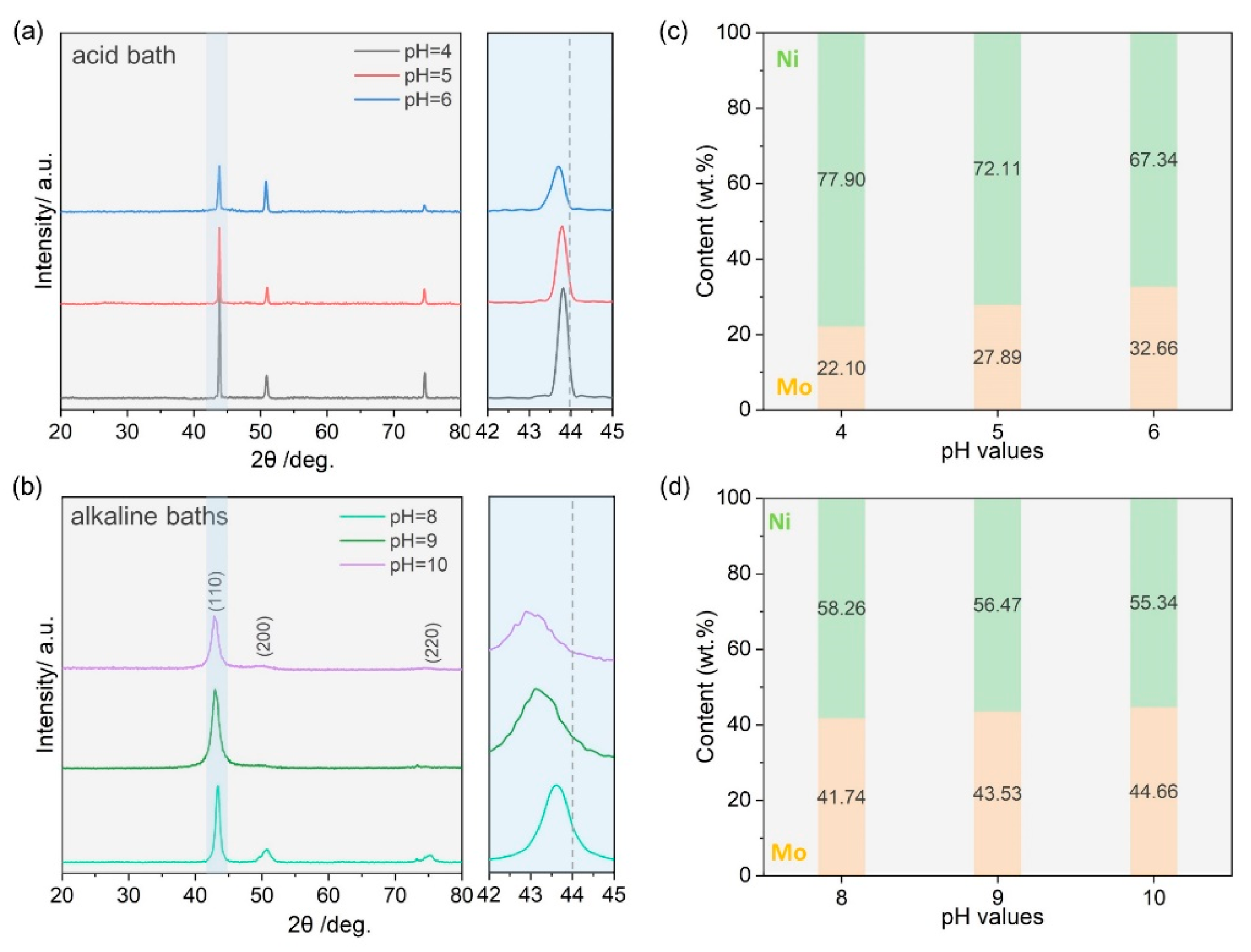
Figure 1 displays the XRD patterns and composition of Ni-Mo alloy coatings deposited in the baths with different pH values. The composition was determined by EDS, and the proportions of light elements (i.e., C, O, etc.) were not included in the calculations, because EDS is inaccurate for the quantitative analysis of light elements. [22,25,26]. The XRD patterns shown in Figure 1a,c reveal that all electrodeposited coatings consist of a crystalline fcc structure of solid solution Ni(Mo). It can be observed that the peak intensity of (110), (200), and (220) textures gradually decreases with the increase in bath pH values, indicating a decrease in crystallite size, which can be calculated by Scherer’s equation [27]. In addition, there is a leftward shift in the diffraction peaks of the (110) lattice plane, due to the Mo atoms being dissolved in the Ni crystal lattice in the form of replacement atoms [28]. As shown in Figure 1b,d, the Mo content in the electrodeposited coatings increases with the increase in bath pH values, which results in a decrease in the crystallite size and more pronounced lattice distortion [18,28,29].
Figure 1.
XRD spectra (a,c) and composition (b,d) of Ni-Mo alloy coatings deposited in the baths with different pH values.
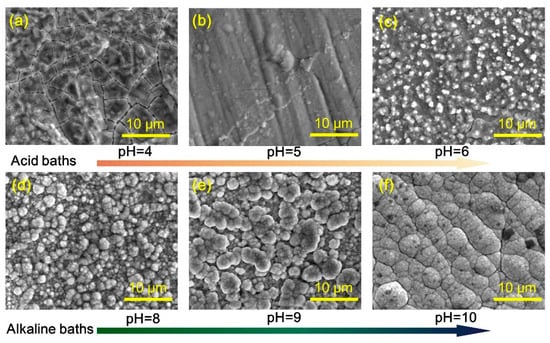
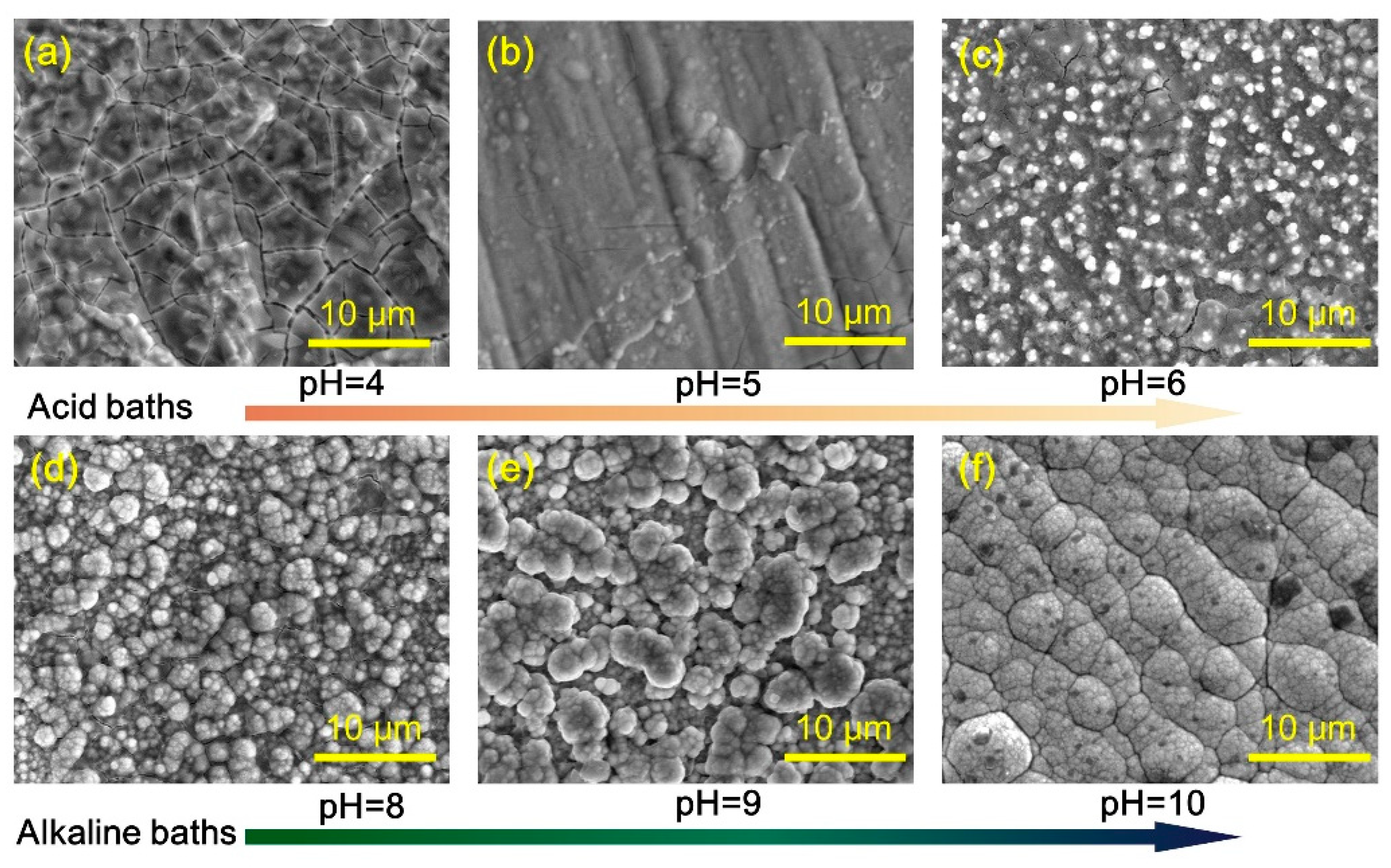
All Ni-Mo alloy coatings display a silvery metallic luster without obvious visual defects. The morphology evolution of Ni-Mo alloy coatings electrodeposited in the baths with different pH values was observed by SEM analysis. As shown in Figure 2, numerous randomly oriented cracks are observed on the surface of the Ni-Mo alloy coating electrodeposited at pH 4 (Figure 2a). Similar cracks in morphology have also been reported in the Ni-Mo alloy coatings electrodeposited in an acid bath [18,30]. For the coatings electrodeposited at pH 5, the cracks in the coating are greatly diminished, and the coating surface becomes much smoother and denser simultaneously (Figure 2b). When the bath pH value is 6, a minimal number of cracks can be found, and some granular protrusions can be observed in the obtained coating (Figure 2c). While the Ni-Mo alloy coatings electrodeposited in an alkaline bath become uniform and comprise fine cauliflower-like grains with increasing bath pH values (8 → 10), these grains enlarge, and the grain boundaries become more pronounced, resulting in the Ni-Mo alloy coatings becoming more compact (Figure 2d,e). However, there are subtle gaps between the coarse grains on the surface of the Ni-Mo alloy coating electrodeposited at pH 10 (Figure 2f).
Figure 2.
SEM images of Ni-Mo alloy coatings deposited in the baths with different pH values: (a) pH = 4; (b) pH = 5; (c) pH = 6; (d) pH = 8; (e) pH = 9; (f) pH = 10.
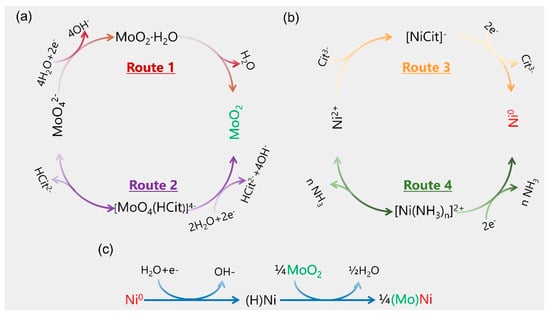
The above characterizations confirm that the composition, phase structure, and morphology of deposited Ni-Mo alloy coatings are highly related to the bath pH values. According to the previously reported literature, the primary reaction routes during the deposition process of Ni-Mo alloy coatings could be summarized as presented in the schematic diagram in Figure 3 [18,28,30,31,32]. The metallic Mo cannot be directly deposited from aqueous baths. It should be induced in the presence of iron group ions (Fe, Co, Ni). Hence, the complex species and reaction intermediates are critical for the reduction of metallic Ni and Mo. As shown in Figure 3, electrodeposition of metallic Ni-Mo alloys is determined by the reaction intermediates MoO2 and Ni0 (Figure 3c), of which the former can be obtained via route 1 and route 2 (Figure 3a), and the latter are mainly formed by route 3 and route 4 (Figure 3b) [28]. Generally, MoO42− ions are preferentially reduced into MoO2 in the complexing form with NiCit−(route 1), rather than via the direct reduction reaction (route 2). The alkaline baths are a favorable condition for the formation of MoO4(HCit)]4− complex [28]. Meanwhile, nickel–ammonia complexes [Ni(NH3)n]2 are more likely to occur in the acid pH [18]. This indicates that the increase in bath pH values facilitates the formation of Mo-containing intermediates and inhibits the formation of Ni-containing intermediates. As a result, the increase in bath pH values facilitates the deposition of Mo, thereby increasing the Mo content and decreasing the crystallite size of Ni-Mo alloy coatings.
Figure 3.
The primary reaction routes during the deposition process of Ni-Mo alloy coatings: (a) Route 1 and 2; (b) Route 3 and 4; (c) Route 5.
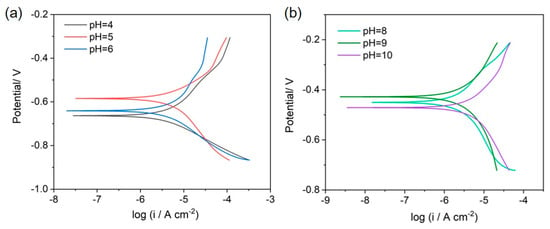
The potentiodynamic polarization curves of the obtained Ni-Mo alloy coatings are depicted in Figure 4. Table 1 lists the corresponding corrosion parameters extracted from the polarization curves, of which the polarization resistance Rp is calculated according to Equation (1) [33]:
where Rp, βa, and βc are the resistance of polarization, anodic, and cathodic Tafel slopes, respectively.
Figure 4.
The potentiodynamic polarization curves of Ni-Mo alloy coatings deposited in the baths with different pH values: (a) acid baths; (b) alkaline baths.
Table 1.
Primary corrosion parameters derived from potentiodynamic polarization curves of Ni-Mo alloy coatings.
Overall, the Ecorr values of Ni-Mo alloy coatings deposited in alkaline baths are much nobler than those of Ni-Mo alloy coatings deposited in acid baths, indicating that the former possess superior thermodynamic stability [15]. In all cases, Ni-Mo alloy coatings deposited at pH 9 show the noblest Ecorr value (−0.39 V). In addition, the values of βa are smaller than those of βc, confirming that the corrosion of Ni-Mo alloy coatings is an anodic process in harsh chloride-containing aerated solutions. Ni-Mo alloy coatings deposited at pH 9 show the highest βa value (317 mV dec−1), which is related to the relatively high molybdenum content in all coatings, and the compact morphology (as shown in Figure 1 and Figure 2b) influences the anodic dissolution reaction by enhancing protective oxide film growth [34]. Therefore, the Ni-Mo alloy coating deposited at pH 9 exhibits the lowest icorr and highest Rp value, which confirms the minimum corrosion rate and best anti-corrosion performance of this coating [33].
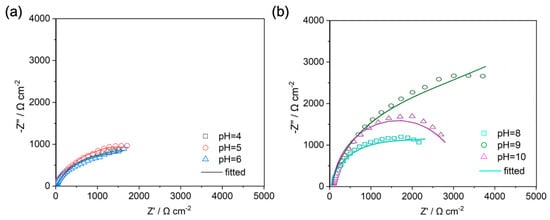
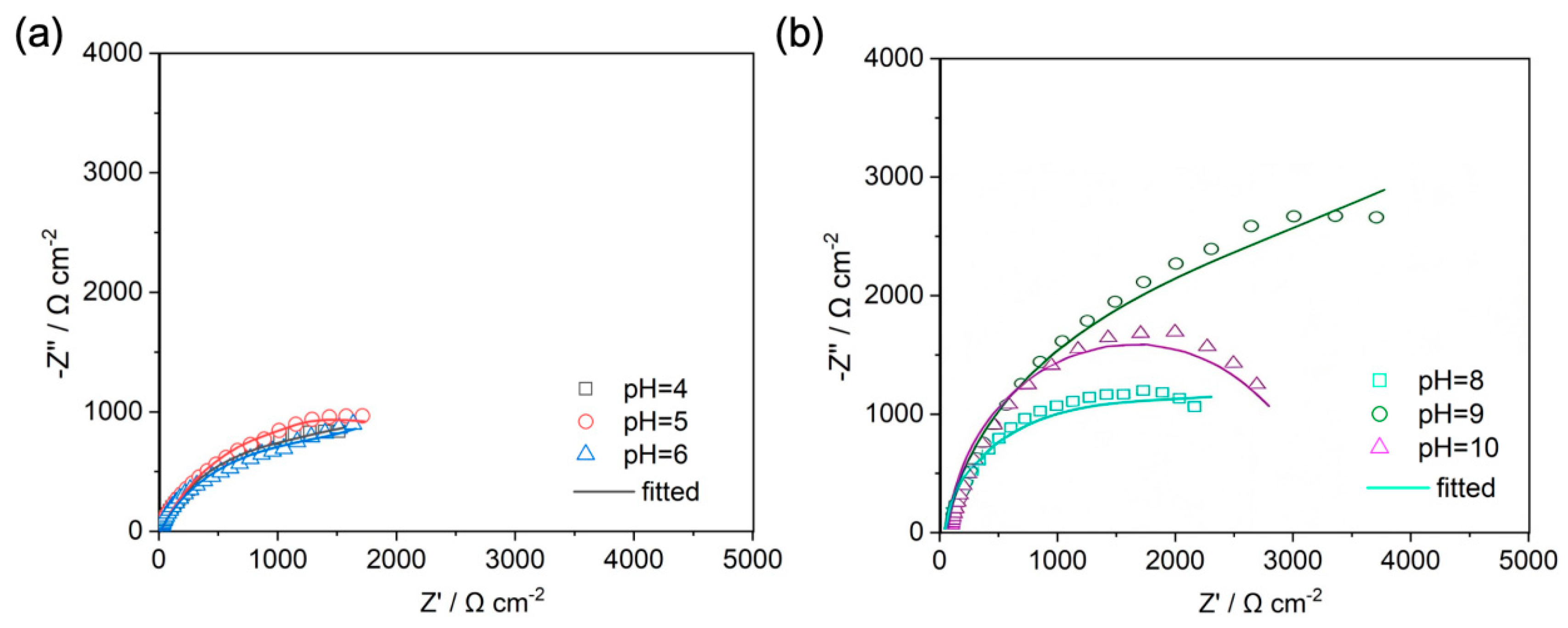
EIS tests were utilized to further explore the corrosion behavior of the electrodeposited coatings. Figure 5 shows EIS results in the mode of Nyquist plots. Clearly, all the Nyquist plots exhibit an unfinished semi-circle, with the coating deposited at pH 9 showing the highest impedance values (|Z|). This confirms the optimal anti-corrosion properties of this coating, corresponding well with the results of potentiodynamic polarization curves.
Figure 5.
The Nyquist plots of Ni-Mo alloy coatings deposited in the baths with different pH values: (a) acid baths; (b) alkaline baths.
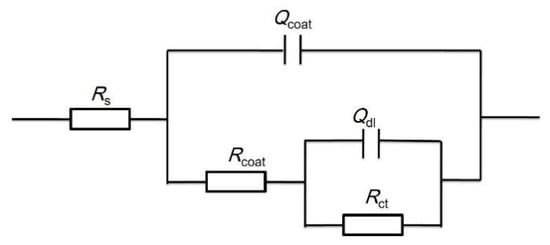
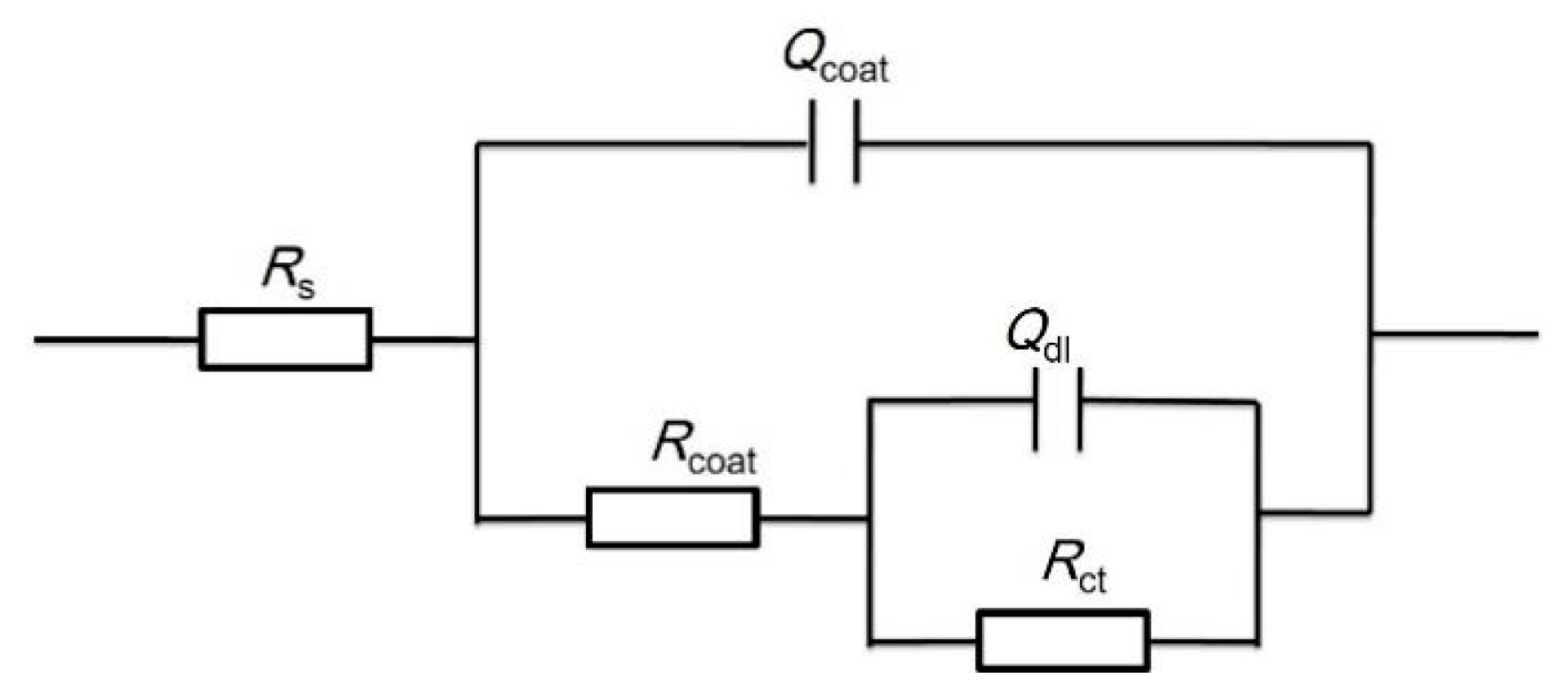
Quantitative data were obtained via equivalent circuit fitting using the electrical equivalent circuit (EEC) shown in Figure 6, where the Rs, Rcoat, and Rct represent the solution resistance, coating resistance, and the charge transfer resistance, respectively. The Qcoat and Qdl are the constant phase element (CPE) for the coating capacitance and the electrical double layer, respectively [35]. The fitted EIS data are displayed in the form of lines, which are in excellent agreement with the experimental plots, confirming the satisfactory fitting quality (Figure 5). The quantitative data and chi-square values (Σχ2, order of magnitudes~10−3) are listed in Table 2. As shown, the impedance values (|Z|) are mainly contributed by Rcoat and Rct, due to the extremely small Rs values. Both the Rcoat and Rct of the Ni-Mo alloy coatings deposited in the alkaline baths are bigger than those of the Ni-Mo alloy coatings deposited in the acid baths, indicating that the former coating exhibits superior corrosion resistance. The Ni-Mo alloy coating electrodeposited at pH 9 exhibits the optimal corrosion resistance, owing to the fact that the sum of their Rcoat and Rct derived from EEC fitting is the highest among all coatings. In addition, the Qcoat-Y0 values firstly decrease when the bath pH increases from 4 to 9, and then increase when the bath pH value increases from 9 to 10. Y0 is an important parameter of CPE, which describes the proportionality factor and varies inversely with the thickness/quality of the passive film [36]. Therefore, the Ni-Mo alloy coatings deposited at pH 9 show the smallest Qcoat-Y0 value, indicating the optimum protective effects of the formed oxidative products.
Figure 6.
The EEC for fitting the EIS experimental data.
Table 2.
Equivalent circuit parameters for the deposited Ni-Mo alloy coatings.
The anti-corrosion properties of Ni-Mo alloy coatings may be affected by several factors, such as the composition, phase structure, and morphology [34]. EDS, XRD, and SEM analysis reveal that the bath pH value is a critical factor for electrodeposition of Ni-Mo alloy coatings. The increase in bath pH values could facilitate the deposition of Mo, thereby increasing the Mo content and reducing the crystallite size of Ni-Mo alloy coatings. The high Mo content may contribute to forming high-quality protective oxidative/passive films, which can prevent the further dissolution of coatings. Grain refinement can improve the homogeneity of the coating and prolong the transport pathway of the corrosive medium. From these aspects, the corrosion resistance of the Ni-Mo alloy coating is expected to improve. However, the subtle gaps between the coarse grains in the coatings deposited at pH 10 (Figure 2f) may lead to corrosion resistance degradation [26]. As a result, the optimum bath pH value for deposition of anti-corrosion Ni-Mo alloy coating is 9, since this coating has high Mo content, refined grains, and appropriate morphology.
4. Conclusion
In this work, the effect of the bath pH values on the characteristics and corrosion resistance of Ni-Mo alloy coatings deposited from a citrate/ammonia solution has been systematically studied by SEM, EDS, XRD, potentiodynamic polarization, and EIS, respectively. The primary conclusions are summarized as follows:
- (1)
- The deposited Ni-Mo alloy coatings consist of a crystalline fcc structure of solid solution Ni(Mo). The increase in bath pH values increases the Mo content and decreases the crystallite size of Ni-Mo alloy coatings.
- (2)
- The Ecorr values of Ni-Mo alloy coatings deposited in alkaline baths are much nobler than those of Ni-Mo alloy coatings deposited in acid baths, and the corrosion of Ni-Mo alloy coatings is an anodic process in 3.5 wt.% NaCl solution.
- (3)
- In all cases, the Ni-Mo alloy coating deposited at pH 9 shows the best corrosion resistance, due to its lowest icorr (7.31 × 10⁻⁶ A cm−2), highest polarization resistance (11.13 kΩ·cm−2), and impedance values.
Author Contributions
Conceptualization, X.S.; methodology, X.S. and Q.Z.; investigation, S.Z. and B.L.; resources, S.Z., B.L., J.L., G.L., L.C. and P.X.; data curation, S.Z., B.L., J.L., G.L., L.C. and P.X.; writing—original draft preparation, X.S., S.Z.; writing—review and editing, X.S., S.Z., Q.Z.; supervision, X.S. and Q.Z.; project administration, X.S. and Q.Z.; funding acquisition, X.S. All authors have read and agreed to the published version of the manuscript.
Funding
This research was funded by the 2025 Nantong Natural Science Foundation [JC2025087], Natural Science Foundation of Jiangsu College of Engineering and Technology (GYKY/2024/1), the First Batch of Self-funded Projects Approved under the Sixth Phase of Jianghai Talents Municipal-Level Cultivation Special Program, Young and Middle-aged Academic Leaders from “Green-Blue Project” of Colleges and Universities in Jiangsu Province and the Natural Science Research of Jiangsu Higher Education Institution of China [24KJD430002].
Data Availability Statement
The data presented in this study are available on request from the corresponding author.
Conflicts of Interest
Authors Longquan Chen and Peijun Xu were employed by the company Nantong Great Electric Co., Ltd. The remaining authors declare that the research was conducted in the absence of any commercial or financial relationships that could be construed as a potential conflict of interest.
References
- Zou, Z.; Zeng, J.; Liu, Z.; Mo, Y.; Liang, G.; Wang, L.; Guo, Z. Study on the corrosion electrochemistry behavior and wear resistance of the arc thermal sprayed Zn–Al alloy coating. J. Mater. Res. Technol. 2023, 24, 8414–8428. [Google Scholar] [CrossRef] [Scilit]
- Huang, X.; Yuan, Y.; Zhao, J.; Wei, C. Comparative study on ultra-low-cycle-fatigue behavior of Q235 normal-steel and Q690 high-strength steel. J. Constr. Steel Res. 2022, 194, 107308. [Google Scholar] [CrossRef] [Scilit]
- Dwivedi, D.; Lepková, K.; Becker, T. Carbon steel corrosion: A review of key surface properties and characterization methods. RSC Adv. 2017, 7, 4580–4610. [Google Scholar] [CrossRef] [Scilit]
- Sun, Y. Surface Engineering & Coating Technologies for Corrosion and Tribocorrosion Resistance. Materials 2023, 16, 4863. [Google Scholar] [CrossRef] [Scilit]
- Zhou, Q.; Xie, W.E.I.; Zhang, Y.; Sheng, M.; Hu, A.; Cheng, X.; Zhang, L.U. Electrodeposition and corrosion resistance of Ni–W–Al2O3 nanocomposite coatings. Surf. Rev. Lett. 2017, 24, 1850015. [Google Scholar] [CrossRef] [Scilit]
- Safavi, M.S.; Walsh, F.C. Electrodeposited Co-P alloy and composite coatings: A review of progress towards replacement of conventional hard chromium deposits. Surf. Coat. Technol. 2021, 422, 127564. [Google Scholar] [CrossRef] [Scilit]
- Ezzat, A.O.; Ohiemi, I.E.; Aigbodion, V.S. Understanding the multifaceted incorporation of a Zn-maize cob nanoparticle composite coating of mild steel: Anti-wear, anti-corrosion, and oxidation resistance. RSC Adv. 2023, 13, 35911–35919. [Google Scholar] [CrossRef] [Scilit]
- Krawiec, H.; Vignal, V.; Latkiewicz, M.; Herbst, F. Structure and corrosion behaviour of electrodeposited Co-Mo/TiO2 nano-composite coatings. Appl. Surf. Sci. 2018, 427, 1124–1134. [Google Scholar] [CrossRef] [Scilit]
- Xu, C.; Li, B.; Liu, Z.; Yuan, Z.; Zhang, Z.; Chen, S. Preparation of nanocrystalline Ni–Mo and Ni–Mo–ZrO2 coating and investigation of its corrosion resistance and wear behaviors. Ceram. Int. 2022, 48, 37102–37113. [Google Scholar] [CrossRef] [Scilit]
- Liu, J.H.; Li, W.H.; Pei, Z.L.; Gong, J.; Sun, C. Investigations on the structure and properties of nanocrystalline Ni-Mo alloy coatings. Mater. Charact. 2020, 167, 110532. [Google Scholar] [CrossRef] [Scilit]
- Li, B.; Chen, S.; Xiao, M.; Tu, Q.; Xu, Z.; Feng, T.; Zhang, Z.; Yuan, Z.; Xu, C.; Gong, L.; et al. Preparation of Ni–Mo/GO composite coatings with strengthened mechanical properties and enhanced corrosion resistance. Surf. Coat. Technol. 2024, 477, 130404. [Google Scholar] [CrossRef] [Scilit]
- Bin, C.A.I.; Tan, Y.F.; Long, H.E.; Hua, T.A.N.; Li, G.A.O. Tribological properties of TiC particles reinforced Ni-based alloy composite coatings. Trans. Nonferrous Met. Soc. China 2013, 23, 1681–1688. [Google Scholar]
- Hu, H.X.; Guo, X.M.; Zheng, Y.G. Comparison of the cavitation erosion and slurry erosion behavior of cobalt-based and nickel-based coatings. Wear 2019, 428, 246–257. [Google Scholar]
- Costovici, S.; Manea, A.C.; Visan, T.; Anicai, L. Investigation of Ni-Mo and Co-Mo alloys electrodeposition involving choline chloride based ionic liquids. Electrochim. Acta 2016, 207, 97–111. [Google Scholar] [CrossRef] [Scilit]
- Bao, Q.; Zheng, W.; Chen, L.; Xu, Z.; Han, J.; Zhu, C. Optimization of plating process and corrosion behavior of nanocrystalline Ni-Mo coatings on pure aluminum. Colloids Surf. A Physicochem. Eng. Asp. 2022, 636, 128128. [Google Scholar] [CrossRef] [Scilit]
- Laszczyńska, A.; Winiarski, J.; Szczygieł, B.; Szczygieł, I. Electrodeposition and characterization of Ni–Mo–ZrO2 composite coatings. Appl. Surf. Sci. 2016, 369, 224–231. [Google Scholar] [CrossRef] [Scilit]
- Bigos, A.; Beltowska-Lehman, E.; García-Lecina, E.; Bieda, M.; Szczerba, M.J.; Morgiel, J. Ultrasound-assisted electrodeposition of Ni and Ni-Mo coatings from a citrate-ammonia electrolyte solution. J. Alloys Compd. 2017, 726, 410–416. [Google Scholar] [CrossRef] [Scilit]
- Bigos, A.; Beltowska-Lehman, E.; Kot, M. Studies on electrochemical deposition and physicochemical properties of nanocrystalline Ni--Mo alloys. Surf. Coat. Technol. 2017, 317, 103–109. [Google Scholar] [CrossRef] [Scilit]
- Yagi, S.; Kawakami, A.; Murase, K.; Awakura, Y. Ni–Mo alloying of nickel surface by alternating pulsed electrolysis using molybdenum (VI) baths. Electrochim. Acta 2007, 52, 6041–6051. [Google Scholar] [CrossRef] [Scilit]
- Marlot, A.; Kern, P.; Landolt, D. Pulse plating of Ni–Mo alloys from Ni-rich electrolytes. Electrochim. Acta 2002, 48, 29–36. [Google Scholar] [CrossRef] [Scilit]
- Zhiani, M.; Taghiabadi, M.M.; Bagherabadi, M.H. Optimization of Ni-Mo-Coated Stainless Steel as a High-Performance Cathode in Alkaline Water Electrolysis. Electrocatalysis 2023, 14, 473–483. [Google Scholar] [CrossRef] [Scilit]
- Alimadadi, H.; Ahmadi, M.; Aliofkhazraei, M.; Younesi, S.R. Corrosion properties of electrodeposited nanocrystalline and amorphous patterned Ni–W alloy. Mater. Des. 2009, 30, 1356–1361. [Google Scholar] [CrossRef] [Scilit]
- Mizushima, I.; Tang, P.T.; Hansen, H.N.; Somers, M.A. Development of a new electroplating process for Ni–W alloy deposits. Electrochim. Acta 2005, 51, 888–896. [Google Scholar] [CrossRef] [Scilit]
- Czerwinski, F.; Kedzierski, Z. On the mechanism of microcrack formation in nanocrystalline Fe–Ni electrodeposits. J. Mater. Sci. 1997, 32, 2957–2961. [Google Scholar] [CrossRef] [Scilit]
- Juškėnas, R.; Valsiūnas, I.; Pakštas, V.; Giraitis, R. On the state of W in electrodeposited Ni–W alloys. Electrochim. Acta 2009, 54, 2616–2620. [Google Scholar] [CrossRef] [Scilit]
- Liu, C.; Huang, X.; Xu, R.; Mai, Y.; Zhang, L.; Jie, X. Microstructure and properties of nanocrystalline Ni-Mo coatings prepared by ultrasound-assisted pulse electrodeposition. J. Mater. Eng. Perform. 2021, 30, 2514–2525. [Google Scholar] [CrossRef] [Scilit]
- Li, B.; Mei, T.; Chu, H.; Wang, J.; Du, S.; Miao, Y.; Zhang, W. Ultrasonic-assisted electrodeposition of Ni/diamond composite coatings and its structure and electrochemical properties. Ultrason. Sonochem. 2021, 73, 105475. [Google Scholar] [CrossRef] [Scilit]
- To, D.T.; Park, S.H.; Kim, M.J.; Cho, H.S.; Myung, N.V. Effects of NH4+/citrate complexing agent ratio on Ni–Mo and Ni–Mo–O electrodeposits from ammonium citrate baths. Front. Chem. 2022, 10, 942423. [Google Scholar] [CrossRef] [Scilit]
- Péter, L.; Fekete, É.; Kapoor, G.; Gubicza, J. Influence of the preparation conditions on the microstructure of electrodeposited nanocrystalline Ni–Mo alloys. Electrochim. Acta 2021, 382, 138352. [Google Scholar] [CrossRef] [Scilit]
- de Almeida, A.F.; de Souto, J.I.V.; dos Santos, M.L.; de Santana, R.A.C.; Alves, J.J.N.; Campos, A.R.N.; Prasad, S. Establishing relationships between bath composition and the properties of amorphous Ni–Mo alloys obtained by electrodeposition. J. Alloys Compd. 2021, 888, 161595. [Google Scholar] [CrossRef] [Scilit]
- Beltowska-Lehman, E.; Indyka, P. Kinetics of Ni–Mo electrodeposition from Ni-rich citrate baths. Thin Solid Film. 2012, 520, 2046–2051. [Google Scholar] [CrossRef] [Scilit]
- Podlaha, E.J.; Landolt, D. Induced codeposition: II. A mathematical model describing the electrodeposition of Ni--Mo alloys. J. Electrochem. Soc. 1996, 143, 893. [Google Scholar] [CrossRef] [Scilit]
- Jiang, J.; Feng, C.; Qian, W.; Zhu, L.; Han, S.; Lin, H. Effect of graphene oxide nanosheets and ultrasonic electrodeposition technique on Ni–Mo/graphene oxide composite coatings. Mater. Chem. Phys. 2017, 199, 239–248. [Google Scholar] [CrossRef] [Scilit]
- Ahmad, Y.H.; Tientong, J.; Nar, M.; D’Souza, N.; Mohamed, A.M.A.; Golden, T.D. Characterization and corrosion resistance of electrodeposited Ni–Mo–silicate platelet nanocomposite coatings. Surf. Coat. Technol. 2014, 259, 517–525. [Google Scholar] [CrossRef] [Scilit]
- Luo, H.; Li, Z.; Mingers, A.M.; Raabe, D. Corrosion behavior of an equiatomic CoCrFeMnNi high-entropy alloy compared with 304 stainless steel in sulfuric acid solution. Corros. Sci. 2018, 134, 131–139. [Google Scholar] [CrossRef] [Scilit]
- Zhou, Q.; Sheikh, S.; Ou, P.; Chen, D.; Hu, Q.; Guo, S. Corrosion behavior of Hf0. 5Nb0. 5Ta0. 5Ti1. 5Zr refractory high-entropy in aqueous chloride solutions. Electrochem. Commun. 2019, 98, 63–68. [Google Scholar] [CrossRef] [Scilit]

Disclaimer/Publisher’s Note: The statements, opinions and data contained in all publications are solely those of the individual author(s) and contributor(s) and not of MDPI and/or the editor(s). MDPI and/or the editor(s) disclaim responsibility for any injury to people or property resulting from any ideas, methods, instructions or products referred to in the content. |
© 2026 by the authors. Licensee MDPI, Basel, Switzerland. This article is an open access article distributed under the terms and conditions of the Creative Commons Attribution (CC BY) license.