1. Introduction
Titanium-based alloys are a popular choice as metallic biomaterials for load-bearing implants due to their favourable properties, including high biocompatibility, high specific strength, a low Young’s modulus compared to steel or CoCr alloys, and excellent corrosion resistance [
1,
2]. Developed as an alternative to the widely used Ti-6Al-4V alloy, Ti-6Al-7Nb substitutes vanadium (V) with niobium (Nb), thereby avoiding the potential cytotoxic effects associated with vanadium [
3,
4,
5]. As a result, Ti-6Al-7Nb has been adopted in orthopaedic and dental implantology owing to its excellent biocompatibility and mechanical properties [
6,
7,
8].
However, a significant drawback of most titanium-based alloys is their lack of intrinsic antibacterial functionality, which permits the formation of biofilms. This issue is reflected in the high prevalence of implant-associated infections, frequently caused by organisms such as Staphylococcus aureus and Escherichia coli. As infection can compromise implant integration and longevity, often necessitating revision surgery, this represents a major limitation in the use of titanium alloys for permanent implants [
9,
10].
To address this limitation, there has been an increasing focus on the use of antibacterial elements such as silver, zinc, or copper either as surface coatings or through alloying [
11]. Among these, copper is particularly notable due to its effective antibacterial activity and low cytotoxicity at low concentrations [
12,
13,
14]. Both in vitro and in vivo studies have shown that copper-bearing titanium alloys exhibit strong antibacterial properties without compromising cytocompatibility, provided that the copper content is appropriately controlled [
15,
16,
17]. Systematic investigations on binary Ti–Cu alloys have demonstrated enhanced bacterial inhibition with increasing copper content. However, excessive copper additions can negatively impact mechanical and corrosion properties, whereas moderate amounts may also provide benefits such as solid-solution strengthening and precipitation hardening [
12,
18,
19,
20]. There is growing evidence that moderate copper additions attain a favourable balance between antibacterial efficacy while maintaining or even improving the alloy’s overall performance [
16,
21].
Despite numerous scientific studies on titanium–copper-based alloys, the fundamental understanding of titanium’s interaction with copper remains incomplete. Studies performed by Williams et al. have shown that the presence of 8 wt.% copper was insufficient to retain the β phase in quenched samples, suggesting an athermal, diffusionless transformation to Ti
2Cu [
22]. While this work provides valuable insight into martensitic behaviour, it was carried out on binary alloys under conventional cooling conditions, limiting its applicability to multicomponent systems processed under the far higher cooling rates of PBF-LB/M. In contrast to these findings is more recent evidence from Donthula et al., who found evidence for both a sluggish and eutectoid transformation taking place in a hypereutectoid Ti-Cu alloy [
23]. However, Donthula’s observations were made at copper contents well above those typically considered for biomedical applications, and therefore, do not clarify how moderate Cu additions behave in medical base alloys such as Ti-6Al-7Nb.
An explanation as to why Williams et al. did not detect any β retention in their study was reported by Dobromyslov and Kazantseva who noticed that only at much higher copper concentrations and cooling rates, the stabilisation of metastable β at room temperature is possible [
24]. They determined that at 13 at.% (16.5 wt.%) copper and a cooling rate of more than 1000 K/s, the microstructure after quenching consists almost entirely of retained β, with only minor traces of α. Although these findings illustrate the strong cooling-rate sensitivity of the system, they rely on binary alloys and do not account for interactions with other elements such as Nb and Al, which significantly influence β-stability. In another work underlining this cooling-rate sensitivity, Dobromyslov investigated the temperature-dependent precipitation rate of Ti
2Cu, detecting this phase after just 10 s at around 700 °C and also identifying copper as the fastest-precipitating d-metal in titanium in the case of binary alloy systems [
25]. This rapid precipitation behaviour highlights the relevance of in situ heat treatment effects during PBF-LB/M; however, data for complex alloys remain scarce, leaving uncertainties regarding precipitation kinetics in multicomponent systems.
Looking into the complex characteristics of copper as a β-stabiliser in ternary alloys, investigations performed by Takahashi et al. on air-cooled Ti-xNb-yCu samples revealed an α + β microstructure for Ti-8Nb-2Cu, but a mixture of α + Ti
2Cu for Ti-10Nb-5Cu despite containing a higher content of β-stabilising elements than the former alloys [
26]. This demonstrates that copper’s β-stabilising effect is highly composition-dependent and not simply additive to that of niobium. Zhao et al. examined water-cooled samples of Ti-10Nb-3Cu, Ti-30Nb, and Ti-30Nb-3Cu, finding an α + β microstructure for Ti-10Nb-3Cu and suppression of α formation in Ti30Nb by adding 3 wt.% copper, resulting in a pure β microstructure [
27]. Similar findings were reported by Li et al., with a transition from β + α″ in Ti-35Nb to β in Ti-35Nb-2Cu, which accounted for a reduction in the martensitic starting temperature [
28]. Together, these studies underline that copper’s influence on phase stability strongly depends on the Nb:Cu ratio and the applied cooling conditions—yet none of these works examine Ti-6Al-7Nb, meaning that the combined effects of Al, Nb, and Cu in this clinically relevant alloy system are still insufficiently clarified. Taking all these results into account, it is evident that the β-stabilising character of Cu is highly sensitive to both cooling rate and alloy composition. However, existing studies focus predominantly on binary or ternary systems processed via conventional routes, leaving a clear gap in understanding how copper behaves in the multicomponent Ti-6Al-7Nb system during PBF-LB/M, where extreme thermal gradients and repeated remelting fundamentally alter diffusion, phase formation, and precipitation mechanisms.
Recent advances in additive manufacturing, particularly powder bed fusion with laser beam (PBF-LB/M), have created new possibilities for the in situ alloying of Ti-6Al-7Nb with copper directly during near-net shape manufacturing [
29,
30]. In this process, alloying occurs within the melt pool itself, enabling compositional adjustment without the need for pre-alloyed powders. This approach allows fabricating patient-specific implants with precisely controlled surface chemistry and tailored microstructures to address clinical requirements [
30,
31]. However, the extremely high cooling rates, steep thermal gradients, and complex melt-pool dynamics inherent to PBF-LB/M significantly influence elemental mixing, diffusion, and phase formation in multicomponent titanium alloys. Therefore, achieving a homogeneous copper distribution and defect-free microstructures requires careful optimisation of process parameters such as laser power, scanning speed, and hatch distance [
20,
32,
33]. These effects make it challenging to achieve homogeneous copper distribution and to predict microstructural evolution reliably, which directly motivates the need for a systematic investigation of this system. Variations in these parameters influence the thermal history, thereby affecting phase formation, grain size, and ultimately both mechanical and biological performance [
34,
35,
36,
37]. Consequently, the design of antibacterial Ti-6Al-7Nb-xCu alloys via PBF-LB/M remains a complex challenge, necessitating a comprehensive investigation into the relationships between processing, microstructure, and properties.
Despite the potential advantages of copper addition to the Ti-6Al-7Nb system and the opportunities offered by in situ alloying via PBF-LB/M, research in this area remains limited. Most existing studies have addressed conventional fabrication routes or binary titanium-copper alloys, while comprehensive investigations of multi-component systems produced by advanced additive manufacturing techniques are still limited [
38,
39]. A thorough understanding of the effects of process parameters on the microstructure and processability of additively manufactured Ti-6Al-7Nb-Cu alloys is, therefore, essential for optimising their fabrication and broadening their application in biomedical implants. Accordingly, the present study aims to address these gaps by analysing how varying copper contents interact with the unique thermal environment of PBF-LB/M and how these interactions govern phase formation, grain refinement, and resulting mechanical performance.
In this work, we present a systematic study of laser powder bed fusion processing and its influence on the microstructure and mechanical properties of Ti-6Al-7Nb alloys with varying copper contents (1 wt.%, 3 wt.%, 5 wt.%, 7 wt.%, and 9 wt.%). By combining controlled in situ alloying with a structured parameter study, the present work aims to clarify how copper interacts with the multicomponent Ti-6Al-7Nb system under the extreme thermal conditions of PBF-LB/M. Comprehensive microstructural characterisation is carried out to address the relationships between processing conditions, structural evolution, and mechanical response, thereby providing a foundation for process optimisation and the future development of advanced titanium-based biomaterials. In particular, this study seeks to close the current knowledge gap regarding copper-induced phase formation, mixing behaviour, and grain refinement in additively manufactured Ti-6Al-7Nb, offering insights that are presently unavailable in the literature.
3. Results
3.1. Calculated Pseudo-Binary Phase Diagram
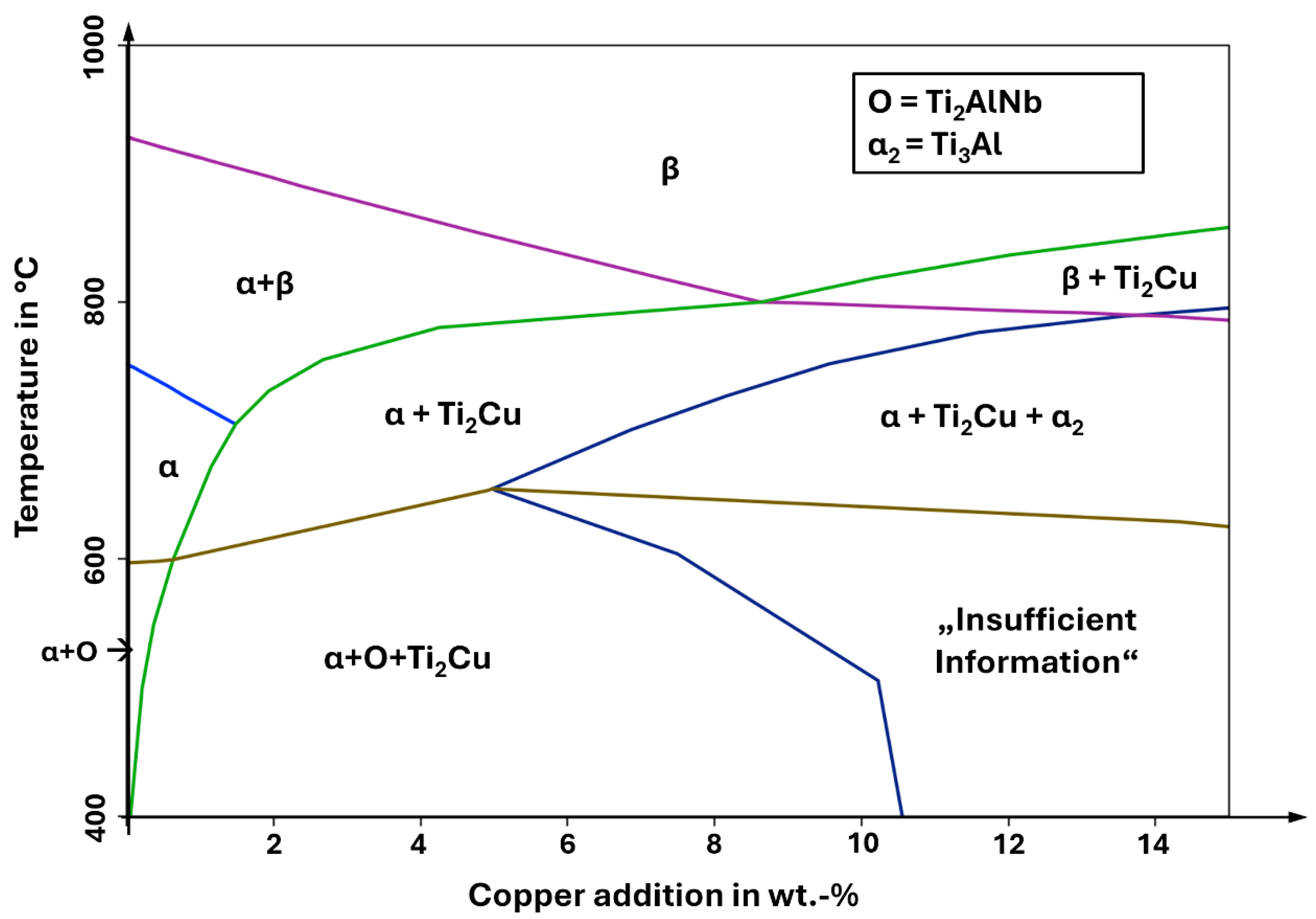
Figure 2 shows the pseudo-binary phase diagram of Ti-6Al-7Nb + xCu, calculated via thermodynamic simulations. For ease of calculation, the aluminium and niobium contents were kept at 6 wt.% and 7 wt.%, respectively, while the copper and titanium fractions were varied. The results obtained using the TCTI6 database represent thermodynamic equilibrium and thus differ significantly from the as-built condition investigated in this study. Although copper has been widely investigated in binary Ti–Cu systems, its behaviour in multicomponent alloys such as Ti-Nb-Cu remains insufficiently understood. Uncertainties persist regarding its effectiveness as a β-stabiliser, the conditions governing Ti
2Cu precipitation, and the ability of current thermodynamic models to accurately predict equilibrium states in these systems. Further experimental and modelling studies are therefore required to clarify these mechanisms, particularly under the rapid solidification conditions typical of PBF-LB/M. Considering this, the phase diagram will be discussed in more detail in the following section.
At high temperatures, the calculated phase diagram predicts a behaviour very similar to the binary Ti–Cu system, characterised by a strong reduction in both the liquidus and β transus temperatures. The β-stabilising effect of copper is evident. Compared to the binary alloy, the eutectoid composition at which β transforms into α + Ti2Cu is shifted just slightly towards higher copper content, from 7.04 wt.% to approximately 8.5 wt.%. The O-phase (ordered Ti2AlNb) is only marginally affected by copper addition, whereas a stabilisation of the α2 (Ti3Al) phase is predicted at higher copper concentrations. Further calculations predict the formation of only 5 vol.% α2 in a 10Cu alloy, but a substantial increase to over 50 vol.% in the 19Cu alloy at around 700 °C. As the applied CALPHAD approach is based on thermodynamic equilibrium, it cannot predict martensite formation. However, since martensite and other metastable phases are frequently observed in PBF-LB/M produced materials, the phase diagram will be discussed in detail later regarding possible phase formation, considering all experimental results, formation enthalpies, and kinetic effects.
3.2. Characterisation of the As-Built Microstructures
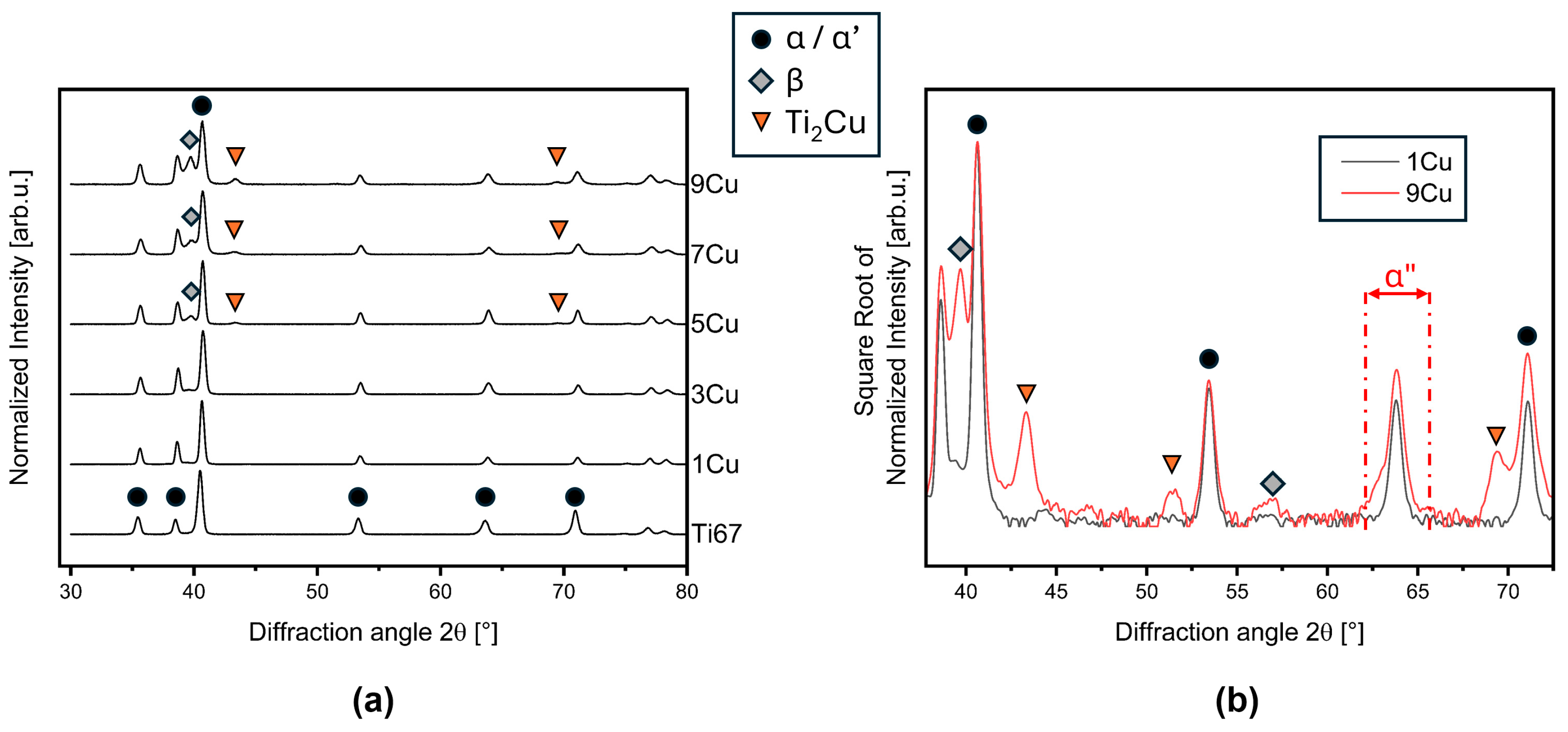
The phase composition of the various in situ alloys was experimentally evaluated by XRD, with the results presented in
Figure 3. Increasing the copper content has a significant effect on the observed phase composition. XRD analysis of the Ti67 reference sample reveals only diffraction angles typical of an α/α′ microstructure, probably overall martensitic owing to the high cooling rates during PBF-LB/M. The 1Cu alloy exhibits a similar diffraction pattern, with diffraction angles nearly identical to Ti67 but with noticeable changes in the relative intensities.
From 1Cu onwards, in all copper-containing alloys, a slight shift in the α diffraction peaks towards higher 2θ values is observed, corresponding to a reduction in lattice parameters, indicating that the measured increase in hardness is at least partially caused by substitutional hardening because of an increase in lattice strain. Additionally, a minor elevation at 39.5° suggests the presence of β-Ti, and this diffraction feature becomes more prominent with increasing copper content. The identification of β-Ti is further supported by another peak at 56°, which is characteristic of the β phase predicted to be stable in the Ti-6Al-7Nb + xCu system according to CALPHAD. Due to their weak intensity relative to α/α′, these diffraction peaks were only visible after applying non-linear scaling of the relative intensity, as illustrated in
Figure 3b.
Detected at first in 5Cu and continuing with increasing copper content, diffraction angles corresponding to the intermetallic Ti2Cu phase are visible, with their intensity progressively increasing in 7Cu and 9Cu. Moreover, increased diffraction intensity is registered around the 39.5° β-Ti diffraction angle, accompanied by a slight broadening of the α-Ti diffraction angles, resulting in the overlapping of multiple peaks.
Light optical microscopy (LOM) analysis of the phase distribution and microstructure reveals that the copper distribution is generally inhomogeneous, showing significant variations depending on the copper content.
Although the parameter windows identified in the preliminary studies resulted in fully dense samples (>99.9% relative density), densification alone does not ensure sufficient melt-pool mixing. Due to the limited diffusion of Cu in the short LPBF melt-pool lifetime and the vast differences in thermal properties between Ti-6Al-7Nb and Cu, local inhomogeneities persist even under conditions that otherwise promote defect-free processing. Consequently, a consistent distribution of copper throughout the samples was not achieved.
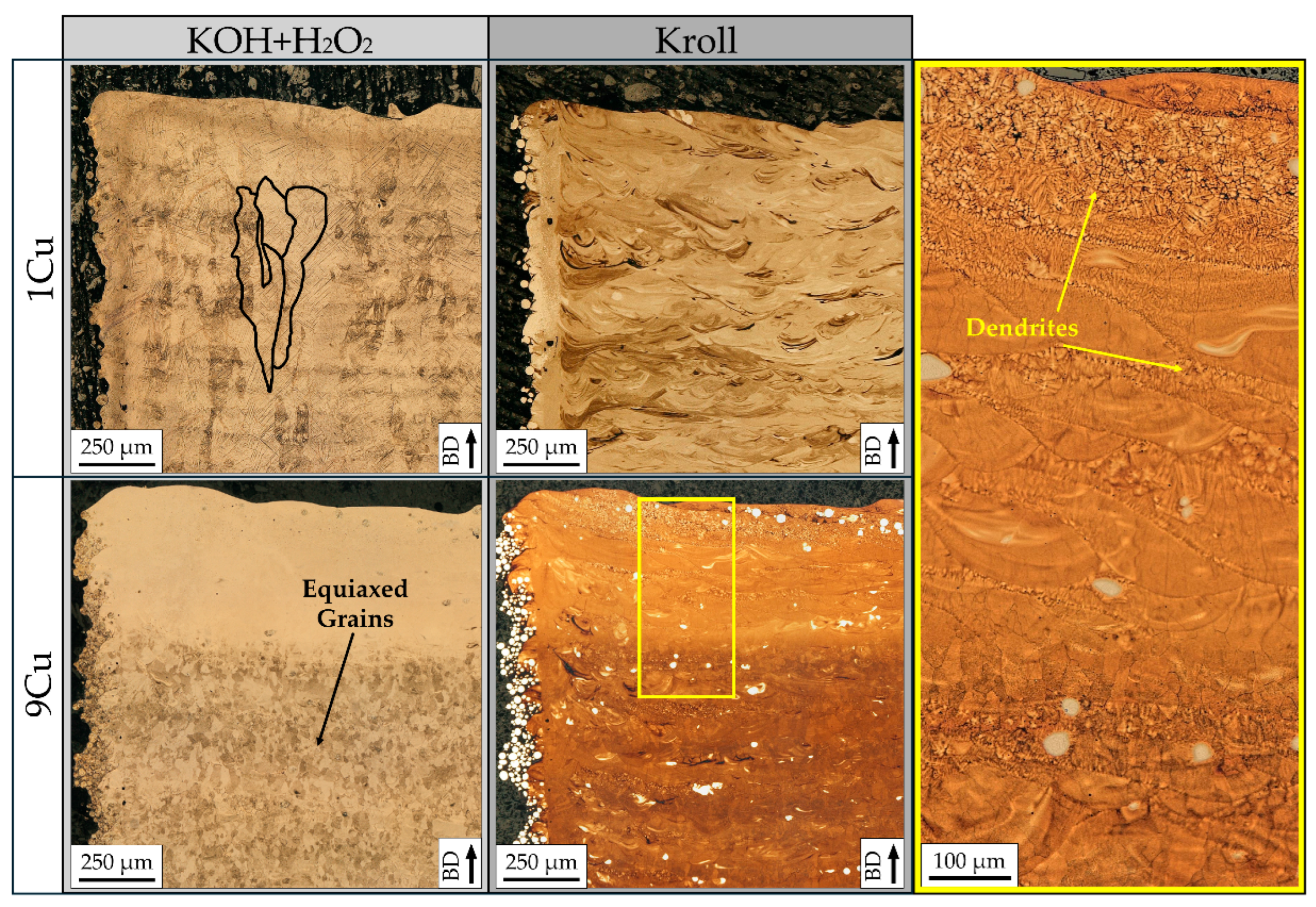
Figure 4 presents representative micrographs of 1Cu and 9Cu, each etched with either KOH + H
2O
2 or Kroll’s reagent, thus highlighting different aspects of the microstructure. Etching with Kroll’s reagent also allows a qualitative assessment of copper concentration: darker areas correspond to elevated copper content, and vice versa.
The morphology of these inhomogeneities and copper-rich regions often resembles melt pool boundaries, suggesting that most of the copper mixing took place in the liquid state. In 3Cu, a greater number of copper-rich areas is observed compared to 1Cu. However, this trend is not observed in 5Cu, for which the highest degree of mixing is qualitatively found in 7Cu. White regions visible in the Kroll-etched micrographs, such as those in
Figure 4, correspond to unmolten Ti67 particles, whose number increases markedly with higher copper content. Near the sample surface, a nearly continuous layer of Ti67 particles embedded within a darkened matrix can be observed. Further examination of copper accumulations, both at the surface and within the bulk, reveals a high density of defects (primarily pores and fine hot cracks) associated with these copper-rich regions.
Apart from inhomogeneous regions resulting from inadequate mixing, the microstructure of 1Cu closely resembles that of standard Ti-6Al-7Nb produced by PBF-LB/M, featuring elongated, epitaxially grown prior β grains that are decomposed into α/α′ platelets, which are often oriented at 45° to the build direction. The microstructure of 3Cu appears similar, albeit with smaller prior β grains and α/α′ platelets, as well as an increased number of regions exhibiting elevated copper concentrations. Moreover, the upper ends of prior β grains (in the build direction) frequently coincide with areas of high copper content, as highlighted in
Figure 4.
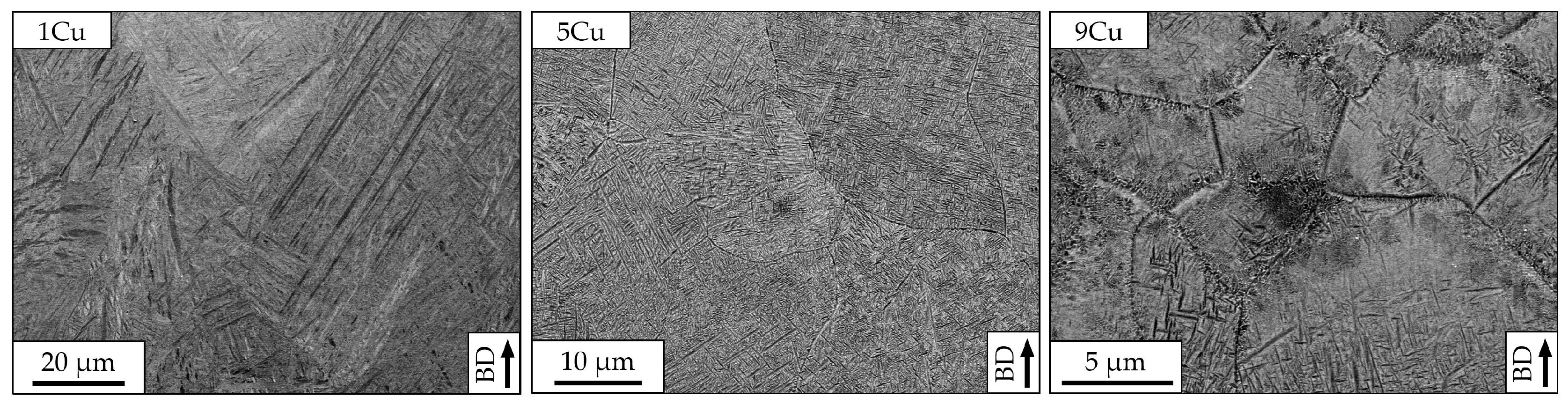
With increasing copper content, the reduction in prior β grain size becomes more pronounced, resulting in a transition from columnar to equiaxed (CET) grain structures. Whereas the epitaxially grown prior β grains observed in 1Cu occasionally exceed 1000 μm in the build direction, a nearly equiaxed microstructure was detected in 5Cu, which consists of globular prior β grains smaller than 50 μm. An even stronger grain refinement can be seen in 7Cu and 9Cu. Here, the individual prior β grains are smaller than 10 μm (
Figure 5), and the grain structure shows signs of directed solidification at the melt pool boundaries, as well as multiple nucleation sites within the melt pool, which cause the observed CET. The difference in grain size is most clearly visible in
Figure 4 on the samples etched with KOH + H
2O
2, where the 1Cu microstructure still exhibits elongated columnar prior-β grains (highlighted in black), whereas the 9Cu sample shows an almost fully equiaxed grain morphology. The nucleation at multiple spots in the melt pool can be observed on the detailed image of the sample 9Cu that was etched with Kroll.
In addition to changes observed in the bulk material, notable microstructural differences are present in the uppermost, i.e., most recently in situ alloyed, layers. While no significant contrast to the bulk is apparent in 1Cu and 3Cu, the surface layers of 5Cu, 7Cu, and 9Cu show clear deviations from the bulk microstructure, with both their extent and inhomogeneity increasing with increasing copper content. As shown in detail in
Figure 4, in the upper edge of a 9Cu sample etched with Kroll’s reagent, a fine dendritic microstructure and darker interdendritic regions that occasionally contain unmolten Ti67 particles are present.
Since consecutive remelting of underlying layers is critical for achieving a homogeneous distribution of copper, these uppermost layers can be interpreted as snapshots of the mixing process effectively frozen in time. The initially high cooling rates result in dendritic solidification, which gradually transitions to equiaxed grains through repeated remelting in subsequent layers. Dark-field imaging demonstrates a flat surface topology, suggesting that the features observed in bright-field images are due to differences in reflectivity rather than variations in surface relief. In dark-field mode, contrast arises mainly from light scattered at local surface slopes or height discontinuities; surfaces with measurable relief therefore exhibit characteristic bright scattering signals. Since the dark-field images of the present samples remain uniformly dark, detectable topographical variations can be excluded at the optical scale. The contrast in bright-field images can thus be attributed to reflectivity differences caused by local compositional or etching variations rather than actual surface relief. Although this separation is qualitative, it is consistent with the chemical inhomogeneities observed in the near-surface regions. SEM investigations on the microstructures show that the refinement is not restricted to prior β grains but also to the size of the α/α’ platelets. Shown in
Figure 5 are representative SEM images of areas with homogeneous distribution of copper in 1Cu, 5Cu and 9Cu at the sample centre with regard to the building height. While 1Cu shows a microstructure consisting of α/α′ platelets typical for PBF-LB/M of Ti-6Al-7Nb, a strong refinement is visible in 5Cu and 9Cu. Based on the XRD results, 5Cu presumably consists of homogeneously distributed α/α′ platelets, between which small amounts of metastable β are visible. 9Cu shows an even stronger refinement but an inhomogeneous microstructure with presumably precipitates of Ti
2Cu at grain boundaries.
3.3. Mechanical Characterisation
The results of mechanical testing shown in
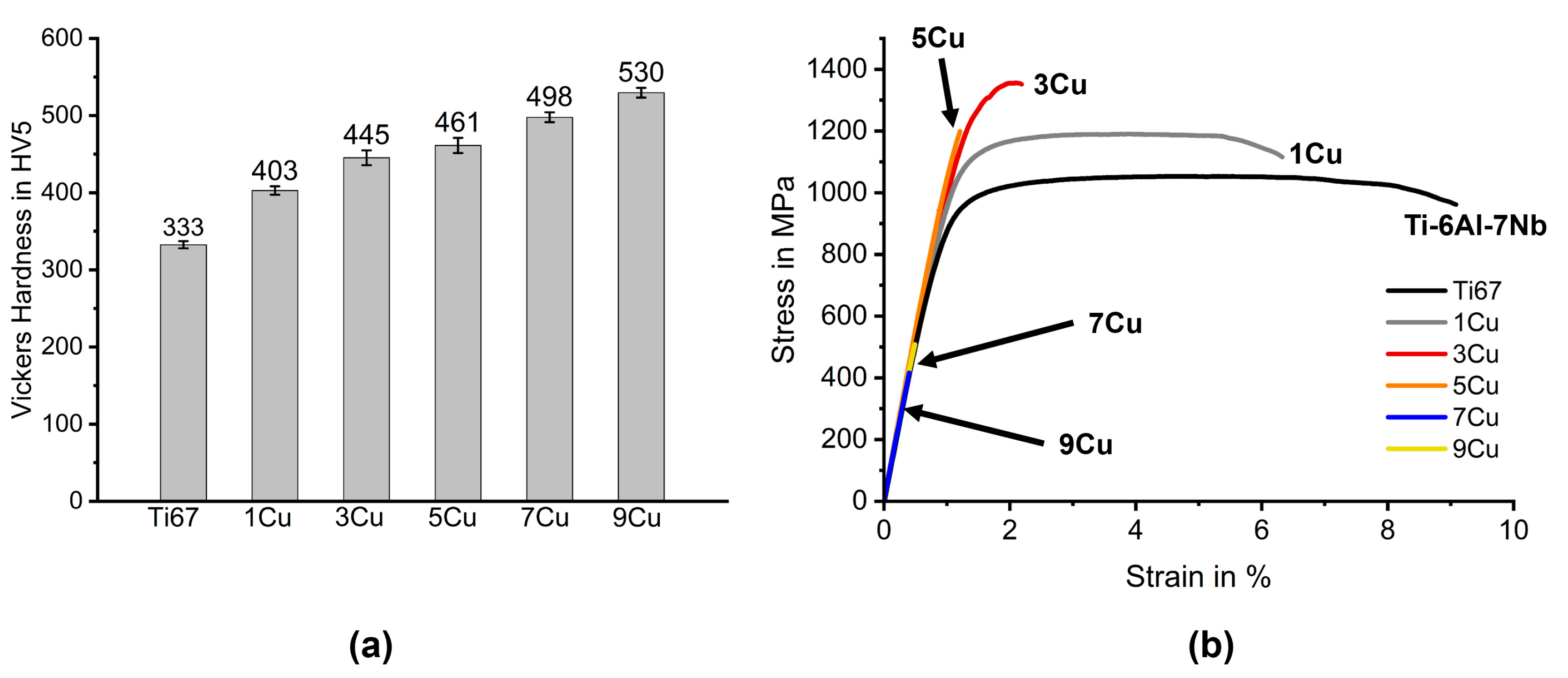
Figure 6 demonstrate that copper addition can lead to a significant increase in both hardness and yield strength, with the payoff of a dramatically reduced elongation at break, which will be discussed in detail later. The hardness of the unmodified Ti-6Al-7Nb reference was measured at 333 ± 2 HV5, whereas the addition of 9 wt.% copper increased by approximately 60%, reaching around 533 ± 6 HV5. The increase in hardness was found to be nearly linear, at approximately +15 HV5 per wt.% Cu. In all cases, the calculated standard deviation remained below 3% of the respective mean value. Tensile testing results show the strengthening effect mediated by copper on the yield stress to a certain degree for 1Cu, 3Cu and 5Cu, while failure on samples of 7Cu and 9Cu took place far below the yield strength of pure Ti-6Al-7Nb.
For illustration and ease of comparison, the most representative stress–strain curve obtained from tensile testing for each copper addition, as well as for unmodified Ti67, is presented. Furthermore, the copper addition exerts only a minor influence on Young’s modulus, which increases from approximately 105 GPa for Ti-6Al-7Nb to a maximum of 111 GPa for 5Cu, before decreasing again for 7Cu and 9Cu.
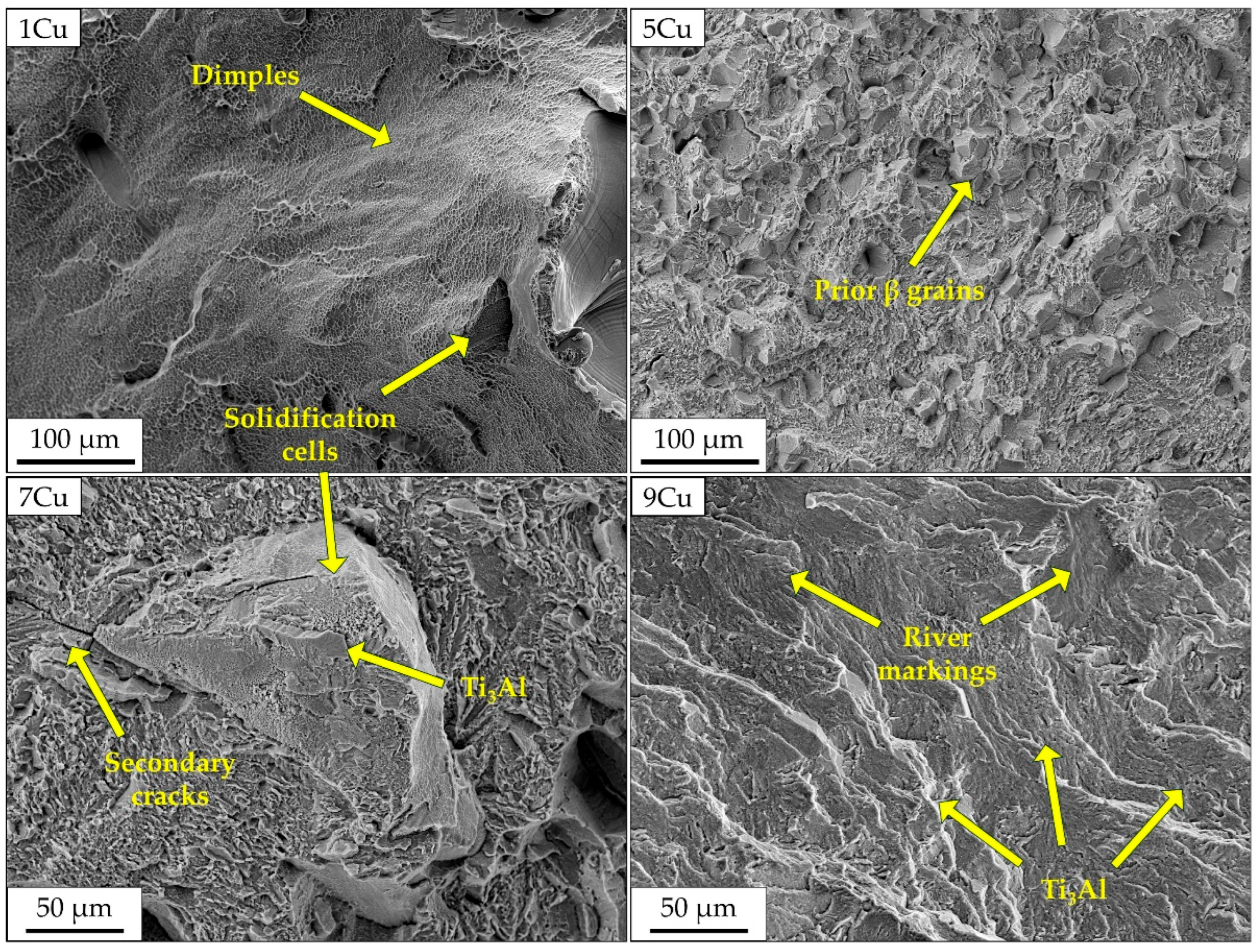
SEM analysis of the fracture surfaces was conducted to investigate the underlying causes of the reduced elongation at break, confirming that the copper addition induces a transition from ductile to brittle fracture behaviour. Fracture surfaces of samples with low copper contents are characterised by intergranular fracture along prior β grain boundaries, whereas those with higher copper content exhibit brittle fracture with transgranular features and facets oriented nearly perpendicular to the loading direction.
As shown in
Figure 7, the fracture surface of the 1Cu alloy displays a high density of ductile dimples distributed across most of the surface, interspersed with various defects. Additionally, scattered across the 1Cu fracture surface are regions exhibiting solidification morphologies that lack evidence of plastic deformation and are therefore identified as solidification cracks. The incidence of hot cracking increases significantly in 3Cu and 5Cu, with deep secondary cracks also becoming apparent at the interface with the neighbouring bulk material with lower copper content.
Regarding the fracture mode, the transition from ductile to brittle occurs at 5 wt.% Cu, with both brittle and ductile features visible in the fracture surfaces of 5Cu as shown in
Figure 7. Small dimples indicating a ductile fracture mode can be seen on prior β grains, indicating intergranular fracture right beside transgranular flat cleavage facets with a size of just a few microns. As expected from the tensile tests, the fracture surfaces of 7Cu and 9Cu exhibit no dimples or areas of plastic deformation. Occasional intercrystalline features on these samples are covered with solidification cells rich in copper, as determined via EDS.
As visible in
Figure 7 the fracture surface of 9Cu is characterised by flat feathery cleavage facets with river markings, separated by cleavage steps. To further clarify the phase constitution of these brittle fracture regions, additional spot EDS analyses were performed. Contrary to the initial assumption that Ti
2Cu might form and promote embrittlement, the analysed areas of the 7Cu and 9Cu samples contained less than 14.5 at.% Cu. Instead, the measured compositions were dominated by Ti and Al with atomic ratios close to 1:1 and 3:1, corresponding to the intermetallic phases TiAl and Ti
3Al. Regions showing these Ti-Al-rich phases are highlighted in
Figure 7 to enhance clarity.
4. Discussion
4.1. Parameter Studies and Processability
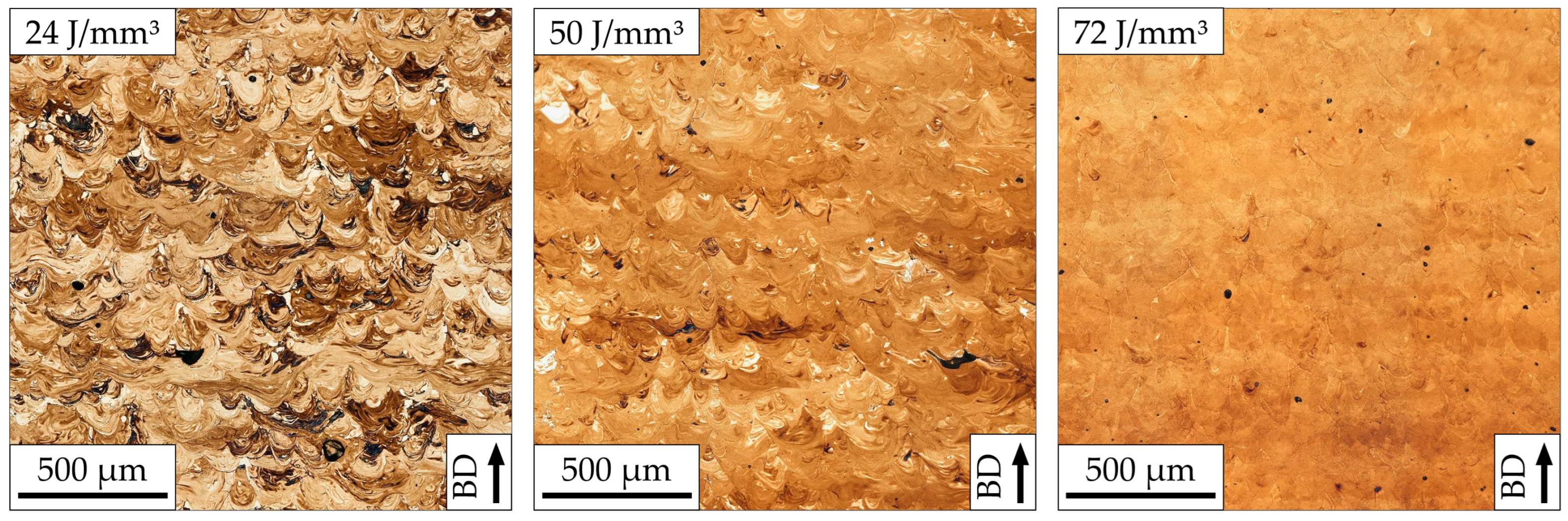
While parameter studies are generally conducted to identify conditions that ensure low porosity at high build rates, in situ alloying additionally requires achieving sufficient chemical homogeneity, particularly effective mixing of the alloying elements. Initially, we assumed that the influence of processing parameters on the degree of mixing would be of secondary importance. This expectation was based on earlier work on in situ alloying and mixed-powder systems, where chemical homogenization was primarily governed by post-processing heat treatments rather than melt-pool dynamics. Consequently, solution annealing was considered essential for obtaining a uniform copper distribution. However, subsequent microstructural investigations contradicted this assumption. As demonstrated in
Figure 8, distinct differences in homogeneity arise solely from variations in processing parameters, confirming that energy density significantly affects mixing by altering melt-pool size and residence time. Since 1Cu and 3Cu were produced with lower energy densities than 5Cu, 7Cu, and 9Cu, their etched micrographs (
Figure 4) show larger and more numerous copper-rich regions, whereas the higher-energy-density conditions used for the higher-Cu powders result in markedly improved mixing. This trend reflects the higher energy required to achieve dense samples at increasing copper contents, most probably due to copper’s higher specific heat capacity and greater reflectivity at the laser wavelength of 1064 nm [
43].
As previously shown in
Figure 4, the degree of mixing in 1Cu differs significantly from that in 9Cu. Etched samples of 3Cu indicate that this difference arises from the higher laser power and lower scanning speed used for powders with greater copper content, leading to a larger melt pool and longer residence time. For comparison,
Figure 8 presents micrographs of samples produced with processing parameters at the lower, medium, and upper ends of the volume energy density range.
Even though PBF-LB/M manufactured parts from titanium often require post-processing in the form of heat treatment to relieve residual stresses, an adjusted heat treatment that also homogenises the chemical composition after in situ alloying is both time-consuming and costly. Considering the strong interplay between chemical homogeneity and melt pool dynamics, processing mixed powders via PBF-LB/M at higher energy densities may prove more economical in terms of overall productivity, despite increasing the manufacturing time, as the need for extensive post-processing heat treatments could be drastically reduced.
Another key finding for in situ alloying of near-net-shaped manufacturing alloyed parts is the formation of an outermost layer containing Ti67 particles in a copper-rich matrix on all samples, attributed to the difference in melting temperature between Ti and Cu. Since titanium and copper can form an eutectic system at ≈70 wt.% Cu with a melting point ≈ 700 K below the liquidus temperature of Ti67, at some distance to the melt pool, the powder bed has a temperature of TCu, liq < Tbed < TTi, liq. In this area, copper particles melt and envelop Ti67 particles, adhering to the outermost layer. This results in the as-built roughness being relatively independent from the used processing parameters, but instead dependent on the processed powder and the amount of copper in it. In the case of functionally graded materials, this disadvantage in terms of surface roughness and dimensional accuracy could be compensated by the advantage of targeted accumulation of the low-melting alloy partner.
4.2. Phase Evolution and Morphology
Since the CALPHAD approach can only provide an estimate of the phase composition under equilibrium conditions, differences between the as-built state and the calculated phase diagram arise from kinetic effects. While the orthorhombic O-phase (Ti
2AlNb) was predicted to account for about 20 vol.% of the microstructure in equilibrium at room temperature for all investigated copper contents, no characteristic diffraction peaks were detected by XRD in the as-built condition; this absence is attributed to its relatively slow formation kinetics. Conversely, most of the copper precipitated as Ti
2Cu, as expected, owing to its extremely rapid formation kinetics and the in situ heat treatment occurring during the PBF-LB/M. Since metastable phases cannot be predicted via CALPHAD, no results concerning the extent of martensite formation or the retention of metastable β were generated. The combination of XRD and SEM investigations shows that 1Cu and 3Cu consist predominantly of α/α′ in the most recently processed layers, or of an extremely fine α + β microstructure in the lower regions of the samples, also attributed to the in situ heat treatment. Subsequently, significant amounts of metastable β were detected in 5Cu, 7Cu, and 9Cu together with Ti
2Cu, leading to the conclusion that the in situ heat treatment partially promoted the decomposition into fine α + Ti
2Cu structures, with a certain amount of copper remaining in solid solution and stabilising β-Ti in conjunction with Nb. While the strong reduction of the martensite start temperature by copper, as well as its rapid diffusion and the formation of Ti
2Cu, are well established, the temperature dependence of copper’s β-stabilising effect remains difficult to assess. Nevertheless, results from other studies [
26,
27,
28] and the observation that the extent of β stabilisation, as well as the fractions of retained β and Ti
2Cu formation, depend strongly on the in situ heat treatment, suggest that the temperature-dependent isomorphous or eutectoid character of copper is even harder to predict in ternary or higher-order titanium alloys. Supporting this approach, the broadening of peaks observed in the XRD data for 9Cu implies the beginning transition from hexagonal α′ to orthorhombic α″ martensite. Since recent investigations on binary alloys have shown that α″ martensite forms only when the atomic size difference between titanium and the alloying element is less than 9%, a criterion met by Ti–Nb but not by Ti–Cu, this provides a starting point for further studies of martensite formation in ternary or higher-order titanium alloys.
The extent and cause of the observed refinement of prior β grains in xCu alloys depend on the copper content. In 1Cu and 3Cu, only slight refinement of prior β grains is observed, with limited inhibition of epitaxial growth evident in copper-enriched regions, most likely due to the formation of brittle intermetallic phases and their differing lattice parameters compared to β-titanium. In contrast, 5Cu, 7Cu, and 9Cu, which exhibit improved mixing as a result of the higher energy density used during processing, show not only a more homogeneous copper distribution but also significantly enhanced grain refinement and a strong columnar-to-equiaxed transition (CET), as can be seen in
Figure 4 on the samples etched with KOH + H
2O
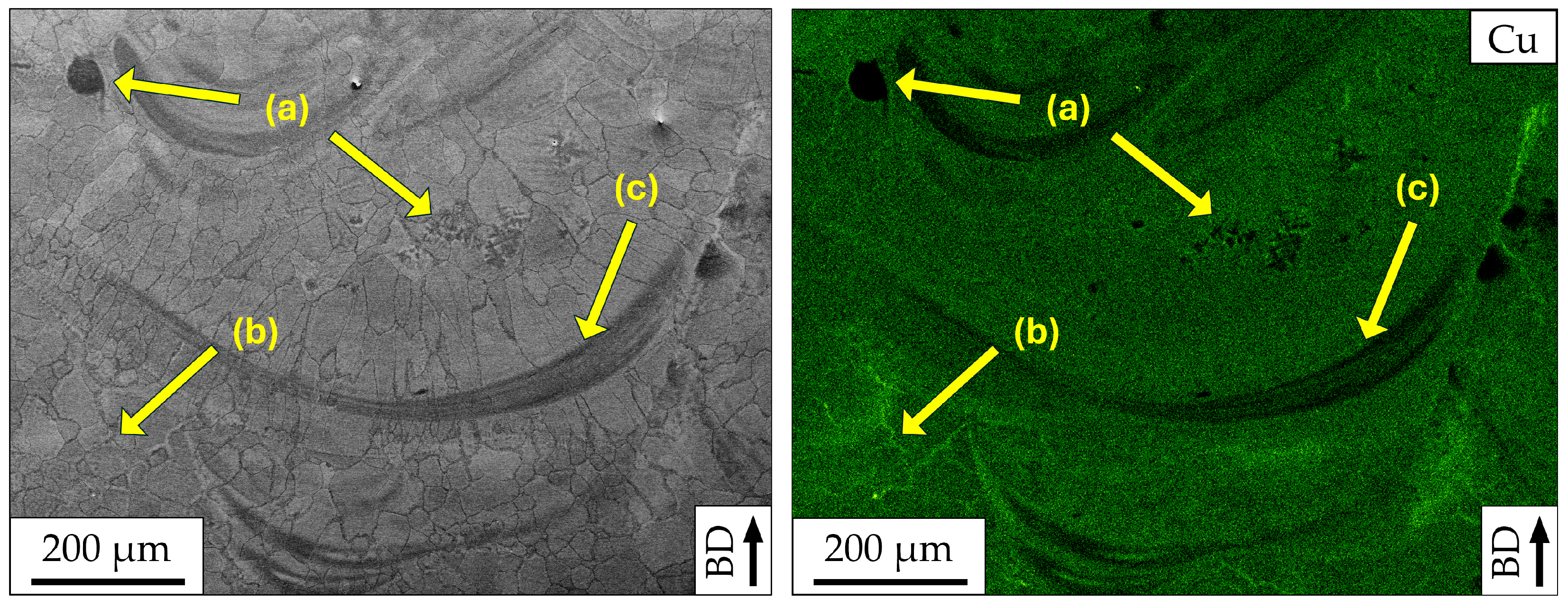
2. A depiction of the grain refinement observed in 9Cu is shown in
Figure 9. Possible causes are heterogeneous nucleation on partially molten Ti-6Al-7Nb particles and constitutional supercooling. CALPHAD equilibrium simulations propose that copper decreases the solidification temperature by approximately 500 K at 20 wt.%, leading to a strong confinement effect of β crystallites in a copper-enriched melt through constitutional supercooling (CS), ultimately inhibiting the epitaxial growth of β grains, as also proposed by Zhang et al. [
44].
This theory is further supported by EDS measurements, which indicate large differences in copper content between the centres and boundaries of the refined grains, as well as a stronger refinement effect in regions with higher copper content, and by LOM investigations of the uppermost layers in samples of 7Cu and 9Cu. Between these layers exhibiting dendritic solidification and β-grain refinement, some homogeneous layers with a different microstructure than in the lower part identified as α + β + Ti2Cu are apparent. Based on LOM and EBSD, as well as on the broadening of the (1 0 −1 1) and (2 −1 −1 0) peaks, we propose the following mechanism taking place in 5Cu, 7Cu, and 9Cu: Following dendritic solidification and the dissolution of copper, α″ martensite forms, which subsequently transforms into a fine microstructure of α + β + Ti2Cu as the temperature during reheating decreases sufficiently to allow the formation of the intermetallic phase. This process lowers the concentration of β-stabilising elements, thereby enabling the formation of α″. EDS measurements reveal significant elemental partitioning, with the β phase containing significant amounts of Cu in addition to Nb, which explains how retained β can coexist alongside α/α′. This proposed pathway is consistent with the observed microstructures, although the exact kinetics and the potential contribution of ultrafast diffusion or local segregation during PBF-LB/M remain subject to further investigation.
4.3. Mechanical Properties
Even though the employed in situ alloying strategy resulted in insufficient mixing, several insights regarding the mechanical properties and the influence of copper additions to Ti-6Al-7Nb can be drawn from the results. The observed increase in hardness with higher copper addition is attributed to a combination of solid solution strengthening, microstructural refinement, and precipitation hardening by finely dispersed Ti
2Cu particles. The inhomogeneous microstructure did not lead to a higher variation in hardness values. A possible compensatory mechanism in the copper-rich, softer or more brittle regions may be a locally higher content of intermetallic phases, enhanced precipitation hardening, and, overall, the inherently high hardness of intermetallic phases, e.g., microhardness of 700 HV5 reported for pure Ti
2Cu [
45,
46].
Subsequently, the brittleness of these phases likely accounts for the sharp decrease in elongation at break observed in tensile testing, which is accompanied by an increased presence of build defects such as liquation cracks and lack of fusion on the microscale; this conclusion is supported by the growing number of solidification cells seen on the fracture surfaces of samples with higher copper content. The cause of these microcracks and lack of fusion is probably the large difference in solidification temperature between Ti-6Al-7Nb and the eutectic point at approximately 65 wt.% Cu, exceeding 700 °C in equilibrium, and still more than 600 °C at 20 wt.% Cu. According to CALPHAD simulations, copper contents above 10 wt.% result in the formation of significant quantities of titanium aluminides. The proposed mechanism is that the formation of Ti2Cu leads to local enrichment of aluminium, which in turn promotes the formation of titanium aluminides. EDS analysis of cleavage facets on fracture surfaces of 7Cu and 9Cu revealed aluminium concentrations above 20 wt.%, indicating that the brittle fracture is caused by Ti3Al formation, thus further highlighting the major role that insufficient mixing of Ti-6Al-7Nb and copper plays in the embrittlement observed during tensile testing.




 ,
,