Abstract
Lapis lazuli is a valued gemstone that displays a wide spectrum of blue hues, yet the quantitative link between its color and internal sulfur speciation remains unresolved. This study integrates colorimetry with electron probe microanalysis and UV-Vis, Raman, and X-ray photoelectron spectroscopy to establish this relationship and build a robust grading framework within the CIE 1976 L*a*b* color space. X-ray diffraction was employed to determine the mineral composition and confirm that the chromogenic elements originated from lazurite. K-means clustering with Fisher’s discriminant validation classifies samples into four grades: Fancy Blue, Fancy Intense Blue, Fancy Deep Blue, and Fancy Dark Blue. Multimodal analyses identify three sulfur species—[S3]·−, S2−, and —and show that higher sulfur content correlates with lower lightness, reduced chroma, and a violetish-blue shift. [S3]·− is confirmed as the dominant chromophore, producing the strong 600 nm absorption that defines the blue hue. A weak absorption band observed near 400 nm in some samples can be attributed to S2− and species, but no visually perceptible effect of this band on the overall color was detected.
1. Introduction
Lapis lazuli is a rock composed of multiple minerals, characterized by a predominantly blue hue that ranges from a greenish-blue hue to a violetish-blue hue. At the same time, because of its rarity, value, and beauty, it is regarded as a gemstone. The principal mineral constituents of lapis lazuli are lazurite and diopside, and it sometimes contains accessory minerals such as calcite, pyrite, feldspar, and mica [1,2,3,4]. Its coloration is governed primarily by the mineral component lazurite, a sodalite-group mineral with an aluminosilicate framework enriched in multivalent sulfur species [5,6]. Significantly, sulfur exhibits coexisting species with multiple oxidation states, including S4, S6, [S2]·−,[S3]·−, , , , and S2−, where “·” means an unpaired electron [5,7,8,9,10,11,12]. Although lazurite exhibits a continuous gradient of blue tones, traditional color evaluation has long relied on subjective visual descriptions and lacks objective, quantitative standards.
In terms of color genesis, sulfides or sulfates in different valence states are thought to be directly associated with the diversity of mineral coloration mechanisms, with most suggesting that the abundant presence of [S3]·− leads to the dark blue color of lapis lazuli [13,14,15], while yellow and orange may be associated, respectively, with [S2]·−, S and (n > 2) [5,6,16], and the green coloration may result from the synergistic interaction of radical pairs such as [S2]·− and [S3]·− or [S2]·− and [5]. On the other hand, a positive correlation between the intensity of the broadband with a maximum around 600 nm and the concentration of another blue color-generating chromophore, the radical anion, has been reported [17]. The stable presence of sulfur species as a natural “redox indicator” is directly related to physicochemical parameters such as the oxygen fugacity and sulfur activity of the mineralized fluids [13]. Meanwhile, the strong stability of the radical anion [S3]·− in both chemical structure and color retention has led to the widespread use of lapis lazuli as a pigment in artworks [18,19,20]. However, the chromatic role of sulfur species and their specific correspondence with spectroscopic features and observed colors remain unclear.
In recent years, the CIE 1976 L*a*b* system has played an important role in the study of gemstones, making a unique contribution to the color genesis of gemstones and color grading [21,22]. By numerically simulating human visual responses, it effectively represents perceived color as seen by the human eye [22].
This study employs the CIE 1976 L*a*b* uniform color space to quantitatively evaluate chromatic parameters. X-ray diffraction (XRD) was used to determine the mineral composition of lapis lazuli. In parallel, electron probe microanalysis (EPMA), UV-Vis spectroscopy, Raman spectroscopy, and X-ray photoelectron spectroscopy (XPS) are integrated to investigate the color origins. This study combines gemological colorimetry and spectroscopy to analyze the relationship between lapis lazuli’s color, its spectral characteristics, and its elemental composition. It provides reproducible and comparable quantitative data that builds upon prior research. This work aims to fill the gap in quantifying how sulfur species correspond to color mechanisms and also provides a new reference for the color grading of lapis lazuli in gemology.
2. Materials and Methods
2.1. Samples
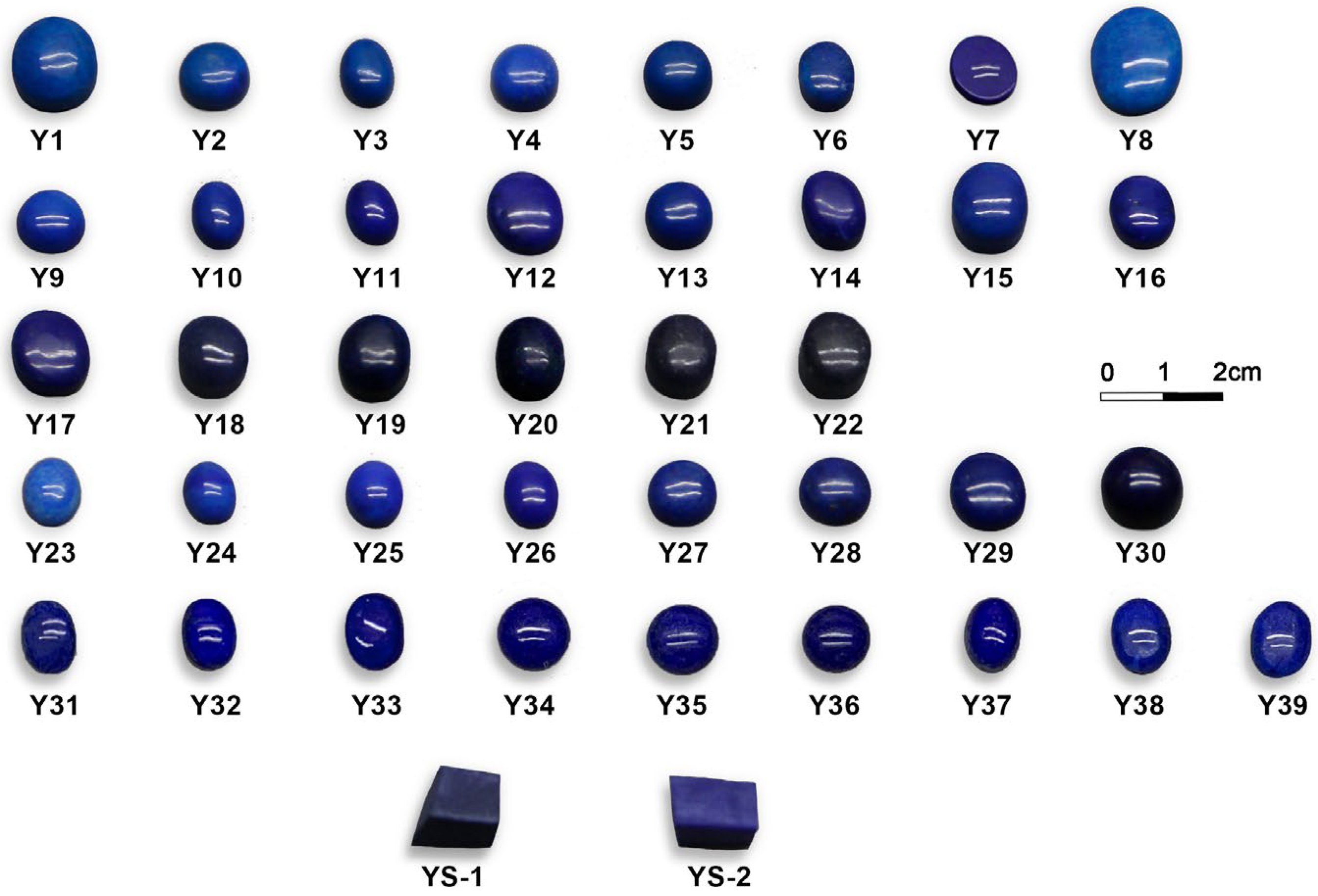
Since lapis lazuli is a polycrystalline aggregate, special attention was given to ensure accuracy and consistency in color measurements. A total of 41 natural lapis lazuli samples were selected with the criterion that no visible or only minimal pyrite and calcite inclusions were present within a 7 mm diameter area—matching the aperture size of the colorimeter. The samples exhibit uniform surface coloration, optical-grade polish, and a continuous color spectrum from light to deep blue. Sample sizes range from 7 mm to 12 mm, with representative examples shown in Figure 1.
Figure 1.
Photograph of the lapis lazuli samples used in this study, taken under a D65 light source.
2.2. Colorimetric Measurements
Colorimetric measurements were performed using an X-Rite SP62 portable spectrophotometer (X-Rite Corporation, Grand Rapids, MI, USA) equipped with a D65 standard illuminant (correlated color temperature: 6504 K), which serves as the industry benchmark for gemstone color evaluation. The experimental parameters were configured as follows: Color data were obtained using the reflectance method. The instrument was calibrated for black and white color before the experiment, and the results of each lapis lazuli specimen were averaged after three measurements of reflectance mode with specular component excluded (SCE), a 2° standard observer angle, and a 400–700 nm spectral range (10 nm interval resolution).
In this uniform color space, colors are defined by three parameters: lightness L* and chromaticity coordinates a* and b*. L* (0–100) denotes brightness from black to white; a* (−120 to +120) spans green (−) to red (+); and b* (−120 to +120) spans blue (−) to yellow (+). Chroma C* measures saturation—higher C* equals more vivid color—and hue angle h° specifies the color’s type. C* and h° are calculated directly from a* and b*, where
In 2001, the CIE introduced the CIEDE2000 (ΔE00) color-difference formula. In this formula, ΔL, ΔC, and ΔH denote differences in lightness, chroma, and hue. The rotation term RT handles chroma–hue interactions in blue regions, while SL, SC, and SH correct for nonuniformity in the CIE L*a*b* space. The weighting factors KL, KC, and KH adjust for viewing conditions; for print applications, KL = KC = KH = 1. The formula is as follows:
2.3. Mineralogical and Compositional Study
Lapis lazuli samples YS-1 and YS-2 were ground into 200-mesh powder for X-ray diffraction analysis and testing. The XRD spectra were obtained by an Empyrean Intelligent X-ray Diffractometer (Malvern Panalytical B.V., Almelo, The Netherlands). Test conditions were as follows: CuKα, tube voltage: 60 kV, tube current: 100 mA, 8°/min scanning speed, and picking step width: 0.02°. XRD data were analyzed for phase identification using the International Centre for Diffraction Data (ICDD) PDF-2 database.
The chemical composition of the surfaces of the lapis lazuli samples was analyzed using an EMPA-1720 instrument (Shimadzu Corporation, Kyoto, Japan). The test samples were coated with a 20 nm carbon layer on the surface. Measurements were performed at an accelerating voltage of 15 kV, a beam current of 20 nA, and a spot diameter of 5 μm. The following certified standards were employed for quantification: Si-diopside, Ca-diopside, Al-chr, Mg-olivine, Na-albite, K-sanidine, S-Barite, Ti-Rutile, Fe-Garnet , and Cl-Tugtupite. The wavelength-dispersive spectrometry system was equipped with RAP-, PET-, and LiF-diffracting crystals. The peak counting times were 20 s for major elements and 10 s for background measurements, which were performed on both sides of each peak. The ZAF method was applied for matrix correction, and the detection limit for conventional elements was 0.01 wt.%.
2.4. Spectroscopic Study
Raman spectroscopy tests were performed using thin sections of YS-1 and YS-2. The instrument model was the HR-Evolution laser micro-Raman spectrometer (HORIBA Scientific, Edison, NJ, USA). and the testing conditions were as follows: testing temperature: 25 °C, humidity: 50%, testing range: 100–2000 cm−1, scanning number: 3 times, a laser scanning spot of 1 μm, a laser wavelength of 532 nm, a laser power of 20 mW, and a resolution of 1–2 cm−1.
Samples YS-1 and YS-2 were selected for X-ray photoelectron spectroscopy analysis, with no ion etching performed for surface cleaning. The XPS spectra were acquired using a Thermo Scientific EscaLab 250Xi X-ray photoelectron spectrometer (Thermo Fisher Scientific, Waltham, MA, USA). A monochromatic Al Kα source (50 W power) was used, with a standard beam spot of 500 μm, an ultrahigh vacuum of 5 × 10⁻¹⁰ mbar in the analysis chamber, and an energy resolution sufficient to resolve the Ag 3d5/2 peak. High-resolution spectra of S 2p were recorded using a narrow-area scan. The C 1s peak (284.80 eV) was used as a reference for binding energy calibration across the spectrum, and the scanning range for S 2p was set from 156 eV to 176 eV. The S 2p spin–orbit doublet was deconvoluted and fitted using the Thermo Avantage software (v5.9921), with the doublet separation between S 2p3/2 and S 2p1/2 fixed at 1.2 eV and an intensity ratio of 2:1.
The UV-Vis spectrophotometer is a non-destructive and rapid means of detection for exploring the cause of the color of the gemstone. The instrument model is Shimadzu UV-3600 (Shimadzu Corporation, Kyoto, Japan). The wavelength range is 360–800 nm. The reflection method is scanned at a medium speed. The diffuse reflectance of the sample is measured and converted by the absorbance formula, where A is the absorbance and R is the diffuse reflectance:
3. Results
3.1. Colorimetric Quantification and Classification
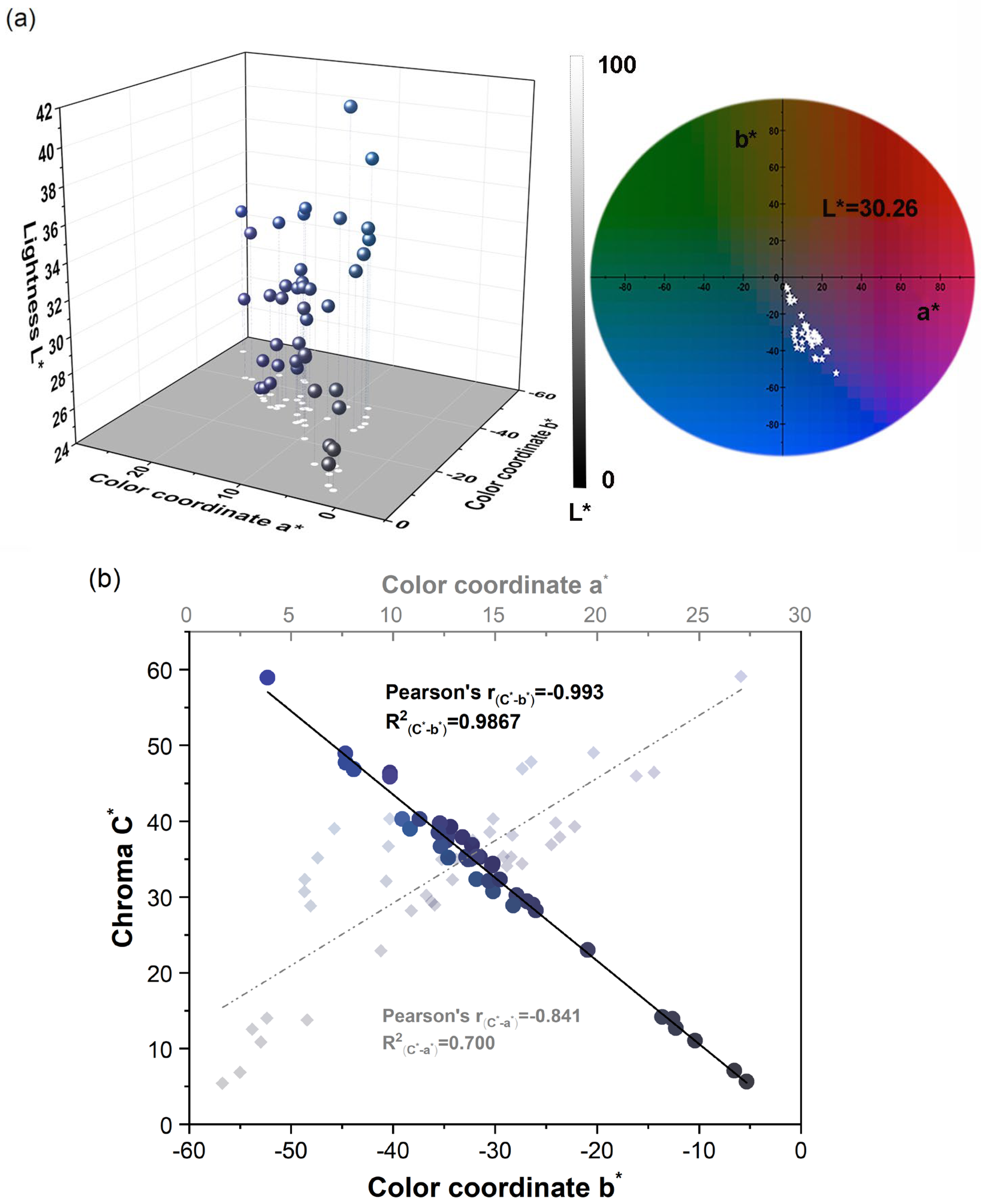
The color characterization of 41 lapis lazuli samples was carried out under the D65 standard light source, and the ranges of lightness L* (24.42–41.96), colorimetric coordinate a* (1.78–27.13), colorimetric coordinate b* (−52.3–−5.34), chroma C* (5.63–58.92), and hue angle h° (280.33–299.57) were determined. The color parameters of the 41 lapis lazuli samples were projected onto the CIE1976 L*a*b* uniform color space (Figure 2a), where L* is used as the z-axis, a* as the x-axis, and b* as the y-axis, and the projection point is the simulated color of the lapis lazuli samples. The chroma C* is expressed as the distance from the projection point to the origin, and the hue angle h° is expressed as the angle between the line from the projection point to the origin and the +a* axis. The results show that all 41 lapis lazuli samples are blue, but to different degrees, with colors ranging from light blue to dark blue. Pearson’s correlation analysis measures the relationships between color parameters. An absolute Pearson correlation coefficient (r) value closer to one indicates a stronger correlation. The standard error (SE) in this study employs the Bootstrap method based on 1000 resamples to evaluate the reliability and accuracy of the correlation coefficients. Analysis of 41 lapis lazuli samples (Figure 2b) revealed that chroma C* is strongly negatively correlated with b* (r = −0.993, R2 = 0.9864, SE = 0.003) and only moderately correlated with a* (r = 0.844, R2 = 0.706, SE = −0.006), suggesting that C* is primarily influenced by b*. Therefore, lapis lazuli appears predominantly blue, often with a slight violet tint, and its chroma is primarily determined by its blue coloration.
Figure 2.
The color analysis of lapis lazuli. (a) The 3D plot displays the color distribution of 41 samples in the CIE 1976 L*a*b* color space, with sphere colors generated based on their measured color parameters. (b) A strong negative correlation is observed between color coordinate b* and chroma C*, with a bootstrap standard error of 0.003.
Partial correlation analysis reveals the true relationship between two variables by controlling for other influences. The absolute value of the partial correlation coefficient r near 1, with a p-value less than 0.05, indicates a statistically significant relationship. Table 1 shows that, when controlling for chroma C*, there is a strong negative correlation between lightness L* and hue angle h°, and when controlling for the hue angle h°, there is a strong positive correlation between lightness L* and chroma C*. Therefore, as the lightness of lapis lazuli increases, the chroma also increases, while the hue angle decreases, corresponding to a brighter and more saturated blue color.
Table 1.
Partial correlation between lightness, chroma, and hue angle.
Based on the CIE1976 L*a*b* uniform color space system, K-means cluster analysis and Fisher’s discriminant analysis are widely used in gemology [21]. Therefore, K-means was used to classify the color of lapis lazuli samples; then Fisher’s discriminant analysis was used to establish discriminant formulas and discriminant criteria, facilitating the subsequent types of new samples.
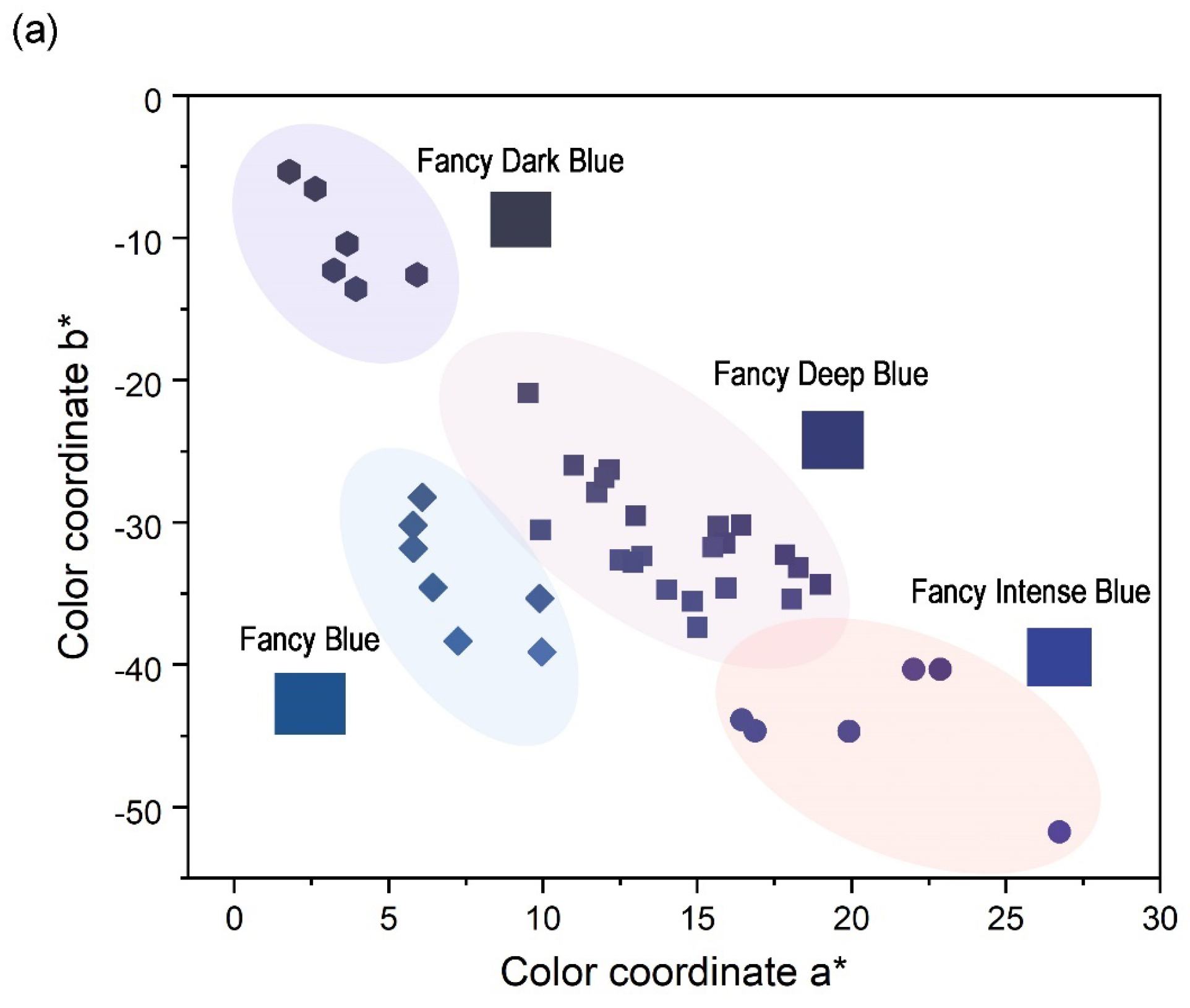
After K-means cluster analysis, according to their lightness L*, as well as parameters a* and b*, the lapis lazuli samples are classified into four grades, as shown in Table 2 and Figure 3a.
Table 2.
K-means clustering classification results for 41 samples and color difference (ΔE00) between different clusters.

Figure 3.
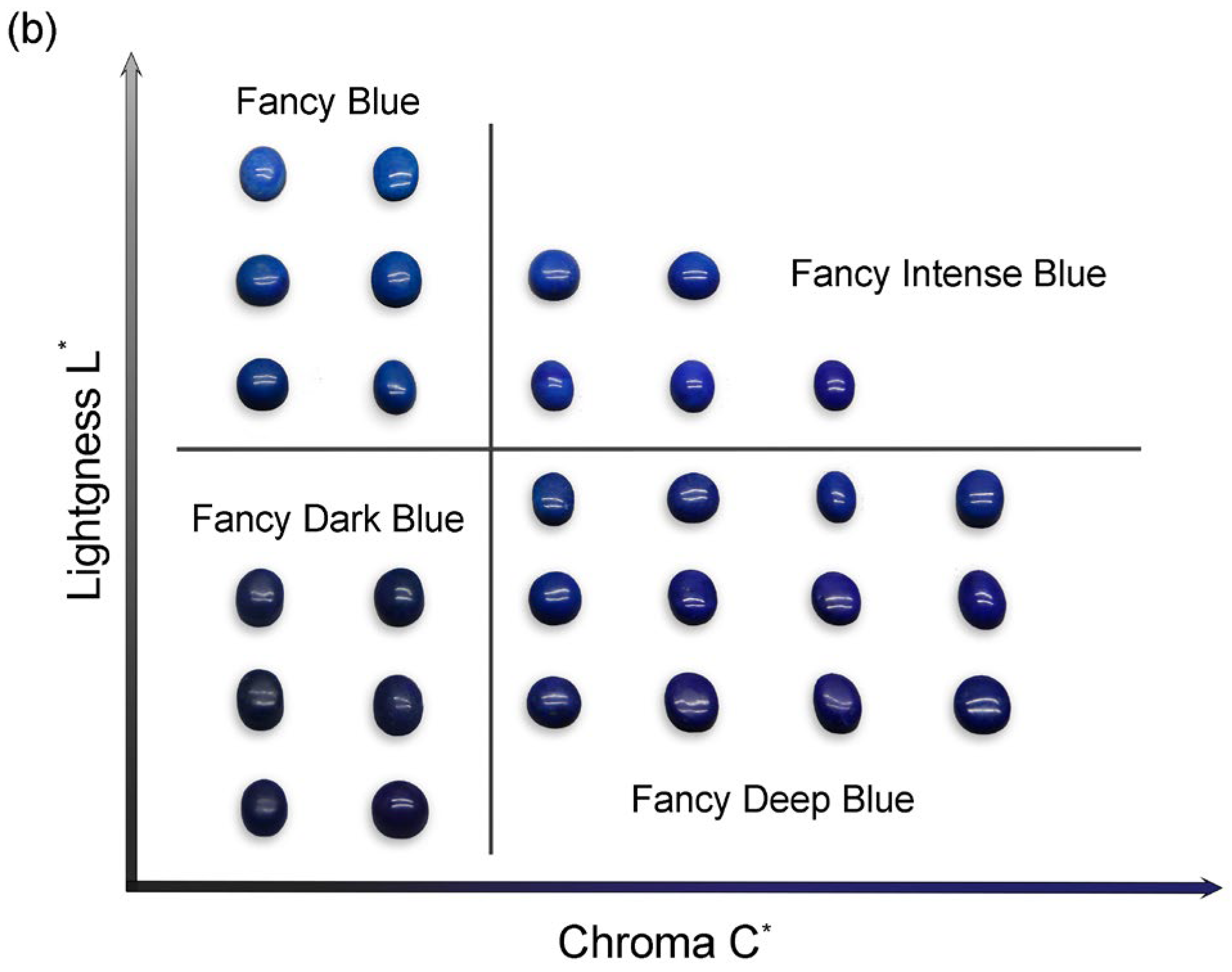
Lapis lazuli color is divided into four grades: Fancy, Fancy Intense, Fancy Deep, and Fancy Dark. (a) Cluster distribution plotted on coordinate a* and coordinate b*. (b) Arrangement of sample classifications.
These four classes of lapis lazuli are analyzed using Fisher’s discriminant analysis, and the discriminant formulas are as follows:
F1 = 9.082 L* − 4.156 a* + 1.757 b* − 149.913
F2 = 9.069 L* − 6.140 a* + 1.893 b* − 172.112
F3 = 8.482 L* − 5.527 a* + 2.350 b* − 126.016
F4 = 9.272 L* − 5.573 a* + 3.944 b* − 115.366
The clustering results were verified by applying the Fisher discriminant formula to the color parameters L*, a*, and b*. Among 41 data sets, one was misclassified, resulting in a color data accuracy of 97.60%, further demonstrating the clustering model’s effectiveness. Based on the K-means clustering and Fisher discriminant analyses and modeled after the Gemological Institute of America’s colored-diamond grading system, lapis lazuli is categorized into four grades, (i) Fancy Blue, (ii) Fancy Intense Blue, (iii) Fancy Deep Blue, and (iv) Fancy Dark Blue, with hue angles ranging from 280.33° to 299.57°. The result of the lapis lazuli color grade is presented in Figure 3b.
According to the CIE L*a*b* uniform color space, color differences (ΔE) between 3.0 and 6.0 are considered perceptible, while values greater than 6.0 are easily distinguishable [23]. To better align with human visual perception of color differences, the four cluster centers derived from the K-means algorithm were adopted as reference points. The CIEDE2000 color difference formula (ΔE00) was employed to calculate the color differences between the four pairs of cluster centers. The results, which were all found to be greater than 6.0, confirm that the color distinctions between each category are readily perceptible (Table 2). This finding further validates the accuracy and perceptual consistency of the classification results.
3.2. Mineral Composition Analysis
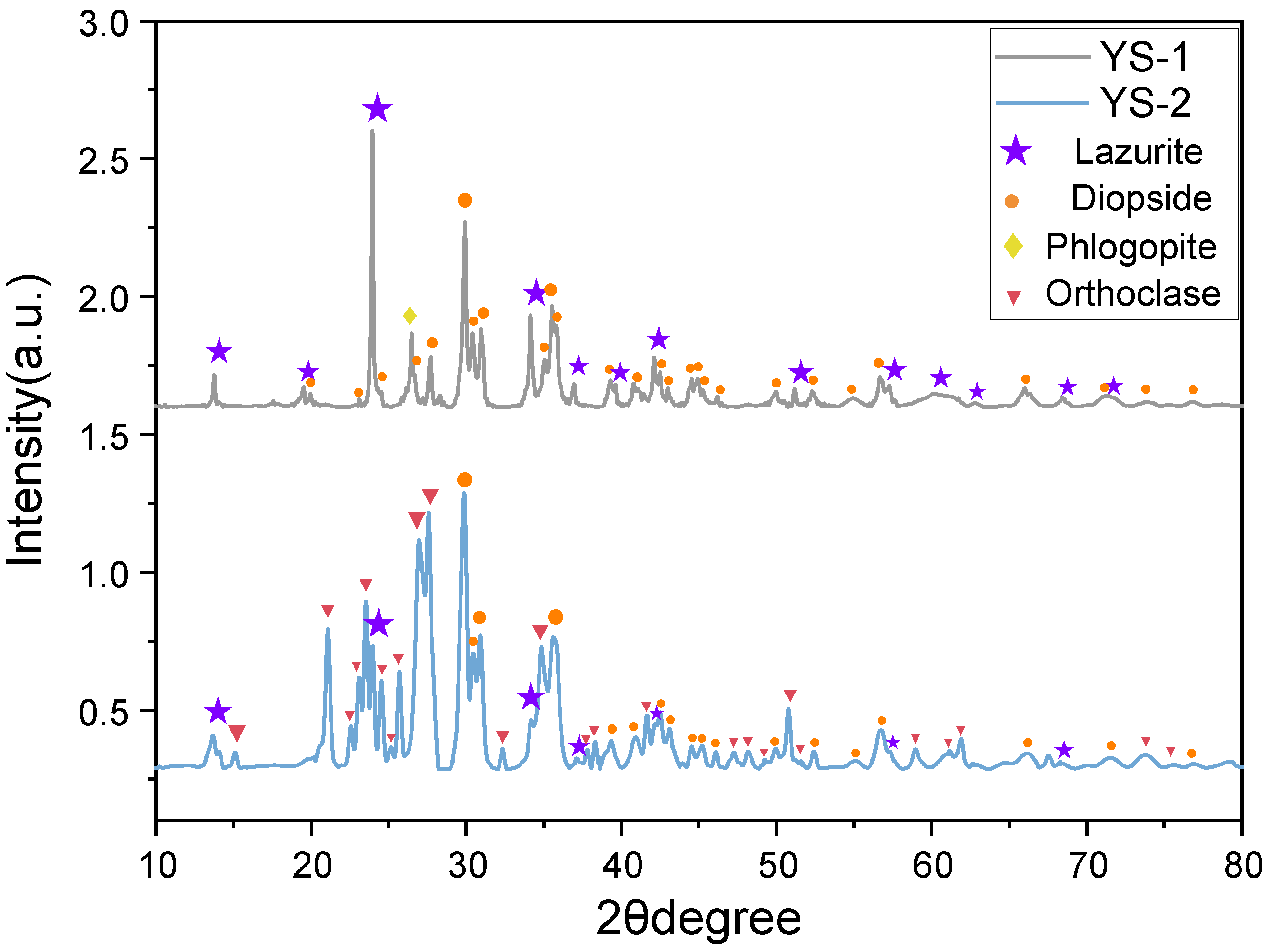
Based on XRD analysis and comparisons with the PDF powder diffraction database, the primary minerals in sample YS-1 are lazurite and diopside, along with a minor composition of phlogopite. Sample YS-2 consists of lazurite, diopside, and orthoclase (Figure 4). It can be known from the mineral composition that only lazurite causes lapis lazuli to appear blue.
Figure 4.
XRD pattern of samples YS-1 and YS-2. The identified phases of YS-1 are lazurite (PDF #77-1702), diopside (PDF #83-1392), and phlogopite (PDF #10-0495). The identified phases of YS-2 are lazurite (PDF #77-1702), diopside (PDF # 75-1092), and phlogopite (PDF #71-0957).
3.3. Chemical Elemental Composition Analysis
To investigate the factors influencing the color of lapis lazuli, representative samples were selected from the four pre-classified color grades. The selection aimed to ensure low color variation within each grade and high color contrast between different grades. A total of nine samples were chosen, with three samples selected from the “Fancy Deep Blue” grade (the largest group, n = 22) to better represent its larger internal variation and two samples from each of the other three grades (each group, n = 6–7). The color differences between the selected samples were quantified using the CIE DE2000 formula (ΔE00). The pairwise ΔE00 values between sample groups ranged from 5.6 to 17.5. With only one inter-group value being 5.6 and all others exceeding 6.0—a threshold for perceptible differences—the selected samples provide a basis with clear inter-group distinctions for subsequent analyses.
We used a combination of EPMA and Energy-dispersive spectroscopy (EDS) by aligning the test surface with the color measurement area. Using electron microprobe spot analyses for lazurite, the mineral responsible for the blue coloration, yielded the following oxide weight percent ranges (wt.%): SiO2: 36.78–43.01, Al2O3: 27.84–36.01, Na2O: 5.59–14.77, CaO: 0.18–8.15, K2O: 0.15–7.79, and SO3: 11.79–23.22. Lower amounts of Cl (0.24–1.41), TiO2 (0.00–0.55), and FeO (0.00–0.15) were found.
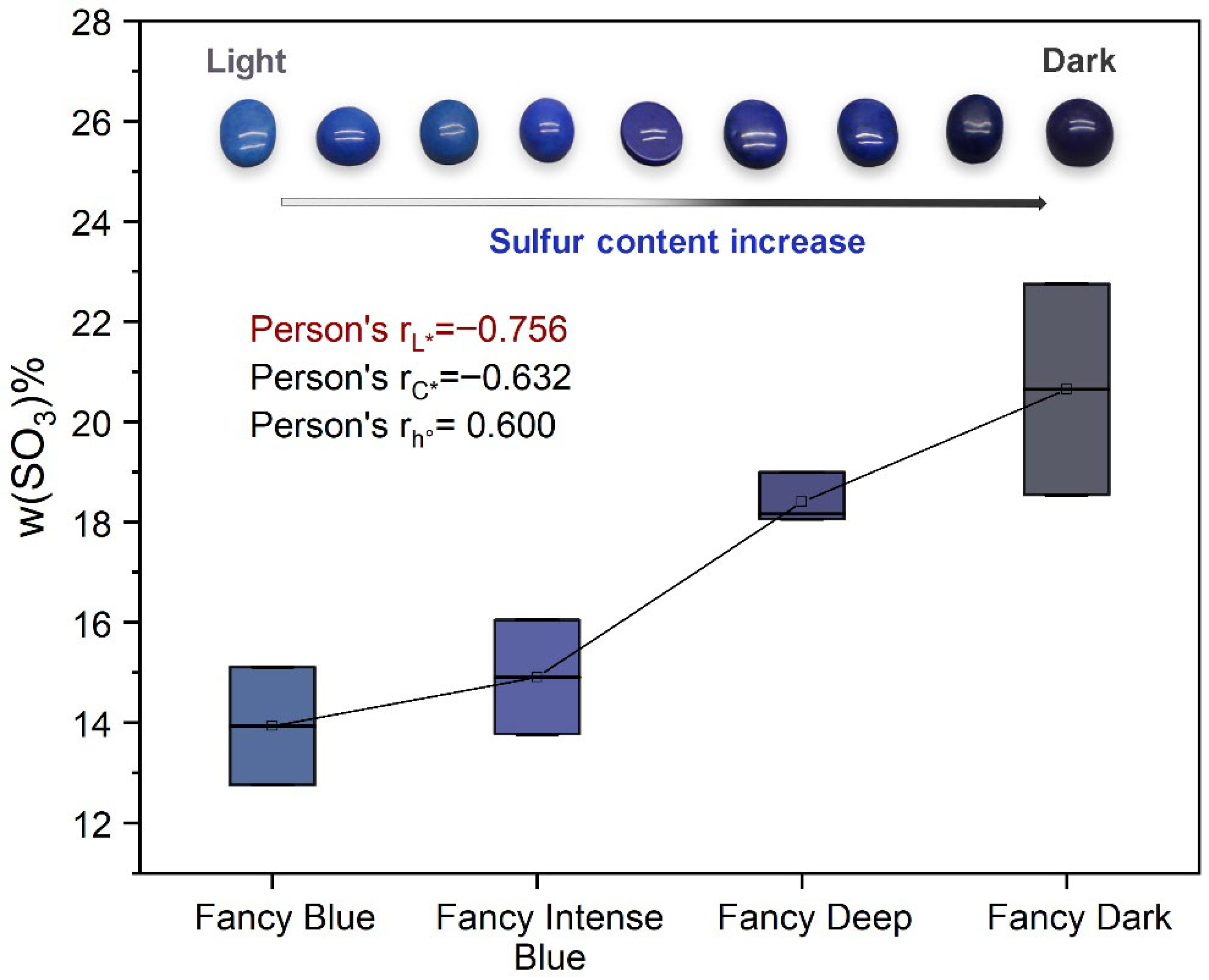
For each sample, three distinct lazurite points were selected for analysis, and the sulfur content—responsible for the mineral’s coloration—was measured and averaged to investigate the relationship between sulfur concentration and color appearance. Results reveal significant sulfur variation across color grades, with darker samples containing higher sulfur concentrations (Figure 5). Pearson’s correlation analysis between sulfur content and colorimetric parameters (lightness L*, chroma C*, and hue angle h°) showed the strongest negative correlation with lightness (r = −0.756, R2 = 0.572, and SE = 0.172). This indicates that elevated sulfur levels produce darker tones, reduced chroma, and a spectral shift toward violet.
Figure 5.
Relationship between four color grades and w(SO3) in nine lapis lazuli samples: sulfur content negatively correlates with lightness L* (r = −0.756, R2 = 0.572, and SE = 0.172) and chroma C* (r = −0.632, R2 = 0.399, and SE = 0.191) and positively with hue angle h° (r = 0.600, R2 = 0.360, and SE = 0.217). Samples are arranged left to right by decreasing lightness (increasing sulfur content).
3.4. Spectroscopic Identification of Chromophores
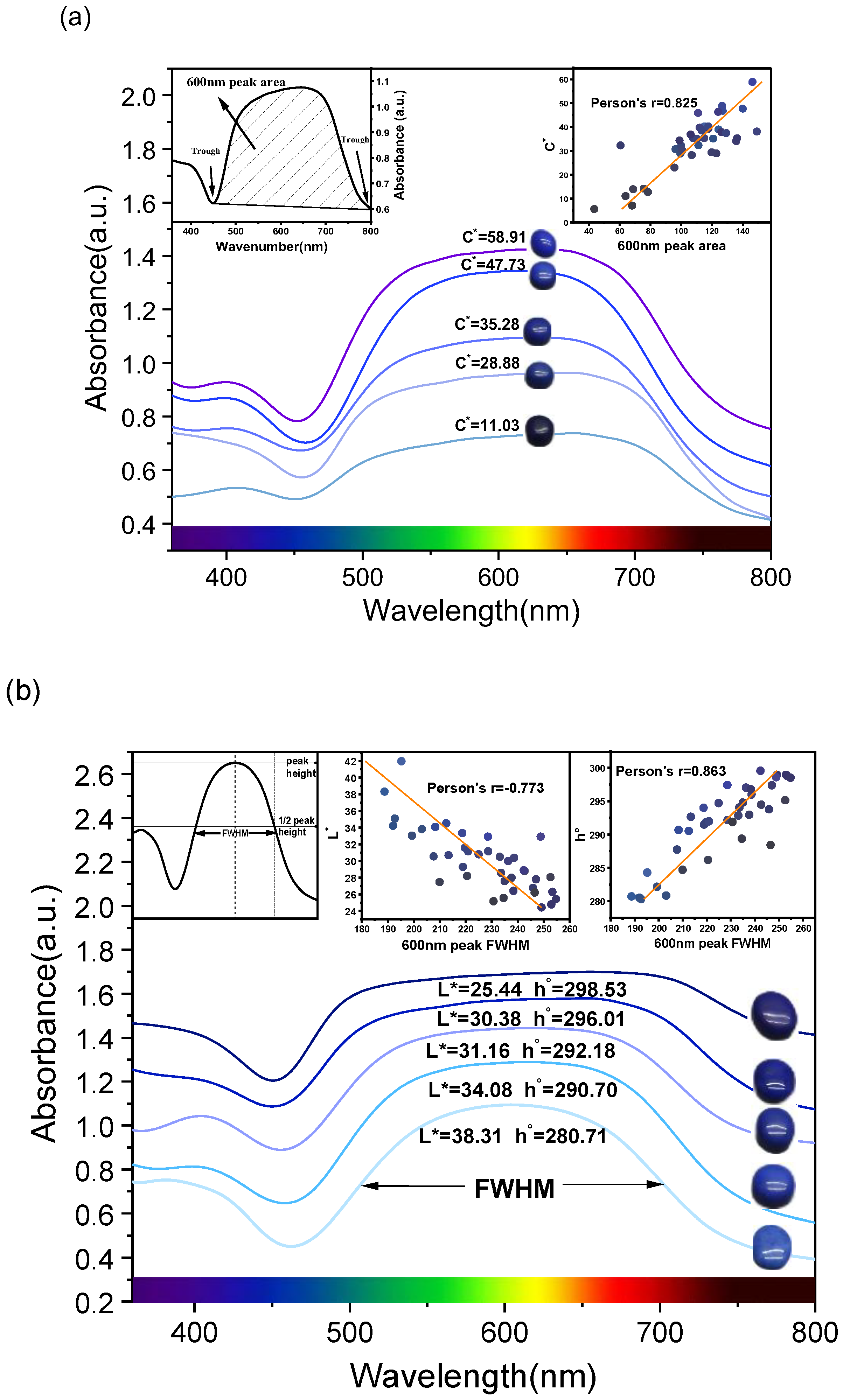
Sulfur is the primary chromophore in lapis lazuli, and it occurs in multiple valence states and chemical forms. The UV-Vis spectra show that all samples exhibit a broad absorption band around 600 nm in the visible region, with some samples also displaying a weak absorption peak at 400 nm. The broad absorption band at 600 nm is attributable to [S3]·−, while the weak absorption peak at 400 nm likely originates from sulfur species, with detailed assignment to be substantiated in the Section 4 through subsequent experimental analyses. Only the broad absorption band at 600 nm exhibits a significant correlation with lapis lazuli’s colorimetric parameters.
Notably, the area of the broad absorption band around 600 nm shows a significant positive correlation with chroma C* (Pearson’s r = 0.825, R2 = 0.681, SE = 0.069), indicating that a larger absorption area corresponds to stronger chroma (Figure 6a). Meanwhile, the full width at half maximum (FWHM) of the absorption peak at 600 nm correlates (Figure 6b) positively with hue angle h° (Pearson’s r = 0.863, R2 = 0.748, and SE = 0.050) and negatively with lightness L* (Pearson’s r = −0.773, R2 = 0.598, and SE = 0.068).
Figure 6.
Correlation between the spectral characteristics of the 600 nm absorption band and the color parameters of lapis lazuli. (a) The spectral area of the 600 nm absorption band correlates positively with chroma C* (Pearson’s r = 0.825, R2 = 0.681, and SE = 0.069). (b) The width of the 600 nm absorption band exhibits a negative correlation with lightness L* (Pearson’s r = −0.773, R2 = 0.598, and SE = 0.068) and a positive correlation with hue angle h° (Pearson’s r = 0.863, R2 = 0.748, and SE = 0.050).
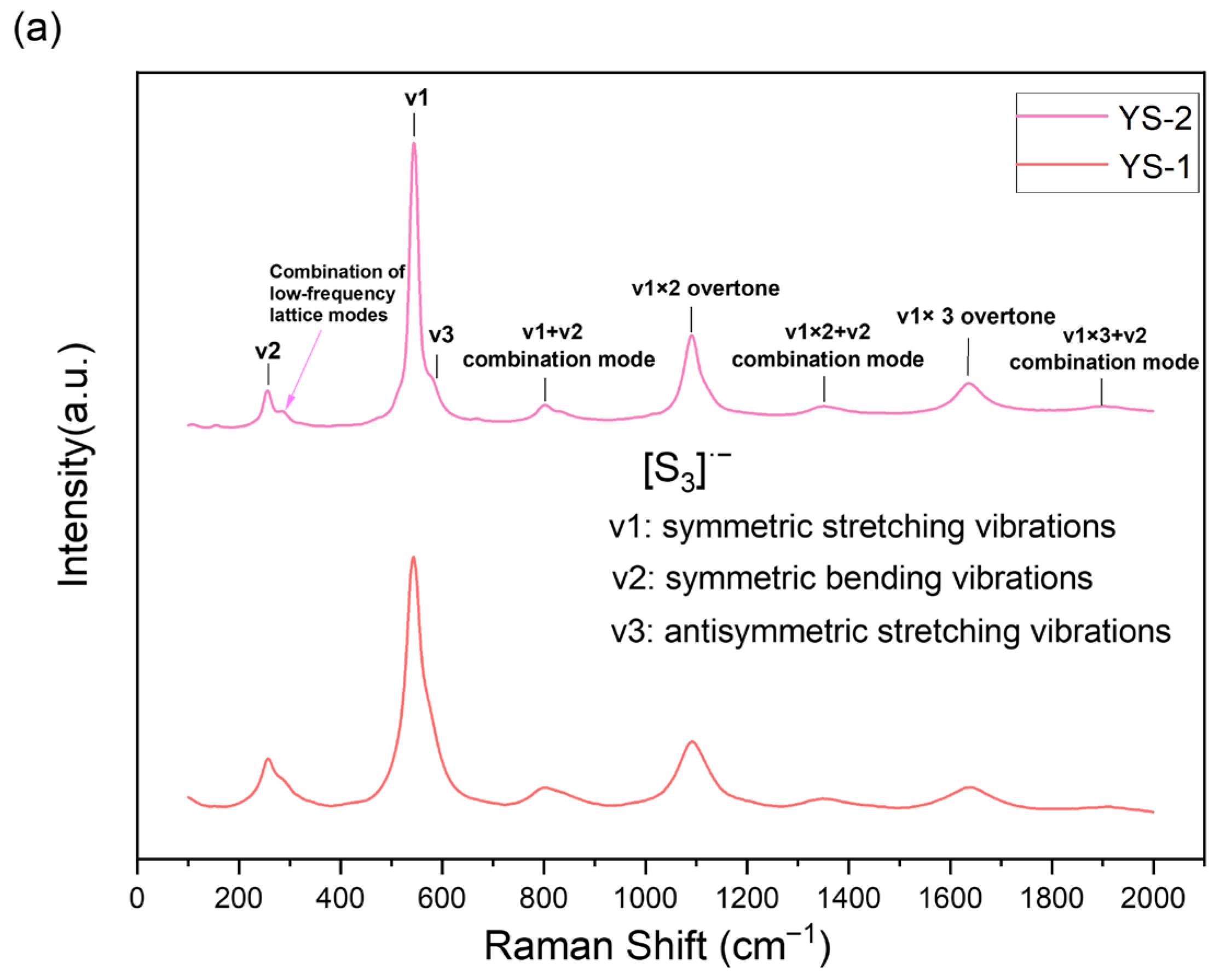
Raman spectroscopy is sensitive to sulfur radicals, and the trace presence of [S2]·−, [S3]·−, S4, S6, and SO4·− was clearly measured by Raman spectroscopy by the previous authors [5,9,24,25]. The characteristic band of [S3]·− appears as a strong band in the Raman spectrum [26], while [S2]·− vibrations are only observable in the Raman spectrum [15]. According to the three peaks of [S3]·− that can be detected in the samples (Figure 7a), a1 symmetric S-S stretching vibrations (v1) and <S-S-S bending vibrations (v2) correspond to 540 cm−1 and 240 cm−1, respectively, whereas b2 symmetric S-S anti-symmetric stretching vibrations (v3) produce peaks at 580 cm−1. The bands at 802, 1352, and 1898 cm−1 correspond to vibrational combinations of [S3]·−, whereas those at 1090 and 1635 cm−1 are attributed to overtones of [S3]·− [6,24,25]. The band at 285 cm−1 arises from combinations of low-frequency lattice modes of Na+ cations [6,24]. No sulfur peaks in terms of the other radicals have been found, suggesting that there is only the presence of [S3]·−, which is a radical anion.

Figure 7.
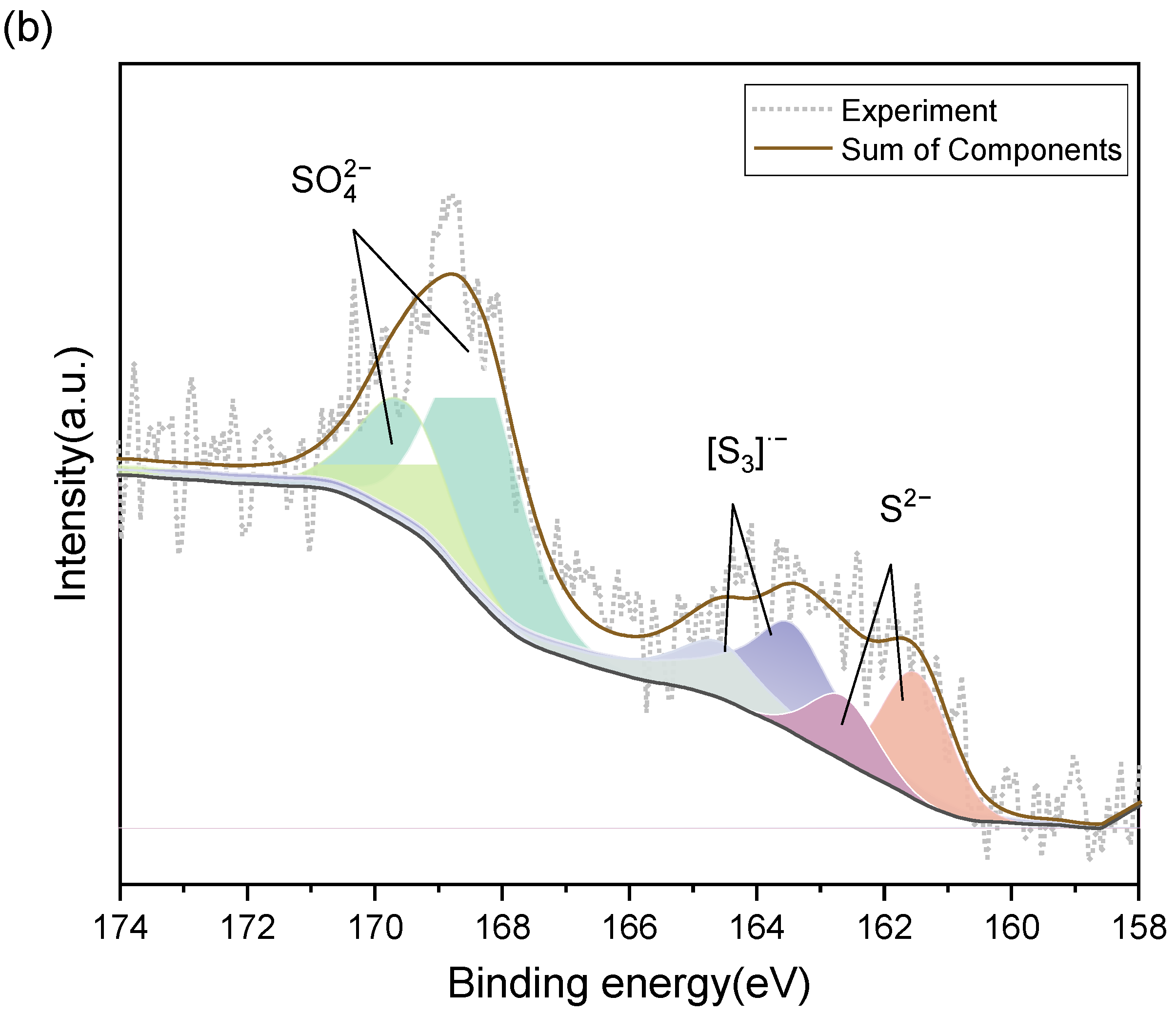
Sulfur species in lapis lazuli. (a) The Raman spectra of samples YS-1 and YS-2 indicate the presence of the radical anion [S3]·− only. (b) Valence states of surface elements in sample YS-1: [S3]·−, S2−, and .
For the qualitative analysis of surface elemental valence states, XPS was employed to determine electron-binding energies. Three sulfur species—sulfate (), polysulfide [S3]·−, and sulfide (S2–)—were identified by XPS (Figure 7b). The specific binding energies and their corresponding species from previous reports [8,27] are presented in Table 3. A comparison of lapis lazuli specimens with different colors shows that an increased proportion of the radical anion [S3]·− corresponds to a deeper blue color.
Table 3.
XPS data of different colors of blue lazurite (S 2p3/2-2p1/2 doublets).
4. Discussion
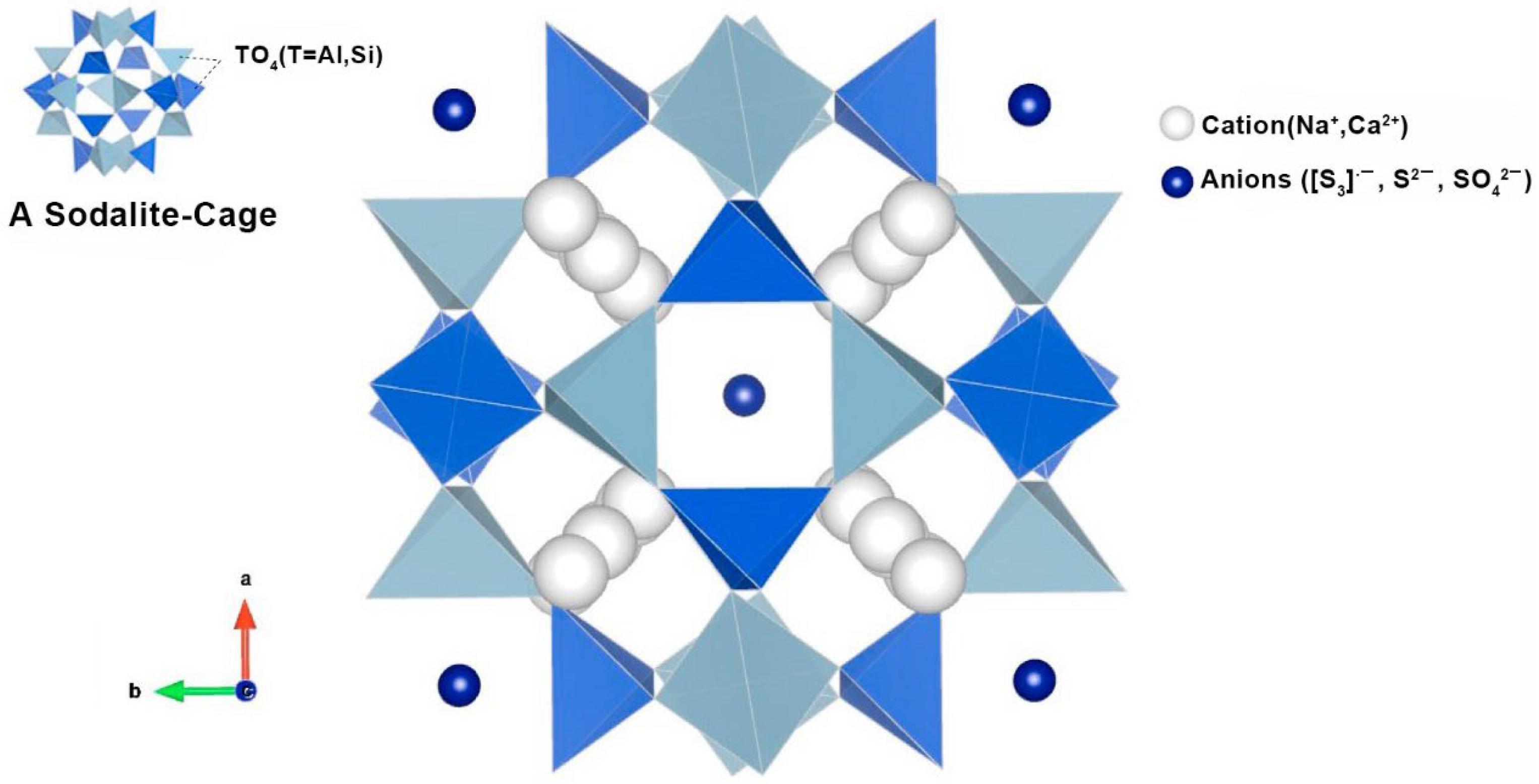
In this study, the combined analysis of XPS, Raman spectroscopy, and UV-Vis spectroscopy indicates that three sulfur species ([S3]·−, S2−, and ) are present within the aluminosilicate framework of lazurite (Figure 8). Lazurite’s cubic symmetry arises from the close packing of six-membered (Al and Si)O4 tetrahedral rings. The framework comprises eight six-membered rings and six four-membered rings, forming a sodalite-type cage [28,29]. Within the cages, charge-compensating cations (Na+ and Ca2+), along with the radical anion [S3]·−, sulfide S2−, and sulfate anion , are encapsulated.
Figure 8.
Schematic diagram of the crystal structure of lazurite. Drawn based on the crystallographic parameters of YS-1, the diagram shows a cubic unit cell oriented perpendicular to the c-axis. The tetrahedra in varying shades of blue represent the aluminosilicate framework. Blue spheres indicate anions, while white spheres represent cations.
The geological formation conditions of lazurite (at high temperatures of 700–750 °C) [30,31] promote thermal dissociation of sulfur, leading to an increased concentration of radical species in the molten sulfur system. In natural sulfur cycles, [S3]·− acts as a key intermediate during such high-temperature processes. Sodalite-cage confinement stabilizes [S3]·− within lazurite [16]. Sulfate () is the most abundant sulfur species and plays a critical role in stabilizing the lazurite structure [27,32]. Additionally, the XPS comparison analysis between the two color groups (Table 3) shows an inverse relationship between S2− and [S3]·− abundances. This pattern may indicate a redox linkage that alters the chromophore population and thus affects color.
The broad absorption peak at 600 nm in the UV-Vis spectrum is attributed to electronic transitions of the radical anion [S3]·− [15,16,33], which is consistent with previous studies. Although the YS-1 sample exhibits a weak absorption band at 400 nm along with the characteristic 600 nm peak, Raman spectroscopy (Figure 7a) only detected [S3]·− as the radical species. Therefore, the weak absorption at 400 nm is assigned to electronic transitions from S2− ion groups to ion groups [34,35]. However, correlation analysis between color parameters and UV-Vis spectral features indicates that the color of lapis lazuli is primarily governed by the [S3]·− radical. The [S3]·− anion has a doublet ground state with C2v symmetry. The central sulfur atom is nearly neutral, while each terminal sulfur carries a partial charge of −0.53, rendering the species paramagnetic [15,36]. As a strong chromophore, [S3]·− exhibits an unstable delocalized charge that undergoes transitions from the ground state to excited orbitals, resulting in strong absorption across red, yellow, and green regions of visible light—thereby producing blue coloration.
Furthermore, the combined analysis of UV-Vis spectroscopy and colorimetric parameters provided key evidence that the [S3]·− radical is the chromophore. According to the color analysis results in Figure 2, the chroma of lapis lazuli is governed by the blue coloration (b* < 0)—the higher the chroma, the bluer the color. Since the peak area at 600 nm is positively correlated with chroma, it can be concluded that the broad absorption band at 600 nm, attributed to [S3]·− radicals, is responsible for the blue color of lapis lazuli. The full width at half maximum (FWHM) describes the spectral spread of absorption: as the FWHM increases, absorption covers a wider wavelength range, shifting the blue balance and moving the hue angle (h°) toward violet. Finally, broader and stronger visible absorption lowers transmittance and therefore reduces lightness (L*). Thus, the [S3]·− radical is the key chromophore responsible for the blue hue of lazurite, and it is the primary colored mineral in lapis lazuli.
On the macro-scale, the foregoing color analysis indicates that the chroma is mainly controlled by the intensity of blue—the bluer the color, the higher the chroma (Figure 2b). Meanwhile, as chroma increases, lightness increases and the hue angle decreases, yielding a brighter and more intense blue color (Table 1). Conversely, a lower chroma results in a darker and less saturated blue color with a violetish tint. EPMA shows that higher sulfur content corresponds to lower lightness, reduced chroma, and an increased hue angle in lapis lazuli. This macroscopic color behavior is consistent with the trend revealed by the EPMA and aligns with the results from the UV-Vis spectra.
A key strength of this study lies in its multidimensional quantitative analysis of [S3]·−, which dominated the chromatic mechanism, providing a theoretical framework for gemstone coloration, quality grading optimization, and synthetic blue pigment enhancement. A limitation is the absence of the 400 nm absorption peak in some samples, impeding full quantification of color contributions from S2− and . Future work should expand to diverse geological sources to establish a robust chromatic prediction model that evaluates [S3]·−, S2−, and .
5. Conclusions
This work quantitatively correlates sulfur speciation with the colorimetric properties of lapis lazuli, establishing a robust color-grading framework based on the CIE 1976 L*a*b* uniform color space. Leveraging K-means clustering with Fisher’s discriminant validation, lapis lazuli was classified into four grades: Fancy Blue, Fancy Intense Blue, Fancy Deep Blue, and Fancy Dark Blue. This study further confirms that lazurite is the primary chromophore-bearing mineral in lapis lazuli. EPMA, XPS, Raman, and UV–Vis data indicate three sulfur species—[S3]·−, S2− and —and show that higher sulfur content correlates with lower lightness, reduced chroma, and a shift toward a violetish-blue hue (increased hue angle). Combined spectroscopic evidence identifies [S3]·− as the key chromophore driving the blue color change: its delocalized negative charge enables electronic transitions that produce the complex absorption peak near 600 nm, while a weak absorption band near 400 nm is attributable to S2− and species. These findings bridge color science, mineral chemistry, and gemology, offering actionable insights for both scientific understanding and industrial applications, with sulfur speciation remaining a pivotal research frontier.
Author Contributions
Conceptualization, X.M., X.H., and Y.G.; resources, X.H.; methodology, X.M.; software, X.M. and Z.J.; investigation, X.M., Z.J., and S.J.; formal analysis, X.M.; data curation, X.M.; writing—original draft preparation, X.M.; writing—review and editing, X.M., X.H., Z.J., S.J., and Y.G.; supervision, X.H. and Y.G.; funding acquisition, X.H. All authors have read and agreed to the published version of the manuscript.
Funding
This investigation was supported by the Project of Shenzhen Polytechnic University, grant number 7025310618.
Data Availability Statement
The raw data supporting the conclusions of this article will be made available by the authors upon request.
Acknowledgments
The XPS and XRD experimental analyses were conducted at the New Materials Metrology Laboratory of the Center for Advanced Metrological Science, National Institute of Metrology, China. We thank the Gem Testing Laboratory within the School of Gemology, CUGB. During the writing process of this work, the authors used ChatGPT-o4 in order to improve language only. After using this tool, the authors reviewed and edited the content as needed and take full responsibility for the content of the publication.
Conflicts of Interest
The authors declare no conflicts of interest.
References
- Saleh, M.; Bonizzoni, L.; Orsilli, J.; Samela, S.; Gargano, M.; Gallo, S.; Galli, A. Application of statistical analyses for lapis lazuli stone provenance determination by XRL and XRF. Microchem J. 2020, 154, 104655. [Google Scholar] [CrossRef]
- Re, A.; Giudice, A.L.; Angelici, D.; Calusi, S.; Giuntini, L.; Massi, M.; Pratesi, G. Lapis lazuli provenance study by means of micro-PIXE. Nucl. Instrum. Methods Phys. Res. Sect. B Beam Interact. Mater. At. 2011, 269, 2373–2377. [Google Scholar] [CrossRef]
- Lo Giudice, A.; Re, A.; Calusi, S.; Giuntini, L.; Massi, M.; Olivero, P.; Pratesi, G.; Albonico, M.; Conz, E. Multitechnique characterization of lapis lazuli for provenance study. Anal. Bioanal. Chem. 2009, 395, 2211–2217. [Google Scholar] [CrossRef]
- Angelici, D.; Borghi, A.; Chiarelli, F.; Cossio, R.; Gariani, G.; Lo, G.A.; Re, A.; Pratesi, G.; Vaggelli, G. μ-XRF Analysis of Trace Elements in Lapis Lazuli-Forming Minerals for a Provenance Study. Microsc. Microanal. 2015, 21, 526–533. [Google Scholar] [CrossRef]
- Chukanov, N.V.; Sapozhnikov, A.N.; Shendrik, R.Y.; Vigasina, M.F.; Steudel, R. Spectroscopic and Crystal-Chemical Features of Sodalite-Group Minerals from Gem Lazurite Deposits. Minerals 2020, 10, 1042. [Google Scholar] [CrossRef]
- Bolotina, N.B.; Sapozhnikov, A.N.; Chukanov, N.V.; Vigasina, M.F. Structure Modulations and Symmetry of Lazurite-Related Sodalite-Group Minerals. Crystals 2023, 13, 768. [Google Scholar] [CrossRef]
- Chukanov, N.V.; Vigasina, M.F.; Zubkova, N.V.; Pekov, I.V.; Schäfer, C.; Kasatkin, A.V.; Yapaskurt, V.O.; Pushcharovsky, D.Y. Extra-Framework Content in Sodalite-Group Minerals: Complexity and New Aspects of Its Study Using Infrared and Raman Spectroscopy. Minerals 2020, 10, 363. [Google Scholar] [CrossRef]
- Sapozhnikov, A.N.; Tauson, V.L.; Lipko, S.V.; Shendrik, R.Y.; Levitskii, V.I.; Suvorova, L.F.; Chukanov, N.V.; Vigasina, M.F. On the crystal chemistry of sulfur-rich lazurite, ideally Na7Ca(Al6Si6O24)(SO4)(S3)–·nH2O. Am. Miner. 2021, 106, 226–234. [Google Scholar] [CrossRef]
- Sapozhnikov, A.N.; Bolotina, N.B.; Chukanov, N.V.; Shendrik, R.Y.; Kaneva, E.V.; Vigasina, M.F.; Ivanova, L.A.; Tauson, V.L.; Lipko, S.V. Slyudyankaite, Na28Ca4(Si24Al24O96)(SO4)6(S6)1/3(CO2)·2H2O, a new sodalite-group mineral from the Malo-Bystrinskoe lazurite deposit, Baikal Lake area, Russia. Am. Miner. 2023, 108, 1805–1817. [Google Scholar] [CrossRef]
- Chukanov, N.V.; Aksenov, S.M.; Rastsvetaeva, R.K. Structural chemistry, IR spectroscopy, properties, and genesis of natural and synthetic microporous cancrinite- and sodalite-related materials: A review. Microporous Mesoporous Mat. 2021, 323, 111098. [Google Scholar] [CrossRef]
- Sapozhnikov, A.N.; Kaneva, E.V.; Cherepanov, D.I.; Suvorova, L.F.; Levitsky, V.I.; Ivanova, L.A.; Reznitsky, L.Z. Vladimirivanovite, Na6Ca2[Al6Si6O24](SO4,S3,S2,Cl)2·H2O, a new mineral of sodalite group. Geol. Ore Depos. 2012, 54, 557–564. [Google Scholar] [CrossRef]
- Fedyaeva, M.; Lepeshkin, S.; Chukanov, N.V.; Oganov, A.R. Mutual Transformations of Polysulfide Chromophore Species in Sodalite-Group Minerals: A DFT Study on S6 Decomposition. ChemPhysChem 2024, 25, e202400532. [Google Scholar] [CrossRef]
- Caggiani, M.C.; Mangone, A.; Acquafredda, P. Blue coloured haüyne from Mt. Vulture (Italy) volcanic rocks: SEM-EDS and Raman investigation of natural and heated crystals. J. Raman Spectrosc. 2022, 53, 956–968. [Google Scholar] [CrossRef]
- Sapozhnikov, A.N.; Chukanov, N.V.; Shendrik, R.Y.; Vigasina, M.F.; Tauson, V.L.; Lipko, S.V.; Belakovskiy, D.I.; Levitskii, V.I.; Ivanova, L.F.S.L. Lazurite: Validation as a Mineral Species with the Formula Na7Ca(Al6Si6O24)(SO4)(S3-)⋅H2O and New Data. Geol. Ore Depos. 2022, 64, 470–475. [Google Scholar] [CrossRef]
- Chivers, T.; Elder, P.J.W. Ubiquitous trisulfur radical anion: Fundamentals and applications in materials science, electrochemistry, analytical chemistry and geochemistry. Chem. Soc. Rev. 2013, 42, 5996–6005. [Google Scholar] [CrossRef]
- Steudel, R.; Chivers, T. The role of polysulfide dianions and radical anions in the chemical, physical and biological sciences, including sulfur-based batteries. Chem. Soc. Rev. 2019, 48, 3279–3319. [Google Scholar] [CrossRef]
- Platonov, A.N.; Tarashchan, A.N.; Belichenko, V.P.; Povarennikh, A.S. Spectroscopic study of sulfide sulfur in some framework aluminosilicates. Const. Prop. Miner. 1971, 5, 61–72. [Google Scholar]
- Rejmak, P. Computational refinement of the puzzling red tetrasulfur chromophore in ultramarine pigments. Phys. Chem. Chem. Phys. PCCP 2020, 22, 22684–22698. [Google Scholar] [CrossRef] [PubMed]
- Romano, R.M.; Pellizzari, J.; Ruvituso, F.L.; Pietrodangelo, G.; Picone, A.L.; Rossi, N.G.; Della Védova, C.O. Tintoretto in the city of La Plata? Several investigations for the reattribution of the Portrait of Melchior Michael to Tintoretto. J. Mol. Struct. 2025, 1321, 140163. [Google Scholar] [CrossRef]
- Favaro, M.; Guastoni, A.; Marini, F.; Bianchin, S.; Gambirasi, A. Characterization of lapis lazuli and corresponding purified pigments for a provenance study of ultramarine pigments used in works of art. Anal. Bioanal. Chem. 2012, 402, 2195–2208. [Google Scholar] [CrossRef] [PubMed]
- Jiang, Y.; Guo, Y. Genesis and influencing factors of the colour of chrysoprase. Sci. Rep. 2021, 11, 9939. [Google Scholar] [CrossRef] [PubMed]
- Shang, Y.; Guo, Y.; Tang, J. Spectroscopy and chromaticity characterization of yellow to light-blue iron-containing beryl. Sci. Rep. 2022, 12, 10765. [Google Scholar] [CrossRef]
- Guo, Y.; Mo, T.; Cheng, S. Contribution of lightness difference to color difference of jadeite-jade based on color difference formula. Bull. Chin. Ceram. Soc. 2010, 29, 496–501. [Google Scholar]
- Chukanov, N.V.; Shendrik, R.Y.; Vigasina, M.F.; Pekov, I.V.; Sapozhnikov, A.N.; Shcherbakov, V.D.; Varlamov, D.A. Crystal Chemistry, Isomorphism, and Thermal Conversions of Extra-Framework Components in Sodalite-Group Minerals. Minerals 2022, 12, 887. [Google Scholar] [CrossRef]
- Farsang, S.; Caracas, R.; Adachi, T.B.M.; Schnyder, C.; Zajacz, Z. S2−and S3− radicals and the S42− polysulfide ion in lazurite, haüyne, and synthetic ultramarine blue revealed by resonance Raman spectroscopy. Am. Miner. 2023, 108, 2234–2243. [Google Scholar] [CrossRef]
- Climent-Pascual, E.; de Paz, J.R.; Rodríguez-Carvajal, J.; Suard, E.; Sáez-Puche, R. Synthesis and Characterization of the Ultramarine-Type Analog Na8−x [Si6Al6O24]·(S2, S3, CO3)1−2. Inorg. Chem. 2009, 48, 6526–6533. [Google Scholar] [CrossRef]
- Tauson, V.L.; Goettlicher, J.; Sapozhnikov, A.N.; Mangold, S.; Lustenberg, E.E. Sulphur speciation in lazurite-type minerals (Na,Ca)8[Al6Si6O24](SO4,S)2 and their annealing products: A comparative XPS and XAS study. Eur. J. Mineral. 2012, 24, 133–152. [Google Scholar] [CrossRef]
- Hassan, I.; Peterson, R.C.; Grundy, H.D. The Structure of Lazurite, Ideally Na6Ca2(Al6Si6O24)S2, a Member of the Sodalite Group. Acta Crystallographica. Sect. C 1985, C41, 827–832. [Google Scholar] [CrossRef]
- Tauson, V.L.; Sapozhnikov, A.N.; Shinkareva, S.N.; Lustenberg, E.E. Indicative properties of lazurite as a member of clathrasil mineral family. Dokl. Earth Sci. 2011, 441, 1732–1737. [Google Scholar] [CrossRef]
- Faryad, S.W. Metamorphic conditions and fluid compositions of scapolite-bearing rocks from the Lapis Lazuli Deposit at Sare Sang, Afghanistan. J. Petrol. 2002, 43, 725–747. [Google Scholar] [CrossRef]
- Faryad, S.W. Metamorphic evolution of the Precambrian South Badakhshan Block, based on mineral reactions in metapelites and metabasites associated with whiteschists from Sare Sang (western Hindu Kush, Afghanistan). Precambrian Res. 1999, 98, 223–241. [Google Scholar] [CrossRef]
- Fleet, M.E.; Liu, X.; Harmer, S.L. Chemical state of sulfur in natural and synthetic lazurite by S K-edge XANES and X-ray photoelectron spectroscopy. Can. Mineral. 2007, 43, 1589–1603. [Google Scholar] [CrossRef]
- Ostroumov, M.; Fritsch, E.; Faulques, E.; Chauvet, O. Etude spectrometrique de la lazurite du Pamir, Tajikistan. Can. Mineral. 2002, 40, 885–893. [Google Scholar] [CrossRef][Green Version]
- Mingsheng, P.; Rubo, Z.; Zheng, C.; He, S. A Study on Spectroscopy of Lazurite and Its Significance. J. Cent. South Univ. (Sci. Technol.) 1983, 2, 90–97. [Google Scholar][Green Version]
- Zhang, M.; Zhang, M.; Wang, Z.J.; Zheng, Q.R.; Cao, S.Q.; Wang, F. Gemmological and Mineralogical Characteristics of Lapis Lazuli. J. Gems Gemmol. 2023, 25, 54–59. [Google Scholar][Green Version]
- Steudel, R.; Steudel, Y. Polysulfide Chemistry in Sodium–Sulfur Batteries and Related Systems— A Computational Study by G3X(MP2) and PCM Calculations. Chem.—A Eur. J. 2013, 19, 3162–3176. [Google Scholar] [CrossRef] [PubMed]
Disclaimer/Publisher’s Note: The statements, opinions and data contained in all publications are solely those of the individual author(s) and contributor(s) and not of MDPI and/or the editor(s). MDPI and/or the editor(s) disclaim responsibility for any injury to people or property resulting from any ideas, methods, instructions or products referred to in the content. |
© 2025 by the authors. Licensee MDPI, Basel, Switzerland. This article is an open access article distributed under the terms and conditions of the Creative Commons Attribution (CC BY) license (https://creativecommons.org/licenses/by/4.0/).