Article

Corrosion and Discharge Behavior of Mg-Y-Al-Zn Alloys as Anode Materials for Primary Mg-Air Batteries

1
Department of Electrical and Mechanical Engineering, Zhejiang Industry Polytechnic College, Shaoxing 312000, China
2
College of Engineering, Zhejiang Normal University, Jinhua 321004, China
3
School of Intelligent Mechatronics Engineering, Zhongyuan University of Technology, Zhengzhou 450007, China
*
Author to whom correspondence should be addressed.
Crystals 2025, 15(12), 1033; https://doi.org/10.3390/cryst15121033
Submission received: 10 November 2025 / Revised: 28 November 2025 / Accepted: 29 November 2025 / Published: 3 December 2025
(This article belongs to the Section Materials for Energy Applications)

Abstract

In this study, the Mg-8Y-0.8Al-xZn (x = 0.25, 0.45, 0.65 in wt.%) anode was selected as the research subject, and the relationship between its microstructural evolution and electrochemical performance was thoroughly investigated. The results indicate that an increasing zinc content leads to a distinct gradient change in the alloy phase composition. At a low zinc content (x = 0.25), the Al2Y phase is uniformly distributed within the matrix. However, when the Zn content reaches 0.45 wt.% or higher, the Mg-Y phase and Mg-Y-Zn phase become the predominant phases. When applying 20 mA·cm−2 current density, the investigated Mg-8Y-0.8Al-0.25Zn anode achieves a high specific capacity of 1030 mAh·g−1 and an anode efficiency of 51%, providing a valuable experimental foundation for the advancement of new energy storage materials and offering significant theoretical guidance for advancing metal–air battery technology.

1. Introduction

With technological progress advancing at an unprecedented rate, the world is facing a dilemma of shrinking energy resources and environmental degradation. This has catapulted the search for sustainable and renewable energy sources to the forefront of global discussion. In the field of new energy storage technology, magnesium–air fuel cells have demonstrated significant application potentials due to their unique electrochemical properties. This battery system utilizes magnesium metal as the anode material and facilitates energy conversion through a direct redox reaction. Recent studies have highlighted the remarkable advantages of this technology in terms of safety, operational reliability, cost effectiveness, environmental sustainability, and discharge performance. All these strengths have established magnesium–air cells as a key contender in the energy storage sector, making them a central focus of ongoing research [1,2,3]. Their versatility opens the door to a wide range of applications, from electric vehicles and offshore operations to submarines and portable electronics. However, despite their promise, magnesium–air batteries face significant obstacles preventing their widespread implementation [4,5,6]. The main challenge is the natural reactivity of magnesium, which can trigger strong self-corrosion, leading to the premature depletion of metal particles and reduced anodic efficiency. Furthermore, the accumulation of discharge byproducts and slow anode reaction dynamics often result in operating voltages that are lower than those predicted by theory, thus limiting the overall performance of the system.
Since the key technological breakthrough of the magnesium–air battery in 1967, the research on alloying modification of its anode material has become the core development trend in this field. Numerous studies indicate that the composite approach, which integrates magnesium with other metallic elements, enables precise control over the material’s chemical composition and microstructure. This refinement leads to a notable enhancement in both electrode discharge performance and utilization efficiency. Among various alloying elements, aluminum, zinc, and yttrium have demonstrated remarkable modification effects on magnesium-based materials. Studies suggest that aluminum primarily exists in a solid solution within the magnesium matrix or forms secondary phase structures, significantly enhancing corrosion resistance by suppressing hydrogen evolution and facilitating the formation of a protective oxide film [7,8,9]. Based on a systematic investigation of the Mg-Al-Ca-Mn alloy system, it has been determined that, when the aluminum content reaches a critical threshold of 3 wt.%, a protective (Mg, Al)2Ca phase precipitates within the matrix [10]. Due to its distinct formation mechanism, this phase greatly enhances the corrosion resistance in an electrolytic environment, effectively suppressing both the initiation and propagation of corrosion reactions. Notably, even a minor addition of aluminum (1 wt.%) to Mg-Y alloys can reduce the hydrogen evolution rate by three orders of magnitude [11]. This substantial improvement is primarily attributed to microstructural optimization and the role of aluminum in promoting passive film formation. Lin et al. [12] undertook a comprehensive investigation into the application of the Mg-Li-Al-Zn alloy in magnesium–air batteries, focusing on the role of aluminum content in regulating electrode material properties. Their findings revealed that higher aluminum concentrations resulted in a significant increase in AlLi particles. As corrosion advances, these reactive particles transform into aluminum particles, which then densely pack into the Mg(OH)2 passive layer, causing a higher volume fraction. In addition to aluminum, zinc is also a well-documented alloying element that boosts the discharge efficiency of magnesium anodes, as evidenced in both Mg-Zn binary alloys and Mg-Al-based alloys [13,14,15]. Through experimental investigations, Tong et al. discovered that introducing trace amounts of zinc can significantly enhance the electrochemical performance of pure magnesium materials, leading to notable improvements in both anode efficiency and specific capacity [13]. From a microstructural perspective, zinc alloying contributes to the refinement of magnesium anode grains, thereby strengthening the corrosion resistance and discharge activity. The experimental findings reveal a strong concentration-dependent effect of zinc doping on the performance enhancement. As the zinc content increases, the material exhibits a clear improvement in both corrosion resistance and electrochemical properties [16,17,18]. From an electrochemical kinetics perspective, the incorporation of Zn2+ modifies the local pH at the anode surface through hydrolysis reactions, accelerating the decomposition of Mg(OH)2 discharge products, enriching advanced electrode materials in marine energy battery systems [19]. Notably, in the investigation of the Mg-Zn-Y alloy system, Chen et al. identified the formation of a stable interface with a well-defined orientation relationship between the icosahedral quasicrystalline phase (I phase) and the hexagonal structure. This distinctive crystallographic feature not only strengthens interatomic bonding but also significantly enhances overall performance [20,21,22,23,24].
Yttrium (Y), a distinctive rare-earth element, has a standard electrode potential comparable to that of magnesium. Moreover, it exhibits an outstanding solid solubility in magnesium, hitting as high as 12.47 wt.% at 566 °C [25]. When yttrium dissolves in magnesium, it not only increases the material chemical activity but also gives a substantial boost to its corrosion resistance. The reason behind this is that Y becomes actively involved in the corrosion process, shoring up the protective oxide layer [26,27]. Experimental data based on Liu et al. [28] showed that adding 2 wt.% yttrium to the magnesium matrix can cause a significant negative shift in the open-circuit potential (OCP), which directly reflects an enhancement in the activity of the Mg-Y alloy system. However, studies in the related literature [28,29] show that an yttrium content exceeding 5 wt.% will induce the secondary phase precipitation, which will further aggravate the material’s corrosion tendency. Lv et al. [30,31] verified the improvement effect of Y element on battery discharge performance by introducing the Y element into Mg-Li and Mg-Li-Al anode material systems [11]. In particular, the newly developed Mg-11Y-1Al alloy has shown excellent comprehensive properties: its yield strength is as high as 350 MPa, while the annual corrosion rate can be stably maintained below 0.2 mm·y−1, which fully reflects the synergistic effect of Y-Al compound addition. The mechanism of action is mainly from promoting the formation of a dense protective film rich in Y2O3/Y(OH)3.
Although binary Mg-Y and Mg-Zn systems have been extensively studied, the specific synergistic regulation mechanism of trace Zn addition within the Mg-Y-Al ternary system—particularly regarding the evolution of second phases from granular Al2Y to long-period stacking-ordered (LPSO) Mg-Y-Zn phases and the resulting micro-galvanic corrosion behavior—remains insufficiently explored. To address this gap, this research focuses on Mg-8Y-0.8Al-xZn alloys (x = 0.25, 0.45, 0.65) to rigorously evaluate how varying trace zinc levels influence microstructural transition, corrosion resistance, and electrochemical discharge properties. The primary objective is to elucidate the critical balance between electrochemical activation and corrosion resistance, specifically targeting the suppression of the “chunk effect”. To validate practical applicability, Mg-air batteries were constructed and tested across multiple current densities. The findings of this study provide theoretical guidance for the design of robust, high-efficiency magnesium anodes for primary Mg-air batteries.

2. Materials and Methods

2.1. Materials

The Mg-8Y-0.8Al-xZn alloys, containing zinc at concentrations of 0.25, 0.45, and 0.65 wt.% (designated as MYZ0.25, MYZ0.45, and MYZ0.65), were synthesized using high-purity components: Mg (99.99 wt.%), Al (99.99 wt.%), Zn (99.95 wt.%), and a Mg-30Y master alloy. To prevent oxidation during the process, the melting was conducted under a protective atmosphere of SF6 and CO2. The procedure began by fully melting high-purity Mg along with the Mg-Y master alloy, after which Zn was introduced. Once all alloying components were completely dissolved, the molten mixture was thoroughly stirred for 2 min to achieve a homogeneous composition. Finally, the refined melt was poured into a preheated iron mold (200 °C) at a casting temperature of 710 °C, ensuring a well-regulated solidification process. The specific ingredients are displayed in Table 1.

2.2. Microstructure Characterization

In this study, a multi-scale characterization technique was employed to systematically examine the microstructure of the materials. An OLYMPUS-BX51M optical microscope (OLYMPUS, Tokyo, Japan) was used for microstructural observation. During sample preparation, gradient grinding was performed using silicon carbide sandpaper (400#–2000#), followed by surface polishing with diamond paste to meet the requirements for optical analysis. To enhance structural features, a selective etching solution composed of acetic acid, picric acid, anhydrous ethanol, and deionized water (volume ratio 1:0.42:7:1) was prepared. A Sirion200 scanning electron microscope (SEM, Thermo Fisher Scientific, Hillsborough, Hillsboro, OR, USA) equipped with a second electron (BSE) detector was utilized to characterize the spatial distribution of second-phase particles in the material. To determine the precise chemical composition of the α-Mg matrix and the intermetallic compounds, Energy Dispersive X-ray Spectroscopy (EDS) analysis was performed.

2.3. Electrochemical Test

A three-electrode system was used to evaluate the electrochemical performance. This method has wide application value in the field of electrochemical research because of its reliability and reproducibility of measurement data. In the experimental design, a platinum electrode was selected as the counter electrode and a saturated calomel electrode (SCE) as the reference electrode. The object alloy material of 1 cm2 exposed area was prepared as a working electrode to systematically investigate its electrochemical behavior in a specific environment. During the experiment, a CHI660E electrochemical workstation (CH Instruments Ins, Shanghai, China) was selected for data acquisition, which enjoys a high reputation in academic circles for its excellent measurement accuracy. In order to simulate corrosion conditions, 3.5 wt.% NaCl solution (China National Medicines Corporation Ltd., Beijing, China) was used as the electrolyte in the study, and the temperature of the solution was strictly controlled within the range of 25 ± 1 °C (298 ± 1 K) through a constant-temperature device to ensure the reliability of the experimental conditions. Before the formal measurement, the alloy sample was pre-treated with microstructure preparation standardization. First, the surface was roughed with 2000# silicon carbide sandpaper to eliminate the macroscopic defects of the sample. A diamond polishing paste was then used to finely polish the surface to achieve a mirrorlike effect, providing ideal conditions for subsequent testing. By conducting scans at a consistent rate of 1 mV·s−1, the polarization curve of the material was accurately charted. To gain a more nuanced understanding of the electrochemical behavior, electrochemical impedance spectroscopy (EIS) was utilized. The process unfolded in several key stages: Initially, the sample was left to stabilize for 60 min under open-circuit conditions. Afterward, a ±5 mV alternating current was applied, with frequencies ranging from 100 kHz to 0.01 Hz. Simultaneously, impedance data at the electrode–electrolyte interface were recorded.

2.4. Immersion Test

A complete quantitative characterization system of material corrosion degradation was established. First, the sample surface was mechanically polished with 2000-mesh silicon carbide sandpaper, and then the surface was purified in an ultrasonic cleaning machine. In the mass measurement process, a high-precision analytical balance (resolution ± 0.0001 g) was used to record the initial mass, and the hydrogen collection method was introduced to optimize the calculation accuracy of the corrosion rate. For precise control of the corrosion area, epoxy resin embedding technology was used, leaving only 10 × 10 mm exposed surface. The treated samples were immersed in 3.5 wt.% NaCl solution for 168 h. After soaking, a special chromate solution of CrO3 200 g·L−1, AgNO3 10 g·L−1 (China National Medicines Corporation Ltd., Beijing, China) was used to selectively remove the corrosion products, which effectively protected the matrix from damage. After the sample was clean and dry, the mass loss data was obtained by secondary weight.

2.5. Battery Tests

To fully assess the electrochemical characteristics of electrode materials, a complete battery testing system was put into place. A 10 h long steady-state discharge test was conducted, with current densities of 2, 5, 10, and 20 mA·cm−2. All discharge experiments were repeated three times. After the discharge process, the anode surface morphology was closely examined via scanning electron microscopy (SEM). During the quantitative characterization process, a chromite solution formulated with boiling chromic acid was selected for the surface treatment. By accurately measuring the quality difference of samples before and after treatment, the quantitative evaluation of material loss was realized. The anodic efficiency parameters derived from Formula (1) provide a scientific basis for the evaluation of material utilization and electrochemical properties:
η = W theoretical W actual × 100 %
Specific   capacity   ( mAh g 1 ) = I × A × t W actual
Specific   energy   density   ( Wh kg 1 ) = Specific   capacity   ( mAh g 1 ) × U
Here, ΔWtheo (g) signifies the anticipated theoretical mass decrease as per Faraday’s law, whereas ΔWactual (g) refers to the actual mass loss observed after the discharge has taken place. The parameters used in the calculations included I (the discharge current density in mA per square centimeter), A (the electrode reaction area in square centimeters), U (the discharge voltage in volts), and t (the duration of the discharge in hours),where η refers to the efficiency of each specimen; Wtheoretical is the theoretical mass loss in terms of relation (2); Wactual is obtained via subtracting the final mass of the specimen from the original mass.
W theoretical = It F ( x i n i M i )
Equation (4) introduces the Faraday constant, F, which clocks in at 96,485 C⋅mol−1. Meanwhile, the variables xi, ni, and mi represent the mass fraction, ionic valence, and molar mass (in grams per mole) of element i, respectively, within our material system.

3. Results and Discussion

3.1. Microstructure

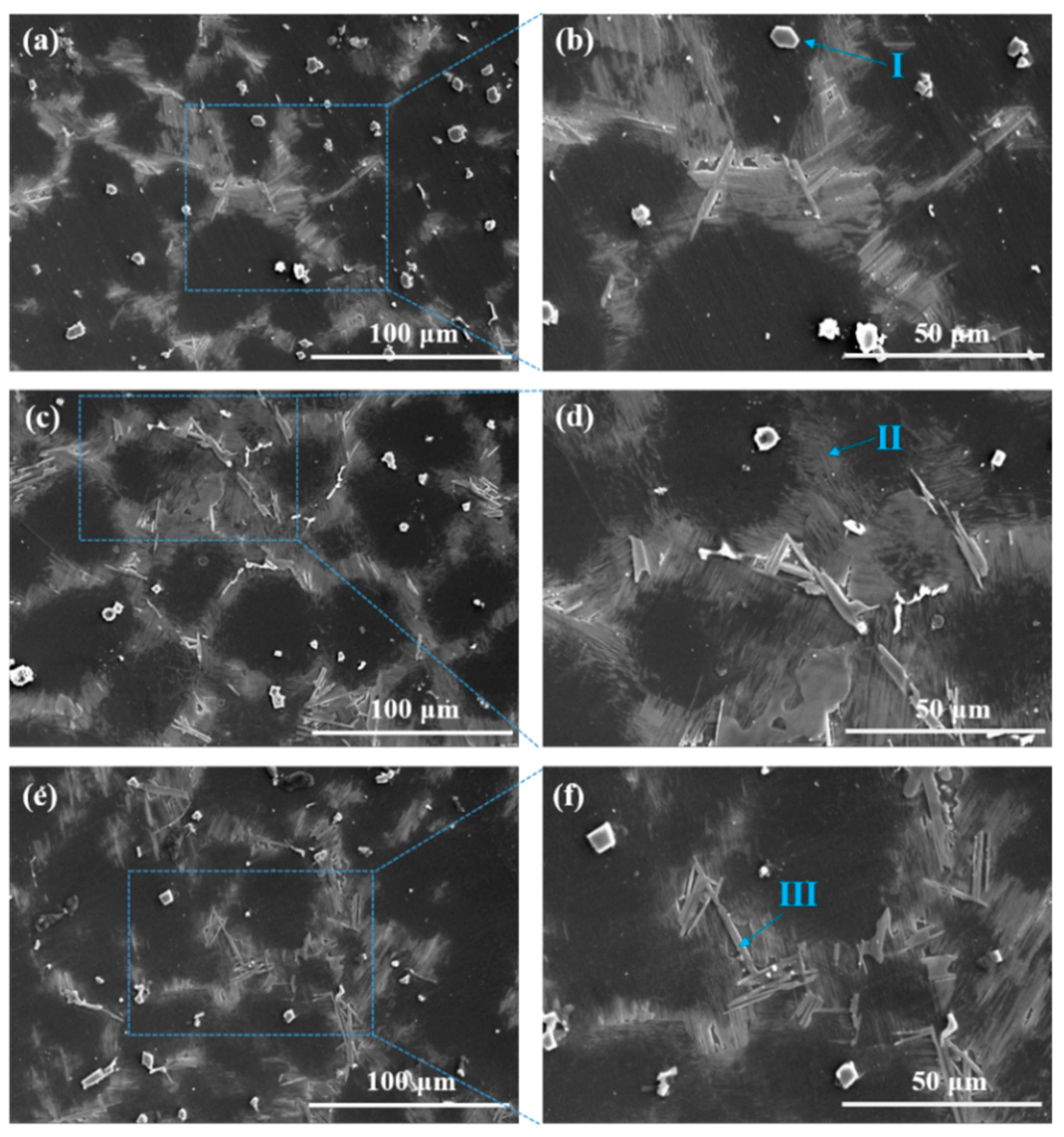
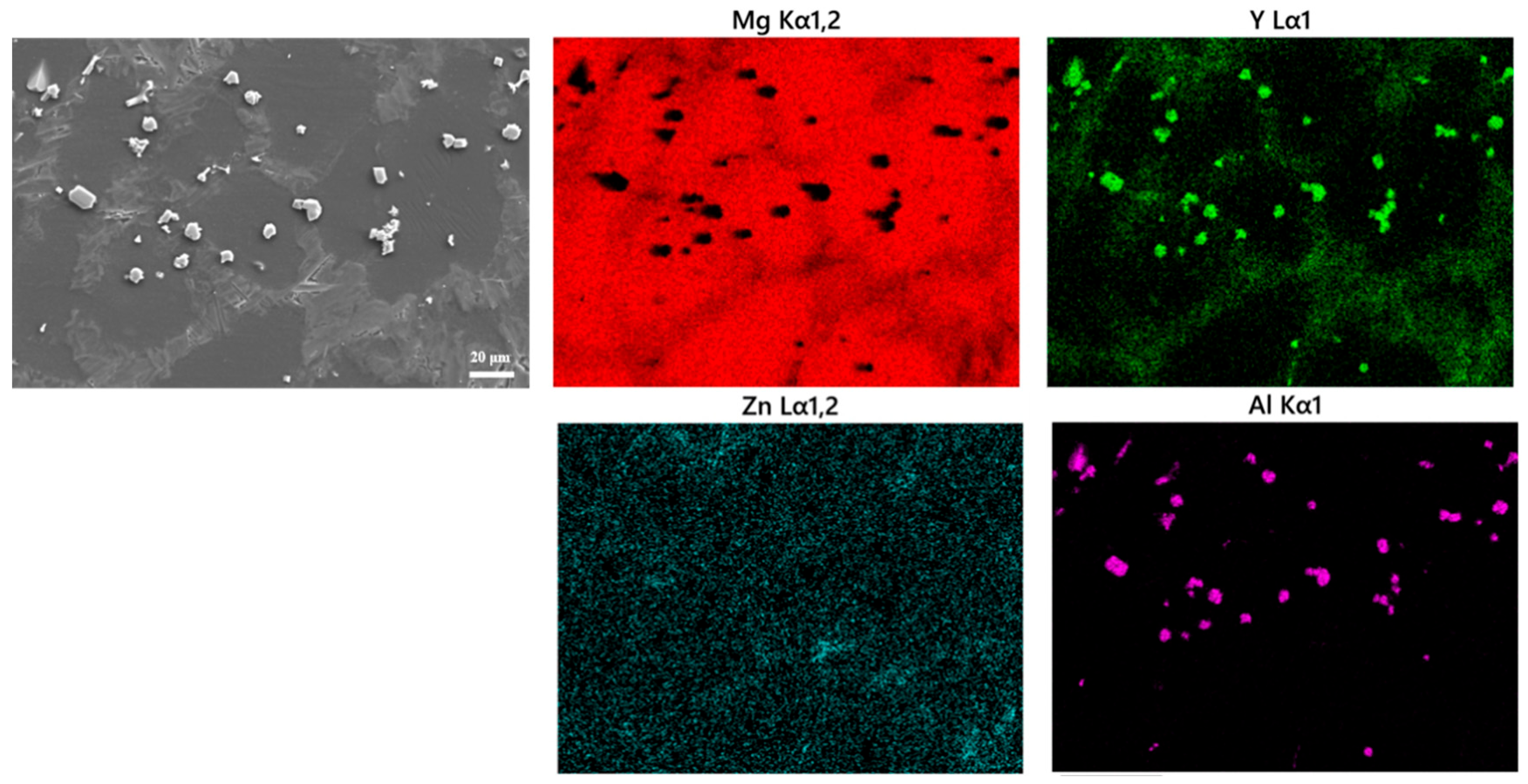
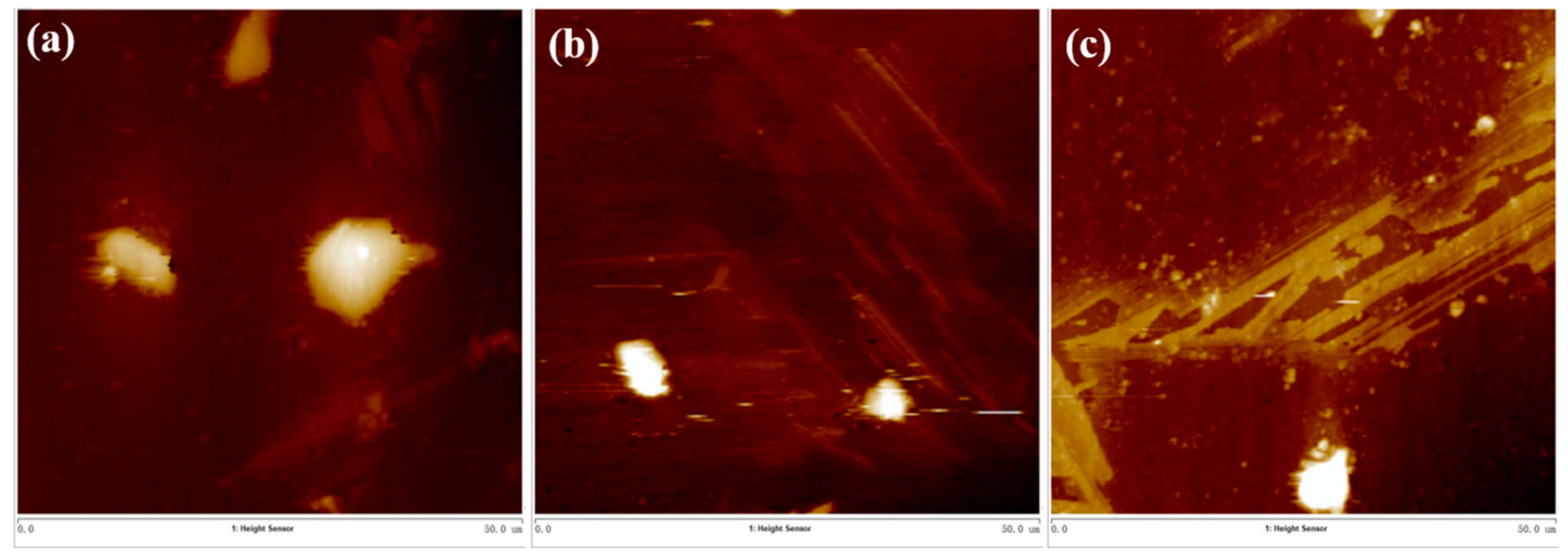
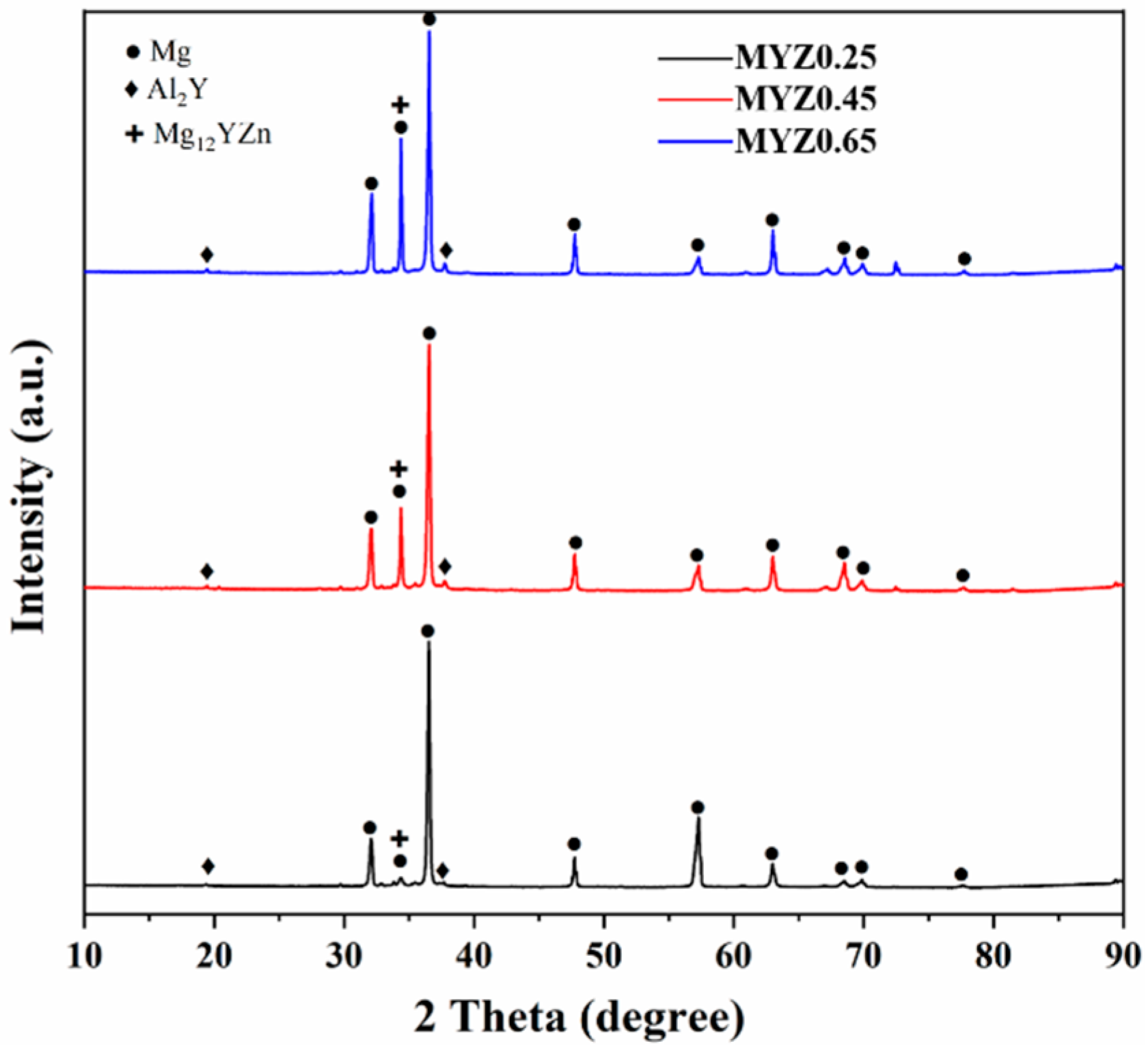
Figure 1a–f depict the as-cast microstructure of Mg-8Y-0.8Al-xZn (x = 0.25, 0.45, 0.65 wt.%) magnesium alloys, showcasing the influence of different zinc levels. The metallographic examination reveals that all three alloys exhibit irregular, flocculent-like phases alongside granular secondary-phase compounds. In Figure 1a, the secondary phase is primarily granular Al2Y, with the flocculent Mg-Y phase appearing less dominant (Table 2). When comparing Figure 1a,c,e, it is evident that, as the zinc content increases, the granular Al2Y phase decreases, while the irregular Mg-Y-Zn phase becomes more pronounced. This trend is further supported by the SEM image in Figure 2, which mirrors the distribution patterns observed in the metallographic analysis. Figure 3 presents a mapping analysis of MYZ0.25, providing a detailed visualization of the Al2Y, Mg-Y, and Mg-Y-Zn phase distributions. Quantitative image analysis via ImageJ 1.x elucidates a significant Zn-dependent coarsening of the second phase. As the Zn content increases from 0.25 to 0.65 wt.%, the predominant secondary phase transitions from fine, discretely distributed Al2Y granules to coarse, semi-continuous Mg-Y-Zn networks. Specifically, the average particle dimension expands nearly six-fold, increasing from 3.2 ± 0.8 μm (diameter) in the MYZ0.25 alloy to 18.7 ± 4.5 μm (length) in the MYZ0.65 alloy. This substantial increase in the continuity and aspect ratio of the cathodic phases intensifies localized micro-galvanic corrosion, thereby promoting the mechanical detachment of the α -Mg matrix (chunk effect) and reducing anodic efficiency. Moreover, Atomic Force Microscopy (AFM) characterization was conducted to quantify the topographical evolution of the second phases. As illustrated in Figure 4, the surface morphology exhibits a distinct transition driven by Zn content: the low-Zn alloy (Figure 4a) is characterized by discrete, granular protrusions (Al2Y phase), whereas the high-Zn alloy (Figure 4c) is dominated by coarse, high-aspect-ratio lamellar structures (Mg-Y-Zn phase) that protrude significantly from the matrix. This topographic evidence quantitatively corroborates the coarsening and morphological transformation of the second phase observed in SEM, confirming that excessive Zn promotes the formation of continuous cathodic networks. In this case, the Al2Y phase is plentiful; the Mg-Y phase is broadly scattered, and the Mg-Y-Zn phase remains relatively scarce. During X-ray Diffraction (XRD) analysis on the as-cast alloys (Figure 5), the results confirm that the alloy is composed of an α -Mg matrix and second phases including Al2Y and long-period stacking-ordered (LPSO) structures (Mg-Y-Zn phases), which corresponds well with our SEM observations and EDS analysis.

3.2. Electrochemical Impedance Spectra

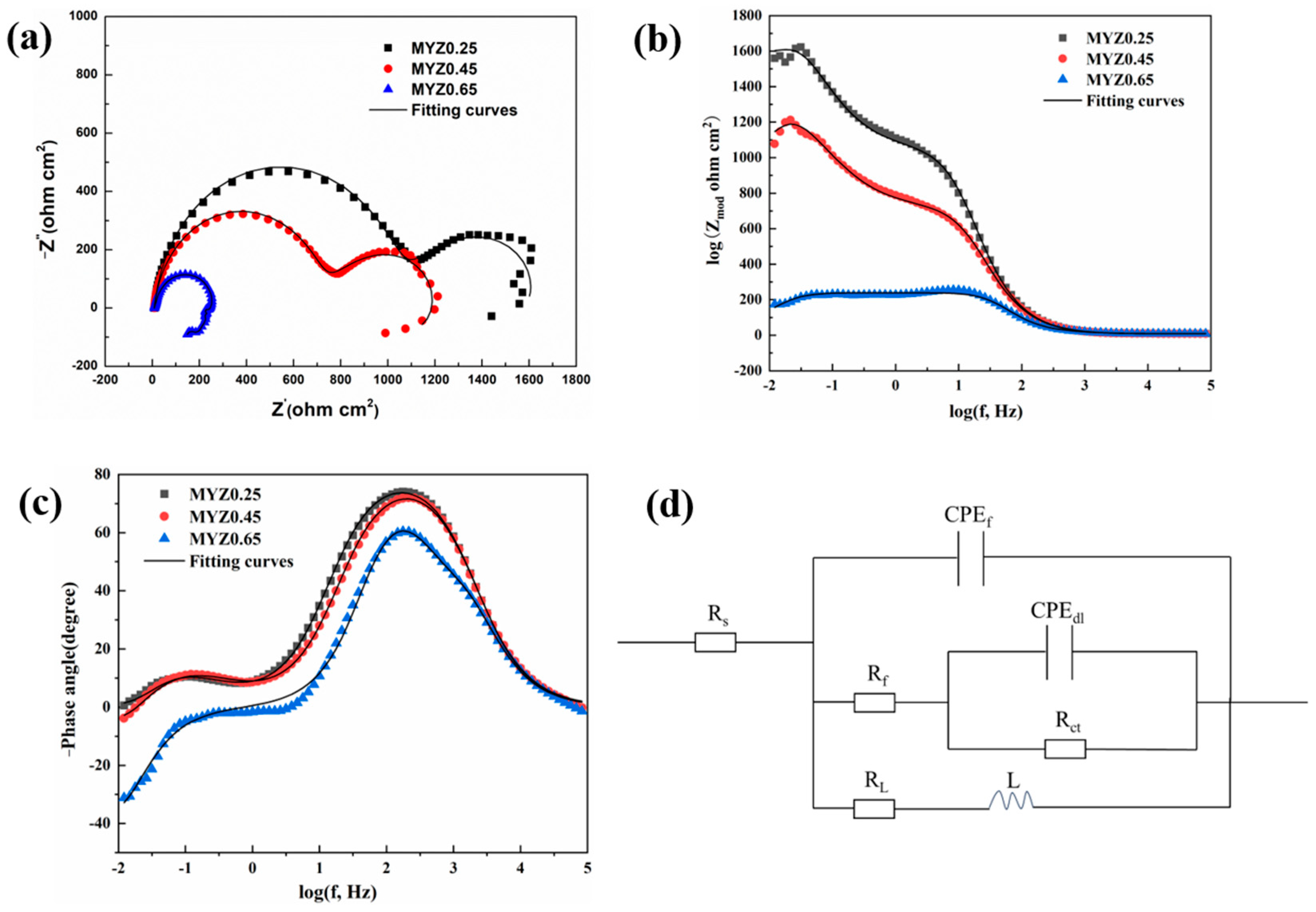
Electrochemical impedance spectroscopy (EIS) offers deeper mechanistic insights than conventional direct current (DC) polarization techniques, enabling a more nuanced understanding of corrosion behavior. EIS was conducted over a 60 min span under stable temperature conditions, utilizing the open-circuit potential method. As illustrated in the Nyquist plot (Figure 6a), the results indicate that the impedance behavior exhibits a pronounced dual-capacitance arc resistance profile, observable in both high- and low-frequency regions. While these capacitive arcs share a similar shape, the notable difference in their magnitudes suggests that, although the corrosion mechanism may be analogous, the kinetics of the process vary considerably. Examination of the EIS spectra across the three anode materials reveals three distinct impedance regions: high-, medium-, and low-frequency reactance zones. The electrochemical impedance spectroscopy (EIS) profiles of these three anodes are expected to exhibit three distinct loops: a high-frequency capacitive loop, a mid-frequency capacitive loop, and a low-frequency inductive loop. Furthermore, Figure 6b illustrates Bode plots of |Z| against frequency, revealing the MYZ0.25 alloy exhibits the highest impedance, indicative of greater polarization resistance and enhanced corrosion resistance. The Bode plot in Figure 6c exhibits two peaks on the log (f) vs. phase angle curves, which correspond to the capacitive loops. Notably, the inductive loop appears within the quadrant, corresponding to the chemical interaction between Mg+ and H2O at the surface in the absence of a protective film or discharge byproducts [32,33].
A systematic analysis of the Nyquist plot confirms that the equivalent circuit model presented in Figure 6d is highly applicable for electrochemical kinetic characterization. As detailed in Table 3, quantitative analysis of electrochemical impedance spectroscopy (EIS) enabled precise determination of the model component parameters. The solution resistance (Rs) is identified at the intersection of the high-frequency region with the real axis, while the semicircular feature of the electrode–electrolyte interface is primarily attributed to charge transfer resistance (Rct), which plays a crucial role in the electron transfer process. To accurately describe the interface non-ideal characteristics, a double-layer model incorporating Rct and a constant phase element (CPEdl) in parallel was constructed. Additionally, in the low-frequency region, a parallel configuration of film resistance (Rf) and film capacitance (Cf) was introduced to effectively represent the electrochemical behavior of the Mg(OH)2 corrosion layer on the anode surface [34]. A smaller Rct value indicates heightened electrochemical activity and a faster discharge rate for magnesium anodes. On the flip side, a wider capacitance arc diameter points to increased resistance in electrochemical reactions, a slower corrosion rate, and improved corrosion resistance. As shown in Table 3, the corrosion resistance of the tested alloys ranks as follows: MYZ0.25 outperforms MYZ0.45, which in turn surpasses MYZ0.65. Additionally, MYZ0.25 demonstrates the greatest resistance in its Mg(OH)2 film, implying that the right amount of Zn content fosters the development of a robust, protective passivation layer. These findings are consistent with the trends observed in the polarization curve data [35,36,37].

3.3. Potentiodynamic Polarization Curve

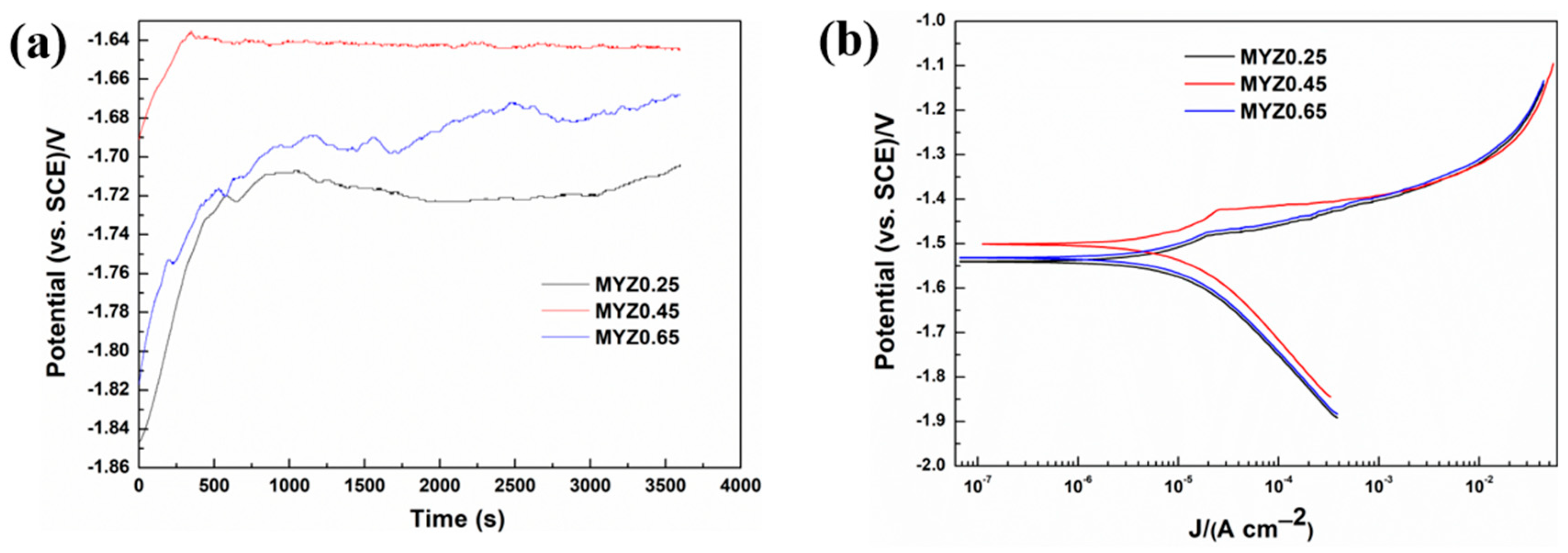
The corrosion behavior of the as-cast alloy in a 3.5 wt.% sodium chloride solution was evaluated using an electrochemical analysis system. Figure 7a illustrates the time-dependent evolution of the open-circuit potential (OCP). The experimental results indicate that the OCP curves of the three alloys exhibit a characteristic pattern: a rapid increase in the initial stage, stabilization in the intermediate stage, and slight fluctuations in the later stage. Among them, the MYZ0.25 alloy demonstrated the highest electrochemical stability, with a significantly shorter stabilization time than that of the control group. A statistical analysis of the last 1000 s of the experiment (see Table 4) revealed that the average OCP values of MYZ0.25, MYZ0.45, and MYZ0.65 alloys relative to the saturated calomel electrode were −1.717 V, −1.646 V, and −1.676 V, respectively. These findings clearly demonstrate that, among the three tested alloys, MYZ0.25 exhibited the lowest corrosion tendency.
As shown in Figure 7, the potentiodynamic polarization experiments in this study were conducted using a 3.5 wt.% NaCl solution as the electrolyte under controlled temperature conditions (25 ± 1 °C). The resulting polarization curve exhibits a distinct two-region characteristic: the cathodic region primarily represents the proton reduction process at the corrosion potential, whereas the anodic region reflects the electrochemical behavior of the metal oxidation reaction [38,39,40]. Due to the negative difference effect (NDE), in which hydrogen evolution increases with anodic polarization, complicating the calculation of accurate corrosion currents, to calculate the corrosion current density (Jcorr), the cathodic Tafel region linear extrapolation method was employed. Based on previous studies [14,41], an extrapolation range of 125–250 mV was selected to ensure data accuracy. Experimental findings indicate that the anodic region does not display a conventional Tafel slope due to the negative difference effect (NDE), posing a significant challenge for further investigations into anode reaction kinetics. It is important to note that corrosion potential (Ecorr) does not exhibit a direct qualitative relationship with corrosion current density (Jcorr). With a continuous increase in voltage, the concentration of Cl on the surface rises. Once a critical voltage is reached, the passivation film abruptly ruptures, allowing chloride ions to penetrate the alloy interior and initiate corrosion. The anodic polarization data clearly shows that the incorporation of zinc in the Mg-Y-Al alloy series plays a crucial role in enhancing performance. On the other hand, the cathodic branches of the tested alloys nearly coincide, suggesting that their cathodic reactions are virtually identical. Key electrochemical metrics, including Jcorr and Ecorr, are detailed in Table 4. Notably, MYZ0.25 demonstrates the highest corrosion resistance, with MYZ0.45 and MYZ0.65 trailing behind in that order.

3.4. Immersion Test

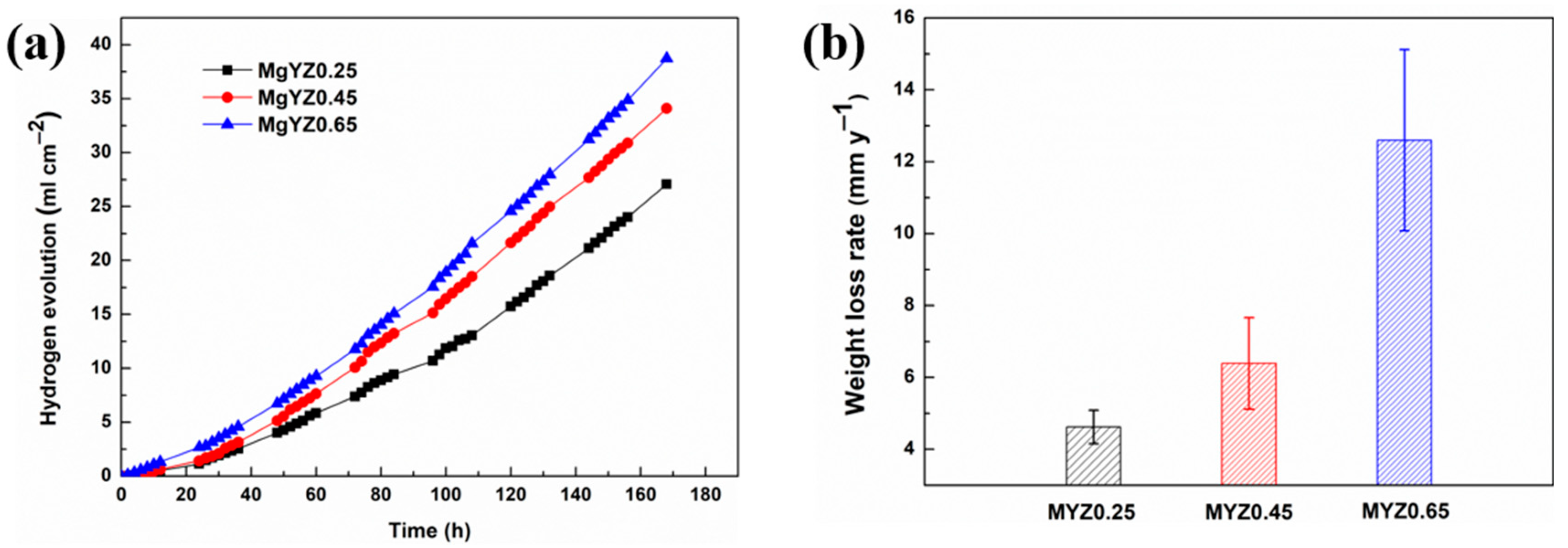
To thoroughly assess the corrosion characteristics of the alloys under investigation, a 168 h immersion test was conducted to measure hydrogen evolution. As depicted in Figure 8a, the MYZ0.65 alloy initially demonstrated a higher rate of hydrogen release than those of MYZ0.45 and MYZ0.25. As the electrochemical interplay between the second-phase particles and the α-Mg matrix grew more pronounced, the integrity of the protective layer began to falter, triggering a marked spike in hydrogen evolution. Figure 8b illustrates the corrosion rates derived from post-immersion weight-loss data, clearly indicating that MYZ0.25 outperforms the others with the lowest corrosion rate, while MYZ0.45 and MYZ0.65 trail behind. By piecing together insights from both hydrogen evolution and weight-loss assessments, the corrosion resistance pecking order among the alloys comes into sharp focus: MYZ0.25 emerges as the frontrunner, with MYZ0.45 in second place and MYZ0.65 bringing up the rear. This sequence aligns seamlessly with the electrochemical trends observed earlier.
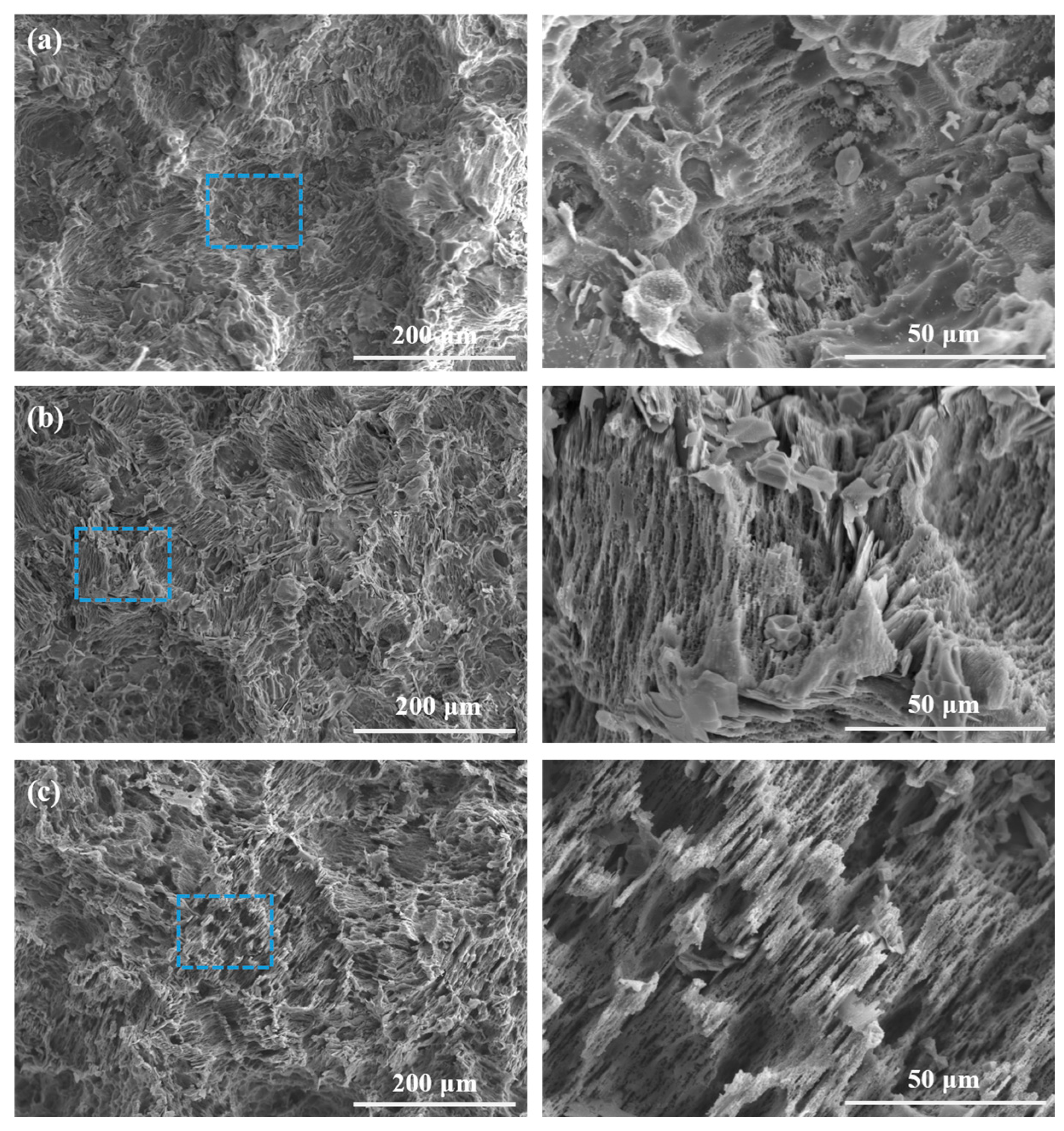
Following immersion, the surfaces of the three alloys revealed distinct layered formations and pronounced pits, as illustrated in Figure 9, the image on the right is an enlarged blue area. As Zn concentrations rose, the surfaces exhibited a marked uptick in layered configurations and more-pronounced pit-like depressions, as illustrated in Figure 9a–c. The research indicates that the deep pits observed in the Y alloy primarily result from the breakdown of α-Mg next to the Al2Y phase, while the lamellar patterns emerge from the dissolution of α-Mg in proximity to the long-period Mg-Y-Zn phase. The heightened presence of layered structures and deeper pits also points to a more intense hydrogen evolution reaction. Significantly, the 0.25 wt.%Zn alloy demonstrates superior corrosion resistance, a fact that is readily apparent.

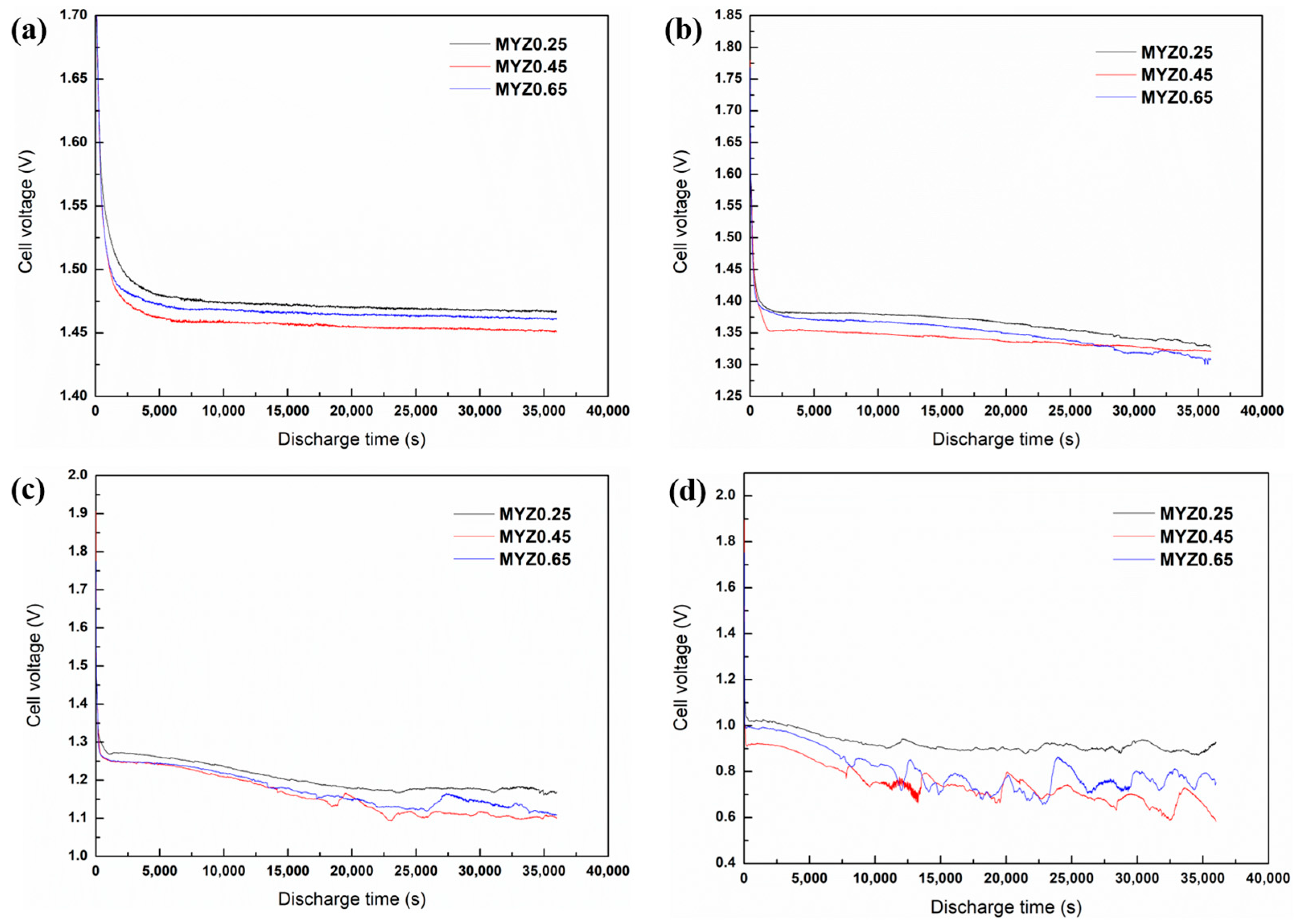
3.5. Galvanostatic Discharge Test

The electrochemical properties of magnesium alloys were evaluated under steady current conditions, immersed in a 3.5% sodium chloride solution at a controlled room temperature of 25 °C. The potential–time curves, as depicted in Figure 10, were analyzed to assess their behavior. To thoroughly examine their performance under different conditions, the alloys were exposed to four varying current densities: 2, 5, 10, and 20 mA·cm−2. This approach provided insights into their potential adaptability for diverse practical uses. According to Figure 10a–d, both discharge curves exhibit similar trends. Initially, all potentials rise during the first few seconds of immersion, and then the electrode potentials reach a steady state. The initial shift in the negative direction indicates the instability of hydride films in solutions with a pH less than 11. As the discharge process progresses, the buildup of byproducts is thought to contribute to the observed rise in potential, creating a counteracting effect that slows further increases. Additionally, noticeable fluctuations in the MYZ0.45 and MYZ0.65 at 20 mA·cm−2 discharge curve suggest a complex surface condition, such as the “chunk effect” or localized corrosion [42,43]. By combining these observations with the electrochemical behavior, the average discharge potential of the three alloys can be ranked as MYZ0.25 > MYZ0.45 > MYZ0.65. This ranking indicates that the activation effect of Mg-Y-Zn phase is effective not only under open-circuit potential (OCP) conditions but also during anodic polarization. In the alloy, the secondary phases that come into being have a substantial potential disparity compared with the α-Mg matrix. This gives rise to micro-galvanic cells, which then drive corrosion deeper into the magnesium interior. The hydrogen produced throughout this procedure seriously undermines the integrity of the hydrated films and corrosion byproducts, leading to the development of layers that are both loose and unstable. These amalgams react vigorously with water, thereby sustaining the activation cycle. Interestingly, it is worth noting that the addition of 0.45 and 0.65 wt.% Zn to the matrix does not result in a significant shift of the discharge potential toward the negative direction. This phenomenon can be attributed to an excessive electrochemical activation effect caused by the high Zn content. As a result, the accumulated corrosion products are difficult to remove through self-peeling. Additionally, this excessive activation effect is reflected in the pronounced fluctuations observed in the MYZ0.25 discharge curve, suggesting a substantial accumulation of discharge products on the electrode surface. Table 5 presents some common parameters of magnesium anodes, further demonstrating the improvement in anode performance after zinc alloying.
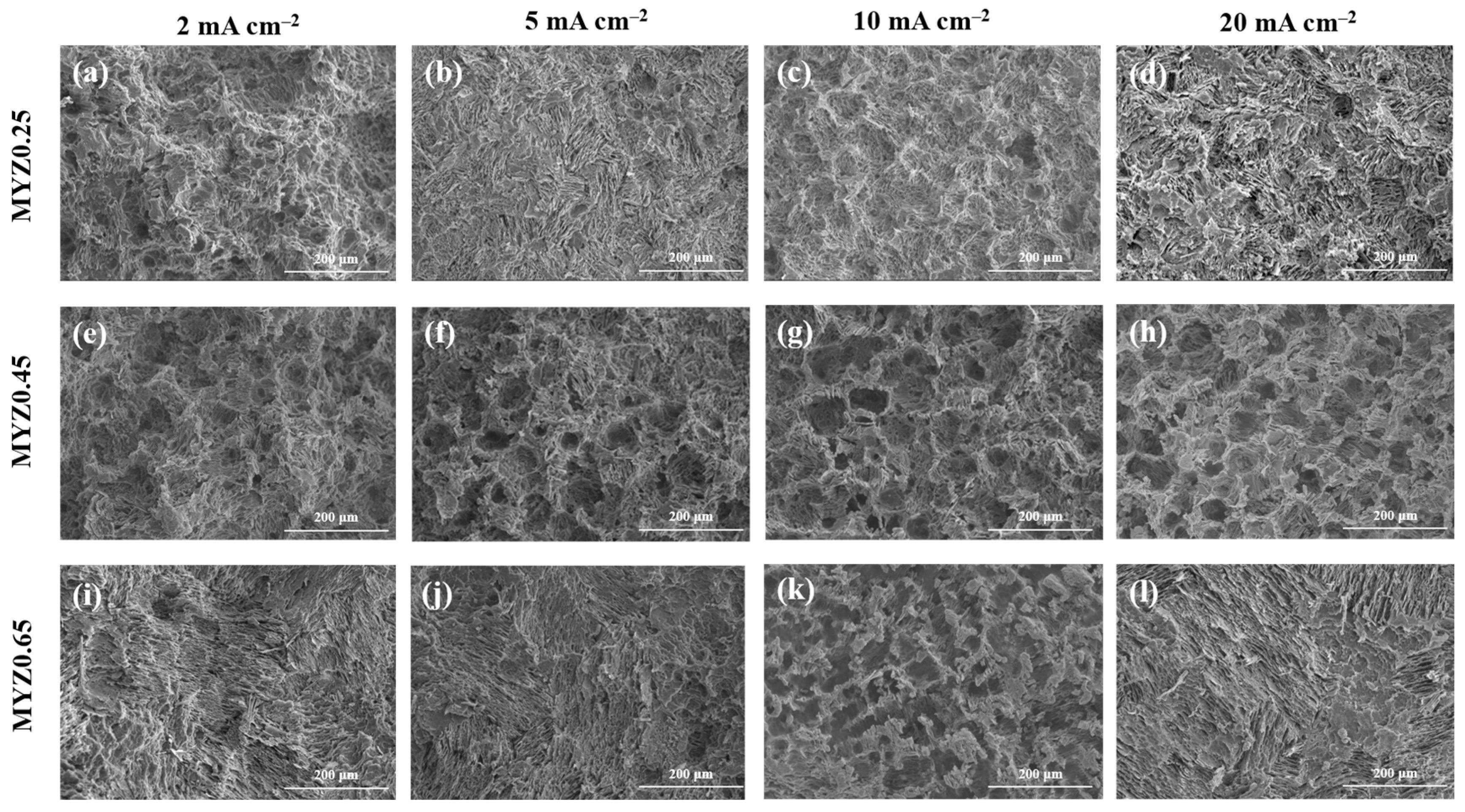
Figure 11 showcases the microstructural changes in the specimens after undergoing battery tests at varying current densities of 2, 5, 10, and 20 mA·cm−2. As seen in Figure 11a, the as-cast MYZ0.25 sample maintains a fairly uniform surface, free from corrosion pits, across all tested current densities (Figure 11a–d). On the flip side, Figure 11e–l reveal a higher density of discharge pits, highlighting the significant influence of secondary phases on the discharge characteristics during anodic polarization. The discharge morphology of MYZ0.25 reveals distinct layered cracks without the discharge products, facilitating electrolyte penetration and thereby improving discharge activity and anodic utilization. In general, the utilization efficiency of the alloys follows the order MYZ0.25 > MYZ0.45 > MYZ0.65. The “excessive electrochemical activation” observed in high-Zn alloys (x ≥ 0.45) is fundamentally attributed to the microstructural transition from fine, dispersed Al2Y precipitates to coarse, semi-continuous Mg-Y-Zn networks. These noble phases act as efficient cathodes, driving severe localized micro-galvanic corrosion that undercuts the α -Mg matrix boundaries. This process precipitates the mechanical detachment of undischarged metallic grains, termed the “chunk effect”, thereby causing substantial non-Faradaic mass loss and significantly compromising anode efficiency compared with that of the low-Zn counterpart. Furthermore, at high current densities, all samples experience a greater efficiency loss than that at small current densities. This indicates that severe anodic polarization hinders the peeling of discharge products, as shown in Figure 11. Given the excellent discharge activity and anodic utilization of MYZ0.25 in the 3.5 wt.% NaCl galvanostatic test, selecting an appropriate content is essential for optimizing performance.

4. Conclusions

This research explores the micro-alloying of magnesium anodes with a tailored blend of yttrium, aluminum, and zinc as a promising strategy to boost the electrochemical efficiency of primary Mg-air batteries. Three distinct micro-alloyed Mg anodes—Mg-8Y-0.8Al-0.25Zn, Mg-8Y-0.8Al-0.45Zn, and Mg-8Y-0.8Al-0.65Zn (wt.%)—were meticulously engineered and evaluated for their corrosion resistance, self-discharge tendencies, and overall discharge performance. The addition of minute amounts of zinc was found to significantly amplify discharge activity while simultaneously curbing the self-discharge rate of these innovative Mg anodes.
The Mg-Y-Zn phase facilitates the dissolution of the anode substrate by forming a galvanic couple with Mg, while also disrupting the protective film structure, thereby reducing the transport overpotential. The observed decrease in wasteful discharge following the incorporation of Al2Y is associated with the suppression of non-dissociative electrolyte (NDE), although the precise mechanism remains unclear. Correspondingly, Mg-air battery evaluations indicate that MYZ0.25 anodes deliver higher voltage and greater power density than those with a higher Zn content. Additionally, the service life of the battery is prolonged when MYZ0.25 anodes are used, owing to their enhanced anodic efficiency.
Employing the Mg-8%Y-0.8%Al-0.25%Zn anode results in notable improvements in both voltage stability and anodic efficiency, contributing to a significantly higher energy density. Under a 20 mA·cm−2 load, the Mg-8%Y-0.8%Al-0.25%Zn-based Mg-air system exhibits an energy density of 950 Wh·kg−1.

Author Contributions

Conceptualization, J.D. and S.G.; methodology, J.D.; investigation, H.Z. and Y.Z.; data curation, C.W.; writing—original draft preparation, J.D.; writing—review and editing, S.G.; funding acquisition, S.G. All authors have read and agreed to the published version of the manuscript.

Funding

A project supported by the Scientific Research Fund of Zhejiang Provincial Education Department (Grant No: Y202558722).

Data Availability Statement

The data presented in this study are available on request from the corresponding author.

Acknowledgments

The Key Scientific Research Project of Colleges and Universities in Henan Province (Grant No: 26A460015; N0: 26A460032); the Postgraduate Education Reform and Quality Improvement Project of Henan Province (Grant No: YJS2025XQLH24; No: YIS2025AL60); the Joint Fund of Zhejiang Provincial Natural Science Foundation of China (Grant No: K2023ZDPY01); and the Planning Research Project of China Association of Higher Education (Grant No: 25ZF0205).

Conflicts of Interest

The authors declare no conflicts of interest.

Abbreviations

EISElectrochemical Impedance Spectroscopy
OCPOpen-Circuit Potential
SCESaturated Calomel Electrode
CPEConstant Phase Element
NDENegative Difference Effect

References

  1. Chen, X.R.; Liu, X.; Li, Q.H.; Zhang, M.X.; Liu, M.; Atrens, A. A comprehensive review of the development of magnesium anodes for primary batteries. J. Mater. Chem. A 2021, 9, 12367–12399. [Google Scholar] [CrossRef]
  2. Li, S.B.; Li, H.; Zhao, C.C.; Wang, Z.H.; Liu, K.; Du, W.B. Effects of Ca addition on microstructure, electrochemical behavior and magnesium-air battery performance of Mg-2Zn−xCa alloys. J. Electroanal. Chem. 2022, 904, 115944. [Google Scholar] [CrossRef]
  3. Zhou, Y.X.; Lu, X.P.; Yang, L.; Tie, D.; Zhang, T.; Wang, F.H. Regulating discharge performance of Mg anode in primary Mg-air battery by complexing agents. Electrochim. Acta 2021, 370, 137805. [Google Scholar] [CrossRef]
  4. Wang, N.G.; Li, W.P.; Huang, Y.X.; Wu, G.; Hu, M.C.; Li, G.Z.; Shi, Z.C. Wrought Mg-Al-Pb-RE alloy strips as the anodes for Mg-air batteries. J. Power Sources 2019, 436, 226855. [Google Scholar] [CrossRef]
  5. Song, Z.X.; Wang, J.J.; Song, Y.; Chen, Z.Y.; Zhang, H.; Wu, Z.; Han, X.P.; Hu, W.B. In Situ Interfacial Passivation in Aqueous Electrolyte for Mg-Air Batteries with High Anode Utilization and Specific Capacity. ChemSusChem 2023, 16, e202202207. [Google Scholar] [CrossRef]
  6. Thomaz, T.R.; Weber, C.R.; Pelegrini, T.; Knörnschild, G. The negative difference effect of magnesium and of the AZ91 alloy in chloride and stannate-containing solutions. Corros. Sci. 2010, 52, 2235–2243. [Google Scholar] [CrossRef]
  7. Yuan, S.Q.; Lu, H.M.; Sun, Z.G.; Fan, L.; Zhu, X.Y.; Zhang, W. Electrochemical performance of Mg-3Al modified with Ga, In and Sn as anodes for Mg-air battery. J. Electrochem. Soc. 2016, 163, A1181–A1187. [Google Scholar] [CrossRef]
  8. Ma, J.L.; Zhang, Y.; Ma, M.S.; Qin, C.H.; Ren, F.Z.; Wang, G.X. Corrosion and discharge performance of a magnesium aluminum eutectic alloy as anode for magnesium-air batteries. Corros. Sci. 2020, 170, 108695. [Google Scholar] [CrossRef]
  9. Wang, H.N.; Li, Y.; Wang, F.H. Influence of cerium on passivity behavior of wrought AZ91 alloy. Electrochim. Acta 2008, 54, 706–713. [Google Scholar] [CrossRef]
  10. Qiu, W.; Yan, R.; Liu, K.D.; Li, Y.; Chen, W.; Chen, K.; Gan, L.; Huang, J.; Ren, Y.; Wang, X.; et al. The semi-continuous (Mg, Al)2Ca second phase on Mg-Al-Ca-Mn alloys as an efficient anti-corrosion anode for Mg-air batteries. J. Alloy Compd. 2024, 990, 174387. [Google Scholar] [CrossRef]
  11. Zhu, Q.; Li, Y.; Cao, F.; Qiu, D.; Yang, Y.; Wang, J.; Zhang, H.; Ying, T.; Ding, W.; Zeng, X. Towards development of a high-strength stainless Mg alloy with Al-assisted growth of passive film. Nat. Commun. 2022, 13, 5838. [Google Scholar] [CrossRef] [PubMed]
  12. Lin, M.C.; Tsai, C.Y.; Uan, J.Y. Electrochemical behaviour and corrosion performance of Mg-Li-Al-Zn anodes with high Al composition. Corros. Sci. 2009, 51, 2463–2472. [Google Scholar] [CrossRef]
  13. Tong, F.; Chen, X.; Wang, Q.; Wei, S.; Gao, W. Hypoeutectic Mg-Zn binary alloys as anode materials for magnesium-air batteries. J. Alloys Compd. 2021, 857, 157579. [Google Scholar] [CrossRef]
  14. Wang, N.; Wang, R.; Feng, Y.; Xiong, W.; Zhang, J.; Deng, M. Discharge and corrosion behaviour of Mg-Li-Al-Ce-Y-Zn alloy as the anode for Mg-air battery. Corros. Sci. 2016, 112, 13–24. [Google Scholar] [CrossRef]
  15. Wen, L.; Yu, K.; Xiong, H.; Dai, Y.; Yang, S.; Qiao, X.; Teng, F.; Fan, S. Composition optimization and electrochemical properties of Mg-Al-Pb-(Zn) alloys as anodes for seawater activated battery. Electrochim. Acta 2016, 194, 40–51. [Google Scholar] [CrossRef]
  16. Bi, G.L.; Li, Y.D.; Zang, S.J.; Zhang, J.B.; Ma, Y.; Hao, Y. Microstructure, mechanical and corrosion properties of Mg–2Dy–xZn (x = 0, 0.1, 0.5 and 1 at.%) alloys. J. Magnes. Alloy 2014, 2, 64–71. [Google Scholar] [CrossRef]
  17. Ha, H.Y.; Kang, J.Y.; Yang, J.; Yim, C.D.; You, B.S. Limitations in the use of the potentiodynamic polarisation curves to investigate the effect of Zn on the corrosion behaviour of as-extruded Mg–Zn binary alloy. Corros. Sci. 2013, 75, 426–433. [Google Scholar] [CrossRef]
  18. Srinivasan, A.; Huang, Y.D.; Mendis, C.L.; Dieringa, H.; Blawert, C.; Kainer, K.U.; Hort, N. Microstructure, Mechanical and Corrosion Properties of Mg-Gd-Zn Alloys. Mater. Sci. Forum 2013, 765, 28–32. [Google Scholar] [CrossRef]
  19. Wang, N.; Wang, R.C.; Peng, C.Q.; Feng, Y. Influence of zinc on electrochemical discharge activity of Mg-6%Al-5%Pb anode. J. Cent. South Univ. Technol. 2012, 19, 9–16. [Google Scholar] [CrossRef]
  20. Luo, Z.P.; Zhang, S.Q.; Tang, Y.; Zhao, D.S. Quasicrystals in as-cast Mg-Zn-RE alloys. Scr. Metall. Mater. 1993, 28, 1513–1518. [Google Scholar] [CrossRef]
  21. Wang, S.D.; Xu, D.K.; Chen, X.B.; Han, E.H.; Dong, C. Effect of heat treatment on the corrosion resistance and mechanical properties of an as-forged Mg–Zn–Y–Zr alloy. Corros. Sci. 2015, 92, 228–236. [Google Scholar] [CrossRef]
  22. Bae, D.H.; Kim, S.H.; Kim, D.H.; Kim, W.T. Deformation behavior of Mg–Zn–Y alloys reinforced by icosahedral quasicrystalline particles. Acta Mater. 2002, 50, 2343–2356. [Google Scholar] [CrossRef]
  23. Lee, J.Y.; Kim, S.H.; Lim, H.K.; Kim, D.H. Effects of Zn/Y ratio on microstructure and mechanical properties of Mg-Zn-Y alloys. Mater. Lett. 2005, 59, 3801–3805. [Google Scholar] [CrossRef]
  24. Chen, X.; Zou, Q.; Le, Q.; Hou, J.; Guo, R.; Wang, H.; Hu, C.; Bao, L.; Wang, T.; Zhao, D.; et al. The quasicrystal of Mg–Zn–Y on discharge and electrochemical behaviors as the anode for Mg-air battery. J. Power Sources 2020, 451, 227807. [Google Scholar] [CrossRef]
  25. Rokhlin, L.L. Magnesium Alloys Containing Rare Earth Metals: Structure and Properties; CRC Press: London, UK, 2003. [Google Scholar]
  26. Liu, X.; Shan, D.; Song, Y.; Han, E. Inffuence of yttrium element on the corrosion behaviors of Mg–Y binary magnesium alloy. J. Magnes. Alloys 2017, 5, 26–34. [Google Scholar] [CrossRef]
  27. Velikokhatnyi, O.I.; Kumta, P.N. First-principles studies on alloying and simpliffed thermodynamic aqueous chemical stability of calcium-, zinc-, aluminum-, yttriumand iron-doped magnesium alloys. Acta Biomater. 2010, 6, 1698–1704. [Google Scholar] [CrossRef]
  28. Liu, M.; Schmutz, P.; Uggowitzer, P.J.; Song, G.; Atrens, A. The inffuence of yttrium (Y) on the corrosion of Mg-Y binary alloys. Corros. Sci. 2010, 52, 3687–3701. [Google Scholar] [CrossRef]
  29. Sudholz, A.D.; Gusieva, K.; Chen, X.B.; Muddle, B.C.; Gibson, M.A.; Birbilis, N. Electrochemical behaviour and corrosion of Mg–Y alloys. Corros. Sci. 2011, 53, 2277–2282. [Google Scholar] [CrossRef]
  30. Lv, Y.; Liu, M.; Xu, Y.; Cao, D.; Feng, J.; Wu, R.; Zhang, M. The electrochemical behaviors of Mg–8Li–0.5Y and Mg–8Li–1Y alloys in sodium chloride solution. J. Power Sources 2013, 239, 265–268. [Google Scholar] [CrossRef]
  31. Lv, Y.; Xu, Y.; Cao, D. The electrochemical behaviors of Mg, Mg-Li-Al-Ce and Mg-Li-Al-Ce-Y in sodium chloride solution. J. Power Sources 2011, 196, 8809–8814. [Google Scholar] [CrossRef]
  32. Zhang, T.; Meng, G.; Shao, Y.; Cui, Z.; Wang, F. Corrosion of hot extrusion AZ91 magnesium alloy. Part II: Effect of rare earth element neodymium (Nd) on the corrosion behavior of extruded alloy. Corros. Sci. 2011, 53, 2934–2942. [Google Scholar] [CrossRef]
  33. Song, Y.; Shan, D.; Chen, R.; Han, E.H. Corrosion characterization of Mg–8Li alloy in NaCl solution. Corros. Sci. 2009, 51, 1087–1094. [Google Scholar] [CrossRef]
  34. Jüttner, K. Electrochemical impedance spectroscopy (EIS) of corrosion processes on inhomogeneous surfaces. Electrochim. Acta 1990, 35, 1501–1508. [Google Scholar] [CrossRef]
  35. Song, G.; Atrens, A.; John, D.S.; Wu, X.; Nairn, J. The anodic dissolution of magnesium in chloride and sulphate solutions. Corros. Sci. 1997, 39, 1981–2004. [Google Scholar] [CrossRef]
  36. King, A.D.; Birbilis, N.; Scully, J.R. Accurate electrochemical measurement of magnesium corrosion rates: A combined impedance, mass-loss and hydrogen collection study. Electrochim. Acta 2014, 121, 394–406. [Google Scholar] [CrossRef]
  37. Parfenov, E.V.; Kulyasova, O.B.; Mukaeva, V.R.; Mingo, B.; Farrakhov, R.G.; Cherneikina, Y.V.; Yerokhin, A.; Zheng, Y.F.; Valiev, R.Z. Influence of ultra-fine grain structure on corrosion behaviour of biodegradable Mg-1Ca alloy. Corros. Sci. 2020, 163, 108303. [Google Scholar] [CrossRef]
  38. Jeong, Y.S.; Kim, W. Enhancement of mechanical properties and corrosion resistance of Mg-Ca alloys through microstructural refinement by indirect extrusion. Corros. Sci. 2014, 82, 392–403. [Google Scholar] [CrossRef]
  39. Bakhsheshi-Rad, H.R.; Idris, M.H.; Abdul-Kadir, M.R.; Ourdjini, A.; Medraj, M.; Daroonparvar, M.; Hamzah, E. Mechanical and bio-corrosion properties of quaternary Mg-Ca-Mn-Zn alloys compared with binary Mg-Ca alloys. Mater. Des. 2014, 53, 283–292. [Google Scholar] [CrossRef]
  40. Deng, M.; Höche, D.; Lamaka, S.V.; Snihirova, D.; Zheludkevich, M.L. Mg-Ca binary alloys as anodes for primary Mg-air batteries. J. Power Sources 2018, 396, 109–118. [Google Scholar] [CrossRef]
  41. Wang, N.; Wang, R.; Xiong, W.; Zhang, J.; Feng, Y. Electrochemical discharge performance of the Mg-Al-Pb-Ce-Y alloy as the anode for Mg-air batteries. J. Mater. Chem. A 2016, 4, 8658–8668. [Google Scholar]
  42. Wang, N.; Wang, R.; Peng, C.; Peng, B.; Feng, Y.; Hu, C. Discharge behaviour of Mg-Al-Pb and Mg-Al-Pb-In alloys as anodes for Mg-air battery. Electrochim. Acta 2014, 149, 193–205. [Google Scholar] [CrossRef]
  43. Andrei, M.; di Gabriele, F.; Bonora, P.L.; Scantlebury, D. Corrosion behaviour of magnesium sacrificial anodes in tap water. Mater. Corros. 2003, 54, 5–11. [Google Scholar] [CrossRef]
  44. Zhu, H.; Liu, H.; Fang, H.; Dai, Y.; Li, L.; Xu, X.; Yan, Y.; Yu, K. Electrochemical performance of Mg-Al-Zn and Mg-Al-Zn-Ce alloys as anodes for Mg-air battery. J. Electrochem. Sci. 2018, 13, 11180–11192. [Google Scholar] [CrossRef]
  45. Ma, J.; Wang, G.; Li, Y.; Ren, F.; Volinsky, A.A. Electrochemical performance of Mg-air batteries based on AZ series magnesium alloys. Ionics 2019, 25, 2201–2209. [Google Scholar] [CrossRef]
  46. Li, Y.; Ma, J.; Wang, G.; Ren, F.; Zhu, Y.; Song, Y.; Zhang, J. Effect by adding Ce and In to Mg–6Al Alloy as anode on performance of Mg-air batteries. Mater. Res. Express 2019, 6, 066315. [Google Scholar] [CrossRef]
  47. Liu, X.; Xue, J.; Zhang, P.; Wang, Z. Effects of the combinative Ca, Sm and La additions on the electrochemical behaviors and discharge performance of the as-extruded AZ91 anodes for Mg-air batteries. J. Power Sources 2019, 414, 174–182. [Google Scholar] [CrossRef]
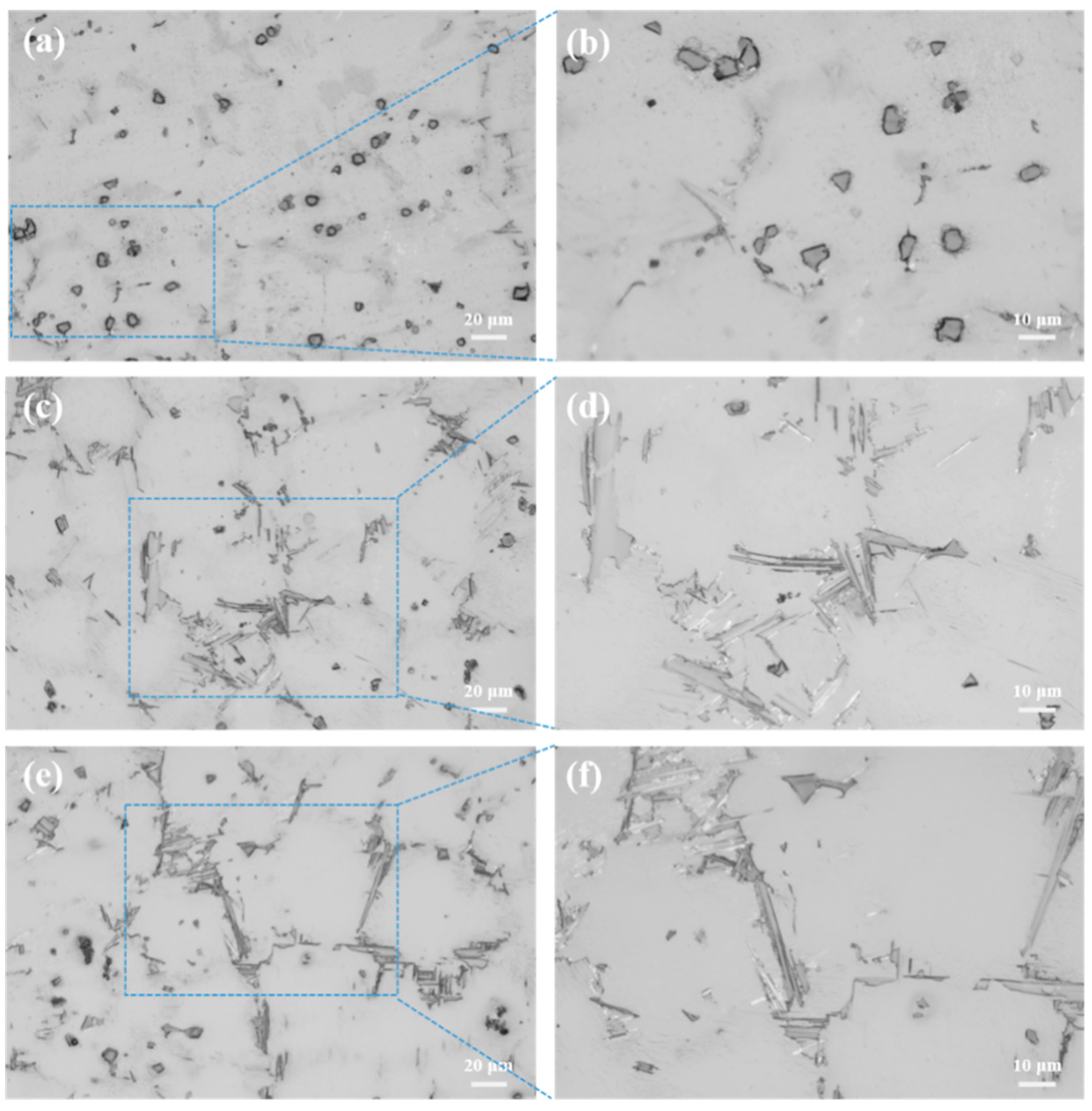
Figure 1. The microstructure of cast (a,b) MYZ0.25, (c,d) MYZ0.45, (e,f) MYZ0.65.
Crystals 15 01033 g001
Figure 2. SEM images of MYZ0.25 (a,b); MYZ0.45 (c,d); MYZ0.65 (e,f).
Crystals 15 01033 g002
Figure 3. SEM images and chemical element mapping of MYZ0.25.
Crystals 15 01033 g003
Figure 4. AFM topographic images of the as-cast Mg-8Y-0.8Al-xZn alloys: (a) MYZ0.25, (b) MYZ0.45, and (c) MYZ0.65.
Crystals 15 01033 g004
Figure 5. XRD analysis of the as-cast Mg-8Y-0.8Al-xZn alloys.
Crystals 15 01033 g005
Figure 6. (a) Nyquist plots of EIS measured at OCPs; (b) phase angle Bode plots against frequency; (c) impedance Bode plots against frequency; (d) circuit model applied to fit the EIS spectra of the investigated alloy.
Crystals 15 01033 g006
Figure 7. Open-circuit potential (a) and polarization curves (b) of the investigated alloys in 3.5 wt.% NaCl solution.
Crystals 15 01033 g007
Figure 8. Hydrogen evolution (a) and weight loss (b) of the investigated alloys during immersion at OCP.
Crystals 15 01033 g008
Figure 9. Surface morphologies with corrosion products after immersion at OCP. (a) MYZ0.25; (b) MYZ0.45; (c) MYZ0.65.
Crystals 15 01033 g009
Figure 10. Discharge curves of the studied anodes in 3.5 wt.% NaCl solution at current densities of (a) 2.5 mA·cm−2; (b) 5 mA·cm−2; (c) 10 mA·cm−2; (d) 20 mA·cm−2.
Crystals 15 01033 g010
Figure 11. Corrosion morphologies of the investigated without-discharge products after discharge for 10 h. (ad) MYZ0.25, (eh) MYZ0.45, (il) MYZ0.65.
Crystals 15 01033 g011
Table 1. Chemical composition of Mg-8Y-0.8Al-xZn (wt.%).
SamplesYAlZnFeSiMg
Mg-8Y-0.8Al-0.25Zn8.06740.81880.24930.01380.1314Bal.
Mg-8Y-0.8Al-0.45Zn7.86360.78980.43030.01170.1182Bal.
Mg-8Y-0.8Al-0.65Zn8.15600.77700.64670.01530.1961Bal.
Table 2. Chemical compositions of the particles marked in Figure 2 by EDS analysis (wt.%).
Element
wt.% Point
MgAlYZn
I3.4232.1264.360.1
II86.060.3913.070.49
III66.782.4725.145.61
Table 3. The fitting results of Nyquist plots.
Mg ElectrodeRs
Ω cm2
Yf
Ω−1 cm−2 sn
nRf
Ω cm2
Yct
Ω−1 cm−2 sn
nRct
Ω cm2
L
H
RL
Ω cm2
MYZ0.259.2131.486 × 10−50.938810370.0025470.7263770.41.874 × 1042054
MYZ0.458.7321.591 × 10−50.9377705.80.0026790.6862624.81.306 × 104649.6
MYZ0.658.7863.775 × 10−50.91849.171.621 × 10−51221.3291158.99
Table 4. Fitting results of the investigated electrodes evaluated from polarization curves.
AnodeEocp (vs. SCE)/VEcorr (vs. SCE)/VJcorr/(μA·cm−2)
MYZ0.25−1.717−1.54012.56
MYZ0.45−1.644−1.50113.55
MYZ0.65−1.676−1.45145.18
Table 5. Summary of discharge characteristics and specific energy densities of other magnesium anodes for Mg-air batteries.
AnodeElectrolyte, wt.%Cathode CatalystCurrent Density, mA·cm −2Average Voltage, VAnodic Efficiency, %Discharge Capacity, mA·h·g−1Ref.
Mg3.5NaClMnO2100.80654.31204[44]
As-cast 3N5Mg3.5NaClMnO2101.22630 [45]
A3(T2)3.5NaClMnO2101.08746.81054[7]
A6(T2)3.5NaClMnO2101.02634.1761[46]
As-cast AZ313.5NaClMnO2101.19532 [45]
AZ31(O)3.5NaClMnO2100.81953.61194[44]
AZ61-0.5Ce(O)3.5NaClMnO2100.89655.11377[44]
AZ91-1.5Ca3.5NaClMnO2101.2751.51155[47]
AZ91-1.5Sm(O)3.5NaClMnO2101.2950.81144[47]
Disclaimer/Publisher’s Note: The statements, opinions and data contained in all publications are solely those of the individual author(s) and contributor(s) and not of MDPI and/or the editor(s). MDPI and/or the editor(s) disclaim responsibility for any injury to people or property resulting from any ideas, methods, instructions or products referred to in the content.