Article

Sintering of Alumina-Reinforced Ceramics Using Low-Temperature Sintering Additive

by
Yuriy Alexandrovich Garanin
1,2,
Rafael Iosifovich Shakirzyanov
1,2,* and
Malik Erlanovich Kaliyekperov
1,2
1
Engineering Profile Laboratory, L.N. Gumilyov Eurasian National University, Satpayev St., Astana 010008, Kazakhstan
2
Laboratory of Solid State Physics, The Institute of Nuclear Physics, Almaty 050032, Kazakhstan
*
Author to whom correspondence should be addressed.
Crystals 2025, 15(11), 949; https://doi.org/10.3390/cryst15110949
Submission received: 27 September 2025 / Revised: 31 October 2025 / Accepted: 31 October 2025 / Published: 31 October 2025
(This article belongs to the Special Issue Ceramic Materials: Structural, Mechanical and Dielectric Properties)

Abstract

Reinforced alumina ceramics are renowned for their high hardness and strength among common oxide ceramics. However, high-temperature or high-pressure treatment is necessary for maximizing values of strength and hardness. In this paper, liquid-phase-assisted pressureless sintering of alumina reinforced with zirconia was studied. Sintering of dense ceramic bodies in relatively low temperatures (up to 1100 °C) was possible with the usage of CuO-TiO2-Nb2O5-based additive, together with an intense milling process. By using the XRD method, the formation of dominant α-Al2O3 and m-ZrO2 phases with small concentrations of secondary ones in experimental samples was confirmed. SEM studies showed that uniform distribution of components in the composite was achieved in samples sintered from intensively milled powders. The significant increase in the values of Vickers hardness and biaxial flexural strength (by 2.6 times) in samples from intensively milled powders at a sintering temperature of 1050 °C was explained by reduced porosity, improved grain distribution, and the formation of the t-ZrO2 phase in the alumina-reinforced composite. The study clearly showed high potential of the proposed low-temperature sintering method for zirconia-toughened aluminum oxide, which can be used in manufacturing of advanced ceramics.

1. Introduction

The challenging task of sintering Al2O3 ceramics from powder compacts still occupies the minds of researchers [1,2]. Since high temperatures of ~1500–1700 °C are required for significant densification of Al2O3, the manufacturing process of dense products can be very expensive. The lowering of the production cost of technical ceramic sintering is an urgent task for ceramic material science.
Advanced ceramics based on α-aluminum oxide, or corundum, are known for outstanding performance properties suitable for high-temperature construction materials, refractories, wear-resistant material, dielectrics for electronics, chemically resistant vessels, grinding, cutting material, component of dispersed nuclear fuel, and electrical insulating material [3,4,5,6,7,8,9,10]. Low geometrical density of 3.95 g/cm3, high Vickers hardness of 20.6–29.4 GPa, and high thermal conductivity among oxide ceramics of 36–39 W/(m·K) with the low price of the starting material made alumina ceramics irreplaceable. However, corundum ceramics are characterized by low crack resistance under mechanical loads, which may limit their use in some exceptional situations [11].
The lack of crack resistance properties of Al2O3 can be overcome by reinforcement with ZrO2 particles, which in turn increases values of bending strength and critical stress intensity factor. The main mechanism that increases mechanical properties is the pinning effect of crack propagation on ZrO2 inclusions. Reinforced alumina in this case is called zirconia-toughened alumina (ZTA) [12,13,14,15]. ZTA is a well-known oxide system that is used for advanced high-strength ceramic production. The main challenges associated with obtaining dense ZTA bodies are the high temperature of the process, ensuring uniform distribution of components, and preservation of submicron grain sizes.
The key process in sintering high-strength ceramics is treatment of starting materials [16]. Powder preparation for ceramic production can be carried out by chemical and physical methods. In general, the chemical method is the production of nano- or submicron oxide powders from metal salts by co-precipitation methods, the hydrothermal method, and the sol–gel technique [17,18,19]. Powders obtained by chemical methods are excellent for the sintering of dense ceramic products because they have a small average particle size, a narrow size distribution, a high specific surface area, and good homogeneity of chemical composition, which is especially important in the production of multicomponent ceramics [20]. The disadvantages of chemical methods for obtaining starting materials include the presence of chemisorbed compounds and impurities, the high cost of metal salts and other components for the process, the complexity of stabilization, poor crystallinity of grains, and poor yield.
In this work, the physical method for preparing starting powder was selected. For ceramic technology, physical powder processing involves mixing, grinding, and thermal annealing of initial reagents of high quality [17]. Since obtaining nanopowders by milling is difficult, special sintering techniques should be used. These techniques include hot isostatic pressing [14], hot pressing [21], and spark plasma sintering [13], in which, in addition to temperature, the pressure can be varied during the sintering process. However, the use of technologies where high temperatures and pressures are combined requires expensive equipment. For this reason, research is still underway on conventional pressureless sintering, which only requires a high-temperature furnace [22,23].
One of the methods of sintering in a low-temperature regime is the introduction of additives into milled powders that form a liquid phase during the sintering process [24,25]. Liquid-phase sintering allows increasing the intensity of diffusion of atoms through the liquid phase and achieving significant shrinkage and densification.
Excellent results on liquid sintering of alumina were obtained for submicron powder (average particle size of 0.2 μm) with the addition of a multicomponent mixture of CuO-TiO2-Nb2O5 (CTN) [26]. The authors showed that high-density samples of corundum ceramics can be obtained at a sintering temperature of 950–975 °C (heating rate of 5 °C/min) and a holding time of 2 h. A more detailed study of the densification mechanisms in the Al2O3-CTN system was given by the authors of [27]. They showed that densification for submicron starting powders is possible at temperatures below the melting point of the CTN additive due to the formation of solid solutions with defects. The movement of these defects leads to the formation of necks and diffusion of atoms without significant coarsening of the grain. Previously, we conducted experiments on the use of CTN additive for micron-sized Al2O3 powders [28]. It was shown that dense samples (geometrical density 3.6 g/cm3) with microhardness HV0.1 = 1344 are obtained at temperatures of 1300 °C from micron-sized powders with an average size of 10 μm. Highly dense samples with microhardness HV0.1 of about 2200 were obtained at a sintering temperature of 1500 °C. We also used CTN additive for liquid sintering of monoclinic zirconium dioxide [29]. It was found that the formation of solid solutions with zirconium dioxide is not observed. After sintering at a temperature of 1100 °C, the ceramics have a dense microstructure and relatively high values of biaxial flexural strength and microhardness (200 MPa and HV0.5 1100, respectively).
Based on the above, it can be assumed that for the composition ZrO2-Al2O3/20–80 wt.%, the use of the CTN additive, with a high degree of probability, should lead to a significant decrease in the sintering temperature. This is due to the fact that the CTN additive has shown its effectiveness with each of the components of the composite ceramics. This composition was chosen due to the fact that a sufficient content of the ZrO2 component is required to reinforce the alumina matrix and test the hypothesis put forward. This paper investigates the effect of sintering temperature in the range of 800–1100 °C on the density, microstructure, and mechanical properties of ZrO2-Al2O3 ceramics with the addition of CTN. The aim of the study is to experimentally confirm the proposed hypothesis. The temperature range of measurements was determined based on the following considerations: sintering at temperatures below the phase transition m-ZrO2 (monoclinic structure) → t-ZrO2 (tetragonal structure) can prevent ceramic from crack formation due to polymorphic transformations; in the chosen temperature range it is possible to investigate the main densification mechanism. In addition, significantly lower sintering temperatures will reduce the cost of ZTA ceramics production. Also, in the study, long-term grinding through milling was used to reduce the average size of the starting Al2O3 powder. The effect of milling was also assessed using a reference series of samples without milling.

2. Materials and Methods

The experimental samples were obtained by using standard ceramic route. The main initial powders were m-ZrO2 and α-Al2O3 powders (Sigma Aldrich, Darmstadt, Germany) with a purity of more than 99%. A mixture of CuO-TiO2-Nb2O5 (initial powders also were from Sigma Aldrich, Darmstadt, Germany > 99% purity, CTN) in a ratio of 4:1:2 (molar ratio) was used as a eutectic liquid-phase additive. Two types of powders for sintering of the alumina ceramics were prepared. In the first case, ZrO2-Al2O3/20–80 wt.% mixture was subjected to grinding with the addition of ethyl alcohol in a planetary ball mill (Pulverisette 7 premium line, Fritsch, Idar-Oberstein, Germany) with a zirconia milling bowl for 8 h at a speed of 500 rpm. All samples obtained from this type of powder will be denoted as ceramics from intensively milled powders (CFIMP). In the second case, a mixture with the same composition was only homogenized with the addition of ethyl alcohol in a planetary ball mill for 30 minutes at a speed of 250 rpm without grinding. All samples obtained from this type of powder will be designated as ceramics from slightly milled powders (CFSMP). Next, 5 wt. % of CTN was added to both powders by mixing in a planetary mill for 30 minutes at a speed of 250 rpm. To obtain a green powder, 4 wt. % of polyvinyl alcohol was added into the ZrO2-Al2O3-CTN mixture.
Green bodies were obtained in the form of tablets by pressing in a steel press mold with a pressure of 430 MPa. The geometric dimensions of obtained samples are given in Table 1. In the next step, green bodies were subjected to temperature treatment in corundum crucibles with preliminary annealing at temperatures of 400 °C for 1 h to remove polyvinyl alcohol and final sintering 800–1100 °C for 5 h with a heating rate of 10 °C/min in a Nabertherm LHT 08/18 muffle furnace (Nabertherm GmbH, Lilienthal, Germany).
The size distribution of powders was analyzed using a laser particle sizer Analysette 22 (Fritsch GmbH, Idar-Oberstein, Germany). Thermogravimetric analysis (TGA) was employed to evaluate the melting temperature of CTN. Measurements were performed using a Themys One analyzer (Setaram KEP Technologies, Caluire, France), with samples heated from room temperature to 1400 °C in an argon atmosphere (partial pressure: 0.5 MPa) at a constant rate of 10 °C/min. The phase composition and crystal structure were studied using X-ray diffraction (XRD) on a Rigaku SmartLab X-ray diffractometer (Rigaku, Tokyo, Japan) with CuKα radiation in Bragg–Brentano geometry. The study of the surface morphology and cross-sectional cuts was carried out using scanning electron microscopy (SEM) on a Phenom ProX G6 scanning electron microscope (Thermo Fisher Scientific, Eindhoven, The Netherlands). Microhardness was estimated by the Vickers method by indenting the polished surface on a Duroline-M1 hardness tester (Metkon Instruments Inc., Bursa, Turkey) with a load of F = 4.904 N at several points in random places. Before indentation, the surface was pre-polished using a Tegramin grinding and polishing machine (Struers, Ballerup, Denmark). Vickers hardness calculated by a formula H V 1.8544 F / d 2 , where d is the diagonal of the obtained indent. The biaxial flexural strength was carried out on a Walter Bai universal testing machine (WalterBai, Lohningen, Switzerland). Flexural strength was estimated using the following formula [30]:
σ t = 3 1 + ν P 4 π h 2 2 1 + 2 ln a c b + ( 1 ν ) ( 2 + ν ) 1 b 2 2 a c 2 a c 2 R 2
where σt—biaxial flexural strength,
P—crush load in N;
υ—Poisson’s ratio (0.3);
ac—radius of the circle on which the spherical supports are located;
b—radius of the pin;
R—radius of ceramic tablet.
The test fixture for biaxial flexural strength had the following values of parameters: ac = 6.5 mm, b = 1.13 mm. During the measurement, a crosshead speed was 0.05 mm/s.

3. Results and Discussion

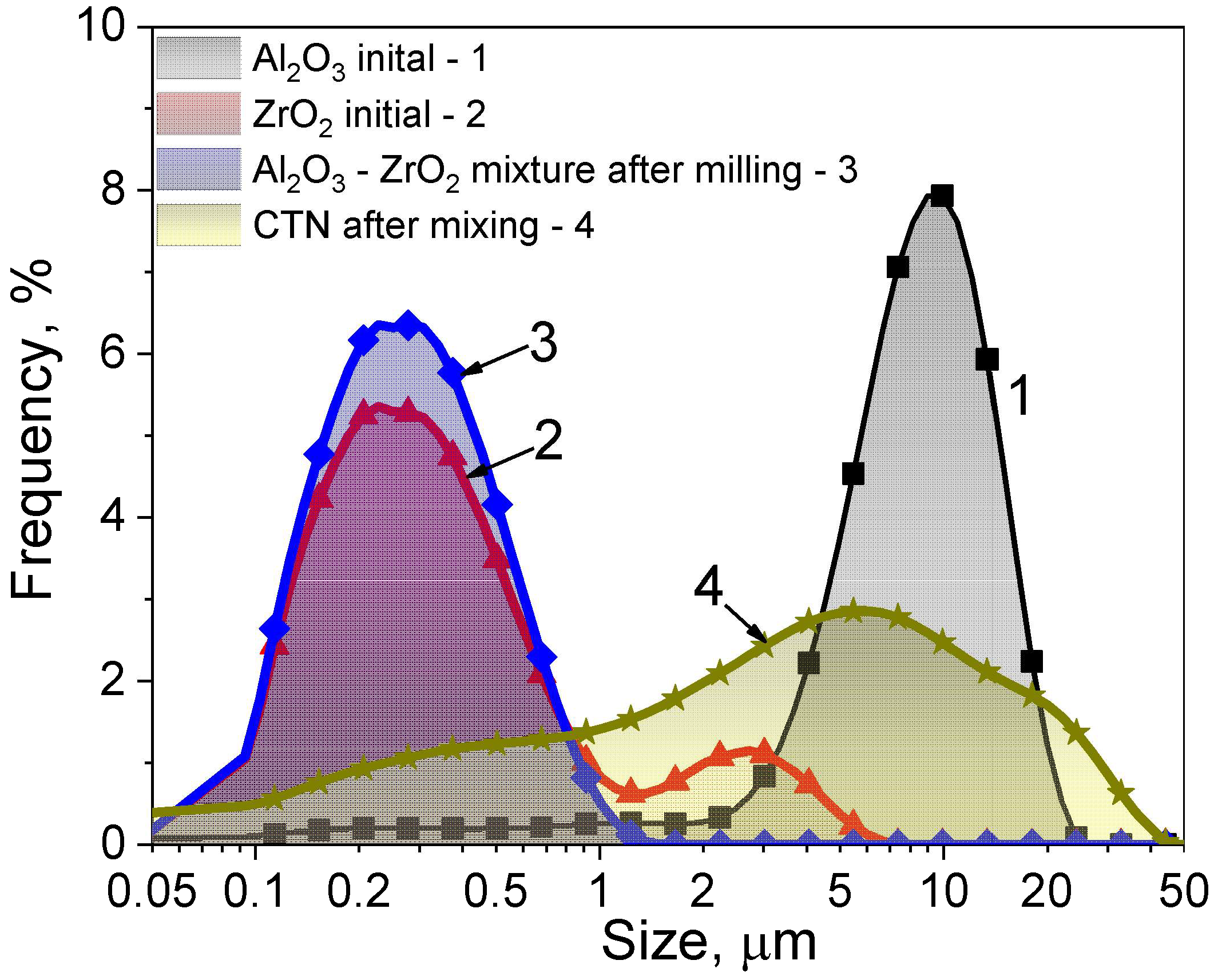
The results of the size distribution by volume measurements of some initial and milled powders are presented in Figure 1. As can be seen from the figure, the size distribution of the original corundum powder has a peak at 10 μm and is limited to 2 μm on the left and 20 μm on the right. According to the results, the micron powder of alumina with an average particle size of 8.79 μm was used as the initial powder for the ZTA matrix. The CuO-TiO2-Nb2O5 powder mixture had an even wider size distribution, in which the particle size was in the range 0.1–40 μm. This is because starting powders of CuO, TiO2, and Nb2O5 had wide distributions, which are shown in Figure S1. After milling the Al2O3-ZrO2 mixture, the particle size became less than 1 μm, with a maximum of ~0.2 μm (average size 0.34 μm). The particle size distribution of Al2O3-ZrO2 after milling was close to that of initial ZrO2 (distribution maximum ~0.2 μm and average size 0.63 μm), but the latter had a bimodal distribution (the second peak was at ~3 μm). Thus, it can be seen that after milling, the Al2O3-ZrO2 mixture for CFIMP samples had a unimodal distribution with a submicron average particle size. As shown by previous studies, small particle size should significantly improve the sinterability of corundum-based ceramics at low sintering temperatures [26]. As will be shown below, the particle size of corundum and zirconium dioxide is of decisive importance for the sinterability of the studied ZTA ceramics, which is consistent with the general ideas about the sinterability of ceramics [19].
The melting point of CTN mixture prepared by mixing CuO, TiO2, Nb2O5 oxides in planetary mill was determined using DTA analysis (Figure 2). The results of this analysis are necessary for interpreting the shrinkage of ceramics with variations in sintering temperature. The first exothermic peak in the DTA thermogram can be associated with the transition of anatase to rutile [31]. The main double endothermic peak at 958 °C and 994 °C is associated with the melting of CTN. The double peak may be due to the non-uniform distribution of titanium oxides, niobium oxide, and copper oxide particles, since, as can be seen from the size distribution analysis, the components of the mixture had significantly different particle sizes (Figure 1). In this case, the formation of new compounds, consisting of CuO, Nb2O5, and TiO2 during heating was non-uniform, and the reaction products could have different chemical compositions. When the temperature reached ~958 °C, melting of the CuO-TiO2-Nb2O5 composites with a lower melting point was observed. At higher temperatures, possible subsequential melting of remaining oxides at a temperature of 994 °C was detected. For this reason, two separated peaks are observed on the DTA thermogram. The inset to Figure 2 shows the TGA curve, which shows no change in mass upon heating, indicating no significant gas evaporation during high-temperature exposure. The increase in mass is associated with the buoyancy effect, in which the Archimedes force at high temperatures becomes smaller and the force of gravity increases [32]. Analysis of the DTA and TGA thermograms allows us to conclude that the onset of the melting point of the CTN composition selected in the work corresponds to about 905 °C, and no mass loss is observed for CTN in the temperature range of 25–1400 °C.
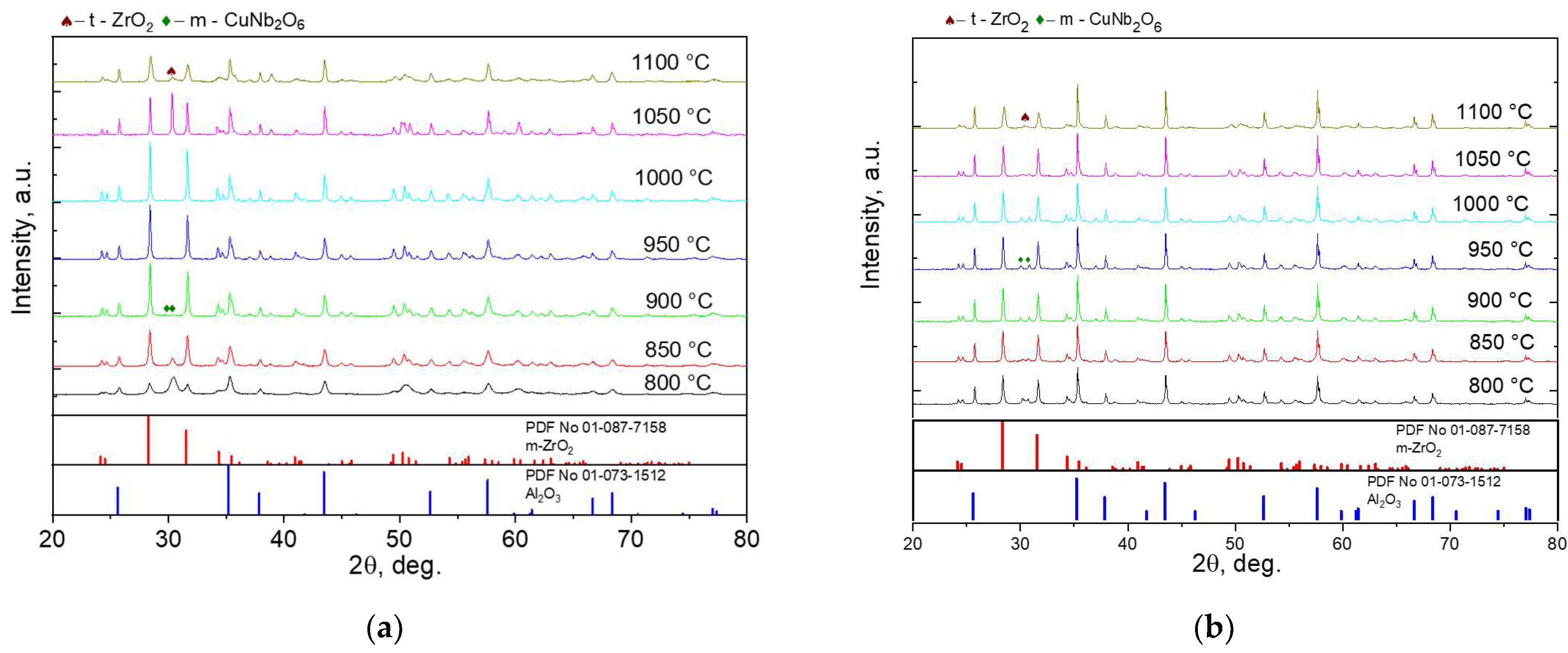
Figure 3 shows the XRD patterns of the sintered ceramics. Regardless of the sintering temperature, all samples contain m-ZrO2 (PDF No. 01-087-7158, space group P121/c1), and Al2O3 (PDF No. 01-073-1512, space group 167: R-3c: H) phases. In addition, in some samples the presence of t-ZrO2 (PDF 00-050-1089, space group 137: P42/nmc) and m-CuNb2O6 (PDF No. 01-082-0417, space group 60: Pbcn) phases is observed. From the analysis of the diffraction patterns, it can be concluded that the main phases of the ZTA ceramics were α-Al2O3 (main peaks at 2θ = 35.2°, 43.4°) and m-ZrO2 (main peaks at 2θ = 28.4° and 31.6°). However, preliminary grinding in CFIMP samples resulted in the formation of t-ZrO2 phase, which is noticeable at low sintering temperatures of 800, 850 °C, and at sintering temperatures of 1050, 1100 °C. The mechanism of formation of metastable t-ZrO2 phase can be given as follows: after milling, zirconium dioxide and aluminum oxide particles could be embedded into each other, creating significant stresses in the zirconium oxide lattice, causing a m → t transition [33,34]. With an increase in sintering temperature, the stresses in the milled particles relaxed, but after activation of liquid-phase sintering (CTN melting temperature), mechanical stresses in m-ZrO2 grains could be initiated again due to the shrinkage, which led to a repeated phase transition.
The absence of formation of the quadruple perovskite Cu3.21Ti1.16Nb2.63O12 phase, which we observed previously on the pure corundum experiments in [28], can also be explained by the wide distribution of particles in the CuO-TiO2-Nb2O5 mixture. In the composition of the green body, due to the wide distribution of oxide particles, CTN could be located unevenly in the volume. This prevents the formation of the quadruple perovskite phase. On the other hand, the contact of the green body with the corundum crucible could affect the chemical reaction 3.21·CuO + 1.16·TiO2 + 2.63·Nb2O5 → Cu3.21Ti1.16Nb2.63O12. It is known that Cu3.21Ti1.16Nb2.63O12 can form a solid solution with aluminum oxide, and the phase diagram of state is of the eutectic type [27]. In this case, the liquid component, under the action of gravity, can flow through the pores into the crucible/green body contact area and remain in the crucible material. Further support for these arguments can be found in the EDS spectra and element distribution maps shown in Figures S3–S16. As can be seen from these maps, titanium is absent from the ceramic bulk, which is the result of some of the melt leaching into the crucible. An additional factor that facilitates the transition of CTN components from the Al2O3 matrix into the crucible is the presence of a sufficiently high concentration of zirconium oxide. CTN components do not interact with ZrO2 particles, which can hinder the diffusion of atoms to form the Cu3.21Ti1.16Nb2.63O12 phase and simplify the “washout” of the melt (at temperatures above the melting point of CTN) [29].
An interesting feature of the obtained diffraction patterns is the change in the intensities of reflections related to the CuNb2O6 phase, with variations in the sintering temperature. The change in intensity or absence of reflections of the above-mentioned phase is not associated with phase transformations during the sintering process. This can be explained by the predominant accumulation of the m-CuNb2O6 phase on the surface of the sintered tablet. Since X-ray radiation penetrates the surface layer of the tablet, information on the crystalline phases of the sample under study is collected only from this layer. When the melting temperature of the CTN mixture was reached, the melt could pass to the surface of the tablet. On the side that was adjacent to the crucible during sintering, the concentration of the CuNb2O6 phase was minimal. Since the tablets were randomly placed in the holder while recording the diffraction patterns, the intensity of the reflections of the CuNb2O6 phase was also random.
Additional information obtained from the diffraction patterns is the significantly different values of the peak widths of the series of samples with and without intensively grinding. Broadened peaks are observed in the XRD patterns of the CFIMP samples. This is especially characteristic of the Al2O3 phase. As is known from the theory of X-ray diffraction, the broadening of reflections is associated with a decrease in the grain size and the presence of stresses in them [35]. Long-term milling leads to an increase in stresses in the crystal structure of corundum and zirconium dioxide. Data on the full height at half-width (FWHM) for the most intense peaks are given in Table 2. It is evident that in the series of samples, the FWHM values decrease with increasing sintering temperature, which indicates stress relaxation.
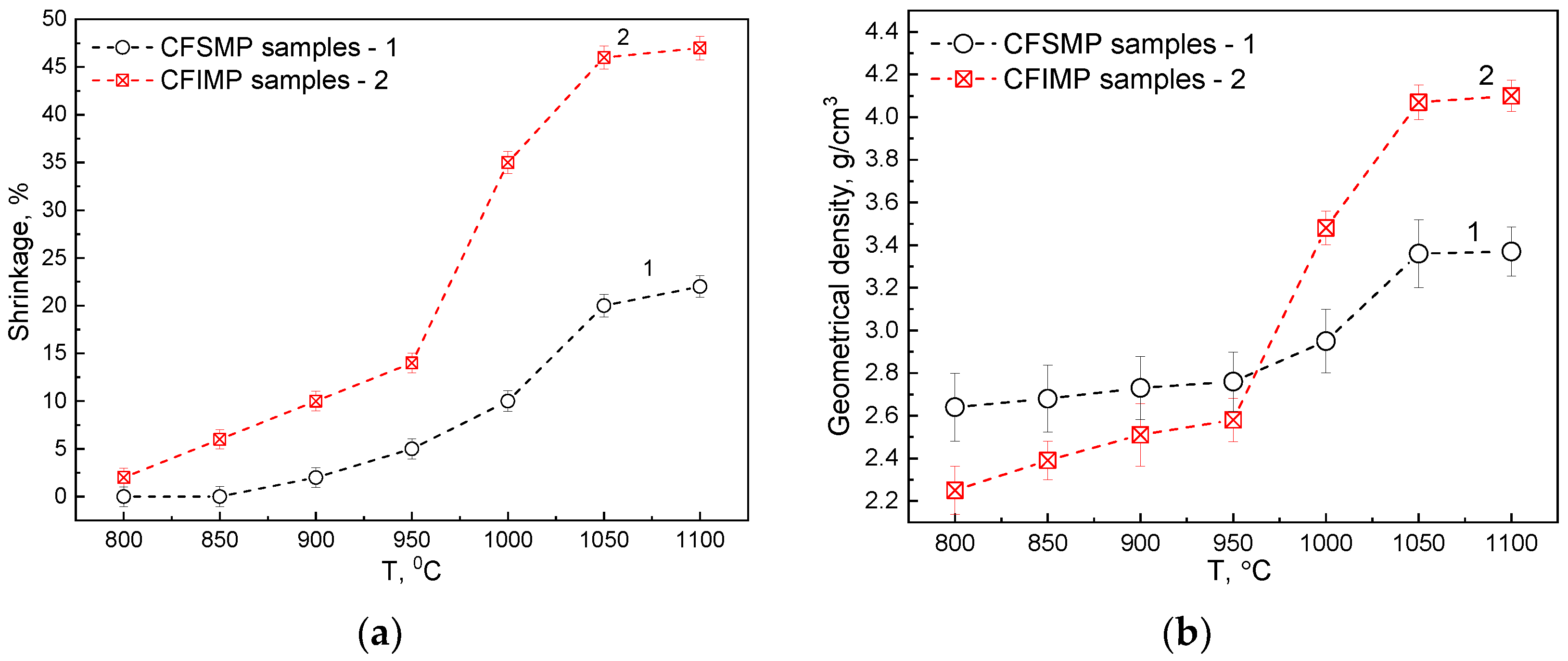
Figure 4 shows the dependences of the geometrical density and volumetric shrinkage of the sintered samples on the sintering temperature. The lower geometrical density of the CFIMP samples (by ~ 0.1–0.2 g/cm3), sintered at temperatures of 800–950 °C, is associated with a less dense packing of the ground Al2O3 and ZrO2 particles after pressing. As can be seen from the SEM results (Figure 5, Figure S3), the aluminum oxide particles initially had a high aspect ratio and were shaped like elongated plates. After pressing, such particles could change their orientation in space and lay like brickwork. In this case, the porosity of the green tablet will be less than when pressing ellipsoidal or spherical particles. However, even despite the higher final geometrical density, these samples show low values of volumetric shrinkage, which indicates low sinterability of the tablets. At a sintering temperature of 1000 °C, a significant increase in geometrical density and volume shrinkage can be observed for the series of ceramics with pre-milling from 2.5 to 4.1 g/cm3 and 14 to 47%, respectively. This feature is associated with the mechanism of liquid-phase sintering in ZTA ceramics, since at this temperature, the CTN additive completely passes into a liquid state, which was established by DTA data. The geometrical density value at temperatures is closest to the theoretical value of 4.21 g/cm3, which was calculated as a weighted average [36]. For samples without milling, significant shrinkage and high geometrical density at this sintering temperature are not observed.
Figure 5 shows the SEM images of the surface of sintered CFSMP tablets. The morphology of the samples sintered in the temperature range of 800–950 °C is generally the same and is characterized by the following features. The Al2O3 grains (dark objects), shaped like plates, are significantly larger in size compared to the ZrO2 and CTN grains (bright objects). The structure has high porosity, since there is no soldering between the corundum grains. It is also worth noting the non-uniform distribution of ZrO2 and CTN particles, expressed in the presence of conglomerates of these particles in the ceramic structure. With an increase in the sintering temperature (from 1000 °C and higher), the ZrO2 and CTN particles become larger, redistributing more uniformly in the volume, and the aluminum oxide grains show better soldering. However, the microstructure retains high porosity even at a temperature of 1100 °C (Figure 5d and Figure S2).
The surface morphology of the CFIMP samples is shown in Figure 6. For sintering temperatures of 800–900 °C, the microstructure is characterized by a submicron grain size and high porosity. Unlike the CFSMP samples, these samples have a more uniform distribution of ZrO2 inclusions, which is evident from the provided micrographs. At a temperature of 900 °C, an increase in the grain size and the formation of necks are observed. The small size of the initial particles and the peak of the melting temperature of the CTN additive (see Figure 2) are the main factors inducing the sintering process at a temperature of 950 °C. With a further increase in the sintering temperature, the liquid-phase sintering mechanism intensifies, which reduces the porosity of the ceramic microstructure and makes it more monolithic. It is worth noting that when the sintering temperature reaches 1050 °C, large crystals of a new phase appear on the surface. These crystals are formed during solidification of the liquid phase, which came out to the surface of the ceramic tablets through the pores. From the EDS maps we can conclude that these crystals belong to m-CuNb2O6 phase because they consist of Cu, O, and Nb elements (Figures S8 and S9).
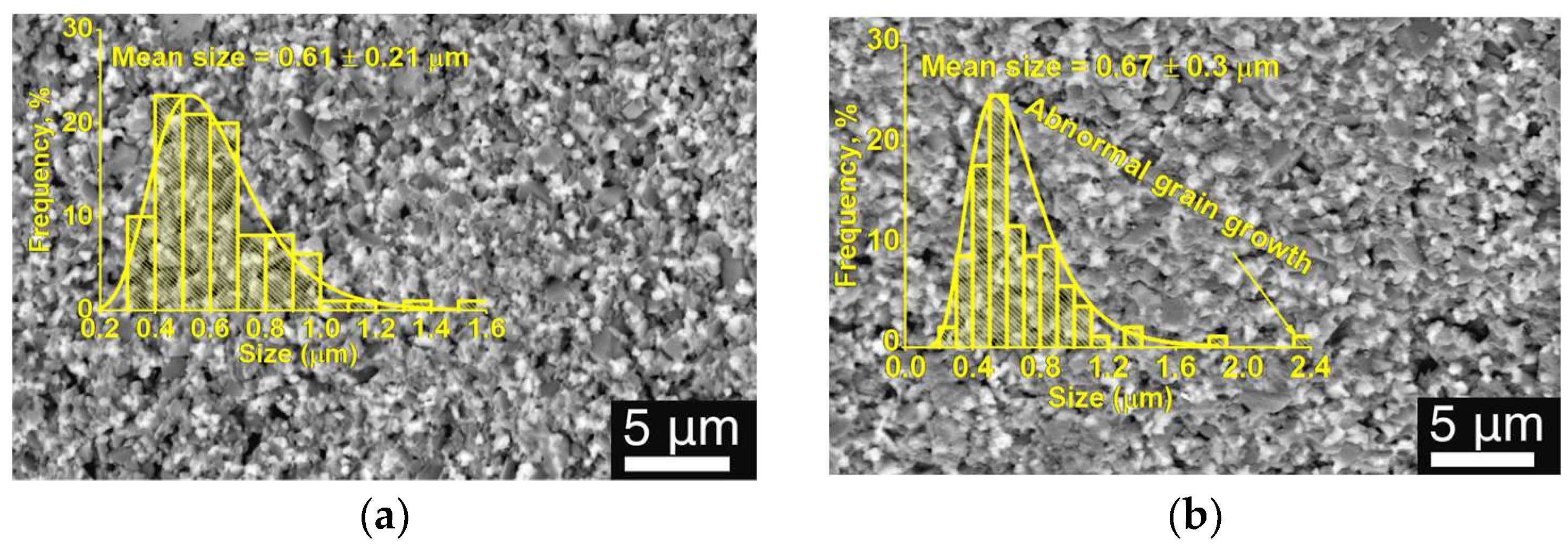
In order to establish whether there was crystallized CTN melt in the volume of the tablet samples, SEM images of the cross-section of the tablets were taken after biaxial flexural tests (Figure 7). As can be seen from the SEM images, for the samples with a sintering temperature of 1050 and 1100 °C, crystals of large size were not detected in the microstructure. The cross-section images also show that the ZrO2 grains are uniformly distributed between the corundum grains, indicating successful sintering of the ZTA ceramics.
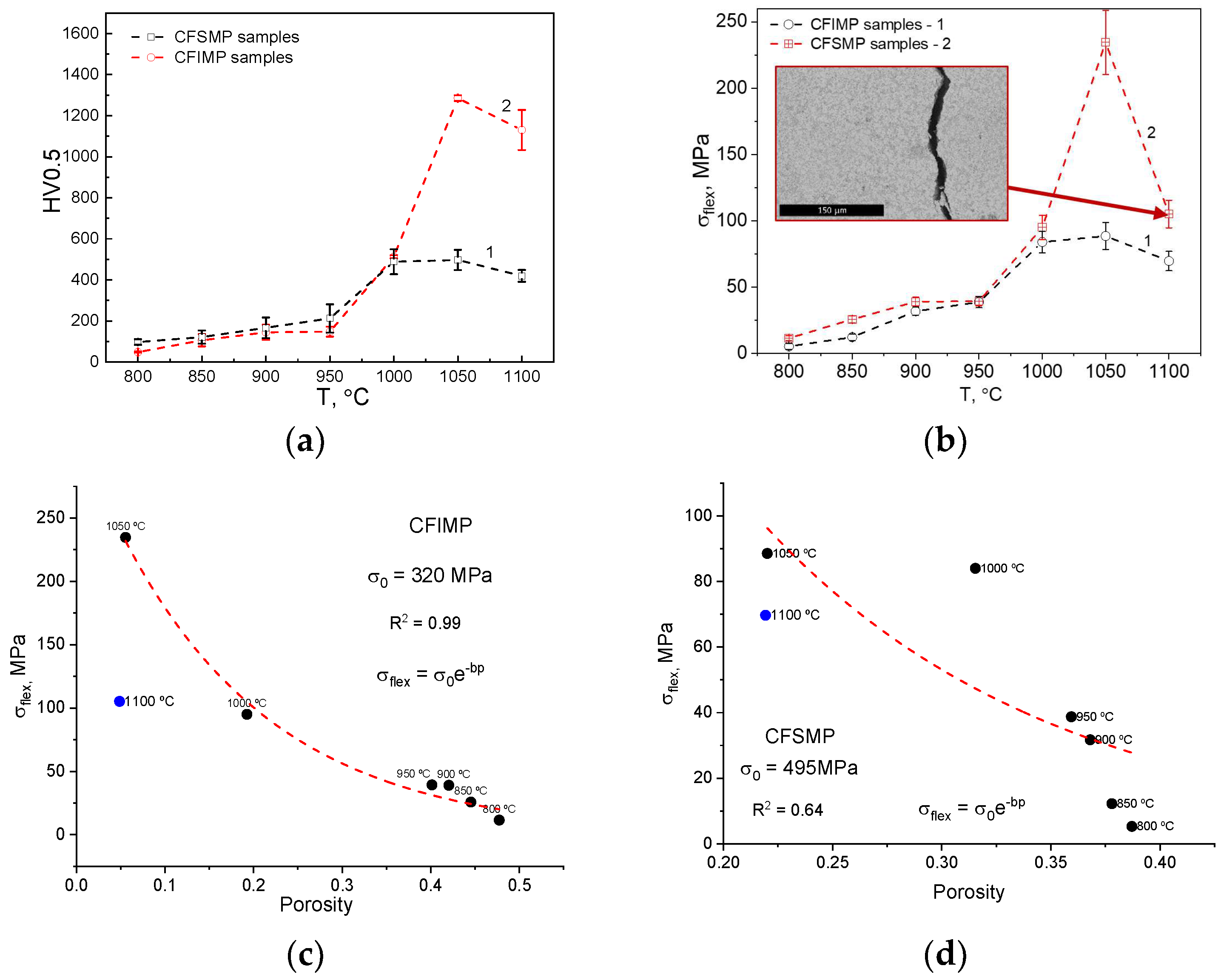
To evaluate the mechanical properties of the sintered alumina-reinforced ceramics, the dependences of microhardness and biaxial flexural strength were measured. The results of mechanical property measurements are shown in Figure 8. An interesting feature of the obtained results is the same trend of the curves for the series of CFIMP and CFSMP samples up to a sintering temperature of 1000 °C. With an increase in the sintering temperature from 800 to 950 °C, the geometrical density of the ceramics slightly increases (Figure 4b), which leads to the formation of a more homogeneous structure. Such a structure better resists external mechanical influences due to better grain cohesion. In this temperature range, the microhardness has a value within 50–200 HV, and the flexural strength is 15–35 MPa. Upon reaching the sintering temperature of 1000 °C, when the CTN additive has passed into a liquid state, the liquid-phase sintering process is initiated, but this process is not yet intense enough to lead to the formation of a monolithic low-porosity microstructure.
Above the sintering temperature of 1000 °C, a dramatic difference in the values of microhardness and biaxial flexural strength between CFSMP and CFIMP samples is observed. According to the literature, strength σ is well-defined by a formula [37]:
σ = K I C Y · π a ,
KIC—fracture toughness/stress intensity factor;
Y—geometry factor;
a—critical defect size.
As can be seen from Figure 8a,b, the values of the above mechanical properties increase more than two times at a sintering temperature of 1050 °C for the CFIMP sample. This difference is directly related to the changes in the microstructure of the sample. With the activation of liquid-phase sintering, the size and concentration of pores are significantly reduced. It is known that intergranular and intragranular pores can be stress concentrators in ceramics [38,39]. According to Formula (2), decreasing porosity reduces the critical defect size (parameter a). Therefore, flexural strength increases.
Liquid-phase sintering in ZTA+CTN leads to significant shrinkage of the ceramics and a decrease in porosity, which in turn significantly improves the mechanical properties (Figure 4 and Figure S2). The strength of ceramics can also be analyzed using the Ryshkewitch equation [40]. This equation has the following notation:
σ f l e x = σ 0 e b p
where σ0—strength of sample with zero porosity;
b—empirical coefficient;
p—porosity.
Figure 8c,d show the dependences of biaxial flexural strength on porosity and the fitting results using Formula (3). It is obvious that the points on the graph at a sintering temperature of 1100 °C deviate from the dependence. Possible reasons for this will be given below. For the CFIMP samples, a good correlation between the model and the experimental data is observed. The flexural strength at zero porosity, according to the fitting results, was 320 MPa. The obtained strength value is lower than that of ZTA ceramics from other studies. This can be explained by the effect of the CTN additive on the mechanical properties. For a series of CFSMP samples, it was found that Formula (2) poorly describes the experimental data. Apparently, the non-uniform microstructure of CFSMP ceramics is the reason for the non-exponential dependence of strength on porosity.
In addition to the above, the improvement in the mechanical properties can be associated with the transition of zirconium dioxide particles to the tetragonal phase, which is characterized by much greater crack resistance compared to the monoclinic phase. When cracks propagate during the application of compressive stresses, cracks in the Al2O3 matrix can stop at ZrO2 inclusions, and if the inclusion has a t-ZrO2 phase, the crack energy can also be absorbed to induce a phase transition (transformation hardening) [41]. Analyzing expression (2), we can conclude that the value of the fracture toughness parameter increases significantly with the formation of the t-ZrO2 phase, which ultimately increases the biaxial flexural strength.
The CFMIP sample with a sintering temperature of 1100 °C shows a decrease in the microhardness and biaxial flexural strength parameters, which may indicate the presence of optimal sintering parameters in the ZTA-CTN system. We assume that the decrease in the flexural strength value is associated with the formation of cracks in the ceramic structure, as shown in the inset of Figure 8b. These cracks could have arisen due to the transformation transition of the tetragonal phase to the monoclinic phase in zirconium dioxide, which, according to some data, is initiated already at a temperature of 930–950 °C [42]. Holding at a temperature of 1100 °C leads to an increase in the grain size (the average size increases from 0.61 to 0.67 μm, Figure 7), in particular to the appearance of elongated needle-shaped grains with sizes greater than 2 μm. This leads to a decrease in the proportion of the stabilized t-ZrO2 phase, which transforms into the m-ZrO2 phase. During sintering, this transition causes mechanical stresses in the Al2O3 matrix due to changes in the volume of the crystal lattice during the transformation transition [43]. Confirmation of the presence of stresses can be found in the data in Table 2 for the FWHM value for the diffraction pattern of the ZTA+CTN sample at 1100 °C. These stresses, in turn, create microcracks, which can form macrocracks in the volume. Thus, optimal sintering regimes for ZTA-CTN ceramics are required to obtain crack-free and monolithic ceramic products. In addition to selecting the optimal temperature, combined grinding of ZTA+CTN powders or starting powders with close average sizes can be used. This should lead to uniform sintering throughout the volume and reduce the possibility of cracking.
In general, the obtained flexural strength values of sintered ZTA-CTN ceramics are significantly lower compared to values of bending strength and flexural strength in other zirconia and ZTA studies [44,45,46,47,48]. We hypothesize that the main reason for such low values is the chosen sintering temperature regime with rapid burnout of the polymer binder. To remove the PVA binder, an initial heating rate of, for example, 0.5 °C/min can be selected, which will lead to slow burnout of the polymer binder and uniform heating of the ceramic body. Rapid burnout of the binder can lead to additional porosity, which significantly reduces the HV and σflex values. A second reason may be the presence of the CuNb2O6 phase. Since niobates have lower strength and hardness compared to Al2O3 and ZrO2, the mechanical properties of the ZTA-CTN composite are lower than those of completely pure ZTA composites. Another issue identified during sintering experiments with ZTA-CTN composites is the emergence of the CTN additive on the surface and its interaction with the crucible material. To reduce this negative side effect, crucibles made of other materials that do not react with CuO-TiO2-Nb2O5 at 1050 °C (e.g., platinum) can be used. Also, more complex temperature treatment regimes with heating and cooling cycles around the melting point of CTN can be used to prevent melt leakage through pores.

4. Conclusions

Alumina-reinforced ceramics with 5 wt.% CTN additive were obtained using standard ceramic technology. The results of the study demonstrate that the use of CTN additive allows sintering dense ZTA tablets with a porosity of 5.54 % at a temperature of 1050 °C. It is shown that the average powder size plays a decisive role in reducing the sintering temperature of ZTA. For efficient sintering of ZTA ceramics with a microhardness of HV0.5 = 1350 and a biaxial bending strength of 235 MPa, the average particle size of the ZrO2 + Al2O3 mixture must be 0.34 μm. The results obtained in the work are explained by the uniform distribution of zirconium oxide and aluminum oxide grains, as well as low porosity, which is caused by liquid-phase sintering after reaching the melting temperature of the CTN additive. In addition to low porosity, the transition from the monoclinic phase to the tetragonal phase in ZrO2 grains also determines high values of microhardness and bending strength. The experimental results indicate that the temperature of 1050 °C is optimal for low-temperature sintering of ZTA ceramics with the addition of CTN, since further increase in the sintering temperature leads to a decrease in the mechanical properties of the samples.

Supplementary Materials

The following supporting information can be downloaded at: https://www.mdpi.com/article/10.3390/cryst15110949/s1, Figure S1: Particle size distribution by volume of powders used for CTN mixture for CuO (a), TiO2 (b), and Nb2O5 (c); Figure S2: Particle size distribution by number of initial powders used for study: CuO (a), TiO2 (b), Nb2O5 (c), ZrO2 (d), Al2O3 (e); Figure S3: SEM images of initial powders used for study: Al2O3 (a), ZrO2 (b), CuO (c), Nb2O5 (d), TiO2 (e); Figure S4: SEM images of the surface of CFSMP samples for sintering temperatures of (a) 800 °C, (b) 850 °C, (c) 900 °C; Figure S5: SEM images of the surface of CFIMP samples for sintering temperatures of (a) 800 °C, (b) 850 °C, (c) 900 °C; Figure S6: Dependence of porosity on the sintering temperature for CFIMP and CFSMP samples; Figures S7–S13: EDX mapping of CFMP sintered at 800–1100 °C; Figures S14–S20: EDX mapping of CFSMP sintered at 800–1100 °C; Table S1: Mean size, mode, and median size of measured distributions (by volume).

Author Contributions

Conceptualization, R.I.S.; methodology, Y.A.G.; validation, Y.A.G. and M.E.K.; formal analysis, R.I.S.; investigation, Y.A.G., M.E.K.; resources, R.I.S.; data curation, Y.A.G. and M.E.K.; writing—original draft preparation, R.I.S. and Y.A.G.; writing—review and editing, R.I.S. and Y.A.G.; visualization, Y.A.G., R.I.S. and M.E.K.; supervision, R.I.S.; project administration, R.I.S.; funding acquisition, R.I.S. All authors have read and agreed to the published version of the manuscript.

Funding

This research was funded by the Science Committee of the Ministry of Education and Science of the Republic of Kazakhstan (No. AP26103789).

Data Availability Statement

The raw data supporting the conclusions of this article will be made available by the authors on request.

Conflicts of Interest

The authors declare no conflicts of interest.

Abbreviations

The following abbreviations are used in this manuscript:
ZTAZirconia toughened alumina
CTNCuO-TiO2-Nb2O5 mixture
SEMScanning electron microscope
XRDX-Ray diffraction
TGAThermal gravimetric analysis
PDFPowder diffraction file
FWHMFull width at half maximum
HVHardness Vickers
CFSMPCeramics obtained from slightly milled powders
CFIMPCeramics obtained from intense milled powders

References

  1. Mahajan, Y.R.; Johnson, R. Handbook of Advanced Ceramics and Composites: Defense, Security, Aerospace and Energy Applications; Springer: Cham, Switzerland, 2020; pp. 1–1547. [Google Scholar] [CrossRef]
  2. Boch, P. Ceramic Materials: Processes, Properties and Applications; Nièpce, J.-C., Ed.; John Wiley & Sons: Hoboken, NJ, USA, 2007; ISBN 978-1-905209-23-1. [Google Scholar]
  3. Abyzov, A.M. Aluminum Oxide and Alumina Ceramics (Review). Part 1. Properties of Al2O3 and Commercial Production of Dispersed Al2O3. Refract. Ind. Ceram. 2019, 60, 24–32. [Google Scholar] [CrossRef]
  4. Ben-Nissan, B.; Choi, A.H.; Cordingley, R. Alumina Ceramics. Bioceram. Their Clin. Appl. 2008, 223–242. [Google Scholar] [CrossRef]
  5. Kenzhina, I.E.; Kozlovskiy, A.L.; Begentayev, M.; Tolenova, A.; Askerbekov, S. Influence of the Change of Phase Composition of (1 − x)ZrO2–xAl2O3 Ceramics on the Resistance to Hydrogen Embrittlement. Materials 2023, 16, 7072. [Google Scholar] [CrossRef]
  6. Yang, J.; Lei, L.; Zhang, J. Preparation of Alumina Ceramics via a Two-Step Sintering Process. Materials 2025, 18, 1789. [Google Scholar] [CrossRef] [PubMed]
  7. Kostishin, V.G.; Mironovich, A.Y.; Timofeev, A.V.; Isaev, I.M.; Shakirzyanov, R.I.; Skorlupin, G.A.; Ril, A.I. Influence of the Deposition Interruption on the Texture Degree of Barium Hexaferrite BaFe12O19 Films. Superlattices Microstruct. 2021, 158, 107005. [Google Scholar] [CrossRef]
  8. Barinov, S.M.; Ponomarev, V.F.; Shevchenko, V.Y. Effect of Hot Isostatic Pressing on the Mechanical Properties of Aluminum Oxide Ceramics. Refract. Ind. Ceram. 1997, 38, 9–12. [Google Scholar] [CrossRef]
  9. Kadyrzhanov, D.B.; Kaliyekperov, M.E.; Idinov, M.T.; Kozlovskiy, A.L. Study of the Structural, Morphological, Strength and Shielding Properties of CuBi2O4 Films Obtained by Electrochemical Synthesis. Materials 2023, 16, 7241. [Google Scholar] [CrossRef] [PubMed]
  10. Kozlovskiy, A.L.; Borgekov, D.B.; Zdorovets, M.V.; Kenzhina, I.E.; Shlimas, D.I. Study of Radiation Damage Kinetics in Dispersed Nuclear Fuel on Zirconium Dioxide Doped with Cerium Dioxide. J. Compos. Sci. 2023, 7, 277. [Google Scholar] [CrossRef]
  11. Wei, S.; Han, G.; Zhang, X.; Sun, J.; Wang, W.; Zhang, J.; Zhang, Z.; Zhang, W.; Zhang, J.; Yang, L.; et al. Preparation of Excellent Performance ZTA Ceramics and Complex Shaped Components Using Digital Light Processing 3D Printing Technology. J. Alloys Compd. 2024, 980, 173640. [Google Scholar] [CrossRef]
  12. Sktani, Z.D.I.; Arab, A.; Mohamed, J.J.; Ahmad, Z.A. Effects of Additives Additions and Sintering Techniques on the Microstructure and Mechanical Properties of Zirconia Toughened Alumina (ZTA): A Review. Int. J. Refract. Met. Hard Mater. 2022, 106, 105870. [Google Scholar] [CrossRef]
  13. Tan, P.; Yang, Y.; Sui, Y.; Jiang, Y. Influence of CeO2 Addition on the Microstructure and Mechanical Properties of Zirconia-Toughened Alumina (ZTA) Composite Prepared by Spark Plasma Sintering. Ceram. Int. 2020, 46, 7510–7516. [Google Scholar] [CrossRef]
  14. Rejab, N.A.; Ahmad, Z.A.; Ab Rahman, M.F.; Su, N.K. ZTA Hardness Enhancement via Hot Isostatic Press Sintering. J. Phys. Conf. Ser. 2018, 1082, 012038. [Google Scholar] [CrossRef]
  15. Sarker, S.; Mumu, H.T.; Al-Amin, M.; Zahangir Alam, M.; Gafur, M.A. Impacts of Inclusion of Additives on Physical, Microstructural, and Mechanical Properties of Alumina and Zirconia Toughened Alumina (ZTA) Ceramic Composite: A Review. Mater. Today Proc. 2022, 62, 2892–2918. [Google Scholar] [CrossRef]
  16. Colomban, P. Chemical Preparation Routes and Lowering the Sintering Temperature of Ceramics. Ceramics 2020, 3, 312–339. [Google Scholar] [CrossRef]
  17. Riedel, R.; Chen, I.W. Ceramics Science and Technology; Wiley VCH Verlag GmbH & Co. KGaA: Weinheim, Germany, 2010; Volume 2. [Google Scholar] [CrossRef]
  18. Garanin, Y.; Shakirzyanov, R.; Borgekov, D.; Kozlovskiy, A.; Volodina, N.; Shlimas, D.; Zdorovets, M. Study of Morphology, Phase Composition, Optical Properties, and Thermal Stability of Hydrothermal Zirconium Dioxide Synthesized at Low Temperatures. Sci. Rep. 2024, 14, 29398. [Google Scholar] [CrossRef] [PubMed]
  19. Ayode Otitoju, T.; Ugochukwu Okoye, P.; Chen, G.; Li, Y.; Onyeka Okoye, M.; Li, S. Advanced Ceramic Components: Materials, Fabrication, and Applications. J. Ind. Eng. Chem. 2020, 85, 34–65. [Google Scholar] [CrossRef]
  20. Segal, D. Chemical Synthesis of Ceramic Materials. J. Mater. Chem. 1997, 7, 1297–1305. [Google Scholar] [CrossRef]
  21. Han, Y.; Li, S.; Zhu, T.; Xie, Z. An Oscillatory Pressure Sintering of Zirconia Powder: Rapid Densification with Limited Grain Growth. J. Am. Ceram. Soc. 2017, 100, 2774–2780. [Google Scholar] [CrossRef]
  22. Hotza, D.; García, D.E.; Castro, R.H.R. Obtaining Highly Dense YSZ Nanoceramics by Pressureless, Unassisted Sintering. Int. Mater. Rev. 2015, 60, 353–375. [Google Scholar] [CrossRef]
  23. Lóh, N.J.; Simão, L.; Faller, C.A.; De Noni, A.; Montedo, O.R.K. A Review of Two-Step Sintering for Ceramics. Ceram. Int. 2016, 42, 12556–12572. [Google Scholar] [CrossRef]
  24. Gupta, R.K.; Anil Kumar, V.; Khanra, G.P. Reactive and Liquid-Phase Sintering Techniques. Intermet. Matrix Compos. Prop. Appl. 2018, 303–318. [Google Scholar] [CrossRef]
  25. Mironovich, A.Y.; Kostishin, V.G.; Al-Khafaji, H.I.; Timofeev, A.V.; Savchenko, E.S.; Ril, A.I. Submicron Barium Hexaferrite Ceramics Manufactured by Low-Temperature Liquid-Phase Sintering of BaFe12O19 Nanoparticles. Russ. J. Inorg. Chem. 2024, 69, 1637–1645. [Google Scholar] [CrossRef]
  26. Yang, Y.; Ma, M.; Zhang, F.; Liu, F.; Chen, G.; Liu, Z.; Li, Y. Low-Temperature Sintering of Al2O3 Ceramics Doped with 4CuO-TiO2-2Nb2O5 Composite Oxide Sintering Aid. J. Eur. Ceram. Soc. 2020, 40, 5504–5510. [Google Scholar] [CrossRef]
  27. Shigeno, K.; Kuraoka, Y.; Asakawa, T.; Fujimori, H. Sintering Mechanism of Low-Temperature Co-Fired Alumina Featuring Superior Thermal Conductivity. J. Am. Ceram. Soc. 2021, 104, 2017–2029. [Google Scholar] [CrossRef]
  28. Shakirzyanov, R.I.; Volodina, N.O.; Kadyrzhanov, K.K.; Kozlovskiy, A.L.; Shlimas, D.I.; Baimbetova, G.A.; Borgekov, D.B.; Zdorovets, M.V. Study of the Aid Effect of CuO-TiO2-Nb2O5 on the Dielectric and Structural Properties of Alumina Ceramics. Materials 2023, 16, 5018. [Google Scholar] [CrossRef]
  29. Kenzhina, I.E.; Kozlovskiy, A.L.; Volodina, N.O.; Shakirzyanov, R.I.; Garanin, Y.A.; Maznykh, S.A.; Makhanov, K.M.; Tolenova, A.U.; Begentayev, M.; Askerbekov, S.K.; et al. Low-Temperature Sintering of Zirconia-Based Ceramic Composites for Capacitor Applications. Ceram. Int. 2025, 51, 33428–33440. [Google Scholar] [CrossRef]
  30. Chung, S.M.; Yap, A.U.J.; Chandra, S.P.; Lim, C.T. Flexural Strength of Dental Composite Restoratives: Comparison of Biaxial and Three-Point Bending Test. J. Biomed. Mater. Res. Part B Appl. Biomater. 2004, 71B, 278–283. [Google Scholar] [CrossRef]
  31. Zhu, X.; Han, S.; Feng, W.; Kong, Q.; Dong, Z.; Wang, C.; Lei, J.; Yi, Q. The Effect of Heat Treatment on the Anatase–Rutile Phase Transformation and Photocatalytic Activity of Sn-Doped TiO2 Nanomaterials. RSC Adv. 2018, 8, 14249–14257. [Google Scholar] [CrossRef] [PubMed]
  32. Saadatkhah, N.; Carillo Garcia, A.; Ackermann, S.; Leclerc, P.; Latifi, M.; Samih, S.; Patience, G.S.; Chaouki, J. Experimental Methods in Chemical Engineering: Thermogravimetric Analysis—TGA. Can. J. Chem. Eng. 2020, 98, 34–43. [Google Scholar] [CrossRef]
  33. Khoshkalam, M.; Faghihi-Sani, M.A.; Nojoomi, A. Effect of Zirconia Content and Powder Processing on Mechanical Properties of Gelcasted ZTA Composite. Trans. Indian Ceram. Soc. 2013, 72, 175–181. [Google Scholar] [CrossRef]
  34. Gafur, M.A.; Al-Amin, M.; Sarker, M.S.R.; Alam, M.Z.; Gafur, M.A.; Al-Amin, M.; Sarker, M.S.R.; Alam, M.Z. Structural and Mechanical Properties of Alumina-Zirconia (ZTA) Composites with Unstabilized Zirconia Modulation. Mater. Sci. Appl. 2021, 12, 542–560. [Google Scholar] [CrossRef]
  35. Nath, D.; Singh, F.; Das, R. X-Ray Diffraction Analysis by Williamson-Hall, Halder-Wagner and Size-Strain Plot Methods of CdSe Nanoparticles- a Comparative Study. Mater. Chem. Phys. 2020, 239, 122021. [Google Scholar] [CrossRef]
  36. Carlevaris, D.; Varriale, F.; Wahlström, J.; Menapace, C. Pin-on-Disc Tribological Characterization of Single Ingredients Used in a Brake Pad Friction Material. Friction 2024, 12, 2576–2593. [Google Scholar] [CrossRef]
  37. Yang, S.; Zhang, C.; Zhang, X. Probabilistic Relation between Stress Intensity and Fracture Toughness in Ceramics. Ceram. Int. 2020, 46, 20558–20564. [Google Scholar] [CrossRef]
  38. Tang, Q.; Gong, J. Effect of Porosity on the Microhardness Testing of Brittle Ceramics: A Case Study on the System of NiO–ZrO2. Ceram. Int. 2013, 39, 8751–8759. [Google Scholar] [CrossRef]
  39. Alfahed, B.; Alayad, A. The Effect of Sintering Temperature on Vickers Microhardness and Flexural Strength of Translucent Multi-Layered Zirconia Dental Materials. Coatings 2023, 13, 688. [Google Scholar] [CrossRef]
  40. Ternero, F.; Rosa, L.G.; Urban, P.; Montes, J.M.; Cuevas, F.G. Influence of the Total Porosity on the Properties of Sintered Materials—A Review. Metals 2021, 11, 730. [Google Scholar] [CrossRef]
  41. Wang, J.; Stevens, R. Zirconia-Toughened Alumina (ZTA) Ceramics. J. Mater. Sci. 1989, 24, 3421–3440. [Google Scholar] [CrossRef]
  42. Patil, R.N.; Subbarao, E.C. Monoclinic–Tetragonal Phase Transition in Zirconia: Mechanism, Pretransformation and Coexistence. Acta Crystallogr. Sect. A 1970, 26, 535–542. [Google Scholar] [CrossRef]
  43. Matsui, K.; Yoshida, H.; Ikuhara, Y. Review: Microstructure-Development Mechanism during Sintering in Polycrystalline Zirconia. Int. Mater. Rev. 2018, 63, 375–406. [Google Scholar] [CrossRef]
  44. Burelli, M.; Maschio, S.; Lucchini, E. Strength and Toughness of Alumina--Zirconia Ceramics under Biaxial Stress. J. Mater. Sci. Lett. 1997, 16, 661–662. [Google Scholar] [CrossRef]
  45. Hajjaj, M.S.; Alamoudi, R.A.A.; Babeer, W.A.; Rizg, W.Y.; Basalah, A.A.; Alzahrani, S.J.; Yeslam, H.E. Flexural Strength, Flexural Modulus and Microhardness of Milled vs. Fused Deposition Modeling Printed Zirconia; Effect of Conventional vs. Speed Sintering. BMC Oral Health 2024, 24, 38. [Google Scholar] [CrossRef] [PubMed]
  46. Hetzler, S.; Hinzen, C.; Rues, S.; Schmitt, C.; Rammelsberg, P.; Zenthöfer, A. Biaxial Flexural Strength and Vickers Hardness of 3D-Printed and Milled 5Y Partially Stabilized Zirconia. J. Funct. Biomater. 2025, 16, 36. [Google Scholar] [CrossRef] [PubMed]
  47. Zenthöfer, A.; Ilani, A.; Schmitt, C.; Rammelsberg, P.; Hetzler, S.; Rues, S. Biaxial Flexural Strength of 3D-Printed 3Y-TZP Zirconia Using a Novel Ceramic Printer. Clin. Oral Investig. 2024, 28, 145. [Google Scholar] [CrossRef] [PubMed]
  48. Kulyk, V.; Vasyliv, B.; Duriagina, Z.; Lyutyy, P.; Vavrukh, V.; Kostryzhev, A. The Effect of Sintering Temperature on Phase-Related Peculiarities of the Microstructure, Flexural Strength, and Fracture Toughness of Fine-Grained ZrO2–Y2O3–Al2O3–CoO–CeO2–Fe2O3 Ceramics. Crystals 2024, 14, 175. [Google Scholar] [CrossRef]
Figure 1. Particle size distribution by volume of powders used for sintering ZTA-CTN ceramics.
Crystals 15 00949 g001
Figure 2. DTA thermogram of CTN mixture (insert: TGA thermogram of CTN mixture).
Crystals 15 00949 g002
Figure 3. XRD patterns of (a) CFIMP- and (b) CFSMP-sintered samples.
Crystals 15 00949 g003
Figure 4. Dependence of volume shrinkage (a) and geometrical density (b) on sintering temperature.
Crystals 15 00949 g004
Figure 5. SEM images of the surface of CFSMP samples for sintering temperatures of (a) 950 °C, (b) 1000 °C, (c) 1050 °C, (d) 1100 °C.
Crystals 15 00949 g005
Figure 6. SEM images of the surface of CFIMP samples for sintering temperatures of (a) 950 °C, (b) 1000 °C, (c) 1050 °C, (d) 1100 °C.
Crystals 15 00949 g006
Figure 7. SEM images of cross-sections of ZTA ceramic CFIMP tablets with sintering temperatures of (a) 1050 °C and (b) 1100 °C (insets—distribution histograms by number).
Crystals 15 00949 g007
Figure 8. Dependences of (a) microhardness, (b) biaxial flexural strength on sintering temperature, and biaxial flexural strength on porosity for CFIMP (c) and CFSMP (d) in ZTA+CTN ceramics.
Crystals 15 00949 g008
Table 1. Data on the diameter d and thickness h of tablets before and after sintering for CFSMP and CFIMP samples. Ts—sintering temperature, d1—tablet diameter before sintering, h1—tablet thickness before sintering, d2—tablet diameter after sintering, h2—tablet thickness after sintering.
SampleTs, °Cd1, mmh1, mmd2, mmh2, mm
CFSMP80012 ± 0.051.57 ± 0.0112 ± 0.051.58 ± 0.01
85012 ± 0.051.57 ± 0.0112 ± 0.051.56 ± 0.01
90012 ± 0.051.72 ± 0.0111.9 ± 0.051.71 ± 0.01
95012 ± 0.051.58 ± 0.0111.8 ± 0.051.56 ± 0.01
100012 ± 0.051.58 ± 0.0111.5 ± 0.051.55 ± 0.01
105012 ± 0.051.41 ± 0.0111 ± 0.051.34 ± 0.01
110012 ± 0.051.58 ± 0.0111 ± 0.051.47 ± 0.01
CFIMP80012 ± 0.051.92 ± 0.0112 ± 0.051.88 ± 0.01
85012 ± 0.051.89 ± 0.0111.8 ± 0.051.84 ± 0.01
90012 ± 0.051.83 ± 0.0111.7 ± 0.051.75 ± 0.01
95012 ± 0.051.89 ± 0.0111.4 ± 0.051.8 ± 0.01
100012 ± 0.051.86 ± 0.0110.4 ± 0.051.6 ± 0.01
105012 ± 0.051.86 ± 0.019.7 ± 0.051.6 ± 0.01
110012 ± 0.051.82 ± 0.019.75 ± 0.051.47 ± 0.01
Table 2. Comparison of FWHM of the main reflections for the corundum and zirconium dioxide phases.
Sintering Temperature, °CPeakFWHM, °
CFSMPCFIMP
800 °CZrO2 (11-1)0.165820.357048
Al2O3 (104)0.075170.403192
850 °CZrO2 (11-1)0.172170.227048
Al2O3 (104)0.08210.365838
900 °CZrO2 (11-1)0.161290.169464
Al2O3 (104)0.063110.18524
950 °CZrO2 (11-1)0.164570.157724
Al2O3 (104)0.070620.18503
1000 °CZrO2 (11-1)0.169880.138214
Al2O3 (104)0.081170.12883
1050 °CZrO2 (11-1)0.163320.133682
Al2O3 (104)0.071320.090018
1100 °CZrO2 (11-1)0.265530.22735
Al2O3 (104)0.07330.12579
Disclaimer/Publisher’s Note: The statements, opinions and data contained in all publications are solely those of the individual author(s) and contributor(s) and not of MDPI and/or the editor(s). MDPI and/or the editor(s) disclaim responsibility for any injury to people or property resulting from any ideas, methods, instructions or products referred to in the content.