Article

Centrosymmetric Double-Q Skyrmion Crystals Under Uniaxial Distortion and Bond-Dependent Anisotropy


Graduate School of Science, Hokkaido University, Sapporo 060-0810, Japan
Crystals 2025, 15(11), 930; https://doi.org/10.3390/cryst15110930
Submission received: 10 October 2025 / Revised: 28 October 2025 / Accepted: 29 October 2025 / Published: 29 October 2025
(This article belongs to the Section Inorganic Crystalline Materials)

Abstract

We theoretically investigate the stability of double-Q square skyrmion crystals under uniaxial distortion. Using an effective spin model with frustrated exchange interactions and bond-dependent anisotropy in momentum space, we construct the low-temperature magnetic phase diagram via simulated annealing. Our results reveal that uniaxial distortion drives a phase transition from the skyrmion crystal to a single-Q conical spiral state when the ratio of exchange interactions parallel and perpendicular to the uniaxial axis is reduced to about 95%. We further find that topologically trivial double-Q states, which emerge in the low- and high-field regimes, are more robust against uniaxial distortion than the skyrmion crystal appearing in the intermediate-field regime. Finally, we examine the role of bond-dependent anisotropy and demonstrate that a finite relative magnitude of this anisotropy is crucial for stabilizing the skyrmion crystal, even under uniaxial distortion. These findings highlight the delicate interplay between lattice distortions and bond-dependent interactions in determining the stability of multiple-Q magnetic textures, and they provide useful guidance for experimental efforts to manipulate skyrmion crystal phases in centrosymmetric magnets.

1. Introduction

Skyrmions are topologically stable objects characterized by a quantized topological number, which renders them robust against external perturbations and gives rise to emergent electromagnetic phenomena. Since their original introduction by Tony Skyrme [1,2], these topologically nontrivial entities have been explored in a wide variety of contexts, including crystalline liquids [3,4,5,6,7], quantum Hall magnets [8,9,10,11,12,13,14], and Bose–Einstein condensates [15,16,17,18,19,20]. In magnetic materials, where skyrmions manifest as nanoscale swirling spin textures, their first experimental discovery in noncentrosymmetric chiral magnets [21,22,23,24] triggered enormous interest in condensed matter physics and materials science [25,26,27,28,29]. They are now recognized not only as a novel realization of topological order but also as promising candidates for next-generation spintronic applications, including racetrack memories and neuromorphic computing devices [30,31,32,33,34,35,36].
In particular, skyrmion crystals (SkXs), where skyrmions form periodic lattices, provide an ideal platform for studying collective excitations [37,38,39,40,41,42], topological transport phenomena [43,44,45,46,47,48,49,50,51], and field/temperature-driven phase transitions [52,53,54,55]. While most early studies focused on hexagonal SkXs stabilized by the Dzyaloshinskii–Moriya (DM) interaction [56,57] in noncentrosymmetric systems [27,58], it has become increasingly clear that SkXs are not restricted to such environments. Recent theoretical and experimental works have shown that SkXs can also be stabilized in centrosymmetric magnets through the competition between frustrated exchange interactions [59,60,61,62,63] and magnetic anisotropies [64,65,66,67,68,69,70,71], thereby significantly broadening the scope of candidate materials [72].
Of particular interest are tetragonal or square-lattice magnets, where the interplay of symmetry-related ordering wave vectors can give rise to double-Q spin textures, including square SkXs. Recent studies have identified double-Q SkXs in tetragonal compounds such as Co 10 x / 2 Zn 10 x / 2 Mn x [73,74,75,76,77] and Cu 2 OSeO3 [78,79], GdRu2Si2 [80,81,82,83,84,85], and GdRu2Ge2 [86]. Understanding the stabilization mechanism and controllability of such square SkXs is crucial both for fundamental studies of nontrivial spin orders. So far, several mechanisms have been theoretically proposed, such as momentum–space frustration [87,88], bond-dependent interaction [89,90], dipolar interaction [91], and staggered DM interaction [92,93].
One of the central questions is how external perturbations affect the delicate stability of SkXs [94,95,96,97,98]. Among them, uniaxial distortion—arising from epitaxial strain, applied pressure, or lattice mismatch in thin films—is particularly important because it breaks the fourfold rotational symmetry of double-Q structures and lifts the degeneracy between orthogonal ordering wave vectors. An illustrative case is EuAl4, where two types of the SkXs have been observed in a rhombic environment [99,100,101,102].
In this work, we investigate the stability of double-Q square SkXs on a square lattice under uniaxial distortion by employing an effective momentum–space spin model with frustrated exchange interactions and bond-dependent anisotropy. Using simulated annealing, we construct low-temperature phase diagrams and track the evolution of spin textures under applied magnetic fields. We find that moderate uniaxial distortion (interaction anisotropy of about 5%) destabilizes the SkX and drives a transition into a single-Q conical spiral state. By contrast, topologically trivial double-Q states that emerge in the low- and high-field regimes are more robust against distortion than the intermediate-field SkX. Furthermore, we demonstrate that a finite bond-dependent anisotropy is indispensable for stabilizing the SkX under distortion, underscoring the cooperative role of frustration and anisotropy. These results establish the essential stability conditions for square SkXs under uniaxial distortion and highlight the crucial role of bond-dependent anisotropy.
The remainder of this paper is organized as follows. Section 2 introduces the model and numerical method. Section 3 presents the phase diagrams and discusses the contrasting robustness of SkX and double-Q states under uniaxial distortion, together with the role of bond-dependent anisotropy. Section 4 summarizes the implications for materials exploration and strain-based control of multiple-Q textures.

2. Model and Method

We begin our analysis with an effective spin model defined on a two-dimensional square lattice with fourfold rotational symmetry as well as spatial inversion symmetry. We set the lattice constant of the square lattice to unity. The Hamiltonian is given by equations.
H = 2 ν α β J Q ν Γ Q ν α β S Q ν α S Q ν β H i S i z ,
where S i = ( S i x , S i y , S i z ) denotes a classical localized spin at site i with a fixed length | S i | = 1 . The Fourier component of the spin variable is written as S Q ν α = ( 1 / N ) i S i e i Q ν · r i for spin direction α = x , y , z ; N is the total number of spins and r i is the position vector.
The first term in Equation (1) describes bilinear exchange interactions resolved in momentum space; J Q ν is the coupling constant at wave vector Q ν . In principle, all wave vectors in the Brillouin zone contribute to the interaction, but in practice, only a few symmetry-related wave vectors dominate the low-energy magnetic instabilities. To capture the essential physics, we restrict our consideration to the ordering wave vectors
Q 1 = ( Q , 0 ) , Q 2 = ( 0 , Q ) , Q 3 = ( Q , Q ) , Q 4 = ( Q , Q ) ,
with Q = π / 4 . These vectors are related to each other: Q 3 = Q 1 + Q 2 and Q 4 = Q 1 + Q 2 , so that Q 3 and Q 4 can be regarded as higher harmonics of Q 1 and Q 2 . We further assume that at zero field the magnetic instabilities at Q 1 and Q 2 are stronger than those at Q 3 and Q 4 so as to satisfy J Q 1 = J Q 2 > J Q 3 = J Q 4 under the tetragonal symmetry, while other higher harmonics beyond these wave vectors can be neglected. This approximation is well justified in localized spin systems, where ferromagnetic exchange interaction competes with further-neighbor antiferromagnetic exchange interactions [103,104,105,106,107], as well as in itinerant electron systems, where long-range interactions arise from Fermi surface nesting [108,109,110], known as the Ruderman–Kittel–Kasuya–Yosida (RKKY) interaction [111,112,113]. Consequently, the low-temperature phase diagram can be captured by considering only these few dominant interaction channels. In what follows, we set J Q 1 = 1 as the unit of energy, which corresponds roughly to the ordering temperature scale. For other wave vector interactions, we take J Q 2 = γ Q 2 J Q 1 and J Q 3 = J Q 4 = γ Q 1 + Q 2 J Q 1 ; we fix γ Q 1 + Q 2 = 0.6 .
To describe the effect of magnetic anisotropy in spin space, we introduce the form factor Γ Q ν α β , which microscopically originates from the interplay of relativistic spin–orbit coupling, the crystalline electric field, and the underlying band structure [114]. For the tetragonal lattice symmetry, we adopt the following parameterization: Γ Q 1 y y = Γ Q 2 x x = 1 + I BA , Γ Q 1 x x = Γ Q 2 y y = 1 I BA , Γ Q 1 z z = Γ Q 2 z z = 1 , and Γ Q 3 x x = Γ Q 3 y y = Γ Q 3 z z = Γ Q 4 x x = Γ Q 4 y y = Γ Q 4 z z = 1 , with all other components vanishing; I BA denotes the bond-dependent anisotropy, which can become the microscopic origin of the SkX [115,116,117,118,119] and other topologically nontrivial spin textures [120,121,122,123]. By construction, Γ Q ν α β is symmetric under the exchange of α and β , consistent with the inversion symmetry of the system. This bond-dependent anisotropy I BA corresponds to a compass-type anisotropic exchange interaction, rather than a local single-ion anisotropy, in a real-space picture. As a consequence, no antisymmetric contribution of the form Γ Q ν α β = Γ Q ν β α , which corresponds to the DM interaction, appears. The second term in Equation (1) corresponds to the Zeeman contribution, capturing the interaction with an external magnetic field H directed along the z axis.
Having formulated the model in the tetragonal limit, we next examine the impact of uniaxial distortion along the [100] axis. This distortion lowers the symmetry from tetragonal to orthorhombic and introduces inequivalence between the [ 100 ] and [ 010 ] directions. Consequently, the exchange constants satisfy J Q 1 J Q 2 , while the relation J Q 3 = J Q 4 is preserved. By systematically varying the ratio J Q 2 / J Q 1 = γ Q 2 , we can map out how the SkX phases evolve under increasing distortion [124]. For simplicity, the ordering wave vectors themselves and all other microscopic parameters are fixed against distortion so that the effect of the anisotropy in J Q ν can be isolated.
To determine the phase diagram, we employ Monte Carlo simulations based on simulated annealing with a system size of N = 16 2 spins. Starting from random configurations at high temperatures T / J Q 1 > 1 , the temperature is gradually reduced according to T n + 1 = α ~ T n with α ~ = 0.999995 0.999999 until a final value T = 0.01 is reached, such that thermal fluctuations are nearly negligible. At the lowest temperature, physical observables are obtained by averaging over 10 5 10 6 Monte Carlo sweeps after equilibration. This procedure allows us to reliably capture the low-temperature spin textures and phase transitions driven by uniaxial distortion.
To characterize the magnetic phases, we evaluate several order parameters and correlation functions that distinguish between single-Q, double-Q, and topologically nontrivial spin textures like the SkX. First, the uniform magnetization along the field direction is defined as
M z = 1 N i S i z ,
where N is the total number of lattice sites. In order to resolve the ordering wave vectors in momentum space, we compute the spin structure factor
S s η ( q ) = 1 N i j S i η S j η e i q · ( r i r j ) ,
with η = x , y , z . We also calculate the in-plane component of the spin structure factor as S s x y ( q ) = S s x ( q ) + S s y ( q ) . From the spin structure factor, the amplitude of the q component of the spin moment is extracted as
m q η = S s η ( q ) N .
These quantities enable us to identify single-Q and double-Q orders.
To probe the topological nature of the spin textures, we evaluate the scalar spin chirality,
χ sc = 1 N i δ = ± 1 S i · S i + δ x ^ × S i + δ y ^ ,
where x ^ ( y ^ ) denotes a unit translation along the x (y) direction. A finite value of χ sc signals the emergence of the SkX or related noncoplanar textures.

3. Results

3.1. Effect of Uniaxial Distortion

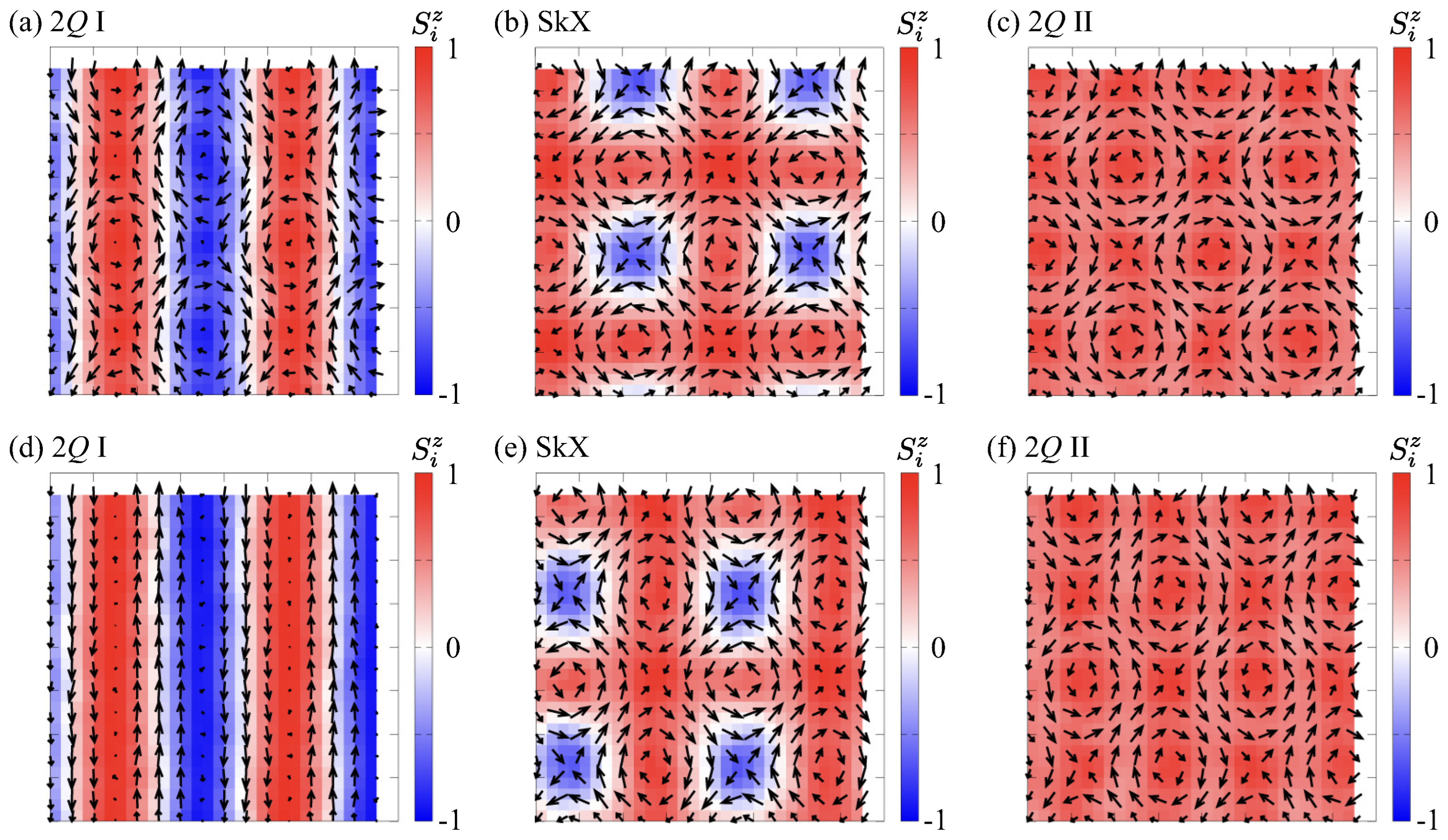
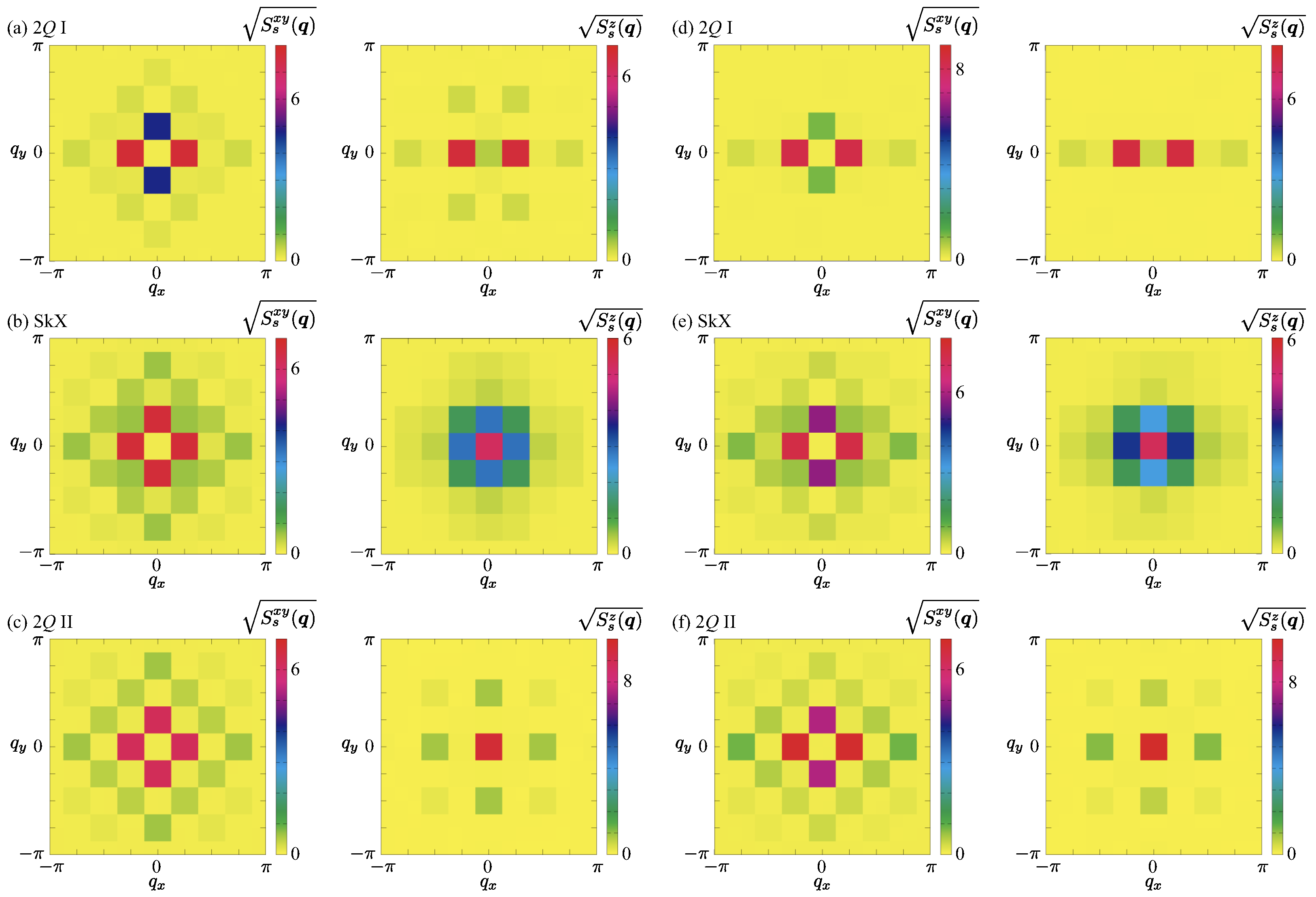
Before discussing the influence of uniaxial distortion, we first summarize the sequence of magnetic phases obtained in the absence of distortion, i.e., for γ Q 2 = 1 [125]. We fix the other model parameters as γ Q 1 + Q 2 = 0.6 and I BA = 0.1 . In this limit, the system retains fourfold rotational symmetry between the two ordering wave vectors Q 1 and Q 2 , and the double-Q states are stabilized in a more symmetric manner. When the magnetic field H is varied, three phases, denoted as double-Q I, SkX, and double-Q II states, are stabilized in addition to the fully polarized state, as shown by the phase diagram in Figure 1. Such a phase sequence among double-Q spin configurations has been identified in GdRu2Si2 [81]. At low fields, the ground state is the double-Q I state, in which a fourfold asymmetric spin texture emerges as a result of the inequivalent superposition of the proper-screw spiral wave at Q 1 and the in-plane sinusoidal wave at Q 2 . The real-space spin texture shown in Figure 2a exhibits a periodic lattice of vortices and antivortices, while the spin structure factor shows sharp peaks at two ordering wave vectors, as shown in Figure 3a. This double-Q I state does not exhibit the net scalar spin chirality χ sc , although it shows the density wave in terms of the scalar spin chirality. This means that the double-Q I state corresponds to a topologically trivial state. It should be noted that in the presence of fourfold rotational symmetry with γ Q 2 = 1 , two double-Q I domain states connected by a 90 rotation are energetically degenerated. Such a degeneracy is lifted by considering the uniaxial distortion effect γ Q 2 < 1 , as detailed below.
As the magnetic field H is increased, the system undergoes transitions to the SkX, in which a superposition of the proper-screw spiral waves occurs at two ordering wave vectors Q 1 and Q 2 . In contrast to the double-Q I phase, showing partial twofold symmetry and displaying stripe-like vortex–antivortex arrangements in real space, the SkX is characterized by a square array of skyrmions, where the real-space spin texture exhibits a periodic lattice of vortices with quantized topological charge, as shown in Figure 2b. The spin structure factor in Figure 3b shows sharp peaks at Q 1 and Q 2 owing to the fourfold rotational symmetry. A hallmark of the SkX is its nonzero scalar spin chirality χ sc , directly signaling the topological nature of this phase. In the present model, the sign of the scalar spin chirality remains undetermined due to the energy degeneracy between SkX states with positive and negative scalar spin chirality; such a degeneracy is lifted by additionally considering the bond-dependent anisotropy at high-harmonic wave vectors Q 3 and Q 4 [126].
At higher fields, the system eventually reduces to the double-Q II state. This state is characterized by a superposition of two in-plane sinusoidal waves at the ordering wave vectors, Q 1 and Q 2 . In real space, the double-Q II state exhibits a fourfold symmetric pattern consisting of vortex–antivortex alignment, which is similar to the double-Q I state and SkX, as shown in Figure 2c. Meanwhile, the z-spin component is almost uniform, which indicates the cancellation of the scalar spin chirality between vortices and antivortices. In other words, the double-Q II state is also regarded as a topologically trivial state. The spin structure factor of the double-Q II state shows two sharp Bragg peaks of equal intensity at Q 1 and Q 2 in the in-plane spin component, as shown in Figure 3c.
We now turn to the effect of uniaxial distortion along the [100] axis by introducing γ Q 2 < 1 . The introduction of distortion explicitly breaks the fourfold rotational symmetry and favors ordering wave vectors aligned with the distortion axis, thereby changing the stability of three magnetic phases realized at γ Q 2 = 1 . In the present model, γ Q 2 < 1 corresponds to a reduction of the exchange interaction along the [010] direction, which can be regarded as the effect of a uniaxial tensile strain along that axis. Although the opposite case, γ Q 2 > 1 , corresponding to compressive strain, is not explicitly shown, the phase behavior is expected to be equivalent upon interchanging the Q 1 and Q 2 axes. Thus, the results for γ Q 2 < 1 capture the general influence of uniaxial distortion on the stability of multiple-Q states, consistent with both tensile and compressive strain conditions observed in experiments.
Figure 2d–f display real-space snapshots at a moderate distortion γ Q 2 = 0.95 for representative fields corresponding to the three phases that appear in the tetragonal limit. At low fields [Figure 2d], the system remains in the double-Q I state; for γ Q 2 < 1 , the tendency toward twofold anisotropy becomes more pronounced. This anisotropy stems from the imbalance between the two ordering wave vectors, with the component at Q 1 favored over Q 2 . In reciprocal space, this is reflected as unequal Bragg intensities at Q 1 and Q 2 in the in-plane spin structure factor, where the ratio S s x y ( Q 2 ) / S s x y ( Q 1 ) is found to be suppressed at γ Q 2 = 0.95 relative to γ Q 2 = 1 , as shown in Figure 3a,d.
At intermediate fields [Figure 2e], the SkX persists even under γ Q 2 = 0.95 , forming a square array of skyrmion cores, but each core becomes slightly elongated along the [010] direction imposed by the distortion. Correspondingly, the spin structure factor preserves two principal Bragg pairs at Q 1 and Q 2 , yet their intensities become imbalanced both for S s x y ( Q ) and S s z ( Q ) , as shown in Figure 3e, indicating a distortion-induced redistribution of weight among ordering wave vectors. The phase remains topological, as signaled by a finite scalar spin chirality. It is noteworthy that the stability of the SkX is more fragile than that of the double-Q I state, because the former spin texture preserves fourfold rotational symmetry, whereas the latter exhibits twofold symmetry at γ Q 2 = 1 . Accordingly, as γ Q 2 decreases from 1, the phase boundary between these two phases shifts upward, indicating that the magnetostriction effect stabilizes the twofold-symmetric double-Q I state over the fourfold-symmetric SkX.
At higher fields, the double-Q II state is stabilized. In real space in Figure 2f, it forms a nearly checkerboard-like arrangement of vortex–antivortex textures, but the fourfold rotational symmetry is broken owing to the effect of distortion. In momentum space, the in-plane spin structure factor shows two sharp but unequal peaks at Q 1 and Q 2 , whereas the out-of-plane component remains weak and featureless except for q = 0 , as shown in Figure 3f.
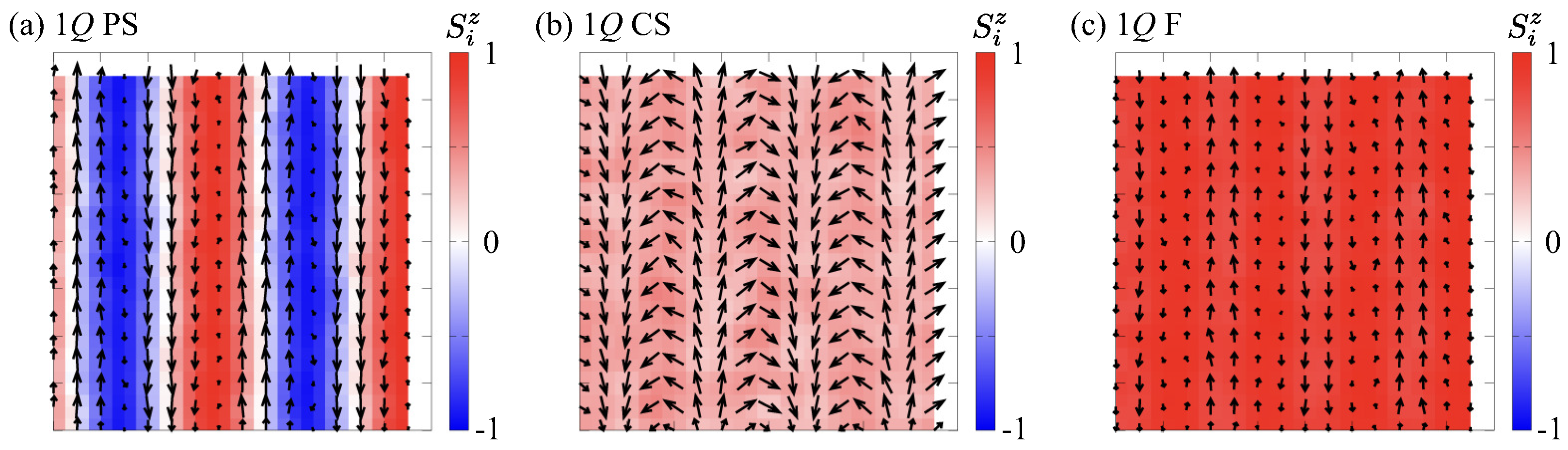
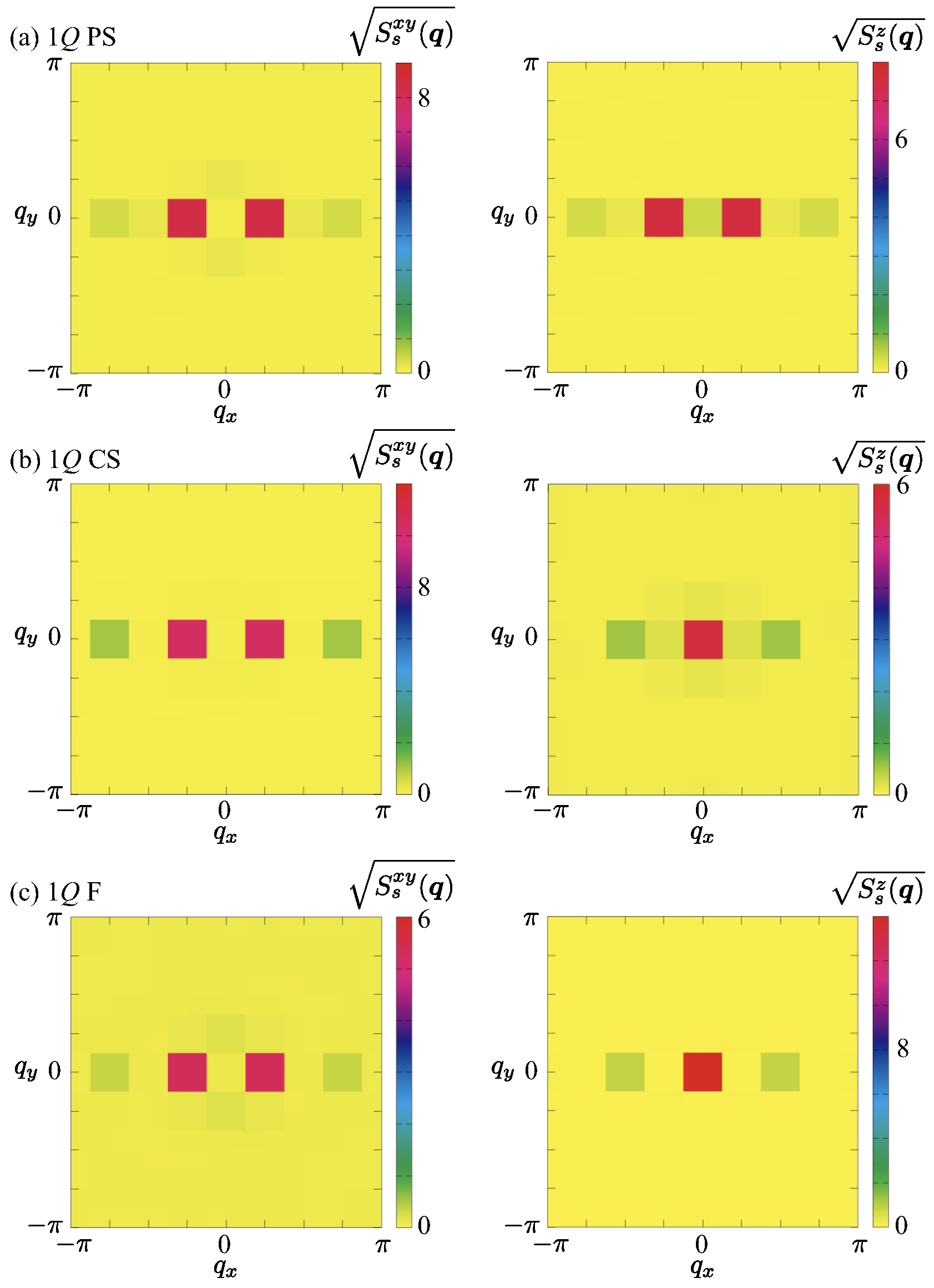
Upon further increasing the distortion, the energetic splitting between Q 1 and Q 2 eventually suppresses multiple-Q superpositions altogether, and single-Q states take over the field windows that hosted double-Q and SkX phases in the tetragonal limit. Figure 4a–c illustrate typical real-space textures at γ Q 2 = 0.8 : a single-Q proper-screw spiral state at low fields, a single-Q conical spiral state at intermediate fields, and a single-Q fan state as the system approaches magnetic field saturation. Although the real-space spin configurations of the double-Q I state in Figure 2d and the single-Q proper-screw spiral state in Figure 4a appear similar, their difference is evident in momentum space. The double-Q I state shows two Bragg peaks at Q 1 and Q 2 in the in-plane spin structure factor, corresponding to the coexistence of two spiral modulations, whereas the single-Q proper-screw spiral state exhibits only a single pair of peaks at Q 1 , as shown in Figure 5a. This contrast in the spin structure factors distinguishes the two phases unambiguously. For the other single-Q phases, the single-Q conical spiral state shows a dominant in-plane peak at Q 1 with negligibly small S s z ( Q 1 ) , as shown in Figure 5b, and the single-Q fan state retains a single Bragg pair in the x y -spin component, while the z-component becomes nearly uniform, as shown in Figure 5c. These trends demonstrate that uniaxial distortion selects a unique helix axis and eliminates multiple-Q interference.
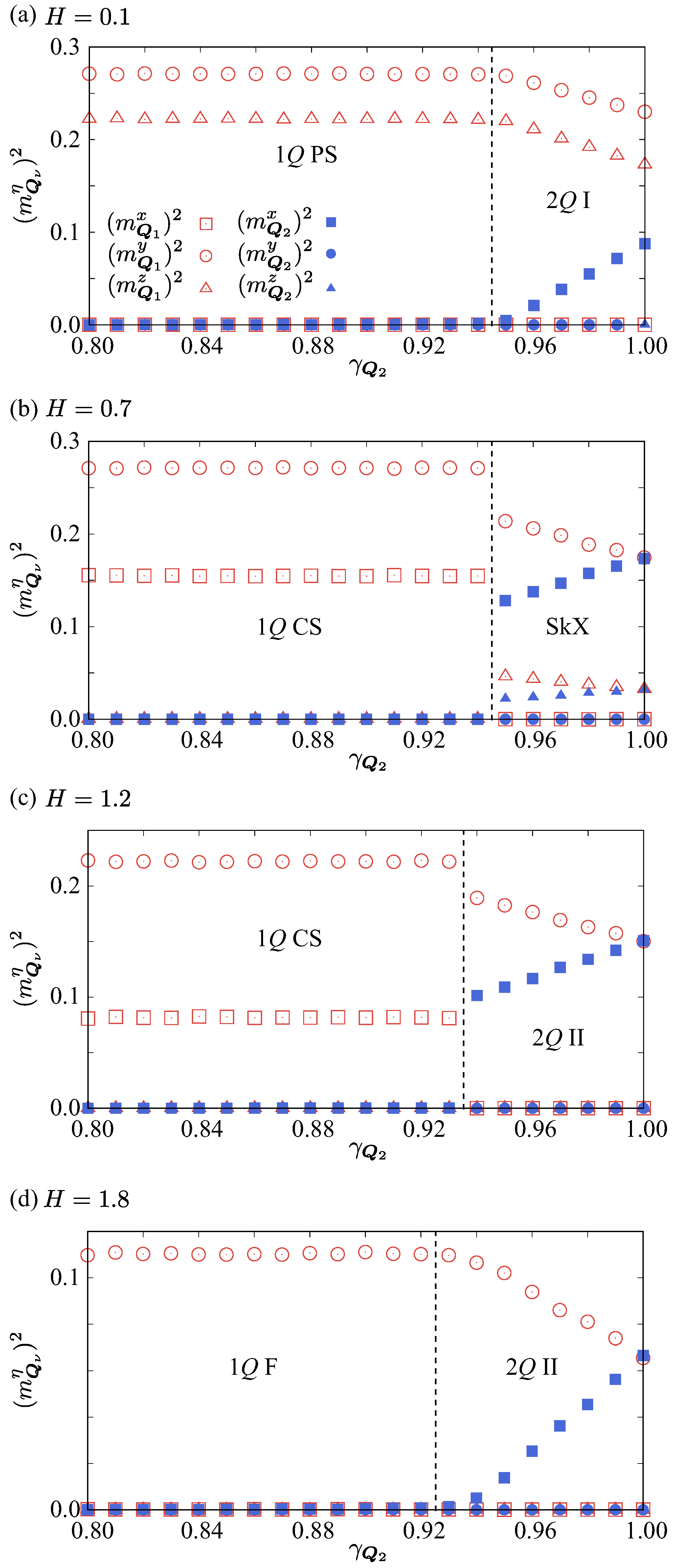
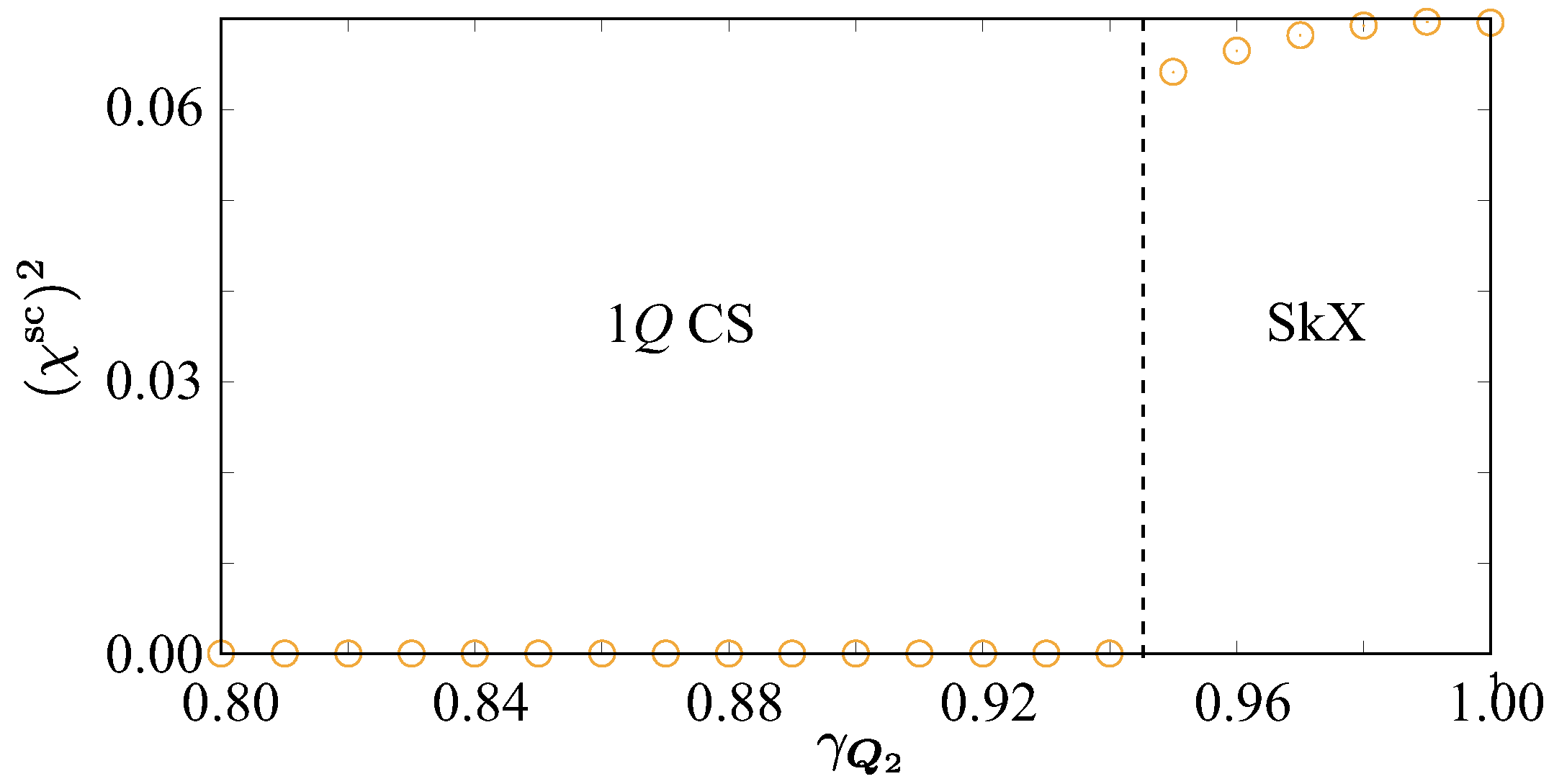
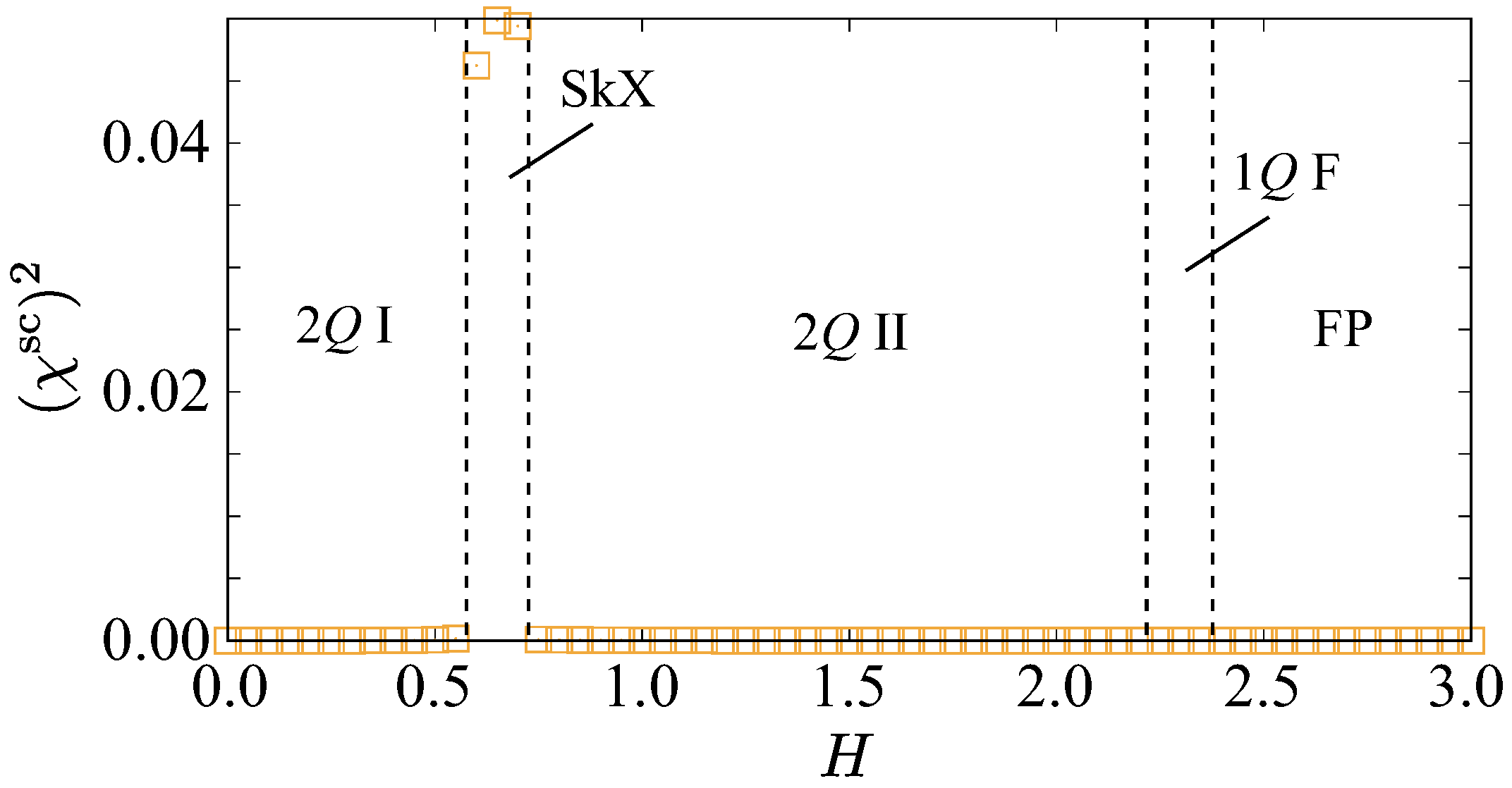
The γ Q 2 dependence of squared magnetic moments, which correspond to order parameters, at fixed fields is quantified in Figure 6a–d. At low field H = 0.1 in Figure 6a, the transition from the double-Q I state to the single-Q proper-screw spiral state occurs when γ Q 2 is reduced below 0.94 : the in-plane moment at Q 2 collapses continuously while that at Q 1 remains robust, consistent with the real-space anisotropy seen in Figure 2d and Figure 4a. Thus, the transition between the double-Q I state and the single-Q proper-screw spiral state is of second order, although this transition does not show a distinct rotational symmetry breaking. At intermediate field H = 0.7 in Figure 6b, a similar threshold separates the SkX from the single-Q conical spiral state; across this boundary, the out-of-plane modulation associated with the SkX (finite m Q 1 z and m Q 2 z ) disappears. The behavior of the squared scalar spin chirality corroborates this picture: ( χ sc ) 2 is essentially zero in the conical spiral state and becomes finite only inside the SkX regime for γ Q 2 0.95 , as shown in Figure 7. At higher fields H = 1.2 in Figure 6c, the double-Q II state gives way to a single-Q conical spiral state upon increasing distortion, again via the progressive suppression of the Q 2 component. Finally, near saturation H = 1.8 in Figure 6d, the system transitions from the double-Q II state to the single-Q fan state, in which the in-plane spin modulation persists only at Q 1 . This transition between the double-Q II state and the single-Q fan state shows properties characteristic of a second-order phase transition.
Two robust messages emerge from these systematic datasets. First, among the multiple-Q textures, the SkX is the most sensitive to uniaxial distortion: a 5 % reduction of the Q 2 channel (i.e., γ Q 2 0.95 ) already induces strong anisotropy in its spin structure factor, and a slightly stronger distortion drives a transition to a single-Q conical spiral state. Second, the topologically trivial double-Q states (I and II) are comparatively more resilient; they survive down to smaller γ Q 2 before converting to single-Q spiral and/or fan states. Combined with the single-Q real- and momentum–space signatures in Figure 4 and Figure 5, these results establish an intuitive hierarchy under uniaxial distortion: SkX → double-Q→ single-Q, in the sense of decreasing robustness against anisotropic splitting of the two fundamental ordering wave vectors.

3.2. Effect of Bond-Dependent Anisotropy

We next examine the role of the bond-dependent anisotropy I BA , which couples spin components to lattice bonds in an anisotropic manner. In contrast to the isotropic Heisenberg exchange, I BA originates from spin–orbit coupling and crystalline symmetry, thereby introducing an additional degree of control over the relative stability of competing magnetic textures. A central outcome of our analysis is that I BA plays a decisive role in stabilizing the SkX even under uniaxial distortion, where otherwise the balance among competing magnetic orders is easily lost.
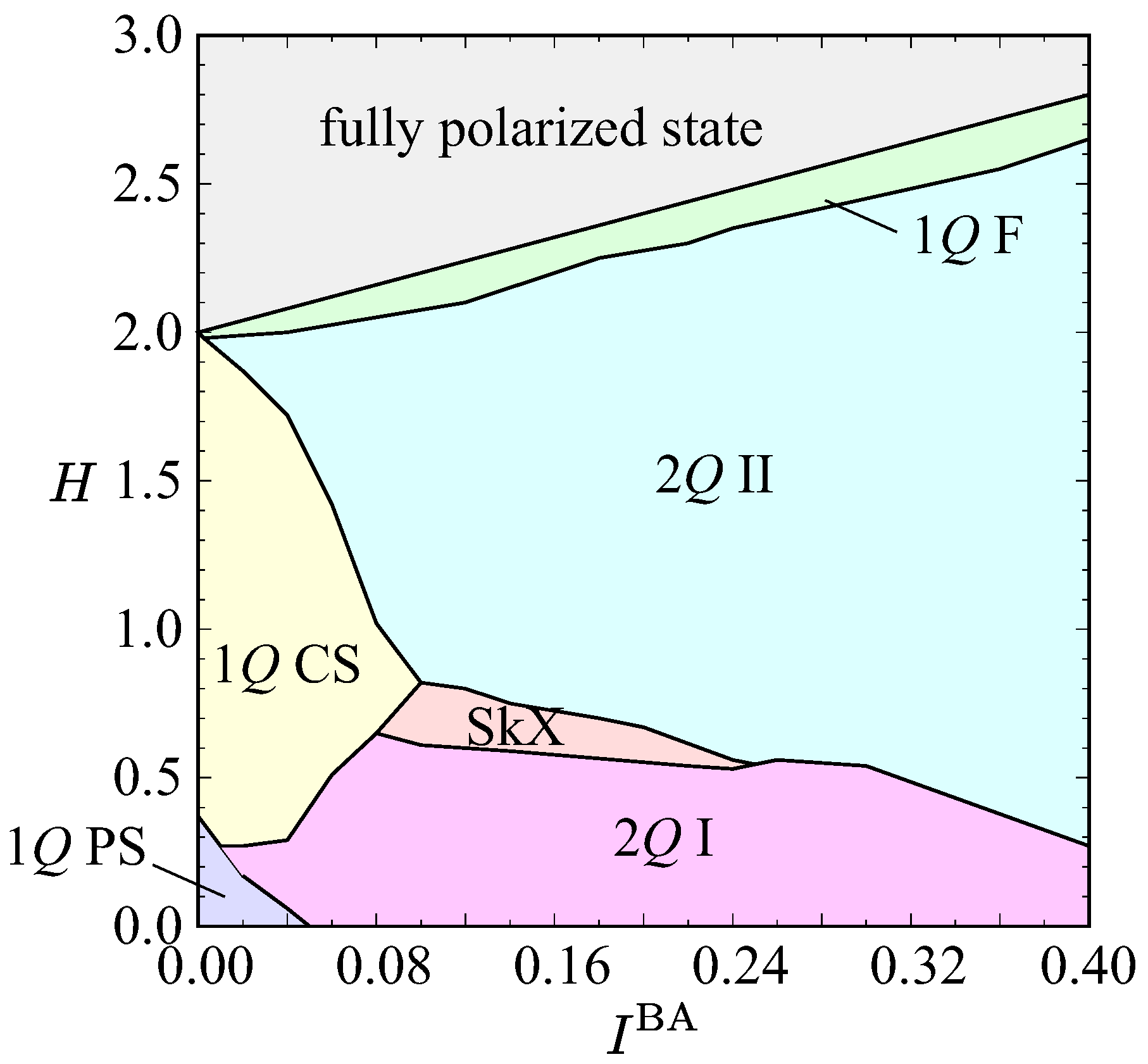
Figure 8 summarizes the phase diagram in the I BA H plane at fixed γ Q 2 = 0.97 and γ Q 1 + Q 2 = 0.6 . Without I BA , the SkX phase is absent, and uniaxial distortion favors the single-Q conical spiral state with the ordering wave vector Q 1 . Once I BA is introduced, however, a finite SkX phase emerges in the intermediate-field regime, and it remains stable for 0.08 I BA 0.25 . This clearly demonstrates that the bond-dependent anisotropy is indispensable for the robustness of SkX textures in the distorted tetragonal environment with bilinear exchange interactions.
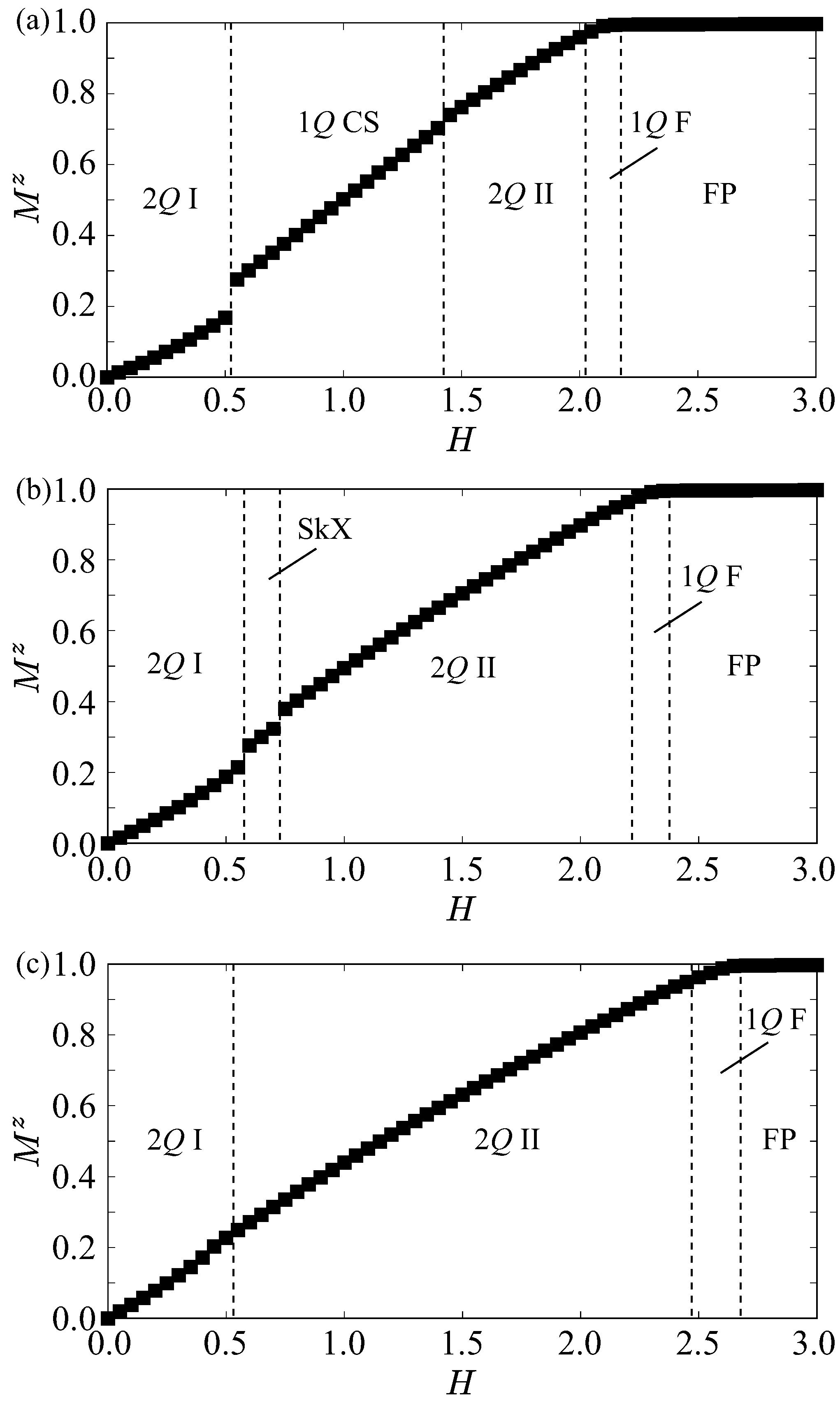
The magnetization curves in Figure 9a–c provide further insight. For a small anisotropy I BA = 0.06 in Figure 9a, the system exhibits a sequence of phase transitions: double-Q I → single-Q conical spiral → double-Q II → single-Q fan → fully polarized state. Here, the SkX is entirely absent, and the transitions are generally sharp except at the boundaries between the double-Q II and single-Q fan states and between the single-Q fan and fully polarized states. When I BA is increased to 0.16 in Figure 9b, the SkX phase is stabilized between the low-field double-Q I and high-field double-Q II states. In this case, the plateau-like behavior of the finite scalar spin chirality χ sc is found in the SkX region [Figure 10], marking the topological nature of the state. The abrupt onset and disappearance of χ sc at the phase boundaries signal the first-order nature of the SkX transitions, consistent with the sharp kinks in M z . For a larger anisotropy I BA = 0.32 in Figure 9c, the SkX region disappears, and the double-Q I and double-Q II states are smoothly connected against the magnetic field. This result confirms that the relative magnitude of I BA plays an important role in realizing the SkX even in the presence of uniaxial distortion.
Finally, we note that the present model implicitly assumes a rigid and spatially uniform strain field, corresponding to the ideal case where the lattice deformation is homogeneously transmitted to the spin system. In experimental situations, strain is typically introduced through external stress, which may lead to partial relaxation depending on the sample geometry and boundary conditions. Nevertheless, the essential tuning parameter in the present model is the ratio between the exchange interactions associated with the two ordering wave vectors, J Q 1 and J Q 2 . This ratio can be effectively modified by either rigid strain or externally applied stress. Thus, the qualitative behavior discussed here, including the strain-induced stabilization and suppression of multiple-Q states, is expected to be robust against the microscopic details of how the distortion is imposed.

4. Conclusions

We have investigated the stability of double-Q square SkXs in a centrosymmetric tetragonal host subject to uniaxial distortion and bond-dependent anisotropy. Using a momentum–space effective spin model with frustrated exchange and a symmetry-allowed anisotropic form factor, we mapped the low-temperature field-distortion phase behavior by simulated annealing and analyzed real- and momentum–space diagnostics. Our central findings are threefold.
First, in the tetragonal limit, the field evolution proceeds through a robust sequence of multiple-Q phases—double-Q I state at low fields, a square SkX at intermediate fields, and double-Q II state at higher fields—before reaching the fully polarized state. Introducing uniaxial distortion along the [100] direction splits the competing instabilities at Q 1 = ( Q , 0 ) and Q 2 = ( 0 , Q ) and promotes twofold anisotropy in both the real-space textures and the spin structure factors. Quantitatively, a modest ∼5% reduction in the Q 2 channel ( γ Q 2 0.95 ) already destabilizes the SkX and drives a transition into a single-Q conical spiral state, whereas the topologically trivial double-Q states remain comparatively more resilient against the same distortion. This establishes a clear robustness hierarchy under distortion: SkX → double-Q→ single-Q.
Second, we clarified the role of bond-dependent anisotropy I BA as a key factor of the SkX under distortion. At fixed orthorhombicity as γ Q 2 = 0.97 , the SkX emerges only when I BA exceeds a finite threshold and persists within an intermediate window of I BA , as further reflected by characteristic kinks in the magnization and a plateau-like onset/offset of the scalar spin chirality inside the SkX regime. Outside this window, the field evolution is dominated by topologically trivial double-Q or single-Q phases. These results demonstrate the importance of I BA even under uniaxial distortion.
Third, our momentum-resolved analysis links qualitative changes in the phase diagram to distinctive experimental fingerprints. Distortion-induced anisotropy should manifest as unequal Bragg intensities at Q 1 and Q 2 in the in-plane and out-of-plane spin structure factors, while topological phase boundaries can be tracked by sharp features in the magnetization and the abrupt appearance/disappearance of scalar spin chirality. These signatures are directly accessible via elastic magnetic scattering, such as small-angle neutron scattering and resonant x-ray measurements, bulk magnetometry, and probes of emergent electromagnetism associated with noncoplanar spin textures.
The present momentum–space spin Hamiltonian can be mapped onto a real-space model with competing exchange interactions and bond-dependent anisotropic exchanges, similar to those arising from RKKY-type or superexchange mechanisms [127]. The parameters J Q ν and I BA can, in principle, be estimated by fitting theoretical spin structure factors and magnetization profiles to experimental data from neutron or resonant x-ray scattering and bulk magnetometry. Once such parameters are determined for a specific material, the model is expected to reproduce other regions of the phase diagram, reflecting its applicability to real systems that host competing multiple-Q magnetic instabilities.
From a broader perspective, our findings carry important implications for materials exploration and strain-based control of multiple-Q textures. The demonstrated sensitivity of square SkXs to small orthorhombic distortions suggests that epitaxial strain, uniaxial pressure, or chemical substitution could be used to selectively stabilize or suppress SkX phases in real tetragonal materials. Conversely, bond-dependent anisotropies, arising from spin–orbit–lattice entanglement, act as a tuning knob to restore SkX stability even under symmetry lowering. This interplay between strain and anisotropy suggests a potential route for tailoring spin textures in tetragonal magnets, particularly in thin films, pressure-tuned bulk crystals, and heterostructures where structural distortions can be controlled.

Funding

This research was supported by JSPS KAKENHI grant numbers JP22H00101, JP22H01183, JP23H04869, JP23K03288, and JP23K20827; and by JST CREST (JPMJCR23O4) and JST FOREST (JPMJFR2366).

Data Availability Statement

The original contributions presented in the study are included in the article; further inquiries can be directed to the corresponding author.

Conflicts of Interest

The author declares no conflicts of interest.

References

  1. Skyrme, T. A non-linear field theory. Proc. R. Soc. Lond. Ser. A Math. Phys. Sci. 1961, 260, 127–138. [Google Scholar]
  2. Skyrme, T.H.R. A unified field theory of mesons and baryons. Nucl. Phys. 1962, 31, 556–569. [Google Scholar] [CrossRef]
  3. Wright, D.C.; Mermin, N.D. Crystalline liquids: The blue phases. Rev. Mod. Phys. 1989, 61, 385–432. [Google Scholar] [CrossRef]
  4. Leonov, A.O.; Dragunov, I.E.; Rößler, U.K.; Bogdanov, A.N. Theory of skyrmion states in liquid crystals. Phys. Rev. E 2014, 90, 042502. [Google Scholar] [CrossRef] [PubMed]
  5. Afghah, S.; Selinger, J.V. Theory of helicoids and skyrmions in confined cholesteric liquid crystals. Phys. Rev. E 2017, 96, 012708. [Google Scholar] [CrossRef]
  6. Duzgun, A.; Selinger, J.V.; Saxena, A. Comparing skyrmions and merons in chiral liquid crystals and magnets. Phys. Rev. E 2018, 97, 062706. [Google Scholar] [CrossRef]
  7. Duzgun, A.; Nisoli, C. Skyrmion Spin Ice in Liquid Crystals. Phys. Rev. Lett. 2021, 126, 047801. [Google Scholar] [CrossRef]
  8. Sondhi, S.L.; Karlhede, A.; Kivelson, S.A.; Rezayi, E.H. Skyrmions and the crossover from the integer to fractional quantum Hall effect at small Zeeman energies. Phys. Rev. B 1993, 47, 16419–16426. [Google Scholar] [CrossRef] [PubMed]
  9. Abolfath, M.; Palacios, J.J.; Fertig, H.A.; Girvin, S.M.; MacDonald, A.H. Critical comparison of classical field theory and microscopic wave functions for skyrmions in quantum Hall ferromagnets. Phys. Rev. B 1997, 56, 6795–6804. [Google Scholar] [CrossRef]
  10. Xie, X.C.; He, S. Skyrmion excitations in quantum Hall systems. Phys. Rev. B 1996, 53, 1046–1049. [Google Scholar] [CrossRef]
  11. Stone, M. Magnus force on skyrmions in ferromagnets and quantum Hall systems. Phys. Rev. B 1996, 53, 16573–16578. [Google Scholar] [CrossRef]
  12. Fertig, H.A.; Brey, L.; Côté, R.; MacDonald, A.H.; Karlhede, A.; Sondhi, S.L. Hartree-Fock theory of Skyrmions in quantum Hall ferromagnets. Phys. Rev. B 1997, 55, 10671–10680. [Google Scholar] [CrossRef][Green Version]
  13. Shkolnikov, Y.P.; Misra, S.; Bishop, N.C.; De Poortere, E.P.; Shayegan, M. Observation of Quantum Hall “Valley Skyrmions”. Phys. Rev. Lett. 2005, 95, 066809. [Google Scholar] [CrossRef] [PubMed]
  14. Yang, K.; Das Sarma, S.; MacDonald, A.H. Collective modes and skyrmion excitations in graphene SU(4) quantum Hall ferromagnets. Phys. Rev. B 2006, 74, 075423. [Google Scholar] [CrossRef]
  15. Ho, T.L. Spinor Bose Condensates in Optical Traps. Phys. Rev. Lett. 1998, 81, 742–745. [Google Scholar] [CrossRef]
  16. Al Khawaja, U.; Stoof, H. Skyrmions in a ferromagnetic Bose-Einstein condensate. Nature 2001, 411, 918–920. [Google Scholar] [CrossRef]
  17. Khawaja, U.A.; Stoof, H.T.C. Skyrmion physics in Bose-Einstein ferromagnets. Phys. Rev. A 2001, 64, 043612. [Google Scholar] [CrossRef]
  18. Ruostekoski, J.; Anglin, J.R. Creating Vortex Rings and Three-Dimensional Skyrmions in Bose-Einstein Condensates. Phys. Rev. Lett. 2001, 86, 3934–3937. [Google Scholar] [CrossRef]
  19. Battye, R.A.; Cooper, N.R.; Sutcliffe, P.M. Stable Skyrmions in Two-Component Bose-Einstein Condensates. Phys. Rev. Lett. 2002, 88, 080401. [Google Scholar] [CrossRef]
  20. Savage, C.M.; Ruostekoski, J. Energetically Stable Particlelike Skyrmions in a Trapped Bose-Einstein Condensate. Phys. Rev. Lett. 2003, 91, 010403. [Google Scholar] [CrossRef]
  21. Mühlbauer, S.; Binz, B.; Jonietz, F.; Pfleiderer, C.; Rosch, A.; Neubauer, A.; Georgii, R.; Böni, P. Skyrmion lattice in a chiral magnet. Science 2009, 323, 915–919. [Google Scholar] [CrossRef]
  22. Yu, X.Z.; Onose, Y.; Kanazawa, N.; Park, J.H.; Han, J.H.; Matsui, Y.; Nagaosa, N.; Tokura, Y. Real-space observation of a two-dimensional skyrmion crystal. Nature 2010, 465, 901–904. [Google Scholar] [CrossRef]
  23. Adams, T.; Mühlbauer, S.; Neubauer, A.; Münzer, W.; Jonietz, F.; Georgii, R.; Pedersen, B.; Böni, P.; Rosch, A.; Pfleiderer, C. Skyrmion lattice domains in Fe1-xCoxSi. J. Phys. Conf. Ser. 2010, 200, 032001. [Google Scholar] [CrossRef]
  24. Neubauer, A.; Pfleiderer, C.; Binz, B.; Rosch, A.; Ritz, R.; Niklowitz, P.G.; Böni, P. Topological Hall Effect in the A Phase of MnSi. Phys. Rev. Lett. 2009, 102, 186602. [Google Scholar] [CrossRef] [PubMed]
  25. Bogdanov, A.N.; Yablonskii, D.A. Thermodynamically stable “vortices” in magnetically ordered crystals: The mixed state of magnets. Sov. Phys. JETP 1989, 68, 101. [Google Scholar]
  26. Bogdanov, A.; Hubert, A. Thermodynamically stable magnetic vortex states in magnetic crystals. J. Magn. Magn. Mater. 1994, 138, 255–269. [Google Scholar] [CrossRef]
  27. Rößler, U.K.; Bogdanov, A.N.; Pfleiderer, C. Spontaneous skyrmion ground states in magnetic metals. Nature 2006, 442, 797–801. [Google Scholar] [CrossRef] [PubMed]
  28. Nagaosa, N.; Tokura, Y. Topological properties and dynamics of magnetic skyrmions. Nat. Nanotechnol. 2013, 8, 899–911. [Google Scholar] [CrossRef]
  29. Tokura, Y.; Kanazawa, N. Magnetic Skyrmion Materials. Chem. Rev. 2021, 121, 2857. [Google Scholar] [CrossRef] [PubMed]
  30. Fert, A.; Cros, V.; Sampaio, J. Skyrmions on the track. Nat. Nanotechnol. 2013, 8, 152. [Google Scholar] [CrossRef]
  31. Kang, W.; Huang, Y.; Zhang, X.; Zhou, Y.; Zhao, W. Skyrmion-electronics: An overview and outlook. Proc. IEEE 2016, 104, 2040–2061. [Google Scholar] [CrossRef]
  32. Finocchio, G.; Büttner, F.; Tomasello, R.; Carpentieri, M.; Kläui, M. Magnetic skyrmions: From fundamental to applications. J. Phys. D Appl. Phys. 2016, 49, 423001. [Google Scholar] [CrossRef]
  33. Fert, A.; Reyren, N.; Cros, V. Magnetic skyrmions: Advances in physics and potential applications. Nat. Rev. Mater. 2017, 2, 17031. [Google Scholar] [CrossRef]
  34. Zhang, X.; Zhou, Y.; Song, K.M.; Park, T.E.; Xia, J.; Ezawa, M.; Liu, X.; Zhao, W.; Zhao, G.; Woo, S. Skyrmion-electronics: Writing, deleting, reading and processing magnetic skyrmions toward spintronic applications. J. Phys. Condens. Matter 2020, 32, 143001. [Google Scholar] [CrossRef]
  35. Bogdanov, A.N.; Panagopoulos, C. Physical foundations and basic properties of magnetic skyrmions. Nat. Rev. Phys. 2020, 2, 492–498. [Google Scholar] [CrossRef]
  36. Reichhardt, C.; Reichhardt, C.J.O.; Milošević, M.V. Statics and dynamics of skyrmions interacting with disorder and nanostructures. Rev. Mod. Phys. 2022, 94, 035005. [Google Scholar] [CrossRef]
  37. Everschor, K.; Garst, M.; Duine, R.A.; Rosch, A. Current-induced rotational torques in the skyrmion lattice phase of chiral magnets. Phys. Rev. B 2011, 84, 064401. [Google Scholar] [CrossRef]
  38. Everschor, K.; Garst, M.; Binz, B.; Jonietz, F.; Mühlbauer, S.; Pfleiderer, C.; Rosch, A. Rotating skyrmion lattices by spin torques and field or temperature gradients. Phys. Rev. B 2012, 86, 054432. [Google Scholar] [CrossRef]
  39. Mochizuki, M. Spin-Wave Modes and Their Intense Excitation Effects in Skyrmion Crystals. Phys. Rev. Lett. 2012, 108, 017601. [Google Scholar] [CrossRef] [PubMed]
  40. Tatara, G.; Fukuyama, H. Phasons and excitations in skyrmion lattice. J. Phys. Soc. Jpn. 2014, 83, 104711. [Google Scholar] [CrossRef]
  41. Lin, S.Z.; Batista, C.D.; Saxena, A. Internal modes of a skyrmion in the ferromagnetic state of chiral magnets. Phys. Rev. B 2014, 89, 024415. [Google Scholar] [CrossRef]
  42. Garst, M.; Waizner, J.; Grundler, D. Collective spin excitations of helices and magnetic skyrmions: Review and perspectives of magnonics in non-centrosymmetric magnets. J. Phys. D 2017, 50, 293002. [Google Scholar] [CrossRef]
  43. Jiang, W.; Zhang, X.; Yu, G.; Zhang, W.; Wang, X.; Benjamin Jungfleisch, M.; Pearson, J.E.; Cheng, X.; Heinonen, O.; Wang, K.L.; et al. Direct observation of the skyrmion Hall effect. Nat. Phys. 2017, 13, 162–169. [Google Scholar] [CrossRef]
  44. Litzius, K.; Lemesh, I.; Krüger, B.; Bassirian, P.; Caretta, L.; Richter, K.; Büttner, F.; Sato, K.; Tretiakov, O.A.; Förster, J.; et al. Skyrmion Hall effect revealed by direct time-resolved X-ray microscopy. Nat. Phys. 2017, 13, 170–175. [Google Scholar] [CrossRef]
  45. Kim, K.W.; Moon, K.W.; Kerber, N.; Nothhelfer, J.; Everschor-Sitte, K. Asymmetric skyrmion Hall effect in systems with a hybrid Dzyaloshinskii-Moriya interaction. Phys. Rev. B 2018, 97, 224427. [Google Scholar] [CrossRef]
  46. Kolesnikov, A.G.; Stebliy, M.E.; Samardak, A.S.; Ognev, A.V. Skyrmionium–high velocity without the skyrmion Hall effect. Sci. Rep. 2018, 8, 16966. [Google Scholar] [CrossRef]
  47. Juge, R.; Je, S.G.; Chaves, D.d.S.; Buda-Prejbeanu, L.D.; Peña Garcia, J.; Nath, J.; Miron, I.M.; Rana, K.G.; Aballe, L.; Foerster, M.; et al. Current-Driven Skyrmion Dynamics and Drive-Dependent Skyrmion Hall Effect in an Ultrathin Film. Phys. Rev. Appl. 2019, 12, 044007. [Google Scholar] [CrossRef]
  48. Göbel, B.; Mook, A.; Henk, J.; Mertig, I. Overcoming the speed limit in skyrmion racetrack devices by suppressing the skyrmion Hall effect. Phys. Rev. B 2019, 99, 020405. [Google Scholar] [CrossRef]
  49. Fattouhi, M.; García-Sánchez, F.; Yanes, R.; Raposo, V.; Martínez, E.; Lopez-Diaz, L. Electric Field Control of the Skyrmion Hall Effect in Piezoelectric-Magnetic Devices. Phys. Rev. Appl. 2021, 16, 044035. [Google Scholar] [CrossRef]
  50. Cook, A.M. Quantum skyrmion Hall effect. Phys. Rev. B 2024, 109, 155123. [Google Scholar] [CrossRef]
  51. Al Saidi, W.; Sbiaa, R. Controlling skyrmion Hall effect dynamics in constricted ferromagnetic nanowires. J. Magn. Magn. Mater. 2025, 614, 172768. [Google Scholar] [CrossRef]
  52. Yi, S.D.; Onoda, S.; Nagaosa, N.; Han, J.H. Skyrmions and anomalous Hall effect in a Dzyaloshinskii-Moriya spiral magnet. Phys. Rev. B 2009, 80, 054416. [Google Scholar] [CrossRef]
  53. Binz, B.; Vishwanath, A.; Aji, V. Theory of the Helical Spin Crystal: A Candidate for the Partially Ordered State of MnSi. Phys. Rev. Lett. 2006, 96, 207202. [Google Scholar] [CrossRef]
  54. Binz, B.; Vishwanath, A. Theory of helical spin crystals: Phases, textures, and properties. Phys. Rev. B 2006, 74, 214408. [Google Scholar] [CrossRef]
  55. Hayami, S.; Okubo, T.; Motome, Y. Phase shift in skyrmion crystals. Nat. Commun. 2021, 12, 6927. [Google Scholar] [CrossRef]
  56. Dzyaloshinsky, I. A thermodynamic theory of “weak” ferromagnetism of antiferromagnetics. J. Phys. Chem. Solids 1958, 4, 241–255. [Google Scholar] [CrossRef]
  57. Moriya, T. Anisotropic superexchange interaction and weak ferromagnetism. Phys. Rev. 1960, 120, 91. [Google Scholar] [CrossRef]
  58. Heinze, S.; von Bergmann, K.; Menzel, M.; Brede, J.; Kubetzka, A.; Wiesendanger, R.; Bihlmayer, G.; Blügel, S. Spontaneous atomic-scale magnetic skyrmion lattice in two dimensions. Nat. Phys. 2011, 7, 713–718. [Google Scholar] [CrossRef]
  59. Okubo, T.; Chung, S.; Kawamura, H. Multiple-q States and the Skyrmion Lattice of the Triangular-Lattice Heisenberg Antiferromagnet under Magnetic Fields. Phys. Rev. Lett. 2012, 108, 017206. [Google Scholar] [CrossRef]
  60. Leonov, A.O.; Mostovoy, M. Multiply periodic states and isolated skyrmions in an anisotropic frustrated magnet. Nat. Commun. 2015, 6, 8275. [Google Scholar] [CrossRef]
  61. Hayami, S.; Lin, S.Z.; Kamiya, Y.; Batista, C.D. Vortices, skyrmions, and chirality waves in frustrated Mott insulators with a quenched periodic array of impurities. Phys. Rev. B 2016, 94, 174420. [Google Scholar] [CrossRef]
  62. Hayami, S. In-plane magnetic field-induced skyrmion crystal in frustrated magnets with easy-plane anisotropy. Phys. Rev. B 2021, 103, 224418. [Google Scholar] [CrossRef]
  63. Kawamura, H. Frustration-induced skyrmion crystals in centrosymmetric magnets. J. Phys. Condens. Matter 2025, 37, 183004. [Google Scholar] [CrossRef] [PubMed]
  64. Butenko, A.B.; Leonov, A.A.; Rößler, U.K.; Bogdanov, A.N. Stabilization of skyrmion textures by uniaxial distortions in noncentrosymmetric cubic helimagnets. Phys. Rev. B 2010, 82, 052403. [Google Scholar] [CrossRef]
  65. Wilson, M.N.; Butenko, A.B.; Bogdanov, A.N.; Monchesky, T.L. Chiral skyrmions in cubic helimagnet films: The role of uniaxial anisotropy. Phys. Rev. B 2014, 89, 094411. [Google Scholar] [CrossRef]
  66. Lin, S.Z.; Saxena, A.; Batista, C.D. Skyrmion fractionalization and merons in chiral magnets with easy-plane anisotropy. Phys. Rev. B 2015, 91, 224407. [Google Scholar] [CrossRef]
  67. Leonov, A.O.; Monchesky, T.L.; Romming, N.; Kubetzka, A.; Bogdanov, A.N.; Wiesendanger, R. The properties of isolated chiral skyrmions in thin magnetic films. New J. Phys. 2016, 18, 065003. [Google Scholar] [CrossRef]
  68. Ehlers, D.; Stasinopoulos, I.; Tsurkan, V.; Krug von Nidda, H.A.; Fehér, T.; Leonov, A.; Kézsmárki, I.; Grundler, D.; Loidl, A. Skyrmion dynamics under uniaxial anisotropy. Phys. Rev. B 2016, 94, 014406. [Google Scholar] [CrossRef]
  69. Leonov, A.O.; Kézsmárki, I. Skyrmion robustness in noncentrosymmetric magnets with axial symmetry: The role of anisotropy and tilted magnetic fields. Phys. Rev. B 2017, 96, 214413. [Google Scholar] [CrossRef]
  70. Hayami, S.; Motome, Y. Effect of magnetic anisotropy on skyrmions with a high topological number in itinerant magnets. Phys. Rev. B 2019, 99, 094420. [Google Scholar] [CrossRef]
  71. Gross, B.; Philipp, S.; Geirhos, K.; Mehlin, A.; Bordács, S.; Tsurkan, V.; Leonov, A.; Kézsmárki, I.; Poggio, M. Stability of Néel-type skyrmion lattice against oblique magnetic fields in GaV4S8 and GaV4Se8. Phys. Rev. B 2020, 102, 104407. [Google Scholar] [CrossRef]
  72. Hayami, S.; Yambe, R. Stabilization mechanisms of magnetic skyrmion crystal and multiple-Q states based on momentum-resolved spin interactions. Mater. Today Quantum 2024, 3, 100010. [Google Scholar] [CrossRef]
  73. Tokunaga, Y.; Yu, X.; White, J.; Rønnow, H.M.; Morikawa, D.; Taguchi, Y.; Tokura, Y. A new class of chiral materials hosting magnetic skyrmions beyond room temperature. Nat. Commun. 2015, 6, 7638. [Google Scholar] [CrossRef] [PubMed]
  74. Karube, K.; White, J.; Reynolds, N.; Gavilano, J.; Oike, H.; Kikkawa, A.; Kagawa, F.; Tokunaga, Y.; Rønnow, H.M.; Tokura, Y.; et al. Robust metastable skyrmions and their triangular–square lattice structural transition in a high-temperature chiral magnet. Nat. Mater. 2016, 15, 1237. [Google Scholar] [CrossRef]
  75. Karube, K.; White, J.S.; Morikawa, D.; Dewhurst, C.D.; Cubitt, R.; Kikkawa, A.; Yu, X.; Tokunaga, Y.; Arima, T.H.; Rønnow, H.M.; et al. Disordered skyrmion phase stabilized by magnetic frustration in a chiral magnet. Sci. Adv. 2018, 4, eaar7043. [Google Scholar] [CrossRef]
  76. Karube, K.; White, J.S.; Ukleev, V.; Dewhurst, C.D.; Cubitt, R.; Kikkawa, A.; Tokunaga, Y.; Rønnow, H.M.; Tokura, Y.; Taguchi, Y. Metastable skyrmion lattices governed by magnetic disorder and anisotropy in β-Mn-type chiral magnets. Phys. Rev. B 2020, 102, 064408. [Google Scholar] [CrossRef]
  77. Henderson, M.E.; Bleuel, M.; Beare, J.; Cory, D.G.; Heacock, B.; Huber, M.G.; Luke, G.M.; Pula, M.; Sarenac, D.; Sharma, S.; et al. Skyrmion alignment and pinning effects in the disordered multiphase skyrmion material Co8Zn8Mn4. Phys. Rev. B 2022, 106, 094435. [Google Scholar] [CrossRef]
  78. Chacon, A.; Heinen, L.; Halder, M.; Bauer, A.; Simeth, W.; Mühlbauer, S.; Berger, H.; Garst, M.; Rosch, A.; Pfleiderer, C. Observation of two independent skyrmion phases in a chiral magnetic material. Nat. Phys. 2018, 14, 936–941. [Google Scholar] [CrossRef]
  79. Takagi, R.; Yamasaki, Y.; Yokouchi, T.; Ukleev, V.; Yokoyama, Y.; Nakao, H.; Arima, T.; Tokura, Y.; Seki, S. Particle-size dependent structural transformation of skyrmion lattice. Nat. Commun. 2020, 11, 5685. [Google Scholar] [CrossRef] [PubMed]
  80. Khanh, N.D.; Nakajima, T.; Yu, X.; Gao, S.; Shibata, K.; Hirschberger, M.; Yamasaki, Y.; Sagayama, H.; Nakao, H.; Peng, L.; et al. Nanometric square skyrmion lattice in a centrosymmetric tetragonal magnet. Nat. Nanotechnol. 2020, 15, 444. [Google Scholar] [CrossRef]
  81. Khanh, N.D.; Nakajima, T.; Hayami, S.; Gao, S.; Yamasaki, Y.; Sagayama, H.; Nakao, H.; Takagi, R.; Motome, Y.; Tokura, Y.; et al. Zoology of Multiple-Q Spin Textures in a Centrosymmetric Tetragonal Magnet with Itinerant Electrons. Adv. Sci. 2022, 9, 2105452. [Google Scholar] [CrossRef]
  82. Matsuyama, N.; Nomura, T.; Imajo, S.; Nomoto, T.; Arita, R.; Sudo, K.; Kimata, M.; Khanh, N.D.; Takagi, R.; Tokura, Y.; et al. Quantum oscillations in the centrosymmetric skyrmion-hosting magnet GdRu2Si2. Phys. Rev. B 2023, 107, 104421. [Google Scholar] [CrossRef]
  83. Wood, G.D.A.; Khalyavin, D.D.; Mayoh, D.A.; Bouaziz, J.; Hall, A.E.; Holt, S.J.R.; Orlandi, F.; Manuel, P.; Blügel, S.; Staunton, J.B.; et al. Double-Q ground state with topological charge stripes in the centrosymmetric skyrmion candidate GdRu2Si2. Phys. Rev. B 2023, 107, L180402. [Google Scholar] [CrossRef]
  84. Eremeev, S.; Glazkova, D.; Poelchen, G.; Kraiker, A.; Ali, K.; Tarasov, A.V.; Schulz, S.; Kliemt, K.; Chulkov, E.V.; Stolyarov, V.; et al. Insight into the electronic structure of the centrosymmetric skyrmion magnet GdRu2Si2. Nanoscale Adv. 2023, 5, 6678–6687. [Google Scholar] [CrossRef]
  85. Dong, Y.; Kinoshita, Y.; Ochi, M.; Nakachi, R.; Higashinaka, R.; Hayami, S.; Wan, Y.; Arai, Y.; Huh, S.; Hashimoto, M.; et al. Pseudogap and Fermi arc induced by Fermi surface nesting in a centrosymmetric skyrmion magnet. Science 2025, 388, 624–630. [Google Scholar] [CrossRef] [PubMed]
  86. Yoshimochi, H.; Takagi, R.; Ju, J.; Khanh, N.; Saito, H.; Sagayama, H.; Nakao, H.; Itoh, S.; Tokura, Y.; Arima, T.; et al. Multistep topological transitions among meron and skyrmion crystals in a centrosymmetric magnet. Nat. Phys. 2024, 20, 1001. [Google Scholar] [CrossRef]
  87. Hayami, S. Multiple skyrmion crystal phases by itinerant frustration in centrosymmetric tetragonal magnets. J. Phys. Soc. Jpn. 2022, 91, 023705. [Google Scholar] [CrossRef]
  88. Hayami, S. Rectangular and square skyrmion crystals on a centrosymmetric square lattice with easy-axis anisotropy. Phys. Rev. B 2022, 105, 174437. [Google Scholar] [CrossRef]
  89. Wang, Z.; Su, Y.; Lin, S.Z.; Batista, C.D. Meron, skyrmion, and vortex crystals in centrosymmetric tetragonal magnets. Phys. Rev. B 2021, 103, 104408. [Google Scholar] [CrossRef]
  90. Hayami, S.; Yambe, R. Helicity locking of a square skyrmion crystal in a centrosymmetric lattice system without vertical mirror symmetry. Phys. Rev. B 2022, 105, 104428. [Google Scholar] [CrossRef]
  91. Utesov, O.I. Thermodynamically stable skyrmion lattice in a tetragonal frustrated antiferromagnet with dipolar interaction. Phys. Rev. B 2021, 103, 064414. [Google Scholar] [CrossRef]
  92. Hayami, S. Skyrmion crystal and spiral phases in centrosymmetric bilayer magnets with staggered Dzyaloshinskii-Moriya interaction. Phys. Rev. B 2022, 105, 014408. [Google Scholar] [CrossRef]
  93. Lin, S.Z. Skyrmion lattice in centrosymmetric magnets with local Dzyaloshinsky-Moriya interaction. Mater. Today Quantum 2024, 2, 100006. [Google Scholar] [CrossRef]
  94. Bogdanov, A.N.; Rößler, U.K. Chiral Symmetry Breaking in Magnetic Thin Films and Multilayers. Phys. Rev. Lett. 2001, 87, 037203. [Google Scholar] [CrossRef] [PubMed]
  95. Shibata, K.; Iwasaki, J.; Kanazawa, N.; Aizawa, S.; Tanigaki, T.; Shirai, M.; Nakajima, T.; Kubota, M.; Kawasaki, M.; Park, H.; et al. Large anisotropic deformation of skyrmions in strained crystal. Nat. Nanotechnol. 2015, 10, 589–592. [Google Scholar] [CrossRef]
  96. Wang, J.; Shi, Y.; Kamlah, M. Uniaxial strain modulation of the skyrmion phase transition in ferromagnetic thin films. Phys. Rev. B 2018, 97, 024429. [Google Scholar] [CrossRef]
  97. Osorio, S.A.; Sturla, M.B.; Rosales, H.D.; Cabra, D.C. From skyrmions to Z2 vortices in distorted chiral antiferromagnets. Phys. Rev. B 2019, 100, 220404. [Google Scholar] [CrossRef]
  98. El Hog, S.; Kato, F.; Koibuchi, H.; Diep, H.T. Finsler geometry modeling and Monte Carlo study of skyrmion shape deformation by uniaxial stress. Phys. Rev. B 2021, 104, 024402. [Google Scholar] [CrossRef]
  99. Shang, T.; Xu, Y.; Gawryluk, D.J.; Ma, J.Z.; Shiroka, T.; Shi, M.; Pomjakushina, E. Anomalous Hall resistivity and possible topological Hall effect in the EuAl4 antiferromagnet. Phys. Rev. B 2021, 103, L020405. [Google Scholar] [CrossRef]
  100. Kaneko, K.; Kawasaki, T.; Nakamura, A.; Munakata, K.; Nakao, A.; Hanashima, T.; Kiyanagi, R.; Ohhara, T.; Hedo, M.; Nakama, T.; et al. Charge-Density-Wave Order and Multiple Magnetic Transitions in Divalent Europium Compound EuAl4. J. Phys. Soc. Jpn. 2021, 90, 064704. [Google Scholar] [CrossRef]
  101. Shimomura, S.; Murao, H.; Tsutsui, S.; Nakao, H.; Nakamura, A.; Hedo, M.; Nakama, T.; Ōnuki, Y. Lattice modulation and structural phase transition in the antiferromagnet EuAl4. J. Phys. Soc. Jpn. 2019, 88, 014602. [Google Scholar] [CrossRef]
  102. Gen, M.; Takagi, R.; Watanabe, Y.; Kitou, S.; Sagayama, H.; Matsuyama, N.; Kohama, Y.; Ikeda, A.; Ōnuki, Y.; Kurumaji, T.; et al. Rhombic skyrmion lattice coupled with orthorhombic structural distortion in EuAl4. Phys. Rev. B 2023, 107, L020410. [Google Scholar] [CrossRef]
  103. Nakatsuji, S.; Nambu, Y.; Tonomura, H.; Sakai, O.; Jonas, S.; Broholm, C.; Tsunetsugu, H.; Qiu, Y.; Maeno, Y. Spin disorder on a triangular lattice. Science 2005, 309, 1697–1700. [Google Scholar] [CrossRef]
  104. Day, P.; Moore, M.W.; Wilkinson, C.; Ziebeck, K.R.A. Neutron diffraction study of the incommensurate magnetic phase of Ni0.92Zn0.08Br2. J. Phys. C Solid State Phys. 1981, 14, 3423. [Google Scholar] [CrossRef]
  105. Regnault, L.; Rossat-Mignod, J.; Adam, A.; Billerey, D.; Terrier, C. Inelastic neutron scattering investigation of the magnetic excitations in the helimagnetic state of NiBr2. J. Phys. 1982, 43, 1283–1290. [Google Scholar] [CrossRef]
  106. Ghimire, N.; Ronning, F.; Williams, D.; Scott, B.; Luo, Y.; Thompson, J.; Bauer, E. Investigation of the physical properties of the tetragonal CeMAl4Si2 (M= Rh, Ir, Pt) compounds. J. Phys. Condens. Matter 2014, 27, 025601. [Google Scholar] [CrossRef] [PubMed]
  107. Gunasekera, J.; Harriger, L.; Dahal, A.; Maurya, A.; Heitmann, T.; Disseler, S.M.; Thamizhavel, A.; Dhar, S.; Singh, D.J.; Singh, D.K. Electronic nature of the lock-in magnetic transition in CeXAl4Si2. Phys. Rev. B 2016, 93, 155151. [Google Scholar] [CrossRef]
  108. Yoshimori, A. A new type of antiferromagnetic structure in the rutile type crystal. J. Phys. Soc. Jpn. 1959, 14, 807–821. [Google Scholar] [CrossRef]
  109. Kaplan, T.A. Some Effects of Anisotropy on Spiral Spin-Configurations with Application to Rare-Earth Metals. Phys. Rev. 1961, 124, 329–339. [Google Scholar] [CrossRef]
  110. Elliott, R.J. Phenomenological Discussion of Magnetic Ordering in the Heavy Rare-Earth Metals. Phys. Rev. 1961, 124, 346–353. [Google Scholar] [CrossRef]
  111. Ruderman, M.A.; Kittel, C. Indirect Exchange Coupling of Nuclear Magnetic Moments by Conduction Electrons. Phys. Rev. 1954, 96, 99–102. [Google Scholar] [CrossRef]
  112. Kasuya, T. A Theory of Metallic Ferro- and Antiferromagnetism on Zener’s Model. Prog. Theor. Phys. 1956, 16, 45–57. [Google Scholar] [CrossRef]
  113. Yosida, K. Magnetic Properties of Cu-Mn Alloys. Phys. Rev. 1957, 106, 893–898. [Google Scholar] [CrossRef]
  114. Yambe, R.; Hayami, S. Effective spin model in momentum space: Toward a systematic understanding of multiple-Q instability by momentum-resolved anisotropic exchange interactions. Phys. Rev. B 2022, 106, 174437. [Google Scholar] [CrossRef]
  115. Hayami, S.; Motome, Y. Noncoplanar multiple-Q spin textures by itinerant frustration: Effects of single-ion anisotropy and bond-dependent anisotropy. Phys. Rev. B 2021, 103, 054422. [Google Scholar] [CrossRef]
  116. Hirschberger, M.; Hayami, S.; Tokura, Y. Nanometric skyrmion lattice from anisotropic exchange interactions in a centrosymmetric host. New J. Phys. 2021, 23, 023039. [Google Scholar] [CrossRef]
  117. Amoroso, D.; Barone, P.; Picozzi, S. Spontaneous skyrmionic lattice from anisotropic symmetric exchange in a Ni-halide monolayer. Nat. Commun. 2020, 11, 5784. [Google Scholar] [CrossRef]
  118. Yambe, R.; Hayami, S. Skyrmion crystals in centrosymmetric itinerant magnets without horizontal mirror plane. Sci. Rep. 2021, 11, 11184. [Google Scholar] [CrossRef]
  119. Amoroso, D.; Barone, P.; Picozzi, S. Interplay between Single-Ion and Two-Ion Anisotropies in Frustrated 2D Semiconductors and Tuning of Magnetic Structures Topology. Nanomaterials 2021, 11, 1873. [Google Scholar] [CrossRef]
  120. Becker, M.; Hermanns, M.; Bauer, B.; Garst, M.; Trebst, S. Spin-orbit physics of j=12 Mott insulators on the triangular lattice. Phys. Rev. B 2015, 91, 155135. [Google Scholar] [CrossRef]
  121. Rousochatzakis, I.; Rössler, U.K.; van den Brink, J.; Daghofer, M. Kitaev anisotropy induces mesoscopic Z2 vortex crystals in frustrated hexagonal antiferromagnets. Phys. Rev. B 2016, 93, 104417. [Google Scholar] [CrossRef]
  122. Liu, C.; Yu, R.; Wang, X. Semiclassical ground-state phase diagram and multi-Q phase of a spin-orbit-coupled model on triangular lattice. Phys. Rev. B 2016, 94, 174424. [Google Scholar] [CrossRef]
  123. Chern, G.W.; Sizyuk, Y.; Price, C.; Perkins, N.B. Kitaev-Heisenberg model in a magnetic field: Order-by-disorder and commensurate-incommensurate transitions. Phys. Rev. B 2017, 95, 144427. [Google Scholar] [CrossRef]
  124. Hayami, S. Orthorhombic distortion and rectangular skyrmion crystal in a centrosymmetric tetragonal host. J. Phys. Mater. 2023, 6, 014006. [Google Scholar] [CrossRef]
  125. Hayami, S.; Kato, Y. Widely-sweeping magnetic field–temperature phase diagrams for skyrmion-hosting centrosymmetric tetragonal magnets. J. Magn. Magn. Mater. 2023, 571, 170547. [Google Scholar] [CrossRef]
  126. Hayami, S.; Yambe, R. Degeneracy Lifting of Néel, Bloch, and Anti-Skyrmion Crystals in Centrosymmetric Tetragonal Systems. J. Phys. Soc. Jpn. 2020, 89, 103702. [Google Scholar] [CrossRef]
  127. Okigami, K.; Hayami, S. Exploring topological spin order by inverse Hamiltonian design: A stabilization mechanism for square skyrmion crystals. Phys. Rev. B 2024, 110, L220405. [Google Scholar] [CrossRef]
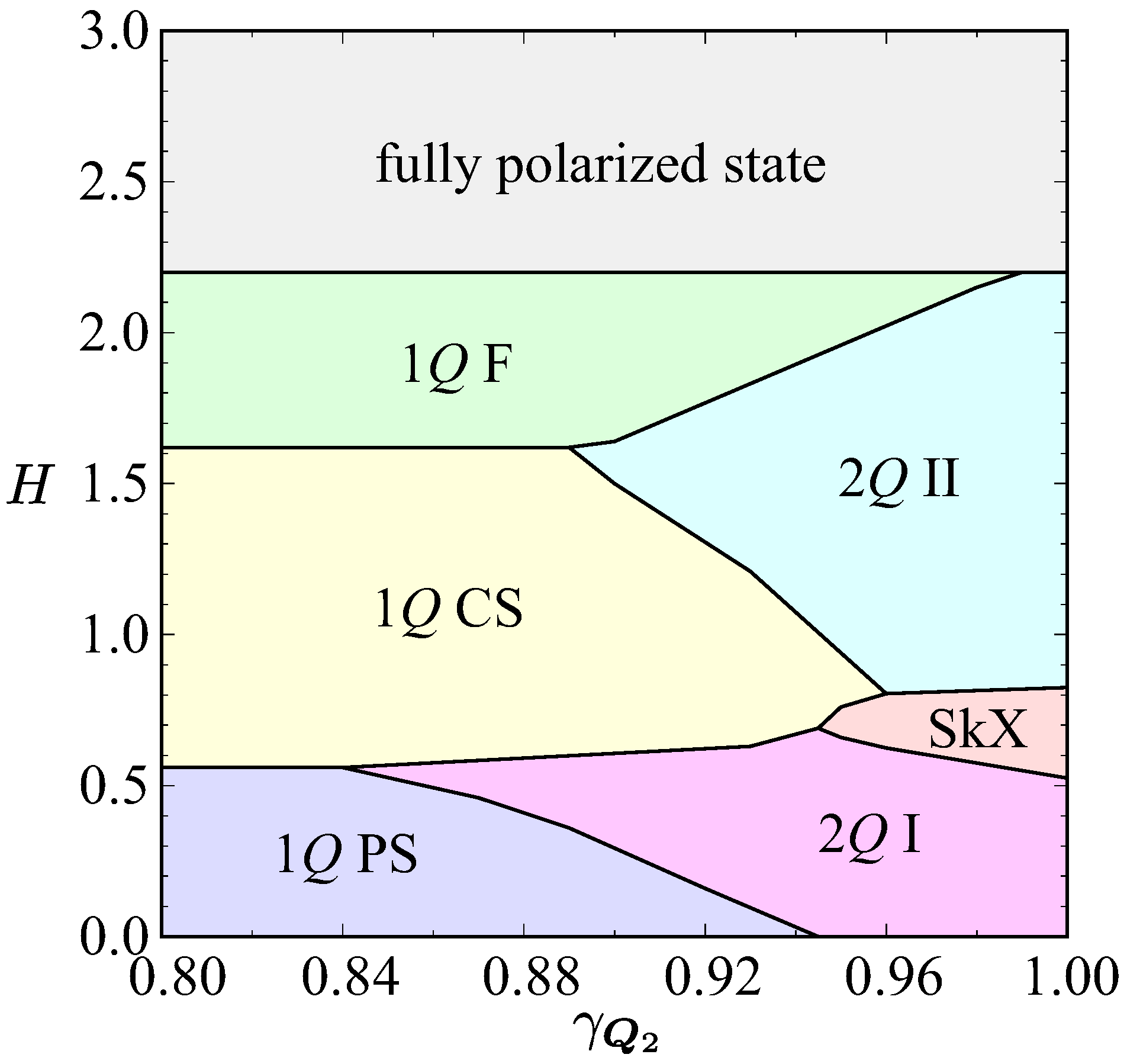
Figure 1. Magnetic phase diagram of the spin model in Equation (1) at low temperatures. The horizontal and vertical axes stand for the interaction parameter at the ordering wave vector Q 2 , γ Q 2 , and the magnetic field, H, respectively. The other parameters are fixed as J Q 1 = 1 , I BA = 0.1 , and γ Q 1 + Q 2 = 0.6 . 1Q and 2Q represent single-Q and double-Q states, respectively. PS, CS, F, and SkX denote proper-screw spiral, conical spiral, fan, and skyrmion crystal, respectively.
Crystals 15 00930 g001
Figure 2. Snapshots of the spin configurations in real space, which are obtained by simulated annealing. The data are shown for the double-Q I state at γ Q 2 = 1 and H = 0.1 in (a), the skyrmion crystal at γ Q 2 = 1 and H = 0.7 in (b), the double-Q II state at γ Q 2 = 1 and H = 1.2 in (c), the double-Q I state at γ Q 2 = 0.95 and H = 0.1 in (d), the skyrmion crystal at γ Q 2 = 0.95 and H = 0.7 in (e), and the double-Q II state at γ Q 2 = 0.95 and H = 1.2 in (f). The arrows represent the direction of spins, and the color stands for the z-spin component.
Crystals 15 00930 g002
Figure 3. Square root of the spin structure factor in each magnetic phase corresponding to Figure 2. The left panel shows the in-plane spin component, and the right panel shows the out-of-plane spin component.
Crystals 15 00930 g003
Figure 4. Real-space spin configurations of (a) the single-Q proper-screw spiral state at γ Q 2 = 0.8 and H = 0.1 , (b) the single-Q conical spiral state at γ Q 2 = 0.8 and H = 0.7 , and (c) the single-Q fan state at γ Q 2 = 0.8 and H = 1.8 . The arrows represent the direction of spins, and the color stands for the z-spin component.
Crystals 15 00930 g004
Figure 5. Square root of the spin structure factor of (a) the single-Q proper-screw spiral state at γ Q 2 = 0.8 and H = 0.1 , (b) the single-Q conical spiral state at γ Q 2 = 0.8 and H = 0.7 , and (c) the single-Q fan state at γ Q 2 = 0.8 and H = 1.8 . The left panel shows the in-plane spin component, and the right panel shows the out-of-plane spin component.
Crystals 15 00930 g005
Figure 6. γ Q 2 dependence of the squared magnetic moments at Q ν for η = x , y , z , ( m Q ν η ) 2 at (a) H = 0.1 , (b) H = 0.7 , (c) H = 1.2 , and (d) H = 1.8 . The vertical dashed lines denote the phase boundaries between different magnetic phases.
Crystals 15 00930 g006
Figure 7. γ Q 2 dependence of the squared scalar spin chirality, ( χ sc ) 2 , at H = 0.7 . The vertical dashed lines denote the phase boundaries between different magnetic phases.
Crystals 15 00930 g007
Figure 8. Magnetic phase diagram when I BA and H are varied at γ Q 1 + Q 2 = 0.6 and γ Q 2 = 0.97 .
Crystals 15 00930 g008
Figure 9. H dependence of the magnetization along the z direction, M z , at (a) I BA = 0.06 , (b) I BA = 0.16 , and (c) I BA = 0.32 . The vertical dashed lines denote the phase boundaries between different magnetic phases. FP stands for the fully polarized state.
Crystals 15 00930 g009
Figure 10. H dependence of the squared scalar spin chirality, ( χ sc ) 2 , at I BA = 0.16 . The vertical dashed lines denote the phase boundaries between different magnetic phases. FP stands for the fully polarized state.
Crystals 15 00930 g010
Disclaimer/Publisher’s Note: The statements, opinions and data contained in all publications are solely those of the individual author(s) and contributor(s) and not of MDPI and/or the editor(s). MDPI and/or the editor(s) disclaim responsibility for any injury to people or property resulting from any ideas, methods, instructions or products referred to in the content.