Abstract
Cracks and crack-like defects in engineering structures have greatly reduced the structural strength. An interface crack with one contact area in a combined tension–shear field of decagonal quasicrystal bi-material is investigated. Based on the deformation compatibility equation and displacement potential function, the complex representation of stress and displacement is given. Using the mixed boundary conditions, the closed-form expressions for the stresses and the displacement jumps in the phonon field and phason field on the material interface are obtained. The results show that the stress intensity factor at the crack tip is zero for the phason field. The variation in the stress intensity factor and the length of the contact zone in the phonon field is given, and the result is consistent with the properties of the crystal. The design of safe engineering structures and the formulation of reasonable quality acceptance standards may benefit from the theoretical research carried out here.
1. Introduction
Quasicrystals, as a lightweight, high-strength material suitable for medium-temperature operation, are becoming a new functional and structural material. With the help of various special properties of quasicrystal materials, scientists have made new breakthroughs in various research fields, which has also promoted the development of quasicrystal material applications. Different from ordinary crystals [1,2,3], the two-dimensional decagonal quasicrystals are periodic in the direction of the decagonal rotational symmetry axis, while the arrangement of plane atoms perpendicular to the decagonal rotational symmetry axis is quasi-periodic, which leads to the additional elastic degrees of freedom that do not exist in ordinary crystals and increases the complexity of fracture mechanics research. The quasicrystal phase of the electron diffraction pattern with 10 rotationally symmetric axes was found by Bendersky [4]. At the same time, Feng et al. found the decagonal quasicrystal phase in rapidly cooled Al-Fe alloy [5]. In 1989, two types of dislocation in decagonal quasicrystals were confirmed by the comparative analysis of electron diffraction [6]. Based on the multiplication of the basis sites’ groups, Girzhon et al. proposed the model of the reciprocal lattice of decagonal quasicrystal [7]. By atomic resolution high-angle annular dark-field scanning transmission electron microscopy, Ma and He observed the largest decagonal subunits, which expanded to 5.2 nm in a decagonal shape [8].
There is a lot of the literature on defects in decagonal quasicrystals. By using the Eshelby method, the elastic field and energy of a decagonal quasicrystal with a special dislocation line are given [9]. Fan’s research team used the complex solution of classical elastic theory and introduced the displacement potential function and stress potential function to transform the final governing equation of the two-dimensional decagonal quasicrystal plane elastic problem into a quadruple harmonic equation [10]. Using this theory and conformal transformation of a complex function, the elliptical notch problem is solved [11]. Wang and Zhong studied the interaction between a semi-infinite crack and a line dislocation in a decagonal quasicrystal solid using the complex variable method [12]. Li constructed the complex potential theory of two-dimensional decagonal quasicrystals and further developed Muskhelishvili’s complex variable method [13]. Fan et al. studied the interface crack problem of two-dimensional decagonal quasicrystal bi-material using the propagation displacement discontinuity method [14]. Wang and Schiavone investigated the elastic field near the tip of an anti-crack in a homogeneous decagonal quasicrystal material and presented explicit and elegant expressions for the anti-crack contraction force [15]. The plane problem of a two-dimensional decagonal quasicrystal with a rigid circular inclusion under infinite tension and concentrated force is studied by Zhai et al. [16]. Based on the complex representation of stress and displacement of two-dimensional decagonal quasicrystal, the above problem is transformed into the Riemann boundary problem by using the analytic continuation principle of complex variable function. Zhao et al. extended the displacement and temperature discontinuity method to the two-dimensional decagonal quasicrystal coating structure and studied the mechanical behavior of the interface crack under thermal–mechanical loads [17]. The plane elastic problem of two asymmetric edge cracks in a two-dimensional decagonal quasicrystal elliptical hole under far-field tensile stress is considered by Yu [18]. Li et al. established a phase field framework to simulate the macroscopic brittle fracture of quasicrystal materials [19]. In this phase field model, the volume fraction parameter is introduced into the fracture toughness to reflect the phase wall effect for the first time.
The classical interface crack model [20] assumes that the crack is completely open, which leads to oscillating singularity at the crack tips. By assuming that there is a small contact zone near the crack tip, the unreal vibration singularity is eliminated [21]. Using a singular integral equation formulation, Qin and Mai investigated interface cracks with contact zones in thermo-piezoelectric materials [22]. An analytical solution for an interface crack with one contact zone in anisotropic material was studied by Herrmann and Loboda [23]. Kharun and Loboda studied the crack problem at the interface of two isotropic materials under mixed-mode loading [24]. The interface crack is assumed to be fully open, partially closed, friction-free contact zone, and fully closed. The problem is reduced to a homogeneous combined Dirichlet Riemann boundary value problem and solved in closed form. The problem of interface crack with a frictionless contact zone at the right crack tip between two semi-infinite piezoelectric/piezomagnetic spaces is considered by Herrmann et al. [25]. Saikia and Muthu studied the interface crack by using the non-intrinsic cohesive zone model to eliminate the stress singularity at the crack tip [26]. However, to the best of the authors’ knowledge, the problem of interface crack with contact zone at the crack tip in decagonal quasicrystals has not been studied.
In the present study, the interface crack theory in elastic fracture mechanics is extended to the elastic fracture mechanics of decagonal quasicrystal bi-material. The interface crack problem with a contact zone in decagonal quasicrystal bi-material is considered, which has a contact zone penetrating the solid along the quasi-periodic direction. By using the method of complex variable function, the mixed boundary value problem is transformed into the Dirichlet Riemann boundary value problem, and the closed solution of the problem is obtained.
2. Basic Equations
The stress and strain of decagonal quasicrystal satisfy generalized Hooke’s law [10,27,28]:
From Equation (1), the strain relation expressed by stress can be written as
where , and are stresses, strains, and elastic constants in the phonon field, respectively; , , and are the stresses, strains, and elastic constants in the phason field, respectively; is the phonon–phason coupling elastic constant.
The strain relation of the plane elastic problem on the quasi-periodic plane of decagonal quasicrystal can be expressed by displacements as
After eliminating the displacement, the deformation coordinate equation expressed by strain is
Introducing stress potential functions , , , the stress–strain relationship can be expressed as
Substituting Equation (5) into Equations (2) and (3), one obtains
Substituting Equations (7) and (8) into Equation (5) yields
where
.
Introducing a new function , one obtains
where .
Equation (9) is automatically satisfied, so is called the stress function. One has [29]
Therefore, the final control function based on stress potential is a quadruple harmonic equation. Substituting Equation (10) into Equation (6), one obtains
Based on the method of stress potential function, Li and Fan [30] developed the complex variable function solution of the quartic harmonic equation. The fundamental solution of Equation (11) is
in which is about four analytic functions of complex variables; , and . Superscript “” indicates complex conjugation, i.e. .
Substituting Equation (14) into Equations (12) and (13), the complex expression of stress function is obtained as
New analytic functions are introduced to make
Then, Equations (15) and (16) can be rewritten as
3. Statement of the Problem
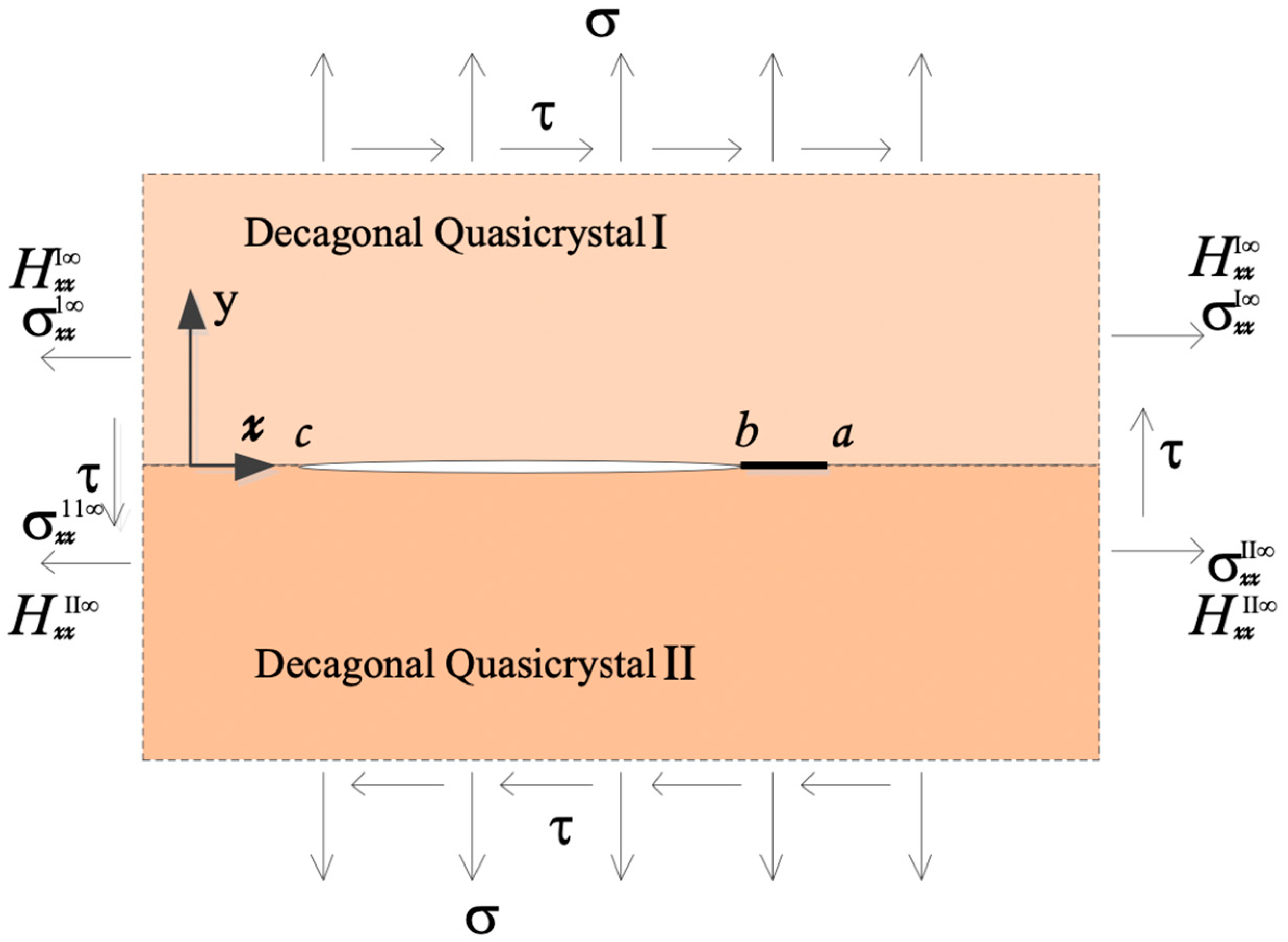
Consider an interface crack with one contact area between two bonded semi-infinite decagonal quasicrystals. and are uniformly loaded in the phonon field, and , , , are applied at infinity, as shown in Figure 1.
Figure 1.
Schematic diagram of an interface crack with one contact area between decagonal quasicrystal bi-materials under infinite load.
The continuity conditions on the interface can be written as follows
The boundary conditions on the crack face can be expressed as follows:
where ; , , and are the phonon field of shear stresses, normal stresses, and displacements along - and -axes, respectively. , , , and are the phason field of shear stresses, normal stresses, and displacements along - and -axes, respectively. Subscripts and mean, respectively, the upper and lower half-planes. Intervals , , and denote the bond, open part of the crack, and contact zone, respectively.
4. Theoretical Derivation of Interface Stresses and Displacement Jump
For the plane elastic problems, the stresses and displacements in the decagonal quasicrystal of point groups, 10 can be expressed in terms of the complex potentials as follows:
in which
, ,
, , ,
Introducing two new functions
Replacing with in Equations (27) and (28) to obtain the following expressions
The differential of the above formula is
Substituting Equations (27), (29) and (31) into Equation (24) yields
Substituting Equations (28), (30) and (32) into Equation (25), one obtains
Introduce the following notation
Thus,
Substituting Equation (37) into Equations (34) and (35), one obtains
Equation (26) can be represented as
Combined with continuity conditions Equations (20) and (21), the following equations are given:
where superscripts “” and “” denote the limit values of the analytical functions, when and , respectively.
Both sides of Equation (41) represent the boundary values of two analytical functions in their respective half-planes, and the two functions can be analytically extended into the whole plane. For the phonon field, we can introduce the following functions:
and
Corresponding, for the phason field, introducing new functions and
and
and are two analytical functions in the whole plane; and are analytical in the region , and the functions , and are bounded at infinity. Based on Liouvill’s theorem, we can conclude that and are constants in the whole plane. That is
After algebraic manipulations, Equations (43) and (44) can be represented in the form
and
where
.
The expressions for stresses in the phonon field can be rewritten as
and
The expressions for stresses in the phason field can be rewritten as
and
The expressions for displacements in the phonon and phason fields can be rewritten in the form
and
Using Equations (49)–(54), we can introduce the following functions:
Substituting Equations (58) and (59) into Equations (54) and (55), one obtains
and
and
Thus, the complex function expressions of the stresses and displacement jump derivatives on the interface are written as
5. Complex Potential Solution of the Problem
From the derivation in the previous section, the problem is transformed into the homogeneous Dirichlet–Riemann boundary value problem
From the second equation of the above equations, one obtains
Thus, the stresses and displacements of the phason field can be expressed as
when , is valid.
Using the conditions at infinity, one obtains
Function is analytic at infinity; one obtains
The general solution of Equation (68) of the combined Dirichlet–Riemann boundary value problem from [30] is unbounded at all points , , and can be written as
where
Replacing with in Equations (31)–(33), one has
derived by differentiation
and have an oscillating singularity at the point and square-root singularities at the points and , respectively. and at infinity can be written as
where
The arbitrary constants , , , have the following forms
The stresses and the derivatives of the displacement jumps for can be expressed as follows:
for :
for :
for :
where
From Equations (80) and (82), it can be seen that the normal stress in the phonon field has a square-root singularity for , and the shear stress has the same singularity for . The relevant stress intensity factors in the phonon field can be defined as
and can be written as
Further, the stress intensity factors can be expressed in the form
The asymptotic behavior of the stresses and the displacement jumps in the phonon field at the points and can be written as
6. Numerical Results and Discussion
The elastic constants of Al Ni Co quasicrystal alloy are taken as the elastic constants of the phonon field, phason field, and coupling constants of the phonon–phason field [31], as shown in Table 1 and Table 2. In order to avoid matrix ill condition caused by material parameters in different orders of magnitude, the material constants are dimensionless, and the dimensionless stress intensity factors in the phonon field are obtained.
Table 1.
Material I constants of decagonal quasicrystal.
Table 2.
Material II constants of decagonal quasicrystal.
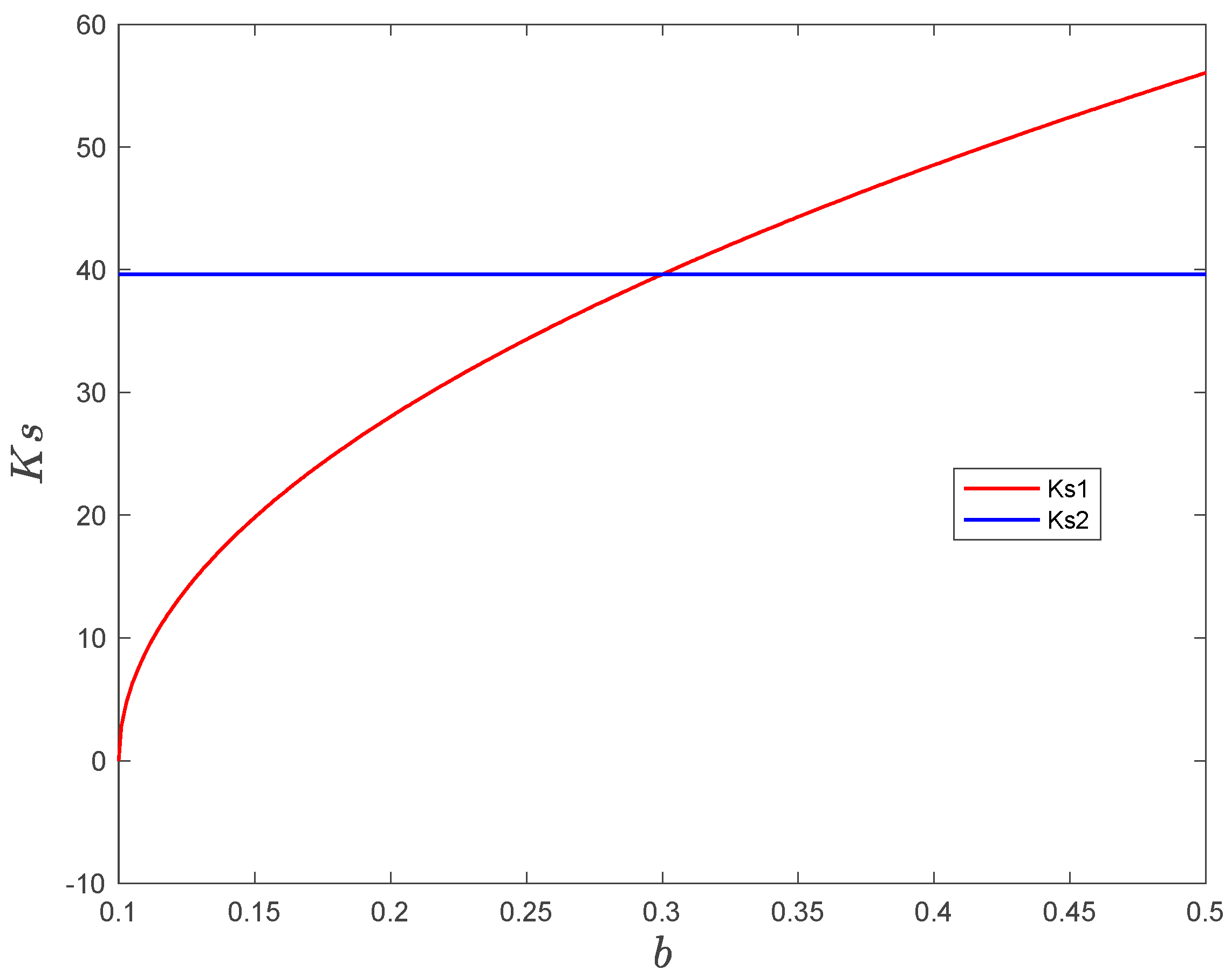
It is clear from Equations (84)–(86) that the length of the contact zone depends only on point . Figure 2 shows the change in the stress intensity factor with the crack contact zone, where the relative contact zone length of a crack with a right contact zone is given. It can be found that for any point, the model framework that only considers the contact area can clearly define the area with a large contact area. The smaller the contact length, the greater the normal stress intensity factor. This is consistent with the trend of classical elasticity.
Figure 2.
Variation in stress intensity factors with the contact zone length.
7. Conclusions
The interface crack contact zone of decagonal quasicrystal bi-materials under far-field mixed loading is studied. Based on the theory of complex variable function, the problem is transformed into a Dirichlet–Riemann problem for analytical solution. The expressions of stress, stress intensity factor, and displacement jump along the material interface are obtained by using the closed analytical formula of the interface crack in the single contact zone of the decagonal quasicrystal bi-materials, and the relationship between the fracture mechanics parameters of the interface crack is given. The analytical expression obtained can be used to verify some numerical analysis and can also accurately show the physical nature of the crack problem in the contact zone of decagonal quasicrystal materials.
Author Contributions
Conceptualization, Z.Z. and B.Z.; methodology, Z.Z.; formal analysis, S.D.; investigation, Z.Z.; writing—original draft preparation, Z.Z.; writing—review and editing, X.L.; supervision, S.D.; project administration, X.L.; funding acquisition, X.L. All authors have read and agreed to the published version of the manuscript.
Funding
The National Natural Science Foundation of China (12262033, 12272195, 12062021, and 12062022), the Ningxia Hui Autonomous Region Science and Technology Innovation Leading Talent Training Project (2020GKLRLX01), and the Natural Science Foundation of Ningxia (2022AAC03068).
Data Availability Statement
The original contributions presented in the study are included in the article, further inquiries can be directed to the corresponding author.
Conflicts of Interest
The authors declare no conflict of interest.
References
- Wu, Y.; Chen, J.; Zhang, L.; Ji, J.; Wang, Q.; Zhang, S. Effect of boron on the structural stability, mechanical properties, and electronic structures of γ′-Ni3Al in TLP joints of nickel-based single-crystal alloys. Mater. Today Commun. 2022, 31, 103375. [Google Scholar] [CrossRef]
- Long, X.; Chong, K.; Su, Y.; Chang, C.; Zhao, L. Meso-scale low-cycle fatigue damage of polycrystalline nickel-based alloy by crystal plasticity finite element method. Int. J. Fatigue 2023, 175, 107778. [Google Scholar] [CrossRef]
- Long, X.; Chong, K.; Su, Y.; Du, L.; Zhang, G. Connecting the macroscopic and mesoscopic properties of sintered silver nanoparticles by crystal plasticity finite element method. Eng. Fract. Mech. 2023, 281, 109137. [Google Scholar] [CrossRef]
- Bendersky, L. Quasicrystal with one-dimensional translational symmetry and a tenfold rotation axis. Phys. Rev. Lett. 1985, 55, 1461–1463. [Google Scholar] [CrossRef] [PubMed]
- Fung, K.K.; Yang, C.Y.; Zhou, Y.Q.; Zhao, J.G.; Zhan, W.S.; Shen, B.G. Icosahedral related decagonal quasicrystal in rapidly cooled Al-14-at.%-Fe alloy. Phys. Rev. Lett. 1986, 56, 2060–2063. [Google Scholar] [CrossRef] [PubMed]
- Zhang, Z.; Urban, K. Transmission electron microscope observation of dislocation and stacking faults in a decagonal Al-Cu-Co alloy. Philos. Mag. Lett. 1989, 60, 97–102. [Google Scholar] [CrossRef]
- Girzhon, V.; Kovalyova, V.; Smolyakov, O.; Zakharenko, M. Modeling of decagonal quasicrystal lattice. J. Non-Crystalline Solids 2012, 358, 137–144. [Google Scholar] [CrossRef]
- Ma, H.; He, Z.; Hou, L.; Steurer, W. Exceptionally large areas of local tenfold symmetry in decagonal Al59Cr21Fe10Si10. J. Alloys Compd. 2018, 765, 753–756. [Google Scholar] [CrossRef]
- Qin, Y.; Wang, R.; Ding, D.H.; Lei, J. Analytical expressions of elastic displacement fields induced by straight dislocations in decagonal, octagonal and dodecagonal quasicrystals. J. Phys. Condens. Matter 1997, 9, 859–872. [Google Scholar] [CrossRef]
- Li, X.-F.; Duan, X.-Y.; Fan, T.-Y.; Sun, Y.-F. Elastic field for a straight dislocation in a decagonal quasicrystal. J. Phys. Condens. Matter 1999, 11, 703–711. [Google Scholar] [CrossRef]
- Liu, G.T.; Fan, T.Y. The complex method of the plane elasticity in 2D quasicrystals point 10 mm ten-fold rotation symmetry notch problems. Sci. China Ser. E 2003, 46, 326–336. [Google Scholar] [CrossRef]
- Wang, X.; Zhong, Z. Interaction between a semi-infinite crack and a straight dislocation in a decagonal quasicrystal. Int. J. Eng. Sci. 2004, 42, 521–538. [Google Scholar] [CrossRef]
- Li, L.H. Complex potential theory for the plane elasticity problem of decagonal quasicrystals and its application. Appl. Math. Comput. 2013, 219, 10105–10111. [Google Scholar] [CrossRef]
- Fan, C.; Lv, S.; Dang, H.; Yuan, Y.; Zhao, M. Fundamental solutions and analysis of the interface crack for two-dimensional decagonal quasicrystal bimaterial via the displacement discontinuity method. Eng. Anal. Bound. Elements 2019, 106, 462–472. [Google Scholar] [CrossRef]
- Wang, X.; Schiavone, P. Elastic field near the tip of an anticrack in a decagonal quasicrystalline material. Appl. Math. Mech. 2020, 41, 401–408. [Google Scholar] [CrossRef]
- Zhai, T.; Ma, Y.Y.; Ding, S.H.; Zhao, X.F. Circular inclusion problem of two-dimensional decagonal quasicrystals with interfacial rigid lines under concentrated force. ZAMM J. Appl. Math. Mech./Z. Angew. Mathe-Matik Mech. 2021, 101, e202100081. [Google Scholar] [CrossRef]
- Zhao, M.; Zhang, X.; Fan, C.; Lu, C.; Dang, H. Thermal fracture analysis of a two-dimensional decagonal quasicrystal coating structure with interface cracks. Mech. Adv. Mater. Struct. 2023, 30, 2001–2016. [Google Scholar] [CrossRef]
- Yu, J. Mode-I Plane Elasticity Problem of Two Asymmetrical Edge Cracks Emanating from an Elliptical Hole in Two-Dimensional Decagonal Quasicrystals. Crystals 2023, 13, 1038. [Google Scholar] [CrossRef]
- Li, P.; Li, W.; Fan, H.; Wang, Q.; Zhou, K. A phase-field framework for brittle fracture in quasi-crystals. Int. J. Solids Struct. 2023, 279, 112385. [Google Scholar] [CrossRef]
- Gautesen, A. The interface crack in a tension field: An eigenvalue problem for the gap. Int. J. Fract. 1992, 55, 261–271. [Google Scholar] [CrossRef]
- Gautesen, A.K. The interface crack under combined loading: An eigenvalue problem for the gap. Int. J. Fract. 1993, 60, 349–361. [Google Scholar] [CrossRef]
- Qin, Q.H.; Mai, Y.W. A closed crack model for interface cracks in thermopiezoelectric materials. Int. J. Solids Struct. 1999, 36, 2463–2479. [Google Scholar] [CrossRef]
- Herrmann, K.P.; Loboda, V.V. On interface crack models with contact zones situated in an anisotropic biomaterial. Arch. Appl. Mech. 1999, 69, 311–335. [Google Scholar] [CrossRef]
- Kharun, I.V.; Loboda, V.V. A set of interface cracks with contact zones in a combined tension-shear field. Acta Mech. 2003, 166, 43–56. [Google Scholar] [CrossRef]
- Herrmann, K.P.; Loboda, V.V.; Khodanen, T.V. An interface crack with contact zones in a piezoelectric/piezomagnetic bimaterial. Arch. Appl. Mech. 2010, 80, 651–670. [Google Scholar] [CrossRef]
- Saikia, P.; Muthu, N. Extrinsic cohesive zone modeling for interface crack growth: Numerical and experimental studies. Eng. Fract. Mech. 2022, 266, 108353. [Google Scholar] [CrossRef]
- Guo, Y.-C.; Fan, T.-Y. A Mode-II Griffith crack in decagonal quasicrystals. Appl. Math. Mech. 2001, 22, 1311–1317. [Google Scholar] [CrossRef]
- Li, L.H.; Fan, T.Y. Complex function method for solving notch problem of point 10 two-dimensional quasicrystal based on the stress potential function. J. Phys. Condens. Matter. 2006, 18, 10631–10641. [Google Scholar] [CrossRef]
- Li, L.H.; Fan, T.Y. Final governing equation of plane elasticity of icosahedral quasicrystals-stress potential method. Chin. Phys. Lett. 2006, 24, 2519–2521. [Google Scholar]
- Loboda, V. The quasi-invariant in the theory of interface cracks. Eng. Fract. Mech. 1993, 44, 573–580. [Google Scholar] [CrossRef]
- Fan, T.Y. Mathematical theory and methods of mechanics of quasicrystalline materials. Engineering 2013, 05, 407–448. [Google Scholar] [CrossRef]
Disclaimer/Publisher’s Note: The statements, opinions and data contained in all publications are solely those of the individual author(s) and contributor(s) and not of MDPI and/or the editor(s). MDPI and/or the editor(s) disclaim responsibility for any injury to people or property resulting from any ideas, methods, instructions or products referred to in the content. |
© 2024 by the authors. Licensee MDPI, Basel, Switzerland. This article is an open access article distributed under the terms and conditions of the Creative Commons Attribution (CC BY) license (https://creativecommons.org/licenses/by/4.0/).