
Article

High-Pressure Vibrational and Structural Studies of the Chemically Engineered Ferroelectric Phase of Sodium Niobate

1
Solid State Physics Division, Bhabha Atomic Research Centre, Mumbai 400085, India
2
Homi Bhabha National Institute, Anushaktinagar, Mumbai 400094, India
3
High Pressure Physics Division, Bhabha Atomic Research Centre, Mumbai 400085, India
4
Department of Condensed Matter Physics and Materials Science, Tata Institute of Fundamental Research, Mumbai 400005, India
*
Authors to whom correspondence should be addressed.
Crystals 2023, 13(8), 1181; https://doi.org/10.3390/cryst13081181
Submission received: 7 July 2023 / Revised: 26 July 2023 / Accepted: 26 July 2023 / Published: 29 July 2023
(This article belongs to the Special Issue Pressure-Induced Phase Transformations (Volume II))

Abstract

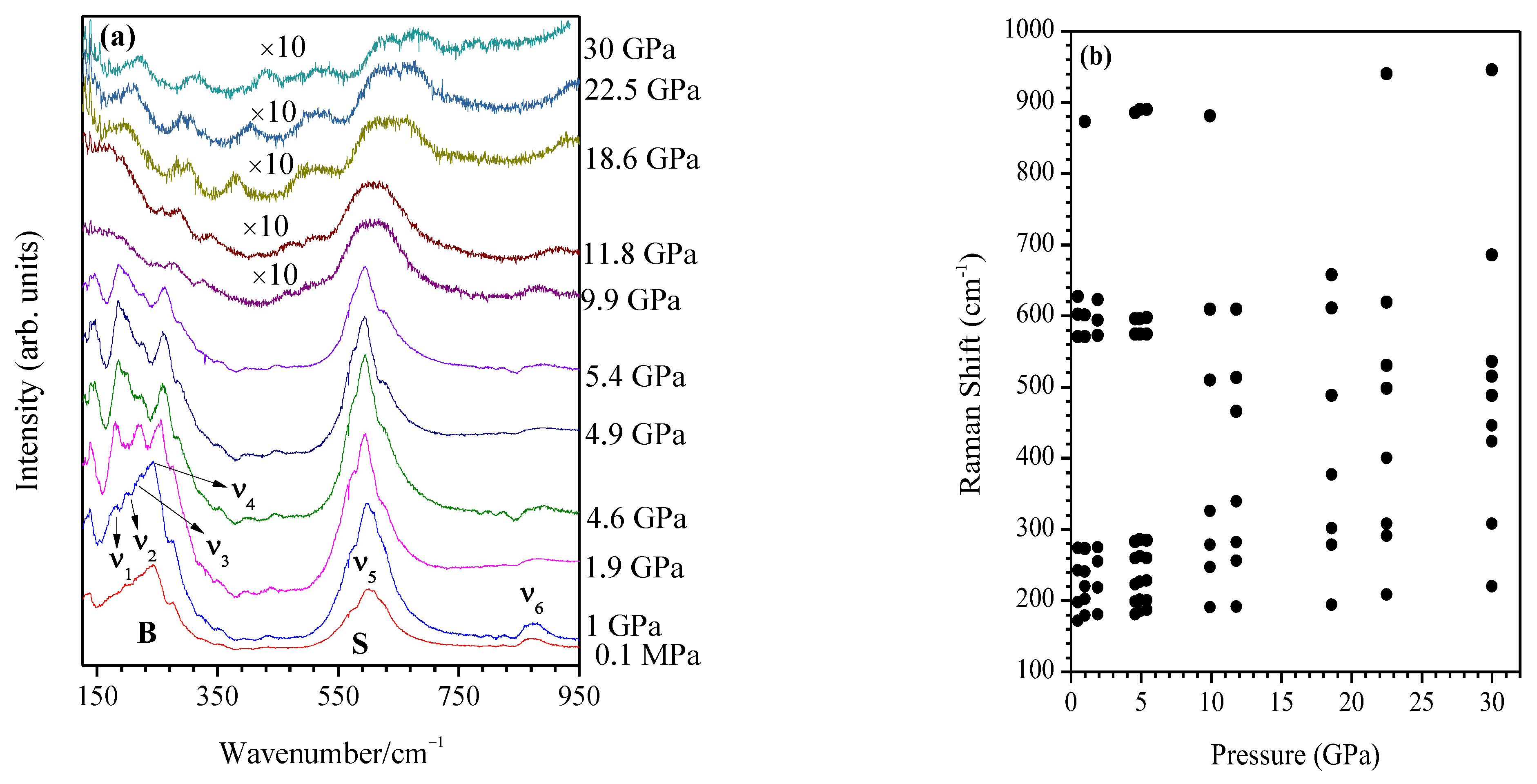
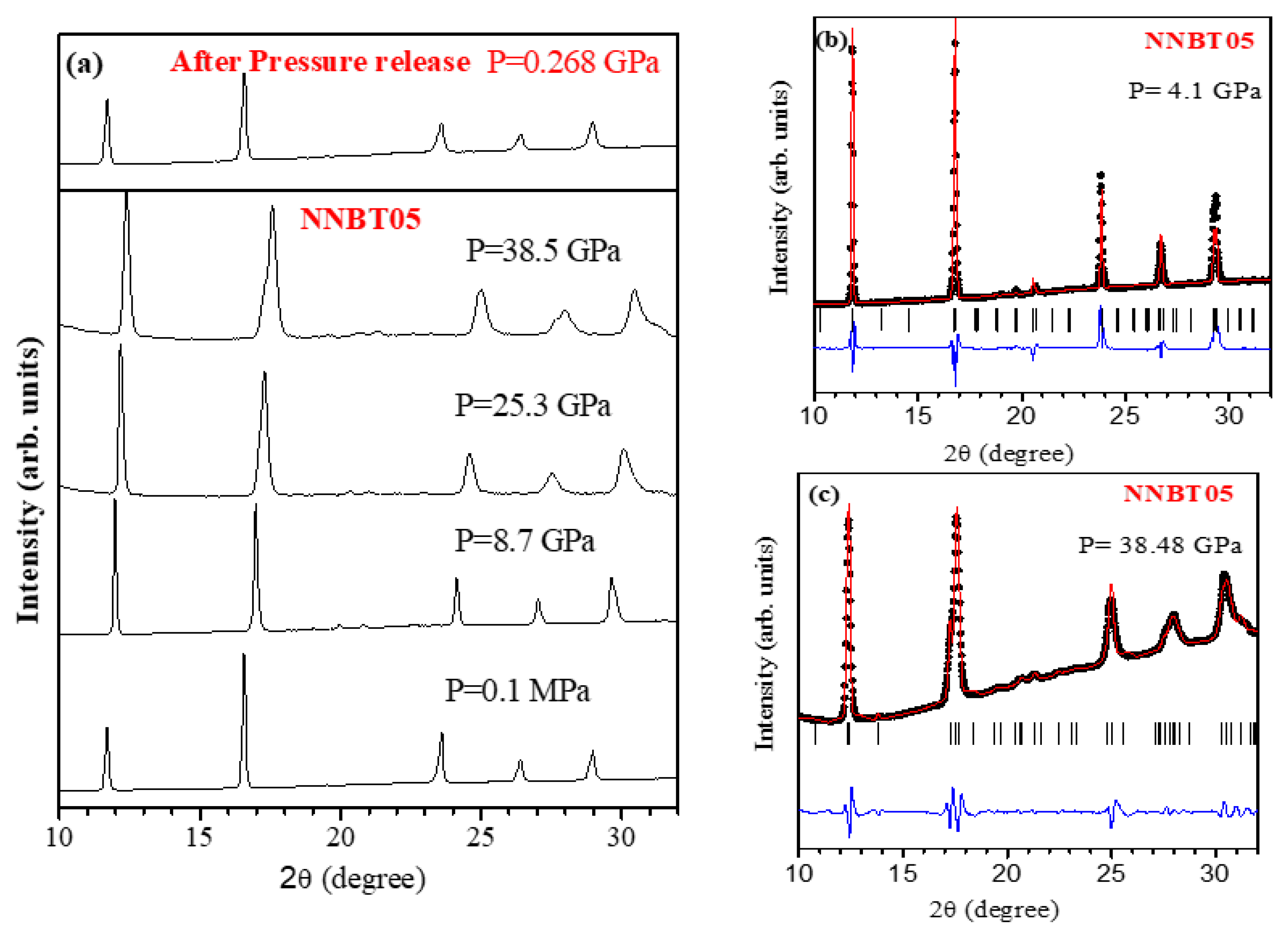
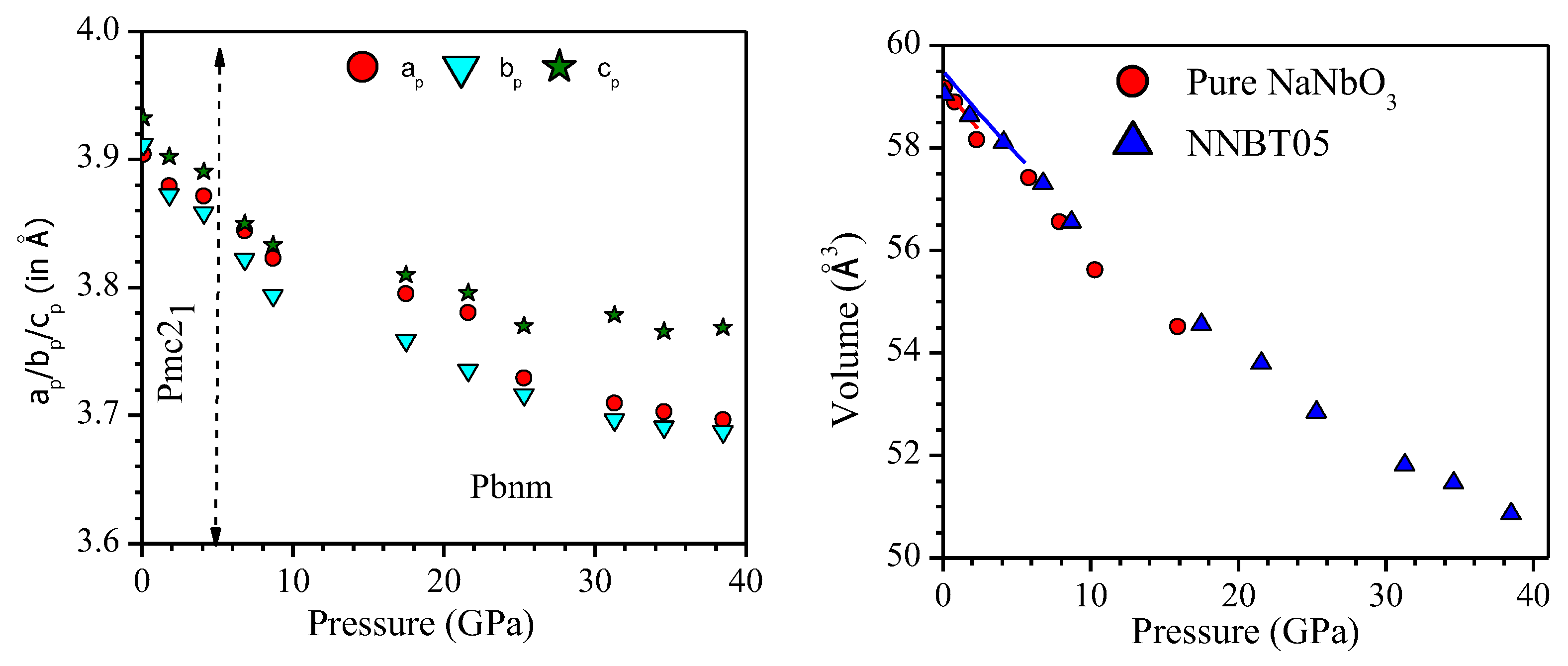
Pure NaNbO3 has an antiferroelectric phase at ambient pressure. The structural behaviour of the chemically engineered ferroelectric phase of sodium niobate, NNBT05: [(0.95) NaNbO3-(0.05) BaTiO3], under high-pressure has been studied using Raman scattering and angle-dispersive synchrotron X-ray diffraction techniques. At pressure > 1 GPa, noticeable changes in the Raman spectra can be seen in the low wavenumber modes (150–300 cm−1). Large changes in the positions and intensities of the Raman bands as a function of pressure provide evidence for structural phase transition. The results indicate significant changes in the bond-lengths and the orientation of the NbO6 octahedra at ~1 GPa, and a transition to the paraelectric phase at ~5 GPa, which are at lower pressures than previously found in pure NaNbO3. The powder X-ray diffraction pattern shows an appreciable change in the peak profile in terms of position and width on increasing pressure. The pressure dependences of the structural parameters show that the response of the lattice parameters to pressure is strongly anisotropic. By fitting the pressure–volume data using the Birch–Murnaghan equation of state, the isothermal bulk modulus was estimated. The experimental results suggest that on doping BaTiO3 in NaNbO3, the bulk modulus increases. The bulk modulus of NNBT05 has been estimated to be 164.5 GPa, which is fairly close to 157.5 GPa, as previously observed in NaNbO3.
Keywords: ferroelectric; antiferroelectric; niobate; Raman scattering; high pressure diffraction ferroelectric; antiferroelectric; niobate; Raman scattering; high pressure diffraction