1. Introduction
Understanding how geometric order can propagate in solids, for example with the generation of fascinating Moiré patterns in the superimposition of two or more identical twisted lattices, the specific relative orientations between twinned crystals or the distribution of ordered variants in the morphology of an initial single crystal after a phase transition, is a major part of describing the properties of coherent interfaces in crystals. The subject has met a particular revival since the discovery [
1] of bilayers of twisted extended 2D structure like graphene and similar structures with very interesting electronic properties of the bilayer depending crucially on its symmetry. Our intention here is to give some general theoretical elements of an answer to this fascinating symmetry problem.
The notion of
bicrystal is issued from the studies of grain boundaries in metals and minerals as first discussed by Bollman [
2] after the seminal approach of Friedel on the symmetries of twinned crystals (see for instance [
3,
4]). First designated as dichromatic pattern (see Pond and Bollman [
5] and Pond & Vlachavas [
6]), the notion of bicrystal was implicitly based on the lattice symmetry mostly because examples at that time were specific studies of grain boundaries of simple metals the atomic structure of which can be described by symmorphic space groups with one unique atom per unit cell. This lack of generality has been discussed by Gratias & Portier [
7] who used space groups and group action theory [
8] to construct a general crystallographic framework for describing the geometry of homophase grain boundaries. In all these approaches, the basic idea was to decipher which symmetries appear in the abstract construction of the superimposition of two crystals of the same nature in different orientations for finding which elementary domain in space should be examined to discuss all the possible interfaces—grain boundaries or twins—that can actually exist between the two crystals.
The overall discussion addressed in the present paper takes its roots on the works of Guymont et al. [
9] and Gratias & Portier [
7] giving the basic tools for handling the symmetry properties of bicrystals using elementary group action theory [
8]. Our present goal is to generalize this notion to that of
N-crystals, an abstract construct built of the superimposition of
N identical crystals displaced and disoriented with respect to each other. This generalization allows the inclusion of the description of symmetry breaking in solids due to group–subgroup phase transformations that generate an assembly of crystalline domains of the low-symmetry phase out of a single crystal of the high-symmetry phase. Classical example of these phase transformation are the many chemical order–disorder transitions in metallic alloys. This leads to a complete geometric description of the interconnection between the variants generated by a group–subgroup phase transition.
The paper has three main sections:
the first section “Standard bicrystallography” discusses the basic tools used to characterize interfaces in homogeneous crystals; a special attention is given to the building of the space group that define all possible space groups of the bicrystal as function of the rigid-body translation ; another key point here is to emphasize the fact that the symmetry group of the bicrystal results from only two kind of symmetry operations these that keep both crystals simultaneously invariant and those that exchange the crystals: there is an homomorphism between the group of the bicrystal and the permutation group of two elements;
the second section shows how to generalize the bicrystal concept to the N-crystal one by constructing all sets of symmetry operations, if any, that realize one of the permutations of N objects;
the third and last section proposes a direct application of the notion of N-crystal in the case of the group–subgroup transformations.
To make the reading easy, the following notations are used all over the paper:
point groups are designated by uppercase letters as G or ; point symmetry elements are designated by lowercase letters as g or ;
space groups, including translation groups, are noted by calligraphic letters like or and space symmetry elements by or ;
for simplicity, the term lattice is indiscriminately used as a set of vectors defining the lattice nodes or as a set of symmetry elements belonging to a translation group;
the space group of the crystal is with point group (symmetry class) G and lattice .
2. Standard Bicrystallography
The crystal is characterized by its space group
of lattice
as defined in the International Tables for Crystallography [
10,
11]. The space group is represented by the set of symmetry elements
defined by a point symmetry operation
g (rotation, mirror, inversion,…) associated with a translation
t:
The elements of
with the identity as point symmetry operation define the lattice
.
The geometric operation that transforms crystal I into crystal II is an isometric transformation that takes the same form as the symmetry elements of the crystal where is the point operation (rotation, mirror, inversion; …) and a rigid-body translation: .
Because of the intrinsic internal symmetries of the crystal, a generic point
has infinitely many equivalent points
, called its
-orbit, that can as well be chosen for defining
; the same applies in the second crystal. Thus, the chain of equivalences:
shows that the most general transformation from crystal I to II, is equivalently described by any element of the left coset
(see for instance Guymont et al. [
9]):
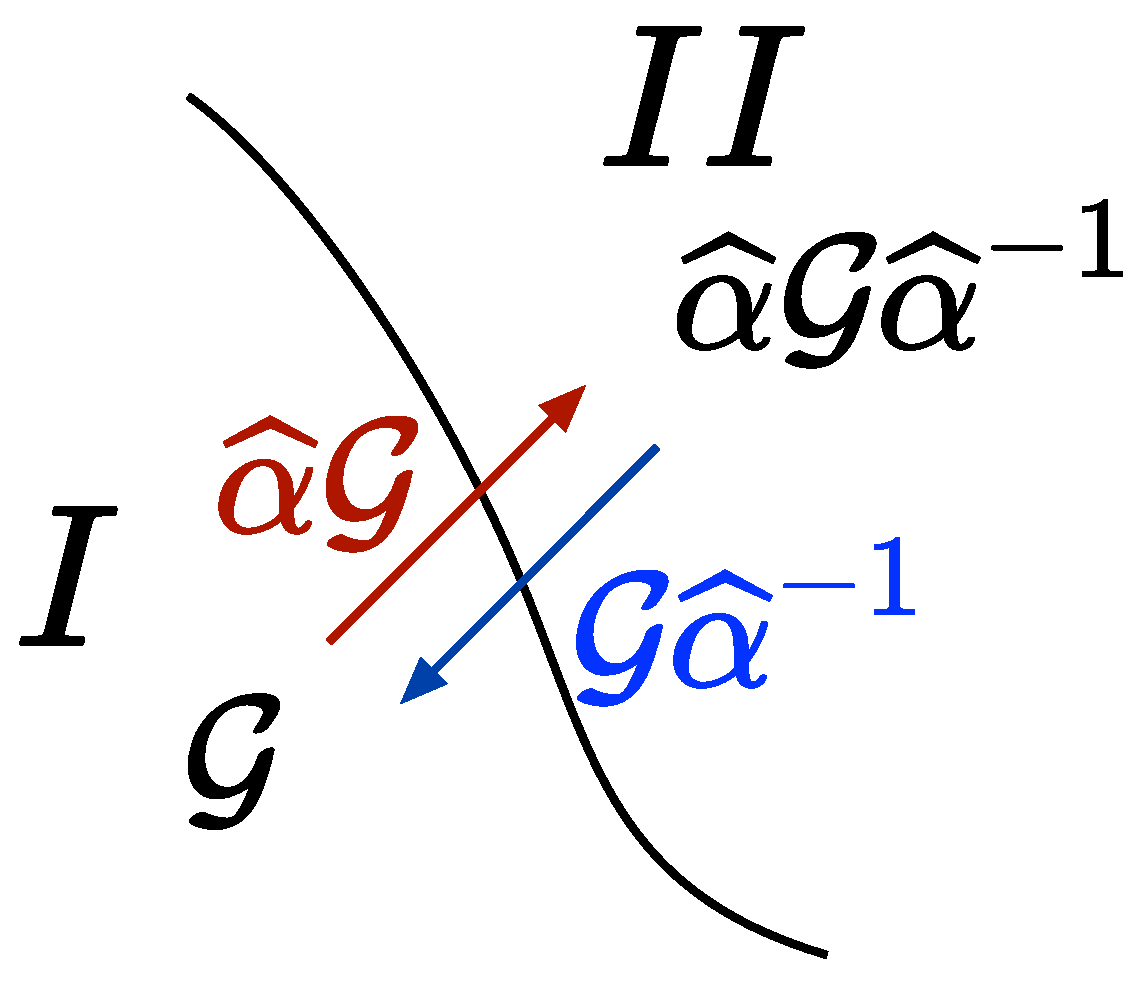
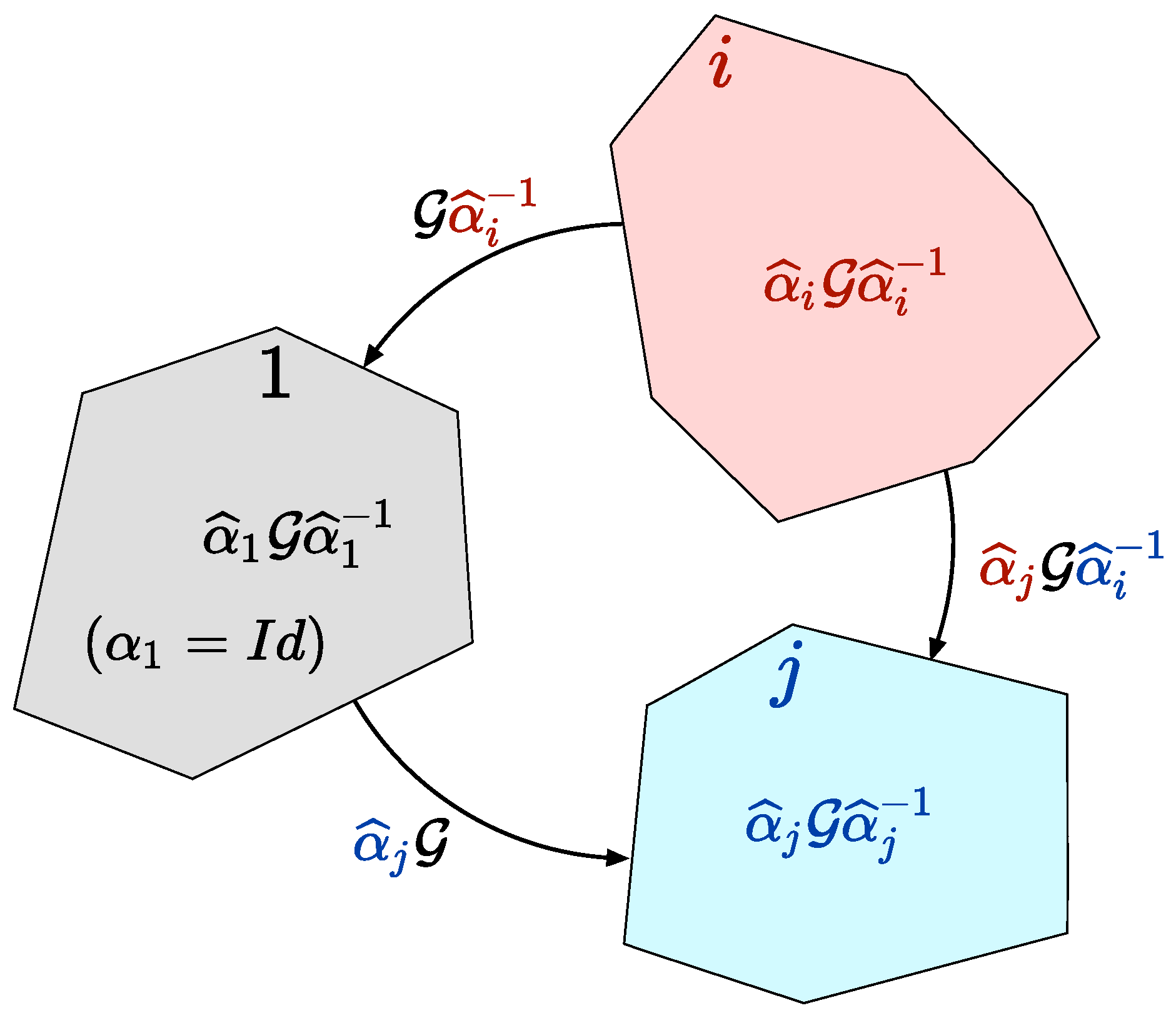
The inverse transformation from II to I is characterized by the right coset
as shown in
Figure 1.
2.1. Translation Invariants
For a generic interface, the lattices and of respectively crystal I and have no translation in common in the sense that no translation of crystal can be expressed as a linear combination with integer coefficients of the basic vectors of crystal I.
There are specific cases however, like coincidence grain boundaries and twins, where the two crystals share a same translation subset of rank 3 of
, called the coincidence lattice (see [
12]) and noted
, which is defined by:
This coincidence lattice
is a subgroup of order
of
and
and is better defined as the intersection of these two lattices:
The second important translation group is the group
generated by the union:
This group is a supergroup of order
of both
and
and is also independent of the rigid-body translation. It has often been called the
Displacement Shift Complete lattice but is now better defined as
Displacement Symmetry Conserving lattice (see [
5]) with the same acronym DSC.
The translation group is the invariance translation group of the rigid-body translation . The rigid-body translation is indeed defined up to any translation of crystal I and any translation of crystal : for a given point operation , any rigid-body translation deduced from by a translation of leads to an equivalent bicrystal.
The translation groups
and
have their image in reciprocal space as demonstrated by Grimmer [
13]: the intersection of the reciprocal lattices
and
is the reciprocal lattice of
whereas the union group is the reciprocal lattice of
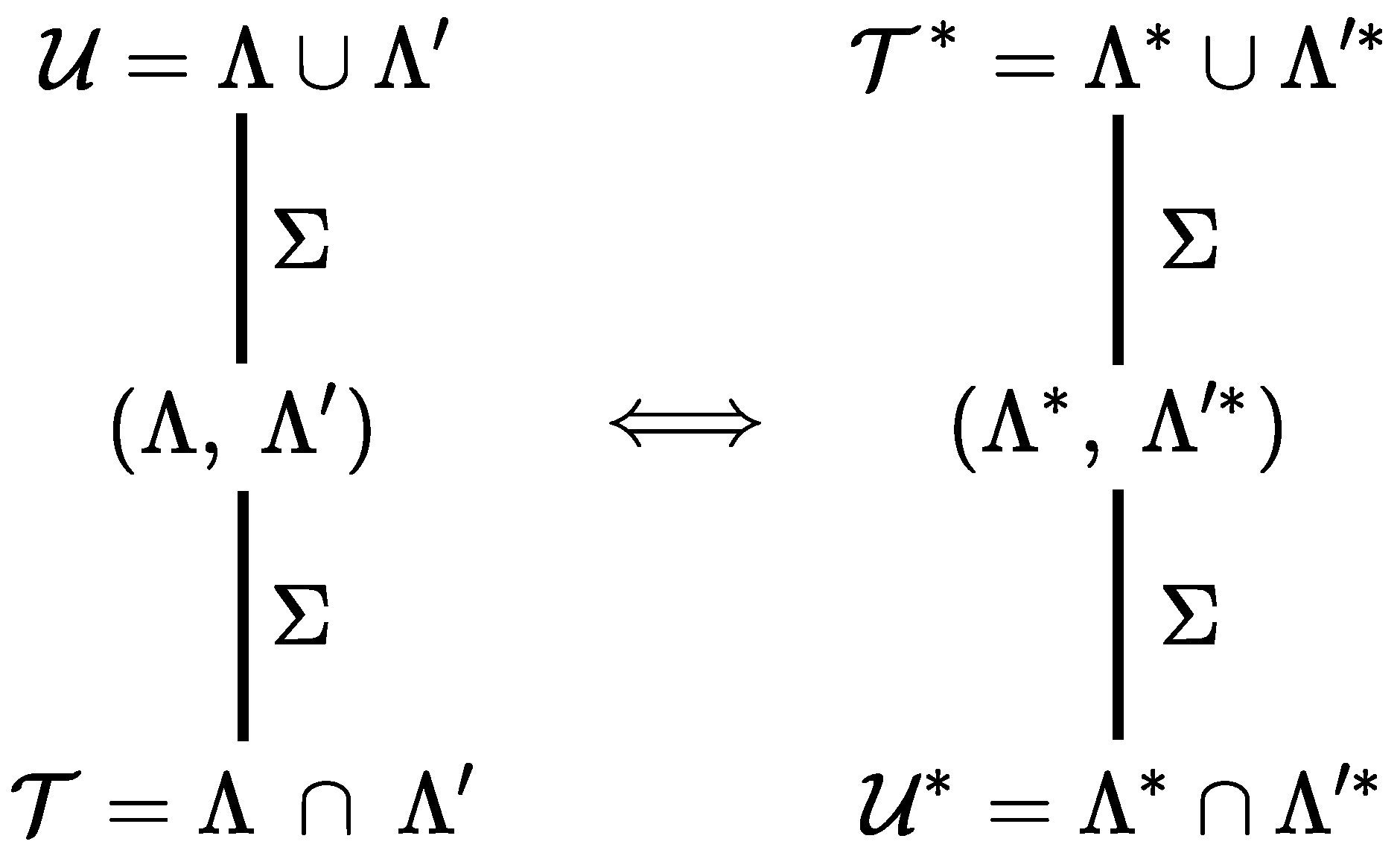
. These general group relations are shown in
Figure 2.
2.2. Symmetry and Rigid-Body Translation
Once a specific operation generating a coincidence lattice is given, the question arises of which kind of space groups can be found depending on the value of the associated rigid-body translation . For that purpose, we will first determine the space group that generates the orbit of all equivalent of whatever its value: as will be discussed next, the little group of in will thus generate the space group .
We have seen in the preceding section that the invariant translation group of , whatever its value, is the union group since is defined up to any translation of either crystals I or . Concerning the orientational symmetries and since is a global translation of one of the crystals with respect to the other, only the point symmetry operations must be considered.
We use the general rule that determining the global symmetry of the union of two equivalent objects (their normalizer) is made in searching for the symmetry elements that are common to both objects and the possible additional external elements, if any, that exchange these two objects.
Let us designate by
G the point group of
and let
be the (point) coset representing the transformation of
I to
. We designate by:
the point group intersection of the points groups of crystals
I and
. This point group, keeping both I and II invariant, is part of the construction of
.
On the other hand, the elements common to
and
,
transform crystal
I into
and vice-versa, generate other equivalent of
,
but in flipping it in the opposite direction . This set, if not empty, is also part of the construction of
.
The union:
is a (point) group with
:
the right and left products of an element of
with an element of
is an element of
; let
, then:
the product of two elements of
is an element of
; let
, then:
Therefore, the group
is either
itself if
is empty, or a supergroup of order 2 of
if
is not empty; in that later case, it can be written as:
with
.
It is now trivial to find the group
describing all the possible symmetries of the bicrystals generated by a given point operation
according to the rigid-body translation
; it is given by the direct product of
with
:
This space group contains at once all the symmetry information for any value of . It is enough to restrict inside the Dirichlet domain of to find all the possible space groups depending on using the following properties:
the number of different possible types of space groups
of the bicrystal created by a point operator
and a rigid-body translation
is the number of different position strata (see [
14,
15]) of the space group
that
can take;
the space group
of the bicrystal is determined by the point group of the symmetry stratum of
in
; in particular, high-symmetry groups appear when
points on special positions (strata of dimension 0) of
; they correspond to the so-called symmetry dictated extrema as discussed by Cahn & Kalonji [
16];
in the construction of , the generating elements belonging to the intersection group are to be taken as they are, whereas those corresponding to the coset must be multiplied by the inversion before being injected in (for example, a mirror in the coset generates a two-fold axis perpendicular to the mirror as generator of ).
2.3. The Space Group of the Bicrystal
Calculating is similar to the previous derivation in using space groups instead of point groups. Here again, the space group is constituted of two kinds of space symmetry elements:
those that leave invariant simultaneously I and : they form a subgroup of noted and defined by ;
those that exchange I and : that are outside and can reduce to the empty set.
The elements of
are defined by:
For example, the subgroup
of
defined by the elements of
that commute with
,
is a subgroup of
. This is the case when
is a pure rotation sharing the same axis as a pure rotation
of
, then
is in
)
The binary elements
are elements of
: let
, then:
As an example, the product
of a rotation of angle
around an axis contained in the plane of a mirror
element of
is an element of
: it generates a mirror of
the plane of which is the mirror plane of
rotated by
) of
— if not empty — are defined by:
As in the preceding section, it is easily demonstrated that the union of the two sets
and
(if not empty) forms a group
:
This space group of the bicrystal with translation group
is also designated as the symmetry group of the
dichromatic pattern (see [
17]).
The explicit computation of is made particularly simple in considering the little group of in :
the elements of
are such that:
leading to
and
; this is achieved for
g belonging to the little group of
(
) where
t and
are translations of
(
);
the elements of
are such that:
leading to
and
; this is achieved for
being element of the little group of
multiplied by the inversion (
) where
t and
are translations of
(
).
This shows that the little (point) group of
in
, say
is directly connected to the point group
of the space group
that is built with
and
multiplied by the inversion:
The number of different strata of
gives the number of various kind of space groups
depending on the values of
. In particular, the symmetry dictated values of
are those corresponding to strata of dimension 0 of
.
2.4. A Simple 2D Example
To exemplify these rules, we consider the classical case of the bicrystal generated by the rotation of a 2D square structure (see for instance [
18,
19,
20,
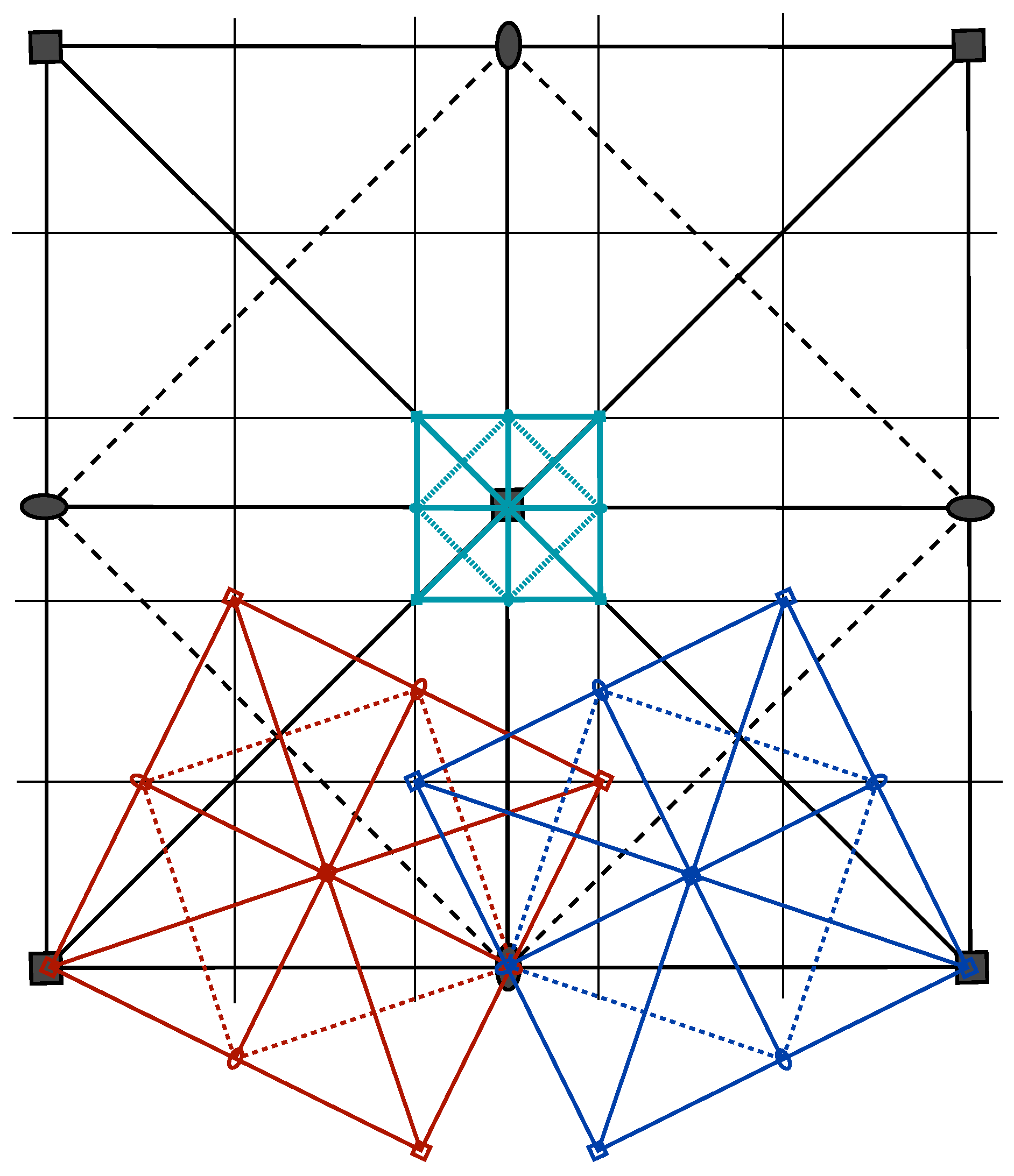
21]) onto itself as shown in
Figure 3. The actual structure belongs to either symmetry class
(space group
) or
that is the holohedry of the square system (space groups
and
). Coincidence lattices appear for rotations
around the origin that superimpose the node
on top of the node
, with
n,
m coprime and
. This leads to the coincidence lattice defined by the vectors
; the index is
and the union lattice
is defined by
.
The computation of
is quite simple. The intersection
is the set
and the exchange set is the set of the mirrors in
corresponding to the initial mirrors,
rotated by
for the class
. This set is empty for the case of the class 4. Therefore:
This demonstrated that
whatever the value of the rotation
generating a coincidence lattice, the bicrystal of a
structure can have only four space groups:
and
corresponding to the four strata of the group
, whereas structures of space groups
and
have seven possible space groups from
to
corresponding to the seven strata of the group
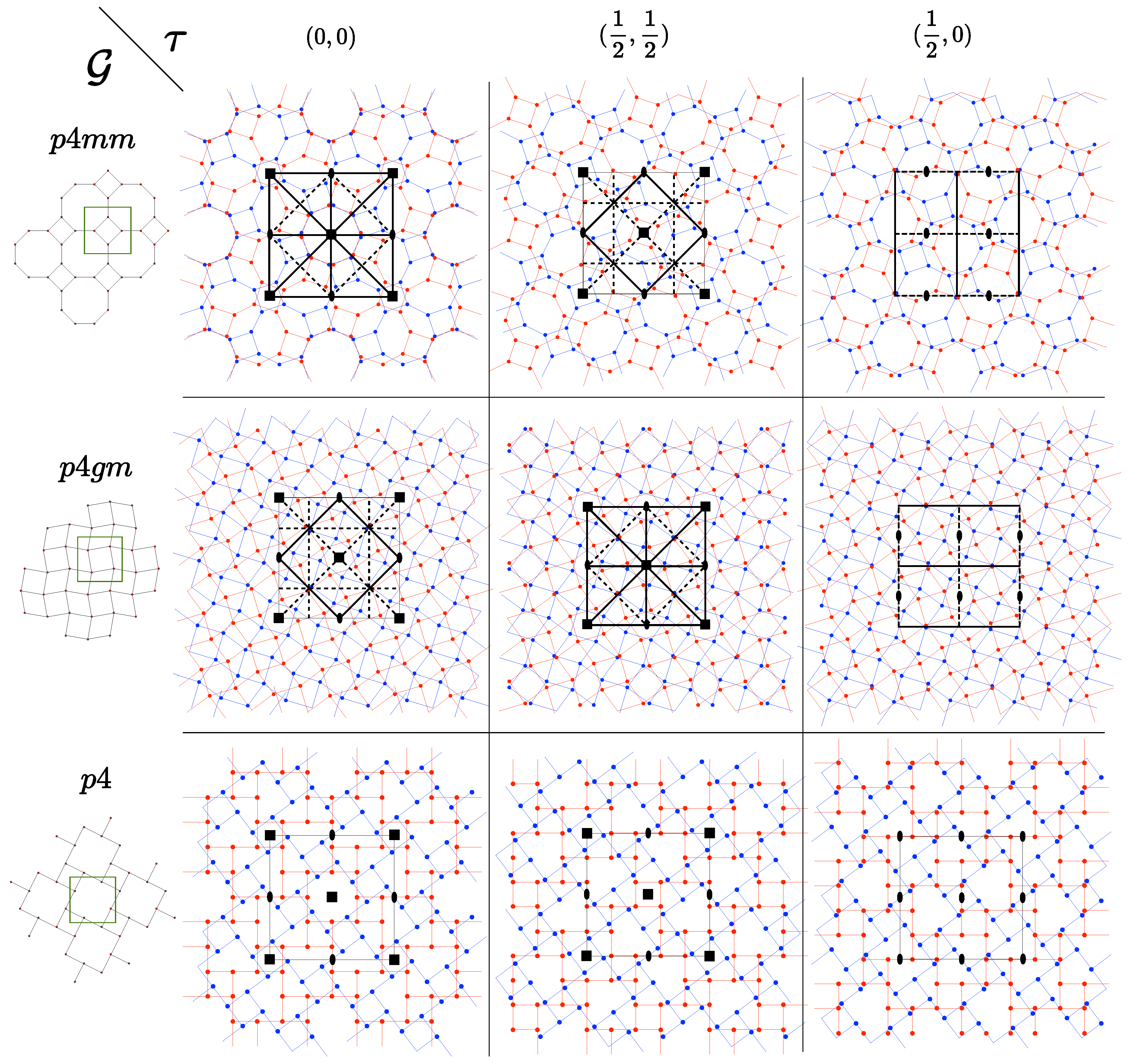
as shown on
Table 1 and exemplified in
Figure 4 for the values of
corresponding to the special points.
Here, in the holohedral examples, all 4-fold and 2-fold rotations belong to
whereas the exchange elements are the original mirrors rotated by
. It is interesting to observe in the case of the strata of dimension 1 in
Table 1, that, as expected, the actual mirrors of
are perpendicular to those of the little group of
as expected in relation (
5); for instance a little group
generates a space group
or
and a little group
generates a mirror
.
2.5. The Special Case of General Quasi-Bicrystals
The physical meaning of the rigid-body translation
deserves special attention for the case of general crystal superimposition with no coincidence lattice. This case corresponds to the limit
where the bicrystal becomes a quasiperiodic structure (see for instance [
22,
23]). The translation group
becomes thus a
module and the size of the unit cell of
reduces to zero. We call it a
quasi-bicrystal. This means that the general quasi-bicrystal is then independent of
: any two quasi-bicrystals built with the same
I and
crystals that differ only by a change
in the rigid-body translation are locally isomorphic, i.e., any local configuration of finite size in one quasi-bicrystal is present in the other with the same frequency and vice-versa. The two quasi-bicrystals are thus
undistinguishable in the sense that modifying the rigid-body translation between the two crystals has the only effect of redistributing in space the atomic configurations of finite size with the same frequencies without adding any new configurations nor removing any existing ones.
3. From Bicrystallography to N-Crystallography
We can extend the
bicrystal concept to that of
crystal where
crystals are superimposed in observing that, for
non-empty, the quotient group
is isomorphic to the permutation group of two objects
:
This basic isomorphism is the starting point for making an easy generalization to N-crystal.
3.1. The N-Crystal Generalization
The overall symmetry group of N equivalent objects for finite N, is isomorphic to a subgroup of the permutation group of N objects. Thus, constructing the symmetry of the abstract crystal, consists of identifying which actual symmetry elements are representative of those of .
For notation coherency, we note the identity as
. The elements of
, say
, transform the
N-uplet of integers
into
. On the other hand, transforming crystal
i into
j is achieved by the elements of the coset (if not empty)
as illustrated in
Figure 5.
At the substitution
, corresponds the coset
. Thus, at the permutation
of
N objects:
corresponds the intersection (if not empty) of the cosets
for all
j varying from 1 to
N:
The symmetry group
of the
N-crystal is the union of the
such intersections (many of them can be empty) associated with the
permutations of the group
:
The mapping between each element of the permutation group and its corresponding coset intersections (possibly empty) insures to be a group.
Introducing the invariant subgroup
generated by the identity permutation
:
we find the basic decomposition for the
N-crystal symmetry group:
and
where
is a subgroup of
.
Expressions (
7) and (
8) are the explicit formula that define the symmetry group of the
N-crystal as natural extensions of formula (
4) of the bicrystal.
3.2. Application to Group–Subgroup Phase Transformations
The simplest and most obvious application of using relation (
8) is the classical group–subgroup phase transformations as exemplified by the numerous cases encountered in solid state physics of alloys with the numerous examples of order–disorder transformations. These are characterized by a symmetry breaking at some critical temperature—or on reaching a two-phased region in the phase diagram—from a high-symmetry group
at high temperature to a low-symmetry subgroup
of order
N in
at low temperature:
The decomposition of
in cosets of
corresponds to a single crystal of space group
at high temperature transforming, at low temperature, into numerous crystallites of phase
that distribute into
N kind of differently oriented/translated crystals
. Each family, called a variant, gather all crystallites described by the same space group
. The coset
is the set of all equivalent operations that transform a given chosen variant of space group
into another of space group
. Passing from the variant
i to the variant
j is achieved by the set of operations
. We recognize here the expressions discussed in the previous section where the operations
are identified to
. Therefore, the symmetry group
is the group
itself since the
N-crystal is the high temperature phase:
The group
of the high temperature phase describes the way the
N variants of the low temperature phase transform into each other. We designate by
the invariant subgroup of order
K in
that is the intersection of the groups of the
N variants:
This intersection group is the kernel of the application
of
on its coset decomposition on
. The pertinent group to be considered for discussing the symmetry breaking induced by the transformation is the image of the application. It is associated with the symmetry group
of order
, isomorphic to a subgroup of
obtained by computing the coset decomposition
of
and extracting its quotient by
:
This image group gives the complete and faithful description of how the parent group operates on the variants .
3.3. Simple Examples
3.3.1. A 2D Toy-Model
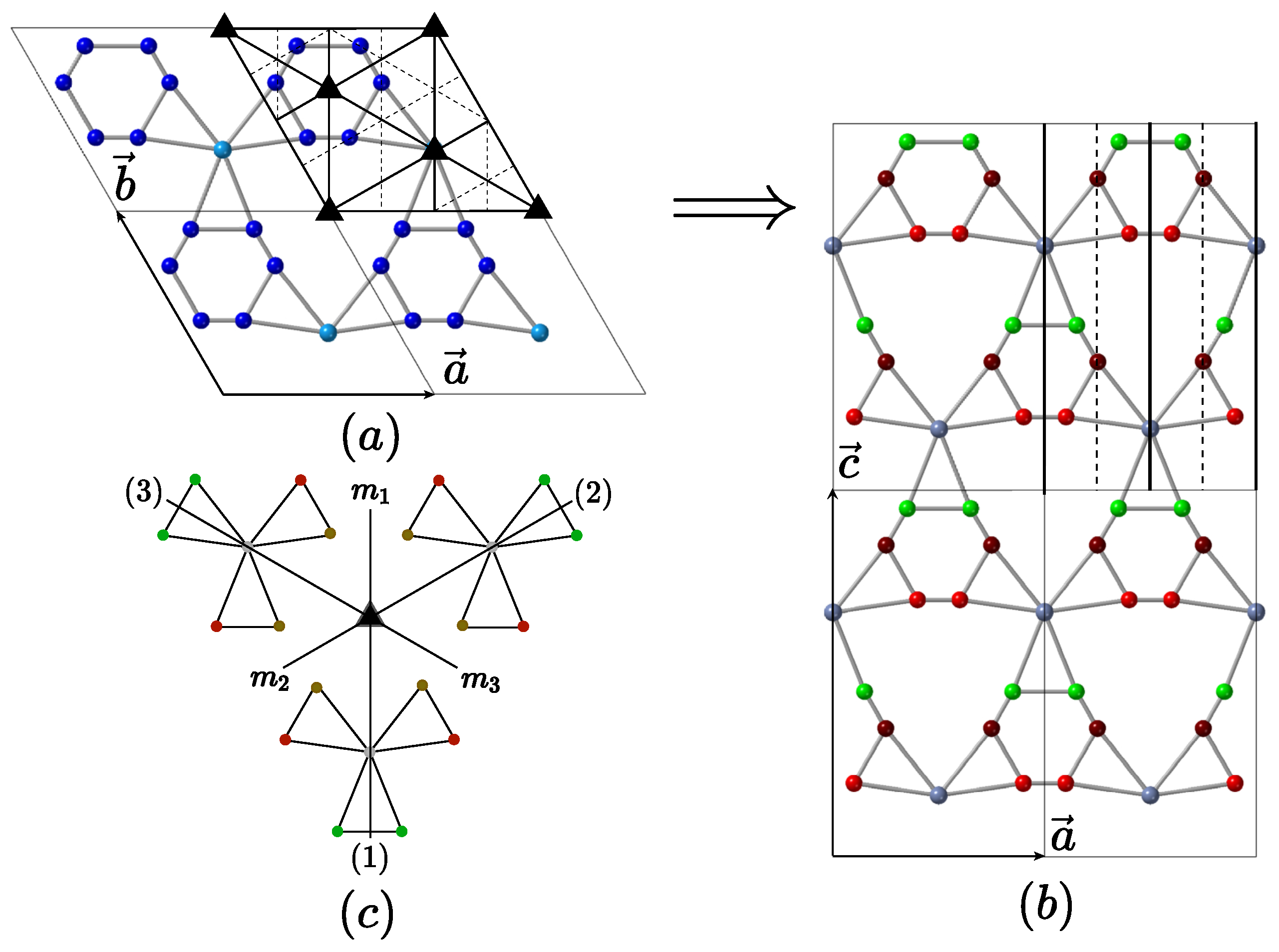
We consider the hypothetical phase transition of blue atoms decomposing by chemical ordering into red, green and brown atoms as shown in
Figure 6. This order–disorder transformation is characterized by the group–subgroup relation:
with standard coset decomposition
:
corresponding to generate 3 variants deduced from each other by the 3-fold rotation lost during the transition.
We note
and
. The permutation group (equivalent here to a three-color symmetry group) is obtained by computing the quotient group of
on the kernel
:
There are thus 6 cosets in the decomposition of
on
defined by the following variant permutations and corresponding cosets intersections:
and the explicit
3-crystal symmetry group can be written as:
the image of which is the group of permutation of three objects of order 6:
isomorphic to the point group
. This is shown in
Figure 6c where the drawing of the three-fold axis and the three mirrors
,
and
explicitly demonstrates how the three variants connect to each other according to
.
A few other classical examples in the family of chemical ordering of metallic alloys are the following.
3.3.2. CuZn B:
Here we have
,
,
,
Here, we are in the simplest case of bicrystal induced by transformation where the translation is the generator of the exchange set (color translation). The image group is .
3.3.3. CuAu L1:
,
,
,
Here the image group is isomorphic to
(regular tetrahedron). We can represent the four variants as the vertices of a regular tetrahedron. For example applying the translation
to the four variants corresponds to the permutation
.
4. Conclusions
We have shown here that the symmetry group of the superimposition of two crystals related by the boundary operation
is the combination of two kind of operations: those that leave simultaneous invariant both crystals (
) and those that exchange them (
):
and, when the exchange set
is non-empty, the quotient group
is isomorphic to
, the permutation group of two objects.
The space group
depends on both the point operation
and the translation part
of
. The number of different possible space groups associated with a given point operation
according to the
value is equal to the number of different strata of the group:
where
G is the point group of the structure and
the union group of the lattices of crystals I and II.
The symmetry group of the superimposition of a
finite number (if
, as for cubic variants generated by iterative mirror twinning on the
plane, the present description fails in which case the analysis developed by Cayron (see for instance [
24]) using groupoids that is to be considered), say
N, of variants is the combination of all possible symmetry operation that permute the
N variants and can be written:
where the
N structurally identical variants are related by
cosets with
. Here again, the quotient group
, where
is a subgroup of the permutation group
of
N objects.
This generalization allows the gathering in a unique scheme of the symmetry studies of N-crystallography on special grain boundaries of N (finite) variants and the coset decomposition in N variants due to a group–subgroup solid state transformation.
The only problem here was to determine the mapping between the actual symmetry crystallographic elements on one side and the abstract permutation operations on the other side. As always when using group theory, the pertinent mapping is obtained by extracting the image group of the application, say
, as the quotient of the overall symmetry group (
or
) by the kernel of the application given by the intersection group
that is invariant in the parent group:
or equivalently:
In both cases, the mathematical skeleton is essentially the natural concept of permutations between objects: symmetry operations in crystallography do nothing but swapping equivalent objects with each others.