Article

Mn-Modified MIL-100(Fe)-Derived FeOx to Boost Toluene Photothermal Catalytic Degradation

1
School of Environment and Architecture, University of Shanghai for Science and Technology, Shanghai 200093, China
2
State Key Laboratory of Plateau Ecology and Agriculture, Qinghai University, Xining 810016, China
3
Shanghai Non-Carbon Energy Conversion and Utilization Institute, Shanghai 200240, China
*
Author to whom correspondence should be addressed.
Catalysts 2026, 16(9), 807; https://doi.org/10.3390/catal16090807
Submission received: 26 August 2026 / Revised: 3 September 2026 / Accepted: 6 September 2026 / Published: 7 September 2026

Abstract

The development of highly efficient catalysts is important for the photothermal catalytic oxidation of volatile organic compounds (VOCs). Herein, MIL-100(Fe) was used as the sacrificial template to prepare MnFeOx catalysts with different Mn contents through the impregnation–calcination method, and their performance in photothermal catalytic oxidation of toluene was investigated. The results show that the content of Mn significantly affects the crystal phase structure, pore properties, surface chemical state, and optical response of the catalyst. Among them, 30%MnFeOx exhibits the best photothermal catalytic activity, with T50 and T90 being 211 and 237 °C, respectively, which are significantly lower than those of FeOx (232 and 260 °C). Characterization results suggested that the introduction of Mn caused the bandgap of FeOx to decrease from 1.96 to 1.67 eV. Meanwhile, the surface Fe2+, adsorbed oxygen (Oads) species, and oxygen vacancies were increased, enhancing visible light absorption and gaseous oxygen species adsorption and activation, which promoted the photothermal catalytic oxidation of toluene. Additionally, the 30%MnFeOx catalyst presented good thermal stability and water resistance. Furthermore, during the reaction process, the in situ activation of the catalyst’s surface induced the increase in surface Fe2+, Mn3+, and Oads species, which enhances the photothermal catalytic activity of the catalyst. Importantly, the in situ DRIFTS results further indicate that toluene is mainly oxidized along the path of toluene → benzyl alcohol → benzoate → maleic anhydride → CO2 and H2O. This work provides a theoretical basis for the construction of low-cost, non-precious-metal Mn–Fe-based photothermal catalysts.

1. Introduction

Volatile organic compounds (VOCs) are significant pollutants in the atmospheric environment. They not only participate in the formation of ground-level ozone and secondary organic aerosols, but also some VOCs have toxic, carcinogenic, and bioaccumulation effects, posing potential threats to the ecological environment and human health [1,2,3]. Toluene is widely derived from petrochemicals, coatings, printing, adhesives, and the use of organic solvents, and is a common aromatic VOC in industrial exhaust gases. Due to the stable aromatic ring structure of the toluene molecule, the activation of the methyl C–H bond, the conversion of oxygen-containing intermediates, and the fragmentation of the aromatic ring usually require a high energy barrier. Therefore, completely mineralizing it into CO2 and H2O still poses certain challenges. Catalytic oxidation can achieve continuous and deep purification of VOCs without transferring pollutants, and is regarded as one of the most promising treatment technologies. The key issue for catalytic oxidation still lies in catalyst design [1].
Precious metal catalysts usually have good low-temperature oxidation activity, but they are costly, have limited resources, and may undergo sintering and poisoning under high-temperature or complex gas conditions [4]. Therefore, developing inexpensive and stable transition metal oxide catalysts is of great significance. The catalytic performance of transition metal oxides is closely related to the metal valence state, oxygen vacancy concentration, metal–oxygen bond strength, lattice oxygen migration ability, and surface adsorbed oxygen content [5]. Manganese oxides have the ability of Mn2+/Mn3+/Mn4+ multi-valent state transformation, which can promote the migration and replenishment of oxygen species through reversible redox cycles [6]. Iron oxides have the advantages of abundant resources, good thermal stability, and more surface oxidation-reduction sites and adsorption sites [7]. Composing Mn and Fe together is expected to regulate the surface electronic structure through the electron exchange between Fe2+/Fe3+ and Mn2+/Mn3+/Mn4+, thereby promoting O2 adsorption, dissociation, and the migration of reactive oxygen species. Studies have shown that the interaction between Fe and Mn can increase the content of defect-related oxygen species, accelerate the further oxidation of benzyl oxygen-containing intermediates, and promote the fragmentation and deep mineralization of the toluene aromatic ring [8,9,10]. Therefore, the construction of Mn-Fe composite oxide will promote the degradation of VOCs.
Recently, photothermal catalysis, by coupling the absorption of light energy with thermal catalytic reactions, had provided a new technical approach for reducing the external energy consumption in the oxidation process of VOCs [11]. During the photothermal catalytic process, the absorbed photons can be converted into local thermal energy through non-radiative relaxation of charge carriers, or generate photogenerated carriers and promote the activation of O2 and surface oxygen species. For composite oxides, light irradiation may also enhance interfacial electron transfer, enabling the synergistic effect of the light and thermal effects. In recent years, catalysts such as CuMn2O4/Mn4O3 [12], MnO2 [13], Mn3O4/Co3O4 [14], and Pt/N-TiO2 [15] have all demonstrated excellent photothermal oxidation performance for toluene. The enhancement of their activity is usually attributed to wide spectral absorption, increased oxygen vacancies, enhanced lattice oxygen activity, and interface carrier migration. However, in the existing high-performance systems, a considerable portion still relies on precious metals such as Pt or complex heterostructure configurations. For non-precious-metal Mn–Fe mixed oxides, the intrinsic relationship among Mn content, crystal phase evolution, interface redox cycling, and photothermal synergy still needs to be further clarified.
Metal–organic framework materials (MOFs) possess characteristics such as adjustable composition, uniform distribution of metal nodes, and rich pore structures [16]. They can serve as ideal sacrificial templates for the preparation of porous metal oxides. Through thermal decomposition or calcination, the metal nodes in MOFs can be transformed into highly dispersed oxide nanoparticles, while retaining, to a certain extent, the porous structure and shorter mass transfer paths of the precursors. In recent years, the MOF-derived materials MnCo spinels [17] and Co/CoOx@CN [18] have been used in VOC catalysis or photothermal catalytic oxidation, demonstrating good activity, stability, and water resistance. Herein, MIL-100(Fe) was used as the precursor to prepare FeOx and a series of Mn-modified MnFeOx catalysts for photothermal catalytic oxidation of toluene. The physicochemical properties of the as-prepared catalysts were characterized by various characterization techniques, including X-ray diffraction (XRD), Fourier transform infrared (FT-IR) spectroscopy, Raman, N2 adsorption–desorption, scanning electron microscopy (SEM), transmission electron microscopy (TEM), and X-ray photoelectron spectroscopy (XPS). The influence of Mn on the crystal structure, pore properties, morphological characteristics, surface electronic state, and optical properties of the catalyst was systematically studied. The stability, reusability, and water resistance of the catalyst were explored. Importantly, the toluene degradation pathway was also proposed in situ using diffuse reflectance Fourier transform infrared spectroscopy (DRIFTS), indicating that toluene degradation follows: toluene → benzyl alcohol → benzoate → maleic anhydride → CO2 and H2O. Meanwhile, the photothermal synergistic effect was evaluated through the comparisons between photothermal and thermal-only reactions and reversible light-on/light-off experiments.

2. Results and Discussions

2.1. Crystal Structure and Pore Properties

2.1.1. Crystal Structure

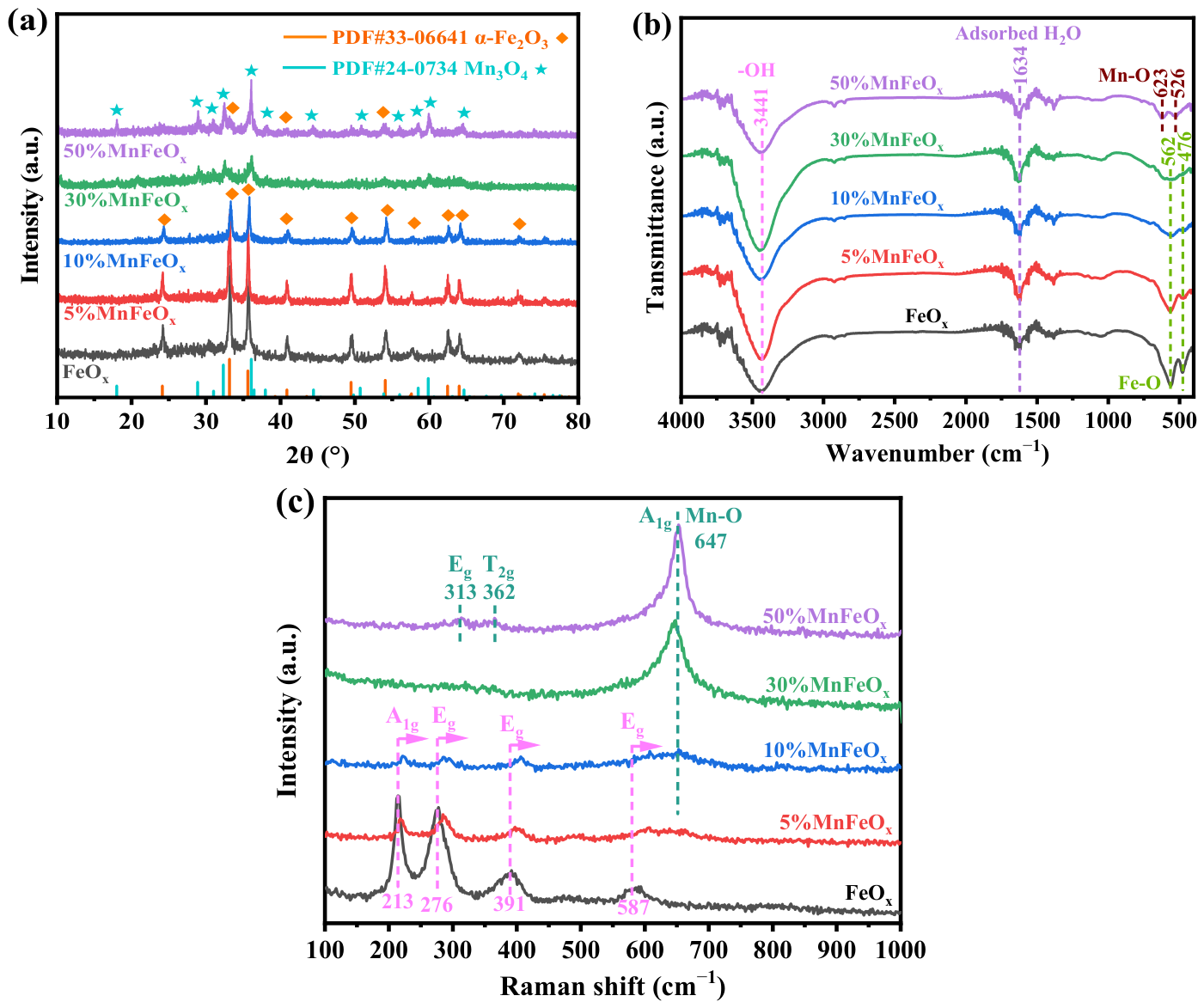
The FeOx and corresponding MnFeOx samples with different Mn contents were synthesized by the MOF templating method, using MIL-100(Fe) as the precursor at 350 °C. Figure 1a presents the X-ray diffraction (XRD) patterns of the as-prepared catalysts. The FeOx displays 10 diffraction peaks at 2θ = 24.1°, 33.2°, 35.6°, 40.9°, 49.5°, 54.1°, 57.6°, 62.5°, 64.0° and 72.3°, which were indexed to the (012), (104), (110), (113), (024), (116), (018), (214), (300) and (119) planes of planes of rhombohedral hematite α-Fe2O3 (PDF#33-0664), respectively [19]. This result suggests that the MOF structure of MIL-100(Fe) was converted to Fe2O3 after calcination at 350 °C. After the introduction of Mn, the characteristic peaks of α-Fe2O3 are still clearly observed for 5%MnFeOx and 10%MnFeOx, and no distinct additional diffraction peaks attributable exclusively to crystalline manganese oxides were detected. This observation suggests that low-load Mn species do not markedly alter the crystalline structure of FeOx. However, as the contents of Mn increased, the intensity of FeOx diffraction peaks decreased, and the peak width was broadened. When the contents of Mn increased to 30%, the diffraction peaks of α-Fe2O3 disappeared. Meanwhile, some weak and new diffraction peaks at 2θ = 18.0°, 28.9°, 31.0°, 32.5°, 36.0°, 38.0°, 44.4°, 50.7°, 56.1°, 58.5°,59.9°, and 64.5°, corresponding to Mn3O4 (PDF#24-0734), appeared [20]. Furthermore, as the content of Mn improved to 50%, the diffraction peaks of Mn3O4 were enhanced sharply, suggesting the formation of crystalline Mn3O4. Notably, compared with the sharp diffraction peaks observed for 5%MnFeOx, 10%MnFeOx, and 50%MnFeOx, the weakest diffraction peaks were observed in 30%MnFeOx. Generally, the width of the diffraction peaks is related to the reduction in the coherent crystal domain size, the increase in the lattice micro-strain, or the enhancement of structural disorder [21]. Meanwhile, the crystallite size of α-Fe2O3 and Mn3O4 on the (104) and (211) crystal faces, respectively, was calculated. As shown in Table 1, the introduction of Mn caused a decrease in the α-Fe2O3 crystal size, suggesting that Mn incorporation inhibits the growth of hematite crystallites and increases structural disorder. With a further increase in Mn to 30% and 50%, the diffraction peaks of α-Fe2O3 disappeared, the diffraction peaks of Mn3O4 appeared, and the crystal size was increased from 8.9 nm to 13.2 nm. This indicated that the increase in Mn content may inhibit the growth of iron oxide grains and the formation of long-range ordered structures, and promote the formation of smaller-sized or less-crystalline oxide structures [22]. These results suggest that the introduction of an appropriate amount of Mn may inhibit the ordered growth of α-Fe2O3 grains and increase micro-strain, lattice defects, or interface disorder.
Figure 1b shows the Fourier transform infrared (FT-IR) spectra of the MIL-Fe(100)-derived FeOx and corresponding MnFeOx samples. As displayed in Figure 1b, the vibration bands at 3441 and 1634 cm−1 are assigned to the stretching vibrations of structural hydroxyl groups and O-H surface-adsorbed H2O, and the bending vibration of the H-O-H in H2O molecules, suggesting the presence of hydroxyl groups and absorbed H2O in the catalyst surface [23,24]. The vibration bands at 700−400 cm−1 are attributed to the vibration of metal–oxygen. For FeOx, the bands at 562 and 476 cm−1 are assigned to the Fe-O bond [25]. After the introduction of Mn, the vibration of Fe-O weakens and widens. Meanwhile, with the increase in Mn content, the Fe-O vibration gradually weakens and disappears with the appearance of Mn-O bond vibration in the tetrahedral and octahedral coordination environments of Mn3O4 at 623 and 526 cm−1, respectively [26]. When the content of Mn increased to 50%, the distinct Mn-O vibrations were observed in 50%MnFeOx, indicating the formation of Mn3O4, which is consistent with the XRD results.
The structure of the as-prepared samples was further investigated via Raman spectra. As illustrated in Figure 1c, four peaks at 213, 276, 391, and 587 cm−1, assigned to A1g and Eg vibration modes of α-Fe2O3, are observed in FeOx [27,28]. After the introduction of Mn, the Raman peaks of FeOx shift to higher wavenumbers. Studies have shown that Mn doping can introduce local lattice disorder, FeO6 octahedral distortion, and controllable compressive strain in α-Fe2O3 [29,30]. Therefore, the blue shift of the Raman peaks of α-Fe2O3 might be related to the local lattice strain induced by Mn. As the content of Mn increased to 30%, the Raman peaks corresponding to α-Fe2O3 disappeared, and new Raman peaks appeared at 313, 362, and 647 cm−1. When the Mn content was further increased to 50%, the intensity of these Raman peaks was greatly enhanced. The strong peak at approximately 647 cm−1 can be attributed to the A1g mode of the Mn-O symmetric stretching vibration in spinel Mn3O4, while the other two peaks at 313 and 362 cm−1 are related to the Eg and T2g vibration modes of Mn3O4, respectively [31,32]. This further confirmed the formation of a Mn3O4 crystal via high Mn introduction, which is in line with the XRD results. Based on the above XRD, FT-IR, and Raman results, it could be concluded that at low Mn content, Mn mainly causes local lattice distortion of α-Fe2O3 and changes in the Fe-O vibration environment. However, at higher Mn content, an independent Mn3O4 crystal phase appears.

2.1.2. Pore Properties

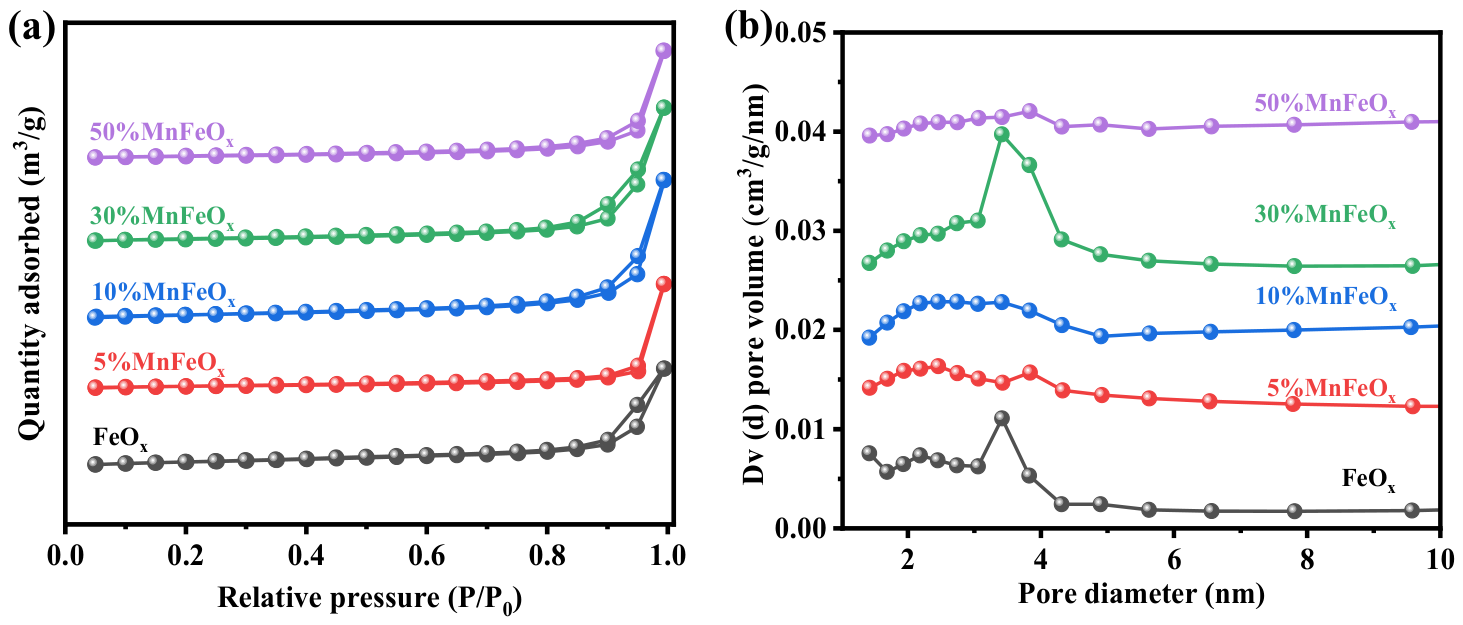
The physical parameters and pore structure of the as-prepared samples were investigated via physical adsorption. Figure 2a,b show the N2 adsorption–desorption curves and pore size distribution of the catalysts, respectively. As shown in Figure 2a, the adsorption amounts of all the curves change relatively slowly in the low and medium relative pressure regions, but increase significantly after (P/P0 > 0.8), and exhibit adsorption–desorption lag in the high relative pressure region. This indicates that the pore structure in the sample is mainly related to the irregular inter-particle mesopores formed by particle aggregation and the capillary condensation in the larger pores. Based on this feature, these adsorption–desorption isotherms can be assigned to type IV curves with an H3 hysteresis loop, suggesting the presence of mesopores in the samples [33,34]. Meanwhile, the pore size distribution of each sample in the range of 2.0–4.9 nm also indicates that the material is mainly composed of small mesopores (Figure 2b).
The specific surface area, total pore volume, and pore size of the prepared samples are summarized in Table 1. Compared with FeOx (49.2 m2/g, 0.271 cm3/g, 2.0−4.2 nm), the introduction of Mn induced a decrease in specific surface area in these MnFeOx samples, while the total pore volumes and pore diameters increased. This might be ascribed to the fact that Mn altered the nucleation and aggregation patterns of Fe2O3 particles, inducing the formation of a more open and interconnected mesoporous network between particles. Among these MnFeOx catalysts, 30%MnFeOx presents the largest surface area (40.2 m2/g), total pore volume (0.361 cm3/g), and large pore diameter (3.0−4.9 nm), which will be beneficial for the adsorption of toluene molecules [35].

2.2. Morphology and Texture

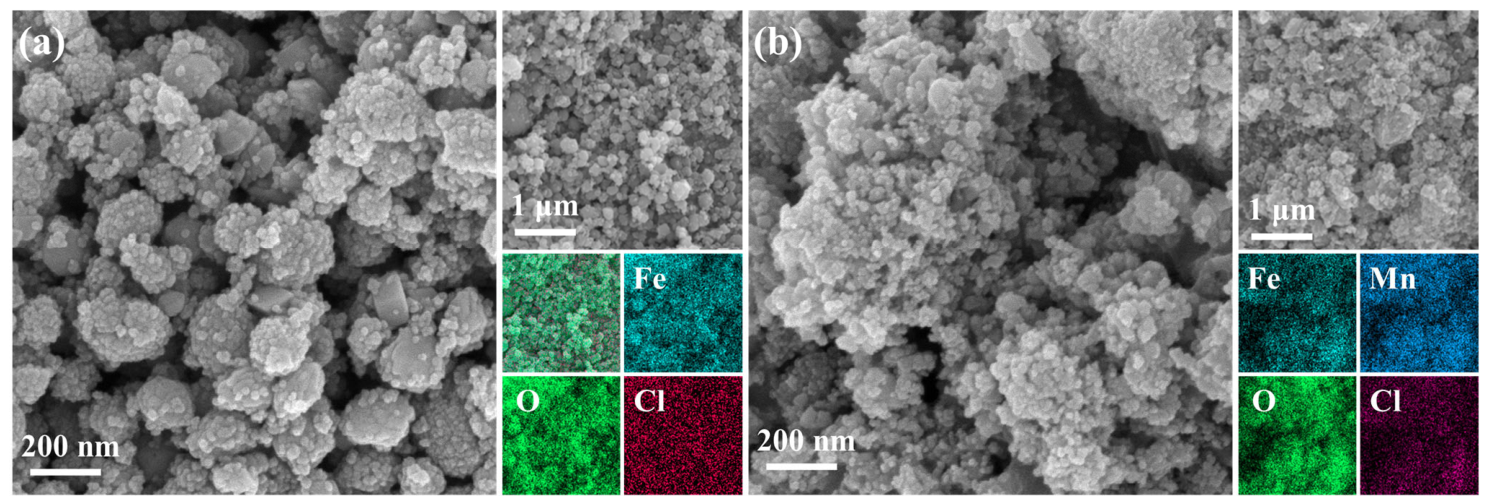
The morphology of the FeOx and 30%MnFeOx was investigated by scanning electron microscopy (SEM). Figure 3 presents the SEM images and corresponding element mapping of FeOx and 30%MnFeOx. As shown in Figure 3a, FeOx is formed by the aggregation of primary particles with a size of several tens of nanometers, resulting in an irregular aggregate. The particle surfaces are relatively rough and retain a certain number of inter-particle pores. Some particles exhibit relatively clear particle boundaries, indicating that FeOx has a typical nanoparticle assembly structure. Meanwhile, the element mapping suggests that Fe and O are evenly dispersed in FeOx. Notably, Cl is also present in the catalyst, which might originate from the metal precursor during the synthesis of MIL-100(Fe). After the introduction of Mn, 30%MnFeOx (Figure 3b) still retains its irregular agglomerated appearance composed of fine particles. Compared with FeOx, the primary particle boundaries in 30%MnFeOx are relatively blurred, the inter-particle contacts are more compact, and larger secondary aggregates are formed. The local open voids have decreased. This indicates that the introduction of higher Mn content has changed the nucleation, growth, and accumulation behavior of the oxide particles. Meanwhile, Fe, Mn, O, and Cl are evenly dispersed.
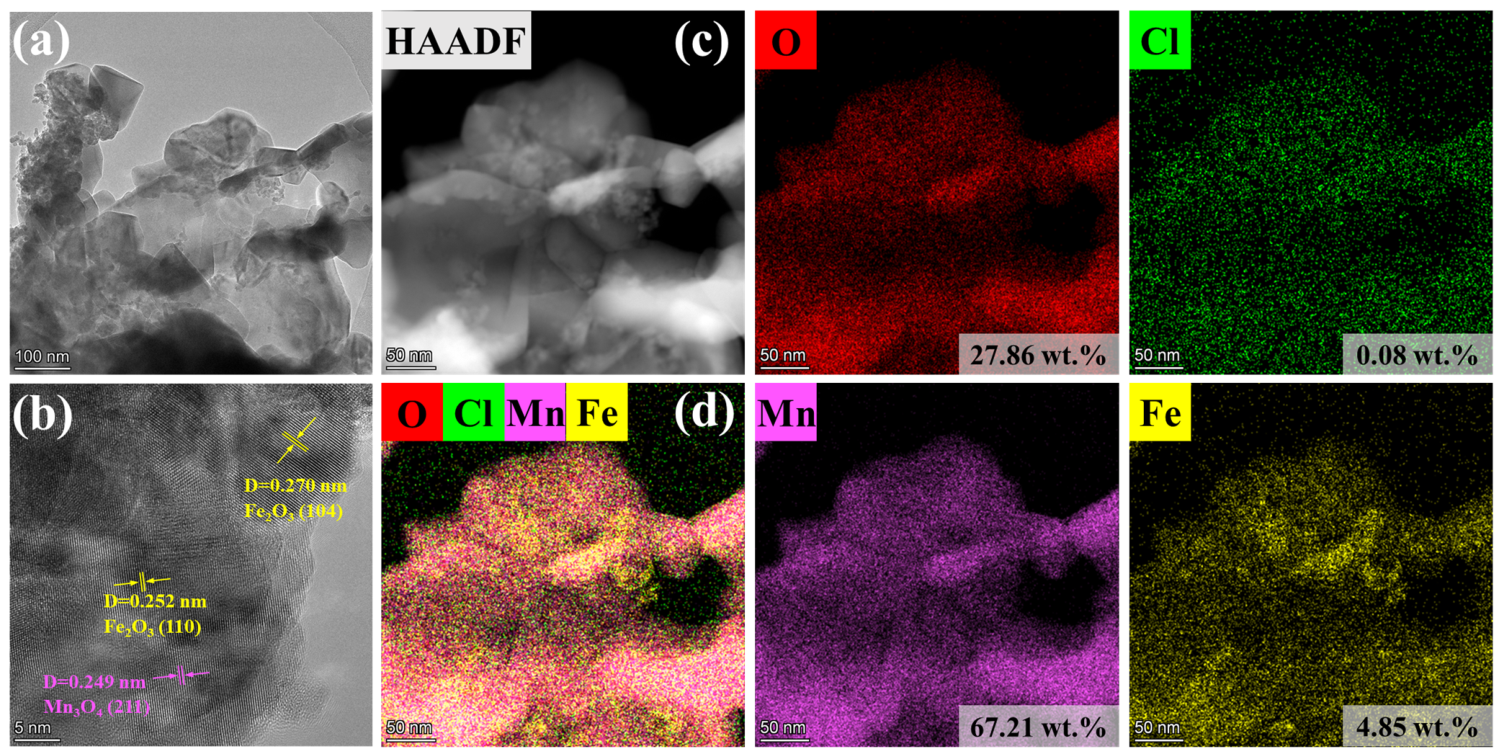
Furthermore, the texture structure of 30%MnFeOx was studied by transmission electron microscopy (TEM). Figure 4 shows the TEM, high-resolution TEM (HRTEM), high-angle annular dark-field imaging-scanning transmission electron microscopy (HAADF-STEM) images, and corresponding element mapping of 30%MnFeOx. As shown in Figure 4a, 30%MnFeOx is mainly composed of irregularly shaped block-like or sheet-like nano-units, with their lateral dimensions ranging from several tens to several hundred nanometers. Different particles interlock and pile up with each other, forming distinct agglomerates, while there are still certain gaps and open spaces between the particles. This is consistent with the SEM result. As shown in Figure 4b, multiple sets of distinct and oriented crystal patterns can be observed in the HRTEM image. The crystal plane spacings of 0.270 nm and 0.252 nm can respectively be attributed to the (104) and (110) crystal planes of α-Fe2O3 [36,37]. The crystal plane spacing of 0.249 nm matches the (211) crystal plane of spinel Mn3O4 [14]. The simultaneous appearance of α-Fe2O3 and Mn3O4 lattice stripes in the same area directly proves the coexistence of the two crystal phases in 30% MnFeOx, which is consistent with the XRD and Raman results. The HAADF-STEM image (Figure 4c) and corresponding element mapping (Figure 4d) suggest that Fe, Mn, O, and Cl are evenly dispersed in the catalyst. The mass fractions of O, Cl, Mn, and Fe are 27.86%, 0.08%, 67.21%, and 4.85%, respectively.

2.3. Surface Chemical and Optical Properties

2.3.1. Surface Chemical Properties

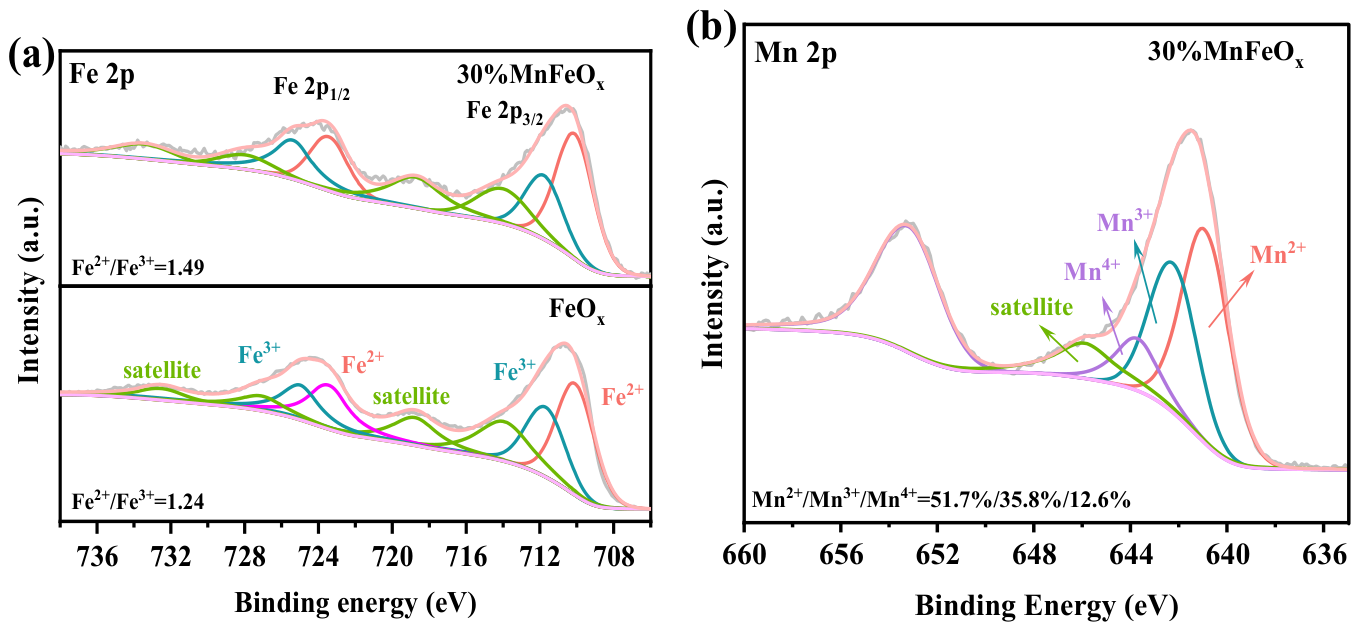
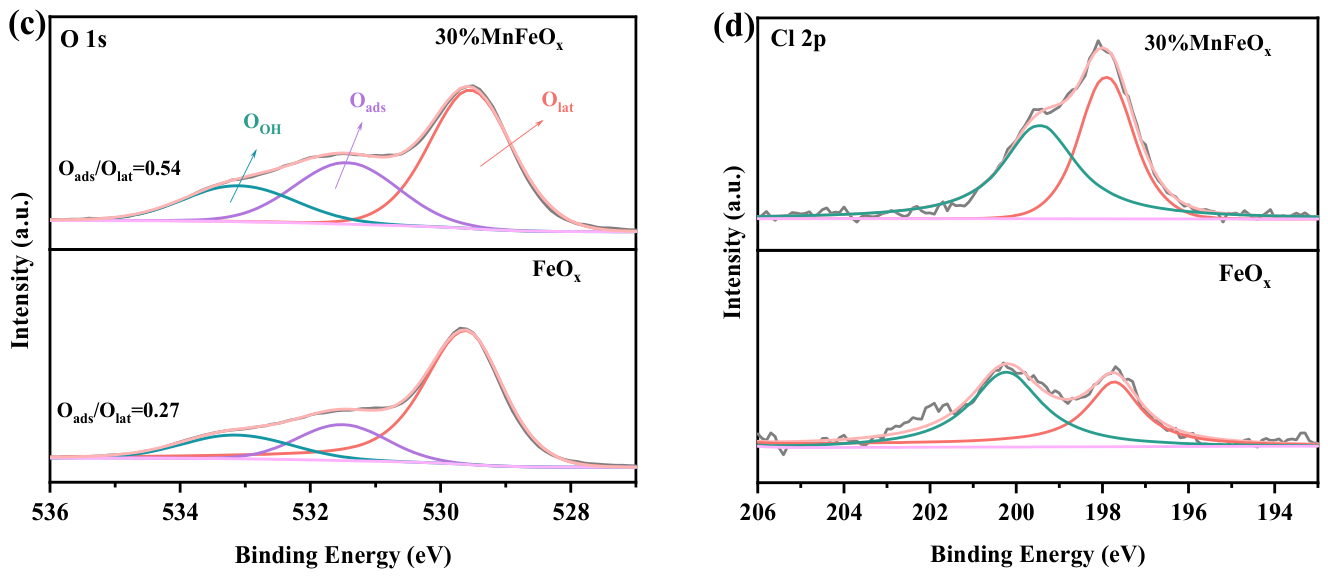
The surface chemical composition of FeOx and 30%MnFeOx was studied by X-ray photoelectron spectroscopy (XPS). Figure 5a displays the XPS spectra of the Fe 2p orbit for FeOx and 30%MnFeOx. The Fe 2p orbits were detected as two peaks at 710.4 and 723.7 eV, corresponding to Fe 2p3/2 and Fe 2p1/2 orbits, respectively [38,39]. The Fe 2p3/2 was divided into four peaks at 710.3, 711.8, 714.0 and 718.8 eV, which corresponded to Fe2+, Fe3+ and their satellite peaks, respectively [40]. Similarly, the Fe 2p1/2 orbit was also split into Fe2+ (723.5 eV), Fe3+ (725.1 eV) and the satellite peaks of Fe2+ (727.1 eV) and Fe3+ (732.4 eV) [41]. Meanwhile, the surface molar ratio of Fe2+/Fe3+ was calculated according to the peak area. The Fe2+/Fe3+ ratios in FeOx and 30%MnFeOx were calculated to be 1.24 and 1.49, respectively. This result suggests that the introduction of Mn promotes the reduction of Fe species to lower oxidation states, enriching the surface of 30%MnFeOx with more Fe2+. Figure 5b shows the Mn 2p orbit of 30%MnFeOx, in which two peaks at 641.4 and 653.4 eV are attributed to the Mn 2p3/2 and Mn 2p1/2 orbits, respectively [42]. The Mn 2p3/2 was deconvoluted into four peaks, Mn2+, Mn3+, Mn4+, and the satellite peak, located at 641.0, 642.3, 643.8, and 646.0 eV, respectively [43,44], suggesting the presence of multiple valence states of Mn in the catalyst surface. Meanwhile, the coexistence of Mn2+/Mn3+/Mn4+ is conducive to the formation of reversible multi-valent redox cycles, which is beneficial for the oxidation reaction [45].
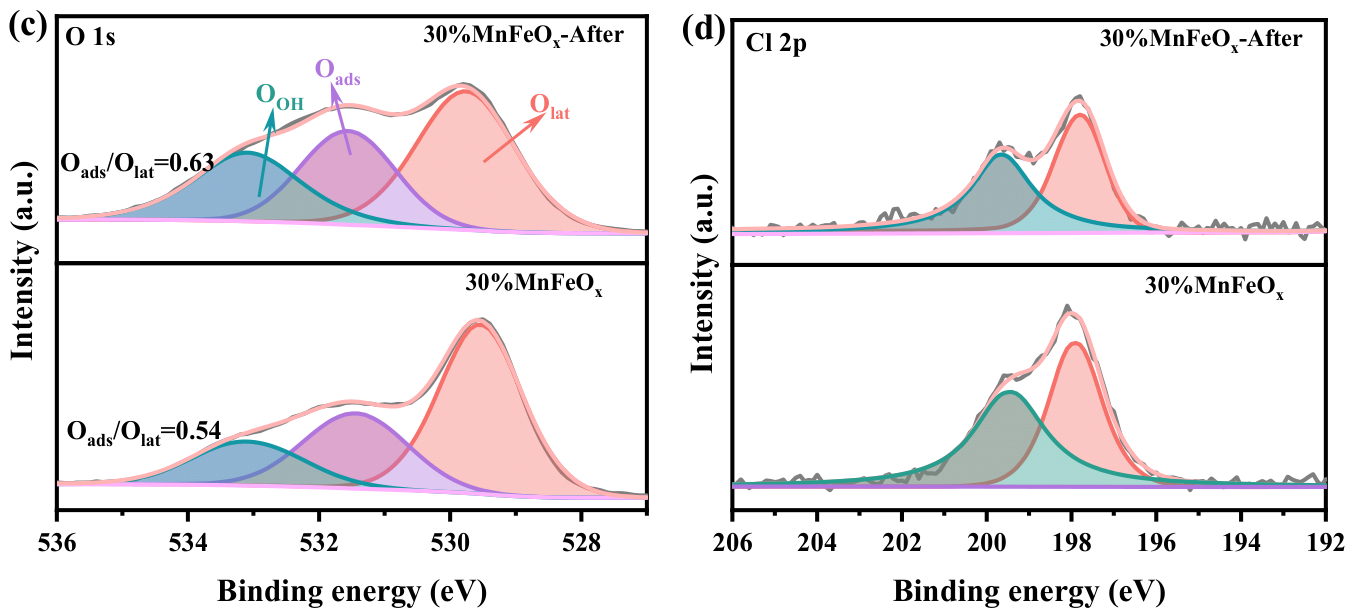
The O 1s spectra (Figure 5c) were divided into three peaks. The lattice oxygen (Olat) species can be found at 529.5 eV [46]. Two other peaks at 531.5 and 533.2 eV are assigned to surface adsorbed oxygen (Oads) species and adsorbed surface hydroxyl (OOH), respectively [47,48,49]. Similarly, the molar ratio of Oads/Olat was also calculated according to the peak area. The values of Oads/Olat for FeOx and 30%MnFeOx are 0.27 and 0.54, respectively. Compared with FeOx, the introduction of Mn induced a great increase in the content of Oads species. Generally, the surface Oads species has higher mobility and reactivity compared to the Olat species, which is conducive to the adsorption and activation of reactants and the interface oxidation-reduction process [50]. Meanwhile, the surface Oads originates from the oxygen species generated by the adsorption and activation of gaseous oxygen species at oxygen vacancies. Therefore, the content of Oads is directly proportional to the content of oxygen vacancies. Specifically, the introduction of Mn induced the formation of more oxygen vacancies in 30%MnFeOx. As presented in Figure 5d, the Cl 2p XPS spectra of FeOx and 30%MnFeOx were divided into Cl 2p3/2 and Cl 2p1/2, located at 197.7 and 200.2 eV, respectively, which corresponded to the Cl or metal-chloride-type surface species [51]. These Cl species may originate from the minor residues of chlorine-containing precursors during the preparation and heat treatment process, or from surface chemical adsorption. According to the above, it can be concluded that the introduction of Mn significantly alters the surface electronic structure of FeOx, resulting in an increase in the Fe2+/Fe3+ ratio from 1.24 to 1.49, and an increase in the Oads/Olat ratio from 0.27 to 0.54. Additionally, a mixed valence state surface composed of Mn2+, Mn3+, and Mn4+ was formed, and the content of oxygen vacancies also improved, which would enhance the catalytic activity of the catalysts.

2.3.2. Optical Properties

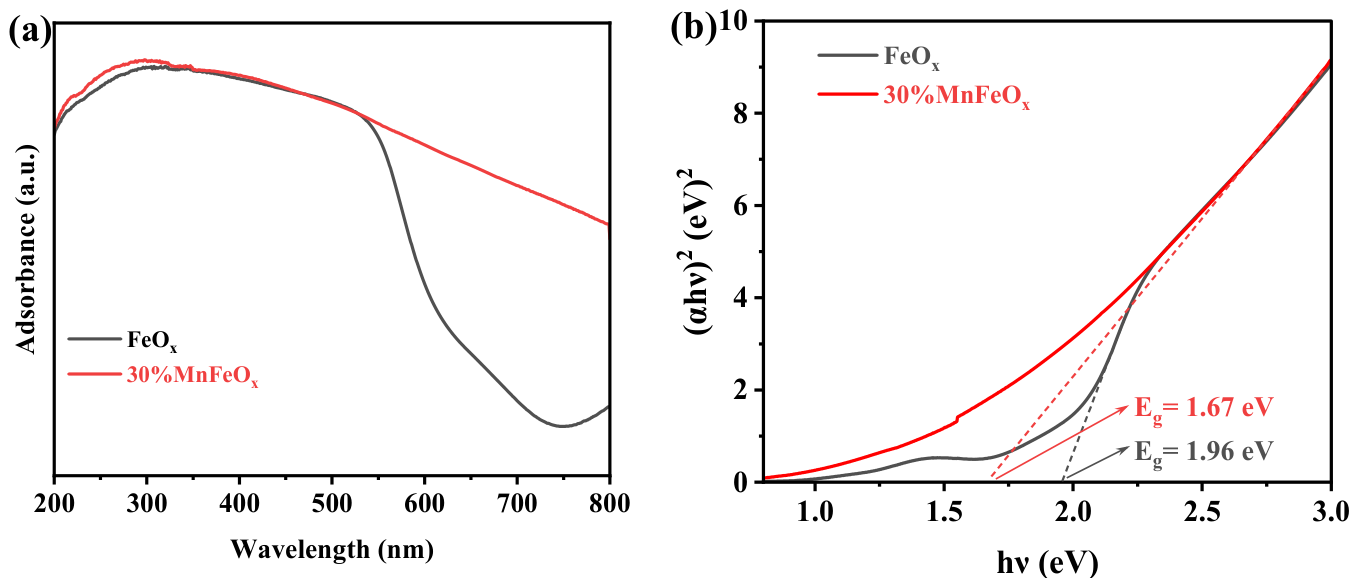
Figure 6 presents the UV-vis diffuse-reflectance spectra (DRS) and corresponding Tauc’s band-gap plots (b) of FeOx and 30%MnFeOx. As shown in Figure 6a, FeOx exhibits strong absorption in the ultraviolet region and a broadened absorption band at approximately 300 nm. As the wavelength increases, its absorbance gradually decreases, and a significant absorption attenuation occurs after approximately 550 nm. This absorption feature is mainly related to the charge transfer from O 2p to Fe 3d in α-Fe2O3 and the Fe3+ crystal field transition [52]. For 30%MnFeOx, the absorption characteristics of 30%MnFeOx in the ultraviolet region are similar to those of FeOx in general, but it maintains a higher absorption intensity in the range of approximately 500–800 nm, indicating that the introduction of Mn has shifted the absorption edge of the material towards the long-wavelength direction and significantly broadened its spectral response range in the visible light and even near-infrared regions. Furthermore, the bandgap energies (Eg) of FeOx and 30%MnFeOx were calculated via the Kubelka–Munk method. As illustrated in Figure 6b, the apparent direct optical band gaps of FeOx and 30%MnFeOx are 1.96 eV and 1.67 eV, respectively. The decrease in the band gap in 30%MnFeOx suggests that the introduction of Mn effectively broadened the visible light response range of the material, which might improve the absorption of low-energy photons and the electron transition, promoting the photothermal oxidation reaction [53].

2.4. Catalytic Performance for Photothermal Toluene Oxidation

2.4.1. Photothermal Catalytic Performance

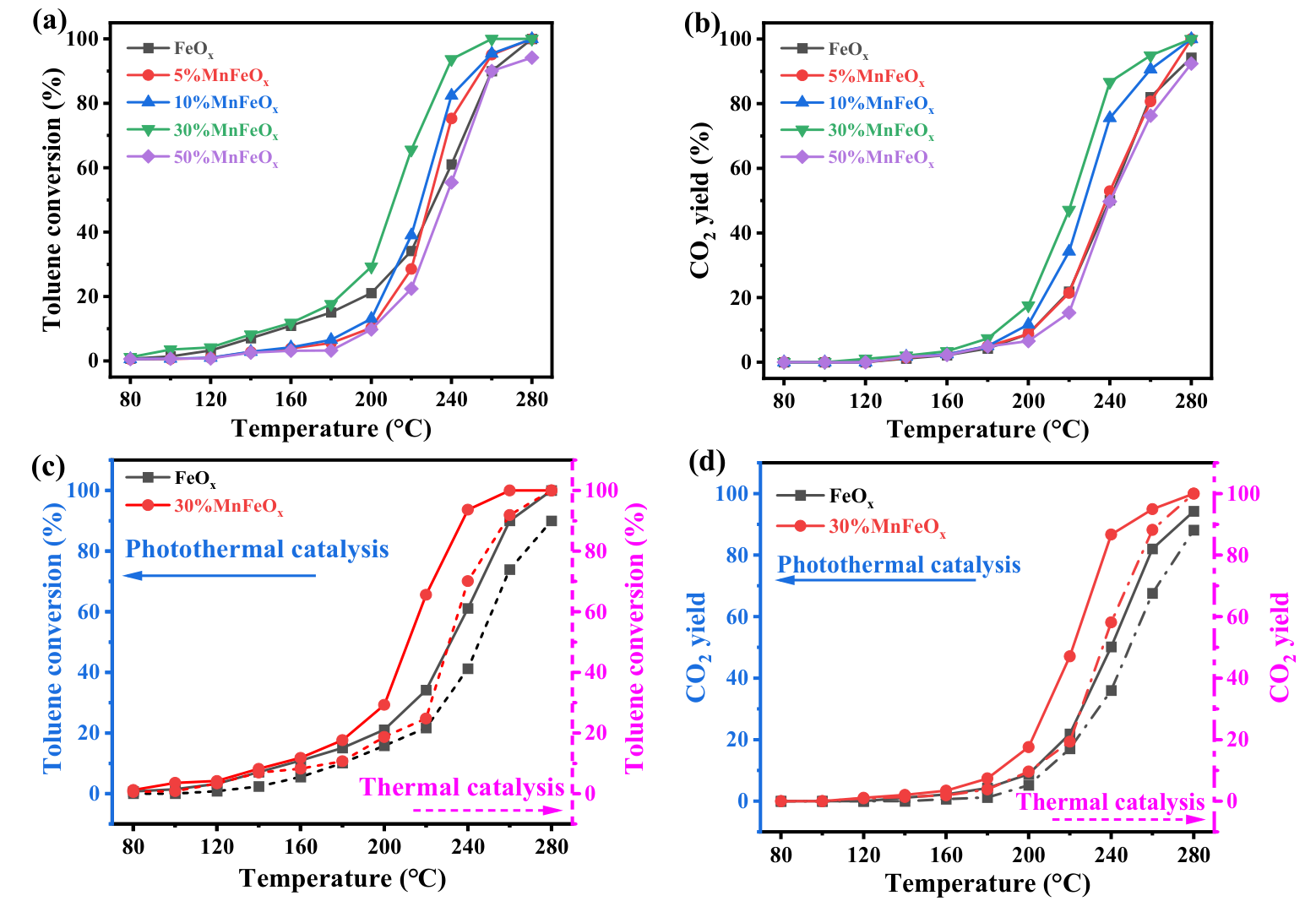
The catalytic activity of the as-prepared catalysts was estimated by the photothermal catalytic degradation using toluene as the model molecule. Figure 7a shows the toluene conversion of FeOx and different Mn-content MnFeOx catalysts under photothermal conditions. All samples exhibited typical S-shaped ignition curves: the toluene conversion was generally low within the range of 80–180 °C, and the reaction gradually accelerated after heating to 200 °C and then rapidly increased in the range of 220–260 °C. Among the different samples, the ignition curve of 30%MnFeOx shifted significantly towards lower temperatures, demonstrating the best low-temperature photothermal catalytic activity. Meanwhile, the temperatures at which toluene conversion reached 10%, 50% and 90% (T10, T50 and T90) are calculated in Table 2. As listed in Table 2, 30%MnFeOx shows the lowest T50 and T90 values of 211 and 237 °C, respectively, followed by 10%MnFeOx (225 and 251 °C), 5%MnFeOx (229 and 255 °C), FeOx (232 and 260 °C), and 50%MnFeOx (236 and 260 °C), suggesting its optimal photothermal activity for toluene degradation. Figure 7b presents the corresponding CO2 yield over these catalysts for toluene photothermal oxidation. The tendency of the CO2 yield is similar to that of toluene conversion. However, at the same temperatures, the CO2 yield was lower than that of toluene conversion, indicating the formation of intermediates during toluene oxidation. Additionally, the 30%MnFeOx catalyst is compared with other Mn-Fe-based or other catalysts for toluene oxidation in Table 3. Compared with the reported catalysts in the literature [12,54,55,56,57,58,59] for toluene oxidation, the prepared 30%MnFeOx catalyst also possesses better catalytic performance at lower light intensity.
Generally, the catalytic performance of a catalyst is closely related to its physicochemical properties. Firstly, the excellent photothermal catalytic performance of 30%MnFeOx is attributed to its enhanced light-capture ability. The UV-vis DRS results show that after the introduction of Mn, the material’s absorption in the 500–800 nm range significantly increases. The surface photonic band gap decreases from 1.96 eV of FeOx to 1.67 eV, enabling 30%MnFeOx to absorb more visible light and a portion of near-infrared light. The absorbed light energy can be converted into lattice heat through non-radiative carrier relaxation, thereby increasing the local temperature on the catalyst surface and accelerating the toluene oxidation reaction [12]. Secondly, the XPS results show that after the introduction of Mn, the ratio of Fe2+/Fe3+ increased from 1.24 to 1.49. Meanwhile, on the 30%MnFeOx surface, there are mixed valence states of Mn2+, Mn3+, and Mn4+. These reversible redox pairs are conducive to the formation of interface electron circulation and the rapid conversion of Fe2+/Fe3+ and Mn2+/Mn3+/Mn4+, promoting the adsorption, dissociation, and electron transfer of oxygen molecules, thereby increasing the generation and replenishment rate of surface-active oxygen [57,58]. Meanwhile, the O 1s XPS results further indicate that the Oads/Olat ratio of 30%MnFeOx increased from 0.27 of FeOx to 0.54, suggesting that its surface has more chemically adsorbed or defect-related oxygen species. During the complete oxidation of toluene, toluene can first adsorb at the metal–oxygen sites and be gradually oxidized by surface-adsorbed oxygen or active lattice oxygen; after the oxygen is consumed, the defect sites are replenished by gaseous O2, thus completing the Mars–van Krevelen-type oxidation cycle. Therefore, the higher Oads/Olat ratio and mixed valence metal centers collectively enhance the generation, migration, and cycling ability of reactive oxygen species, thereby promoting the aromatic ring cleavage and deep mineralization of toluene and its oxygen-containing intermediates. According to the above, 30%MnFeOx exhibited the lowest toluene ignition temperature, the highest conversion rate of toluene at medium and low temperatures, and the highest CO2 yield in catalysts with different Mn contents. Its excellent performance can be attributed to the following synergistic effects: (1) enhanced visible–near-infrared absorption improves the photothermal conversion ability; (2) the mixed valence states of Fe and Mn accelerate the redox cycle; and (3) more abundant surface-adsorbed oxygen and defect sites enhance the activation of O2 and the migration of lattice oxygen.
To further investigate the role of light during photothermal catalysis, the catalytic performance of FeOx and 30%MnFeOx for toluene oxidation under photothermal conditions and thermal conditions was compared. Figure 7c and d illustrate toluene conversion and the corresponding CO2 yield for toluene degradation under different conditions, respectively. At the sample temperature, toluene conversion and the CO2 yield of the FeOx and 30%MnFeOx under photothermal conditions were both higher than those under pure thermal conditions, and this promoting effect was most obvious in the ignition range of 200–240 °C. For example, at approximately 220 °C, the photothermal toluene conversion of 30%MnFeOx was about 65%, while under pure thermal conditions it was only about 25%. Meanwhile, the corresponding photothermal CO2 yield was about 47%, which is also significantly higher than the approximately 20% under pure thermal conditions. These results indicate that light may activate oxygen species through photogenerated carriers or interface electrons, thereby generating a light–heat synergy effect.

2.4.2. Reusability, Stability and Water Resistance

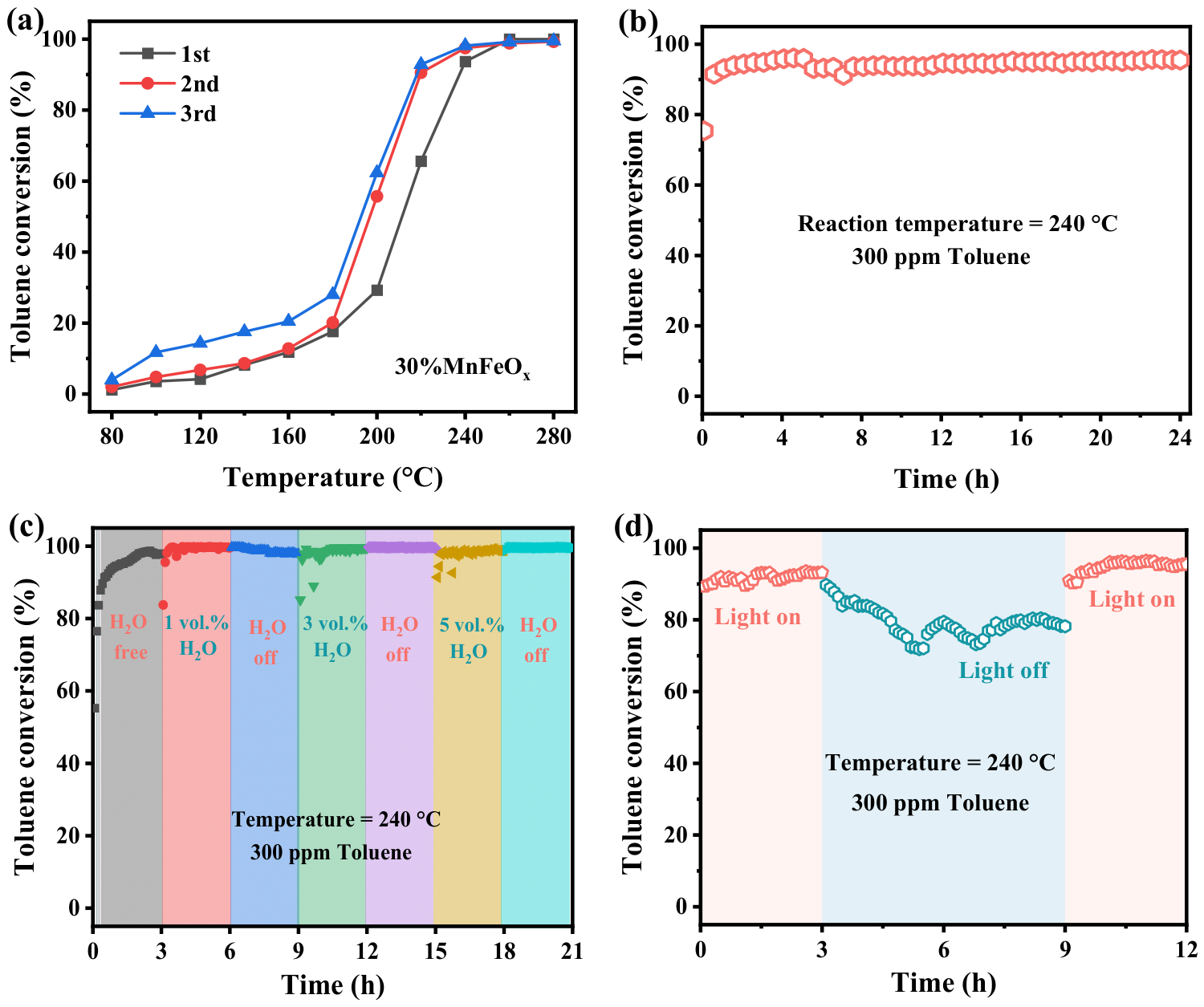
To evaluate the reusability, long-term stability, water resistance, and light response characteristics of 30%MnFeOx in the photothermal catalytic oxidation of toluene, cyclic activity, continuous operation, water vapor switching, and light–dark switching experiments were conducted. The results are shown in Figure 8. As shown in Figure 8a, the three cycles all exhibited typical S-shaped ignition behavior and reached a toluene conversion rate of approximately 95–100% within the range of 240–280 °C, indicating that the catalyst has good reusability in the high conversion range. Notably, after the cycle process, the activity of the catalyst has significantly improved, which suggests that 30%MnFeOx underwent a certain degree of in situ activation during the initial reaction process, rather than being deactivated through cycling. This activation process may be related to the removal of weakly adsorbed water on the surface, the rebalancing of Fe/Mn valence states, the exposure of defect sites, and the redistribution of surface-active oxygen species. Zhang et al. [13] also found that manganese oxide photothermal catalysts can form stable active surfaces during the reaction process through the migration of surface oxygen species and the adjustment of redox states. Meanwhile, 30%MnFeOx exhibited good thermal stability for 24 h.
Figure 8c presents the water resistance of 30%MnFeOx for photothermal toluene oxidation. After introducing 1 vol.% of H2O, the catalytic activity remained basically unchanged, indicating that the low concentration of water vapor had a relatively minor impact on the reaction. When the water vapor concentration was increased to 3 vol.%, the toluene conversion rate experienced a brief drop at the beginning of the switching process, but then gradually recovered to a level close to the initial one. Similarly, under the condition of 5 vol.% water vapor, only slight and brief fluctuations in activity were observed, and the conversion rate after stabilization still remained above approximately 95%. After each interruption of water vapor supply, the toluene conversion rate could quickly recover, indicating that the inhibition caused by water vapor was reversible, rather than causing the destruction of the catalyst crystal phase or the permanent deactivation of the active components. The instantaneous inhibition of water vapor may result from the competitive adsorption of H2O, toluene, and O2 at the metal center, surface hydroxyl sites, and oxygen vacancies. After the adsorption of water or hydroxyl species temporarily occupies the active sites, the adsorption rate of toluene and the activation rate of O2 can be reduced. When the water vapor is removed, or the surface reaches the adsorption equilibrium again, the occupied sites are released, and the catalytic activity is restored accordingly [58]. In short, 30%MnFeOx possesses great water resistance for the photothermal catalytic oxidation of toluene.
Figure 8d shows the catalytic performance of toluene photothermal oxidation over 30%MnFeOx under conditions of the presence and absence of light at 240 °C. During the initial illumination stage, the toluene conversion rate remained at approximately 90–94%. After the light source was turned off, the conversion rate gradually decreased and stabilized at approximately 72–80%, indicating that 30%MnFeOx still has a strong intrinsic thermal catalytic oxidation ability in the dark state, but its activity significantly decreased without the promotion of light. When the light source was turned on again, the toluene conversion rate rapidly recovered to approximately 90%, and then further increased to approximately 95%, and the recovered activity was basically consistent with that in the initial illumination stage. This reversible response rules out the possibility of permanent structural changes caused by short-term light exposure, indicating that light energy has an immediate and recoverable promoting effect on the catalytic reaction. This further confirmed the light–heat synergy effect for toluene degradation over 30%MnFeOx.
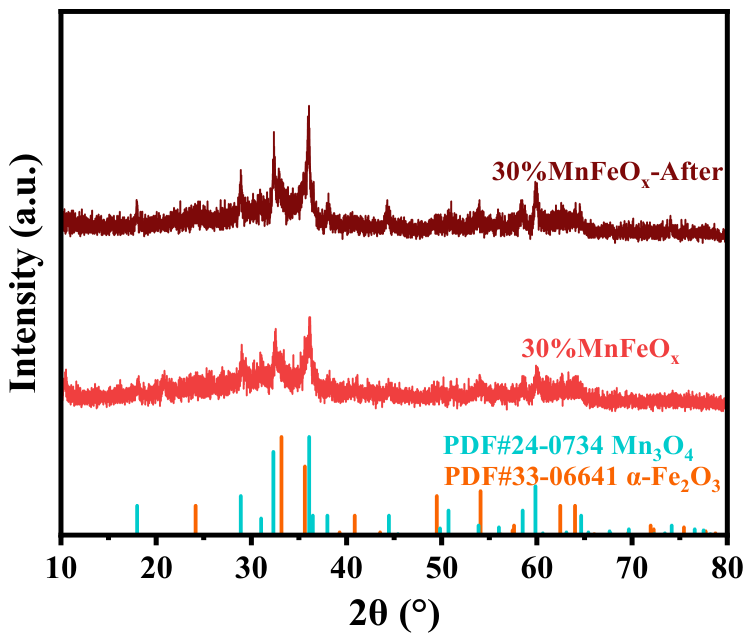
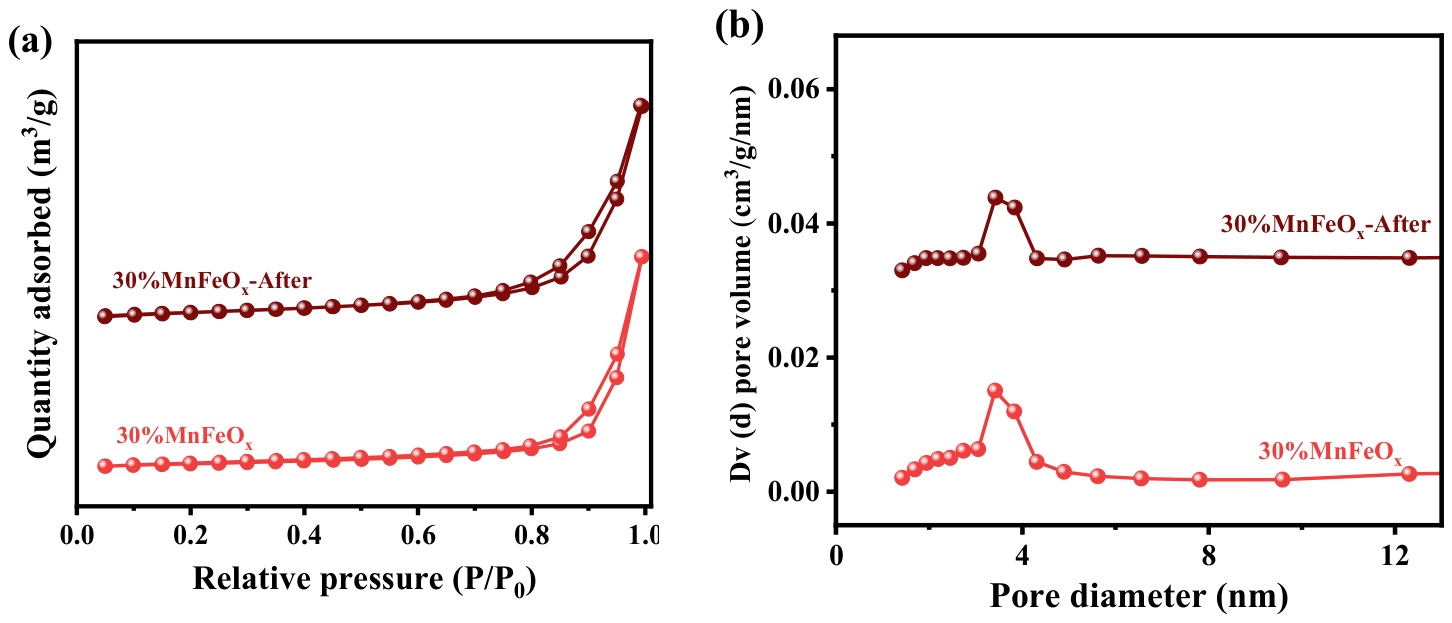
To explore the reasons for the performance improvement after the cycle, XRD, physical adsorption, and XPS were conducted on 30%MnFeOx after the reaction. Figure 9 displays the XRD patterns of 30%MnFeOx before and after toluene photothermal oxidation. As shown in Figure 9, the diffraction peaks of 30%MnFeOx-After are similar with those of 30%MnFeOx, suggesting that the photothermal oxidation of toluene did not change the crystal structure of 30%MnFeOx. The results of N2 adsorption–desorption curves (Figure 10a), pore size distribution (Figure 10b), and corresponding physical parameters (Table 4) suggested that toluene photothermal oxidation did not cause changes in N2 adsorption–desorption curves and the pore structure, which also confirmed the good stability of 30%MnFeOx. Notably, after the reaction, the surface area and pore volume were increased from 40.2 m2/g and 0.361 cm3/g to 53.1 m2/g and 0.372 cm3/g. This increase may be related to the surface reconfiguration induced by the reaction; that is, removing weakly bound surface species or rearranging particle aggregates leads to the opening of the inter-particle pores that were previously difficult to access. Meanwhile, the larger accessible surface area can expose more metal–oxygen centers, oxygen vacancies, and adsorbed oxygen species for the adsorption of toluene and O2, while the slightly increased pore volume may facilitate the diffusion of reactants and oxygen-containing intermediates. This could promote the adsorption of toluene molecules, enhancing toluene degradation [35].
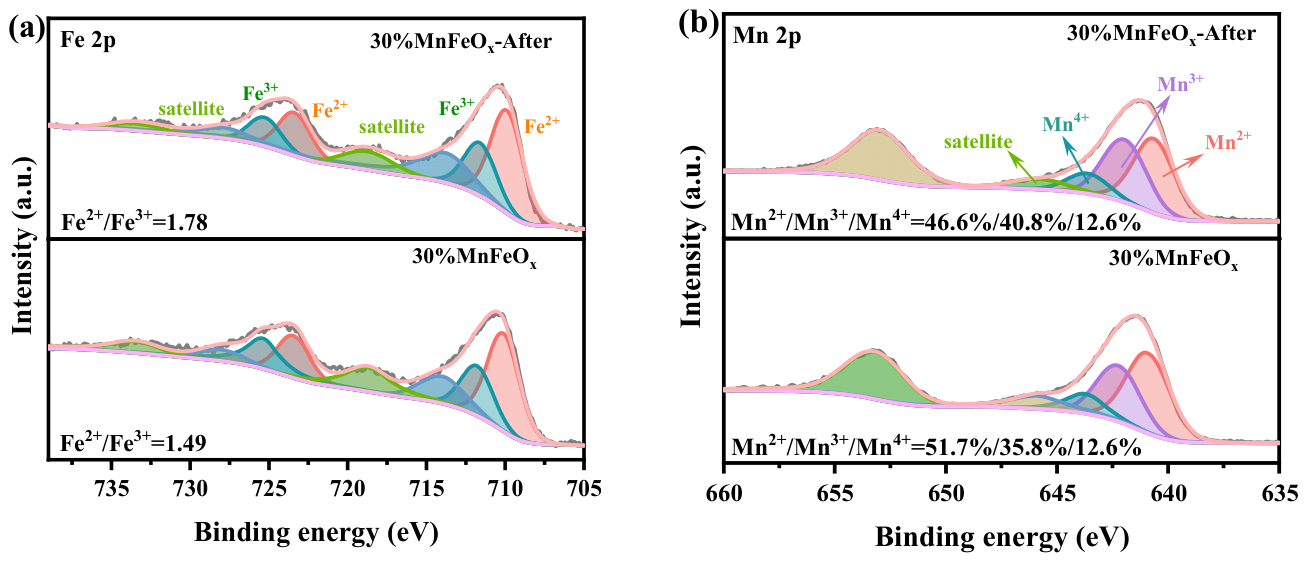
Figure 11 shows the XPS spectra of Fe 2p, Mn 2p, O 1s, and Cl 2p orbits for 30%MnFeOx before and after the reaction. Compared with the fresh 30%MnFeOx (Fe2+/Fe3+ = 1.49, Mn3+: 35.8%, Oads/Olat = 0.54), the content of surface Fe2+/Fe3+, Mn3+, and Oads/Olat in 30%MnFeOx-After is increased to 1.78, 40.8%, and 0.63, respectively. The increase in Fe2+ and Mn3+ species could improve the reversible electron transfer between Fe2+/Fe3+ and Mn2+/Mn3+, enhancing the redox cycle. Additionally, the improved surface Oads/Olat value suggests that more low-coordinated oxygen environments and defect sites capable of adsorbing gaseous O2 may have been formed during the reaction, which could boost the adsorption and activation of gaseous oxygen species and the surface oxygen migration capabilities, promoting toluene oxidation. Therefore, based on the above analysis, the enhanced catalytic performance of 30%MnFeOx after the reaction for toluene degradation might be ascribed to the increase in surface area and surface Fe2+, Mn3+, and Oads species.

2.5. Toluene Degradation Pathway

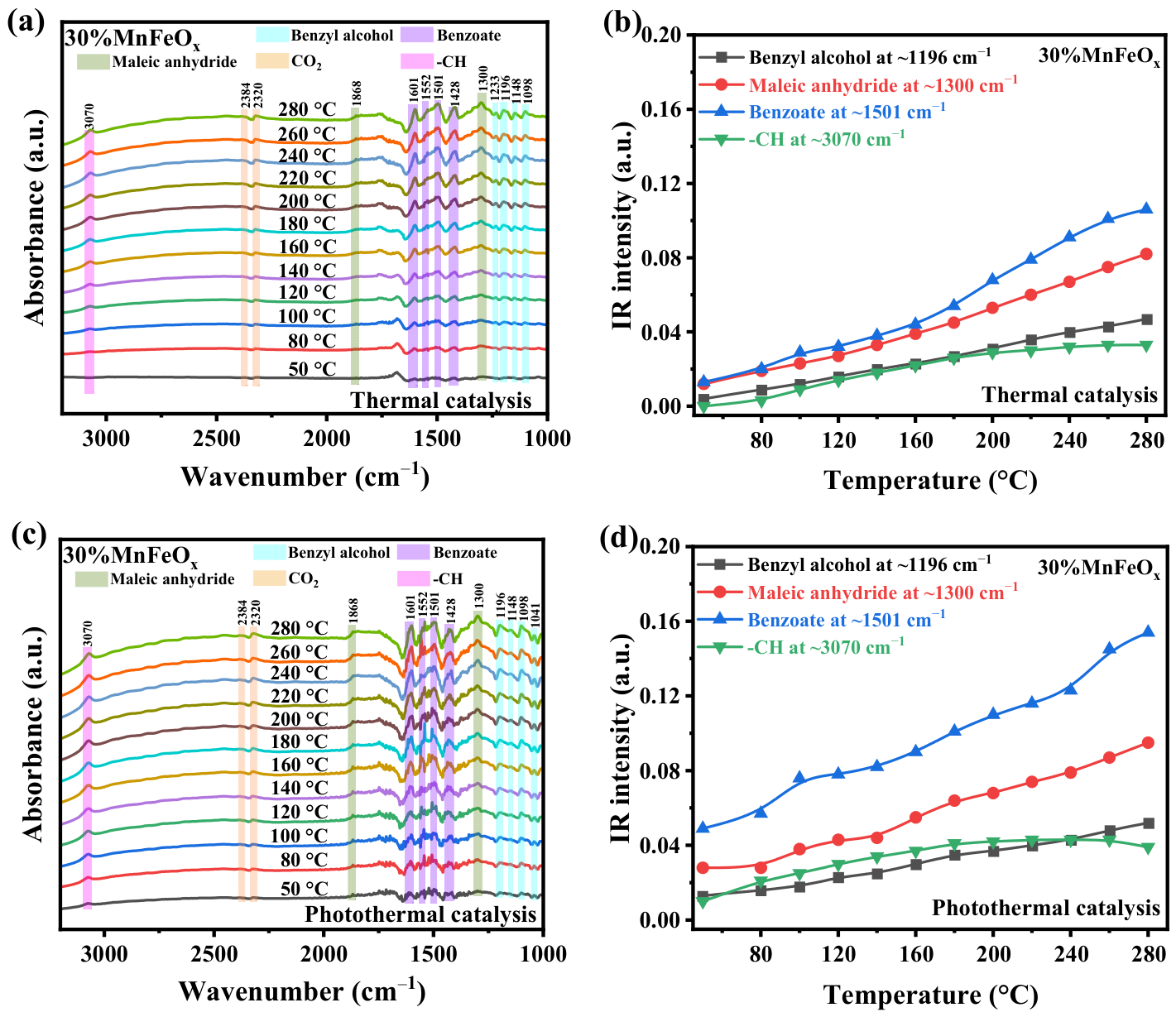
To clarify the surface reaction pathways of toluene oxidation on the 30%MnFeOx catalyst, in situ diffuse reflectance Fourier transform infrared spectroscopy (DRIFTS) tests were conducted at different temperatures under both thermal catalytic and photothermal catalytic conditions. Figure 12a shows the in situ DRIFTS of toluene oxidation under thermal conditions, and the corresponding assignment of the intermediates is summarized in Table 5. As shown in Figure 12a, under thermal catalytic conditions, the absorption peak at ~3070 cm−1 corresponds to the C–H stretching vibration of the aromatic ring [60,61]. The double peaks at 2384 and 2320 cm−1 correspond to the ν3 asymmetric stretching vibration of gaseous or weakly adsorbed CO2 [62,63]. Their intensities gradually increase with the rise in temperature, indicating that toluene and its oxygen-containing intermediates undergo continuous deep oxidation and mineralization [64]. Meanwhile, some new absorption peaks appeared as the temperature increased. The peaks at 1868 and 1300 cm−1 are assigned to the symmetric and asymmetric ν(C=O) stretching of cyclic anhydride, suggesting the formation of maleic anhydride during toluene oxidation [65]. The absorption peaks at 1601, 1552, 1501 and 1428 cm−1 are attributed to the COO asymmetry and symmetry vibration of benzoate [66]. The other absorption bands at 1233, 1196, 1148 and 1098 cm−1 are ascribed to the ν(C–O) stretching vibration of alkoxide species [67]. The appearance of these intermediates indicates that toluene was oxidized.
To better present the changes of the intermediates, the changes in these peaks’ intensity are illustrated in Figure 12b. As the reaction temperature increased from 50 °C to 280 °C, the peak intensities at 1196, 1300 and 1501 cm−1, corresponding to benzyl alcohol, maleic anhydride and benzoate, all continued to increase, among which the signal related to benzoate was always the strongest at 1501 cm−1. This indicates that benzoate is the main intermediate with a relatively high and stable surface coverage of 30%MnFeOx. The large accumulation of benzoate also means that its subsequent decarboxylation or aromatic ring cracking may be an important kinetic step in the complete oxidation of toluene. At the same time, the peak related to anhydride/maleate at 1300 cm−1 strengthened with the increase in temperature, indicating that the temperature rise promoted the further oxidation and aromatic ring cracking of benzoate.
The DRIFTS spectra obtained under photothermal catalysis conditions are shown in Figure 12c. The main peak positions are basically consistent with those under thermal catalysis conditions, indicating that light irradiation did not fundamentally change the main reaction pathway of toluene oxidation. However, at the same temperature, the signals of benzyl alcohol, benzoate, maleic anhydride-related species, and CO2 in the photothermal catalysis process were overall stronger than those in the separate thermal catalysis. As can be seen from Figure 12b,d, at 280 °C, the benzoate signal at 1501 cm−1 under photothermal conditions was approximately 0.155, while it was approximately 0.106 under thermal catalysis. The corresponding 1300 cm−1 signals were approximately 0.095 and 0.082, respectively. This indicates that light irradiation promoted the activation of the methyl C–H bond of toluene and the generation and subsequent transformation of oxygen-containing intermediates. Similar phenomena have been observed in manganese oxide photothermal catalytic systems, where light irradiation can enhance the lattice oxygen activity and oxygen migration ability, thereby promoting the formation of benzoate, aromatic ring cracking, and final mineralization [13,68]. Notably, under photothermal catalytic conditions, the aromatic C–H signal at 3070 cm−1 tends to stabilize in the medium-high temperature range and slightly decreases at high temperatures. Meanwhile, the signals of benzoate, maleic anhydride-related species, and CO2 continue to increase. This indicates that the adsorbed toluene is not simply accumulated but is continuously consumed and transformed into oxygen-containing intermediates under the combined effect of light and heat. Combined with the results of catalytic activity and the CO2 production rate, it can be concluded that light, on one hand, increases the local temperature of the catalyst through photothermal conversion, and on the other hand, may promote the Mn/Fe redox cycle, lattice oxygen migration, and activation of adsorbed oxygen, thereby accelerating the stepwise oxidation and deep mineralization of toluene [58]. Based on the above results, the degradation pathway of toluene over 30%MnFeOx is toluene → benzyl alcohol → benzoate → maleic anhydride → CO2 and H2O.

3. Materials and Methods

3.1. Chemicals and Materials

Ferric chloride hexahydrate (FeCl3·6H2O, ≥99%) and 1,3,5-benzenetricarboxylic acid (H3BTC, ≥98%) were obtained from Aladdin Co., Ltd. (Shanghai, China). Manganese acetate tetrahydrate (Mn(CH3COO)2·4H2O, ≥99%) and toluene (C7H8, 98%) were purchased from Sinopharm Chemical Reagent Co., Ltd. (Shanghai, China).

3.2. Catalyst Preparation

3.2.1. Preparation of MIL-100(Fe) Precursor

MIL-100(Fe) was prepared by a conventional solvothermal method. Generally, 6 mmol of ferric chloride hexahydrate (FeCl3·6H2O) and 4 mmol of 1,3,5-benzenetricarboxylic acid (H3BTC) were dissolved in 30 mL of H2O and stirred for 1 h to obtain the clarified solution. Then, the above solution was transferred to a Teflon-lined stainless-steel autoclave and reacted at 160 °C for 15 h. After cooling to room temperature, the powder of MIL-100(Fe) could be acquired via centrifugation, after washing three times with anhydrous ethanol and drying at 60 °C for 12 h.

3.2.2. Preparation of FeOx and the Different Contents of Mn-Modified MnFeOx

FeOx was synthesized by the sacrificial template method, using MIL-100(Fe) as the precursor. A certain amount of the as-prepared MIL-100(Fe) was placed in a crucible and calcined in a muffle furnace at 350 °C for 2 h with a heating rate of 1 °C/min.
For the synthesis of different contents of Mn-modified MnFeOx, the wet impregnation–calcination method was employed. Firstly, a certain amount of manganese acetate tetrahydrate (Mn(CH3COO)2·4H2O) was dissolved in 40 mL of H2O. Then, 1.0 g of the as-prepared MIL-100(Fe) was dispersed in the above solution and stirred at 80 °C for 6 h. After that, the mixed solution was placed in an oven and dried at 60 °C for 12 h. Finally, the dried powder was calcinated in a muffle furnace at 350 °C for 2 h with a heating rate of 1 °C/min to obtain the MnFeOx sample. The MnFeOx catalysts with the mass percentages of Mn and MIL-100(Fe) of 5%, 10%, 30% and 50% were named 5%MnFeOx, 10%MnFeOx, 30%MnFeOx, and 50%MnFeOx, respectively.

3.3. Catalyst Characterization

The physical and chemical structures of the as-prepared catalysts were characterized by XRD, FT-IR, Raman, N2 adsorption–desorption, SEM, TEM, XPS, and UV-vis DRS. The detailed information is listed as follows.
XRD patterns of the as-prepared catalysts were obtained from a Bruker D8 Advances X-ray diffractometer (Billerica, MA, USA), equipped with Cu-Kα radiation and monochromatic detector in a 2θ range of 5–80°. The emission current and accelerating voltage were 40 mA and 40 kV, respectively. FT-IR and Raman spectra were acquired from a Thermo Fisher Nicolet iS50 infrared spectrometer (Waltham, MA, USA) and a Horiba LabRAM HR Evolution Raman spectrograph (Paris, France), respectively. The resolution ratio and scan times for FT-IR were 4 and 64, respectively. The excitation wavelength for Raman spectra was 532 nm. The N2 adsorption–desorption curves were obtained from a Quantachrome Autosorb iQ2 physical adsorption instrument (Boca Raton, FL, USA). Before the test, the samples were pretreated under vacuum conditions at 300 °C for 6 h. The N2 adsorption–desorption was performed at −196 °C. A Shimadzu UV2600 UV-vis DRS spectrometer (Kyoto, Japan) was employed to obtain the UV-vis DRS spectra. Before the test, the spectrometer was zeroed and calibrated using a BaSO4 mirror.
The SEM and TEM images were obtained from a JEOL JSM-7800F scanning electron microscope (Tokyo, Japan) and FEI Talos F200S transmission electron microscope (Portland, OR, USA), respectively. A Thermo ESCALAB 250Xi X-ray photoelectron spectroscopy microprobe (Waltham, MA, USA) was employed to investigate the surface chemistry of the as-prepared catalysts. C 1s (284.8 eV) was used for the energy calibration.

3.4. Photothermal Catalytic Performance Test

The photothermal catalytic reaction was performed on a fixed-bed reactor, equipped with a xenon lamp (300 W, 330 mW/cm2, full-spectrum irradiation), using toluene as the model molecule. Generally, 100 mg of the catalyst particle with a size of 20–40 mesh was placed in a quartz reactor. The reaction gas contained 300 ppm toluene, and 20 vol.% O2 balanced with Ar was introduced to the reaction system in a total flow rate of 50 mL/min. The concentrations of toluene and CO2 in the inlet and outlet were determined by an online gas chromatography system (GC2026, Ruimin, Shanghai, China) equipped with two flame ionization detectors (FIDs). FID1, equipped with a Ni-based catalyst in the reformer, was used to detect CO2. FID2 was applied to detect VOC molecules. The toluene conversion (Xt) and corresponding CO2 yield (YC) were calculated according to the following Equations (1) and (2):
Xt = (C0 – Ct)/C0 × 100%
YC = CC/7C0 × 100%
where Ct, C0, and CC are the outlet and inlet toluene concentration, and the outlet CO2 concentration, respectively. At each temperature, the toluene and CO2 concentrations were detected three times. The toluene conversion and CO2 yield were calculated based on the average values of the three detected results. The water resistance test was also performed on the fixed-bed reactor. During the water resistance test, 1–5 vol.% water vapor was introduced by a bubbling method. The thermal catalysis was also performed on this reactor without turning on the xenon lamp.

3.5. Intermediates Detection

The toluene degradation intermediates under the thermal and photothermal conditions were determined by in situ DRIFTS spectra, carried out on a Thermo Fisher, Nicolet/iS50 infrared spectrometer (Waltham, MA, USA) equipped with an in situ reaction cell. Typically, 50 mg of the catalyst powder was pretreated at 300 °C for 60 min. After cooling to 30 °C, the gas was switched to 20 vol.% O2 balanced with Ar. Meanwhile, the background was taken. Then, 300 ppm toluene + 20 vol.% O2 balanced with Ar was introduced into the reaction system and pre-adsorbed for 60 min. After that, the temperature was heated to the target temperature and the spectra were collected. During the collection of the spectra, the resolution and scanning times were set at 4 and 32, respectively.

4. Conclusions

In summary, MIL-100(Fe) was used as the sacrificial template, and different Mn contents of MnFeOx catalysts were successfully prepared by the impregnation–calcination method. The Mn content significantly affected the toluene photothermal oxidation performance of the catalysts by regulating the crystal phase structure, pore properties, surface redox state, and optical response. The results of photothermal catalytic performance suggested that the Mn content had a non-monotonic effect on the photothermal catalytic oxidation of toluene. Appropriate addition of Mn can enhance the catalytic performance, while excessive Mn will instead lead to a decrease in activity. Among the various MnFeOx catalysts, the 30%MnFeOx catalyst presents the optimal catalytic performance with the T90 value of 237 °C. Meanwhile, the 30%MnFeOx catalyst possesses good stability and water resistance. Characterization results suggest that the introduction of Mn enhanced the adsorption of light, surface Fe2+ and Oads species, promoting toluene photothermal catalytic oxidation. Additionally, in situ DRIFTS results indicate that toluene mainly undergoes a stepwise oxidation process on the 30%MnFeOx surface, namely toluene → benzyl alcohol → benzoate → maleic anhydride → CO2 and H2O. Among them, benzoate is the main intermediate with a relatively high surface coverage, and its subsequent dehydrogenation and aromatic ring cleavage may be important steps affecting the deep oxidation. Light irradiation does not fundamentally change the main reaction pathway of toluene, but can promote the generation of oxygen-containing intermediates and further conversion, accelerating the aromatic ring cleavage and ultimately mineralization. This study provides a feasible strategy for constructing Mn-Fe-based photothermal catalysts for VOC oxidation using non-precious-metal components, thereby avoiding reliance on noble-metal active components.

Author Contributions

F.B.: writing—original draft, funding acquisition, data curation, formal analysis, and writing—review and editing. R.Q.: data curation, formal analysis, and investigation. J.X.: data curation, methodology, and software. Y.L.: investigation and software. J.W.: conceptualization and resources. Y.Z.: data curation. X.Z.: conceptualization, supervision, project administration, and funding acquisition. All authors have read and agreed to the published version of the manuscript.

Funding

This research was funded by the National Natural Science Foundation of China (No. 22506124), the Shanghai Rising-Star Program (24YF2729800), and the Shanghai Oriental Talent Youth project (QNJY2024173).

Data Availability Statement

The authors declare that all data supporting the findings of this study are available within the article.

Acknowledgments

The authors acknowledge the sponsorship of the Energy Science and Technology discipline under the Shanghai Class IV Peak Disciplinary Development Program.

Conflicts of Interest

The authors declare no conflicts of interest.

References

  1. Liu, R.; Wu, H.; Shi, J.; Xu, X.; Zhao, D.; Ng, Y.H.; Zhang, M.; Liu, S.; Ding, H. Recent progress on catalysts for catalytic oxidation of volatile organic compounds: A review. Catal. Sci. Technol. 2022, 12, 6945–6991. [Google Scholar] [CrossRef] [Scilit]
  2. Chen, J.; Fang, Q.; Yu, H.; Huang, J.; Qu, H.; Bi, F.; Zhang, X. Oxygen vacancy regulation in Cobalt-based catalysts for the degradation of volatile organic compounds: Strategies and mechanisms. J. Colloid Interface Sci. 2026, 709, 139931. [Google Scholar] [CrossRef] [Scilit] [PubMed]
  3. Feng, Y.; Yao, C.; Jiang, J.; Gao, A.; Liu, G.; Chang, Q.; Liu, W.; Dai, Y. Facile Synthesis of (NH4)2[Pd(C2O4)2]·2H2O and Its Application as a New Precursor in the Preparation of Pd-Based Catalysts for VOC Oxidation. Catalysts 2026, 16, 603. [Google Scholar] [CrossRef] [Scilit]
  4. Zhang, H.; Wang, Z.; Lin, H.; Liu, Y.; Dai, H.; Deng, J. Catalytic oxidation of volatile organic compounds over supported noble metal and single atom catalysts: A review. J. Environ. Sci. 2025, 155, 858–888. [Google Scholar] [CrossRef] [Scilit] [PubMed]
  5. Žumbar, T.; Arčon, I.; Djinović, P.; Aquilanti, G.; Žerjav, G.; Pintar, A.; Ristić, A.; Dražić, G.; Volavšek, J.; Mali, G.; et al. Winning Combination of Cu and Fe Oxide Clusters with an Alumina Support for Low-Temperature Catalytic Oxidation of Volatile Organic Compounds. ACS Appl. Mater. Interfaces 2023, 15, 28747–28762. [Google Scholar] [CrossRef] [Scilit] [PubMed]
  6. Lu, T.; Zhang, C.; Du, F.; Zhang, C.; Zhang, R.; Liu, P.; Li, J. Mutual inhibition effects on the synchronous conversion of benzene, toluene, and xylene over MnOx catalysts. J. Colloid Interface Sci. 2023, 641, 791–802. [Google Scholar] [CrossRef] [Scilit] [PubMed]
  7. Ma, X.; Wang, W.; Zhang, X.; Li, H.; Sun, J.; Liu, X.; Sun, C. MOF-derived FeOx with highly dispersed active sites as an efficient catalyst for enchaning catalytic oxidation of VOCs. J. Environ. Chem. Eng. 2024, 12, 111966. [Google Scholar] [CrossRef] [Scilit]
  8. Liu, H.; Yu, H.; Fu, D.; Song, Z.; Wu, W.; Li, D.; Li, H.; He, Y.; Zhang, J.; Zhang, X. Enhanced Catalytic Performance of FeMnOx Catalysts Synthesized via Agar Method for Toluene Oxidation: Synergistic Effects and Degradation Mechanism. Appl. Organomet. Chem. 2025, 39, e70183. [Google Scholar] [CrossRef] [Scilit]
  9. Wang, Y.; Wu, J.; Wang, G.; Yang, D.; Ishihara, T.; Guo, L. Oxygen vacancy engineering in Fe doped akhtenskite-type MnO2 for low-temperature toluene oxidation. Appl. Catal. B Environ. 2021, 285, 119873. [Google Scholar] [CrossRef] [Scilit]
  10. Chen, J.; Chen, X.; Xu, W.; Xu, Z.; Chen, J.; Jia, H.; Chen, J. Hydrolysis driving redox reaction to synthesize Mn-Fe binary oxides as highly active catalysts for the removal of toluene. Chem. Eng. J. 2017, 330, 281–293. [Google Scholar] [CrossRef] [Scilit]
  11. Qiao, R.; Gao, B.; Zhang, M.; Yu, H.; Wei, J.; Huang, J.; Bi, F.; Zhang, X. Acid activation-induced defect-rich δ-MnO2 for enhanced o-xylene photothermal catalytic degradation: Performance, synergistic mechanism and impurity gases tolerance. Sep. Purif. Technol. 2026, 400, 138468. [Google Scholar] [CrossRef] [Scilit]
  12. Nie, L.; Li, S.; Chai, S.; Han, N.; Chen, Y. Photothermal catalytic oxidation of toluene with enhanced efficiency over constructed CuMn2O4/Mn2O3 heterojunction catalyst. Appl. Surf. Sci. 2022, 605, 154567. [Google Scholar] [CrossRef] [Scilit]
  13. Zhang, M.; Li, G.; Li, Q.; Chen, J.; Elimian, E.A.; Jia, H.; He, H. In situ construction of manganese oxide photothermocatalysts for the deep removal of toluene by highly utilizing sunlight energy. Environ. Sci. Technol. 2023, 57, 4286–4297. [Google Scholar] [CrossRef] [Scilit] [PubMed]
  14. Zhao, J.; Li, C.; Yu, Q.; Zhu, Y.; Liu, X.; Li, S.; Liang, C.; Zhang, Y.; Huang, L.; Yang, K.; et al. Interface engineering of Mn3O4/Co3O4 S-scheme heterojunctions to enhance the photothermal catalytic degradation of toluene. J. Hazard. Mater. 2023, 452, 131249. [Google Scholar] [CrossRef] [Scilit] [PubMed]
  15. Wang, H.; Zhao, Q.; Li, D.; Zhang, Z.; Liu, Y.; Guo, X.; Li, X.; Liu, Z.; Wang, L.; Ma, J.; et al. Boosting photothermocatalytic oxidation of toluene over Pt/N-TiO2: The gear effect of light and heat. Environ. Sci. Technol. 2024, 58, 7662–7671. [Google Scholar] [CrossRef] [Scilit] [PubMed]
  16. Che, Y.; Han, Z.; Tian, Y.; Yin, S.; Wang, J.; Lin, L. Catalytic oxidation of methanol over MOF-74-derived Co-Mn oxides. Sep. Purif. Technol. 2026, 410, 139341. [Google Scholar] [CrossRef] [Scilit]
  17. Gao, B.; Bi, F.; Zhou, Z.; Zhang, Y.; Wei, J.; Lv, X.; Liu, B.; Huang, Y.; Zhang, X. A bimetallic MOF-derived MnCo spinel oxide catalyst to enhance toluene catalytic degradation. Chem. Commun. 2024, 60, 7455–7458. [Google Scholar] [CrossRef] [Scilit] [PubMed]
  18. Zeng, Y.; Zhong, J.; Feng, F.; Ye, D.; Hu, Y. Synergistic photothermal catalytic oxidation of methanol and toluene mixture over Co-MOFs-derived catalyst: Interfacial and promotion effects. Chem. Eng. J. 2024, 485, 149720. [Google Scholar] [CrossRef] [Scilit]
  19. Pandit, V.R.U.; Jadhav, G.K.P.; Jawale, V.M.S.; Dubepatil, R.; Gurao, R.; Late, D.J. Synthesis and characterization of micro-/nano-α-Fe2O3 for photocatalytic dye degradation. RSC Adv. 2024, 14, 29099–29105. [Google Scholar] [CrossRef] [Scilit] [PubMed]
  20. Guo, W.; Gu, F.; Chen, Q.; Fu, K.; Zhong, Y.; Lv, J.; Pan, S.; Chen, Y. Photothermal-boosted flexible rechargeable zinc-air battery based on Ni-doped Mn3O4 with excellent low-temperature adaptability. Carbon Energy 2024, 6, e567. [Google Scholar] [CrossRef] [Scilit]
  21. Zubair, A.; Mouri, T.K.; Chowdhury, M.T. Influence of Cu induced crystallographic disorder on the optical and lattice vibrational properties of ZnO nanoparticles. Phys. Chem. Chem. Phys. 2023, 25, 27628–27653. [Google Scholar] [CrossRef] [Scilit] [PubMed]
  22. Le, T.T.; Hoang, V.C.; Ahn, Y.Y.; Kim, K.; Chae, K.H.; Kim, S.H.; Moon, G.H. Sustainable mineralization of bisphenol A via iron-oxide-fortified manganese catalysts: Integrating radical and nonradical pathways for advanced wastewater treatment. J. Hazard. Mater. 2025, 492, 138047. [Google Scholar] [CrossRef] [Scilit] [PubMed]
  23. Huang, J.; Wang, H.; Wang, Y.; Hu, H.; Zhang, H.; Guo, L.; Liu, S.; Wei, J.; Bi, F.; Li, Y.; et al. Regulating catalytic performance and nitrogen transformation pathways in Universitetet i Oslo-66-derived Cu/Ce-Zr catalysts for acetonitrile oxidation. Sep. Purif. Technol. 2026, 413, 139716. [Google Scholar] [CrossRef] [Scilit]
  24. Cieschi, M.T.; de Francisco, M.; Herrero, P.; Sánchez-Marcos, J.; Cuevas, J.; Esteban, E.; Lucena, J.J.; Yunta, F. Synthesis and Characterization of Nano Fe and Mn (hydr)oxides to Be Used as Natural Sorbents and Micronutrient Fertilizers. Agronomy 2021, 11, 1876. [Google Scholar] [CrossRef] [Scilit]
  25. Kumaravel, S.; Avula, B.; Chandrasatheesh, C.; Niyitanga, T.; Saranya, R.; Hasan, I.; Abisheik, T.; Rai, R.S.; Pandiyan, V.; Balu, K. Rational construction of MOF derived α-Fe2O3/g-C3N4 composite for effective photocatalytic degradation of organic pollutants and electrocatalytic oxygen evolution reaction. Spectrochim. Acta Part A Mol. Biomol. Spectrosc. 2024, 310, 123972. [Google Scholar] [CrossRef] [Scilit] [PubMed]
  26. Wang, B.; Yu, J.; Lu, Q.; Xiao, Z.; Ma, X.; Feng, Y. Preparation of Mn3O4 microspheres via glow discharge electrolysis plasma as a high-capacitance supercapacitor electrode material. J. Alloys Compd. 2022, 926, 166775. [Google Scholar] [CrossRef] [Scilit]
  27. Ladhane, S.; Shah, S.; Thombare, J.; Ingole, M.; Rahane, S.; Vairale, P.; Doiphode, V.; Hase, Y.; Patole, S.P.; Jadkar, S. Strategic enhancement in charge carrier dynamics of photoactive Fe2O3 by decorating WS2 nanosheets for enhanced photoelectrochemical water splitting. J. Mater. Sci. Mater. Energy 2026, 2, 16. [Google Scholar] [CrossRef] [Scilit]
  28. Yang, B.; Ma, X.; Wang, H.; Yao, R.; Li, A.; A, Z.; Zheng, Z.; Han, Y.; Ran, X. Highly Efficient Electrochemical Nitrate Reduction to Ammonia over a Fe2O3/NiFe2O4 Heterostructured Catalyst. ACS Sustain. Chem. Eng. 2026, 14, 4148–4157. [Google Scholar] [CrossRef] [Scilit]
  29. Kyesmen, P.I.; Simfuke, J.; Jubu, P.R.; Adeola, A.O.; Diale, M. The Structural Properties and Photoelectrocatalytic Response of Mn-Doped Hematite Photoanodes Prepared via a Modified Electrodeposition Approach. ChemElectroChem 2024, 11, e202400348. [Google Scholar] [CrossRef] [Scilit]
  30. Li, L.; Wu, P.; Li, W.; Huang, J.; Li, H.; Yang, S. Precise Lattice-Strain Modulation of Hematite Enabled by Gradient Doping of Mn for Enhanced Photoelectrocatalytic Oxidative C-C Bond Scission. Small Struct. 2024, 5, 2300531. [Google Scholar] [CrossRef] [Scilit]
  31. Ghosh, S.K.; Kumari, P.; Saha, C.; Singh, H.; Waziri, I.; Mbileni-Morema, C.N.; Mallick, K. Optimizing Energy Storage Performance: In situ Synthesized Manganese Oxide (Mn3O4) Nanoparticle-Based Symmetric Supercapacitor on a Paper Substrate. ChemistrySelect 2024, 30, e202402255. [Google Scholar] [CrossRef] [Scilit]
  32. Pandey, V.; Adiba; Nehla, P.; Munjal, S.; Ahmad, T. Bipolar Resistive Switching with Multiple Intermediate Resistance States in Mn3O4 Thin Film. Mater. Today Commun. 2023, 34, 105484. [Google Scholar] [CrossRef] [Scilit]
  33. Thommes, M.; Kaneko, K.; Neimark, A.V.; Olivier, J.P.; Rodriguez-Reinoso, F.; Rouquerol, J.; Sing, K.S.W. Physisorption of gases, with special reference to the evaluation of surface area and pore size distribution (IUPAC Technical Report). Pure Appl. Chem. 2015, 87, 1051–1069. [Google Scholar] [CrossRef] [Scilit]
  34. Cychosz, K.A.; Guillet-Nicolas, R.; García-Martínez, J.; Thommes, M. Recent advances in the textural characterization of hierarchically structured nanoporous materials. Chem. Soc. Rev. 2017, 46, 389–414. [Google Scholar] [CrossRef] [Scilit] [PubMed]
  35. Wang, Y.; Li, X.; He, J.; Xiao, J.; Chen, D.; Li, N.; Xu, Q.; Li, H.; Lu, J. Manganese dioxide supported on hollow graphitized carbon spheres for the catalytic oxidation of toluene: Improved adsorption and electron transfer. Sep. Purif. Technol. 2023, 321, 124203. [Google Scholar] [CrossRef] [Scilit]
  36. Alhabradi, M.; Nundy, S.; Ghosh, A.; Tahir, A.A. Vertically Aligned CdO-Decked α-Fe2O3 Nanorod Arrays by a Radio Frequency Sputtering Method for Enhanced Photocatalytic Applications. ACS Omega 2022, 7, 28396–28407. [Google Scholar] [CrossRef] [Scilit] [PubMed]
  37. Dong, T.; Yi, W.; Deng, T.; Qin, T.; Chu, X.; Yang, H.; Zheng, L.; Yoo, S.J.; Kim, J.; Wang, Z.; et al. Diffusionless-Like Transformation Unlocks Pseudocapacitance with Bulk Utilization: Reinventing Fe2O3 in Alkaline Electrolyte. Energ. Environ. Mater. 2023, 6, e12262. [Google Scholar] [CrossRef] [Scilit]
  38. Chen, M.; Fu, L.; Zhu, D.; Huang, Y.; Li, R.; He, S.; Liu, S.; Lee, S.-C.; Cao, J. Promoting Low-Temperature Toluene Oxidation via Pt-O-Fe Interfacial Sites in a Pt/CuO–Fe3O4 Catalyst. Environ. Sci. Technol. 2025, 59, 11365–11376. [Google Scholar] [CrossRef] [Scilit] [PubMed]
  39. Hu, H.; Wang, Y.; Zhai, Z.; Huang, J.; Ji, S.; Song, Y.; Bi, F.; Yang, Y.; Zhang, X. Machine-learning-guided prediction and mechanistic insights into support-acidity-regulated N2 selectivity over cu-based catalysts for acetonitrile oxidation. J. Colloid Interface Sci. 2026, 725, 141357. [Google Scholar] [CrossRef] [Scilit] [PubMed]
  40. Peng, B.; Song, T.; Wang, T.; Chai, L.; Yang, W.; Li, X.; Li, C.; Wang, H. Facile Synthesis of Fe3O4@Cu(OH)2 Composites and Their Arsenic Adsorption Application. Chem. Eng. J. 2016, 299, 15–22. [Google Scholar] [CrossRef] [Scilit]
  41. Luo, Y.; Yang, H.; Ma, P.; Luo, S.; Zhao, Z.; Ma, J. Fe3O4/CoO Interfacial Nanostructure Supported on Carbon Nanotubes as a Highly Efficient Electrocatalyst for Oxygen Evolution Reaction. ACS Sustain. Chem. Eng. 2020, 8, 3336–3346. [Google Scholar] [CrossRef] [Scilit]
  42. Zhang, W.; Dai, W.; Zhang, W.; Yan, J.; Li, Z.; Kang, S.; Ren, S.; Lei, Z.; Wang, Z.; Shui, H. High-entropy Mn-based spinel oxides with enhanced catalytic activity, sulfur resistance, and thermal stability for propane total oxidation. J. Hazard. Mater. 2026, 514, 142966. [Google Scholar] [CrossRef] [Scilit] [PubMed]
  43. Cheng, Y.; Zhu, J.; Wang, Z.; Zhang, J.; Yue, Y.; Liu, Q.; Qian, G. Revealing oxygen transfer between Mn3O4 and CuMn2O4 and its effect on enhanced catalytic oxidization of VOCs. Surf. Interfaces 2023, 41, 103242. [Google Scholar] [CrossRef] [Scilit]
  44. Wang, H.; Wang, L.; Luo, Q.; Zhang, J.; Wang, C.; Ge, X.; Zhang, W.; Xiao, F.-S. Two-dimensional manganese oxide on ceria for the catalytic partial oxidation of hydrocarbons. Chem. Synth. 2022, 2, 2. [Google Scholar] [CrossRef] [Scilit]
  45. Geng, Y.; Xue, W.; Ye, J.; Zhang, R.; Mishra, P.; Zhao, J. Enhanced Oxidation of Glucose to Formic Acid under Mild Conditions Using an Oxygen-Deficient MnOx-Based Catalyst and a Novel Catalyst Regeneration Strategy. ACS Sustain. Chem. Eng. 2024, 12, 15182–15192. [Google Scholar] [CrossRef] [Scilit]
  46. Wei, J.; Han, X.; Huang, J.; Wang, H.; Zhou, D.; Bi, F.; Zhang, Z.; Zhao, S.; Qiao, R.; Zhang, N.; et al. Tuning interfacial electron interactions to accelerate spatial charge migration and boost hydroxyl radical-driven photoactivation for efficient toluene photothermal oxidation. Chin. Chem. Lett. 2026, 113044. [Google Scholar] [CrossRef] [Scilit]
  47. Zhang, N.; He, C.; Jing, Y.; Qian, Y.; Obuchi, M.; Toyoshima, R.; Kondoh, H.; Oka, K.; Wu, B.; Li, L.; et al. Enhanced Nitrous Oxide Decomposition on Zirconium-Supported Rhodium Catalysts by Iridium Augmentation. Environ. Sci. Technol. 2025, 59, 1598–1607. [Google Scholar] [CrossRef] [Scilit] [PubMed]
  48. Li, L.; Anzai, A.; Chen, Y.; Yasumura, S.; Maeda, N.; Qian, Y.; Ren, S.; Zhang, N.; Zhao, Z.; Toyao, T.; et al. Brønsted acid sites in zeolites activate ozone to generate reactive oxygen species for CO oxidation. Nat. Commun. 2026, 17, 4814. [Google Scholar] [CrossRef] [Scilit] [PubMed]
  49. Sun, X.; Cui, J.; Wang, Y.; Jin, Y.; He, R.; Cheng, Z.; Lan, G.; Qiu, Y.; Liu, B.; Shi, C.; et al. The synergistic effects of Pt-OH and Pt0 enhanced the low-temperature catalytic performance of Pt/CNTs for preferential CO oxidation in a H2 stream. Chem. Synth. 2026, 6, 38. [Google Scholar] [CrossRef] [Scilit]
  50. Li, H.; Schill, L.; Riisager, A. Insights into the mitigation effect of water on SO2 poisoning of a novel Mn–Fe oxide catalyst applied for low-temperature selective catalytic reduction of NOx with NH3. Fuel 2025, 399, 135655. [Google Scholar] [CrossRef] [Scilit]
  51. Zhao, Y.; Hu, J.; Chiang, C.-L.; Li, Y.; Yang, W.; Yang, Z.; Hung, W.-H.; Lin, Y.-G.; Chen, Z.; Li, B.; et al. Ruthenium oxychloride supported by manganese oxide for stable oxygen evolution in acidic media. J. Mater. Chem. A 2022, 10, 20964–20974. [Google Scholar] [CrossRef] [Scilit]
  52. Suligoj, A.; Grinberg, D.; Paz, Y. Post-Excitation Transient IR Phenomena in α-Fe2O3 Films. J. Phys. Chem. C 2021, 125, 28013–28024. [Google Scholar] [CrossRef] [Scilit]
  53. Ben Soltan, W.; Sun, J.; Wang, W.; Song, Z.; Zhao, X.; Mao, Y.; Zhang, Z. Discovering the key role of MnO2 and CeO2 particles in the Fe2O3 catalysts for enhancing the catalytic oxidation of VOC: Synergistic effect of the lattice oxygen species and surface-adsorbed oxygen. Sci. Total Environ. 2022, 819, 152844. [Google Scholar] [CrossRef] [Scilit] [PubMed]
  54. Li, J.J.; Yu, E.Q.; Cai, S.C.; Chen, X.; Chen, J.; Jia, H.P.; Xu, Y.J. Noble metal free, CeO2/LaMnO3 hybrid achieving efficient photo-thermal catalytic decomposition of volatile organic compounds under IR light. Appl. Catal. B Environ. 2019, 240, 141–152. [Google Scholar] [CrossRef] [Scilit]
  55. Huang, J.; Zhang, Y.; Wu, M.; Zuo, S.; Yao, C.; Ni, C.; Li, X. Photothermal catalytic oxidation of toluene by perovskite oxide/biochar nanocomposite: Effect of biomass incorporation. Sep. Purif. Technol. 2024, 330, 125316. [Google Scholar] [CrossRef] [Scilit]
  56. Li, G.; Zhang, M.; Chen, J.; Li, Q.; Jia, H. Combined effects of Pt nanoparticles and oxygen vacancies to promote photothermal catalytic degradation of toluene. J. Hazard. Mater. 2023, 499, 131041. [Google Scholar] [CrossRef] [Scilit] [PubMed]
  57. Wang, Y.; Chen, Z.; Lu, S.; Xin, S.; Liu, G.; Zhou, C.; Xin, Y.; Wang, Q.; Wang, Q.; Wang, Y.; et al. Efficient oxidation and stable removal of toluene over controlled metal-organic framework derived MnFeOx catalysts. Mol. Catal. 2024, 553, 113792. [Google Scholar] [CrossRef] [Scilit]
  58. Meng, S.; Wang, Y.; Wang, B.; Xuan, Y.; Liang, Y.; Zhu, X.; Yun, Y.; Wang, D.; Peng, Y. The strong Fe-Mn interaction over red mud accelerating the activation of key oxygen species for toluene oxidation. Chem. Eng. J. 2025, 509, 161265. [Google Scholar] [CrossRef] [Scilit]
  59. Li, J.; Zhang, R.; Liu, Y.; Sun, T.; Jia, J.; Guo, M. Enhanced catalytic activity of toluene oxidation over in-situ prepared Mn3O4-Fe2O3 with acid-etching treatment. Catal. Commun. 2023, 174, 106581. [Google Scholar] [CrossRef] [Scilit]
  60. Cheng, G.; Song, Z.; Zhang, J.; Qi, G.; Liang, T.; Cui, Q.; Guo, Z.; Jin, M.; Li, H.; Mao, L.; et al. An investigation of the activity and mechanism of the catalytic oxidation of toluene by FeMnOx catalyst. Mol. Catal. 2023, 550, 113573. [Google Scholar] [CrossRef] [Scilit]
  61. Lyu, Y.; Chen, S.; Wang, S. Understanding the Poisoning Mechanisms of Na2O and NaCl on CuO/Al2O3 Catalysts: Toluene Oxidation Performance and Reaction Pathways. CleanMat 2025, 2, 198–201. [Google Scholar] [CrossRef] [Scilit]
  62. Yu, X.; Zhao, C.; Yang, L.; Zhang, J.; Chen, C. Photothermal catalytic oxidation of toluene over the Pt–Mn2O3/CN nanocomposite catalyst. EES Catal. 2024, 2, 811–822. [Google Scholar] [CrossRef] [Scilit]
  63. Xu, W.; Wu, H.; Liao, Y.; Jiang, X.; Song, L.; Duan, C.; Liu, Z.; Yu, C.; Yeung, K.L.; Ye, D. CeO2 nanoislands on LaMnO3 perovskite accelerate lattice oxygen activation for efficient toluene removal. Environ. Funct. Mater. 2026, 5, 171–182. [Google Scholar] [CrossRef] [Scilit]
  64. Shin, H.; Vikrant, K.; Kim, K.-H.; Heynderickx, P.M.; Boukhvalov, D.W. Thermocatalytic oxidation of a binary mixture of formaldehyde and toluene at ambient levels by a titanium dioxide supported platinum catalyst. Sci. Total Environ. 2024, 915, 169612. [Google Scholar] [CrossRef] [Scilit] [PubMed]
  65. Zhang, Y.; Li, Y.; Zeng, Z.; Hu, J.; Huang, Z. Promotion mechanism of CuMn2O4 modification with NaOH on toluene oxidation: Boosting the ring-opening of benzoate. Fuel 2022, 314, 122747. [Google Scholar] [CrossRef] [Scilit]
  66. Bi, F.; Wei, J.; Gao, B.; Liu, N.; Xu, J.; Liu, B.; Huang, Y.; Zhang, X. New insight into the antagonism mechanism between binary VOCs during their degradation over Pd/ZrO2 catalysts. ACS ES&T Eng. 2024, 4, 1346–1355. [Google Scholar] [CrossRef] [Scilit]
  67. Shen, Q.; Lu, Z.; Bi, F.; Zhang, D.; Li, L.; Zhang, X.; Yang, Y.; Wu, M. Regulating electronic metal-support interaction by synthetic methods to enhance the toluene degradation over Pt/Co3O4 catalysts. Sep. Purif. Technol. 2023, 325, 124707. [Google Scholar] [CrossRef] [Scilit]
  68. Aguirre, A.; Fornero, E.L.; Villarreal, A.; Collins, S.E. Identification of key reaction intermediates during toluene combustion on a Pd/CeO2 catalyst using operando modulated DRIFT spectroscopy. Catal. Today 2022, 394–396, 225–234. [Google Scholar] [CrossRef] [Scilit]
Figure 1. The (a) XRD patterns, (b) FT-IR spectra and (c) Raman spectra of MIL-100(Fe)-derived FeOx and corresponding MnFeOx catalysts.
Catalysts 16 00807 g001
Figure 2. The (a) N2 adsorption–desorption curves and (b) corresponding pore size distributions of MIL-100(Fe)-derived FeOx and corresponding MnFeOx catalysts.
Catalysts 16 00807 g002
Figure 3. The SEM images and corresponding mapping of (a) FeOx and (b) 30%MnFeOx.
Catalysts 16 00807 g003
Figure 4. (a) TEM image; (b) HRTEM image; (c) corresponding HAADF-STEM image and (d) EDS elemental mappings of 30%MnFeOx-Cl.
Catalysts 16 00807 g004
Figure 5. XPS spectra of FeOx and 30%MnFeOx: (a) Fe 2p; (b) Mn 2p; (c) O 1s and (d) Cl 2p orbits.
Catalysts 16 00807 g005aCatalysts 16 00807 g005b
Figure 6. (a) The UV-vis DRS spectra and (b) corresponding Tauc’s band-gap plots of FeOx and 30%MnFeOx.
Catalysts 16 00807 g006
Figure 7. Photothermal catalytic performance for toluene degradation over the as-prepared catalysts: (a) toluene conversion and (b) CO2 yield. Catalytic performance of 30%MnFeOx for toluene oxidation under thermal and photothermal catalysis: (c) toluene conversion and (d) CO2 yield.
Catalysts 16 00807 g007
Figure 8. The (a) reusability, (b) long-term stability, (c) water resistance and (d) light–dark cycle stability of toluene photothermal catalysis over 30%MnFeOx.
Catalysts 16 00807 g008
Figure 9. XRD patterns of 30%MnFeOx before and after photothermal catalysis of toluene.
Catalysts 16 00807 g009
Figure 10. (a) N2 adsorption–desorption isotherms and (b) pore size distributions of 30%MnFeOx before and after photothermal catalysis of toluene.
Catalysts 16 00807 g010
Figure 11. XPS spectra of 30%MnFeOx before and after photothermal catalysis of toluene: (a) Fe 2p; (b) Mn 2p; (c) O 1s; and (d) Cl 2p.
Catalysts 16 00807 g011aCatalysts 16 00807 g011b
Figure 12. In situ DRIFTS spectra and the plots of IR signal intensities of the surface-adsorbed intermediates of 30%MnFeOx under toluene (a,b) thermal and (c,d) photothermal catalytic degradation.
Catalysts 16 00807 g012
Table 1. Physical parameters of MIL-100(Fe)-derived FeOx and corresponding MnFeOx catalysts.
SamplesCrystallite Size (nm)BET Surface Area (m2/g)Total Pore Volume (cm3/g)Pore Diameter (nm)
α-Fe2O3 (104)Mn3O4 (211)
FeOx16.3/49.20.2712.0−4.2
5%MnFeOx14.9/20.10.2773.4−4.2
10%MnFeOx14.3/36.90.3512.0−4.9
30%MnFeOx/8.940.20.3613.0−4.9
50%MnFeOx/13.226.30.2882.0−4.2
Table 2. Catalytic performance of the as-prepared catalysts for toluene photothermal oxidation.
SamplesPhotothermal Catalytic Performance (°C)Thermal Catalytic Performance (°C)
T10T50T90T10T50T90
FeOx156232260180245280
5%MnFeOx200229255///
10%MnFeOx190225251///
30%MnFeOx151211237174231259
50%MnFeOx200236260///
Table 3. The performance comparison of catalysts for toluene degradation reported in the literature.
CatalystsToluene Concentration (ppm)Catalytic TypeSpace Velocity (mL/(g h))Irradiance (mW/cm2)Activity (T90, °C)Ref.
30%MnFeOx300Photothermal30,000330237This work
CeO2/LaMnO3200Photothermal32,320280275[54]
CMO-5100Photothermal30,000700220[12]
LaCoO3/BC-1500Photothermal20,000350375[55]
0.65Pt/Mn-TiO2200Photothermal56,250625192[56]
MnFOx1000Thermal40,000-270(T100)[57]
15Mn/ARM1000Thermal60,000-268[58]
Mn3O4-Fe2O31000Thermal48,000 279[59]
Table 4. Physical parameters of MIL-100(Fe)-derived FeOx and corresponding 30%MnFeOx catalysts.
SamplesBET Surface Area (m2/g)Total Pore Volume (cm3/g)Pore Diameter (nm)
30%MnFeOx40.20.3613.0−4.9
30%MnFeOx-After53.10.3723.0−4.2
Table 5. Assignment of the species generated in the in situ DRIFTS spectra for toluene photothermal and thermal oxidation.
Position (cm−1)AssignmentCharacteristic ofRefs.
~3070ν(C–H) stretching vibration of aromatic ringAromatic ring[60,61]
~2384, ~2320ν3 asymmetric stretching vibration of CO2Gaseous CO2[62,63]
~1868, ~1300symmetric and asymmetric ν(C=O) stretching of cyclic anhydrideMaleic anhydride[65]
~1601, ~1552, ~1501, ~1428The COO asymmetry and symmetry vibration of benzoatebenzoate[66]
~1233, ~1196, ~1148, ~1098, ~1041ν(C–O) stretching vibration of alkoxide speciesBenzyl alcohol[67]
Disclaimer/Publisher’s Note: The statements, opinions and data contained in all publications are solely those of the individual author(s) and contributor(s) and not of MDPI and/or the editor(s). MDPI and/or the editor(s) disclaim responsibility for any injury to people or property resulting from any ideas, methods, instructions or products referred to in the content.