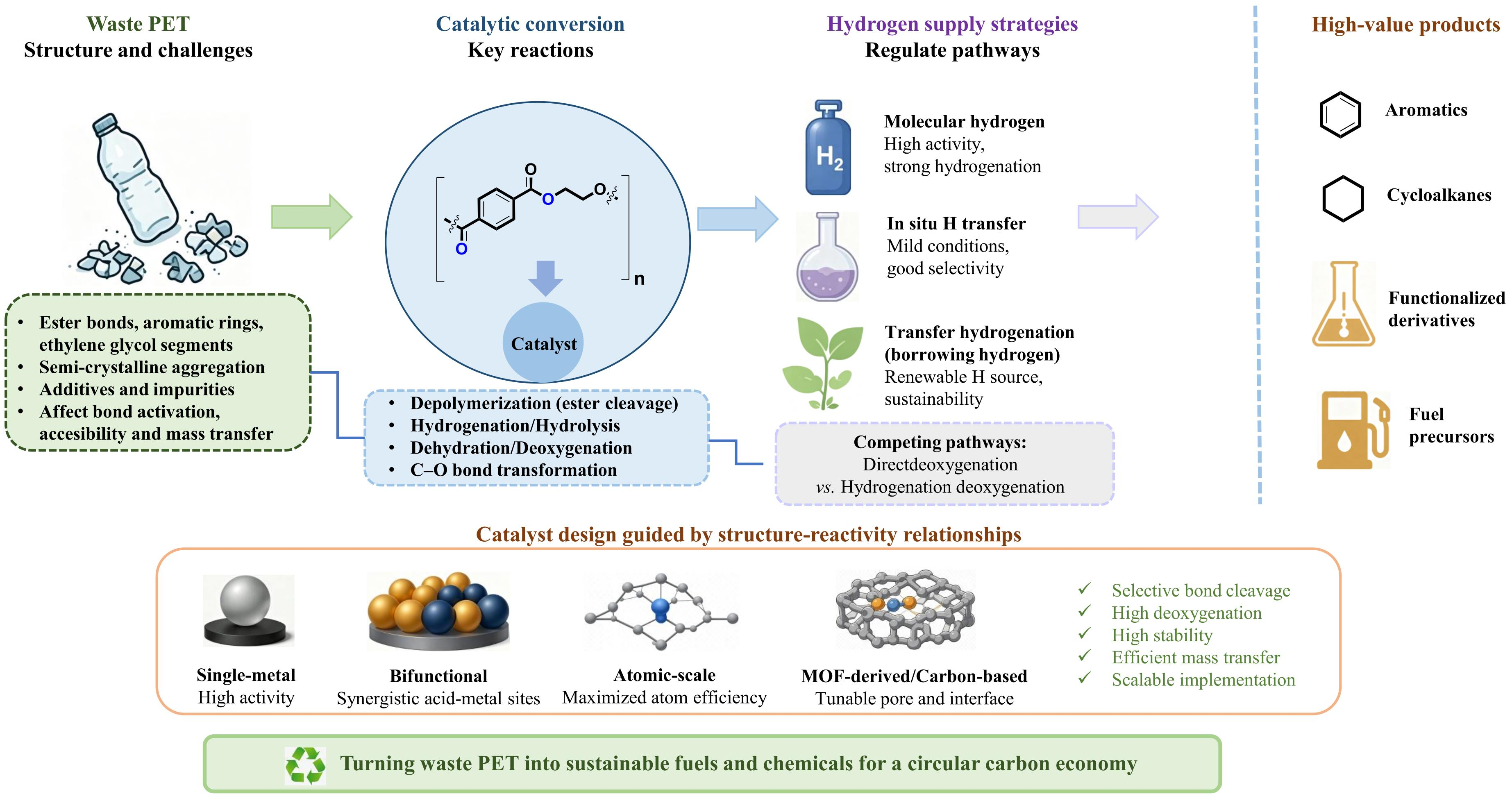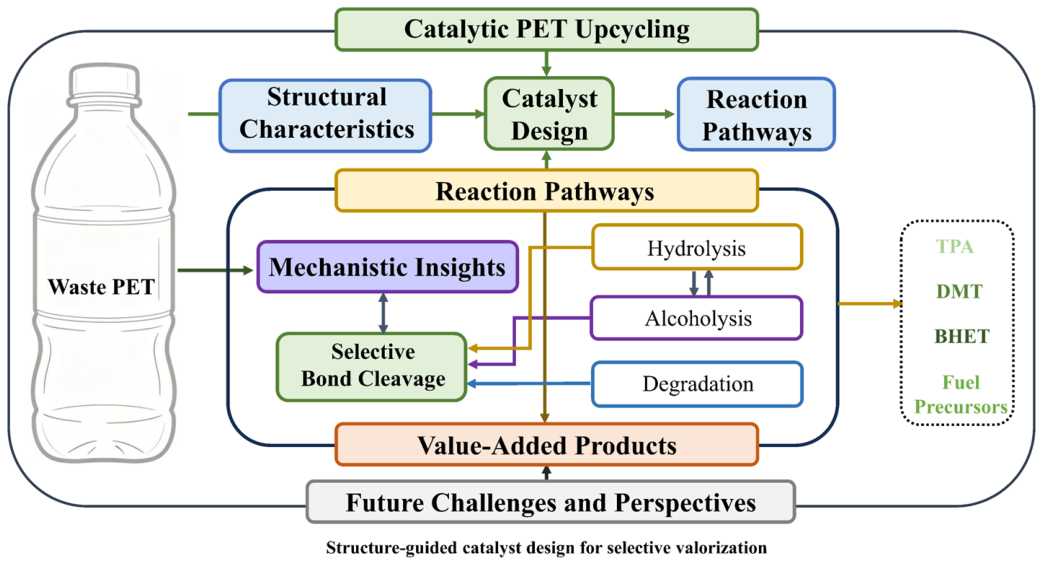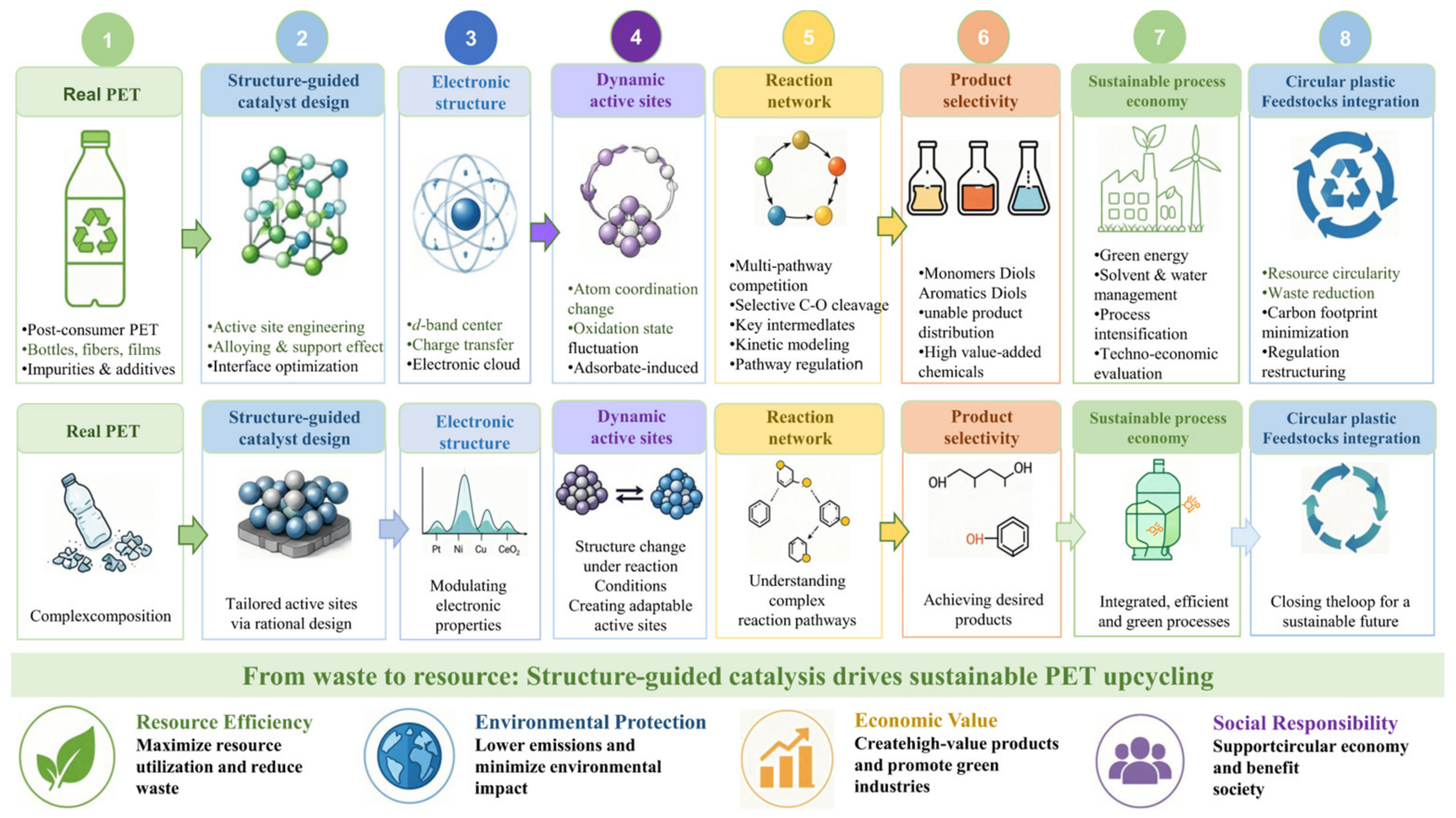
Catalytic Upcycling of Waste Polyethylene Terephthalate: Recent Advances in Catalyst Design, Reaction Pathway Control, and High-Value Conversion


Abstract
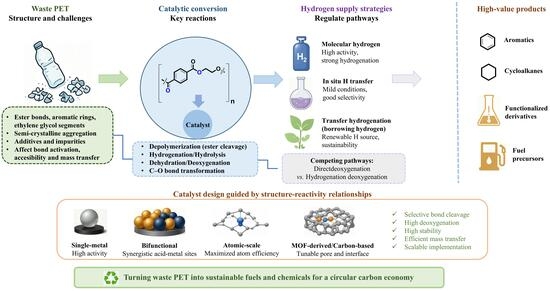
1. Introduction
- (1)
- Time frame. Priority was given to studies on the catalytic upgrading and recovery of PET published between 2020 and 2026; only landmark foundational papers published before 2020 were retained to explain the underlying mechanisms.
- (2)
- Screening criteria. All core literature on PET depolymerization and hydrogenation was included. Polyethylene (PE) and other polyolefin studies were used solely for comparative analysis of mass transfer and catalyst deactivation, with their relevance noted in the text. Irrelevant papers on purely mechanical pyrolysis were excluded.
- (3)
- Standardization of Definitions. All chemical abbreviations and catalytic terminology adhere to IUPAC and mainstream journal standards. The list of abbreviations was revised to eliminate definitional errors.
2. Structural Characteristics and Catalytic Activity of PET
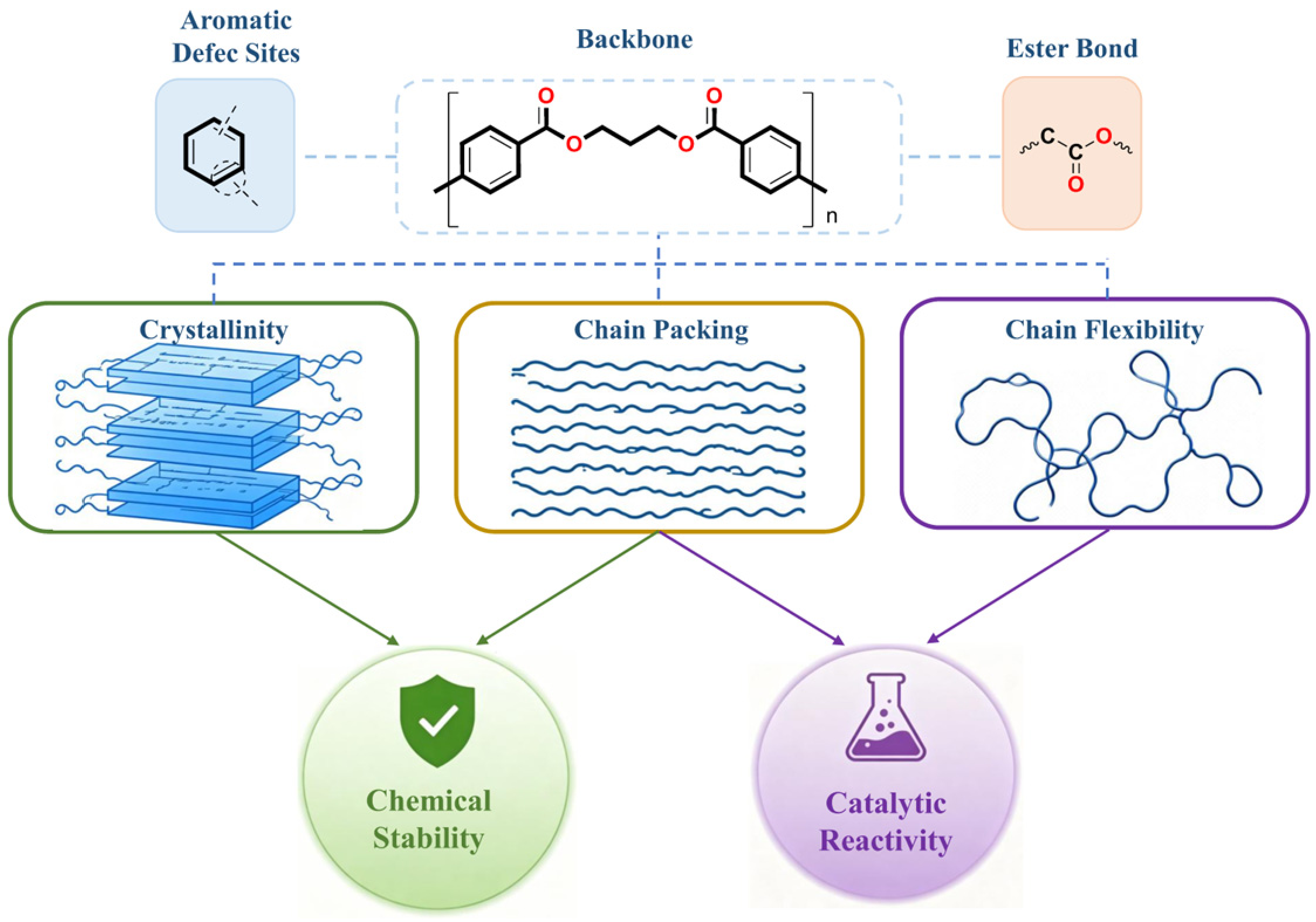
2.1. Molecular Structure and Chemical Stability of PET
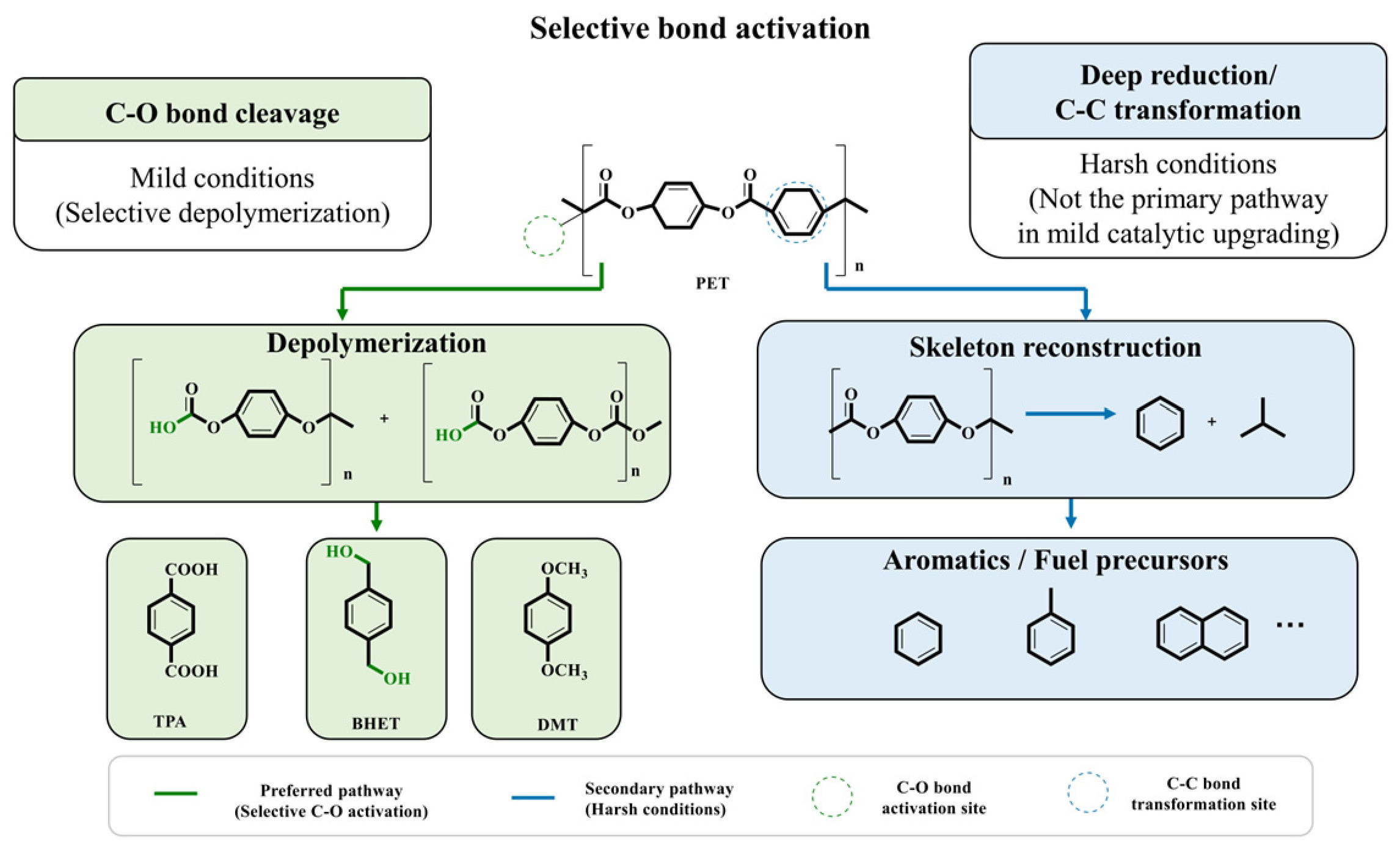
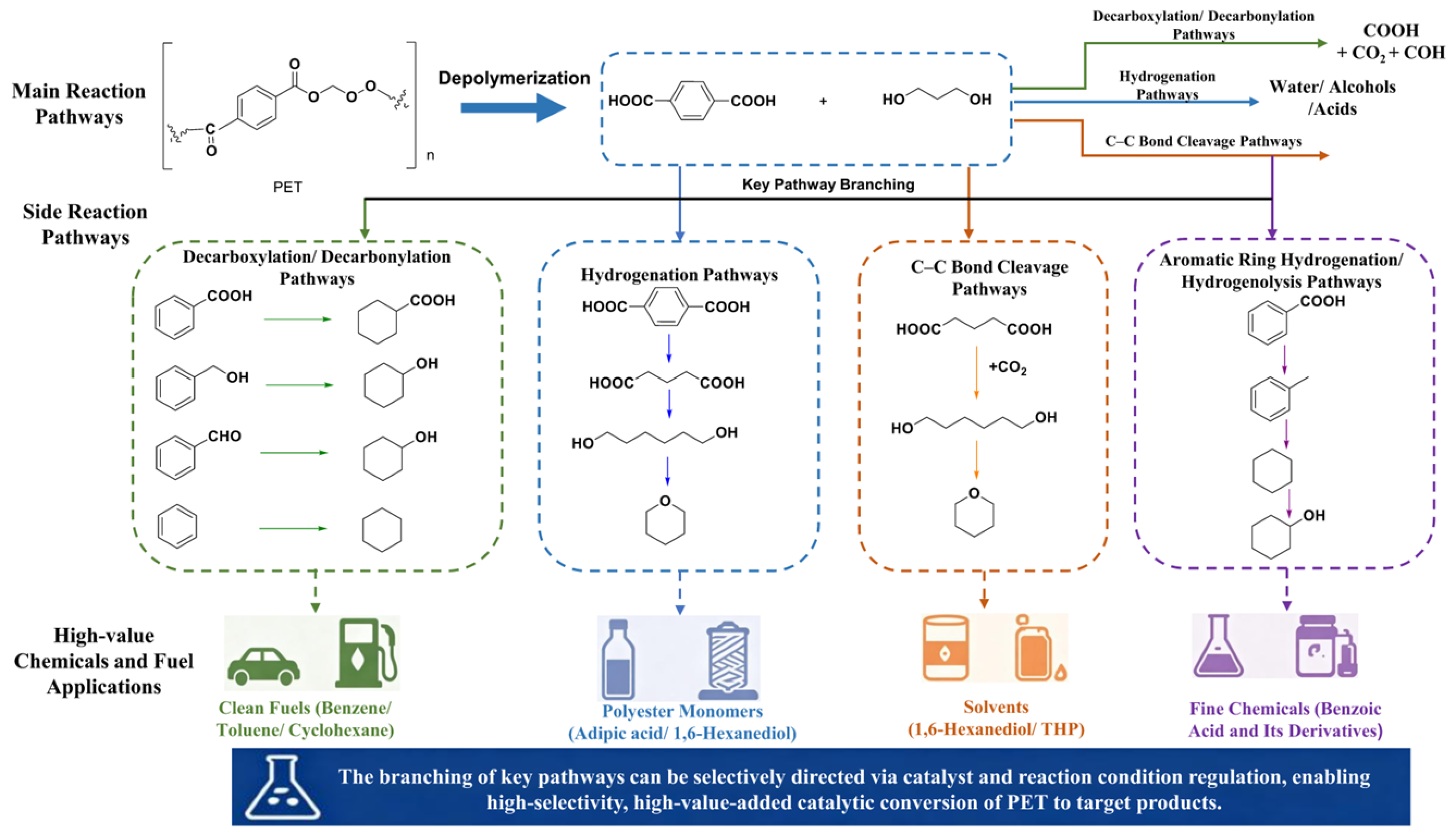
2.2. Selective Bond Cleavage and Reaction Pathways in PET
2.3. Structural Factors Governing the Catalytic Reaction of PET
3. Design of Functional Sites and Structure–Activity Relationships in the Catalytic Upgrading of PET
3.1. Catalytic Functional Requirements and Action Mechanism
3.2. Catalyst Composition and Electronic Structure Regulation
3.3. Synergy Among Multifunctional Sites and Spatial Coupling of Sites
3.4. Synergistic Regulation of Support, Interface and Defects
3.5. Structure–Activity Relationships and Catalyst Design Principles
4. Pathway Branching and Selectivity Control in the High-Value Conversion of PET
4.1. Shared Intermediates and Pathway Branching
4.2. Closed-Loop Monomer Pathway
4.3. Aromatic Oxygen-Containing Compound Pathway
4.4. Alicyclic Monomer Pathway
4.5. Functionalized Monomer Approach
4.6. Deep Deoxygenation Pathway
4.7. Pathway Comparison and Regulation Principles

| Target Pathway | Substrate Type | Shared Intermediates | Product & Application Scenario | Competitive Reactions | Major Carbon Loss Pathways | Critical Catalytic Parameters | Key Mechanistic Questions | Refs. |
|---|---|---|---|---|---|---|---|---|
| Closed-loop monomers | Direct conversion of whole waste PET | Polyester oligomers, BHET, MHET, TPA, DMT | TPA is used as an organic ligand in MOFs, and recycled PET can be used as a raw material for medical-grade and food-contact-grade recycled polyester | Complete depolymerization and reesterification/side reactions | Oligomer residues, monomer impurities, and separation losses | Acid–base type, nucleophilic activity, product removal | Can monomers re-polymerize, and where do impurities in actual waste PET go | [2,65,91] |
| Aromatic oxygenated compounds | Both waste PET and TPA model substrates are acceptable | TPA, DMT, BHET, and aromatic carbonyl intermediates | P-Xylene can serve as a precursor for biofuels. Methyl benzoate-type aromatic compounds can serve as general intermediates in pharmaceutical synthesis; BTX serves as a raw material for new polymer-grade aromatic monomers; TPA serves as a ligand for MOFs | Carbonyl hydrogenation, C–O hydrogenation, decarboxylation/decarbonylation | Decarboxylation-induced carbon loss, deep deoxygenation, and carbon buildup | Metal electronic structure, hydrogen coverage, oxygen affinity, and acid site density | Can the results from model intermediates be extrapolated to direct PET conversion | [42,45,46,47,92] |
| Alicyclic monomers | Both waste PET and TPA model substrates are acceptable | Aromatic dicarboxylic acids/diesters/diols | CHDM and CHDA closed-loop polyester materials, and DMCH high-density naphthenic aviation fuel components | Sequence of aromatic ring hydrogenation and carbonyl hydrogenation, and competition for C–O hydrogenolysis | Functional group loss, ring opening, and low-carbon byproducts | Consecutive metal sites, adsorption configuration, hydrogen pressure, and residence time | Sequence of key intermediates and distinction between parallel and sequential pathways | [94,95] |
| Functionalized monomers | Direct conversion of whole waste PET | Polyesters, BHET, and acyl Intermediates | PET ammonolysis for the preparation of Schiff Base-type nitrogen-containing functional organic intermediates; Hydrogenated PET derivatives can serve as general precursors for pharmaceutical synthesis | Targeted substitution vs. over-substitution/cross-linking | Excess reagents, salt byproducts, and purification losses | Nucleophilic properties, acid–base strength, solvents, and reaction ratios | Functional group positional selectivity and product compatibility | [24,98] |
| Fuel and light aromatics | Waste PET/PET and PP blended plastic | Low-oxygen aromatics, cyclic alcohols/hydrocarbons | BTX and C8 naphthenes can be used as gasoline blending components; oxygen-containing aromatic products can serve as liquid organic hydrogen carriers (LOHC); and PX aromatic monomers can serve as precursors for new materials | Deep deoxygenation and C–C cracking | Decarboxylation/decarboxylation leading to gas and coke formation | Metal-acid balance, acid strength, temperature, hydrogen pressure, residence time | Do liquid carbon yield and hydrogen consumption offer LCA/TEA advantages | [45,51,95] |
5. Analysis of the Catalytic Upgrading Mechanism of PET
5.1. Mechanism of Initial PET Activation
5.2. Intermediate Evolution and Reaction Pathways
5.3. Rate Control and Pathway Competition
5.4. Dynamic Evolution of Catalysts and Active Sites
6. Challenges and Prospects for Catalytic Upgrading of PET
6.1. Challenges in Real Waste PET
6.2. Structure Guided Catalyst Design
6.3. Process Evaluation and Integration for Sustainable Development
Author Contributions
Funding
Data Availability Statement
Conflicts of Interest
Abbreviations
| PET | Polyethylene terephthalate |
| TPA | Terephthalic acid |
| EG | Ethylene glycol |
| BHET | Bis(2-hydroxyethyl) terephthalate |
| DMT | Dimethyl terephthalate |
| DFT | Density functional theory |
| PVC | Polyvinyl chloride |
| PA | Polyamide |
| PE | Polyethylene |
| PP | Polypropylene |
| MHET | Mono (2-hydroxyethyl) terephthalate |
| AI | Artificial intelligence |
| LCA | Life cycle assessment |
| TEA | Techno-economic analysis |
| MOF | Metal–organic framework |
| COF | Covalent organic framework |
| DMCH | 1,4-dimethylcyclohexane |
| CHDM | 1,4-cyclohexanedimethanol |
| CHDA | 1,4-cyclohexanedicarboxylic acid |
| BTX | Benzene, Toluene, Xylenes |
| LOHC | Liquid organic hydrogen carrier |
| C-Bal. | Carbon balance |
| Conv. | Conversion |
References
- Guo, Z.; Li, Y.; Wang, M.; Ma, D. Catalytic Upcycling of PET: From Waste to Chemicals and Degradable Polymers. Acc. Chem. Res. 2025, 58, 3184–3194. [Google Scholar] [CrossRef] [Scilit] [PubMed]
- Ahmed, A.A.; Alyami, M.; AlArjani, A.; Bafaqeer, A.; Owolabi, T.O.; Salami, T.; Al-Absi, Z.A.; Ghanem, A.S.; Salah, A.; Qahtan, T.F. Recent progress on recycling and upcycling of PET plastic waste into high-value-added materials for versatile applications. J. Environ. Chem. Eng. 2025, 13, 116678. [Google Scholar] [CrossRef] [Scilit]
- Clark, R.A.; Shaver, M.P. Depolymerization within a Circular Plastics System. Chem. Rev. 2024, 124, 2617–2650. [Google Scholar] [CrossRef] [Scilit] [PubMed]
- Groseclose, T.M.; Nguyen, H.B. Recent advances in enzyme engineering for improved deconstruction of poly(ethylene terephthalate) (PET) plastics. Commun. Mater. 2025, 6, 190. [Google Scholar] [CrossRef] [Scilit]
- Cao, F.; Wang, L.; Zheng, R.; Guo, L.; Chen, Y.; Qian, X. Research and progress of chemical depolymerization of waste PET and high-value application of its depolymerization products. RSC Adv. 2022, 12, 31564–31576. [Google Scholar] [CrossRef] [Scilit] [PubMed]
- Barnard, E.; Rubio Arias, J.J.; Thielemans, W. Chemolytic depolymerisation of PET: A review. Green Chem. 2021, 23, 3765–3789. [Google Scholar] [CrossRef] [Scilit]
- McNeeley, A.; Liu, Y.A. Assessment of PET Depolymerization Processes for Circular Economy. 1. Thermodynamics, Chemistry, Purification, and Process Design. Ind. Eng. Chem. Res. 2024, 63, 3355–3399. [Google Scholar] [CrossRef] [Scilit]
- Awaja, F.; Pavel, D. Recycling of PET. Eur. Polym. J. 2005, 41, 1453–1477. [Google Scholar] [CrossRef] [Scilit]
- Tournier, V.; Topham, C.M.; Gilles, A.; David, B.; Folgoas, C.; Moya-Leclair, E.; Kamionka, E.; Desrousseaux, M.L.; Texier, H.; Gavalda, S.; et al. An engineered PET depolymerase to break down and recycle plastic bottles. Nature 2020, 580, 216–219. [Google Scholar] [CrossRef] [Scilit] [PubMed]
- Conroy, S.; Zhang, X. Theoretical insights into chemical recycling of polyethylene terephthalate (PET). Polym. Degrad. Stab. 2024, 223, 110729. [Google Scholar] [CrossRef] [Scilit]
- Westhues, S.; Idel, J.; Klankermayer, J. Molecular catalyst systems as key enablers for tailored polyesters and polycarbonate recycling concepts. Sci. Adv. 2018, 4, eaat9669. [Google Scholar] [CrossRef] [Scilit] [PubMed]
- Vollmer, I.; Jenks, M.J.F.; Roelands, M.C.P.; White, R.J.; van Harmelen, T.; de Wild, P.; van der Laan, G.P.; Meirer, F.; Keurentjes, J.T.F.; Weckhuysen, B.M. Beyond Mechanical Recycling: Giving New Life to Plastic Waste. Angew. Chem. Int. Ed. 2020, 59, 15402–15423. [Google Scholar] [CrossRef] [Scilit] [PubMed]
- Kosloski-Oh, S.C.; Wood, Z.A.; Manjarrez, Y.; de los Rios, J.P.; Fieser, M.E. Catalytic methods for chemical recycling or upcycling of commercial polymers. Mater. Horiz. 2021, 8, 1084–1129. [Google Scholar] [CrossRef] [Scilit] [PubMed]
- Ju, Z.; Zhou, L.; Lu, X.; Li, Y.; Yao, X.; Cheng, S.; Chen, G.I.; Ge, C. Mechanistic insight into the roles of anions and cations in the degradation of poly(ethylene terephthalate) catalyzed by ionic liquids. Phys. Chem. Chem. Phys. 2021, 23, 18659–18668. [Google Scholar] [CrossRef] [Scilit] [PubMed]
- Sun, Z.; Wang, K.; Lin, Q.; Guo, W.; Chen, M.; Chen, C.; Zhang, C.; Fei, J.; Zhu, Y.; Li, J. Value-Added Upcycling of PET to 1,4-Cyclohexanedimethanol by a Hydrogenation/Hydrogenolysis Relay Catalysis. Angew. Chem. Int. Ed. 2024, 136, e202408561. [Google Scholar] [CrossRef] [Scilit] [PubMed]
- Li, J.; An, Z.; Kong, Y.; Zhang, L.; Yang, J.; Wang, X.; Wang, J.; Duan, D.; Zhang, Q.; Long, R.; et al. Selective recovery of para-xylene from polyethylene terephthalate plastic. Appl. Catal. B-Environ. Energy 2024, 141, 1. [Google Scholar] [CrossRef] [Scilit]
- Guo, Z.; Wu, J.; Wang, J. Chemical degradation and recycling of polyethylene terephthalate (PET): A review. RSC Sustain. 2025, 3, 2111–2133. [Google Scholar] [CrossRef] [Scilit]
- Babaei, M.; Jalilian, M.; Shahbaz, K. Chemical recycling of Polyethylene terephthalate: A mini-review. J. Environ. Chem. Eng. 2024, 12, 112507. [Google Scholar] [CrossRef] [Scilit]
- Luo, X.; Li, Q. Reaction mechanism of PET conversion to 1,4-cyclohexanedimethanol and p-xylene via halogen hydride depolymerization and hydrogenation. J. Environ. Manag. 2026, 400, 128751. [Google Scholar] [CrossRef] [Scilit] [PubMed]
- Wei, J.; Zhu, M.; Liu, B.; Wang, N.; Liu, J.; Tomishige, K.; Liu, S.; Liu, G. Hydrodeoxygenation of Oxygen-Containing Aromatic Plastic Wastes to Liquid Organic Hydrogen Carriers. Angew. Chem. Int. Ed. 2023, 62, e202310505. [Google Scholar] [CrossRef] [Scilit] [PubMed]
- Lee, M.-h.; Jang, H.-Y. Waste plastic upcycling via homogeneous catalytic hydrogenation/dehydrogenation/transfer hydrogenation. Bull. Korean Chem. Soc. 2025, 46, 968–977. [Google Scholar] [CrossRef] [Scilit]
- Li, Y.; Wang, M.; Liu, X.; Hu, C.; Xiao, D.; Ma, D. Catalytic Transformation of PET and CO2 into High-Value Chemicals. Angew. Chem. Int. Ed. 2022, 61, e202117205. [Google Scholar] [CrossRef] [Scilit] [PubMed]
- Liu, J.; Yi, S.; Cheng, J.; Liu, S. Catalytic reductive conversion of polyethylene terephthalate (PET) plastic waste into fuels, valuable chemicals and degradable polymers. Green Chem. 2025, 27, 11312–11342. [Google Scholar] [CrossRef] [Scilit]
- Kulyabin, P.S.; Luk, J.; Uslamin, E.A.; Kolganov, A.A.; Saini, G.; Marcial-Hernandez, R.; Pancholi, K.; Kühne, B.; Dauth, A.; McKay, A.P.; et al. From Plastic Waste to Pharmaceutical Precursors: PET Upcycling Through Ruthenium Catalyzed Semi-Hydrogenation. Angew. Chem. Int. Ed. 2026, 65, e21838. [Google Scholar] [CrossRef] [Scilit] [PubMed]
- Zhang, M.; Huo, Z.; Li, L.; Ji, Y.; Ding, T.; Hou, G.; Song, S.; Dai, W. One-pot Hydrogenolysis of Polyethylene Terephthalate (PET) to p-xylene over CuZn/Al2O3 Catalyst. ChemSusChem 2024, 18, e202402013. [Google Scholar] [CrossRef] [Scilit] [PubMed]
- Badia, J.D.; Ballesteros-Garrido, R.; Gamir-Cobacho, A.; Gil-Castell, O.; Cháfer, A. Chemical recycling of post-consumer poly(ethylene terephthalate) (PET) driven by the protic ionic liquid 2-HEAA: Performance, kinetics and mechanism. J. Environ. Chem. Eng. 2024, 12, 113134. [Google Scholar] [CrossRef] [Scilit]
- Kawai, F.; Kawabata, T.; Oda, M. Current knowledge on enzymatic PET degradation and its possible application to waste stream management and other fields. Appl. Microbiol. Biot. 2019, 103, 4253–4268. [Google Scholar] [CrossRef] [Scilit] [PubMed]
- Zheng, M.; Li, Y.; Dong, W.; Zhang, Q.; Wang, W. Hydrolase-Catalyzed Depolymerization Mechanism toward Crystalline and Amorphous Polyethylene Terephthalate. ACS Sustain. Chem. Eng. 2024, 12, 10252–10259. [Google Scholar] [CrossRef] [Scilit]
- Pasula, R.R.; Lim, S.; Ghadessy, F.J.; Sana, B. The influences of substrates’ physical properties on enzymatic PET hydrolysis: Implications for PET hydrolase engineering. Eng. Biol. 2022, 6, 17–22. [Google Scholar] [CrossRef] [Scilit] [PubMed]
- Fang, P.; Xia, S.; Lu, X. Rapid alcoholysis of PET enhanced by its swelling under high temperature. J. Environ. Chem. Eng. 2022, 10, 107823. [Google Scholar] [CrossRef] [Scilit]
- McNeeley, A.; Liu, Y.A.; Vadoudi, K. Poly(ethylene Terephthalate) Waste Heterogeneity and Recycling Pathways: Evaluating Mechanical and Chemical Recycling Technologies in the Context of the Poly(ethylene Terephthalate) Supply Chain. Ind. Eng. Chem. Res. 2025, 64, 20837–20875. [Google Scholar] [CrossRef] [Scilit]
- Amundarain, I.; López-Montenegro, S.; Asueta, A.; Arnaiz, S.; Pereda-Ayo, B. Neopentyl glycol as an alternative solvent for the chemical recycling of complex PET waste. Mater. Adv. 2025, 6, 1042–1050. [Google Scholar] [CrossRef] [Scilit]
- Kots, P.A.; Vance, B.C.; Quinn, C.M.; Wang, C.; Vlachos, D.G. A two-stage strategy for upcycling chlorine-contaminated plastic waste. Nat. Sustain. 2023, 6, 1258–1267. [Google Scholar] [CrossRef] [Scilit]
- Guo, X.; Xin, J.; Lu, X.; Ren, B.; Zhang, S. Preparation of 1,4-cyclohexanedimethanol by selective hydrogenation of a waste PET monomer bis(2-hydroxyethylene terephthalate). RSC Adv. 2015, 5, 485–492. [Google Scholar] [CrossRef] [Scilit]
- Guo, H.; Lan, E.; Zhou, J.; Xu, Z.; He, J.; Shen, K.; Fang, J. Catalytic PET depolymerization toward circular recycling: Mechanistic activation, process translation, and product-slate control. Chem. Eng. J. 2026, in press. [Google Scholar] [CrossRef] [Scilit]
- Rollo, M.; Raffi, F.; Rossi, E.; Tiecco, M.; Martinelli, E.; Ciancaleoni, G. Depolymerization of polyethylene terephthalate (PET) under mild conditions by Lewis/Brnsted acidic deep eutectic solvents. Chem. Eng. J. 2023, 456, 141092. [Google Scholar] [CrossRef] [Scilit]
- Gao, X.; Wang, Z.; Zhang, M.; Yu, Y.; Zhang, S.; Mei, Q. From Solvent to Catalyst: In Situ Amino Acid-Like Species Enable PET Upcycling Without Added Catalysts. Angew. Chem. Int. Ed. 2025, 64, e202513723. [Google Scholar] [CrossRef] [Scilit] [PubMed]
- Coates, G.W.; Getzler, Y.D.Y.L. Chemical recycling to monomer for an ideal, circular polymer economy. Nat. Rev. Mater. 2020, 5, 501–516. [Google Scholar] [CrossRef] [Scilit]
- Okonsky, S.T.; Krishna, J.V.J.; Lee, D.H.; Toraman, H.E. Kinetic modelling and measurement of catalyst deactivation for the catalytic co-pyrolysis of PP and PET with HZSM-5. Appl. Catal. A-Gen. 2025, 708, 120574. [Google Scholar] [CrossRef] [Scilit]
- Seo, H.J.; Lee, C.; Kim, Y.; Lee, W.; Park, S.; Roh, J.W.; Giri, A.; Park, G.; Hyun, D.C.; Moon, G.D.; et al. Waste-derived CoFe2O4-CaO magnetically recoverable dual acid-base catalyst for efficient PET glycolysis. Chem. Eng. J. 2026, 543, 178407. [Google Scholar] [CrossRef] [Scilit]
- Xie, S.; Wang, C.; Hu, W.; Hu, J.Z.; Wang, Y.; Dong, Z.; Intan, N.N.; Pfaendtner, J.; Lin, H. Chemical recycling of post-consumer polyester wastes using a tertiary amine organocatalyst. Cell Rep. Phys. Sci. 2024, 5, 102145. [Google Scholar] [CrossRef] [Scilit]
- Ni, W.; Ran, H.; Wang, R.; Liu, Y.; Zhou, P.; Guo, T.; Shan, J.; Lai, Z.; Liu, B.; Liang, S.-J.; et al. Stepwise hydrogen spillover–engineered synergistic sites enable near-quantitative conversion of waste PET to p-xylene. Nat. Commun. 2026, 17, 2128. [Google Scholar] [CrossRef] [Scilit] [PubMed]
- Shao, Y.; Fan, M.; Sun, K.; Gao, G.; Li, C.; Li, D.; Jiang, Y.; Zhang, L.; Zhang, S.; Hu, X. The quantitative conversion of polyethylene terephthalate (PET) and Coca-Cola bottles to p-xylene over Co-based catalysts with tailored activities for deoxygenation and hydrogenation. Green Chem. 2023, 25, 10513–10529. [Google Scholar] [CrossRef] [Scilit]
- Guo, M.; Shao, Y.; Song, C.; Liu, H.; He, F.; Zhang, L.; Zhang, S.; Wei, T.; Hu, X. One-Pot Tandem Butanolysis and Hydrogenolysis of PET to Selectively Produce p-Xylene through Coordination of Basic Sites, Oxygen Vacancies, and Hydrogenation Sites of Cu–Mg–Al Catalyst. ACS Sustain. Chem. Eng. 2026, 14, 10292–10307. [Google Scholar] [CrossRef] [Scilit]
- Wang, B.; Yan, X.; Huang, J.; Jing, Y.; Saravanamurugan, S.; Lee, A.F.; Li, H. Tuning selectivity in the direct hydrogenolysis of PET plastic over Co catalysts through interfacial hydrogen spillover. Nat. Commun. 2026, 17, 5155. [Google Scholar] [CrossRef] [Scilit] [PubMed]
- Cheng, J.; Xie, J.; Xi, Y.; Wu, X.; Zhang, R.; Mao, Z.; Yang, H.; Li, Z.; Li, C. Selective Upcycling of Polyethylene Terephthalate towards High-valued Oxygenated Chemical Methyl p-Methyl Benzoate using a Cu/ZrO2 Catalyst. Angew. Chem. Int. Ed. 2024, 63, e202319896. [Google Scholar] [CrossRef] [Scilit] [PubMed]
- Chen, Q.; Yan, H.; Zhao, K.; Wang, S.; Zhang, D.; Li, Y.; Fan, R.; Li, J.; Chen, X.; Zhou, X.; et al. Catalytic oxidation upcycling of polyethylene terephthalate to commodity carboxylic acids. Nat. Commun. 2024, 15, 10732. [Google Scholar] [CrossRef] [Scilit] [PubMed]
- Dai, L.; Van Geem, K.M.; Zhang, H.; Xiao, R.; Lei, H.; Ruan, R. Designing zeolite catalysts for chemical recycling of plastics. Nat. Rev. Mater. 2026, 11, 258–260. [Google Scholar] [CrossRef] [Scilit]
- Helmer, R.; Borkar, S.; Li, A.; Mahnaz, F.; Vito, J.; Bishop, M.; Iftakher, A.; Hasan, M.M.; Rangarajan, S.; Shetty, M. Tandem Methanolysis and Catalytic Transfer Hydrogenolysis of Polyethylene Terephthalate to p-Xylene Over Cu/ZnZrOx Catalysts. Angew. Chem. Int. Ed. 2024, 137, 4. [Google Scholar] [CrossRef] [Scilit]
- Kim, M.; Ro, I. Advances in heterogeneous catalysts for sustainable PET upcycling: From mechanistic understanding to catalyst design. Chem. Commun. 2025, 61, 19390–19402. [Google Scholar] [CrossRef] [Scilit] [PubMed]
- Liu, J.; Wang, N.; Liu, S.; Liu, G. Catalytic Hydrodeoxygenation of Mixed Plastic Wastes into Sustainable Naphthenes. JACS Au 2024, 4, 4361–4373. [Google Scholar] [CrossRef] [Scilit] [PubMed]
- Liu, L.; Corma, A. Bimetallic Sites for Catalysis: From Binuclear Metal Sites to Bimetallic Nanoclusters and Nanoparticles. Chem. Rev. 2023, 123, 79. [Google Scholar] [CrossRef] [Scilit] [PubMed]
- Salaev, M.A.; Xiong, H.; Corberán, V.C.; Liotta, L.F.; Vodyankina, O.V. Synergistic effects in heterogeneous catalysis: Status and perspectives. Mater. Today Chem. 2025, 46, 102722. [Google Scholar] [CrossRef] [Scilit]
- Chen, X.; Hu, J.; Liu, J.; Hai, P.; Guan, J. Advances in dual-atom catalysts for the electroreduction of carbon dioxide. Chem. Eng. J. 2025, 522, 167504. [Google Scholar] [CrossRef] [Scilit]
- Li, B.; Jiang, W.; Chen, P.; Wang, X.; Zhou, M.; Chen, Z.; Lu, Y.; Zhang, X.; Zhao, L.; Lin, H. Nanoconfined Multi-Scale Metal Catalysts: Confinement-Induced Geometric, Electronic, and Microenvironment Regulation for Selective Multi-Electron CO2 Reduction. Adv. Energy Mater. 2026, 16, e70795. [Google Scholar] [CrossRef] [Scilit]
- van der Hoeven, J.E.S.; Jelic, J.; Olthof, L.A.; Totarella, G.; van Dijk-Moes, R.J.A.; Krafft, J.-M.; Louis, C.; Studt, F.; van Blaaderen, A.; de Jongh, P.E. Unlocking synergy in bimetallic catalysts by core–shell design. Nat. Mater. 2021, 20, 1216–1220. [Google Scholar] [CrossRef] [Scilit] [PubMed]
- Brösigke, G.; Repke, J.-U.; Schomäcker, R.; Matera, S. The closer the better? Theoretical assessment of the impact of catalytic site separation for bifunctional core–shell catalyst particles. Chem. Eng. J. 2022, 446, 136891. [Google Scholar] [CrossRef] [Scilit]
- Berdugo-Díaz, C.E.; Manetsch, M.T.; Sik Yun, Y.; Lee, J.; Luo, J.; Chen, X.; Flaherty, D.W. Ester Reduction with H2 on Bifunctional Metal-Acid Catalysts: Implications of Metal Identity on Rates and Selectivities. Angew. Chem. Int. Ed. 2023, 62, e202216165. [Google Scholar] [CrossRef] [Scilit] [PubMed]
- Fischer, A.F.; Iglesia, E. The nature of “hydrogen spillover”: Site proximity effects and gaseous intermediates in hydrogenation reactions mediated by inhibitor-scavenging mechanisms. J. Catal. 2023, 420, 68–88. [Google Scholar] [CrossRef] [Scilit]
- Shan, Y.; Wu, Z.; Li, T. Asymmetric super-exchange interaction induced by inter-site distance effect for hydrogen evolution reaction. Mater. Chem. Phys. 2022, 279, 125748. [Google Scholar] [CrossRef] [Scilit]
- Hu, W.; Noh, G.; Iglesia, E. Consequences of metal-acid site proximity for alkane isomerization and β-scission mediated by bifunctional catalytic cascades. J. Catal. 2023, 425, 125–142. [Google Scholar] [CrossRef] [Scilit]
- Wang, Q.N.; Duan, R.; Feng, Z. Understanding the Synergistic Catalysis in Hydrogenation of Carbonyl Groups on Cu-Based Catalysts. ACS Catal. 2024, 14, 1620–1628. [Google Scholar] [CrossRef] [Scilit]
- Luo, Z.; Ge, X.; Cao, Y.; Wang, Z.; Zhou, J.; Li, W.; Duan, X.; Zhou, X. Inverse NiOx-Ag Interface to Decouple Reactant Activation for Ag-Ni/SiO2-Catalyzed Ester Hydrogenation. Angew. Chem. Int. Ed. 2025, 65, 2. [Google Scholar] [CrossRef] [Scilit] [PubMed]
- Pan, Y.; Zhen, S.; Liu, X.; Ge, M.; Zhao, J.; Gu, L.; Zhou, D.; Zhang, L.; Su, D. Looping metal-support interaction in heterogeneous catalysts during redox reactions. Nat. Commun. 2025, 16, 8627. [Google Scholar] [CrossRef] [Scilit] [PubMed]
- Lee, K.; Han, S.; Kim, M.; Kim, B.; Park, J.A.; Lim, K.S.; Ha, S.J.; Kim, H.O. Metal–Organic Framework for Plastic Depolymerization and Upcycling. Crystals 2025, 15, 897. [Google Scholar] [CrossRef] [Scilit]
- Songlei, M.; Yong, G.; Yanqin, X.W. Efficient depolymerization of PET over Ti-doped SBA-15 with abundant Lewis acid sites via glycolysis. Catal. Sci. Technol. 2023, 13, 6561–6569. [Google Scholar] [CrossRef] [Scilit]
- Hou, Z.; Lan, H.; Zhu, K.; An, X.; Liu, H.; Qu, J. Hierarchically Porous Carbon Derived from Pore Remodeling of Waste Polymeric Membranes for High-Efficiency Adsorption Applications. Resour. Conserv. Recycl. 2023, 190, 106845S. [Google Scholar] [CrossRef] [Scilit]
- Sun, B.; Li, B.; Marc, M.; Yin, L.; Song, Q.; Shi, X.; Wang, D.; Lin, F.; Wang, K. Synergistic pore-acidity engineering of hierarchical ZSM-5 for hydrogen-free upcycling of Polyethylene to C8–C12 Methylated Aromatics. Innov. Energy 2026, 3, 100155. [Google Scholar] [CrossRef] [Scilit]
- Ge, J.; Peters, B. Mass transfer in catalytic depolymerization: External effectiveness factors and serendipitous processivity in stagnant and stirred melts. Chem. Eng. J. 2023, 466, 143251. [Google Scholar] [CrossRef] [Scilit]
- Gabrič, M.; Lavrič, Z.; Schwiderski, M.; Marc, L.; Temmel, E.; Grilc, M.; Likozar, B. Polyethylene Terephthalate Glycolysis: Kinetic Modeling and Validation. Polymers 2025, 17, 2246. [Google Scholar] [CrossRef] [Scilit] [PubMed]
- Wang, W.; Yao, X.; Chen, W. Overcoming Mass Transfer Limitations in Catalytic Oxidation and Reduction from Reactive-Species Engineering to Sustainable Catalyst Systems. Catalysts 2026, 16, 349. [Google Scholar] [CrossRef] [Scilit]
- Tan, J.Z.; Ortega, M.; Miller, S.A.; Hullfish, C.W.; Kim, H.; Kim, S.; Hu, W.; Hu, J.Z.; Lercher, J.; Koel, B.E.; et al. Catalytic Consequences of Hierarchical Pore Architectures within MFI and FAU Zeolites for Polyethylene Conversion. ACS Catal. 2024, 14, 7536–7552. [Google Scholar] [CrossRef] [Scilit]
- Zhang, S.; Xue, Y.; Wu, Y.; Zhang, Y.X.; Tan, T.; Niu, Z. PET recycling under mild conditions via substituent-modulated intramolecular hydrolysis. Chem. Sci. 2023, 14, 6558–6563. [Google Scholar] [CrossRef] [Scilit] [PubMed]
- Qamar, M.Z.; Ali, A.; Saeed, M.A.; van der Heijden, M. Electrocatalytic Upcycling of PET-Derived Products: Catalyst Design, C1–C2 Products, and Coupled Electrochemical Reactions. Nano Energy 2026, 152, 111865. [Google Scholar] [CrossRef] [Scilit]
- Abdelgaid, M.; Mpourmpakis, G. Structure–Activity Relationships in Lewis Acid–Base Heterogeneous Catalysis. ACS Catal. 2022, 12, 4268–4289. [Google Scholar] [CrossRef] [Scilit]
- Anderson, L.B.; Connon, S.J.; Molloy, C.; Martin, I.L.; Pedrini, L. Effect of phase transfer catalyst structure on the alkaline hydrolysis of poly(ethylene terephthalate). Green Chem. 2024, 26, 11125–11131. [Google Scholar] [CrossRef] [Scilit]
- Gang, C.; Tian, J.; Ma, B.; Zhao, C. Unlocking High-Concentration PET Upcycling via Site-Decoupled Copper Catalysis. Angew. Chem. Int. Ed. 2025, 64, e202516357. [Google Scholar] [CrossRef] [Scilit] [PubMed]
- Ding, W.; Ji, D.; Wang, K.; Li, Y.; Luo, Q.; Wang, R.; Li, L.; Qin, X.; Peng, S. Rapid Surface Reconstruction of Amorphous-Crystalline NiO for Industrial-Scale Electrocatalytic PET Upcycling. Angew. Chem. Int. Ed. 2025, 64, e202418640. [Google Scholar] [CrossRef] [Scilit] [PubMed]
- Zhao, G.; Lin, J.; Lu, M.; Li, L.; Xu, P.; Liu, X.; Chen, L. Potential cycling boosts the electrochemical conversion of polyethylene terephthalate-derived alcohol into valuable chemicals. Nat. Commun. 2024, 15, 8463. [Google Scholar] [CrossRef] [Scilit] [PubMed]
- Wu, Y.; Wang, J.; Zhang, Y.; Mao, J.; Xu, C.; Ding, H.; Ma, F.; Luo, Y.; Chen, R.; Li, D.; et al. Metal-supported interaction governs kinetic bifurcation of reconstruction of Cu CO2RR catalysts. J. Catal. 2026, 460, 116973. [Google Scholar] [CrossRef] [Scilit]
- Kondo, F.; Kamiya, N.; Bekker, G.-J.; Nagao, S.; Numoto, N.; Sekiguchi, H.; Ito, N.; Oda, M. Structure-activity relationship of PET-degrading cutinase regulated by weak Ca2+ binding and temperature. Biophys. Physicobiol. 2025, 22, e220009. [Google Scholar] [CrossRef] [Scilit] [PubMed]
- Yue, S.; Wang, P.; Zhan, L.S. From Plastic Waste to Treasure: Selective Upcycling through Catalytic Technologies. Adv. Energy Mater. 2023, 13, 2302008. [Google Scholar] [CrossRef] [Scilit]
- Murali, V.; Kim, H.; Kim, H.U.; Kim, J.R.; Son, S.H.; Park, Y.K.; Ha, J.M.; Jae, J. Selective one-pot chemical recycling of PET waste to xylene monomers: Insights into a Ru/TiO2 catalyst design and interfacial dynamics in a biphasic system. Green Chem. 2025, 27, 2203–2219. [Google Scholar] [CrossRef] [Scilit]
- Yang, T.; Yang, Z.; Zhang, Y.; Hu, C.; Xie, Z.; Sun, Z.; Pang, X.; Chen, X. Upcycling of PET waste: From one polymer to another polymer. Polym. Chem. 2025, 17, 7–20. [Google Scholar] [CrossRef] [Scilit]
- Watson-Sanders, S.; Dadmun, M. More Efficient Chemical Recycling of Poly(Ethylene Terephthalate) by Intercepting Intermediates. ChemSusChem 2024, 17, 23. [Google Scholar] [CrossRef] [Scilit] [PubMed]
- Heinks, T.; Hofmann, K.; Last, S.; Gamm, I.; Blach, L.; Wei, R.; Bornscheuer, U.T.; Hamel, C.; Langermann, J. Selective Modification of the Product Profile of Biocatalytic Hydrolyzed PET via Product-Specific Medium Engineering. ChemSusChem 2024, 18, 6. [Google Scholar] [CrossRef] [Scilit] [PubMed]
- Curley, J.B.; Liang, Y.; DesVeaux, J.S.; Choi, H.; Clarke, R.W.; Maurya, A.K.; Michener, W.E.; Stanley, L.M.; Wu, Y.; Hesse, S.A.; et al. Closed-loop recycling of mixed polyesters via catalytic methanolysis and monomer separations. Nat. Chem. Eng. 2025, 2, 568–580. [Google Scholar] [CrossRef] [Scilit]
- Watson-Sanders, S.; Johnson, K.; Barber, S.; Biery, A.R.; Wilcox, L.; Galan, N.J.; Zheng, J.; Saito, T.; Dadmun, M.D. Solubility-limited depolymerization kinetics in the glycolysis of carbonyl-containing polymers. Polym. Chem. 2026, 17, 1569–1583. [Google Scholar] [CrossRef] [Scilit]
- Parida, D.; Aerts, A.; Vanbroekhoven, K.; Van Dael, M.; Mitta, H.; Li, L.; Eevers, W.; Van Geem, K.M.; Feghali, E.; Elst, K. Monomer recycling of polyethylene terephthalate, polycarbonate and polyethers: Scalable processes to achieve high carbon circularity. Prog. Polym. Sci. 2024, 149, 101783. [Google Scholar] [CrossRef] [Scilit]
- Luna, E.; Olazabal, I.; Roosen, M.; Müller, A.; Jehanno, C.; Ximenis, M.; de Meester, S.; Sardon, H. Towards a better understanding of the cosolvent effect on the low-temperature glycolysis of Polyethylene Terephthalate (PET). Chem. Eng. J. 2024, 482, 148861. [Google Scholar] [CrossRef] [Scilit]
- Shen, B.; Xu, H.; Xiao, H.; Shen, Z.; Ma, J.; Wei, S.; Zhang, H.; Wang, Y.; Yang, L. Repolymerization-suppressed closed-loop recycling of PET to BHET via metal-free ammonium acetate catalysis. Res. Chem. Int. 2025, 51, 5905–5921. [Google Scholar] [CrossRef] [Scilit]
- Ye, M.; Li, Y.; Yang, Z.; Yao, C.; Sun, W.; Zhang, X.; Chen, W.; Qian, G.; Duan, X.; Cao, Y. Ruthenium TiO2-Catalyzed Hydrogenolysis of Polyethylene Terephthalate: Reaction Pathways Dominated by Coordination Environment. Angew. Chem. Int. Ed. 2023, 135, e202301024. [Google Scholar] [CrossRef] [Scilit] [PubMed]
- Ou, W.; Chang, Z.; Zhang, G.; Zhao, H. Ru nanoparticles encapsulated in defective UiO-66def for the hydrogenation of benzene rings in polyethylene terephthalate degraded chemicals. J. Mater. Chem. A 2025, 13, 33404–33416. [Google Scholar] [CrossRef] [Scilit]
- Jiang, X.; Chang, Z.; Yang, L.; Du, W.; Hou, Z. Hydrogenation of waste PET degraded bis(2-hydroxyethyl)cyclohexane-1,4-dicarboxylate to 1,4-cyclohexanedimethanol over Cu-based catalysts. Fuel 2024, 363, 130944. [Google Scholar] [CrossRef] [Scilit]
- Wang, N.; Liu, J.; Wei, J.; Liu, S.; Liu, G. Selective hydrodeoxygenation of polyethylene terephthalate plastic wastes into 1,4-dimethylcyclohexane by Ir-ReOx/SiO2 + HZSM-5 catalytic system. Sci. China Chem. 2025, 68, 1563–1575. [Google Scholar] [CrossRef] [Scilit]
- Rabiei, N.; Kish, M.H. Aminolysis of polyesters for cracking and structure clarifying: A review. Polym. Adv. Technol. 2022, 33, 3903–3919. [Google Scholar] [CrossRef] [Scilit]
- Wei, X.; Zheng, W.; Chen, X.; Qiu, J.; Sun, W.; Xi, Z.; Zhao, L. Chemical upcycling of poly(ethylene terephthalate) with binary mixed alcohols toward value-added copolyester by depolymerization and repolymerization strategy. Chem. Eng. Sci. 2024, 294, 120103. [Google Scholar] [CrossRef] [Scilit]
- Otaibi, A.A.; Alsukaibi, A.K.D.; Rahman, M.A.; Mushtaque, M.; Haque, A. From Waste to Schiff Base: Upcycling of Aminolysed Poly(ethylene terephthalate) Product. Polymers 2022, 14, 1861. [Google Scholar] [CrossRef] [Scilit] [PubMed]
- Ambursa, M.M.; Juan, J.C.; Yahaya, Y.; Taufiq-Yap, Y.H.; Lin, Y.C.; Lee, H.V. A review on catalytic hydrodeoxygenation of lignin to transportation fuels by using nickel-based catalysts. Renew. Sustain. Energy Rev. 2021, 138, 110667. [Google Scholar] [CrossRef] [Scilit]
- Qu, L.; Jiang, X.; Zhang, Z.; Zhang, X.G.; Song, G.Y.; Wang, H.L.; Yuan, Y.P.; Chang, Y.L. A review of hydrodeoxygenation of bio-oil: Model compounds, catalysts, and equipment. Green Chem. 2021, 23, 9348–9376. [Google Scholar] [CrossRef] [Scilit]
- Prabhudesai, V.S.; Gurrala, L.; Vinu, R. Catalytic Hydrodeoxygenation of Lignin-Derived Oxygenates: Catalysis, Mechanism, and Effect of Process Conditions. Energy Fuels 2022, 36, 1155–1188. [Google Scholar] [CrossRef] [Scilit]
- Jung, S.; Park, Y.K.; Kwon, E.E. Catalytic hydrodeoxygenation for upgrading of lignin-derived bio-oils. In Biomass, Biofuels, Biochemicals; Bhaskar, T., Pandey, A., Eds.; Elsevier: Amsterdam, The Netherlands, 2021; pp. 129–145. [Google Scholar] [CrossRef] [Scilit]
- Pereira, P.; Guirguis, P.M.; Pester, C.W.; Savage, P.E. Reaction Network and Kinetics Model for Neutral Hydrolysis of Poly(ethylene terephthalate). Ind. Eng. Chem. Res. 2026, 65, 4905–4914. [Google Scholar] [CrossRef] [Scilit] [PubMed]
- Wang, M.; Li, Y.; Zheng, L.; Hu, T.; Yan, M.; Wu, C. Recycling and depolymerisation of poly(ethylene terephthalate): A review. Polym. Chem. 2024, 15, 585–608. [Google Scholar] [CrossRef] [Scilit]
- Di Lorenzo, M.L. Crystallization of Poly(ethylene terephthalate): A Review. Polymers 2024, 16, 1975. [Google Scholar] [CrossRef] [Scilit] [PubMed]
- Najmi, S.; Vance, B.C.; Selvam, E.; Huang, D.; Vlachos, D.G. Controlling PET oligomers vs monomers via microwave-induced heating and swelling. Chem. Eng. J. 2023, 471, 144712. [Google Scholar] [CrossRef] [Scilit]
- Jiang, M.; Wang, X.; Xi, W.; Yang, P.; Zhou, H.; Duan, J.; Ratova, M.; Wu, D. Chemical catalytic upgrading of polyethylene terephthalate plastic waste into value-added materials, fuels and chemicals. Sci. Total Environ. 2024, 912, 169342. [Google Scholar] [CrossRef] [Scilit] [PubMed]
- Deng, L.; Guo, W.; Ngo, H.H.; Zhang, X.; Wei, D.; Wei, Q.; Deng, S. Novel catalysts in catalytic upcycling of common polymer wastes. Chem. Eng. J. 2023, 471, 144350. [Google Scholar] [CrossRef] [Scilit]
- Luo, X.; Li, Q. Multiscale mechanisms elucidation and kinetic modeling for polyethylene terephthalate separation pathways: A combined computational-experimental perspective on pyrolysis, hydrolysis, and alcoholysis processes. Sep. Purif. Technol. 2025, 370, 133293. [Google Scholar] [CrossRef] [Scilit]
- Javed, S.; Fisse, J.; Vogt, D. Kinetic Investigation for Chemical Depolymerization of Post-Consumer PET Waste Using Sodium Ethoxide. Ind. Eng. Chem. Res. 2023, 62, 4328–4336. [Google Scholar] [CrossRef] [Scilit]
- Li, H.; Zhang, J.; Yao, Z.; Hu, P. Accelerating the identification of the rate controlling steps by conducting microkinetic modeling on surrogate networks. Catal. Sci. Technol. 2025, 15, 2766–2775. [Google Scholar] [CrossRef] [Scilit]
- Chu, M.; Kang, Q.; Hu, P.; Zhang, Q.; Chen, J. Unlocking opportunities: Supported metal catalysts for the chemical upcycling of waste plastics. Chem. Eng. J. 2024, 496, 154375. [Google Scholar] [CrossRef] [Scilit]
- Li, J.; Ma, Y.; Ho, J.C.; Qu, Y. Hydrogen Spillover Phenomenon at the Interface of Metal-Supported Electrocatalysts for Hydrogen Evolution. Acc. Chem. Res. 2024, 57, 895–904. [Google Scholar] [CrossRef] [Scilit] [PubMed]
- Zhao, S.; Wang, Z.H.; Wang, J.Y.; Wang, P.F.; Liu, Z.L.; Shu, J.; Yi, T.F. Unveiling the mysteries of hydrogen spillover phenomenon in hydrogen evolution reaction: Fundamentals, evidence and enhancement strategies. Coord. Chem. Rev. 2025, 524, 216321. [Google Scholar] [CrossRef] [Scilit]
- Zhang, H.; Chen, L.; Dong, F.; Lu, Z.; Lv, E.; Dong, X.; Li, H.; Yuan, Z.; Peng, X.; Yang, S. Dynamic transformation of active sites in energy and environmental catalysis. Energy Environ. Sci. 2024, 17, 6435–6481. [Google Scholar] [CrossRef] [Scilit]
- Chen, L.; Ding, X.; Urban, J.J. Advances in in situ/operando techniques for catalysis research: Enhancing insights and discoveries. Surf. Sci. Technol. 2024, 2, 9. [Google Scholar] [CrossRef] [Scilit]
- Liu, Y.; Su, X.; Ding, J.; Zhou, J.; Liu, Z.; Wei, X.; Yang, H.B.; Liu, B. Progress and challenges in structural, in situ and operando characterization of single-atom catalysts by X-ray based synchrotron radiation techniques. Chem. Soc. Rev. 2024, 24, 11850–11887. [Google Scholar] [CrossRef] [Scilit] [PubMed]



| Catalytic Function | Target Products/Downstream Applications | Key Structural Modulation | Impact on the Reaction Process | Potential Issues | Validation Metrics | Representative Catalysts | Refs. |
|---|---|---|---|---|---|---|---|
| Regulation of ester bond activation and nucleophilic transfer | TPA, MHET, BHET, DMT/ Closed loop recycling new mat materials | Types, strengths, distribution and synergistic relationships of acid–base sites | Carbonyl polarization, nucleophilic attack, and ester bond cleavage | Increased acidity or alkalinity ≠ increased activity; Side reactions must be avoided | Acid–base site characterization, in situ spectroscopy, kinetics, and product analysis | Solid acids, zeolites | [1,12,35,36,37] |
| Hydrogen activation and directed hydrogen transfer | CHDM, DMCH, Aromatic diols/Polyester monomer feedstocks, molecular medicine precursor, biofuel precursors | Metal composition, electronic structure, and interface structure | H2 dissociation, hydrogen migration, and carbonyl/C–O transformation | Hydrogen adsorption requires a balance between activation and residence time | H2 chemical adsorption, in situ XPS, isotope experiments | Ru, Pt, Pd, Ni, and bimetals | [15,20,24,34] |
| Identification of oxygen-containing intermediates and selective bond cleavage | para-xylene, benzoic acid, naphthenes/ New-material copolymer monomers, oxygen-containing pharmaceutical precursors, low sulfur naphthenic fuels, MOF ligands | Oxygen affinity, defect sites, interface structure | Competition between carbonyl hydrogenation and C–O cleavage | Avoid excessive oxygen adsorption, which can lead to deep deoxygenation | Adsorption energy, in situ analysis, theoretical calculations | Ru/TiO2, Pt/CeO2, etc. | [42,46,47] |
| Chain segment approaching and intermediate transport | All categories PET High-value conversion products/ MOF ligands | Pore structure, wettability, surface polarity | Promote diffusion and reduce mass transfer limitations | A balance must be achieved between pore structure optimization and the utilization of active sites | Diffusion experiments, model analysis | Graded pore materials | [6,7,31] |
| Product desorption and active site cyclization | Polymer-grade, low-impurity, oxygen-containing monomers/ Recycled polyester feedstock, meeting pharmaceutical impurity standards, biofuels, MOF ligands | Adsorption strength, surface polarity, interfacial structure | Promoting desorption and recovery of active sites | Excessive adsorption leads to coverage and deactivation | Cycle testing, surface analysis | MOF/COF, oxide support | [1,6,7,12] |
| Level of Evidence | Core Objectives | Comparison of Control Conditions | Typical Research Methods | Application Scenario Correlation | Major Limitations | Minimum Validation Requirements | Refs. |
|---|---|---|---|---|---|---|---|
| Correlation | Identify selectivity-related catalyst characteristics and evaluate the influence of monomer purity on downstream product performance | It is necessary to standardize the degree of crystallinity, particle size, and reaction parameters | Correlation analysis between structural parameters and final-state properties | Targeted production of biofuels and high-purity monomers to ensure the mechanical properties of recycled polyesters | It is difficult to control for covariates such as particle size, number of sites, mass transfer, and solvent. Therefore, only a correlation can be demonstrated | Compare at least several independent catalysts and perform statistical correlation analysis | [1,7,42,43] |
| Control variable | Quantitatively demonstrate the independent regulatory effects of structural parameters, such as the metal-support interface and oxygen vacancies, on reaction pathways | Fixed metal loading, particle size, and total number of active sites, standardized stirring rate, solvent, and reactor, elimination of mass transfer interference | Keep key variables such as composition, particle size, and site exposure constant | CHDM drug delivery, CHDM/CHDA medical-grade polymer synthesis precursors, catalytic systems for producing polyester monomers and naphthenic base oils | It is still not possible to directly prove which elementary step is affected | Establish a rigorous comparison system and use intrinsic activity indicators such as TOF for evaluation | [15,24,45,69] |
| Mechanistic evidence | Elucidate the quantitative relationship between the dynamic structure of the catalyst and elementary reactions such as C–O bond cleavage, aromatic ring hydrogenation, and deoxygenation | Simultaneously use model substrates (BHET/TPA/DMT) and actual waste PET | In situ/operando characterization, isotope tracing, time-resolved kinetics, DFT calculations, etc. | Balancing deoxygenation and decarboxylation to improve the carbon yield of aviation fuel, retaining the aromatic skeleton to obtain aromatic intermediates, product TPA serves as a MOFligand | In situ signals may correspond to multiple intermediates, requiring cross-validation using a variety of techniques | In situ experiments are corroborated by kinetic and theoretical calculations | [20,42,47] |
| Prediction Validation | Establishing structure–activity relationship models with predictive capabilities across different raw materials and catalytic systems | Conduct a parallel comparison using genuine PET raw material to analyze the interference of impurities in the raw material on the reaction data | Model development and validation across substrates and catalysts | MOF materials as PET catalytic systems; PET ammonolysis for the preparation of nitrogen-containing organic functional intermediates; the targeted production xylene for use in the pharmaceutical and fuel sectors | Real waste PET systems still require validation for long-term stability and complex impurities | Maintaining prediction accuracy across different PET sources, reaction conditions, and catalyst systems | [42,45,52,65] |
| Reaction Pathway | Catalyst System | Raw Materials and Conditions | Performance (Conv./Yield/Selectivity/C-Bal.) | Cycle Stability | Core Mechanism Evidence | Refs. |
|---|---|---|---|---|---|---|
| Closed-loop monomer (BHET) | CoFe2O4-CaO | PET flakes; Glycolysis, 210 °C, 3 h, PET:EG = 1:5 (w/w) | >99%/BHET > 90%/Not reported | 20 cycles, yield > 85% | Acid–base synergy and magnetic recovery | [40] |
| NH4OAc | Mixed PET bottle sheets; Glycolysis, 200 °C, 3 h, PET:EG = 1:3 | >99%/BHET 96.3%/Not reported | Not reported | Hydrogen bonding inhibits the side reaction of monomer re-esterification | [91] | |
| Aromatic hydrocar-bon com-pounds | Ru/TiO2 | Mixed waste PET; 220 °C, 10 bar H2, 12 h, n-dodecane/H2O | >90%/BTX = 92%/Not reported | Not reported | Metal-oxide interfaces promote selective C-O hydrogenation | [83] |
| Co-Fe-Al | PET pellets and Coca-Cola bottles; 210 °C, 4 MPa H2, 10 h | >99%/PX = 98/Not reported | 5 cycles, stable | Regulating the deoxidation activity by CoFe alloy ratio | [43] | |
| Aromatic oxygen-containing compounds (methyl p-methyl benzoate) | 5% Cu/m-ZrO2 | DMT (derived from PET methanolysis); 180 °C, 1 MPa H2, fixed-bed | >58%/49.9%/86%/Not reported | stable 120 h | Selective bond cleavage at oxygen vacancies on a support | [46] |
| Alicyclic monomers (CHDM) | Ru@UiO-66def | Model DMT; 150 °C, 3 MPa H2, 2 h | 96.1%/CHDM 94.5%/98.3%/Not reported | 5 cycles, no significant decrease | Pore-confined Ru sites preferentially adsorb aromatic rings | [93] |
| Cu/MgAl2O4 | BHCD Intermediates; 240 °C, 4 MPa H2 | >99%/CHDM 98%/98%/Not reported | Stable operation for at least 80 h | Strong metal-support interactions and abundant basic sites | [94] | |
| Alicyclic monomers (1,4-DMCH) | Ir-ReOx/SiO2 + HZSM-5 | Real PET waste; 190 °C, 3 MPa H2, 4 h | >99%/1,4-DMCH 95.8%/>95.8%/Not reported | 3 cycles, significant deactivation | Metal-acid bifunctional series hydrogenation deoxygenation system | [95] |
| Functionalized monomer (terephthalamide) | Alkylamine organic catalysts | Used PET bottles; Methanol hydrolysis, 160 °C, 1 h, | >99%/>99%/>99%/Not reported | 5 cycles, yield dropped to 50% | Enhances the nucleophilic attack ability of methanol while activating the ester carbonyl group of PET | [41] |
| Functionalized monomers (Schiff Bases) | Catalyst-free | PET; Condensation, 130 °C | Yield 25% | No need | Amidolysis | [98] |
| Fuel (LOHC) | Ru-ReOx/HZSM-5 | Mixed aromatic plastic waste; 180 °C, 3 MPa H2, 6 h | >99%/Mixed LOHC 70.3%/Not reported/Not reported | 5 cycles, No significant inactivation | Ru and ReO hydrogenation, HZSM–5 dehydration | [20] |
| PET Substrate | Catalyst System | Reaction Pathway | Catalytic Performance | Catalyst Deactivation and Metal Leaching | C Balance | Continuous Operation | LCA/TEA | Refs. |
|---|---|---|---|---|---|---|---|---|
| Post-consumer waste PET beverage bottles | Co-based bifunctional catalyst | One-pot hydrogenation-deoxygenation in series | PX yield > 99%, high PX selectivity is maintained after 5 cycles | After cycling, the CoFe grains showed only slight growth, with no noticeable sintering or metal leaching | Not reported | Only batch autoclave tests performed; no fixed-bed continuous validation | Not reported | [43] |
| Cu-Based Catalysts with Controlled ZrO2 Crystal Phases | Two-step tandem process: PET methanolysis to DMT, then fixed-bed selective hydrogenation of DMT | DMT conversion rate 58%, MMB selectivity 86% | Activity decreased over 40 h; La doping suppressed Cu agglomeration | Not reported | Step 1: Batch PET methanolysis; Step 2: Continuous fixed-bed hydrogenation | Not reported | [46] | |
| TiO2-Supported Ru Precious | Single-step PET hydrogenolysis to BTX; selectivity governed by Ru coordination environment | Total BT yield reaches 77% | Not reported | Not reported | Only batch autoclave tests, no fixed-bed continuous experiments | Not reported | [92] | |
| Post-consumer PET bottle flakes | Cu–Mg–Al mixed oxide catalyst | n-Butanol-mediated one-pot tandem butanolysis-hydrogenolysis | Complete PET conversion with high PX selectivity | Not reported | Not reported | Only batch autoclave experiments; no continuous fixed-bed tests | Not reported | [44] |
| Biocatalytic enzyme | Hydrolyze PET ester bonds to gradually depolymerize PET into TPA and EG monomers | PET depolymerization ≥90%; TPA productivity 16.7 g L−1 h−1 | Metal-free system, no metal leaching | Not reported | 150 L batch bioreactor scale-up test; no long-term continuous-flow process | Only enzyme production cost estimated | [9] | |
| Mixed post-consumer PET waste | Protic ionic liquid 2-HEAA (2-hydroxyethyl ammonium acetate) | Amino group of 2-HEAA attacks PET carbonyl to form N-BHET intermediate, which undergoes EG exchange to yield BHET monomer | PET conversion approaches 100% | Metal-free, no metal leaching; Stable activity over 4 cycles | Not reported | Only batch glass reactor; no continuous-reactor experiments | Not reported | [26] |
Disclaimer/Publisher’s Note: The statements, opinions and data contained in all publications are solely those of the individual author(s) and contributor(s) and not of MDPI and/or the editor(s). MDPI and/or the editor(s) disclaim responsibility for any injury to people or property resulting from any ideas, methods, instructions or products referred to in the content. |
© 2026 by the authors. Licensee MDPI, Basel, Switzerland. This article is an open access article distributed under the terms and conditions of the Creative Commons Attribution (CC BY) license.
Share and Cite
Cao, L.; Luo, P.; Tan, X. Catalytic Upcycling of Waste Polyethylene Terephthalate: Recent Advances in Catalyst Design, Reaction Pathway Control, and High-Value Conversion. Catalysts 2026, 16, 782. https://doi.org/10.3390/catal16090782
Cao L, Luo P, Tan X. Catalytic Upcycling of Waste Polyethylene Terephthalate: Recent Advances in Catalyst Design, Reaction Pathway Control, and High-Value Conversion. Catalysts. 2026; 16(9):782. https://doi.org/10.3390/catal16090782
Chicago/Turabian StyleCao, Liya, Peng Luo, and Xiang Tan. 2026. "Catalytic Upcycling of Waste Polyethylene Terephthalate: Recent Advances in Catalyst Design, Reaction Pathway Control, and High-Value Conversion" Catalysts 16, no. 9: 782. https://doi.org/10.3390/catal16090782
APA StyleCao, L., Luo, P., & Tan, X. (2026). Catalytic Upcycling of Waste Polyethylene Terephthalate: Recent Advances in Catalyst Design, Reaction Pathway Control, and High-Value Conversion. Catalysts, 16(9), 782. https://doi.org/10.3390/catal16090782