Review

Catalytic Upcycling of Waste Polyethylene Terephthalate: Recent Advances in Catalyst Design, Reaction Pathway Control, and High-Value Conversion


Key Laboratory of Environmental Pollution Monitoring and Disease Control, School of Public Health, Guizhou Provincial Engineering Research Center of Ecological Food Innovation, Guizhou Medical University, Ministry of Education, Guiyang 561113, China
*
Author to whom correspondence should be addressed.
Catalysts 2026, 16(9), 782; https://doi.org/10.3390/catal16090782
Submission received: 28 July 2026 / Revised: 24 August 2026 / Accepted: 26 August 2026 / Published: 28 August 2026
(This article belongs to the Section Catalysis in Organic and Polymer Chemistry)

Abstract

The catalytic upcycling of waste polyethylene terephthalate (PET) is a key strategy for both plastic recycling and the high-value conversion of carbon resources. PET has a rigid aromatic backbone, a semi-crystalline morphology, and a complex composition in real waste streams. These properties make its catalytic conversion sensitive to factors such as chemical bond activation, segment accessibility, and mass transfer limitations. This paper systematically summarizes the core scientific issues associated with the catalytic upgrading of PET through a logical research framework. The discussion covers structural characteristics, catalyst design, reaction pathway control mechanism analysis, and high-value product development. This review emphasizes the relationship between the molecular structure and reactivity of PET. It also elaborates the regulatory effects of diverse catalytic functions on selective conversion. These functions involve acid–base sites, metal sites, interfacial structures, and pore structures. Furthermore, this work illustrates the formation mechanisms of typical target products. The discussed products include ring-closed monomers, aromatic chemicals, alicyclic monomers, functionalized derivatives, and fuel precursors. By integrating in situ characterization, kinetic analysis, and theoretical calculations, this review identifies key challenges in current mechanistic research on PET catalytic upgrading. Prospective research directions are also proposed for the future development of highly efficient, stable, and scalable catalytic systems.

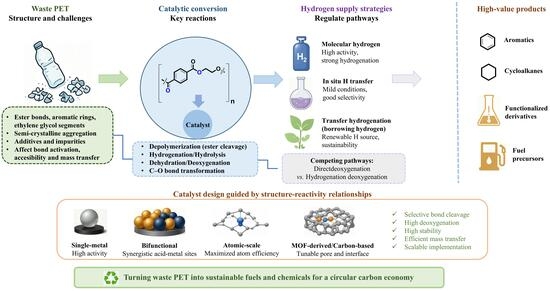
Graphical Abstract

1. Introduction

The continued growth of global plastic waste and persistently low recycling rates reveal the limitations of traditional plastic production and consumption models in terms of resource efficiency and environmental impact. Traditional disposal methods treat plastic waste simply as solid waste to be landfilled or incinerated. However, in catalytic conversion systems, plastic waste can be used as a renewable carbon source to produce high-value chemicals and clean fuels [1]. The catalytic high-value conversion of waste plastics involves the selective cleavage of chemical bonds, the restructuring of functional groups, and the precise regulation of the carbon backbone to directionally convert waste plastics into polymer monomers, platform compounds, fine chemicals, or fuel precursors, thereby improving carbon utilization and enhancing the added value of the products.
PET is one of the most studied polyester materials in research on chemical recycling and catalytic upcycling of plastics. It is formed by the polycondensation of terephthalic acid (TPA) and ethylene glycol (EG), and its molecular structure contains various active groups such as ester bonds, carbonyl groups, aromatic rings, and ethylene glycol segments, providing multiple reactive sites for reactions such as depolymerization, hydrogenation, hydrolysis, deoxygenation, aromatic ring transformation, and functionalization [1,2], However, the rigid aromatic backbone, semi-crystalline structure, and intermolecular stacking of PET, together with dyes, additives, and impurities in real waste, hinder effective contact between catalyst active sites and polymer reactive sites. As a result, the catalytic conversion of PET is constrained by both its intrinsic chemical reactivity and the catalytic accessibility of its molecular segments [3,4]. Therefore, the catalytic conversion of PET is not a simple degradation process, but rather a selective conversion process governed by a combination of molecular structure, aggregate characteristics, mass transfer limitations, and catalyst surface interactions.
Waste PET primarily comes from beverage bottles, food packaging materials, textile fibers, and engineering plastic products. The current recycling methods mainly include mechanical recycling, chemical depolymerization, and thermochemical conversion [5]. Mechanical recycling technologies are mature and cost-effective and have been successfully implemented at the industrial scale. However, repeated melting and processing cause chain scission, reduced molecular weight, and impurity buildup, leading to continuous deterioration in mechanical and processing properties [6]. Chemical depolymerization selectively recovers raw materials such as TPA, Bis (2-hydroxyethyl) terephthalate (BHET), Dimethyl terephthalate (DMT), and EG, as monomers or oligomers, through processes such as hydrolysis, ethylene glycol hydrolysis, methanol hydrolysis, and ammonia hydrolysis. However, it is difficult to achieve the targeted production of high-value-added chemicals through this method [7]. Thermochemical conversion technologies such as pyrolysis and hydrocracking can convert PET into fuel components and small-molecule chemicals. However, they generally suffer from issues including complex product distributions, low selectivity for target products, and scope for improvement in overall carbon resource utilization efficiency [6,7].
Compared with other traditional approaches, the catalytic upgrading of PET involves the directed conversion of PET structural units. Specifically, through the synergistic control of processes such as the selective cleavage of ester bonds, carbonyl hydrogenation, C–O bond hydrogenolysis, aromatic ring retention/hydrogenation, and deoxygenation, waste PET can be selectively converted into closed-loop recycled monomers, aromatic chemicals, alicyclic monomers, functionalized monomers, and fuel precursors [1]. Based on this, the catalytic upgrading of PET involves two stages: Deconstructing PET into repolymerizable monomers to enable closed-loop recycling of carbon resources, and further converting PET-derived intermediates into high-value products to expand the chemical value chain for the recovery of polyester waste.
Currently, most reviews on PET conversion are categorized according to process routes such as hydrolysis, alcoholysis, ammonolysis, hydrogenolysis, or thermal cracking, focusing primarily on reaction conditions, catalysts, and product types. However, there remains a lack of systematic analysis regarding how the intrinsic structure of PET determines the entry points of catalytic reactions, the regulation of key pathway branching by different active sites, and the impact of the matrix complexity of actual waste PET on catalytic activity and operational stability. A research framework based solely on process type cannot adequately reveal the intrinsic structure–activity relationships linking PET structural features, catalyst design, and product selectivity.
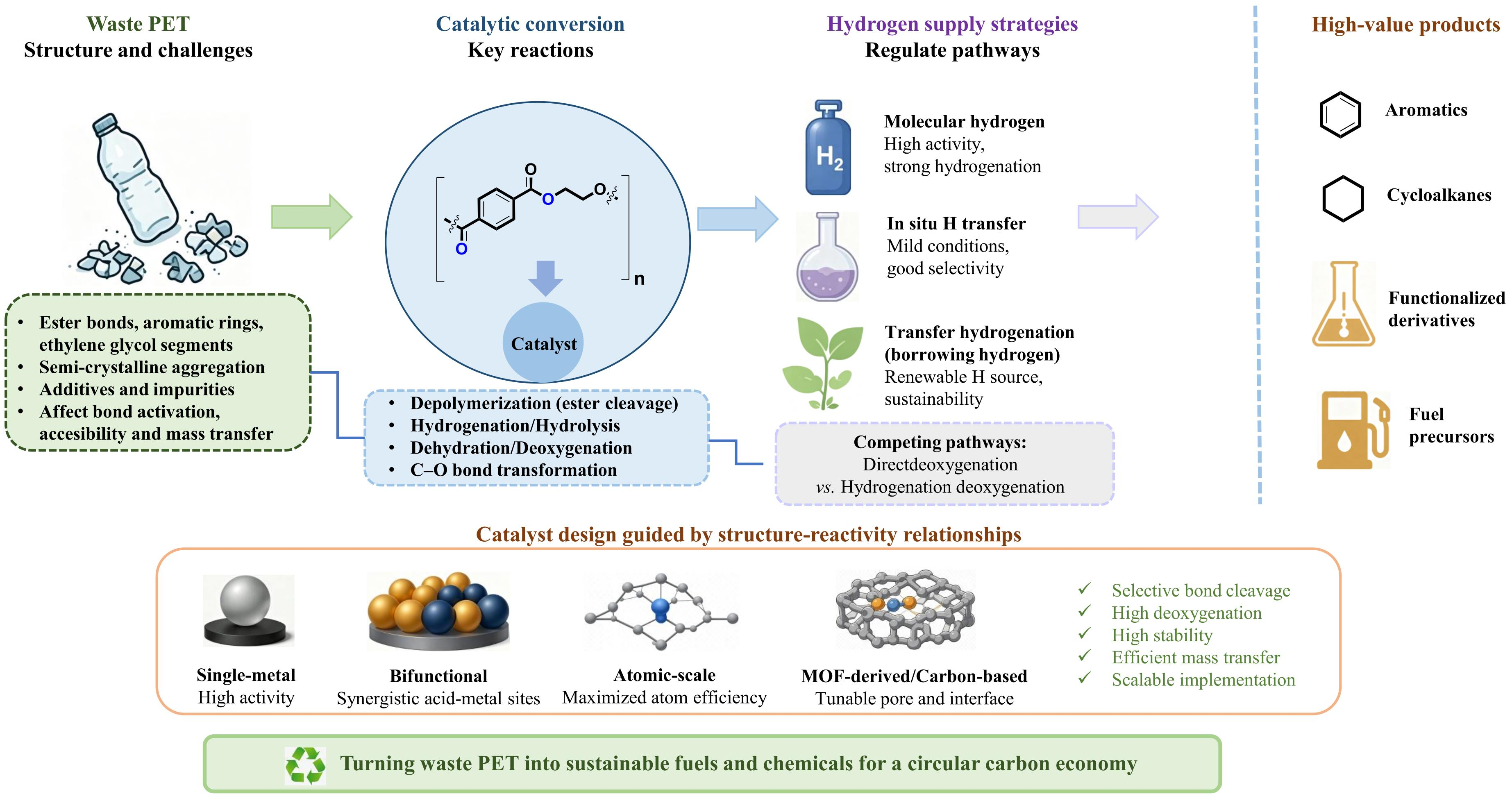
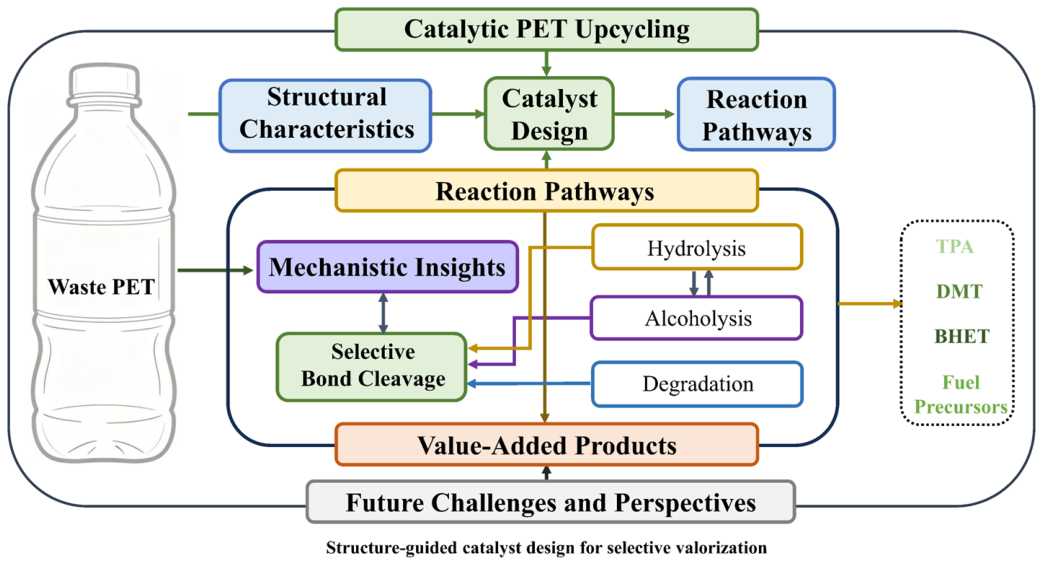
Based on the reactivity of PET structures, this paper establishes a framework encompassing structural characteristics, catalyst design, reaction pathway control, mechanism analysis, and the production of high-value products. Focusing on the catalytic conversion of PET into high-value products, this paper explores various dimensions, including PET structural effects, catalytic system design, product-oriented reaction networks, and reaction mechanism analysis. It elucidates the impact of PET structural properties and the complexity of real waste plastics on the reaction, outlines the logic behind the construction of catalytic systems, analyzes the conversion pathways for different target products, and, using multi-scale research methods, clarifies the evolution of active sites and the mechanisms of reaction selectivity (Figure 1).
To ensure the timeliness and relevance of the references, this review adopted clear literature screening criteria:
(1)
Time frame. Priority was given to studies on the catalytic upgrading and recovery of PET published between 2020 and 2026; only landmark foundational papers published before 2020 were retained to explain the underlying mechanisms.
(2)
Screening criteria. All core literature on PET depolymerization and hydrogenation was included. Polyethylene (PE) and other polyolefin studies were used solely for comparative analysis of mass transfer and catalyst deactivation, with their relevance noted in the text. Irrelevant papers on purely mechanical pyrolysis were excluded.
(3)
Standardization of Definitions. All chemical abbreviations and catalytic terminology adhere to IUPAC and mainstream journal standards. The list of abbreviations was revised to eliminate definitional errors.

2. Structural Characteristics and Catalytic Activity of PET

Unlike nonpolar plastics such as polyolefins, PET contains ester bonds, carbonyl groups, aromatic rings, and ethylene glycol segments, which give it both selectively activatable reaction sites and high chemical stability and structural rigidity [8]. Therefore, the catalytic conversion of PET is not a simple polymer depolymerization process, but rather a selective conversion process influenced by the combined effects of molecular structure, aggregate state characteristics, segment accessibility, and the complex composition of actual waste PET. By focusing on the molecular structure of PET, selective bond cleavage behavior, and key structural factors affecting reaction activity, this study provides a structural foundation for subsequent catalyst design and the regulation of product-oriented pathways.

2.1. Molecular Structure and Chemical Stability of PET

The ester bonds, carbonyl groups, aromatic rings, and ethylene glycol segments in the PET repeat unit collectively govern both its chemical stability and reaction pathways. Among these, the ester bonds serve as the key sites for PET depolymerization and initial activation. Their cleavage leads to the formation of monomers or oligomeric intermediates such as TPA, BHET, DMT, and EG [9]. The carbonyl group is highly polar. Its carbonyl carbon is susceptible to nucleophilic attack, which promotes acyl substitution. It also serves as a key site for the formation and transformation of oxygenated intermediates during hydrogenation and dehydrogenation [10,11]. Aromatic rings impart rigidity and thermal stability to the PET main chain and modulate the reactivity of adjacent ester bonds and carbonyl groups through electronic effects [12]. Under mild catalytic conditions, the aromatic skeleton typically remains intact, yielding aromatic products such as TPA, aromatic alcohols, or diols. Under hydrogenation conditions, these can be further converted into alicyclic monomers or cyclic alcohols [11,12]. Conformational changes in the ethylene glycol segments influence local chain flexibility, segment mobility, and the accessibility of ester bonds. Simultaneously, these segments can act as alcoholysis reagents or oxygen-containing platform molecules to participate in subsequent hydrolysis, hydrogenation, and deoxygenation reactions [13,14].
Overall, the catalytic conversion of PET primarily involves the cleavage of ester bonds, the conversion of carbonyl groups, the activation of C–O bonds, and the selective functionalization of aromatic rings [15]. In most mild catalytic systems, the aromatic C–C backbone is not a preferred site for cleavage but rather serves as a platform structure for subsequent functionalization and saturation reactions. In contrast, carbon backbone cracking and C–C bond rearrangement typically occur only under high-temperature cracking, deep hydrocracking, or strong reduction conditions, and are primarily associated with fuel production pathways rather than serving as a common mechanism for the high-value upgrading of PET [12,16].

2.2. Selective Bond Cleavage and Reaction Pathways in PET

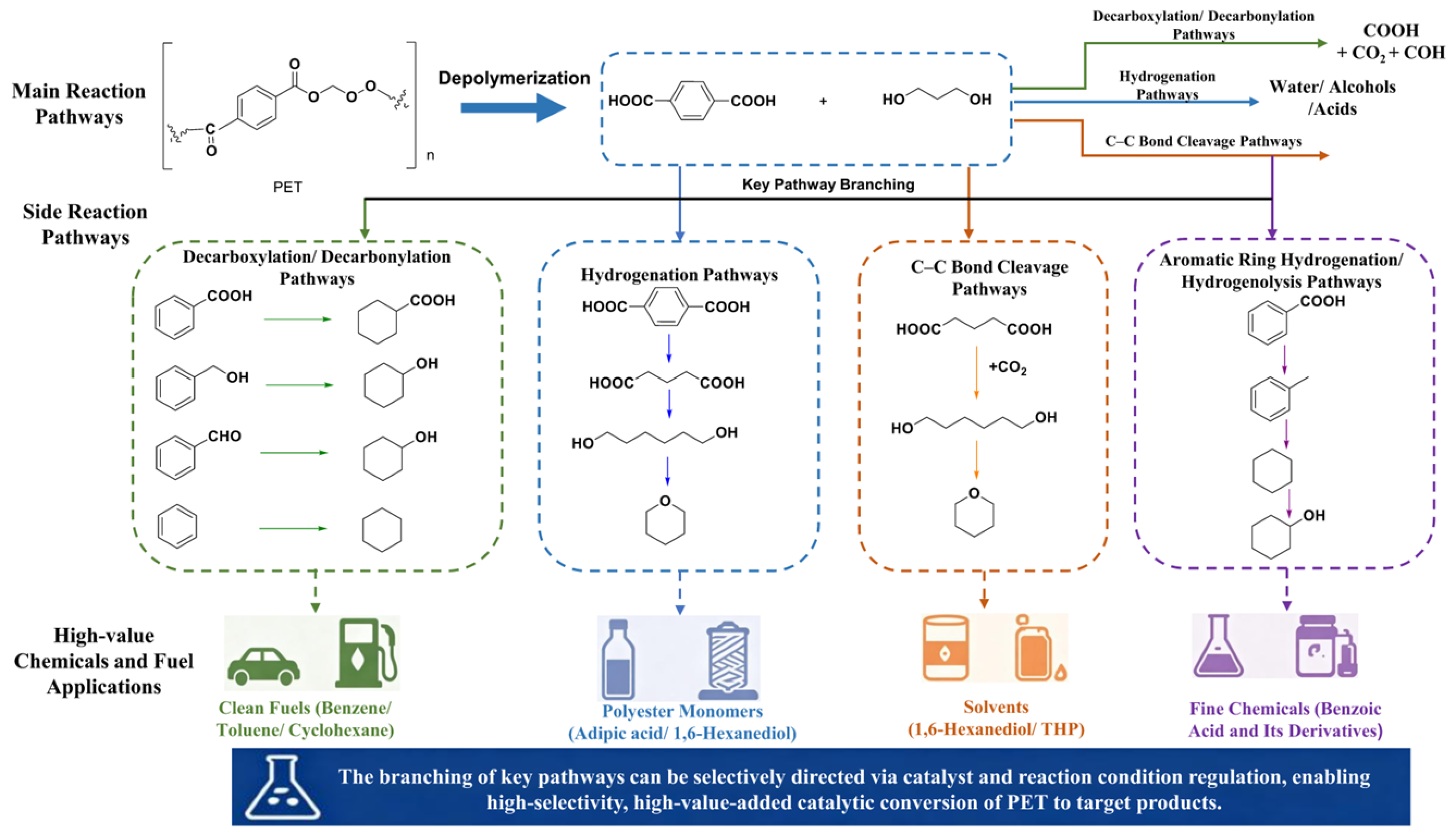
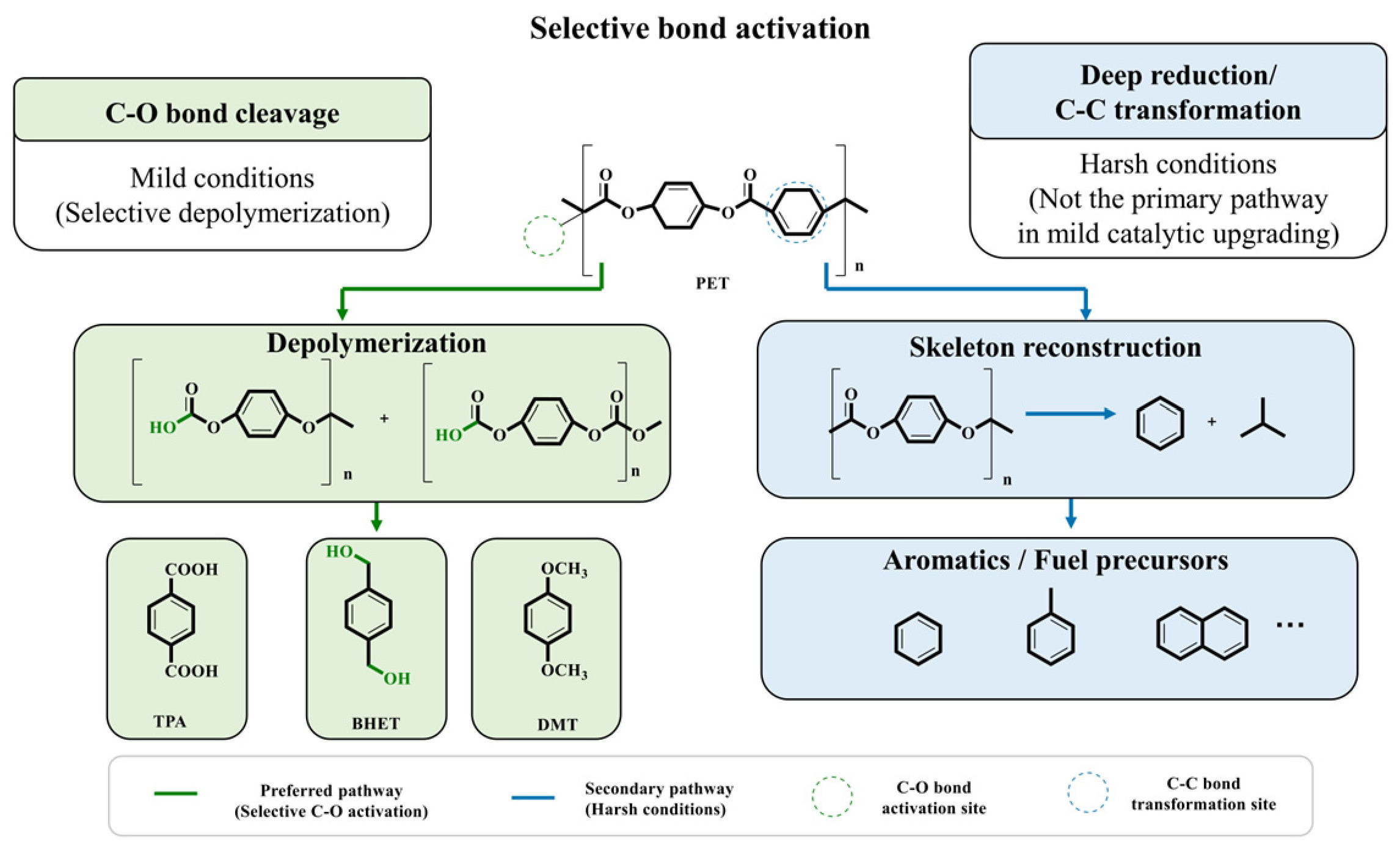
The core of catalytic PET upgrading is the selective activation of key chemical bonds and the targeted synthesis of products through controlled bond cleavage and intermediate transformation pathways. Traditional chemical depolymerization methods, such as hydrolysis, alcoholysis, and amide hydrolysis, primarily involve the selective cleavage of ester bonds in the PET main chain to produce TPA, BHET, MHET, DMT, and related oligomer intermediates [12,17,18]. These intermediates can undergo further hydrogenation, dehydrogenation, and reduction reactions to produce high-value oxygen-containing compounds, aromatic chemicals, and alicyclic monomers [19]. Therefore, PET depolymerization not only enables monomer recovery but also provides a key reaction platform for subsequent selective functionalization and catalytic upgrading. As shown in Figure 2, catalytic upgrading of PET involves competing pathways such as ester bond cleavage, C–O bond transformation, aromatic ring hydrogenation, and deep deoxygenation/cracking. Mild conditions tend to favor selective C–O activation and monomer recovery, whereas harsh conditions promote aromatic skeleton restructuring and conversion to fuels.
During the subsequent catalytic upgrading process, the hydrogenation of ester and carbonyl groups, together with the C–O bond hydrogenolysis, jointly determine the evolution pathways of oxygen-containing intermediates. The hydrogenation of carbonyl and ester groups promotes the conversion of acid and ester intermediates into alcohol compounds, while the dehydrogenation of C–O bonds further reduces the oxygen content, driving the formation of aromatic alcohols and low-oxygen aromatic compounds [20,21,22]. The competition between the two determines whether the product remains at the oxygen-containing platform molecule stage or continues to transform into a more deeply reduced product.
In addition, the extent to which the aromatic skeleton is retained and the degree of hydrogenation further determine the type of final product [23]. When the aromatic ring remains intact, PET-derived intermediates can form TPA, aromatic alcohols, and other aromatic platform compounds [24]. Further hydrogenation and saturation of the aromatic ring can lead to the formation of alicyclic dicarboxylic acids, alicyclic diols, and cycloalkanes [19]. Extensive deoxygenation, cracking, and carbon skeleton restructuring typically require stronger reducing or acidic catalytic conditions and result in low-oxygen products such as aromatics, naphthenes, and fuel precursors [25].
Therefore, the selective conversion of PET is not a single-bond cleavage process, but rather is determined by the competition among reactions such as ester bond activation, C–O bond hydrogenolysis, carbonyl hydrogenation, aromatic ring hydrogenation, and deep deoxygenation/cracking. The relative advantages of different pathways depend on the reactivity of chemical bonds, the stability of intermediates, the accessibility of chain segments, and reaction conditions, providing a foundation for subsequent catalyst design and the selective control of reaction pathways.

2.3. Structural Factors Governing the Catalytic Reaction of PET

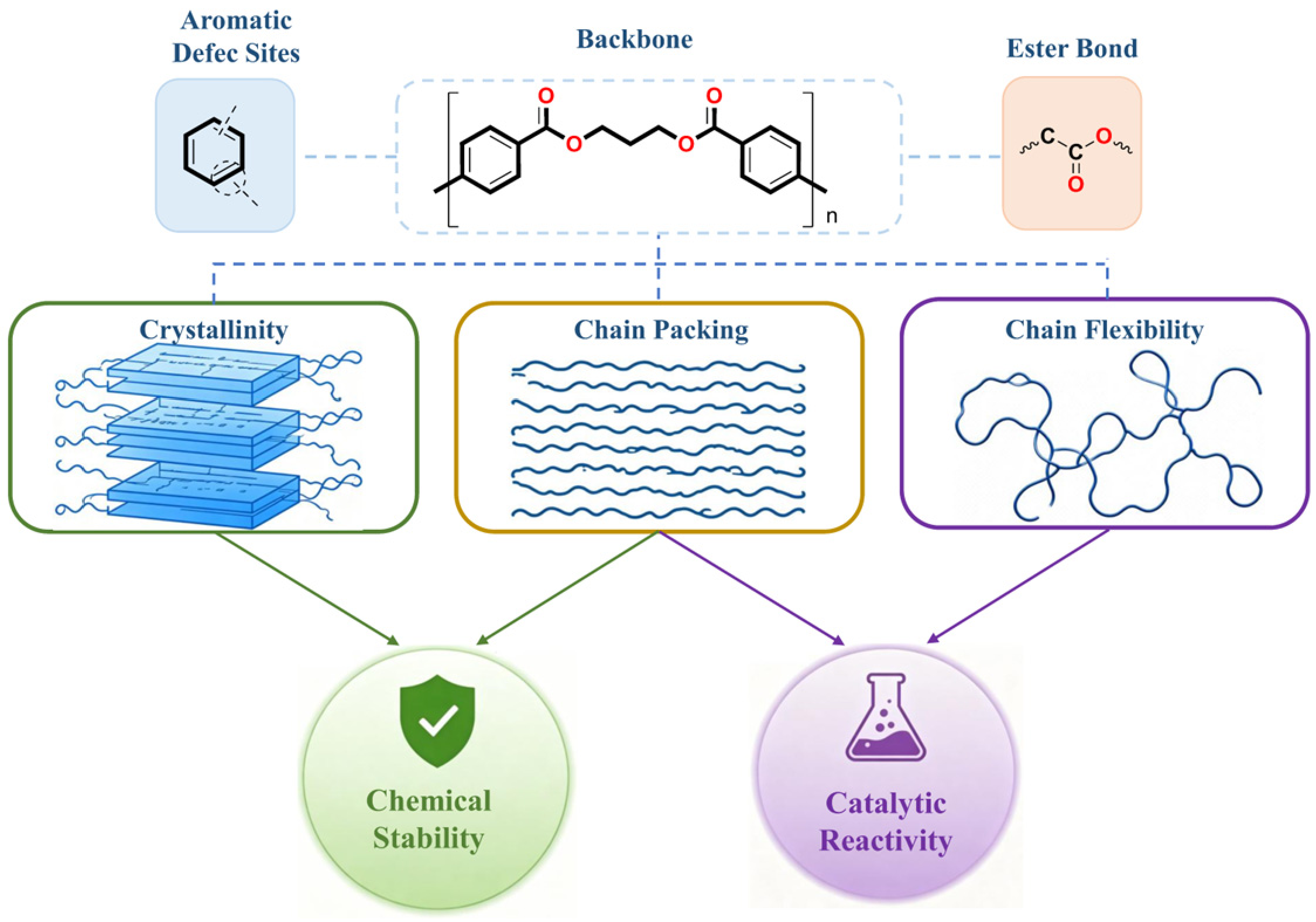
The reactivity of PET in catalytic reactions depends not only on the activation energy of individual bonds but also on molecular structure, morphological characteristics, segment accessibility, and the complexity of real waste PET [26]. As shown in Figure 3, the molecular structure of PET determines the reactive sites, while the aggregate structure further regulates the accessibility of these sites during the reaction. Together, they influence the catalytic reaction pathways and product distribution.
At the molecular structural level, the ester bonds and carbonyl groups in PET serve as the primary reaction points for depolymerization and the transformation of oxygen-containing intermediates, while the aromatic rings influence backbone retention, aromatic ring hydrogenation, and product types. The ethylene glycol segments, meanwhile, affect the exposure of reaction sites by regulating local flexibility, conformational changes, and segment migration [27]. Thus, the electronic effects and spatial configurations of the different structural units within the repeating unit jointly determine the selective activation behavior of PET.
From the perspective of aggregate structure, crystallinity and segment orientation significantly influence catalytic accessibility [27]. In highly crystalline regions, molecular chains are tightly packed, and ester bond sites are constrained by ordered stacking, making it difficult for the catalyst, solvent, and reactants to come into close contact, which results in a reduced depolymerization rate. In contrast, amorphous regions exhibit greater segmental freedom, allowing reaction sites to be more readily exposed. Hydrolysis, alcoholysis, or hydrogenolysis typically occur preferentially in these regions [28]. For fiber-grade PET and stretch film, the oriented structure further enhances interchain packing and diffusion constraints, causing the reaction to tend to initiate at the outer surface, defect regions, and amorphous regions, and gradually progress toward the internal crystalline regions [27].
In addition to the aggregated structure, segment accessibility is also influenced by a combination of particle size, specific surface area, degree of swelling, solvent penetration, and the plasticizing effect of the reaction medium [29]. In different catalytic systems, the ability of the reaction medium to effectively penetrate the PET phase and approach the target bond is just as important as the intrinsic reactivity of the chemical bond itself [30]. Thus, catalytic conversion of PET depends not only on bond activation capacity but is also governed by a combination of factors, including segment exposure, mass transfer processes, and the migration behavior of intermediates [23].
Differences in the structure and composition of real PET further increase the uncertainty of the catalytic conversion [12]. Real PET typically exhibits variations in origin, molecular weight, crystallinity, and orientation, and contains dyes, plasticizers, stabilizers, fillers, metal residues, and other plastic impurities [31]. Textile, colored, and multilayer packaging PET exhibit significant differences in purity and additive composition, which may further affect swelling behavior, mass transfer processes, intermediate adsorption, and catalyst stability [31,32]. In mixed plastic systems, chlorine-containing, nitrogen-containing, or hydrocarbon species generated by components such as polyvinyl chloride (PVC), polyamide (PA), polyethylene (PE), or polypropylene (PP) may also induce catalyst poisoning, carbon deposition, and changes in product distribution [33].
Therefore, the catalytic upgrading of PET requires simultaneous consideration of reactivity at the molecular scale, accessibility of aggregated states, and the complexity of actual waste PET. Clarifying the relationship between these structural factors and selective bond cleavage is the foundation for transitioning from empirical optimization to structure-directed pathway control.

3. Design of Functional Sites and Structure–Activity Relationships in the Catalytic Upgrading of PET

In PET hydrogenation, hydrolysis, and deoxygenation upgrading, polymer segments must undergo a series of sequential steps (e.g., surface approach, initial ester bond activation, hydrogen generation and transfer, adsorption/desorption of oxygenated intermediates, and further conversion) [34]. Catalyst design must satisfy the requirements of individual reaction steps while also coordinating the synergistic interplay among multiple catalytic functions. Focusing on the core catalytic functions corresponding to the target reaction network, this study reviews relevant experimental and theoretical research supporting key issues such as catalyst component regulation strategies, interface construction, spatial proximity effects, pore structure optimization, and previously reported structure–activity relationships. It systematically elucidates the design principles for high-value PET conversion catalysts from three dimensions Including functional requirements, structural regulation, and experimental evidence.

3.1. Catalytic Functional Requirements and Action Mechanism

In nucleophilic depolymerization systems, the initial conversion of PET primarily depends on the activation of the carbonyl group of the ester bond and the attack of nucleophilic species on the carbonyl carbon [35]. Acid and base sites work synergistically to promote ester bond cleavage. Lewis acid (L-acid) sites can coordinate with the carbonyl oxygen or the ester oxygen, thereby increasing the electrophilicity of the carbonyl carbon. Brønsted acid (B-acid) sites, on the other hand, enhance ester bond polarization through protonation or hydrogen bonding. Basic sites promote the activation of nucleophilic species such as water, alcohols, or amines, thereby accelerating the nucleophilic substitution process [36,37]. However, the effectiveness of acid and base functions does not depend solely on the number of sites, but rather on site type, strength, accessibility, and the compatibility between the substrate and the reaction medium [38]. Excessively strong acidic sites may induce side reactions such as dehydration, condensation, and carbon accumulation. In contrast, an excessively strong basic environment may lead to saponification, salt formation, and subsequent separation difficulties [39]. Therefore, the key to PET ester bond activation lies not in maximizing acid–base activity, but in achieving a balance between bond-cleavage efficiency and the suppression of side reactions, while ensuring localized polarization and nucleophilic activation [40,41].
During PET hydrogenation and hydrodeoxygenation, catalysts promote hydrogen dissociation, surface-hydrogen migration, and directional hydrogen-species transfer to oxygen-containing intermediates [42]. By contrast, PET hydrolysis proceeds via nucleophilic attack on ester carbonyls for selective ester-bond cleavage and requires no hydrogen activation [36,37]. The adsorption strength of metal sites for hydrogen and oxygen-containing species must fall within an appropriate range. Weak adsorption limits H2 activation and hydrogen transfer, while excessive adsorption may lead to intermediate retention, increased surface coverage, and non-selective deep conversion [43]. Therefore, hydrogen activation capacity alone is not a sufficient indicator for evaluating catalytic performance. It is also necessary to comprehensively consider the hydrogen generation rate, surface hydrogen coverage, hydrogen migration pathways, and the residence time of oxygen-containing intermediates at active sites.
Another key function is the selective recognition of carbonyl, ester, and C–O bonds [23]. Another key function is the selective recognition of carbonyl, ester, and C–O bonds [23]. Oxygen-affinity sites, defect structures, and the metal–support interface can adjust the adsorption configuration of oxygen-containing intermediates, thereby influencing the competitive relationships among carbonyl hydrogenation, ester bond cleavage, and C–O bond hydrogenolysis [44,45]. However, excessive adsorption of oxygen-containing species does not necessarily promote the target reaction; rather, it may hinder product desorption and induce continuous deoxygenation or deep conversion [46,47]. Thus, catalyst design should not be evaluated solely based on a single adsorption energy or oxygen vacancy concentration, but should comprehensively consider adsorption configuration, bond-breaking energy barriers, and product desorption kinetics.
Besides the intrinsic properties of active sites, the catalytic conversion of PET macromolecular substrates is also significantly influenced by interfacial contact and mass transfer processes [12]. The catalyst must facilitate the migration of polymer segments, swollen intermediates, or soluble oligomers toward the active sites, while ensuring that primary products can rapidly desorb and diffuse away from the reaction interface [27]. Therefore, structural parameters such as external surface accessibility, pore size and connectivity, surface wettability, and solvent compatibility, together with the properties of the active sites, jointly determine the catalytic efficiency [48]. In diffusion-limited systems, simply increasing the active site density not only fails to improve the apparent reaction rate but may also reduce catalytic stability due to pore blockage, localized overreaction, and carbon deposition [17] (Table 1).

3.2. Catalyst Composition and Electronic Structure Regulation

The catalyst composition determines whether different catalytic functions can operate synergistically within a single system. Metal sites primarily mediate H2 activation and hydrogen transfer, whereas acid and base sites promote ester bond polarization and nucleophile activation. Oxygen-affinity components and defect structures, meanwhile, contribute to the stabilization of oxygen-containing intermediates and the regulation of bond-cleavage mechanisms [49]. Consequently, the key to composition design lies not in simply increasing the content of active components, but in balancing the relative rates of different functional steps within the target reaction network. If the rate of ester bond cleavage is lower than that of the subsequent hydrogenolysis process, highly active metal sites may not be fully utilized due to insufficient substrate supply. Conversely, if depolymerization proceeds too rapidly and subsequent transformations are insufficient, this may lead to the accumulation of oligomers and oxygen-containing intermediates, causing pore blockage and side reactions [50,51].
Bimetallic and alloy systems are often used to decouple hydrogen activation from the conversion of oxygen-containing bonds [52]. Electronic effects can alter adsorption strength and reaction energy barriers by modulating the d-band structure of metal centers, while geometric effects can change the adsorption configuration of reactants and reaction pathways by controlling metal size [53,54,55]. However, performance improvements in bimetallic systems do not necessarily stem from true bimetallic synergy. They may also be attributed to increased metal dispersion, changes in particle size, alterations in support properties, or an increase in the number of active sites [56]. Therefore, to elucidate the mechanism of bimetallic synergy, comparative experiments must be conducted using single-metal catalysts, physically mixed metal samples, and metal-interface catalysts, while maintaining consistency in particle size, metal loading, and the degree of active site exposure. Concurrently, multidimensional characterization methods, including normalized reaction rate analysis, the evolution of product selectivity, and in situ structural characterization, should be employed to comprehensively validate the bimetallic synergy effect.

3.3. Synergy Among Multifunctional Sites and Spatial Coupling of Sites

The advantage of multifunctional catalysts lies in the ability of adjacent functional sites to work together in a series of consecutive steps (e.g., ester bond activation, hydrogen generation, intermediate migration, and subsequent bond cleavage) [57,58]. Appropriate spatial proximity can shorten the migration distance between intermediates and active hydrogen species, thereby reducing the probability of them entering off-target reaction pathways. However, a smaller site distance is not necessarily more advantageous [59,60]. When strong acid sites and strong dehydrogenation sites are too close, primary products may undergo further dehydration, deoxygenation, or cracking before desorption. Conversely, excessive site spacing increases the resistance to intermediate diffusion and leads to competitive adsorption and mass transfer limitations [61]. Therefore, the spacing between functional sites should be regarded as a key parameter influencing the kinetics of cascade reactions, rather than merely a structural characterization indicator.
The metal-support interface is generally considered a key region where hydrogen activation and carbonyl polarization act synergistically. However, establishing interface effects requires distinct experimental and theoretical evidence [62,63]. While the support modulates the metal particle size, valence state, and wettability, it may also alter PET swelling behavior, oligomer adsorption, and the local solvent environment. Therefore, performance improvements do not necessarily stem from a specific active interface structure [17]. More reliable evidence of interfacial synergy should include a quantitative correlation between interfacial density and intrinsic reaction rates, changes in selectivity under conditions where metal particle size and dispersion are kept similar, the dynamic stability of the interfacial structure under in situ conditions, and reversible regulation achieved through selective poisoning, site blocking, or interfacial engineering [64].

3.4. Synergistic Regulation of Support, Interface and Defects

The molecular size of PET and its oligomers is much larger than that of conventional small-molecule reactants. Therefore, a high site density within the micropores does not necessarily translate into effective active site utilization. For partially dissolved PET, reactions typically occur preferentially on the outer surface, in defect regions, or near swollen chain segments. Consequently, the outer surface area and mesoporous connectivity better reflect catalytic accessibility than the total specific surface area [65,66]. Hierarchical pore structures can provide multiscale transport pathways for polymer chain segment approach, oligomer diffusion, and product desorption. However, pore structure optimization must be considered in conjunction with the actual swollen state under liquid-phase reaction conditions. Conventional nitrogen adsorption tests do not fully represent the effective pore channels during the reaction process [30,67].
To determine whether the pore structure truly improves catalytic performance, the effects of external mass transfer and internal diffusion must be ruled out [68]. Although this study focuses on polyethylene, the principles of hierarchical pore engineering presented here can be applied to PET conversion systems. Therefore, diffusion limitations should be evaluated by combining various variables, such as PET particle size, stirring rate, catalyst particle size, and substrate concentration, using methods such as apparent activation energy, initial reaction rate, and the Weisz–Prater criterion [69,70]. When the reaction rate depends significantly on PET particle size or stirring conditions, performance differences among catalysts cannot be simply attributed to the intrinsic properties of active sites [71,72]. Only after mass transfer limitations are quantitatively eliminated can reliably compare the structure–activity correlations linking catalyst composition, electronic properties, interfacial configuration and catalytic performance.

3.5. Structure–Activity Relationships and Catalyst Design Principles

In current research on the catalytic upgrading of PET, many of the proposed structure–activity relationships remain at the level of correlation rather than strict causality [73]. A common analytical approach involves comparing catalyst characterization parameters with the final conversion rate or selectivity, and attributing a specific structural feature in high-performance catalysts to the source of activity. However, such analyses often overlook variables such as the number of active sites, substrate accessibility, mass transfer effects, solvent effects, and dynamic catalyst restructuring [74]. Therefore, a reliable structure–activity relationship requires not only demonstrating that a specific structural feature coincides with changes in performance but also proving that this structural change can modulate specific elementary steps, reaction pathway branching, and intrinsic reaction rates predictably [75]. For the Ru-catalyzed PET hydrogenolysis system, isotope-tracing experiments verify that C–O bond cleavage proceeds via hydrogenolysis instead of dehydrogenation, supported by deuterium (from D2 tracer) incorporation into product methyl groups [42]. Likewise, in situ XPS and EXAFS of Co/Al2O3 reveal dynamic variation in the Co0/Co2+ ratio under reaction conditions. This ratio directly governs para-xylene selectivity, proving that catalytic active sites are not static but dynamically reconstruct under reaction conditions [43,45].
Establishing structure–activity relationships in the catalytic upgrading of PET requires consideration of at least several levels of evidence. First, variable interference must be eliminated by using control systems with similar composition, particle size, and exposed sites. Second, kinetic indicators, such as the initial turnover frequency per accessible active site, should be used in place of simple endpoint conversion rates. Furthermore, by combining time-resolved analysis, isotope tracing, in situ characterization, and theoretical calculations, a quantitative link is established between structural evolution and key elementary steps. Finally, the generalizability of the structure–activity relationship is assessed through cross-scale validation using model intermediates, model PETs, and real PET systems [73,76,77]. If the relationship is established solely based on data from a single pure substrate and final-state performance, its generalizability will be severely limited.
Catalyst stability is also an integral part of the structure–activity relationship, rather than an engineering parameter independent of activity. Metal sintering, leaching, acid–base site loss, interfacial restructuring, pore blockage, and impurity poisoning can all alter the actual reaction pathways [78,79,80,81]. If structural evolution under operating conditions is ignored, structural features observed before the reaction may be mistaken for the actual active structure. Therefore, future research should comprehensively evaluate structural changes in the catalyst before the reaction, during operation, and after deactivation, and correlate these changes with initial reaction rates, selectivity evolution, and cycling performance. Table 2 summarizes the levels of evidence and minimum validation requirements needed to establish structure–property relationships for the catalytic upgrading of PET. Overall, PET catalyst design should gradually shift from empirical structure–property relationships correlations to the construction based on mechanistic validation and activity prediction.
In summary, catalyst design for the catalytic upgrading of PET should follow the principle of functional matching driven by the reaction network, rather than deriving reaction pathways based on material categories. Through the synergistic regulation of composition, interfaces, site spacing, pore structure, and wettability, rate matching between different elementary steps can be achieved. Combined with controlled-variable experiments, in situ characterization, and kinetic analysis, this approach establishes structure–activity relationships with causal relationships. Only by simultaneously balancing activity, selectivity, accessibility, and stability can catalyst design lay the foundation for scaling up from model systems to actual waste PET.
However, the function of the catalyst does not directly determine the final product. Rather, it influences the competition among different reaction pathways by regulating the formation, transformation, and desorption of shared intermediates. The mechanism of pathway branching and the principles of selectivity control in the high-value processing of PET will be discussed further.

4. Pathway Branching and Selectivity Control in the High-Value Conversion of PET

The high-value conversion of PET is essentially a complex network of competing reaction pathways, not a simple mapping between catalyst type and target product. Different products typically arise from common primary depolymerization intermediates and diverge along distinct pathways in subsequent steps, including carbonyl hydrogenation, C–O bond hydrogenolysis, aromatic ring hydrogenation, selective functionalization, and deep deoxygenation [17,82]. Based on shared intermediates and their evolution, this paper focuses on the formation pathways of different target products, analyzes key pathway branching points that influence carbon efficiency and product selectivity, and further elucidates the mechanisms by which catalyst composition, active site structure, and reaction conditions regulate pathway distribution. Figure 4 summarizes the reaction network and key branching nodes for the evolution of shared intermediates into different high-value products during the catalytic upgrading of PET. The various product pathways are not mutually exclusive but are jointly determined by multiple competing elementary reactions. Their final distribution depends on the synergistic interaction among catalyst structure, active site properties, and reaction environment.
Before analyzing PET catalytic conversion pathways, this work defines unified criteria to avoid ambiguous reaction classification. Two transformation routes are differentiated: closed-loop monomer recovery and upcycling to chemically modified/value-added products. Closed-loop recovery depolymerizes PET into native monomers (TPA, BHET). For the upcycling route, hydrogenation, amination, and other transformations are used to obtain structurally novel high-value chemicals. Skeletal rearrangement only occurs in some specific reaction pathways. Seven chemically distinct reactions, namely hydrolysis, alcoholysis, hydrogenation, hydrocracking, dehydrogenation, functionalization and fuel-targeted cracking, possess independent mechanisms and will be discussed separately in text and tables. Two experimental systems are also distinguished: direct conversion of bulk waste-PET polymer, and conversion over pre-depolymerized TPA/BHET model substrates. Monomer models fail to reproduce polymer swelling and interfacial mass transfer limitations, so their kinetic and selectivity performance cannot be directly compared. Subsequent sections and Table 3 adopt this unified classification standard.

4.1. Shared Intermediates and Pathway Branching

The catalytic upgrading of PET can involve two types of reaction mechanisms. The first involves depolymerization followed by upgrading, in which PET first forms soluble oligomers and monomers under the influence of solvents, acid–base sites, or interfacial interactions, and subsequent transformations, such as hydrogenation and hydrogenolysis, are then carried out at metal sites. The second involves polymer segments undergoing simultaneous bond cleavage and hydrogenation processes at multifunctional interfaces. However, direct experimental evidence is still absent for the pathway where macromolecular PET chains access metal active sites inside catalyst pores. Time-resolved product monitoring and intermediate-trapping experiments indicate that for most supported-metal catalysts (e.g., Ru/TiO2, Pt/CeO2), PET is first depolymerized at external acid–base sites to form soluble intermediates. These intermediates then migrate toward metal sites for further conversion, with no direct contact between polymer chains and metal centers [18]. This conclusion is supported by control experiments: under identical conditions, intact PET and model substrates (BHET, DMT) yield highly similar product distributions, implying common diffusible intermediates in both systems [83]. It is often difficult to distinguish between these mechanisms based solely on the distribution of final products [45]. Therefore, experiments using model substrates such as TPA, DMT, or BHET are primarily used to elucidate the subsequent transformation patterns of intermediates and cannot directly represent the initial activation process of the PET polymer phase. When comparing reaction pathways, it is necessary to clarify whether the subject of study is the direct transformation of the polymer or the further upgrading of depolymerization products [83,84].
The presence of an intermediate does not necessarily mean that increasing its concentration will improve the yield of the target product. An intermediate may serve as a key reaction node, or it may become a reaction bottleneck or accumulate in a side stream [85]. Only by combining time-resolved concentration profiles, independent intermediate feeding experiments, and kinetic analysis can the formation–consumption relationship of an intermediate be determined [86]. Therefore, the core of product-oriented control lies in modulating the rate relationships between the target branch and competing pathways, ensuring that the target reaction takes precedence over re-esterification, side reactions, and deep degradation, while simultaneously maximizing carbon efficiency.

4.2. Closed-Loop Monomer Pathway

This section addresses the closed-loop monomer recovery pathway. Only bulk waste PET polymer is used as the substrate. No model compounds (TPA, BHET) are used for depolymerization. This route features selective ester-bond cleavage without carbon-skeleton reconstruction, yielding products identical to virgin PET in chemical structure. The key to the closed-loop monomer pathway lies in the selective cleavage of ester bonds and the rapid release and stable retention of monomers. This process is primarily governed by three factors. Whether the PET segments are sufficiently swollen to expose the ester bonds, the oligomers can be efficiently converted into the target monomers, and the resulting monomers undergo further re-esterification, condensation, or degradation [87,88]. Therefore, a high PET conversion rate does not equate to efficient closed-loop recovery. Particularly when the system is accompanied by the formation of large amounts of oligomers or non-repolymerizable byproducts, the value of material for recycling remains limited [89]. The selectivity of this pathway is primarily influenced by the nature of the acid and base sites, the reactivity of the nucleophile, the swelling capacity of the solvent, the composition of the reaction medium, and the rate of product removal [90]. Strong ester bond activation can promote the depolymerization process but may also enhance side reactions. High nucleophile concentrations favor monomer formation but may increase the subsequent separation burden [91]. Therefore, the evaluation of closed-loop pathways should comprehensively consider the separation yield, purity, and repolymerization performance of the repolymerizable monomers, rather than focusing solely on the PET conversion rate [87].

4.3. Aromatic Oxygen-Containing Compound Pathway

This section describes the high-value upgrading pathway. Both bulk waste PET and TPA model substrates can be applied herein. Aromatic carbon skeletons are reconstructed via competing carbonyl hydrogenation and decarboxylation reactions, producing oxygen-containing aromatic chemicals with novel molecular structures. The aromatic oxygen-containing compound pathway aims to preserve the aromatic carbon skeleton to the greatest extent possible. Its key pathway branching primarily occurs between carbonyl hydrogenation, C–O bond hydrogenolysis, and decarboxylation/decarbonylation processes [20]. When carbonyl hydrogenation predominates, the product can remain at the aromatic alcohol or aromatic diol stage. Further enhancing C–O hydrogenolysis, however, reduces the oxygen content of the product. Decarboxylation, decarbonylation, and cracking processes, on the other hand, may lead to irreversible carbon loss [43,45]. Therefore, the core of this pathway is not to maximize deoxygenation, but to establish a reasonable selectivity window between functional group transformation and the retention of aromatic carbon.
Key parameters influencing this branching behavior include the adsorption capacity of metal for the carbonyl group and the aromatic ring, surface hydrogen coverage, metal-oxygen affinity, acid site properties, and the spatial distance between the metal and the acid site. Stronger hydrogen activation promotes carbonyl conversion, but excessively high hydrogen coverage may promote hydrogenation of the aromatic ring. Increased acidity can promote C–O cleavage, but may also induce dehydration, condensation, and carbon deposition [45,92]. Thus, catalyst evaluation should take into account not only the selectivity of the target oxygen-containing functional group conversion but also the efficiency of aromatic carbon retention and carbon loss from gas-phase byproducts, rather than focusing solely on the yield of the main product.

4.4. Alicyclic Monomer Pathway

This section illustrates a typical upgrading route. Either bulk waste PET or BHET model intermediates can serve as substrates. Aromatic-ring hydrogenation and saturation constitute the core reactions for molecular skeleton rearrangement, producing alicyclic functional monomers. The key to the alicyclic monomer pathway lies in coordinating the reaction sequence between the hydrogenation of the aromatic ring and the conversion of the carboxyl, ester, or hydroxymethyl groups [19]. If the carbonyl group undergoes preferential complete hydrogenation while the rate of aromatic ring saturation is insufficient, the system is prone to accumulating intermediates such as aromatic diols. Conversely, preferential saturation of the aromatic ring may alter the adsorption configuration of the carboxyl or ester group on the alicyclic skeleton and its subsequent transformation behavior. At the same time, excessively rapid hydrogenolysis of the C–O bond can lead to the loss of the target bifunctional structure [93,94]. Therefore, the selectivity of this pathway does not depend on the feasibility of a single reaction step but is jointly determined by the kinetic matching among aromatic ring hydrogenation, carbonyl hydrogenation, and C–O bond cleavage.
This pathway branching is primarily regulated by the size of the continuous metal sites, the adsorption configuration of the aromatic rings, hydrogen pressure and surface hydrogen coverage, the electronic structure of the metal, the residence time of the reactants, and the properties of the acid sites [19,92]. Metal sites with strong aromatic adsorption and hydrogenation capabilities can promote aromatic ring saturation. However, excessively large continuous metal sites may further promote non-selective reactions such as dehydrogenation and ring opening [45,93]. Therefore, through alloying, diluting continuous metal sites, modulating the interfacial electronic structure, and optimizing residence time, a selectivity control window can be established between complete aromatic ring hydrogenation and effective functional group retention [95].

4.5. Functionalized Monomer Approach

This section focuses on a framework-remodeling upgrading pathway. It exclusively employs bulk waste PET polymers as substrates. Through amine-based nucleophilic substitution, heteroatoms are introduced to construct novel nitrogen-containing molecular frameworks, which are absent in pristine PET structures. The functionalized monomer approach is based on ester bond activation and employs nucleophilic substitution reactions, such as amination, amide cleavage, and alcohol-amine cleavage, to construct nitrogen-containing, oxygen-containing, and polyfunctional aromatic monomers. The key challenge lies in the selective competition between the target substitution and overreaction [96,97]. Insufficient nucleophilic activity can easily lead to the accumulation of oligomers or incompletely converted intermediates, whereas excessively high nucleophilic activity or local concentration may induce consecutive substitution, cross-linking, and the formation of complex byproducts [98].
This pathway branching is jointly influenced by the basicity and steric hindrance of the nucleophile, the acid–base strength of the catalyst, solvent polarity, PET swelling behavior, reactant ratios, and the solubility characteristics of the products. The key to catalyst design lies not simply in enhancing the activation of ester bonds, but in selectively lowering the energy barrier of the target substitution step and promoting the timely desorption of the product, thereby preventing non-selective deep reactions [82]. Furthermore, if the target product can be selectively crystallized and precipitated during the reaction or rapidly removed via extraction, a reaction–separation coupling strategy can further suppress consecutive substitution and reverse reactions, thereby improving the selectivity of the functionalized monomer.

4.6. Deep Deoxygenation Pathway

This section introduces the fuel-oriented carbon-skeleton upgrading pathway. Both pure waste PET and PET/polyolefin blends can be used as substrates. Deep deoxygenation and carbon chain cracking are used to produce low molecular weight naphthenic fuel precursors. The pathway for light aromatics, such as fuel, involves further deoxygenation, decarboxylation/decarbonylation, and a limited degree of C–C bond cracking. The core trade-off lies in balancing fuel quality improvement with maintaining carbon efficiency [99]. Increased oxygen removal is typically accompanied by higher hydrogen consumption and a higher probability of decarboxylation and decarbonylation, while excessive cracking, although beneficial for fuel fraction production, may lead to increased gas and coke formation, resulting in carbon loss [100,101]. Therefore, complete deoxygenation or maximization of liquid yield cannot serve as the sole metric for evaluating the advantages of this pathway.
The selectivity of this pathway primarily depends on the match between the hydrogenation/deoxygenation capacity of metals and the cracking capacity of acids, as well as the synergistic regulation of factors such as acid site properties, pore confinement, hydrogen pressure, temperature, and residence time [99]. Excessive acidity tends to promote condensation, coking, and non-selective cracking, while excessive metal hydrogenation capacity may lead to excessive hydrogen consumption and aromatic saturation [102]. Therefore, a rational catalytic design should prioritize selective deoxygenation that influences fuel properties, while limiting unnecessary C–C bond cleavage and promoting rapid desorption of deoxygenation products [99].

4.7. Pathway Comparison and Regulation Principles

There is no single priority among different target pathways determined solely by the economic value of the products [18]. The closed-loop monomer pathway focuses on maximizing the retention of the carbon backbone and material value. The aromatic oxygen-containing chemicals and functionalized monomer pathways emphasize the value added by functional groups. The alicyclic monomer pathway focuses on enhancing material properties following backbone upgrading. Meanwhile, the fuel pathway offers advantages in terms of adaptability to complex feedstocks and simplified separation [93]. Therefore, pathway selection should comprehensively consider feedstock purity, the difficulty of forming shared intermediates, key pathway branching, carbon yield, hydrogen consumption, separation load, and target product demand [92].
From the perspective of catalytic regulation, different parameters primarily influence specific pathway branching. Acid–base properties and solvent swelling capacity regulate ester bond cleavage and intermediate release. Metal electronic structure, hydrogen coverage, and oxygen affinity influence the competition between carbonyl hydrogenation and C–O hydrogenolysis. Continuous metal site structure and adsorption configuration control the extent of aromatic ring hydrogenation. The spatial relationship between metal and acid sites, along with residence time, determines the depth of cascade reactions. Pore structure and wettability, in turn, affect substrate diffusion, intermediate migration, and the occurrence of side reactions [49,50,92]. Therefore, catalyst optimization should not simply pursue higher activity but should instead establish causal relationships between catalytic parameters and specific branching pathways. Table 3 systematically summarizes the shared intermediates, competing reactions, carbon loss pathways, key regulatory parameters, and issues requiring verification across the five categories of target conversion pathways, revealing the regulatory logic governing the selectivity from intermediates to target products in the high-value processing of PET.
Table 3. Classification of PET conversion pathways: Closed-loop monomer recovery and structural transformation-based upcycling.
Target PathwaySubstrate TypeShared IntermediatesProduct & Application ScenarioCompetitive ReactionsMajor Carbon Loss PathwaysCritical Catalytic ParametersKey Mechanistic QuestionsRefs.
Closed-loop monomersDirect conversion of whole waste PETPolyester oligomers, BHET, MHET, TPA, DMTTPA is used as an organic ligand in MOFs, and recycled PET can be used as a raw material for medical-grade and food-contact-grade recycled polyesterComplete depolymerization and reesterification/side reactionsOligomer residues, monomer impurities, and separation lossesAcid–base type, nucleophilic activity, product removalCan monomers re-polymerize, and where do impurities in actual waste PET go[2,65,91]
Aromatic oxygenated compoundsBoth waste PET and TPA model substrates are acceptableTPA, DMT, BHET, and aromatic carbonyl intermediatesP-Xylene can serve as a precursor for biofuels. Methyl benzoate-type aromatic compounds can serve as general intermediates in pharmaceutical synthesis; BTX serves as a raw material for new polymer-grade aromatic monomers; TPA serves as a ligand for MOFsCarbonyl hydrogenation, C–O hydrogenation, decarboxylation/decarbonylationDecarboxylation-induced carbon loss, deep deoxygenation, and carbon buildupMetal electronic structure, hydrogen coverage, oxygen affinity, and acid site densityCan the results from model intermediates be extrapolated to direct PET conversion[42,45,46,47,92]
Alicyclic monomersBoth waste PET and TPA model substrates are acceptableAromatic dicarboxylic acids/diesters/diolsCHDM and CHDA closed-loop polyester materials, and DMCH high-density naphthenic aviation fuel componentsSequence of aromatic ring hydrogenation and carbonyl hydrogenation, and competition for C–O hydrogenolysisFunctional group loss, ring opening, and low-carbon byproductsConsecutive metal sites, adsorption configuration, hydrogen pressure, and residence timeSequence of key intermediates and distinction between parallel and sequential pathways[94,95]
Functionalized monomersDirect conversion of whole waste PETPolyesters, BHET, and acyl IntermediatesPET ammonolysis for the preparation of Schiff Base-type nitrogen-containing functional organic intermediates;
Hydrogenated PET derivatives can serve as general precursors for pharmaceutical synthesis
Targeted substitution vs. over-substitution/cross-linkingExcess reagents, salt byproducts, and purification lossesNucleophilic properties, acid–base strength, solvents, and reaction ratiosFunctional group positional selectivity and product compatibility[24,98]
Fuel and light aromaticsWaste PET/PET and PP blended plasticLow-oxygen aromatics, cyclic alcohols/hydrocarbonsBTX and C8 naphthenes can be used as gasoline blending components; oxygen-containing aromatic products can serve as liquid organic hydrogen carriers (LOHC); and PX aromatic monomers can serve as precursors for new materialsDeep deoxygenation and C–C crackingDecarboxylation/decarboxylation leading to gas and coke formationMetal-acid balance, acid strength, temperature, hydrogen pressure, residence timeDo liquid carbon yield and hydrogen consumption offer LCA/TEA advantages[45,51,95]
Overall, the design of highly efficient pathways should follow the principles of identifying shared intermediates, analyzing decisive branching, and matching catalytic parameters. By precisely regulating the metal electronic structure, acidity and basicity, site proximity, hydrogen coverage, pore structure, and residence time, it is possible to achieve synergistic optimization of carbon efficiency and selectivity for the target product.
This section provides a visual comparison of catalytic systems under a unified evaluation framework. It also quantitatively validates the theories on catalytic function regulation and reaction branching discussed above. Representative recent literature was compiled, and the data are organized by conversion pathway in Table 4. The table provides a comprehensive overview of key quantitative metrics. These include catalyst composition, PET feedstock type, detailed reaction conditions, PET conversion, target product yield, product selectivity, carbon balance, catalyst recycling performance, and evidence of core mechanisms. This enables a direct side-by-side comparison of different catalytic schemes under identical substrates or similar operating conditions. Ru-based precious metal catalysts can achieve excellent product selectivity under mild reaction conditions. Metal-acid bifunctional catalytic systems can achieve deep deoxygenation to produce fuel-like products. However, acidic sites are prone to inducing carbon deposition, leading to catalyst deactivation. Currently, most studies have conducted experiments using only high-purity model PET. Long-term stability data for the catalytic treatment of non-ferrous plastics, fibers, and mixed real waste plastics remain relatively scarce.

5. Analysis of the Catalytic Upgrading Mechanism of PET

The core of mechanistic analysis in PET catalytic upgrading is to identify the causal relationships among polymer-scale mass transfer, chemical bond activation, and the dynamic structure of the catalyst [42,77,103]. Most current studies still infer mechanisms based on characterization before and after the reaction, model substrate results, and the distribution of final products. Consequently, it remains difficult to resolve key issues such as whether PET undergoes homogeneous depolymerization following bulk swelling or layer-by-layer erosion from the outer surface inward, whether macromolecular chains can directly contact metal sites, the sequence of ester bond cleavage, carbonyl hydrogenation, C–O bond hydrogenolysis, and aromatic ring hydrogenation, and whether the apparent rate is controlled by surface elementary reactions or polymer mass transfer. Rather than merely listing characterization and computational methods, the discussion should focus on these unresolved mechanistic controversies, addressing the limitations of existing evidence, possible competing explanations, and pathways for their validation.

5.1. Mechanism of Initial PET Activation

The initial activation of PET depends not only on the ability of the catalyst to activate the ester bond but is also jointly influenced by polymer accessibility and mass transfer processes. For highly crystalline PET, the catalyst, reaction medium, and nucleophilic reagent typically have difficulty penetrating the crystalline regions. Thus, the reaction primarily occurs in the amorphous regions, defect zones, and on the outer surfaces of the particles [104,105]. Consequently, the overall reaction rate is governed not only by the kinetics of ester bond cleavage but also by physical processes such as PET swelling, interfacial wetting, chain segment relaxation, and oligomer diffusion [106]. If chemical reaction control and mass transfer control are not distinguished, and catalytic performance is evaluated solely based on the overall conversion rate, the contributions of the electronic structure of active sites and surface chemical properties may be overestimated [5]. The initial activation of PET should be regarded as a process involving the combined effects of polymer structural evolution, interfacial mass transfer, and reactions at the catalytic surface.
Currently, there are two main models describing the initial depolymerization process of PET. One model posits that the reactive medium first enters the amorphous region and induces segment swelling, gradually exposing the internal ester bonds. The other model suggests that the reaction occurs preferentially at the particle surface, and as oligomers and monomers desorb, the reaction interface gradually advances inward. These two models are not mutually exclusive. Their relative contributions depend on factors such as PET crystallinity, particle size, solvent affinity, and reaction temperature [18,104,106]. Since overall conversion and mass loss cannot directly reflect the actual reaction pathway, a comprehensive assessment must be made by combining methods such as swelling behavior, changes in crystallinity, cross-sectional morphology, and in situ characterization [105].
In multiphase catalytic systems, there is still a lack of direct evidence regarding whether macromolecular PET segments can directly access the metal active sites. For limited pore-size supported metal or single-atom catalysts, the likelihood of polymer chains directly participating in reactions at the metal sites is low [18]. A more likely process, supported by swelling behavior analysis and in situ ATR-IR spectroscopy, is that PET first undergoes partial depolymerization on its outer surface at acid and base sites under the influence of the solvent, generating diffusible intermediates such as BHET, TPA, and DMT, which subsequently enter the metal sites to undergo hydrogenation, hydrolysis, or deoxygenation reactions. Swelling-behavior analysis and in situ ATR-IR characterization support the following pathway. Solvent-assisted PET partial depolymerization takes place at external acid–base sites of the catalyst to produce diffusible intermediates (BHET, TPA, DMT), which subsequently migrate to metal sites for hydrogenation, hydrolysis, or deoxygenation. This mechanism is corroborated by experiments. PET overall conversion is strongly affected by crystallinity and particle size. These two parameters mainly govern swelling and mass transfer processes instead of the intrinsic kinetics of bond cleavage [27,106]. Nevertheless, for catalysts with highly exposed external surfaces or solvent systems where PET is fully soluble, the distinction between direct surface reaction and depolymerization-mediated cascade conversion blurs. The dominant pathway is co-determined by reaction conditions and catalyst microstructure [104]. That is, the PET upgrading process may follow a serial pathway involving conversion from depolymerization to small molecules [104]. In this process, the acid and base sites primarily promote ester bond activation, while the metal sites are responsible for H2 activation and the transformation of oxygen-containing intermediates. The spatial proximity of these sites determines the migration of intermediates and the efficiency of subsequent reactions. Verification of such synergistic effects requires a combination of experiments, including site-blocking, spatial isolation, physical mixing controls, and intermediate tracing, rather than relying solely on inferences based on performance improvements in bifunctional catalysts [107,108]. Therefore, elucidating the initial activation mechanism of PET requires simultaneous consideration of structural evolution at the polymer scale and catalytic surface chemical processes, as well as further clarification of the spatial accessibility of active sites and their bond-cleavage pathways.

5.2. Intermediate Evolution and Reaction Pathways

Mono-(2-hydroxyethyl) terephthalate (BHET), MHET, TPA, DMT, and oligomers are commonly used as model substrates in studies of PET transformation. However, their reaction behavior does not fully represent the mechanisms of direct polymer transformation [17]. Model substrates eliminate constraints such as PET swelling, crystalline structure, segment diffusion, and interfacial depolymerization, and may exaggerate the contribution of metal sites to the subsequent transformation of small molecules. Therefore, even if PET and model intermediates exhibit similar product distributions, this merely suggests that they may share subsequent reaction pathways. It does not directly prove that they undergo the same initial activation process.
A key issue in the PET transformation process is the sequence of C–O bond hydrogenolysis and ester bond cleavage [23,104]. If dehydrogenation occurs before depolymerization, the metal site may directly participate in the activation of the ester group to form short-chain or partially deoxygenated intermediates. If depolymerization occurs preferentially, PET is first converted into soluble monomers or oligomers, followed by carbonyl hydrogenation and C–O bond cleavage. Since different pathways may ultimately converge to the same aromatic alcohol or diol products, it is difficult to distinguish the reaction order based solely on the distribution of final products. Therefore, it is necessary to establish the relationship between the formation and consumption of intermediates by combining low-conversion rate sampling, isotope labeling, and independent intermediate feed experiments [109].
The competition between aromatic ring hydrogenation and carboxyl/ester group hydrogenation also determines the formation pathway of alicyclic products [17,50]. This process is influenced by a combination of adsorption configuration, metal crystal planes, surface hydrogen coverage, solvent effects, and the proximity of acidic and basic sites. Preferential hydrogenation of the carbonyl group may lead to the formation of aromatic diol intermediates, whereas preferential hydrogenation of the aromatic ring may involve intermediate stages such as cyclohexanedicarboxylic acid (ester). The two pathways differ in terms of hydrogen consumption, excessive hydrogenation, and the tendency toward ring opening. Therefore, the reaction mechanism must be determined by combining evidence from kinetics and intermediate evolution, rather than relying solely on the final products [82].
The core value of in situ characterization lies in distinguishing between competing reaction mechanisms, rather than simply identifying adsorbed species [10]. Time-resolved Raman spectroscopy, online chromatography, or mass spectrometry should be combined with isotope experiments, reaction-order analysis, and intermediate pulse experiments to determine whether the detected species are reaction intermediates, byproducts of adsorption, or deactivation precursors [17]. In particular, it is necessary to compare the transient behavior of PET, oligomers, and monomers in the same catalytic system to clarify the applicability of the mechanism derived from model substrates to both the polymerization stage and the subsequent small-molecule transformation stage.

5.3. Rate Control and Pathway Competition

The apparent kinetics of catalytic upgrading of PET typically involve multiple consecutive steps, including external mass transfer, intraparticle diffusion, polymer swelling, segment depolymerization, oligomer desorption, and surface hydrogenation. Therefore, the measured apparent activation energy and reaction order do not necessarily correspond to a single chemical elementary step [110]. Low activation energy may result from mass transfer limitations, while rate differences caused by variations in particle size, stirring rate, or PET crystallinity may also be mistaken for differences in the intrinsic catalytic activity of the catalyst [104].
Accurate identification of rate-limiting steps requires hierarchical kinetic evidence [17,111]. However, the rate-limiting step is not an intrinsic constant feature of a catalytic system but shifts with reaction conditions and substrate physical properties. This is validated by control experiments varying PET particle size and stirring speed. For ethylene glycol-mediated glycolysis, the overall reaction is governed by external mass transfer below 200 °C, while chemical reaction becomes rate-determining above 200 °C. This transition is supported by experimental data, where apparent activation energy rises from 60 kJ/mol to above 100 kJ/mol [69,104]. Such condition-dependent behavior suggests that all mass transfer resistances should be systematically excluded before assigning reaction rate to a specific elementary step. It further proves that no fixed single rate-limiting step exists across the full practical operating range. First, the effects of external mass transfer should be ruled out by varying the stirring rate, catalyst particle size, PET particle size, and substrate concentration. Subsequently, the effects of crystallinity and swelling degree on the reaction rate should be examined to evaluate the contributions of intraphase diffusion and segment accessibility within the polymer phase. Based on this, and in combination with isotope effects, reaction order, apparent activation energy, and theoretical calculations, it can be further determined whether steps such as ester bond cleavage, H2 dissociation, carbonyl hydrogenation, or C–O hydrogenolysis are chemically controlled processes.
Microdynamic models should not only describe adsorption and reaction processes on ideal surfaces, but also account for the preliminary steps in the conversion of PET to soluble oligomers, the migration of intermediates between phases, and the desorption of products [82]. The elementary step with the lowest energy barrier does not necessarily determine the overall selectivity. When oligomer formation is limited, metal sites may be in a substrate-deficient state, while hindered diffusion or desorption of intermediates may induce overhydrogenation and coke deposition [108]. Therefore, pathway competition essentially depends on the matching relationship between the energy barriers of chemical reactions and the timescales of mass transport.
Theoretical calculations should also avoid directly equating TPA, DMT, or simple ester model systems with the actual transformation mechanisms of PET [17,109]. A more reasonable model requires the gradual incorporation of oligester segments, explicit solvents, interfacial acid–base sites, dynamic hydrogen coverage, and defect reconstruction, while incorporating experimental kinetics as constraints. At present, a more reliable understanding of the mechanism does not lie in identifying a single rate-limiting step, but rather in clarifying how, under different feedstock structures and reaction conditions, the rate-limiting mechanism shifts from mass transfer to surface reaction, or from ester bond cleavage to the subsequent hydrolysis process [104].

5.4. Dynamic Evolution of Catalysts and Active Sites

In bifunctional catalytic systems, the synergy between the metal and the acidic support is typically attributed to hydrogen overflow. However, an improvement in catalytic performance does not directly prove that hydrogen species have migrated across the interface [112]. Changes in the number of metal sites, modulation of acid–base properties, enhanced interfacial adsorption, and intermediate migration may all produce similar effects [113]. Therefore, hydrogen overflow as a key step must be demonstrated through methods such as spatial isolation of the catalyst, hydrogen-deuterium exchange, selective poisoning, and transient kinetics [114].
The role of oxygen vacancies must also be understood in terms of dynamic processes rather than static structures [115]. Oxygen vacancies may be stable sites that exist before the reaction and participate in adsorption activation. They may also dynamically form and disappear under the influence of H2, solvents, or oxygen-containing intermediates, or they may simply be inactive structural features formed during reduction, cooling, or vacuum characterization. In situ Raman on Cu/ZrO2-catalyzed PET hydrogenolysis confirms that an H2 atmosphere markedly elevates catalyst oxygen-vacancy concentration. The drop in oxygen-vacancy population upon exposure to oxygen-containing substrates verifies their dynamic participation in substrate activation [46,116]. Nevertheless, no clear correlation exists between oxygen-vacancy content and activity for systems like Ru/TiO2. Oxygen-isotope-exchange experiments reveal that oxygen vacancies here serve only as inert spectator sites and are excluded from the core catalytic cycle [44,117]. Such system-dependent discrepancy proves oxygen-vacancy functions are not universal. Mechanistic validation should be performed case-by-case, and no unified mechanistic model applies to all catalysts. Simply comparing characterization signals before and after the reaction makes it difficult to distinguish among these scenarios. Therefore, a direct correlation between the evolution of oxygen vacancies and catalytic behavior should be established by combining in situ characterization, isotope oxygen exchange, and changes in reaction rate and selectivity [116,117].
In addition, metal valence states, single-atom coordination, and metal-support interfaces may undergo continuous restructuring in reaction environments such as H2, water/alcohol, and organic acids [112]. Structural reorganization may either form new active sites or lead to sintering, agglomeration, loss, and pathway deviation. Impurity elements (e.g., Cl, N, and S), dyes, and metal ions in actual PET may further affect the stability of active sites [115]. Thus, the dynamic structure under operating conditions and its correlation with changes in activity are key to identifying real active sites.
In summary, research on the catalytic upgrading mechanisms of PET should shift from merely observing intermediates and catalytic structures to evidence-based elimination of competing pathways. Future research must address key issues such as bulk swelling vs. surface erosion, direct activation vs. depolymerization followed by conversion, the sequence of C–O hydrogenolysis and ester bond cleavage, competition between aromatic ring and carbonyl hydrogenation, reaction-controlled vs. mass transfer limited processes, as well as hydrogen overflow and oxygen vacancies. Only by integrating the polymer scale, intermediates, active sites in the working state, and kinetics can a verifiable mechanism for the catalytic upgrading of PET be established.

6. Challenges and Prospects for Catalytic Upgrading of PET

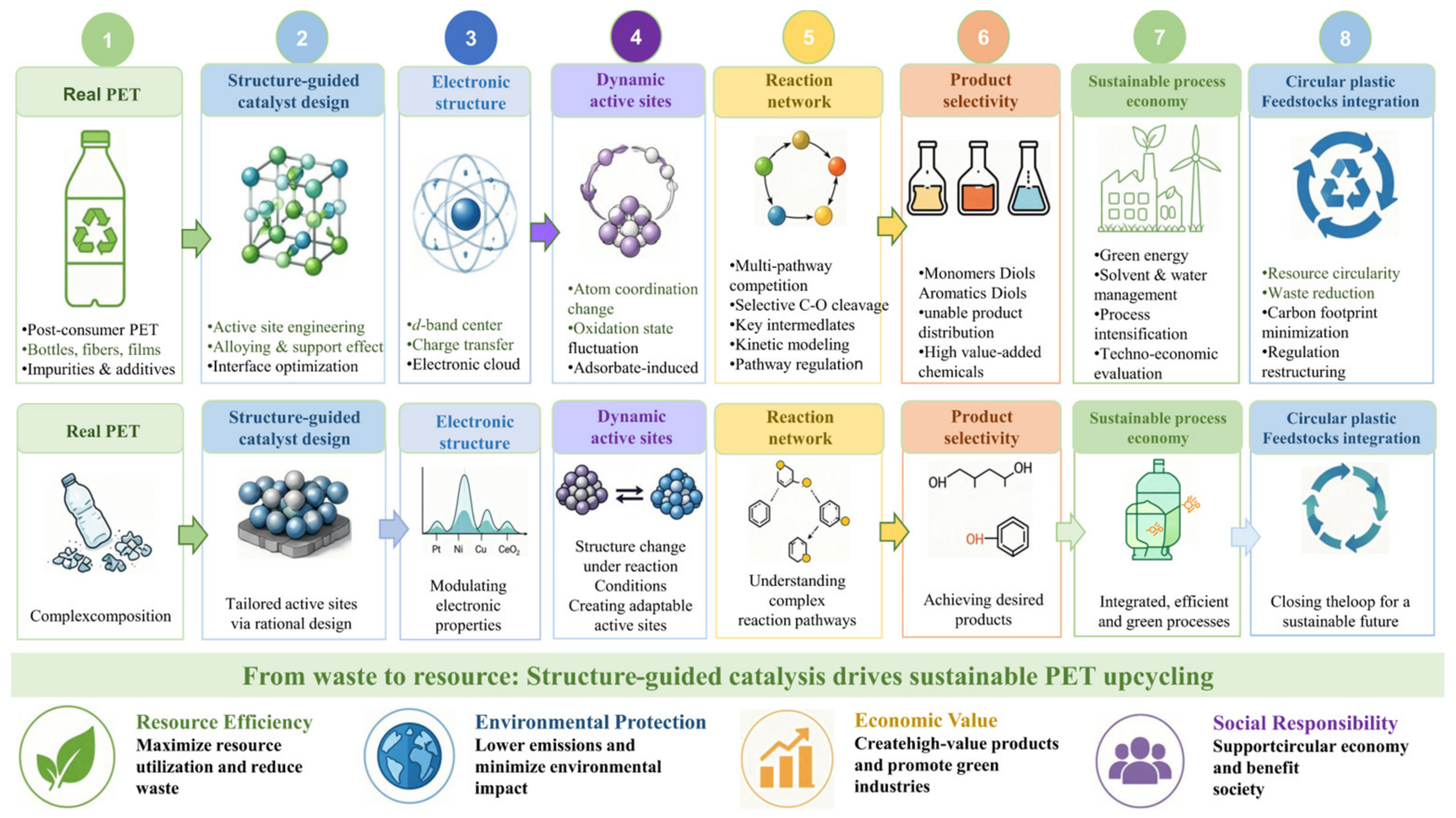
Catalytic upgrading of PET has gradually shifted from a simple pursuit of high conversion rates to the comprehensive optimization of target product selectivity, adaptability to real-world PET, and process sustainability. This paper discusses key issues in the catalytic upgrading of PET from the perspectives of PET structural reactivity, catalyst design, product-oriented pathways, and mechanism analysis. Based on this, it focuses on the complexity of real waste PET, the predictive design of structure-directed catalysts, and the evaluation of sustainable processes to further identify the core challenges that still need to be addressed in this field for practical applications. The overall research framework is shown in Figure 5.

6.1. Challenges in Real Waste PET

The composition and structure of real waste PET are far more complex than those of model PET. Its catalytic reactivity depends not only on the polymer backbone but also on a combination of crystallinity, molecular weight, orientation, additives, dyes, fillers, metal residues, and mixed plastic components. Bottle-grade, fiber-grade, colored, and multilayer packaging PET exhibit significant differences in crystallinity, impurity composition, and segment accessibility, which can lead to changes in ester bond depolymerization, swelling-mediated mass transfer, intermediate adsorption, and catalyst stability. Therefore, the high conversion rates and high selectivity achieved in model PET systems cannot be directly equated with actual performance in real waste PET.
Impurities in real waste PET are a major limiting factor for catalytic upgrading. Dyes and pigments may mask acid, base, or metal sites. Stabilizers and plasticizers may alter the properties of the reaction medium. Food residues and inorganic fillers can affect mass transfer and product separation. Metal ions and impurities such as Cl, N, and S may induce metal poisoning, loss of acid and base sites, carrier corrosion, and carbon deposition. Mixed plastics may also introduce chlorine-, nitrogen-, or hydrocarbon-containing byproducts, further altering reaction pathways and accelerating catalyst deactivation.
Most existing studies on the catalytic conversion of PET use high-purity model polyesters as feedstock. Systematic research on beverage bottles, fibers, mixed-color PET, and mixed real waste PET is scarce. To clearly summarize the current state of research on real waste systems, this section compiles representative literature into Table 5. A cross-comparison is conducted based on key engineering indicators such as feedstock type, catalytic performance, deactivation and leaching, material carbon balance, continuous operation, and LCA/TEA. This clearly reveals the data gaps that currently exist between small-scale laboratory trials and industrial applications.
Therefore, future evaluation systems should be expanded from high-purity model PET to graded real samples, including bottle flakes, fibers, colored PET, multilayer packaging, and mixed plastic waste. Raw material characterization must simultaneously report information such as crystallinity, molecular weight distribution, additive and dye composition, and metal and halogen content, and establish correlations with PET conversion rate, target product selectivity, carbon yield, monomer purity, cycling stability, and impurity tolerance. Only by clearly identifying the gaps between model substrates and real waste PET can one determine whether a catalytic system has practical upscaling potential.

6.2. Structure Guided Catalyst Design

The design of catalysts for the catalytic upgrading of PET requires a shift from empirical screening to structure-guided predictive design. The core of this approach is not simply altering the metal species, acid–base strength, or support composition, but rather elucidating how the configuration of active sites, local electronic structure, interfacial synergy, pore structure, and substrate accessibility collectively determine key steps such as ester bond cleavage, carbonyl hydrogenation, C–O bond hydrogenolysis, aromatic ring hydrogenation, and deoxygenation. Particularly for real PET systems, catalysts must not only exhibit high activity and selectivity but also be capable of resisting impurity poisoning, coking, sintering, metal loss, and structural rearrangement.
DFT calculations and artificial intelligence (AI) can provide tools for catalyst design. DFT can systematically determine the adsorption energies, ester bond cleavage energy barriers, carbonyl hydrogenation energy barriers, C–O bond hydrogenolysis energy barriers, aromatic ring hydrogenation energy barriers, and deoxygenation energy barriers on different metals, alloys, single-atom sites, acid and base sites, oxygen vacancies, and metal-support interfaces, and screen for electronic structures that influence pathway branching. Microdynamic models can further determine the rate-controlling roles of these elementary steps in the overall reaction.
AI can correlate catalyst composition, metal electronic structure, acid–base properties, defect concentration, pore structure, surface wettability, and reaction conditions with PET conversion, target product selectivity, carbon yield, hydrogen consumption, and catalyst lifespan. By further incorporating variables such as the actual source of PET, crystallinity, molecular weight, dye and additive content, Cl/N/S impurities, and mixed plastic composition, it is also possible to predict the adaptability of catalysts to complex waste streams and their deactivation trends. More valuable intelligent models in the future should not only predict which catalysts exhibit high activity but also predict which types of PET feedstocks they are suitable for, which product pathways they will follow, what type of deactivation will occur, and how they can be regenerated.

6.3. Process Evaluation and Integration for Sustainable Development

The practical value of catalytic upgrading of PET cannot be determined solely by laboratory conversion rates and product yields. It also requires a combination of life cycle assessment (LCA) and techno-economic analysis (TEA) to evaluate its resource, energy, environmental, and economic feasibility. Different pathways exhibit significant variations in energy consumption, hydrogen consumption, solvent usage, separation load, and carbon emissions.
There is an urgent need for standardized evaluation metrics in this field. In addition to PET conversion rates and target product selectivity, reporting should be standardized for parameters such as carbon yield, monomer yield, mass balance, catalyst cycle life, structural retention rate, true PET compatibility, impurity tolerance, E-factor, energy consumption, hydrogen consumption, solvent usage, product separation difficulty, and carbon footprint. In the absence of these metrics, comparisons between different catalytic systems often remain at the level of apparent activity, making it difficult to assess their true application potential.
Process integration is key to enhancing the sustainability of PET catalytic upgrading. Low-energy pretreatment, selective impurity removal, mechanical comminution, dissolution assistance, and reaction medium optimization can improve the accessibility of PET segments and reduce interference from impurities. Continuous-flow reactions help enhance heat and mass transfer, stabilize reaction residence time, and improve scalability and controllability. Reaction-separation coupling enables the timely removal of monomers or target products, thereby suppressing re-esterification, side reactions, and catalyst deactivation. Future PET catalytic upgrading should integrate catalyst design, feedstock pretreatment, reaction engineering, product separation, and LCA/TEA assessments into a unified framework to achieve synergistic optimization of activity, selectivity, stability, economic viability, and environmental benefits. Currently, PET catalytic upgrading research mostly employs high-purity polyester model substrates and batch-mode pilot setups for mechanistic investigation. Studies with real waste PET reveal that most reports omit critical engineering metrics, including catalyst coking, metal leaching, mass-carbon balance, and long-term continuous-operation performance. Moreover, standardized quantitative LCA and TEA evaluations are scarce, hindering the translation of lab-optimized catalytic systems toward practical industrial deployment. Future work should develop unified comprehensive evaluation benchmarks covering feed impurity characteristics, cycling stability, product separation costs, carbon utilization efficiency, continuous-run performance, as well as environmental and economic indicators. Such standards would allow fair cross-route comparison and bridge the gap between fundamental research and industrial implementation.

Author Contributions

L.C.: Conceptualization, data curation, formal analysis, methodology, and writing—original draft. P.L.: Writing—review and editing, conceptualization. X.T.: Supervision, writing—review and editing, project administration. All authors have read and agreed to the published version of the manuscript.

Funding

This work was supported by the Guizhou Provincial Science and Technology Program Project (QianKeHe Basic QN [2026] 003-20), and Guizhou Medical University High-level Talent Initiation Program (XiaoBoHe J [2025] 032).

Data Availability Statement

No new data were created or analyzed in this study. Data sharing is not applicable to this article.

Conflicts of Interest

The authors declare no conflicts of interest.

Abbreviations

The following abbreviations are used in this manuscript:
PETPolyethylene terephthalate
TPATerephthalic acid
EGEthylene glycol
BHETBis(2-hydroxyethyl) terephthalate
DMTDimethyl terephthalate
DFTDensity functional theory
PVCPolyvinyl chloride
PAPolyamide
PEPolyethylene
PPPolypropylene
MHETMono (2-hydroxyethyl) terephthalate
AIArtificial intelligence
LCALife cycle assessment
TEATechno-economic analysis
MOFMetal–organic framework
COFCovalent organic framework
DMCH1,4-dimethylcyclohexane
CHDM1,4-cyclohexanedimethanol
CHDA1,4-cyclohexanedicarboxylic acid
BTXBenzene, Toluene, Xylenes
LOHCLiquid organic hydrogen carrier
C-Bal.Carbon balance
Conv.Conversion

References

  1. Guo, Z.; Li, Y.; Wang, M.; Ma, D. Catalytic Upcycling of PET: From Waste to Chemicals and Degradable Polymers. Acc. Chem. Res. 2025, 58, 3184–3194. [Google Scholar] [CrossRef] [Scilit] [PubMed]
  2. Ahmed, A.A.; Alyami, M.; AlArjani, A.; Bafaqeer, A.; Owolabi, T.O.; Salami, T.; Al-Absi, Z.A.; Ghanem, A.S.; Salah, A.; Qahtan, T.F. Recent progress on recycling and upcycling of PET plastic waste into high-value-added materials for versatile applications. J. Environ. Chem. Eng. 2025, 13, 116678. [Google Scholar] [CrossRef] [Scilit]
  3. Clark, R.A.; Shaver, M.P. Depolymerization within a Circular Plastics System. Chem. Rev. 2024, 124, 2617–2650. [Google Scholar] [CrossRef] [Scilit] [PubMed]
  4. Groseclose, T.M.; Nguyen, H.B. Recent advances in enzyme engineering for improved deconstruction of poly(ethylene terephthalate) (PET) plastics. Commun. Mater. 2025, 6, 190. [Google Scholar] [CrossRef] [Scilit]
  5. Cao, F.; Wang, L.; Zheng, R.; Guo, L.; Chen, Y.; Qian, X. Research and progress of chemical depolymerization of waste PET and high-value application of its depolymerization products. RSC Adv. 2022, 12, 31564–31576. [Google Scholar] [CrossRef] [Scilit] [PubMed]
  6. Barnard, E.; Rubio Arias, J.J.; Thielemans, W. Chemolytic depolymerisation of PET: A review. Green Chem. 2021, 23, 3765–3789. [Google Scholar] [CrossRef] [Scilit]
  7. McNeeley, A.; Liu, Y.A. Assessment of PET Depolymerization Processes for Circular Economy. 1. Thermodynamics, Chemistry, Purification, and Process Design. Ind. Eng. Chem. Res. 2024, 63, 3355–3399. [Google Scholar] [CrossRef] [Scilit]
  8. Awaja, F.; Pavel, D. Recycling of PET. Eur. Polym. J. 2005, 41, 1453–1477. [Google Scholar] [CrossRef] [Scilit]
  9. Tournier, V.; Topham, C.M.; Gilles, A.; David, B.; Folgoas, C.; Moya-Leclair, E.; Kamionka, E.; Desrousseaux, M.L.; Texier, H.; Gavalda, S.; et al. An engineered PET depolymerase to break down and recycle plastic bottles. Nature 2020, 580, 216–219. [Google Scholar] [CrossRef] [Scilit] [PubMed]
  10. Conroy, S.; Zhang, X. Theoretical insights into chemical recycling of polyethylene terephthalate (PET). Polym. Degrad. Stab. 2024, 223, 110729. [Google Scholar] [CrossRef] [Scilit]
  11. Westhues, S.; Idel, J.; Klankermayer, J. Molecular catalyst systems as key enablers for tailored polyesters and polycarbonate recycling concepts. Sci. Adv. 2018, 4, eaat9669. [Google Scholar] [CrossRef] [Scilit] [PubMed]
  12. Vollmer, I.; Jenks, M.J.F.; Roelands, M.C.P.; White, R.J.; van Harmelen, T.; de Wild, P.; van der Laan, G.P.; Meirer, F.; Keurentjes, J.T.F.; Weckhuysen, B.M. Beyond Mechanical Recycling: Giving New Life to Plastic Waste. Angew. Chem. Int. Ed. 2020, 59, 15402–15423. [Google Scholar] [CrossRef] [Scilit] [PubMed]
  13. Kosloski-Oh, S.C.; Wood, Z.A.; Manjarrez, Y.; de los Rios, J.P.; Fieser, M.E. Catalytic methods for chemical recycling or upcycling of commercial polymers. Mater. Horiz. 2021, 8, 1084–1129. [Google Scholar] [CrossRef] [Scilit] [PubMed]
  14. Ju, Z.; Zhou, L.; Lu, X.; Li, Y.; Yao, X.; Cheng, S.; Chen, G.I.; Ge, C. Mechanistic insight into the roles of anions and cations in the degradation of poly(ethylene terephthalate) catalyzed by ionic liquids. Phys. Chem. Chem. Phys. 2021, 23, 18659–18668. [Google Scholar] [CrossRef] [Scilit] [PubMed]
  15. Sun, Z.; Wang, K.; Lin, Q.; Guo, W.; Chen, M.; Chen, C.; Zhang, C.; Fei, J.; Zhu, Y.; Li, J. Value-Added Upcycling of PET to 1,4-Cyclohexanedimethanol by a Hydrogenation/Hydrogenolysis Relay Catalysis. Angew. Chem. Int. Ed. 2024, 136, e202408561. [Google Scholar] [CrossRef] [Scilit] [PubMed]
  16. Li, J.; An, Z.; Kong, Y.; Zhang, L.; Yang, J.; Wang, X.; Wang, J.; Duan, D.; Zhang, Q.; Long, R.; et al. Selective recovery of para-xylene from polyethylene terephthalate plastic. Appl. Catal. B-Environ. Energy 2024, 141, 1. [Google Scholar] [CrossRef] [Scilit]
  17. Guo, Z.; Wu, J.; Wang, J. Chemical degradation and recycling of polyethylene terephthalate (PET): A review. RSC Sustain. 2025, 3, 2111–2133. [Google Scholar] [CrossRef] [Scilit]
  18. Babaei, M.; Jalilian, M.; Shahbaz, K. Chemical recycling of Polyethylene terephthalate: A mini-review. J. Environ. Chem. Eng. 2024, 12, 112507. [Google Scholar] [CrossRef] [Scilit]
  19. Luo, X.; Li, Q. Reaction mechanism of PET conversion to 1,4-cyclohexanedimethanol and p-xylene via halogen hydride depolymerization and hydrogenation. J. Environ. Manag. 2026, 400, 128751. [Google Scholar] [CrossRef] [Scilit] [PubMed]
  20. Wei, J.; Zhu, M.; Liu, B.; Wang, N.; Liu, J.; Tomishige, K.; Liu, S.; Liu, G. Hydrodeoxygenation of Oxygen-Containing Aromatic Plastic Wastes to Liquid Organic Hydrogen Carriers. Angew. Chem. Int. Ed. 2023, 62, e202310505. [Google Scholar] [CrossRef] [Scilit] [PubMed]
  21. Lee, M.-h.; Jang, H.-Y. Waste plastic upcycling via homogeneous catalytic hydrogenation/dehydrogenation/transfer hydrogenation. Bull. Korean Chem. Soc. 2025, 46, 968–977. [Google Scholar] [CrossRef] [Scilit]
  22. Li, Y.; Wang, M.; Liu, X.; Hu, C.; Xiao, D.; Ma, D. Catalytic Transformation of PET and CO2 into High-Value Chemicals. Angew. Chem. Int. Ed. 2022, 61, e202117205. [Google Scholar] [CrossRef] [Scilit] [PubMed]
  23. Liu, J.; Yi, S.; Cheng, J.; Liu, S. Catalytic reductive conversion of polyethylene terephthalate (PET) plastic waste into fuels, valuable chemicals and degradable polymers. Green Chem. 2025, 27, 11312–11342. [Google Scholar] [CrossRef] [Scilit]
  24. Kulyabin, P.S.; Luk, J.; Uslamin, E.A.; Kolganov, A.A.; Saini, G.; Marcial-Hernandez, R.; Pancholi, K.; Kühne, B.; Dauth, A.; McKay, A.P.; et al. From Plastic Waste to Pharmaceutical Precursors: PET Upcycling Through Ruthenium Catalyzed Semi-Hydrogenation. Angew. Chem. Int. Ed. 2026, 65, e21838. [Google Scholar] [CrossRef] [Scilit] [PubMed]
  25. Zhang, M.; Huo, Z.; Li, L.; Ji, Y.; Ding, T.; Hou, G.; Song, S.; Dai, W. One-pot Hydrogenolysis of Polyethylene Terephthalate (PET) to p-xylene over CuZn/Al2O3 Catalyst. ChemSusChem 2024, 18, e202402013. [Google Scholar] [CrossRef] [Scilit] [PubMed]
  26. Badia, J.D.; Ballesteros-Garrido, R.; Gamir-Cobacho, A.; Gil-Castell, O.; Cháfer, A. Chemical recycling of post-consumer poly(ethylene terephthalate) (PET) driven by the protic ionic liquid 2-HEAA: Performance, kinetics and mechanism. J. Environ. Chem. Eng. 2024, 12, 113134. [Google Scholar] [CrossRef] [Scilit]
  27. Kawai, F.; Kawabata, T.; Oda, M. Current knowledge on enzymatic PET degradation and its possible application to waste stream management and other fields. Appl. Microbiol. Biot. 2019, 103, 4253–4268. [Google Scholar] [CrossRef] [Scilit] [PubMed]
  28. Zheng, M.; Li, Y.; Dong, W.; Zhang, Q.; Wang, W. Hydrolase-Catalyzed Depolymerization Mechanism toward Crystalline and Amorphous Polyethylene Terephthalate. ACS Sustain. Chem. Eng. 2024, 12, 10252–10259. [Google Scholar] [CrossRef] [Scilit]
  29. Pasula, R.R.; Lim, S.; Ghadessy, F.J.; Sana, B. The influences of substrates’ physical properties on enzymatic PET hydrolysis: Implications for PET hydrolase engineering. Eng. Biol. 2022, 6, 17–22. [Google Scholar] [CrossRef] [Scilit] [PubMed]
  30. Fang, P.; Xia, S.; Lu, X. Rapid alcoholysis of PET enhanced by its swelling under high temperature. J. Environ. Chem. Eng. 2022, 10, 107823. [Google Scholar] [CrossRef] [Scilit]
  31. McNeeley, A.; Liu, Y.A.; Vadoudi, K. Poly(ethylene Terephthalate) Waste Heterogeneity and Recycling Pathways: Evaluating Mechanical and Chemical Recycling Technologies in the Context of the Poly(ethylene Terephthalate) Supply Chain. Ind. Eng. Chem. Res. 2025, 64, 20837–20875. [Google Scholar] [CrossRef] [Scilit]
  32. Amundarain, I.; López-Montenegro, S.; Asueta, A.; Arnaiz, S.; Pereda-Ayo, B. Neopentyl glycol as an alternative solvent for the chemical recycling of complex PET waste. Mater. Adv. 2025, 6, 1042–1050. [Google Scholar] [CrossRef] [Scilit]
  33. Kots, P.A.; Vance, B.C.; Quinn, C.M.; Wang, C.; Vlachos, D.G. A two-stage strategy for upcycling chlorine-contaminated plastic waste. Nat. Sustain. 2023, 6, 1258–1267. [Google Scholar] [CrossRef] [Scilit]
  34. Guo, X.; Xin, J.; Lu, X.; Ren, B.; Zhang, S. Preparation of 1,4-cyclohexanedimethanol by selective hydrogenation of a waste PET monomer bis(2-hydroxyethylene terephthalate). RSC Adv. 2015, 5, 485–492. [Google Scholar] [CrossRef] [Scilit]
  35. Guo, H.; Lan, E.; Zhou, J.; Xu, Z.; He, J.; Shen, K.; Fang, J. Catalytic PET depolymerization toward circular recycling: Mechanistic activation, process translation, and product-slate control. Chem. Eng. J. 2026, in press. [Google Scholar] [CrossRef] [Scilit]
  36. Rollo, M.; Raffi, F.; Rossi, E.; Tiecco, M.; Martinelli, E.; Ciancaleoni, G. Depolymerization of polyethylene terephthalate (PET) under mild conditions by Lewis/Brnsted acidic deep eutectic solvents. Chem. Eng. J. 2023, 456, 141092. [Google Scholar] [CrossRef] [Scilit]
  37. Gao, X.; Wang, Z.; Zhang, M.; Yu, Y.; Zhang, S.; Mei, Q. From Solvent to Catalyst: In Situ Amino Acid-Like Species Enable PET Upcycling Without Added Catalysts. Angew. Chem. Int. Ed. 2025, 64, e202513723. [Google Scholar] [CrossRef] [Scilit] [PubMed]
  38. Coates, G.W.; Getzler, Y.D.Y.L. Chemical recycling to monomer for an ideal, circular polymer economy. Nat. Rev. Mater. 2020, 5, 501–516. [Google Scholar] [CrossRef] [Scilit]
  39. Okonsky, S.T.; Krishna, J.V.J.; Lee, D.H.; Toraman, H.E. Kinetic modelling and measurement of catalyst deactivation for the catalytic co-pyrolysis of PP and PET with HZSM-5. Appl. Catal. A-Gen. 2025, 708, 120574. [Google Scholar] [CrossRef] [Scilit]
  40. Seo, H.J.; Lee, C.; Kim, Y.; Lee, W.; Park, S.; Roh, J.W.; Giri, A.; Park, G.; Hyun, D.C.; Moon, G.D.; et al. Waste-derived CoFe2O4-CaO magnetically recoverable dual acid-base catalyst for efficient PET glycolysis. Chem. Eng. J. 2026, 543, 178407. [Google Scholar] [CrossRef] [Scilit]
  41. Xie, S.; Wang, C.; Hu, W.; Hu, J.Z.; Wang, Y.; Dong, Z.; Intan, N.N.; Pfaendtner, J.; Lin, H. Chemical recycling of post-consumer polyester wastes using a tertiary amine organocatalyst. Cell Rep. Phys. Sci. 2024, 5, 102145. [Google Scholar] [CrossRef] [Scilit]
  42. Ni, W.; Ran, H.; Wang, R.; Liu, Y.; Zhou, P.; Guo, T.; Shan, J.; Lai, Z.; Liu, B.; Liang, S.-J.; et al. Stepwise hydrogen spillover–engineered synergistic sites enable near-quantitative conversion of waste PET to p-xylene. Nat. Commun. 2026, 17, 2128. [Google Scholar] [CrossRef] [Scilit] [PubMed]
  43. Shao, Y.; Fan, M.; Sun, K.; Gao, G.; Li, C.; Li, D.; Jiang, Y.; Zhang, L.; Zhang, S.; Hu, X. The quantitative conversion of polyethylene terephthalate (PET) and Coca-Cola bottles to p-xylene over Co-based catalysts with tailored activities for deoxygenation and hydrogenation. Green Chem. 2023, 25, 10513–10529. [Google Scholar] [CrossRef] [Scilit]
  44. Guo, M.; Shao, Y.; Song, C.; Liu, H.; He, F.; Zhang, L.; Zhang, S.; Wei, T.; Hu, X. One-Pot Tandem Butanolysis and Hydrogenolysis of PET to Selectively Produce p-Xylene through Coordination of Basic Sites, Oxygen Vacancies, and Hydrogenation Sites of Cu–Mg–Al Catalyst. ACS Sustain. Chem. Eng. 2026, 14, 10292–10307. [Google Scholar] [CrossRef] [Scilit]
  45. Wang, B.; Yan, X.; Huang, J.; Jing, Y.; Saravanamurugan, S.; Lee, A.F.; Li, H. Tuning selectivity in the direct hydrogenolysis of PET plastic over Co catalysts through interfacial hydrogen spillover. Nat. Commun. 2026, 17, 5155. [Google Scholar] [CrossRef] [Scilit] [PubMed]
  46. Cheng, J.; Xie, J.; Xi, Y.; Wu, X.; Zhang, R.; Mao, Z.; Yang, H.; Li, Z.; Li, C. Selective Upcycling of Polyethylene Terephthalate towards High-valued Oxygenated Chemical Methyl p-Methyl Benzoate using a Cu/ZrO2 Catalyst. Angew. Chem. Int. Ed. 2024, 63, e202319896. [Google Scholar] [CrossRef] [Scilit] [PubMed]
  47. Chen, Q.; Yan, H.; Zhao, K.; Wang, S.; Zhang, D.; Li, Y.; Fan, R.; Li, J.; Chen, X.; Zhou, X.; et al. Catalytic oxidation upcycling of polyethylene terephthalate to commodity carboxylic acids. Nat. Commun. 2024, 15, 10732. [Google Scholar] [CrossRef] [Scilit] [PubMed]
  48. Dai, L.; Van Geem, K.M.; Zhang, H.; Xiao, R.; Lei, H.; Ruan, R. Designing zeolite catalysts for chemical recycling of plastics. Nat. Rev. Mater. 2026, 11, 258–260. [Google Scholar] [CrossRef] [Scilit]
  49. Helmer, R.; Borkar, S.; Li, A.; Mahnaz, F.; Vito, J.; Bishop, M.; Iftakher, A.; Hasan, M.M.; Rangarajan, S.; Shetty, M. Tandem Methanolysis and Catalytic Transfer Hydrogenolysis of Polyethylene Terephthalate to p-Xylene Over Cu/ZnZrOx Catalysts. Angew. Chem. Int. Ed. 2024, 137, 4. [Google Scholar] [CrossRef] [Scilit]
  50. Kim, M.; Ro, I. Advances in heterogeneous catalysts for sustainable PET upcycling: From mechanistic understanding to catalyst design. Chem. Commun. 2025, 61, 19390–19402. [Google Scholar] [CrossRef] [Scilit] [PubMed]
  51. Liu, J.; Wang, N.; Liu, S.; Liu, G. Catalytic Hydrodeoxygenation of Mixed Plastic Wastes into Sustainable Naphthenes. JACS Au 2024, 4, 4361–4373. [Google Scholar] [CrossRef] [Scilit] [PubMed]
  52. Liu, L.; Corma, A. Bimetallic Sites for Catalysis: From Binuclear Metal Sites to Bimetallic Nanoclusters and Nanoparticles. Chem. Rev. 2023, 123, 79. [Google Scholar] [CrossRef] [Scilit] [PubMed]
  53. Salaev, M.A.; Xiong, H.; Corberán, V.C.; Liotta, L.F.; Vodyankina, O.V. Synergistic effects in heterogeneous catalysis: Status and perspectives. Mater. Today Chem. 2025, 46, 102722. [Google Scholar] [CrossRef] [Scilit]
  54. Chen, X.; Hu, J.; Liu, J.; Hai, P.; Guan, J. Advances in dual-atom catalysts for the electroreduction of carbon dioxide. Chem. Eng. J. 2025, 522, 167504. [Google Scholar] [CrossRef] [Scilit]
  55. Li, B.; Jiang, W.; Chen, P.; Wang, X.; Zhou, M.; Chen, Z.; Lu, Y.; Zhang, X.; Zhao, L.; Lin, H. Nanoconfined Multi-Scale Metal Catalysts: Confinement-Induced Geometric, Electronic, and Microenvironment Regulation for Selective Multi-Electron CO2 Reduction. Adv. Energy Mater. 2026, 16, e70795. [Google Scholar] [CrossRef] [Scilit]
  56. van der Hoeven, J.E.S.; Jelic, J.; Olthof, L.A.; Totarella, G.; van Dijk-Moes, R.J.A.; Krafft, J.-M.; Louis, C.; Studt, F.; van Blaaderen, A.; de Jongh, P.E. Unlocking synergy in bimetallic catalysts by core–shell design. Nat. Mater. 2021, 20, 1216–1220. [Google Scholar] [CrossRef] [Scilit] [PubMed]
  57. Brösigke, G.; Repke, J.-U.; Schomäcker, R.; Matera, S. The closer the better? Theoretical assessment of the impact of catalytic site separation for bifunctional core–shell catalyst particles. Chem. Eng. J. 2022, 446, 136891. [Google Scholar] [CrossRef] [Scilit]
  58. Berdugo-Díaz, C.E.; Manetsch, M.T.; Sik Yun, Y.; Lee, J.; Luo, J.; Chen, X.; Flaherty, D.W. Ester Reduction with H2 on Bifunctional Metal-Acid Catalysts: Implications of Metal Identity on Rates and Selectivities. Angew. Chem. Int. Ed. 2023, 62, e202216165. [Google Scholar] [CrossRef] [Scilit] [PubMed]
  59. Fischer, A.F.; Iglesia, E. The nature of “hydrogen spillover”: Site proximity effects and gaseous intermediates in hydrogenation reactions mediated by inhibitor-scavenging mechanisms. J. Catal. 2023, 420, 68–88. [Google Scholar] [CrossRef] [Scilit]
  60. Shan, Y.; Wu, Z.; Li, T. Asymmetric super-exchange interaction induced by inter-site distance effect for hydrogen evolution reaction. Mater. Chem. Phys. 2022, 279, 125748. [Google Scholar] [CrossRef] [Scilit]
  61. Hu, W.; Noh, G.; Iglesia, E. Consequences of metal-acid site proximity for alkane isomerization and β-scission mediated by bifunctional catalytic cascades. J. Catal. 2023, 425, 125–142. [Google Scholar] [CrossRef] [Scilit]
  62. Wang, Q.N.; Duan, R.; Feng, Z. Understanding the Synergistic Catalysis in Hydrogenation of Carbonyl Groups on Cu-Based Catalysts. ACS Catal. 2024, 14, 1620–1628. [Google Scholar] [CrossRef] [Scilit]
  63. Luo, Z.; Ge, X.; Cao, Y.; Wang, Z.; Zhou, J.; Li, W.; Duan, X.; Zhou, X. Inverse NiOx-Ag Interface to Decouple Reactant Activation for Ag-Ni/SiO2-Catalyzed Ester Hydrogenation. Angew. Chem. Int. Ed. 2025, 65, 2. [Google Scholar] [CrossRef] [Scilit] [PubMed]
  64. Pan, Y.; Zhen, S.; Liu, X.; Ge, M.; Zhao, J.; Gu, L.; Zhou, D.; Zhang, L.; Su, D. Looping metal-support interaction in heterogeneous catalysts during redox reactions. Nat. Commun. 2025, 16, 8627. [Google Scholar] [CrossRef] [Scilit] [PubMed]
  65. Lee, K.; Han, S.; Kim, M.; Kim, B.; Park, J.A.; Lim, K.S.; Ha, S.J.; Kim, H.O. Metal–Organic Framework for Plastic Depolymerization and Upcycling. Crystals 2025, 15, 897. [Google Scholar] [CrossRef] [Scilit]
  66. Songlei, M.; Yong, G.; Yanqin, X.W. Efficient depolymerization of PET over Ti-doped SBA-15 with abundant Lewis acid sites via glycolysis. Catal. Sci. Technol. 2023, 13, 6561–6569. [Google Scholar] [CrossRef] [Scilit]
  67. Hou, Z.; Lan, H.; Zhu, K.; An, X.; Liu, H.; Qu, J. Hierarchically Porous Carbon Derived from Pore Remodeling of Waste Polymeric Membranes for High-Efficiency Adsorption Applications. Resour. Conserv. Recycl. 2023, 190, 106845S. [Google Scholar] [CrossRef] [Scilit]
  68. Sun, B.; Li, B.; Marc, M.; Yin, L.; Song, Q.; Shi, X.; Wang, D.; Lin, F.; Wang, K. Synergistic pore-acidity engineering of hierarchical ZSM-5 for hydrogen-free upcycling of Polyethylene to C8–C12 Methylated Aromatics. Innov. Energy 2026, 3, 100155. [Google Scholar] [CrossRef] [Scilit]
  69. Ge, J.; Peters, B. Mass transfer in catalytic depolymerization: External effectiveness factors and serendipitous processivity in stagnant and stirred melts. Chem. Eng. J. 2023, 466, 143251. [Google Scholar] [CrossRef] [Scilit]
  70. Gabrič, M.; Lavrič, Z.; Schwiderski, M.; Marc, L.; Temmel, E.; Grilc, M.; Likozar, B. Polyethylene Terephthalate Glycolysis: Kinetic Modeling and Validation. Polymers 2025, 17, 2246. [Google Scholar] [CrossRef] [Scilit] [PubMed]
  71. Wang, W.; Yao, X.; Chen, W. Overcoming Mass Transfer Limitations in Catalytic Oxidation and Reduction from Reactive-Species Engineering to Sustainable Catalyst Systems. Catalysts 2026, 16, 349. [Google Scholar] [CrossRef] [Scilit]
  72. Tan, J.Z.; Ortega, M.; Miller, S.A.; Hullfish, C.W.; Kim, H.; Kim, S.; Hu, W.; Hu, J.Z.; Lercher, J.; Koel, B.E.; et al. Catalytic Consequences of Hierarchical Pore Architectures within MFI and FAU Zeolites for Polyethylene Conversion. ACS Catal. 2024, 14, 7536–7552. [Google Scholar] [CrossRef] [Scilit]
  73. Zhang, S.; Xue, Y.; Wu, Y.; Zhang, Y.X.; Tan, T.; Niu, Z. PET recycling under mild conditions via substituent-modulated intramolecular hydrolysis. Chem. Sci. 2023, 14, 6558–6563. [Google Scholar] [CrossRef] [Scilit] [PubMed]
  74. Qamar, M.Z.; Ali, A.; Saeed, M.A.; van der Heijden, M. Electrocatalytic Upcycling of PET-Derived Products: Catalyst Design, C1–C2 Products, and Coupled Electrochemical Reactions. Nano Energy 2026, 152, 111865. [Google Scholar] [CrossRef] [Scilit]
  75. Abdelgaid, M.; Mpourmpakis, G. Structure–Activity Relationships in Lewis Acid–Base Heterogeneous Catalysis. ACS Catal. 2022, 12, 4268–4289. [Google Scholar] [CrossRef] [Scilit]
  76. Anderson, L.B.; Connon, S.J.; Molloy, C.; Martin, I.L.; Pedrini, L. Effect of phase transfer catalyst structure on the alkaline hydrolysis of poly(ethylene terephthalate). Green Chem. 2024, 26, 11125–11131. [Google Scholar] [CrossRef] [Scilit]
  77. Gang, C.; Tian, J.; Ma, B.; Zhao, C. Unlocking High-Concentration PET Upcycling via Site-Decoupled Copper Catalysis. Angew. Chem. Int. Ed. 2025, 64, e202516357. [Google Scholar] [CrossRef] [Scilit] [PubMed]
  78. Ding, W.; Ji, D.; Wang, K.; Li, Y.; Luo, Q.; Wang, R.; Li, L.; Qin, X.; Peng, S. Rapid Surface Reconstruction of Amorphous-Crystalline NiO for Industrial-Scale Electrocatalytic PET Upcycling. Angew. Chem. Int. Ed. 2025, 64, e202418640. [Google Scholar] [CrossRef] [Scilit] [PubMed]
  79. Zhao, G.; Lin, J.; Lu, M.; Li, L.; Xu, P.; Liu, X.; Chen, L. Potential cycling boosts the electrochemical conversion of polyethylene terephthalate-derived alcohol into valuable chemicals. Nat. Commun. 2024, 15, 8463. [Google Scholar] [CrossRef] [Scilit] [PubMed]
  80. Wu, Y.; Wang, J.; Zhang, Y.; Mao, J.; Xu, C.; Ding, H.; Ma, F.; Luo, Y.; Chen, R.; Li, D.; et al. Metal-supported interaction governs kinetic bifurcation of reconstruction of Cu CO2RR catalysts. J. Catal. 2026, 460, 116973. [Google Scholar] [CrossRef] [Scilit]
  81. Kondo, F.; Kamiya, N.; Bekker, G.-J.; Nagao, S.; Numoto, N.; Sekiguchi, H.; Ito, N.; Oda, M. Structure-activity relationship of PET-degrading cutinase regulated by weak Ca2+ binding and temperature. Biophys. Physicobiol. 2025, 22, e220009. [Google Scholar] [CrossRef] [Scilit] [PubMed]
  82. Yue, S.; Wang, P.; Zhan, L.S. From Plastic Waste to Treasure: Selective Upcycling through Catalytic Technologies. Adv. Energy Mater. 2023, 13, 2302008. [Google Scholar] [CrossRef] [Scilit]
  83. Murali, V.; Kim, H.; Kim, H.U.; Kim, J.R.; Son, S.H.; Park, Y.K.; Ha, J.M.; Jae, J. Selective one-pot chemical recycling of PET waste to xylene monomers: Insights into a Ru/TiO2 catalyst design and interfacial dynamics in a biphasic system. Green Chem. 2025, 27, 2203–2219. [Google Scholar] [CrossRef] [Scilit]
  84. Yang, T.; Yang, Z.; Zhang, Y.; Hu, C.; Xie, Z.; Sun, Z.; Pang, X.; Chen, X. Upcycling of PET waste: From one polymer to another polymer. Polym. Chem. 2025, 17, 7–20. [Google Scholar] [CrossRef] [Scilit]
  85. Watson-Sanders, S.; Dadmun, M. More Efficient Chemical Recycling of Poly(Ethylene Terephthalate) by Intercepting Intermediates. ChemSusChem 2024, 17, 23. [Google Scholar] [CrossRef] [Scilit] [PubMed]
  86. Heinks, T.; Hofmann, K.; Last, S.; Gamm, I.; Blach, L.; Wei, R.; Bornscheuer, U.T.; Hamel, C.; Langermann, J. Selective Modification of the Product Profile of Biocatalytic Hydrolyzed PET via Product-Specific Medium Engineering. ChemSusChem 2024, 18, 6. [Google Scholar] [CrossRef] [Scilit] [PubMed]
  87. Curley, J.B.; Liang, Y.; DesVeaux, J.S.; Choi, H.; Clarke, R.W.; Maurya, A.K.; Michener, W.E.; Stanley, L.M.; Wu, Y.; Hesse, S.A.; et al. Closed-loop recycling of mixed polyesters via catalytic methanolysis and monomer separations. Nat. Chem. Eng. 2025, 2, 568–580. [Google Scholar] [CrossRef] [Scilit]
  88. Watson-Sanders, S.; Johnson, K.; Barber, S.; Biery, A.R.; Wilcox, L.; Galan, N.J.; Zheng, J.; Saito, T.; Dadmun, M.D. Solubility-limited depolymerization kinetics in the glycolysis of carbonyl-containing polymers. Polym. Chem. 2026, 17, 1569–1583. [Google Scholar] [CrossRef] [Scilit]
  89. Parida, D.; Aerts, A.; Vanbroekhoven, K.; Van Dael, M.; Mitta, H.; Li, L.; Eevers, W.; Van Geem, K.M.; Feghali, E.; Elst, K. Monomer recycling of polyethylene terephthalate, polycarbonate and polyethers: Scalable processes to achieve high carbon circularity. Prog. Polym. Sci. 2024, 149, 101783. [Google Scholar] [CrossRef] [Scilit]
  90. Luna, E.; Olazabal, I.; Roosen, M.; Müller, A.; Jehanno, C.; Ximenis, M.; de Meester, S.; Sardon, H. Towards a better understanding of the cosolvent effect on the low-temperature glycolysis of Polyethylene Terephthalate (PET). Chem. Eng. J. 2024, 482, 148861. [Google Scholar] [CrossRef] [Scilit]
  91. Shen, B.; Xu, H.; Xiao, H.; Shen, Z.; Ma, J.; Wei, S.; Zhang, H.; Wang, Y.; Yang, L. Repolymerization-suppressed closed-loop recycling of PET to BHET via metal-free ammonium acetate catalysis. Res. Chem. Int. 2025, 51, 5905–5921. [Google Scholar] [CrossRef] [Scilit]
  92. Ye, M.; Li, Y.; Yang, Z.; Yao, C.; Sun, W.; Zhang, X.; Chen, W.; Qian, G.; Duan, X.; Cao, Y. Ruthenium TiO2-Catalyzed Hydrogenolysis of Polyethylene Terephthalate: Reaction Pathways Dominated by Coordination Environment. Angew. Chem. Int. Ed. 2023, 135, e202301024. [Google Scholar] [CrossRef] [Scilit] [PubMed]
  93. Ou, W.; Chang, Z.; Zhang, G.; Zhao, H. Ru nanoparticles encapsulated in defective UiO-66def for the hydrogenation of benzene rings in polyethylene terephthalate degraded chemicals. J. Mater. Chem. A 2025, 13, 33404–33416. [Google Scholar] [CrossRef] [Scilit]
  94. Jiang, X.; Chang, Z.; Yang, L.; Du, W.; Hou, Z. Hydrogenation of waste PET degraded bis(2-hydroxyethyl)cyclohexane-1,4-dicarboxylate to 1,4-cyclohexanedimethanol over Cu-based catalysts. Fuel 2024, 363, 130944. [Google Scholar] [CrossRef] [Scilit]
  95. Wang, N.; Liu, J.; Wei, J.; Liu, S.; Liu, G. Selective hydrodeoxygenation of polyethylene terephthalate plastic wastes into 1,4-dimethylcyclohexane by Ir-ReOx/SiO2 + HZSM-5 catalytic system. Sci. China Chem. 2025, 68, 1563–1575. [Google Scholar] [CrossRef] [Scilit]
  96. Rabiei, N.; Kish, M.H. Aminolysis of polyesters for cracking and structure clarifying: A review. Polym. Adv. Technol. 2022, 33, 3903–3919. [Google Scholar] [CrossRef] [Scilit]
  97. Wei, X.; Zheng, W.; Chen, X.; Qiu, J.; Sun, W.; Xi, Z.; Zhao, L. Chemical upcycling of poly(ethylene terephthalate) with binary mixed alcohols toward value-added copolyester by depolymerization and repolymerization strategy. Chem. Eng. Sci. 2024, 294, 120103. [Google Scholar] [CrossRef] [Scilit]
  98. Otaibi, A.A.; Alsukaibi, A.K.D.; Rahman, M.A.; Mushtaque, M.; Haque, A. From Waste to Schiff Base: Upcycling of Aminolysed Poly(ethylene terephthalate) Product. Polymers 2022, 14, 1861. [Google Scholar] [CrossRef] [Scilit] [PubMed]
  99. Ambursa, M.M.; Juan, J.C.; Yahaya, Y.; Taufiq-Yap, Y.H.; Lin, Y.C.; Lee, H.V. A review on catalytic hydrodeoxygenation of lignin to transportation fuels by using nickel-based catalysts. Renew. Sustain. Energy Rev. 2021, 138, 110667. [Google Scholar] [CrossRef] [Scilit]
  100. Qu, L.; Jiang, X.; Zhang, Z.; Zhang, X.G.; Song, G.Y.; Wang, H.L.; Yuan, Y.P.; Chang, Y.L. A review of hydrodeoxygenation of bio-oil: Model compounds, catalysts, and equipment. Green Chem. 2021, 23, 9348–9376. [Google Scholar] [CrossRef] [Scilit]
  101. Prabhudesai, V.S.; Gurrala, L.; Vinu, R. Catalytic Hydrodeoxygenation of Lignin-Derived Oxygenates: Catalysis, Mechanism, and Effect of Process Conditions. Energy Fuels 2022, 36, 1155–1188. [Google Scholar] [CrossRef] [Scilit]
  102. Jung, S.; Park, Y.K.; Kwon, E.E. Catalytic hydrodeoxygenation for upgrading of lignin-derived bio-oils. In Biomass, Biofuels, Biochemicals; Bhaskar, T., Pandey, A., Eds.; Elsevier: Amsterdam, The Netherlands, 2021; pp. 129–145. [Google Scholar] [CrossRef] [Scilit]
  103. Pereira, P.; Guirguis, P.M.; Pester, C.W.; Savage, P.E. Reaction Network and Kinetics Model for Neutral Hydrolysis of Poly(ethylene terephthalate). Ind. Eng. Chem. Res. 2026, 65, 4905–4914. [Google Scholar] [CrossRef] [Scilit] [PubMed]
  104. Wang, M.; Li, Y.; Zheng, L.; Hu, T.; Yan, M.; Wu, C. Recycling and depolymerisation of poly(ethylene terephthalate): A review. Polym. Chem. 2024, 15, 585–608. [Google Scholar] [CrossRef] [Scilit]
  105. Di Lorenzo, M.L. Crystallization of Poly(ethylene terephthalate): A Review. Polymers 2024, 16, 1975. [Google Scholar] [CrossRef] [Scilit] [PubMed]
  106. Najmi, S.; Vance, B.C.; Selvam, E.; Huang, D.; Vlachos, D.G. Controlling PET oligomers vs monomers via microwave-induced heating and swelling. Chem. Eng. J. 2023, 471, 144712. [Google Scholar] [CrossRef] [Scilit]
  107. Jiang, M.; Wang, X.; Xi, W.; Yang, P.; Zhou, H.; Duan, J.; Ratova, M.; Wu, D. Chemical catalytic upgrading of polyethylene terephthalate plastic waste into value-added materials, fuels and chemicals. Sci. Total Environ. 2024, 912, 169342. [Google Scholar] [CrossRef] [Scilit] [PubMed]
  108. Deng, L.; Guo, W.; Ngo, H.H.; Zhang, X.; Wei, D.; Wei, Q.; Deng, S. Novel catalysts in catalytic upcycling of common polymer wastes. Chem. Eng. J. 2023, 471, 144350. [Google Scholar] [CrossRef] [Scilit]
  109. Luo, X.; Li, Q. Multiscale mechanisms elucidation and kinetic modeling for polyethylene terephthalate separation pathways: A combined computational-experimental perspective on pyrolysis, hydrolysis, and alcoholysis processes. Sep. Purif. Technol. 2025, 370, 133293. [Google Scholar] [CrossRef] [Scilit]
  110. Javed, S.; Fisse, J.; Vogt, D. Kinetic Investigation for Chemical Depolymerization of Post-Consumer PET Waste Using Sodium Ethoxide. Ind. Eng. Chem. Res. 2023, 62, 4328–4336. [Google Scholar] [CrossRef] [Scilit]
  111. Li, H.; Zhang, J.; Yao, Z.; Hu, P. Accelerating the identification of the rate controlling steps by conducting microkinetic modeling on surrogate networks. Catal. Sci. Technol. 2025, 15, 2766–2775. [Google Scholar] [CrossRef] [Scilit]
  112. Chu, M.; Kang, Q.; Hu, P.; Zhang, Q.; Chen, J. Unlocking opportunities: Supported metal catalysts for the chemical upcycling of waste plastics. Chem. Eng. J. 2024, 496, 154375. [Google Scholar] [CrossRef] [Scilit]
  113. Li, J.; Ma, Y.; Ho, J.C.; Qu, Y. Hydrogen Spillover Phenomenon at the Interface of Metal-Supported Electrocatalysts for Hydrogen Evolution. Acc. Chem. Res. 2024, 57, 895–904. [Google Scholar] [CrossRef] [Scilit] [PubMed]
  114. Zhao, S.; Wang, Z.H.; Wang, J.Y.; Wang, P.F.; Liu, Z.L.; Shu, J.; Yi, T.F. Unveiling the mysteries of hydrogen spillover phenomenon in hydrogen evolution reaction: Fundamentals, evidence and enhancement strategies. Coord. Chem. Rev. 2025, 524, 216321. [Google Scholar] [CrossRef] [Scilit]
  115. Zhang, H.; Chen, L.; Dong, F.; Lu, Z.; Lv, E.; Dong, X.; Li, H.; Yuan, Z.; Peng, X.; Yang, S. Dynamic transformation of active sites in energy and environmental catalysis. Energy Environ. Sci. 2024, 17, 6435–6481. [Google Scholar] [CrossRef] [Scilit]
  116. Chen, L.; Ding, X.; Urban, J.J. Advances in in situ/operando techniques for catalysis research: Enhancing insights and discoveries. Surf. Sci. Technol. 2024, 2, 9. [Google Scholar] [CrossRef] [Scilit]
  117. Liu, Y.; Su, X.; Ding, J.; Zhou, J.; Liu, Z.; Wei, X.; Yang, H.B.; Liu, B. Progress and challenges in structural, in situ and operando characterization of single-atom catalysts by X-ray based synchrotron radiation techniques. Chem. Soc. Rev. 2024, 24, 11850–11887. [Google Scholar] [CrossRef] [Scilit] [PubMed]
Figure 1. Research Framework for a Review of High-Value Conversion of Waste PET through Catalysis. Arrows indicate the flow of materials and research logic. Colored boxes denote distinct functional modules covering waste PET feedstock, catalyst design, reaction pathways, mechanistic insights, and target value-added products.
Catalysts 16 00782 g001
Figure 2. Selective Bond Cleavage and Reaction Pathways in the Catalytic Upgrading of PET. The green solid arrow shows the preferred C-O activation pathway under mild conditions. The blue solid arrow represents the secondary C-C transformation pathway under harsh conditions. Dotted circles indicate bond-activation sites on PET polymer chains.
Catalysts 16 00782 g002
Figure 3. Schematic illustration of the influence of PET molecular structure and aggregation state characteristics on catalytic reactivity. Dotted lines denote the influence-relevance relationships between different structural features. Solid-colored arrows represent the direct effect of structural features on material properties. Red atoms in the chemical formula highlight the oxygen sites of ester bonds.
Catalysts 16 00782 g003
Figure 4. Product-directed reaction network and critical path forks in PET catalytic upgrading. Arrows represent the direction of reaction-transformation pathways.
Catalysts 16 00782 g004
Figure 5. Framework for structure-directed design and product pathway regulation in PET catalytic upgrading. Arrows show the logical workflow of PET upcycling. Colored backgrounds denote sequential technical modules. Bottom icons represent resource efficiency, environmental protection, economic value, and social-responsibility dimensions.
Catalysts 16 00782 g005
Table 1. Basic catalytic functions, structural control parameters, and key evaluation indicators in the PET catalytic upgrading process.
Catalytic FunctionTarget Products/Downstream ApplicationsKey Structural ModulationImpact on the Reaction ProcessPotential IssuesValidation MetricsRepresentative CatalystsRefs.
Regulation of ester bond activation and nucleophilic transferTPA, MHET, BHET, DMT/
Closed loop recycling new mat
materials
Types, strengths, distribution and synergistic relationships of acid–base sitesCarbonyl polarization, nucleophilic attack, and ester bond cleavageIncreased acidity or alkalinity ≠ increased activity; Side reactions must be avoidedAcid–base site characterization, in situ spectroscopy, kinetics,
and product analysis
Solid acids, zeolites[1,12,35,36,37]
Hydrogen activation and directed hydrogen transferCHDM, DMCH, Aromatic diols/Polyester monomer feedstocks,
molecular medicine precursor,
biofuel precursors
Metal composition, electronic structure, and interface structureH2 dissociation, hydrogen migration, and carbonyl/C–O transformationHydrogen adsorption requires a balance between activation and residence timeH2 chemical adsorption, in situ XPS, isotope experimentsRu, Pt, Pd, Ni, and bimetals[15,20,24,34]
Identification of oxygen-containing intermediates and selective bond cleavagepara-xylene, benzoic acid, naphthenes/
New-material copolymer monomers, oxygen-containing pharmaceutical precursors, low sulfur naphthenic fuels, MOF ligands
Oxygen affinity, defect sites, interface structureCompetition between carbonyl hydrogenation and C–O cleavageAvoid excessive oxygen adsorption, which can lead to deep deoxygenationAdsorption energy, in situ analysis, theoretical calculationsRu/TiO2, Pt/CeO2, etc.[42,46,47]
Chain segment approaching and intermediate transportAll categories PET High-value conversion products/
MOF ligands
Pore structure, wettability, surface polarityPromote diffusion and reduce mass transfer limitationsA balance must be achieved between pore structure optimization and the utilization of active sitesDiffusion experiments, model analysisGraded pore materials[6,7,31]
Product desorption and active site cyclizationPolymer-grade, low-impurity, oxygen-containing monomers/
Recycled polyester feedstock, meeting pharmaceutical impurity standards, biofuels, MOF ligands
Adsorption strength, surface polarity, interfacial structurePromoting desorption and recovery of active sitesExcessive adsorption leads to coverage and deactivationCycle testing, surface analysisMOF/COF, oxide support[1,6,7,12]
Table 2. Hierarchy of evidence and minimum validation requirements for establishing structure–activity relationships in PET catalytic upgrading.
Level of EvidenceCore ObjectivesComparison of Control ConditionsTypical Research MethodsApplication Scenario CorrelationMajor LimitationsMinimum Validation RequirementsRefs.
CorrelationIdentify selectivity-related catalyst characteristics and evaluate the influence of monomer purity on downstream product performanceIt is necessary to standardize the degree of crystallinity, particle size, and reaction parametersCorrelation analysis between structural parameters and final-state propertiesTargeted production of biofuels and high-purity monomers to ensure the mechanical properties of recycled polyestersIt is difficult to control for covariates such as particle size, number of sites, mass transfer, and solvent. Therefore, only a correlation can be demonstratedCompare at least several independent catalysts and perform statistical correlation analysis[1,7,42,43]
Control variableQuantitatively demonstrate the independent regulatory effects of structural parameters, such as the metal-support interface and oxygen vacancies, on reaction pathwaysFixed metal loading, particle size, and total number of active sites, standardized stirring rate, solvent, and reactor, elimination of mass transfer interferenceKeep key variables such as composition, particle size, and site exposure constantCHDM drug delivery, CHDM/CHDA medical-grade polymer synthesis precursors, catalytic systems for producing polyester monomers and naphthenic base oilsIt is still not possible to directly prove which elementary step is affectedEstablish a rigorous comparison system and use intrinsic activity indicators such as TOF for evaluation[15,24,45,69]
Mechanistic evidenceElucidate the quantitative relationship between the dynamic structure of the catalyst and elementary reactions such as C–O bond cleavage, aromatic ring hydrogenation, and deoxygenationSimultaneously use model substrates (BHET/TPA/DMT) and actual waste PETIn situ/operando characterization, isotope tracing, time-resolved kinetics, DFT calculations, etc.Balancing deoxygenation and decarboxylation to improve the carbon yield of aviation fuel, retaining the aromatic skeleton to obtain aromatic intermediates,
product TPA serves as a MOFligand
In situ signals may correspond to multiple intermediates, requiring cross-validation using a variety of techniquesIn situ experiments are corroborated by kinetic and theoretical calculations[20,42,47]
Prediction ValidationEstablishing structure–activity relationship models with predictive capabilities across different raw materials and catalytic systemsConduct a parallel comparison using genuine PET raw material to analyze the interference of impurities in the raw material on the reaction dataModel development and validation across substrates and catalystsMOF materials as PET catalytic systems; PET ammonolysis for the preparation of nitrogen-containing organic functional intermediates; the targeted production xylene for use in the pharmaceutical and fuel sectorsReal waste PET systems still require validation for long-term stability and complex impuritiesMaintaining prediction accuracy across different PET sources, reaction conditions, and catalyst systems[42,45,52,65]
Table 4. Quantitative comparison of typical catalytic systems for high-value conversion of waste PET based on product-oriented reaction pathways.
Reaction PathwayCatalyst SystemRaw Materials and ConditionsPerformance (Conv./Yield/Selectivity/C-Bal.)Cycle StabilityCore Mechanism EvidenceRefs.
Closed-loop monomer (BHET)CoFe2O4-CaOPET flakes; Glycolysis, 210 °C, 3 h, PET:EG = 1:5 (w/w)>99%/BHET > 90%/Not reported20 cycles, yield > 85%Acid–base synergy and magnetic recovery[40]
NH4OAcMixed PET bottle sheets; Glycolysis, 200 °C, 3 h, PET:EG = 1:3>99%/BHET 96.3%/Not reportedNot reportedHydrogen bonding inhibits the side reaction of monomer re-esterification[91]
Aromatic hydrocar-bon com-poundsRu/TiO2Mixed waste PET; 220 °C, 10 bar H2, 12 h, n-dodecane/H2O>90%/BTX = 92%/Not reportedNot reportedMetal-oxide interfaces promote selective C-O hydrogenation[83]
Co-Fe-AlPET pellets and Coca-Cola bottles; 210 °C, 4 MPa H2, 10 h>99%/PX = 98/Not reported5 cycles, stableRegulating the deoxidation activity by CoFe alloy ratio[43]
Aromatic oxygen-containing compounds (methyl p-methyl benzoate)5% Cu/m-ZrO2DMT (derived from PET methanolysis); 180 °C, 1 MPa H2, fixed-bed>58%/49.9%/86%/Not reportedstable 120 hSelective bond cleavage at oxygen vacancies on a support[46]
Alicyclic monomers (CHDM)Ru@UiO-66defModel DMT; 150 °C, 3 MPa H2, 2 h96.1%/CHDM 94.5%/98.3%/Not reported5 cycles, no significant decreasePore-confined Ru sites preferentially adsorb aromatic rings[93]
Cu/MgAl2O4BHCD Intermediates; 240 °C, 4 MPa H2>99%/CHDM 98%/98%/Not reportedStable operation for at least 80 hStrong metal-support interactions and abundant basic sites[94]
Alicyclic monomers (1,4-DMCH)Ir-ReOx/SiO2 + HZSM-5Real PET waste; 190 °C, 3 MPa H2, 4 h>99%/1,4-DMCH 95.8%/>95.8%/Not reported3 cycles, significant deactivationMetal-acid bifunctional series hydrogenation deoxygenation system[95]
Functionalized monomer (terephthalamide)Alkylamine organic catalystsUsed PET bottles; Methanol hydrolysis, 160 °C, 1 h, >99%/>99%/>99%/Not reported5 cycles, yield dropped to 50%Enhances the nucleophilic attack ability of methanol while activating the ester carbonyl group of PET[41]
Functionalized monomers (Schiff Bases)Catalyst-freePET; Condensation, 130 °CYield 25%No needAmidolysis[98]
Fuel (LOHC)Ru-ReOx/HZSM-5Mixed aromatic plastic waste; 180 °C, 3 MPa H2, 6 h>99%/Mixed LOHC 70.3%/Not reported/Not reported5 cycles, No significant inactivationRu and ReO hydrogenation, HZSM–5 dehydration[20]
Table 5. A comparison of substrates, stability, and process sustainability in representative studies on the catalytic conversion of real waste PET.
PET SubstrateCatalyst SystemReaction PathwayCatalytic PerformanceCatalyst Deactivation and Metal LeachingC BalanceContinuous OperationLCA/TEARefs.
Post-consumer waste PET beverage bottlesCo-based bifunctional catalystOne-pot hydrogenation-deoxygenation in seriesPX yield > 99%, high PX selectivity is maintained after 5 cyclesAfter cycling, the CoFe grains showed only slight growth, with no noticeable sintering or metal leachingNot reportedOnly batch autoclave tests performed; no fixed-bed continuous validationNot reported[43]
Cu-Based Catalysts with Controlled ZrO2 Crystal PhasesTwo-step tandem process: PET methanolysis to DMT, then fixed-bed selective hydrogenation of DMTDMT conversion rate 58%, MMB selectivity 86%Activity decreased over 40 h; La doping suppressed Cu agglomerationNot reportedStep 1: Batch PET methanolysis; Step 2: Continuous fixed-bed hydrogenationNot reported[46]
TiO2-Supported Ru PreciousSingle-step PET hydrogenolysis to BTX; selectivity governed by Ru coordination environmentTotal BT yield reaches 77%Not reportedNot reportedOnly batch autoclave tests, no fixed-bed continuous experimentsNot reported[92]
Post-consumer PET bottle flakesCu–Mg–Al mixed oxide catalystn-Butanol-mediated one-pot tandem butanolysis-hydrogenolysisComplete PET conversion with high PX selectivityNot reportedNot reportedOnly batch autoclave experiments; no continuous fixed-bed testsNot reported[44]
Biocatalytic enzymeHydrolyze PET ester bonds to gradually depolymerize PET into TPA and EG monomersPET depolymerization ≥90%; TPA productivity 16.7 g L−1 h−1Metal-free system, no metal leachingNot reported150 L batch bioreactor scale-up test; no long-term continuous-flow processOnly enzyme production cost estimated[9]
Mixed post-consumer PET wasteProtic ionic liquid 2-HEAA (2-hydroxyethyl ammonium acetate)Amino group of 2-HEAA attacks PET carbonyl to form N-BHET intermediate, which undergoes EG exchange to yield BHET monomerPET conversion approaches 100%Metal-free, no metal leaching; Stable activity over 4 cyclesNot reportedOnly batch glass reactor; no continuous-reactor experimentsNot reported[26]
Disclaimer/Publisher’s Note: The statements, opinions and data contained in all publications are solely those of the individual author(s) and contributor(s) and not of MDPI and/or the editor(s). MDPI and/or the editor(s) disclaim responsibility for any injury to people or property resulting from any ideas, methods, instructions or products referred to in the content.