Article

Enhanced CO2-Assisted Dehydrogenation of Ethane over Highly Dispersed Chromium Moieties

Shanghai Key Laboratory of Electrochemical and Thermochemical Conversion for Resources Recycling, Department of Chemistry, Fudan University, Shanghai 200438, China
*
Author to whom correspondence should be addressed.
Catalysts 2026, 16(8), 714; https://doi.org/10.3390/catal16080714
Submission received: 2 July 2026 / Revised: 3 August 2026 / Accepted: 5 August 2026 / Published: 7 August 2026
(This article belongs to the Special Issue Heterogeneous Catalysis in China: New Horizons and Recent Advances)

Abstract

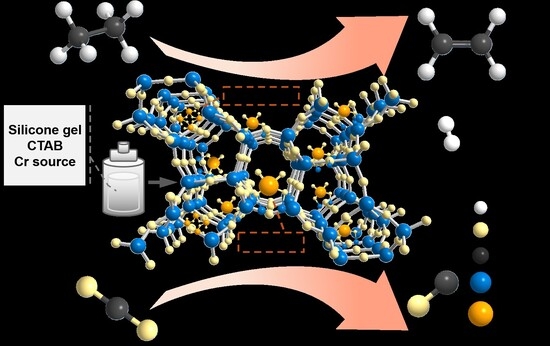
CO2-assisted ethane dehydrogenation (CO2-EDH) provides an attractive route to ethylene, yet its practical efficiency is limited by nonselective cracking, coke formation, and irreversible reduction of active Cr species. Here, a series of highly dispersed chromium catalysts (Cr@S-1) was prepared by a cetyltrimethylammonium bromide (CTAB)-assisted one-pot strategy. Their catalytic performance for CO2-EDH to ethylene was evaluated. XRD, XPS, UV-vis, Raman, and H2-TPR analyses indicate that the CTAB-mediated synthesis environment regulates MFI crystallization and chromium precursor distribution, leading to improved Cr dispersion and an enhanced population of Cr6+ species. The optimized catalyst delivered 69.8% initial ethane conversion and 54.7% ethylene yield at 650 °C without any observable deactivation over 70 h after the induction period, exhibiting better catalytic performance than the conventional impregnated counterpart (Cr/S-1). These results identify surfactant-regulated zeolite encapsulation as an effective route to prepare stable and selective Cr-based catalysts for CO2-assisted ethane dehydrogenation.

Graphical Abstract

1. Introduction

Ethylene is a key molecular platform in the petrochemical industry, underpinning the production of polyethylene, ethylene oxide, ethylene glycol, vinyl chloride, ethylbenzene, and many downstream commodities [1,2,3]. Industrial ethylene production is still dominated by steam cracking, a mature but energy-intensive process involving high-temperature free radical reaction, large heat input, cryogenic separation, and periodic decarbonization [1]. Despite decades of optimization, its high energy consumption, high CO2 emissions, and limited scope for selectivity improvements have motivated the development of alternative on-purpose ethylene technologies. The growing availability of ethane-rich natural gas and shale gas further strengthens this motivation, since catalytic ethane dehydrogenation provides a direct route of conversion from C2 to C2 with potentially higher carbon efficiency [4,5,6,7]. However, the endothermic ethane dehydrogenation is limited by thermodynamic equilibrium, requiring elevated temperatures to obtain a high yield of ethylene, which likely promotes C-C cleavage, leading to heavy coke deposition and fast catalyst deactivation.
CO2-assisted ethane dehydrogenation (CO2-EDH) provides an opportunity to integrate light-alkane upgrading with CO2 utilization [8,9,10,11,12,13,14]. Compared with O2-based oxidative dehydrogenation, CO2 is a milder oxidant that can reduce the risk of deep oxidation while contributing thermodynamic and kinetic benefits [15]. During dehydrogenation, CO2 can consume H2 via a reverse water–gas shift reaction (RWGS) or promote oxidative dehydrogenation through redox cycling and lower coke deposition via the Boudouard reaction. Recent studies further suggest that CO2 co-feeding can suppress sintering or deep reduction in selected atomically dispersed catalysts and enable tandem alkane dehydrogenation/CO2 reduction [12,13,16]. These benefits, however, are highly conditional: sluggish CO2 activation, occurrence of dry reforming, excessive RWGS, C-C bond scission, over-reduction of active species, and coke accumulation can all compromise ethylene selectivity and catalyst stability. The central challenge is therefore to create catalytic sites that selectively activate C-H bonds, inhibit C-C bond cleavage while simultaneously facilitating CO2 reduction.
Chromium-based catalysts occupy a privileged position in this context because Cr species can interconvert between multiple oxidation states and coordination environments through redox cycles under dehydrogenation conditions [17,18,19,20,21]. Early studies on CO2-EDH demonstrated that supported CrOx catalysts could deliver high ethylene yields, which strongly depend on support identity, Cr loading, and surface chromium structure [17]. In situ Raman, UV-vis, XPS and XAS characterizations indicate that isolated chromate-like species, oligomeric/polymeric CrOx domains, and bulk Cr2O3 possess distinct reducibility and alkane activation behavior. For light alkane dehydrogenation, highly dispersed CrOx species are generally beneficial, whereas excessive Cr loading or weak anchoring promotes Cr aggregation, nonselective cracking, coke deposition, and irreversible loss of high-valent Cr species [18,19,20,21]. Recent studies further reinforce that the catalytic function of Cr is governed less by nominal Cr content than by the nuclearity, oxidation state, coordination unsaturation, and spatial distribution of the Cr moieties [22,23,24].
Zeolites provide an appealing scaffold for imposing this level of control. Their crystalline micropores, shape-selective channels, hydrothermal robustness, and framework-associated anchoring sites can stabilize isolated metal centers or highly dispersed oxide moieties while restricting their migration and sintering [25,26,27,28]. Compared with amorphous silica or conventional mesoporous supports, zeolites can create well-defined microenvironments in which metal speciation, reactant access, product desorption, and coke formation are regulated simultaneously. In view of this, stable Cr-MFI catalysts have been developed for ethane dehydrogenation [22,28,29,30,31,32,33]. Atomically dispersed Cr species in highly siliceous MFI have shown high activity for alkane activation and co-fed CO2, and the synergy between the chromium moieties and MFI microenvironment has been clarified by in situ spectroscopy and theoretical analysis [22]. Silanol nests in the zeolitic framework are more helpful in dispersing the CrOx-active species than terminal silanols, which subsequently result in higher CO2-EDH activity [30]. A highly active and stable catalyst for CO2-EDH was developed by formation of single-site CrOx moieties embedded in the framework vacancy defects of silicalite-1 zeolite [31]. These studies suggest that siliceous MFI is not simply an inert support, but a confinement environment capable of controlling Cr speciation, moderating redox evolution, and suppressing deactivation.
Herein, to improve the utilization of Cr and reduce its usage, highly dispersed chromium silicalite-1 catalysts have been developed for CO2-assisted ethane dehydrogenation via a CTAB-assisted one-pot strategy. Catalytic evaluation combined with characterizations including XRD, TEM, N2 physisorption, ICP-OES, XPS, UV-vis, Raman, H2-TPR, NH3-TPD and TG analyses have been conducted and compared with a conventional silicalite-1 supported Cr catalyst. The structure–activity relationship has been discussed, and the nature of the catalyst and the deactivation mechanism have been illustrated.

2. Results and Discussion

2.1. Catalyst Synthesis and Textural Properties

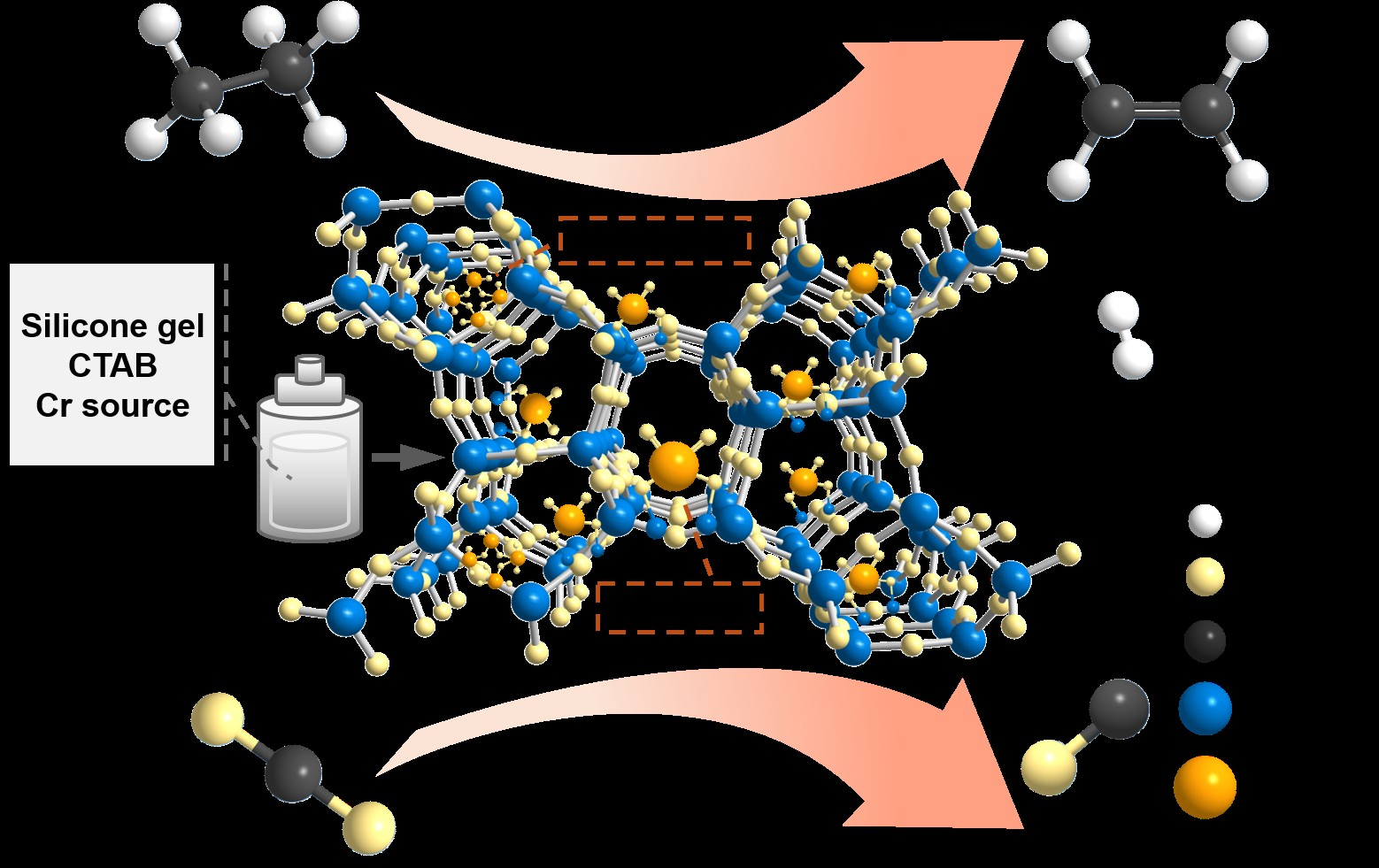
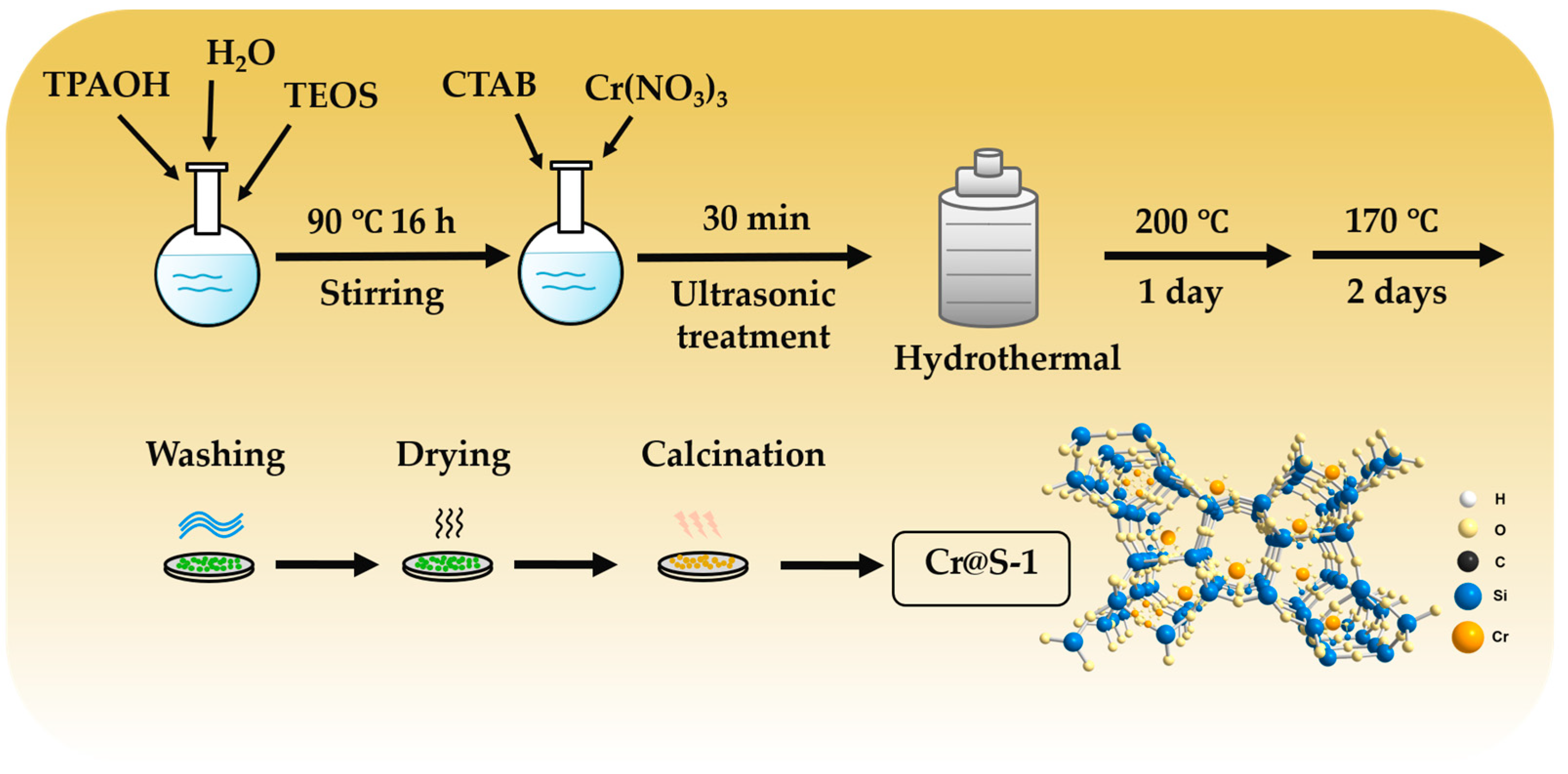
A highly dispersed chromium silicalite-1 catalyst was synthesized via a one-pot method with the assistance of CTAB. The preparation procedures are illustrated in Scheme 1. Details can be seen in Section 3.1.
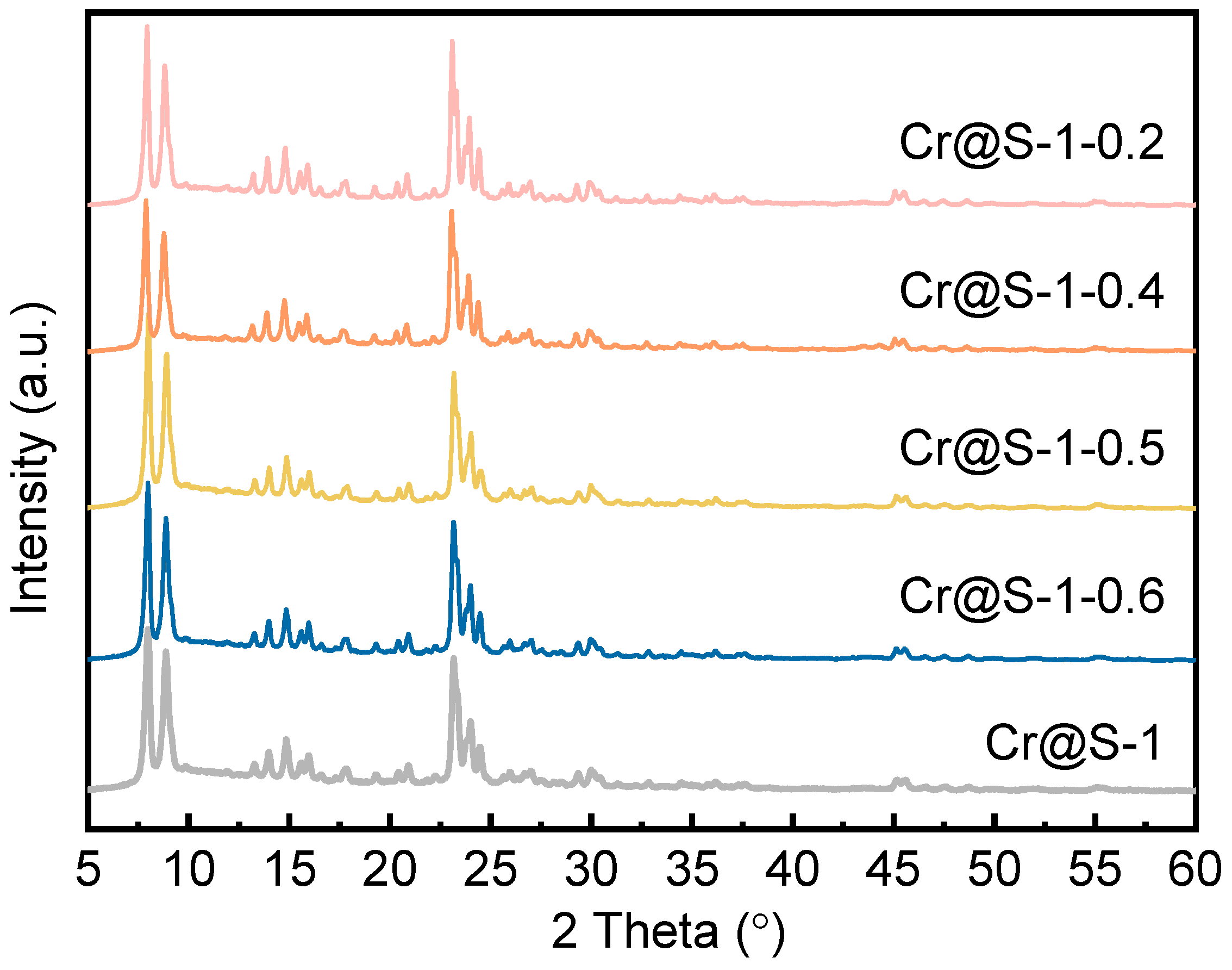
The XRD patterns of 1.5Cr@S-1-y catalysts prepared with different CTAB amounts are shown in Figure 1 and compared with those of impregnated catalyst 1.5Cr/S-1 and S-1 support in Figure S1. It is worth noting that a lower (y) value corresponds to a higher CTAB/Cr ratio. All samples display characteristic MFI reflections at 2θ = 8.0°, 8.9°, 23.1°, 23.3°, and 24.0°, confirming that the introduction of Cr and CTAB-assisted synthesis preserves the silicalite-1 topology structure. No diffraction peaks attributed to the crystalline CrOx or Cr2O3 are observed, indicating the absence of large crystalline chromium oxide domains within the XRD detection limit.
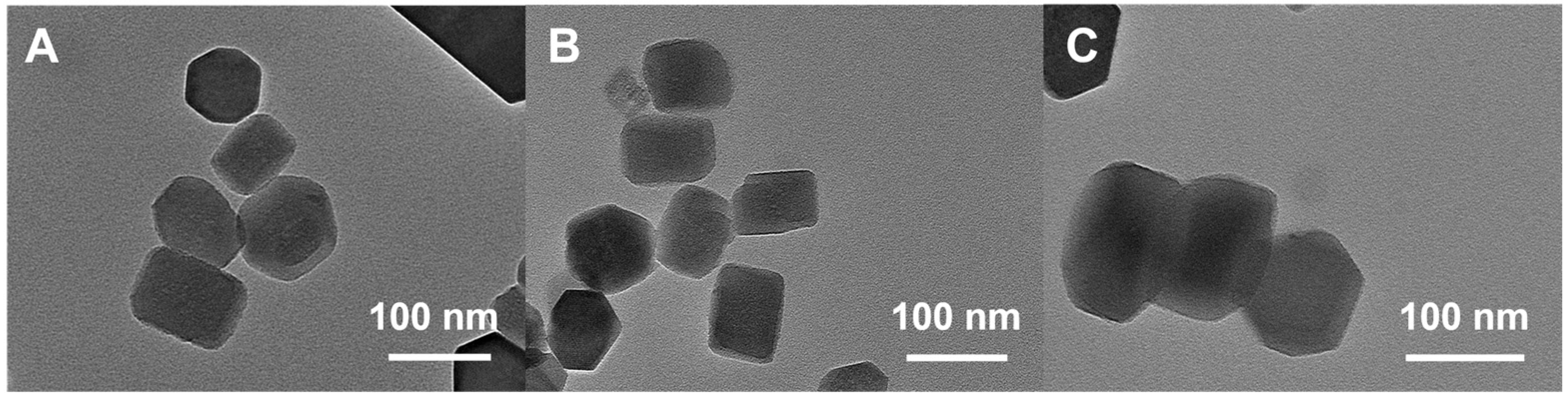
The morphology of the catalysts was characterized by TEM. All exhibited a rectangle-like morphology with particle sizes smaller than 150 nm (Figure 2). The catalysts prepared by the one-pot method without CTAB showed slightly smaller particle sizes compared to those prepared by impregnation. After chromium loading, no crystal particles were observed on the surface for any of the catalysts, which is consistent with the conclusions drawn from XRD analysis. Notably, compared with Cr@S-1, the introduction of CTAB favors the enlargement of particle size.
N2 physisorption was employed to evaluate the textural properties of the samples. All samples show Type I uptake at low relative pressure and a hysteresis loop at high relative pressure (Figure S2), indicating the coexistence of micropores and mesopores, primarily micropores. Detailed textural properties are summarized in Table 1. Both the specific surface area and the micropore volume of Cr highly dispersed catalysts are similar to those of the silicalite-1 support by conventional preparation, indicating that the samples had similar crystallinities and their micropore channels were not blocked by the incorporated chromium species due to their good dispersion. It is noteworthy that when the CTAB is excessive (y = 0.2), the mesopore volume decreases markedly, whereas the micropore volume remains nearly unchanged. This suggests that excessive CTAB may disturb the formation of mesoporosity [34].

2.2. Catalytic Activity

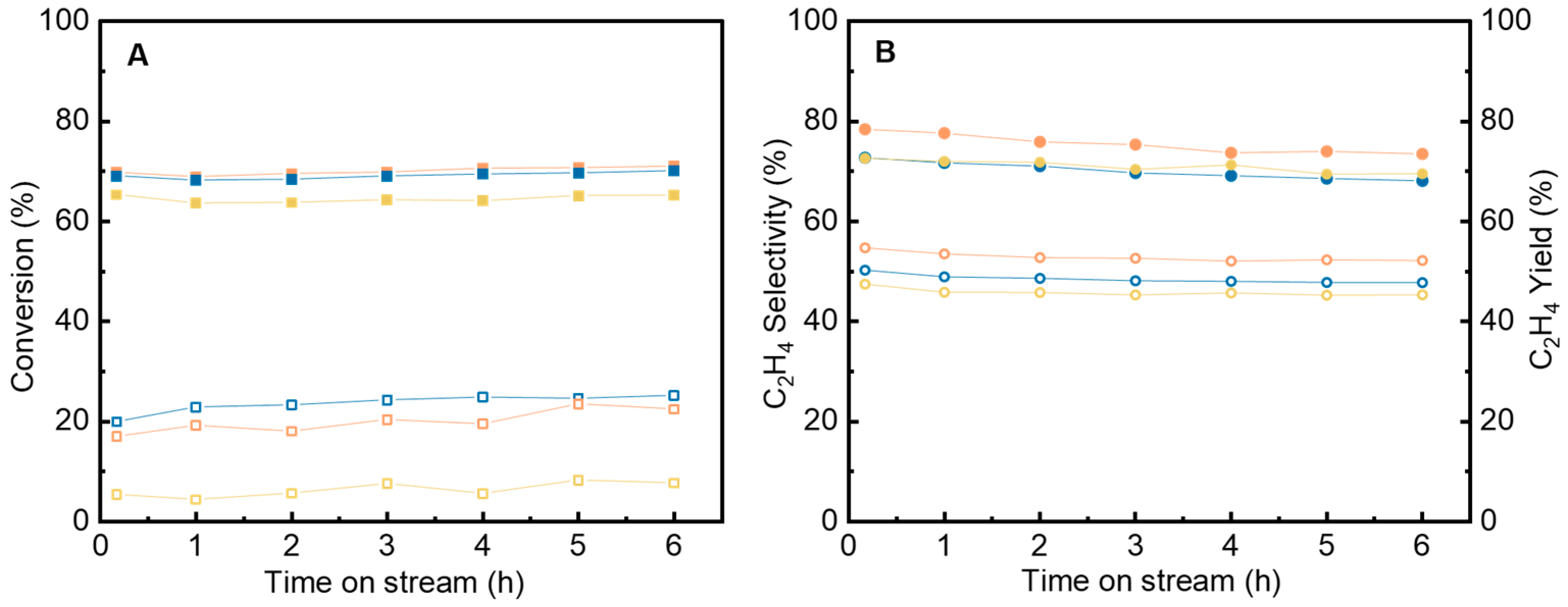
The catalytic performance of Cr highly dispersed catalysts has been investigated in CO2-assisted ethane dehydrogenation, and the results are depicted in Figure 3 and Table 2. All catalysts demonstrate excellent activity towards ethylene, and the only detectable byproduct is methane. Compared to the supported catalyst Cr/S-1 with the same Cr loading, Cr highly dispersed catalysts via CTAB-assisted one-pot synthesis show significant improvements in both ethylene selectivity and carbon balance, leading to an enhanced ethylene yield. It is obvious that the amount of CTAB added has a critical impact on CO2-EDH performance. The one-pot synthesis without CTAB assistance results in a substantial decrease in ethane conversion and ethylene selectivity. This suggests that Cr species are unevenly dispersed in the absence of CTAB regulation, which may promote deep cracking and coke formation. On the contrary, a decrease in ethylene selectivity is also observed when CTAB is high (y = 0.2), which might be due to the restricted mass transfer of ethylene product by the decreased mesopore volume. The optimal catalyst can be obtained at y = 0.5, exhibiting an initial ethylene yield of 54.7%, which is about 9.0% higher than that of the conventional supported catalyst (50.2%).
Since CO2-assisted ethane dehydrogenation is usually accompanied by dry reforming, the carbon balance based on CO2 (CO2-C.B.) was calculated and is listed in Table 2. CO2-C.B. was slightly higher than 100% for all catalysts, indicating the occurrence of dry reforming during dehydrogenation. However, all carbon balances are around 110%, indicating that the reaction mechanism on these catalysts may be the same, and the proportion of side reactions such as reforming is low.
The catalytic performance of Cr highly dispersed catalysts with different Cr loadings was also evaluated in CO2-EDH. As listed in Table 3, both ethane and CO2 conversions increase with Cr loadings while the ethylene selectivity and yield display a volcano-type trend. It seems that increasing chromium loading raises the density of active Cr sites, promoting the dehydrogenation of ethane, while high density also leads to the growing contribution of nonselective cracking, as evidenced by its low carbon balance. This is why the deactivation constant also increases with Cr loadings (Table S2). The optimal catalyst is obtained at a Cr loading of 1.5 wt.%, which gives the highest initial ethylene yield of 54.7%. As for TOF, it decreases as the Cr content increases (Table S2).
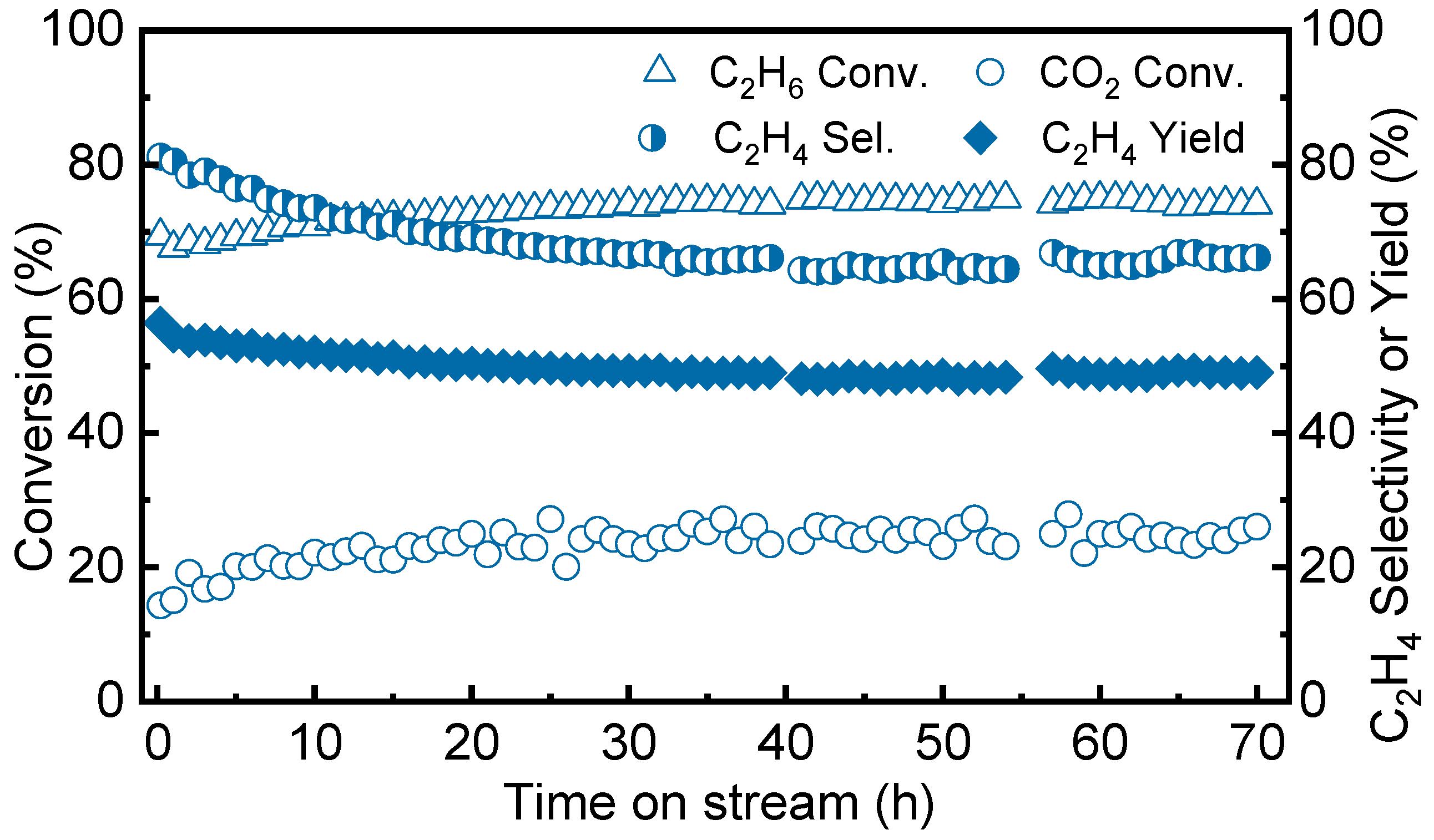
Long-term CO2-EDH was also carried out to evaluate the catalytic stability of the 1.5Cr@S-1-0.5 catalyst; the results are illustrated in Figure 4. The catalyst is quite stable after the initial induction period, and the yield of ethylene is maintained at about 49% without any obvious trend of deactivation after 70 h, which suggests that the present highly dispersed Cr silicalite-1 catalyst is a promising CO2-assisted dehydrogenation catalyst in future industrial applications.
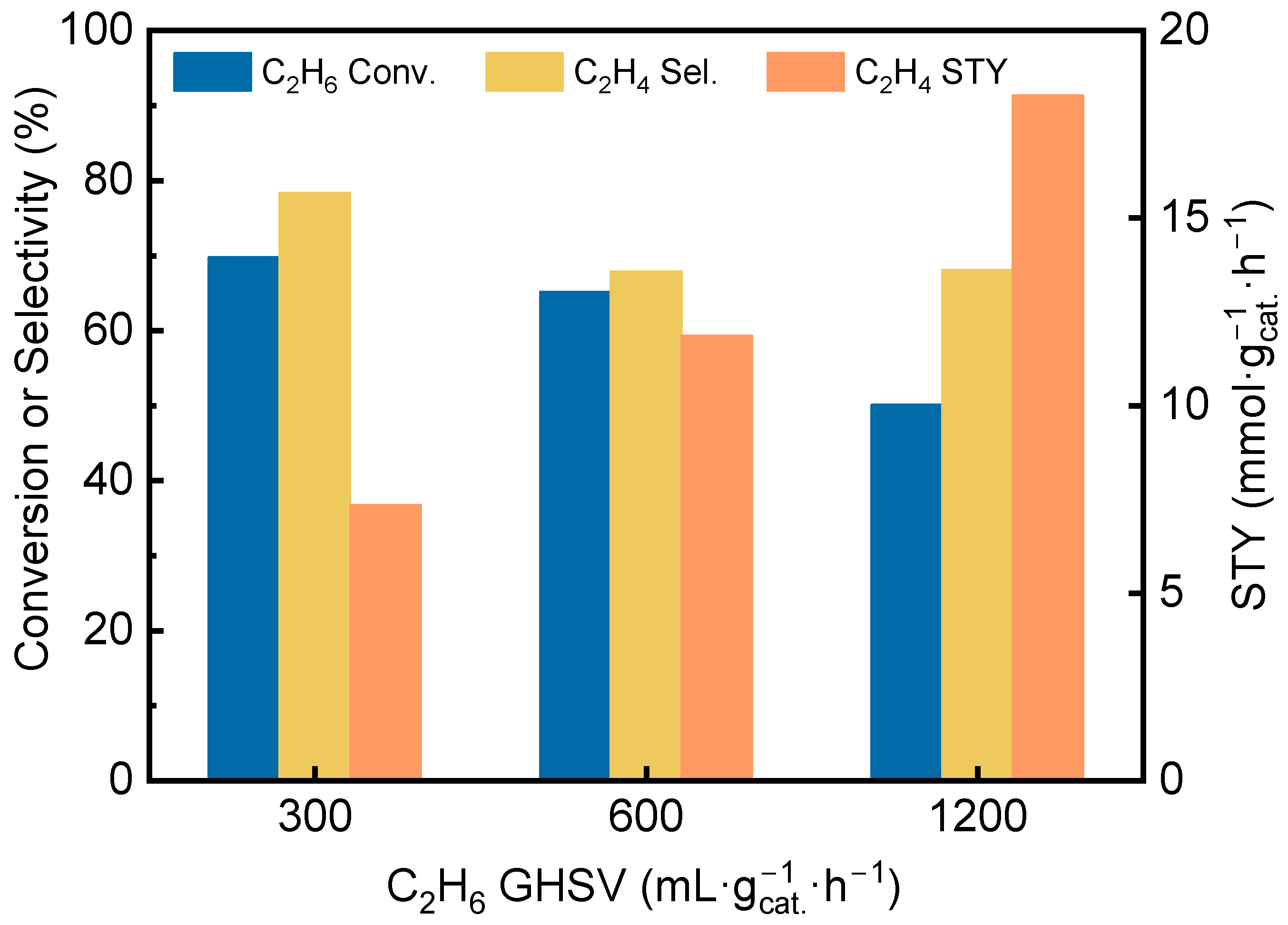
The catalytic behavior of the 1.5Cr@S-1-0.5 catalyst was investigated at several GHSVs to determine the effect of contact time on catalyst efficiency; the results are summarized in Figure 5 and Table 4. It is obvious that ethane conversion as well as ethylene selectivity exhibited a downward trend with the increase in GHSV. This decline is more apparent in conversion under the high GHSV (from 600 to 1200 mL·gcat−1·h−1), and more pronounced in selectivity under relatively low GHSV (from 300 to 600 mL·gcat−1·h−1). Meanwhile, the space-time yield (STY) of the catalyst increases accordingly (Table S3). Table S4 presents a summary of the catalytic performance of previously studied Cr-based catalysts in CO2-assisted ethane dehydrogenation [17,19,30,31,35,36,37,38,39,40,41,42,43,44,45,46,47,48]. It can be seen that our present catalyst has comparable activity to that of reported ones, while its stability is better.

2.3. State of Active Species

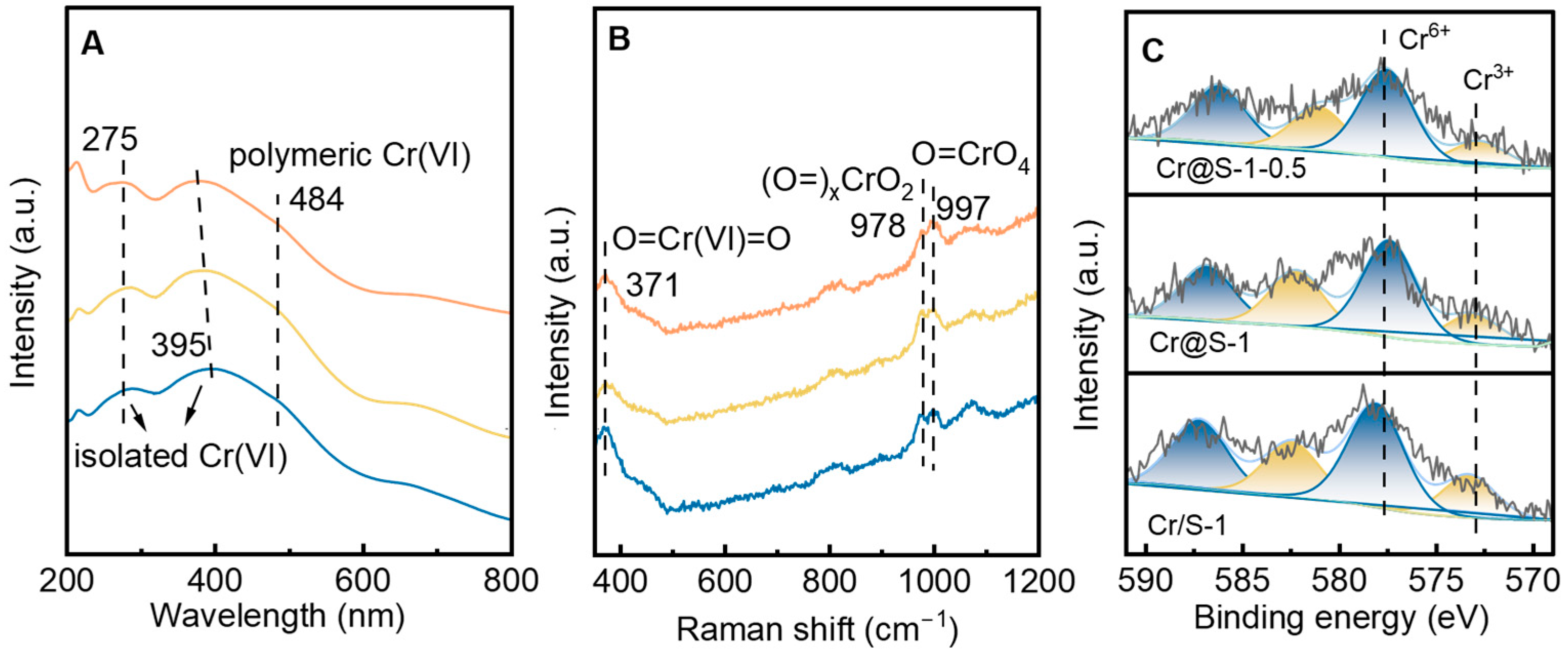
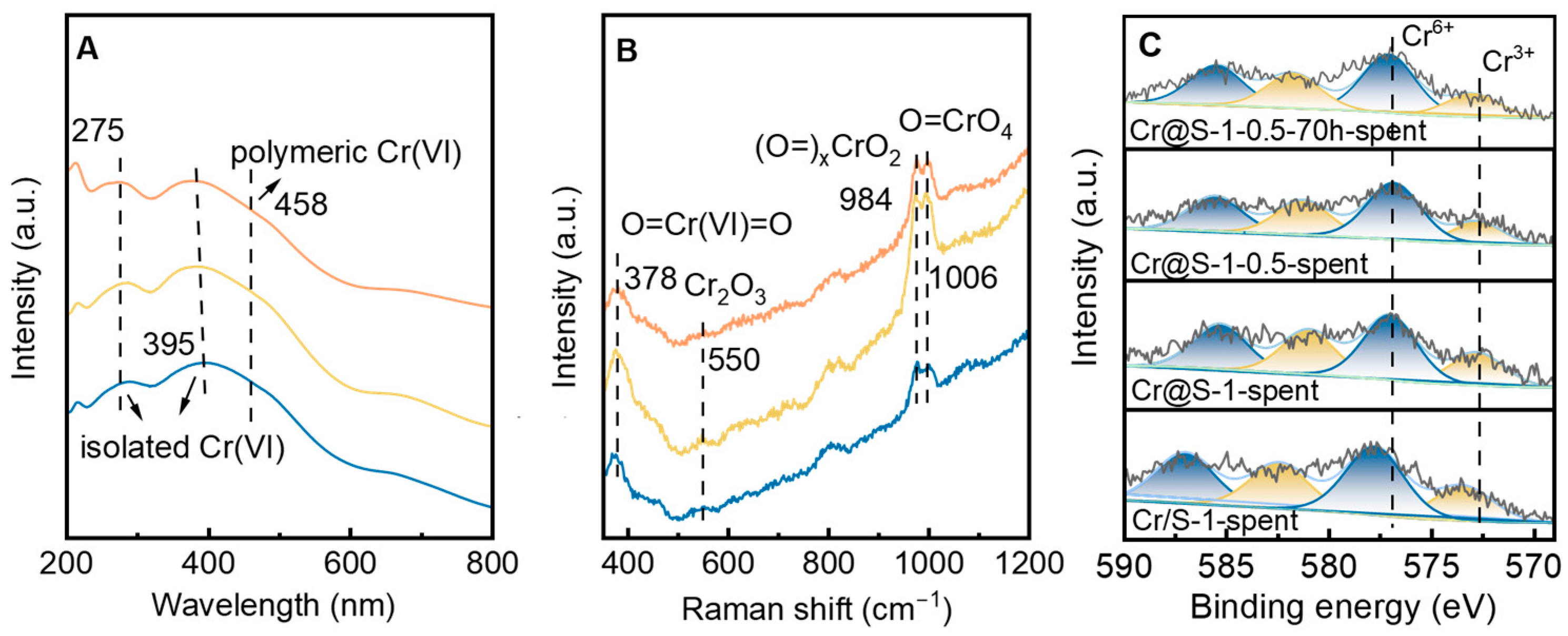
The characteristics of Cr species in the fresh catalysts were examined using multiple techniques. Figure 6A illustrates the UV–vis spectra of three representative catalysts. Two absorption bands at approximately 275 and 395 nm are observed for all the catalysts, which can be assigned to the O2−→Cr6+ charge transfer of monochromate species with tetrahedral symmetry. The peak around 484 nm associated with polymeric Cr6+ oxides is also present, though its intensity is much weaker. The absence of a band around 600 nm indicates that no crystalline Cr2O3 was detected [18,49,50]. Laser Raman spectra depicted in Figure 6B provide complementary structural insights into the Cr species of these catalysts. Three bands at about 371, 978 and 997 cm−1 are evident for all of the catalysts. The intense band at 371 cm−1 can be attributed to the bending vibrations of bridging O=Cr=O bonds within polymeric Cr6+ oxides, while the latter two are assigned to the symmetric stretching vibrations of two distinct isolated Cr6+ species: dioxo species (O=)2CrO2 and mono-oxo species O=CrO4, respectively [51,52,53]. The band at 550 cm−1 assigned to crystalline Cr2O3 was not observed. Based on the above results, no significant differences were observed in the surface Cr species among 1.5Cr/S-1, 1.5Cr@S-1, and 1.5Cr@S-1-0.5. X-ray photoelectron spectroscopy (XPS) was conducted to elucidate the oxidation states of surface Cr species. As shown in Figure 6C, deconvolution of the Cr 2p3/2 peak in the 575–583 eV range gives two components at binding energies (BEs) of ~573.0 and ~578.0 eV, assigned to Cr3+ and Cr6+, respectively [24]. As shown in Table 5, three catalysts have similar BEs. However, the Cr6+/Cr3+ ratio is quite different. 1.5Cr@S-1-0.5 exhibits the highest surface Cr6+/Cr3+ ratio of 3.57, while 1.5Cr/S-1 has the lowest value of 2.56. This may account for the better activity of 1.5Cr@S-1-0.5 than 1.5Cr/S-1 since it has been proposed that Cr6+ species are responsible for the high catalytic activities of Cr-based catalysts in light alkane dehydrogenation using CO2 as a mild oxidant.
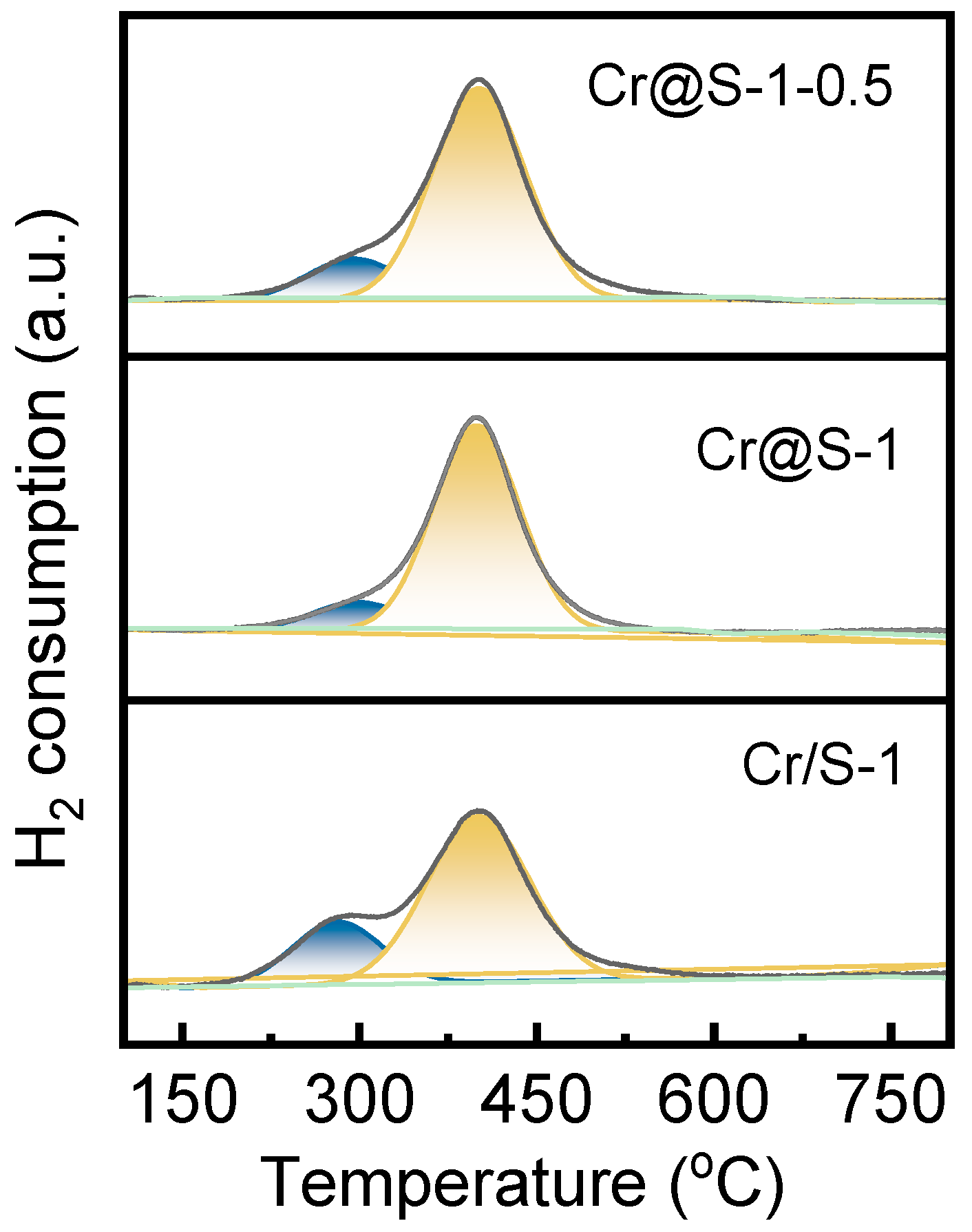
The higher proportion of Cr6+ species on 1.5Cr@S-1-0.5 compared with 1.5Cr/S-1 can be further confirmed by H2-TPR results. As illustrated in Figure 7, one broad reduction peak in the temperature range of 200–600 °C is observed, which can be attributed to the reduction of Cr6+ to Cr3+. H2 consumption descends in the order of 1.5Cr@S-1-0.5 > 1.5Cr@S-1 > 1.5Cr/S-1, implying that the amount of redox Cr6+ species decreases following the above sequence. This is consistent with XPS results since the total Cr contents are basically the same. To further elucidate the nature of the Cr species in the catalysts, the H2-TPR profiles were deconvoluted. Each profile is composed of a weak peak centered at 290 °C (except for Cr/S-1 at 275 °C) and an intense peak at around 400 °C, associated with the reduction of polymeric Cr6+ and isolated Cr6+ species, respectively [54]. Notably, isolated Cr6+ species account for the majority in these catalysts, and the ratio of isolated Cr6+ to polymeric Cr6+ of 1.5Cr@S-1-0.5 is higher than that of 1.5Cr/S-1. Since isolated Cr6+ is reported to be more active for ethane dehydrogenation than polymeric Cr6+ or crystalline Cr2O3 [33,55], the above result may be another reason for the excellent activity of the present catalyst, due to its better dispersion of Cr species using the one-pot CTAB-assisted strategy.
As shown in Figure S4 and Table S5, the ratio of isolated Cr6+ to polymeric Cr6+ in these catalysts gradually decreases with increasing Cr content. This may explain the decline in the TOF of these catalysts with increasing Cr content.
The surface acidity of the Cr catalysts was investigated by the NH3-TPD measurement. As presented in Figure S5, an asymmetric broad peak in the range of 100–500 °C can be observed in all curves, indicating the presence of both weak and medium–strong acid sites arising from Cr species with unsaturated coordination. The number of acid sites was quantified and is presented in Table 6. However, there is no significant correlation between the surface acidity and dehydrogenation activity, indicating that the dehydrogenation over Cr-based catalysts mainly proceeds through a redox mechanism rather than a heterolytic one [37,56].

2.4. Catalyst Deactivation

It can be seen from Figure 3 that ethane yield declines gradually with reaction time over all of the catalysts. In order to determine the deactivation mechanism, spent catalysts after 6 h of reaction were characterized by UV-vis, Raman and XPS. Although no significant differences were found in the UV-vis spectra as depicted in Figure 8A, a weak band at 550 cm−1, assigned to crystalline Cr2O3, appeared in all of the spent catalysts in the Raman spectra (Figure 8B), indicating the aggregation of Cr species during dehydrogenation. The intensity of this band decreased in the order of 1.5Cr@S-1 > 1.5Cr/S-1 > 1.5Cr@S-1-0.5, implying 1.5Cr@S-1-0.5 is the most stable catalyst against aggregation. This can be confirmed by the XPS measurement, which shows that the Cr6+/Cr3+ ratio decreases markedly after 6 h of reaction, indicating that not all Cr3+ species reduced from Cr6+ can be reoxidized to their original form during the reaction. The remaining Cr3+ species were easily moved, encountered each other, and were combined into Cr2O3 nanoparticles under a high reaction temperature, which may account for catalyst deactivation. The decrease in Cr6+ species was calculated based on the change in the Cr6+/Cr3+ ratio before and after the reaction, as listed in Table 7. Again, 1.5Cr@S-1-0.5 is the most stable among these catalysts.
TG analysis was used to assess carbon deposition on the spent catalysts (Figure S6 and Table 7). Although the 1.5Cr@S-1-0.5 catalyst exhibits the highest stability among the three catalysts, it also possesses the highest amount of carbon deposition. This result indicates that coke deposition is not the main cause for deactivation, and the preservation of Cr6+ species is more decisive for catalytic stability. It is noteworthy that the carbon deposition on the 1.5Cr@S-1-0.5-70h catalyst after 70 h of reaction (0.55 wt.%) was significantly lower than that on the other three catalysts (after 6 h of reaction), especially 1.5Cr@S-1-0.5-spent (1.15 wt.%). This demonstrates that during the reaction, in addition to acting as a mild oxidant for the oxidation of Cr3+ [37,56], CO2 also plays a role in carbon removal.
In summary, CTAB modulates the dispersion and speciation of Cr: it enhances the “structural resilience” of Cr6+ against deep reduction by improving its dispersion, thereby maximizing the proportion of highly active isolated Cr6+ species and minimizing the formation of inactive crystalline Cr2O3 and the content of polymeric Cr6+ species; meanwhile, aggregation of active isolated Cr6+ species is avoided. This synergistic effect endows Cr@S-1-0.5 with the best catalytic performance (high ethylene selectivity, low methane selectivity, and high stability) for ethane dehydrogenation in the presence of CO2.

3. Materials and Methods

3.1. Reagent and Materials

The tetraethyl orthosilicate (TEOS), hexadecyltrimethylammonium bromide (CTAB) were purchased from Sinopharm Chemical Reagent Co. Ltd. (Shanghai, China). The Cr(NO3)3·9H2O was purchased from Aladdin Biochemical Co. Ltd. (Shanghai, China). All the chemicals were of analytical grade and used as received.

3.2. Catalyst Preparation

Cr highly dispersed silicalite-1 catalysts were synthesized as follows: a transparent suspension with a molar composition of 9 TPAOH:25 SiO2:480 H2O was prepared by mixing calculated tetrapropylammonium hydroxide (TPAOH, 40 wt.% aqueous solution), tetraethyl orthosilicate (TEOS), and distilled water. The mixture was first stirred at room temperature for 30 min to hydrolyze TEOS and then at 90 °C for 16 h. Predetermined amounts of chromium nitrate and CTAB were then introduced. The resulting gel was transferred to a Teflon-lined stainless-steel autoclave and crystallized first at 200 °C for 1 day and then at 170 °C for 2 days. The obtained product was filtered, washed, dried overnight at 100 °C, and calcined in air at 650 °C for 6 h. The samples were denoted xCr@S-1-y, where x is the Cr mass fraction in the final catalyst and y is the metal-ion/CTAB molar ratio; xCr@S-1 denotes synthesis without CTAB.
Silicalite-1 (S-1) was prepared using the same procedure without the addition of chromium nitrate and CTAB, followed by calcination in air at 550 °C for 4 h. Silicalite-supported chromium catalysts were prepared by incipient wetness impregnation using S-1 as the support and Cr(NO3)3·9H2O as the chromium precursor. The impregnated samples were calcined in air at 650 °C for 6 h and denoted xCr/S-1, where x is the Cr mass fraction in the final catalyst.

3.3. Catalyst Characterization

X-ray powder diffraction (XRD) patterns were collected on a D2 PHASER X-ray diffractometer (Bruker, Billercia, MA, USA) with Cu Kα radiation to investigate the crystalline phases of the samples. A Micromeritics TriStar II analyzer (Micromeritics, Atlanta, GA, USA) was applied to obtain N2 adsorption/desorption isotherms, from which the specific surface areas were calculated by the Brunauer–Emmett–Teller (BET) method, the micropore volume was calculated by the t-plot method, and the total pore volumes were calculated by the Barrett–Joyner–Halenda (BJH) method. Inductively coupled plasma–optical emission spectroscopy (ICP-OES) was performed on an Agilent 5110 spectrometer (Agilent Technologies, Santa Clara, CA, USA.). The morphology of the samples was revealed using a transmission electron microscope (Hitachi HT7700 Exalens, Hitachi High-Technologies Corporation, Tokyo, Japan) operating at 120 kV. XPS analyses were carried out on a K-Alpha spectrometer (Thermo Scientific, Waltham, MA, USA), employing Al-Kα radiation as the excitation source. The calibration of the binding energy was conducted with reference to the C1s peak of the contaminant carbon at 284.8 eV. Ultraviolet–visible diffuse reflectance spectroscopy (UV-vis) was performed using a Lambda 650S spectrophotometer (PERKIN ELMER, Shelton, CT, USA) equipped with an integrating sphere attachment. The spectrometer was calibrated with barium sulfate (BaSO4) as a reference standard, and the spectra were recorded in the range of 200–800 nm. Laser Raman spectroscopy measurements were carried out on an XploRA Raman spectrometer (HORIBA Scientific, Edison, NJ, USA) using a 532 nm air-cooled solid-state laser as the excitation source. The coke content of the spent catalysts was determined by thermogravimetric analysis (TGA) using an SDT Q600 instrument (TA, New Castle, DE, USA). The calculation was based on the difference in weight loss between two distinct plateaus observed in the temperature range of approximately 350 to 800 °C during the heating process.
H2 temperature-programmed reduction (H2-TPR) was performed on an Auto Chem II instrument (Micromeritics, Atlanta, GA, USA). A 100 mg sample was loaded on a quartz tube and purged with helium at 300 °C for 2 h with a flow rate of 30 mL/min. After cooling down to room temperature, the amount of hydrogen consumed was monitored with a thermal conductivity detector (TCD) under a 10 vol% H2/Ar flow in the range of 100 to 800 °C at a rate of 10 °C/min. The acidity of the samples was measured by ammonia temperature-programmed desorption (NH3-TPD) experiments performed on a Micromeritics AutoChem II chemisorption analyzer (Micromeritics, Atlanta, GA, USA). Approximately 100 mg of the catalyst (40–60 mesh) was first activated in a nitrogen flow at 550 °C for 1 h, cooled to 80 °C, and then exposed to a 10 vol% NH3/He mixture (30 mL/min) for 2 h to achieve saturated adsorption. Subsequently, the sample was purged with helium (30 mL/min) for 2 h to remove physisorbed ammonia. Finally, the temperature was raised to 600 °C at a heating rate of 10 °C/min to desorb the chemisorbed NH3.

3.4. Catalytic Testing

The reaction was conducted in a fixed-bed flow microreactor under atmospheric pressure. A catalyst mass of 200 mg sieved by 40∼60 mesh was loaded in the middle of a quartz tube (inner diameter of 6 mm and length of 45 cm) and pretreated in a N2 atmosphere for 1 h at 650 °C with a heating rate of 10 °C/min prior to the reaction. The reactant consisted of 3.3 vol% ethane, 6.7 vol% CO2 and the balance of N2, with a total gas hourly space velocity (GHSV) of 9000 mL·gcat−1·h−1. Online gas chromatography (GC) was applied for product analysis, which has a flame ionization detector (FID) with a 6 m packed column of Porapak Q for hydrocarbon detection (e.g., C2H6, C2H4, CH4) and a TCD with a 2 m packed column of TDX-01 for other gas detection (e.g., H2, N2, CO, CO2). Ethane conversion χ(C2H6), ethylene selectivity S(C2H4), ethylene yield Y(C2H4), carbon balance (C.B.) and CO2-based carbon balance (CO2-C.B.) were determined using the following formula:
χ C 2 H 6 =     C 2 H 6   in     C 2 H 6   out   C 2 H 6   in   ×   100 %
S ( C 2 H 4 ) =   C 2 H 4   out C 2 H 6   in   C 2 H 6   out   ×   100 %
Y ( C 2 H 4 ) = χ ( C 2 H 6 )   ×   S ( C 2 H 4 )
C . B . =   C x H y   out C 2 H 6   in   ×   100 %
CO 2 - C . B . = CO 2   out + CO out   CO 2   in   ×   100 %
where C x H y   in and   C x H y   out represent the gas flow of hydrocarbons in the feed and output, respectively; CO x   in and   CO x   out represent the gas flow of carbon oxides in the feed and output, respectively.
Catalytic stability was evaluated by the deactivation rate constant (kd, h−1) based on a first-order deactivation model:
k d   t   =   ln [ 1 Y C 2 H 4 , F Y C 2 H 4 , F ]     ln [ 1 Y C 2 H 4 , I Y C 2 H 4 , I ]
where Y C 2 H 4 , F and Y C 2 H 4 , I are the final and initial C2H4 yield of the CO2-EDH reaction, respectively, and t is the time on stream.
All test results are reproducible within the precision of 5% based on triplicate measurements.

4. Conclusions

In summary, chromium highly dispersed catalysts were synthesized by a CTAB-assisted one-pot strategy for CO2-assisted ethane dehydrogenation. CTAB addition regulates the pore structure and the chromium distribution while preserving the MFI framework. Among the catalysts examined, 1.5Cr@S-1-0.5 exhibited the best catalytic performance and maintained an ethylene yield of around 50% over the 70 h reaction, significantly outperforming its conventionally impregnated counterpart, 1.5Cr/S-1. The enhanced performance is attributed to CTAB-mediated confinement, which improves Cr dispersion, suppresses crystalline Cr2O3 formation, and maintains the Cr6+ species, which are regarded as possible precursors to the active sites. Deactivation is associated with Cr6+ species reduction and coke deposition, the former of which may play a more crucial role. These findings demonstrate that surfactant-assisted zeolite encapsulation can tune CrOx nuclearity and redox stability for selective CO2-assisted ethane dehydrogenation.

Supplementary Materials

The following supporting information can be downloaded at https://www.mdpi.com/article/10.3390/catal16080714/s1. Figure S1. XRD patterns of pristine siliceous supports, Cr-loaded and Cr highly dispersed Cr catalysts; Figure S2. N2 adsorption–desorption isotherms of (a) Cr@S-1-0.5, (b) Cr@S-1, (c) Cr/S-1, and (d) S-1; Figure S3. N2 adsorption–desorption isotherms of Cr@S-1-y prepared with different CTAB amounts. (a) Cr@S-1, (b) Cr@S-1-0.6, (c) Cr@S-1-0.5, (d) Cr@S-1-0.4, and (e) Cr@S-1-0.2; Figure S4. H2-TPR profiles of xCr@S-1-0.5 catalysts with different Cr loadings; Figure S5. NH3-TPD profiles of Cr/S-1, Cr@S-1, and Cr@S-1-0.5; Figure S6. TG profiles of spent Cr catalysts after CO2-assisted ethane dehydrogenation; Table S1. Catalytic performance of various 1.5 wt% Cr catalysts in the presence of CO2; Table S2. Catalytic performance of xCr@S-1-0.5 with different Cr loadings in the presence of CO2; Table S3. Ethylene formation rates and deactivation constants of 1.5Cr@S-1-0.5 under different C2H6 GHSV values and feed compositions; Table S4. Comparison of catalytic performance of Cr-based catalysts for CO2-assisted ethane dehydrogenation; Table S5. Quantitative Cr speciation estimated from H2-TPR for xCr@S-1-0.5 with different Cr loadings.

Author Contributions

Y.C.: investigation, data curation, writing—original draft. W.H.: methodology, formal analysis. Y.Y.: conceptualization, supervision, writing—review and editing, project administration. Z.G.: supervision. All authors have read and agreed to the published version of the manuscript.

Funding

This research was funded by the National Natural Science Foundation of China, grant number 22072027.

Data Availability Statement

The data presented in this study are available in the article.

Conflicts of Interest

The authors declare no conflicts of interest.

References

  1. Ren, T.; Patel, M.; Blok, K. Olefins from Conventional and Heavy Feedstocks: Energy Use in Steam Cracking and Alternative Processes. Energy 2006, 31, 425–451. [Google Scholar] [CrossRef]
  2. Amghizar, I.; Vandewalle, L.A.; Van Geem, K.M.; Marin, G.B. New Trends in Olefin Production. Engineering 2017, 3, 171–178. [Google Scholar] [CrossRef]
  3. Gao, Y.; Neal, L.; Ding, D.; Wu, W.; Baroi, C.; Gaffney, A.M.; Li, F. Recent Advances in Intensified Ethylene Production—A Review. ACS Catal. 2019, 9, 8592–8621. [Google Scholar] [CrossRef]
  4. Sattler, J.J.H.B.; Ruiz-Martinez, J.; Santillan-Jimenez, E.; Weckhuysen, B.M. Catalytic Dehydrogenation of Light Alkanes on Metals and Metal Oxides. Chem. Rev. 2014, 114, 10613–10653. [Google Scholar] [CrossRef] [PubMed]
  5. Li, C.; Wang, G. Dehydrogenation of Light Alkanes to Mono-Olefins. Chem. Soc. Rev. 2021, 50, 4359–4381. [Google Scholar] [CrossRef] [PubMed]
  6. Dai, Y.; Gao, X.; Wang, Q.; Wan, X.; Zhou, C.; Yang, Y. Recent Progress in Heterogeneous Metal and Metal Oxide Catalysts for Direct Dehydrogenation of Ethane and Propane. Chem. Soc. Rev. 2021, 50, 5590–5630. [Google Scholar] [CrossRef] [PubMed]
  7. Fairuzov, D.; Gerzeliev, I.; Maximov, A.; Naranov, E. Catalytic Dehydrogenation of Ethane: A Mini Review of Recent Advances and Perspective of Chemical Looping Technology. Catalysts 2021, 11, 833. [Google Scholar] [CrossRef]
  8. Wang, S.; Zhu, Z.H. Catalytic Conversion of Alkanes to Olefins by Carbon Dioxide Oxidative Dehydrogenation A Review. Energy Fuels 2004, 18, 1126–1139. [Google Scholar] [CrossRef]
  9. Gomez, E.; Yan, B.; Kattel, S.; Chen, J.G. Carbon Dioxide Reduction in Tandem with Light-Alkane Dehydrogenation. Nat. Rev. Chem. 2019, 3, 638–649. [Google Scholar] [CrossRef]
  10. Li, G.; Liu, C.; Cui, X.; Yang, Y.; Shi, F. Oxidative Dehydrogenation of Light Alkanes with Carbon Dioxide. Green Chem. 2021, 23, 689–707. [Google Scholar] [CrossRef]
  11. Gambo, Y.; Adamu, S.; Tanimu, G.; Abdullahi, I.M.; Lucky, R.A.; Ba-Shammakh, M.S.; Hossain, M.M. CO2-Mediated Oxidative Dehydrogenation of Light Alkanes to Olefins: Advances and Perspectives in Catalyst Design and Process Improvement. Appl. Catal. Gen. 2021, 623, 118273. [Google Scholar] [CrossRef]
  12. Zheng, Y.; Zhang, X.; Li, J.; An, J.; Xu, L.; Li, X.; Zhu, X. CO2-Assisted Oxidation Dehydrogenation of Light Alkanes over Metal-Based Heterogeneous Catalysts. Chin. J. Catal. 2024, 65, 40–69. [Google Scholar] [CrossRef]
  13. Zhang, S.; Wu, C.; Xin, J.; Yang, G.; Li, Y.; Su, M.; Zhang, H.; Zhang, H.; Wang, L. Advances in CO2-assisted Oxidative Dehydrogenation of Light Alkanes to Light Alkenes. ChemPhysChem 2025, 26, e202401073. [Google Scholar] [CrossRef] [PubMed]
  14. Li, Z.; Han, W.; Dong, F.; Zhang, H.; Meng, X.; Tang, Z. Recent Advances on CO2-Oxidative Dehydrogenation of Low-Carbon Alkanes to High-Value Olefins: A Critical Review. Fuel 2026, 411, 138114. [Google Scholar] [CrossRef]
  15. Mukherjee, D.; Park, S.-E.; Reddy, B.M. CO2 as a Soft Oxidant for Oxidative Dehydrogenation Reaction: An Eco Benign Process for Industry. J. CO2 Util. 2016, 16, 301–312. [Google Scholar] [CrossRef]
  16. Zheng, Y.; Li, J.; Zhang, X.; An, J.; Xin, W.; Zhu, X.; Li, X. Effect of CO2 Co-Feeding on the Stabilization of Atomically Dispersed Iron Species over MgAl2O4 During Ethane Dehydrogenation Reactions. ACS Catal. 2023, 13, 11153–11163. [Google Scholar] [CrossRef]
  17. Wang, S.; Murata, K.; Hayakawa, T.; Hamakawa, S.; Suzuki, K. Dehydrogenation of Ethane with Carbon Dioxide over Supported Chromium Oxide Catalysts. Appl. Catal. Gen. 2000, 196, 1–8. [Google Scholar] [CrossRef]
  18. Baek, J.; Yun, H.J.; Yun, D.; Choi, Y.; Yi, J. Preparation of Highly Dispersed Chromium Oxide Catalysts Supported on Mesoporous Silica for the Oxidative Dehydrogenation of Propane Using CO2: Insight into the Nature of Catalytically Active Chromium Sites. ACS Catal. 2012, 2, 1893–1903. [Google Scholar] [CrossRef]
  19. Al-Awadi, A.S.; El-Toni, A.M.; Labis, J.P.; Khan, A.; Ghaithan, H.; Al-Zahrani, A.A.; Abasaeed, A.E.; Al-Zahrani, S.M. Mesoporous Organo-Silica Supported Chromium Oxide Catalyst for Oxidative Dehydrogenation of Ethane to Ethylene with CO2. Catalysts 2021, 11, 642. [Google Scholar] [CrossRef]
  20. Liu, P.; Zhang, L.; Li, M.; Sun, N.; Wei, W. Recent Progress in Cr-Based Catalysts for Oxidative Dehydrogenation of Light Alkanes by Employing CO2 as a Soft Oxidant. Clean Energy 2021, 5, 623–633. [Google Scholar] [CrossRef]
  21. Lara-Moreno, L.; Sánchez-López, P.; Pawelec, B.; Navarro Yerga, R.M.; Gomez, S.A.; Moyado, S.F.; Zepeda, T.A. CO2-Oxidative Dehydrogenation of Light Alkanes Catalyzed by Cr Catalysts Supported on Different Mesoporous Silica Structures. Top. Catal. 2025, 68, 1682–1700. [Google Scholar] [CrossRef]
  22. Zhou, W.; Felvey, N.; Guo, J.; Hoffman, A.S.; Bare, S.R.; Kulkarni, A.R.; Runnebaum, R.C.; Kronawitter, C.X. Reduction of Cofed Carbon Dioxide Modifies the Local Coordination Environment of Zeolite-Supported, Atomically Dispersed Chromium to Promote Ethane Dehydrogenation. J. Am. Chem. Soc. 2024, 146, 10060–10072. [Google Scholar] [CrossRef] [PubMed]
  23. Hu, Z.-P.; Qin, G.; Han, J.; Zheng, Y.; Liu, Z.; Jiang, Y.; Su, X.; Ji, T.; Li, M.; Yuan, Z.-Y.; et al. Synergy Principle of Single Active Centers and Microenvironment for Cr-MFI-Catalyzed Alkane Dehydrogenation. Natl. Sci. Rev. 2025, 12, nwaf405. [Google Scholar] [CrossRef] [PubMed]
  24. Lv, M.; Li, Q.; Xue, F.; Li, Z.; Zhang, P.; Fan, L.; Zeng, J.; Li, M.; He, Y.; Li, D.; et al. Enriching Unsaturated Coordination for High-Performance Chromium Oxide Catalysts. Chem. Mater. 2025, 37, 167–174. [Google Scholar]
  25. Gao, C.; Lyu, F.; Yin, Y. Encapsulated Metal Nanoparticles for Catalysis. Chem. Rev. 2021, 121, 834–881. [Google Scholar] [PubMed]
  26. De, S.; Ould-Chikh, S.; Aguilar, A.; Hazemann, J.-L.; Zitolo, A.; Ramirez, A.; Telalovic, S.; Gascon, J. Stable Cr-MFI Catalysts for the Nonoxidative Dehydrogenation of Ethane: Catalytic Performance and Nature of the Active Sites. ACS Catal. 2021, 11, 3988–3995. [Google Scholar] [CrossRef]
  27. Zhang, Q.; Gao, S.; Yu, J. Metal Sites in Zeolites: Synthesis, Characterization, and Catalysis. Chem. Rev. 2023, 123, 6039–6106. [Google Scholar] [CrossRef] [PubMed]
  28. Liu, L.; Wang, L.; Xiao, F.-S. Zeolite Catalysts for Non-Oxidative Ethane Dehydrogenation to Ethylene. EES Catal. 2024, 2, 923–931. [Google Scholar] [CrossRef]
  29. Mimura, N.; Okamoto, M.; Yamashita, H.; Oyama, S.T.; Murata, K. Oxidative Dehydrogenation of Ethane over Cr/ZSM-5 Catalysts Using CO2 as an Oxidant. J. Phys. Chem. B 2006, 110, 21764–21770. [Google Scholar] [CrossRef] [PubMed]
  30. Cheng, Y.; Zhang, F.; Zhang, Y.; Miao, C.; Hua, W.; Yue, Y.; Gao, Z. Oxidative Dehydrogenation of Ethane with CO2 over Cr Supported on Submicron ZSM-5 Zeolite. Chin. J. Catal. 2015, 36, 1242–1248. [Google Scholar] [CrossRef]
  31. Cheng, Y.; Lei, T.; Miao, C.; Hua, W.; Yue, Y.; Gao, Z. Single-Site CrOx Moieties on Silicalite: Highly Active and Stable for Ethane Dehydrogenation with CO2. Catal. Lett. 2018, 148, 1375–1382. [Google Scholar] [CrossRef]
  32. Wang, J.; Song, Y.-H.; Yuan, E.-H.; Liu, Z.-T.; Liu, Z.-W. Elucidating the Support-Size Effect on the Catalytic Stability of CrOx/Silicalite-1 for Oxidative Dehydrogenation of Propane with CO2. Catal. Lett. 2023, 153, 790–804. [Google Scholar] [CrossRef]
  33. Zhu, X.-M.; Cheng, S.; Wang, Y.; Chen, D.-L.; Lu, J.-Q. Identification of Active Sites in Cr@Zeolite Catalysts and Reaction Routes for CO2 -Assisted Oxidative Propane Dehydrogenation. ACS Catal. 2026, 16, 8656–8668. [Google Scholar] [CrossRef]
  34. Zhang, Q.; Zhai, Y.; Wang, F.; Zhang, X.; Lv, G.; Liu, Y.; Li, M.; Li, M. One-Step Controllable Strategy for Synthesizing Hierarchical Fe-MFI/MCM-41 Composites Using CTAB as a Dual-Functional Template. Microporous Mesoporous Mater. 2022, 329, 111515. [Google Scholar] [CrossRef]
  35. Zhao, X.; Wang, X. Oxidative Dehydrogenation of Ethane to Ethylene by Carbon Dioxide over Cr/TS-1 Catalysts. Catal. Commun. 2006, 7, 633–638. [Google Scholar] [CrossRef]
  36. Asghari, E.; Haghighi, M.; Rahmani, F. CO2 Oxidative Dehydrogenation of Ethane to Ethylene over Cr/MCM-41 Nanocatalyst Synthesized via Hydrothermal/Impregnation Methods: Influence of Chromium Content on Catalytic Properties and Performance. J. Mol. Catal. Chem. 2016, 418–419, 115–124. [Google Scholar] [CrossRef]
  37. Li, X.; Chen, H.; Liu, W.; Shen, J.; Luo, S.; Jing, F. Enhanced Lattice Oxygen Activity on Glow Discharge Plasma Irradiated SrCr/SiO2 and the Performance in Oxidative Dehydrogenation of Ethane with CO2. Mol. Catal. 2021, 509, 111658. [Google Scholar] [CrossRef]
  38. Talati, A.; Haghighi, M.; Rahmani, F. Impregnation vs. Coprecipitation Dispersion of Cr over TiO2 and ZrO2 Used as Active and Stable Nanocatalysts in Oxidative Dehydrogenation of Ethane to Ethylene by Carbon Dioxide. RSC Adv. 2016, 6, 44195–44204. [Google Scholar] [CrossRef]
  39. Al-Awadi, A.S.; El-Toni, A.M.; Alhoshan, M.; Khan, A.; Labis, J.P.; Al-Fatesh, A.; Abasaeed, A.E.; Al-Zahrani, S.M. Impact of Precursor Sequence of Addition for One-Pot Synthesis of Cr-MCM-41 Catalyst Nanoparticles to Enhance Ethane Oxidative Dehydrogenation with Carbon Dioxide. Ceram. Int. 2019, 45, 1125–1134. [Google Scholar] [CrossRef]
  40. Li, X.; Liu, S.; Chen, H.; Luo, S.; Jing, F.; Chu, W. Improved Catalytic Performance of Ethane Dehydrogenation in the Presence of CO2 over Zr-Promoted Cr/SiO2. ACS Omega 2019, 4, 22562–22573. [Google Scholar] [CrossRef] [PubMed]
  41. Rahmani, F. Enhanced Dispersion of Cr Nanoparticles over Nanostructured ZrO2-Doped ZSM-5 Used in CO2-Oxydehydrogenation of Ethane. Microporous Mesoporous Mater. 2017, 242, 34–39. [Google Scholar] [CrossRef]
  42. Asghari, S.; Haghighi, M.; Taghavinezhad, P. Plasma-Enhanced Dispersion of Cr2O3 over Ceria-Doped MCM-41 Nanostructured Catalyst Used in CO2 Oxidative Dehydrogenation of Ethane to Ethylene. Microporous Mesoporous Mater. 2019, 279, 165–177. [Google Scholar] [CrossRef]
  43. Rahmani, F.; Haghighi, M. One-Pot Hydrothermal Synthesis of ZSM-5–CeO2 Composite as a Support for Cr-Based Nanocatalysts: Influence of Ceria Loading and Process Conditions on CO2 -Enhanced Dehydrogenation of Ethane. RSC Adv. 2016, 6, 89551–89563. [Google Scholar] [CrossRef]
  44. Al-Awadi, A.S.; El-Toni, A.M.; Al-Zahrani, S.M.; Abasaeed, A.E.; Alhoshan, M.; Khan, A.; Labis, J.P.; Al-Fatesh, A. Role of TiO2 Nanoparticle Modification of Cr/MCM41 Catalyst to Enhance Cr-Support Interaction for Oxidative Dehydrogenation of Ethane with Carbon Dioxide. Appl. Catal. Gen. 2019, 584, 117114. [Google Scholar] [CrossRef]
  45. Bugrova, T.A.; Dutov, V.V.; Svetlichnyi, V.A.; Cortés Corberán, V.; Mamontov, G.V. Oxidative Dehydrogenation of Ethane with CO2 over CrOx Catalysts Supported on Al2O3, ZrO2, CeO2 and CexZr1-xO2. Catal. Today 2019, 333, 71–80. [Google Scholar] [CrossRef]
  46. Cheng, Y.; Miao, C.; Hua, W.; Yue, Y.; Gao, Z. Cr/ZSM-5 for Ethane Dehydrogenation: Enhanced Catalytic Activity through Surface Silanol. Appl. Catal. Gen. 2017, 532, 111–119. [Google Scholar] [CrossRef]
  47. Wan, T.; Jin, F.; Cheng, X.; Gong, J.; Wang, C.; Wu, G.; Liu, A. Influence of Hydrophilicity and Titanium Species on Activity and Stability of Cr/MWW Zeolite Catalysts for Dehydrogenation of Ethane with CO2. Appl. Catal. Gen. 2022, 637, 118542. [Google Scholar] [CrossRef]
  48. Wei, S.; Wang, C.; Zhou, L.; Zhang, X.; Zhou, Z.; Liu, X. Zr-Modified γ-Al2O3 Supported CrOx Catalyst for CO2 Assisted Ethane Dehydrogenation. Fuel 2025, 382, 133770. [Google Scholar] [CrossRef]
  49. Chakrabarti, A.; Gierada, M.; Handzlik, J.; Wachs, I.E. Operando Molecular Spectroscopy During Ethylene Polymerization by Supported CrOx/SiO2 Catalysts: Active Sites, Reaction Intermediates, and Structure-Activity Relationship. Top. Catal. 2016, 59, 725–739. [Google Scholar] [CrossRef]
  50. Cavani, F.; Koutyrev, M.; Trifirò, F.; Bartolini, A.; Ghisletti, D.; Iezzi, R.; Santucci, A.; Del Piero, G. Chemical and Physical Characterization of Alumina-Supported Chromia-Based Catalysts and Their Activity in Dehydrogenation of Isobutane. J. Catal. 1996, 158, 236–250. [Google Scholar] [CrossRef]
  51. Lee, E.L.; Wachs, I.E. In Situ Spectroscopic Investigation of the Molecular and Electronic Structures of SiO2 Supported Surface Metal Oxides. J. Phys. Chem. C 2007, 111, 14410–14425. [Google Scholar] [CrossRef]
  52. Kim, D.S.; Tatibouet, J.-M. Surface Structure and Reactivity of CrO3/SiO2 Catalysts. J. Catal. 1992, 136, 209. [Google Scholar] [CrossRef]
  53. Lee, E.L.; Wachs, I.E. In Situ Raman Spectroscopy of SiO2 -Supported Transition Metal Oxide Catalysts: An Isotopic18O−16O Exchange Study. J. Phys. Chem. C 2008, 112, 6487–6498. [Google Scholar] [CrossRef]
  54. Wu, R.; Liu, N.; Dai, C.; Yu, G.; Xu, R.; Chen, B. CO in Situ Directed Highly Efficient CrOx@silicalite-1 for Propane Oxidation Dehydrogenation by CO2. Catal. Today 2024, 436, 114746. [Google Scholar] [CrossRef]
  55. Santhoshkumar, M.; Hammer, N.; Ronning, M.; Holmen, A.; Chen, D.; Walmsley, J.; Oye, G. The Nature of Active Chromium Species in Cr-Catalysts for Dehydrogenation of Propane: New Insights by a Comprehensive Spectroscopic Study. J. Catal. 2009, 261, 116–128. [Google Scholar] [CrossRef]
  56. Luo, Y.; Miao, C.; Yue, Y.; Hua, W.; Gao, Z. Chromium Oxide Supported on Silicalite-1 Zeolite as a Novel Efficient Catalyst for Dehydrogenation of Isobutane Assisted by CO2. Catalysts 2019, 9, 1040. [Google Scholar] [CrossRef]
Scheme 1. Schematic illustration of one-pot synthesis of Cr highly dispersed silicalite-1.
Catalysts 16 00714 sch001
Figure 1. XRD patterns of 1.5 wt% Cr highly dispersed catalysts with different CTAB additions.
Catalysts 16 00714 g001
Figure 2. TEM images of (A) 1.5Cr/S-1, (B) 1.5Cr@S-1, and (C) 1.5Cr@S-1-0.5.
Catalysts 16 00714 g002
Figure 3. Catalytic performance of various Cr catalysts in CO2-assisted ethane dehydrogenation. (A) Conversion of C2H6 and CO2. (B) Selectivity and yield of C2H4. Reaction condition: 200 mg catalyst, 650 °C, C2H6:CO2:N2 = 1:2:27, and total flow rate = 30 mL/min. Blue represents 1.5Cr/S-1; yellow represents 1.5Cr@S-1; and orange represents 1.5Cr@S-1-0.5. For (A), solid squares stand for C2H6 conversion, and hollow squares stand for CO2 conversion. For (B), solid circles represent C2H4 selectivity, and hollow circles represent C2H4 yield.
Catalysts 16 00714 g003
Figure 4. Long-term stability of 1.5Cr@S-1-0.5 in CO2-assisted ethane dehydrogenation over 70 h. Reaction condition: 200 mg catalyst; 650 °C; C2H6:CO2:N2 = 1:2:27; total flow rate = 30 mL/min.
Catalysts 16 00714 g004
Figure 5. Effect of C2H6 GHSV on catalytic performance of 1.5Cr@S-1-0.5.
Catalysts 16 00714 g005
Figure 6. Spectroscopic characterization of fresh Cr catalysts: (A) UV-vis spectra; (B) Raman spectra; and (C) Cr 2p XPS spectra. For (A,B), blue represents 1.5Cr/S-1, yellow represents 1.5Cr@S-1, and orange represents 1.5Cr@S-1-0.5.
Catalysts 16 00714 g006
Figure 7. H2-TPR profiles and estimated Cr species distributions of 1.5Cr/S-1, 1.5Cr@S-1, and 1.5Cr@S-1-0.5.
Catalysts 16 00714 g007
Figure 8. Spectroscopic characterization of spent Cr catalysts after 6 h CO2-assisted ethane dehydrogenation: (A) UV-vis spectra; (B) Raman spectra; and (C) Cr 2p XPS spectra. For (A,B), blue represents spent Cr/S-1, yellow represents spent Cr@S-1, and orange represents spent Cr@S-1-0.5.
Catalysts 16 00714 g008
Table 1. Textural properties of zeolites and catalysts.
SampleSBETVmicroVmesoVtotal
(m2/g) a(cm3/g) b(cm3/g) b,c(cm3/g) c
S-14660.110.420.53
1.5Cr/S-14170.100.400.50
1.5Cr@S-1-0.24100.110.100.21
1.5Cr@S-1-0.44410.120.230.35
1.5Cr@S-1-0.54160.120.200.32
1.5Cr@S-1-0.64390.120.230.35
1.5Cr@S-14360.120.290.41
a Calculated using the BET method. b Calculated using the t-plot method. c Calculated using the BJH method.
Table 2. Catalytic performance of Cr-loaded catalysts in the presence of CO2 a.
SampleC2H6 Conv.CO2 Conv.Selectivity (%) bYield
(%) b
C.B.
(%) b
CO2-C.B.
(%) b
(%) b(%) bCH4C2H4
1.5Cr/S-169.1 (70.1)20.0 (25.2)14.5 (16.2)72.7 (68.1)50.2 (47.7)91.1 (89.0)110 (111)
1.5Cr@S-165.3 (65.2)5.4 (7.7)8.2 (9.3)72.5 (69.5)47.4 (45.3)87.4 (86.1)116 (119)
1.5Cr@S-1-0.269.8 (69.8)22.7 (20.6)17.7 (15.7)73.3 (74.4)51.1 (52.0)93.7 (93.1)116 (117)
1.5Cr@S-1-0.468.5 (69.6)14.0 (17.3)11.3 (12.9)79.4 (74.4)54.4 (51.7)93.7 (91.2)108 (110)
1.5Cr@S-1-0.569.8 (71.0)17.0 (22.5)11.9 (14.1)78.4 (73.4)54.7 (52.1)93.2 (91.1)108 (109)
1.5Cr@S-1-0.667.3 (68.1)17.5 (22.5)10.5 (12.3)78.2 (73.2)52.6 (49.8)92.4 (90.1)107 (108)
a Reaction conditions: 200 mg catalyst; 650 °C; C2H6:CO2:N2 = 1:2:27; total flow rate = 30 mL/min. b The values outside and inside the brackets are obtained at 10 min and 6 h, respectively.
Table 3. Catalytic performance of xCr@S-1-0.5 with different Cr loadings in the presence of CO2 a.
SampleICPC2H6 Conv.CO2 Conv.Selectivity (%) bYield
(%) b
C.B.
(%) b
(%)(%) b(%) bCH4C2H4
S-1-0.50.002.6 (3.2)4.2 (3.3)0.0 (0.0)58.6 (48.6)1.5 (1.6)98.9 (98.3)
0.5Cr@S-1-0.50.4945.9 (40.7)8.7 (11.2)6.0 (6.7)76.7 (86.0)35.2 (35.0)92.5 (97.0)
1.0Cr@S-1-0.50.8556.7 (56.0)7.9 (8.1)5.4 (6.1)87.6 (85.6)49.7 (47.9)96.0 (95.3)
1.5Cr@S-1-0.51.4569.8 (71.0)17.0 (22.5)11.9 (14.1)78.4 (73.4)54.7 (52.1)93.2 (91.1)
2.0Cr@S-1-0.51.7081.3 (81.8)30.5 (34.0)23.5 (25.9)56.4 (50.1)45.8 (41.0)83.7 (80.4)
a Reaction conditions: 200 mg catalyst; 650 °C; C2H6:CO2:N2 = 1:2:27; total flow rate = 30 mL/min. b The values outside and inside the brackets are obtained at 10 min and 6 h, respectively.
Table 4. Catalytic performance of 1.5Cr@S-1-0.5 under different C2H6 GHSVs.
C2H6 GHSV
(mL·gcat−1·h−1)
C2H6 Conv.
(%) b
CO2 Conv.
(%) b
Selectivity (%) aYield
(%) a
C.B.
(%) a
CO2-C.B.
(%) a
CH4C2H4
300 b69.8 (71.0)17.0 (22.5)11.9 (14.1)78.4 (73.4)54.7 (52.1)93.2 (91.1)108 (109)
600 c65.2 (66.9)24.0 (25.8)14.9 (15.2)67.9 (61.5)44.3 (41.1)88.8 (84.4)106 (106)
1200 d50.1 (40.9)13.1 (11.6)8.4 (7.3)68.1 (81.7)34.1 (33.4)88.3 (95.5)106 (104)
a The values outside and inside the brackets are obtained at 10 min and 6 h, respectively. b Reaction condition: 200 mg catalyst; C2H6:CO2:N2 = 1:2:27; 650 °C; total flow rate = 30 mL/min. c Reaction condition: 200 mg catalyst; 650 °C; C2H6:CO2:N2 = 2:4:24; total flow rate = 30 mL/min. d Reaction condition: 100 mg catalyst; 650 °C; C2H6:CO2:N2 = 2:4:24; total flow rate = 30 mL/min.
Table 5. XPS and H2-TPR characterization of fresh Cr catalysts.
SampleBE (eV)Cr6+/Cr3+
from XPS
H2 Consumption
(mmol/g)
Peak Temperature
(°C)
Isolated/Polymeric Cr6+
Cr3+Cr6+
1.5Cr/S-1573.1578.02.60.3273993.0
1.5Cr@S-1573.0577.53.20.3723995.3
1.5Cr@S-1-0.5573.0578.13.60.3913988.1
Table 6. NH3-TPD results of Cr/S-1 and Cr@S-1-y.
SamplesTemperature
(°C)
Amount of Desorbed NH3
(mmol/g)
Total
(mmol/g)
1.5Cr/S-11431973200.0500.0940.1920.336
1.5Cr@S-11401893100.0380.0700.1970.305
1.5Cr@S-1-0.51301742900.0260.0380.1850.249
Table 7. XPS-derived Cr oxidation states and amount of carbon deposition for spent Cr catalysts.
SampleBE (eV)Cr6+/Cr3+Decline of Cr6+
(%)
Carbon Deposit Amount
(wt%)
Cr3+Cr6+
1.5Cr/S-1-spent573.5577.92.07.9%0.87
1.5Cr@S-1-spent573.0577.72.012.8%1.05
1.5Cr@S-1-0.5-spent573.3577.72.95.1%1.15
1.5Cr@S-1-0.5-70h-spent573.4577.92.67.9%0.55
Disclaimer/Publisher’s Note: The statements, opinions and data contained in all publications are solely those of the individual author(s) and contributor(s) and not of MDPI and/or the editor(s). MDPI and/or the editor(s) disclaim responsibility for any injury to people or property resulting from any ideas, methods, instructions or products referred to in the content.