Article

g-C3N4 Quantum Dot-Impregnated Graphitic Carbon Nitride Photocatalysts for Efficient Levofloxacin Degradation


by
Sergio Garcia Mata
1,2,
Daniel Sanchez Martinez
3,
Sergio Obregón
1,
Jesús Sebastián Rodríguez Girón
4,5,
Edgar Jocsan Ruiz Ruiz
2 and
Diana Berenice Hernández Uresti
1,*
1
Universidad Autónoma de Nuevo León, CICFIM, Facultad de Ciencias Físico Matemáticas Av. Universidad SN, Cd. Universitaria, San Nicolás de los Garza 66455, Nuevo León, Mexico
2
Universidad Autónoma de Nuevo León, Facultad de Ciencias Químicas, Av. Universidad SN, Ciudad Universitaria, San Nicolás de los Garza 66455, Nuevo León, Mexico
3
Universidad Autónoma de Nuevo León, Facultad de Ingeniería Civil, Departamento de Ecomateriales y Energía, Cd. Universitaria, San Nicolás de los Garza 66455, Nuevo León, Mexico
4
Universidad Autónoma Metropolitana, Unidad Azcapotzalco, Departamento de Ciencias Básicas, División de Ciencias Básicas e Ingeniería (DCBI), Secretaría de Ciencia, Humanidades, Tecnología e Innovación (SECIHTI), Ciudad de México 02128, Mexico
5
Universidad Autónoma Metropolitana, Unidad Azcapotzalco, División de Ciencias Básicas e Ingeniería (DCBI), Departamento de Energía, Ciudad de México 02128, Mexico
*
Author to whom correspondence should be addressed.
Catalysts 2026, 16(8), 699; https://doi.org/10.3390/catal16080699
Submission received: 28 June 2026 / Revised: 24 July 2026 / Accepted: 29 July 2026 / Published: 31 July 2026

Abstract

In this work, we report the synthesis of a photocatalytic system based on impregnating g-C3N4 quantum dots (CNQDs) onto the surface of exfoliated graphitic carbon nitride (CN). The CNQDs were prepared using a top-down strategy via a hydrothermal route and then grafted onto exfoliated g-C3N4 under solvothermal conditions. The prepared CNQDs/CN composites were characterized using several techniques, including X-ray powder diffraction (XRD), Fourier transform infrared spectroscopy (FTIR), transmission electron microscopy (TEM), X-ray photoelectron spectroscopy (XPS), UV-Vis diffuse reflectance spectroscopy (DRS), photoluminescence spectroscopy (PL), and nitrogen physisorption. According to XPS analysis, a slight increase in the O 1s signal in the 1-CNQDs/CN sample could indicate a higher amount of adsorbed hydroxyl groups, which would favor the dispersion of the powder material in the aqueous medium. The photocatalytic degradation of the antibiotic levofloxacin (LEVO) was assessed using the CNQDs/CN samples, with the sample impregnated with 1 wt.% of CNQDs demonstrating the highest photocatalytic performance under UV-vis radiation conditions. Likewise, the 1-CNQDs/CN sample also exhibited the lowest photoluminescence emission (λexc = 315 nm), indicating that the presence of g- C3N4 quantum dots contributed to the decrease in the recombination rate of the photogenerated electron–hole pairs in the photoexcited graphitic carbon nitride. The stability tests revealed a modest performance reduction of 21% over three cycles. From the photocatalytic tests using scavenger agents, it was determined that hydroxyl (·OH) and superoxide (·O2) radicals are the reactive species that govern the levofloxacin photodegradation under experimental conditions. Consequently, we determined a photocatalytic mechanism consistent with the results.

1. Introduction

Fluoroquinolones (FQs) represent the third-largest group of antibiotics, with a broad spectrum, and are widely used for human and veterinary medical treatments. When released into the environment, these compounds can generate bacterial resistance and toxic effects in various organisms. Due to their low biodegradability, FQs can be found in wastewater treatment plants (WWTPs), surface water, groundwater, and agricultural soil. The fluoroquinolones most frequently detected in hospital wastewater and WWTPs are ciprofloxacin, norfloxacin, levofloxacin (LEVO), and ofloxacin, with concentrations ranging from ng/L to mg/L [1]. For example, LEVO can be found in sewage as 65–80% of the compound is excreted in human urine during this medical treatment [1,2]. The removal of FQs can be achieved through biological processes, but they often yield poor results due to the toxic effects of these antibiotics on microorganisms, as well as the need for several weeks of treatment [3,4,5]. Advanced oxidation processes (AOPs) have recently been recognized as promising technologies for the removal of pollutants from aqueous environments. These include photocatalysis, electrocatalysis, and Photo-Fenton methods, all of which offer effective pathways for degrading persistent pharmaceutical pollutants [6,7]. Among the available technologies, heterogeneous photocatalysis has emerged as one of the most promising strategies due to its high reaction rate, cost-effectiveness, minimal environmental impact and feasibility of using sunlight as radiation [8,9,10].
Graphitic carbon nitride (g-C3N4) is a metal-free polymeric semiconductor that has been used as a visible-light-driven photocatalyst. Wang et al. first reported its photocatalytic performance for hydrogen evolution from the water-splitting process [11]. Since then, its photocatalytic properties have been extensively explored for different applications, including the degradation of organic pollutants such as phenols [12], dyes [13], pesticides [14] and antibiotics [15], among others. Unfortunately, the photocatalytic behavior of g- C3N4 is limited due to its low surface area and rapid recombination of photogenerated charge carriers [16,17]. Several strategies have been employed to enhance the photocatalytic performance of g-C3N4, such as the synthesis of well-defined morphologies [18,19], exfoliation [20], molecular doping [21] and formation of heterostructures with other semiconductors [22,23]. For instance, Padervand et al. synthesized a Fe3N/Fe2O3/C3N4 heterostructure for rhodamine B dye (RhB) degradation and CH4 evolution rate [24]. For the formation of heterostructures, it is desirable to avoid metals and metal-containing compounds due to their high cost and toxicity. In this context, the physical junction of bulk g-C3N4 with g-C3N4 quantum dots appears to be a promising metal-free and non-toxic photocatalyst for aqueous ecosystems contaminated with pharmaceuticals such as fluoroquinolones.
Quantum dots (QDs) are notable for their unique properties, such as quantum confinement, light absorption in the visible region, abundant surfactant sites, and multi-exciton effects, making them one of the most attractive materials available. Thanks to these characteristics, they have been widely used in applications such as catalysis, sensing, imaging, and medicine. Quantum confinement gives QDs sufficient driving force for proton reduction, which is why numerous studies have been reported on their use in photocatalysis, including water splitting for hydrogen production, CO2 reduction, and the degradation of organic pollutants. In photocatalytic systems, QDs act as sunlight absorbers, thus promoting more efficient processes [25]. Table 1 shows a comprehensive overview of the emerging synthesis strategies and applications of g-C3N4 homojunction photocatalysts.
Herein, we report the synthesis of a metal-free g-C3N4 system based on impregnating CNQDs onto the surface of exfoliated g-C3N4 material. The photocatalytic performance of the samples was evaluated in the degradation of the antibiotic levofloxacin under UV-vis light irradiation, including reproducibility assays, along with structural, morphological, optical, and textural characterization. The results indicated that CNQDs promote a uniform distribution of photogenerated charge carriers within bulk g-C3N4, thereby enhancing the photodegradation of levofloxacin under the irradiation conditions investigated.

2. Results and Discussion

2.1. Characterization of the Samples

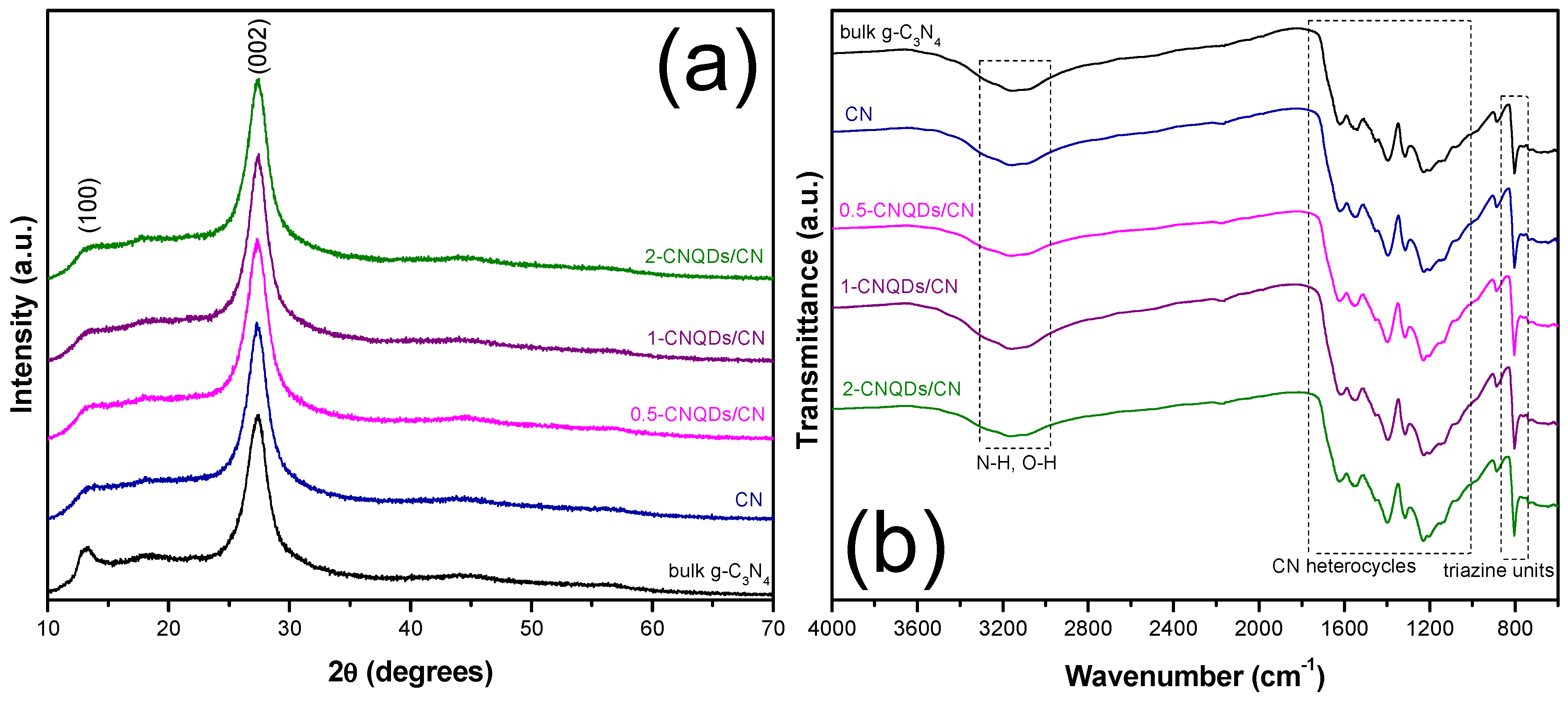
The synthesized samples were analyzed using XRD analysis. Figure 1a displays the diffraction patterns for bulk g-C3N4, the CN sample, and the CNQDs/CN composites. It can be observed that the bulk sample exhibits a diffraction peak at 13.1° (2θ), corresponding to the (100) diffraction plane, which represents the periodic arrangement of the heptazine units with an estimated distance of 0.675 nm [29,30]. However, the CN sample does not show this diffraction peak, indicating a disruption in the interplanar distance of the structural packing motif of the heptazine units in g-C3N4. Similarly, the CNQDs/CN composites also lack this diffraction peak since they were prepared from the CN sample. The most intense diffraction peak located at 27.3° (2θ) corresponds to the (002) diffraction plane according to PDF 87-1526 [31]. The diffraction peak is associated with the interlayer stacking of the conjugated aromatic system in g-C3N4. The CN-based samples show a slight decrease in the intensity of the same diffraction peak, suggesting a mild exfoliation of the layers in the samples [32,33].
FTIR analysis was also performed on the g-C3N4 samples to identify the presence of functional groups. Figure 1b shows the FTIR spectra, where a well-defined peak at 803 cm−1 can be associated with the characteristic ring vibration of the heptazine units in graphitic carbon nitride [34]. The peaks in the 1000–1700 cm−1 range are attributed to the vibration modes of CN heterocycles derived from the repetitive units in the g-C3N4 framework, consistent with previous studies [35]. Additionally, the broadband centered at 3150 cm−1 is related to the stretching vibration modes of the N-H and O-H bonds, confirming the presence of amino (-NH/-NH2) and hydroxyl (O-H) functional groups.
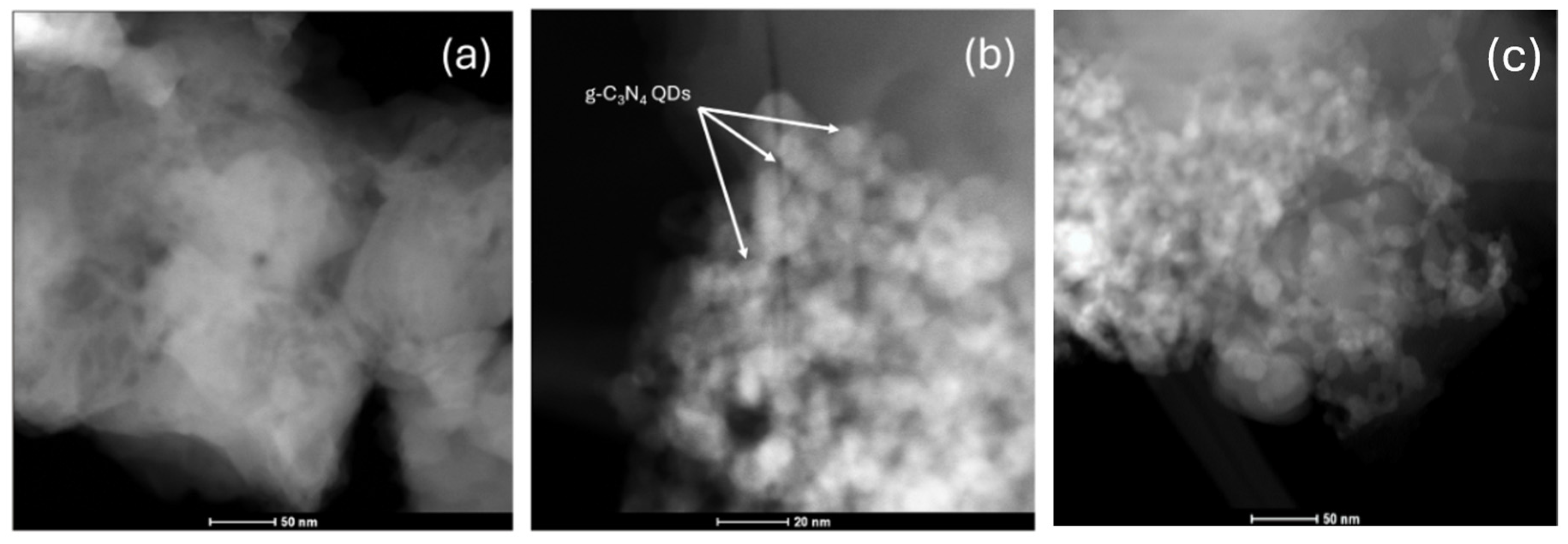
TEM micrographs of the CN and 1-CNQDs/CN samples are shown in Figure 2. The CN sample exhibits a morphology composed of mildly exfoliated g-C3N4 sheets with a highly porous structure, which can be attributed to the acid treatment applied to the bulk material, as shown in Figure 2a. In this image, only the layered and exfoliated nature of g-C3N4 is evident, without the presence of additional nanostructures. By contrast, in the 1-CNQDs/CN sample (Figure 2b), the successful incorporation of g-C3N4 quantum dots (CNQDs) onto the CN surface is clearly observed. These CNQDs appear as quasi-spherical nanoparticles with diameters below 20 nm, uniformly distributed and anchored to the exfoliated sheets. Moreover, as the percentage of quantum dots (2-CNQDs/CN) increases, there is greater saturation and/or agglomeration on the surface of g-C3N4; see Figure 2c. The coexistence of the porous g-C3N4 framework with the attached CNQDs suggests a synergistic structure, where the quantum dots can act as active sites and facilitate charge transfer processes.
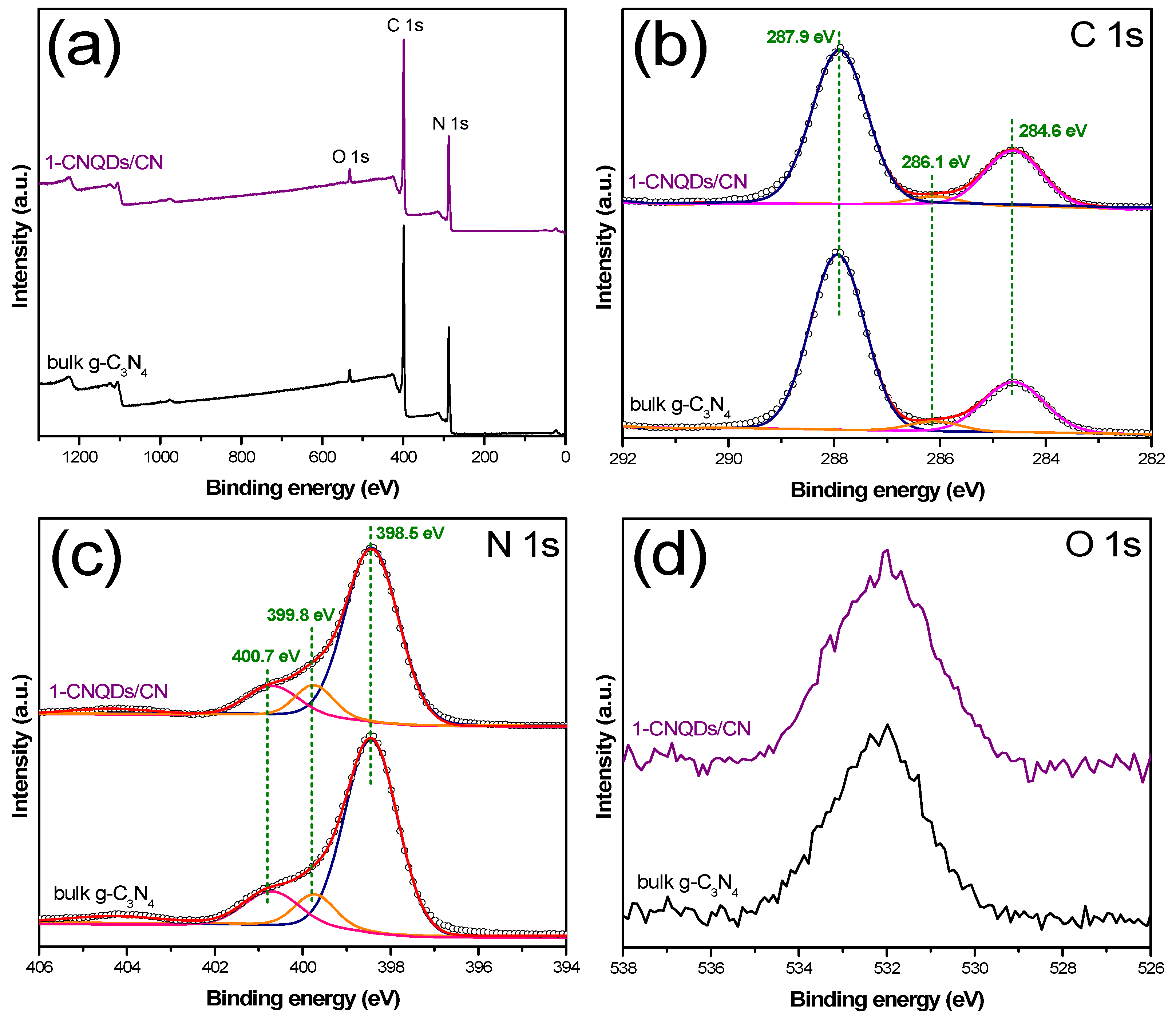
To further investigate the chemical composition and confirm the interaction between CNQDs and g-C3N4, the bulk g-C3N4 and 1-CNQDs/CN samples were analyzed by XPS. Figure 3a shows the survey spectra, which exhibit binding energies associated with the C 1s, N 1s, and O 1s states, indicating that the samples are composed of carbon, nitrogen, and oxygen elements. Figure 3b shows the high-resolution C 1s spectra, where two main peaks are observed at 284.6 and 287.9 eV. The energy peak at 284.6 eV is assigned to the C-C bond or adventitious carbon in the samples, while the peak located at 287.9 eV is ascribed to the sp2-hybridized carbon bonded to nitrogen atoms in the triazine rings (N–C=N) of the carbon nitride framework [36,37]. A negligible peak located at 268.1 eV can be related to carbon in the form of C-(N)3 [38]. The high-resolution N 1s spectra (Figure 3c) can be deconvoluted into three peaks at 398.5, 399.8, and 400.7 eV, corresponding to sp2-hybridized nitrogen (C–N=C), tertiary nitrogen N-(C)3, and amino functional groups (C-N-H), respectively. Figure 3d shows the high-resolution O 1s region, where weak peaks centered at 532.1 eV can be attributed to hydroxyl groups adsorbed on the surface of the samples. A slight increase in the O 1s signal in the 1-CNQDs/CN sample could indicate a higher amount of adsorbed hydroxyl groups. This would favor the dispersion of the powder material in an aqueous medium.
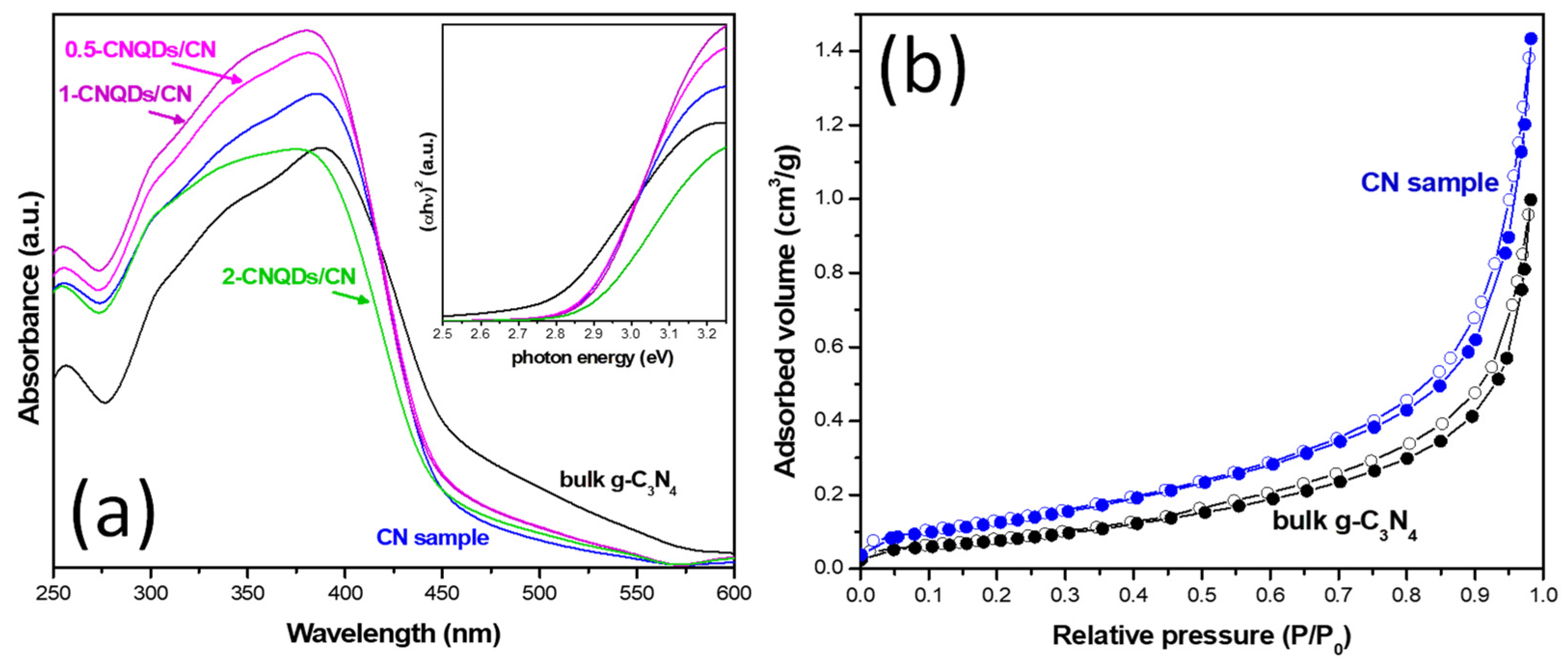
The DRS spectra of the CNQDs/CN system are shown in Figure 4a. As is well known, g-C3N4 exhibits absorption in the visible region between 400 and 500 nm, indicating that the semiconductor can be used as a visible-light-driven photocatalyst. Based on the results, the CN sample shows a slight blue shift compared to the bulk g-C3N4, probably associated with the mild exfoliation discussed above. Likewise, the CNQDs/CN samples exhibit an absorption profile like the CN sample, without significant differences associated with the incorporation of the CNQDs. The band gap energy values were calculated from the Tauc plots, as shown in the inset of Figure 4a. For bulk g-C3N4, the band gap value was estimated at 2.78 eV, while the calculated value for the CN sample was 2.86 eV. For all CNQDs/CN samples, the band gap values were close to that of the CN sample, noting that the incorporation of the quantum dots does not affect the absorption edge of g-C3N4. The textural properties of the bulk and CN samples were also studied through nitrogen physisorption measurements at −196 °C. Figure 4b displays the adsorption–desorption isotherms, where both samples exhibit type-II isotherms according to the classification of the International Union of Pure and Applied Chemistry (IUPAC). The presence of the hysteresis loop can be attributed to the capillary condensation of nitrogen molecules within the pores, which is consistent with the presence of mesoporous structures [39,40,41]. Table 2 summarizes the textural properties of the analyzed samples, where the surface area values were calculated using the Brunauer–Emmett–Teller (BET) method. As can be seen, bulk g-C3N4 shows a low surface area of 6.8 m2/g, a value almost similar to that reported for the bulk material prepared from the thermal polycondensation of the melamine precursor [42]. Conversely, the CN sample shows a slightly larger surface area, probably due to mild exfoliation during the treatment with HNO3 and/or the calcination process. Furthermore, no significant changes occurred when CNQDs were added due to the low percentage used. The average pore diameter and the total pore volume of the samples exhibit close values, indicating that the processing of the bulk material does not affect the porosity, and the increase in the surface area of the CN sample should be related to mild exfoliation of the bulk g-C3N4.

2.2. Photocatalytic Degradation of Levofloxacin

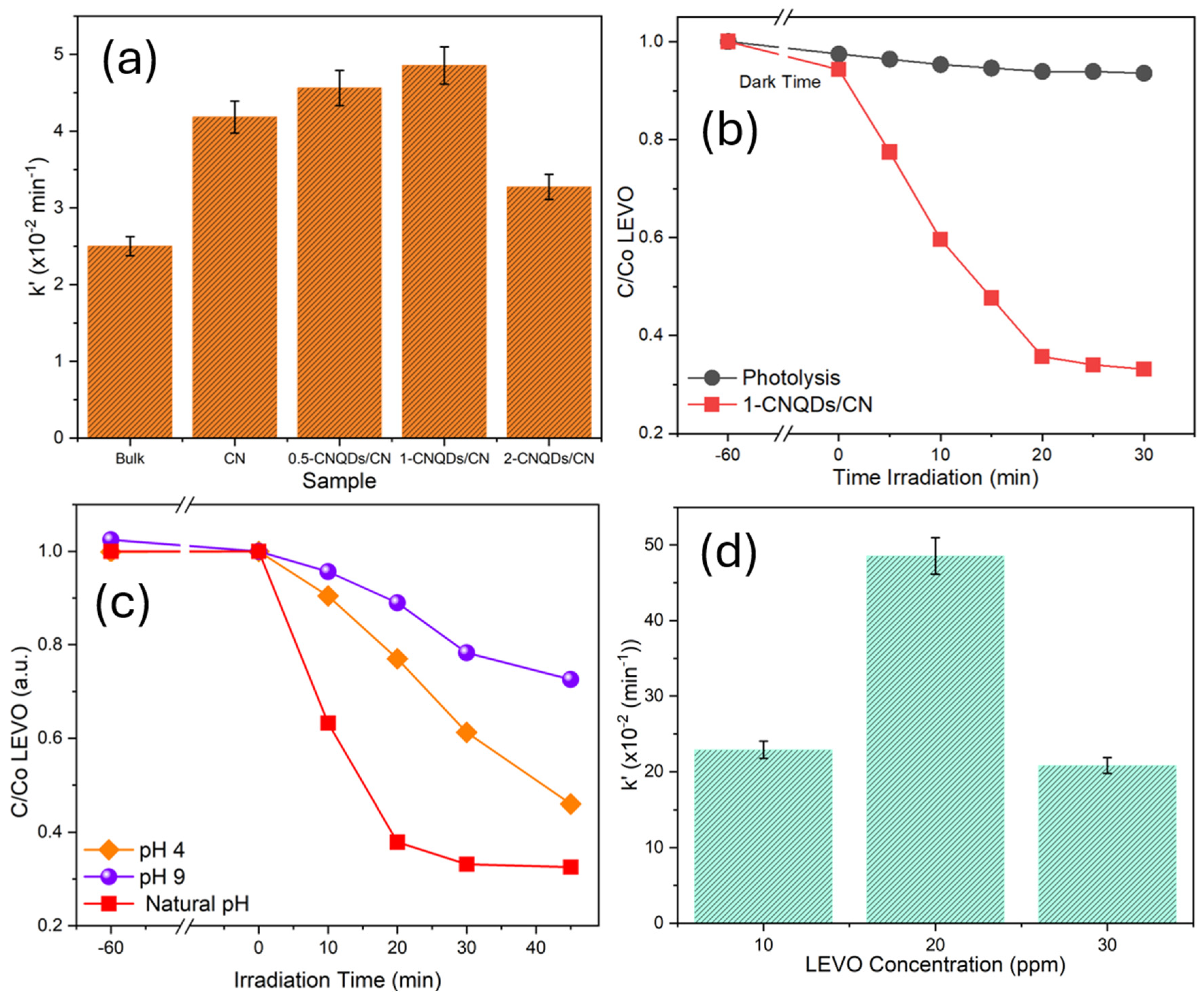
The photocatalytic properties of the CNQDs/CN samples were examined in the degradation of the antibiotic LEVO, which was measured by reverse-phase high-resolution liquid chromatography (HPLC). Figure 5a shows the degradation data fitted to pseudo-first-order kinetics. The rate constant of the bulk g-C3N4 is 0.025 min−1, achieving approximately 50% levofloxacin degradation after 30 min of UV-vis irradiation. The CN sample exhibits a rate constant of 0.050 min−1, indicating higher degradation than the bulk sample under the same conditions. This enhancement can be attributed to the mild exfoliation and increased surface area of the CN sample, as discussed previously. Moreover, improved photocatalytic performance is observed in the CNQDs/CN samples, with the 1-CNQDs/CN sample exhibiting the highest degradation of LEVO, around 69%. Likewise, the antibiotic concentration remained unchanged when subjected only to UV-vis irradiation in the absence of the photocatalyst, indicating that photolysis alone did not significantly contribute to its degradation, suggesting that the presence of the photocatalyst is necessary to degrade the contaminant; see Figure 5b. The incorporation of CNQDs likely contributes to reducing the recombination rate of the charge carriers in the photoexcited CN sample. Conversely, the photocatalytic activity of the 2-CNQDs/CN sample decreases, although it remains higher than that of the bulk g-C3N4 and CN samples. This decrease could be attributed to an excess of CNQDs on the surface of g-C3N4, which may adversely affect photoactivity by acting as recombination centers for the hole–electron pairs on the semiconductor surface and block photon absorption [43,44,45]. It is worth noting that all samples exhibit around 70% degradation after 90 min of irradiation. This phenomenon could be attributed to the formation of recalcitrant by-products that have not undergone degradation and absorb light at the same wavelength as levofloxacin [46,47,48].
The initial pH value exerts a decisive influence on the photocatalytic degradation of antibiotics. Figure 5c shows the kinetic profiles of LEVO degradation at different initial pH values using the 1-CNQDs/CN photocatalyst. The highest photocatalytic efficiency was achieved when the pH was not modified (natural pH), while at pH values of 4.0 and 9.0, LEVO degradation was lower. Previous studies have shown that pH conditions significantly affect the efficiency of levofloxacin removal by the photocatalyst [49,50]. For instance, Xuan et al. reported the effect of pH on levofloxacin degradation using g-C3N4. As the initial pH increased from 5 to 10, the levofloxacin degradation efficiency decreased, indicating that neutral environments are more favorable for levofloxacin removal, while acidic or alkaline conditions significantly hinder photocatalytic performance [51]. It is well known that levofloxacin exists in different chemical species depending on the pH of the aqueous solution, with a pKa1 ≈ 5.7–6.0 corresponding to the carboxyl group and a second pKa2 ≈ 8.2, corresponding to the piperazine amine [52]. Under our unmodified conditions (pH 5.5), LEVO exists predominantly in its cationic form with both the carboxyl and piperazine amine groups protonated, although the zwitterionic fraction increases as the pH approaches pKa1. As these pH conditions exceed the point of zero charge (PZC) of g-C3N4 (4.2), the surface of the material is negatively charged [53]. This complementarity, a negatively charged photocatalyst surface and a predominantly cationic LEVO species, favors electrostatic attraction and accounts for the slight dark adsorption observed during the hour equilibration prior to light-induced degradation.
Figure 5d shows the effect of the initial LEVO concentration on the pseudo-first-order apparent rate constant (k’) obtained with the 1-CNQDs/CN photocatalyst. The rate constant exhibits a clear optimal value at 20 mg/L. This result is consistent with the Langmuir–Hinshelwood mechanism: at low concentrations, there are insufficient LEVO molecules to occupy the active sites generated by the photocatalyst, and consequently, the photogenerated reactive oxygen species react with water or dissolved oxygen rather than with the pollutant, thereby limiting the apparent degradation rate. An optimal balance between the number of LEVO molecules adsorbed on the catalyst surface and the availability of photogenerated charge carriers is achieved at 20 mg/L, thereby maximizing the reaction rate. At high concentrations, excess LEVO molecules saturate the active sites of the 1-CNQDs/CN, decreasing its degradation. Furthermore, higher LEVO concentrations are expected to intensify light-shielding effects, wherein the antibiotic itself competes with the catalyst for incident photons, both factors further reduce the reaction rate [54,55].
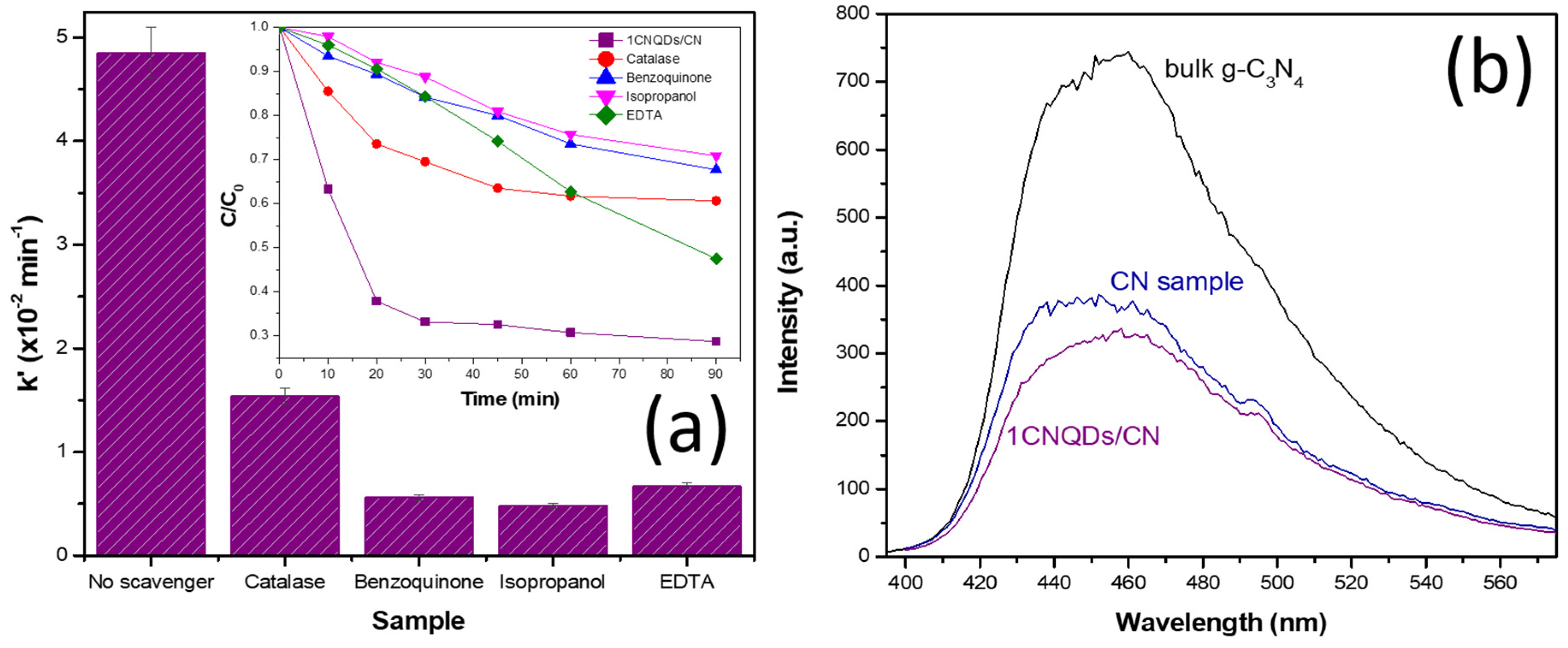
Several scavenger agents were studied to determine the reactive species that control the photocatalytic process. Figure 6a displays the degradation profile of levofloxacin and the calculated reaction rates using the 1-CNQDs/CN sample in the presence of propan-2-ol (isopropanol), potassium iodide, cyclohexa-2,5-diene-1,4-dione (p-benzoquinone), and catalase, which act as scavengers for hydroxyl radicals (·OH), photogenerated holes (h+), superoxide anion radicals (·O2), and hydrogen peroxide (H2O2), respectively. According to the results, all scavenger agents caused a decrease in the degradation of LEVO, confirming the crucial role of the reactive species during the photocatalytic process. In particular, the presence of p-benzoquinone and isopropanol significantly reduced the photodegradation rate, resulting in reaction rates of 0.56 × 10⁻² and 0.48 × 10⁻² min−1, respectively. These values correspond to an approximate decrease of 88% and 90% in the photodegradation rate compared to the reaction rate obtained without the presence of any scavenger agent. These results confirm that hydroxyl and superoxide radicals are the reactive species that govern the photocatalytic process under the conditions of our study. However, it is widely recognized that g-C3N4 cannot directly oxidize hydroxyl ions to generate ·OH radicals, indicating that these radicals must be generated through alternative pathways [56]. In this sense, one of the most accepted routes for the indirect formation of hydroxyl radicals in aqueous photocatalytic systems starts from the generation in the medium of highly reactive oxidizing oxygen species (hROS), where the reduction of oxygen (O2) by electrons photogenerated during the reaction gives rise to the formation of the superoxide radical (·O2), continuing with the protonation of the superoxide radical to subsequently lead to the formation of hydrogen peroxide (H2O2), which is reduced or decomposed to form the ·OH radical [57]. The previously explained sequence is O2 → ·O2 → H2O2 → ·OH.
PL spectroscopy is a reliable technique for studying the recombination of charge carriers generated in a photocatalyst [58,59]. Figure 6b displays the PL emission spectra of bulk g-C3N4, CN, and 1-CNQDs/CN samples excited at a wavelength of 315 nm. The CN sample exhibits significantly lower PL emission compared to the bulk sample. Additionally, the 1-CNQDs/CN sample shows even lower intensity in PL emission. The decrease in PL emissions indicates less recombination of charge carriers and suggests an enhancement in photocatalytic performance. This decrease in the charge carrier recombination could be attributed to a phenomenon associated with the reduction in PL emission from g-C3N4 due to the presence of CNQDs on its surface, which act as charge capture and transfer centers, promoting electron migration to active sites and minimizing recombination losses. The synergistic interaction between g-C3N4 and CNQDs directly contributes to enhanced photocatalytic activity by increasing the availability of charge carriers for surface reactions [60,61,62].
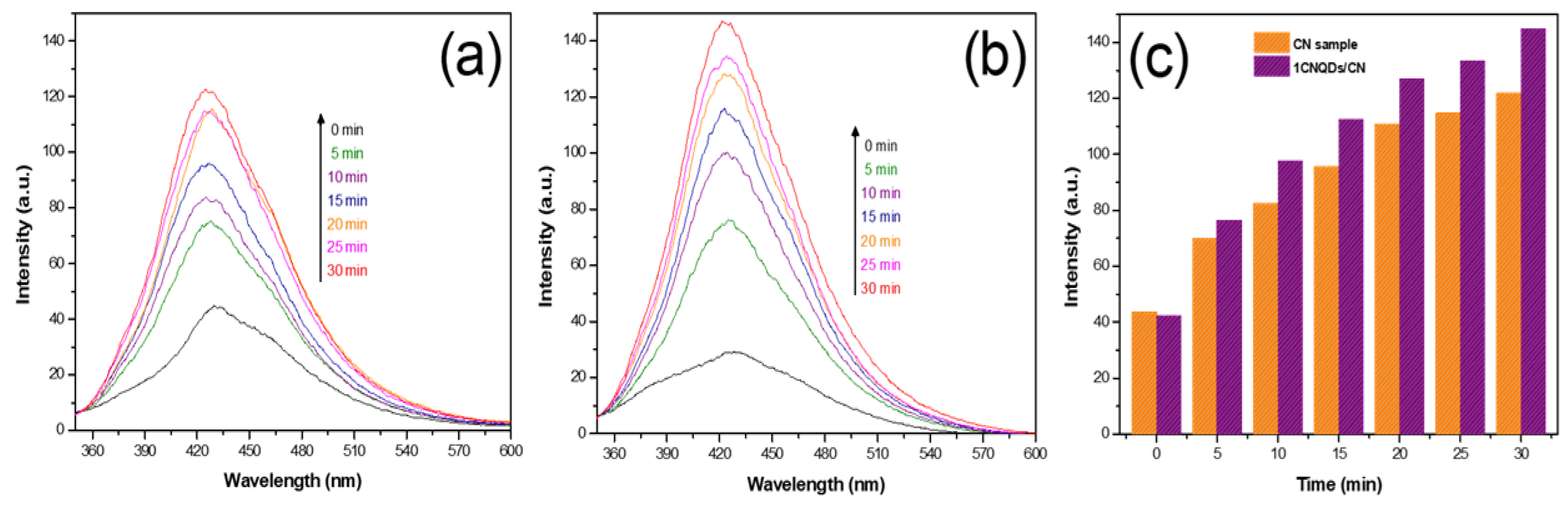
Figure 7a,b show the fluorescence spectra of the 2-hydroxy terephthalic acid generated from the reaction between terephthalic acid and hydroxyl radicals formed from CN and 1-CNQDs/CN samples under UV-vis light irradiation. As seen, 2-hydroxy terephthalic acid emits fluorescent radiation with the highest intensity at 427 nm. The results indicate that the 1-CNQDs/CN sample exhibits higher PL emission than the CN sample, suggesting a greater production of hydroxyl radicals under the same irradiation conditions; see Figure 7c. It is well known that hydroxyl radicals are highly reactive species capable of attacking organic molecules and oxidizing them to form CO2 and water [63]. Therefore, our results suggest that the 1-CNQDs/CN sample demonstrates superior photocatalytic performance through the generation of hydroxyl radicals, which can oxidize LEVO molecules.
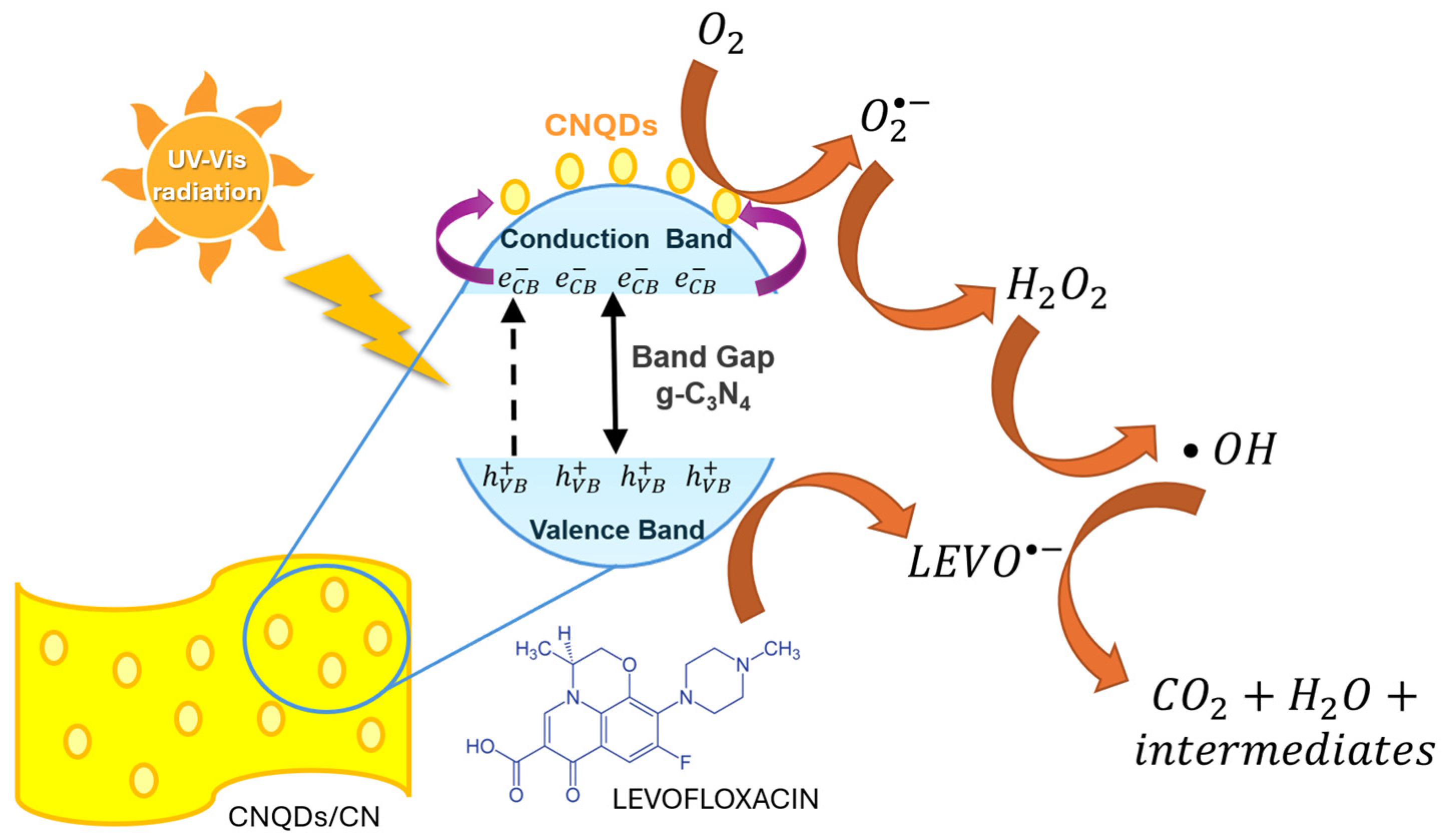
The possible mechanism for the photocatalytic performance of the 1-CNQDs/CN sample is depicted in Figure 8. Under UV-vis irradiation, incident photons excite electrons from the valence band (VB) to the conduction band (CB) across the characteristic band gap of g-C3N4, generating photoinduced electron–hole pairs (eCB/h+VB). The CNQDs, located at the semiconductor interface, act as charge transfer and separation centers, promoting the migration of photogenerated electrons and decreasing electron–hole recombination, as shown by the purple arrows. Electrons in the conduction band react with dissolved molecular oxygen (O2) to produce the superoxide radical (·O2), which subsequently transforms into hydrogen peroxide (H2O2) and the hydroxyl radical (·OH). Simultaneously, the photogenerated holes in the valence band directly oxidize the LEVO molecules, generating the radical intermediate LEVO•−. The combined action of these oxidizing species (·O2, H2O2, and ·OH) on the organic contaminant drives its progressive mineralization, ultimately producing CO2, H2O, and several lower molecular weight degradation intermediates. This highlights the synergistic role of CNQDs in enhancing the photocatalytic efficiency of the CNQD/CN system for the removal of emerging pharmaceutical contaminants from aqueous media.
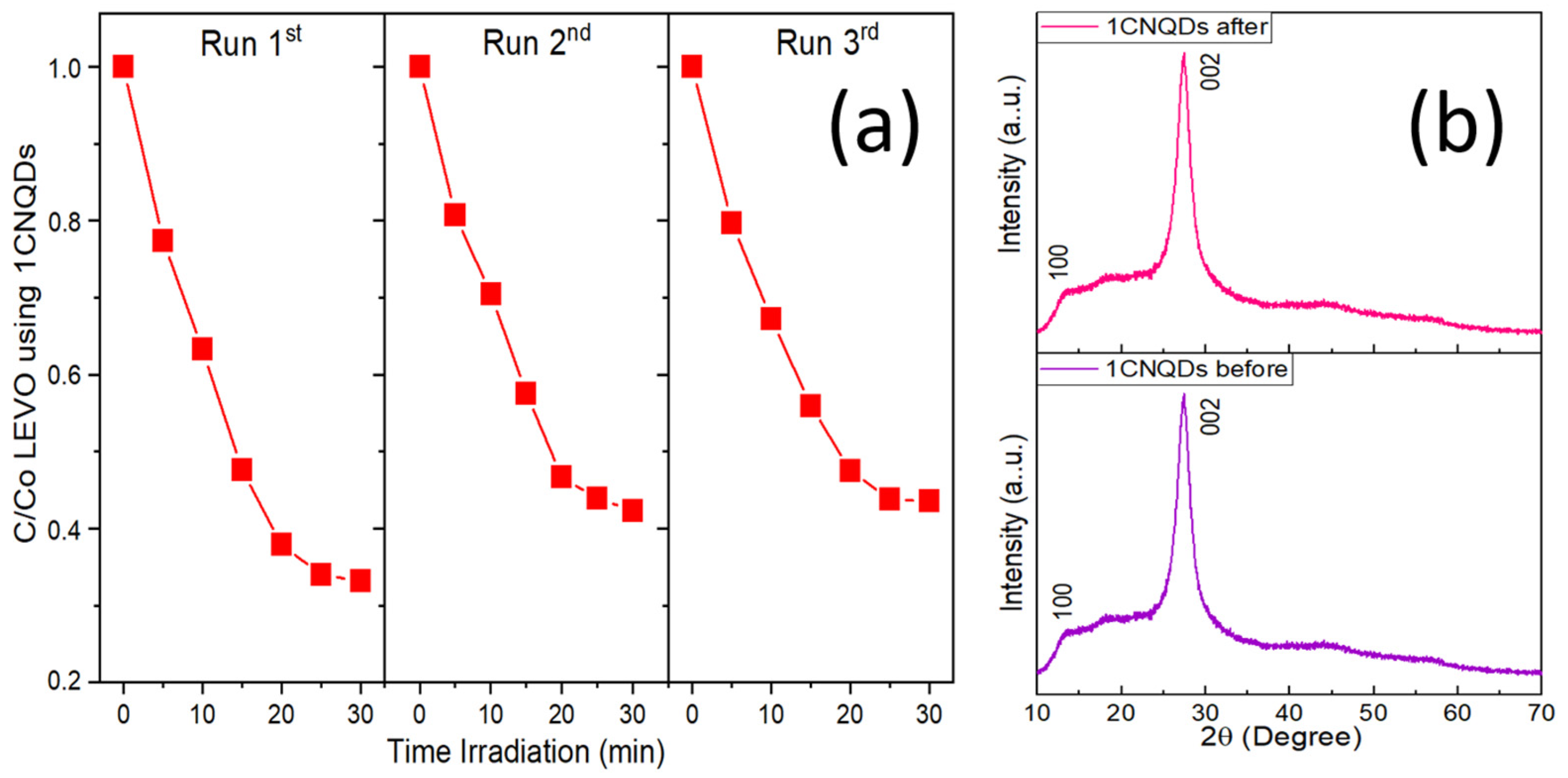
The 1-CNQDs/CN sample demonstrated photocatalytic behavior with high stability during repeated degradation cycles under UV-vis light irradiation. Figure 9a shows the photocatalytic activity of the 1-CNQDs/CN sample in the degradation of levofloxacin during three consecutive cycles. The photocatalyst maintained similar behavior, with a slight decrease in the percentage of degradation due to the amount of photocatalyst lost between cycles. Figure 9b shows the XRD patterns before and after three consecutive cycles, confirming its photochemical stability and the absence of photocorrosion in the photocatalyst.

3. Materials and Methods

3.1. Synthesis of g-C3N4

The synthesis of bulk g-C3N4 was performed by polycondensation of cyanamide (Sigma-Aldrich, ≥99%, St. Louis, MI, USA) at 500 °C for 4 h. Additionally, acidification of the bulk material was carried out as previously reported [64,65]. In this sense, 1.5 g of bulk g-C3N4 was added to 100 mL of a 0.1 M HNO3 solution and magnetically stirred for 8 h under cold conditions. Then, the suspension was poured into distilled water, resulting in a precipitate that was recovered through centrifugation and washed several times with distilled water. Finally, the dry acid-treated solid was calcined at 550 °C for 3 min. The resulting exfoliated g-C3N4 material was labeled as CN sample.

3.2. Preparation of CNQDs

The preparation of g-C3N4 quantum dots (CNQDs) was carried out via a hydrothermal route. Initially, 0.5 g of bulk g-C3N4 was dispersed in 70 mL of distilled water, poured into a Teflon reactor covered with stainless steel, and heated at 200 °C for 10 h. Subsequently, the supernatant solid was retained by filtration using a nylon filter (Whatman, 0.22 µm), and the resulting colloidal suspension was considered to contain g-C3N4 quantum dots (CNQDs). The concentration of g-C3N4 quantum dots was obtained by gravimetry, and it was around ≈ 1 mg/mL.

3.3. Preparation of the CNQDs/CN System

The CNQDs/CN system was synthesized by mixing CNQDs and CN photocatalysts under solvothermal conditions. In a typical procedure, 1.5 g of exfoliated g-C3N4 was added to 70 mL of ethanol (≥99.5%, ACS reagent, USA) and mixed with a specified volume of the CNQDs aqueous solution. The mixture was transferred to a Teflon reactor and heated at 90 °C for 2 h. Then, the suspension was centrifuged and dried at 85 °C overnight. The samples were labeled as X-CNQDs/CN, where X represents the weight ratio of CNQDs in each sample (0.5%, 1%, and 2% wt.).

3.4. Materials Characterization

The samples were analyzed using X-ray powder diffraction (XRD) with a Bruker D8 Advance diffractometer (Karlsruhe, Germany) with Cu Kα radiation (1.540598 Å) and a graphite monochromator. XRD data were recorded in the 2θ interval from 10° to 70° with a step of 0.05°/s. Fourier transform infrared spectroscopy (FTIR) was performed using a SHIMADZU IRAffinity-1S spectrophotometer (Kyoto, Japan) equipped with an attenuated total reflectance (ATR) accessory, covering the range of 4400–400 cm−1. Transmission electron microscopy (TEM) was performed using a FEI Tecnai G2 F20 X-Twin microscope (Waltham, MA, USA). Each powder sample was dispersed in ethanol, and one drop was placed on a copper grid. XPS analyses were performed using an Auger Perkin Elmer PHI 560 spectrometer (Eden Prairie, MN, USA) equipped with a hemispherical electron analyzer. The working radiation was Al Kα X-ray (1486.6 eV). Survey spectra were collected in the 0–1350 eV range with a pass energy of 100 eV and a step size of 1 eV. High-resolution spectra were collected with a pass energy of 50 eV and a step size of 0.1 eV/step. Diffuse reflectance spectra (DRS) were obtained using a Thermo-Fisher Scientific Evolution 220 UV-vis spectrophotometer (Waltham, MA, USA) equipped with an integrating sphere and employing BaSO4 as the reflectance standard. DRS spectra were recorded in the range of 190–800 nm. The absorbance spectra of CNQDs were obtained using a quartz cell as the sample holder instead of the integrating sphere. Photoluminescence (PL) spectrum was analyzed using a Cary Eclipse fluorescence spectrometer. The excitation wavelength was set at 315 nm, and PL emission was recorded between 350 and 700 nm at a scanning rate of 1200 nm/min. The textural properties were studied through nitrogen physisorption measurements. The adsorption–desorption isotherms were obtained at 77 K using a BEL BELSORP-mini II instrument (Osaka, Japan). Before analysis, the samples were degassed at 70 °C for 4 h. The surface area was estimated according to the BET (Brunauer–Emmett–Teller) theory.

3.5. Photocatalytic Tests

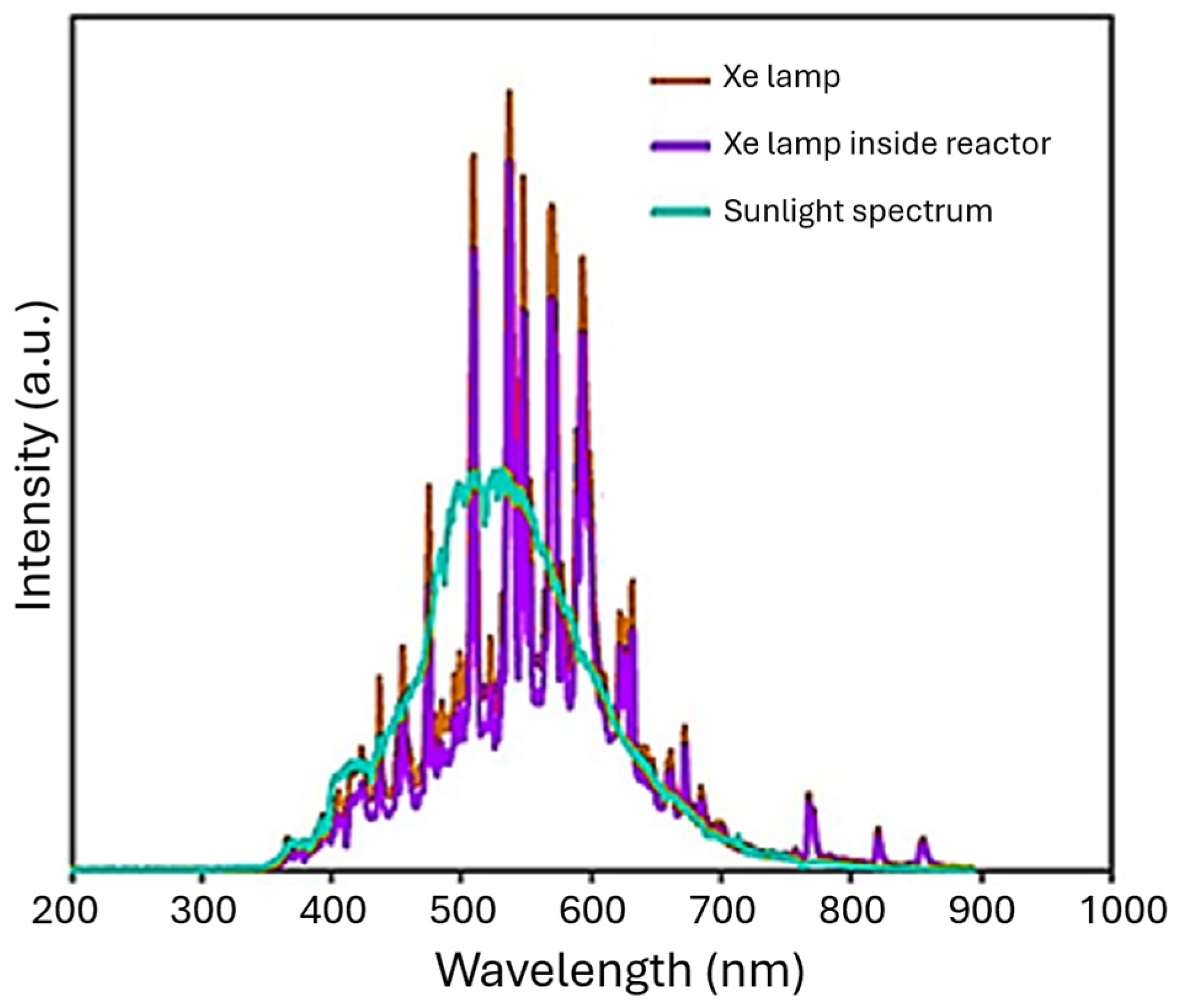
The photocatalytic activity of the CNQDs/CN system was studied by assessing the degradation of the antibiotic levofloxacin (Sigma-Aldrich, anhydrous basis HPLC, ≥98%, St. Louis, MI, USA) at an initial concentration of 20 mg/L. For this purpose, a cylindrical reactor with a cooling jacket was utilized, and the temperature was maintained at 25 °C during the experiments. For the experiments involving different initial pH values, the pH was adjusted by adding either 0.1 M HNO3 or 0.1 M NaOH until the desired values of 4.0 or 9.0 were reached. The aqueous suspension containing the powdered photocatalyst (1 g/L) and the model pollutant was magnetically stirred for 1 h under dark conditions to achieve adsorption–desorption equilibrium of the levofloxacin molecules on the surface of the material. Subsequently, the system was irradiated with a 35 W Xe lamp with a correlated color temperature of 6000 K and a luminous flux of 36,000 lux. The emission spectrum of the Xe lamp was recorded using an Ocean Optics Jaz spectrometer (Dunedin, FL, USA); see Figure 10. The spectral analysis revealed a minor contribution of ultraviolet radiation above 390 nm, confirming that the lamp provides a suitable approximation of the solar spectrum under the studied conditions.
At different time intervals, aliquots were taken and centrifuged at 6000 rpm for 30 min to remove the photocatalyst. The supernatant liquid was used to measure the depletion of LEVO concentration using HPLC analysis. Additional photocatalytic tests were conducted using scavenger agents to elucidate the importance of the reactive species in the degradation of levofloxacin. The concentration of each scavenger was established according to our previous work [66]. Briefly, propan-2-ol (3.2 × 10⁻² mol/L), potassium iodide (2.0 × 10⁻² mol/L), p-benzoquinone (2.0 × 10⁻² mol/L) and catalase (9.4 × 10⁵ units/L) were used for the scavenging of hydroxyl radicals (·OH), photogenerated holes (h+), superoxide anion radicals (·O2), and hydrogen peroxide (H2O2), respectively. All remaining experimental conditions were the same as those described in the photodegradation tests. The detection of hydroxyl radicals (·OH) produced during the photocatalytic process was performed using terephthalic acid (Sigma-Aldrich, ~98%, St. Louis, MI, USA) at 4 × 10⁻⁴ mol/L with NaOH (ACS reagent, ≥97.0%, pellets, USA) at 2 × 10⁻³ mol/L. Aliquots were taken every 5 min and centrifuged. The supernatant liquid was analyzed using a Cary Eclipse MY1306M001 fluorometer (Palo Alto, CA, USA) with an excitation wavelength of 315 nm, recording the emission spectra in the range of 350 to 600 nm.

3.6. Analytical Determination of Levofloxacin

The concentration of levofloxacin was determined using reverse-phase high-resolution liquid chromatography (HPLC) through a Phenomenex Luna C18 (5 µm, 250 × 4.6 mm) column and a mobile phase of acetonitrile:H2O (60:40) at pH 3, adjusted with 0.025 M phosphoric acid. The flow rate was 1 mL min−1 in isocratic mode, the diode array detector was set to 297 nm, and the retention time was 2.4 min.

4. Conclusions

In summary, a photocatalytic system based on the impregnation of g-C3N4 quantum dots (CNQDs) onto the surface of mildly exfoliated g-C3N4 (CN) through a solvothermal route has been prepared. The CNQDs/CN composites were characterized by several techniques, demonstrating the close physical junction between the CNQDs and the g-C3N4 nanosheets. The 1-CNQDs/CN sample exhibited the highest photocatalytic performance in the degradation of the antibiotic levofloxacin, with a reaction rate around 1.9 times higher than that of the bulk material. The improved photoactivity can be attributed to increase charge separation and a decrease in electron–hole recombination by the addition of CNQDs on the surface of g-C3N4. Furthermore, CNQDs broaden the light absorption range and provide additional active sites, thereby increasing the availability of charge carriers for redox reactions. Also, the results confirm the good photochemical stability of the 1-CNQDs/CN sample and the absence of photocorrosion in the photocatalyst. Furthermore, the essential role of reactive species was confirmed through scavenger experiments, where hydroxyl and superoxide radicals were found to play the most significant role in the photocatalytic process. Based on the results, a possible mechanism for the photodegradation of levofloxacin has been discussed. This work demonstrates that metal-free g-C3N4 quantum dots are a promising way to improve the photocatalytic performance of a semiconductor, making them promising materials for developing hybrid composites with enhanced photocatalytic performance. For future work, it would be advisable to perform total organic carbon (TOC) analyses to assess the actual degree of mineralization, as well as to identify the intermediate compounds using liquid chromatography–mass spectrometry (LC-MS). Furthermore, evaluating the performance of these CNQDs/CN samples under natural sunlight will be a crucial step toward real-world environmental remediation applications.

Author Contributions

Conceptualization, S.O. and J.S.R.G.; methodology, D.S.M. and S.G.M.; formal analysis, D.B.H.U. and S.G.M.; investigation, E.J.R.R. and J.S.R.G.; resources, J.S.R.G.; data curation, S.O. and D.B.H.U.; writing—original draft preparation D.B.H.U. and S.G.M.; writing—review and editing, S.O. and D.S.M.; project administration, E.J.R.R.; funding acquisition, D.S.M. All authors have read and agreed to the published version of the manuscript.

Funding

This research was funded by CONAHCyT/SECIHTI, project number CBF-2025-I-1769.

Data Availability Statement

Data is available upon request.

Acknowledgments

D. Sanchez for the project approved by CONAHCyT/SECIHTI Number Project CBF-2025-I-1769. S. Obregón thanks CONACYT for the project approved by the sectorial research fund for education CB No. A1-S-9529 and the Marcos Moshinsky Chair support from Marcos Moshinsky Foundation (UNAM). J.S.R.G. (CVU 824115) acknowledges the postdoctoral fellowship EPM 2024(1) provided by CONAHCyT/SECIHTI.

Conflicts of Interest

The authors declare no conflicts of interest.

Abbreviations

The following abbreviations are used in this manuscript:
AOPsAdvanced oxidation processes
ATRAttenuated total reflectance
BETBrunauer–Emmett–Teller
CBConduction band
CNExfoliated graphitic carbon nitride
CNQDsg-C3N4 quantum dots
DRSDiffuse reflectance spectroscopy
FQsFluoroquinolones
FTIRFourier transform infrared spectroscopy
HPLCHigh-resolution liquid chromatography
hROSHighly reactive oxidizing oxygen species
IUPACInternational Union of Pure and Applied Chemistry
LEVOLevofloxacin
PLPhotoluminescence spectroscopy
PZCPoint of zero charge
QDsQuantum dots
RhBRhodamine B
TEMTransmission electron microscopy
VBValence band
WWTPsWastewater treatment plants
XPSX-ray photoelectron spectroscopy
XRDX-ray diffraction

References

  1. Lu, G.; Lun, Z.; Liang, H.; Wang, H.; Li, Z.; Ma, W. In situ fabrication of BiVO4-CeVO4 heterojunction for excellent visible light photocatalytic degradation of levofloxacin. J. Alloys Compd. 2018, 772, 122–131. [Google Scholar]
  2. Doorslaer, X.V.; Dewulf, J.; Langenhove, H.V.; Demeestere, K. Fluoroquinolone antibiotics: An emerging class of environmental micropollutants. Sci. Total Environ. 2014, 500, 250–269. [Google Scholar] [CrossRef] [Scilit] [PubMed]
  3. Gong, Y.; Li, J.; Zhang, Y.; Zhang, M.; Tian, X.; Wang, A. Partial degradation of levofloxacin for biodegradability improvement by electro-Fenton process using an activated carbon fiber felt cathode. J. Hazard. Mater. 2016, 304, 320–328. [Google Scholar] [CrossRef] [Scilit] [PubMed]
  4. Xiong, J.Q.; Kurade, M.B.; Jeon, B.H. Biodegradation of levofloxacin by an acclimated freshwater microalga. Chlorella vulgaris. Chem. Eng. J. 2016, 313, 1251–1257. [Google Scholar]
  5. Bognár, S.; Jovanović, D.; Despotović, V.; Jakšić, S.; Panić, S.; Milanović, M.; Finčur, N.; Putnik, P.; Merkulov, D.Š. Advanced photocatalytic degradation of organic pollutants using green tea-based ZnO nanomaterials under simulated solar irradiation in agri-food wastewater. Foods 2025, 14, 622. [Google Scholar] [CrossRef] [Scilit] [PubMed]
  6. Zhang, Q.-E.; Hu, C.-C.; Guo, S.-Q.; Liu, J.-W.; Hu, S.-C.; Xin, Y.-X.; Yu, J.-G.; Zhao, G.-Q.; Lu, L. Design and synthesis of uniform defective carbon nanosheets via CoAl-layered double hydroxide interlayer confinement for boosting peroxymonosulfate activation with highly efficient degradation of antibiotics contaminants. J. Environ. Chem. Eng. 2025, 13, 115601. [Google Scholar] [CrossRef] [Scilit]
  7. Zhao, G.-Q.; Zhang, Q.-E.; Xin, Y.-X.; Lv, H.-Q.; Pan, Y.; Hu, C.-C.; Yu, A.-L.; Li, L.-H.; Lu, L.; Yu, J.-G. Graphitic carbon nitride meets single-atom: A novel photocatalyst for efficient utilization in environmental remediation and clean energy production. Coord. Chem. Rev. 2026, 547, 217144. [Google Scholar] [CrossRef] [Scilit]
  8. Bhatkhande, D.S.; Pangarkar, V.G.; Beenackers, A.A. Photocatalytic degradation for environmental applications a review. J. Chem. Technol. Biotechnol. 2002, 77, 102–116. [Google Scholar]
  9. Pavel, M.; Anastasescu, C.; State, R.-N.; Vasile, A.; Papa, F.; Balint, I. Photocatalytic degradation of organic and inorganic pollutants to harmless end products: Assessment of practical application potential for water and air cleaning. Catalysts 2023, 13, 380. [Google Scholar] [CrossRef] [Scilit]
  10. Ren, H.; Miao, Z.; Zhao, Y.; Ghasemi, S.; Feng, X.; Liu, E.; Padervand, M. Advances and challenges in multiple S-scheme heterojunction photocatalysts. J. Alloys Comp. 2025, 1028, 180646. [Google Scholar] [CrossRef] [Scilit]
  11. Wang, X.; Maeda, K.; Thomas, A.; Takanabe, K.; Xin, G.; Carlsson, J.M.; Domen, K.; Antonietti, M. A metal-free polymeric photocatalyst for hydrogen production from water under visible light. Nat. Mater. 2009, 8, 76–80. [Google Scholar] [PubMed]
  12. Ren, H.-T.; Jia, S.-Y.; Wu, Y.; Wu, S.-H.; Zhang, T.-H.; Han, X. Improved photochemical reactivities of Ag2O/g-C3N4 in phenol degradation under UV and visible light. Ind. Eng. Chem. Res. 2014, 53, 17645–17653. [Google Scholar] [CrossRef] [Scilit]
  13. Ahmaruzzaman, M.; Mishra, S.R. Photocatalytic performance of g-C3N4 based nanocomposites for effective degradation/removal of dyes from water and wastewater. Mater. Res. Bull. 2021, 143, 111417. [Google Scholar] [CrossRef] [Scilit]
  14. Zhu, N.; Li, R.; Zhang, J.; Yan, Q.; Jiao, J.; Liang, D.; Yue, H.; Sang, N.; Li, G. Photo-degradation behavior of seven benzoylurea pesticides with C3N4 nanofilm and its aquatic impacts on Scendesmus obliquus. Sci. Total Environ. 2021, 799, 149470. [Google Scholar] [CrossRef] [Scilit] [PubMed]
  15. Hernández-Uresti, D.B.; Vázquez, A.; Sanchez-Martinez, D.; Obregón, S. Performance of the polymeric g-C3N4 photocatalyst through the degradation of pharmaceutical pollutants under UV-Vis irradiation. J. Photochem. Photobiol. A Chem. 2016, 324, 47–52. [Google Scholar] [CrossRef] [Scilit]
  16. Masih, D.; Ma, Y.; Rohani, S. Graphitic C3N4 based noble-metal-free photocatalyst systems: A review. Appl. Catal. B Environ. 2017, 206, 556–588. [Google Scholar] [CrossRef] [Scilit]
  17. Pattnaik, S.P.; Behera, A.; Martha, S.; Acharya, R.; Parida, K. Facile synthesis of exfoliated graphitic carbon nitride for photocatalytic degradation of ciprofloxacin under solar irradiation. J. Mater. Sci. 2019, 54, 5726–5742. [Google Scholar] [CrossRef] [Scilit]
  18. Hoang, T.V.A.; Nguyen, P.A.; Shin, E.W. Effect of Morphological Modification over g-C3N4 on photocatalytic hydrogen evolution performance of g-C3N4-Pt photocatalysts. Catalysts 2023, 13, 92. [Google Scholar] [CrossRef] [Scilit]
  19. Obregón, S. Exploring nanoengineering strategies for the preparation of graphitic carbon nitride nanostructures. FlatChem 2023, 38, 100473. [Google Scholar] [CrossRef] [Scilit]
  20. Kashyap, T.; Boruah, P.J.; Bailung, H.; Sanyal, D.; Choudhury, B. Simultaneous layer exfoliation and defect activation in g-C3N4 nanosheets with air-water interfacial plasma: Spectroscopic defect probing with tailored optical properties. Nanoscale Adv. 2021, 3, 3260–3271. [Google Scholar] [CrossRef] [Scilit] [PubMed]
  21. Ge, F.; Huang, S.; Yan, J.; Jing, L.; Chen, F.; Xie, M.; Xu, Y.; Xu, H.; Li, H. Sulfur promoted n-π* electron transitions in thiophene-doped g-C3N4 for enhanced photocatalytic activity. Chin. J. Catal. 2021, 42, 450–459. [Google Scholar] [CrossRef] [Scilit]
  22. Vavilapalli, D.S.; Peri, R.G.; Sharma, R.K.; Goutam, U.K.; Muthuraaman, B.; Rao, M.S.R.; Singh, S. g-C3N4/Ca2Fe2O5 heterostructures for enhanced photocatalytic degradation of organic effluents under sunlight. Sci. Rep. 2021, 11, 19639. [Google Scholar] [CrossRef] [Scilit] [PubMed]
  23. Yuan, X.; Liu, X. g-C3N4/TiO2-B{100} heterostructures used as promising photocatalysts for water splitting from a hybrid density functional study. Phys. Chem. Chem. Phys. 2022, 24, 17703–17715. [Google Scholar] [CrossRef] [Scilit] [PubMed]
  24. Padervand, M.; Rhimi, B.; Wang, C. One-pot synthesis of novel ternary Fe3N/Fe2O3/C3N4 photocatalyst for efficient removal of rhodamine B and CO2 reduction. J. Alloys Comp. 2021, 852, 156955. [Google Scholar] [CrossRef] [Scilit]
  25. Sun, P.; Xing, Z.; Li, Z.; Zhou, W. Recent advances in quantum dots photocatalysts. Chem. Eng. J. 2023, 458, 141399. [Google Scholar] [CrossRef] [Scilit]
  26. Liu, Y.; Gong, Y.; Cui, X.; Yu, H.; Qin, W.; Cui, X.; Huo, M. Synthesis of O-doped C3N4 decorated with C3N4 quantum dots: Construction of a homo junction photocatalyst for the enhanced photocatalytic degradation of tetracycline. J. Taiwan Inst. Chem. Eng. 2022, 38, 104457. [Google Scholar] [CrossRef] [Scilit]
  27. Maged, S.; El-Borady, O.M.; El-Hosainy, H.; El-Kemary, M. Efficient photocatalytic reduction of p-nitrophenol under visible light irradiation based on Ag NPs loaded brown 2D g-C3N4/g-C3N4 QDs nanocomposite. Environ. Sci. Pollut. Res. 2023, 30, 117909–117922. [Google Scholar] [CrossRef] [Scilit] [PubMed]
  28. Chen, X.; Chu, B.; Gu, Q.; Li, W.; Lin, R.; Chu, J.; Peng, Z.; Lu, J.; Wu, D. Inhibition of Fusarium graminearum growth and deoxynivalenol accumulation in barley malt by protonated g-C3N4/oxygen-doped g-C3N4 homojunction. Food Res. Int. 2022, 162, 112025. [Google Scholar] [CrossRef] [Scilit] [PubMed]
  29. Zhu, K.; Lv, Y.; Liu, J.; Wang, W.; Wang, C.; Wang, P.; Meng, A.; Li, Z.; Li, Q. Explosive thermal exfoliation of intercalated graphitic carbon nitride for enhanced photocatalytic degradation properties. Ceram. Int. 2019, 45, 3643–3647. [Google Scholar] [CrossRef] [Scilit]
  30. Che, H.; Liu, L.; Che, G.; Dong, H.; Liu, C.; Li, C. Control of energy band, layer structure and vacancy defect of graphitic carbon nitride by intercalated hydrogen bond effect of NO3 toward improving photocatalytic performance. Chem. Eng. J. 2019, 357, 209–219. [Google Scholar] [CrossRef] [Scilit]
  31. Montalvo-Herrera, T.; Vallejo-Márquez, J.; Hernández-Uresti, D.B.; Sánchez-Martínez, D. Enhanced visible light photoactivity of polymeric g-C3N4 by twice exfoliation in the degradation of acetaminophen and ibuprofen. J. Mater. Sci. Mater. Electron. 2022, 33, 16210–16218. [Google Scholar] [CrossRef] [Scilit]
  32. Dong, F.; Zhao, Z.; Xiong, T.; Ni, Z.; Zhang, W.; Sun, Y.; Ho, W.-K. In situ construction of g-C3N4/g-C3N4 metal-free heterojunction for enhanced visible-light photocatalysis. ACS Appl. Mater. Interfaces 2013, 5, 11392–11401. [Google Scholar] [CrossRef] [Scilit] [PubMed]
  33. Paul, T.; Das, D.; Das, B.K.; Sarkar, S.; Maiti, S.; Chattopadhyay, K.K. CsPbBrCl2/g-C3N4 type II heterojunction as efficient visible range photocatalyst. J. Hazard. Mater. 2019, 380, 120855. [Google Scholar] [CrossRef] [Scilit] [PubMed]
  34. Wang, F.; Liu, Z.; Shi, L. Boosting photocatalytic activity of g-C3N4/nano-sized ZnO fabricated in CO2-saturated solutions. Mater. Lett. 2021, 296, 129894. [Google Scholar] [CrossRef] [Scilit]
  35. Ma, Y.; Liu, E.; Hu, X.; Tang, C.; Wan, J.; Li, J.; Fan, J. A simple process to prepare few-layer g-C3N4 nanosheets with enhanced photocatalytic activities. Appl. Surf. Sci. 2015, 358, 246–251. [Google Scholar] [CrossRef] [Scilit]
  36. Fan, C.; Miao, J.; Xu, G.; Liu, J.; Lv, J.; Wu, Y. Graphitic carbon nitride nanosheets obtained by liquid stripping as efficient photocatalysts under visible light. RSC Adv. 2017, 7, 37185–37193. [Google Scholar] [CrossRef] [Scilit]
  37. Narkbuakaew, T.; Sujaridworakun, P. Synthesis of tri-s-triazine based g-C3N4 photocatalyst for cationic rhodamine B degradation under Visible Light. Top. Catal. 2020, 63, 1086–1096. [Google Scholar] [CrossRef] [Scilit]
  38. Wang, X.; Xiong, H.; Chen, T.; Xu, Y.; Bai, G.; Zhang, J.; Tian, Y.; Xu, S. Phosphorus-doped g-C3N4 nanosheets as an efficient and sensitive fluorescent probe for Fe3+ detection. Opt. Mater. 2021, 119, 111393. [Google Scholar] [CrossRef] [Scilit]
  39. Zhao, B.; Wang, B.; Lu, H.; Dai, S.; Huang, Z. Tuning the visible-light photocatalytic degradation activity of thin nanosheets constructed porous g-C3N4 microspheres by decorating ionic liquid modified carbon dots: Roles of heterojunctions and surface charges. New J. Chem. 2019, 43, 10141–10150. [Google Scholar] [CrossRef] [Scilit]
  40. Qian, X.; Meng, X.; Sun, J.; Jiang, L.; Wang, Y.; Zhang, J.; Hu, X.; Shalom, M.; Zhu, J. Salt-assisted synthesis of 3D porous g-C3N4 as a bifunctional photo- and electrocatalyst. ACS Appl. Mater. Interfaces 2019, 11, 27226–27232. [Google Scholar] [CrossRef] [Scilit] [PubMed]
  41. Xiao, J.; Xie, Y.; Nawaz, F.; Wang, Y.; Du, P.; Cao, H. Dramatic coupling of visible light with ozone on honeycomb-like porous g-C3N4 towards superior oxidation of water pollutants. Appl. Catal. B Environ. 2016, 183, 417–425. [Google Scholar] [CrossRef] [Scilit]
  42. Sing, K.S.W. Reporting physisorption data for gas/solid systems with special reference to the determination of surface area and porosity. Pure Appl. Chem. 1982, 54, 2201–2218. [Google Scholar] [CrossRef] [Scilit]
  43. Chauhan, A.; Verma, R.; Kumari, S.; Sharma, A.; Shandilya, P.; Li, X.; Batoo, K.M.; Imran, A.; Kulshrestha, S.; Kumar, R. Photocatalytic dye degradation and antimicrobial activities of pure and Ag doped ZnO using Cannabis sativa leaf extract. Sci. Rep. 2020, 10, 7881. [Google Scholar] [CrossRef] [Scilit] [PubMed]
  44. Pal, S.; Mondal, S.; Maity, J.; Mukherjee, R. Synthesis and characterization of ZnO nanoparticles using moringa oleifera leaf extract: Investigation of photocatalytic and antibacterial activity. Int. J. Nanosci. Nanotechnol. 2018, 14, 111–119. [Google Scholar]
  45. Fagier, M.A. Plant-mediated biosynthesis and photocatalysis activities of zinc oxide nanoparticles: A prospect towards dyes mineralization. J. Nanotechnol. 2021, 15, 6629180. [Google Scholar] [CrossRef] [Scilit]
  46. Di, J.; Chen, C.; Zhu, C.; Song, P.; Duan, M.; Xiong, J.; Long, R.; Xu, M.; Kang, L.; Guo, S.; et al. Cobalt nitride as a novel cocatalyst to boost photocatalytic CO2 reduction. Nano Energy 2021, 79, 105429. [Google Scholar] [CrossRef] [Scilit]
  47. Ran, J.; Guo, W.; Wang, H.; Zhu, B.; Yu, J.; Qiao, S. Metal-free 2D/2D phosphorene/g-C3N4 van der waals Heterojunction for highly enhanced visible-light photocatalytic H2 production. Adv. Mater. 2018, 30, 1800128. [Google Scholar] [CrossRef] [Scilit] [PubMed]
  48. Sarkar, D.; Pramanik, J.; Samajdar, S.; Biswas, M.; Ghosh, S. Charge carrier dynamics in semiconductorcocatalyst interfaces: Influence on photocatalytic activities. RSC Appl. Interfaces 2025, 2, 573. [Google Scholar] [CrossRef] [Scilit]
  49. Lan, H.; Li, L.; An, X.; Liu, F.; Chen, C.; Liu, H.; Qu, J. Microstructure of carbon nitride affecting synergetic photocatalytic activity: Hydrogen bonds vs. structural defects. Appl. Catal. B Environ. 2017, 204, 49–57. [Google Scholar] [CrossRef] [Scilit]
  50. Liang, Q.; Li, Z.; Huang, Z.; Kang, F.; Yang, Q. Holey graphitic carbon nitride nanosheets with carbon vacancies for highly improved photocatalytic hydrogen production. Adv. Funct. Mater. 2015, 25, 6885–6892. [Google Scholar] [CrossRef] [Scilit]
  51. Cárdenas, A.; Vázquez, A.; Obregón, S.; Ruíz-Gómez, M.; Rodríguez-González, V. New insights into the fluorescent sensing of Fe3+ ions by g-C3N4 prepared from different precursors. Mater. Res. Bull. 2021, 142, 111385. [Google Scholar] [CrossRef] [Scilit]
  52. Hassan, A.S.; Alawam, A.S.; Allam, A.A.; Mahgoub, S.M.; Refat, M.; Mahmoud, R. Comparative adsorption of levofloxacin by Cu–Fe layered double hydroxides and mixed oxides: Kinetics, isotherms, mechanisms, energy efficiency, and green valorization of waste adsorbents. RSC Adv. 2026, 16, 8735. [Google Scholar] [CrossRef] [Scilit] [PubMed]
  53. Fronczak, M.; Krajewska, M.; Demby, K.; Bystrzejewski, M. Extraordinary Adsorption of Methyl Blue onto Sodium-Doped Graphitic Carbon Nitride. J. Phys. Chem. C 2017, 121, 15756–15766. [Google Scholar] [CrossRef] [Scilit]
  54. Rameel, M.I.; Wali, M.; Al-Humaidi, J.Y.; Liaqat, F.; Khan, M.A. Enhanced photocatalytic degradation of levofloxacin over heterostructured C3N4/Nb2O5 system under visible light. Heliyon 2023, 9, e20479. [Google Scholar] [CrossRef] [Scilit] [PubMed]
  55. Zhong, X.; Ji, M.; Wu, W.; Lu, C.; Liu, W.; Jiang, F. Enhanced degradation of levofloxacin through visible-light-driven peroxymonosulfate Activation over CuInS2/g-C3N4 Heterojunctions. Nanomaterials 2024, 14, 74. [Google Scholar] [CrossRef] [Scilit] [PubMed]
  56. Vilé, G. Photocatalytic materials and light-driven continuous processes to remove emerging pharmaceutical pollutants from water and selectively close the carbon cycle. Catal. Sci. Technol. 2021, 11, 43. [Google Scholar] [CrossRef] [Scilit]
  57. Nosaka, Y.; Nosaka, A.Y. Generation and Detection of Reactive Oxygen Species in Photocatalysis. Chem. Rev. 2017, 117, 11302–11336. [Google Scholar] [CrossRef] [Scilit] [PubMed]
  58. Jallouli, N.; Pastrana-Martínez, L.M.; Ribeiro, A.R.; Moreira, N.F.; Faria, J.L.; Hentati, O.; Silva, A.M.; Ksibi, M. Heterogeneous photocatalytic degradation of ibuprofen in ultrapure water, municipal and pharmaceutical industry wastewaters using a TiO2/UV-LED system. Chem. Eng. J. 2018, 334, 976. [Google Scholar] [CrossRef] [Scilit]
  59. Li, X.; Chen, T.; Qiu, Y.; Zhu, Z.; Zhang, H.; Yin, D. Magnetic dual Z-scheme g-C3N4/BiVO4/CuFe2O4 heterojunction as an efficient visible-light-driven peroxymonosulfate activator for levofloxacin degradation. Chem. Eng. J. 2023, 452, 139659. [Google Scholar] [CrossRef] [Scilit]
  60. He, Y.; Cai, J.; Li, T.; Wu, Y.; Yi, Y.; Luo, M.; Zhao, L. Synthesis, characterization, and activity evaluation of DyVO4/g-C3N4 composites under visible-light irradiation. Ind. Eng. Chem. Res. 2012, 51, 14729–14737. [Google Scholar] [CrossRef] [Scilit]
  61. Garcia, L.M.P.; Tavares, M.T.S.; Neto, N.F.A.; Nascimento, R.M.; Paskocimas, C.A.; Longo, E.; Bomio, M.R.D.; Motta, F.V. Photocatalytic activity and photoluminescence properties of TiO2, In2O3, TiO2/In2O3 thin films multilayer. J. Mater. Sci. Mater. Electron. 2018, 29, 6530–6542. [Google Scholar] [CrossRef] [Scilit]
  62. Peralta, M.D.L.R.; Pal, U.; Zeferino, R.S. Photoluminescence (PL) quenching and enhanced photocatalytic activity of Au-Decorated ZnO nanorods fabricated through microwave-assisted chemical synthesis. ACS Appl. Mater. Interfaces 2012, 4, 4807–4816. [Google Scholar] [CrossRef] [Scilit] [PubMed]
  63. Zheng, Y.; Lin, L.; Wang, B.; Wang, X. Graphitic carbon nitride polymers toward sustainable photoredox catalysis. Angew. Chem. Int. Ed. 2015, 54, 12868–12884. [Google Scholar] [CrossRef] [Scilit] [PubMed]
  64. Prabavathi, S.L.; Saravanakumar, K.; Park, C.M.; Muthuraj, V. Photocatalytic degradation of levofloxacin by a novel Sm6WO12/g-C3N4 heterojunction: Performance, mechanism and degradation pathways. Sep. Purif. Technol. 2021, 257, 117985. [Google Scholar] [CrossRef] [Scilit]
  65. Liu, W.; Li, Z.; Kang, Q.; Wen, L. Efficient photocatalytic degradation of doxycycline by coupling α-Bi2O3/g-C3N4 composite and H2O2 under visible light. Environ. Res. 2021, 197, 110925. [Google Scholar] [CrossRef] [Scilit] [PubMed]
  66. He, Y.; Ma, Z.; Junior, L.B. Distinctive binary g-C3N4/MoS2 heterojunctions with highly efficient ultrasonic catalytic degradation for levofloxacin and methylene blue. Ceram. Int. 2020, 46, 12364–12372. [Google Scholar] [CrossRef] [Scilit]
Figure 1. XRD patterns (a) and FTIR spectra (b) of the CNQDs/CN system.
Catalysts 16 00699 g001
Figure 2. TEM micrographs of CN (a), 1-CNQDs/CN (b), and 2-CNQDs/CN (c) samples.
Catalysts 16 00699 g002
Figure 3. (a) XPS survey spectra and corresponding high-resolution (b) C 1s, (c) N 1s, and (d) O 1s spectra of bulk g-C3N4 and 1-CNQDs/CN samples.
Catalysts 16 00699 g003
Figure 4. UV-Vis diffuse reflectance spectra of the CNQDs/CN samples (a); nitrogen adsorption–desorption isotherms of bulk and CN samples (b).
Catalysts 16 00699 g004
Figure 5. Pseudo-first-order constants using CNQDs/CN samples as photocatalyst (a), kinetic experiments of levofloxacin degradation (b), kinetic profiles at different pH values (c), and pseudo-first-order rate constants at varying initial levofloxacin concentrations (d) under UV-vis light irradiation.
Catalysts 16 00699 g005
Figure 6. Photocatalytic degradation of levofloxacin using the 1-CNQDs/CN sample in the presence of several radical scavengers (a) and PL emission spectra (λexc = 315 nm) of bulk g-C3N4, CN and 1-CNQDs/CN samples (b).
Catalysts 16 00699 g006
Figure 7. Fluorescence spectra of terephthalic acid solutions using (a) CN and (b) 1-CNQDs/CN samples under UV-vis irradiation; (c) fluorescent emission intensity at 427 nm.
Catalysts 16 00699 g007
Figure 8. Proposed schematic diagram of the photogenerated charge transfer in the 1-CNQDs/g-C3N4 system for the levofloxacin degradation under UV-vis light irradiation.
Catalysts 16 00699 g008
Figure 9. Photocatalytic degradation of levofloxacin after repetitive cycles using the 1-CNQDs/CN sample (a) under UV-vis light irradiation and the XRD patterns (b) before and after the cycles.
Catalysts 16 00699 g009
Figure 10. Emission spectrum of the irradiation source.
Catalysts 16 00699 g010
Table 1. Comparative overview of g-C3N4 homojunction photocatalysts.
SampleSynthesisReactiveApplicationRef.
C3N4QDs/O-doped C3N4Hydrothermal method and chemical oxidationDicyanamide85% of degradation of
tetracycline (10 mg/L)
[26]
Ag NP loaded gC3N4/gC3N4QDsPhotodeposition processDicyandiamide95% of degradation of the PNP to the PAP[27]
Protonated gC3N4/O-doped gC3N4Hydrothermal synthesis and electrostatic assemblyMelamine, thiourea, urea, etc.67% inhibition of F. graminearum[28]
gC3N4QDs/gC3N4Polycondensation and solvothermal routecyanamide70% of degradation of levofloxacin (20 mg/L)This work
Table 2. Textural properties of bulk and CN samples.
SampleSurface Area (m2/g)Average Pore Diameter (nm)Total Pore Volume (cm3/g)
bulk g-C3N46.820.23.50 × 10−2
CN sample11.018.04.97 × 10−2
1-CNQDS/CN12.319.86.09 × 10−2
Disclaimer/Publisher’s Note: The statements, opinions and data contained in all publications are solely those of the individual author(s) and contributor(s) and not of MDPI and/or the editor(s). MDPI and/or the editor(s) disclaim responsibility for any injury to people or property resulting from any ideas, methods, instructions or products referred to in the content.